Home Blog Page 285

Survivor Night offers help and hope to victims

0

A collection of leaders from local and state victims’ rights organizations are teaming to educate Toledo’s victims about resources that might lift them from the clutches of hopelessness.

Victims’ Rights Survivor Night will begin at 5 p.m. April 25 at the 911 Training Center on Jefferson Avenue. Until 7 p.m., those affected by crimes from rape to homicide to bullying can visit booths hosted by state and local agencies to learn where and how they can seek help. The free event will also feature a performance by the Toledo Youth Choir and presentations by the Victims of Crime Compensation and the Victim Information and Notification Everyday (VINE).

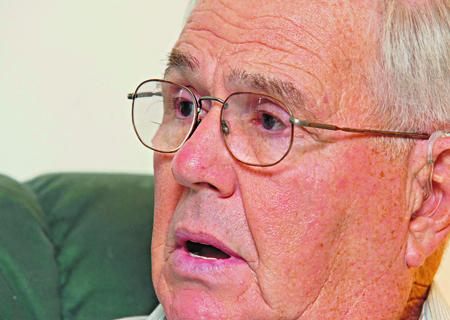
The idea is to make the confusing process of seeking aid more accessible, as well as to reach out to individuals who do not know what programs can help them, said Russ Simpson of Parents of Murdered Children.

Simpson and his wife, Pat, lost two of their four children to murder.

Russ Simpson

“In this field, everyone is protecting their little piece of the pie; we want to put down that line, like, ‘I have to protect my program, you have to protect yours,’” said Lynn Carder, program coordinator with the Victim Witness Assistance Program through the prosecutor’s office. “But the bottom line is that we have to provide services to the victims and when you gather everybody together, you’re much more likely to find someone that can help.”

By forming a coalition, the groups can guide more traffic to programs that are underutilized. Simpson said  a lot of people are unaware that they might qualify for state funding to cover funeral expenses after a homicide. Or they might not realize that the government runs a victim notification program that tracks a perpetrator’s movements through the different steps of the legal processes. VINE alerts the victim when that perpetrator moves to different facilities or is up for parole, among other actions.

“So many people fall through the cracks,” Simpson said.

Falling through the cracks is easy if there are no formal charges made or if the victim’s aggressor is not indicted by a grand jury, never found or if the crime is a misdemeanor. Victims in these situations don’t end up in the system that puts them in touch with Carder’s program, so she is unable to educate them about their options, she said.

Events like Survivor Night helps to fill those cracks.

“Come on down and ask for services. It doesn’t make any difference whether the crime happened 15 years ago — there are people out there who haven’t seen help for 10 years,” Simpson said.

Cindy Dugan lost her son nearly four years ago. Matthew, known as a gentle and loving jokester with a deep, contagious laugh, was shot in 2008 at a BP station in Toledo. He was the store clerk at the time.

Her son’s killer Anthony Belton was sentenced to death this month.

Dugan uses VINE to easily track developments surrounding the convicted man. She also had the help of victim advocates during the trial.

“It would have been a lot more frightening without that and I don’t think I would have been able to carry on for as long as I did,” she said. “I would have felt very overwhelmed and very lost in the whole process.”

Victims’ Rights Survivor Night attempts to reach out to those who haven’t reported their crimes. She said she understands why people are intimidated by the justice system.

“All I can say is for people to be patient and strong,” she said. “It’s endurance — one day at a time. That’s the way we did it. We thought, ‘Oh, this would be the last day we go to court month after month after year after year.”

Woodberry: The facts about who saved Scott High School

0

“Just the facts, ma’am.”

— Joe Friday, “Dragnet” 1951–59

— Warren Woodberry,

Scott High School, class of 1956

Those on the March 17 tour of the newly renovated, nearly 100-year-old Scott High School witnessed a reminder of how history can be left out or altered. The new principal of Scott began by asking those present, starting with the class of 1940, to raise their hand. Before they could be acknowledged, a voice rang out from the side of the room with the following question: “What about the class of 1930?”  The voice belonged to Martin, the son of 93-year-old Doris Sing Hedler, who was in the class of 1936. Ms. Hedler was in the honor society and was the baccalaureate chairperson for 1936. When I interviewed her she described how the old school looked in her day and how thrilled she was that it was renovated, not torn down.

Here are some economic costs for 1936:

  • Average cost of new house: $3,925.
  • Average wages per year: $1,713.
  • Cost of a gallon of gas: 10 cents.
  • Average cost for renting a house: $24 per month
  • One loaf of bread: 8 cents.
  • One pound of hamburger meat: 12 cents.
  • Studebaker car: $665.
  • Ladies Swimsuit: $6.95.

Just as Ms. Hedler was almost overlooked before her son spoke out, it is important to speak out and acknowledge those who really led the fight to save Scott High School from the wrecking ball. It was brought to my attention that in various newspaper articles and statements, Scott alumni are often given the back seat or not mentioned at all in the history of the fight to save Scott. The members of the Scott Alumni Association, under former president Robert Davis and spurred by Coach Ben Williams, began the fight to save Scott from the wrecking ball. Others, including the Old West End Association and Save Our Scott, came on board at a later date and played an equal role in strengthening the Scott alumni fight to save the school. It was not house parties that saved Scott. It was attendance at meeting after meeting and constant correspondence and appeals to the Toledo Public Schools Board of Education, the mainstream media, the Ohio State Facility Commission, Joyce Barrett of Heritage Ohio, and many other supporters, politicians and Scott alumni.

Credit must be given to The Toledo Journal and its education writer, Bob Stiegel, who wrote stories while some other papers were negative about the value of saving Scott and those who fought this battle. Also, the role of former TPS board member Darlene Fisher can never be diminished in the eyes of the those who fought, as she was there from Day One. Although her name, and many others, are completely absent from some articles about who saved Scott High School, those involved know the valuable role she played. People have a right to their opinions of who saved Scott High School but they do not have a right to ignore the leadership of the Scott Alumni Association.

A little history: Once, the Ohio State Facility Commissioner, Michael Shoemaker, received letters from members of the Scott Alumni Association (all of which I have archived) concerning their efforts to save Scott. A visit was arranged through TPS for him to visit Scott. After the building inspection, Mr. Shoemaker declared the building sound and strong, and stated that his commission would allow for renovation if the additional funds could be found.

The TPS board, under then-president Steve Steel, the Scott Alumni Association under president Robert Davis, and the public united behind the levy, which resulted in the $42 million renovation of Scott High School. Saving Scott resulted in saving the oldest high school in Toledo, recognition by historic preservationists throughout the United States, and the tradition of the nearly 100-year-old school was allowed to continue into history. Now the family legacy can continue. Also making history is Treva Jeffries, Scott’s first African-American principal, which would not have happened without the struggle waged by the Scott Alumni Association. Like the “Trail of Tears,” there are two sides or more to every story, but the fact of who lead the fight to save Scott only has one side and that story can be found in the body of this column.

On March 13, Toledo City Council recognized members of the Scott Alumni Association and its supporters who fought to save Scott by issuing a proclamation by City Councilman Tyrone Riley, a  member of the Scott Alumni Association.

“Once a Bulldog — Always a Bulldog.”

“Just the facts, ma’am.”

Warren Woodberry is a community activist and Scott High School alumnus.

Historic-themed dinner set for Vistula House

0

Toledo’s Vistula District is inviting you to take a step back in time for a dinner party.

Set in the dining room of the 1865 Vistula house, the feast will be served surrounded by decor representative of the Victorian era. Among 14 course options, highlights will include teriyaki-style salmon with rice pilaf, a filet of beef with mushroom demi-glace and Cornish game hen a l’orange.

The house will host three dinners, all starting at 6 p.m., April 26-28, 2012. Ten people can attend each evening. Tickets cost $100 a person and can be reserved by calling (419) 389-3452.

Proceeds will go to the Historic Vistula Foundation, a nonprofit that aims to preserve historical properties.

The Vistula District predates Toledo’s incorporation and includes large homes, smaller dwellings, corner stores and ethnic churches.

Miller: Carrie Fisher: Self-acceptance run wild

0

As Princess Leia in “Star Wars,” actress Carrie Fisher inspired galaxy-shaking visions in millions of young men. As an author, Fisher inspired a generation of young women with her insightful prose about love and life. As a wife (and ex-wife) she inspired lyrics in some of Paul Simon’s most affecting songs. As a drug addict with bipolar disorder, Fisher inspired legions of fellow sufferers with her direct, raw testimony.

The many sides of Carrie Fisher, 56, coalesce in her one-woman stage show, “Wishful Drinking,” playing through April 22 at the Victoria Theatre in Dayton, Ohio. During the show, she gleefully takes the audience through her Hollywood childhood with parents Debbie Reynolds and Eddie Fisher, her explosive “Star Wars” fame, its toll on her relationships and her struggles with drug use and mental illness (“I’m a Pez dispenser and I’m in the textbook of Abnormal Psychology,” she enthuses).

During an April 12 interview on the stage set for “Wishful Drinking,” which replicates her Los Angeles home, Fisher was as direct and open as her onstage persona.

Toledo Free Press: Ricky Gervais was on CBS this morning and he made a comment that humor is an evolutionary tool to help us deal with ‘stuff.’ That really resonated after seeing your show last night.

Carrie Fisher: It’s the best alchemy you can do, to take something that’s really not funny and make it funny. That takes time and it takes a certain slant.

TFP: Watching the show last night, I couldn’t decide if what you were doing was courageous or self-loathing or a mix of the two.

CF: No self loathing.

TFP: It’s some raw, brutal stuff that you are putting out there for people to digest.

CF: Like what ?
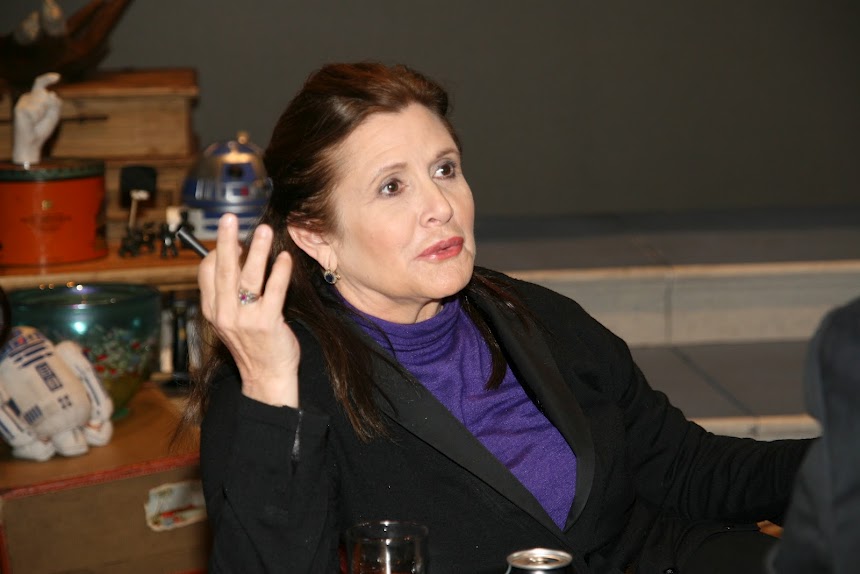
Carrie Fisher, photographed April 12 by David Panian

TFP: Like the electric shock therapy experiences, talking about the drug use, the suicidal feelings, the parental issues; those are things that people usually do on couches with the doors closed. You’ve put it out there and it has to be punishing to relive night after night.

CF: I have processed a lot of it. I’m not really ashamed of it. Most of it though, me being in a mental hospital, me being in a rehab, that was out there so I just put my version of it out there.

TFP: With the electric convulsive therapy (ECT) effect on your memory, is your mom still making the scrapbooks and the photo albums to help your memory?

CF: Actually it is only short-term memory that goes. Long term I am really good at it, unfortunately. Or, I am as good at it as someone my age would be. You don’t know how much of your memory has been affected by age or drug use. It’s like I say, E-C-T, L-S-D or A-G-E. Those are your three choices.

TFP: I wanted to ask you about a couple of your movies, the first one being “When Harry Met Sally.” What a tight movie that is with the back-and-forth dialogue. You worked with Billy Crystal, Meg Ryan and Rob Reiner all at the top of their games. Were there a lot of rehearsals to master the script?

CF: Well, like you said, it was people at the top of their game, people who know what they are doing and they have done a lot of it. The dialogue it was really well written and anything that is well written, you are not going to have a problem with it. If you get a certain type of actor and they are well-cast they are going to be able to embellish on it a little bit if that is allowed.

The one scene that was very difficult was the four-way scene we did on the phone. We did that in real time. They were all gathered in sets on the other side of the stage and Bruno [Kirby] and I were on one side. They shot it 50-some times and after the 50th time Bruno said, “I want another one.” And I said. “You will be doing that one on your own.”

TFP: As a writer, how critical are you when someone sends you a script to read? Can you just read it and enjoy it or are you wanting to move commas around and make revisions?

CF: I can both read it and enjoy it and want to move commas around. If you see something that is kind of derivative, you know. Sometimes it can make you kind of sorry that they didn’t do anything braver but I also know as a writer how difficult that is, so it’s nice to be in the comfort zone of what is expected.

TFP: “The Blues Brothers.” Working with John Belushi and Dan Aykroyd had to be wild.

CF: Everybody was high. Especially John. I was 21 years old and I wasn’t really off and running with the drugs yet but that was a fertile environment for that kind of behavior.

TFP: Was it clear then that John had a problem or was it just part of the party at the time?

CF: It was clear he had a problem and he involved me. He said, “You and I are alike.” John was like, if it was there, he wanted it. If you could eat it, f**k it, snort it or shoot it John wanted it. That’s not really a good motto. That’s going to end up badly.

TFP: Did his comparing himself to you resonate with you at the time of his death?

CF: No it didn’t resonate with me, it scared the s**t out of me. I knew he wasn’t wrong. I actually spent a night with John and it was horrible. He started drinking sake and he was knocking things over and by the end of the night, he disappears and there was someone that he ended up doing coke with. I have always stayed so pissed at that person. He came back to me and he said, “I did coke.” And I said, “John, we can leave right now.” He just looked at me for a minute and said, “No.”

TFP: Your next movie is “It’s Christmas, Carol!” That’s your first holiday project since the “Star Wars Holiday Special.”

CF: If you go back and look at that it’s not so bad that it’s funny, it’s so bad that it’s boring.

TFP: Did you and Mark Hamill and Harrison Ford have an obligation to George Lucas to do the special?

CF: We would have signed on to do anything with him. But it did seem bad at the time.

TFP: The other thing that came out about that time was the Ringo Starr TV special where he had a look-alike and you were the love interest confused by the two Ringos.

CF: I have no recollection of that.

TFP: It wasn’t great, either.

CF: It sounds awful.

TFP: It is an interesting part of the show when you talk about the songs Paul Simon wrote about you. Are you Charlie the Archangel from the song “Crazy Love Vol. II” on “Graceland,” with the lyrics, “Fat Charlie the Archangel files for divorce?”

CF: No, that’s Lorne Michaels. I was from the title song, “She’s come back to tell me she’s gone/As if I didn’t know that, as if I didn’t know my own bed/As if I’d never noticed the way she brushed her hair from her forehead.” I feel privileged to be in one of his songs and certainly if the choice was, “Would you read one of my books or listen to one of his songs?” I would listen to him.

TFP: Did you do that a lot, brush your hair from your forehead?”

CF: (Brushing her hair from her forehead) Yes, just like that. I still do it if it’s down.

TFP: You have two iconic images in pop culture, the doughnut-braid hair and the metal bikini. What would the trifecta be? What would be the one additional thing that you would like to put in the Smithsonian to fill out the shelf?

CF: Probably the image [from the “Wishful Drinking” book cover] with me looking down, the stoned Princess Leia.

TFP: Are you looking forward to seeing yourself on the big screen in 3-D when the original trilogy comes out in 3-D?

CF: I am looking forward to doing that. Hyperspace should look cool in 3-D.

TFP: If I were to go to your house would I find “Star Wars” everywhere?

CF: Yes, you have to look but you would find it. It’s not obvious, except for one thing. On my birthday, George Lucas sent me a painting of me as Princess Leia in a metal bikini. I am sure it’s regifting. Someone gave him that and he was wondering, “Why is that in my house?” so I have it in my backroom now. And I am confused as to what I should ultimately do with it.

TFP: You mentioned that George Lucas came to see your show. Did you hold back on the jokes about him?

CF: Oh, no, I was worse. I’ve been making fun of that man forever. He invites it; he doesn’t talk a lot.

TFP: Your Democratic politics come through pretty strong in the show. Are you a big Obama supporter?

CF: I love Obama.

TFP: Have you taken any heat for getting into the politics? That is a different arena from the personal stuff, when you talk about Dick Cheney.

CF: I can’t imagine that Cheney is popular. Who donated that heart? He didn’t know where it was going to.

TFP: What is your next writing project?

CF: I am trying to adapt an earlier book of mine but I want to try to write something that has absolutely nothing to do with me. Fiction, I hope.

TFP: Thank you for your time.

CF: Thanks for coming and wondering if I have self-loathing.

TFP: That’s a fair question.

CF: Is it? I’ve never been asked that.

TFP: As I said, the things you choose to relive publicly seem to be as punishing as they are therapeutic.

CF: If I had self-loathing I wouldn’t talk about it. I make fun of it but it’s not self-loathing. It’s self-acceptance run wild.

Michael S. Miller is editor in chief of Toledo Free Press and Toledo Free Press Star. Email him at [email protected].


Victoria Theatre Association offers a special discount for fans of Carrie Fisher in Toledo.  For 35% off any performance of WISHFUL DRINKING STARRING CARRIE FISHER. Go to www.ticketcenterstage.com and use coupon code BUNS at checkout.


Food and beverage director bring world experience and passion for service to Hollywood Casino Toledo

0
Marc Guastella brought worldwide experience running restaurants to the Hollywood Casino Toledo. Toledo Free Press photo by Joseph Herr.

Marc Guastella has managed restaurants at some of the world’s finest hotels and resorts, including the Mandarin Oriental in London, The Peninsula in Chicago and the Bellagio, MGM Grand and Mandalay Bay in Las Vegas.

Most recently he was director of operations for celebrity chef Michael Mina’s high-end restaurant empire.

Now the 32-year-old South African is bringing his skill and passion for fine-dining service to Hollywood Casino Toledo, where he will manage dining operations as director of food and beverage.

“I was contacted for the opportunity and when I came out here and met with the executive team and all the people who were on board at the time, it just looked like an incredible opportunity,” Guastella said. “The company’s vision, where it’s going, its expansion, just the quality of product is something really special. I thought it would be great to be a part of.”


Guastella’ss family — wife Kathryn, son Michael, 3, and daughter Bailey, 1 — moved to Maumee from Las Vegas in December.
“It’s really nice. It’s a great place to raise kids and it looks like there will be great opportunities to do things in the summertime, which we’re kind of experiencing now,” Guastella said.

“My wife is originally from the Midwest, Grand Rapids, Mich., so she’s really happy.”

Passion and drive
Casino General Manager Richard St. Jean said he was pleased to recruit a food and beverage director of Guastella’s caliber.
“Marc’s passion and drive for the restaurant and hospitality industry has led him on an international career working alongside some of the world’s most knowledgeable and celebrated chefs,” St. Jean wrote in an email to Toledo Free Press.

“I expect that his experience in presentation and service will exceed our guests expectations as he introduces his standards of quality and detail to our guests.”

Guastella was born in Johannesburg, South Africa, and grew up in Cape Town. He started his restaurant career shortly after high school, working as a server at The Cape Grace, one of South Africa’s leading hotels. He later moved to London and then the United States, quickly rising through the restaurant management ranks to general manager.

In 2010, he joined the corporate team at Mina Group, where he oversaw all the Mina restaurants and reported directly to Mina. At the time, there were six restaurants, including BOURBON STEAK and SALTWATER at the MGM Grand Detroit. By the time he left, there were about 20 eateries.

Guastella was also part of the group that came to Detroit in 2007 to help open the two
MGM Grand restaurants.

Guastella said he loved working with Mina Group, but decided to pursue the Toledo job because of his wife and children.

“I was on the road a lot and this just gives an opportunity with my two little ones to kind of settle down in that respect,” Guastella said.

“There’s absolutely no animosity there. I have the utmost respect for Michael, his company and his success. It’s a great organization.

“Michael’s a phenomenal person. He’s just unbelievably passionate about what he does. He cares deeply about everybody that works in his organization and fosters their development. He’s an incredible person, an incredible culinarian and an unbelievable restaurateur, hence his success.”

Guastella said the most important lesson he took from Mina Group is its emphasis on unforgettable service.

“There’s a lot of good restaurants, but there’s very few great restaurants,” Guastella said. “It’s an organization that fosters that unbelievable attention to detail and that’s what’s made him a success.”

Four dining options

Hollywood Casino Toledo, slated to open in May, will offer four dining options: Final Cut Steak and Seafood, the Skybox Sports Bar, Epic Buffet and Take 2 Grill.

“This restaurant [Final Cut] is really going to stand head and shoulders above the competition, and the same thing for the sports bar, the buffet and the grill too,” Guastella said. “We really want every single niche we have to stand apart and for people to want to come back.”

Guastella has ambitious goals for the venue, particularly Final Cut, which he hopes can earn a Forbes four-star rating. The designation is rare; there are no Forbes four-star
restaurants in Ohio and only one in Michigan — BOURBON STEAK at MGM Grand Detroit.

“The goal is to be the benchmark of service, not only in Toledo but in Ohio and really just be the finest restaurant out there,” Guastella said. “We want to be known as a destination. I want going for a great steak to be synonymous with coming to Final Cut, to get into people’s minds that there’s no alternative, for them to say, ‘This is where we go when it’s a special occasion,’ because the service is going to be amazing, the food is going to be amazing and the experience overall is going to be unforgettable.”

Final Cut, which will feature prime beef and seafood dishes, will be luxurious, but not pretentious, Guastella said.

“It will be an atmosphere where you are completely taken care of from the time you arrive until the time you leave,” Guastella said. “Just an overall luxurious experience from start to finish, but at the same time not at all stuffy. A lot of the time, restaurants that are high-end have a very stuffy label to them. We want guests to feel at ease and just enjoy their experience; we don’t want to intimidate them at all. Partnering great food and great atmosphere is a winning formula.”

One of Guastella’s favorite parts of his job is seeing customers satisfied.

“When somebody comes to a restaurant like this for a special occasion, the satisfaction you get for just blowing them away, where they leave and say, ‘You know what? That was
the best dining experience of my life,’ is incredible,” Guastella said. “There’s not many jobs on a day-to-day basis where you can say you can achieve that and really impact somebody’s life positively every day.” ✯

For more information, visit www.hollywoodcasinotoledo.com

Letters to the editor: April 22, 2012

0

A Titanic thank-you

TO THE EDITOR,
We at the Greater Toledo Area Chapter of the American Red Cross wish to thank Toledo Free Press, not only for making us the beneficiary of the April 14 Titanic-themed “A
Night To Remember” dinner and ball, but also for the time and effort that was put into ensuring attendees had an evening that felt more like an experience than an event.

Planning an evening like “A Night to Remember” is difficult work. It is especially complicated when guided by a theme. Every decision in the process, from the venue and entertainment to the napkin colors and parking arrangements, has to be scrutinized.

Everyone who had a hand in planning the evening should be proud of its flawless execution as the musicians were excellent, the setting was perfect, the silent auction items were intriguing, and most importantly, guests had a
wonderful time.

We are beyond grateful that all of this work was done on our behalf. The money raised from the evening will go toward our local programs and services.

Helping families get back on their feet in the wake of a disaster, educating the public on preparedness, connecting military families, and the rest of the services we provide to our community. We follow through on our mission only by the generosity you’ve demonstrated.

For that, we thank you.

Sincerely,
TIM YENRICK
Regional CEO
American Red Cross

Pounds: Mike moves on

0

Mike Karabin has retired after 32 years with the University of Toledo athletic department, most recently serving as the university’s deputy athletic director.

Karabin is one of those people who seems to know everybody; I have known him and considered him a friend for 13 years.
He was a fixture in the athletic department and was responsible for many of the additions on campus. He is a terrific fundraiser and the evidence is in the structures he has contributed to. He was a major force behind the $20 million expansion of the
Glass Bowl.

He is also credited with the Larimer Athletic Complex as well as the Findlay
Building. Most recently he was an important mover behind the renovation of Savage Arena.
I was one of those who thought renovating Savage Arena was crazy, but I was wrong. It is no one of the premier structures in the MAC.

Karabin will always have these great accomplishments as part of his legacy at UT.

Karabin was also behind some of the scheduling that has brought us great games such as University of Pittsburgh (one of the greatest UT victories ever, against then-No. 9 Pitt), Boise State, Navy, Syracuse and Purdue.

He also brought the games to ESPN. I believe that is one of the main reasons UT’s football program is at or near the top of the MAC every year.

Karabin played baseball at UT, where he won the MAC batting title his senior year, the first ever at the college to win the batting title. He hit .419 that year, which is fifth best of all time at UT. He then played for the Chicago Cubs organization for two years and later returned to UT as a coach.

He was the head baseball coach for one season in 1982, leading the Rockets to a second-place finish in the MAC.

Karabin was honored with induction into the Varsity “T” Hall of Fame in 2007.
It is hard to see good people leave and very seldom do they leave with this kind of legacy. He is a good man and a good father.

I will miss him at the university and wish him well, but even at 55 years young, I am sure Karabin is not done. I am sure he will do something after his career at UT — we can only hope it is here in Toledo.

Good luck, Mike!


Thomas F. Pounds is president and publisher of Toledo Free Press and Toledo Free Press Star.

Local producer lends expertise to ‘Holiday Wishes 2’

0
Christopher Stoll, owner of Audioflare Recording Studio (formerly Zeta Recording) has 30 years of recording and education experience on his résumé. Toledo Free Press photo by Joseph Herr

When “Holiday Wishes 2” makes it into the hands of people throughout Northwest Ohio this holiday season, there is likely to be a lot of —justified — praise directed at the artists who contributed their voices, passion and time to the CD project benefiting Make-A-Wish Foundation.

But often the accolades go only toward the most visible individuals involved in the project even though there are scores of people behind the scenes without whom “Holiday Wishes 2” would not be possible.

Many listeners may not have heard of one of the most important figures involved in the recording of this year’s album. His name is Christopher Stoll and he is an engineer at Audioflare Productions. Out of his Holland studio, Stoll produced more than one-third of the 44 tracks that make up “Holiday Wishes 2.”

“I am pretty lucky, because the studio that I’m at now, it is big and perfectly suited for music,” Stoll said. “I can pretty quickly get a lot of good sounds from a lot of acoustic-type music. That’s why I record a lot of bands here, and artists like that.”


Christopher Stoll

Stoll’s expertise was pushed to the limit during this year’s recording process, though. Among the 17 tracks he supervised, he oversaw

recordings of everything from soulful ballads to Irish folk to a 50-member choir. It’s a remarkable variety of music — and Stoll wouldn’t have it any other way.

“Well, the good news is, for me, that’s what I love. I mean, I love the differences and all the different styles. And, for me, that’s where my creative juices start flowing and I even get more excited about having all these different things, all the different genres,” Stoll said. “And then you have to get all of that to sort of … fit together, too. That’s even harder.

“I can do 15 individual — or 17 or 18 — different songs; it’s not all that hard. But then you have to fit all those together.”

The skills needed to find that balance come from nearly a quarter century in music, starting during his days as an undergrad at the University of Toledo.

“I started in computer science engineering, but I shifted to music after my first year, finding more love of the music world,” Stoll said.

“I eventually just started taking a bunch of music classes, and at that time they actually had a class just called Electronic Music. Which I really didn’t have any idea what that was, but I decided, ‘Well, I’ll sign up for it.’ … And then, basically, you find out that you start doing these weird things with tape decks and old synthesizers and tape delays, and that was basically how it all started.”

After obtaining his master’s degree from Bowling Green State University, Stoll was hired by a studio named Audio Matrix in Downtown Toledo, a move that more firmly set him on the path of production.

The company had an audio sampler, which was a rarity at the time, used primarily to sample sounds for commercial purposes. But Stoll found it — and himself — pressed into service in new ways as time moved on.

“A lot of rappers were interested in that, and I didn’t figure that out until later, but we ended up doing lots of rap music, because most everyone would just bring in records and we would just sample beats and sample different songs,” he said.

Today, of course, recording, sampling and mixing are far less complicated than they were when Stoll first started in the mid-1980s.

“Technology just keeps chugging along, too, so faster computers and better plug-ins and that type of stuff has really made my job easier,” Stoll said. “I love working on a computer as opposed to the old reel-to-reel, which was always a hassle.”

Of course, technological advances don’t mean the work is easy. Stoll estimates he put 15-17 hours of work into each track he participated in for “Holiday Wishes 2.” He’s been involved with the project since last year’s inaugural project, “Holiday Wishes.”

“The deadline part is the hardest part. Anytime you have a deadline, it can crush you, and it kind of hurts creativity a little bit,” Stoll said. “I mean, sometimes it doesn’t, but that can kind of be the pressure, you know?

“I like having more time to do things, make sure I don’t screw up.”

Few who will enjoy Stoll’s masterful work on “Holiday Wishes 2” would claim he screwed up, however.

To him, it’s just using his own gifts to give back — the true spirit of the season.

“It’s really just impossible not to give it your all and make it the best you can because you know what the benefit is of the whole thing,” he said.

Pounds: Titanic echoes

0

Some moments in history imprint themselves on our collective psyche so strongly that the echoes cut through decades, generations and time like an ocean liner cutting through calm seas.

The April 15, 1912, sinking of Titanic after it struck an iceberg is clearly one of those events. The luxury liner, known as the Ship of Dreams, has rested on the bottom of the Atlantic Ocean for exactly 100 years, but it continues to fascinate us, through novels, films and documentaries.

Locally, several people had direct connections to Titanic.

William Harbeck was a deputy sheriff of Lucas County  who was on the great liner as a filmmaker, capturing the maiden voyage on reels of film that were lost in the disaster.

Henry Michael Mitchell had a sister-in-law in Toledo, named Anna Jeffrey. On his way to visit her, a coal strike changed his travel arrangements and he died on Titanic.

The Vanderplancke family was traveling from Belgium to work on a Fremont beet farm. All four family members were lost.

Martha Kuskie, a maid at the Madison Hotel in Downtown Toledo, came here from Hungary and was waiting for Titanic to deliver her fiancé, John Andonis. He never arrived.

There are other connections, from a survivor who died in nearby Adrian, Mich., to a local man whose grandmother died on the ship. Those stories and many others are told in this special issue, which collects well-known stories and reveals many new ones.

As part of the observation of the anniversary, there are displays at libraries in Toledo and Perrysburg, the national touring artifact exhibit at the Henry Ford Museum in Dearborn, the film “Titanic 3D” at Rave Motion Pictures theaters and our Red Cross dinner, which re-created a dining and ballroom experience.

The images and legends of Titanic continue to hold our imaginations. As we move into the second century since the wreck, let us hope its twin lessons of hubris and heroism prevail in our thoughts and actions.

Thomas F. Pounds is president and publisher of Toledo Free Press and Toledo Free Press Star.

Miller: Ballard explores beyond Titanic

0
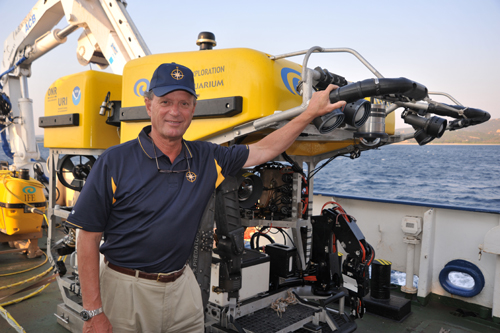
Deep-sea explorer Robert Ballard. Photo courtesy seasearch.com

One is a legendary explorer who now works in films. The other is a legendary filmmaker who now explores. Robert Ballard and James Cameron are woven into Titanic history, deep-sea exploration lore and each other’s lives.

Ballard is a marine biologist whose discoveries include such shipwrecks as the German battleship Bismarck, the USS Yorktown, John Kennedy’s PT-109 and most famously, Titanic. He has also discovered hot air vents 9,000 feet under the Pacific Ocean near the Galapagos Islands and helped develop the technology that allows deep-sea exploration without risk to human divers. He is also a documentary filmmaker, working on series and specials with National Geographic.


His friend Cameron is also known for developing technology, employing special effects advances on the world’s two highest-grossing films, “Avatar” ($2.8 billion worldwide) and “Titanic” ($1.9 billion worldwide  and counting with its current 3-D release). Cameron’s underwater explorations include visits to the Titanic wreck site and a recent one-man dive nearly seven miles deep into the Mariana Trench.

During a March 26 telephone interview, Ballard discussed Cameron, Titanic and how technology impacts deep-sea exploration.

Toledo Free Press: It’s interesting to speak to you just hours after your friend James Cameron made his dive to the Mariana Trench. Were you involved in that expedition?

Robert Ballard: He is an amazing guy. I just flew in from London so I have not seen any footage, but I have been well aware of the expedition. We are good friends, and we have been communicating about it for quite a while. We all know one another. It’s a big ocean and there is plenty of room for a lot of us.

TFP: How long have you collaborated with Cameron?

Ballard: Jim and I have been friends for a long, long time. He contacted me shortly after I found Titanic. He came and visited me and I helped plot his strategy. During the filming of “Titanic” he would call me. Remember, when the movie starts, the ship has already been found.

He was mostly interested in footage I had taken, how I got into the ship, because he wanted to film in it as well. It’s always been a close association. He invited me to the premiere in 1997 and we’ve remained good friends.

TFP: You have very strong feelings about preserving Titanic. When Cameron first contacted you, did you have misgivings?

Ballard: He shared my views on not taking things from Titanic. We shared the same philosophy and we collaborated. He just lent me some of his powerful lights for my next expedition.

Robert Ballard

TFP: There is an explorer in Cameron’s film named Bobby who resembles you. Will you see the new 3-D version of “Titanic”?

Ballard: Of course, I’m excited to see the 3-D version. I shoot in 3-D, so I am familiar with the technology.

TFP: What 100th anniversary observances are you involved in?

Ballard: We have quite a number of projects. There’s a cover story in the current issue of National Geographic, television shows about Titanic, an exhibit at Mystic Aquarium here in Connecticut and a huge project in Belfast, Ireland, we’ve been working on for four years — Titanic Belfast’s Ocean Exploration Centre — which will help enthuse people about our oceans. There will be a lot of activity, then we’ll move on.

TFP: You had relationships with some of Titanic’s survivors. Your choice to explore the ship but not take anything from it must have encouraged a bond.

Ballard: I knew a number of survivors, Eva Hart [who died in 1996] in particular. All the survivors, all the families who lost relatives, all felt the ship should be left alone. The Smithsonian felt it should be left alone, the British Museum felt it should be left alone, all of the people closely associated with the Titanic felt it should not be desecrated.

TFP: Your list of discoveries is legendary, but Titanic is your best-known find. When you discovered the wreck site, you could not have known how big a role Titanic would play in your life.

Ballard: When I first started looking for Titanic, I wasn’t that emotionally attached to it but when I found it the ballgame changed. The most important discovery was finding where the humans landed. Titanic sank fairly quickly, but hundreds of people went over without life jackets, succumbed to hypothermia and fell to the ocean floor. Their bodies were eaten by the animals, their bones dissolved, but their shoes are left there as their tombstones.

So all over the debris field you have pairs of shoes, and those are very powerful images. Titanic spoke to me.

TFP: We know now that your search for Titanic was almost a cover operation for a U.S. Navy project.

Ballard: Titanic gave me an opportunity to take some missions that were classified at the time. They dealt with finding two nuclear submarines that we lost during the Cold War, the Thresher and the Scorpion. We did not want the Soviet Union to know where those submarines were, so Titanic provided a convenient distraction while we found the submarines.

TFP: Very few people will ever experience a deep-sea dive on the scale you have made. How do you excite people about such exploration?

Ballard: It’s clearly like going to another planet. Most of our planet is covered by deep water, not meant for humans to live in; we can only make short visits. But there are tremendous resources and knowledge to be gained. That is why we go.

We may never live in the deep sea but we will most certainly one day move onto the ocean’s surface; we’re doing that now as thousands of people live on oil platforms. I see a day when more people will live on the ocean.

TFP: How has technology affected the adventurous elements of exploration?

Ballard: More and more often we’re using robots; I don’t physically go like I used to. I am more interested now in exploring and learning than I am in the experience of diving. It’s sort of like, I like horseback riding, but I don’t ride the horses to work. I’m looking at the most efficient way of doing it. I can do most of the robotic operations from land; I don’t even have to go to the sites. What I learn is more important than how I learn it.

TFP: With the adventures and dangers you have faced, do you find a hard time putting in an average day? After you’ve been two miles under the ocean surface, how do you approach a normal day in everyday life?

Ballard: It’s no different. My community is very nice and quiet; I was just at the store buying my salad for lunch, and no one treats me differently. I put my pants on one leg at a time, just like everyone else.

Michael S. Miller is editor in chief of Toledo Free Press and Toledo Free Press Star.