Home Blog Page 280

Interfaith Blood Drive ‘postponed indefinitely’ amid strike concerns

0
Devorah Shulamit -- photo by Shena Kaye

Devorah Shulamit never thought she’d see the day when an event celebrating life would become what she says is just one of many casualties of a workers’ strike.

As founder and chairwoman of the Interfaith Blood Drive, Shulamit has spent the past 12 months preparing for the organization’s 25th anniversary blood drive. The Interfaith board hoped to collect 300 useable units of blood during the two-day event, in preparation for the July 4 holiday weekend. The drive also serves as a spiritual celebration of unity among people of all faiths.

Those preparations were dashed May 29, when the organization’s board of directors voted 8-1 to postpone the blood drive indefinitely, pending the outcome of the management/union conflict at the Western Lake Erie region of the American Red Cross.

The Interfaith board took the vote when the host of the event, Grace Lutheran Church, withdrew its offer to Interfaith for the use of its Monroe Stree building, until after the United Food and Commercial Workers (UFCW) Local 75 union workers’ strike against the American Red Cross was settled.

Grace Lutheran Church Pastor Holli Burkard told Interfaith board member and blood drive co-chairman Phil Meuser and Toledo Free Press that she was opposed to the blood drive for reasons of social justice.

“I recommended that we not host it,” she told Toledo Free Press. “I believe in justice for all people. There are many issues here.”

Among the issues Burkard mentioned were her concerns that employees were working for a business that she believes does not offer reasonable health care coverage, the church members’ possible opposition to not respecting the rights of union workers, and the possibility of picketing outside the church building.

Burkard said the decision not to host the event was made by the church’s governing body.

Concerns about picketing

Robert Haaf, Grace Lutheran Church’s council president, serves as the chairman for the church’s governing body. Haaf said the 18-member governing body, elected to three-year rotating terms, “acted on behalf of the congregation.” He said he could not remember the result of the vote and could not provide that tally “because the minutes of that meeting have not yet been accepted.” He did say the vote was not unanimous.

Haaf echoed some of the same issues his pastor, cited, including concerns that there may be picketing in front of the church, an event he said “no one ever wants to see at their church.” He also expressed concerns about safety of the volunteers and donors because “there have been national media reports in the past where people who picket and people who cross the picket line end up in a physical confrontation, and then there are times when nothing happens at all.”

Haaf said the governing body’s ultimate concern came down to “the unknown” — not knowing what could happen if it permitted a blood drive where striking workers may picket.

Haaf said the governing body had “an awareness that Toledo has the reputation of being a pro-union city and had concerns that some church members may not be comfortable hosting an event that may lead to people being asked to cross a picket line.”

Haaf did not say whether the governing body discussed any of the social justice issues his pastor raised.

Disappointment, sadness

Interfaith board members expressed disappointment and sadness over the decision, the timing of the decision and the reasons they were given for the decision. Grace Lutheran Church has hosted the Interfaith Blood Drive for 20 consecutive years, and the Interfaith board had been given a verbal commitment for its continued use in 2012 just 12 months earlier. It was not informed of the withdrawal of that permission until May 15, five weeks before the June 23-24 event.

Despite their frustration with Grace Lutheran’s decision, Interfaith board members Evelyn and Hindol Ghatak stressed their appreciation for the church’s pastor.

“We all agree that Pastor Holli has been very graceful,” Hindol said. “We live in a democracy. And obviously, their congregation, the board, has decided they don’t feel comfortable doing it now. And I think that this is their prerogative. Over the years, they have been very, very nice, and they have been very generous.”

Evelyn agrees.

“Grace Lutheran, in the community, is awesome,” she said. “They’re very, very, very open to anything. They’re always very accommodating.”

Not all Interfaith board members were as supportive or understanding of Grace Lutheran’s decision as the Ghataks.

When the blood drive board learned of the loss of Grace Lutheran as its host, Shulamit said she tried to focus on the positive and encouraged members to inquire at other area houses of worship as to the possibility of hosting the June 23-24 event. The reports of those last-minute inquiries at the May 29 meeting proved discouraging to Shulamit. Board members had contacted and had been turned down by five Toledo-area houses of worship: Epworth United Methodist Church, Hope Lutheran Church, Memorial Lutheran Church, Monroe Street United Methodist Church and Temple Shomer.

None of the clergy who rejected the Interfaith Blood Drive’s last-minute request raised the issue of socially unjust treatment of Red Cross employees. All rejections were based on logistical issues, including scheduling conflicts, the possibility of interrupting religious services, traffic issues, parking issues, room size issues and the lack of air conditioning.

Not being fair

Dale Parker, UFCW Local 75 union representative, said he was pleased to hear that the Grace Lutheran governing body rescinded its offer to host the blood drive.

“I applaud Grace Lutheran Church for standing up for what is right and just in the world,” Parker said. “The Red Cross is not being fair. They are proposing an increase by a large amount in the employees’ contribution to health care costs.”

Parker said the employee contribution is currently 15 percent, but the Red Cross is proposing a 10 percent contribution for single employees and a 20 percent contribution for a single employee plus one and/or a family going into the 2013-2014 year and beyond. Parker said employees are being asked to accept a contract that does not spell out health costs beyond just one year.

“We don’t consider it fair or just either,” he said. “We can’t sign a contract without knowing what the terms of the contract will be, and this contract is forever. We are being asked to sign a contract where we give up our right to bargain for health coverage forever. This is not just for one or two years. It’s forever.”

Bill Dudley, Director of Strategic Campaign for UFCW Local 75, said, “It doesn’t surprise me at all that faith leaders and people of faith would stand with the workers because this is a social issue. It’s an issue of economic justice and fairness.”

Dudley said the striking workers are willing to pay a little more than they have paid in the past, but are not willing to give up the right to bargain. Dudley said Red Cross management is asking its workers to give up all rights to collective bargaining forever.

“We’ve already decided that issue in Ohio,” Dudley said. “Ohio Senate Bill 5 appeared on the Ohio ballot as Issue 2 last year. It was defeated by 62 percent. Ohioans have spoken clearly that they don’t expect public sector employees to give up the right to collective bargaining.

“But that’s exactly what the Red Cross expects union workers to do.”

No compromise

Ian Thigpen, communications program manager for the Western Lake Erie Region of the American Red Cross, the region that provides blood to 18 hospitals in 10 Northwest Ohio counties and Monroe County, Mich., said the Red Cross wants the striking employees to return to work “as soon as possible” but cannot “compromise what we offer all Red Cross employees.

“We cannot offer Western Lake Erie employees something that we don’t offer Red Cross employees in other parts of the country.”

Thigpen said the American Red Cross has signed 21 union contacts across the United States since July 2011, three since the Toledo-area strike started four months ago. He said that only three unions remain on strike: those that represent workers in Cleveland, Lansing, Mich., and Toledo.

Parker disputed Thigpen’s claim that 21 unions across the nation have accepted the contract Toledo-area workers have rejected.

“They have not responded to us in good faith,” Parker said. “They say that 21 other unions across the country have accepted the same offer we won’t accept. We have asked for a list of those 21 other unions they say have accepted the offer. Although we have asked for that list, they have failed to provide it.”

Parker said the union has filed a complaint with the National Labor Relations Board, contending that Red Cross management does not provide the union with the information it requests. Dudley said a hearing to investigate the union’s accusation is tentatively scheduled for August.

Thigpen said he is personally troubled with the predicament that the Interfaith Blood Drive faces.

“I have met some of the people involved in the Interfaith Blood Drive, and they are good people,” he said. “And I am sad — and I’m confident that this is the official opinion of the Red Cross — I am sad that we could not celebrate the 25th anniversary of their blood drive with them.”

The Interfaith board issued a statement concerning the Red Cross labor/management dispute after it decided to postpone the blood drive until after the strike.

“The Interfaith board takes no sides with the management/labor dispute between the American Red Cross and its union employees. The Interfaith board’s sole goal

in life is to generate as many units of blood as possible. To do so, we need the support of the community, and, because of the strike, we do not currently have the support of the community.”
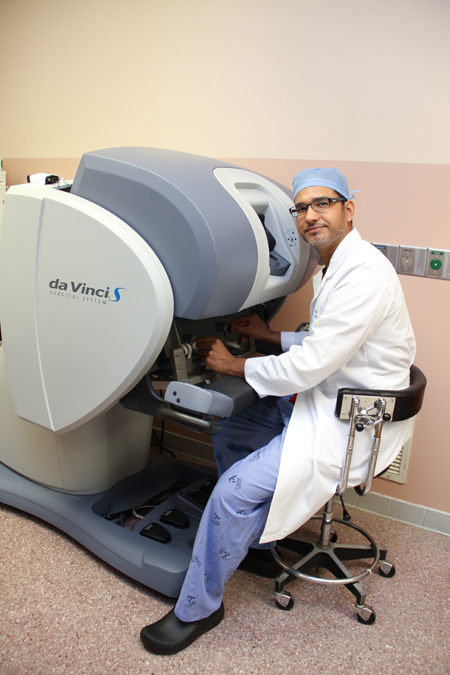

Mercy implements robotic surgery center

0
Dr. Mirza Baig, robotics director at Mercy Health, at the controls of the DaVinci SI surgical station. Photo courtesy Mercy Health Partners.

Mercy Health Partners recently opened two new surgical suites with amenities specifically for robotic surgical procedures.

The $2.5 million da Vinci Si will be used at St. Vincent Mercy Medical Center on Cherry Street along with one of Mercy’s older da Vinci models.

In 2002, Mercy was the first hospital in the area to acquire the da Vinci robotic surgical system and is now the only area hospital to use the Si, which Mercy acquired in 2009.

With the da Vinci Si, surgeons maneuver instruments at a console, while instruments at the patient-side cart perform movements in sync with the physician.

Director of Robotics Dr. Mirza Baig, who specializes in urology and pediatric urology, said the cutting-edge da Vinci Si is used for gynecology, urology, cardiovascular and some general surgical procedures.

“We’ve sort of collaborated all the specialties and took an integrated comprehensive approach to robotic surgery here,” Baig said. “When patients come, regardless of the specialty, regardless of the case, it’s a similar type of experience that they end up getting.”

Baig said this is done through a nurse navigator, who walks the patient and family through the entire process and is there before, during and after surgery. He said another is a full-time robotic supervisor who is constantly behind the scenes working with the technology and patient care.

Also, Mercy has implemented new ways for surgeons to track their results and increase their expertise.

Baig said the Si’s camera distinguishes the system in robotic surgery technology.

Director of Robotics Dr. Mirza Baig

“What’s unique about the Si is the visual acuity, the camera that it uses,” Baig said. “The optics are unmatched. It’s 3-dimensional, high definition and … it’s the clearest picture you can get.

“It’s also magnified by 10 times, so you can imagine the technology of magnification and precision you can get from these types of surgeries.”

One of the other differences between the da Vinci Si and its elder counterpart is that the da Vinci Si has two consoles, allowing two physicians to collaborate and use the system during surgery.

“We take training and medical education very seriously here,” Baig said. “I sort of equate it to driver’s education, where the teacher has the emergency brake. They’re able to switch controls back and forth.”

Baig said the No. 1 reason Mercy purchased the da Vinci Si was for its single-port technology.

“All of this is minimally invasive, all of this is through small tiny incisions, [and] now you can take it a step further and just do it through one incision,” Baig said. “Through a belly button incision you’ll get surgery without a scar, that’s the idea. That’s specific to this robot. We purchased this technology and we’ve performed the first single sight robotic surgery in town, and we’ve done several now and it’s gone well.”

Mercy is also using Firefly technology as part of the da Vinci Si. Firefly technology allows physicians to inject the patient with a dose of green dye. Normal organ tissue is colored green while tumor tissue isn’t. This allows surgeons to more precisely determine what to remove.

Baig said since the da Vinci’s implementation at Mercy almost 10 years ago, about 1,700 robotic surgeries have been performed.

“We have approximately 21-22 surgeons that are actively doing cases and others that have showed interest in learning robotic surgery, because the benefits are clear to the patients: smaller incisions, less blood loss, quicker recovery time, quicker return to work, all compared to open surgery,” Baig said.

Baig said measuring the success of the da Vinci can be misleading because of the common misconception that the robot is doing the surgery, not the surgeon. Baig is quick to clarify that the Si is a tool and cannot replace the surgeon.

“If the surgeon is capable and well trained, then the robotic surgery, compared to open surgery, is safer,” Baig said. “So the success sort of has different variables that affect it. There are many studies that were performed where the same surgeon has compared his open surgeries to his same robotic surgeries and the benefits and success have been clear.”

ProMedica acquired its first da Vinci in 2008, Director of Surgery and Endoscopy Michelle Ziegler said. ProMedica now has two da Vincis that are used for urology, gynecology and vascular surgeries.

“As we see that robotic surgery is increasing along with the need for it, we have a committee continuing to look at it and the options for the new technology,” Ziegler said.

UT offers film crew training courses this summer (2012)

0
Film crew training lab at the University of Toledo. Toledo Free Press photo by Brian Bohnert

In summer 2011, The Avengers assembled in the downtown streets of Cleveland, leaving skyscrapers destroyed and streets reduced to gravel.

But when Captain America, Iron Man, Thor and The Hulk needed a short break from the action, the feared foursome would transform back into Chris Evans, Robert Downey Jr., Chris Hemsworth and Mark Ruffalo …

… until the film crew readied the lights for the next shot.

With more big Hollywood films like “The Avengers” and “The Ides of March” rolling production trucks into the Buckeye State, the University of Toledo will offer Film Crew Training courses this summer to prepare Ohioans for growing job opportunities in the local film industry.

In a partnership with Michigan-based trade school The Center for Film Studies, UT will offer three six-week courses, each specializing in different entry-level film production jobs.

Camera and Audio Training is the first class, Grip Training is the second and Production Training is the third. Each of the six-week courses will take place on UT’s Main Campus in the Center for Performing Arts from June 25 to July 27. Students can select from sessions at 9:30 a.m. to 2 p.m. or from 5:30-10 p.m.

James Hill, chair of the Department of Theatre and Film at UT, said each course will give the participants a specific skill set that will make them valuable for when studios both large and small come looking for trained crewmembers.

“Ohio legislatures do offer tax incentives to both independent and major studios. One of the requirements is the need to employ people from Ohio,” Hill said. “So, they’re looking for experienced and well-trained crewmembers.”

The camera and audio course will focus primarily on equipment, cinematography and terminology and boom operation while the grip training will teach students how to behave on a live set. Hill said students will “learn manners and protocols” on a film set, as well as how to move scenery, furniture, cameras and any other piece of equipment used in a production.

The third course, production training, is the more advanced of the three courses. Hill said this course will deal with logistics like time management and how to set-up for a shot.

The Center for Film Studies approached UT because they wanted to branch into Ohio. Because UT has a good film program, Hill said the university decided it would try it.

While classes will be given inside UT’s Center for Performing Arts, Hill said all courses will be taught by Center for Film Studies staff.

In a news release, Betty Anzaldua, program director for UT, said the courses are very important for the area because of the rise in the number of Hollywood productions coming to Ohio.

“We look at the classes we will be offering as providing an outstanding career path in a real growth industry in Toledo and throughout our region,” Anzaldua said. “There are hundreds of jobs available in our region which graduates of our Film Crew Training classes will compete for while participating in a job that promotes our area worldwide.”

Ohio offers many tax incentives for both independent and major film productions that come to the state, with one being that the studios hire local crewmembers.

In the news release, Anzaldua estimated the beginning pay of program graduates ranges anywhere from $15 to $25 an hour.

The fee for each course is $3,650, but Hill said there are many different forms of financial assistance for those who qualify.

“You can get funding through the Workforce Development Program,” Hill said. “Financial aid is also available but you will not be going through the University of Toledo, you’ll be going through the Center for Film Studies. It may be expensive but it can pay back well in a short time.”

For more information or to sign up for UT’s Film Crew Training courses, call 1 (877) 387-1112, email [email protected] or visit www.universityoftoledofilm.com.

Pounds: Addition by subtraction

0

Downtown Toledo is growing.

That’s not an opinion; there is empirical proof on several streets. The residences, restaurants, arts activities and development announcements at the Marina District, Toledo Edison Steam Plant and elsewhere are easy-to-see evidence. The corner where Toledo Free Press is housed, where Monroe Street meets Huron Street next to Fifth Third Field, is particularly healthy. You can stand there in the shadow of one of the greatest minor league baseball stadiums in America and see Huntington Center, SeaGate Centre, restaurants such as The Blarney Irish Pub, Table Forty4, Cock ‘n’ Bull, PizzaPapalis and a new Italian restaurant. If you look far enough, you can see the Bronze Boar, Quimby’s and Grumpy’s, with Spaghetti Warehouse, Packo’s at the Park and Swan Creek Candle just out of sight around the corner.

One business that recently closed represents not a loss, but an opportunity. Marilyn’s on Monroe, an adult establishment, recently shut its doors at 715 Monroe St.

Toledo City Council, the Planning Commission and interested groups such as the Mud Hens, Destination Toledo and Downtown Toledo Improvement District should consider ways to prevent adult entertainment businesses from returning to this growing, family-friendly area of Toledo.

I understand this is contrary to Toledo Free Press’ general pro-development, leave-government-out-of-it philosophy. Everyone has a right to earn a living and the less government interference, the better.

But a sexually oriented business in the heart of an area trying to brand itself as a destination for families is a deterrent to growth and development. This is not an argument about morality; it’s a business outlook defined by the unquestionable guidelines of “location, location, location.”

Just steps from the home of the Mud Hens, a business that has been charged with everything from tax and workers’ compensation issues to solicitation, illegal drugs and alcohol handling issues detracts from the atmosphere of growth. It is not conducive to family foot traffic.

As a resident of the block, raising two small children, I am keenly aware of how visiting families perceive our corner of Downtown Toledo and the imaginary boundaries they draw in their minds as they experience Downtown.

715 Monroe St. is listed as being owned by George Stamatopoulus, who is reportedly from Illinois and does not reside in Toledo.

Toledo zoning laws state that sexually oriented business is not allowed “within 500 feet of any residential district, school (K-12), religious institution, public park, public playground, public library, pre-school, child day care, or other use established specifically for the activities of minors,” none of which apply here.

My understanding is that while Marilyn’s is closed, its permit to operate a sexually oriented business remains in effect for one year and it could reopen, as long as it meets code.

Could enough interested parties join to take over the lease and “wait out the clock” so that license expires? It seems unlikely that in this environment of renewal, the Planning Commission and City Council would want to see another such establishment take root.

The Downtown business community recently showed that it can band together, regarding intersection names, and with all due respect, that argument was about an issue with nowhere near the impact of allowing a red light business to operate in the heart of Downtown.

Yes, such businesses are legally allowed within the city and state but perhaps the city could create a sexually oriented business-free zone or establish that no sexually oriented business can operate within so many thousands of feet of a sports arena.

Trying to shut down an existing business is bad for the city. Trying to keep a closed place closed is less intrusive. It’s addition by subtraction; take away an element and watch the remaining participants benefit.

Thomas F. Pounds is president and publisher of Toledo Free Press and Toledo Free Press Star

Poland to honor Peggy Grant

0

Adam Kulach, Poland’s Minister of Foreign Affairs for Africa and the Middle East, is en route to Ohio to present a prestigious award.

Peggy Grant, art director for 20 North Gallery, will receive the “Bene Merito” Decoration ofHonor, recognizing Polish or foreign citizens for activities aimed at strengthening Poland’s position in the international arena.

Kulach will present the award to Grant at the Toledo Club June 2 at 10 a.m.

Grant has traveled the globe with her late spouse Adam Grant’s paintings, focusing particularly on Adam’s homeland of Poland. Adam grew up in Warsaw in the 1920s and ’30s and was seized by Nazis when he was 18 years old. He moved from a prison called Pawiak to Auschwitz to Mauthausen, where the typical prisoner survived about two weeks.

But Adam lived because he could paint. His Nazi captors afforded him marginally better treatment than the other prisoners because he painted portraits of them for their families or landscapes for their offices.

Peggy has devoted much of her time and attention to speaking out against prejudice and ignorance, educating people about the history of the Holocaust and educating people about Poland-U.S. relations.

After Adam died in 1992, Peggy was determined to hang Adam’s work in Poland — a place he never returned to once he moved to America. Peggy’s hard work enabled her to hang Grant’s work at the Jagiellonian University in Poland. A room in the Polish embassy in Saudi Arabia is named after Adam.

Szyperski: You see some, you miss some, you move along

0

Between games, practices and the backyard, I’ve likely watched myson play hundreds of hours of soccer over the past six years.

Being a bit of a videophile, I also like to record what I’m watching with the stark realization that we may or may not ever watch it again.

It’s actually a family tradition that has been passed down from my parents to me — hundreds of hours of recorded kids’ sporting events sitting in a box quietly awaiting an  audiencethat may or may not ever show up.

You just never know when that one special moment in time is destined to arrive, however. The sporting event I most recall from my younger days, working hard to win a tennis match that I realistically had no business winning, is unfortunately not among the hours upon hours of my youth athletic footage.

My mom became so enthralled in the action of the whole thing that she stopped recording at some point, so the magic of it will instead forever be left to memories alone. Still, even if it were sitting in my video treasure trove, would I really sift through the massive amount of non-eventful moments in time just to find it?

Today’s cyber world is different, though. Not only can I keep better track of the best and brightest highlights of my children’s athletic and other achievements, I can share them with the world within a few seconds if I so desire.

At his last regular game of this past spring soccer season, my son, Jack, added such a share-worthy highlight to his lifetime collection.

I must have had mother’s intuition about a momentous event on the horizon, as I made it a point to stop at the drugstore closest to the playing fields in order to procure the all important miniDV tapes we seem to be perpetually out of. When I saw that the cost was $17 for two of them, I made it a point to walk out of the store empty-handed.

I couldn’t help but tell myself, “How likely is it that I’m going to record something I would pay $17 to see again when I have hundreds of hours of my own recorded childhood that I don’t even bother glancing at for free?”

Less than an hour later, my 9-yearold took a cross shot from one of his teammates and headed it into the goal for the first time. From the crowd’sreaction, it was a pretty nice shot and a pretty big deal. As you can guess, I didn’t get it on tape.

The surprise, however, is that I didn’t see it happen at all. Yes, after hundreds of hours of watching him play, my son made his finest soccer maneuver to date in the 90 seconds I was crouched down looking at a photo book the team was giving his coach after the game.

In my defense, Jack wasn’t even in the game when I took my eyes off of the field, but that didn’t stop me from guiltily and defeatedly dwelling on it for days after. I spent four days in missed-moment mourning, and then I missed something else.

After 10 minutes down the street without them, my husband and I joined our three children at a small family get-together at my parents’ house.

Expecting to see smiles and hear light-hearted conversation, we walked into a room full of stunned faces and an obvious air of quiet disbelief.

“What’s going on?” I cautiously asked, assuming everyone was just talking about us behind our backs or something.

“Everything’s OK, but Jack just choked on a piece of candy and I had to give him the Heimlich maneuver,” my sister (and hero for life), Michelle, calmly replied.

After four days of foolishly carrying around a pit in my stomach because I happened to miss a moment, I quickly realized that the only thing that mattered was the happy ending.

As the scary ordeal began to muddyJack’s brain when he settled in that night, I was able to confidently assure him that we have to let the bad part go to honor the good part.

As hard as it is to keep going and not take too much pause, it’s the only way that seems to work. Wish as we might, the dwelling on it doesn’t change a thing.

We take it in, we take it on, we let it go and we move on. Easier said than done, but that’s all there is to it.

Shannon and her husband, Michael, are raising three children in Sylvania.

Guitarist to rock NW Ohio Blues & Jazz Festival

0
Kelly Richey -- Photo by Michael Wilson

It’s something Kelly Richey has heard since she was 15 when she got a Les Paul copy and a three-watt amp:

Girls can’t play guitar.

“And I’m like, ‘Yes, they can,’ ” she said and laughed. “And I was really on a mission to prove that.

“The power that the electric guitar represented drew me in because I did not feel empowered as a teenager, and Iwas enticed by what I felt that guitar had to offer,” Richey said. “I started out on the electric and quickly got an acoustic guitar, and I’ve been playing ever since.”

And man, can she play. Watch a video of her cover of “Hey Joe” at kellyrichey.com.

The musician offers more than a sonic assault of dazzling riffs andblazing solos.
“I’ve never been the type of entertainer that made people just drink and dance and have fun; I’ve just always wanted to move people and inspire people to think,” Richey said. “So that’s a bit of a blessing and a curse, but I think in the long run it’s part of my signature. I want [a song] to say something if there are lyrics, and I want the music to take you on a journey and make you want to hear it again.”

In 2010, the singer-songwriter took a year off to reflect on her career.

“I’ve been on the road nonstop — and I just wanted to evaluate what I was doing,” she said. “I decided that I would honor that dream that I always had to record a simple acoustic CD of all of my favorite songs that I’d written.”

Her unplugged effort, “Finding My Way Back Home,” was released in January along with “Kelly Richey Live.”

The acoustic disc opens with “Dig a Little Deeper,” the title track of her 1999 CD.

“My uncle was the preacher of our church, and he had a favorite hymn that my mom used to make me sing, and the first line of that hymn was ‘I don’t know about tomorrow, I just know about today.’ And that inspired me to write this song because I really at that point in my life didn’t know exactly where I was going,” Richey said during a call from her office and studio in Cincinnati.

“And I chose, OK, I’m going to continue to follow my heart and I’m not going to question it. And if I follow my heart, show up and do what I’m supposed to do, hopefully I’ll end up in the right place.”

Richey will play 6 p.m. June 9 at the Northwest Ohio Blues & Jazz Festival at Centennial Terrace in Sylvania. Tickets are $25 in advance, $30 at the gate. VIP tickets are $60.

Other acts include 427, Swamp Kings, Joe McBride and Spyro Gyra.

Richey’s website describes her as “Stevie Ray Vaughan trapped in a woman’s body with Janis Joplin screaming to get out.”

“[Blues/rock guitarist] Lonnie Mack had said to me that I was Stevie Ray Vaughan trapped in a woman’s body. And during a conversation about Lonnie, that quote was born, and it was [from] a critic,” she said.

“I know that when I step on stage with an electric guitar, if you like Stevie Ray Vaughan and if you like Janis Joplin, you’re going to like me. I think there’s a lot about what I take to the stage that embodies that; they were huge infuence on me.”

Forum stresses retraining baby boomers, sustainability

0

Jason Madasz opened his second cellular retail store immediately after the first. Then he opened a third later in the year, followed by a fourth a couple of years later.

“A lot of people in business today, they are lured into a place where they think they have to grow very, very quickly,” he said. “A lot of businesses will incur tremendous amounts of debt to grow.”

He knows firsthand. The mounting overhead costs, the slimming profit margins, the lengthening lines of credit for equipment, the long-term leases and the cost of upkeep all rolled into an amorphous debt that threatened to ruin him and his family.

“$100,000 of debt took my soul away overnight — it will no matter what you do,” he said.

Madasz recovered enough to open a new business. But this time he’s debt-free. That’s because his business, DebtTech Financial Solutions, centers on lifting families out of debt.

He wants to set a good example and has done so for hundreds of clients over the past few years, he said.

Madasz will present his techniques, focusing on sustainability and planning, at the Innovation with Entrepreneurs Forum on June 9, 2012, along with about 25 other entrepreneurs, finance experts and health and wellness professionals.

The forum, hosted at Davis College, will run from 8:30 a.m. to 1 p.m.

It will be broken into four sessions: new paradigms in health and wellness, educational links to entrepreneurship, investing opportunities and a networking hour.

All themes are tied to sustainability, said Loren Frendt, the principal consultant of the Sustainable Resources Institute LLC.

The institute is one of the organizers, along with Boomers RN and Five Wellnesses.

The forum will also focus on helping baby boomers in a world of waning job opportunities.

“There’s a job war going on,” Frendt said. “You’d better regroup yourself, retrain the troops and re-educate yourself to meet the demand.”

During the past four years, about 200 unemployed or change-seeking people have taken the institute’s skill training classes to become more marketable. They have all landed jobs,
Frendt said.

Jim Matzinger, program coordinator of the Green Product Center with the Center for Innovative Food Technology (CIFT), helps business people make their products more marketable to the government.

Matzinger will present about how the CIFT program aids companies that are going green by using bio-based products. Federal, state and local governments contract with companies that produce bio-based products. Matzinger has 10 Toledo-area companies as clients, up from two when he started years ago. He has 50 clients statewide.

He will demonstrate a few bio-preferred products at the forum, including a polymer made from wood flour sawdust.

“Anything that is made with petroleum can be made with bio-based substitutes,” he said. “The idea is to become less dependent on foreign oil and help with the environment.”

So where does health and wellness fit into environmental and financial sustainability?

“We cannot maximize our potential when we’re not taking care of ourselves,” said Deitra Hickey, who owns the Serenity Health & Wellness Center in Maumee. “When my body
needs a break, I won’t be efficient as a business owner.”

Hickey will present about the holistic approach to health, which encourages people to treat their ailments and stresses with natural methods rather than prescription drugs. Her business substitutes massage therapy for painkillers, colon hydrotherapy for laxatives and yoga for fatigue.

Depression? Often 30 minutes in the infrared sauna during the winter does the trick, she said.

“We just don’t give our bodies enough credit sometimes,” Hickey said. “There’s things we can donaturally — I am not by any means saying that no one needs medication — but there are things we can do to supplement traditional medicine instead of packing on more and more.”

Registration for the forum runs from 8:30-9 a.m. and costs $10, with $5 going toward a micro-grant that will be awarded to an attendee and $5 to Heroes in Action, a military outreach group.

Inventor James Findlay, who has run a series of businesses since the 1970s, said it is important to be honest if you want a sustainable business.Teamwork, hard work, competence, involvement and payback follow in that order, he said.

“I couldn’t outspend everybody and I couldn’t outsmart them, but I could outwork them.”

Toledo Free Press is a media sponsor of this event.

2012 Old West End Festival offers parade, art, music, home tours

0
This house at 2320 Scottwood Avenue was on the historic home tour for the 2012 Old West End Festival. Toledo Free Press photo by Joseph Herr.

An 1877 directory of the Old West End marketed the neighborhood by extolling the “great depths of its lots” and the “high character of the residents of the neighborhood.”

Frank Lloyd Wright studied the area while planning his Oak Park Project in Illinois. The Libbey family, who built up Toledo’s glass industry, lived there. Lavish homes equipped with classical columns and bulging bay windows were going up from one lot to the next back then, eventually covering a 25-block radius.

“When you lived here, you were in the upper crust,” said Joe Minnich, who is refurbishing a 9,733-square-foot home on Scottwood Avenue built in 1892.

This was a place to be seen. More than 100 years later, it still is — especially during the old West End Festival on June 2-3.

“What makes the Old West End special is very simple: beautiful big houses and a very fine community of people who live there and work on the community spirit,” said Don Brewer, entertainment coordinator for the festival.

The parade

The Old West End Festival marks its 41st celebration this year. Starting at 10 a.m. June 2, Robinwood Avenue will come alive with the King Wamba Parade — a moving party of the Scott High School Marching Band, a roller derby troupe, belly dancers, enormous marionette puppets and floats constructed by local organizations.

This year, the parade has a particularly special guest. Cirque du Soleil performers will stride alongside the floats on stilts.

“When they called I about fell out of my chair,” said Jeni Belt, coordinator of the King Wamba Parade.

This is the first year the festival has hosted the internationally renowned traveling dancers and acrobats. The group’s booking agent requested the invite to the Old West End Festival, Belt said.

In addition to the parade, Cirque du Soleil performers will perform off the main stage during the afternoons  on June 2 and 3.

The King Wamba Parade dates back to 1909, when the neighborhood threw a Mardi Gras-style carnival in honor of King Wamba, a Visigothic king in Spain from 672 to 680.

That first carnival ran for four days and exemplified historical events that took place in seventh century Toledo, Spain.

But the carnival didn’t make a comeback until 2007, when Mark Moffett, then-parade chair, sought to bring it back. When Moffett took charge of the parade, it was comprised of a few neighborhood groups and a grand finale of the Scott High School Marching Band. Now groups are coming from Columbus and Detroit to partake in the party.

The parade travels about a mile, starting at Robinwood Avenue, winding onto Bancroft Street, taking a right onto Collingwood Boulevard and finishing up at the Mansion View Inn.

Arts and entertainment

Brewer posted an ad on Craigslist this winter calling for performers to take the Art Fair stage and 26 responses flooded in immediately. He took the first 10 who responded. For performers, the Old West End Festival is a hot gig.

“The festival, which started out simply as home tours, has grown into an arts festival, with the beer tent, the children’s tent, the crafts festival, the car show and the parade,” Brewer said.

Performers who scored the main stage slots include Aegele, Middle Eastern Dancers and students from Toledo School for the Arts. Shows start at noon and end at 6 p.m. on Saturday and Sunday.

The other venue, the Arboretum Stage, will be located by the Beer Pavilion on Delaware Avenue. Ten bands will play on Saturday, starting at noonand ending at 9 p.m. Six bands will perform Sunday, starting again at noon and ending at 6 p.m. Tunes will range from bluegrass, rock, hip-hop, jazz/funk, folk, Hawaiian and soul.

The Toledo Museum of Art’s Glass Pavilion will host an art fair of at least 30 juried artists from more than six states from 10 a.m. to 5 p.m. both days.

Yard sales will abound throughout the neighborhood. Food carts offering everything from barbecue to gyros to pizza will be open until 6 p.m. both days.

There will be an antique and classic car show, children’s activities, a 5K run/walk and a marketplace at Woodruff and Parkwood avenues.

The house tours

“We bought the porch and the house came with it,” said Lynn LaPlante, who lives in a Queen Anne-style home on Scottwood Avenue with her husband Dave.

But more than just brick and mortar accompanied the deal. The red brick house at 2320 Scottwood Ave. is ripe with history.

Albert Wright, who started out in the railroad tie industry and founded the Jennison-Wright Company, had the house built for himself when he moved to Toledo in 1895. Crews constructed three storiesand an attic, with separate stairways and separate entrances for the servants. They even installed a button in the dining room floor that the family could push to alert the maids when they wanted something.

The interior of the house is trimmed in oak and cherry woods, with a mix of dentil molding and egg-and-dart overlays. Two rich wooden pocket doors slide open to reveal a living room to the right of the foyer and a dining room to the back.

The floorboards release a robust creaking sound with each step — and in the air lingers the faint scent of finished wood.

But the 3,500 square feet weren’t enough for Wright, the original owner. He moved down the road to a larger home about 10 years later to compete with his neighbors, who were building even larger houses, Dave LaPlante said.

The place was home to a series of other families between Wright and the LaPlantes, including a man who ran a leather business and a couple of University of Toledo professors.

At one point during the house’s history, a 14-year-old maid lived in the servants’ quarters,
Lynn LaPlante said.

Another house open for festival tours is Joe Minnich’s fixer-upper — a looming yellow brick house sprawling within view of the Toledo Museum of Art on Scottwood Avenue. The exterior appears as though it could guard royalty, with its majestic columns flanking the terrazzo tile porch, ornate roof brackets and carved medallionsadorning the house’s brick façade that faces the street.

The interior tells the story of evolving architectural tastes. The house was built for a German brewer, Hermann Dick,  in 1892 but the Blevens family bought the place in 1916.

Whereas much of the wood lining the living room, the dining room and the upstairs bedroom originally bore a dark finish, the new family painted everything white.

They took out a first-story bay window and replaced it with an overhanging solarium off the side of the house. They swapped the traditional metal doorknobs with glass ones —symbolizing the evolution of Toledo as the “Glass City” between the 1890s and the 1910s.

In the 1960s, the structure became home to the International Institute.

But many of the household accessories date back more than 100 years — from the chandelier hanging over the living room to the soap dish in the bathroom.

Minnich is trying to bring the place back to what it was in the 1890s, so he has stripped most of the white finish from the wood.

He has found that only the finest materials went into making most of the house. The original crew used bird’s eye mahogany — one of the finest, most dense types of high-quality wood — to line the second story rooms.

The white tile covering the bathroom walls? It is detailed with a gold leaf design.

If you stand in the middle of the second-story landing, you can see out windows on all four sides of the house. There are also at least three full-length mirrors within view.

But the extravagance is not true of the entire house. The original owners went to great lengths to ensure that the servants knew their place.

Although it is easier to make a door out of one type of wood, the doors separating the servants’ quarters and the family dwelling are made of two bound together. The sides facing the servants’ quarters are made of a utilitarian pinewood. The sides facing
the rest of the house are fine mahogany.

The histories of these homes are just a few components of the Old West End Festival — but history is at the crux of the entire weekend.

“A lot of what Toledoans can take away from this is to become more aware and connected to the history,” Moffett said. “Many of us are not in touch with the history of Toledo and
I think the parade and the festival can connect us.”

Barhite: Area pools to open; Roosevelt Pool revamped

0

Local pools, including Toledo’s Roosevelt Pool, will open this month after a long, hot spring.

The weather usually isn’t nice enough by early June for people to be so excited, but Maumee Public Service Director Joe Camp said this pool season is looking warmer.

Unlike 2009, when attendance at Rolf Park Pool, 2115 Cass Road, dropped because of the economic slump and cooler temperatures, Camp expects the customary 19,000-23,000 visits this summer because of the anticipated hotter weather.

Admission to the Maumee pool is a bit more expensive than to Toledo-run pools, but Camp said the experience is more like a waterpark.

“We have three slides, the diving board and the play structure,” he said.

The eighth season for the pool will start June 2 with hours from noon to 6:45 p.m. weekdays and noon to 5:45 p.m. weekends. Daily admission is $8 for those 48 inches or taller and $5 for those shorter.

Camp said individual memberships are $50 for those who live within the city limits of  Maumee or within the school district boundaries. Just because a person’s mailing address is Maumee doesn’t mean he or she lives within the corporate limits, though, he said.

Toledo City Pools open later in the month. The city’s seven pools open June 19 and will be available for swimming noon to 6 p.m. most days. The prices are $1-$2 and free at the Savage Splash Pad.

One highlight of this year is the reopening of the Roosevelt Pool at Smith Park. The pool was destroyed by vandals in 2009.

“The pools definitely contribute to our quality of life in the city,” said city Public Information  Officer Jen Sorgenfrei in an email. “It’s an amenity thatmost communities offer their citizens, so even in difficult budget times we have worked really hard to maintain access to pools throughout the city.”

Sorgenfrei said former Council President Wilma Brown pushed for the reopening of Roosevelt, and Councilman Tyrone Riley has also stressed the importance of having a pool.

Pool attendance varies each year, with a total of 57,261 visits in 2002compared to 23,269 in 2011.

Along with the weather, the number of pools opened annually affects total attendance. City pools had 12,434 visits in 2009, which was a cooler summer.

Another area pool about readyto open for the summer is the Perrysburg City Pool, 915 Elm St.

The pool will open June 9 with hours 1-8:30 p.m. daily. Pool passes are available to city residents ($70) or school district residents ($140). Those who aren’t residents can  purchase a single-day pass for $10.Those 5 and younger are free.