Home Blog Page 276

Pemberville walk to benefit pancreatic cancer research

0

Robert Kohring Sr. was always the picture of health.

The 78-year-old walked miles a day, exercised regularly and even enjoyed playing basketball every now and then.

But in March 2010, the spry, athletic former Marine was diagnosed with pancreatic cancer, a quick and silent killer.

“Going from a man who we thought would end up living to be 100 to him passing away 54 days later, it was scary,” said his daughter, Lori Laake.

Laake and her siblings have since donated their time and money to fighting pancreatic cancer, striving for advancements in early detection — a key component Laake believes could have saved her father’s life.

“It’s the fourth deadliest cancer and the statistics have not changed in 25 years,” Laake said. “When you think of that, it’s pretty scary. … There have been great strides made in early detection, but we’re not there yet.”

To help raise money for pancreatic cancer research, Laake and her siblings will sponsor a memorial walk in Pemberville on Aug. 19. The event is hosted by The Lustgarten Foundation, a nonprofit organization dedicated to raising money and awareness for the illness.

The walk starts at 1 p.m. in downtown Pemberville, beginning at the Pemberville Fire Department and looping for three miles.

Laake, a Dayton resident, said she chose to host the walk in Pemberville for the sentimental ties.

“Dad was born in Pemberville and he spent virtually his entire life there,” Laake said. “This is the town he would walk all these miles in and everybody knew him. So, we figured what better place to do it then where he was born, raised and died.”

The $30 preregistration fee can be paid on The Lustgarten Foundation’s website or there is a $35 registration fee the day of the walk. There will be a raffle featuring gift baskets and Lustgarten bracelets, Laake said.

Florence O’Berg, walk manager for Lustgarten, said Cablevision, the company that helped found The Lustgarten Foundation, underwrites all administrative costs to ensure that 100 percent of the proceeds go to pancreatic cancer research. The Lustgarten Foundation was founded by and named after Marc Lustgarten, a Cablevision executive who died from pancreatic cancer in 1999. He was 52 years old.

“All of the money raised goes directly to research,” O’Berg said. “Since 1998, $42 million has been given to research through The Lustgarten Foundation.”

O’Berg said there are 115 research projects at 41 medical and research centers worldwide benefitting from money The Lustgarten Foundation has raised.

Anyone interested in donating to pancreatic cancer research can contact The Lustgarten Foundation by calling their toll-free number at (866) 789-1000 or visiting www.lustgarten.org.

A silent killer

According to statistics from the National Cancer Institute, the median age at diagnosis for pancreatic cancer from 2005-09 was 71, with 27.8 percent of diagnoses between the ages of 75 and 84. Kohring was 78 when he was diagnosed in 2010.

Dr. Jeffrey Muler, an oncologist and hematologist at the HOA Cancer Center in Sylvania, said pancreatic cancer is so deadly because no reliable early screenings exist and the disease does not respond to treatments like other forms of cancer might.

“It has a tendency to spread early and it is harder to treat with chemotherapy or radiation than with other cancers like leukemia,” Muler said.

While pancreatic cancer survival rates are generally low, Muler said it all depends on the type of cancer and the stage of development.

“If you look at metastatic pancreatic carcinomas, the survival rate can be around six months. With aggressive treatment, it can be extended to 11 or 12 months. If the patient has surgery, the survival rate at five years can be from 10 to 25 percent,” Muler said.

According to The Lustgarten Foundation’s statistics, there are an estimated 44,303 new cases of pancreatic cancer each year. Of those patients, 37,660 will not survive.

“The one-year survival rate is 26 percent and the five-year survival rate is 6 percent,” O’Berg said. “And the only way we’re going to change that is through research.”

Walking for a cure

There are about 25 people registered for the walk and Laake said she expects more. Reporter and TV personality Susan Ross Wells will attend the walk. She lost her father to pancreatic cancer when she was a child, Laake said.

“I don’t want people to feel isolated by this cancer, so this is a way to draw people together and get people involved,” Laake said. “I believe there is a cure. I have hope. I don’t want my father to die in vain.”

For more information, visit www.lustgarten.org.

Young guns: Citizen ready to rock U.S.

0
Citizen

Don’t let the youth of local band Citizen fool you.

Though two of its members just graduated from high school, the group has already put out two splits, an EP, signed with Boston-based label Run For Cover Records and will kick off a national tour on June 22.

“Earlier this year we were offered a tour with Man Overboard, and it was really frustrating to see we were getting tour offers and we couldn’t do it because we were all in school,” said Citizen guitarist and 2012 Start High grad Nick Hamm. “We were searching for any way we could to still do it, but obviously it just doesn’t work when you want to graduate high school.”

Prior to its national tour, Citizen will perform at Frankie’s on June 17.

Nick’s brother Eric Hamm (bass), Mat Kerekes (vocals), Ryland Oehlers (guitar) and Cray Wilson (drums) round out the group. Citizen’s core of the Hamm brothers and Kerekes has been playing music together for years.

“It’s really rewarding,” Hamm said. “Obviously we’ve been around each other so much that we fight, and me and my brother kind of have clashing personalities. But it’s been exciting because our past bands haven’t really paid off, and when we started Citizen it’s just like all of a sudden the shows are insane.

“It’s crazy to see people as excited about it as we are, and it’s awesome that it’s with people that I’ve known for so long and that I grew up around.”

Since forming about two years ago, Citizen has steadily built a name for itself. The first steps of that journey started in August 2010, when the band headed to Fairless Hills, Pa., to record with Vince Ratti (August Burns Red, Bury Your Dead, Tigers Jaw).

“I think I was 16 when we went out and recorded, and it was really the first time I had been away from home with a band,” Hamm said. “It was pretty nuts. Like, our vehicle broke down and stuff, but it gave me a good taste of what to expect in the future.”

The result was Citizen’s split EP with The Fragile Season titled “The Only Place I Know,” released on Nov. 26, 2010, via Either/Or Records. The release caught the attention of Run For Cover Records owner Jeff Casazza.

After releasing its second EP, “Young States,” in September, Citizen sent Casazza tracks from its new split with Turnover. Impressed, Casazza added both bands to Run For Cover Records in March and released the split on May 22.

“He’s known about us for a few years, and it was always the label that we thought would be great for us,” Hamm said of Casazza and Run For Cover Records. “They’re kind of the lifeblood of the scene we’re in.”

With a sound that Hamm described as “indie punk,” Citizen has gathered a large fan base with its honest lyrics and energetic live shows.

“Our vocalist Mat writes most of the lyrics, but I think it helps us that we’re experiencing growing up right now because it’s easy to write about things that we’re experiencing,” Hamm said. “He writes a lot about dealing with frustrations of growing up and dealing with anger and things like that.”

Fans have connected with those lyrics, too, as Hamm discovered during an intimate classroom performance at Bled Fest in Howell, Mich., last year.

“That was really, like, the first show I had played that immediately when we started playing I was just overwhelmed by the amount of people in that room and the amount of people that knew our words,” Hamm said of the performance. “I didn’t even know people listened to us like that, so it was just really overwhelming and really exciting.”

With a strong core fan base and more than 7,500 likes on its Facebook page, Hamm is looking forward to that continued excitement with Citizen.

In addition to doing its first national tour with Turnover and Light Years this summer, Hamm said Citizen will probably begin recording its debut full-length this winter with Will Yip (Papa Roach, CKY, The Wonder Years).

“I haven’t been past Chicago west,” Hamm said. “So I’m really excited to see the country with good friends.”

On June 17, 2012, Citizen will perform with NRR, React and Freedom at Frankie’s, located at 308 Main St. Tickets are $5 in advance and $8 at the door. Doors are at 7 p.m. and all ages are welcome. For more information, visit frankiesinnercity.com.

Dutch trend of Repair Cafés building in America

0
Toledo Bikes! provides space and tools for people to repair their own two-wheeled transports. Toledo Free Press photo by Joseph Herr.

Although he came home to good-natured complaints from his wife, like  ‘You stink,’ Frank Kadlick loved his job as a City of Toledo refuse collector.

“They had a lot of fancy names for what we did,” Kadlick said, “but I was a garbageman.”

Kadlick, 47, worked for the City of Toledo refuse collection division for 26 years and said he particularly loved finding what he called “those rare gems” that sometimes showed up in people’s garbage cans.

“If there was something that was thrown in, sometimes it might look brand-new,” Kadlick said. “And like that old saying goes, ‘One guy’s junk is another guy’s treasure.’”

Kadlick’s experiences are not unique to garbage collectors. Waste disposal is a serious social issue in many parts of the world for many reasons, not the least being the shortage of land. Space restrictions are especially problematic in the Netherlands, one of the the most population-dense countries in the world.
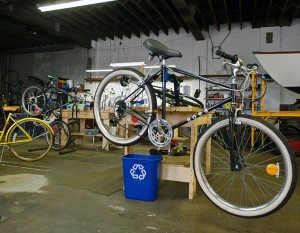
Toledo Bikes! teaches people how to repair bicycles. The Downtown nonprofit also fixes and sells donated bicycles. Toledo Free Press Photo By Joseph Herr

For Dutch journalist Ed Gouwelaar, the issue became a personal crusade. Gouwelaar, who regularly reported on waste disposal, recalled walking down the street on garbage-collection day and noticing what people were throwing out.

“It struck me there were many things there that could be repaired,” Gouwelaar said.

Today, Gouwelaar, 42, describes himself as a former journalist. He left the profession to become more personally active in environmental sustainability.

“I was a journalist, but I wanted to do more,” Gouwelaar said. “I really wanted to contribute something and to take sides. As a journalist, you always have to be objective. You can’t really promote something.”

His thoughts kept returning to those salvageable items she’d seen in the trash.

“I thought it would be easy [to reduce waste] if you could repair those things,” he said. “[To make] repairing a real alternative to throwing away and buying something new, you have to make repairing easy and attractive and accessible.”

The first Repair Café

His solution was the creation of a neighborhood Repair Café.

“It should be something that is fun to do,” Gouwelaar said. “It shouldn’t be a workplace or a shop where you drop things off and pick them up later, but I thought to make it a social event where you can meet your neighbors and you can make new contacts with people from your own neighborhood. That makes it fun.”

Gouwelaar said finding repair experts wasn’t difficult, and she was pleasantly surprised to find there are still people who know how to fix almost anything.

“The funny thing is, for those people, it’s their biggest hobby,” she said. “They like doing it and they like sharing the knowledge and passing it on and helping other people.”

The first organized meeting in 2009 was “an unexpected success,” Gouwelaar said.

She wasn’t sure if anyone would come. Instead, area residents showed up early, bringing everything from electrical appliances to clothes to furniture to musical instruments.

“People were very enthusiastic,” Gouwelaar said. “Many people came to me and said, ‘Oh, this is really a solution for me. I don’t like to throw out things, but you have to because you cannot get them repaired anywhere. Is this going to be here every week now? Or every month?’ So, I thought, ‘Well, apparently, this strikes a note.’”

In response, Gouwelaar founded the Repair Café Foundation in March 2010. Its mission is to spread the concept of Repair Cafés and help establish new locations. The foundation provides information, guidelines, posters, fliers, sample news releases and a 26-page instruction booklet.

“Now all kinds of groups all over The Netherlands want to do this for themselves,” she said.

As of June 1, 42 groups in the Netherlands have established Repair Cafés, from locations in big-city Amsterdam to hamlets of 600 villagers, Gouwelaar said.

Funding comes from private individuals, the government and private foundations, Gouwelaar said, with the greatest support coming from the DOEN Foundation, a Dutch organization that promotes and supports social cohesion.

“They want to bring people together who live in the same neighborhood and to strengthen the community,” she said. “That’s their goal. And that’s what the Repair Café also does.”

Finding electricians is an important first step in establishing a Repair Café, Gouwelaar said.

“You need at least three or four electricians — people who know how electrical current works and who can handle electrical appliances,” she said.

A second consideration is finding a place to meet and a third consideration is publicity.

“There, you get help from us, from the foundation, because we have a press release prepared where you just have to fill in the name of your group and your location,” Gouwelaar said. “So it’s not really that difficult for people to get started with our help.”

The cost of tools is seldom problematic because people with repair skills often have their own tools.

“If you have the electrician and you have a carpenter and someone who’s a good bicycle mechanic and you have a seamstress, they are usually willing to bring their own machines and tools,” Gouwelaar said. “If you organize it for a second or third time, then you might want to buy some tools, but they are not essential to get started. You can very well use or ask the repair men and women to bring their own.”

US movement

Unbeknownst to her, Gouwelaar’s crusade in The Netherlands had a counterpart in the United States.

In 2009, the same year she organized her first Repair Café meeting, a group of environmentally minded individuals in Brooklyn, met to discuss ways they could have a positive impact on their neighborhood environment. They established what they called a Fixers Collective, which, three years later, has become a model for Fixers Collectives across the nation.

A New York Times article about the Brooklyn Fixers Collective came to the attention of Greg Kono, exhibit developer at Pacific Science Center, a private, nonprofit science museum in Seattle.

Kono’s manager saw the article and asked him to determine whether the Pacific Science Center could organize a similar project.

Kono contacted the West Seattle Tool Library, a donation-operated organization that loans tools to community members, and suggested the initiative would be a great fit.

“The Tool Library loved the idea, and pushed me out front, and said, ‘You run it,’” Kono said.

Space for the West Seattle Fixers Collective, which recently marked its first anniversary, was offered rent-free from the Tool Library, which also provides liability insurance.

“All those things were already in place that let me move forward,” Kono said. “Now, it’s just getting the word out, which seems to be exploding now with all of the national publicity.”

The West Seattle Fixers’ Collective regularly invites local experts to teach workshops, including home plumbing, house wiring, bicycle repair and a plumbing series for women  taught by a female contractor. The group has also hosted an “Ask the Expert” series, which offered advice to people working on projects.

Several owners who operate local repair shops in areas with Repair Cafés and Fixers Collectives said they do not feel threatened by the tool libraries, but enjoy increased business because people begin to develop a mindset for repair.

Kono said he doesn’t want to compete with repair shops.

“We’re more about having people … work on those pieces themselves,” Kono said. “I don’t want to a have a pile of stuff that somebody dropped off.”

Toledo reaction

Margaret Danziger, deputy director of the Toledo-Lucas County Public Library (TLCPL), acknowledged tool libraries offer a valuable service, but said she doesn’t see the TLCPL board of directors pursuing that avenue of services.

“I’m not saying we wouldn’t consider a tool library,” Danziger said. “I’m just saying that, at this point, we’re just really thinking about bottom line, and not adding anything more to the taxpayer.”

Danziger said the TLCPL will ask voters in November to renew a two-mill levy, which currently provides the library with $15,295,000 a year, and to approve a .9-mill increase, which would generate another $7,647,500 a year. The .9-mill increase will cost an additional $25 to $27 more per year for every $100,000 in home value, Danziger said.

“If the levy does not pass, we will lose 50 percent of our budget,” Danziger said. “It means half of everything. It would affect hours, buildings, locations, staff and materials, everything you could think of. It would be destruction. So it is pretty clear that we must pass this.”

Danziger suggested tool libraries would fit better in the small business community.

Jim Izbinski, the 25-year manager of Reggie’s Bike Shop, 5934 Secor Road, said he supports the concept of people taking ownership of their belongings.

“I really like the idea of people learning to fix their own things,” he said.

Izbinski said he has seen a 40 to  50 percent increase in repair business during the past five years.

“Back 10 to 12 years ago, people said, ‘Ah, $60. … I’ll buy a new bike for $200-$300,’” Izbinski said. “Well, now they’re saying, ‘I’ll just pay the $60 and get this one fixed.’”

Despite the increased interest he has seen in bicycle repair, however, Izbinski isn’t sure a Fixers Collective could succeed in his hometown.

“Toledo just seems to be so far behind the times as far as things like that go,” Izbinski said. “I don’t know if we have the right mindset. I don’t know if we could get enough people. … I used to go to these meetings that used to try to help promote cycling. We tried to get the bike lanes paved, lines on the roads, bicycle lanes. Nothing ever seemed to happen. I just don’t know … I don’t know why it is. For some reason, it doesn’t matter what it is, organizing anything in Toledo is a difficult thing. I don’t understand why, but it is.”

Dave Smith, owner of Dave Smith Appliance Services, 3820 W. Alexis Road, said he would be concerned with what he considers the average person’s lack of expertise in repairing electrical products.

Smith got his start repairing microwaves for Highland Appliance in the early 1980s and started his own business in 1993. He said appliance repair is no longer mainly mechanical, like changing belts and making adjustments, but a highly technical and demanding electronics job that includes repairing lasers in dishwashers and adjusting Internet-capable appliances.

“It’s a far cry from putting a little grease on something and changing a valve,” Smith said. “It’s a completely, completely different industry from what it was.”

Although Smith said self-repair can be beneficial for simple repairs, he is uncomfortable with the idea of people trying to fix their own appliances.

“We’re kind of seeing that a little bit online now,” Smith said. “You can go online and find YouTube videos. And you can find chats on how to do some simple repairs yourself.

“Out of curiosity, I checked some of these things out, but the problem is some of this information is very mixed. Some of it is right, dead on. That’s good advice. That was a good fix. That was a good repair. And other times, I’m thinking, ‘Oh, my, my. What’s this person [saying]? That’s the most ridiculous thing to do. And somebody’s going to get himself killed here.’”

Smith said his shop often gets business from people who botched a self-repair attempt.

“The whole key there, with do-it-yourself, is knowing when to quit and call a professional,” Smith said. “This is not a business you learn in a three-month class. It takes a lot of time even to do it professionally.”

Mike Janiszewski, owner of Fix-It Shop, 1801 Sylvania Ave., said he sees a need for mom-and-pop repair businesses.

“It’s a part of Americana that’s going quickly,” said Janiszewski, whose shop repairs vacuum cleaners and rug shampooers and makes minor electrical repairs to lamps.

Janiszewski’s 34 years of experience have convinced him people could benefit from learning simple repair skills.

“Men will bring lamps in here that don’t work. The only reason they don’t work is because they need a light bulb,” Janiszewski said. “I call it common sense. On minor repairs, they have no clue.”

However, Janiszewski doesn’t believe people would be inclined to support a Toledo-area Repair Café or Fixers’ Collective.

“Having a smaller population than those two big cities (Amsterdam and Brooklyn), I don’t think there’d be enough interest here in Toledo to support it,” Janiszewski said. “I don’t want to say people are lazy, but if you drive around town and see all the grass cutters, all the snow [blowers], and all the window washers, you can kind of tell people don’t like to do a whole lot anymore. I don’t think there would be an interest.”

Janiszewski said Toledoans seem more inclined to dispose of an item than to repair it.

“Today, they throw everything away,” Janiszewski said. “Take food, for example. I like leftovers. My kids, they don’t. They’ll throw it away instead of putting it in the refrigerator. … A lot of younger people … they waste massive amounts of stuff. … Growing up and doing this [job], it’s amazing the changes I’ve seen. People are becoming more wasteful. Very, very wasteful.”

Toledo Bikes!

Mike Hayden, director of operations and education for Toledo Bikes!, acknowledges both Janiszewski and Izbinski may have valid points in their observations of Toledoans in general.

“Taken as a whole, they’re probably right,” Hayden said. “But to change things, you know, you have to start somewhere.”

Hayden believes Toledo Bikes! has taken the first step in what he hopes will become standard practice for all Toledoans.

Toledo Bikes!, 1114 Washington St., in Downtown Toledo, is a nonprofit charitable organization. Offering the use of tools and workstations, Toledo Bikes! encourages people to bring bicycles for repair rather than toss them in a landfill. Bikes beyond repair are recycled into parts or scrap metal.

Hayden said Toledo Bikes! receives donations of six to 10 bikes a week, and has more than 250 bikes in inventory. Bicycles are “upgraded” and sold in the Washington Street showroom or donated to local schools. In November, Toledo Bikes! donated 15 bicycles to Keyser Elementary School.

Although Toledo Bikes! was unaware of the Repair Café and Fixers Collective movement, a summer program it has planned for the Toledo YWCA, 1018 Jefferson Ave., is similar to what is happening in Amsterdam, Brooklyn and Seattle.

“We’re going to train the kids in bicycle mechanics, and then we’re going to start having them process and work on these kids bikes so that at the end of the summer, we’ll be able to do another bike giveaway to the schools,” Hayden said.

Hayden said he has faith that people can change.

“It’s an educational thing that we’re going to have to go through,” he said. “It will happen here sooner or later. It’s just that Toledo is one of those places that takes longer for things to take root.”

Cultural shift

David Takats, director of fund development and marketing for Goodwill Industries of Northwest Ohio, said he sees the Repair Café and Fixers Collective movement as positive for everyone.

“That’s fantastic,” Takats said. “We really encourage that type of behavior. But there are plenty of people that can’t fix things, that can’t use those items. And those are the people who donate to us generally — because they want to give something to a good cause.

“Don’t throw it in the garbage. If you don’t know how to fix it, if you don’t know what to do with it, give it to us. We’ll take care of it. If it can’t be fixed, if it can’t be sold, we’ll responsibly recycle it and make sure it doesn’t go into a landfill. But if it can, we love to give it to people and let them use it, have that product have a repurpose, a new life.”

Takats said people should consider the long-term consequences of tossing items in the trash.

“Think of what you’ve probably thrown away this year alone by yourself,” he said. “And if everyone were to bring in that kind of stuff, how much could we actually keep out of landfills? How much good could we actually do for the community, and the public, and just the whole welfare of the planet, if everyone kind of thought consciously like that, that I’m consciously not going to throw this away?”

Takats said he is starting to see a shift in American culture making repurposing acceptable.

“I think there is awareness

of just the elements of what we waste,” Takats said. “There’s that element from society that’s starting to look at it and say, ‘We don’t want to ruin our planet and all of our natural resources.’

“And this is just a first step, a beginning. We’re not fully there, by any means, but I do think that there’s a cultural shift. …

“It makes sense not to destroy the planet, not to be wasteful, not to throw things away that could be fixed, that could be used again.”

— Reporting by John P. McCartney

“Color Ignited” celebrates 50 years of art glass in Toledo

0
Vase Form, by Robert Fritz. Photo courtesy Toledo Museum of Art

Toledo is now known as the birthplace of the studio glass movement, but participants at the original workshop 50 years ago had trouble even forming a bubble.
“Nobody knew anything. Literally no one knew how to make a bubble. Th ere was no one there to ask,” recalled 89-year-old Toledo artist Edith Franklin, one of the fewer than 10 people who attended the fi rst of two 1962 glass workshops at Toledo Museum of Art (TMA).
“Color Ignited: Glass 1962–2012,” a new exhibition at TMA, will commemorate the 50th anniversary of those historic workshops.
Th e free show, which will focus on the evolution of the use of color in glass, debuted June 14 during the GlassArt Society Conference and will run
through Sept. 9, 2012.
On display are more than 80 objects from private collections, galleries and other museums as well as TMA’s collection, including work by Harvey Littleton, Dominick Labino, Marvin Lipofsky, Dale Chihuly, Dan Dailey, Laura de Santillana, Heinz Mack, Klaus Moje, Yoichi Ohira, Ginny Ruffner and Judith Schaechter.
The exhibition is the first in the new $3 million Frederic and Mary Wolfe Gallery of Contemporary Art.
The space was the home of TMA’s glass collection before the Glass Pavilion opened in 2006.
Jutta-Annette Page, TMA’s curator of glass and decorative arts and vice president of the Glass Art Society, called the exhibition “visually enthralling” and said she hopes visitors leave with a better appreciation of Toledo’s role in the evolution of studio glass.
“I very much hope this exhibition will make it clear this very important movement started here in Toledo and also help people realize this is aninternational movement that is here to stay,” Page said.
Visitors can also view the exhibit from the gallery’s mezzanine level.
“It allows people to look at the works on the ground floor from a different vantage point, which some of the artists are intending on in their works,” Page said.
Several of Franklin’s pieces from the original studio glass workshop are on display.
“I had them at home for years and nobody looked at them and now they’vebecome famous,” Franklin said.
Such early pieces are rare.

“It’s a very, very small group of surviving objects and the reason for that is they had not really figured out the technological issues that came with this experimentation,” Page said.
“Most of the pieces broke.”
The first workshop used glass from melted-down fiberglass marbles made at the Johns Manville plant in Waterville.
Learning to add color was part of the experimentation process.
“If you look at these very earliest pieces they were all greenish, transparent glass because the color was entirely determined by the glass batch,” Page said. “Very early on the palette was limited to the prefabricated glass the artists were using, but they very quickly experimented with color.”

Franklin never worked with glass again, but has fond memories of that first workshop.
“It was a wonderful experience,” Franklin said. “It’s been exciting these past couple of years. It’s nice it’s getting the recognition it should. Too bad some of the people aren’t alive who would have been enjoying this.”

Admission to the museum, located at 2445 Monroe St., is free. Hours are 10 a.m. to 4 p.m. Tuesday through Thursday, 10 a.m. to 10 p.m. Friday, 10 a.m. to 6 p.m. Saturday andnoon to 6 p.m. Sunday. Th e museum is closed Mondays and major holidays.
For more information, visit www.toledomuseum.org. ✯

War of 1812: Royal Navy Capt. Robert Barclay had a hard-luck life

0

Ever feel like the world is against you? I think we all have. Oh, I’ve had unlucky days. Like the time I overslept for the trial on which I was juror No. 7. As I strode through the courtroom to my seat, two hours late, the stares of disdain from the lawyers and judge melted me into the woodwork. It was a terrible, horrible, no-good, very bad day.
Some of us get more than our fair share of those days; Capt. Robert Heriot Barclay of the British Royal Navy was one such unfortunate.
Who? Sure, you all have heard of Commodore Oliver Hazard Perry, the victor of the Battle of Lake Erie, but you probably haven’t heard much about his adversary Barclay. Th e battle was fought Sept. 10, 1813. Perry won; Barclay lost. As a result, Perry became a superstar, and Barclay, well, he faded into a history book.
Born in Scotland with an instinctive love of the sea, Barclay left his family at the tender age of 12 and proudly enlisted in the British Royal Navy. A note in a family album suggested that he was “ill-used” as a teenage midshipman and that seems to hold true as the good hearted and hardworking young man was frequently taken advantage of. Despite stoic performances at sea, he just never seemed to get ahead.
In 1805, during the early Napoleonic Wars,it seemed he was on his way up with his assignment to serve on the Victory under the famous Lord Horatio Nelson.
Soon he was promoted to lieutenant and assigned his own ship, Swiftsure, which he commanded successfully through therenowned British victory at Trafalgar.
Instead of being promoted further, however, he was repeatedly assigned to lesser ships.
From 1809 on, the unlucky Barclay always carried a combination knife and fork utensil with him so he could cut his food one-handed, having lost his left arm in battle
with the French that year.

After serving four more years in the Atlantic, he was sent to North America, finally as commander of all naval forces on the lakes. Ten days later, however, his title was usurped by his superior officer, Sir James Yeo. Commander Yeo in turn ordered him to Lake Erie as a mere senior officer, a post he was offered only because Yeo’s first choice for the position refused it as a demeaning assignment.
Because England was preoccupied with Napoleon in Europe at this time, Barclay had the daunting task of organizing a British fleet that was undermanned, underequipped and underfed into a competent force.
He succeeded as well as anyone could have expected and aboard his flagship, Detroit, he boldly took on Perry.

Unfortunately, Barclay lost himself in the battle — parts of himself, that is. About an hour into the fight, a canister shot took out a chunk of his thigh. An hour or so later, his right shoulder blade was shattered by grapeshot (golf-ball sized metal, clustered like grapes and shot from cannons).
As if the wounds weren’t enough, Barclay soon faced a court martial for losing the contest. As he was escorted into the courtroom, his mutilated body brought tears to the men who served with him.

He was acquitted of any wrongdoing, but, deeply depressed by his appearance, he offered his fiancée a release from their engagement. She responded that if there was enough of him left to contain his soul, then she would marry him, and she did. Finally, some solace came his way.

Ironically, just four years afterBarclay’s death, his ship Detroit, which was decrepit but periodically used as a merchant ship after the battle, became the object of a publicity stunt. A number of businesses along the Niagara River, which runs over Niagara Falls, decided to send the old ship over the edge in order to draw customers to the area.

The shores were lined with curiosity seekers for this spectacle, which many felt was tasteless.
As it turned out, the boat was tossed and broken by the rapids, but became permanently lodged against an island. Like its former commander, the rest of its life was spent disfigured but in bittersweet peace, as life rushed by.


Frank Kuron is author of the War of 1812 book, “Thus Fell Tecumseh.” Email him at [email protected]

Food bank “baffled” by church’s comments

0

Pilgrim Church staffers recently announced they have to cut its food pantry to once a week, citing an area food bank’s dwindling supply as the reason.
But the announcement surprised the Toledo Northwest Ohio Food Bank (TNOFB), where Pilgrim Church has actually picked up 10,000 more pounds of food this year compared to last year.
The 97-year-old church, located at 1375 W. Sylvania Ave., has operated a food pantry for the past fi ve years, distributing food twice a week. On June 7, pantry program director Dawn Wilsonreported to a Toledo broadcast media outlet that the church food pantry was “being forced to take away” a day of its pantry service “even though the need for the food is not dwindling.”
Wilson told Toledo Free Press Pilgrim Church was forced to eliminate Tuesdays as a food distribution day because the TNOFB is having trouble keeping its shelves stocked.
“There isn’t enough food for us to choose from,” she said. “A lot of times, we go down there, and they don’t have a lot to offer us.”
But James Caldwell, president and chief executive officer of TNOFB, disputed Wilson’s statements that his food bank couldn’t adequately serve its clients.

“We’re just kind of baffled,” Caldwell said. “I really don’t think they know what they’re doing. I’m not trying to be negative. I just really think it’s a lack of experience.”

Pastor Ellis Young stepped into his position at Pilgrim Church three weeks ago. Wilson has been food pantry program director for three months.Barbara Grandowicz, TNOFB’s director of operations, said Pilgrim Church has received 35,000 pounds of food so far this year.

Wilson said one solution the church is pursuing is to find a second source of food.

TNOFB is not the only food bank in the city, but most people are unaware the Toledo Seagate Food Bank exists, said Deborah Vas, executive director of Seagate. She said the majority of the calls she receives come from food pantry operators who had only recently heard of her food bank.

When Wilson took the position at Pilgrim Church in March, she was not informed about the Seagate bank. While she’s not sure why the church has not used its services in the past, she said it is working on becoming a member.

Vas confirmed that Wilson has begun the application process for Pilgrim Church to become one of more than 400 nonprofi t member organizations that the food bank services. As of June 13, 2012, Vas reported that Wilson needs to submit a copy of Pilgrim Church’s 501(c)(3) (nonprofit) status. Aft er receipt of that document, Seagate personnel will conduct an inspection of the church’s facilities, confirming the existence of a pantry room and documenting proper refrigeration and cleanliness standards, a process that Vas said may only take a week to complete.

“At that point, they’re notified that, yes, they will receive food,” Vas said.

Vas said she is puzzled by the public’s lack of awareness about Seagate. She also suggested that the responsibility of membership rests with the food pantry itself.

“I think those who may not be taking advantage of both food banks simply are not aware of Seagate,” she said. “And that happens. When a new organization calls, they’ll say, ‘Well, somebody told me … there’s another food bank. How do we get with you?’

“That’s the only answer I can have. If you find an organization that does not take advantage of both, I would ask them, ‘Are you aware that there’s twofood banks? Are you aware that you can get something for free?’”

Other reasons for the elimination of Tuesdays for food distribution day included the cost of food, an increase in demand, the lack of an adequate number of volunteers and the concern that a few clients may be using the services in excess or as a “personal scheme.”

“We deal with a population that sometimes likes to ‘shoot the gaps,’ if you will,” said Young. “You were just here Tuesday, and now it’s Thursday. You’re back. … We don’t have a problem with that if the need is there. But sometimes we deal with gluttony. I think it’s becoming more and more common.”

But Young said the majority of Pilgrim Church clients truly need help.

“Understand, it’s not these bums out here who won’t work,” Young said. “A
lot of times, these are fine, upstanding people who would do better if they could, who would be responsible for feeding themselves if they had the resources. They just don’t have them.”

Barhite: The men who make Toledo the ‘manliest’ city

0

How fitting that Toledo was named the manliest city in Ohio just before Father’s Day.
The reasons forthis accolade are linked to the number of home improvement stores, monster truck rallies and motorcycles per capita.
Cleveland is the second manliest city in Ohio and Cincinnati is the third, according to the study released by Bert Sperling and Combos Snacks.
But the real test of a man has nothing to do with Harleys, going to Lowe’s or the lack of girly nail salons and boutiques in Toledo.
My dad gets the manliest man award because he had three daughters and never once said he wanted a son. People always teased him about the drama of three girls, but he dismissed it with a shrug and said he was happy with us three. That’s a real man.
My husband’s grandpa gets a nod because he married into a family with four young children and raised them as his own. That’s a real man.
A friend gets the award because he moved away from the Toledo area to live in his wife’s hometown after herbrother died in Iraq. That’s a real man.
At the Zepf Center in Toledo, I recently learned about more real men. They graduated from the Nurturing Fathers Program, which is a 13-week training course that teaches parenting and nurturing skills to men.

The classes provide skills for healthy family relationships and child development. It also helps the fathers with career development and assists with employability. Statistics show that states with fatherhood programs see an increase in child support compliance, employment rates, incomes and time spent with children, according to the Zepf Center.

Real men ask for help. New father Vince Guerrieri will celebrate his first Father’s Day this year. He channels “The Godfather” when it comes to real men.
“A man who doesn’t spend time with his family can never be a real man,” Guerrieri said.

Longtime Toledo resident Matt Zaleski thinks back to all the men he saw as he was growing up. They worked hard to support their families, had a spiritual direction and still managed to spend time with those they loved.

And then there is father of five, Troy Johnson. For him, real men are strong. But not just strong in the “I can open that jar for you” way. Real men are strong enough to ask for help, strong enough to put family first, strong enough to come to the aid of their community.

All these men live in Northwest Ohio; all these men are the reason why we are the manliest in the state.

Treece: Inflation or deflation? Yes

0

Anyone who has an interest in finance should subscribe to John Mauldin’s biweekly newsletter. His information is timely, relevant and always contains citations, usually from leading economists and money managers.

In one of his last newsletters, Mauldin noted that when asked whether the economy will experience inflation or deflation, his “ready answer is, ‘Yes.’”

Many investors believe inflation is simply printing money. Inflation is actually a resulting  price increase for goods or services because a currency lost value. Deflation is just the opposite: Prices drop because of a currency suddenly strengthening. Inflation and deflation occur when the relationship between economic growth, as measured by the annual change in gross domestic product (GDP), and money supply go out of whack.

Contrary to what many people believe, printing money is perfectly OK — if the nation has the economic growth to substantiate it. If the economy expands by 5 percent and money supply does not grow at all, currency becomes much more valuable since there is a relatively smaller amount than there was before that economic growth.

Th is is our main problem with the standard: While it can be good to have a commodity backing a currency, it limits the amount by which the government increases the money supply. In the situation we currently find ourselves in — with a massive national debt — the standard seems like a great idea. On the flip side, when the economy expands and we do not increase the money supply, goods will have to be sold for less than what it cost to produce them. Th is could spell disaster for an economy in recovery.

It is also important to note that between the late 1800s and the early 1900s while the U.S. was on the standard, we experienced a depression approximately once every seven years.

Relating specifically to the United States, Mauldin asserted that we will see both inflation and deflation over time. As I have mentioned before, two factors must be present for inflation to exist: volume and velocity.

Following the quantitative easing policies of the Federal Reserve in the past decade,
there is plenty of volume, but there is no velocity.

Velocity occurs when money turns over in the economy. For example, if you were to have $1,000 on deposit with Bank of America, and the bank was hypothetically only required to have 10 percent of that deposit on hand, it could loan out $900. Th e money has turned over by one depositor becoming the creditor to a borrower while the bank profits.

When banks begin to loan funds to consumers and small businesses, we will absolutely see inflation.

We will likely not begin to see new loans until borrowers are certain that interest rates have bottomed, and that will not happen until interest rates begin to rise. Nobody wants to catch a falling knife, but when borrowers can see a tangible bottom for rates, they will want to snag a loan as cheaply as possible.

I believe inflation will not occur before a bout of deflation. We are already seeing positive economic news but what will truly spark real economic growth in this country will be a sharp decline in gas prices once we begin to tap into our four big domestic oil and natural gas reserves.

Most Americans do not have the option to pay or not pay for oil-based energy. Between home heating and fueling automobiles, this money must be spent and takes away from their ability to purchase consumer goods. Going aft er our domestic oil will create jobs
in the refi ning and transportation industry, but will also stimulate the manufacturing industry.

If manufacturers’ costs are lower, they can justify hiring more employees considering the new increase in demand as well.

I have no doubt energy prices hold back domestic economic growth, so as soon as we can bring those prices down the economy will expand. Th e Fed will have a difficult task trying to keep the inflation rate relatively similar to GDP growth to avoid high deflation or inflation.

As Mauldin put it best, will there be inflation or deflation? Yes.

Make sure that you are positioned accordingly or else your portfolio may suff er the consequences.


Ben Treece is a 2009 graduate from the University of Miami (Fla.), BBA International Finance and Marketing. He is a partner with Treece Investment Advisory Corp (www.TreeceInvestments.com) and a stockbroker licensed with FINRA, working for Treece Financial Services Corp. The above information is the express opinion of Ben Treece
and should not be construed as investment advice or use

Retirement Guys: Who will get your Beanie Babies?

0

Remember Beanie Babies? The little stuffed animals filled with plastic “beans”? There were nine original Beanie Babies and it is a mystery to me (Mark) how many there are today.

I have seen articles saying there are more than 300, 600 and as many as 2,000 you can collect. I guess we will have to leave that to a Beanie Baby aficionado.

They were introduced in 1993 and became a craze to collect. I have heard some of the original nine could be worth more than $4,000.
My father-in-law had an old Gibson guitar from the 1950s and I had heard guitars from that era could be worth as much as  $100,000. This one turned out to be worth about $1,500.

I have watched the reality show “American Pickers” a few times. These two guys go on expeditions to find vintage valuables they can acquire and sell for a
profit. It is amazing they can find something old and decrepit and realize it’s something someone would pay a lot of money.
As an estate-planning attorney, I have drafted estate plans for folks with classic car collections, comic book collections, and, yes, Beanie Babies. These items are typically of great sentimental value to the owner because of the effort spent acquiring them or perhaps some connection to family. But what will happen to these collections
when the owner passes away?
My mother-in-law had a collection of dolls and it was important to my wife to preserve this collection when her mom passed away. Sadly, what often happens is the children or heirs come into a decedent’s home, divide up tangible personal items and toss the rest. It could be because of ignorance of the value or just the goal of not accumulating so much “junk” that producers want to do an episode of “Hoarders” about you.
If you do not have an estate plan, such as a last will and testament, you should consult with an estate planning attorney right away to create one. You can list specific gift s in your will.

I suggest keeping it simple, but list items that would be important to you to get where you want them to go.

Here is a tip: Sometimes things don’t get listed because most folks are not going to go back to the attorney’s office to change their will every time they acquire something new.

This can be overcome by inserting a clause into the will referring to a “separate writing.” This clause states that from time to time you may want to designate specific gift s from your estate effective upon your death.

The advantage of this is the clause includes an attached form where you can list items after the will has been drafted. As long as the form is witnessed, the designated gifts become part of the document after the fact. Pretty neat.

If you have not created a will yet, or need to update it, get it done right away.


Securities and Investment Advisory Services are offered through NEXT Financial Group Inc., Member FINRA/SIPC. NEXT Financial Group Inc. does not provide tax or legal advice. The Retirement Guys are not an affiliate of NEXT Financial Group.

Letters to the editor, June 10, 2012

0

Only owner can decide future
of sexually oriented business

TO THE EDITOR,

I appreciate and share Toledo Free Press’ enthusiasm for the growth of Downtown Toledo. The area Tom Pounds mentioned (“Addition by subtraction,” June 3) surrounding the Monroe/Huron intersection certainly has been energized by private and public investment and serves as a wonderful hub of activity for Downtown.

Adult establishments, classified as “sexually oriented businesses” under the Toledo Zoning Code, are permitted in the Downtown Commercial zoning district subject to spacing requirements.

As noted in your column, these businesses are required to be 500 feet from any residential zoning district, church or use established specifically for the activities of minors, such as schools and parks, and 1,000 feet from any other sexually oriented business.

We checked on the spacing requirements and determined that the business at 715 Monroe is 530 feet from Fifth Third Field and approximately 700 feet from Glass City Academy.
As much as I share your desire to keep downtown “family friendly,” there does not appear to be any legal basis for disapproving the zoning permit.

Your suggestions regarding creating a sexually oriented business-free zone or prohibiting a sexually oriented business within so many feet of a sports arena could not be applied retroactively, so ultimately it will be up to the building owner to decide if the proposed sexually oriented business opens at 715 Monroe. ✯

TOM LEMON, AICP
Director, Toledo-Lucas County Plan Commissions

Closing of Raceway Park is a loss

TO THE EDITOR,

There is much talk and excitement about the new casino.

However, what is being overlooked in all the exciting newsmstories about the grand opening is the price we paid for the new casino.

As some people may remember, Raceway Park is set to close its doors soon. The new casino, while adding pizzazz and jobs to the other side of the river, has added blight and destruction to North Toledo.

Our concerns about Raceway Park were subdued in the initial casino proposal when Penn National Gaming hinted that the new facility would not adversely affect Raceway Park.

Now everyone who visits the new casino is basically they are willing to overlook that. I am not. People will argue that the new casino is a nicer facility than Raceway. They would be correct, although if Penn National put a fraction of the money they put in the new Casino into the Park it would not be so.

They might also argue that the new casino provides more jobs than Raceway Park. Again, they would be correct. But what Penn National leaves behind in its wake is the further destruction of the North End.

But really, who cares about the North End anyway? North Towne Mall is gone as well as numerous other businesses. Most Toledoans have little or no occasion to visit that blighted area and now with Raceway Park closing one less reason to visit.

If we keep playing our cards this way perhaps one day there will be nothing of interest left at all.

Does no one remember we fought a “war” with Michigan for that area? Perhaps we should give it back because it seems we don’t really want it anyway. ✯

DANIEL P. FINKEL
Toledo


