Home Blog Page 276

FBI indicts 18 in IHOP raid case

0

The Federal Bureau of Investigation announced Wednesday the indictment of 18 people allegedly linked to a series of criminal schemes centered on seven Northwest Ohio and Indiana IHOP restaurants that resulted more than a $3 million loss to the company

The charges outlined in the indictment include money laundering, identity theft, alien harboring and arson.

The charges stem from a Sept. 20 raid of the seven IHOP locations in west Toledo, Springfield Township, Perrysburg, Sylvania Township, Lima, Findlay and Evansville, Ind.

“These defendants turned pancake houses into crime dens,” said Steven M. Dettelbach, United States Attorney for the Northern District of Ohio, in a news release. “This indictment lays out a menu of crimes ranging from harboring undocumented workers to identity theft to money laundering to insurance fraud.”

Carole Rendon, first assistant U.S. Attorney, said the franchise owner, Tarek “Terry” Elkafrawi, used his seven IHOP locations as fronts for money laundering. She said Elkafrawi and others stole money from corporate IHOP by underreporting net sales to decrease the amount of payments owed.

“The crimes that are laid out in the 64-count indictment result in losses in excess of three million dollars,” Rendon said.

The indictment states that Elkafrawi and 17 others allegedly used their control of the IHOP restaurants to “fraudulently manipulate sales figures, salaries and payrolls to evade taxes, avoid paying royalties and illegally divert money from the IHOP franchises to themselves.”

In underreporting sales figures, Elkafrawi and the others allegedly generated $1.2 million in unreported income, Rendon said.

Federal authorities also alleged that Elkafrawi directed employee Jose Leon-Gonzalez to burn down the Findlay IHOP in 2008. Elkafrawi then claimed $1.3 million through insurance and through “inflated payroll claims,” according to a new release.

In addition to those charges, Elkafrawi allegedly employed nearly 200 illegal immigrants to work in his seven IHOP locations, with most of them using stolen or fraudulent identities. Elkafrawi allegedly had Carlos, Gamboa, Leon-Gonzalez and other employees obtain false documentation for the workers.

Rendon said law enforcement officials will seize all seven IHOP locations, 12 bank accounts, a home and other property purchased by Elkafrawi and Autumn Lee Tangas, a co-conspirator in the alleged schemes.

Taking part in last year’s raid were members of the FBI, U.S. Department of Homeland Security, and Immigration and Customs. All searches took place at around 6 a.m. that morning.

The 1:30 p.m. press conference to announce the indictments took place at the U.S. Attorney’s Office at Four Seagate downtown.

The names of the 18 arrested:

  • Tarek Elkafrawi
  • Autumn Lee Tangas
  • Tarek Eid Omar
  • Khaled Yousef
  • Jamil Mohammed Awwad
  • Ramiz Awwad
  • Carlos Gamboa
  • Jose Leon-Gonzalez
  • Donna Herriot
  • Lucky Williams
  • Mark Anthony Turner
  • Sara Rinebolt
  • Cesar Avilla
  • Yoni Merida
  • Ali Mahmoud
  • Mohammed Hassan
  • Kelly Elkafrawi
  • Khalil Aboudakka

‘Viva Ross-Vegas!’ Casino to open May 29

0
Toledo Free Press photo by James A. Molnar

Hollywood Casino Toledo’s interior demands attention from four of your five senses the moment you step onto its granite floors.

All at once.

An LED banner stretches across the entrance, rapidly scrolling through images of limousines and glamorous women. Then it’s Toledo’s skyline and the words “HOLLYWOOD CASINO” positioned on a hill like California’s famous “Hollywood” sign.

Guitars wail and singers croon from the H Lounge stage, which glows purple and blue in the distance. Past rows of table games, slot machines beep, whir and blink, each offering a quick escape into a fantasy — a jungle, ancient Egypt, outer space or the ocean floor.

The aroma of cakes and pastries tugs visitors toward Epic Buffet, where chefs work busily and glass cases display desserts like edible artwork.

“This is the first Las Vegas-style casino in Ohio and as people walk in they forget they’re in Toledo,” General Manager Richard St. Jean said during a media tour May 21, a sneak peek before the official opening at 2 p.m. May 29.

Visitors might also forget where they’re going from one end of the casino floor to the other. The 125,000-square-foot gaming area offers 2,002 slot machines and 60 table games and 20 live poker tables. More than 220 televisions, lining the walls and standing on columns amidst the card tables, compete for eye contact. Scene, the swanky sports bar beside the stage, features glass panels splashed with televised game broadcasts.

“You’ll never miss a sporting event,” said Neal Perry, director of table games. “If you look to your right you’ll see a TV and if you turn to your left you’ll see a TV.”

The casino offers 24 beers on tap and a slew of fancy liquor drinks. Final Cut Steak & Seafood even offers pre-prohibition-style Manhattans brewed in wooden barrels.

All the high-tech buzz is woven into a 1930s art-deco feel, marked with movie posters boasting stars like Marilyn Monroe, Katharine Hepburn and Humphrey Bogart.

Most of the chairs are covered in white leather, with material textured like alligator skin.

Mock-stone columns stretch from the floor to the ceiling, accentuated with rows of spheres that resemble continuous chains of pearl necklaces.

The Hollywood Casino Toledo has been a long time coming.

The history

Ohio voters passed Issue 3 on Nov. 3, 2009, with 53 percent of voters in favor. The measure amended the Ohio Constitution to allow casinos in Cincinnati, Cleveland, Columbus and Toledo.

Proponents argued the casinos would generate hundreds of millions in tax revenue for the state, create local jobs at a time when Ohio’s unemployment rate was nearly 11 percent and keep money in Ohio rather than sending it to casinos in neighboring states.

Opponents argued that casinos have negative effects on compulsive gamblers, their families and communities and would likely attract out-of-state owners.

“The fundamental reasoning against gambling is the impact it has on people who become problem gamblers — people mortgage their houses, they do all kinds of things to get money to go gamble more,” said Tom Smith, public policy director for the Ohio Council of Churches, which opposed the measure.

The 2009 measure succeeded where four previous attempts had failed. A 1990 initiative proposing a casino resort hotel in Lorain failed with 37 percent of voters in favor. A 1996 initiative proposing eight permanently moored riverboat gaming facilities was defeated with 38 percent of voters in favor.

A 2006 initiative proposing allowing slot machines at horse racing tracks failed with 43 percent of voters in favor. A 2008 initiative proposing a privately owned $600 million resort and casino near Wilmington was defeated with 37 percent of voters in favor.

Smith pointed to these failures as evidence that voters approved the casinos in 2009 because they were marketed as a job growth source.

“It would never have passed if we wouldn’t have been in an economic downturn,” Smith said.

After the measure passed, lawmakers were given six months to enact regulations on how the casinos would operate and grant licenses to casino operators. Meanwhile, developers began design work. Ground was broken in August 2010 on the $320 million casino. More than 1,300 employees have been hired, 90 percent of them local.

Per state legislation, the casinos will have an entry age of 21, rules prohibiting free drinks and smoking and no alcohol sold after 2:30 a.m.

One of the guidelines for Toledo’s casino was it could not build a hotel on-site or within 10 miles until Lucas County hotels sustain a 68 percent occupancy threshold for a three-year period.

Each casino will pay a fixed tax of 33 percent of gross casino revenue. Fifty-one percent of the revenue will be distributed among Ohio’s 88 counties in proportion to population; half of each county’s distribution will go to its largest city if that city’s population is above 80,000. Thirty-four percent of the revenue will be distributed among all public school districts, 5 percent among  host cities, 3 percent to Ohio Casino Control Commission, 3 percent to the Ohio State Racing Commission fund, 2 percent to a state law enforcement training fund and 2 percent to a state problem gambling and addictions fund.

Cleveland’s Horseshoe Casino became the first casino in the state when it opened May 14. Hollywood Casino Columbus is set to open this fall while the Horseshoe Casino Cincinnati is set to open spring 2013.

Once all four are open, the casinos are expected to generate about $25.3 million in annual tax revenue for the City of Toledo, Lucas County and Lucas County school districts.

Michigan’s example

Although Michigan does not report payout for slot machines in its casinos, the state receives an average of $121 million in wagering tax each year, said Eric T. Bush, administrative manager for the Michigan Gaming Control Board (MGCB). Michigan’s wagering tax is 8.1 percent.

Bush said Michigan’s share of the adjusted gross revenue made from the casinos is 45 percent, all going to the state’s education fund. The Detroit casinos are some of the largest employers in the city, employing between 8,000 and 9,000 workers.

According to the MGCB’s 2011 Detroit Casinos Revenue spreadsheet, Detroit’s casinos had a total adjusted gross receipt of $1.4 billion in 2011.

Viva ‘Ross-Vegas’

Hollywood Casino Toledo, located on a 44-acre site on the banks of the Maumee River five minutes south of Downtown Toledo, could draw up to 2.8 million visitors per year, according to Penn National Gaming, which operates the site.

Some of the casino employees refer to the property as “Ross-Vegas,” a nod to the casino’s proximity to Rossford.

Pat McGrady, president of the Rossford Business Association, said the group has been working closely with the casino.

“Through the last couple of years, our business association has kept an open mind with welcoming the casino,” McGrady said. “The casino has been a big part of our organization, joining it, being part of the meetings as they draw near to the opening day, making sure they give us information as partners and helping us transition.”

McGrady, who owns the Cold Stone Creamery/Blimpie location in Rossford, said many Rossford businesses are hoping to draw casino employees as well as out-of-town guests.

Holley Bockelman, who owns Bock’s Place with her father Bill Bockelman, said she thinks the casino will be good for business.

“I think it’s going to be great. The more people coming through Rossford the better,” Bockelman said. “I don’t think there’s anything negative about this whole thing.”

John Names, who owns Danny’s Cafe with his wife Vickie, said he isn’t expecting much of a change.

“We’re hoping for the best and ready for the worst,” Names said. “People will be coming for the casino so we don’t expect anything really, but we seem to attract out-of-town customers passing through so maybe we’ll pick up a few new faces.”

Larry Eilert, owner of Larry’s Auto Center, said he’s cautiously optimistic.

“I’m excited and hopeful. Hopefully it can give our town some new vigor and pick it up a little,” Eilert said. “This is all new, so you don’t know what to anticipate. You’re always a little apprehensive about what it’s going to draw, but I think in the long run it will make our town much more attractive and give us a little boost and bring all the other businesses up a little. I’m looking forward to it and I hope it will work.”

Safety

Rossford Schools Superintendent Bill McFarland said children’s safety is the focus of the school district.

“The amount of traffic and the possible criminal element it brings to town — those are the only concerns that have been raised,” McFarland said. “We’re only going to be in school for four days after it opens, so hopefully by the end of the summer, the mass of people going there will have leveled off a little bit.”

Rossford Police Chief Glenn Goss Sr. recently met with the school board to address concerns, particularly increased traffic expected on Glenwood Road near Indian Hills Elementary.

“We’ve got a lot of kids that walk, especially on Glenwood,” said McFarland, who said the district planned to post more crossing guards. “We’re going to do everything we can to protect our kids.”

Goss said he plans to increase the presence of law enforcement in the area.

“Like any department, you want to be proactive, not reactive,” Goss said. “We want to be prepared for what may be coming and not necessarily wait until it’s too late and wish we did something.”

Traffic and parking

Non-casino traffic will be rerouted south on Glenwood Road to Buck Road to I-75 to reduce congestion in the casino area, Goss said. Toledo Police will also reroute traffic.

The casino offers free parking for more than 3,000 vehicles, but two lots in Rossford have been designated for overflow parking if needed, Goss said. One is between Rossford United Methodist Church and Rossford Community Recreation Center on State Route 65. Another will be the Rossford High School parking lot after school hours.

The lots will be operated by Penta Career Center law enforcement students under the supervision of the Wood County Sheriff’s Office. Parking is $8, which will go to Penta, and shuttles to the casino will run every 20 to 30 minutes, Goss said.

For more information, visit the website www.hollywoodcasinotoledo.com.

Toledo Free Press Special Sections Editor Sarah Ottney and Toledo Free Press Staff Writer Brian Bohnert contributed to this article.

Activist fights law that slows aid for some veterans

0

The county’s Veterans Service Commission (VSC) denied 12 of the 437 veterans who applied for emergency financial aid during the past three months because of questions surrounding the applicants’ previous residency.

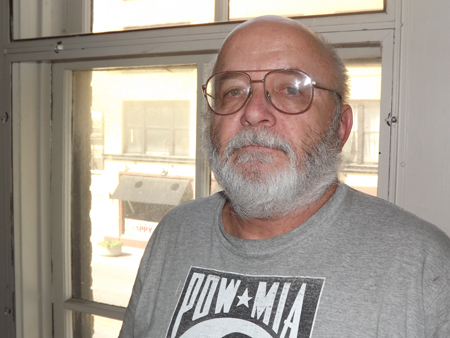
That’s 12 too many for Nick Haupricht, chairman of Remembrance Inc., a local group of six veterans that advocates for the refurbishing of war memorials.

“We’ve got veterans out there on the streets — that’s what burns me,” he said.

Haupricht attributes this to a section of the Ohio Revised Code written into law in the ’90s. Section 5901.08 requires veterans to prove that they have lived in the county in which they are seeking financial assistance for at least three months.

For example: If a man loses his home in Michigan, catches a bus to Toledo and winds up on the streets, in order to receive emergency cash from the Lucas County Veterans Service Commission (VSC), he’d need to either enroll in a local shelter’s housing program or sign a lease. And then wait for three months.

Nick Haupricht

Or say a woman who served in Iraq has lived on and off Toledo’s streets for a while. If she has no proof that she’s lived somewhere in Lucas County then she cannot receive aid from Lucas County’s VSC.

The VSC rarely has to turn people away based on the three-month rule, said Jason Brown, deputy director of VSC. In 2011, the VSC fielded 1,961 requests for emergency financial assistance. Of the 59 requests denied because of residency issues, some were turned away merely because they failed to finish paperwork, Brown said.

Also, veterans new to Lucas County fall under the jurisdiction of their previous homes, and are thus eligible to receive aid from their home county’s commission. Likewise, if a veteran leaves Lucas County, the Lucas County VSC can continue to serve that individual for three months, Brown said.

But the rule is all too familiar for folks at Cherry Street Mission, where veterans comprise 15 percent of the homeless seeking shelter. Whether they’re coming in from out of state or have stayed off the grid for a while, many veterans who enter the mission’s doors have to play that three-month waiting game, said Dan Rogers, CEO and president of the mission.

After the shelter has served someone for 90 days, staff can report to the VSC for that individual to receive aid. But even for those who have lived in Lucas County for at least three months, digging up old leases for proof of residency can be daunting, Rogers said.

The law was instated to solve a “double, triple and even quadruple-dipping” problem, Brown said. The Veterans Service Commission had found that a number of low-income veterans were using up one county’s resources to his or her limits and moving on to the next, he said.

The Lucas County VSC has no limit on the amount of money given to each person who requests help, but one person can receive help up to three different times in one year, he said.

“So a lot of people are punished for the people who took advantage,” said Renee Palacios, director of the Family House.  “That just puts another layer of bureaucracy in front of homeless people. Years ago our economy was way different — it’s time to move forward.”

With the new directive from the Lucas County Homelessness Board that presses the county shelter system to reduce the average length of stay to 30 days, the three-month rule regarding veterans becomes all the more challenging, Palacios said.

Tammy Holder, executive director of the Beach House Family Shelter, said she hasn’t seen barriers blocking impoverished veterans from getting the aid they need from the commission. About 6 percent of those who sought shelter at the Beach House  Family Shelter last year were veterans, she said.

Sen. Edna Brown, who is on the State and Local Government and Veterans Affairs committee, wrote in a prepared statement that her office has communicated with the Ohio Department of Veterans Services and the Lucas County VSC regarding the rule.

Acknowledging that the rule was implicated to preclude a person from receiving assistance from multiple counties at once, she wrote that her office is researching options to determine if there are other ways for commissions to determine if a veteran in question is receiving service elsewhere.

Her office is comparing solutions that other states have made, she wrote.

“I understand that this rule makes it difficult for homeless veterans to receive financial assistance from the county commissions,” she wrote.

Haupricht and his crew have started a campaign to strike down the three-month residency law. They’ve contacted state senators and representatives and will pass out fliers during the Memorial Day parade.

Barhite: Compulsive gamblers can ban themselves from Ohio casinos

0
Toledo Free Press photo by James A. Molnar

Many people will want to visit  Hollywood Casino Toledo  after it opens May 29.

But some people already know — or will find out — they shouldn’t be anywhere near a place that allows gambling.

For those people, the Ohio Casino Control Commission has a new program in response to the opening of four casinos in Ohio and the gambling addiction that might follow for some.

The voluntary exclusion program gives people the option of putting themselves on a list that bans them from entering an Ohio casino, according to Laura Clemens, who directs the responsible gambling program for the commission.

If those people try to get in, they will be escorted out. If they happen to get in and then win, their winnings will be forfeited, and if they get caught in the casino, they could be charged with trespassing.

“We already have a couple of people on the list and some appointments to get on the list,” Clemens said. “We meet with them and take an application and a photo. We want to make sure it is voluntary.”

Because the list is voluntary, a family member or spouse cannot put a person on it, she said. A person can choose to be on the list for one year, five years or a lifetime.

Although casinos are new to Ohio, gambling addiction is not. Clemens said the Ohio Department of Alcohol & Drug Addiction Services and the Ohio Lottery have offered gambling addiction programs and organized media campaigns for years.

However, the newest radio and TV campaign, “Silence the Addiction,” and the voluntary exclusion program are timed to coincide with the opening of the casinos. Cleveland’s casino opened May 14; Columbus’ casino is opening in the fall and Cincinnati’s casino will open next spring.

“We are putting a larger focus on the resources that are available,” Clemens said. “Many of the resources have been there, but we want to make sure people know about them.”

A study is being completed to gauge the gambling situation in Ohio and make sure the resources are adequate.

The cities that are opening casinos are being “over surveyed,” Clemens said, although the survey also addresses lottery gambling and playing poker with friends.

“We aren’t saying don’t gamble, we are saying gamble responsibly,” Clemens said. “Go in with a certain amount of money and when that is gone, stop. Or go to a casino for two hours and then leave.”

For those who suspect they have a problem, Clemens suggested starting with a call to the Ohio Problem Gambling Helpline at (800) 589-9966.

Those who call will talk to a real person, not a machine, she said. If someone wants to be added to the exclusion list, to get the process started email [email protected].

Detroit, Cleveland media praise Toledo casino

0
Cleveland media praised the Toledo casino location for its variety and spaciousness. Toledo Free Press photo by James Molnar

A sneak peek of the Hollywood Casino Toledo on May 21 gave the media a chance to get a look at Penn National Gaming’s latest property before its May 29 opening.

Many reported on the glamorous 1930s style, the food and the games — but also on the fact that Toledo’s casino could siphon business from Detroit’s three casinos.

A May 22 story by Matt Helms in the Detroit Free Press emphasized the glitz of the Hollywood Casino Toledo in addition to the worries that the joint might take away patrons from Detroit casinos:

“Analysts said Detroit’s casinos could take as much as a 5 percent hit to their revenues once all of the Ohio casinos are up and running. A study done for the city estimates it will lose $30 million a year in revenue by 2015. Mayor Dave Bing’s administration said it is already factoring that loss into its budgets.”

Helms also pointed out that the new casino is smoke free, aside from designated outdoor areas for smokers, and doesn’t have a hotel attached, unlike Detroit’s casinos.


The design and decor reflects the glitz and glamour of 1930s art deco Hollywood.

The Detroit News also reported that Toledo’s casino could be a hit to the Motor City’s casinos.

Karl Henkel reported: “Horseshoe Casino Cleveland, which opened May 14 (in Cleveland), and Hollywood Casino Toledo together represent the greatest threat to Detroit’s three gambling destinations — MGM Grand Detroit, Greektown and MotorCity casinos — which last year generated $1.4 billion in revenue.”

The May 22 story also touched on the different benefits the Detroit casinos offered versus Toledo’s.

“Promotions and discounts will play a role in the casino competition. John McNamara, marketing operations manager at Hollywood Casino, said it will offer certain benefits but won’t immediately copy Detroit’s “comp”-heavy model.

The casino will have a tiered rewards program for food, drinks and retail comps, and plans to give away a car sometime in July, McNamara said.

By contrast, Detroit’s casinos offer free plays of games along with food discounts.”

Toledo’s casino being largely smoke-free might not be beneficial, one source in the story also said.

“Casinos that have tried to reduce smoking have not done well,” said Jake Miklojcik, a casino analyst and president of Michigan Consultants in Lansing.

A story reported by Sandra McNeill for CBS Detroit focused on the art deco meets Hollywood décor:

“When you walk into the Hollywood Casino the theme is evident. Photographs of late movie stars from the well-known to the more obscure decorate the walls.”

McNeill’s piece also discussed the hiring of Michiganders at the Ohio casino: “The new casino is giving jobs not just to residents from Ohio, but also to those from Michigan.

Detroiter London Johnson, who has worked at the MGM Grand as a coat check attendant, said her new job will be worth the hour-long daily commute.”

Cleveland recently saw the opening of Horseshoe Casino Cleveland and Cincinnati and Columbus are set to open their own casinos.

Thomas Ott for The Plain Dealer wrote: “The Cleveland casino is vertical — four floors — tucked into the heart of a downtown and is expected to see spin-off traffic. The Hollywood is all one floor, will have entertainment and dining options not found at the Horseshoe and sits in a sea of parking less than five miles from a farmer’s field.”

He also noted that Hollywood’s parking is free, while the Horseshoe’s parking costs $15-35, although that fee can be waived if patrons “gamble for at least a half-hour and wager certain minimums.”

The Cleveland casino does beat Toledo when it comes to the number of games — but not wide open space. Ott wrote:

“The Hollywood Casino has 2,002 slot and video-poker machines, 60 gaming tables and 20 poker tables, fewer than the Horseshoe in every category. But the Hollywood has nearly 30,000 more square feet of gaming space, resulting in an open and airy feel comparable to that of a mall.”

Taylor Kia to host Child Safety Program on June 16

0

In the summer of 1981, 6-year-old Adam Walsh was abducted and murdered by convicted serial killer, Ottis Toole. Adam’s murder sparked national interest and even inspired his father to fight for justice with his own television show, “America’s Most Wanted.”

Years later, John Walsh teamed with one of the men who ultimately solved the case to create an organization with dedicated to comprehensive child safety. On June 16, that organization will come to Toledo to provide area parents with necessary tools to keep their children safe.

DNA LifePrint, a Florida-based organization dedicated to improving child safety across the nation, will come to Taylor Kia at 6300 W. Central Ave. as part of its DNA LifePrint Child Safety Program.

The event will run from 9:30 a.m. – 2 p.m. is completely free of charge. At the event, DNA LifePrint will provide Toledoans with its new Biometric Fingerprinting and a complete, FBI-certified DNA identification kit.

Joseph Matthews, founder of DNA LifePrint, said the process does not take long and involves using state-of-the-art technology to put together a portable kit families can keep in the privacy of their own homes.

“All you do is swab the inside of the cheek, put it in a solution and you have it forever. If you ever need it, God forbid, the police can use it,” Matthews said.

Matthews said the fingerprinting process involves taking a digital scan of all 10 fingers on a child’s hands and taking a high-resolution digital photo. Both the fingerprint scan and the photographs are burned to a disc and no other copies are made, he said.

“What some people don’t realize is that if you have just a thumb or one or two fingers, the FBI won’t accept it,” he said. “They have to take all 10 digits to be able to put it in their database.”

Any parent who has a kit put together will also receive a free “Child Safety Journal.” Inside the journal, Matthews said parents can write down the child’s personal information as well as answer questions an investigator would ask before beginning a search.

“What we want to do is encourage every parent around the country to get the kit for their kids,” Matthews said. “It’s really a no-brainer to get the kit. The peace of mind alone is worth it.”

The event is sponsored by Taylor Kia, with all costs covered by the dealership. For those who cannot attend the free event but still want to obtain a kit, they can be purchased at www.dna-lifeprint.com for $6.95 with a $7.95 shipping and handling fee.

Pounds: The gamble

0
Editorial cartoon by Don Lee

Congratulations to Penn National Gaming and Hollywood Casino Toledo. The property is astounding in its vision and a triumph in its execution. Every inch of the casino has been crafted with care, attention to detail and a major-market quest for quality that should be lauded and applauded.

Hollywood Casino Toledo is a marvel, an attraction that catapults Toledo into the modern era of entertainment. Our zoo, museum and baseball stadium will always be cornerstones of our identity and future, but the casino is a new investment, an exciting gamble that should draw business and dollars from a great regional circle.

Penn National Gaming could have downscaled its investment in this unproven market or could have hedged its bet. Nothing of the sort is evident anywhere on the property. The technology in the gaming and the intense passion in the casino’s four restaurants are a major statement on Penn National’s confidence in this market. The company has already made major philanthropic investments in our community, and has proven itself to be a more open-minded and fair neighbor than many of our long-standing institutions.

Now, it’s our turn. It is vital to our future that Hollywood Casino Toledo becomes a renowned success. If it does, there will surely be more investment and development to follow. If it were to fail, it strains credulity to imagine a scenario in which another major business would invest this kind of multimillion dollar venture in Northwest Ohio. If a $320 million major market draw doesn’t earn support, what message does that send to other prospective investors who may be circling Toledo?

Is it a panacea? No. Does the castle being strong mean the kingdom will be run flawlessly? No. But the investment and promise the casino represents are owed an opportunity to thrive and flourish. If you don’t gamble, how about trying one of the restaurants or seeing a live show? How about at least checking out the property and then spreading the good word to others in our region and beyond?

It may not be winner take all, but Hollywood Casino Toledo represents a turning point in the culture and future of Toledo. Are we going to step up and contribute to its success or are we going to stand back, arms folded, skeptical, while a golden development opportunity dances in front of us?

Again, congratulations to the owners and staff of Hollywood Casino Toledo — and to contractor Rudolph|Libbe. Thank you for your investment and belief in Toledo; here’s to a long, mutually beneficial run that pays off for everyone.


Thomas F. Pounds is president and publisher of Toledo Free Press and Toledo Free Press Star. Contact him at [email protected].

Szyperski: Little Children

0

Despite my reputation as someone who is not a fan of novels (based solely on my ongoing admission that I am not afan of novels), I was actually part of a book club once.

One of our selections was a book called “Little Children.” It simultaneously followed the stories of two unhappy stay-at-home parents having an affair, a married man obsessed with an Internet porn star, a convicted child molester’s attempt to contain his compulsions and a rogue former police officer intent on stalking said convicted child molester.

We were privy to the separate but equally distressed lives of a group of people living in the same suburb but mostly unaware of one another.

Not surprisingly, the lives of the main players semi-dramatically intersected at the end of the book. We are then left to wonder what the point was exactly and what the book specifically had to do with little children. Not being terribly well-versed in fiction and sometimes too literal for such things, I’m not 100 percent sure of the author’s intentions.

However, it was my best guess that the supposed adults in the book were the “little children” named in the title, based on their constant impulsive and immature actions.

Every time I have a childish moment in my adulthood, I seem to think of that book. I wish I could say that such moments were fewer and further between, but they happen more frequently than I’d like to admit. Fortunately, I have no experience with affairs, obsession and revenge, but I will admit to stooping toward envy, pettiness, insecurity and immaturity on occasion.

Even more than temporarily adopting childish tendencies, I just flat out forget to be a grown up at times.

I took yet another little trip through juvenile junction as an incident involving my son unfolded over several months last fall. As my son struggled through a difficult time with a couple of other boys, I opted to take my concerns directly to “higher ups” rather than directly to the other boys’ parents.

There was a part of me that knew I wasn’t quite taking the most mature approach, but there was an even bigger part of me that was much wimpier than the mature part.

More recently, in the heat of a newer disagreement, I finally informed the other parents of my son’s previous issues with their sons face-to-face and without any hesitant truths or sugarcoating.

After an initial and understandably defensive response by one of the boys’ mothers, she suddenly softened and opened up to me with receptive ears and from a place of obvious compassion. Such a simple and understated gesture made all of the difference and allowed us to move forward with mutual understanding and a much better appreciation for one another.

Although I suppose it shouldn’t be, it’s an amazing thing when both sides lay out their conflicts honestly and come to the table with a true willingness to find a way past them.

Not long ago, I was awed when I witnessed two of my son’s third grade classmates do that very thing as I sat nearby in the cafeteria. I could see that one was at a place of deep hurt, but he was willing to directly and explicitly tell his friend, “You pained me in this way and I don’t understand why.”

He continued by rationally offering specific details and feelings, and his friend reciprocated with the same. Even more impressively, they really, truly listened to one another’s convictions and concerns and bent where they each needed to in order to work it out. Within a few minutes and without adult facilitation, they literally shook hands and walked away together.

After my heart sang to the tune of the next generation, I cringed inside at the number of times I can’t seem to conduct myself in the same manner.

I know I’m not alone in this. As I relayed my story of the long overdue parent-to-parent breakthrough to friends, person after person admitted that they usually aren’t willing to use the direct approach to kid conflicts either. We seem to make assumptions that the other parents don’t want to hear us out and won’t be willing to work with us.

I’m learning (repeatedly) that one of the greatest signs of maturity is knowing that you don’t know everything. You can’t know everything. We can make broad assumptions based on our limited and biased awareness of others, but the chance that we are spot-on in our assessments are slim to none. We can only learn how to get along by extending an open hand, an open mind and an open heart.

Even little children seem to know such a thing.

Shannon and her husband, Michael, are raising three children in Sylvania. 

Sen. Brown: Bringing jobs home

0

Like you, too often I’ve opened the newspaper only to learn that jobs in our state — whether in Mansfield, Lorain or Springfield — are being outsourced to places like China, Indonesia or Mexico. We have seen a decade of manufacturing job loss and factory shutdowns, which has weakened communities and blindsided families all across our state.

Today, the manufacturing sector is beginning to turn around. During the past two years, our country has added 400,000 manufacturing jobs. We made a tough choice to restructure the auto companies, which has revitalized manufacturing across the supply chain.

But it’s not enough — we must encourage companies to return to the United States,and discourage them from ever leaving. We have to replace “outsourcing” with “reshoring” — bringing good-paying jobs back to the United States.

Combined with our country’s outdated trade policy, current American tax law actually encourages companies to move jobs offshore — where labor is cheap and environmental and health standards are weak. As it stands, businesses can receive a tax break for moving personnel and company equipment to a foreign country — effectively deducting the cost ofmoving jobs overseas from their U.S. taxes.

Instead of promoting job growth here, our nation’s tax laws reward companies for outsourcing.

That’s why I’m sponsoring the Bring Jobs Home Act, which makes two common-sense changes in our tax laws—a carrot-and-stick approach. The proposed legislation would give a 20 percent tax credit for costs associated with moving a production line, trade or business back to the United States.

Any business that brings jobs back to the United States can use this credit to reduce their overall tax liability.

In providing this tax credit, we incentivize companies to reshore jobs that might have been moved abroad. It would also close the tax loophole that allows companies to take a tax deduction when they send jobs abroad. Our laws should reward companies for bringing jobs to the U.S., not for shipping them overseas.

It’s clear why the United States, and Ohio especially, is a good place to do business. We have a first-class workforce, a strong network of colleges and universities and manufacturing know-how that is second to none.

Despite all the roads and bridges we need to repair, which the Senate-passed highway bill takes a major step toward achieving, companies invest in the U.S. because we’re capable of building a first-class infrastructure. Not only that, but companies are returning to the U.S. because of higher costs associated with doing business abroad: whether that be transportation costs, higher labor wages in places like China or the legal difficulties of doing business overseas.

The Bring Jobs Home Act builds upon these factors by giving a real, financial incentive for companies to bring their production lines back to the United States. It aims to make the United States more attractive to business development and investment, and would help make our country more competitive in the global marketplace.

We need to turn our tax code right-side up when it comes to U.S. jobs — both promoting their creation and discouraging their elimination. That’s what the Bring Jobs Home Act does, and it’s one important step that we can take to continue turning our economy around.

Sherrod Brown (D) is a U.S. Senator from Ohio. Email him at [email protected]

Berry: Unprecedented negativity?

0

The Barack Obama re-election campaign’s “Truth Team” email “Tip Sheet” of May 20 was  sent in anticipation of what it calls “the unprecedented level of negative campaigning we’re going to see from our opponents this year.”

What is being said and published in the effort to defeat PresidentObama and his agenda is nothing compared to the blatant lies and vicious character assassinations that his party have disseminated for the past several years against conservative Republican politicians and spokespersons, conservative causes such as Ohio SB5 and protection of religious freedom, and ordinary Americans like me who support them.

“Unprecedented negativity”? Ask conservative women about negative. Ask them about Playboy’s list of the top 10 conservative women who should be “hate-f***ed.” Ask Laura Ingraham, whom Ed Schultz of MSNBC called a “right-wing slut.” Ask S.E. Cupp, whose image was defiled in a recent issue of Hustler. Ask Wisconsin Lt. Gov. Rebecca Kleefisch, who Democrat talk show host John Sylvester accused of performing “fellatio on all the talk show hosts in Milwaukee” and of engaging in gang sex. Ask ordinary conservative women who are being called whores by Democrats — the party that is supposedly sensitive to women — about negativity.

Ask conservative columnists Michelle Malkin, who has published a list of media attacks on conservativewomen at http://michellemalkin. com/2012/03/07/the-war-onconservative-women/, and Cupp. Democrats have called Malkin “(a) mashed-up bag of meat with lipstick
on it,” and Cupp a demonstration of the necessity of abortion.

Ask Ann Romney, who was attacked for having “never worked a day in her life,” even though she raised five boys while suffering from breast cancer and multiple sclerosis — as conservatives are accused of being insensitive to the sick.

Ask Condoleeza Rice, who was smeared with vilely racist cartoons crafted by liberals — who call conservatives racially insensitive.

Negative? Rep. Paul Ryan has been depicted in an online ad paid for by the pro-Obama Agenda Project as gleefully pushing a wheelchair-bound grandmother off a cliff. Negative? Democrats have publicly fantasized about former president George W. Bush being assassinated and Rush Limbaugh and Justice Clarence Thomas dying horrible and painful deaths, and lamented former vice-president Dick Cheney’s successful heart transplant.

They have actively campaigned on demonstrably false grounds to driveLimbaugh and other conservative spokesmen from the airwaves. This, from the party that advocates civility and free speech.

Democrats have characterized me, a conservative blogger and tea party activist,as bigoted, a terrorist, racist, a Nazi, a religious fanatic, an idiot, a liar, a failure, hateful, ignorant, un-American, uneducated, anti-free speech and, by the President himself, a hick who clings to his guns and religion.

My opinions have been called slanted nonsense, laughable, trash, rubbish, childishly simplistic bombast, revisionist, blind, irresponsible and manipulative, and I have been threatened with physical harm for expressing them.

The president welcomes the backing of Bill Maher (who, among many offenses against civility, attacked Sen. Rick Santorum’s children for being home-schooled) and other character assassins, and — speaking of unprecedented — used his 2010 State of the Union address to defame Supreme Court justices who dared defy his will by upholding election law.

In other words, only Democrats are allowed to criticize their opponents, and there are no limits on the obscenity, crudeness, slander and deceit that are to be deployed in doing so; but conservatives, even though they make every effort to be civil and stay with the facts, are to be forbidden from speaking out in any way against the progressive agenda.

This mindset is precisely typical of Obama’s crybaby, the-buck-stopsthere attempts to divert scrutiny from his hideous record of failed policies, broken promises and betrayals of the Constitution, liberty and the best interests of the republic.

Thomas Berry, for Children of Liberty, www.meetup.com/The-Children-of-Liberty