Home Blog Page 275

Szyperski: Spring Break 2012

0

I sometimes wonder if teachers have any idea what they start when they send home certain assignments.

For example, we recently encountered a bit of homework-induced family upheaval from a seemingly innocuous exercise in using future tense.

The homework’s prompt was simple enough at first: “Write a paragraph telling what you and your family will be doing over Spring Break this year. Be sure to make your verbs future tense.”

Yet, what is simple for some turns into a rather touchy situation for others. My family would be the “others” in this scenario. Since my husband, Mike, and I hadn’t mentioned anything, our son, Jack, immediately inquired about our spring break plans so that he could bang out his paragraph and get on with more important things like playing video games and arguing with his sister.

My guess is that he was secretly excited to hear what fantastic, well-planned adventures we had in store for him during his academic hiatus. However, I’m quite certain my confused and nervous stammering quickly doused his hopes of a surprise Disney-type vacation.

“Hmm, let me go talk to Daddy for a minute.”

At least we weren’t caught completely unprepared. In fact, Mike and I had already discussed a few regional getaway options. However, after some debate about whether we were ready to leave our new dog at home alone overnight and whether our getaway options would be better summertime activities, we had semi-decided on a more unconventional option.

In an unprecedented move, we had agreed to possibly take the money we would have spent on travel and buy a new TV with it.

Before judgement is passed on the legitimacy of our idea to trade family togetherness for a 40-inch flat-panel LCD, let me at least introduce our current TV.

The front panel broke off when we hauled it to a restaurant for my mom’s 60th surprise birthday party, which was seven years ago. No doubt that such a thing is only a minor cosmetic issue and, despite that little abdominal scar, the TV has continued to function in an acceptable manner.

Indeed, there have been times when we thought we might be losing her. A weird light spot here and there or an odd flip of the screen and we assumed we might finally be headed for flat-panel land.

Yet, she has always seemed to make a miraculous recovery, which I hate to admit has been increasingly disappointing as the years go by.

As much as I usually advocate for the appreciation and preservation of an object with history, I can’t help but want to put the ol’ girl, aka our 27-inch Panasonic, out of our misery. At this point, her remote is long gone and she is missing three of her six on-set buttons, the only pieces we had left of her original control system.

We can still flip through the TV/Video options and turn the channel, but it now takes a pencil, some surgical skills and a bit of patience. I have to be honest, the use-a-pencil process has grown tiresome.

Furthermore in our defense, had we known that televisions would become significantly thinner and produce a superior picture just a couple of years after we bought ours, we wouldn’t have spent so much time making sure we picked out the most reliable model. Still, we accepted that we were stuck with our once-stellar choice. Until now.

After some very quick discussion, Mike and I decided to reveal our whole mini-vacation-turned-TV-staycation plan to Jack. His reaction was mixed. While he was excited at
the prospect of a new TV, he was disappointed that it still didn’t come with ESPN.

While he was glad to finally have something to write about, he rightfully declared, despite my urging, that he would not be explaining what we were originally going to do as part of his paragraph. In his words, “that would be the past tense.”

In attempting to keep with his future tense instructions, he instead went with: “My family and I will be getting a flat-screen TV on Spring Break. I will be watching a lot of TV shows when we get the TV. I will also be having a great time when I get my new TV.”

Please tell the award committee to send our “Parents of the Year” prize to our home next month, as we will no doubt be there “watching a lot of TV shows.”

Shannon Szyperski and her husband, Michael, are raising three children in Sylvania. Email her at letters@toledo freepress.com.


Miller: Disservice with a smile

0

Customer service is a fascinating topic. Given the wide range of human emotion, intelligence and civility, there is no single approach to customer service that is going to be successful 100 percent of the time.
The Golden Rule (“Do unto others as you would have them do unto you,” for those unfamiliar with that timeless advice) should be foolproof, except for the fact that  there are so many fools aggressively seeking to prove it isn’t.
Many of my jobs throughout the years have depended on customer service skills, which is the primary reason my current employment revolves around many hours spent alone with a computer. When it comes to dealing with hostility, stupidity and the deadly cross section of the two where so many people dwell, my people skills fall somewhere between wolverine and mockingbird.
For example, when I open the rare email from someone seeking to stop their newspaper delivery, there are generally two paths.

The first path is an email that reads, “Thank you for delivering Toledo Free Press each week, but for Reason X, could you please take me off your distribution list?” Even though I have no hand in delivery, I try to personally respond to such emails and quickly guide the customer through the process.

The second path is an email that reads, “STOP LITTERING MY DRIVEWAY, YOU SUCK AND I’M CALLING THE POLICE!!! $@#@^&#%.” I pass those emails to Circulation without comment, then carefully record the email address of the sender in my copy of the Necronomicon.
I experienced an interesting customer service interaction June 2, 2012, at the Busch’s grocery store in Saline, Mich. It was a quick stop to get Sunday breakfast. My wife and I had a rare at-home night without our little boys, so on impulse, I stopped by the adult beverage case and picked up one of her favorites, Mike’s Hard Lemonade, black cherry flavor.

At the register, the clerk rang up the few items from my cart, and the woman who was bagging groceries asked, “Paper or plastic?” to which I replied, “Plastic, thanks.”
“Would you like your milk in a bag?” she asked.
“Please,” I said.
“Would you like your girlie drinks in a bag?” she asked.
I stopped in mid-credit card swipe, looked at the clerk, whose eyes had gone wide, and said/laughed/choked, “Wow.”
The clerk said something I didn’t quite catch and the bagger replied with something along the line of “Well, it’s a fruity drink,” a phrase which can be interpreted in at least two ways: “The drink itself is fruity” and “The purchaser of said drink is fruity.”

Since these are not mutually exclusive propositions, that’s at least three possible interpretations.
I was more amused than offended, but I could see the clerk was not comfortable.

“Tell her you bought them for Shannon,” she said. That threw me off for a second — how did she know my wife’s name? — until I realized my credit card must have brought up our customer loyalty information.
The bagger was grinning mischievously, and I studied her to make sure she was a stranger and not someone who knew me well enough to push her luck with her oddly aggressive comments.
I was still more amused than offended.
After all, a hundred years ago, when I was acting like a lone wolf, circling around women like I was shopping and assuming every one of them was a member of the Coalition of the Willing, my drink of choice was Zima, so I’ve never confused heterosexual
prowess with manly drinks like whiskey or Two-Buck Chuck.
Still, it wasn’t mutual sparring — I wasn’t speculating on her sexuality or returning her vollies.
I paid and walked the short distance to pick up my plastic bags. As the bagger handed me the last one, she leaned in and asked, “Did you want the little pink umbrellas to go with your girlie drinks?”
I had not engaged in her game — it’s a dangerous dynamic for an older male to make playful or mock-aggressive comments to a young woman, especially when lured into innuendo/sexuality territory. Especially for me, as I tend to go from zero to nuclear, seeking permanent, scarring damage instead of gentle ribbing. But she continued to take shots, and I thought, “Now you’re kind of crossing the line.”

“Now you’re kind of crossing the line,” I said out loud, as she turned to help the next customer. I already knew she had gifted me with a column idea, so I stepped back and
asked, “What’s your name?” and saw “Kimberly” on her plastic name tag as she jokingly tried to cover it.
Her last words as I walked away were a mock (I assume) “I know people.”
“And I’m going to introduce you to 200,000 more people next Sunday,” I thought to myself as I walked out.

There’s no way for me to know if Kimberly is Saline’s version of Chelsea Handler or if she just took one look at me and decided I would either be amenable to her jokes or incapable of firing back.

I was neither, as she now knows. Good for Kimberly that she is comfortable enough in her role as grocery bagger to playfully question a customer’s manhood and sexuality based on his drink purchase. Good for Kimberly that she must feel her jabs can be separated from what a more sensitive person might construe as a bullying form of homophobia.
Kimberly’s comments certainly won’t stop me from shopping at Busch’s.

But the next time I’m buying Mike’s Hard Lemonade, maybe I’ll stop a mile down the road at the Country Market.

They may even sell little pink umbrellas.


Michael S. Miller is editor in chief of Toledo Free Press and Star.

Happy Father’s Day, Dad: Can I have the car keys please?

0

It’s become an epidemic, just as we thought it might:  Baby Boomers became a sandwich generation and, while we fondly recall trying to convince dad to loan us the car keys, it is becoming more necessary and problematic to actually coax keys away from aging parents.

.

Noticing the increasing number of dings in our folks’ car fenders, doors and bumpers makes us shudder at the thought of having “the talk.” Families argue over whether or not it’s really necessary. They mimic dad and mom’s excuses: “There hasn’t been an accident … yet.”  “I’ll know when to give up driving.” “You’ll take my car keys out of my cold, dead hands.”

It is a rite of passage, a badge of freedom, when we earn that driver’s license, and it is the beginning of the end of independence when we have to give it up. Public transportation being all but nonexistent in this area is one of many issues. And fear of our parents’ wrath seems to stand in the way of doing what we know is the right thing.

When is it the right time? Well, kind of like Alcoholics Anonymous tells you: If you are wondering if there’s a problem then there’s probably a problem.

Talking to your parents’ physician is a good place to start.  Often the response from the physician will be, “You mean they still drive?” Doctors don’t notice who brings someone to the appointments, whether the patient is driving themselves or not, and might not want to broach the subject event if they are reaching an age when driving may become problematic.  In Ohio, a physician can write a letter or fill out a Bureau of Motor Vehicles form recommending a person be retested, regularly tested or not be allowed to drive.  But how can he or she objectively come to that conclusion, unless there is a clear and definitive diagnosis which precludes driving — such as advanced dementia?

Options for objectivity

In Toledo we have two programs for evaluating a person’s ability to drive: One at Flower Hospital, (419) 824-1968, and one at University of Toledo Medical Center, (419) 383-5040, in which occupational therapists evaluate a driver’s reflexes, cognition, problem-solving and on-road driving ability using a vehicle with a brake on the passenger side.

Medicare covers 80 percent of this evaluation and a secondary insurance should pick up the remainder.  This evaluation results in a written report and recommendations by the therapists to the physician, client and family, and may include suggestions such as driver’s retraining, limiting driving to certain conditions (daytime, close proximity to home, good weather) or may recommend no driving.  The program cannot revoke a person’s license, but the recommendations go to the physician.

If your physician is reluctant to make such a referral or address the issue, consider putting your request in writing and copying the Bureau of Motor Vehicles. One reluctant physician contacted the daughter of a client and told her, “Now that it has been put into writing, I am legally responsible if your father should have an accident.” Transportation solutions

So mom and dad can no longer drive.  Now what?

Senior Centers Inc. offers transportation services for seniors, (419) 242-9511, is a low-cost option that can help seniors and disabled persons receive cab and ambulette rides twice a month to physician appointments. Some senior centers have transportation to and from activities. TARPS is another option, (419) 382-9901.

If your parents are fortunate enough to have some assets available, hiring a companion service can be a good option, especially since they probably should have someone in attendance at physician appointments.  The number of companion home health agencies in this area has tripled in the past 10 years. Shop around and interview several before settling. Cost can vary from $15 to $22 per hour with two- to four-hour minimum scheduling. The companion can also provide some light housekeeping, companionship, cooking assistance and other services.

The important thing is not to play ostrich on this issue. Too often we see people driving who should probably not be. Road rage remains problematic, putting seniors and others at even more risk if they are not vigilant drivers.  The Bureau of Motor Vehicles often passes someone’s driver’s license renewal by giving prompts on the vision portion — the only real screening portion of the renewal process (“Don’t you see the flashing light on the right side there?” I’ve heard with my own ears while standing in line at the BMV).

Here’s a clue: If a person has trouble walking, is suffering from short-term memory loss, has a progressive chronic illness or falls frequently, they might not be safe driving.

Please, talk to someone.  Call the Area Office on Aging at (419) 382-0624, your parents’ physician or contact a private geriatric care manager (www.caremanager.org).

While it may not be the Father’s Day gift he was expecting, showing your love by protecting your dad and others could be the best gift of all. The only thing worse than living through taking dad’s car keys away would be attending his funeral, or another’s, caused by a fatal auto crash.

Debra Roidl, MSW, is a certified care manager in the Toledo area.

Renowned painter’s work to be displayed Downtown

0

You might not have heard of Robert Heindel, but he’s a household name for the Royal British family and members of Japanese royalty.

The Toledo native, who graduated from Central Catholic High School in the 1950s, rose to international fame in the 1970s with his paintings of ballet dancers and opera actors and actresses. Andrew Lloyd Webber commissioned him to paint scenes of “Cats” and “Phantom of the Opera” during dress rehearsals. He painted depictions of dancers in Kabuki theater in Japan. Princess Diana collected a number of his paintings.

His work is permanently on display at the Smithsonian Institution, the Glasgow Museum and the National Portrait Gallery in the United Kingdom, and elsewhere. Before his death, his paintings sold for as much as $55,000 and now they’re selling for $130,000 in the UK, said Colin Rawlings, Heindel’s former agent.

“He’s America’s best-kept secret,” Rawlings said. “He’s celebrated in Japan, he’s celebrated in Europe, but for one reason or another, America never really got it.”

With the goal of telling Heindel’s story so Toledoans can “get it” too, Sur-Saint Clair, at the corner of Washington Avenue and St. Clair Street, will display 25-30 of Heindel’s paintings starting July 18. The gallery will also have original paintings for sale during the course of the exhibition.

The gallery’s goal is to raise $7,000 to cover shipping costs and other fees, as his paintings are coming from all over the country. Richard Rideout and his wife Janet Albright run the gallery.

Major donors will have the opportunity to meet Heindel’s wife, Rose, at the VIP gathering on July 18, Rideout said.

Heindel broke into the art industry by illustrating cars for automobile companies and drawing for magazine covers including TIME and Ladies’ Home Journal.

Rose dragged him to a ballet performance in Detroit shortly after they married and left Toledo in 1963. Although initially unenthusiastic about attending, Heindel was instantly drawn to the dancers’ figures and form.

From then on he became known for painting subtle yet emotional depictions of dancers during rehearsals. But he didn’t just paint their movements, Rawlings said, Heindel took care to weave the subject’s mood and personality into his art.

“He got under the skin of the person he was looking at,” Rawlings said. “If they were having a bad day, you could see it in the drawing.”

Contact Sur-Saint Clair at (419) 241-7100 for more information.

Pounds: Sad hiatus

0

Just days after it released a significant report on how local courts handle domestic violence cases, Independent Advocates (IA) announced it was suspending its operations.

Since 2007, the local organization has primarily been identified with Rebecca Facey and Rachel Richardson, who have worked to improve the community’s response to domestic violence.

“It is amazing to see how much this grassroots organization has been able to achieve with minimal funds and resources,” Facey said in a May 31, 2012, news release. “The passion and commitment of myself and Rachel Richardson as well as countless volunteers, board members and concerned community members has helped create a lasting impact on how Toledo thinks about domestic violence. We have been honored to serve hundreds of survivors of domestic violence in Lucas County.”

IA recently released a report that said of the nearly 1,600 domestic violence cases seen by Toledo Municipal Court in 2011, 79 percent were completely dismissed or reduced to lesser charges while just 2 percent actually went to trial.

“The prosecution relies on the victim to show up in court and testify and, if they don’t, the court doesn’t have a case,” Facey said. “I can say as an advocate having worked with women, their primary goal when they call the police is for the violence that is happening right now to stop. When they come to court, they’re looking for the person to be held accountable so that it doesn’t happen again, and so that the person just doesn’t get away with it. But unfortunately, the message both the victims and defendants are getting is that, ‘If you can get the victim not to come to court, the case goes away.’”

The volunteer-based Court Watch program that assembled the report will continue to operate and collect future data, according to a news release, and Facey said she will continue her schooling so she can continue fighting for domestic violence victims.

“We felt there was a need for comprehensive court advocacy services for victims of domestic violence and we generally felt that the community response to domestic violence needed to be improved drastically,” Facey told Toledo Free Press in 2010. “We want to try to bring domestic violence to the forefront of community members’ minds and the courts’ minds.”

That need still exists, and while the community owes a debt of gratitude to Facey, Richardson and IA, let us hope others will step up to meet that need and continue the legacy of IA’s important work.


Thomas F. Pounds is president and publisher of Toledo Free Press and Toledo Free Press Star.

Toledoan chairs Ohio Restaurant Association

0

On June 9, Roger Parker, the operating partner of Toledo’s Mancy Brothers’ Catering was inducted as chairman of the Ohio Restaurant Association (ORA), a trade association of 2,400 members.

Roger Parker of Mancy Brothers’ Catering was recently inducted as chairman of the Ohio Restaurant Association. Photo Courtesy Kris Berger Long

“In itself, [the appointment] brings more attention to the community,” Parker said. “I can facilitate conversations and by doing that, certainly there are issues and concerns local restaurants have and I can certainly put it on the agenda.”

Parker was honored at the Toledo Museum of Art on June 9 at a celebration attended by Dawn Sweeney, president and CEO of the National Restaurant Association. Parker joined the ORA board of directors in 2006 and became a member of its executive committee in 2007. He was also president of the Northwest Ohio Restaurant Association from 2006-08.

The ORA board has sought to promote membership benefits in recent years. The ORA offers legislative advocacy for the industry, an education fund for those in culinary career paths, attorney services, social networking, cost-reducing energy programs and marketing materials to its members.

Parker, a Florence, Kan., native, worked at restaurants and hotels as a youth, but majored in finance at Farleigh Dickinson University. To make money in college, he continued working at eateries.

“The next thing you know, I’m coming out with a degree. I walked into a bank and said, ‘How much can I get paid?’ And I looked at what I was making as a bartender and thought, ‘Wow, wait a minute, this doesn’t make sense.’ And I just stuck with [bartending],” he said.

Parker eventually became assistant beverage manager at le Parker Meridien Hotel in New York City. Over the course of his career, he has worked at the New York Helmsley Hotel, Vista International Hotel and the Grand Hyatt New York.

In 1989, Parker left the Big Apple to manage the largest catering association in Maryland. In 1993, he joined V/Gladieux Enterprises, Inc., which brought him to Toledo. After 17 years with the company, he came on with Mancy’s in 2010 to run the catering division of the company.

Mancy’s Restaurant Group, a Toledo staple since 1921, operates Mancy’s Italian Grill, Mancy’s Steakhouse, Shorty’s and Bluewater Grille. Although Shorty’s already offered catering, Parker worked to expand the catering services of the other three restaurants.

SWAT teans train at Owens Community College

0
Perrysburg police offiers train in a simulated environment at Owens Community College. Toledo Free Press photo by Erik Gable.

“Police! Search warrant!”

With that warning, SWAT team members filed into the office of a doctor suspected of running an illegal pill mill, weapons at the ready.

The raid was a simulation and the office part of a mock city on the Owens Community College campus, but the officers approached it as they would a real operation, spreading out, checking each room and calling reports to comrades.

“Door right, door right.”

“We got a counter here we can’t see underneath.”

“Clear in here! One suspect in custody.”

The weeklong training session, which started June 11, was the first such program to result from a new partnership between Owens and the Ohio Tactical Officers Association (OTOA).

“They have the expertise, we have the facilities, and together we can put on a stellar course,” said Michael Cornell, director of the Owens Community College Center for Emergency Preparedness.

Cornell said although other organizations provide tactical training for law enforcement, this is the only one sanctioned by the OTOA.

Robert Grooms, left, and Dave Molter, both of the Perrysburg Township Police Department, take part in SWAT training at Owens Community College. TOLEDO FREE PRESS PHOTO BY ERIK GABLE

Owens opened its $20.5 million Center for Emergency Preparedness in 2007, aiming to provide realistic training grounds for all kinds of emergency personnel.

The 240-acre facility includes a mock city with buildings representing a bank, gas station and hospital emergency department. There’s also a collapsed building, a train yard, a high-rise, a 32-foot-deep pond for diving rescue operations, an area for agricultural accident simulations and a Boeing 727 for airport exercises.

“We have, really, the ability to train anybody that needs to be trained,” said Cornell, a former Army Ranger who has also worked for the Department of Defense and Department of Homeland Security.

The center also has indoor and outdoor training towers that can simulate fires, situations with a gunman in a building and other emergencies. In addition to using projection screens, instructors can turn on sprinklers or pipe in distracting noises to make the scenario as realistic as possible.

“It gives us the ability to have a mega-lab, so to speak, for our students,” Cornell said.

And with so much space, several agencies can train simultaneously.

Joe Ball of the Perrysburg Township Police Department and Scott Sims of the Lake Township Police Department, who jointly command a new SWAT unit serving northern Wood County, served as assistant instructors for the week’s training. Ball said serving high-risk warrants — the scenario for many of the training exercises the group went through — makes up much of SWAT teams’ work.

“We’re not just walking into somebody’s house — this is high-risk stuff here,” Ball said. “When we enter, things are very, very volatile and dangerous.”

Sims said it can be hard for SWAT teams to find places to train. They often have to negotiate access to abandoned buildings and worry about bothering neighbors.

“It’s great for Northwest Ohio to have a training facility where we can do everything in one spot,” he said.

Patrick Fiorilli, president of the OTOA and the commander of a Cleveland-area SWAT unit, agreed.

“I have not seen a facility like this anywhere in Ohio,” Fiorilli said. “It’s very unique. It’s almost like a one-stop shop for us for tactical training.”

Fiorilli said Owens and the OTOA would also like to use their partnership to give patrol officers more access to tactical training, possibly helping them head off dangerous situations before they escalate.

Owens and OTOA plan to offer training twice a year at first, with advanced SWAT training and sniper school offered as well. Owens will also be the site of OTOA’s five-day annual training conference in May 2013, which is expected to draw more than 900 law enforcement officers from across Ohio.

An area SWAT team trains at Owens Community College. TOLEDO FREE PRESS PHOTO BY ERIK GABLE

The English Beat: ‘A combination of all the music that ever turned us on’

0
The English Beat's Dave Wakeling. Photo byi Bryan Kremkau

With their frenetic, fun cover of “Tears of a Clown” in 1979, The English Beat began blending musical styles in search of the perfect hybrid of sound.


Dave Wakeling of The English Beat by Bryan Kremkau

“We wanted a combination of all the music that ever turned us on, and we wanted to put that together in a way that would make people dance and then give our social opinion on a topic and try to get away with it whilst they were dancing,” said Dave Wakeling, singer and guitarist, with a laugh.

The group served up ska, reggae, soul, pop, punk and world music and landed on the charts in the early 1980s with “Save It for Later,” “Mirror in the Bathroom,” “Hands Off…She’s Mine,” “I Confess” and “Can’t Get Used to Losing You.”

“We never used any of the latest doodads; we used classical instruments and classical recording methods. And thank heavens we did because otherwise we’d have records with Japanese bamboo flutes (imitates one) like everybody else did,” Wakeling joked during a call from his home in Pacific Palisades, Calif.

Wakeling, guitarist Andy Cox, singer Ranking Roger, bassist David Steele, drummer Everett Morton and saxophonist Lionel Augustus Martin helped put together “Keep The Beat: The Very Best of The English Beat” and a box set titled “The Complete Beat,” which will be released July 10 by Shout! Factory.

The five-disc box set features the band’s three studio albums and previously unreleased material.

“There was some sort of kismet about [how the group came together]. It fell together so magically that you kind of had the sense it wasn’t going to last forever, you know, that you should make the best of it while it’s there, and that’s what we did,” Wakeling recalled.

“After three albums, you either really mean it or you’re pretending, and we were definitely pretending at that point. And because we were so grateful that we ever got a chance to start in the first place, it felt like it was the decent thing to pull the plug,” the singer-songwriter said.

Wakeling and Roger went on to form General Public, known for the songs “Tenderness” and a cover of “I’ll Take You There.”

Wakeling will bring The English Beat — drummer Rhythmm Epkins, bassist Wayne Lothian, toaster Antonee First Class, saxophonist Matt Morrish and keyboardist Kevin Lum — to Mickey Finn’s Pub for an 8 p.m. show June 21, 2012. Tickets are $25 and $30.

“I always dreamt of being in a group. I never thought anybody would hear my songs, and I love it best that people would still be interested in them 30 years later. It’s the most wonderful honor,” Wakeling said.

“I mean, the money’s great, and the fast cars and the fast women and all of that, but they all come and go. If a song says something to you, that means the world to me.”

Trio of antique shops thrives on Adams Street in UpTown

0

Whether it be a wooden table or a vintage dress, antique-lovers can likely find whatever they desire inside the triangle of antique stores on Adams Street.

Adams Street Antiques & Art and J. Valentine Antiques opened in November followed by Great Finds on Adams in February. All three are located on the 1500 block of Adams Street. Rather than view each other as competition, the owners said the other locations provide more selection for customers.

“They feel that it’s beneficial. They call it clustering when shoppers come to a district and they can’t find an item in one store, [owners] can send the customer down the street,” said Julie Champa, executive director of the UpTown Association.

The three stores also contribute to the growing economy of Adams Street located in UpTown Toledo. “The antique stores add to the vibrancy of the neighborhoods. We think that antique stores are a really good fit for the types of businesses that we’re looking to attract,” Champa added of the community with about 1,000 residents and restaurants like Manos and Manhattan’s.

Adams Street Antiques & Art

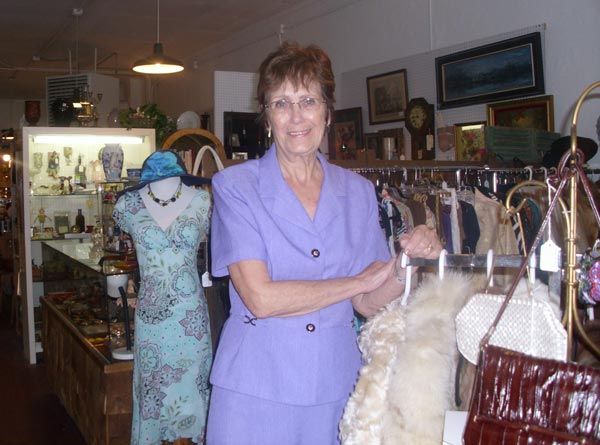
Connie Hoffmann, owner of Adams Street Anitiques & Art. TOLEDO FREE PRESS PHOTO BY BRIGITTA BURKS

“I just love this shop. I never thought I would. I thought it would be fun, but I didn’t realize how much I would enjoy coming in every day,” said Connie Hoffmann, owner of Adams Street Antiques & Art.

Hoffmann used to manage the now closed Erie Street Market, formerly a popular place for antiques. Now many of the former Erie vendors have found a home in her store or at Great Finds on Adams, owned by Julie Hopfer and Lacey Fix. Hopfer and Fix were also vendors at Erie Street Market.

Adams Street Antiques is the largest of the three stores and houses 14 vendors. Hoffmann is one of those vendors and specializes in vintage wares, shabby chic items and glassware.

“I’ve always loved antiques and I’ve always been a collector and I’ve always been interested in them,” she said.

Hoffmann encouraged Hopfer and Fix to open their own store across the street after receiving word that Erie Street was closing in early 2012. Hopfer was one of the first vendors in Hoffmann’s store and Fix had worked closely with Hoffmann at Erie Street.

“I was overall manager, but she was my gal on the spot,” Hoffmann said of Fix, who is also a vendor at Hoffmann’s store.

This kind of camaraderie is typical among all four owners and each encourages shoppers to try the other shops. “We’d like to have it be a destination. Antiquers like to go from one to the other and we make sure that they do … or we suggest it,” Hoffmann said with a laugh.

Hoffmann also makes sure her customers are never bored. She changes the window display every month (June’s theme is brides and summer), serves coffee and tea and keeps her merchandise selection fresh.

“We have people that come in every week because we change our merchandise often or if we don’t get new things, we change the layout so there’s always new things to look at,” Hoffmann said.

Despite the tough economy, Hoffmann said business has been good.

“When things are like they are now people tend to buy antiques because they get nostalgic and they come in and see something that their grandmother had and they buy it for their children or they buy it for themselves,” she said.

Great Finds on Adams

Fix and Hopfer are quick to praise their Adams Street locale and its nearness to the two other stores.

“This corner is a fantastic corner so to leave this corner would be nuts,” Hopfer said. “You name it we’ll have it … or we know someone that already has it.”

“If people can’t find it here, we tell them to go [to Adams Street Antiques] or go two doors down (J. Valentine),” Fix added.

Antiques have been a lifelong interest for Fix. “My mother collected art all my life and I was raised around antiques so it’s always been an interest,” she said.

Hopfer’s introduction to antiques was a little different. In her work in the floral market, “I started displaying certain items I would make on old items and notice that [customers] always wanted to buy the old items, too,” she said.

Great Finds has 12 vendors all with their own personality, including herself and Fix, Hopfer said.

“Here we just have everything; everything but the kitchen sink and that, too,” she said. “We have a lady that’s shabby chic; we have another lady that loves the ’50s and ’60s and the retro stuff and my husband likes the architectural stuff; [Lacey] dabbles in everything.”

“Shot glasses to chandeliers,” Fix chimed in.

J. Valentine Antiques

James Valentine, owner of J. Valentine, didn’t always want to sell antiques — he originally went to school to be a veterinarian. But, one day when he was out walking his dog, he stopped to help a man struggling to carry a dresser. Valentine began working for the man, delivering the furniture, and fell in love with the items.

Now his store, the only of the three without other regular vendors, specializes decorative arts and large furniture, specifically mid-century Danish furniture.

“I have a small shop and that gives me the ability to talk to customers about each item because I know the history of each one,” he said.

Valentine, who used to manage Wildwood Antiques Center, decided to get his own space because “I figured I was outgrowing my basement.”

He didn’t know Hoffmann was renting the space across the street when he signed the lease, but the coincidence seems to have worked out and the two opened their stores together on Nov. 11, 2011.

“With antique stores, you really can’t compete with each other. You could go over there and spend hours. You could come over here and spend hours and you would never see the same thing,” he said.

Despite having larger items than the other two stores, most items in Valentine’s store are under $600.

“In Toledo, we are the bottom of the barrel in prices. My high prices are considered bottom of the barrel anywhere else,” he said.

“People think that buying antiques is so expensive, but it’s really not. It’s actually cheaper than buying new and new stuff doesn’t last too long,” the Detroit native added.

Adams Street Antiques & Art is at 1500 Adams St., Toledo. Store hours are 11 a.m. to 7 p.m. Wednesday through Saturday and 10 a.m. to 3 p.m. Sunday.

Great Finds on Adams is at 1501 Adams St., Toledo. Store hours are 12-7 p.m. Wednesday through Saturday and 10 a.m. to 3 p.m. Sunday.

J. Valentine Antiques is at 1505 Adams St., Toledo. Store hours are 11 a.m. to 6 p.m. Wednesday through Saturday and 11 a.m. to 2 p.m. Sunday.

For more information, visit http://www.uptowntoledo.org.

Coffee Fest a learning experience for Plate 21

0
Toledo Free Press photo by Joseph Herr

Coffee Fest 2012 was more than a latte art competition to Sandy Spang and her crew at Plate 21. It was a learning experience.

From June 8-10, Spang and her best baristas attended the convention in Chicago, which showcased everything new in the coffee world, including advancements in equipment and technique, as well as the newest coffee tastes and textures.

The event brought together some of the world’s most talented coffee businesses and enthusiasts.

“It was full of a lot of really great people,” Spang said.

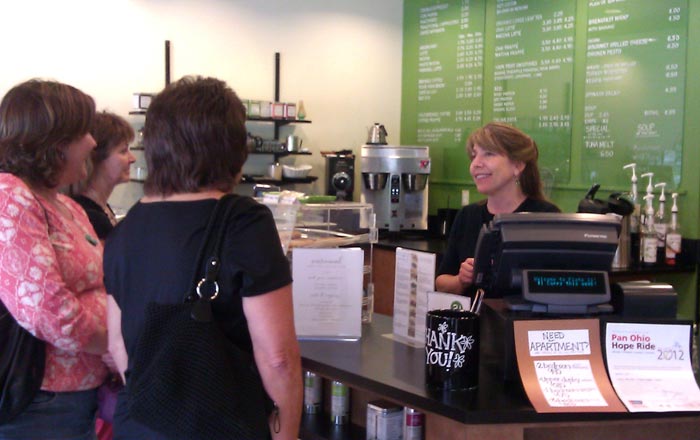
Sandy Spang, owner of Plate 21, serves customers. PHOTO COURTESY PLATE 21

From equipment vendors to roasters to coffeehouses large and small, Spang said the convention was an opportunity for coffee businesses around the world to network and share new ideas, all with the goal of learning from one another.

“It’s not just attended by [coffee shop] owners, it’s attended by equipment vendors, roasters and all sorts of people passionate about coffee,” she said.

Spang purchased new equipment for Plate 21, and also brought back new coffee brands and flavors in order to offer Toledo coffee “it has never seen before,” she said.

“We bought a new grinder developed just for pour-over brewing and we’re going to bring in new coffees,” she said. “When you stay in Toledo and you don’t go to these things, you don’t get to experience all of the new things. … We even had contact with roasters from Seattle. Coffee attracts tremendous folks.”

Latte Art Championship

A featured event at the convention was the Latte Art Championship, a 64-bracket, head-to-head competition between the most talented baristas from around the globe.

All competing baristas had three minutes to pour a drink they were satisfied with. Once the decorated beverage was poured, it was photographed and put on a screen for the audience to see before being presented to the judges.

The drinks were judged on five categories: aesthetic beauty, definition, color infusion, degree of difficulty and creativity, and speed, according to the event’s website.

First prize was $2,500, second place received $1,000 and third place received $500.

Plate 21 baristas John Amato and Andrew Trumbull represented the business in the competition, with a third barista serving as an alternate. While neither placed, they were all grateful for the opportunity and eager for next year’s event.

“It was really neat spending time with some of the best baristas in the world,” Amato said. “It was really great to be a part of that culture.”

The biggest challenges Amato said he and his peers faced were learning the protocols and working on equipment they had never worked on before.

“It was so much different,” he said. “It’s like you’re driving an automatic car your whole life and someone puts you in a manual.”

Spang said she is proud of her baristas and that the knowledge gained from the competition will prepare them to be serious contenders for next year’s Latte Art Championship.

“They have the competition experience; now they need equipment experience,” Spang said. “I think we’re at the level it takes to compete on an international level, but we just need to learn the equipment. I think we stepped it up. We’re there and we’re not done.”

‘Community’s living room’

Plate 21, located at 3664 Rugby Drive, in Toledo, opened Sept. 29, 2009. Then-Mayor Carty Finkbeiner cut the ribbon to the new coffeehouse, welcoming it to the community.

“This is what we need in our community. These are the kinds of businesses we need,” Finkbeiner said.

Spang, who said she wants the shop to be used as the “community’s living room,” said the date was not only the grand opening of Spang’s business, it was also National Coffee Day.

“What serendipity,” Spang said. “We had no idea that we were opening on National Coffee Day.”

Aside from new equipment, Spang said learning from other professionals at Coffee Fest has given her and her colleagues a new outlook on the future of the business.

“That is why you go to places like that,” she said. “It moves you up to a new level. We’ve got a lot of exciting new stuff coming in and we’re really excited about all of the ideas we’re going to be implementing. It was a very productive weekend.”