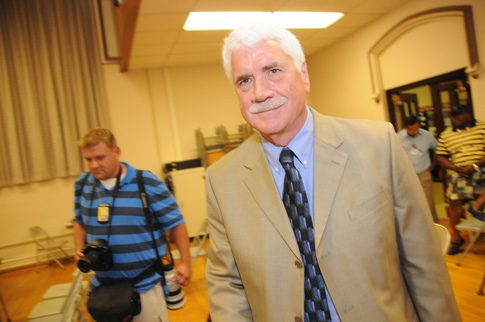
Those serving our country are sacrificing enough; they shouldn’t have to sacrifice their pets as well.
To ensure wagging tails and wet noses are part of the welcome home party, an animal loverin South Carolina offers service men and women a pet foster service. Ohio is one of his busier states because of Wright-Patterson Air Force Base.
Steve Albin started the nonprofit NetPets.org one week after Sept. 11, 2001. Since then, volunteers have fostered 20,000 pets, including dogs, cats, bird, horses, ferrets, rabbits, hermit crabs, a goat and a pot-bellied pig.
In the past, military personnel had to find a family member or friend tocare for their pet. If they couldn’t, they would put the pet up for adoption, take it to a shelter or abandon it, Albin said.
During the Gulf Wars, a minimum of 25,000 pets were put to sleep.
“What type of morale builder is that? To go serve and protect you haveto kill your best buddy.”
The program — recognized by the U.S. Department of Defense as itspet assistance provider — allows for military people to leave their pets with foster families who volunteer for NetPets.
The military person doesn’t haveto be entering combat to use this service either. He or she might be relocating for training or attending a special assignment. Many times they might be temporarily moving their whole family to a place that doesn’t allow pets.
“After they fill out the secure form,we start looking for a foster home. We foster the dogs and birds by breed type and/or size, and keep them as close to the pets’ residence as possible,” Albin said.
Once a foster home is selected, pets visit their foster family with their owner.
“We have a meet and greet on the territory of the foster home. We don’t say‘Meet in the park’ because we want to know if there are going to be any issues,” Albin said. “We only have had to change foster homes or go to a second foster home somewhere around 12 times.”
Military pet owners pay for food, grooming and supplies for their pets, but participation in the program is free.
Albin said his nonprofit helps ease minds of those serving our country.
“Pets are part of the family. As soon as the military pet owners come back, they can pick up their beloved pets,” Albin said.
No participant has died before returning to his or her pet.
For more information go to www.netpets.org/militarypet/foster.php#fosthome.
When Toledo native Peter Brown was 19 years old, he enlisted in the Marine Corps without hesitation.
He was sent to the jungles of Vietnam a few months later.
“It was my generation,” Brown said. “Some guys were going to Canada, some were getting deferments. That wasn’t in my book. I figured I could do something for my country rather than my country doing something for me.”
At age 63, Brown feels the effects of his service every day, as he endures painful diseases brought on by hiswartime exposure to Agent Orange.
The chemical herbicide was used by the United States to kill vegetation and foliage in the Vietnamese jungles.
“Someone from veterans services said it’s like a cancer that’s eating you alive from the inside out,” said Peter’s wife, Conni Urbanski-Brown.
Brown left Vietnam in 1970, and although he experienced some medical problems in the 1990s, his symptoms didn’t flare up until about 10 years ago. He began undergoing medical testing and three years later began receiving U.S. Department of Veterans Affairs (VA) medical care.
Type 1 diabetes, chronic pain, neuropathy and ischemic heart disease — the conditionshave cropped up over time, one after another, said Brown, who has also suffered multiple seizures and heart attacks. He said he often wakes up in the morning wondering what is going to happen that day.
“It stuck out its ugly head, and I was like, ‘Wow, what’s happening?” Brown said. “It had lain dormant for 35 years in my system.” Hard to track
Veterans do not receive compensation for Agent Orange exposure, but for the diseases the dioxin causes. This makes it difficult to know how many veterans are affected by Agent Orange or receiving compensation from the government due to its effects, said Deborah Heaney, staff physician with the VA Ann Arbor Healthcare System.
Heaney said the VA currently recognizes 14 diseases as presumptive conditions that, if a veteran has served in certain areas during certain time periods, qualify them to automatically receive compensation from the government.
Diabetes, a form of neuropathy and ischemic heart disease are three of these diseases, according to publichealth.va.gov.
“For most compensation issues, the veteran has to prove a link between exposure and their condition. For these presumptive conditions, the veteran doesn’t have to prove any causation,” Haney said. “The government has decided it’s the dioxin in Agent Orange.”
The Agent Orange Act, which instituted a process for establishing these presumptive conditions, was passed in 1991. In 1994, the National Academy of Science published the
first report on the diseases that qualify as presumptive conditions. Since then, the government has been adding new conditions to the list.
In the jungle
Upon enlisting, Brown spent eight weeks in boot camp in San Diego, then five weeks in infantry training. He spent 20 days at home in Toledo before being deployed to Vietnam in 1969.
Brown went through the rigorous boot camp with a broken foot.
“I fractured a small bone in the back of my leg, but I didn’t want to mess with karma and get set back another two weeks, so I sucked it up,” Brown said.
He spent seven months in the Vietnam jungle, north of the demilitarized zone, arriving a few months after the Tet Offensive when the war was “starting to die down.”
“The trees were so thick that it would be sunny outside but seem dark on the jungle [floor],” Brown said.
Brown said he encountered pythons, panthers, rats as big as dogs and “bugs you never figured would be on the planet” while overseas, but enjoyed the experience overall.
“I seized the moment because I knew it would never happen again,” Brown said.
Daily exposure
While Brown and his fellow servicemen were stationed in the dense jungle, they were exposed to Agent Orange almost daily.
Brown recalls one 18-day period of monsoon rain during which the gas was not sprayed, but when the weather was clear, five or six C-130s would fly across the jungle and spray the chemical that Brown said looked like snow.
“We would smell the gas fumes, but we didn’t realize it was harming us,” Brown said. “Nobody knew it was dioxin. None of us knew anything about it.”
Brown was especially close to the herbicide, as he worked the radio on the tarmac where helicopters landed, he said.
“They would spray the perimeter and just like that, it would kill [the plants],” Brown said. “The chopper blades were spinning and would send [the Agent Orange] back down to the ground. We were constantly breathing it. When you’re 19, 20, you’ve pumped
gas and smelled those fumes. You don’t figure it will hurt you.”
When Brown returned to the U.S. in 1970, he was offered $6,000 to go to California as a sergeant, but he declined.
“I had a pretty good record so they wanted to make me a sergeant, but I said, ‘Are you kidding me? It’s party time,’” Brown said, grinning.
Urbanski-Brown said Americans were not as supportive of returning troops as they are now.
“We didn’t get the ‘welcome homes’ like they do now,” Brown said. “They called us baby-killers. We had to keep it all inside.”
Brown resumed a job at Doehler-Jarvis Corporation before becoming a semi truck driver, but had to stop working 11 years ago when getting in and out of the truck and loading heavy items got to be too painful and difficult, Urbanski-Brown said. Quality of life ruined
Brown said he was not happy to give up working at age 52. It was the end to a lifetime of work that began when he was 12, working a paper route and setting pins at a bowling alley.
“I was never a guy who liked being on the dole; I like working,” Brown said. “That’s why this just kills me.”
Now, Brown spends most of his days at home, watching old programs on TV. He doesn’t leave the houseregularly except for trips to the doctor every three to six months.
Urbanski-Brown said it’s a struggle for her husband to walk, and he uses a wheelchair to go any farther than the bathroom. She said the VA is supposed to install a ramp and handicap bars in the bathroom, but hasn’t yet.
“It totally ruined his quality of life,” Urbanski-Brown said. “He used to have a boat, a motorcycle and a big old truck. He used to go camping and fishing in Canada.”
Brown takes a dozen different types of medicine every day, alongwith insulin twice a day and steroid injections every three months.
In addition to physical ailments, Brown has been diagnosed with post-traumatic stress disorder (PTSD) and sees a psychiatrist every six months. Some days he experiences depression.
“I have my bad days and my good days. All of us do. Mine are just a little bit more extreme,” Brown said. “But I’m not complaining. The guys that come back from Afghanistan and Iraq are a lot worse off than I am. … I think about [them] every day, which I think we all do, hopefully.”Urbanski-Brown has created a Facebook page to help raise awareness of those affected by Agent Orange, which she describes as “widespread but just not talked about.”
Nearly 30 years have passed since Thomas Belkofer’s days at Rossford High School, but a group of students want to make sure his sacrifice and the service of other military alumni are not forgotten.
The 44-year-old lieutenant colonel was killed by a bomb in Kabul, Afghanistan, on May 18, 2010, during an orientation visit prior to his second deployment. His photo is among those displayed in a case outside the school’s main office. Called the Wall of Honor, the displayincludes 51 photos of alumni, from those who served in World War II to those serving today.
“They span almost the whole history of Rossford,” said Martha Fellman, adviser to the school’s SOS (Serving Our Soldiers) Club, which started collecting photos for the Wallof Honor four years ago.
A second group of photos will be installed this fall.
“We collected enough by last fall that we had our unveiling of the Wall ofHonor,” Fellman said. “We receive more weekly. Every year students graduate and students enlist. We’re planning on keeping it going indefinitely.”
Fallen soldier
A 1983 graduate of Rossford High School, Belkofer had been in the Army for 18 years when he was killed. He was married with two daughters and was the middle of three sons. His two brothers also served in the military. He is buried at Arlington National Cemetery.
Belkofer’s parents, Donald and Sharon Belkofer of Perrysburg Township, said their son was humble about recognition, but would have been honored to be remembered by his alma mater.
“It’s a really neat thing they’ve done. The students have worked very hard to put that together,” Sharon said. “It means a lot. I think Tom would have really appreciated it. He loved what he did, he loved the military. He felt very strongly about the commitment that our country has and he had a great deal of commitment to the soldiers who worked with him. The last thing he really cared about was getting a lot of personal attention, but he was proud of what he had accomplished and I think he would have been pleased they remembered and wanted to include him.”
The idea for the Wall of Honor came from a similar organization at Bowling Green State University. The BGSU club’s adviser helped Fellman start the group in Rossford.
“I just thought it was a really good way to recognize and honor our students who have served, but also to be a reminder to our community,” said Fellman, a businessand computer instructor at the high school. “A lot of time people forget. Unless they see something recently in the news, they just don’t think about the sacrifices the military families and soldiers are making for us. This just seemed like a good way to recognize them and help them in any way we can.”
The club, which has about 30 members, also organizes fundraisers and volunteers at local events that support causes to help meet the needsof service men and women and their
families at home.
Club members dress in costume and hand out candy during the annual Military Family Fun Night at the Corn Maze at the Butterfly House in Whitehouse. They have also raised money for Honor Flight Northwest Ohio, helped send care packages to soldiers in Afghanistan and babysat for children of deployed soldiers while their parents were at meetings.
For more information about the club or Wall of Honor, contact Fellman at (419) 666-5262, Ext. 1329, or [email protected].
Submissions for the wall should include a 5-by-7-inch photo, Rossford High School graduation year, military branch and rank and any other pertinent information. Submissions can be e-mailed to Fellman, dropped off at the school’s office or mailed to Rossford High School SOS Club, Attention: Martha Fellman, 701 Superior St., Rossford, OH 43460.
When Dawn Heisler and her friends started sending care packages to their loved ones serving overseas, they couldn’t have known that years later they’d be sending about 100 each month.
In late 2004, Heisler was sending goods to her grandson Trent, then a Marine serving in Iraq. Now, as head of military outreach nonprofit Heroes in Action, she’s sent thousands of packages to military members and helped out their families in other ways.
“It just multiplied,” said Heisler, who is retired from medical sales.
“We call our boxes hugs from home, just because it reminds [military personnel] of home and that somebody hasn’t forgotten them.”
Care packages include items like baby wipes, shaving cream, Gatorade, Fritos, magazines, cards and more.
“Of course, they get the Girl Scout cookies,” Heisler added.
“It gives you the comfort of home when you’re over there. You just can’t go down to the local store,” said volunteer Bill Batts, who served in the Gulf War. Each month, volunteers pack boxes that are sent to those serving. To receive care packages, a soldier or soldier’s loved one emails Heisler contact information, which is added to a list. The “heroes” receiving the packages also get recognized at heroesinaction.org.
“Once we take on a name, we support them the whole time they’re overseas,” Heisler said. Heroes in Action will often send extra boxes for the soldiers to share with their units. The care packages also include cards and letters from schoolchildren or those living in retirement homes.
“It makes [the soldiers] feel great. They know someone’s back home caring for them, praying for them, loving them, just awaiting their return,” said Leonard Lamb, who served in Iraq. Lamb, a veteran with disabilities, spends much of his time volunteering for Heroes in Action.
Lamb got involved with Heroes in Action about three and a half years ago.
“I’m the one [Heisler] calls. I do literally anything and everything,” he said. Heroes in Action also helps military families and veterans with miscellaneous tasks — from cleaning a soldier’s house while he or she is recovering from surgery to clearing branches from a yard to providing bus fare to a stranded soldier. Many volunteers, like Lamb, a builder, use their skills to help out.
“Remodels, plumbing, electrical, basically if there’s a need for it, we can find someone who will do it,” Lamb said.
Batts started volunteering for Heroes in Action about a year ago when nonprofit helped him get furniture after being homeless.
“It meant a lot to me,” said Batts, who now helps move furniture donations. “I’d do anything for [Heisler].”
Heisler is currently in the process of finding furniture for a military family with five children, who lost their home in a fire.
“Sometimes we can’t do everything because of the funds, but we try to do something and help,” Heisler said.
Those on the receiving end of Heroes in Action are thankful, added Heisler,whose grandson is now in college.
“We get a lot of letters just thanking us for caring, thanking us for sending their packages every month,” she said.
Snack/item donations are accepted at 5025 Glendale Ave., Toledo, from 8:30 a.m. to 4:30 p.m. Monday through Thursday. Furniture donations must be arranged by calling (419) 699-3439.
Checks can be sent to Heroes In Action Military Support Outreach, P.O. Box 352046, Toledo, OH 43635. To learn more, visit the website.
When LaMont Gee was hit in the throat by shrapnel while defending a bridge in Belgium during World War II, his friends thought he was dead.
The 18-year-old was drafted in 1943 and assigned to the Army’s 988th
E n g i n e e r i n g Treadway Bridge Company, which built bridges to replace those
destroyed by the retreating German army.
He was injured during an attack by a German airplane attempting to destroy a recently completed bridge. After a field hospital operation and two months of rehabilitation in England, his voice returned and he rejoined his company in Germany.
“I walked over and the guys just looked at me,” said Gee, now 87, a Silver Star and Purple Heart recipient who served as grand marshal of this year’s Memorial Day parade
in Sylvania. “They said, ‘What are you doing here?’ I said, ‘Where’s my duffel bag?’ It was still in the truck. I got it and we just kept on going. When there’s a job to do, you do it.”
The Sylvania resident’s story is among those archived at the Library of Congress in Washington, D.C., as part of the Veterans History Project.
The ongoing nationwide project, which started in 2000, collects firsthand audio- or videotaped accounts of World War I, World War II, the Korean War, the Vietnam War, the Persian Gulf War and the Afghanistan and Iraq conflicts from veterans as well as U.S. citizen civilians involved in supporting war efforts, including warindustry workers, USO workers, flight instructors and medical volunteers.
The project also collects original documents, such as photographs, letters, diaries and maps.
Tom Barden, dean of the Honors College at the University of Toledoand a Vietnam War veteran, is the Northwest Ohio regional coordinator of the Veterans History Project.
“It’s an amazing project,” Barden said. “To me as an academic, all oral history is important. History is written about the famous people, but to methe more interesting stories are those
of the average person and their lives.”
Local interviewer
More than 75,000 stories have been collected so far, including
more than 500 by retired Sylvania resident Bud Fisher.
“75,000 may sound like a lot, but it’s not when you consider how many millions of peopleserved,” said Fisher, who compiled many of his interviews into two books: “What a Time It Was” about World War II and “Thirty Below on Christmas Eve” about the Korean War.
Each of those millions has a story and Fisher enjoys giving them a voice.
“What I enjoy the most is watching these fellows open up,”Fisher said. “When they came home they didn’t sit their families down and tell them about the war. They took off their uniforms and went back to work or school. A story might have come out here or there, but I provided the means by which they could really open up and talk about their military service from start to finish. I helped to transport them back 60 years to when they were young.”
Copies of the interviews are also archived locally at UT’s Canaday Center or Perrysburg’sWay Public Library. The veteran also receives a copy of the interview.
“That’s like a genealogical treasure,” Fisher said. “When they are long gone, their family can hear their voice, which is priceless. I’d love to hear my grandfather’s voice or my great grandfather’s voice, even though I know a fair amount about them. It’s like a voice from the past.”
Another local interviewer is Richard Baranowski, local history librarian at Way Public Library.
“Fifty years from now, 100 yearsfrom now, a descendent of one of these guys will be able to go to the Library of Congress and see his ancestor on a video camera,” Baranowski said. “Can you imagine if we had that from the Civil War, how valuable that would be today? History dies with people. A lot of the people we’ve interviewed havedied. I think it’s a good idea to see what you can preserve.”
Some veterans are determined to never talk of their experiences again while others find it therapeutic, Fisher said. Some are talkative while others need more prodding to open up.
“No one has ever said I’m sorry I did this. Everybody is happy they did
it,” Fisher said.
Fisher, who served during the Korean War, said being a fellow veteran has helped, but anyone can conduct interviews if they know what questions to ask.
“The process is simple. I take my recorder to their kitchen table and we talk,” Fisher said. “It helps to be a student of history, but you don’t have to be knowledgeable about the war.
You just have to know what questions to ask.”
Fisher asks veterans to bring theirdischarge papers as reference. Barden suggests doing some background research, but then just listen.
“Do your homework, but don’t use it,” Barden said. “People want to feel like you know what they are talking about, but if you start talking like a historian, they might get intimidated.”
Start with a family member, Fisher suggested.
“Everybody’s got a father or grandfather or uncle who was in the service and you can practice on them,” Fisher said. “Not everybody has to do 500 interviews.”
Some veterans tell him their contributions are not important enough to talk about, but Fisher disagrees.
“I tell them not everybody won Medal of Honor, but every story
is important. If you served, your story is important,” Fisher said.
“Historians talk about the generals and the admirals and the leaders of the country. They don’t talk about the people who did the work. This is a way to finally have a history of the common man, the ordinary GI.
We’ve heard enough about Douglas MacArthur and Admiral [Chester W.] Nimitz and General [George S.] Patton. We know all about those guys, but finally we’re going to hear the stories of the guys who made them famous.” For more information about the Veterans History Project, visit www.loc.gov/vets.
Former Lt. Col. Gordon Rolla Lanker, a resident of Toledo, published his first book at the age of 96.
Lanker’s memoir, “Just Another Unsung Hero,” details his lifeas a pilot in World War II, his life leading up to his deployment and his journey back to the workforceupon his return.
Lanker dictated his story on five 90-minute tapes and enlisted the help of his grandson, Cory Lanker, to help put the story into words.
The idea for the book came from Gordon’s wish that he knew more about his great-grandfather’s experiences in the Civil War.
“He was in several important battles in the Civil War,” Gordonsaid. “I thought ‘Wouldn’t that have been nice if he would have kept some kind of diary or something?’
I thought that it would be a good idea to write a book.”
Gordon eventually mentioned the idea to his family, which prompted Cory to push his grandfather toward making the memoir a reality.
RECRUITMENT OFFICES: U.S. Army, Navy, Marine and Air Force Recruitment
4925 Jackman Road
Toledo, OH 43613
Army (419) 292-0358
Navy (419) 475-1561
Marines (419) 292-0388
Air Force (419) 480-1104 U.S. Air Force Recruitment
522 S. Reynolds Road
Toledo, OH 45615
(419) 531-7385 U.S. Army Recruitment
551 S. Reynolds Road
Toledo, OH 45615
(419) 531-3515 U.S. Marine Recruitment
522 S. Reynolds Road
Toledo, OH 45615
(419) 531-0353 U.S. Navy Recruitment
557 S. Reynolds Road
Toledo, OH 43615
(419) 531-7615 Army National Guard Recruitment
925 Research Drive
Toledo, OH 43614
(800) 464-8273 Ohio Air National Guard Recruitment
2660 S. Eber Road
Swanton, OH 43558
(800) 495-4250 Naval Reserve Recruitment
28828 Glenwood Road
Perrysburg, OH 43551
(419) 661-1321 OFFICES: American Red Cross Services
3100 W. Central Ave.
Toledo, OH 43606
(419) 329-2900 • redcrosstoledo.org AmVets Career Center
Herzing University
5212 Hill Ave.
Toledo, OH 43615
(419) 776-0300 ext. 131
amvetscareercenter.org Area Office on Aging
2155 Arlington Ave.
Toledo, OH 43609
(419) 382-0624 • areaofficeonaging.com Bowling Green AmVets
1045 N. Main St., Ste. B
Bowling Green, OH 43402
(419) 352-4800 Disabled American Veterans
dav.org FOCUS Homeless Housing Services
2283 Ashland Ave.
Toledo, OH 43620
(419) 244-2175 • focustoledo.org Lucas County Homelessness Board
1946 N. 13th St.
Toledo, OH 43604
(419) 244-9440
endinghomelessnesstoledo.org Lucas Metropolitan Housing Authority
211 S. Byrne Road
Toledo, OH 43615
(419) 259-9448 • lucasmha.org Lucas County Veterans Services
1301 Monroe St., Suite 180
Toledo, OH 43604
(419) 213-6090 Lutheran Social Services
2149 Collingwood Blvd.
Toledo, OH 43620
(419) 243-9178 • lssnwo.org Ohio Dept. of Veterans Services
77 S. High St., 7th Floor
Columbus, OH 43215
(614) 644-0898 • dvs.ohio.gov The Source
1301 Monroe St.
Toledo, OH 43604
(419) 213-JOBS (5627)
thesourcenwo.com Toledo AmVets
4133 N. Summit St.
Toledo, OH 43611
(419) 726-0724 • amvets.org United Way of Greater Toledo
424 Jackson St.
Toledo, OH 43604
(419) 248-2424 / Emergency 2-1-1
unitedwaytoledo.org United Way of Wood County
1616 E. Wooster St., Unit 25
Bowling Green, OH 43402-2763
(419) 352-2390 Veterans Affairs Healthcare System
annarbor.va.gov Veterans Affairs Outpatient Clinic
3333 Glendale Ave.
Toledo, OH 43614
(419) 259-2000 Vet Center of NW Ohio
1565 S. Byrne Road
Toledo, OH 43614
(419) 213-7533 Wood County Veterans Assistance
1616 E. Wooster St., Unit 22
Bowling Green, OH 43402
(419) 354-9147 FOR STUDENTS: Lourdes University
6832 Convent Blvd.
Sylvania, OH 43560
(419) 824-3732 Owens Community College
Veterans Services
(567) 661-VETS (8387)
www.owens.edu/veterans/index.html University of Toledo
Military Service Center
Main Campus
Rocket Hall Room 1529
Mail Stop 343
Toledo, OH 43606
(419) 530-1392
utoledo.edu/call/military OTHER RESOURCES/GROUPS: 1Matters: Veterans Matter
(800) 361-8387
1matters.org American Legion
(800) 433-3318 • legion.org The Arms Forces
P.O. Box 981
Maumee, OH 43537
thearmsforces.org Blue Star Mothers of America
bluestarmothers.org Flat Daddies
(855) 206-8810 • flatdaddies.com Heroes in Action
P.O. Box 352046
Toledo, OH 43635
heroesinaction.org Honor Flight
P.O. Box 23018
Toledo, OH 43623
honorflightnwo.org USO
(888) 484-3876 • uso.org Wounded Warrior Project
(877) TEAM-WWP (832-6997)
woundedwarriorproject.org Veterans of Foreign Wars
(614) 224-1838 • vfw.org
— Compiled by Brigitta Burks
“An American tragedy” is how one longtime local Red Cross volunteer describes post traumatic stress disorder (PTSD ) and other issues faced by military members.
“The psychological stress that many members of the armed forces face — problems such as PTSD and suicide — is an American tragedy that will get worse and worse unless the issue is addressed now,” said Fred Vallongo, a volunteer with the Greater Toledo Area Chapter of the American Red Cross.
Reconnection workshops
Vallongo is a volunteer mental health worker for the local Red Cross chapter as well as a national instructor for the organization’s Reconnection Workshops. The workshops are designed to offer support and education to service members and their families.
“Toledo and Northwest Ohio are historically military-friendly areas. We have high numbers of people who enlist in the military and a lot of the problemswe face are reconnecting families (after deployment),” said Vallongo, a veteran who served as a Navy hospital corpsman in the Marine Corps and has been involved with the Red Cross for 17 years.
“For every joyful reunion that is shown on the local news, there is always a tenser issue somewhere else.”
The Reconnection Workshops range from lessons on communicating clearly to exploring stress and trauma. Family members also learn how to identify signs of depression in theirloved ones and what they can do to help.
Other workshops are available to returning military members who have difficulty preparing for deployment or assimilating back to their lives at home. The classes include topics suchas “Working Through Anger” and “Relating to Children” and provide military members with the counseling and information needed to reconnect with their families.
Emergency messages
The local Red Cross chapter also provides an emergency communications service that directs messages from family members to active military members wherever they are stationed.
“The military relies on the Red Cross to verify the conditions of an emergency back home,” said Ken Robinson, Red Cross regional director of programs and services. “Sometimes the emergencies are happy news, such as a recent birth, but most of the calls received are for sad news regarding a death in the family.”
After a family reaches out to theRed Cross with their personal emergency, the organization immediately contacts the hospital or funeral home to confirm details. An official message is then sent overseas to another Red Cross office closer to the family’s service member. A military officer responds before relaying the message to the intended receiver, who can then formally ask the unit’s commander for temporary leave.
The Greater Toledo Area Chapter delivered between 300 and 400 emergency messages last year, Robinson said.
“At the local level, we also do family follow-ups (after sending the message) to find out how the family members are doing or if they need anything through our resources,” Robinson said.
“Once we’re confident that the family is OK, we will close up the case.”
Volunteers are always needed and appreciated, Vallongo said.
“Less than 1 percent of the population serves in a uniform that helps protect our country,” Vallongo said.
“Servicemembers, firefighters, police officers — those people risk their lives every day for our safety. They have a heavy load to carry for the rest of us. I encourage the other 99 percent of us to find ways to help those brave men and women. If you look for a way to help, I’ll guarantee you’ll find a way.”
To learn more about Red Cross service programs for veterans and military families, contact the local chapter at (419) 329-2900. Volunteer inquiries and donations can be offered by visiting www.redcrosstoledo.org or www.redcross.org.
Every day, the horrors of war push at least one Iraq or Afghanistan war veteran to commit suicide — a statistic that 1,600 new mental health professionals throughout the nation’s Veterans Affairs (VA) system will soon begin fighting.
The federal announcement of the increase in clinic staff follows a 35 percent increase in demand for mental health help across the country, said Rep. Marcy Kaptur.
She said the change is a transformative one.
“This is a legislative battle that I have fought in Washington since my early years. It’s been three decades of effort to try to get the Department of Veterans Affairs to give equal attention to neurological damage as they do to spinal cord injury,” Kaptur said.
At least nine of the new mental health professionals are coming to theToledo and Ann Arbor region, following a few years of increased mental health service requests.
Since 2007, the VA Ann Arbor Healthcare System, which operates Toledo’s Outpatient VA Clinic, has added 30 percent more mental health staff, said Robert McDivitt, director of the VA Ann Arbor Healthcare System.
The announcement also coincides with Toledo’s new outpatient VA clinic, slated to open this fall.
The current clinic on Glendale Avenue was built in 1978 and covers 30,000 square feet. It will move into a new space at 1200 S. Detroit Ave. that will cover 66,000 square feet.
McDivitt said the system expects to care for 12,000 veterans this year.
A few years ago the clinic was handling at least 2,000 fewer patients.
The Toledo clinic has 110 staff members and the new one will employ about 122.
“We really outgrew the space,”McDivitt said. Increased local service
In the past, patients needing cardiac stress testing, diagnostic testing for blood flow problems and audiology testing services had to travel to Ann Arbor for treatment. But the Toledo clinichas added some of these services within the past year, and will soon build on them further with the new building.
Doctors will be able to perform occupational therapy in the new facility, a service not available at the Glendale Avenue location, said Leo Greenstone, associate chief of stafffor ambulatory care.
The system is also recruiting a psychologist to conduct compensation and pension exams for the first time in Toledo, a service that vets were traveling to Cleveland for in the past, McDivitt said.
Telemedicine has helped boost treatment at the Toledo clinic as well, linking a doctor in Ann Arbor into a video conference with patients in Toledo to save local veterans a few trips north, said Stephen Chermack, chief of mental health.
Caring for patients with posttraumatic stress disorder (PTSD) is a process that varies with each veteran, Chermack said. Treatment typically consists of a combination of pharmaceutical drugs and psychotherapy. He said some veterans choose to stabilize other factors in their lives before starting to address memories that trigger depression and reoccurring, disturbing thoughts.
More work needed
Kaptur said more work still needs to be done. Patients will still be unable to access infusion treatments for cancer. A free bus transports 40 to 60 veterans a day from the Toledo clinic to the Ann Arbor hospital.
“The Ann Arbor Veterans Hospital is a massive facility and because it’s so large it consumes a lot of time in finding parking. We have vets who go up there for cancer infusions, they’re made to wait all day to go back on the bus and it’s not very pleasant,” Kaptur said. “And for those with neurological conditions, you have to have services close to where people live and work. To make someone travel an hour and wait all day and wait weeks for an appointment doesn’t work.”
The Arms Forces
A Maumee woman founded a nonprofit called The Arms Forces in 2009 because of what she saw as a lag in services for people s u f f e r i n g from traumatic brain injury and PTSD . Pam Hays, herself a traumatic brain injury survivor, has since linked at least 200 veterans to services that will help them cope. She and a volunteer coordinator are the main operators of the organization.
“It’s a complicated, convoluted system for anyone, and if you have someone coming back with a brain injury or PTSD , they’re going to have cognitive challenges and they’re going to have a much more difficult time accessing that system,” Hays said. “The way we try to do everything is very simplified. We want to meet [veterans] where they are rather than get them to go through hoops to find help.”
The Ann Arbor system is adopting a similar model by initiating an outreach program that sends social workers into communities to search for veterans who may not be linked to VA health services yet, McDivitt said. The system now has six outreach workers who work with homeless and formerly homeless vets.
The new Toledo clinic is designed to not only serve medical needs but educational needs as well. McDivitt described the new layout as a “healing environment,” equipped with a coffee shop and Internet cafe where families can gather. The new site will feature a
veteran resource center and a community meeting room, as well as a “wall of heroes” on which Toledo-area veterans can post their photographs. The design of the new place is “bright, open and sunny,” touched with artwork that is centered around veterans, he said.
“Our mission here in the VA begins with the three words, ‘Honor America’s veterans,’ and you’re going to see that mission reflected from the time the veteran comes inthe new clinic until he or she leaves,” McDivitt said.
For more information, visit www.annarbor.va.gov.
Don Zellers considers himself the typical Toledo taxpayer.
At 41, Zellers is married and, for the first time in his life, the owner of a house, which he and his wife purchased five years ago. In October, Zellers, who has lived in the Toledo area all his life, lost his job with Clear Channel Toledo after surviving a few rounds of cutbacks.
Zellers works part-time positions with Clear Channel and Great Lakes Trivia, and began freelance writing for local publications, including restaurant reviews for Star, after being out of work for a month and a half.
He said he feels frustrated and overwhelmed with the seven levies Lucas County voters will face Nov. 6: five county levies, the Toledo Public Schools (TPS) 6.9-mill continuing levy for those in the TPS district and the 1-mill Parks and Recreation levy for Toledo citizens.
“A lot of people, including myself, are not getting raises and are making less money than they did last year, but the city expects us to pay more,” Zellers said. “And if you’re already making less money, where is that money supposed to come from? … It’s not like I’m living in abject poverty, but I’m definitely not living on the high horse.”
As an on-air personality with Fred LeFebvre on the 1370 AM WSPD morning show, Zellers has become the face of a station campaign to address the “levy fatigue” and its effect on the wallets of county taxpayers.
“What about Don?” is the question LeFebvre asks his listeners to consider when they head to the polls this November.
“We want people to begin to think of Don and themselves when they go to vote,” LeFebvre said. “It’s an individual choice, not a group or city choice.
“Think — do you want to raise your taxes? Can you afford it?”
Toledo-Lucas County Public Library
The Toledo-Lucas County Public Library is placing a 2.9-mill levy on the ballot that if passed will replace and increase their 2-mill levy, which is due to expire at the end of this year. The current 2-mill levy has been in effect for four years. The proposed levy will not require renewal for five years.
The levy will cost the owner of a $100,000 home $88.80 per year for five years, according to a newsletter on the Toledo Regional Chamber of Commerce’s website, toledochamber.com. This is a $27.55 per-year increase from the $61.25 taxpayers owning $100,000 homes have paid each year since 2007.
Rhonda Sewell, library media relations coordinator, said this levy is expected to generate $21 million to $23 million per year, which she said accounts for about half of the library’s budget. The other half is provided by the State of Ohio Public Library Fund (PLF).
A library operating levy has not been defeated since 1977. Sewell said a capital levy failed in 1991 but when reintroduced in 1995, it passed with 74 percent of the vote.
Clyde Scoles, executive director of the Toledo-Lucas County Public Library, said the 1995 capital levy was one of the largest bond issues passed
in Lucas County at the time. It upgraded, expanded and modernized the library system, Scoles said.
In 2009, 17.8 percent of the library’s state aid was cut. Since then, about 27 percent of library hours have been cut. The Sanger branch on West Central Avenue is the only library left with Sunday hours. Sewell said the library is operating at 1996 levels of funding from the state.
While Sewell said the library cannot promise all previously cut hours will be restored, the levy is expected to return the hours, staff members and materials lost in the cuts. Scoles said 50 percent of the current hours may have to be cut if this levy does not pass.
Scoles said he is hoping the increased levy generates $5 million to $6 million more per year for the library system that recorded nearly 3 million visits in 2011. Scoles and Sewell cite the variety of services the branch provided by the 19 neighborhood branches, where attendance has remained high during tough economic times, as reasons voters should support the library levy.
“We’re not talking so much about helping the library system but saving the library system,” Scoles said. “… People come for a variety of reasons — job information, homework help. Businessmen come in and grow their businesses using our databases and the expertise of business librarians and information centers. All of that would be curtailed quite a bit if our budget was cut by 50 percent.
Metroparks of Toledo Area
Metroparks of Toledo Area plans to become the most recent addition to the ballot for Lucas County voters, as the board of directors decided July 25 to place a 0.9-mill levy before voters in November.
The 0.9-mill levy would replace the 0.3-mill levy that expires at the end of its ten-year term on Dec. 31. If passed, the 0.9-mill levy will require renewal in 10 years.
This levy provides the funds for the
Metropark system’s land acquisition, improvement projects and park operations, said Executive Director Steve Madewell.
The Metroparks’ 1.4-mill general operating levy, which is also a ten-year levy, is not set to expire for another five years.
According to the The Toledo Regional Chamber of Commerce, the owner of a $100,000 home would pay $27.56 per year, an increase of $19.10 from the $8.46 citizens pay to the current levy.
The last time a Metroparks levy failed was in the early 1990s, said Scott Carpenter, director of public relations for Metroparks. It was presented to the county the following year and passed.
Because of the long-term nature of Metropark projects, this upcoming levy would help finish projects at various stages of planning including the Middlegrounds in Downtown, the Blue Creek Conservation Area in Whitehouse and the Fallen Timbers Battlefield in Maumee, Carpenter said.
It would also provide for purchasing new land and maintaining the current parks.
“In addition to the completion of those projects, it would go toward the replacement and maintenance of restrooms, picnic areas, shelters and things like that,” Madewell said. “What we’re really focused on is preserving natural areas of open space and keeping clean, safe, natural and free Metroparks across the county.”
Lucas County Children Services
Lucas County Children Services will be represented on November’s ballot with a 1.85-mill levy. This is a 0.85 increase from the current levy, which will expire its five-year term in December 2013.
If passed, collection on the 1.85-mill levy wouldn’t start until 2014 and would continue for five years. Julie Malkin, the agency’s public information officer, said the agency is placing the issue on the ballot this year to better plan their finances in the coming year.
The 1.85-mill levy would cost the owner of a $100,000 home $56.66 per year, an increase of $26.04 on the current $30.62 per year paid to the 1-mill levy, according to the Chamber of Commerce.
Last year, voters approved a 1.4-mill levy for Children Services that will require renewal at the end of its five-year term. Combined, the agency would receive 3.25-mills from the county’s citizens, a decrease from the 3.5-mills the agency collected in 2001.
“We decreased our levy millage because we felt like we didn’t need to collect that much from taxpayers. We want to have a sound financial standing so that we make sure the children in Lucas County are safe,” Malkin said.
Federal funding, which makes up the bulk of the remainder of the agency’s funding, has been cut over the years. Malkin said local levy dollars are matched by federal dollars, so if the levy does not pass, more federal funding will be cut.
“We’ve been able to maintain the staffing levels of people that actually go out and see kids,” Executive Director Dean Sparks said. “Internally we have done everything we can to become a leaner system.”
The agency will have to cut $800,000 out of its budget if the levy passes, Sparks said. If it doesn’t pass, $13 million to $14 million of the agency’s $43 million will have to be cut.
“If it doesn’t end up passing this time or next time, that’s going to affect direct services for kids, services we contract for,” Sparks said. “We spend $350,000 for substance abuse services. Child advocacy contracts would be in danger, mentoring and tutoring for children would be in danger, not to mention there would be a significant layoff of our staff.”
Imagination Station
Imagination Station will ask voters to renew its 0.17-mill levy, which is set to expire at the end of 2013. The new levy would not take effect until 2014 and would continue for five years.
Executive Director Lori Hauser said the levy would generate about $1.3 million of the organization’s $3.2 million revenue by costing owners of a $100,000 home $5.21 a year.
Lori Hauser
The other $1.9 million is earned money, which comes from gate admission, memberships, corporate sponsorships, development and donations.
Twenty-seven percent of the nonprofit science center’s public funds go to exhibit maintenance and rental, Hauser said.
The rest goes to general operations and science education.
“We aren’t here to replace schools, we are here to work with schools,” Hauser said. “We’re wanting to get [kids] excited about [science]. Those are the careers of the future and we want to educate our youth.”
Hauser said corporations have invested $1.5 million in exhibits since 2009, including “Eat it Up!” with ProMedica and “Grow U” with The Andersons.
Hauser said Imagination Station is going on the ballot this fall because in case the levy does fail, like it did in 2006 and 2007 when it was called COSI, the extra time before the levy expires will give the center the opportunity to talk to citizens of Lucas County and find out their concerns and suggestions.
Mental Health and Recovery Services
The Mental Health and Recovery Services Board of Lucas County has placed a 10-year, 1-mill levy on the ballot. The board’s last levy renewal was passed in 2008, so this levy would generate new money for the agency.
Executive Director Scott Sylak said the agency has not asked taxpayers for new money in 24 years.
This levy would cost $30.62 per year for the owner of a $100,000 home, according to the Chamber of Commerce. This is in addition to the levy dollars already being collected by the agency’s 2008 levy.
“Basically, over the last six years, including this fiscal year, we’ve lost nearly $7 million. We’ve had to utilize $3 million of our reserves. We’ve cut our services by about $3.9 million and used $3 million of cash to supplement those losses to make up that gap. The issue now is we no longer have the reserve to supplement (our funds). We have no choice but to ask for new, additional dollars,” Sylak said.
Sylak said the agency has cut board and administrative services by more than 25 percent and has worked with its provider networks to improve the efficiency of the system and implement outcome measures to determine how effective the services are. Non-management staff has received one small pay increase in the past five years while executive and management staff haven’t received any increase.
“We don’t plan on increasing the amount of administration with these dollars at this time. We will critically evaluate the services that are most important to reinvest in, including treatment, medicine, housing, crisis support services and the expansion of kids services,” Sylak said.
Sylak said the levy will get the agency close to the dollar amount it has lost during the past six years.
Division of Recreation
Toledo City Council approved a new 1-mill levy for this November’s ballot, which would require renewal in 10 years.
Toledo City Councilman Steve Steel said the levy is expected to generate about $3 million per year for parks and recreation maintenance and programming.
Owners of a $100,000 home would pay $30.62 per year if the levy passed, according to the Chamber of Commerce.
Steel said Toledo has never had a recreation levy but almost every other community in the area has, including Maumee, Oregon and Sylvania.
Recreation funding comes from the city’s general fund, and when cuts must be made, parks and recreation funding is at the top of the list, Steel said. If this levy is passed, he said, the general fund might be loosened up for other city endeavors.
A task force of community members created a report that suggested multiple recommendations for raising funds for the recreation division. Steel said in addition to a levy, recommendations included charging for parking and admission into city swimming pools.
Steel said the city already charges admission into its pools and parking at Walbridge Park. Steel said other options they could have chosen were increasing summer baseball recreational league fees and charging for parking at all park locations.
City Council also chose to use funds from the Athletic Commission to fund a master plan. The master plan will determine what is needed from the city parks system and implement decisions made by citizens.
“We need to look at what is needed overall for recreation. Where are the gaps and what can the city do to fill those gaps?” Steel said.
Councilman Mike Craig has asked the city administration to hold off on demolishing the pools that have been identified for demolition. Steel plans to join Craig’s effort until taxpayers have the chance to create a dedicated funding stream for city recreation by passing this November’s levy.
Toledo Public Schools
Toledo Public Schools (TPS) is asking taxpayers to approve a new 6.9-mill continuing levy, which according to the Chamber of Commerce will cost the owner of a $100,000 home $211.28 per year.
The district is under investigation by the Ohio Department of Education for attempting to erase low attendance records by retroactively withdrawing and re-enrolling frequently absent students. Pecko went public with the district’s actions last week.
Jerome Pecko
The money from the levy would fund the district’s current transformation program and balance the budget beyond the 2012-13 school year. While the 2012-13 budget is currently balanced, a failed levy in November would mean drastic cuts the following year.
“Without additional funding at this time, the district will have to cut an excess of $15 million before the beginning of the 2013-14 school year,” TPS Superintendent Jerome Pecko said at a news conference in May.
“6.9-mill is not going to get us what we need but we think that the community can support it,” said Jim Gault, chief academic officer for TPS.
The school system has made staff cuts along with cutting middle school sports and ninth-grade sports, the gifted program in grades three through six, busing for high schools and altogether eliminating Libbey High School. TPS has since brought back some of the sports programs.
Pecko said that the proposed levy would allow the district to pursue a new district-wide discipline program, a unified student data program for parents and teachers, the gifted program for grades three through six and employee evaluations based on student performance.
School Board President Lisa Sobecki urged voters to consider what the levy provides.
“I’ve personally had to do this in my own life: looking at our home budget and putting values behind choices, and I would ask the citizens of Toledo to do that and put values behind those budgets and think of the students that we serve and look at what they’ll be doing some day. They might be your pharmacist, your lawyer … we need to have an opportunity for a solid foundation.”
In November 2010, TPS proposed Issue 5, a 7.8-mill levy which voters rejected. That levy, which would have generated roughly $21.6 million, was the second to fail in 2010 as TPS attempted to meet its $40 million deficit.
Issue 5 would have been the highest millage amount passed for TPS in the past four decades, and the first levy passed for TPS since 2001.
Umbrella levy
Lucas County Commissioner Pete Gerken has suggested discussing an “umbrella” levy, encompassing all health and human services issues. Gerken said a few members of the Chamber of Commerce and the Citizens’ Review Committee are interested in being the sounding board for such a discussion, which Gerken said will likely occur after the November election.
“I think everyone has some thoughts about the number of levies and the crossover of services like human resources, finances and ‘backroom operations’ the organizations all do separately,” Gerken said.
Gerken said Ohio’s Montgomery County does a health and human services umbrella levy, and Gerken wants to facilitate a discussion to see if that could possibly work in Lucas County. Gerken said he does not know about the success or failure Montgomery’s levy has had.
“Any discussion we have will be unique to Lucas County. Certainly the concept of doing things in a coordinated fashion makes sense to me,” Gerken said.
Gerken said he has no notion of how the funds from this levy would be distributed, but said collection by the auditor and distribution by the commissioners is one idea to discuss.
“We may find out it doesn’t work, but until we sit down and everyone puts down their pieces we won’t know,” Gerken said. “Eventually, there’s going to be winners and losers. With evaluations down 12 percent, there’s less resources and we owe it to everybody to start working together.”
Adding it up
If the seven levies are passed in November, the cost to taxpayers owning a $100,000 home would be $450.75, up $105.54 per year, according to the Chamber of Commerce.
Once property evaluations received feedback from the state at the end of October, citizens will be able to calculate the exact amount they will owe in property taxes on the Auditor’s Real Estate Information System, available online at co.lucas.oh.us.
“I know people need money and there’s some good causes out there,” Zellers said. “But I don’t know this time. I’m not sure. … I don’t know if I can vote for any of them. I’ll have to really look at them all and decide.”
Editorial cartoon by Don Lee for the Toledo Free Press.




 Learn more at