Home Blog Page 270

SWAT teans train at Owens Community College

0
Perrysburg police offiers train in a simulated environment at Owens Community College. Toledo Free Press photo by Erik Gable.

“Police! Search warrant!”

With that warning, SWAT team members filed into the office of a doctor suspected of running an illegal pill mill, weapons at the ready.

The raid was a simulation and the office part of a mock city on the Owens Community College campus, but the officers approached it as they would a real operation, spreading out, checking each room and calling reports to comrades.

“Door right, door right.”

“We got a counter here we can’t see underneath.”

“Clear in here! One suspect in custody.”

The weeklong training session, which started June 11, was the first such program to result from a new partnership between Owens and the Ohio Tactical Officers Association (OTOA).

“They have the expertise, we have the facilities, and together we can put on a stellar course,” said Michael Cornell, director of the Owens Community College Center for Emergency Preparedness.

Cornell said although other organizations provide tactical training for law enforcement, this is the only one sanctioned by the OTOA.

Robert Grooms, left, and Dave Molter, both of the Perrysburg Township Police Department, take part in SWAT training at Owens Community College. TOLEDO FREE PRESS PHOTO BY ERIK GABLE

Owens opened its $20.5 million Center for Emergency Preparedness in 2007, aiming to provide realistic training grounds for all kinds of emergency personnel.

The 240-acre facility includes a mock city with buildings representing a bank, gas station and hospital emergency department. There’s also a collapsed building, a train yard, a high-rise, a 32-foot-deep pond for diving rescue operations, an area for agricultural accident simulations and a Boeing 727 for airport exercises.

“We have, really, the ability to train anybody that needs to be trained,” said Cornell, a former Army Ranger who has also worked for the Department of Defense and Department of Homeland Security.

The center also has indoor and outdoor training towers that can simulate fires, situations with a gunman in a building and other emergencies. In addition to using projection screens, instructors can turn on sprinklers or pipe in distracting noises to make the scenario as realistic as possible.

“It gives us the ability to have a mega-lab, so to speak, for our students,” Cornell said.

And with so much space, several agencies can train simultaneously.

Joe Ball of the Perrysburg Township Police Department and Scott Sims of the Lake Township Police Department, who jointly command a new SWAT unit serving northern Wood County, served as assistant instructors for the week’s training. Ball said serving high-risk warrants — the scenario for many of the training exercises the group went through — makes up much of SWAT teams’ work.

“We’re not just walking into somebody’s house — this is high-risk stuff here,” Ball said. “When we enter, things are very, very volatile and dangerous.”

Sims said it can be hard for SWAT teams to find places to train. They often have to negotiate access to abandoned buildings and worry about bothering neighbors.

“It’s great for Northwest Ohio to have a training facility where we can do everything in one spot,” he said.

Patrick Fiorilli, president of the OTOA and the commander of a Cleveland-area SWAT unit, agreed.

“I have not seen a facility like this anywhere in Ohio,” Fiorilli said. “It’s very unique. It’s almost like a one-stop shop for us for tactical training.”

Fiorilli said Owens and the OTOA would also like to use their partnership to give patrol officers more access to tactical training, possibly helping them head off dangerous situations before they escalate.

Owens and OTOA plan to offer training twice a year at first, with advanced SWAT training and sniper school offered as well. Owens will also be the site of OTOA’s five-day annual training conference in May 2013, which is expected to draw more than 900 law enforcement officers from across Ohio.

An area SWAT team trains at Owens Community College. TOLEDO FREE PRESS PHOTO BY ERIK GABLE

The English Beat: ‘A combination of all the music that ever turned us on’

0
The English Beat's Dave Wakeling. Photo byi Bryan Kremkau

With their frenetic, fun cover of “Tears of a Clown” in 1979, The English Beat began blending musical styles in search of the perfect hybrid of sound.


Dave Wakeling of The English Beat by Bryan Kremkau

“We wanted a combination of all the music that ever turned us on, and we wanted to put that together in a way that would make people dance and then give our social opinion on a topic and try to get away with it whilst they were dancing,” said Dave Wakeling, singer and guitarist, with a laugh.

The group served up ska, reggae, soul, pop, punk and world music and landed on the charts in the early 1980s with “Save It for Later,” “Mirror in the Bathroom,” “Hands Off…She’s Mine,” “I Confess” and “Can’t Get Used to Losing You.”

“We never used any of the latest doodads; we used classical instruments and classical recording methods. And thank heavens we did because otherwise we’d have records with Japanese bamboo flutes (imitates one) like everybody else did,” Wakeling joked during a call from his home in Pacific Palisades, Calif.

Wakeling, guitarist Andy Cox, singer Ranking Roger, bassist David Steele, drummer Everett Morton and saxophonist Lionel Augustus Martin helped put together “Keep The Beat: The Very Best of The English Beat” and a box set titled “The Complete Beat,” which will be released July 10 by Shout! Factory.

The five-disc box set features the band’s three studio albums and previously unreleased material.

“There was some sort of kismet about [how the group came together]. It fell together so magically that you kind of had the sense it wasn’t going to last forever, you know, that you should make the best of it while it’s there, and that’s what we did,” Wakeling recalled.

“After three albums, you either really mean it or you’re pretending, and we were definitely pretending at that point. And because we were so grateful that we ever got a chance to start in the first place, it felt like it was the decent thing to pull the plug,” the singer-songwriter said.

Wakeling and Roger went on to form General Public, known for the songs “Tenderness” and a cover of “I’ll Take You There.”

Wakeling will bring The English Beat — drummer Rhythmm Epkins, bassist Wayne Lothian, toaster Antonee First Class, saxophonist Matt Morrish and keyboardist Kevin Lum — to Mickey Finn’s Pub for an 8 p.m. show June 21, 2012. Tickets are $25 and $30.

“I always dreamt of being in a group. I never thought anybody would hear my songs, and I love it best that people would still be interested in them 30 years later. It’s the most wonderful honor,” Wakeling said.

“I mean, the money’s great, and the fast cars and the fast women and all of that, but they all come and go. If a song says something to you, that means the world to me.”

Trio of antique shops thrives on Adams Street in UpTown

0

Whether it be a wooden table or a vintage dress, antique-lovers can likely find whatever they desire inside the triangle of antique stores on Adams Street.

Adams Street Antiques & Art and J. Valentine Antiques opened in November followed by Great Finds on Adams in February. All three are located on the 1500 block of Adams Street. Rather than view each other as competition, the owners said the other locations provide more selection for customers.

“They feel that it’s beneficial. They call it clustering when shoppers come to a district and they can’t find an item in one store, [owners] can send the customer down the street,” said Julie Champa, executive director of the UpTown Association.

The three stores also contribute to the growing economy of Adams Street located in UpTown Toledo. “The antique stores add to the vibrancy of the neighborhoods. We think that antique stores are a really good fit for the types of businesses that we’re looking to attract,” Champa added of the community with about 1,000 residents and restaurants like Manos and Manhattan’s.

Adams Street Antiques & Art

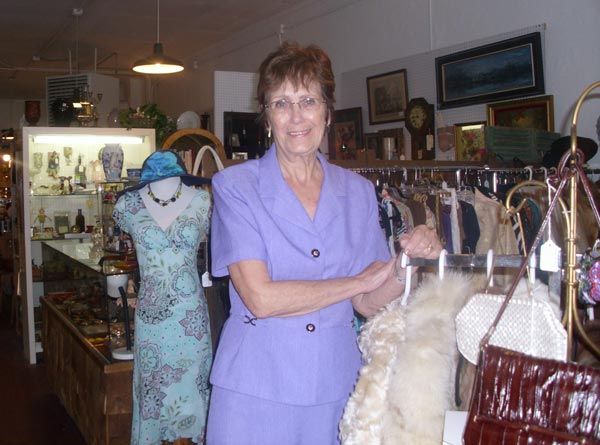
Connie Hoffmann, owner of Adams Street Anitiques & Art. TOLEDO FREE PRESS PHOTO BY BRIGITTA BURKS

“I just love this shop. I never thought I would. I thought it would be fun, but I didn’t realize how much I would enjoy coming in every day,” said Connie Hoffmann, owner of Adams Street Antiques & Art.

Hoffmann used to manage the now closed Erie Street Market, formerly a popular place for antiques. Now many of the former Erie vendors have found a home in her store or at Great Finds on Adams, owned by Julie Hopfer and Lacey Fix. Hopfer and Fix were also vendors at Erie Street Market.

Adams Street Antiques is the largest of the three stores and houses 14 vendors. Hoffmann is one of those vendors and specializes in vintage wares, shabby chic items and glassware.

“I’ve always loved antiques and I’ve always been a collector and I’ve always been interested in them,” she said.

Hoffmann encouraged Hopfer and Fix to open their own store across the street after receiving word that Erie Street was closing in early 2012. Hopfer was one of the first vendors in Hoffmann’s store and Fix had worked closely with Hoffmann at Erie Street.

“I was overall manager, but she was my gal on the spot,” Hoffmann said of Fix, who is also a vendor at Hoffmann’s store.

This kind of camaraderie is typical among all four owners and each encourages shoppers to try the other shops. “We’d like to have it be a destination. Antiquers like to go from one to the other and we make sure that they do … or we suggest it,” Hoffmann said with a laugh.

Hoffmann also makes sure her customers are never bored. She changes the window display every month (June’s theme is brides and summer), serves coffee and tea and keeps her merchandise selection fresh.

“We have people that come in every week because we change our merchandise often or if we don’t get new things, we change the layout so there’s always new things to look at,” Hoffmann said.

Despite the tough economy, Hoffmann said business has been good.

“When things are like they are now people tend to buy antiques because they get nostalgic and they come in and see something that their grandmother had and they buy it for their children or they buy it for themselves,” she said.

Great Finds on Adams

Fix and Hopfer are quick to praise their Adams Street locale and its nearness to the two other stores.

“This corner is a fantastic corner so to leave this corner would be nuts,” Hopfer said. “You name it we’ll have it … or we know someone that already has it.”

“If people can’t find it here, we tell them to go [to Adams Street Antiques] or go two doors down (J. Valentine),” Fix added.

Antiques have been a lifelong interest for Fix. “My mother collected art all my life and I was raised around antiques so it’s always been an interest,” she said.

Hopfer’s introduction to antiques was a little different. In her work in the floral market, “I started displaying certain items I would make on old items and notice that [customers] always wanted to buy the old items, too,” she said.

Great Finds has 12 vendors all with their own personality, including herself and Fix, Hopfer said.

“Here we just have everything; everything but the kitchen sink and that, too,” she said. “We have a lady that’s shabby chic; we have another lady that loves the ’50s and ’60s and the retro stuff and my husband likes the architectural stuff; [Lacey] dabbles in everything.”

“Shot glasses to chandeliers,” Fix chimed in.

J. Valentine Antiques

James Valentine, owner of J. Valentine, didn’t always want to sell antiques — he originally went to school to be a veterinarian. But, one day when he was out walking his dog, he stopped to help a man struggling to carry a dresser. Valentine began working for the man, delivering the furniture, and fell in love with the items.

Now his store, the only of the three without other regular vendors, specializes decorative arts and large furniture, specifically mid-century Danish furniture.

“I have a small shop and that gives me the ability to talk to customers about each item because I know the history of each one,” he said.

Valentine, who used to manage Wildwood Antiques Center, decided to get his own space because “I figured I was outgrowing my basement.”

He didn’t know Hoffmann was renting the space across the street when he signed the lease, but the coincidence seems to have worked out and the two opened their stores together on Nov. 11, 2011.

“With antique stores, you really can’t compete with each other. You could go over there and spend hours. You could come over here and spend hours and you would never see the same thing,” he said.

Despite having larger items than the other two stores, most items in Valentine’s store are under $600.

“In Toledo, we are the bottom of the barrel in prices. My high prices are considered bottom of the barrel anywhere else,” he said.

“People think that buying antiques is so expensive, but it’s really not. It’s actually cheaper than buying new and new stuff doesn’t last too long,” the Detroit native added.

Adams Street Antiques & Art is at 1500 Adams St., Toledo. Store hours are 11 a.m. to 7 p.m. Wednesday through Saturday and 10 a.m. to 3 p.m. Sunday.

Great Finds on Adams is at 1501 Adams St., Toledo. Store hours are 12-7 p.m. Wednesday through Saturday and 10 a.m. to 3 p.m. Sunday.

J. Valentine Antiques is at 1505 Adams St., Toledo. Store hours are 11 a.m. to 6 p.m. Wednesday through Saturday and 11 a.m. to 2 p.m. Sunday.

For more information, visit http://www.uptowntoledo.org.

Coffee Fest a learning experience for Plate 21

0
Toledo Free Press photo by Joseph Herr

Coffee Fest 2012 was more than a latte art competition to Sandy Spang and her crew at Plate 21. It was a learning experience.

From June 8-10, Spang and her best baristas attended the convention in Chicago, which showcased everything new in the coffee world, including advancements in equipment and technique, as well as the newest coffee tastes and textures.

The event brought together some of the world’s most talented coffee businesses and enthusiasts.

“It was full of a lot of really great people,” Spang said.

Sandy Spang, owner of Plate 21, serves customers. PHOTO COURTESY PLATE 21

From equipment vendors to roasters to coffeehouses large and small, Spang said the convention was an opportunity for coffee businesses around the world to network and share new ideas, all with the goal of learning from one another.

“It’s not just attended by [coffee shop] owners, it’s attended by equipment vendors, roasters and all sorts of people passionate about coffee,” she said.

Spang purchased new equipment for Plate 21, and also brought back new coffee brands and flavors in order to offer Toledo coffee “it has never seen before,” she said.

“We bought a new grinder developed just for pour-over brewing and we’re going to bring in new coffees,” she said. “When you stay in Toledo and you don’t go to these things, you don’t get to experience all of the new things. … We even had contact with roasters from Seattle. Coffee attracts tremendous folks.”

Latte Art Championship

A featured event at the convention was the Latte Art Championship, a 64-bracket, head-to-head competition between the most talented baristas from around the globe.

All competing baristas had three minutes to pour a drink they were satisfied with. Once the decorated beverage was poured, it was photographed and put on a screen for the audience to see before being presented to the judges.

The drinks were judged on five categories: aesthetic beauty, definition, color infusion, degree of difficulty and creativity, and speed, according to the event’s website.

First prize was $2,500, second place received $1,000 and third place received $500.

Plate 21 baristas John Amato and Andrew Trumbull represented the business in the competition, with a third barista serving as an alternate. While neither placed, they were all grateful for the opportunity and eager for next year’s event.

“It was really neat spending time with some of the best baristas in the world,” Amato said. “It was really great to be a part of that culture.”

The biggest challenges Amato said he and his peers faced were learning the protocols and working on equipment they had never worked on before.

“It was so much different,” he said. “It’s like you’re driving an automatic car your whole life and someone puts you in a manual.”

Spang said she is proud of her baristas and that the knowledge gained from the competition will prepare them to be serious contenders for next year’s Latte Art Championship.

“They have the competition experience; now they need equipment experience,” Spang said. “I think we’re at the level it takes to compete on an international level, but we just need to learn the equipment. I think we stepped it up. We’re there and we’re not done.”

‘Community’s living room’

Plate 21, located at 3664 Rugby Drive, in Toledo, opened Sept. 29, 2009. Then-Mayor Carty Finkbeiner cut the ribbon to the new coffeehouse, welcoming it to the community.

“This is what we need in our community. These are the kinds of businesses we need,” Finkbeiner said.

Spang, who said she wants the shop to be used as the “community’s living room,” said the date was not only the grand opening of Spang’s business, it was also National Coffee Day.

“What serendipity,” Spang said. “We had no idea that we were opening on National Coffee Day.”

Aside from new equipment, Spang said learning from other professionals at Coffee Fest has given her and her colleagues a new outlook on the future of the business.

“That is why you go to places like that,” she said. “It moves you up to a new level. We’ve got a lot of exciting new stuff coming in and we’re really excited about all of the ideas we’re going to be implementing. It was a very productive weekend.”

Council to host another hearing about homeless shelter cuts

0

Toledo City Council members presented proposed legislation at a June 13 hearing to temper some fears of area homeless shelter directors in light of recent cuts.

Looming budget cuts have trapped some homeless shelters in a bind, as money they have always depended upon dries up with no other source to cover the losses, said Renee Palacios, director of the Family House.

The city released Emergency Solutions Grant (ESG) recommendations last week and the results dashed any hopes shelter directors had of making up for cuts they incurred when the city announced Community Development Block Grant (CDBG) recommendations.

These funds come from the U.S. Department of Housing and Urban Development (HUD), but allocation decisions are made locally.

The homeless shelters, including the Aurora House, Family House, Bethany House, Harbor House and La Posada Family Emergency Shelter, learned about two months ago that they would no longer receive their typical funding. Many of these shelters have depended on tens of thousands of dollars from these grants each year for decades. The Aurora House, a rehabilitative transitional housing program, used CDBG funding for at least 12 percent of its budget.

The new budget cycle starts at the beginning of July for these shelters, so staff and directors must scramble to fill holes within two weeks.

Palacios said the proposed cuts would eliminate 12 percent from their total budget, around $85,000.

“We have had emergency meetings to find where $85,000 can be cut and we’ve put three things on the chopping block,” Palacios said. “We’ve put feeding our residents, security and transportation for children to our daycare all on the chopping block. When you’re talking 12 percent in 11 days, you have to make some pretty rash decisions.”

The Family House provides 37,000 meals a year to their residents.

Lourdes Santiago, director of the Department of Neighborhoods, said the city’s review panel did not grant some agencies with CDBG funding because they were eligible for ESG funding while other agencies were not. The CDBG pot was shallower this year — Toledo  received $6.8 million this year compared to last year’s $8.8 million. At the same time, HUD afforded Toledo $610,000 in ESG, up from $353,000 in the year prior.

Jennifer Flory, a Family House resident, addressed the issue of rapid rehousing — a method that county shelters are being asked to pursue.

For Flory’s daughter, 9-year-old Jaylyn, rapid rehousing would not be good as she has ADHD, epilepsy and a form of autism, Flory said.

“It would not be safe for us to move an autistic child around so much,” Flory said.

Many other shelter residents pleaded with City Council members to make a well-informed decision as to where money needs to go. City Council has the final say.

“This should not be about how many shelters there are,” said Ken Leslie, founder of nonprofit 1Matters and former Toledo Lucas County Homelessness Board member. “If the Family House closes, where will people go?”

Palacios said she won’t give up.

“One Government Center isn’t going to be able to shake us out,” Palacios told Toledo Free Press last week.

Councilman D. Michael Collins introduced a proposed amendment that would reduce funds to other local agencies by 10 percent in order to gently guide the shelters into the fiscal transition.

“This is a one-time fix,” Collins said. “It gives the organizations and the City of Toledo a year to come up with a better way of addressing HUD’s changing priorities and the Department of Neighborhoods’ policies.”

Council will host another hearing to present additional proposals.

Mercy College hosts medical camp for kids

0
Andrea Ankney applies leads to monitor Blake Bansek's brain waves at Mercy's Camp Scrubs. Toledo Free Press photo by Vincent D. Scebbi.

Austin Underwood never gave up as he performed CPR to resuscitate his patient at St. Vincent’s.

Fortunately for the eighth-grader from St. Joseph’s School in Fremont, it was just a simulation he participated in during Mercy College’s Camp Scrubs from June 11-14.

Underwood was one of about 30 sixth- through ninth-graders who participated in the camp aimed at students interested in health care careers.

Jen Skeldon, program developer at Mercy College, said students see “all sides” of the hospital, from the emergency room to mechanical rooms.

“Hospitals are like little cities,” Skeldon said. “It takes a whole bunch of people to run a hospital.”

Campers spent their days attending lectures about various topics and participating in hands-on demonstrations such as the simulation labs at Mercy St. Vincent Medical Center.

The simulation labs offered experiences similar to case studies, using dummies that act and react to symptoms, medications and side effects.

Dr. Frank Heinselman, emergency medical resident physician, said the campers worked to identify wounds and diagnose and treat the patient.

Other demonstrations included one where campers witnessed how the magnets in MRIs and computed tomography scans work and how technicians prepare patients for sleep studies.

Campers also learned about the human body, including the components of blood, and listened to guest speakers discuss topics ranging from diet and exercise to tattoos and piercings. Liz Young of Dave’s Running in Sylvania spoke about foot care and energy drinks.

Alex Bronikowski, an eighth-grade student at Regina Coeli in Toledo, said her favorite part of the course were the dissections. Campers dissected animal organs such as hearts, stomachs, brains and eyeballs.

Bronikowski, who said she wants to be an anesthesiologist or coroner, said she was fascinated by the similarities between livestock and human hearts.

Skeldon said the camp, which began five years ago, gives students who are interested in math and science the opportunity to see all of Mercy College and hospital.

Pemberville walk to benefit pancreatic cancer research

0

Robert Kohring Sr. was always the picture of health.

The 78-year-old walked miles a day, exercised regularly and even enjoyed playing basketball every now and then.

But in March 2010, the spry, athletic former Marine was diagnosed with pancreatic cancer, a quick and silent killer.

“Going from a man who we thought would end up living to be 100 to him passing away 54 days later, it was scary,” said his daughter, Lori Laake.

Laake and her siblings have since donated their time and money to fighting pancreatic cancer, striving for advancements in early detection — a key component Laake believes could have saved her father’s life.

“It’s the fourth deadliest cancer and the statistics have not changed in 25 years,” Laake said. “When you think of that, it’s pretty scary. … There have been great strides made in early detection, but we’re not there yet.”

To help raise money for pancreatic cancer research, Laake and her siblings will sponsor a memorial walk in Pemberville on Aug. 19. The event is hosted by The Lustgarten Foundation, a nonprofit organization dedicated to raising money and awareness for the illness.

The walk starts at 1 p.m. in downtown Pemberville, beginning at the Pemberville Fire Department and looping for three miles.

Laake, a Dayton resident, said she chose to host the walk in Pemberville for the sentimental ties.

“Dad was born in Pemberville and he spent virtually his entire life there,” Laake said. “This is the town he would walk all these miles in and everybody knew him. So, we figured what better place to do it then where he was born, raised and died.”

The $30 preregistration fee can be paid on The Lustgarten Foundation’s website or there is a $35 registration fee the day of the walk. There will be a raffle featuring gift baskets and Lustgarten bracelets, Laake said.

Florence O’Berg, walk manager for Lustgarten, said Cablevision, the company that helped found The Lustgarten Foundation, underwrites all administrative costs to ensure that 100 percent of the proceeds go to pancreatic cancer research. The Lustgarten Foundation was founded by and named after Marc Lustgarten, a Cablevision executive who died from pancreatic cancer in 1999. He was 52 years old.

“All of the money raised goes directly to research,” O’Berg said. “Since 1998, $42 million has been given to research through The Lustgarten Foundation.”

O’Berg said there are 115 research projects at 41 medical and research centers worldwide benefitting from money The Lustgarten Foundation has raised.

Anyone interested in donating to pancreatic cancer research can contact The Lustgarten Foundation by calling their toll-free number at (866) 789-1000 or visiting www.lustgarten.org.

A silent killer

According to statistics from the National Cancer Institute, the median age at diagnosis for pancreatic cancer from 2005-09 was 71, with 27.8 percent of diagnoses between the ages of 75 and 84. Kohring was 78 when he was diagnosed in 2010.

Dr. Jeffrey Muler, an oncologist and hematologist at the HOA Cancer Center in Sylvania, said pancreatic cancer is so deadly because no reliable early screenings exist and the disease does not respond to treatments like other forms of cancer might.

“It has a tendency to spread early and it is harder to treat with chemotherapy or radiation than with other cancers like leukemia,” Muler said.

While pancreatic cancer survival rates are generally low, Muler said it all depends on the type of cancer and the stage of development.

“If you look at metastatic pancreatic carcinomas, the survival rate can be around six months. With aggressive treatment, it can be extended to 11 or 12 months. If the patient has surgery, the survival rate at five years can be from 10 to 25 percent,” Muler said.

According to The Lustgarten Foundation’s statistics, there are an estimated 44,303 new cases of pancreatic cancer each year. Of those patients, 37,660 will not survive.

“The one-year survival rate is 26 percent and the five-year survival rate is 6 percent,” O’Berg said. “And the only way we’re going to change that is through research.”

Walking for a cure

There are about 25 people registered for the walk and Laake said she expects more. Reporter and TV personality Susan Ross Wells will attend the walk. She lost her father to pancreatic cancer when she was a child, Laake said.

“I don’t want people to feel isolated by this cancer, so this is a way to draw people together and get people involved,” Laake said. “I believe there is a cure. I have hope. I don’t want my father to die in vain.”

For more information, visit www.lustgarten.org.

Young guns: Citizen ready to rock U.S.

0
Citizen

Don’t let the youth of local band Citizen fool you.

Though two of its members just graduated from high school, the group has already put out two splits, an EP, signed with Boston-based label Run For Cover Records and will kick off a national tour on June 22.

“Earlier this year we were offered a tour with Man Overboard, and it was really frustrating to see we were getting tour offers and we couldn’t do it because we were all in school,” said Citizen guitarist and 2012 Start High grad Nick Hamm. “We were searching for any way we could to still do it, but obviously it just doesn’t work when you want to graduate high school.”

Prior to its national tour, Citizen will perform at Frankie’s on June 17.

Nick’s brother Eric Hamm (bass), Mat Kerekes (vocals), Ryland Oehlers (guitar) and Cray Wilson (drums) round out the group. Citizen’s core of the Hamm brothers and Kerekes has been playing music together for years.

“It’s really rewarding,” Hamm said. “Obviously we’ve been around each other so much that we fight, and me and my brother kind of have clashing personalities. But it’s been exciting because our past bands haven’t really paid off, and when we started Citizen it’s just like all of a sudden the shows are insane.

“It’s crazy to see people as excited about it as we are, and it’s awesome that it’s with people that I’ve known for so long and that I grew up around.”

Since forming about two years ago, Citizen has steadily built a name for itself. The first steps of that journey started in August 2010, when the band headed to Fairless Hills, Pa., to record with Vince Ratti (August Burns Red, Bury Your Dead, Tigers Jaw).

“I think I was 16 when we went out and recorded, and it was really the first time I had been away from home with a band,” Hamm said. “It was pretty nuts. Like, our vehicle broke down and stuff, but it gave me a good taste of what to expect in the future.”

The result was Citizen’s split EP with The Fragile Season titled “The Only Place I Know,” released on Nov. 26, 2010, via Either/Or Records. The release caught the attention of Run For Cover Records owner Jeff Casazza.

After releasing its second EP, “Young States,” in September, Citizen sent Casazza tracks from its new split with Turnover. Impressed, Casazza added both bands to Run For Cover Records in March and released the split on May 22.

“He’s known about us for a few years, and it was always the label that we thought would be great for us,” Hamm said of Casazza and Run For Cover Records. “They’re kind of the lifeblood of the scene we’re in.”

With a sound that Hamm described as “indie punk,” Citizen has gathered a large fan base with its honest lyrics and energetic live shows.

“Our vocalist Mat writes most of the lyrics, but I think it helps us that we’re experiencing growing up right now because it’s easy to write about things that we’re experiencing,” Hamm said. “He writes a lot about dealing with frustrations of growing up and dealing with anger and things like that.”

Fans have connected with those lyrics, too, as Hamm discovered during an intimate classroom performance at Bled Fest in Howell, Mich., last year.

“That was really, like, the first show I had played that immediately when we started playing I was just overwhelmed by the amount of people in that room and the amount of people that knew our words,” Hamm said of the performance. “I didn’t even know people listened to us like that, so it was just really overwhelming and really exciting.”

With a strong core fan base and more than 7,500 likes on its Facebook page, Hamm is looking forward to that continued excitement with Citizen.

In addition to doing its first national tour with Turnover and Light Years this summer, Hamm said Citizen will probably begin recording its debut full-length this winter with Will Yip (Papa Roach, CKY, The Wonder Years).

“I haven’t been past Chicago west,” Hamm said. “So I’m really excited to see the country with good friends.”

On June 17, 2012, Citizen will perform with NRR, React and Freedom at Frankie’s, located at 308 Main St. Tickets are $5 in advance and $8 at the door. Doors are at 7 p.m. and all ages are welcome. For more information, visit frankiesinnercity.com.

Dutch trend of Repair Cafés building in America

0
Toledo Bikes! provides space and tools for people to repair their own two-wheeled transports. Toledo Free Press photo by Joseph Herr.

Although he came home to good-natured complaints from his wife, like  ‘You stink,’ Frank Kadlick loved his job as a City of Toledo refuse collector.

“They had a lot of fancy names for what we did,” Kadlick said, “but I was a garbageman.”

Kadlick, 47, worked for the City of Toledo refuse collection division for 26 years and said he particularly loved finding what he called “those rare gems” that sometimes showed up in people’s garbage cans.

“If there was something that was thrown in, sometimes it might look brand-new,” Kadlick said. “And like that old saying goes, ‘One guy’s junk is another guy’s treasure.’”

Kadlick’s experiences are not unique to garbage collectors. Waste disposal is a serious social issue in many parts of the world for many reasons, not the least being the shortage of land. Space restrictions are especially problematic in the Netherlands, one of the the most population-dense countries in the world.
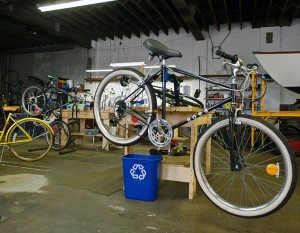
Toledo Bikes! teaches people how to repair bicycles. The Downtown nonprofit also fixes and sells donated bicycles. Toledo Free Press Photo By Joseph Herr

For Dutch journalist Ed Gouwelaar, the issue became a personal crusade. Gouwelaar, who regularly reported on waste disposal, recalled walking down the street on garbage-collection day and noticing what people were throwing out.

“It struck me there were many things there that could be repaired,” Gouwelaar said.

Today, Gouwelaar, 42, describes himself as a former journalist. He left the profession to become more personally active in environmental sustainability.

“I was a journalist, but I wanted to do more,” Gouwelaar said. “I really wanted to contribute something and to take sides. As a journalist, you always have to be objective. You can’t really promote something.”

His thoughts kept returning to those salvageable items she’d seen in the trash.

“I thought it would be easy [to reduce waste] if you could repair those things,” he said. “[To make] repairing a real alternative to throwing away and buying something new, you have to make repairing easy and attractive and accessible.”

The first Repair Café

His solution was the creation of a neighborhood Repair Café.

“It should be something that is fun to do,” Gouwelaar said. “It shouldn’t be a workplace or a shop where you drop things off and pick them up later, but I thought to make it a social event where you can meet your neighbors and you can make new contacts with people from your own neighborhood. That makes it fun.”

Gouwelaar said finding repair experts wasn’t difficult, and she was pleasantly surprised to find there are still people who know how to fix almost anything.

“The funny thing is, for those people, it’s their biggest hobby,” she said. “They like doing it and they like sharing the knowledge and passing it on and helping other people.”

The first organized meeting in 2009 was “an unexpected success,” Gouwelaar said.

She wasn’t sure if anyone would come. Instead, area residents showed up early, bringing everything from electrical appliances to clothes to furniture to musical instruments.

“People were very enthusiastic,” Gouwelaar said. “Many people came to me and said, ‘Oh, this is really a solution for me. I don’t like to throw out things, but you have to because you cannot get them repaired anywhere. Is this going to be here every week now? Or every month?’ So, I thought, ‘Well, apparently, this strikes a note.’”

In response, Gouwelaar founded the Repair Café Foundation in March 2010. Its mission is to spread the concept of Repair Cafés and help establish new locations. The foundation provides information, guidelines, posters, fliers, sample news releases and a 26-page instruction booklet.

“Now all kinds of groups all over The Netherlands want to do this for themselves,” she said.

As of June 1, 42 groups in the Netherlands have established Repair Cafés, from locations in big-city Amsterdam to hamlets of 600 villagers, Gouwelaar said.

Funding comes from private individuals, the government and private foundations, Gouwelaar said, with the greatest support coming from the DOEN Foundation, a Dutch organization that promotes and supports social cohesion.

“They want to bring people together who live in the same neighborhood and to strengthen the community,” she said. “That’s their goal. And that’s what the Repair Café also does.”

Finding electricians is an important first step in establishing a Repair Café, Gouwelaar said.

“You need at least three or four electricians — people who know how electrical current works and who can handle electrical appliances,” she said.

A second consideration is finding a place to meet and a third consideration is publicity.

“There, you get help from us, from the foundation, because we have a press release prepared where you just have to fill in the name of your group and your location,” Gouwelaar said. “So it’s not really that difficult for people to get started with our help.”

The cost of tools is seldom problematic because people with repair skills often have their own tools.

“If you have the electrician and you have a carpenter and someone who’s a good bicycle mechanic and you have a seamstress, they are usually willing to bring their own machines and tools,” Gouwelaar said. “If you organize it for a second or third time, then you might want to buy some tools, but they are not essential to get started. You can very well use or ask the repair men and women to bring their own.”

US movement

Unbeknownst to her, Gouwelaar’s crusade in The Netherlands had a counterpart in the United States.

In 2009, the same year she organized her first Repair Café meeting, a group of environmentally minded individuals in Brooklyn, met to discuss ways they could have a positive impact on their neighborhood environment. They established what they called a Fixers Collective, which, three years later, has become a model for Fixers Collectives across the nation.

A New York Times article about the Brooklyn Fixers Collective came to the attention of Greg Kono, exhibit developer at Pacific Science Center, a private, nonprofit science museum in Seattle.

Kono’s manager saw the article and asked him to determine whether the Pacific Science Center could organize a similar project.

Kono contacted the West Seattle Tool Library, a donation-operated organization that loans tools to community members, and suggested the initiative would be a great fit.

“The Tool Library loved the idea, and pushed me out front, and said, ‘You run it,’” Kono said.

Space for the West Seattle Fixers Collective, which recently marked its first anniversary, was offered rent-free from the Tool Library, which also provides liability insurance.

“All those things were already in place that let me move forward,” Kono said. “Now, it’s just getting the word out, which seems to be exploding now with all of the national publicity.”

The West Seattle Fixers’ Collective regularly invites local experts to teach workshops, including home plumbing, house wiring, bicycle repair and a plumbing series for women  taught by a female contractor. The group has also hosted an “Ask the Expert” series, which offered advice to people working on projects.

Several owners who operate local repair shops in areas with Repair Cafés and Fixers Collectives said they do not feel threatened by the tool libraries, but enjoy increased business because people begin to develop a mindset for repair.

Kono said he doesn’t want to compete with repair shops.

“We’re more about having people … work on those pieces themselves,” Kono said. “I don’t want to a have a pile of stuff that somebody dropped off.”

Toledo reaction

Margaret Danziger, deputy director of the Toledo-Lucas County Public Library (TLCPL), acknowledged tool libraries offer a valuable service, but said she doesn’t see the TLCPL board of directors pursuing that avenue of services.

“I’m not saying we wouldn’t consider a tool library,” Danziger said. “I’m just saying that, at this point, we’re just really thinking about bottom line, and not adding anything more to the taxpayer.”

Danziger said the TLCPL will ask voters in November to renew a two-mill levy, which currently provides the library with $15,295,000 a year, and to approve a .9-mill increase, which would generate another $7,647,500 a year. The .9-mill increase will cost an additional $25 to $27 more per year for every $100,000 in home value, Danziger said.

“If the levy does not pass, we will lose 50 percent of our budget,” Danziger said. “It means half of everything. It would affect hours, buildings, locations, staff and materials, everything you could think of. It would be destruction. So it is pretty clear that we must pass this.”

Danziger suggested tool libraries would fit better in the small business community.

Jim Izbinski, the 25-year manager of Reggie’s Bike Shop, 5934 Secor Road, said he supports the concept of people taking ownership of their belongings.

“I really like the idea of people learning to fix their own things,” he said.

Izbinski said he has seen a 40 to  50 percent increase in repair business during the past five years.

“Back 10 to 12 years ago, people said, ‘Ah, $60. … I’ll buy a new bike for $200-$300,’” Izbinski said. “Well, now they’re saying, ‘I’ll just pay the $60 and get this one fixed.’”

Despite the increased interest he has seen in bicycle repair, however, Izbinski isn’t sure a Fixers Collective could succeed in his hometown.

“Toledo just seems to be so far behind the times as far as things like that go,” Izbinski said. “I don’t know if we have the right mindset. I don’t know if we could get enough people. … I used to go to these meetings that used to try to help promote cycling. We tried to get the bike lanes paved, lines on the roads, bicycle lanes. Nothing ever seemed to happen. I just don’t know … I don’t know why it is. For some reason, it doesn’t matter what it is, organizing anything in Toledo is a difficult thing. I don’t understand why, but it is.”

Dave Smith, owner of Dave Smith Appliance Services, 3820 W. Alexis Road, said he would be concerned with what he considers the average person’s lack of expertise in repairing electrical products.

Smith got his start repairing microwaves for Highland Appliance in the early 1980s and started his own business in 1993. He said appliance repair is no longer mainly mechanical, like changing belts and making adjustments, but a highly technical and demanding electronics job that includes repairing lasers in dishwashers and adjusting Internet-capable appliances.

“It’s a far cry from putting a little grease on something and changing a valve,” Smith said. “It’s a completely, completely different industry from what it was.”

Although Smith said self-repair can be beneficial for simple repairs, he is uncomfortable with the idea of people trying to fix their own appliances.

“We’re kind of seeing that a little bit online now,” Smith said. “You can go online and find YouTube videos. And you can find chats on how to do some simple repairs yourself.

“Out of curiosity, I checked some of these things out, but the problem is some of this information is very mixed. Some of it is right, dead on. That’s good advice. That was a good fix. That was a good repair. And other times, I’m thinking, ‘Oh, my, my. What’s this person [saying]? That’s the most ridiculous thing to do. And somebody’s going to get himself killed here.’”

Smith said his shop often gets business from people who botched a self-repair attempt.

“The whole key there, with do-it-yourself, is knowing when to quit and call a professional,” Smith said. “This is not a business you learn in a three-month class. It takes a lot of time even to do it professionally.”

Mike Janiszewski, owner of Fix-It Shop, 1801 Sylvania Ave., said he sees a need for mom-and-pop repair businesses.

“It’s a part of Americana that’s going quickly,” said Janiszewski, whose shop repairs vacuum cleaners and rug shampooers and makes minor electrical repairs to lamps.

Janiszewski’s 34 years of experience have convinced him people could benefit from learning simple repair skills.

“Men will bring lamps in here that don’t work. The only reason they don’t work is because they need a light bulb,” Janiszewski said. “I call it common sense. On minor repairs, they have no clue.”

However, Janiszewski doesn’t believe people would be inclined to support a Toledo-area Repair Café or Fixers’ Collective.

“Having a smaller population than those two big cities (Amsterdam and Brooklyn), I don’t think there’d be enough interest here in Toledo to support it,” Janiszewski said. “I don’t want to say people are lazy, but if you drive around town and see all the grass cutters, all the snow [blowers], and all the window washers, you can kind of tell people don’t like to do a whole lot anymore. I don’t think there would be an interest.”

Janiszewski said Toledoans seem more inclined to dispose of an item than to repair it.

“Today, they throw everything away,” Janiszewski said. “Take food, for example. I like leftovers. My kids, they don’t. They’ll throw it away instead of putting it in the refrigerator. … A lot of younger people … they waste massive amounts of stuff. … Growing up and doing this [job], it’s amazing the changes I’ve seen. People are becoming more wasteful. Very, very wasteful.”

Toledo Bikes!

Mike Hayden, director of operations and education for Toledo Bikes!, acknowledges both Janiszewski and Izbinski may have valid points in their observations of Toledoans in general.

“Taken as a whole, they’re probably right,” Hayden said. “But to change things, you know, you have to start somewhere.”

Hayden believes Toledo Bikes! has taken the first step in what he hopes will become standard practice for all Toledoans.

Toledo Bikes!, 1114 Washington St., in Downtown Toledo, is a nonprofit charitable organization. Offering the use of tools and workstations, Toledo Bikes! encourages people to bring bicycles for repair rather than toss them in a landfill. Bikes beyond repair are recycled into parts or scrap metal.

Hayden said Toledo Bikes! receives donations of six to 10 bikes a week, and has more than 250 bikes in inventory. Bicycles are “upgraded” and sold in the Washington Street showroom or donated to local schools. In November, Toledo Bikes! donated 15 bicycles to Keyser Elementary School.

Although Toledo Bikes! was unaware of the Repair Café and Fixers Collective movement, a summer program it has planned for the Toledo YWCA, 1018 Jefferson Ave., is similar to what is happening in Amsterdam, Brooklyn and Seattle.

“We’re going to train the kids in bicycle mechanics, and then we’re going to start having them process and work on these kids bikes so that at the end of the summer, we’ll be able to do another bike giveaway to the schools,” Hayden said.

Hayden said he has faith that people can change.

“It’s an educational thing that we’re going to have to go through,” he said. “It will happen here sooner or later. It’s just that Toledo is one of those places that takes longer for things to take root.”

Cultural shift

David Takats, director of fund development and marketing for Goodwill Industries of Northwest Ohio, said he sees the Repair Café and Fixers Collective movement as positive for everyone.

“That’s fantastic,” Takats said. “We really encourage that type of behavior. But there are plenty of people that can’t fix things, that can’t use those items. And those are the people who donate to us generally — because they want to give something to a good cause.

“Don’t throw it in the garbage. If you don’t know how to fix it, if you don’t know what to do with it, give it to us. We’ll take care of it. If it can’t be fixed, if it can’t be sold, we’ll responsibly recycle it and make sure it doesn’t go into a landfill. But if it can, we love to give it to people and let them use it, have that product have a repurpose, a new life.”

Takats said people should consider the long-term consequences of tossing items in the trash.

“Think of what you’ve probably thrown away this year alone by yourself,” he said. “And if everyone were to bring in that kind of stuff, how much could we actually keep out of landfills? How much good could we actually do for the community, and the public, and just the whole welfare of the planet, if everyone kind of thought consciously like that, that I’m consciously not going to throw this away?”

Takats said he is starting to see a shift in American culture making repurposing acceptable.

“I think there is awareness

of just the elements of what we waste,” Takats said. “There’s that element from society that’s starting to look at it and say, ‘We don’t want to ruin our planet and all of our natural resources.’

“And this is just a first step, a beginning. We’re not fully there, by any means, but I do think that there’s a cultural shift. …

“It makes sense not to destroy the planet, not to be wasteful, not to throw things away that could be fixed, that could be used again.”

— Reporting by John P. McCartney

“Color Ignited” celebrates 50 years of art glass in Toledo

0
Vase Form, by Robert Fritz. Photo courtesy Toledo Museum of Art

Toledo is now known as the birthplace of the studio glass movement, but participants at the original workshop 50 years ago had trouble even forming a bubble.
“Nobody knew anything. Literally no one knew how to make a bubble. Th ere was no one there to ask,” recalled 89-year-old Toledo artist Edith Franklin, one of the fewer than 10 people who attended the fi rst of two 1962 glass workshops at Toledo Museum of Art (TMA).
“Color Ignited: Glass 1962–2012,” a new exhibition at TMA, will commemorate the 50th anniversary of those historic workshops.
Th e free show, which will focus on the evolution of the use of color in glass, debuted June 14 during the GlassArt Society Conference and will run
through Sept. 9, 2012.
On display are more than 80 objects from private collections, galleries and other museums as well as TMA’s collection, including work by Harvey Littleton, Dominick Labino, Marvin Lipofsky, Dale Chihuly, Dan Dailey, Laura de Santillana, Heinz Mack, Klaus Moje, Yoichi Ohira, Ginny Ruffner and Judith Schaechter.
The exhibition is the first in the new $3 million Frederic and Mary Wolfe Gallery of Contemporary Art.
The space was the home of TMA’s glass collection before the Glass Pavilion opened in 2006.
Jutta-Annette Page, TMA’s curator of glass and decorative arts and vice president of the Glass Art Society, called the exhibition “visually enthralling” and said she hopes visitors leave with a better appreciation of Toledo’s role in the evolution of studio glass.
“I very much hope this exhibition will make it clear this very important movement started here in Toledo and also help people realize this is aninternational movement that is here to stay,” Page said.
Visitors can also view the exhibit from the gallery’s mezzanine level.
“It allows people to look at the works on the ground floor from a different vantage point, which some of the artists are intending on in their works,” Page said.
Several of Franklin’s pieces from the original studio glass workshop are on display.
“I had them at home for years and nobody looked at them and now they’vebecome famous,” Franklin said.
Such early pieces are rare.

“It’s a very, very small group of surviving objects and the reason for that is they had not really figured out the technological issues that came with this experimentation,” Page said.
“Most of the pieces broke.”
The first workshop used glass from melted-down fiberglass marbles made at the Johns Manville plant in Waterville.
Learning to add color was part of the experimentation process.
“If you look at these very earliest pieces they were all greenish, transparent glass because the color was entirely determined by the glass batch,” Page said. “Very early on the palette was limited to the prefabricated glass the artists were using, but they very quickly experimented with color.”

Franklin never worked with glass again, but has fond memories of that first workshop.
“It was a wonderful experience,” Franklin said. “It’s been exciting these past couple of years. It’s nice it’s getting the recognition it should. Too bad some of the people aren’t alive who would have been enjoying this.”

Admission to the museum, located at 2445 Monroe St., is free. Hours are 10 a.m. to 4 p.m. Tuesday through Thursday, 10 a.m. to 10 p.m. Friday, 10 a.m. to 6 p.m. Saturday andnoon to 6 p.m. Sunday. Th e museum is closed Mondays and major holidays.
For more information, visit www.toledomuseum.org. ✯