Home Blog Page 264

Local schools seek voter approval to bolster finances

0
JIm Gault is chief academic officer for Toledo Public Schools. Toledo Free Press photo by Joseph Herr

Lake Local Schools treasurer Jeff Carpenter calls it a perfect storm.

Shattered by state cuts and federal funding losses and starved by dwindling tax revenue, schools statewide are trying to pick up the pieces by asking voters to approve levies.

On Aug. 7, Carpenter’s district will seek votes to pass a 6.75-mill operating levy while Swanton Local Schools will try to pass a renewal 4.45-mill levy. The two districts’ ballot issues join 34 other school issues on ballots statewide. Over the past two years, the average number of school levies appearing simultaneously on ballots statewide was about 20, said Howard Fleeter, consultant for the Education Tax Policy Institute.

Toledo Public Schools (TPS) announced in May that it would put a 6.9-mill continuing levy on the November ballot. But the district might lower that  amount based on a better-than-projected budget calculation reached in the past few weeks.

The districts on Lucas and Wood County ballots have something in common: Their last attempts at levies failed. Officials say they have no more room to cut.

“They’ve cut us to the bone from the state and the federal level and the only thing we have left is to go to our property owners and ask for assistance,” said Jim Gault, chief academic officer TPS.

Losing money

Lake Local Schools lost more than $1.6 million in federal and state funding from 2011 to 2012, while TPS has lost $3.3 million in state dollars. Cuts pushed the districts to seek levies.

When the last TPS levy failed in November 2010, drastic measures were taken.

TPS closed Libbey High School, cut middle school and freshmen sports and stopped busing high school students. The walk zone for other grades increased to two miles from one.

“Everything we stated that would be lost came to fruition,” Gault said. “I’m not sure if the community thought those things were going to happen.”

Since 2008, the district has let go at least 1,000 employees and ended the gifted program for grades three through six. If the November levy were to pass, the district could bring back the gifted program, Gault said.

School funding has been on the decline for years, but the most recent major cuts came from a state budget passed last year that left Ohio public schools with $2.8 billion less than before from both federal and state sources. Federal stimulus money had run out — a reality districts had  braced for, but one that nonetheless took its toll, Carpenter said.

Less support from the state and federal government saddles local property owners with the responsibility to cover district losses, creating disparities among districts based on property value and voters willing to pass levies, said Lisa Sobecki, TPS school board member.

The filing deadline for the November ballot is August 8 so it is too soon to tell how many schools will ultimately seek levies, but the number is expected to be high.

“What we’ve been expecting is that the effects of the budget are really going to show up on the ballot this year,” Fleeter said.

Unconstitutional

Gov. John Kasich had to fill an $8 billion budget hole when he took office; law requires that Ohio maintain a balanced budget each cycle.

Mike Mahoney, spokesperson for the Ohio Educators Association, said educators are waiting for Kasich to release a new funding formula.

“Ohio’s elected officials have a constitutional responsibility to provide high-quality public education regardless of where [students] reside and socioeconomic status,” Mahoney said. “We are supporting the development of an objective method in a transparent funding formula that is tied to what children need for their education and instruction and we haven’t seen that yet.”

Ohio’s method for funding public education was ruled unconstitutional 10 years ago and state politicians have been mulling over the issue since. Former Gov. Ted Strickland presented House Bill 1, which used an evidence-based model to identify successful practices and allot money for districts to implement a list of components, but Kasich scrapped it when he took office.

Carpenter said he didn’t think Strickland’s plan would have worked given the funding levels.

“It was a good attempt to try to quantify what a school district does and how much each costs, but there were 28 different major components, and of that, four of those didn’t get funded at all and 10 of them were partially funded,” Carpenter said. “I don’t care what formula or method you come up with, if you’re not going to fully fund it then why bother?”

Kasich’s spokesperson Rob Nichols said that in the wake of spent federal stimulus dollars and depleted local revenues, the state’s payment share increased by 3.5 percent with Kasich’s budget. The office will likely release a new funding formula in conjunction with next year’s budget.

“Ohio is one of the worst states for putting money into the actual instruction and pouring too much money into bureaucracy and red tape and administration,” Nichols said.

As schools await a new plan, Mahoney said districts statewide are having to cut nontesting areas, including physical education, music and art programs. At risk are a number of advanced placement courses for foreign languages and equipment such as up-to-date computers, he said.

“There is a slightly different story at every school district, but the sad thing is that what we all have in common is less opportunity for students,” Mahoney said.

Jeff Schlade, superintendent for Swanton Local Schools, said federal and state losses have made passing this levy more critical. Voters approved this levy in 1995 and have renewed it multiple times since, with the exception of last March.

If passed, the levy does not represent a new tax, just a continuation of the same millage district voters have paid since 1995, Schlade said.

The district’s revenue has dropped to $12 million from $14 million since 2009, resulting in a round of cuts that severed the high school industrial arts program. The district also laid off two secretarial employees and  an elementary music teacher.

Some positions were left unfilled after employees retired as well, said Joyce Kinsman, treasurer of Swanton Local Schools.

Not alone

Carpenter echoed layoff concerns.

The district has laid off eight teachers, two counselors and 12 classified employees within the past couple of years, and passing the November levy is a matter of staying afloat, he said.

Lake Local Schools didn’t lose much basic state aid — but lost staggering amounts from state-collected tax revenue, Carpenter said. A few years ago, a local tax on personal, tangible property was phased out and replaced by a state-collected commercial activity tax. This new fund sufficiently supplanted the local tax until 2012, when the district received $1.1 million a year compared to its share of $1.4 million in 2011. By 2013, the state will allot Lake Local Schools $928,260 from that fund. The state also eliminated a public utility tangible tax, which brought the district $130,800 — creating a “tremendous loss” for the schools, Carpenter said.

Losing these types of taxes became the real kicker for districts statewide over the past two years, Fleeter said.

In addition to that, the district gets less money from the state each time a student takes a voucher to go to another district or a private school, Carpenter said.

“We’re not alone,” he said.

Trouble at TPS

If voters were to pass the TPS levy, it would mark the first flow of new operating money since 2001. Despite cuts, the district has been able to bring back some middle school sports, initiate an early high school options program and a distance learning lab. TPS has also integrated special education students into the classrooms with their peers.

The levy would allow the district to start an International Baccalaureate program at Start High School, a performing arts program at Bowsher High School and a renewable energy program at Woodward High School, among other special programs at other schools. TPS would pilot an online digital classroom, replacing some textbooks with tablets, Gault said.

But a problem looms that might interfere: Superintendent Jerome Pecko came forward  two weeks ago with news about school officials  retroactively withdrawing and re-enrolling frequently absent students.

The Ohio Department of Education has launched an investigation.

Pecko said he has thought about how the investigation might impact voter support for the levy.

“[The issue] is out there and it’s a factor … I’m hoping that the state will come to the conclusion that what we’re doing is not of the stature that would require any kind of sanctions,” he said.

The potential decision to lower the levy millage has nothing to do with the Ohio Department of Education investigation, Pecko said.

TPS Treasurer Matthew Cleland said Aug. 2 that the most recent five-year budget projection calculated $8.5 million more than the previous one had.

Officials discovered at the end of June that the state will allot $3.7 million more to TPS in foundation funds than it had announced in May, Cleland said.

In addition, fewer students took EdChoice vouchers than expected and last school year’s switch from the middle school format to the kindergarten through eighth grade  structure saved $1 million more than anticipated.

Union concessions helped to save money on health care plans as well, Cleland said.

TPS’ annual budget is about $300 million.

Toledo-born golfer Stacy Lewis ranked No. 2 in world

0
Toledo-born Stacy Lewis is the the No. 2-ranked female golfer in the world and the top-ranked American golfer. Photo courtesy Sterling Sports Management.

Competing in the Jamie Farr Toledo Classic will be a homecoming of sorts for top-ranked American golfer Stacy Lewis.

Lewis, 27, who is ranked No. 2 in the world behind Yani Tseng of Taiwan, was born in Toledo.

Although she moved to South Carolina and then Texas for her father’s job when she was young, the family returned regularly to visit.

“My parents were born and raised in Toledo,” Lewis wrote in an email to Toledo Free Press. “We moved when I was 2, but I have come back frequently. We still have lots of family in the area on my dad’s side and I feel so supported by them.”

Lewis achieved her goal of becoming the top-ranked American female golfer in June after winning the ShopRite LPGA Classic in New Jersey by a decisive four strokes.

The win bumped her past American Cristie Kerr into the No. 3 slot behind Tseng and 2010 Jamie Farr champion Na Yeon Choi of South Korea. Kerr had been the top-ranked American since 2009.

“I was being interviewed after a win and was speechless when I heard,” Lewis said. “I did not know how to react.”

Lewis, who recently passed Choi to gain the No. 2 spot, started golfing at age 8, although she said her talent wasn’t immediately apparent.

“My dad loved it and encouraged me to play,” Lewis said. “I was average to start and loved playing with my dad. Eventually, it led to a college scholarship.”

The Jamie Farr was the first LPGA tournament Lewis attended.

“We were visiting in the summer and I got to go,” Lewis said. “I visited [Toledo] most years growing up.”

The Jamie Farr was also the first LPGA tournament Lewis competed in, through a sponsors’ exemption as an amateur in 2008, and she has returned to compete each year since. Her highest finish was a tie for 26th in 2010.

Lewis said a win in her hometown would be extra-special.

“It would mean a lot to win in Toledo,” Lewis said. “I have a large contingent of family and friends and also the great people from Marathon [Petroleum Corporation] that will come follow me. They are known as the Lew Crew.”

The Findlay-based company is one of Lewis’ sponsors.

Battle with scoliosis

Lewis’ website, www.stacysback.com, proclaims her as “The Next Great American Golfer.”

The designation is made all the more impressive given the medical challenges she had to overcome to reach her goals.

Diagnosed with scoliosis when she was 11, Lewis spent more than seven years wearing a back brace for 18 hours a day, removing it only to play golf. Scoliosis is a medical condition that affects the curvature of the spine.

“I hid it and was self-conscious, but not really teased,” Lewis said of the brace.

After graduating from high school, she had back surgery, causing her to redshirt her freshman year at the University of Arkansas.

She worried she would never play golf again.

“The doctor told me I would be able to play golf, but I was unsure,” Lewis said. “He encouraged me to play. I had to follow doctor’s orders in order to live a normal life.”

Turns out Lewis’ worry was for naught.

Lewis won the Southeastern Conference (SEC) Tournament her redshirt freshman year and was named the SEC Freshman Golfer of the Year. She went on to win 12 collegiate tournaments, including the NCAA’s individual championship in 2007.

In September 2007, while only a junior at Arkansas, she finished T-5 at the Kraft Nabisco, a major championship on the LPGA Tour, and then won the rain-shortened LPGA NW Arkansas Championship.

In 2008, Lewis became the first person in the 76-year history of the Curtis Cup, a prestigious amateur tournament held at the Old Course at St. Andrews in Scotland, to post a 5-0 record as she led the U.S. team to victory.

Lewis turned professional later that year and joined the LPGA Tour in 2009.

In 2011, Lewis held off top-ranked Tseng to win the 2011 Kraft Nabisco Championship, her first major title.

“[It was] nerve-wracking and a lot of fun!” Lewis said. “I still get a smile when I think of it.”

Since 2007, she has posted seven top-10 finishes in the 18 major championships she has entered. She has a win and four top-10 finishes in her last seven majors.

Thus far in 2012, Lewis has two wins, nine top-10 finishes and more than $900,000 in earnings. She is ranked in the top 10 in greens in regulation, putts, scoring average and No. 1 in birdies made.

Lewis still has a rod and five screws in her back.

“They will stay as long as nothing happens to them,” Lewis said. “I should not need further surgeries. I feel lucky to be able to play golf as a result of the surgery.”

Volunteering

Off the course, Lewis regularly volunteers her time to causes around the world. Photos on her website show her working with Habitat for Humanity in Virginia, helping build a school in Africa and lobbying in Washington, D.C., for physical education programs.

“Golf has taken me many places and I have met many great people,” Lewis said.

She said her most memorable trip was with Golf Fore Africa, a nonprofit that works with HIV/AIDS orphans in Africa.

She also often meets with scoliosis patients.

“I tell young fans with scoliosis to remain positive and follow doctor’s orders,” Lewis said.

Big ambitions

Lewis still has high aspirations for her golf game.

Now she has Tseng, who has held the No. 1 spot for 77 consecutive weeks, in her sights.

“I hope to be No. 1 in the world,” Lewis said. “I love the competitiveness.”

For more information, visit www.stacysback.com.

Toledo Free Press Golf Writer Fred Altvater contributed to this report.

Youth employment program offers health care education

0

About 40 area teens have been learning about the health care industry this summer as part of ProMedica’s Summer Youth Employment Program.

At Mayor Mike Bell’s encouragement, ProMedica hired the teens for a variety of jobs in the eight-week program. Their jobs included tasks in groundskeeping, patient care, pediatrics, the neonatal intensive care unit (NICU), transportation and even the surgical area (sterilizing equipment). Seven of the teens were referred by The Source, a local employment service. The teens, almost all from metro Toledo, worked 24 hours a week and received minimum wage.

The teens, 16-19, were thoroughly screened and ProMedica received more than 120 applications, said Wendy Papenfuss, the director of workforce planning at ProMedica.

The program was celebrated Aug. 1 at Ottawa Park. The teens were fed CityBBQ and listened to remarks by Randy Oostra, CEO of ProMedica, and Bell. Many of the teens’ supervisors also attended.

“They’ve fallen in love with these kids. They don’t want them to leave,” Papenfuss said.

One of those supervisors is Connie Bahls, operations manager, who oversaw three teens, including Start High School student Caleb Self. Self is responsible for cleaning up the Renaissance Lobby this summer. He said the job, his first at Toledo Hospital, has taught him values like hard work and responsibility.

“[Visitors] say the place has never looked so good,” Bahls said.

Papenfuss and Oostra said they hope the summer program exposed the teens to the health care industry.

“It’s good for the youth as far as getting exposure to health care careers. I think it’s good as far as thinking about our future pipeline of employees. I think it’s a great thing to help support the city in these economic times,” Oostra said.

Jalyssa Parker and Saveenah Allen, both recent graduates of Horizon Science Academy Toledo, said the jobs have impacted their career goals.

“Honestly, we’re young so we wouldn’t really get a job in health care, so for us to like preview [health care jobs] is a great experience,” said Parker, who used to want to be a veterinarian and now wants to be a nurse.

Parker worked in the NICU. “I got to feed, hold, everything dealing with babies,” she said.

Both Allen and Parker said they formed bonds with patients and loved their experiences.

“When I would come back and they weren’t there, I’d be like, ‘Where’s so and so?’” Parker said, adding that she was happy when the patients were released, even if she missed them.

Allen, who will attend University of Toledo in the fall, worked in pediatrics. She had already been volunteering at ProMedica before she was hired for the summer.

When asked if she had a favorite moment in the program, she replied, “The whole thing, I just enjoyed it all.”

Papenfuss said the jobs also taught the teens some basic life skills. “What we’ve found is most of them didn’t have bank accounts so we’ve had to help them set up bank accounts so they’ve learned some very basic payroll and bank account skills,” she said.

She said ProMedica would definitely consider having the program again next summer and even expanding it. Papenfuss also said ProMedica is trying to hire 12 of the teens who already graduated.

Oostra said early jobs like these offer valuable lessons.

“We all look back on our experiences and those first jobs and the impact they’ve had on our lives. Having to get up and go to work every day, interact with people, dress appropriately, those are skills that if you don’t have that opportunity in life to be able to go to work and have those jobs and interact with people, you may not be able to learn those skills,” he said.

Szyperski: School papers that I used to know

0

My first child was born around the same time as mainstream digital photography. He was only a month or two old before we made the leap to pixelated pictures and never looked back. While I’m more than appreciative to have waved goodbye to buying and developing rolls of film forever, I sometimes wish we would have leaped about six months earlier. Those first few precious weeks of my son’s life still sit un-digitized in a plastic storage container somewhere in our basement. I have a feeling I will one day kick around similar disappointment regarding the mixed formats of my children’s school work.

In my long, yet-to-be-recorded list of musts for new parents, I should no doubt include a warning to have a paper plan before your first child starts school. I was, in fact, aware of the paper flood that accompanies the academic years before my oldest entered elementary, but I foolishly figured I would take it as it came. Perhaps it was still my naiveté, or perhaps it was that I was also wrapped up in parenting a toddler and producing child number three, but I apparently threw just about anything that came home into a seemingly bottomless tribute-to-kindergarten pit.

Busyness aside, I’m honestly just not that great at deciding what to toss and what to keep for posterity’s sake when it comes to school papers. I’ve resorted to asking my parenting peers how they balance the ongoing paper surge with finding the pieces special enough to have and to hold from this day forward. Opinions range from keeping most of it from year to year to dumping the whole lot on a daily basis. I surely want to keep some of it, but I realize that keeping too much just doesn’t make sense.

Now that I have two children in elementary school with the third starting preschool this fall, I am finding that having more than one or two kids makes saving things space-and-sanity-prohibitive rather quickly. I am also somewhat mentally crippled by the fact that I saved most everything from my son’s kindergarten year but had wised up a bit by the time my daughter had entered kindergarten. Considering they will both fight tooth and nail to ensure the equality in something as nondescript as a glass of water, I’m quite frightened by the long-term consequence of accidentally throwing away one’s 100 Days of School crown and not the other’s. Such a simple mistake might go unnoticed now but come back to bellow at me with contempt in, say, 2032.

Of course, what I also need to recognize is that there are boxes upon boxes of my own academic and arts-and-crafts history in the depths of my parents’ home a few miles away. Yet I have little desire to excavate them to reminisce and, thankfully, zero interest in comparing them to my siblings’ stash for rivalry purposes. I suspect that as I meander through my golden years I will still have a greater interest in recalling my own children’s little handprints and first attempts at letter formation than I will my own.

In light of the fact that all of these material memories will most likely remain in my care for some time, I should probably keep the stockpile as simple as possible. After kids come grandkids, and then we’re talking serious possible exponential plastic storage tub growth. Actually, it is the sight of Mount Plastic Storage Tub that makes me long for the day, hopefully not too far down the road, when the school paper flood will turn into more of a digital affair.

We are no doubt moving into the age of the digital backpack, but we’re currently still in mixed-format limbo. Will I eventually not have to “know” which papers to keep for future sentimental reference because so few will come home? Will I continue to struggle with picking and choosing electronic documentation of my children’s academic achievements? Will I one day hold onto those last treasured reminders of pre-digitized elementary education even tighter? Will my children care in the least?

Surprisingly, my hope is that the material side of school will slow to a best-of-the-best-only trickle with the hundreds of yearly worksheets finding their way to a tablet computer or other electronic medium. As is clearly evidenced by the TV show “Hoarders” and others of its kind, an overabundance of worldly possessions, even school papers, is not our finest quality as a society. After all, it is the feeling of cumulative pride in and love for our children as they triumph that we need to grab onto and never let go.

Shannon Szyperski and her husband Michael are raising three children in Sylvania.

‘Hardcore Pawn’ star to visit Hollywood Casino Toledo

0
Seth Gold, star of the reality TV show "Hardcore Pawn," will visit Hollywood Casino Toledo. Photo courtesy TruTV

Seth Gold still isn’t used to fame. And it seems he likes it that way.

It’s clear from talking to him that Gold — one of the stars of the top-rated TruTV series “Hardcore Pawn” — is genuinely tickled by the fame that has suddenly been thrust upon him. But at his core, he doesn’t think of himself as a celebrity.

“It’s surreal. It’s tough for me to even put into words,” Gold said of his newfound notoriety. “Essentially, I call myself a pawnbroker, first and foremost. And when people come around and wanna take pictures, and when I do these events, a lot of people show up, you know, obviously, they find some sort of connection with our show, with the people involved. And it’s a fun, unique, crazy experience.”

His next event will be in Toledo — Gold will be making an appearance at Hollywood Casino Toledo on Aug. 4 from 2-4 p.m. This is just the latest stop on a particularly unique path to fame for the young pawnbroker, who originally had a much different career in mind.

Gold attended the University of Michigan with an eye on eventually getting into medicine.

“I sort of changed pace my senior year. I said, ‘Well, I really don’t love what I’m doing right now, and I’ve got a lot more schooling in order to complete this degree. So, I think I’m gonna go in the family business,” he said.

The family business was American Jewelry and Loan, a large pawnshop in Detroit owned and operated by his father Les, who’s also a main figure on “Hardcore Pawn.”

“The funny part was, I didn’t even call my dad to tell him I was coming in the business because I stayed away from it for a very, very long time. And I called my mom, and I went, ‘You know, I wanna get into the business.’ And her response was, ‘What business?’ And I went, ‘The family business!’ It kind of caught everybody off guard.”

He has worked full time at American Jewelry for the past seven years, becoming his father’s business partner in the process.

When Gold speaks of misconceptions people have about the pawn business, it’s clear the younger Gold has inherited a great deal of his father’s passion for his work.

“There’s 25 million people around the United States without bank accounts. Where are those people supposed to go, you know, to get money? And a lot of people are like, well, easy, just ask a family member. Just go to the bank. Well, that’s not an option for a lot of people,” Gold said.

That’s a facet of pawn shops that Gold is clearly proud to highlight on “Hardcore.” Other shows in the genre tend to focus on pie-in-the-sky sales of big ticket items, which is actually a fairly small percentage of an average pawn shop’s transactions.

“I’m in the business of loaning money and getting interest. I’m not in the business of buying low and selling high, because ultimately, the more I loan, the more interest I accumulate,” Gold said. “So a lot of people don’t understand that there’s an actual business formula behind the method. Because once someone loses their merchandise — they’re not a customer of mine anymore.”

Nowadays, thanks to the success of “Hardcore,” business is booming. The TV process began with a phone call a few years ago.

“I got a call from a producer saying, ‘Hey, you have a unique business, I think we should film it.’ And my first reaction was, ‘Absolutely not,’ and I hung up the phone. I’m not kidding,” Gold said with a laugh. “And I was like, ‘Well, you know, I don’t really run the company, I’m not the president of the company, maybe I should talk to Les about it.’ So, I went in his office, and he’s like, ‘Absolutely, we’re doing it.’

“And I said, ‘You know Dad, I really don’t know about this whole reality TV thing.’ And he’s like, ‘Seth, how big can it possibly get?’”

How big has it gotten so far? It’s become one of TruTV’s highest rated shows: six seasons, 94 episodes and more on the way. A spinoff — “Combat Pawn” — debuted earlier this year. And now he’s booking personal appearances at casinos and the like.

Still, at the end of the day Gold said he keeps his focus on American Jewelry and Loan — a place he has put his heart into, and which he trusts will still be going strong long after the television show is a thing of the past.

“The show’s great, it’s a great experience, but I know there’s gonna be an end date at some point. And I need to keep my business going beyond that.”

Legendary trumpeter to headline 2012 River Raisin Jazz Festival

0
Arturo Sandoval. Photo by Manny Iriarte

It was a journalist who turned Arturo Sandoval on to jazz.

“He played for me a Charlie Parker and Dizzy Gillespie record. Oh my goodness, I went crazy, saying, ‘Wow! What is this? Man, what are those people playing? That’s so difficult! I love it! I want to learn how to play that!’

“And then I start with that and I’m still trying to figure out what those people were playing,” the renowned trumpet player said.

In 1977, Sandoval had a chance to meet his idol when Gillespie visited his home country of Cuba. But he didn’t tell the trumpeter he was also a musician right away.

“I drove him all over the city for the whole day. Then in the evening, we got a jam session,” Sandoval recalled. “When he gets to the place, I was warming up on stage and he saw me with a trumpet, and he opened his eyes and said, ‘What the heck’s my driver doing with a trumpet?’ And somebody said, ‘No, no, no! He’s the guy here in Cuba!’”


Arturo Sandoval

With the help of Gillespie, Sandoval soon became one of the great horn players of the world.

“[Gillespie] really helped me a lot. He was so good to me since we met. He gave me so many opportunities over so many years,” he said.

Sandoval was touring with Gillespie in Spain in 1990 when he and his family were granted political asylum by the United States.

“Dear Diz (Every Day I Think of You)” is the title of Sandoval’s disc released in May.

“[It’s] a group of tunes I have been playing that I had the honor and privilege to play with [Gillespie] many times when he was alive. It was a lot of fun doing the record; this is the kind of material that I really love,” the jazzman said.

“The most important thing he taught me was love music,” Sandoval said. “That was really the key motivation for me was how much he loved music and how much he really enjoyed talking and playing and trying to learn things about music.”

One of his father’s loves inspired his new CD, “Tango — Como Yo Te Siento,” released in July.

“I remember my father — my dear father, he’s in heaven — he liked tango music very much, and he never showed any kind of interest in music in general,” Sandoval said during a call from his home near Los Angeles.

“But when you put in a good tango, he loved it. He knew the lyrics and the melodies of every tango. And in certain ways, this is a tribute as well to my dear father.”

The Grammy Award winner will headline the River Raisin Jazz Festival at 7:30 p.m. Aug. 12 at St. Mary’s Park in Monroe. The event is free.

“At all my gigs, I play percussion and I sing a couple tunes, and I play piano and play keyboard, and I dance a little bit, and I tell the story — I have fun on stage,” Sandoval said. “My intention, my goal, is to let the people have fun too.”

River Raisin Jazz Festival

St. Mary’s Park, Monroe, Free

Saturday, Aug. 11

1 p.m.              The River Raisin Big Band

2:30 p.m.         Deon Yates

4 p.m.              Hot Sauce

5:45 p.m.         Chris Standring

7:30 p.m.         Alexander Zonjic & Friends with special guest Bob James

Sunday, Aug. 12

1 p.m.              RJ Spangler with special guests Larry Smith and Nikki Pearse

2:30 p.m.         Soundproof

4 p.m.              David Myles & The Mylestones

5:45 p.m.         Chieli Minucci

7:30 p.m.         Arturo Sandoval

Pounds: Nexus nixed

0

One week after a report described Toledo as one of “America’s Emptiest Cities,” Toledo City Council showed the world why there is more motivation to leave the city than there is to invest here. In a stunning and arrogant vote July 31, Council failed to approve the Nexus Academy of Toledo’s request to open a charter school Downtown.

Council voted 6-4 to deny permission to Nexus, owned by the national company Connections Education, to open a charter school on the fourth floor of One Lake Erie Center, 600 Jefferson Ave.

The decision bolsters every impression that Toledo is not business friendly and will undoubtedly discourage untold other enterprises from considering investing in Downtown.

Led by Toledo Public Schools loyalist Steve Steel, fellow shortsighted and insensate Council members Lindsay Webb, Phil Copeland and Adam Martinez voted against the special-use permit that would have allowed Nexus to open. Paula Hicks-Hudson was on vacation. Tyrone Riley chose to abstain, which sealed the charter school’s fate.

Council rules state that “A member abstaining at a regularly scheduled Council Meeting shall do so only in the event of a conflict of interest.” Riley gave no such reason, and in fact, on July 3, voted in favor of waiving the minimum 30-day period for the special-use permit Nexus was seeking. If Riley had a conflict, why did he vote for that ordinance on July 3?

Riley told Toledo Free Press on Aug. 1 he had a “prior business arrangement with a business adjacent to that property (the restaurant Our Brothers Place) and I wanted to avoid any type of impropriety or the appearance of impropriety. If I voted one way or the other, it may give someone the impression that I was trying to protect one of the local establishments.”

Riley said he voted for the 30-day waiver July 3 because, “I was still in this prior business arrangement with one of the adjacent properties at the time and I just didn’t realize that may be a conflict.”

But he later added, “I made a mistake in not completely understanding this rule of Council. My vote was inconsistent. I didn’t have a complete handle on the rule of Council. Both sides had compelling arguments and I was thinking, ‘OK,’ they’re both compelling,’ and I just abstained and that was a mistake on my part.”

Steel claimed the special-use permit should be denied because the Nexus Academy location would be within 1,000 feet of convenience stores. But before the vote, Toledo-Lucas County Plan Commission Director Tom Lemon told Council that because the building Nexus wanted to locate is within an entertainment district, the spacing requirements regarding convenience stores would not apply.

Ignoring that simple fact, Steel, Webb, Copeland, Martinez — and passively, Riley — voted against jobs, education and development.

“Some of [the charter schools] that are in that core Downtown area have been there since longer than I was voting, certainly. We should be very cautious about it whenever you have kids that are walking around a bunch of adult-oriented establishments,” Steel told Toledo Free Press on Aug. 1. “I have voted yes on special-use permits for charter schools. I would have the same objection if TPS wanted to go in. It has to do with children, a lot of kids going to and from school are unsupervised. That’s why we have coding in the law about adult-oriented establishments.”

“The spacing requirement for carryouts is bogus to begin with. We’ve vilified carryouts and now, by association, we’ve vilified schools that want to go near carryouts,” Councilman Tom Waniewski told Toledo Free Press on Aug. 1. “Here’s a charter school that wants to do business and we’re saying, ‘Mmm, you can’t because there are carryouts around.’ If you just came here from another planet and you didn’t know my colleagues on Council, you might be scratching your head saying, ‘What are you talking about?’

“We’ve got people on City Council who have no concept of business and are merely voting for stupid reasons. The other stupid reason is some of them on Council have a bias against charter schools so they are too intricately tied to TPS and are afraid of the competition.

“A recent study showed we are one of the poorest cities to do business with. This adds to that. Why are we telling businesses how to run their business? Selling [cigarettes and alcohol] to minors is illegal, so let’s enforce those laws that we have rather than create these artificial pieces of duct tape. We’re not the morals police.”

These four Council members also sent the message that they believe Downtown Toledo is not a safe place for students attending school. This despite the healthy attendance at Toledo School for the Arts and other Downtown charter schools, not to mention the thousands of students bused Downtown each season to Fifth Third Field and Imagination Station.

If they believe that, perhaps they should spend more time improving that situation than blocking viable business development.

“Some Council members used their vote to express their disdain for charter schools in general and to me that’s just wrong,” Councilman Rob Ludeman told Toledo Free Press on Aug. 1. “Charter schools are allowed by Ohio law and as long as they meet all the zoning requirements we should allow them to go in. It’s a huge component of the economic development of Downtown.

“It’s a slap in the face to them and the business community Downtown. They apparently just didn’t listen to the planning commissioner director. There are other charter schools in the Downtown entertainment district already; how do you pick and choose? That’s just not right.

“When it came time for the vote, Tyrone Riley abstained. We have a Council rule that you can’t abstain unless you have a direct association with that entity and he has no connection to this charter school so the least he should have done is voted. They all just looked at me with blank faces when I read the rule. I was on Council when we put that in place because it was getting ridiculous how many people didn’t want to make a decision on things. You are elected to make a decision,” Ludeman said.

It’s almost as if these myopic Council members want to see Downtown fail; certainly, nothing in this decision shows any understanding of the facts or ramifications surrounding this vote.

Voters are right to ask, “What are these people thinking?”

Rebecca Booth, a spokesperson for Nexus, which has advertised in these pages, was gracious after the vote.

“We believe that this is just one step in a series of steps toward opening a charter school. We believe in our blended learning environment and we still think that we’ve got a great location to help out our students, so we’re moving forward hoping that we can still open in the fall,” she told Toledo Free Press on Aug. 1. “Everything is all up in the air but we’re exploring all possibilities. We were surprised [by the vote]. We go back to this just being part of the process. Sometimes you’re going to hit a hurdle and sometimes you’re not.”

At the same session, Council approved special-use permits for three other schools outside Downtown — all of which are reportedly located near convenience stores or bars. Ironically, as construction on the school had already started, Steel, Webb, Copeland, Martinez — and passively, Riley — have, for now, put union construction workers out of a job.

They have also potentially opened Council and the city to legal action. Even if the case never sees a day in court, a different kind of jury is watching this dysfunction and will return its own verdict, one that will continue to stymie efforts of growth and development in our hurting, increasingly troubled city.

Riley said he will change his vote to “yes” if Council reconsiders the vote, which it will apparently do on Aug. 7. That can only be proposed by Steel, Webb, Copeland or Martinez. There is an opportunity for redemption in the midst of this mess. But if any these Council members choose to let the vote stand and deny Riley his opportunity to revote, they should be painted as the aspiring statists they are — and the business community should rally to make sure they are voted out of office at the earliest opportunity.

Sun Burn 3: Finkbeiner: Bell, RGP, Port ‘dropped the ball’ on solar

0
A field of solar panels. Photo courtesy Regional Growth Partnership.

Part 1

Part 2

Between 2005, when it began publishing, and June 30, 2012, Toledo Free Press, a weekly newspaper, published 97 articles with the keywords “solar industry.” Between Jan. 1, 1997, and June 30, 2012, The Blade, a daily newspaper, published 388 articles with those same keywords.

In the beginning, the two publications were almost of a singular voice on the topic.

In those 485 newspaper stories, the print media regularly turned to national, state, county and City of Toledo politicians and candidates — including Toledo’s mayor, an Ohio senator and House of Representatives member, the University of Toledo president, a UT president emeritus, a local broadcast TV news co-anchor, community leaders from the Regional Growth Partnership and the Toledo-Lucas County Port Authority, and local business men and women — for their perspective on Northwest Ohio’s solar industry.

Starting in 1997 and peaking in 2007, nearly everyone interviewed and everyone who submitted a guest column voiced support for the solar industry and the hope that it would become the salvation of the economic woes the area faced.

Some guest columnists proposed strategies they believed would ensure success. Others prodded Toledoans to develop attitudes that promoted the city and focused on its strengths. Many suggested that Toledo could become the solar hub, at that time referred to as “the next Silicon Valley” of the United States.

The solar industry enjoyed the unbridled support of almost everyone in Northwest Ohio.

Who were those people?

What did they have to say?

And, enjoying the 20/20 vision that comes with hindsight, what do some of those people have to say now?

Mayoral approval

Focused on building Toledo’s industrial base as well as promoting the city as one of America’s best, then-Mayor Carty Finkbeiner embraced the solar industry and all the potential it offered the city. If ever there was a political advocate for the solar industry, it was Finkbeiner.

In September 2007, Finkbeiner announced Toledo would work with the University of Toledo to develop the Ohio Center for Renewable Energy and Sustainable Development, a program the Lucas County Improvement Corporation predicted would pay huge dividends to Northwest Ohio’s economy.

Two months later, Finkbeiner wrote a column published in Toledo Free Press, declaring June 18, 2007, a symbolic day in Toledo’s history as wrecking balls knocked down the smokestacks at the Toledo Jeep Plant and Toledo began its transition from smokestacks and pollution to clean technology and alternative fuels. Finkbeiner said the solar industry, rooted in cleaning up and preserving the environment, would be Toledo’s economic future.

In April 2008, Finkbeiner touted Toledo’s foray into alternative energy, proclaiming that Toledo was “one of six solar energy capitals in the world,” projected to have 3 million jobs in the solar economy during the next 20 years.
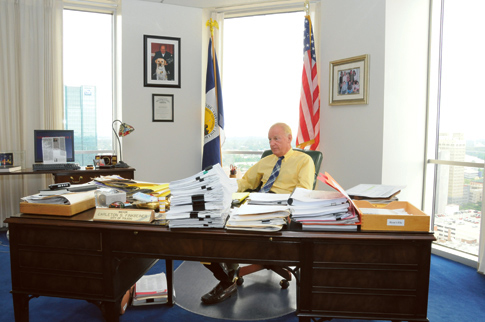
Carty FInkbeiner at the mayoral desk in One Government Center in July 2009.

Even as he faced the threat of a recall election in December 2008, Finkbeiner took the opportunity to plug the solar industry.

Refusing to let the recall petition effort demoralize him, Finkbeiner publicly suggested that Take Back Toledo, the group of opponents that  organized the petition drive to unseat him during his 2006-09 term, should “also support us in working to bring alternative energy jobs and companies to Toledo.”

Recalling those days during a July 31 interview, Finkbeiner said, “Those Take Back Toledo people wanted change and people who are excited for change are very, very good for America. You need critics. If everybody agrees, you’re not getting the other opinion.

“I was challenging them. ‘Let’s use your energy and get behind the alternative energy thing. Put it into that, and we’ll move forward together.’

“I was just trying to challenge, as I always do,” Finkbeiner said. “That’s just my personality, to say, ‘OK. That’s your perspective. Why don’t we get behind the alternative energy thing and we’ll be working together on something. You put your energy, and I’ll put my energy, and two will be better than one. Let’s get at it.’ ”

A source of momentum Finkbeiner  pointed to in December 2008 was Toledo’s growing reputation in the national media as a center of solar-energy innovation and manufacturing. Finkbeiner took tremendous pleasure in January 2009 when Foreign Direct Investment magazine named Toledo the “Most Business Friendly City in North America.” He said at the time that the national recognition must motivate the community to increase “support of growing advanced technology businesses by encouraging an entrepreneurial mindset and funding research that fuels growth.”

Bell at the helm

When Mike Bell moved into the mayor’s office Jan. 4, 2010, beating Democrat Keith Wilkowski by a margin of 2 percent of the popular vote, the local print media reported he would not follow Finkbeiner’s lead as a solar energy advocate.

In an interview July 25, Mayor Mike Bell said he did not choose to not make the solar industry a part of his agenda. When he took over in January 2010, the City of Toledo was $48 million dollars in debt. He felt it most important to find a way to get Toledo out of the red.

One avenue was to investigate the possibilities that Asian investors had an interest in Toledo.

Bell said that since the city faced a $48 million debt, he didn’t even think to consider Finkbeiner’s solar push. His focus was the $48 million debt, not the outgoing mayor’s agenda.
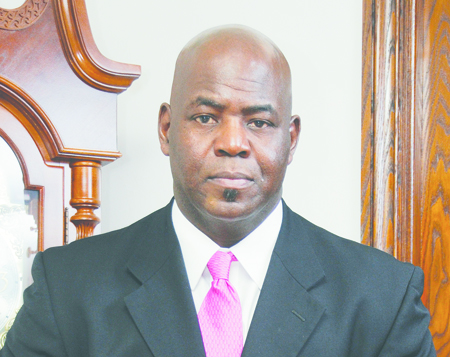
Mayor Mike Bell

Bell said the solar industry was already established in Northwest Ohio, and he didn’t think focusing on it would bring the financial solution Toledo needed. In his judgment, pursuing Asian investor interest would pay quicker dividends.

“When you ask me about this two-and-a-half years later, I would point out the fact that we’re out of debt and actually have a surplus in the city budget,” Bell said. “I’d say that’s proof I made the right decision.”

Bell said he thinks the solar industry is, and will continue to be, an important part of Toledo. However, he says it has issues to solve, like making solar panels affordable for homeowners who want to install them in their homes. He feels confident the solar industry will continue to be a part of Toledo, and now that the city has a surplus in its budget, he may have the luxury to look at other things. Bell said he most needed to improve the city’s budget issues, and he’s pleased that he’s done that.

“I say, ‘Finkbeiner pooh-poohs that explanation. He didn’t have the deficit he claims to have had,’ ” Finkbeiner said July 31. “Let’s just be very blunt. First, there was no $48 million deficit. That was a Mike Bell, Steve Herwat (deputy mayor of operations) made-up figure. I can prove it. I’ve been to The Blade. They all didn’t want to get into it.

“His debt was exactly what my debt was the last year I was mayor (2009). The bottom fell out of the American economy and the Toledo economy. It was in October 2008, one month before the presidential election.

“The American automobile industry is very relevant. The American automobile industry was fleecing Toledo.  We dropped $28 million in anticipated revenue from 2007 to the end of 2008. To be precise, when I began my last year as mayor in 2009, it was $27.7 million debt that I had to make up during the year 2009.

“I didn’t make it all up. I made all of it up but about $4.5 million. So that $27.7 million that I had as a deficit to make up in 2009 was also what Mr. Bell had, because the economy was just as flat in 2010. He had $27.7 million plus $4.5 million that I did not balance the budget with (for a total deficit of

$32.2 million, not $48 million).

“The automobile industry is what brought the present black-and-white situation back. That’s what did it. Period. End of discussion. There’s no question.

“And the casino. The Jeep plant and the casino both have put the coffers back in respectful [shape]. No budget cutting. No fewer and no more bodies working for the city.

“And, secondly, [making up the deficit is] no explanation to running off to China thrice.

“And at the moment, I don’t know of one single job that’s been created in Northwest Ohio as a result of all those trips to China. Not a single job,” FInkbeiner said. “If you find one and point it out, I’ll accept your correction.”

In Dec. 2011, however, Bell did publicly support a landfill reclamation project that had the potential to substantially boost Toledo’s credentials as a solar-energy hub.

OCI Solar Toledo City LLC, a partnership of two international energy companies, OCI Solar Power and CME Energy, invested an estimated $20 million into plans to install an 80-acre solar-energy field on top of capped landfills in North Toledo next to I-75, located close to Chrysler’s Toledo Assembly Complex.

The project, which was predicted to generate enough electricity to power as many as 7,000 homes upon completion in 2013, was to be the largest solar-energy installation in Toledo.

In late 2011, plans were for OCI Solar Toledo City to also lease landfills from the City of Toledo for about $20,000 a year. Reports suggested that Toledo Public Power might buy energy generated from these solar fields and resell it. The end-users of that power could be local businesses and residents.

Bell said the project was a common-sense use of land that otherwise would not be redeveloped.

“It’s land that we couldn’t do anything else with,” Bell said, “so it’s nice that we’ve found something positive to do on that piece of property that will help our community.”

Democrats in charge

Democrat Ted Strickland was governor of Ohio when the solar energy industry took off in 2007. Strickland relinquished the office in 2011 after Republican John Kasich defeated him in the Nov. 2, 2010, election, with 49.09 percent of the vote to Strickland’s 47.04 percent.

Under Strickland, the Toledo-area solar energy companies flourished. Strickland visited Toledo often in the late 2000s to take part in ceremonies, such as when more than 1,400 panels made in Perrysburg’s First Solar plant were installed on the Toledo Museum of Art’s rooftop. The panels were meant to help the museum generate enough power to handle one-fifth of its energy needs.

A portion of the installation project was funded by the state through an Ohio Department of Development grant. Strickland joined local political and business leaders the day of the installation ceremony, heaping praise on the project.

“This is but one example of what can be done to make our state more progressive [and] to make us less dependent on outside supplies for our energy needs,” Strickland said. “We will look back maybe 10, 20 years from now, and we will realize the significance of what’s happening with our economy today.”

While in office, Strickland supported an alternative energy agenda, specifically backing Ohio’s Senate Bill 221 which required 25 percent of all Ohio’s energy to be generated through alternative means by 2025. That bill became law in May 2009.

In a Toledo Free Press guest column, April 4, 2008, Karl Rundgren, then managing editor and co-anchor of FOX Toledo News, praised the national attention Toledo had received for its focus on green technology that same week when CNN ran a report that featured First Solar and Xunlight.

Rundgren foreshadowed the 2009 mayoral recall drive when he pointed out a warning in that same CNN report.
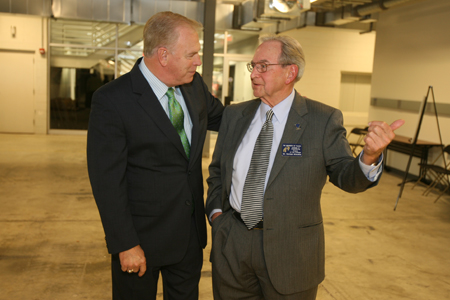
Ohio Governor Ted Strickland speaks with Norm Nitschke.

“These jobs are developing, but they’ll go to the place that is prepared for them,” Rundgren wrote. “Communities that delay and debate might find themselves doing without, watching as other cities become the capitals of alternative energy. While Toledo is doing well now, I worry that we could end up our own worst enemy. Our history of territorial griping, finger pointing and baseless threats could lead to a pathetic squabble that costs time and, ultimately, jobs.”

Republicans in charge

When Kasich took office, his Republican-led administration criticized Strickland and former Lt. Gov. Lee Fisher for how Ohio’s $8.2 billion in federal stimulus money from the President Barack Obama-supported American Recovery and Reinvestment Act of 2009 was dispersed. Although Kasich never publicly criticized Obama, members of his administration questioned Strickland’s relationship with executives at Toledo’s Willard & Kelsey Solar Group LLC, suggesting that the $23,400 worth of  2010 campaign contributions by four Willard & Kelsey executives were improper and indicated favoritism from Strickland.

On March 10, 2010, State Sen. Mark Wagoner joined fellow Republicans in criticizing Strickland. They called for the governor to be more open to “game-changing investments,” such as the rejected proposal offered by local solar company executive Norm Johnston, chairman of nonprofit group Ohio Advanced Energy,  vice chairman of Germany’s Calyxo GmbH and chief executive of Calyxo’s North American subsidiary, to use state funding to cover 30 former industrial sites with solar panels.

Johnston had complained about the Strickland administration’s rejection of his $750 million proposal to build 30 solar fields on cleaned-up industrial sites throughout Ohio.

Johnston claimed Strickland was to blame for Ohioans not having thousands more jobs in solar industry in 2010.

Strickland countered, saying he put emphasis on solar and other renewable energies as two of the most exciting prospects for reversing what he said felt like a decade-long recession in Ohio. Strickland said his approach would have resulted in thousands of solar jobs for Ohioans. Then-gubernatorial candidate Kasich criticized Strickland over what Kasich said was the disappearance of some 300,000 jobs during Strickland’s administration.

Strickland asserted that his solar policy adjustments would have created more jobs sooner had Republicans not opposed legislation that would establish a market for solar products.

Republicans reacted angrily to the suggestion they opposed any job-creating legislation.

“We passed Senate Bill 221 … that moved advanced alternative energy further down the road in Ohio, and that was a very bipartisan effort to do so,” Rep. Randy Gardner said. “The strongest champion on SB 221, I think, was at the time [former Republican House leader] Jon Husted.”

One Republican’s strategy

The animosity between Ohio’s Democratic and Republican parties escalated in April when Jeff Jacobson, former Republican lawmaker and current secretary-treasurer of The Ohio Air Quality Development Authority (OAQDA), moved to turn over three Toledo-area solar companies to the attorney general’s collections department for failing to make scheduled payments on millions in low-interest state loans issued in 2010.

“I don’t know why companies would think it’s OK to take our money and not pay,” Jacobson told media April 15. “Us doing nothing is not a good reaction to something like that.”

Other OAQDA members did not support Jacobson’s motion. Jacobson acknowledged that he didn’t expect his motion to garner support, but said he made it to send a message from Kasich’s administration to Ohio companies that the OAQDA is keeping detailed records and expects to be paid back the money it loans.

Katie Sabatino, an Ohio Department of Development spokesperson, said such drastic measures may become common if businesses “don’t live up to the commitments they promised [because] we’re going to take appropriate action. We want to make sure we’re being business friendly in letting them repay their loans, but still being good stewards of taxpayer dollars.”
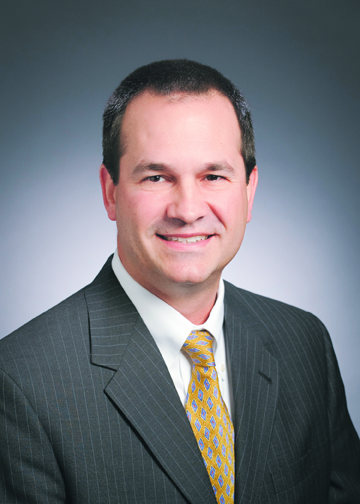
Dean Monske

Willard & Kelsey Solar and Xunlight Corp. have made interest-only payments on Advanced Energy loans of $5.1 and $4 million, respectively. This despite the fact that their loan agreements required them to make principal payments. Willard & Kelsey’s $5.1 million loan and a separate $5 million loan from the Department of Development will come due Sept. 30.

On April 15, Mossie Murphy, Willard & Kelsey’s chief financial officer, insisted that the firm never misused state funds and always complied with state law. He said private funding, which had also been scrutinized in the local print media, is used at the discretion of Willard & Kelsey’s executives and not subject to public review.

“We view the state money as sacred, and the state loans we fully intend to pay,” Murphy told media.

The third firm, Buckeye Silicon of Toledo, has not made a $2,400-a-month interest payment on its $1.4 million loan in 2012, although the firm was supposed to begin paying $25,000 a month on principal starting May 2012.

Educational leadership

Toledoans appreciated the notoriety then-Gov. Strickland brought their city when he christened Northwest Ohio an official hub of solar energy research and innovation, on July 1, 2010. Many saw the ceremony as an economic-development coming-of-age party intended to boost investment and create local jobs in alternative energy.

Strickland’s ceremony confirmed something that Dan Johnson, then-provost and chief operating officer of Zayed University, Dubai, United Arab Emirates, and UT president emeritus, already knew. A year earlier, Johnson expressed that same pride and delight when he saw UT and Xunlight accept leadership roles in the international solar energy industry by representing Toledo at the World Future Energy Summit in Abu Dhabi, UAE.

Johnson encouraged more members of the Toledo business and educational communities to attend future summits.

In a Toledo Free Press guest column Feb. 13, 2009, Johnson wrote, “To compete, we must have a strategy that recognizes and takes into account what is happening globally as well as nationally and locally. Participating in the World Future Energy Summit was a good move and one that should be repeated every year.”

Frank Calzonetti, UT’s vice president of research and development, praised Johnson’s strategy, saying UT’s decision to attend the summit spoke volumes about Toledo’s commitment to the solar energy industry.

“Our presence at this meeting sends a message that we are a global player and gives us an opportunity to show leading companies, investors and government officials why Toledo is a good place for research collaboration, business location and investment in renewable energy,” Calzonetti said.

More than three years later,  Johnson said he has been privileged to attend the past three World Future Energy Summit conventions and “see the global input into the development of solar energy. There are literally hundreds and hundreds of companies worldwide involved in solar energy research and development.” That exposure has convinced Johnson that “we must collaborate together.”

“What we’ve seen happen in Toledo [these past four years] in terms of response to specific solar industry companies is the result of a shift of policy decisions,” he said.

“The enthusiasm we saw here in the United States in 2008 produced a considerable investment and a large number of startups. As those start-ups developed and matured, the market and business cycles took over.

“Look at the auto industry as an example. Almost, if not all, the start-ups 75 years ago are gone now,” Johnson said. “The industry grew, and as technology developed the startups of the early 20th century gave way to other companies.

“The shake-up we see happening in the solar industry could have and should have been expected. It’s a natural process in the business cycle. If you look at it from a global perspective, it’s a pattern we see in all new industries.

“It’s also very important to recognize that demand for solar energy is affected by policy. We’ve been strong on the technical development side. We need to be as strong on policy issues.

“Also, although we have been strong on things like technological development, we have not been strong on marketing supply. Some companies and some countries have done it better than others. We have much to learn about how to market solar energy.”

Johnson insists “there is still a lot of potential for Toledo. However, we need to have strong leadership in this area. We need leadership. Where will it come from? That will be interesting to see.”

Finkbeiner said the leaders for economic development in this region are the University of Toledo and Bowling Green State University, the Regional Growth Partnership (RGP), the Port Authority and the mayor.

“The University of Toledo has been a tremendous leader because it has the wherewithal and the staff to assist with the research and development aspect of things as they did with Harold McMaster.”

In discussing Willard & Kelsey’s continuing research and development, including 3-by-6 and 4-by-8 solar panels and higher-than-industry-standard, energy-efficient solar windows, Michael Cicak praised UT’s researchers and their work with his firm.

“You can’t sell the University of Toledo short,” Cicak said July 19. “They have some damn good people who are working very, very diligently with us with some projects.”

Cicak, chairman and CEO of Willard & Kelsey, was an original partner with Harold McMaster in the pioneering developmental work UT did with GlassTech Solar in 1984 and Solar Cells, Inc. in 1990. Solar Cells eventually became First Solar after being bought by True North Partners, LLC in 1999 and renamed First Solar, Inc.

Community leadership

Finkbeiner said he is particularly disappointed in what he called a lack of leadership from the RGP and the Toledo-Lucas County Port Authority, organizations that he said played a major role in promoting the solar industry from 2006-09.

As an example, Finkbeiner pointed to Steven Weathers, then-president and CEO of the Regional Growth Partnership, who came out on June 8, 2007, in strong support of the University of Toledo’s Northwest Ohio Science and Technology Corridor as a way to diversify and stabilize the region’s economy.

“I see it as the branding of an area like Silicon Valley where we can bring together all the components of economic development within Northwest Ohio, becoming a center of innovative technology in addition to automotive manufacturing,” Weathers said.

The RGP is responsible for marketing and promoting Northwest Ohio. The Port Authority aims to generate transportation and economic development in the Toledo area. Finkbeiner said both have “dropped the ball.”

In RGP’s defense, its president and CEO, Dean Monske, said that through RGP’s editorial marketing program, “We continuously communicate with national and international media, promoting our regional strengths, assets and success stories.

“When we began pitching our regional solar story in 2007, we were fortunate to catch the media at a time when ‘green’ industry was the hot topic. What resulted were dozens of stories about this region in top-tier media outlets across the world. Today, we still pitch this story on a national level, but most media interest comes from industrial trade publications.

“Most growth in the local solar industry has taken place in the creation of new startup companies. The lead entity in working directly with technology startups is Rocket Ventures, LLC, a venture capital organization created as a joint venture in 2011 through the RGP and University of Toledo Innovation Enterprises,” Monske said.

Prior to the joint venture, Rocket Ventures operated directly under the RGP, where it worked with technology-based startups, including solar companies, Monske said.

“The recent merger presents a more sustainable and lower-cost platform to continue providing services to technology-based clients,” Monske said.

“Undoubtedly, the global economic downturn has hampered growth in solar,” Monske said. “However, with our core capacity in this industry, combined with our regional competitive assets spanning the traditional sectors such as workforce, geographic location, education, transportation and quality of life, Northwest Ohio can maintain and enhance its standing as a major player in the industry.”

The ultimate responsibility

Finkbeiner also pointed to the mayor, whom he said “remains the most important” leader in the region’s economic development.

“Those three organizations (UT, the RGP and the Port Authority), and that one individual, is where the responsibility lies. The glory goes to them if we gain and grow jobs, and the responsibility is on their shoulders if we don’t do that,” Finkbeiner said.

“I believe that one, if not the most important reason [for the decline of the solar industry in this area], is all of the attention, excitement, glory and journalism following the very early Mike Bell-tenure trip to China. It took us off the message. It took us off focus. We began to look at the relationships with China, not the rest of the world, as the single most important economic development initiative. And I haven’t heard hardly a word about alternative energy since that China topic was introduced.

“In this man’s opinion, the Chinese have not created hardly a job in the United States of America. They’re investors in real estate in this country. They aren’t manufacturers. They aren’t doing major technology investments. They’re basically real estate investors — a hotel in Downtown Toledo, the Marina District, and a docks property in East Toledo — but the jobs are not a part of their mission.

“Since we got so involved with that China thing, I haven’t heard, read hardly a word about alternative energy and its significance.

“Some region of the United States is going to be a major player in alternative energy programs, starting with research and development, the manufacture at a cost-efficient scale of alternative energy. The world is overheating. It’s becoming more and more known to even the doubting Thomases, and we can’t continue to be held hostage to dictators in other parts of the world who don’t really share our belief in democracy, in freedom, in respect for women.

“And so just to get their oil, we sell our principles and our very important constitutional guarantees of freedom and opportunity. We sell those out just to get oil and support dictators that are harsh, unfair to significant parts of the population.

“But we, within the confines of the continental United States, need to be that region that isn’t guided by gray skies, as you now know.”

Finkbeiner also discounted any argument that sunnier climates might steal Toledo’s solar energy potential.

“I didn’t know this until the last two or three or four years ago when I asked the question, ‘Are we going to be foreclosed upon to the Arizonas and the Californias because of their supposedly clear skies and sunshine?’

“The response that I got was, ‘No. It has nothing to do with that or First Solar wouldn’t have picked that site in Toledo to locate.’

“So I’d say the sun is still rising on alternative energy options,” he said.

“I hope that alternative energy advocates, including Northwest Ohioans like Marcy Kaptur, Bob Latta and Sherrod Brown, will continue … not just with whatever the popularity quote of the month is. We have got to be consistently keeping our eye on any development opportunities in the field of alternative energy that we might be able to welcome to Northwest Ohio, using the resources at UT.”

Sources:

Newspaper sources

1. Toledo Free Press, “Plan to transform regional economy”, Duane Ramsey, June 8, 2007.

2. Toledo Free Press, “Transforming Toledo”, Tom Pounds, June 8, 2007.

3. Toledo Blade, “Catching up on tech grants – Frozen out of funds early in program, area intensifies effort”, Jon Chavez, Sept. 23, 2007.

4. Toledo Free Press, “Advanced energy activity ‘encouraging’ ”, Brooke Brockschmidt, Matt Sattle and Shawn Ferguson, Sept. 28, 2007.

5. Toledo Free Press, “2007: A year of recognition and defined vision”, Carty Finkbeiner, Dec. 28, 2007.

6. Toledo Free Press, “Toledo 2020: Engaging future stakeholders”, Dan Johnson, Jan. 4, 2008.

7. Toledo Free Press, “RGP fosters technology”, Steve Weathers, Jan. 25, 2008.

8. Toledo Blade, “Middle East nation may invest here, mayor says – Economic team has 101 companies on list”, Ignazio Messina, April 2, 2008.

9. Toledo Free Press, “Alternative energy: Making lemonade from the lemons”, Dan Johnson, May 2, 2008.

10. Toledo Free Press, “Toledo company develops technology for cleaner biofuel”, Duane Ramsey, May 25, 2008.

11. Toledo Blade, “Analysts cool on First Solar – New competitors, high stock price spur ratings dip”, Gary T. Pakulski, June 8, 2008.

12. Toledo Free Press, “Toledo’s future in alternative energy”, Dan Johnson, Aug. 1, 2008.


13. Toledo Free Press, “Business-led effort aims to recall mayor, establish PAC”, Scott McKimmy, Dec. 4, 2008.

14. Toledo Free Press, “Toledo turns to solar to revive city”, Associated Press, Dec. 8, 2008.

15. Toledo Blade, “Finkbeiner bullish on city’s prospects for development – Mayor’s critics see lack of progress”, Tom Troy, Dec. 28, 2008.

16. Toledo Blade, “City making strides, mayor says – His annual talk cites alternative energy”, Ignazio Messina, Jan. 6, 2009.

17. Toledo Blade, “Solar field’s backers ask Toledo Council to invest”, Ignazio Messina, Jan. 15, 2009.

18. Toledo Free Press, “What 2009 offers”, Steve Weathers, Jan. 16, 2009.

19. Toledo Blade, “Council OKs $65,000 for solar project”, Ignazio Messina, Jan. 21, 2009.

20. Toledo Free Press, “Regional cooperation is bold step in right direction”, Carty Finkbeiner, Jan. 23, 2009.

21. Toledo Free Press, “Toledo at the World Future Energy Summit”, Dan Johnson, Feb. 13, 2009.

22. Toledo Free Press, “Local public, private sources file for stimulus money”, Duane Ramsey, March 6, 2009.

23. Toledo Blade, “Thin is key for First Solar – Cost-saving production is choice for it, Xunlight”, Gary T. Pakulski, May 31, 2009.

24. Toledo Free Press, “Can Toledo re-invent itself?”, Dan Johnson, June 9, 2009.

25. Toledo Free Press, “SSOE ranked among fastest-growing firms”, Duane Ramsey, Oct. 8, 2009.

26. Toledo Blade, “First Solar plant re-energized – Expansion reflects growth in demand across N. America”, Gary T. Pakulski, Nov. 22, 2009.

27. Toledo Blade, “Third Frontier: A good investment for NW Ohio”, Steve Weathers, Dec. 10, 2009.

28. Toledo Free Press, “UT honors efforts of Abu Dhabi energy company”, Kristen Criswell, July 29, 2010.

29. Toledo Free Press, “Expanding our economic horizon through alternative energy”, Dan Johnson, July 29, 2010.

30. Toledo Blade, “Obama’s rosy take on Toledo imprecise; Area’s clean-energy progress overstated”, Joe Vardon, Aug. 22, 2010.


Online sources

31. Ask.com, “Carlton S (Carty) Finkbeiner second term; 2006–2010”,

http://www.ask.com/wiki/List_of_mayors_of_Toledo,_Ohio


32. Ask.com, “Michael Bell (Mayor)”, http://www.ask.com/wiki/Michael_Bell_(mayor)


33. Ask.com, “Presidential Election 2008”, http://www.ask.com/wiki/United_States_presidential_election,_2008


34. CBS News, “Stimulus recipient under investigation for insider trading”, Laura Strickler, March 22, 2012, http://www.cbsnews.com/8301-31727_162-57402463-10391695/stimulus-recipient-under-investigation-for-insider-trading/


35. City of Toledo, “Mayor’s Office Staff”, http://www.ci.toledo.oh.us/MayorsOffice/MayoralStaff/tabid/267/Default.aspx


36. Nasdaq.com. “Interactive Stock Chart – First Solar, Inc.”, http://www.nasdaq.com/symbol/fslr/interactive-chart


37. Recovery.gov, “The Recovery Act”,

http://www.recovery.gov/About/Pages/The_Act.aspx


38. ToledoFreePress.com, “Sun Burn 1: Area courted solar energy with research”, July 19, 2012, https://tfpmay.toledowebdesigns.com/2012/07/19/sun-burn-1-area-courted-solar-energy-with-research/


39. ToledoFreePress.com, “Sun Burn 2: Global changes slow solar growth”, July 26, 2012, https://tfpmay.toledowebdesigns.com/2012/07/26/sun-burn-2-global-changes-slow-solar-growth/


40. Wikipedia.org, “Ohio Gubernatorial Election 2010”, http://en.wikipedia.org/wiki/Ohio_gubernatorial_election,_2010


41. Wikipedia.org, “SSOE”, http://en.wikipedia.org/wiki/SSOE

Nine Lives to play the After Play Party at Friday at The Farr

0

Nine Lives lead singer Jake Pilewski never pictured himself in a cover band. Turns out it’s been one of the most positive musical decisions he’s made.

“I got so into the writing that I said, ‘You know, I would never be in a cover band. I would rather play a dive bar the rest of my life making chump change a night just as long as I’m playing originals,’” Pilewski said. “Well, then reality sets in, and you start realizing, ‘Oh, I’ve got bills and I’ve got to do this and I’ve got to do this.’”

Formerly of local band Highland, which also featured Nine Lives members Mike Toth and Mike Haskins, Pilewski said he didn’t consider playing covers an option until he went to a music convention in Harrisburg, Pa., where Fuel vocalist Brett Scallions was speaking.

“At the time he had just left Fuel, and he was telling this story about how Fuel was a big cover band all around Harrisburg, Pa., for years,” Pilewski said of Scallions. “And he said in Harrisburg, they were artsy, but still these places were going to hire bands to play what the bar crowd wanted to hear, which was cover music.”

Jake Pilewski and Nine Lives will headline the After Play Party at Friday at the Farr. Photo courtesy Mike Toth

That experience, as well as seeing Cincinnati cover band The Menus live at Put-In-Bay, was enough to convince Pilewski to give covers a shot. He and Haskins left Highland nearly three years ago to join Toth in Nine Lives, a move that proved to be fruitful.

It wasn’t long before Nine Lives was playing at some of Toledo’s bigger bars and events, including fundraisers at The Blarney Irish Pub and Mud Hens’ Opening Day.

“It definitely was worth it right off the bat when we started seeing the reaction from people,” Pilewski said. “It made the whole decision to start playing cover music a lot easier.”

Comprised of Pilewski, drummer Toth, lead guitarist Haskins, Tim Bauer (guitar/piano/sax/harmonica/vocals) and bassist Chad Singleton, Nine Lives will perform on Aug. 10 at the Jamie Farr Toledo Classic as part of the tournament’s Friday at The Farr festivities.

“We are absolutely stoked,” Pilewski said. “That’s one of those things that we’ve heard over the years, like, what a party it is.”

Pilewski and Nine Lives are particularly excited to play at the tournament given that it’s not their typical venue.

“We love the usual [venues],” Pilewski said. “That’s what keeps us going, but it’s great to play something completely different because there’s kind of a bit of mystery and mystique about the whole thing, that you go in not knowing what to expect.”

Part of what has helped Nine Lives find so much local success is its versatility. The band covers everything from 1950s era music to pop, classic rock, blues, dance, country and Top 40 hits.

“Whether they were born in the ’50s or they were born in 1989, I mean, we have a little bit of something for everybody,” Pilewski said. “They always say, ‘You can’t make everybody happy,’ but we come pretty close to it at least throughout the night, as long as people stick around the whole set.”

Friday at the Farr will take place during the Jamie Farr Toledo Classic at Highland Meadows Golf Club, 7455 Erie St., in Sylvania.

Daily tournament tickets start at $15 and are available at the gate or Shawn’s Irish Tavern, which is also providing shuttle service on Aug. 10 from its Toledo location, 4400 Heatherdowns Blvd. Weekly tickets are $50 and are available at local Kroger stores. Kids 17 and younger get in free with an adult. More ticket information is available online at jamiefarrtoledoclassic.com.

After the final golfer finishes her round at approximately 7 p.m., Nine Lives will perform at the public pavilion at Highland Meadows as a grand finale to the Friday at The Farr festivities.

For more information, visit facebook.com/ninelivestoledo or facebook.com/KlingersClub.

Local businesswoman, student to golf with Jamie Farr

0
Brooke Darah, left, and Judy McFarland. Photo courtesy Thread Marketing Group.

An area businesswoman and a college student will golf alongside Toledo legend Jamie Farr on Aug. 6.
“It is very exciting as well as a little nerve-wracking, given my handicap,” said Judy McFarland, president of Thread Marketing Group, with a laugh. McFarland’s company is one of the sponsors of the Jamie Farr Toledo Classic.
At the Mercy/Lucas County Healthy Communities Foundation Pro-Am, McFarland and Lourdes University student Brooke Darah will round out Farr’s team. Farr, best known for his role on the television show “M*A*S*H,” is bringing a friend who will play and a pro golfer will complete the fivesome.
McFarland said Thread attempts to support a different cause every year and chose to support the tournament for its positive impact on the community. The classic will raise money for 10 area charities.
“The effect [the classic] has on our local economy as well as our community brand is just enormous,” McFarland said. “It’s just a win, win, win in all that it accomplishes.”
McFarland said she chose Darah to join the group because of the student’s Sylvania ties. The tournament takes place at Sylvania’s Highland Meadows Golf Club.

Darah is not only on the Lourdes University women’s golf team, but she is a graduate of Sylvania Northview High School.
The businesswoman said she wanted to “give a local gal an opportunity of a lifetime” in addition to supporting Lourdes, a client of Thread’s.
“I was worried given her age, [Darah] might not know who Jamie Farr is,” McFarland said with a chuckle.
But Darah not only knew who Farr was, she said her grandfather knew Farr personally and she met the star at a restaurant once.
Darah, a junior studying nursing, said she was thrilled McFarland invited her to play.
“[Lourdes] has a really good golf program, I think. It’s a honor that they chose me to represent our school andpromote Lourdes,” Darah said.
She also said she hoped and believed Farr would remember her, or at least her last name.
Golfing at the classic will also give Darah a chance to meet professional golfers. Her favorites are Paula Creamer and Christina Kim.
McFarland met Farr a few years ago at a photo shoot, but said the two just exchanged pleasantries.
Although she is nervous about her skill level, she said Darah offered to give her pointers.
“I am one of those people who love the game, who has not quite mastered it,” McFarland said.
Toledo-based Thread Marketing offers marketing, communications, public relations and information technology services. The company has been around for 25 years and employs about 40 people. For more information, visit www.threadgroup.com.
The classic runs from Aug. 6-12.

For more information, visit the website www.jamiefarrtoledoclassic.com.