Home Blog Page 261

Kuron: Building Fort Amherstburg

0

Remember that old song from the musical, Annie Get Your Gun? It reminds me of a friendly competition I had with one of the neighborhood kids of my youth. It started when he got a new bike for his birthday. My next birthday produced a bike too, but a three-speed! You could be sure that if I got a new basketball, he would soon have a new football. It got really ugly when my Detroit Tigers won the World Series in ’68 and his Cleveland Indians, well, didn’t. Even our fathers got in on that rivalry! This one-ups-man-ship attitude is what prompted the building of the British Fort Amherstburg at the mouth of the Detroit River in Canada.  

In 1796, Jay’s Treaty stipulated that the British finally surrender possession of Fort Detroit to the Americans – something they were supposed to have done at the end of the Revolution, thirteen years earlier. The concession stung the British because Detroit was a very lucrative trading center with the Native Americans. Solution – construct a comparable fortress right across the Detroit River, right across from the now American Fort Detroit. It would be named after Jeffery Amherst, a British hero of the French and Indian War. Besides being the first British Governor General in the Canadian territories, Amherst is also notorious for being the first to employ biological warfare.  Are you ready? He actually ordered the distribution of blankets, to unknowing Native Americans, which were infected with the smallpox virus.   

The post became known as Fort Amherstburg, and being just a military stronghold, or just a trading center, simply wouldn’t do. Yes, it was both of those things, but alongside of it a ship-building facility was constructed – the King’s Navy Yard. Here, four of the six ships to do battle with Oliver Perry in 1813 would be built.  

Physically the fort took on the general design of many other British forts. Palisades enclosed the 900- yard rectangular perimeter at a height of ten feet. The four corners had diamond shaped earthworks which hid four cannons each. Inside, buildings housed the supplies and occupants.  

At the onset of war, in August of 1812, it was this fort that US General Hull came within a few miles of attacking before having a change of heart and retreating to Fort Detroit. Here also, Alexander McKee spent many years as a frontier trader with other infamous characters like Simon Girty. Earlier, McKee ran a trading post on the lowlands of the Maumee River just below the current 577 Foundation property in Perrysburg, Ohio.  

It was at Fort Amherstburg that such famous leaders as Tecumseh and General Brock would meet to plan military maneuvers throughout the Northwest Territory. These two giants of military prowess made their first War of 1812 move when they successfully attacked Hull and regained possession of Fort Detroit. Just two months later General Henry Proctor was awarded command of the fort after Brock was killed at Queenston Heights. From this base, Proctor and Tecumseh directed the attack at the Raisin River, and later unsuccessfully led their forces against Fort Stephenson and Fort Meigs.  

The victory of Oliver Perry over the British fleet on September 10, 1813 triggered heated arguments between Tecumseh, who wanted to fight the approaching American force at the fort, and Proctor who wanted to retreat. Proctor won the debate and the withdrawal began, but not before Fort Amherstburg, which had stood for seventeen years, was torched.  

The Americans would catch and defeat their opponent at what is known as the Battle of the Thames and so the smoldering ruins of Fort Amherstburg would temporarily come into their possession, but only until the end of the war in 1815.  

From this time on it was referred to more often as Fort Malden, in the city of Amherstburg. It was only sparsely manned for years and was even used as an insane asylum for a time, until the property was eventually sold off for urban development. Since 1939 the original grounds have been regained and opened to the public. Next time you take a trip to Canada, set aside a day to visit this historic location. You’ll have one up on your friends. 

Frank Kuron is author of the War of 1812 book, “Thus Fell Tecumseh.” Email him at [email protected] 

Bugle Call: Upcoming Events 

Some key websites to learn of upcoming 1812 Bicentennial events: 

www.1812amherstburg.com/event/roots-to-boots  — August 3-5, 2012 — Roots to Boots Weekend Festival in Amherstburg, Ontario. 

www.pc.gc.ca/eng/lhn-nhs/on/malden/index.aspx  — Fort Malden National Historic Site of Canada. 

www.warof1812.ohio.gov — Most Ohio events are listed. 

www.opsail.org – Details of the US Navy’s OpSail tour of the eastern seaboard and Great Lakes. The Niagara and ships of today’s military will be in Toledo from August 22-27, 2012. 

www.battleoflakeerie-bicentennial.com – Details of a full re-enactment of the Battle of Lake Erie planned for September of 2013 in which you can participate.  

www.fortmeigs.org – Numerous activities year-round. 

www.riverraisinbattlefield.org – Numerous activities year-round. 
Treece: State of the economy

0

Before getting into this week’s financial report, I wanted to take a moment and comment on my article from last week, Corn is King. In that article, I quoted the price of corn as being $800/bushel. Corn is quoted in cents, not dollars. The current price of corn is just over 800 cents/bushel, or $8/bushel. I can only attribute my misrepresentation to habit; when we constantly quote stock prices and bond prices in dollars, it flowed a little too easily. I should have caught this error in my proof reading but I did not, and for that I am sorry. I would like to thank my readers for pointing out my mistake in a courteous and professional manner, and I will do better in the future. 

While presenting to a 401(k) plan that we advise up in Auburn Hills we were revisiting our economic forecasts from back in the 1st quarter of 2012 and found that many of our predictions came to fruition. We predicted that we would begin to see signs of a strengthening economy, but that policy would hold back the private sector more than anything. Sure enough, failed policies from the federal, state and local levels have resulted in a temporary freeze in the economy.  

Manufacturing, retail sales and housing prices and activity are all up in the reporting period, however hiring has leveled off and jobless claims have ticked up slightly. Unemployment has continued to be an issue for this recovery for 2 main reasons; we lack skilled labor and future employee costs are unknown. 

Some readers have questioned our economic analysis as being politically biased and driven. We do our best to let the investing public know that the markets and public policy have a very close relationship; one tends to mold the other. My father, Dock D. Treece, has been in the financial services industry since 1979 and has made money under every president since Jimmy Carter; case in point, we do not allow our own political perspectives to influence our investment goals, objectives or choices. The fact of the matter is that the Affordable Care Act has many employers terrified to take on new staff. This is not a comment on socialized medicine, the current administration or the healthcare industry, this is simply commenting on documented responses of business owners to the law as it is written. If the Affordable Care Act carries on as is, expect unemployment to remain high for an extended period of time. 

Private sector business owners have also noticed a frightening trend when hiring; finding skilled workers has proven to be very difficult. Between a lack of interest in younger generations to focus on engineering studies and many apprenticeship training programs closing their doors, finding the right people for the manufacturing jobs that have been moving back from overseas has not been an easy task. 

“Onshoring” of manufacturing jobs has been another trend that we predicted well over a year ago. Between rising labor costs abroad and the inability to protect product patents, many manufacturers have decided to shift their factories to the US and North America (Bose and Honda are 2 big ones to name a few).  

Adding to the solid economic numbers, Industrial Production was up .6% year over year and Home Builder Confidence turned in at the highest level since February of 2007. This shows us that the bottom of the real estate market has likely come and gone, and buyers are now looking for new construction homes instead of older model homes from the 40’s, 50’s and 60’s.  

One cause for concern that we have has been an increase in food, energy and housing costs, or what is known in economics as inelastic goods. These are items that even when the price increases, their demand stays relatively constant. When prices increase for inelastic goods, consumers have fewer dollars to allocate towards discretionary spending, i.e. entertainment. Historically, when these prices increase and the economy fails to grow, we have what is called stagflation, which was a term tightly associated with the Misery Index under President Carter. 

On the whole, the economy is improving, slowly but surely. In our opinion there are many policy choices that could be made to speed up the recovery, but all things considered the US economy is getting stronger, even if the numbers do not always reflect it.  

Ben Treece is a 2009 Graduate from the University of Miami (FL), BBA International Finance and Marketing. He is a partner with Treece Investment Advisory Corp (www.TreeceInvestments.com) and a stockbroker licensed with FINRA, working for Treece Financial Services Corp. The above information is the express opinion of Ben Treece and should not be construed as investment advice or used without outside verification. 


Rathbun: Actions for the fiscal cliff

0

It increasingly looks like Congress is going to do nothing about the fiscal cliff that we are headed for at the beginning of next year.  For those of you that are not familiar with the term “fiscal cliff” or the implications of it, let me briefly explain. 

At the end of this year the overall tax rates are going to increase, the payroll tax will increase and over 1 trillion of automatic spending cuts will go into effect.  Additionally, there are several new taxes that will take affect in 2013 from the Obamacare legislation among others. 

All told, there is about 600 billion dollars of effect on the economy next year and that will, according to some experts, plunge us into a deep recession that will last a while.  I am not going to discuss this aspect today but rather what actions you should consider, regardless of what happens. 

The first things we are looking at are the tax rates.  The tax rates are going to go up next year regardless of the fiscal cliff being dealt with or not.  Whether President Obama gets re-elected or Mitt Romney gets elected, Congress will raise tax rates to provide the illusion that they are being fiscally responsible. 

With that in mind, between now and the end of the year, one should look at what we call “tax harvesting”.   

Under normal circumstances, tax harvesting, involves taking some loses at the end of the year to offset gains taken throughout the year or vice versa.  Profits always have to be recognized in the year they are realized but losses are carried forward if they are not used in the year they are realized. 

We recently had a case come into our office where the advisor took a 48,000 dollar loss for a client without any offsetting gains in the same year.  The losses were then carried forward at the rate of 3,000 dollars against ordinary income per year.  (You can use the losses faster if you have gains in the future that are realized.)  The problem was that this investor is 96 years old and does not have the possibility of realizing 48,000 dollars of gains in her lifetime. 

The advisor clearly wasn’t thinking and openly admitted his mistake.   

This year, however, is slightly different in that we will want to take gains where we can so that the taxes are at a lower rate than they will be after the first of the year.  Capital gain rates are scheduled to increase and the rate on dividend income will probably increase tremendously for most taxpayers. 

We are starting early this year in our tax harvesting since it is likely that there will be a large number of people doing the same thing later this year, plus the overall market is up right now and we believe that could change dramatically by the end of the year. 

As we get closer to the end of the year we will get a better picture of what next year will be like so we will make adjustments accordingly, but for now it would be good if you started to look at your portfolio from a tax standpoint and talk to your advisor and tax professional sooner rather than later. 

Gary L. Rathbun is the president and CEO of Private Wealth Consultants, LTD.  

Owens implements virtual welding technology

0
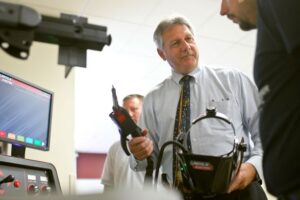
David Siravo, director of skilled trades and apprenticeship training at Owens Community College, operates the VRTEX 360. Toledo Free Press photo by JOSEPH HERR

It may look solid, but there is more to a good weld than what meets the eye. 

“People can make a beautiful weld, but it can be broken with a hammer,” said Jim Gilmore, chairman of diesel and welding technologies at Owens Community College. “You want something that looks good and is functional as well, so you couldn’t break it with a hammer or even a semi truck. Everything – our buildings, our bridges – depends on that.” 

Area welders now have the opportunity to test the appearance and durability of their products as well as practice and hone their welding skills using Owens Community College’s new VRTEX 360 systems. 

The VRTEX 360 is a Virtual Reality Arc Welding trainer, a computer-based educational tool that allows users to practice welding technique in a simulated environment, logging practice hours while reducing the material waste, scrap and energy consumption associated with traditional welding training, according to manufacturer Lincoln Electric’s website. 

In January 2011, Owens unveiled its newly renovated $1.1 million, 14,512-square-foot Welding Design Center on its Toledo-area campus in Perrysburg Township. Using grant funds, the school purchased a VRTEX 360 training system from Lincoln Electric six months ago and a second system about a month ago. 

David Siravo talks with students about the VRTEX 360 at Owens Community College. Toledo Free Press photo by JOSEPH HERR

When using the system, welders use tools to perform the movements of welding while wearing a mask that displays an image of what they are virtually “welding” in front of them, said David Siravo, director of Skilled Trades and Apprenticeship Training at Owens. A large screen displays the same image for instructors to view the process. 

As the student welds, the machine makes sounds similar to those in a real welding situation, Siravo said. A quiet sound is good, while a loud sound means a good weld is not being formed. After the weld is completed, the VRTEX 360 inspects the weld with two tests. 

The first test is a “nondestructive test,” where the system checks to make sure the weld is visually sound and has been formed correctly. For the “destructive test,” the virtual weld is placed on a press that pushes down, trying to break it. 

“[The two tests] are the criteria used to determine if you are going to pass that particular welding certification test,” Siravo said. 

The sound of a crowd cheers if the weld holds up and boos if the weld does not. 

“It shows you how it broke and where it broke so we can look at it and rotate it from all directions and also zoom in on it, so we can get a better picture of what happened,” Siravo said. “This tells us a lot about if I am prepared to go to the real welder or not.” 

While virtual training does not replace traditional welding training, 77 percent of welding training can be accomplished on the machine, as welders gain the muscle memory required to perform real welding, Siravo said. 

“We had a gentleman who had welded for Chrysler and was retired, so he said he hadn’t welded in several years,” Bankey said. “It was kind of neat because he got on there and after a couple of tries it came back to him really quickly.” 

Siravo said all types of welding can be practiced on the VRTEX 360, and instructors can use a flash drive to convert students’ performance data from the system to a pdf file on their own computer. 

Because the units are portable, Owens also now has the capability to transport the technology to area companies for employee welding evaluation and training. 

“[Before] if a company said, ‘We would like you to assess our employees,’ they might have to make arrangements to bring their employees down to our lab,” said Michael Bankey, associate vice president of Owens’ Workforce and Community Services. “What’s unique here is we can take it to the company, where before we couldn’t.” 

The mobility saves companies time and money, Bankey said. 

“Before we could send an instructor if [the company] had welding equipment at the facility already. But it might be the case where if they do have welding capabilities at their company, they’re using it for production, so the last thing they want to do is shut that down to have someone else in training,” Bankey said. 

The VRTEX 360’s initial assessment feature is will be used as a pre-qualification for Owens welding students and also allows students who may not know if welding is what they want to pursue to try out the field by practicing on the virtual systems, Bankey said. The welding program at Owens is an associate of applied science degree, consisting of 66 credits. 

“If they think they want to weld but maybe have never welded before and wonder if it’s really for them, we’re going to create some really short couple of nights where they’re going to be able to do some welding on the machines,” Bankey said. “This way it will provide a very safe environment where they can’t hurt themselves, so it takes out that fear. If they like the feel and decide this is for them then we want to get them over to the (Perrysburg Township) campus and get them working on the pathway towards getting certified.” 

Another plus of the VRTEX 360 is the controlled environment in which welders of all levels can practice, Bankey said. 

“Some of [the company’s] folks may have never welded before, so then you have the whole safety issue,” Bankey said. “We just want to make sure no one is going to get hurt or burn themselves.” 

Nick Nijakowski, a welder and welding trainer at Swanton Welding & Machining, tested the VRTEX 360 at a recent Owens open house and found the machine felt similar to a real-life welding situation minus the heat and other dangerous elements. 

Nijakowski said he had looked at similar equipment numerous times before, but that it’s hard to practice and get a hands-on feel at crowded shows. 

“Here I can mess with it,” Nijakowski said of Owens’ VRTEX 360. 

Bankey said Owens has also taken the VRTEX 360 to Maumee Valley Fabricators, who declined to comment. 


Bicycling healthy, relaxing way to explore city

0
Photo courtesy JAY CATLOW

“I’ve lived in Toledo my whole life, but never knew that was there.”
“I’ve driven past this, but never took the time to stop and check it out.”
“I will want to revisit this.”
Those were among the comments overheard by Bill Tucholski during a recent “Explore Toledo” bicycle ride he organized.
The second annual 30-mile ride drew 23 riders and included stops at historical and cultural landmarks and several points of interest in Toledo’s older neighborhoods and Downtown.
“What motivated us to ride together on city streets, sidewalks and trail links for several hours on a hot summer day could best be described as a desire to experience a sense of adventure in an urban setting,” Tucholski said. “Many of us also wished to reconnect with our and Toledo’s past and to learn about what the city has to offer besides the usual fare.”
Among sights and stops during the ride were a walking tour of the community garden near the Sofia Quintero Art & Cultural Center, a view of the brightly colored murals along Broadway Street, a stroll through the San Marcos Taqueria, the Emerald Street Railroad Bridge trestle, the historic Casey-Pomeroy House, a memorial park for union workers on Champlain Street, the future site of Middlegrounds Metropark, a glassblowing demonstration at Toledo Museum of Art’s Glass Pavilion and Ottawa Park’s Toledo Police Museum.
The riders also stopped at Manhattan’s for lunch and Netty’s on South Detroit Avenue for ice cream.
“By riding at a nice leisurely pace, we had a chance to observe urban dwellers and visitors going about their daily routines and business in a manner that we are usually blind to,” Tucholski said. “Many drivers in vehicles and pedestrians expressed words or gestures of encouragement, like a thumbs-up, along the entire route, even though they were clueless about who we were or what we were all about!”
The riders were mainly in their 50s and 60s or older and, although tired, were sorry to see the day end, Tucholski said.
“We all felt somehow younger than our years with a renewed sense of connectedness to our immediate surroundings, heritage and each other,” Tucholski said. “That was the direct result of touring Toledo in this manner.”
Americans have been in love with automobiles for more than a century.
Because of the great distances many of us have to travel, most have abandoned the use of bicycles as a primary mode of transportation. But with the economy and a growing interest in health and the environment, this option is slowly coming back.
According to the League of American Bicyclists’ annual community survey, 0.4 percent of the Toledo population used a bicycle to commute to work in 2010.
Jay Catlow, who is a member of the volunteer bike patrol for Metroparks of Toledo Area and who participated in the “Explore Toledo” bike ride, said bicycling helps him maintain his
weight and manage stress.
“My aerobic levels are very good for a 69-year-old,” Catlow said.
“Riding with friends is also a very good health benefit. I would say I do 20 miles at least three to five days a week and also do 10 miles of mountain biking a week.
Those with health issues or handicaps can often ride with the use of adaptive equipment or can ride recumbent bikes or tricycles, Tucholski said. As with any physical activity, be sure to hydrate before, during and after a ride, he added.
Useful equipment and accessories to consider include a rearview mirror, a carrier on the rear of the bike, a bike bag for valuables, a spare tire, a tool kit, a snack, a camera, a bike lock and keys and padded riding gloves, Tucholski said.
For more information about the next bike ride, contact Bill Tucholski at [email protected]. ✯

Szyperski: Is turnabout fair play?

0

Inspired by the rousing appearances of the U.S. women’s soccer team in last summer’s World Cup and this summer’s Olympic Games, my 9-year-old son informed me that he would really like a women’s soccer video game. He already has a few games showcasing the premier men’s soccer players in the world, so he was hoping to also add the premier women’s players to his collection. We reserve such purchases for birthdays and holidays, but I decided to take a peek at what was out there for future reference.

Nada.

Somewhat surprised, I decided to dig a little deeper into the gender equality of the sports gaming world. After some searching, I found that the reality-based video games do tend to computer generate many more male athletes than female athletes. EA Sports, the maker of the Madden franchise, offers computer-generated versions of the NFL, NHL, NBA and FIFA, along with NCAA football and basketball. However, I could not find any games featuring female WNBA, FIFA or NCAA players.

I did find video game representation of real-life female athletes included in EA Sports’ “Grand Slam Tennis” and “Tiger Woods PGA Tour” series. From other manufacturers I found a “Shawn Johnson Gymnastics” game and two female athletes depicted in “Supremacy MMA,” a mixed martial arts game. I eventually tracked down a Mia Hamm Soccer game … released in November of 2000 … for Nintendo 64. I see.

As a woman, I feel I should be outraged that my gender is underrepresented in sports-based video games. After all, I was very athletic as a child, playing everything from soccer to softball to varsity tennis. I even quarterbacked my otherwise all-boy flag football team. I spent my Sundays glued to NFL games and asked for sports memorabilia for my birthday. I was a female athlete before cleats and mitts came in pink to please the athletic female masses. Yet, somehow, I’m just not overly appalled that female athletics sometimes take a back seat to male athletics.

Despite my own affinity for sports, I have a daughter who couldn’t care less about them. However, I’ve still encouraged my mechanically-inclined, fashion-minded, no-interest-whatsoever-in-sports middle child to play anyway, because society now says that girls should be involved in sports. I personally just want to see her do whatever it is she enjoys, but growing up in the Title IX era I can’t help but think that it’s somehow my responsibility to ensure that she picks at least one sporty side dish for her life’s main course.

On the flip side, I have a son who has an affinity for sports that far surpasses even my own as a child. With very minimal nudging, he has realized an inherent love for soccer and for the sporting world at large. There is something about it that strikes a chord in him and gives him not only an understanding of athletics but of life in general.

So, I just happen to have a boy who lives for sports and a girl who could easily live without them. They are easily only two cases in a sea of millions, and their personal preferences could no doubt be vice versa. Yet, I can’t help but hold some concern about them both having the freedom to pursue their individual interests as time goes on.

Due to Title IX requirements and the higher cost and gender-partiality of certain sports (namely football), some universities now offer more women’s varsity sports than men’s varsity sports. In fact, our largest local university only offers six men’s varsity sports as opposed to nine women’s varsity sports. One of the sports that got the Title IX boot locally was men’s varsity soccer.

My daughter, who couldn’t care less, will have the opportunity to play collegiate soccer just down the road from us, but my son, who may actually want to do such a thing, will likely not be afforded that same chance because of his gender. In fact, life often becomes unfair in the name of fairness, because equality is ultimately in the eye of the beholder and not in the lines of well-meaning laws. Equality comes more in the form of respect and opportunity for those who take an interest than in the form of evenly split monetary, gender and other ratios.

With that in mind, I’m honestly OK with things like an unbalanced supply of male to female athletes in the world of video games if it reflects the demands of those who do take an interest. However, when my fair-minded, sports-loving, video-game-collecting son points out that he would like to see a league of determined and talented athletic women get a fair electronic shake, it’s time to send an email to EA Sports.


Shannon and her husband, Michael, are raising three children in Sylvania. Email her at [email protected].

UT runner wins Warrior Dash Michigan

0
Hannah Brisson, in her Robin running costume, jumps over fire during Warrior Dash Michigan. Photo courtesy Robert Brisson.

Most athletes tone it down in the offseason. Hannah Brisson jumps through fire.

“There’s never a point when we’re not training,” Hannah said. “In between seasons we take a week off, but other than that we’re training year round.”

Hannah, a senior from Casco, Mich., runs cross-country, indoor track and outdoor track for the University of Toledo. She raced at Warrior Dash Michigan for the second straight offseason on July 29, and for the second straight year she won. After missing the victory last season because of a business trip, Hannah’s mother Claire Brisson was excited for an opportunity to see her win.

Hannah Brisson

“I thought ‘Gee, nice of you to do this twice Hannah,’” Claire said. “I was really disappointed that I missed it last year. As the day progressed, we were getting more and more amazed and excited. We were really enjoying the whole cultural event that it is. Everything about it is so quirky and different.”

Hannah placed first out of 4,566 women, finishing in 27:27.15 despite the wind resistance from the cape of her Robin costume. She continued her winning ways with a championship in the corn on the cob eating contest. Warrior Dash is a 5K race filled with obstacles including mud pits, wall climbs, barbed wire, rope ladders, flotation devices and fire pits. Hannah first learned about the event when a friend on UT’s men’s track team posted about it on Facebook.

“I looked it up and thought it was really cool,” she said. “I thought it would be just another 5K, but I saw it had a bunch of obstacles in it. I asked some of my friends back home if they wanted to do it and they were all for it.”

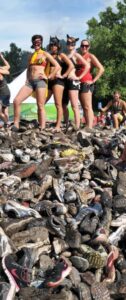
Hannah Brisson, left, as Robin, and her Warrior Fire team pose atop the pile of shoes donated after the 2012 event. Photo courtesy Robert Brisson.

They were more than all for it, showing up as Batman and Catwoman to pair with Hannah’s Robin costume. Hannah ran unofficially with her friends after racing for time earlier in the day.

“We actually had time to enjoy all the obstacles,” she said. “It was a lot of fun.”

Much to her mother’s dismay, Hannah discarded part of her costume after the second race. She was one of thousands of runners who tossed their shoes in a pile to donate to charity.

“My mom was like, ‘You have to hold on to them because they’re special,’ but I donated them,” Hannah said. “She wanted to make a mold of them. My mom and dad are very trinkety. They like to keep memorabilia of everything to do with me and my brother. It’s my shoes though. It’s kind of gross.”

“She wore the same shoes twice and won twice, so I would have liked to bronze them,” Claire said.

“The next thing I know, I saw her barefoot and they were in a pile with thousands of shoes. Hannah has a big heart and that was a wonderful thing to do.”

Claire will have plenty of opportunities to collect trinkets in Hannah’s two remaining seasons at UT. Hannah will return in 2013 for a fifth season of eligibility after redshirting and switching majors from nursing to business and health. She almost stayed in her home state of Michigan for college, but Toledo swayed Hannah in the end.

Soon Hannah will have less time to devote to obstacle races and her shift management position at Hollywood Casino Toledo, and she can’t wait.

“I was torn between Michigan State and Western Michigan University,” she said. “At the last minute, someone mentioned UT had a good running program and nursing program. I emailed the coaches, and a week later they were at my house talking to me. A week after that I was on a tour at Toledo. I fell in love with it.”

“We have our first practice next week, and I am dying for it to get here,” she said. “I can’t wait to see my teammates. I miss my coaches so much.”

Hannah credits her success at Warrior Dash and in other aspects of life to her coaches.

“The coaches are amazing,” she said. “There are so many things they have taught me through training that help me even with Warrior Dash. They teach you how to eat right, train right, be disciplined and make sacrifices. You can apply that to any aspect of your life just from the training we do at school.”

Hannah plans to apply those lessons to a new challenge next summer.

“It’s been fun, but I think it’s time to move on to something else,” Hannah said. “I think I’m going to try the Tough Mudder next year.”

Pounds: No confidence IV

0

“The only sure things in life are death, taxes and Lucas County having the worst election board in the State of Ohio.”

— Steve Fought, campaign manager for Rep. Marcy Kaptur


Fought made that comment during the heat of a March election that saw a number of bungles. But when eyeing the lack of progress the Lucas County Board of Elections (BOE) has made since then, those words should act as a clarion call for action. Once again, the BOE finds itself on the end of a wrist-slapping from Ohio Secretary of State Jon Husted. Husted is being called upon, again, to resolve personnel issues the BOE — Democrats Ron Rothenbuhler and Keila Cosme, Republicans Jon Stainbrook and Anthony DeGidio and director Meghan Gallagher — can’t resolve for itself.

“It is unfortunate and pathetic that the Lucas County Board of Elections is continually unable to agree on the staffing and organization of the board. Instead, the Lucas County Board of Elections requires constant intervention by my office,” Husted wrote July 25. “I continue to hope (and now insist) that the board members and staff will learn to communicate with each other and focus instead on conducting fair and efficient elections for the citizens or Lucas County.”

He expressed similar sentiments in January: “Let me remind the members of the Lucas County Board of Elections, it is their responsibility, and theirs alone, to remedy the continuing issues of staff competency and workplace environment. Hopefully, a timely solution will prevent this office from the need to take separate action.”

But like a father who raises his voice and wags his finger but fails to dispense discipline, Husted seems dangerously hesitant in dealing with the local BOE. With a presidential election looming — one that could be extremely close and could come down to an even closer Ohio vote — there must be zero tolerance of future dysfunction in the BOE.

With the further debacle on Aug. 6, in which the BOE failed to determine hours and even the location for an early voting center,  and reports that even more tie votes will be sent to Husted, this growing morass clearly been allowed to fester beyond any common sense. Lucas County Commissioner Pete Gerken is justified in raising the alarm in Columbus, and hopefully Husted will finally stop threatening and will take direct action.

Husted is already making most of the BOE’s decisions; he might as well take control firsthand. Again, we respectfully ask for and urge Husted to dismantle the BOE’s leadership and force a clean slate that can begin to rebuild confidence as we near a presidential election. If the Secretary of State’s office does not increase its oversight and guarantee the BOE can run an efficient and honest election, the resulting lack of confidence and potential legal issues will rest squarely on its shoulders. There will be scandal on a scale that makes the usual local political games look like preschool frolics, and Husted will carry direct responsibility.

If the chaos is allowed to continue, the only vote that will be believed is a resounding vote of no confidence in the process.


Thomas F. Pounds is president and publisher of Toledo Free Press and Toledo Free Press Star. Contact him at [email protected].

Miller: River of stars

0

The local Make-A-Wish Foundation has more than 90 pending wishes to fulfill, which means it’s time to step up and help this inspirational and invaluable organization. Christmas may be more than 130 days away, but it’s time to start listening to holiday songs that will help the kids depending on Make-A-Wish Foundation.

For Christmas 2011, Toledo Free Press produced “Holiday Wishes,” a CD of holiday songs performed by Northwest Ohio musicians. The CD was a 25-track compilation that raised more than $25,000 for Make-A-Wish Foundation. It was underwritten by Toledo Transmission and UAW Local 14, so every dollar raised, through sales at Panera Bread locations, went directly to Make-A-Wish Foundation.

Although Toledo Free Press had produced two previous CDs, one collecting historical recordings and one from a Toledo songwriting contest, neither approached the scale or complexity of “Holiday Wishes.”

The 2011 CD collected 25 tracks, with contributions from such Northwest Ohio stalwarts as Pat Dailey, Jamie Farr, Mannheim Steamroller, Sheri LaFontaine, Candice Coleman, the Toledo Symphony Orchestra, Crystal Bowersox and Alyson Stoner. It also featured new recordings from Kerry Patrick Clark, Jeff Stewart, Kyle White, Ramona Collins, TAPESTRY, Chrys Peterson & Hepcat Revival, Voodoo Libido, Mighty Wyte and Jameil Aossey, among several others.

With tremendous media support from the late, lamented FOX Toledo, WPOS, 101.5 The River and many of our media friends, the CD sold out in its Panera Bread locations, and even before 2012 started, we were thinking about a second volume.

Rather than start in late July, as we did last year, the 2012 compilation process started in January. Lexi Staples gave us a copy of a track her father, the late radio personality Dennis Staples, recorded of “How The Grinch Stole Christmas!” That required tracking down permission from Random House Publishing, Warner Bros. Studios and the estate of Dr. Seuss. With all those rights now granted, it will be a great honor to include that track on this year’s CD.

Pat Dailey has also generously granted use of another track. “River of Stars” is a gorgeous, soaring song that, while not strictly about the holidays, touches on many elements of the season’s most universal themes of spirituality, connection and unbridled hope.

LaFontaine has allowed us to include “Toledo My Hometown” on this year’s collection. It is a contribution that raises the bar for all the participating artists. “Toledo My Hometown” is a seasonal staple on The River, and it is an honor to have it on this year’s Make-A-Wish holiday project.

There are several artists returning from last year, but we’re keeping the collaborations and song choices under wraps until the recordings are complete. I will say that if the plans come together as hoped, we will be able to offer a CD that will raise the bar for future efforts. Suffice it to say that Stewart, White, Coleman, Peterson and our friends in Voodoo Libido and Hepcat Revival are among those talking to us about this year’s CD, and there are some exciting things on the way.

We are also working on a couple of historical surprises; if we do this right, each year’s CD will serve as an archive of Toledo’s musical history, even as it captures year-by-year changes in bands and styles.

This year’s CD will include a number of exciting new artists, from young country singers to veteran rockers. I am honestly not sure how we’re going to contain all this music on a single disc; it’s a wealth of riches.

Not that every wish comes true; we were hoping to include a track from Weezer’s 2008 EP “Christmas With Weezer,” but although bassist and Northwest Ohio native Scott G. Shriner was receptive to the idea, we were turned down by the group’s management.

The best news for the project is the return of three people who are behind the scenes, but are integral to the process; indeed, without them it would not have happened last year and would not happen this year. Chris Stoll, engineer at Zeta Recording, donates studio time and his finely attuned ears to the project. Matt Fehr engineers the CD and ensures the disc is produced to the highest standards of quality. Larry Meyer navigates the legal and publishing issues to make sure every t is crossed and every i is dotted.

My friend Eric Slough is no longer with the local Make-A-Wish chapter, but development officer Ellie McManus is a dream to work with and is a constant inspiration and reminder of the Make-A-Wish Foundation’s mission.

To that end, there is always room for more support. If your company is interested in making this year’s CD bigger and better, contact me or McManus at [email protected]. Our area Make-A-Wish kids try to retain the hope and inspiration of the holiday season every day of the year. It’s a blessing and privilege to be able to contribute to their dreams and at the same time spread the joy of the holiday season.

It may be the heat of August, but if you pass my car in Toledo and hear Christmas songs, you’ll know there are scores of people working on a project to benefit some of our region’s most remarkable kids.


Michael S. Miller is editor in chief of Toledo Free Press and Toledo Free Press Star. Email him at [email protected].

Johnson: New realities and old ideas

0

One of the great privileges of working in education is the opportunity to encounter a fresh class of new students each fall. They arrive on our campuses excited, nervous, some frightened but nearly all full of optimism, new ideas and a positive outlook on the world.

I remember my first days as a college freshman and I can assure you, I was one of the nervous and frightened ones. But being a college freshman is like opening a new diary where each day offers fresh experiences, new ideas and glimpses of hope for the future. The success of these new students may well be one of the most important goals we as a nation, state and community should pursue.

There is, however, a new reality that is adversely affecting the success rates of college students. It is a harsh reality that now has the attention of our public officials, university administrators and families and students themselves. That reality is the high cost of higher education and, especially for middle-class students, the increasing cost of public higher education.

For many, the only solution is student loans. As a state, we’ve done almost nothing to solve this problem; an ever-greater portion of the growing cost of public higher education is being shifted to the students. The sad result is students frequently have to borrow beyond their means to repay just to stay in school and graduate. An increasing number of young people are deciding that higher education is just beyond their means. Sadly, this frequently comes in the second or third year of college, forcing the student to drop out with loans in the tens of thousands of dollars and no degree. All this is coming at a time in our history when, more than ever, we need well-educated citizens and workers to compete in a world where education and innovation are the major drivers of our economies.

What can we do here in Ohio to help solve this looming problem for our state and its young citizens? I believe there are at least two steps we can take:

First, we need to agree that this is a problem we want to solve. It must become a priority at all levels. We can do that with the right kind of leaders and leadership.

Second, we need to identify possible solutions for public discussion and develop public opinion around these solutions. We can do that, again, with the right kind of leaders and leadership.

Allow me to offer a few ideas to help start a conversation. There are, I believe, at least three possibilities that should be considered as we address the cost of higher education: technology, duplication and financing.

Technology. The rapid advances in learning technologies have the capacity to help reduce the high cost of instruction. We’ve known this for some time. New technologies are regularly announced that could, if adopted, help reduce the cost of instruction.  A “blue-ribbon” task force on the role of technology in reducing the cost of higher education would identify exciting new possibilities for students, universities and the state to consider.

Duplication. This sensitive topic is sometimes discussed (in whispered tones) in the hallways of our legislature and among higher education policy-makers from time to time. It is well-known that our colleges and universities offer a wide array of academic programs, many of which are duplicated on many if not all campuses. There is a good case for duplicating some basic programs in the arts, sciences, humanities and social sciences. There is not, however, a good case for duplicating high-cost programs at six, seven or more of our state university campuses but since each university operates autonomously, little can be done to limit such duplication. The issue of duplication offers a great opportunity for university leaders to engage in a collaborative venture to reduce unnecessary duplication in the interest of cost.  This could potentially be an opportunity to offer a broader array of programs that are not currently available in the right locations.

Financing. Nearly a decade ago I was shocked to find that a one-cent sales tax devoted to higher education in Ohio would allow all our universities to virtually eliminate tuition for resident undergraduate students. A half-cent increase in sales tax would allow our universities to cut the cost of tuition for these students virtually in half. I continue to believe strongly that the high cost of public higher education in Ohio is a retardant to economic development. An investment by the public on the order of a half-cent sales tax devoted to reducing public university tuition would be a great stimulus for closing Ohio’s higher education gap and attracting companies, bringing thousands of jobs to the state. This is the power of higher education in today’s economy.

Just food for thought. I’d be interested in your views on how to address the problem of high tuition in our state’s universities. We need to find a solution soon.


Dan Johnson is director of global initiatives, president emeritus and distinguished university professor of public policy and economic development at the University of Toledo. Email him at [email protected].