Tattoo artist Frankie Williams hard at work. (Courtesy photo)
Glass City Center will feature hundreds of artists
TOLEDO – There are several reasons why someone might want a tattoo. Some people use them as a way to pay homage to a family member or a pet, some want to make an ideological statement, and others want to express a facet of their interests. While anyone can go into a tattoo parlor, some people want a broader experience. That’s where the Toledo Tattoo Festival comes in.
From May 1-3, the Glass City Center will host the fourth annual Toledo Tattoo Festival. The event will feature more than 200 tattoo artists from Toledo and around the world. There will be vendors selling merchandise, contests, and opportunities to schedule a tattoo or get one from artists during the festival.
From May 1-3, the Glass City Center will host the fourth annual Toledo Tattoo Festival. (Courtesy photo)
Quinn Hurley, director of operations for Tattoo Fest, is in charge of talking to artists, setting up the room, and communicating with the Lucas County Health Department. He also answers questions about the event when someone reaches out.
He said the idea for the festival started in 2019, and the first one was held in Fort Wayne, Ind. Since then, the event has been held in a variety of cities, but Toledo remains the second-longest-running city. The group Hurley used to manage, Studio 13 Tattoo in Fort Wayne, used to have a location in Toledo, which is why the city was chosen for the Tattoo Festival.
Hurley said there is no one reason why someone might choose to become a tattoo artist, but you have to have an appreciation for art, and it’s a lot of work.
“It is one of the best careers that somebody can go in to do art for a living. There’s not going to be a ton of places out there that are hiring artists for a job, and tattooing kind of provides that,” he said. “It is a lot of work…Talk to any tattooer, and they’ll tell you about all the trials and tribulations, the successes and failures that they had learning to be a great tattoo artist. Everybody’s experience is different, but I think first and foremost, it’s a love of art, and there’s a culture around tattooing that I think is pretty alluring for a lot of people.”
Hurley noted that, in the past, tattoos were considered more taboo, but now that society is more accepting of them, the industry has continued to grow. More people from different walks of life get tattoos instead of just one specific demographic.
“It’s just grown and grown and grown. Which means when you find people that look like you that are tattooing, you’re more likely to get tattooed. It’s not as scary as it once was.”
From left to right, tattoo artists Jake Farris, Jordi Pla, Joshua Ross, and Dave Tevenal. (Courtesy photo)
One of the biggest reasons for having Tattoo Fest is to build a community. Hurley said an event like this brings people from the same industry together to connect with people in a city they otherwise may not have visited.
Hurley said Tattoo Fest is a great way for someone who wants a tattoo, either for the first time or to add another one, because it gives them a chance to walk around, see different styles, and talk to artists at their booths. It is also great for someone who is too intimidated to walk into a tattoo shop.
The event is family-friendly, but you must be 18 or older to get a tattoo. A single-day pass is $25, and a three-day pass is $65.
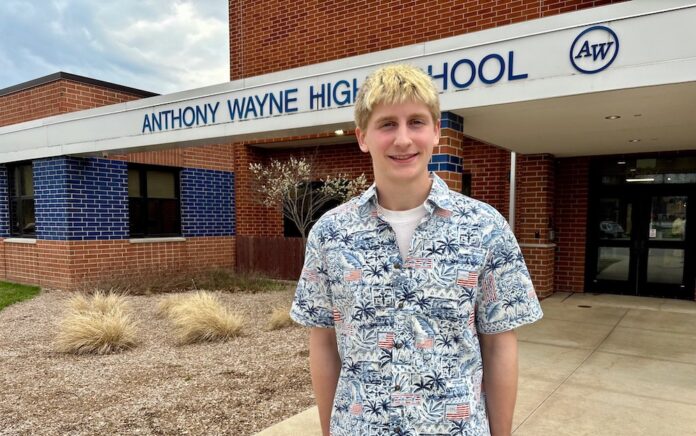
Garrett Smith, an Anthony Wayne High School senior, will head to the U.S. Naval Academy in Annapolis, Md. after graduation. (AWFP photo by Karen Gerhardinger)
Garrett Smith, an Anthony Wayne High School senior, is heading to the U.S. Naval Academy in Annapolis, Md.
As the youngest of four sons of Bruce and Victoria Smith of Monclova Township, Garrett was influenced in part by his brothers – AW grads Cameron (2018), Cayden (2021) and Roray (2022). All three chose the USNA and have shared stories with Garrett.
Like his brothers, Garrett has a resume filled with AP classes, student clubs – including DECA – the Anthony Wayne Rotary’s Interact Club, student council and National Honor Society. Throughout school, he has also run cross country and been a member of the swimming and lacrosse teams. In the community, Garrett is part of the Waterville Historical Society’s Student Advisory Council, working with other high school students to prepare programming on local history to present to all district third-graders each spring.
As an Eagle Scout with Troop 104 of St. Joseph’s in Maumee, Garrett built raised beds for the Anthony Wayne High School Family and Consumer Sciences classes, earning his Eagle Scout rank. He has participated in the Scouts National Youth Leadership Training Program for the past four summers.
During a visit to the USNA Summer Seminar last summer, Garrett was able to see up close what life is like in the academy.
“Everyone seemed so enthusiastic, energetic and had such a positive attitude. It’s an infectious environment to be a part of. I was able to meet people from all 50 states, from all sizes of towns and cities, and there were a lot of new perspectives and leadership styles,” Garrett said.
That experience is what led him to apply for the USNA – a process that included a Congressional nomination by U.S. Rep. Marcy Kaptur (D-Toledo).
“I want to thank the many teachers that have encouraged and supported me throughout the process, as well as Marcy Kaptur,” Garrett said.
Dave and Amy Lindquist farm 400 acres and live on Finzel Road. Nearby is their son and daughter-in-law - right in front of where a data center project is expected to be built. (AWFP photo by Karen Gerhardinger)
WATERVILLE TOWNSHIP – Looking east from their front yard, Dave and Amy Lindquist gazed past the open farmland across Finzel Road to the semis traversing U.S. 24 in the distance.
When the highway was completed in 2012, it changed the landscape of the rural Waterville Township. Now, with news that a developer is eyeing 1,000 to 1,400 acres south of Neapolis-Waterville road for a hyperscale data center, residents are bracing for a project they believe will have even more of an impact than the highway bypass.
“I hope this doesn’t go in, because I think it will ruin Waterville Township,” Dave said, after listening to township trustees share details during their April 22 meeting.
Pointing to her T-shirt motto “Faith Over Fear,” Amy said she’s shed many tears and said many prayers that a data center doesn’t come to their rural neighborhood, which she describes as tight-knit and friendly.
Keith and Brenda Moosman stand in front of the dream home and business they built 16 years ago near the corner of Neapolis-Waterville and Finzel roads. Both worry about the impact of a data center on the community. (AWFP photo by Karen Gerhardinger)
Among her neighbors are Keith and Brenda Moosman, who built their dream home – along with barns for his home-based business – on Neapolis-Waterville Road 16 years ago. Now he’s wondering whether a data center will be in his back yard.
“Why here? Why not away from people? Would you like a manufacturing plant in your back yard?” Keith asked.
Pointing to the west, he named his neighbors, who will all be affected if a hyperscale data center comes in. While the landowners who were contacted about selling might know what is going to happen, the property owners surrounding the area are left in the dark, and with a lot of stress.
Not only would it be difficult to find the same setting elsewhere to rebuilt a home and business, getting a fair market value from their home will be a challenge if such a project comes to fruition, Keith said. And his neighbors, including a family that just paid $2.4 million for a home down the street, share that same concern, he said.
“It’s wrenching. I’ve spent a lot of late nights wondering ‘what ifs,'” Moosman said.
Trustees Kyle Hertzfeld, Toby Miller and Julie Theroux shared on April 22 how an unknown company wants to build a hyperscale data center in the township. (AWFP photo by Karen Gerhardinger)
As chair of the township zoning commission, Moosman knows that board of trustees – including Kyle Hertzfeld, Toby Miller and Julie Theroux – are doing what they can, but as a small township with little funding, only so much can be done when facing a large industry that is prepared to offer farmers $1 million an acre.
During their regular April 22 meeting, held in Waterville First Presbyterian Church to accommodate a large crowd, the trustees finally confirmed what has been rumored for more than a year.
“Yes, there is a company interested in building a data center in Waterville Township. We don’t know who,” Miller said, adding that the township’s abundant land and access to water, electricity, the Nexus gas transmission pipeline and U.S. 24 makes the area very attractive.
Only seven companies do hyperscale facilities, and he suspects it could be Microsoft or Apple, as Meta and Google have facilities elsewhere.
“We won’t know who it is until the day it happens,” Miller said, explaining that nondisclosure agreements prevent those owning the land from sharing information.
The trustees have been preparing for this possibility over the past year, first requiring that a data center only be allowed on agricultural land with a conditional use permit (CUP), which allows the township to stipulate conditions on lighting, landscaping, sound, vibrations, setbacks and more.
In December, the board approved a 12-month moratorium and formed a Data Center Advisory Committee (DCAC) consisting of not just township officials but many residents. The group meets monthly to come up with recommendations to strengthen the zoning code and provide protections, such as requiring the developer to invest in $1 million or higher escrow to return the land to its original condition if the facility is abandoned.
The group is also applying to the Ohio Department of Natural Resources (ODNR) and U.S. Fish and Wildlife Service to request habitat studies of nesting and hunting areas for bald eagles and golden eagles.
Pulling up a video on his phone, Keith shows a bald eagle consuming a large fish by his neighbors pond. On Hertzfeld Road, Brett Warner has covered his chicken run to protect them from eagles who come in for dinner on a regular basis.
“We have collected data showing there’s a lot of eagles in this area,” Miller said, noting that such studies by the state or federal agencies could take years to complete.
While working every angle to protect the township, the trustees hired two Columbus law firms to provide guidance on what is legal to do.
“We are doing everything possible within the law. It would be super nice if the state gave us authority, as residents, to say we don’t want this,” Miller said.
The township cannot ban data centers, because it’s illegal to tell a property owner what he or she can do with their land.
“We live in a free country, and property owners have rights. As long as they’re within the law, they can do whatever they want with their property,” he added. “Our understanding from multiple attorneys and the Lucas County prosecutor is that banning data centers is not a legal option. We do that, and we would be immediately sued. And we don’t have the funds to defend ourselves.”
The recommendations from the DCAC will be presented within the next few months during public meetings at the township and county level, with comments welcome at each step of the way. Miller estimates it will take at least 120 days for those changes to the zoning code to be approved.
“We’re doing everything and anything we can to protect the residents,” Miller said, explaining that the year-long moratorium is allowing the board to put these measures in place. Any data center CUP application received before December 17 can be rejected, but the township cannot extend its moratorium without the expectations of legal action.
During a public comment section, several residents asked about how to control the impacts on wells, the environment and housing values.
Janice Braida asked whether Miller or his fellow trustees, Hertzfeld and Theroux, stand to benefit from a data center.
“No,” Theroux said.
“”I don’t have MOUS or NSAs or land options. I live on Hertzfeld. And between Hertzfeld and U.S. 24 is generally where we think it will be. I stand to be screwed quite substantially,” said Miller.
Hertzfeld said he doesn’t want a data center, but can’t vote, as he has extended family members that might benefit.
Warner, who served as a trustee for 10 years along Kyle, beginning in 2005, remembers the two of them sitting in that same church basement, accompanied by the late Les Disher, as residents rallied against plans to reroute U.S. 24 through Waterville Township. Later, the board and community tried to stop the Nexus pipeline. Now he can look out his window and see both, Warner said.
“The board did everything we could to make sure it was done right. We realized we could steer the car, but there was no way to step on the brakes,” Warner told the audience gathered on April 22. “This is what this board is doing now. If you’re coming to rant, this is the wrong place. They are on your side and then some.”
The Lindquists and Moosmans understand that trustees are doing what they can, but fear for the impact on their community – one in which neighbors know each other and appreciate that farmland is valuable.
“People have to eat,” said Dave, who farms 400 acres in the area.
Keith saw his cousins Ronald and Dorothy lose their home to the U.S. 24 bypass and understands how such a project can interrupt families that have lived in the township for generations.
“You can’t pay for memories,” Brenda said, noting that while a few farmers stand to gain from the sale, many more will see their dreams for their future generations to stay in the township be shattered.
While the Moosmans don’t have an anti-data center sign in front of their home, as Keith avoids being political, most of their neighbors do. Lyn Cox, founder of the AW-CRAP Facebook page that is dedicated to fighting data centers – including distributing signs – urged residents to sign a petition to amend the Ohio Constitution to ban the construction of data centers that consume over 25 megawatts of energy per month.
According to Conserve Ohio, 25 mw is “the threshold between a manageable, community-friendly facility and an industrial scale data center that can use as much power as a small town.”
Ohio currently ranks fourth in the nation for the number of data centers. For hyperscale centers, Ohio comes in at No. 2.
“Ohio has done it’s share. If they want to put in more data centers, there’s 49 more states. Find another,” Cox said. “We can decide what we want Ohio to look like.
She urged residents to help gather signatures by downloading a petition at conserveohio.com, or visit the AW-CRAP Facebook page.
Petition gatherers are also attending local municipal meetings and will be on hand during the June 9 Eats and Beats Food Truck Tuesday event at Conrad Park and the June 11-13 Cherry Fest in Whitehouse.
In this week’s episode of Toledo Works, we’re featuring some of our favorite interviews. Our “Best Of” that includes Jaden Jefferson‘s conversations with London Mitchell of the Toledo History Museum and Tonya Scherf of Food for Thought, as well as Stephen Zenner‘s discussion with photographer Jay “Dirty Kics” Dickerson.
Everywhere in Toledo, you’ll find people who play a role in making our city tick – from hospitals and factories to restaurants and art galleries – and behind every person is a story. Our program, Toledo Works, highlights those stories from workers’ firsthand accounts. Each week, Toledo Free Press hosts Jaden Jefferson and Stephen Zenner focus on a different topic within the Toledo workforce, exploring their day-to-day challenges and triumphs.
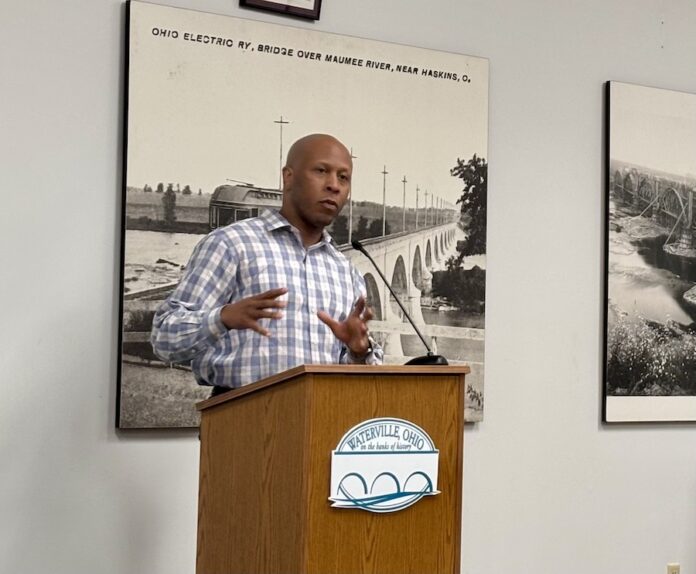
First Energy local engagement specialist Victor Coleman Jr. answers questions from Waterville City Council during its April 13 meeting. (AWFP photo by Karen Gerhardinger)
WATERVILLE – With a list of 65 lights that need to be replaced or repaired, Waterville City Council welcomed First Energy local engagement specialist Victor Coleman Jr. to its April 13 meeting to answer numerous questions.
When city staff or residents see a downed pole or non-working light, the first step is to call Toledo Edison – a subsidiary of First Energy. Once a call is made, Edison creates a log with the exact location and issue. Reporting it more than once does not bump that call up the list, Coleman said.
Once the call comes in, a team arrives to determine if it’s a simple repair, such as a replacement bulb or pole, or more complicated, such as damaged underground line.
“We’re finding in the suburbs that someone is boring for new infrastructure and nicks our lines. If there are multiple lines out on one street, that tells me the lines are nicked,” Coleman said, adding that it likely explains issues on Pray Boulevard, where multiple lights have been out at once.
In that case, a contractor needs to be hired to run a new line to repair those lights – and that’s a more lengthy process. If it takes longer than eight weeks to see any action, Coleman recommended that staff contact him.
Council President Todd Borowski asked about the condition of the substation, which Coleman said he imagines will be upgraded soon. Scott Jahns asked about the more frequent outages and if it’s related to the substation.
“Every outage is different,” Coleman said, noting that it could be related to something as simple as a squirrel causing damage or a more complicated problem due to the substation.
Jahns also asked about the replacement of old lights with LED lights, and having multiple types of lights in one neighborhood.
“We’re trying to create a plan to target areas so they’re not mismatched, and figure out which communities to do first,” Coleman said, adding that the goal is to have the same lights in one area.
One of the challenges that First Energy is facing is due to a backorder of parts that started during the pandemic – including a 40-month waitlist for some.
“Fiberglass poles are my biggest headache. If anyone wants to start a business…we can’t seem to get them fast enough. That’s where a lot of our backlog comes from,” Coleman said.
Council members and Mayor Tim Pedro also asked questions about specific equipment and how First Energy is working to create smart infrastructure, which Coleman said is an ongoing goal for the company.
Electric bills now display comparisons for usage for each customer, and Council Member Mary Duncan said she appreciated knowing when she’s using more or less. This is automatically included on the bills as a goal to educate customers, Coleman said.
During the meeting, council also:
•Reviewed the final drawing of a mural that will be painted by Dean Davis on the wall of a commercial building on Mechanic Street. The mural project is sponsored by the Anthony Wayne Area Arts Commission (AWAAC), which is providing the $10,000 to $12,000 in funding – not taxpayer dollars. The 80-foot wide by 18-foot tall mural is meant to draw the attention of those passing by and to enhance the downtown area, said AWAAC Vice President Lisa Exner. Work is expected to begin around May 7.
Rendering by Dean Davis.
•Listened to N. Sixth Street resident Mark Weibler ask about the city’s plans for roadways without curbs, including his street and Canal Road. While the city did bring the berm up, as he requested a few years ago, stone was used, and that allows water to get under the base of roadways and cause erosion. Administrator Jon Gochenour said that Canal Road will be repaved and widened this year with an extra berm. The entire area around Sixth Street is old and in need of berms and other work. About $100,000 of work is planned, Gochenour added.
•Listened to Leslie Harper and Leitra Harper caution about the use of gas-fired power plants and the impact of emissions. Both are concerned about a potential plant for a data center and such plants creating pollution in the community.
•Heard Lisa Haberstock asked Pedro what action has been taken to study data centers during a six-month moratorium that ends in May. No committee has been formed, Pedro said. Instead, he and council members have toured data centers in New Albany and met with local officials while watching legislation proposed at the state level. Haberstock asked where to find updates and feedback on that progress, and Pedro said she should call him after the meeting.
•Answered questions from Dana Rae Drive resident Brian Glonek about plans for two parcels that the city plans to transfer to the Waterville Community Improvement Corporation in order to sell at a more competitive rate. Mayor Pedro said Council wants to hear developer proposals for housing and recreation, not commercial and industrial uses on land that long ago was slated for an industrial park. A final reading and legislative action is expected on Monday, April 27.
•Heard that $100,000 in sidewalk repairs are planned for this year, starting with the ones deemed most deficient. Gochenour said some sidewalk repairs will have to wait because of utilities underneath that need to be repaired first.
•Learned that Gochenour is taking proposals from several refuse and recycling companies, and these will be presented to the Public Works Committee for review before coming back to council for a decision in May.
•Learned that Partners for Clean Streams had a cleanup day on April 9 to remove trash from dumpsters near the Kroger on Pray Boulevard.
•Heard that a farmers market and flea market will be held from 10 a.m. to 4 p.m. on the third Sunday of May, June, July and August at Parker Square.
•Heard Jahns ask about the retention pond on the Toledo Port Authority-owned land on Farnsworth Road behind the industrial park. Residents are concerned about the depth and proximity to the road and the danger for children in the nearby Mill Creek neighborhood. The developer is planning to install fencing, Gochenour said.
•Congratulated the Tree Commission for earning the Tree City USA and Growth Award this year for going above and beyond in community forest management.
•Learned that Kroger is rededicating its store after a remodel, with a celebration on Friday, April 24 at 9:45 a.m.
•Heard that the Waterville Area Chamber of Commerce will hold a grand opening with the new owners of Ultra Car Wash on Pray Boulevard on Friday, May 8 from 4 to 7 p.m.
•Heard Pedro say that while Gov. Mike DeWine turned down a request for a pause on the demolition of the Roche de Boeuf Bridge, that he is meeting with the Save The Bridge Association and still working on ideas as the Ohio Department of Transportation reviews bids for its demolition.
•Held a first reading on an ordinance to renew a five-year franchise agreement with Waterville Gas and Oil company to transmit and supply gas in the city. A second ordinance covers the price includes a $2.00 per month increase in the customer charge from $12.50 to $14.50, plus a decrease in the volumetric rate from $7.55 to $6.724 per thousand cubic feet.
TOLEDO — To be secretary of state is to be Ohio’s top elections official, a role that involves oversight over the state’s elections and, consequently, enormous responsibility.
At Trinity Episcopal Church in downtown Toledo last Thursday, a secretary of state candidates forum was held. The event, hosted by the League of Women Voters and moderated by City of Toledo Prosecutor Rebecca Facey, aimed to inform attendees about the secretary of state’s responsibilities while also providing an opportunity to hear from the candidates.
Organizers said they extended invites to all candidates in the race to be Ohio’s next secretary of state, though only three agreed to participate: Democrats Allison Russo and Bryan Hambley, as well as Libertarian Tom Pruss.
During the forum, candidates were first asked prepared questions before pivoting to questions written by audience members on index cards. Among the first issues the candidates tackled was ensuring elections are accessible, and at the same time, secure.
State Representative Russo (D-Upper Arlington) previously served as house minority leader in the legislature before launching her campaign to be secretary of state. She told attendees: “Let’s be clear: no one wants voter fraud. No one wants that, but we know it is exceedingly rare when it happens.”
Dr. Hambley, a southeast Ohio oncologist, is the other Democrat in the race. “I believe we need to re-enter the ERIC system,” he said, referring to the Electronic Registration Information Center (ERIC), “a nonprofit, nonpartisan membership organization created by and comprised of state election officials” from around the country, according to its website.
ERIC has allowed for states to share voter information between one another, assisting them in keeping their voter roles up to date, as well as outreach to eligible — but not yet registered — voters. For example, if you were to move from Connecticut to Colorado (both ERIC states), Colorado could reach out to you with information on registering to vote there, while informing Connecticut that you no longer live there and should be removed from its voter rolls. Ohio was previously a part of this system, up until Secretary of State Frank LaRose (R) pulled out of it.
Hambley added, on maintaining accurate voter rolls, that “we don’t need to be kicking people off the voter rolls in this manner our secretary of state has been using.”
Pruss, the sole Libertarian and third-party candidate in the race for secretary of state, said “we have to keep educating” people about updating their voter registration, adding that “we shouldn’t be purging people to purge them.”
He took a cautious approach to requiring more of voters in the name of election security, saying that “we’re going to cause everybody to go through hoops for something very minuscule.”
Dr. Hambley and Rep. Russo spoke to their concerns over partisan gerrymandering in the state of Ohio.
“Often, the secretary of state is the tie-breaking vote” on the Ohio Ballot Board, said Rep. Russo, which is composed of two Democratic state legislators, two Republican state legislators, and the secretary of state. The board is responsible for crafting the ballot language that voters see when deciding on important matters, including constitutional amendments. She emphasized the need for clear ballot language, allowing the public to better understand what it’s voting on.
Dr. Hambley said “this power is critical to get rid of gerrymandering,” explaining how a constitutional amendment to address gerrymandering could be put before voters — such as 2024’s Issue 1 — which Secretary of State LaRose, and Republicans on the ballot board, have been accused of making intentionally misleading (as to guarantee its failure).
Pruss proposed a change to the Ohio Ballot Board’s composition: “I would make the ballot board truly nonpartisan: one Democrat, one Republican, and three independents.”
Candidates also discussed the role that local boards of elections play in ensuring Ohio’s elections go smoothly. “You have to make the process easier for poll workers, as well,” said Pruss, referring to the training election workers in Ohio go through.
Both Dr. Hambley and Rep. Russo said they believe it’s important to invest in resources, training, and equipment so that local county boards of election are able to do their jobs well. Rep. Russo criticized the state legislature’s Republican majority for, she says, not providing funding to support the implementation of requirements it adds of county elections offices.
Rep. Russo also expressed disapproval with the elimination of the Ohio Elections Commission by her General Assembly colleagues in last year’s budget bill, calling the move “ripe for abuse of power.” Under the change, the commission’s responsibilities are placed under the secretary of state’s purview. The OEC’s primary role was to act as an independent watchdog when it comes to campaign finance law.
Responding to an audience question about how they would handle a situation in which ICE, Immigrations and Customs Enforcement, is stationed outside Ohio polling locations, every candidate said they would oppose it.
“There’s no need for ICE to be there,” Pruss said, adding that “American citizens vote in American elections. It’s always been that way.”
“What a time of fear we live in? Intentional fear,” said Dr. Hambley.
Rep. Russo said “that will absolutely be something that I will push back strongly on,” said Rep. Russo on ICE, or any group, having a presence outside Ohio polling locations.
The Toledo Free Press previously reached out to the Republican candidates in the race, Ohio Treasurer Robert Sprague and Marcell Strbich, for one-on-one interviews. So far, only Sprague has responded and did agree to sit down for a Zoom interview with TFP, as did Dr. Hambley, both of which you can find in this article.
The TFP is also working to secure one-on-one interviews with Rep. Russo and Mr. Pruss.
In January the Toledo Museum of Art announced that its guards would need to reapply for their jobs with Safeguard Security Services, a company contracted to manage protective services for the museum. The transition to Safeguard was completed March 1. (TFP photo by Laurie Bertke)
TOLEDO – After working in accounting for 35 years with one company, Rose Letherby thought she found her dream job as a protective services officer with the Toledo Museum of Art.
The position she took eight years ago allowed her to tap back into her roots as a college art major. “I love to talk to people, and I love to interact, and I love art,” said Letherby. “I thought I was going to be there until I was 75.”
Things changed for Letherby on Jan. 27 when museum leadership surprised employees with the news that the protective services officers — commonly referred to as PSOs or security guards — were being outsourced to a company called Safeguard Security Services.
The director of Protective Services and employees associated with the control room would remain as museum employees, but the rest of the protective services staff was told at the mandatory department meeting that they would need to reapply and interview with Safeguard if they wanted to continue employment with the museum beyond Feb. 28.
Letherby, who had just accepted a promotion from part-time to full-time with benefits two weeks prior to the announcement, said she and the other guards were “absolutely blindsided” by the news. She said she hadn’t even had time to complete the paperwork and begin receiving benefits.
“It’s almost like a slap in the face, is what it amounted to,” said Letherby. She interviewed and accepted a position with Safeguard, but left the museum for employment elsewhere the day before the transition to Safeguard was completed March 1.
Toledo Museum of Art (TFP photo by Laurie Bertke)
Museum has long history with Safeguard
The contract with Safeguard builds on what the museum’s director, Adam Levine, describes as an “incredibly close relationship” between the two entities.
The current director of Protective Services, Risa Smith, is a former Safeguard employee, and the president and owner of Safeguard, Josh Hardman, worked as director of Protective Services for the museum from 2014 to 2017 before leaving that post to purchase the Toledo-based security and investigations firm.
In a written statement, Hardman said the company has enjoyed a business relationship with the Toledo Museum of Art going back to 1999. During that time, Safeguard employees have staffed a variety of positions, including mobile patrols, parking lot security and control room operators.
Levine, who also serves as president and CEO of the museum, describes Safeguard as an organization that knows the institution inside and out. He said TMA’s leadership has been considering the transition to Safeguard for protective services for about two years.
With 61 employees, Protective Services was the museum’s largest department and the one with the highest rate of turnover. Managing such a large department in-house, including hiring and training new employees, took a large toll, particularly on human resources, according to Levine.
Adam Levine, TMA’s Edward Drummond and Florence Scott Libbey President, Director and CEO (TFP photo by Laurie Bertke)
Levine said the move was about efficiency and not about cutting costs.
“Finances were not a factor in this decision. We made the decision because of the value of time that was being allocated to administrative burden, administrative work related to turnover among frontline staff, among the guards,” he said. “So there are real savings there, but they’re not like dollars and cents savings. The time is going to be reallocated to other things.”
Thirty-eight employees in Protective Services were impacted, including eight full-time and 30 part-time positions. According to Levine, all but two of the guards initially chose to stay on with Safeguard.
Levine noted the museum has made concerted efforts over the past five years to increase hourly wages for protective services employees from $8.75 to more than $15, and the museum negotiated for employees making the transition to receive a slight raise from that amount.
But Liz Sullivan, a former Protective Services supervisor who left employment with the museum in mid-February, said full-time employees lost health care and retirement benefits and saw a significant reduction in paid time off as part of the move to Safeguard. Several other employees interviewed by the Toledo Free Press confirmed this assessment.
Hardman declined to share details about the benefits that Safeguard employees receive.
News met with shock, hurt
Sullivan was one of three Protective Services supervisors and her duties included scheduling hours for about 45-50 guards to cover the daily needs of the museum. She said she learned the news about Safeguard about an hour before the rest of the staff, during a meeting with the director of Protective Services and the chief financial officer.
She had worked for the museum a little more than six years, advancing from gallery guard to team leader and then supervisor.
“I love the museum. I thought this was my forever job,” said Sullivan. “I really did work very, very hard for them because I loved the things they were pursuing and the mission and so forth. I thought they were really living that, they were dedicated to that. And I feel like this has shown me it’s really much more all about the bottom line and who’s important and who’s not, I guess. And that was very heartbreaking for me.”
She wrestled with the decision of whether to apply for Safeguard for a few days, but ultimately did not interview with the company. “I just couldn’t allow myself to be treated that way — to give so much to something, believe in people and then have them just treat you with so little regard,” said Sullivan. “It was soul crushing.”
Other protective services employees who spoke to the Toledo Free Press expressed feeling similarly hurt, disheartened and shocked by the news they received that day. According to several people who attended the Jan. 27 meeting, one employee put their resignation in and was gone by the end of that day, and several others walked out of the meeting.
“Almost everyone was upset by this whole thing and feels that it was underhanded,” said another protective services employee who asked not to be identified. The employee said the decision reflects a broader trend of upper management disregarding the frontline workers who keep things running and interact with the public on a daily basis. “We’ve been made to feel unimportant, in many ways.”
Guards question decision’s timing
About two weeks after museum leadership announced the contract with Safeguard, Levine received a copy of a petition the International Union, Security, Police and Fire.
Professionals of America filed with the National Labor Relations Board seeking to represent the museum’s guards. The letter was dated Feb. 10. A Notice of Petition for Election was posted for employees to review, but the petition was withdrawn Feb. 26.
Levine said the letter dated Feb. 10 was the first he heard about any organizing effort among the guards, and he said it was “absolutely not a factor” in the decision to move the Protective Services department to Safeguard. He said the final decision to pursue the contract with Safeguard was made at the end of last year.
Several guards who spoke with the Toledo Free Press still expressed suspicion that the move was related to union talk among the staff that had picked up steam in January.
Earlier that month, Sullivan said she and two other supervisors were asked by the chief financial officer and the director of Protective Services to bring anything they heard about unionizing to the attention of management.
“During those conversations, we were told that the supervisors were very important, that we would be protected, that they were putting measures in place so that we would not have to be part of the union and that we would stay TMA employees,” she said.
Sullivan said she never spoke to Levine on the topic of unionizing.
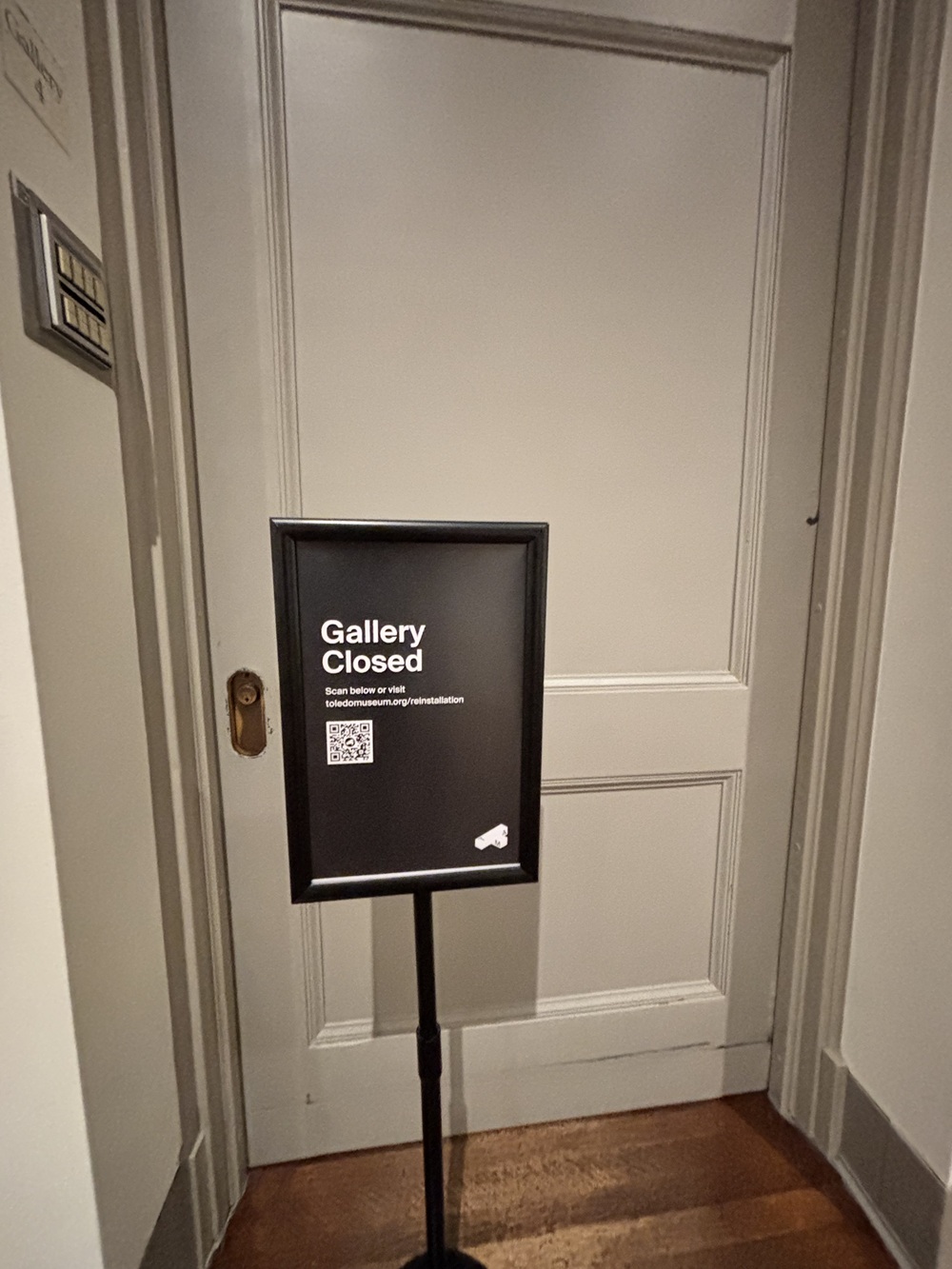
Letherby said safety concerns were among the reasons some guards were interested in organizing their own union. With more galleries temporarily closing as part of the museum’s reinstallation project, guards have spent a growing number of hours in construction zones.
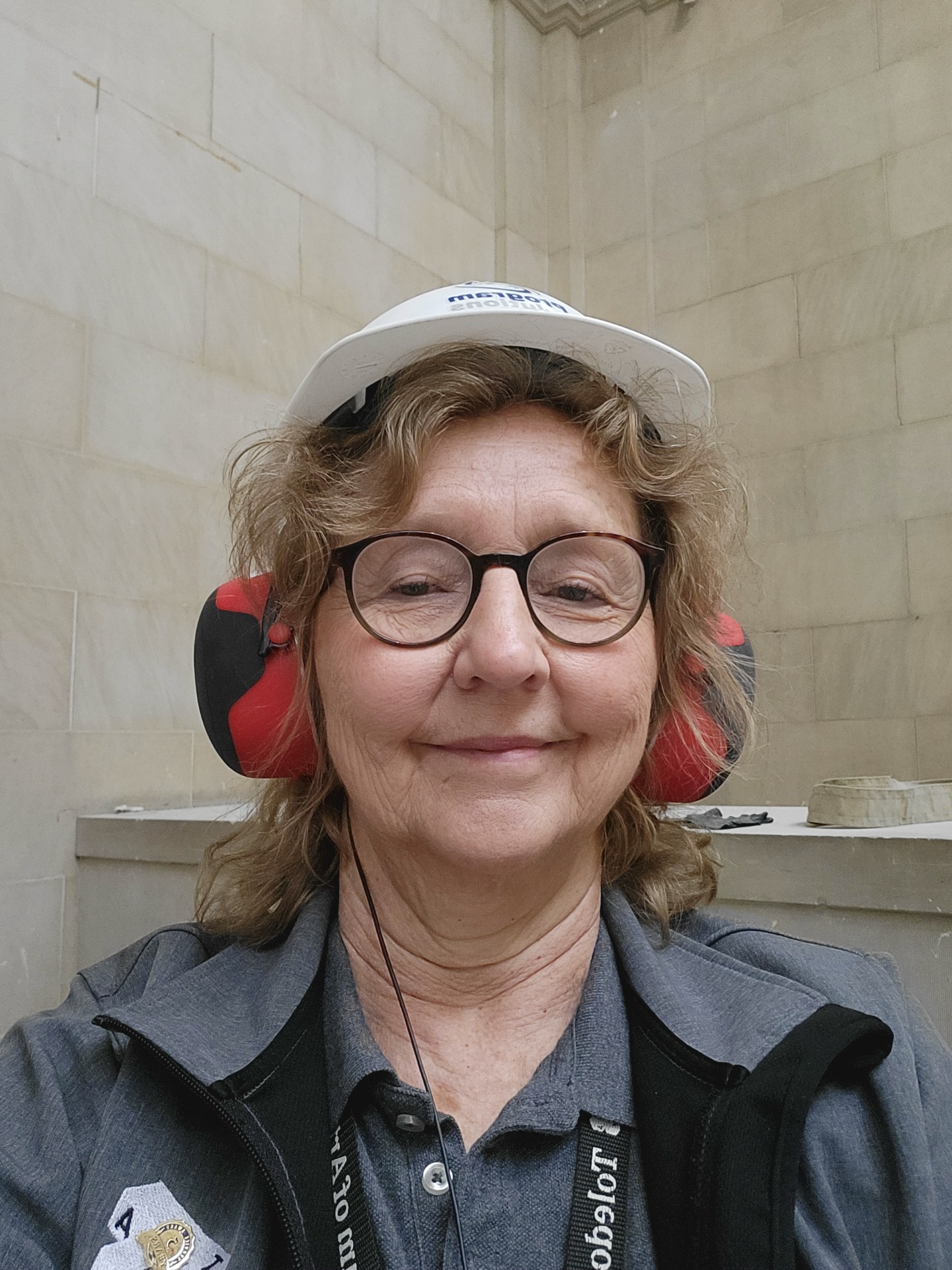
Rose Letherby left her job as a protective services officer with the Toledo Museum of Art at the end of February. In this photo she provided, she is pictured on the job guarding in one of the construction zones. (Courtesy photo)
Toward the end of her employment with the museum, Letherby said she was spending less time working in a public-facing capacity and more time in hardhat zones as a construction guard. Letherby said she often experienced dust, loud noise and extreme heat and cold, such as when she was standing at the open dock doors while items were being moved.
“But you want your paycheck, you put the hard hat on and you go to work,” she said.
Protective services officers are not a part of the union that other TMA employees formed in April 2025, which included educators, curators, visitor services staff, technicians and research personnel. The employees voted to form Art Workers United through AFSCME Ohio Council 8 to address concerns about “job security, equitable wages and better working conditions,” according to a news release from the council announcing the vote.
A representative of AFSCME Ohio Council 8 said the protective services officers were not included due to their employment classification. The council declined to provide further comment or connect the Toledo Free Press with a representative of Art Workers United due to contract negotiations that are currently taking place.
With more galleries temporarily closing as part of the museum’s reinstallation project, several guards said they have spent an increasing number of hours monitoring construction zones. (TFP photo by Laurie Bertke)
No changes to visitor experience
Acknowledging the difficulty of the situation, Levine emphasized the importance of managing the museum in a way that fulfills its mission of integrating art into the lives of people.
“These are not decisions that we take lightly,” he said. “But I do feel very confident that we made the right decision, not just for the museum, but also did so in a way that was right for that team.”
Levine said Protective Services has had different structures over the years and had not always been managed in-house. He added that the museum made every effort to ensure everyone retained their jobs who wanted to do so.
“People’s jobs have changed. And that is real,” he said. “So people did not lose their jobs, but people are totally entitled to the feeling of a sense of loss.”
Levine said he and the rest of the leadership team are keeping close tabs on the transition, and that visitors can expect the same customer service, friendliness and safety standards from the museum guards as always. “It was one of the criteria for us that visitors would not notice any difference, and I do not believe that they would,” he added. “We continue to receive great feedback on our guards.”
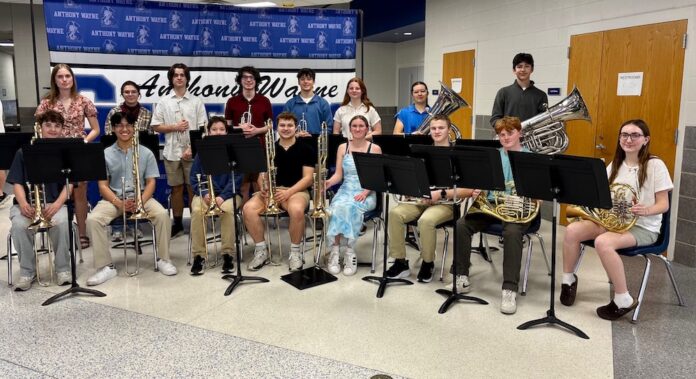
Members of the Symphonic Winds Brass Choir performed prior to the start of the April 13 Anthony Wayne Board of Education meeting. (AWFP photo by Karen Gerhardinger)
Anthony Wayne students recently underwent state testing – and Superintendent Kevin Herman is confident they will perform well. But student success goes beyond test scores, he told the Anthony Wayne Board of Education during its April 13 meeting.
To illustrate that success, Herman welcomed student athletes, musicians and other groups to speak to the board.
Athletics
During the meeting, Athletic Director John Snyder shared that 196 high school and 118 junior high athletes participated in athletics this winter. That’s 41 percent of all 7-12 students. Of those, 47 percent are female and 53 percent male.
Leah Pike made school history as the first female student-athlete to earn a spot on the AW All-Ohio wall, after she earned First Team All-Ohio in women’s basketball. She is also on the wall for volleyball. She and her twin sister, Mallory, are heading to Ball State University, where they will play collegiate basketball.
In addition, the dance team earned the OASSA state championship, and the cheer team earned the America’s Cheerleading Cup national championship and the OASSA state championship for game day build. The girls basketball team and girls swim and dive team both earned Northern Lakes League (NLL) championships. The boys swim and dive team ended the season as NLL runner-up and Ohio High School Athletic Association (OHSSA) state championship qualifiers. The gymnastics team were district runner-up and OHSSA state championship qualifiers.
Band
After a performance by the Symphonic Winds’ Brass Choir, Band Director Roy Young gave an update on the program, which has 456 students in grades 5-12 who are in band, including 161 in the high school, 120 in the junior high, and 175 in the middle school.
The 150-member Marching Generals perform in numerous parades throughout the community and will perform at Disney World this year. In total, band performances are held at least 60 times a year.
In 2026, 16 junior high and 10 high school students were chosen for the Ohio Music Educators Association (OMEA) District 1 Honors Band. Since 2009, 16 students have been selected for OMEA All State Ensembles. Evey Bringolf played with the All-State Band in Columbus.The band participated in 83 solo and ensemble adjudicated events, earning 58 superior ratings and 22 excellent ratings.
Showing a photo of five graduates who are now members of The Ohio State University Marching Band, Young said the best part of his job is seeing his students move on to take their band experiences to the next level.
DECA
Becky Stutz, the Anthony Wayne-Penta teacher who is advisor for the student career tech organization DECA, shared how 18 students will be headed to Atlanta for DECA’s International Career Development Conference (ICDC) next week. Billy Dean, Alex Bischoff, Arjun Jayaraman, Aradhya Mutumula, AJ Rea ,Garrett Smith, Maddock Hires, Miley Denman, Lydia Fabian, Ellison Lopez, Sophia Huhn, Madeline Johnson, Dalia Shordt, Brady Wells, Brady Zare, Josie Phillips and Ava Wepler will compete with students from around the country. Stutz, a 1987 graduate who was involved in DECA during her high school years, has taught business and led DECA programs for 33 years and will retire next month.
Purple Star Generals
Christine Young, who serves as a liaison for military families in the district, shares how April is the month of the military child – a time to recognize and honor the role that the children of military members play.
Christine Young, who is the military family liaison for the district, shared that April is the month of the military child. (AWFP photo by Karen Gerhardinger)
“When a service member serves, the entire family serves. Our students carry that reality with them, and we are better for having them in our schools,” she said. “As conflicts arise around the world, many of our families face the reality of deployment, extended time apart and the uncertainty that comes with it. These moments are not just experienced by the service member – they are felt deeply at home, in our classrooms and throughout our community.”
The district supports 97 students who have a parent or guardian currently serving, along with 37 students who have siblings in the military. Another 247 have a parent who is a veteran, and four students have experienced the loss of a loved one in the line of duty.
“These are not just numbers – they are stories of resilience, sacrifice and unwavering dedication,” Young said.
To support these students, each of the district’s buildings has a Purple Star Liaison, who provides support for the students through programs that encourage understanding, empathy and belonging. Young asked the community – including neighbors and local business members – to support military families.
The community is welcome to attend a military signing ceremony on Friday, May 1 at 7 p.m. in the high school auditorium, as seniors who plan to serve in the military after graduation are recognized.
“Let’s come together to ensure these young men and women see just how proud we are of their decision and how deeply our community stands behind them,” she said.
Ray Greene named treasurer
Ray Greene will take over as treasurer of the district on July 31. He previously served as assistant treasurer. (AWFP photo by Karen Gerhardinger)
After nearly 20 years as district treasurer, Kerri Johnson announced her retirement effective July 31. Ray Greene, who has served as assistant treasurer since August 2022, was named treasurer during the meeting. As assistant, Greene helped manage the district’s financial operations, budgeting and fiscal planning.
“Ray has been an integral member of our financial team and has earned the trust and respect of staff, administrators, and the Board of Education,” Herman said. “His experience, professionalism, and dedication to fiscal responsibility make him exceptionally well prepared to lead the district’s financial operations into the future.”
Greene came to the district with a resume that includes teaching high school students in advanced economics, business law, marketing, accounting and web design; assistant baseball coach for NCAA Division I and II universities; a masters of education in educational technology and an MBA in general management.
Kerri Johnson is retiring after nearly 20 years as treasurer of Anthony Wayne Local Schools. (Courtesy photo)
The board thanked Johnson for her years of service and leadership. During her tenure, the district earned multiple Auditor of State Awards, recognizing the district’s commitment to accurate financial reporting, sound internal controls, and responsible management of public funds.
During the meeting, the board also:
-Authorized the treasurer to advertise for bids for the junior high kitchen and HVAC improvement project, with monies from the Food Service Fund.
-Approved the newly created job of behavior specialist. While the district contracts with the Educational Service Center of Lake Erie West to have an individual in that role two days a week, Herman said having a full-time specialist who is part of staff will be beneficial.
-Accepted the resignations of Whitehouse cafeteria/playground aide Nita Haas and high school science teacher Corbin Genson, and the retirements of high school teacher Lisa Ernsthausen and food service secretary Brenda Cohrs.
-Approved the hiring of Wendy Jacoby, junior high cook, and John Hursh, junior high physical education teacher.