Home Blog Page 253

Two Councilmen refuse pay for absences

0

Toledo City Council members have two options when they miss a meeting: either have their pay docked or get an “excusal” from the other members. Being excused is common practice. Only two of the 12 members have taken pay deductions in 2012.

Council members can deduct 2 percent from their annual salaries for missing a regular meeting and 1 percent for missing a committee meeting. But most opt for the other route — if two-thirds of Council votes for an excusal, the absent member still gets paid.

So far in 2012, Council has not voted down any excusals.

“In my 14 years, no one has not been excused,” said Council clerk Jerry Dendinger.

Members do not have to give a reason to get excused.

Councilmen Phil Copeland and Tom Waniewski are the only two members who have taken pay deferments this year. As of Sept. 7, Copeland has had 18 absences, including one regular meeting. He took deferments for 13 committee meetings and one special Council meeting, amounting to $4,125. Waniewski has had four absences in 2012, all from committee meetings, with one being excused and three others being deferred, amounting to an $825 deduction in his pay.

Waniewski and Copeland were also the only two to defer last year. In 2011, Copeland deferred $7,700 and missed 29 meetings, including four regular meetings and one special meeting. Of those, he had two regular meetings and two committee meetings excused. Waniewski deferred $4,125, accounting for 15 committee meetings. He had one excused absence for a committee meeting.

So far in 2012, President Joe McNamara has had perfect attendance. Lindsay Webb had the most excusals with 16, including two regular meetings and one special meeting, followed by Mike Craig with 13 missed committee meetings and Adam Martinez with 11, including one special meeting and two regular meetings. For committee meeting excusals, Rob Ludeman had one, George Sarantou had two, Steve Steel had three, Tyrone Riley had three and D. Michael Collins had four. Paula Hicks-Hudson had five excusals for committee meetings and one for a regular meeting. The absences, had they not been excused, would amount to about $20,000 in deferments.

Nonpresidential Council members make $27,501.76 per year. The president makes $32,000.80 per year.

In 2011, Webb and Martinez had the most absences at 19 each, including three regular meetings and two special meetings for Webb and two regular meetings and one special meeting for Martinez.

Attendance is personally important to McNamara. In 2011, he missed three committee meetings.

“I’m elected to go to meetings. That’s the point of Council and I take it seriously and that’s why I try to plan my life around meetings,” he said.

However, McNamara said it is routine to excuse people.

“City Council is a part-time job and people do have other things going on in their lives. I do think that allowing for people to miss some meetings is reasonable, but the important thing is that we have enough members so we’re able to have a quorum,” McNamara said.

Having enough members for quorum hasn’t been an issue in his tenure, he added.

In 2012, Waniewski has taken just one excusal for an agenda review Aug. 21 as a “vacation.” He said it’s his usual policy to take a deduction for any missed meetings.

“I feel so strongly about doing your job, particularly when there’s legislation that affects people. There’s zoning issues that affect businesses and you’ve gotta show up for the job in order to get paid for it,” he said.He said many members like himself have other jobs and family emergencies or illnesses do arise. However, Waniewski said, “Maybe what we need to do before we excuse [members] is ask what their excuse is.”

Still, Waniewski said he doesn’t see himself voting down someone’s excusal.

“It’s on an individual’s conscience to decide whether they should excuse themselves, so I don’t see myself objecting,” he said.

Waniewski praised McNamara for his scheduling abilities and also said this Council has been better about attendance than those in past years.

Craig said he generally doesn’t skip regular meetings, but sometimes misses committee meetings if he has other Council business or a prior arrangement.

“You may only have a day or two or maybe three notice and if I already have something scheduled, I go and do what I have scheduled,” he said. Craig also said committee meetings are sometimes called for Council members who have questions he may not need answered.

“Why would I go to a meeting that’s unnecessary for me and why would I take that away from my pay if I’ve done my homework?” he said.

Committee meetings are also recorded and can be listened to later, he added.

Copeland, who is running for Lucas County recorder against Sarantou, had the most absences and the most deferments. He said he wasn’t sure of the total number of meetings he missed, but that his job at Laborers’ Local 500 often takes him away from home. Copeland is out of town for work on the third Thursday of every month.

“A lot of times I’m out for work and I didn’t feel I should be paid for meetings [if] I wasn’t there,” he said.

The times he took excusals were for reasons like sickness, he added.

Webb said some of her absences in recent years could be attributed to maternity leave and raising a family. She gave birth in both 2010 and 2011.

“The people I represent appreciate the fact that I’m a hardworking mom and I have a full-time job. City Council is considered part time and I have a large family and I keep all the balls in the air,” she said. Webb also said her voice as a working mom is “essential” to Council.

“I earn my paycheck in a number of different ways,” Webb said, adding that she listens to recordings of missed committee meetings and gets notes from other members. She is also a coordinator for the National Employment Law Project in Ann Arbor.

Martinez said he missed a number of meetings because of his position as an adjunct teacher at Owens Community College and because of a master’s program in Cleveland that he commuted to.

“Most of us do have our other jobs that may not be as flexible,” Martinez said. He added that he has taken pay deferments in the past if he took a vacation or didn’t have a reasonable excuse for being absent.

“There’s always an opportunity to go online and listen to the conversations that have been held,” he added. Martinez said he also checks with committee chairs to make sure there aren’t any impending issues in the case of an absence.

McNamara emphasized that attendance of regular City Council meetings is more important than committee meetings.

“Members can better plan their schedules around Council meetings,” he said, adding that committee meetings can be at the “whim” of the chair.

Copeland said of Sarantou, his opponent and chair of the finance committee, “He schedules [finance committee meetings] when it fits him. That’s the thing.”

Sarantou said he has scheduled three finance committee meetings on the third Thursday of the month to accommodate other people who needed to be there. The rest have been on other days, he said.

“I will match my attendance records with [Copeland’s] attendance records any day,” Sarantou said. “The fact of the matter is he’s missed a huge amount of meetings.”

“If you’re gonna miss that many meetings, why should you get paid?” Sarantou said. He asked how voters should trust Copeland would show up at the recorder’s office if elected.

If elected, Copeland said he plans to be a “full-time recorder.” Sarantou also pledged to be there every day.

In 2011, Sarantou missed 12 meetings, including one special meeting.

Copeland said he doesn’t keep track of Sarantou’s attendance.

“When I’m there, I’m there to try to get the work done for the City of Toledo,” he said.

Casino revenue helping offset funding shortfalls

0
Hollywood Casino Toledo. Toledo Free Press file photo

With city and county budgets statewide affected by slashed and dried up revenue sources, local government officials say they are thankful for the quarterly infusion of casino tax revenue, while noting the amount is rarely enough to fully offset funding gaps.

Gamblers wagered a total of $349.8 million at Ohio’s two casinos in August: $168.2 million at Hollywood Casino Toledo and $181.6 million at Horseshoe Casino Cleveland, according to a monthly report released Sept. 7 by the Ohio Casino Control Commission. After payouts, the casinos had a total adjusted gross revenue of $40.3 million for the month.

The state collects a 33 percent tax on that revenue. Fifty-one percent is distributed quarterly among Ohio’s 88 counties based on population. Counties whose largest city has a population of 80,000 or more split their share with that city. Those cities are Akron, Canton, Cincinnati, Cleveland, Columbus, Dayton, Toledo and Youngstown. Thirty-four percent is distributed among all public school districts, 5 percent among all host cities, 3 percent to Ohio Casino Control Commission, 3 percent to the Ohio State Racing Commission fund, 2 percent to a state law enforcement training fund and 2 percent to a state problem gambling and addictions fund.

The first quarterly distribution to cities and counties was July 31; the next distribution will be Oct. 31. The first biannual school district distribution is set for Jan. 31, to be followed by the second distribution Aug. 31.

Toledo has so far received $531,616 in casino revenue, which includes its $192,041 share of Lucas County’s distribution as well as a host city distribution of $339,575.

City Finance Director Patrick McLean said the entire amount went into the city’s general fund. The city’s 2012 budget includes a projected $3.4 million in casino revenue.

In future years, the city hopes to dedicate some of its casino revenue to the city’s rainy day fund, McLean said.

“We weren’t able to do that for 2012. We may be able to do it for 2013. We will make those kinds of decisions as part of our 2013 budget preparations, which are under way right now,” McLean said.

Lucas County received $192,041, which went into the county’s general fund, said Kelly Roberts, director of the county’s Office of Management and Budget. Lucas County’s 2012 budget includes a projected $545,000 in casino tax revenue.

“We’re hoping to hit our estimate,” Roberts said. “We’re hoping it doesn’t replace the local government funds, that we keep getting the funds we’re getting and that the casino revenue doesn’t offset it and replace it.”

Wood County’s distribution of $110,296 was allocated to the county engineer’s road and bridge fund, said Wood County Administrator Andrew Kalmar. Kalmar said the Wood County Commissioners will evaluate the county’s needs each quarter before deciding where to spend casino revenue.

“There is no certain projection at the moment how much casino tax will come in, even in the next year or two years,” Kalmar said. “Our presumption is people will initially be excited about casinos and new places to go and the tax revenue might be a little higher, but then after a while that might come down to a more regular level. We’ll just have to wait and see.”

Cleveland received about $1.2 million in casino revenue, including its $554,424 share of Cuyahoga County’s distribution and a host city payout of $648,431.

Cleveland City Council passed legislation last year allocating 15 percent to council and 85 percent to the administration’s general fund, but no specifics are available regarding where those funds will be applied, said City of Cleveland press secretary Andrea Taylor.

Cuyahoga County received a distribution of $554,424. The money is in a general fund while members discuss proposed legislation, said Cuyahoga County Council Chief of Staff Joe Nanni. One recent proposal suggested using the money to promote downtown and suburban economic development as well as help fund educational initiatives, Nanni said.

“It’s nice to have, but no matter what we do we will be limited in what we can do, compared to the municipality here,” Nanni said. “There’s not a whole lot to go around.”

More than 200 miles removed from glitz of the slot machines and the glam of the gaming tables, Ohio’s least-populous county is also benefiting from bets wagered at the state’s two casinos. Half comprised of public land, including vast tracts of state forests and wildlife areas, South-central Ohio’s Vinton County has just over 13,000 residents and received $11,668, the state’s smallest distribution.

“I can tell you right now, it’s going directly into the general fund to try and make up some of the money we’ve lost,” said Vinton County Commissioner Mike Bledsoe. “We appreciate it’s there, no doubt about that, but it’s not going to a rainy day fund or a slush fund. It’s just another fund we hope will help us keep our head above water, which we’re sinking fast.”

Vinton County Auditor Cindy Owings Waugh said she’s glad Ohio is benefitting from gambling rather than another state, but she isn’t yet comfortable counting on any certain revenue level.

“The casino money is so new. We can’t count on it. It’s a new thing. People want to try it out and half those people might never go back. I’m not counting my chickens before they hatch. I would need a couple more years before I started counting on that money,” Waugh said.

Waugh said she is eagerly anticipating the Oct. 8 opening of Hollywood Casino Columbus, about 75 miles away, because it will offer much-needed job opportunities as well as increase state casino revenue.

“We will have jobs from that. People will drive. I have no doubt in my mind someone from Vinton County will be employed there,” Waugh said. “There are no jobs here. One job to us means a lot. There are not the employment opportunities there are in other places for Vinton County.”

As stipulated by state law, a county’s distribution will be split with that county’s largest city if the city had more than 80,000 residents according to the 2000 census. Canton and Youngstown have since dropped below 80,000 residents, but will still receive payouts because the language of the bill bases the distributions on 2000 figures.

Cleveland suburb Parma had a population of 85,655 residents in 2000, but won’t get any casino tax revenue because it is Cuyahoga County’s second largest city behind Cleveland.

Horseshoe Casino Cleveland became the first casino in the state when it opened May 14. Hollywood Casino Toledo opened May 29. Horseshoe Casino Cincinnati is set to open in spring 2013.

To view the complete tax distribution list, visit www.tax.ohio.gov and click on the “Casino Tax News” icon. To view the full monthly casino revenue reports, visit casinocontrol.ohio.gov and click on “Monthly Casino Revenue.”

Barhite: You never know how far a little kindness will go

0

I befriended a few “unpopular” people during my adolescence.

The junior high girl who students teased because of her back brace for scoliosis. The obese band member who substituted breath mints for regularly brushing.  And the neighborhood girl who no one wanted to sit with on the bus.

I hadn’t thought about these good-hearted people in a long time, and then I helped with a Sept. 19 program at Bowling Green State University, where I also work.

Rachel’s Challenge is a global initiative to start a chain reaction of kindness. Rachel Scott was the first student shot and killed at Columbine High School in 1999.

After her death, Scott’s family found some of her writings, which indicated, “I have this theory that if one person can go out of their way to show compassion, then it will start a chain reaction of the same. People will never know how far a little kindness can go.”

It is a simple message worth repeating, especially with the school year under way.

“Our words have power to hurt, our words have power to heal,” said speaker Doug Brandl, one of Scott’s family friends.

On Sept. 17, ProMedica released a statement that indicated 20 percent of high school students reported being bullied while at school, and an estimated 16 percent reported being bullied electronically, according to the Centers for Disease Control and Prevention.

To help combat this, ProMedica Toledo Children’s Hospital runs a program called Teen Peers Educating Peers (Teen PEP). Teen PEP leaders in 12 schools address teen relationship violence, bullying, rape, sexual abuse, physical and emotional abuse, as well as stereotyping and neglect, the news release stated.

I was a member of Teen PEP in the mid-90s, and (unfortunately) this program will celebrate its 20th anniversary next year because bullying and being mean is more prevalent than ever.

Even 13 years after Columbine, Rachel’s Challenge resonated with BGSU students who were 5 or 6 years old when this shooting occurred because they have lived through recent school violence.

Freshmen Bekah Pastor and Sarah Spaulding were seniors at Chardon High School during the Feb. 27 shooting in Northeast Ohio.

Pastor’s sister was in the cafeteria where the shooter carried out his killings. For 45 minutes, Pastor didn’t know her sister had survived. They had bickered that morning and she worried those would be her last words.

Spaulding thought the lockdown was a drill … until it wasn’t. Her coping mechanism these days: smiling more. She also gave her mom the “biggest hug in my whole life” after the shooting.

Pastor said she tries not to judge people because she doesn’t know their struggles. She occasionally gets rattled if she hears a loud noise that she mistakes for a gunshot, but the major aftereffect of the shooting is watching how she treats others.

“I learned not to take things for granted,” Pastor said. “If I have a bad thought, I keep it to myself.”

Rachel Scott would be proud.

European Auto Show at Vin Devers Sept. 23

0
A Ferrari on display at the 2011 Vin Devers European Auto Show.

If you’d like to enjoy a leisurely Sunday observing some of the world’s finest and most pristine automobiles, head to the Third Annual European Auto Show at Vin Devers Autohaus of Sylvania on Sept. 23.

Ferraris? Check. Bentleys? Check. Porsches? Check.

Those will be just a few of the automobile models on display at the show, said Jason Perry, Vin Devers general manager.

The event will take place 11 a.m. to 3 p.m. at the dealership, 5570 Monroe St., and will feature automobiles from the U.K., Germany, France, Italy and Sweden.

A vehicle on display at last year’s European Auto Show. Photo Courtesy Vin Devers Autohaus of Sylvania.

Registration, which runs from 9-11 a.m., costs $12. Awards will be handed out at 2 p.m. The event will also feature concessions and K100 (99.9 FM) will be broadcasting on site. There will be a detail clinic and a tech clinic on site for the event, Perry said.

Vin Devers Autohaus, an authorized franchise of Mercedes-Benz and Audi, has been in business since 1956 and underwent a $1.2 million renovation of its dealership early last year that gave it a new look. Franklin Park Lincoln-Mercury, formerly known as Vin Devers Lincoln-Mercury, is also part of the dealership family.

Toledo resident Justin Lange, who has attended the show in past years, is planning on attending again this weekend.

“I’m really excited about the show,” said Lange, 28, a car enthusiast. “I like to compare the different styles of cars. I like to look at the older cars as well as the newer cars to see where the technology has moved over the years.”

Lange, a married father of two, said he plans to take his kids.

“It’s always nice to have something different to do, something outside the norm. I want to show them what Daddy could’ve had if they weren’t there,” Lange said, laughing. “You see a lot of cars you usually don’t get to see around this area that are really special and rare. European car companies are important because Europe, more than any other region, treats putting together a car like an art form. [The automobiles] are finely tuned machines. [The Europeans] put the beauty of the car almost above, or on par, with everything else. And European cars are very useful, too.”

Now in its third year, the auto show has become more popular each year, Perry said.

“The show was [initially] a ground-floor exploration that has turned into a sizable event sparked by our community’s enthusiasm for European flavors,” Perry said. “It’s gonna be a great year.

For more information, contact Perry at [email protected].

Families, community rally around girls with rare disease

0
Carlee Kudzia and Kaylee Halko. Toledo Free Press photo by Joseph Herr.

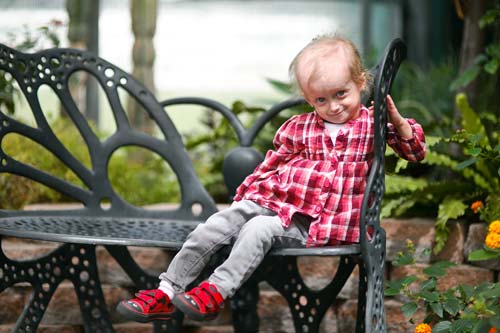
Kaylee Halko’s enthusiasm to meet the winged wonders at the Butterfly House was obvious when she arrived.

But the 9-year-old was polite; she greeted Carly Kudzia and showed the 2-year-old some moths eating a banana.

Then Kaylee stood still with outstretched arms and said, “I’m standing right here: Land on me!”

Kaylee Halko of Monclova Township has a rare rapid-aging disease called progeria. Toledo Free Press Photo by Joseph Herr

With butterflies and moths flitting around, she cracked, “Do they not like small people or something? Seriously?”

While Carly happily trotted around, Kaylee’s eagerness — and impatience — grew.

“I don’t bite,” she told the flying insects. Not exactly the butterfly whisperer.

With the help of Carly’s brother, Garrett, Kaylee soon had two paper kite butterflies perched on her hands.

Meanwhile, Carly was watching koi in a pond. Then the outgoing girl climbed up on a bench and sat next to a young boy, who didn’t know what to think.

“She’s such a flirt,” joked Heather Kudzia, Carly’s mom.

Kaylee and Carly have a lot in common with the butterflies. They’re beautiful and delicate. They’re colorful characters who make people smile. And right now, they have a short life expectancy.

The two girls are among 96 children in the world who have progeria, a rapid-aging disease. Kaylee lives in Monclova Township, just minutes away from Carly in Whitehouse.

“It certainly is a coincidence to have them so close considering there are only 22 for the entire U.S. population,” said Audrey Gordon, president and executive director of the Progeria Research Foundation, a nonprofit organization dedicated to discovering treatments and a cure for the fatal genetic condition.

“The fact that this disease is so rare in the world and we have two girls in the area, maybe they’re here to help and support each other,” said Duke Wheeler, co-owner of Wheeler Farms and the Butterfly House in Whitehouse.

Carly Kudzia of Whitehouse is one of 96 children with progeria worldwide. Toledo Free Press Photo by Joseph Herr

“It helps because they’re close. Kaylee loves the fact that Carly lives nearby,” said Marla Halko, Kaylee’s mom.

“[Progeria] is a hard disease, and I’m glad that the community supports Kaylee and accepts her differences,” she said. “It’s just great that people want to get involved and try to help us fight this disease.”

Wheeler is one of those offering assistance. He donated the Butterfly House’s Sept. 8 proceeds, totaling $1,000, to the Progeria Research Foundation.

“It’s kind of tough to raise money for a rare disease nobody really knows about,” said Ryan Kudzia, Carly’s dad.

Both families are holding fundraisers to help pay for a new drug trial that will be conducted by the Progeria Research Foundation.

Studies have shown rapamycin may be a possible treatment. The drug decreased the disease-causing protein progerin by 50 percent in mice, according to a 2011 study published in Science Translational Medicine.

“We’re really excited about that possibility, of the drugs transferring over from helping cells in animal models to the children,” Gordon said. “We’re excited for the children, and we’re excited for the families — there’s really true hope now.”

She estimated the cost for the new study at $5 million.

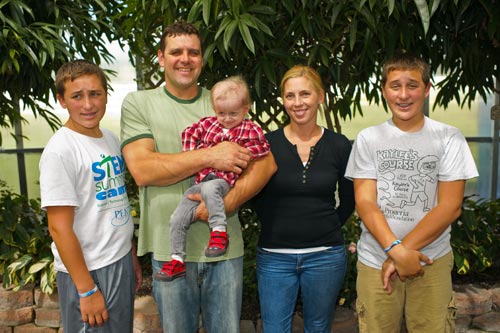
Kaylee Halko’s family. Toledo Free Press Photo by Joseph Herr

“When Carly was diagnosed (in April 2011), the second drug trial was well under way; it was too late for her to participate,” Heather said. “The third drug trial we think is being finalized right now.”

Kaylee is participating in the current trial.

“She’s healthy. We haven’t had any issues,” Marla said. “The Progeria Research Foundation is actually working on prolonging the second trial so the children don’t have to go off the medication while they’re trying to work with the Food and Drug Administration [on the new trial].”

The waiting is hard.

“What are we doing? We’re just sitting around getting old! I can’t stand it! Get me the medicine! Everyone is feeling that, I’m sure,” Heather said.

In the meantime, Kaylee and Carly are staying busy.

“Kaylee’s taking jazz and tap dancing now,” Marla said. “She loves tap. She’ll come home from school and put the shoes on and tap around just because she loves the sound.”

“She’s also taking karate and is an orange belt,” said Tim Halko, her dad.

“Carly’s into ‘Curious George’ videos. She’s got her own pink iPod; she’s really into that and videos and pictures,” Ryan said. “She’s just an all-around happy little girl.”

“We’re lucky that people recognize Kaylee. They know about progeria. They know it’s something not to be scared of. They wave; they’re friendly,” Heather said. “We don’t want to shy away from the fact that Carly has progeria; we want to tell the whole world, see if they can help. And when you recognize Carly, you don’t wonder, but instead you wave or smile.”

Carly’s Party for the Cure

A fundraiser, Carly’s Party for the Cure, is set for 7:30 p.m. Sept. 28 at the Pinnacle, 1772 Indian Wood Circle, in Maumee.

This is the second year for the fundraiser, which will feature about 50 raffle and auction baskets, appetizers, a cash bar and music by Alter Ego.

Tickets for the 21-and-older event are $25 and are available online at teamCarlyQ.com/events.

The 2011 party raised $26,000 for the Progeria Research Foundation.

“We had over 400 people last year at the event, so we’re hoping to at least have 400 this year at the Pinnacle and maybe more,” Ryan said.

Carly Kudzia’s family. Toledo Free Press Photo by Joseph Herr

“It’s kind of overwhelming to feel all of that love coming toward our family and toward Carly,” Heather said. “I definitely feel lifted up and that we are not alone.”

Kaylee’s Course

Kaylee’s Course, the seventh annual race for progeria research, will take place Oct. 13 at Monclova Primary School, 8035 Monclova Road.

Registration begins at 9 a.m. The race starts at 10 a.m. Cost is $12 before Oct. 1 and $15 after for the 5K run/2-mile walk. Children 10 and younger are free.

There also will be a silent auction and raffle. Proceeds will go to the Progeria Research Foundation.

See details at sweetkaylee.com and on Facebook at groups.to/sweetkaylee.

Tim and Marla are looking for silent auction items and sponsorships. Contact them at [email protected] or (419) 878-3231.

“The event has gotten bigger than I ever thought it would,” Marla said.

“Last year, the school had a hard time trying to contain it,” Tim said, adding that nearly $60,000 was raised at the event. “It means a lot to us that the community has supported us and Kaylee — and Carly.”

Way Public Library announces fall, winter 2012 film series

0

The Way Public Library in Perrysburg will feature several film series this fall and winter.  

The Reel Talk Film Series showcases classic films and is set for 10 a.m. on one Thursday a month. A guest speaker talks after each movie. “Broadway Melody of 1936” kicks off the 12th season of this series Oct. 11. The movie stars Robert Taylor and Eleanor Powell and is about the hijinks that go into getting a lead role on Broadway. “The Pirate,” starring Judy Garland, Gene Kelly, plays Nov. 8 and Ship Ahoy plays Dec. 6.

The Reel Art Film Series highlights foreign and art films at 7 p.m. on one Friday every month. The ninth season starts with “Queen to Play” on Sept. 28. The 2009 French film is about a chambermaid who learns to play chess. “My Father My Lord” is featured Oct. 26, followed by “Regarding Henry” on Nov. 16 and “Of Gods and Men” on Dec.14. 

The recently formed “Show Me the Movie Series” features “Moneyball” at 2 p.m. Oct. 4.  The 2011 film stars Brad Pitt and tells the story of Oakland A’s general manager Billy Beane and his unique way of putting a team together. “Bernie” is the next film in the series, set for 2 p.m. Nov. 7. 

The Fonda Family Film Festival will highlight the Fondas at 2 p.m. on Sundays in November. Henry Fonda’s “The Best Man” is 2 p.m. Nov. 4. Fonda plays a presidential candidate in the 1964 film. A guest speaker will present afterward. “Ulee’s Gold” with Peter Fonda is Nov. 11 followed by Jane Fonda’s “Cat Ballou” on  Nov. 18. 

All showings are free. Free refreshments are available. The library is located at 101 East Indiana Ave., Perrysburg.  Call (419) 874-3135 for more information or visit http://www.waylibrary.info. More films will be announced for 2013. 

–Staff reports 


Kuron: Hats Off to Harrison! 

0

Once on vacation, my friends and I popped into a little Manhattan hat shop. We all got a kick out of taking on the persona of the different styles as we tried them on. A fine suede number had one friend looking for his horse, pardner. A velvet beret gave his girlfriend a yearning for brushes, paint and a trip to France. I left the shop sporting both a narrow-brimmed straw hat and a new-found Spanish accent, bragging that my coffee was 100% Columbian. 

Well, due to the heroic wearing of many figurative hats during his career, William Henry Harrison would eventually rise to become the 9th president of the United States. And one of his campaign stops was right here in Perrysburg, Ohio in 1840.  

Before all the presidential politicking began, Harrison wore the governing hats of Ohio State Senator, U.S. Representative and Senator from Ohio, U.S. Ambassador to Columbia, and Governor of Indiana. Prior to his governance years, Harrison wore both military and diplomat hats. 

Back in 1791, a young Harrison enlisted into the still adolescent American army at Fort Washington in the new city of Cincinnati. Just three years into his military career, he found himself fighting as an ensign to Mad Anthony Wayne along our Maumee River at the Battle of Fallen Timbers. As Wayne negotiated the peace treaty after that fight, Harrison studied the emotions, tact, and personalities involved. Some espouse that Harrison’s most-valued service might have been in the years after this episode when his diplomat hat was firmly in place. He endured some fiery encounters but negotiated several Indian treaties and diffused many other heated situations throughout our region. 

Perhaps his most stellar performances, while wearing his military hat, occurred right here in our backyards from 1811-13. He was involved in confrontations at Tippecanoe (Indiana), Fort Meigs (Perrysburg), Fort Seneca (Tiffin), Fort Stephenson (Fremont), and finally at the infamous Battle of the Thames(Chatham, Ont.). 

On June 11, 1840, Ol’ Tippecanoe, as he became known after his defeat of Tecumseh’s village along the Indiana river of that name, sailed into Perrysburg aboard the Commodore Perry, and was transported in a two-horse carriage to the ruins of the fort he defended 27 years earlier. It was a tremendous campaign rally. His was one of the slickest efforts for the highest office to date.  

How adroit were Harrison’s spin doctors? Very! First they molded Harrison’s reputation and nickname into one of the first slogan’s ever used in a presidential race, “Tippecanoe and Tyler Too!” At that time, the country was generally disgruntled with Democrat incumbent Martin Van Buren, many dubbing him Martin Van Ruin because of the depression they were suffering through. (Yeah, Tricky Dicky was not the first derogatory political nickname!) So, Van Buren, who was a bit of a dandy – dressing in stylish clothes and known to drink fine wine, had to divert the electors’ attention away from his poor record. His handlers thus portrayed Harrison as a backwoods farmer living in a lowly log cabin and preferring cheap hard cider over the good wine of cultured society. Harrison’s spinners took this intended slam and spun it right back, creating the Log Cabin and Hard Cider campaign which successfully toured the country from city to city, including Perrysburg. 

The common man ate it up; and drank it up too! Hard cider was freely dispensed to the crowd that day. Harrison’s campaign roadies donned their hats, well, coonskin caps, and proceeded as they did at most rallies, to build a 25’ x 40’ log cabin from local buckeye trees. Harrison, et al, paraded through the streets amidst the cheering and singing of the local “Buckeyes”; a term solidified for Ohioans by Harrison’s use of buckeyes extensively in his campaign. Attendees even participated in contests, like bringing to town the largest log. A team from Swanton won with a 50-footer! Finally, there were the speeches, concluding with Harrison’s. This gala event is still celebrated in downtown Perrysburg every September as Harrison Rally Day! 

Curiously, Harrison had the shortest presidency in history, dying of pneumonia after only one month in office. This was due in part to his giving the longest inauguration speech in history, nearly two hours, in a blustery snowstorm, without wearing an overcoat, gloves… or a hat!   

### 

Frank Kuron is author of the War of 1812 book, “Thus Fell Tecumseh.” Email him at [email protected] 


Bugle Call: Upcoming Events 

*Fort Meigs will host the next in their monthly Bentley Lecture Series presentations on Thursday, September 20. Nautical archaeologist, Ms. Carrie Sowden will speak on, “Archaeology of the War of 1812 on the Great Lakes”. The presentation is free and meets in the Fort Meigs Visitor Center, 29100 W. River Road in Perrysburg at 7:30 p.m. 


Joe Jackson delivers diverse tribute to ‘The Duke’ 

0
Joe Jackson tried for a unique interpretation of Duke Ellington's work in his tribute, "The Duke." Photo by Frank Veronsky

No brass — that was the one rule Joe Jackson had while making a disc to honor jazz legend Duke Ellington. 

“I decided not to use any horns because I didn’t want it to sound anything like Ellington and his band. Sometimes you just have to make certain rules and limit yourself in some ways because then it opens your imagination in other ways,” he said. 

Released in June, “The Duke” debuted at No. 1 on the Billboard Contemporary Jazz Album Chart and the Billboard Current Jazz Album Chart. Jackson serves up fresh takes on 15 of the big band leader’s classics over 10 songs. 

“The more I listened to other people’s versions of Ellington music, the more I thought no matter how good they were, they really didn’t go far enough; they were too close to the originals,” Jackson said during a phone call from New York. “So this idea just gradually grew on me of a whole project of new interpretations of Ellington.” 

And the singer-songwriter definitely used his imagination. Consider “Caravan.” 

“I’m not a fan of Ellington’s lyrics, I mean, he didn’t write them himself anyway. A lot of his songs have really cheesy lyrics that were added after the fact,” Jackson said. “And ‘Caravan,’ the tune is so strange and exotic and mysterious, and as soon as you add the dopey English words to it, it spoils it for me. It’s one of the reasons why you never really hear it sung even though the tune is quite familiar.  

“But I thought: What if it was sung in a different language? A language that was maybe more in keeping with the melody? And I had worked with [Iranian singer] Sussan Deyhim before — that was one of the first ideas I had for the record. So I contacted her, and she was very interested in the idea of translating it into Farsi.” 

For “It Don’t Mean a Thing (If It Ain’t Got That Swing),” Jackson sings with punk icon Iggy Pop. 

“I was just going to sing the song myself, and at one point I started experimenting lowering the key, lower than I normally would, and I just suddenly heard [Pop’s] voice in my head,” he recalled. “And I thought, that’s weird, why am I hearing that? And I went and put on one of his records, and the song ‘The Passenger’ turned out to be in exactly the same range.  

“And I thought, that’s an interesting idea, I wonder if he’d do it? I thought he might because I’ve met him a couple times; he’s a pretty cool guy and is open to doing different things. And he had fun doing it.” 

The British musician enjoyed the no-brass challenge. 

“I used a string quartet on three tracks, but in other cases, the guitar or keyboards. There are a lot of different colors on the record that are taking the place of the horns,” he explained. “Regina Carter’s violin, for instance, is a big sort of voice in this. She’s touring with us as well, which I think is very exciting.” 

 Jackson is touring to support “The Duke” this fall with a limited number of U.S. shows. He will play at 8:30 p.m. Sept. 27 at the Michigan Theater in Ann Arbor. Tickets range from $35 to $65. 

Since his “Look Sharp!” 1979 debut, Jackson — like Ellington — has experimented with all kinds of music. He was part of the pop, punk, new-wave movement with hits “Is She Really Going Out With Him?” and “I’m the Man.” His smooth styling surfaced on 1982’s “Night and Day,” which featured “Steppin’ Out” and “Breaking Us in Two,” and 1984’s “Body and Soul” that included “You Can’t Get What You Want (Till You Know What You Want).” 

“I don’t even really think of it in terms of styles, and that’s one of the things I admire about Ellington: He had no respect for musical categories or genres. He said there’s only two kinds of music — good and bad. And I’ve always kind of felt like that,” Jackson said. 

“If I just allow myself to be free and spontaneous and just make music, that’s the way it comes out — it comes out very eclectic.” 

Retirement guys: Things ain’t like they used to be

0

You have probably heard the old expression, “things ain’t like they used to be.”  It is pretty obvious to most that today we are living in a different time.  Things are a lot different then they used to be in many ways.  One of the big ways things are different is in the area of planning for retirement.  In the past you could work for a company your entire career, have a pension, health benefits, and be confident that Social Security would be there.  My Grandpa Clair worked his entire career at General Motors and retired with financial security.  Things are different for many people in the work place these days.  Because of negative economic conditions, many workers who were relying on their 401k’s saw the balances severely damaged by the stock market collapse in the early 2000’s and again in 2008.   Additionally, many companies have downsized to leave workers out of work mid-career.  

Because we are living in a different time, it is vitally important that you take control of your situation and try to become as self-reliant as possible.  It is unlikely that the government, your employer or anyone else is going to “bail you out.”  By utilizing The Retirement Guys 4 Strategies For a Successful Retirement, you can put yourself in a position for a much higher probability for success so that you can experience the retirement that you have in mind, whether it is sitting on the couch or getting our there and focusing your energy on what is near and dear to your heart.   

While it may be true that “things ain’t like they used to be,” we must realize that things in the past weren’t always rosy.  We remember happy positive things, but the fact is that our parents and grandparents struggled with some of the same challenges we face.  Things like making a living, putting food on the table and taking care of our families.  It may be that my Grandpa Clair had the advantage of career-long security by working for one company his entire career, but he had to get that job to begin with and he had to show up everyday and punch the time clock and do his work.  His generation also faced dealing with a World War that interrupted and seriously interfered with a potentially successful career.  We now have a somewhat different set of challenges to face in our time.  What I (Mark) have realized is that we can learn important things from those who have come before us to help us become successful in our endeavors.  Our parents and grandparents have set the example for us to follow of hard work, discipline, integrity, perseverance and sacrifice.  They told us to, “do the right thing,” “be a leader” and “work hard.”  Applying these lessons learned and combining it with today’s new technology and certain “action steps” will go a long way to helping us achieve our goals.  

Action steps that can be taken are what we call the “4 Strategies For a Successful Retirement.”   

1. Implement the Independent Income System 

     Making sure each of your accounts is designed for a specific purpose.  Don’t just throw all of your money into an investment and hope that it does well.  Take into consideration what the purpose is for each of your accounts, time frames, appropriate levels of risk, need for income, need for growth and protecting what you have.   

  1. TakingControl Of Your Future IRA Tax Liability 

     Take action before the tax rates and the laws change. If you have reached retirement you now need to know the most efficient way to take retirement account money out.  Do you know the rules?   Things like Required Minimum Distributions, Roth Conversions, Re-characterization, etc., are critical rules to understand.  Formulate plan for the new “distribution phase” of your life.  

  1. Use the Tax Laws to Increase Your Children and Grandchildren’s Inheritance  

     Creating a multi-generational stretch-out plan.  The rules changed a few years ago allowing a non-spouse beneficiary to “stretch out” paying the taxes over and individuals life expectancy.  This can prevent the tax ticking time bomb from exploding in your heirs’ faces that may cause them to have to pay income taxes on all the money in your retirement account at once.  This may mean hundreds of thousands of dollars lost in unneeded payments to the IRS.    

  1. ProtectYour Assets From the High Cost ofLong Term Care Expenses 

The biggest fear that many retirees have is their life savings being wiped out by the high cost of long-term care. By using the concepts of Leveraging and Arbitrage (we call it Levertrage) learn how you may be able to create dollars to pay for long term care without ever buying traditional long-term care insurance.  This could help protect your assets for you or your spouse should one of you need care.  The last thing you want is very little money left to live out the later part of your life. 

You know what to do.  Take action!  Apply these principles.  As always, we wish you the best. 


Mayor declares Sept 14-16 Startup Weekend Toledo 

0

Toledo Mayor Michael Bell officially declared Sept 14-16 as “Startup Weekend Toledo” in recognition of the event of the same name being held for area entrepreneurs and start-up business enthusiasts at the University of Toledo’s College of Business and Innovation.  

Mayor Bell urged citizens to join him in recognizing the organizers, judges, speakers, and sponsors of Startup Weekend Toledo for helping to build a robust entrepreneurial community in the City of Toledo.  

Deputy Mayor Paul Syring will attend Startup Weekend on Sunday, Sept. 16, and will hand out prizes to the winners at 7:30 p.m.  

Startup Weekend Toledo organizers emphasized that the final presentations and awards ceremony is open to the public. People are suggested to arrive at 4:30 p.m. to get a seat for the presentations from the weekend competition starting at 5 p.m. with the awards at 7:30 p.m.  

For more information, go to http://toledo.startupweekend.org