Home Blog Page 252

Ottney named Toledo Free Press Managing Editor

0

Whether documenting a tense ballgame, chasing down elusive sources or crafting flowing narratives, journalism is not just a job — it is a way of life.

Toledo Free Press writers Sarah Ottney, Brigitta Burks and Caitlin McGlade and Sports Editor Zach Davis know all about that. Ottney and Burks are being promoted to managing editor and news editor, respectively. Gina Fielding has been named Social Networking Editor. McGlade and Davis are leaving the state for new opportunities.

Sarah Ottney

Sarah Ottney

Ottney, 28, is an Oak Harbor native. She graduated from Ohio Wesleyan University in 2006 with dual degrees in English and journalism. Ottney then moved to South Dakota for a reporting and copy editing job at the Aberdeen American News. For three years, Ottney wrote about a variety of topics, including outdoors, agriculture and features. She also designed news pages for print, including covers and sports.

She moved back to Northwest Ohio in 2009 to serve as an AmeriCorps VISTA member with the Ohio Association of Second Harvest Foodbanks.

Since taking her special sections editor job with Toledo Free Press in 2011, Ottney has organized sections small and large, covering topics ranging from weddings to Mud Hens Opening Day, from dining guides to the military.

“I like the challenge of finding a new angle to sections we do every year. It really lets me be creative. And every week it’s something different so I never get bored,” Ottney said.

She said she loves compiling the 90-page-plus print monster that is the annual Mud Hens Opening Day issue.

“The enthusiasm is contagious,” Ottney said. “Everyone is really excited about baseball starting again and there are so many facets to the Mud Hens that people may not have thought about before. Everyone involved with the Mud Hens is really passionate about what they do. I’m not really a baseball fan myself, but they won me over.”

As Ottney continues at Toledo Free Press, she looks forward to documenting Toledo’s growth.

“I’m enjoying watching Toledo come back from the recession,” she said. “I moved back here right in the middle of it and worked for AmeriCorps so I saw Toledo and its problems at their worst firsthand. I was able to put faces on a lot of our most difficult issues and it’s been neat to see how that experience has translated to make me a better journalist.”

Michael S. Miller, Toledo Free Press editor in chief, said Ottney is already a valuable staff member and her promotion will provide more opportunities for her to practice her craft.

“Sarah writes compelling, clean copy and has a deft hand editing others’ contributions,” Miller said. “Her new leadership role here will have a dramatic impact on our news coverage and social networking plans.”

Brigitta Burks

Brigitta Burks

Burks, 25, comes to Toledo from the Cincinnati area. She graduated from Mount Notre Dame High School in 2006 and then attended Ohio University. After endless hours editing and writing at the student-run newspaper, The Post, Burks graduated from OU with a degree in journalism and specializations in history and women’s studies. She also interned at the Hamilton Journal News.

From there, she took a job with the American Bankruptcy Institute in Alexandria, Va., as the nonprofit’s communication/administrative assistant. She moved to Toledo about a year ago and landed a job with Toledo Free Press.

“My favorite part about being a journalist is the opportunity to help people in a way,” Burks said. “Whether you’re writing about a political figure and you’re educating the public and helping people make more informed decisions, or if you’re writing about charities — I’m really passionate about community-driven journalism.”

“Brigitta is an insightful reporter and talented editor,” Miller said. “Readers will see great strides in our reporting and the scope of our investigative projects.”

Gina Fielding

A graduate of Genoa High School, and an education major at the University of Toledo, Social Networking Editor Gina Fielding is CEO of digital marketing business Gabella Media and editor in chief of www.damngina.net.

She is a radio personality who serves as social media director for “Andrew Z in the Morning” on Star 105.5.

“Gina has dynamic ideas for our website, Facebook, Twitter, Instagram and Issuu services,” Miller said. “As the industry evolves with technology, all media must not only keep up but lead the way, and Gina will help us with that mission. Our goal is be as accessible and interactive as possible.”

Caitlin McGlade

Caitlin McGlade

McGlade, 24, is leaving Toledo Free Press for an internship at Congressional Quarterly in Washington, D.C., where she will cover Congress.

“As a political science major, I’m interested in watching the political machine work,” McGlade said. “I’ve covered city and county government and now I’m interested in seeing how the federal government works. I’ve written stories about federal legislation, but I’ve never been to the place where they are making it happen.”

McGlade came to Toledo Free Press as an intern in 2009 and was hired as a staff writer in December after graduating from Ohio University, where she majored in journalism and political science.

McGlade covered city and county government, boards of elections, political campaigns, business, environment and art for Toledo Free Press.

“I’ve learned a lot at Toledo Free Press. I haven’t been able to cover everything because we are a small staff, but what I have been able to cover I have been able to devote time and attention to make the stories truly well-rounded, researched, in-depth and written in a way that I might not get to anywhere else,” McGlade said.

“Toledo not only has a compassionate community, but a growing arts scene and I think I’ll miss watching that develop.”

McGlade grew up in Dayton and graduated from Bowling Green High School in 2007. She also interned at The Columbus Dispatch, The Arizona Republic and The Athens (Ohio) Messenger and worked with Burks at OU’s student newspaper, The Post.

“I worked in Washington, D.C., and I am excited for the opportunities Caitlin is pursuing,” Miller said. “Her leadership and determination will be missed, but she will find great success in The District.”

Zach Davis

Zach Davis

Davis, 24, is leaving Toledo Free Press for a job at the Laredo Morning Times in Texas. He will join the newspaper’s sports writing staff.

Davis grew up in Heath, Ohio, and graduated from Heath High School. He graduated from the University of Toledo with a degree in communication with a concentration in journalism. Before coming to Toledo Free Press in 2011, Davis worked at FOX Sports Ohio and interned with the Columbus Blue Jackets. He was also an active writer with UT’s student newspaper, The Independent Collegian, and was sports editor in 2010.

“My roots come from Toledo; this is where I’ve learned my skills. It’s been an exciting time in Toledo and I’m excited to see what else is out there,” Davis said. “I’ll miss the people here.”

“Zach lives sports, and Texas is fertile ground for sports journalism,” Miller said. “We wish him well and know he will thrive there.”
‘2016’/’The Campaign’

0

“We survived Bush, you’ll survive Obama.’

— Facebook post


I pay attention to a great deal of political discourse, and that six-word statement sums up America’s current situation better than reams of more sophisticated rhetoric ever could. It is simultaneously defiant and resigned, divisive and clement. Two new films, “The Campaign” and “2016: Obama’s America,” contain similarly overlapping and contradictory messages.

“2016” is a documentary, in the same way Michael Moore’s films are documentaries —  not cinematic questions in search of answers, but agendas in search of supporting “facts.”

Based on books by commentator Dinesh D’Souza, “2016” seeks to “explain” President Barack Obama’s political philosophy through contextualization of Obama’s childhood and parental models. That in itself isn’t a controversial thesis. It is inarguable that one’s childhood and formative years help define who one is as an adult. In some cases that might mean capitulation to parental ideals and in some cases that might mean a rejection of those ideals. Either way, you am who you am in large part because of your upbringing.

For me, the son of an Air Force veteran and a woman from Texas, that upbringing was 100 percent baseball, hot dogs, apple pie and the American flag. I was raised under conditions of unconditional love for America and American exceptionalism. As I grew older, I learned to question and often doubt the caretakers of America’s freedom, but I have never questioned the freedom itself. I do believe the United States of America is the greatest blend of freedom, capitalism and opportunity in world history. That doesn’t mean I believe our country is perfect, but that devotion and dedication to America shapes my politics and philosophy.

Neither Obama nor D’Souza shared my experience. D’Souza spent the first 17 years of his life in his native India.  Obama was born in Hawaii (really, he was), spent a number of his early years in Indonesia and later moved back to Hawaii. Obama’s Kenyan biological father only met the future president once; it was up to Obama’s mother to raise him, and eventually, she shifted that responsibility to his grandparents. In “2016,” D’Souza makes the case that because he believes Obama was not raised to love America but to question and even resent its colonialist tendencies, he  builds his presidency around trying “to shrink America’s footprint in the world because he thinks we’ve been stepping on the world.”

At the afternoon showing Aug. 24 at Rave Cinemas at Fallen Timbers, the audience was about 70, by which I mean there were about 70 people in the audience and their average age was 70. The group was engrossed by “2016,” murmuring and nodding; it very much resembled a church service in the way the audience responded to the film’s narrative. At the end of the film, the audience enthusiastically applauded and was clearly energized by the message.

“2016” is much more moderate in its approach than the typical Michael Moore joint, but it does contain some howlers. The use of ominous music when Indonesia is on screen, the graphics of gathering black clouds and the images of cemeteries used over discussions of a future under Obama are clumsy and transparent. D’Souza is careful to avoid  giving attention to Obama’s place of birth and admitted drug use, which allows him to spend time on Obama’s influences and mentors (Bill Ayers, Jeremiah Wright, etc.).

D’Souza more boldly than any previous commentator, attributes Obama’s political ascent to his race. D’Souza tries to diffuse the tactic by literally showing the skin of his hand and letting the audience see he shares Obama’s general pigmentation. (“See!” he seems to say, “I have dark skin, too, so I clearly I can’t be racist!”) It is fair to connect Obama’s election to the historical journey of civil rights in America, but it’s disingenuous to attribute the man’s success to that factor alone.

“The Campaign,” a comedy that pits Will Ferrell’s Republican incumbent senator against Zach Galifianakis’ amateur challenger, does not strive to be overly specific in its current events satire. But it perfectly captures the influence of money (with Dan Aykroyd and John Lithgow as de facto Koch Brothers) and the lemming tendencies of many voters. In one scene, Galifianakis reads from crayon-illustrated pages of “Rainbowland,” written by Ferrell’s character in second grade, interpreting it as a communist manifesto. A whipped-to-a-frenzy audience member screams at Ferrell, “You can’t make me live in Rainbowland!” It would be even funnier if it weren’t an accurate reflection of the impact of partisan rhetoric.

The main targets of “The Campaign” may be politicians, but the most collateral damage is done to voters, who are treated as parrots more concerned with the party line than with facts or what is best for the country.

“2016” and “The Campaign” are appropriate bookends to experience as the November election nears. One is clearly serious and one is clearly a farce, but there are elements of  possibly unintentional seriousness in the comedy and elements of probably unintentional hilarity in the documentary.

One message is clear in both movies: We can argue and debate and yell all we want, but after the ballots are counted it often doesn’t matter which candidate won; it’s often the citizens, defiant and resigned, divisive and clement, who lose.

Michael S. Miller is editor in chief of Toledo Free Press and Toledo Free Press Star. Email him at [email protected].

Artist revved up for Motorcycle Cannonball

0

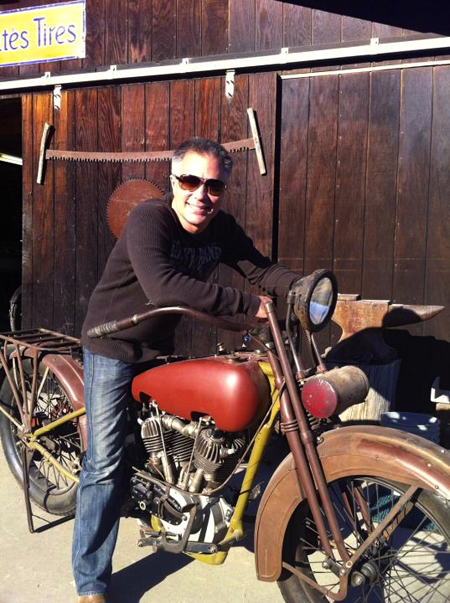
Painting an old motorcycle takes time. Ask Scott Jacobs.

“If you think about a new bike, most of the wires and tubes, so many things are encapsulated now inside the engine so they look cleaner,” said the officially licensed Harley-Davidson artist.

“On an old bike, everything is showing, all the wires are hanging out, and there’s tubes, and there’s all kinds of things that are exposed. There’s so much more to paint.”

He puts it all on canvas, producing picture-perfect works.

“The thing I needed to accumulate over the years was the patience to do that kind of work, because there’s a lot of artists out there in the world that are very talented that are capable of doing very detailed paintings, but they’re not patient enough,” Jacobs said.

“It’s hard to start a painting and maybe finish it two or three months later; a lot of people need satisfaction a little quicker than that.”

Scott Jacobs

The longtime biker will ease off the throttle this month for the Motorcycle Cannonball 2012 Endurance Run and ride 3,950 miles across the country on a 1926 Harley-Davidson J.

First, Jacobs had to brush up on the foot clutch and tank shift.

“I trained on this [bike] for 150 miles so far, and I stalled it five times in the first half-hour. And after that, I really got comfortable on it,” he said.

There’s no getting too comfortable.

“[The seat] looks like what would be on an old tractor, and it’s got very, very little cushioning on it, just some leather stretched over it,” Jacobs said with a laugh.

He became obsessed with the old-timey run in 2011.

“I went for three days as a spectator and followed the bikes and photographed them for paintings. And the whole time I was there, I was thinking, ‘Oh my God, if I ever have the opportunity to do this, I would love to,’ ” Jacobs said.

A friend found the antique machine online, and Jacobs was on his way as this year’s race features bikes from 1930 or earlier.

“I bought this junky old bike and I had a restorer work on it; he just finished it — took him 10 months,” he said. “Most everything on the race should be in a museum. I paid a fortune having mine restored, and it should be in a museum.

“Some people are thinking I’m crazy to ride this brand-new, restored bike and putting 4,000 miles on it across the country, but that’s what they were made for; they’re made to enjoy.”

Most will appreciate seeing more than 70 vintage bikes winding across the United States. Riders leave Newburgh, N.Y., on Sept. 7 and will motor through the plains, the Badlands and the Rocky Mountains before hitting the Pacific Coast Highway and zooming over the Golden Gate Bridge to cross the finish line in San Francisco on Sept. 23.

Jacobs and the racers will roll along the coast of Lake Erie and stop Sept. 8 at the Comfort Inn, 5909 Milan Road in Sandusky. Riders are expected between 5 and 5:30 p.m.

“You’re going to see some of the rarest bikes in the world,” Jacobs said during a call from a Harley-Davidson convention in Milwaukee.

The interview was punctuated with Jacobs greeting well-wishers.

“We just did that ‘Secret Millionaire’ show, so many dealers are coming over saying, ‘Hi, I saw your show.’ I’m spending more time talking about the show instead of trying to sell artwork,” he said.

“[The show is] emotional. I break down quite a few times because there are so many of us that are so blessed in our lives and in success and the lifestyle that we lead, and then to go and meet these people who are living on the streets and hear their stories — it’s so tough.”

Copies of his book, “The Art of Scott Jacobs — The Complete Works,” will be for sale during the race, and proceeds will go to the charities he donated to on “Secret Millionaire”: G.I. Go Fund, GlassRoots and International Youth Organization for Newark, N.J.

Asian carp threaten balance in the Great Lakes

0
Asian carp boil out of an inland waterway.

By Bo Ljungholm

“Jaws,” the 1970s horror classic, lured record audiences into theaters and sent terrified beach buffs scurrying out of the water. Fortunately, freshwater rivers and lakes offered water-lovers a refuge from any menacing creatures lurking beneath the surface.

Times have changed.

On a clear autumn day in 1994, Marcy Poplett was idling her personal watercraft on the Illinois River and enjoying the gold and auburn leaves along the shore when a silver carp leapt from the water and smacked her between the eyes. Unconscious and bleeding profusely, she fell off the craft and began drifting downstream in the current. She revived just in time to see a towboat headed toward her. The towboat’s horn blasted a warning and a nearby boater rescued Poplett, who suffered multiple injuries including a concussion and a broken nose.

Knocking on the gates

Silver carp belong to a notorious family of fish generally known as Asian carp, and along with their cousin, the bighead carp, they are penetrating further into the country’s freshwater systems and knocking on the gates to the Great Lakes.

Imported from Asia to help control aquatic plants in aquaculture ponds, the fish were accidentally and intentionally introduced to U.S. freshwater rivers and lakes. Prolific breeders and voracious eaters, they out-compete other fish for food and territory and leave an environmental mess in their wake. If they become established in the Great Lakes, they could threaten its $7 billion commercial and sport fishing industry.

Bighead carp have been recorded in at least 18 states and are firmly established in Illinois and Missouri. They can grow to more than 3 feet and reach a scale-tipping 100 pounds. Tales of silver carp attacks are as abundant and large as the fish themselves.

“Big Jim” Hardy owns a bait and tackle shop in Ottawa, Ill., not far from the Illinois River. The fish often jump into his boat, he said, and leave blood and slimy scales. Hardy’s fishing buddy shares the pain and the curse of the carp.

“A 40-pound silver carp hit him right in the face,” Hardy said. “Broke his glasses and knocked out some of his false teeth. Thought he broke his jaw, too. He built a cage around his boat, and now he wears a catcher’s mask when he’s on the river.”

Hardy said the carp started to infest this part of the river system, where the Illinois and Fox rivers meet, about two years ago.

“Now, the rivers are alive with thousands of them,” he said.

Vulnerable site

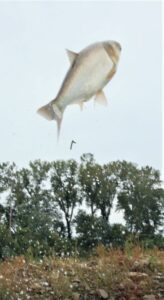
An Asian carp defecates as it appears to fly over the treeline in this photo taken by the USGS Columbia Environmental Research Center.

The steady drumbeat of the Asian carp advance is resonating throughout the country.

One particularly vulnerable site for the carp invasion is the Chicago Sanitary and Ship Canal, part of a series of canals and rivers that link the Mississippi River to Lake Michigan and the rest of the Great Lakes. Electrical barriers about 30 miles from Chicago help keep the upstream portion of the canal free of carp.

But do the electrical barriers guarantee that Asian carp will not invade the Great Lakes?

“No,” said Philip Willink with the Chicago Field Museum, who maintains an informational webpage about Asian carp. He compares the efficiency of the electrical barriers to biologists who use electricity to stun fish for survey collections — a few fish always manage to escape. Studies also indicate that Asian carp navigating toward Lake Michigan could breach the barriers if they swim alongside barges and other vessels that could deflect the electrical current.

Close the locks and dam the canal, say some. Many local and state environmental agencies and organizations are calling for permanent solutions that include filling in portions of the canal system. But this extreme measure would cost billions of dollars in construction and lost revenue from shipping traffic and recreational boating along the canal and river system.

Asian carp have had their day in the highest court of the land. Several Great Lakes states sued the State of Illinois to permanently close the navigational locks leading into Lake Michigan. The U.S. Supreme Court rejected those pleas.

Illinois is President Barack Obama’s home state and Michigan officials accused his administration of favoritism when it supported Illinois in the lawsuit.

But the Obama administration supports other measures to contain these foreign invaders. Its plans include an Asian Carp Control Strategy Framework — and a $51.5 million program-in addition to the $105 million already allocated — to defend the Great Lakes. This multi-faceted strategy includes a list of lethal tactics that reads like a page from a spy novel, including female carp urine to lure unsuspecting males, poison pellets and underwater guns that shoot high-intensity sound waves.

Jackson Gross, a U.S. Geological Survey biologist and lead investigator for one of the projects, said the water guns can shoot a blast of air more than 30 feet to scare or stun fish. If the stun gun proves to be effective, it will used in the Chicago Sanitary Canals to help repel carp.

Like so many other concerned scientists, he laments the loss of native fish in the Illinois River. A century ago, it supported the largest inland fishery in America.

“The Illinois had one of the most diverse fish populations in the country until Asian carp took over,” he said. “Wild carp are like a cancer on the environment.”

Potential weak link

Not far from Chicago lies another potentially weak link that could offer a supply line for the Asian carp attack. Eagle Marsh, a 716-acre wetland preserve just south of Fort Wayne, Ind., lies near a centuries-old trail where French fur trappers once portaged their canoes between the Wabash and Maumee rivers, which link the Mississippi to Lake Erie.

Asian carp in the Wabash might also find this to be a convenient route to the lake if severe floods breach the gap between the rivers. The Environmental Protection Agency (EPA) and the Fish and Wildlife Service funded the installation of an 8-foot-tall chain-link fence the length of nearly four football fields to span the flood-prone area and keep carp from reaching the Maumee. In spite of these efforts, Asian carp imprints have been spotted in Lake Erie and efforts to track and hunt them down have intensified.

Reports of bighead carp in Lake Erie, though few and far between, have surfaced throughout the years from Pelee Island, Sandusky Bay and Cedar Point.

Like evidence at a crime scene, results from water samples collected in late August have brought out the forensic fish experts. A posse of officials from Ohio Department of Natural Resources, Michigan Department of Natural Resources, U.S. Fish and Wildlife Service and U.S. Army Corps of Engineers found silver carp DNA in 20 out of 150 samples taken throughout Sandusky Bay and Sandusky River. Samples from Maumee Bay were negative. Intensive electrofishing and test netting yielded no live Asian carp in any of the areas that were sampled.

Did the criminals escape the dragnet, or was this DNA just a form of circumstantial evidence?

“The breadth of positive samples from the Sandusky Bay area was not expected,” said Michigan Department of Natural Resources Fisheries Chief Jim Dexter. “We need to understand the source of the eDNA (environmental DNA) in order to address it and keep silver and bighead carp from establishing a viable population in the Great Lakes.”

Fish parts and fish DNA can be transported by storm sewers, in bilge water or by fish-eating birds, such as pelicans, that fly long distances.

Inviting habitat

Whatever the mode of transport, Maumee Bay and the Maumee River’s currents, water temperature and abundant food supply offer one of the most inviting habitats in Lake Erie for Asian carp to thrive and reproduce. That doomsday scenario could devastate the most fertile fisheries area in all of the Great Lakes, and the Maumee River’s sport fishing heritage could become a faint memory, like the dilapidated canal locks that lie along its banks.

Commercial fishing could also suffer if Asian carp have their way. Rick Unger, president of the Lake Erie Charter Boat Association, said he thinks that local Department of Natural Resources personnel and other local government agencies are extremely vigilant.

“My concern,” he said, “is at the federal level and not enough being done at the shipping canal in Chicago.”

Federal help is on the way, and the recent introduction of the Stop Invasive Species Act, sponsored by U.S. Sen. Debbie Stabenow, a Michigan Democrat, and Rep. Dave Camp, a Michigan Republican, requires a fast-track plan to defend the Great Lakes’ rivers and tributaries from Asian carp.

Specifically, the bipartisan plan calls for the U.S. Army Corps of Engineers to provide options for stopping Asian carp across 18 possible points of entry into the Great Lakes. Center-stage are the Chicago Waterway System and infrastructure projects that would block Asian carp while allowing shipping to continue along the waterways.

Is there any chance for deliverance from this scaly scourge? Schafer Fisheries in Thomson, Ill., has been harvesting and selling fish since 1955. Now, it annually sells some 10 million pounds of Asian carp worldwide to countries with hearty appetites for what most Americans regard as trash fish. Carp are one of the most popular food fish in the world.

“Problem is that most Americans under 40 won’t buy carp,” said Steve McNitt, general sales manager for Schafer. “They want a boneless white fillet that doesn’t taste like fish.”

Schafer’s retail store features a broad menu of carp products including sausage, hotdogs, jerk and gefilte fish. Asian carp are also processed into a potent and popular brand of fertilizer that is sold across the country. Most of Schafer Fisheries’ revenue comes from Asian carp, and though the commercial harvests may not halt the advance of Asian carp, they do bring one more possible solution to the table.

While new markets are explored and more studies initiated, there will be no truce in the battle for the Great Lakes. The list of foreign villains in the Great Lakes reads like a rogues’ gallery of criminals and killers. Sea lampreys literally sucked the lifeblood out of the Great Lakes fisheries in the 1950s and ’60s; zebra mussels clog municipal water intakes, foul boats and piers and cause millions of dollars in damage; the EPA has identified at least 25 invasive species that disrupt and damage the Great Lakes ecosystem.

Asian carp may appear in that gallery one day, but there is still time to turn the tide and save the Great Lakes from yet another killer.

Baumhower: Seeing Toledo for the first time … again

0
The U.S. Brig Niagara clears the Cherry Street/MLK Bridge inbound at the start of Navy Week in Toledo, in this Instagram photo taken from the Navy frigate USS DeWert moored at the Maritime Academy pier by Toledo Free Press Managing Editor Sarah Ottney.

What if I told you of a magical place where you can see Toledo in a way you’ve never imagined, where photography enthusiasts try to capture Toledo as it has never been shared before? This special magical place is actually an app for smartphones and the next evolution of social media called Instagram.

Where Twitter shares your words and thoughts with the world, Instagram visually shares your life.

According to the Instagram website, Instagram is “a fast, beautiful and fun way to share your photos with friends and family” but its simple concept has evolved into a global phenomenon. Instagram is a free application for your smartphone that allows you to take pictures and use numerous and simple filters that can give your photo a vintage feel. After taking the picture and deciding what filter to use comes the social part. You can share this new picture with any of your social networks — Facebook, Twitter, Tumblr, etc. You can geotag the exact location it was shot and you can #tag the photo in any way you wish people to see/find it. You could keep all of your photos private, but what’s the fun in that?

.

If you are like me and love to be visually stimulated, Instagram will become your new pastime. The social part of Instagram allows you to search for anything you wish to see, from cities like New York or London to events like Hurricane #Isaac or the #RNC. Once you learn Instagram’s language by deciphering its “tagging,” the way pictures are labeled, you will master the new medium. You can search “Toledo,” “ToledoMudHens” the “ToledoZoo” or anything else you can dream of. The contrasts between Toledo, Ohio and Toledo, Spain alone are worth it.

As of Aug. 30, there were more than 19,800 pictures tagged with the word #Toledo. Some of the pictures shared could hang on any art gallery’s wall, but the artist is choosing to share his or her vision via Instagram. I’ve lived 95 percent of my life in Toledo and was reminded of how beautiful our city can be.

One of the features of Instagram is the ability to “follow” your favorite photographers, whether it be your BFF, a celeb or some random Instagram pro. A couple of the best local Instagrammers are Eric Shanteau, 34, (hobbes2485) and Ben Morales 32, (benmorales), they deserve a “follow.” These two take Hallmark quality pictures of Northwest Ohio, of places we have seen over and over but never like this. Their optimistic vision of our area will brighten your day.

Toledo Free Press (toledofreepress) recently signed up and debuted in a big way by sharing some Navy Week pictures shot on the USS De Wert by Managing Editor Sarah Ottney. The 50-plus pictures really gave a sense of what of a Navy boat ride down the Maumee would feel like.

Great tags to use are:

#Toledo, #ToledoOhio #Sylvania, #Maumee, #Perrysburg, #ToledoMudHens, #ToledoWalleye, #UTRockets, #ToledoZoo, #ToledoMuseumOfArt, #ToledoArtMuseum, #ToledoFinest, #ToledoFail.

If you would like to share your picture with Toledo Free Press, please tag the photo with #TFP or #ToledoFreePress and we will find it.

Instagram is another opportunity for Toledo to open our doors to the world and show what a tremendous place it is to call home or do business.


Find Jeremy Baumhower on Instagram @jeremybaumhower.

Local club plays with metal, rocks, beads at annual show

0

Did you know that the powder on chewing gum is calcium carbonate from limestone? It is added to make the gum less sticky.
This lesson and others will be taught at the 41st Annual Jewelry, Gem and Mineral Show, said Steve Shimatzki, president of the Toledo Gem and Rockhound Club, said.
“The main goal of the club is educational,” Shimatzki said. “Every year we get a chance to put a museum up.”
The event, sponsored by the club, will be at the Stranahan Theater Complex for three days, Sept. 7 from 2-8 p.m., Sept. 8 from 10 a.m. to 6 p.m. and Sept. 9 from 11 a.m. to 5 p.m. Adults will be charged $4, students and seniors $3 and kids under 12 get in free.
The show will feature demonstrations and activities for all ages and is organized entirely by volunteers, Shimatzki said. At the event, community members may purchase jewelry, beads, gem trees, faceted stones, mineral specimens, fossils, cabochons, tools and carvings. The event is “all-encompassing, not just an art show,” Metalcraft Moderator Deb Hoffmaster said.

There will be components and pieces artists can purchase, not finished works alone. Oneof the activities is geode openings. Geodes are sedimentary rocks  with crystals inside. The rocks have been underground for millions of years and, when split open, the attendee will be the first to see the contents.
“There’s a little bit of excitement in that,” Shimatzki said.
There will also be a raffle at the event that benefits Bowling Green State University and the University of Toledo’s geology departments. The club donates $100 and the attendees are encouraged to join in. However much money is raised is split between the two colleges equally. Last year, both schools received more than $500.
After learning about rock formations in elementary school and high school, Shimatzki said, “We want to make that available for the college years.”
The club meets every month at the Toledo Botanical Garden for business meetings. The members meet individually to work on projects throughout the month. The club has been in existence for 51 years.
Anyone interested can view the club’s display cases at local libraries.
Shimatzki’s work is featured at the Reynolds Corner Library and includes a 13-pound crystal and fossils.
“People think of rocks as just,” Steve Shimatzki said. “[But] you crack it open and there’s a whole ‘nother world in it.”

Retirement guys: Four tips to protect your investments

0

S&P 500 has gained more than 100 percent since it bottomed out back in March 2009.
Economists will continue to debate when the next crash or recession will occur. Some will be right and most will probably be wrong, and trying to figure who to listen to can make the average investor’s head spin.

Eventually a decline will happen; it is a normal part of our economy and has been that way forever. Instead of trying to time it just right, use these four tips to get your portfolio ready before a decline occurs.
1. Don’t always stay fully invested in the markets. In general, risky investments such
as stocks, bonds, mutual funds and variable annuities, are long-term investments. The less the investor needs to rely on these accounts for current income, the more risk the investor could be willing to take.

I, Nolan, remember my professor in college telling me that over time, stocks and bonds go up in value. In theory he was right, yet he didn’t mention that investors need to factor time into that equation. A good rule of thumb is as investors gets older, they should be safer with their money, especially with money they need in the next few years. Realize that no one can predict the markets in the short term.

Sometimes it makes sense to either not take the risk at all or have an exit plan in place prior to markets getting bad. If an investor is taking current income from risky investments or isn’t sure what the exit strategy would be if the markets declined, this would be a good area to review now.
2. Stress test your investment plan. The American Heart Association on www.heart.org says a stress test helps a doctor know the type of exercise that is right for you. The test helps a doctor figure out how well a patient will do when stress occurs. The work this association is doing is saving lives and extremely important. The same principles can be applied by the average investor. Monitor how investments are currently doing. Get an investment EKG, if you will, that shows what percentage of your money is at risk versus principally guaranteed, how much income is flowing in monthly and what the maximum drawdown the portfolio could decline. If an investor hasn’t reviewed these numbers before or it has been a while, now is the time to look at the potential warning signs before an unexpected problem occurs.
3. Remove emotions, use logic. Using logic assumes the average investor will use correct and reliable evidence. The problem is when it comes to investing; logic can go out
the window. We get it — in today’s society the average investor is bombarded with investment decisions, most of which play on their emotions, which is why logic usually gets clouded. Don’t let this happen to you. Try and make decisions based upon facts. If you are considering making changes, does the change logically make sense or is it just to solve a short-term emotional concern? If an investor doesn’t logically understand his or her investment plan, now is the time to talk with a professional and have it explained.
4. Diversify beyond traditional investments. In our opinion, true diversification goes beyond owning a few different investment accounts that go up and down at the same time.
Although traditional investments like stocks, mutual funds, bonds, and variable annuities have done well in the past few years, the same principle applies today as it did years ago; don’t put all of your eggs in one basket. If all the accounts an investor owns go up and down just like the stock market, he or she probably isn’t fully diversified. One tip for an investor right now is to review the correlation of the investment holdings. Try to diversify into several different potentially profitable strategies that have different correlations.
Hopefully, the stock market continues to go up for a long time to come. Yet, our country is at a crossroads and global issues still loom, so we have a long road ahead of us.
Even if a stock market crash doesn’t happen any time soon, taking these four tips and reviewing them with your plan will only make you a better educated investor and put you in a position to be more prepared than you were before.

Securities and Investment Advisory Services are offered through NEXT Financial Group Inc., Member FINRA / SIPC. NEXT Financial Group, Inc. does not provide tax or legal advice. The Retirement Guys are not an affiliate of NEXT Financial Group. 

Startup Weekend set for entrepreneurs, tech industry 

0

Startup Weekend Toledo, a first-time local event for entrepreneurs and aspiring business owners, will be held Sept. 14-16 at the College of Business and Innovation at the University of Toledo. 

Startup Weekend Toledo is an intense 54-hour event where entrepreneurs, business startup enthusiasts, software and web developers, marketing gurus and anyone interested in building a business come together over the weekend to share ideas, form teams and launch a start-up. 

This event is billed as “No talk, all action – launch a startup business in 54 hours,” according to Lindsey Danforth, lead organizer for it.  

“For too long, we have focused on manufacturing in this town and ignored all the tech-savvy, forward thinkers that were just waiting for the environment to become friendlier towards tech,” Danforth said.   

“These events have been gaining momentum across the U.S. and around the world. They have produced a lot of cutting edge companies in the tech industry. There’s no reason why we can’t produce them in Toledo,” she said.  

Danforth reported that there has been a quiet movement in the tech industry starting about a year ago with the formation of groups such as Startup Toledo, Tech Toledo, Toledo Web Professionals and other regional organizations.  

The movement has been building ever since individuals have been getting together and realizing that Toledo has some serious talent but needed a bridge to connect the various players in the community, Danforth explained.  

“We will continue to support entrepreneurs and the tech industry here,” she said.  

Although Danforth does not have her own company, she said, “I come from a long line of entrepreneurs so it’s in my blood.”  

Toledo has seen the recent formation of some interesting start-ups such as Beyond Gaming, Buyvite, Givt, and Magnate Interactive.   

Danforth said the Toledo area even has some tech celebrities who will be speakers at Startup Weekend. Matt Braun, founder of Magnate, developed an application that has more than four million downloads. Ten- year-old Jonathan Buchanan of Perrysburg has made a name for himself as the youngest person to create an application available for sale in the app store.  

Buyvite and Givt are recent recipients of early-stage funding from Rocket Ventures, LLC, an angel investment and venture capital firm that is a joint venture of the Regional Growth Partnership and UT Innovation Enterprises.  

Rocket Ventures and UT Innovation Enterprises have played a major role in supporting entrepreneurs with funding and startup services, according to Danforth.  Rocket Ventures will provide a free consultation to the winning startup at Startup Weekend. 

Buyvite is an early stage group payment platform that allows friends or relatives to group pay inside any e-commerce at point-of-sale. Givt is a social gifting app that makes it much easier to give free gift cards to Facebook friends.  

Brandy Alexander-Wimberly, founder and CEO of Buyvite, and Justin Blanchard, founder and CEO of Givt, will serves as coaches for teams at Startup Weekend.  Other coaches include Gene Powell of Spoke and Steve Schwartz of Alpha Jango.  

Organizers and volunteers have been working to ensure that Startup Weekend provides not only the inspiration but all the resources required for building and launching a viable, scalable company.  

Knowledgeable and successful entrepreneurs will participate as coaches and speakers to inspire, share information and mentor teams throughout the weekend.  

Educators of entrepreneurship from BGSU and UT are supporting the event and serving as judges. Gene Poor, chairman of the Board for Life Formations, teaches future entrepreneurs as the Hamilton Professor of Entrepreneurship at BGSU. Sonny Ariss, chairman of the Department of Management, is a fellow of the Center for Entrepreneurship and Technology Commercialization at UT.  

Business concept pitching and team building will occur on Friday. Teams will be formed around concepts and various related skills. The rest of the weekend will be used for mind mapping, strategizing and building a real business.  

The new business ideas will be pitched to a panel of judges on Sunday with a winner to be selected and announced.  The winning team will receive a two-hour brainstorming session with Rocket Ventures and a two-month, part-time membership to Seed Coworking.  

Seed Coworking is another new venture in Toledo that offers a community atmosphere and workspace for tech entrepreneurs and isolated individuals who may be working at home or out of a coffee shop.  

The organizers of the first local Startup Weekend are holding a free pre-event mixer for attendees and anyone interested in learning more about it Sept. 6 from 5:30 to 7:30 p.m. at Seed Coworking on South St. Clair Street in downtown Toledo.  

Startup Weekend is a global grassroots movement of active and empowered entrepreneurs who are learning the basics of founding startups and launching successful ventures. The non-profit organization based in Seattle can be found in more than 200 cities around the world with more than 400 events held in 100 countries in 2011.  

Tickets for the event are $50 per person and $35 for students. For information about the local Weekend Startup events, go to http://toledo.startupweekend.org 


Kuron: Isaac Hamblin – Heroic man with historic stuff! 

0

I had a wagon as a kid, didn’t you? Some of you surely bought station-wagons as adults, right? My grown-up wagon was my bee-ay-you-tee-full (thank you Jim Carrey), metallic gold, 1973, Ford Mustang – which vanished one morning from right in front of my house! Oh, I got it back in a few days, so maybe I shouldn’t have been so upset. After all, it was only missing my 8-track tapes, which wouldn’t fit into the hole where the player used to be anyway. And I hadn’t originally ordered air-conditioning, so driving now was quite refreshing without any windows. Owning cool stuff is risky, and one little-known early American, Isaac Hamblin, learned this lesson when his favorite wagon was stolen by none other than General Henry Proctor, leader of the British forces in Canada, circa 1813. 

Do you remember studying Shay’s Rebellion? Sorry, I know. Well, it was a short-lived revolt against taxation during the 1780s, and its participants were either loved or hated. One of its leaders, Perez Hamlin, may have been an uncle to Isaac. No matter; the notoriety of the “Hamlin” name, whether a relative or not, made life difficult for Isaac. He hoped adding a “b” to his name would distance him from Perez, but it didn’t work. So when the British, in need of tradesmen, solicited Americans to settle in Upper Canada (today’s Ontario) in the late 1700s; Isaac, a stone mason, made the move. 

Isaac thrived along the Thames River, near present-day Chatham, for well over ten years until the War of 1812 happened. At its beginning, US General Hull reassured the Americans in the area that they would soon be secure. Well… things didn’t go quite as planned. Hull’s defeat in 1812 is legendary, and soon British General Proctor was in command of Canada. He reversed the peaceful co-habitation that had existed between the two countries by actually plotting to have an Indian contingent wipeout the Americans in residence. Isaac learned of his murderous plot and managed to intercept a strategic letter intended for the perpetrators. This lessened the extent of the disaster and Proctor always suspected that Isaac had a hand in foiling his plan. 

Isaac’s Canadian residence was well-maintained with an orchard, several fine horses and an exceptional American-built wagon. Unfortunately, as September, 1813 arrived, all his possessions became easy pickins’ for Proctor, and even Harrison, the American general who was pursuing the British and Indians across Canada at this time.  

Just weeks before the Battle of the Thames would occur near Isaac’s home; Proctor simply took Isaac’s horses and wagon for his own use. Isaac was taken too; literally, wound-up in a heavy rope like a mummy from his toes to his neck and kept in this horrid condition for seventeen days… seventeen days! And, he was taunted daily with kicks and cursings from both Proctor and Tecumseh.  

As it happened, the night before the battle, Harrison made camp at the edge of Isaac’s property. Expecting an enemy attack overnight, Harrison used the wood of Isaac’s home, barns, and fruit trees to set up a breastwork of defense, but the fight never came. 

The morning of the battle Isaac was still bound, now aboard a British supply ship sailing up the Thames River. Harrison’s men captured that vessel. Isaac was finally unwrapped, and unfettered in his determination to avenge his circumstances. Because he could identify Tecumseh, Harrison asked him to serve on the front lines as a spy; and by that afternoon he was eagerly fighting in the heart of the Battle of the Thames, even becoming a key eyewitness to Tecumseh’s death! 

It’s unclear which family members Isaac may have lost in the chaos of 1813, but he did soon marry and removed to Ohio, settling near present-day Worthington, and later Mt. Vernon. Isaac led a somewhat transient life thereafter, but all his children were native Ohioans.  

Isaac’s wagon, shot-up and useless, but filled with Proctor’s personal possessions, was found abandoned as that general disgracefully fled the Thames battlefield as soon as the opening shots were fired. Proctor continued riding Isaac’s fine horse all the way to a British court-martial for his cowardice. 

### 

Frank Kuron is author of the War of 1812 book, “Thus Fell Tecumseh.” Email him at [email protected] 


Bugle Call: Upcoming Events 

Some key websites to learn of upcoming 1812 Bicentennial events: 

www.warof1812.ohio.gov — Most Ohio events are listed. 

www.battleoflakeerie-bicentennial.com – Details of a full re-enactment of the Battle of Lake Erie planned for September of 2013 in which you can participate.  

www.fortmeigs.org – Numerous activities year-round. 

www.riverraisinbattlefield.org – Numerous activities year-round. 


Ombudsman: Mistake in kidney transplant shouldn’t scare potential donors

0

News broke that a transplant kidney had been accidentally thrown away and ruined at the University of Toledo Medical Center (UTMC) days before my mom’s kidney stone surgery.  

“Great,” I thought. She was going to a different hospital, but a mistake in the same city so close to her surgery date made me nervous. Additionally, it involved the same organ, although at least it wasn’t a transplant. 

But how common is it for a kidney to become compromised en route to the recipient anyway? Should we decline being listed as organ donors on our driver’s licenses if medical (or human) error is possible? Is it even worth thinking about becoming a living donor like at UTMC where a man donated to his sister only to have the kidney accidentally discarded by a nurse? 

When I called the National Kidney Foundation in New York and talked to spokesman Sean Roach, he was aware of the UTMC incident and referred me to the immediate past president of the National Kidney Foundation. 

The news was reassuring. 

A kidney being compromised during a transplant surgery “is reported very rarely,” said Dr. Bryan Becker, who is the chief medical officer at the University of Illinois Hospital and Health Sciences System. 

 “Donors should feel very confident that their kidney will be handled successfully and expertly and placed into the recipient in as ready a time frame as possible,” he said in an email. 

The National Kidney Foundation also offered some compelling reassurance on the overall success of transplants.  

“Medication and medical advances have resulted in transplant surgeries today that are very successful, in fact as high as 95 percent. The transplantation of vital organs has become routine surgical operation and is no longer experimental,” the website stated. 

Last year, 16,812 kidney transplants took place in the United States. Of those, 11,043 kidney transplants came from deceased donors and 5,769 came from living donors. 

Becker said organ donation benefits both the recipient and the donor.   

“Not only is there altruism in action, but a lifesaving effort is present and interestingly, data suggest that donors historically have led healthier lives than age-matched controls,” he said. 

If that doesn’t make you want to reconsider any hesitation toward kidney donation, check out these somber stats from the National Kidney Foundation: 

  • Nearly 3,000 new patients are added to the kidney waiting list each month. 
  • Every day, 18 people die while waiting for a transplant. 
  • Last year, 4,903 patients died while waiting for a kidney transplant. 
  • Every 10 minutes someone is added to the transplant list. 

So I ask, “Should we hesitate to donate just because one brother’s sacrifice went awry?”