Home Blog Page 250

Obama talks China, economy, education at BGSU

0
President Barack Obama talked China, economy and education during a Sept 26, 2012, visit to Bowling Green State University -- his 13th visit to Ohio during the 2012 Presidential campaign. Toledo Free Press photo by Joseph Herr.

President Barack Obama told an often-roaring crowd of more than 5,500 about his plans for the economy, health care and education affordability on Sept. 26 at the Stroh Center
in Bowling Green.
“You’ve got a big choice to make and it’s not just a choice between two parties or two candidates. It is a choice between two fundamentally different paths for America,” he said.
Obama has traveled to Ohio 13 times this year and was at Scott High School on Labor Day. He went to Kent State University following his appearance in Bowling Green. His opponent Mitt Romney also spoke in Northwest Ohio on Sept. 26.
Obama criticized Romney’s plans for the economy, especially tax breaks.
“Top-down economics never works. The country doesn’t succeed when only the rich get richer. We succeed when the middle class gets bigger,” he said.
When the enthused crowd booed Romney’s stances, Obama responded with “Don’t boo, vote,” as he also said at Scott High School.
“We don’t believe that anybody is entitled to success in this country. We don’t believe government should be helping people who refuse to help themselves, but we do believe in something called opportunity,” Obama added.
“This country’s gone through a very tough time. We’ve still got a lot of folks who are hurting out there and I’m not somebody who’s come here offering some easy, quick solutions. The truth is, it’s going to take more than a few years to solve the challenges that were building up over decades,” he said.
The president said that although the country does face challenges, these are problems that can be solved.
“For the young people out here, I want you to understand, there is not a country on Earth that wouldn’t gladly trade places with the United States of America,” he said.
The president later launched into his plan for the economy, saying, “I want to export more products and outsource fewer jobs.”
“We can give more tax breaks to companies that are shipping jobs overseas or we can start rewarding companies that open new plants and train new workers and create new jobs right here in the United States,” he said.
With the right policies, a million new manufacturing jobs could be created in the next four years, Obama added. He later said that those who make more than $250,000 per year should have to pay a higher tax rate.
He also criticized Romney’s famous statement on the auto industry, “Let Detroit go bankrupt.”
“That would have been walking away from an industry that supports one in eight Ohioans. It supports businesses in 82 of 88 Ohio counties,” he said.
Obama lambasted Romney’s statements that he’d be tough on China and said that Romney had profited from sending jobs to China.

“It feels a lot like a fox saying we need more secure chicken coops,” Obama said.
“I have woken up every single day doing everything I can to give American workers a fair shot in this global economy. We brought more trade cases against China in one term than the previous administration did in two. And by the way, we’ve been winning those cases,” he said.
Obama also spoke to the crowd, which included many college students, about the importance of education.
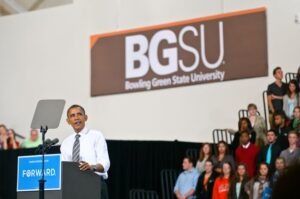
Education was “the only reason I’m standing here,” President Obama told the BGSU crowd. Toledo Free Press photo by Joseph Herr

“[Education] was my gateway to opportunity; that’s the only reason I’m standing here,” he said. “It’s the path more than ever to a middle-class life. Today, millions of students are paying less for college because we took on a system that was wasting billions of dollars using banks and lenders and middlemen on the student loan process. We said, ‘Let’s give that money directly to students.’”
The president also said he would work with college presidents to make college more affordable.
In addition, he said the country has doubled the amount of its renewable, clean energy sources.
“Today, America is less dependent on foreign oil than at any time in nearly 20 years,” he said. Still,
Obama said, he wanted the United States to control more of its own energy resources.
“Let’s take that money we’re giving to companies that are already hugely profitable. Every time you go to the pump, they’re making money; they don’t need a tax break. Let’s use that money and invest in wind and solar and clean coal
technology,” he said.
Obama also pledged not to make Medicare voucher-based, which is part of Romney’s potential plan.
“We’ll reform and strengthen Medicare for the long haul, but we’ll do it by reducing the actual cost of care, not by dumping the costs onto seniors,” he said.
The president also pointed out his military successes, including the end of the war in Iraq, winding down the war in Afghanistan and the killing of Osama bin Laden.
“As we saw just a few days ago, we still face some serious threats in the world and that’s why as long as I’m commander in chief we’re going to maintain the strongest military the world’s ever known. And when our troops come home, and they take off their uniform, we’re going to serve them as well as they served us,” he said.
Obama emphasized that change takes time.
“I’ve always said change is hard; it takes more than one term or even one president. And the way our democracy works, we’re never going to get everything that each of us individually wants.
“But if we’re working together, you can make things happen. Now, you can’t make it happen if you write off half the nation before you take office,” he said.

Jim Wisler, an audience member and retired quality control worker for Ford, agreed.
“I know at this age, it takes more than two or three years to get through this mess. Back in the Depression years, well, it took 12 years for Roosevelt,” he said.
Wisler made the trip from Catawba Island with his wife Nancy, who said the drive was “well worth it.”
Rayia Gaddy, a Bowling Green State University sociology and psychology student, said she appreciated that the president addressed different groups like the working and middle classes in his speech.
Gaddy has a personal stake in some of Obama’s education policies. She is at BGSU on a full ride and has siblings who dropped out of college because they could no longer afford school.
“Starting and then not being able to go when they really loved it, it really tore them up,” she said.
Andrew McCaffrey, a BGSU education student, said he liked the diversity of the crowd. “I was interested to see that [Obama] was coming to Ohio yet again. It’s a testimony to how important Ohio is in the election,” he added.
McCaffrey said he also agreed with the president’s stance on energy.
“A great deal of America’s problems can be traced back to energy and if we develop energy independently, that’ll improve our domestic situation as well as foreign situation,” he said.
Kelly Wicks, who is running for the Ohio House of Representatives, spoke to the president.
“I got to spend a minute with him and he asked who I was, what I did, how the campaign was going, said good luck, said make sure to tell everybody (volunteers) thank you,” he said.
Wicks has been to several Obama rallies, but said this crowd had the most energy he’s seen. He also said he likes watching people’s reactions.
“That moment, just watching people in the audience who can’t believe that they’re there or he made eye contact with them, that changes people’s lives,” Wicks said.
Early voting was another big subject at the rally.

Seth Melchor, the BGSU student who introduced Obama, did so after breaking his wrist the night before.
“He was supposed to get it set yesterday but he didn’t want to miss this,” Obama said. “Now, I just want to make the point that if Seth can come up here with a broken wrist then there is not a student here who cannot get registered.”
In-person voting begins in Ohio on Oct. 2. The deadline to register to vote is Oct. 9.

Retirement Guys: 4 tips for a better investment plan

0


Mark and I have recently started working on a new educational series for consumers that helps guide them on how to better manage their money, protect their hard earned assets, and efficiently plan their estate. The series is called, “The Essential Series: The Essentials for Investing, The Essentials for Asset Protection, and The Essentials for Estate Planning.” The goal is to help the average investor discover where he or she stands financially, gain knowledge and continue to move forward toward creating a better comprehensive plan. As we finish up the final touches on “The Essentials for Investing,” we wanted to share with our readers four tips investors should be able to answer in order to create a better investment plan.


  1. Investors should understand the current investment plan and how it works.


Often when we meet with investors, they own several different investment accounts. The primary goals of those accounts are usually either protection of principal or long-term growth. Two more in-depth answers an investor should have is what is the investment methodology and the specific purpose for each account. The methodology should describe the disciplined process used to reach the investment goals and objectives. Understanding the specific purpose and timeframe of when the account will be used will be helpful in picking suitable investment options.


  1. Control the total cost and yield of investment accounts.


All financial products come with a cost and have the potential for yield. Both safe and risky investments have costs. Nothing is for free. In talking with thousands of investors over the years, we have found that many investors have not done a complete cost and yield analysis on their total investment picture. For example, look at the difference just 1 percent can make over time.  An investor who earned 5 percent annually would need $269,000 to fund $1,000 per month for 30 years with a 3 percent annual increase. Yet, if the annual net return is increased just 1 percent, only $237,000 is needed to fund the same goal. That 1 percent means a difference of $32,000 over the long term.


  1. Take action to reduce the amount of income taxes paid on withdrawals from retirement accounts.


In the good old days the average investor was taught to save in tax deferred retirement accounts like IRAs and 401(k)s. As the saying goes, as you get older you spend less and won’t need as much income as you do in your working years. In reality, that often is not the case for many of the seniors and retirees we meet with. That means the majority of a retiree’s income is going to come from traditional tax deferred retirement accounts that have never been taxed. Income taxes can significantly reduce the income the retiree receives. A solution is to work on building up tax-free accounts to compliment tax-deferred investments. Consider a plan that can help fund the earlier years of retirement when income needs could be higher while you are enjoying the fruits of your labor.


  1. If the stock market started to decline, know what specific steps should be taken to avoid losses.


We call this running the fire safety drill. I, Nolan, having two young boys, have a variety of fire safety tools built into my home. From circuit breakers to smoke detectors and fire extinguishers, I have the tools in place to respond if a fire ever breaks out in our home. I also talk every year with my family about not only how those fire safety tools work, but what to do when they go off. That way, hopefully they will avoid a panic and be able to get out safely. In the investment world, the same logic applies. An investor should have a variety of tools in place to not only help prevent, but quickly put out a financial fire if one occurs. If the fire looks like it is going to get out of control, he or she should know the exit plan and who to call for help. This plan needs to be in place before the financial fire happens.


For more information about The Retirement Guys, tune in every Saturday at 1 p.m. on 1370 WSPD or visit www.retirementguysnetwork.com.  Securities and Investment Advisory Services are offered through NEXT Financial Group Inc., Member FINRA / SIPC.  NEXT Financial Group, Inc. does not provide tax or legal advice.  The Retirement Guys are not an affiliate of NEXT Financial Group. The office is at 1700 Woodlands Drive, Suite 100, Maumee, OH 43537. 419-842-0550 

Rathbun: To Infinity and Beyond 

0

Last week I couldn’t help but think of the old movie, “Toy Story.” While I have never actually seen the movie, I do remember the advertisements with a character named Buzz Lightyear, voiced by Tim Allen, and his catch phrase “to infinity and beyond.” The Federal Reserve chairman essentially used that mentality last week when he announced additional money printing until the economy recovers “and beyond.” 

At the very least, this means that the balance sheet of the Fed will go from $2.3 trillion to more than $4 trillion in the next year or so. Bank of America came out with calculations that speculated that the Fed’s balance sheet would go as high as $5 trillion by the end of 2014. 

If this is the case, and I believe that the bank is probably correct, then by the end of 2014, the Fed will own about 33 percent of the entire mortgage market and account for just below 30 percent of all goods and services used to calculate the GDP. Additionally, by that time, it will own 65 percent of the entire bond market with maturities older than five  years. 

 The Fed has implied that it will keep interest rates at or near zero until 2015. It has also implied that inflation is not a problem and that these policies and actions will have no negative effect on the dollar. This from the same people that said TARP would save us, then QE1 would save us, then QE2 would save us, then operation twist, then operation twist 2 and now QE3 with an additional continuation of operation twist. 

What’s next? The Fed will soon run out of debt to purchase and then it will have to come up with another strategy. What could that possibly be? Well, I said a while back on one of the radio shows that I do, the Fed would reach a point where it starts to purchase equities. Unfortunately, by this time, hyperinflation is likely. (I will expand more on this scenario in a future column.) 

 The question for immediate consumption then becomes what happens over the next few years as the Fed carries out its plan to print and print and print?  The Bank of America’s report speculates that gold will reach $3,350 an ounce and oil will reach $190 a barrel. I would agree with this assessment but with the caveat that this is probably on the low side. 

 Now our favorite Keynesian economist Paul Krugman likes what Bernacke has started, but was disappointed that the response wasn’t “stronger.” We have reached a point of absurdity in economics and with the general populace more concerned with “American Idol” judges than with the state of the country, I don’t see the understanding level increasing anytime soon. 

 I often use the path that Zimbabwe has gone down with its currency to illustrate the path that we are on. In 1980, not that long ago for some of us, the Zimbabwe dollar was on parity with the American dollar. Today you can purchase a $100 trillion dollar bill from Zimbabwe for less than $1 on E-Bay. The currency lost so much value that Zimbabwe quit using its currency several years ago and replaced it with American dollars for most day-to-day commerce. 

 We could easily go down the same path. It will be very different, of course, since we are a world currency and dollars are used throughout the world for oil and other commodities, but we could easily experience similar problems.   

The Fed’s actions are counterintuitive to what is needed. Higher deficits and larger national debt will sink us, not save us. We have reached a critical pivot point in our economic history and future generations will look back at our actions and say, “How could they be so obtuse to reality? Why did they think that borrowing more money would reduce the debt? Why did the Fed think that it could stop inflation cold whenever it wanted? Why did it think borrowing money would increase employment?” 

Why indeed? 

It won’t be long before the number of dollars needed to buy a loaf of bread will reach “infinity and beyond.” 

Gary L. Rathbun is the president and CEO of Private Wealth Consultants, LTD.  

Area residents reflect on competing in Transplant Games, life as organ recipients 

0
Tonya Gomez's medals from the Transplant Games.

Those who are fortunate enough to be in good health often take life for granted. For Northwest Ohioans Allison Herr and Tonya Gomez, that is not the case. 

Herr, a 9-year-old living in Metamora, was born with biliary atresia and put on the transplant list for a liver by the age of 1. After waiting almost two years — and nearly losing the youngest of their three children — the Herr family got a call in 2006 notifying them a match had been found. 

Allison Herr, 9, of Metamora, a liver recipient, won six medals at the Transplant Games of America in July. PHOTO COURTESY HERR FAMILY 

“We got a call after being on the waiting list for one year and nine months,” Allison’s mother, Jenny Herr, told Toledo Free Press. “She got the new liver, had some minor ups and downs the first year, but today she’s completely healthy and active. She’s your typical 9-year old.” 

Although thrilled her daughter is now thriving, Jenny said it’s difficult to know the organ donor who gave Allison a liver — and the gift of life — had to die. 

“It’s hard to put into words. We’re celebrating life, but there’s suffering on the other end of it,” Jenny said. “What are the right words? When you talk to a donor, the donor families are so grateful to see us. [But] it’s hard to accept that, when you know deep down, our donor family, the first thing they think would have to be, ‘What would my child be doing now?’ Those feelings stay with you.” 

In July, Allison competed in the inaugural Transplant Games of America in Grand Rapids, Mich., winning three gold medals (swimming, long jump and softball throw) and three silver medals (50-meter dash and two relay races). The games feature organ recipients as well as living donors competing in Olympic-style events. 

 “It is hard to describe the emotional feeling you get from seeing your daughter, who basically cheated death, competing,” Jenny said. “We’ve met donor families and have gone through the grieving process and it comes full circle. Because of these people, we have people who are able to live life because they chose to donate [their organs].” 

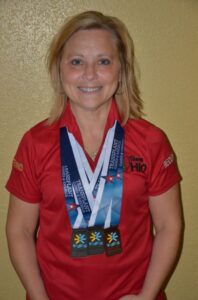
Tonya Gomez of Archbold, a double lung recipient, won three medals at the Transplant Games of America in July. PHOTO COURTESY GOMEZ FAMILY 

Tonya Gomez, a 40-year-old dietician who lives in Archbold with her husband, Mario, and their son, Eric, also competed in the Transplant Games, winning silver medals in badminton and basketball and a bronze medal in table tennis. 

Born with cystic fibrosis, a genetic disorder that affects mainly the lungs but also the pancreas, liver and intestine, Gomez was put on the waiting list for lungs when she was 30. 

“It got to a point where, over the years, I would get infections and it would scar your lungs and you start losing function little by little,” Gomez said. “For a long time I would sleep with oxygen just to give myself more energy. It got to the point where I had to be with oxygen 24/7 before my transplant.” 

Her health suffered further after the birth of her son. 

“I had my son in 2001 and I think after that, my health wasn’t superb,” said Gomez, who named her son after her brother who died of cystic fibrosis in 1981 at age 6. 

“[The doctors] told me I would probably have to wait two years because I was so petite that I would need a child’s lungs [for the transplant],” Gomez said. “My lung capacity was at 19 percent when I had my transplant.” 

After a year and a half of waiting, Gomez received two lungs.  

“The lungs fit perfectly and [the doctors said] it was easy getting my old lungs out,” Gomez said. “About a week and a half after my transplant, I had a little bit of a reaction, but I haven’t had any problems since then.”  

Like Jenny Herr, Gomez also struggles with knowing her life-saving lungs came from someone else’s death. 

“The hardest part was knowing that I got my lungs from a 10-year-old boy,” Gomez said. “It hit my husband and I hard. We cried for a long time. It’s tough because my son, Eric, is 10 and that’s how old Adam was when he died. It was very tough thinking about that.” 

Gomez met her donor’s family in 2005. 

“That was a really emotional time,” Gomez said. “Adam was their only son. They have two daughters. They were awesome. I am grateful to them. Saying thank you isn’t enough. I remember the first time we met and the first time we had to say goodbye. It’s really hard. A part of Adam is inside me and when I am leaving [his mother], it’s always tough. I think they see the good that can come out of something that is so devastating, that you can do something like [donate an organ] and leave a legacy like that.” 

For more information, visit www.lifeconnectionofohio.org or www.transplantgamesofamerica.org. 

Sears: Responsibly addressing pension reform

0

By State Rep. Barbara Sears

The years spent after retirement should be some of the most enjoyable years of a person’s life. But under Ohio’s current public pension system, the retirement of about 1.7 million Ohioans was not certain, particularly for future generations.

Last week, the Ohio House passed a series of reforms that addressed the threat of insolvency and unsustainability the systems had been facing. Through the findings of a report by the Ohio Retirement Study Council (ORSC), the House moved forward on the Senate-passed bills in an open and bipartisan process.

It made sense to me and my colleagues in the House to wait for the study to be released before passing legislation that impacts so many people. The ORSC report confirmed that the Senate bills were a good start, but that some further changes needed to be made.

For instance, the Senate plan included provisions tha allowed pension boards the unilateral
authority to change pension requirements and benefits on demand.

However, the House felt it was appropriate to delay this authority by 180 days, during which the ORSC will study the potential impact of board authority and its
alternatives. This provision will help protect the solvency of the pension system, making it easier for public employees to plan for their futures.

Ohio is unique in that it has five separatepublic pension systems, whereas most states have only one or two. That allows public employees in Ohio more flexibility in their retirement planning and is a reason why I believe Ohio has such great public workers.

However, without reform, those retirement systems eventually would have collapsed, which would have obviously been devastating for so many hardworking Ohioans who had planned for years for their retirement.

This bipartisan plan also safeguards taxpayer dollars. One theme throughout each of the bills was asking public employees to contribute more toward their retirements, therefore restraining from having tax dollars pouring into a system that isn’t even sustainable.

I commend the members of the House and Senate, as well as all of those who testified on the issue. I believe the process was open from beginning to end, which resulted in good legislation that will ensure stable retirements for Ohio’s public employees
for years to come.

District 46 Representative Barbara Sears may be reached by calling (614) 466-1731, emailing District46@ohr. state.oh.us, or writing to State Rep. Barbara Sears, 77 South High St., Columbus, Ohio

Densic: Relearn and return

0

By Robert Densic

In this heated election season, many politicians are telling you what the main cause of our nation’s problems is. We hear concerns of a federal government spending problem that gives drunken sailors a bad name. Someone else will offer up a concern of federal revenue or someone not paying their fair share. While these answers focus on the frightening economic conditions we find ourselves in, they often miss a larger debate: that of God-given freedom and liberty, or state control.

The forefathers who came to this continent did so with a clearly established goal. The Mayflower Compact reads, “in the name of God, Amen. We whose names are underwritten … by the grace of God … defender of Faith; having undertaken, for the Glory of God, and the advancement of the Christian faith … a voyage to plant the first colony… do by these present, and in the presence of God, covenant and combine ourselves together into a civil body politic.” Apparently the forefathers had not attended public education where they would be taught of “separation of church and state.”

Our nation’s Founding Fathers carried this vision forward throughout our Declaration of Independence and our Constitution. The italics are mine.

Declaration of Independence

“When in the course of human events it becomes necessary to dissolve the political bands which have connected them with another, and to assume among the powers of the earth, the separate and equal station to which the Laws of Nature and of Nature’s God entitle them …

“We hold these truths to be self-evident, that all men are created equal, that they are endowed by their Creator with certain unalienable rights …

“… and for the support of this Declaration, with a firm reliance on the protection of Divine Providence, we mutually pledge to each other our Lives, our Fortunes, and our sacred Honor.”

The U.S. Constitution

“We the People of the United States, in Order to form a more perfect Union, establish Justice, insure domestic Tranquility, provide for the common defense, promote the general Welfare and secure the Blessings of Liberty to ourselves and our Posterity, do ordain and establish the Constitution for the United States of America.”

Like so much of our nation’s history, we have forgotten where we have come from. We have ignored the lessons of the past and we have stood by as the principles that were fought and paid for with blood have been twisted or ignored. The forefathers who came to this continent did so to maximize the freedoms they recognized as coming from God. Our Founding Fathers fought a war with the most advanced and feared army and navy the world had ever seen. They won and secured that freedom not only for themselves, but for future generations.

It is our duty, it is our solemn obligation to carry on these principles. The book of Revelation warns us “Remember the height from which you have fallen! Repent and do the things you did at first. If you do not repent, I will come to you and remove your lampstand from its place.” (Rev 2:5). As Joshua was taking the nation of Israel to the Promised Land, representatives from the twelve tribes carried stones from the river bed of the Jordan River to create a memorial — so that future generations would learn and return to the ways of God-given freedom.

On Sept. 17,  we celebrated the 225th anniversary of our Constitution. If we are to restore our nation, we must take up the burden of remembering the past, relearning the principles and returning to them. We can become in the words of Samuel Adams “the tireless, irate minority keen on setting brushfires of freedom in the minds of men!”

Here are 10 steps you can take to save the Constitution, created by Julia Shaw of The Heritage Foundation.

1. Read it.

2. Understand it (with your family).

3. Teach it. Start a Constitution study group.

4. Learn about the men who created it. Study the Founding Fathers.

5 Discover the fundamental principles behind it. Read a book.

6. Share what you know in your local community, over the backyard fence or on the front porch.

7. Spread the word. Talk to others.

8. Arm yourselves for debate. Read, read and read some more. Find original source documents.

9. Shore up the American dream. Resist the vast expansion of the federal government.

10. Commit to it. Work to strengthen your family, your church and your community.

‘Iconic Ohio’ cocktails offer tribute to Ohio eateries

0

An Ohio-based vodka company has concocted three cocktails inspired by legendary Ohio eateries, including Tony Packo’s.

Buckeye Vodka created its “Iconic Ohio” drinks in tribute to Toledo-based Tony Packo’s, Columbus-based White Castle and Cincinnati-based Skyline Chili.

The Buckeye Packo-tini, developed by Ohio company Buckeye Vodka in honor of Toledo-based Tony Packo’s. Photo by Eric Sagun.

“We wanted to honor three incredibly successful Ohio-based food companies, and also have a little bit of fun,” said Jim Finke, CEO of Dayton-based Crystal Spirits LLC, parent company of family-owned Buckeye Vodka, which launched in April 2011.

The drinks — the Buckeye Packo-tini for Tony Packo’s, Buckeye Bacon Slider for White Castle and Buckeye 5-Way for Skyline Chili — were the brainchild of Buckeye Vodka marketing representative Eric Sagun and developed by company mixologist Rachelle Chiarappa.

“They sound terrible, but they are actually really good,” Finke said, laughing.

The Buckeye Packo-tini features dill syrup and Tony Packo’s sweet-hot pickle juice, served in a martini glass with Tony Packo’s pickle slices on a cocktail stick, Chiarappa said.

“Obviously, we wanted to incorporate pickles,” Chiarappa said. “I’m a huge fan of dirty martinis, so we did that with pickles instead of olives. The sweet hits first, followed by the heat and just makes a more complex martini than pickle juice and vodka. It resonates in the different parts of your mouth. Because Buckeye Vodka is made from corn, it has a spicy aftertaste that carries well with that type of flavor.”

The Buckeye Bacon Slider, developed by Ohio company Buckeye Vodka in honor of Columbus-based White Castle. Photo by Eric Sagun.

Chiarappa’s idea for the Buckeye Bacon Slider was to incorporate all the ingredients and garnishes that come on a burger. The drink includes homemade hickory-smoked bacon-infused vodka and seasoned tomato mix served in a tall glass with a sea salt rim, candied bacon strip and cocktail stick featuring a cheese cube, cocktail onion and pickle slice.

“You don’t get overpowered by the bacon, but you can definitely taste it. It enhances the vodka taste and gives you that smell you get at the grill,” Chiarappa said. “I was unsure at first, but trust me, it was delicious. People who like bloody marys would like this drink.”

The Buckeye 5-Way features dark rum and five-spice syrup sweetened with honey and molasses, finished with thin spaghetti as a stir stick. The flavors mirror the restaurant’s chili sauce, which includes spices like cinnamon, nutmeg and clove, Chiarappa said.

The Buckeye 5-Way, developed by Ohio company Buckeye Vodka in honor of Cincinnati-based Skyline Chili. Photo by Eric Sagun.

“People who don’t know Skyline Chili often ask, ‘Why does this smell like cinnamon when it’s supposed to be chili?’ That’s the big Grecian influence,” Chiarappa said. “I took all the spices they use in their chili, but made the drink sweet by pairing them with honey and molasses along with vodka and rum. It’s amazing. This one is my favorite. You think of a gingerbread cookie when you smell this drink.”

Because it’s sweet where the other two are salty, people who drink lime and Coke or Bacardi and diet will like the 5-Way, Chiarappa said.

Chiarappa said it was fun to think outside the box.

“It’s nice because it keeps the focus on the local economy,” Chiarappa said. “Initially I thought we were going to make them as a novelty at best, but when everything turned out, they were actually fantastic.”

Sagun agreed.

“I’ve personally tried all three and was very pleasantly surprised by how good they tasted,” he said.

Chiarappa said she only asks that people try before they judge.

“Definitely keep an open mind and don’t judge a drink by its cover,” Chiarappa said. “Don’t be afraid to try new things, especially if it’s a drink from your city.”

Buckeye Vodka products are sold in about 300 of Ohio’s 450 liquor stores and are available in about 600 Ohio bars and restaurants, Finke said. Toledo Walleye home games last season featured a Buckeye Vodka Shot of the Game.

For more information, visit www.BuckeyeVodka.com.

Buckeye Packo-tini

  • 2.5-ounce Buckeye Vodka
  • 0.5-ounce dill syrup
  • 0.5-ounce Tony Packo’s pickle juice

Shaken and served in a martini glass with Tony Packo’s pickle slices on a cocktail stick.

Buckeye 5-Way

  • 1.5-ounce Buckeye Vodka
  • 1.5-ounce dark rum
  • 1.5-ounce five-spice syrup

Shaken and stirred on the rocks with a small bunch of thin spaghetti as stir stick. To make five-spice syrup (yields about 2.5 cups), grind to a course powder (in a spice or coffee grinder):

  • 5 cardamom pods
  • 1 3-inch cinnamon stick
  • 1 tablespoon whole cloves
  • 1 teaspoon nutmeg
  • 1 tablespoon Szechuan peppercorns (or sub a scant teaspoon of pink peppercorns)

Toast ground spices in a skillet until they are fragrant (monitor closely so as not to burn). Bring 2.5 cups of simple syrup to a boil. Add 2 tablespoons of molasses and 1 tablespoon of honey. Add spices, simmer for five minutes, then let cool to room temperature. Fine-strain (using sieve) spices out and store syrup in an airtight container in the refrigerator.

Buckeye Bacon Slider

  • 1.5-ounce bacon-infused Buckeye Vodka
  • 3-ounce seasoned tomato mix

Shaken and served on the rocks with a smoked sea salt rim, candied bacon strip, cheese cube, cocktail onion and pickle slice on a cocktail stick.

To make bacon-infused vodka, pan fry five to six thick-cut strips of hickory-smoked bacon until crisp. Put the bacon and fat into a jar that seals, then add 4 cups Buckeye Vodka. Make sure lid is secured airtight and store in an area out of direct sunlight (does not require refrigeration). In two weeks, strain the vodka to remove bacon fat and strips (coffee filter works).

To make seasoned tomato mix:

  • 16-ounce tomato juice
  • 1 tablespoon horseradish
  • 1 tablespoon finely chopped dill
  • 1 teaspoon celery salt
  • 1 teaspoon Old Bay seasoning
  • Fresh-ground pepper to taste
  • Worcestershire to taste

Website links area teens with local volunteer work

0

UGIVE.ORG gives local high school students and nonprofits a way to connect via volunteer opportunities.

The website allows nonprofits to post volunteer opportunities that high-schoolers can then sign up for at no cost. It’s a great tool for high schools that require volunteer hours, said Jamie Baird, youth service outreach coordinator.

“It’s up to the student to go in and find an opportunity and sign up for it. The nonprofit can go in and approve the hours for the student so they can keep track of everything,” Baird said. Teachers can also make certain volunteer opportunities “featured” so they appear more prominently to encourage students to apply.

Baird and Sadi Starmack, both AmeriCorps VISTA workers, recently took over as youth service outreach coordinators for the nonprofit. The last coordinator, Paige Salamin, has been in Toledo for three years.

“I’ve loved every second of it and if AmeriCorps would let me stay in my position, I would. I’m basically timing out,” Salamin said.

The nonprofit is headquartered in Cincinnati and has several locations throughout the state, including in Toledo. Right now, the website is just for high school students, but could expand to college students in the future, Baird said.

This year, the nonprofit is especially pushing literacy tutoring and hopes to get 150 high school kids to be tutors.

“I’ve been a tutor before in high school and college and it’s important to coordinate those activities,” Starmack said.

“A lot of kids who aren’t proficient in reading by third grade are less likely to graduate from high school or graduate from high school on time, so we’re trying to improve the graduation rate,” Baird added.

Volunteering can also offer something to the high schoolers. “Not only are you helping yourself if you’re volunteering, because you are building skills, but it looks great if you’re applying for college or anything like that, but [also] that sense of community is important to a lot of people,” Baird said.

“It’s important for community members to take initiative to make their community a better place instead of just kind of sitting around, waiting to be rescued,” Starmack said.

Another part of UGIVE is UCREW, which gives 30 high school students a chance to develop their own social enterprise and choose their own cause. Last year, the local UCREW raised $1,500 for Cancer Connection of Northwest Ohio through a spaghetti dinner, car wash and bake sales. The program will run from October to February 2013.

“It was a really great experience and I definitely loved meeting some of the people,” said Trevor Walsh, a senior at Lake High School, who did UCREW last school year.

UCREW chose to support Cancer Connection last year because it had helped out one of the group member’s family.

“We are kind of like a family, you could say, in that we bonded kind of closely so we took that on a personal level,” Walsh said.

Walsh also used UGIVE to volunteer at Food for Thought and Sunrise Center.

“UGIVE is a really easy way to find opportunities in the area,” Walsh said. “Youth get the idea that we’re supposed to make an impact when we grow up, when in fact we’re supposed to be making that impact right now.”

For more information, visit UGIVE.org.

Szyperski: The first day of the rest of my life

0

Well, they up and did it. All three of my children have actually started spreading their metaphorical wings. Although I knew this day would come, for some reason the knowing didn’t manage to ruin the surprise. I didn’t fully believe it until it actually happened to me.

I now have three kids in school. Granted, Lucy, my youngest, is only there five hours a week, but all three are out of the house at the same time at some point during the week nonetheless. I no doubt feel a little saddened by the realization that we are on the path of no return. Yet, I surprisingly have some other emotions unexpectedly bubbling up to the surface too. I think these emotions can best be expressed with the term “Woohoo!”

That’s right, jubilation. I’m honestly not as excited about the prospect of time to myself as I am about the idea that after almost ten years of mothering I can actually feel some sense of accomplishment. First steps and potting training and one more candle on the birthday cake just didn’t seem to do it for me. Although those things were signs that we were headed for our ultimate goal of autonomy, it is hard to feel accomplished when you’re still up to your elbows in the stress, chaos and dealing with bodily fluids and functions that come along with raising small children.

Guiding three children from womb to outside world is definitely something to celebrate. In fact, it’s been one of my very few goals for quite some time. Get up in the morning, get three children through the day, go to bed, repeat. Over and over and over again until they learn to fly on their own.

Some days have been unbelievably hard. I couldn’t wait until they ended so I could get some sleep and try again the next day. Some days were so sweet and so magical and so full of love and laughter that I never wanted them to end. Ever. Granted there were many, many more of the former than the latter, but that’s just how this occupation goes.

Raising children has, indeed, been a full-time occupation for me, my dream job in fact. Despite the pleas of feminists everywhere, I never truly longed to be anything other than a wife and a mother. I tried several other occupations throughout the years but just couldn’t find one that was challenging enough to build me up, tear me down and demand everything in me to get through a day like motherhood has. It’s eclectic nature and high degree of difficulty have kept me interested and engaged for the long haul (most days anyway).

The biggest downside to motherhood as a primary occupation is that it doesn’t last forever. Yes, once you’re a mother you’re always a mother, of course. However, there comes a point at which you go from being a high-demand, work-around-the-clock full-time staff member to a freelance consultant brought in mainly for special assignments. In an age of “Everyone Should Have and Be Everything Across a Lifetime,” a woman baking and sewing her way through domestic retirement once her nest is empty no longer seems like much of an option. Of course, I’m not even doing those things while my children are living at home, so I suppose it wouldn’t make sense for me to start once they’re off somewhere else.

So, what is one who has made a career of motherhood to do once a few hours open up in her week? Judging by the sea of workout clothing in line at preschool pickup, I am apparently supposed to be exercising. I will definitely take that into consideration, but realizing how quickly I went from having three little ones at home to having three children gone five hours a week leads me to believe that all of my children will be in school full time before I know it (less than two years to be exact).

In light of this, my plan is to start planning. How many of us have the opportunity to take on our dream job at 27 and then have our horizons once again open up at 38? As much as I sometimes dread the thought of a position I already have and love being reorganized, I intend to take on my uncertain future with great aplomb. Truth be told, this is just the first day of the rest of my life.

Race for the Cure to honor two local women

0
Last year's Susan G. Komen Race for the Cure raised about $1 million. Photo Courtesy Susan G. Komen Race for the Cure.

Ingrid Bias was closing a window the night she felt something wrong with her breast tissue.

“Of course, my heart sank because I knew something was seriously wrong,” said the associate minister at Abundant Life Baptist Church.

Ingrid Bias. Photo Courtesy Susan G. Komen Race for the Cure.

Bias had a mammogram and biopsy and learned she had three tumors in her breasts. Within 30 days of her discovery in the summer of 2011, she had a double mastectomy, a second surgery and chemotherapy.

Now in the summer of 2012, her annual MRI has come back clean, she’s on a vegetarian diet and she’s lost 25 pounds. She is also the “In Celebration” honoree for the 19th Annual Northwest Ohio Susan G. Komen Race for the Cure. The Sept. 30 race takes place Downtown and includes a Survivors Tent and Parade.

The 5K run/walk earned the local Komen affiliate about $1 million last year. Most of that money goes to support grants in the 24-county area the affiliate serves and the rest goes to support research. The affiliate is aiming to have 20,000 participants at its Race for the Cure event this year.

“The Race for the Cure is our primary way of raising revenue,” said Mary Westphal, executive director of the chapter. “It literally means saving lives in the fight against breast cancer right here locally in the community.”

Bias said she is grateful to be the honoree this year, but it “leaves a bittersweet taste in your mouth.”

“I pretty much went through hell to be the honoree,” she said. Much of Bias’ treatment was funded by grants from Komen to CareNet.

“We have pretty much worked hand in hand since,” Bias said. “They are a rare group, I must say. Mary and those women talk to me like we’ve been friends for life.”

One of the reasons Bias is passionate about Komen is its support of African-American women. African-American women older than 40 in Northwest Ohio are diagnosed at a significantly lower rate than white women, but their mortality rate is nearly equal, according to Komen.

“Right now, I don’t see anybody else out there saying, ‘What can we do for African-American women? What can we do to keep them alive?’” Bias said.

Bias recently went through training to be a community health adviser to minority women. The training was courtesy of a $1 million grant from KeyBank Foundation and will eventually serve more than 110,000 women.

“Breast cancer is diagnosed every two minutes, and a woman dies of breast cancer every 13 minutes in the United States,” said Beth E. Mooney, KeyCorp chairman in a news release. “Its impact is especially devastating for women of color, who are more likely to die from breast cancer, and for poor or uninsured women.”

Now Bias makes a point to educate other women on the eight signs of breast cancer and accompanies women to mammograms and treatment.

“If a stranger talks to me too long, it’s gonna come up,” she said. Bias encouraged women to get checked out, especially if they are scared.

“I encourage them to go in. You know why? Because if they’re scared, there’s a reason for it,” she said. Bias also emphasized taking vanity out of the equation.

“When I’m talking about the vanity, in the African-American community, we don’t want to be ostracized for a mastectomy,” she said. “Women have to realize a lot of women have had mastectomies.”

“There’s life after a mastectomy. You can’t make it about somebody else. You have to make it about you,” she said.

Westphal said of Bias, “She is a very strong woman. She’s very inspiring. She’s a woman who has battled breast cancer with grace and style.”

Margaret “Lambie” Guyton Stout. Photo Courtesy Susan G. Komen Race for the Cure.

Margaret “Lambie” Guyton Stout will also be honored at the race. Stout, a mother and businesswoman, died from breast cancer Sept. 11, 2011, at 42.

The race will include a three-quarter-mile “Fun Walk” with mascots and prompts like “hop like bunny,” starting at 10 a.m. There will also be a Kids for the Cure play area at Fifth Third Field. Parental supervision is required.

Online registration is available at komennwohio.org. Registration can also be mailed to 1255 Corporation Drive, P.O. Box 1147, Holland, 43528. On-site registration is available race day at 7:30-9 a.m. at Fifth Third Field. Brondes Ford Maumee will have registration 10 a.m. to 7 p.m. Sept. 27 and 28 and 10 a.m. to 4 p.m. Sept. 29.

The race begins at 9:30 a.m. Sept. 30. The survivor parade is at 8:45 a.m. and the awards ceremony is 10:45 a.m. Race-day registration is $45. Pre-registration is $30 for adults and $20 for those younger than 17. For a map and complete schedule, visit www.komennwohio.org/komen-race-for-the-cure.