Home Blog Page 241

BBB Torch Awards honor ethics in area businesses

0

The Better Business Bureau (BBB) announced the winners of its annual Torch Awards during a Nov. 1 luncheon in Perrysburg.

The Torch Awards honor area businesses that demonstrate the highest standards of business ethics and conduct. A panel of judges, consisting of volunteer community leaders, chose winners in five categories: small business (1-9 employees), medium business (10-49 employees), large business(50-149 employees), extra-large business (150-plus employees) and non-profit.

More than 100 nominations were received.

Also awarded during the ceremony were two $500 Jim Smythe Memorial Student of Integrity Scholarships, presented to area high school seniors to further their education.

Small business: Gillette Roofing

Residential roofing contractor Gillette Roofing, 1774 Sudbury Drive, in Holland, has been in business for 32 years and operates under the mantra “Make and keep customers happy.”

Whether it’s owner David Gillette personally inspecting the repair of a damaged driveway, advising potential customers during a consultation that their roof doesn’t yet need to be replaced or returning an over payment for services, the company strives to maintain honesty, integrity and moral business practices in all interactions, whether with customers, employees or business associates.

Gillette Roofing regularly donates many hours of labor to local families in need, as well as to nonprofits such as Habitat for Humanity and Sunshine, formerly Sunshine Children’s Home.

For more information, visit www.gilletteroofingllc.com.

Medium business: Earl Bros. Transmission & Auto Repair

Family-owned and operated for four generations, Earl Bros. Transmission & Auto Repair has served Northwest Ohio customers since 1933. With seven locations in Toledo, Maumee, Fremont and Bowling Green, Earl Bros. handles everything from oil changes to emergency repairs and strives to go above and beyond to meet each customer’s needs.

“We are very modest and view our ethics as common practice, an everyday occurrence, something that has been part of our upbringing,” wrote Robert D.Earl as part of the BBB Torch Award entry form. The company is committed to supporting other local businesses, buying most of its parts locally and outsourcing services to local companies when needed. The company also regularly supports local events ando rganizations, such as the Lagrange Street Polish Festival, Make-A-Wish Foundation, the YMCA and more.

For more information, visit www.earlbros.com.

Large business: Edgewood Manor Nursing Center

Edgewood Manor Nursing Center, 1330 S. Fulton St., in Port Clinton, is an award-winning skilled nursing and rehabilitation center offering residential, respite and outpatient care.

Services include physical, occupational and speech therapies, respiratory and restorative programs and wound care. For 30 years, the company has been committed to excellence and to providing prompt, ethical, compassionate interactions with its residents, patients, family members and employees.

“From the time I enter the front door, I am greeted with warm smiles and several friendly acknowledgments of my presence,” wrote a regular visitor in the Torch Award entry form. “It is nice to watch the residents stop and talk to the receptionist and the business office staff as if they have been friends for years.”

The company regularly supports local community groups, including Port Clinton High School, United Way in Ottawa County, American Cancer Society and more.

For more information, visit the web site www.edgewoodmanornursingcenter.com.

Extra-large business:Huntington National Bank

Founded in 1866, Huntington National Bank provides full-service commercial, small business and consumer banking services; mortgage banking services; treasury management and foreign exchange services; equipment leasing; wealth management services and more.

Headquartered in Columbus, the bank has more than 690 branches in Ohio, Michigan, Pennsylvania, Indiana, West Virginia and Kentucky.

Huntington prides itself on its core value of continuous improvement, including regularly evaluating customer needs and introducing new programs and services that meet those needs. Huntington provides financial education to local school districts and nonprofit organizations and regularly partners with a variety of local charitable organizations.

For more information, visit www.huntington.com.

Nonprofit: American Red Cross of Northwest Ohio/Kidney Foundation of Northwest Ohio (Tie)

The American Red Cross of Northwest Ohio, 3100 W. Central Ave., in Toledo, is dedicated to providing services to those in need.

Known around the world as a respected humanitarian organization, the Red Cross provides relief to victims of disaster and helps people prevent, prepare for and respond to emergencies.

Additionally, the American Red Cross provides support to individuals serving in the armed forces and their families, including emergency communication services, counseling programs and family support groups.

The organization is committed to maintaining the highest standards of performance, ethics, integrity and workplace conduct.

For more information, visit the web site www.redcrosstoledo.org.

The Kidney Foundation of Northwest Ohio, 3100 W. Central Ave., Suite 250, in Toledo, is the area’s leading advocacy and support system for individuals living with chronic kidney disease.

Founded in 1966, the nonprofit strives to empower those living with kidney disease to fight the disease as well as enhance their quality of life by easing emotional and financial burdens.

The organization also aims to increase public awareness of the risks and consequences of kidney disease, with the hope of preventing disease development.

The nonprofit serves 12,000 people per year in 20 area counties through patient services and educational outreach. For more information, visit the web site kfnwo.org.
Election 2012: Witzler challenges Treasurer Kapszukiewicz

0

Lucas County voters will decide Nov. 6 whether Democrat Wade Kapszukiewicz will return to the treasurer’s office for a third term or if Norm Witzler, a Republican who previously served on Waterville City Council,will replace him.

Kapszukiewicz said he’s proud of his record as a treasurer who looks beyond balancing the books and tries to use the resources of the office to move Lucas County forward.

Witzler said he’d like to change a few things about the way the office operates and also described himself as a responsive leader who, while on City Council, made a point of answering every letter and phone call he received.

Wade Kapszukiewicz

Kapszukiewicz won his first election at 23, when he was elected to the board of the Lucas County Educational Service Center, now called The Educational Service Center of Lake Erie West.

He was elected to Toledo City Council in 1999, then re-elected in 2001 and 2003.He attributes his desire to seek public office to the Rev. Tim O’Brien, a professor he met while pursuing his bachelor’s degree from Marquette University in Milwaukee.

“He came from the social justice wing of the Catholic church,” Kapszukiewicz said of O’Brien, whom he called the most important influence on his professional life.

Kapszukiewicz has a bachelor’s degree in journalism and political science from Marquette and a master’s degree in public policy from the University of Michigan.

When he decided to run for treasurer in 2004, Kapszukiewicz said, “I was attracted to the ability to use the treasurer’s office to help move the county forward.”

Kapszukiewicz said he tries to be more than just a “bean counter.”

“Don’t worry, rest assured, all the beans are counted,” he said, “But at the end of the day, if that’s all I did I’d be doing the community a disservice.”

He cited his office’s decision to purchase $18 million in bonds to help finance the Huntington Center and the creation of a $5 million loan program for small businesses that he said has allowed 38 employers to create or retain 375 jobs. Any income that may have been lost by lending that money to businesses at low interest, instead of keeping it in the county’s stock portfolio, is more than made up by the positive economic benefit from those businesses’ operations, he said.

Kapszukiewicz said he sees those decisions as sound financial investments, but, “more than that, I see them as investments in the quality of life for Lucas County citizens.”

The incumbent said he’s most proud of his work with a coalition of other county treasurers to pass legislation establishing a funding stream for the Lucas County Land Bank and speeding up the process by which the Land Bank acquires vacant tax-foreclosed properties. Close to 700 properties have been acquired by the Land Bank with the goal of either rehabilitating or demolishing them to stop the erosion of property values in Toledo, he said.

Norm Witzler

A lifetime resident of Lucas County, Witzler said that although he’s not the incumbent, he still brings plenty of financial acumen to the race, gathered through formal education and through his experience over the years.

Witzler went to Bowling Green State University for two years to study accounting, then spent another semester at the University of Toledo before deciding to begin a building trades apprenticeship instead.

He was employed as a plumber from 1968-84 and later worked for Chrysler. For the past five years, he has worked at a Home Depot store in Toledo.

Witzler served three four-year terms on the Waterville City Council, being elected in 1992, 1996 and 2000. He said he wanted to be a voice for people in Waterville, and made a point of responding when people contacted him with concerns.

“I returned every phone call and every letter that I ever received,” he said. “I can’t say that for the rest of the Council when I was involved, or the mayor.”

His financial experience includes serving as the treasurer for Family House, a families-only homeless shelter in Toledo. Witzler said he would like to be more aggressive about delinquent tax collections.

Kapszukiewicz contested the idea that he’s not aggressive enough, saying he’s been “extraordinarily tough on people who are trying to game the system and avoid paying taxes.” He cited his introduction of tax lien sales in 2006.

Witzler also said he would like to revisit some of the structures the Land Bank plans to tear down with an eye toward rehabilitating them instead. Although rehabilitation would cost more, he said, it could also get properties back on the tax rolls sooner and with higher values.

He said his decision to run also came from not wanting the treasurer’s office to be “another unchallenged seat in Lucas County.”

Barhite: Don’t squander Ohio’s role in the presidential election

0
President Barack Obama and challenger Mitt Romney both made multiple campaign appearances in northwest Ohio leading up to the 2012 Presidential Election. Toledo Free Press photos by Joseph Herr.

Here’s a prediction: Ohio might not always be a presidential swing state.

We might not always be the state to win. One day the Buckeye State might not be worth the gazillions spent on television ads, mailings, phone calls and every-other-day visits from the candidates.

Our population is declining; we are down to 18 electoral votes and the next census could take away more. As populations shift to the Southwest and the Latino population becomes a more sought-after demographic, Ohio could lose some of its electoral prominence, according to Sam Nelson, a political science professor at the University of Toledo.

But for at least one more presidential election, maybe two, Ohio matters. We matter a lot. And we should enjoy it.

“Every vote does count. That is for sure,” said U.S. Sen. Rob Portman of Ohio. “I know people are tired of seeing TV ads. I am, too, but we do have a great opportunity.”

It is a proud fact that Ohio has accurately picked the president for the past 12 elections; the last candidate to lose Ohio and still become president was John F. Kennedy in 1960. Also,no Republican has ever won without carrying the state. Current polls show President Barack Obama, a Democrat, with a slight edge on Republican Mitt Romney.

Before I spoke to Portman on Oct. 31, he had been campaigning in Ohio with Romney. After I spoke to him, he had plans to keep campaigning for the former Massachusetts governor.

Portman said Ohio is a classic swing state with no clear majority. Adding to Ohio’s complexity is that voters are willing to change their minds, making the state’s 18 electoral votes anyone’s to win — or lose.

“We are not blue or red, which makes us a prime target in every presidential election year,” the Republican said. “It puts us in the spotlight. If you lived in Texas or New York, you would be looking at Ohio and saying, ‘I wish I could impact the election like that.’”

But many Ohioans are tired of the onslaught. They want the ads to stop. They want the visits to end. They want the calls to cease.

So what’s the alternative?

Nelson said some states haven’t seen the candidates this entire campaign season. He has friends in other states who plan to vote, but know their votes won’t truly matter.

The professor used to be in that club. Then he moved to Ohio before the 2000 election.

“I had been living in Illinois where things weren’t close, and I got here and I was like, ‘Oh,my vote matters.’”

In 2000 and 2004, Republican George W.Bush won Ohio — and the election. Before that, Democrat Bill Clinton won two terms in the White House, taking Ohio both times.

Ohio’s importance probably doesn’t go back to its founding in 1803, but certainly in modern politics Ohio has played a pivotal role, according to Nelson. He attributes it in part to the state’s location. Ohio borders Michigan to the northwest, Pennsylvania to the east, Indiana to the west, Kentucky to the south and West Virginia to the southeast.

Each border comes with a variety of educational levels and occupations.

“The state is really diverse and is somehow a microcosm of the U.S., which means it will bein the middle of the divide,” Nelson said. “Even though the state is Republican leaning, it is close enough that it is a swing state.”

In 2008, Ohio went blue for Obama. Nelson said in this election there are plausible ways for Obama to win a second term without Ohio, but it would be much harder — almost impossible —for Romney to do the same.

Portman said Ohioans are concerned about jobs and their future. He thinks Romney’s plan for economic growth would benefit the state’s large automobile industry. Romney did not want the automobile industry to go bankrupt, Portman said. He had a plan, just not the same plan as Obama.

Ron Rothenbuhler, chairman of the Lucas County Democratic Party, said the election hinges on Ohio. Billboards, radio and television ads and volunteers at every polling location are part of the plan to secure Ohio for Obama — a president who designed the auto bailout that many Northwest ohio workers lauded.

Rothenbuhler has been interviewed by journalists from across the globe. Everyone wants to know how Ohio will swing.

“If that doesn’t make us feel important, then I guess you don’t care,” Rothenbuhler said. But even if you don’t care, it’s hard to ignore.

Ohio was mentioned during the first presidential debate in Denver on Oct. 3. Portman said he tried to be as authentic as possible when he played Obama during prep for that debate. He didn’t take it easy on Romney. He wanted to prepare him for anything.

“If you are doing a good job, the candidate doesn’t like you,” he said.

Portman is proud to be a part of a moment that many pundits say turned the campaign into a “horse race,” but he gives the credit to Romney.

“He did that on his own, not because of his advisers,” Portman said. “He was being himself. He is passionate about needing to get America on track.”

Democrat Angela Zimmann, who is running for Ohio’s 5th Congressional District, said if she beats Republican Bob Latta she will work with Obama or Romney.

“I have a group of supporters who are called ‘Republicans for Zimmann’ — they are voting for Mittromney and me,” she said. “People herein this district are really independent and cross party lines all the time.”

That independence is what both Romney and Obama camps are hoping for come election day.

And it’s why everyone will be watching Ohio.

“I would encourage everyone to go online or otherwise get the information that you need and exercise your right to vote. This could be a close election in Ohio,” Portman said.

Allegrini: Time for change

0

We often hear about the“mess” that President Barack Obama inherited when he was elected four years ago.

Many blame George W. Bush, saying that his policies and those of Republicans caused the worst of everything, inflicting this awful state on the backs of the American citizen.

Obama cannot be expected to fix the problems in four years, because of course the mess was much worse than could have been predicted. In addition, awful Republicans in Congress have done nothing to help, and have halted any conversation with the administration, especially a president who is so willing to “listen to ideas.”

Obama is the victim of someone else’s mess, and his efforts should not be judged on their own merit, but rather the mess he inherited.

The victim mentality is the feather in the cap of most Democrats. They capitalize on the distress of the American who fears that his or her only grasp of the American dream, that which the government affords, will be lost if the wrong people are elected.

And, ironically, the threat on which those fears are based is that Republicans will take away those things to which they are entitled. It works in every instance, not just with economic issues, but social issues as well.

According to Vice President Joe Biden, Republicans will put black people “back in chains.” Republicans are only happy if women are denied access to mammograms, birth control, abortion and equal pay for equal work. Certainly,republicans don’t want kids to go to college and make themselves marketable. Besides, there aren’t any jobs anyway and the Republicans did that, too.

There is a war on seniors, gay Americans, veterans, green energy, labor unions … these are only a few examples, but the list of the victimized goes on and on.

Back in the 1920s, my grandfather and his family came to America from Italy and my wife’s family came from Lebanon. Their parents left those countries for a better life, not a better government. Our great-grandparents begged our grandparents to learn English, to be American. They lived through the Great Depression, after having been here only a few years, and found that even an America in depression was stil lAmerica; it was about working hard to overcome.

They looked to their families,their neighbors, their communities and their churches to help them through the worst. They were the best of what the Goldenrule is all about. They never, even in the worst of economic circumstances, gave up on the American dream, knowing that with freedom they would not only overcome, but be better because of the struggle.

Our families,like so many other melting-pot Americans, came to this country knowing itwas exceptional! They were not victims,they were patriots invigorated by thespirit of freedom and liberty!

Our fear is that as we depend more on the government to solve our problems, we lose that American spirit.

When we delegate responsibility to take care of those in need to government bureaucrats, we lose what made us great.

Once we lose that spirit, we lose our freedom.

It is our duty to fight for freedom and liberty, to fight against a government that wants to provide everything from cradle to grave. Dependencyleads to slavery, and once we depend on others for our daily needs, it leads to control. This is what this election is about: starting the process of rolling back this out-of-control government, which preys on the victim mentality for its reason to intrude.

Mitt Romney said, “What makes America the greatest nation in the world is the heart of the American people: hardworking, innovative, risk-taking, God-loving, family-oriented American people.”

That is why we will be voting for Romney. I believe that he understands we need a course shift, and I believe his leadership can bring real hope to the people, to grasp an American dream that comes from within and not from the government.

The fact is, the “mess” that Obama inherited was not Bush’s mess. The mess was created by all of us who sat back and let the government step in without question. I, for one, will not make that mistake again, and promise, if Romney is elected, to hold him to account. This is our country, and we must fight to preserve it no matter who sits in the Oval Office. We have a choice on Nov. 6 between an America based on the dependency of the victimized and government entitlement or an America of potential and, to quote Romney, “individual initiative, personal responsibility, opportunity, freedom, small government, the Constitution.”

Now, after four years, it’s not time for moving “forward” on the current path. It is time for “change” in the direction of freedom. That same freedom sought by our Founders and our grand-parents, and the very same freedom that should be guaranteed for the future of our children.

The Halo Effect

0

Walking may be one of the more underrated and least glamorized forms of exercise, but there are many songs devoted to it.

Johnny Cash gave us “Walk the Line.” Dionne Warwick advised us to “Walk On By.” Nancy Sinatra said, “These Boots Are Made for Walkin’.”

There are dozens more*, including songs about walking that do not use the word in the title. The one-hit wonders The Proclaimers, in “I’m Gonna Be (500 Miles),” testified they would walk 500 miles for their girl; the Bee Gees bragged about their walking prowess in “Stayin’ Alive”; and Green Day, in “Boulevard of Broken Dreams,” wails, “I walk alone, I walk alone.”

That’s one song I don’t sing much these days, as while I am walking more than at any time in my adult life, I am rarely by myself.

Since Sept. 1, as part of a major lifestyle change that included bariatric sleeve surgery on Sept. 18, I have walked every day, at least one mile but up to as many as four. I started at 380 pounds; as of this writing, I am just under 298 pounds, so I have left a lot of excess weight on the sidewalks and walking paths of my journey.

From the beginning, when I started talking about the decision with my primary care physician, or doctor, as I call him, I have been told and retold that exercise is the key to weight loss, in conjunction of course with watching what you eat. Since I have been living for two months on liquid medical protein with the slow reintroduction of food through such mushy treats as sugar-free applesauce, low-fat cottage cheese and baby food, the eating side is under control. Post-surgery, I have about 15 percent of my original stomach left, so there is no real choice.

The baby food weeks were particularly challenging. I would stand in front of the shelves at Meijer, considering jars of brightly colored Gerber products like a sommelier studying a collection of fine wine. I would choose a jar, hold it up to the light and read the label, considering the color, consistency and ingredients. I do not recommend the herb chicken, but the lasagna was palatable, as were most of the vegetable flavors.

When I first started walking, even a few blocks would have me hobbling like an old dray horse trying to navigate a road filled with nails, broken glass and land mines. But with the proper shoes and an attitude blending equal parts determination and resignation, each day got better.

I bought an inexpensive pedometer and marked off paths of one, two and three miles around my neighborhood at home and around the Downtown offices of Toledo Free Press. I have met more neighbors and seen more of my town in eight weeks than I had in ten years. At home, my wife, two young sons and our little dog, too, all march along, enjoying the weather when it allows. Downtown, there is an endless stream of people to watch and traffic to dodge. I see people entering and leaving The Swamp Shop at Fifth Third Field, scurrying up and down sidewalks and keeping Downtown’s heartbeat steady.

On bad weather days, I hike a path at a local mall, weaving around shoppers and trying to keep pace with the walking seniors.

One phenomenon accompanying bariatric surgery is “The Halo Effect.” This is a ring of influence that sees people around the patient becoming more aware of their own health and taking positive action. This has been gratifyingly true in my heightened case; as I have made this journey a public story, I have heard from hundreds of people who have had the surgery, are contemplating the surgery or have someone in their lives who might need to explore the possibility. Reader support has been comforting and terrific, but I owe even more gratitude to the friends and family who have supported me in ways great and small, from checking in through texts and Facebook to actively walking with me. I will make the effort with or without a walking partner, but it does make it easier and seem to go faster while talking to someone, and my pace is usually more intense.

I knew when I started on this path that the journey would last forever. Knowing there are people walking beside me makes it more enjoyable and fun. At 82 pounds down, I am halfway to my goal. With my family, friends and “The Halo Effect,” I have faith that goal is not only attainable, it is sustainable.

As I hum to my diminishing belly as I circle the blocks, “Because you’re mine, I walk the line.”

Michael S. Miller is editor in chief of Toledo Free Press and Toledo Free Press Star. Contact him at [email protected].


*The Walking Top 40 includes “Walking on Sunshine” by Katrina and the Waves, “Walk on Water” by Eddie Money, “Walk on the Wild Side” by Lou Reed, “Jesus Walks” by Kanye West, “Walking on the Sun” by Smash Mouth, “Walk This Way” by Aerosmith (with Run-DMC if you went to high school in the ’80s), “Walking on a Thin Line” by Huey Lewis and The News, “Walking in Memphis” by Marc Cohn, “Walking on Broken Glass” by Annie Lennox, “Walk the Dinosaur” by Was (Not Was), “Walk of Life” by Dire Straits and “Walk Like a Man” as suggested by The Four Seasons and Bruce Springsteen. You can be “Walking to New Orleans” with Fats Domino (who also offered “I’m Walkin’” and “I Want to Walk you Home”), “Walking on the Moon” or “Walking in Your Footsteps” with The Police, “Walk Like an Egyptian” with The Bangles, “Walk Hard” with Dewey Cox  and go “Walkin’ After Midnight” with Patsy Cline. Roy Orbison, U2 and Neil Young all urged us to “Walk On.” Matt Monro, Kelly Clarkson and Five Finger Death Punch all suggested we “Walk Away.” A number of sentimental fellows, from Elvis Presley to Jerry Lewis, offer solace that “You’ll Never Walk Alone.”

Burnard: The choice: Obama

0

Here is my last appeal before the election, my appeal for sanity and for the best interests of our country. Our country has never faced a more divergent choice between two paths than it faces now.

On one hand, we have President Barack Obama, who I believe has done a credible job under as extenuating circumstances as have faced a president in our lifetime, and on the other, Mitt Romney, a man backed by incredibly rich and powerful interests, who will do or say anything to become president.

The interests backing him are spending hundreds of millions of dollars to further their interests, not ours. Twenty years ago, any candidate of either party who said the things that Romney has said, as well as refused to say, would have never been seriously considered to become the most powerful man in the world.

Romney, his running mate Paul Ryan and the shadowy groups hoping to hijack the government have shown no hesitation to rewrite history, twist or ignore facts and lie to reach their ends. Romney has changed positions so many times on so many subjects, it’s hard to believe he has any true beliefs. He makes up things Obama supposedly said, like how Obama promised to create 9 million jobs with his stimulus. Fact-checkers have never been able to find any such statement. The closest they could come was when Obama was a candidate and promised to create 2.5 million jobs by 2011, which in fact, he exceeded.

Romney claims Obama has doubled the deficit with four straight years of $1 trillion deficits. But the 2009 deficit of $1.2 trillion dollars was George W. Bush’s last budget, not Obama’s first budget. In fact, spending growth under Obama is at the lowest rate in 60 years.

One lie that is on every other commercial on every channel is that Jeep is moving its production to China. This ad was specifically made for the Toledo area, to try to scare voters into thinking that Romney will prevent that from happening. The head of Chrysler’s American operations issued a statement that completely refuted that notion. Instead of “My bad” or some such statement, Romney did what he’s done throughout the campaign; he doubled down instead of pulling the ads.

If you’re a woman, you should be really concerned. To get the backing of the more extreme elements of his party, Romney has adopted the policies of the most radical old white men who profess to know what’s better for you than you do.

If Romney is so wonderful, why did The Boston Globe, the paper of record in Massachusetts where he was governor, and the Salt Lake Tribune, the Mormon-owned paper of record in Utah, both endorse Obama?

Obama, on the other hand, has accomplished more in four years than Bush accomplished in eight years for the good of working Americans and the middle class. Financial recessions take longer to recover from than normal recessions, and this one was a doozy. Despite getting no help from the scorched-earth policies of the GOP legislators, Obama has managed to create 5.2 million new jobs, shrink the size of the federal government, reduce the deficit by $2 trillion and get health care reform enacted that will provide health care for tens of millions more people, help small businesses provide affordable care to their employees, get rid of bias against pre-existing conditions, allow kids to stay on their parents’ insurance until age 26 and will not take $716 million from Medicare.

Obama got significant Wall Street reforms passed. He saved the auto industry and got the loans paid back with interest. He got the Lilly Ledbetter reforms instituted for equal pay for women, got Osama bin Laden, ended the war in Iraq, has instituted an end to the war in Afghanistan,  got Moammar Gadhafi out with no troops, repealed “don’t ask, don’t tell,” got the BP oil spill cleaned up with no taxpayer money, unified the world against Iran with crippling sanctions and saved the global economy from collapse.

With the GOP support he got, this was like having one hand tied behind his back. If you want to see the difference, watch the news. New Jersey Gov. Chris Christie is extolling the virtues of the president’s response to Hurricane Sandy. Romney is collecting canned goods on the campaign trail while previously promising to gut FEMA. Who’s in it for the right reasons?

The choice is Barack Obama.

Sharp: Before you vote

0

During the past four weeks I have demonstrated how, on major issues, Barack Obama and Mitt Romney are the same. The response has been frenzied ridicule. Yet, critics cannot refute the facts, based on their own candidates’ statements. For example, in the wars on terrorism and drugs, which have killed and maimed tens of thousands of innocents and devastated communities both abroad and at home, the candidates are identical, varying slightly in degree, not policy. In both wars we have had more casualties among civilians and the innocent than among the intended targets. Both have brought this nation to the edge of economic collapse. It does not mean raising a white flag to rethink our practices. It is not weak to admit failure and fault. But, there is no point in covering well-established ground.

I have been told that it is unreasonable to vote Libertarian (or anything other than the big two). Depending on who is speaking, it is called a vote for Romney or Obama. Mine is in fact a vote for Gary Johnson. It is far more unreasonable to vote for Romney and expect him to repeal Obamacare and not replace it with something equally oppressive and tentacled. Likewise, it is highly unreasonable to vote for Obama and expect that he will not have a kill list and include Americans under the National Defense Authorization Act. It is reasonable to vote for a candidate who has proven to uphold one’s morals and values, even when the odds of winning the election are unlikely. Last week I showed that a 5 percent vote for Johnson would end the monopoly of the two party system. There is a lot of reason and rationality in voting for that.

During the past 150 years, the Republicans and Democrats have jockeyed for power and control. During that period some good has come — the abolition of slavery, the right for women to vote, civil rights applied to minorities in a meaningful fashion — but it has come at a great cost to the major parties and thus Americans as a whole. Both parties have moved further from their core values and more toward centralized power at the top. They have moved ever closer to each other in that regard. They still speak of differences as if they still hold their original philosophies. They do not. They are concerned with power and force, the seduction of government. It is why Romney will replace and not repeal and why Obama has expanded, not ended, the Bush-era Patriot act.

Is this inevitable? Are the seduction of power and the use of force so great that good people succumb? Will all Parties eventually fall victim? I can’t answer that, but I know that the Founders were aware of this problem. John Adams said: “There is nothing which I dread so much as a division of the republic into two great parties, each arranged under its leader, and concerting measures in opposition to each other. This, in my humble apprehension, is to be dreaded as the greatest political evil under our Constitution.”

But also under our system we have the power to check them, if we let go of our fear. It is generally our fear of the freedoms of others that makes serfs of us all.

Governments, in all forms, are an evil. That does not mean they are populated by evil people; on the contrary, almost all truly feel they are doing a service. So why is government an evil?

Whether you are a believer in a supreme being or just in natural law, you recognize that each individual is endowed with certain inalienable rights.

These rights are at times on loan to governments and then used collectively. If you are a true believer this loan of your God given power to an entity for whom God did not intend it is the first step. When those rights are retained by these outsiders it increases the evil. If you are a believer in natural law it is the same. When you loan some part of your sovereign power to others, without real power to get it back, it goes against natural law. In both cases, when we yield sovereign power we become more childlike to their adult status in our power relations. Under the Constitution, we still retain the ability under both scenarios to take back our power, but we don’t. We fall victim to the fear each major party spreads to keep us from doing so. We avoid the stern parent.

It is up to us to keep our public servants from gorging on our collective rights under the guise of paternal care. All incumbents need to be returned to private life eventually. I think the time is now.

Vote.

New senior housing development opens in Sylvania

0
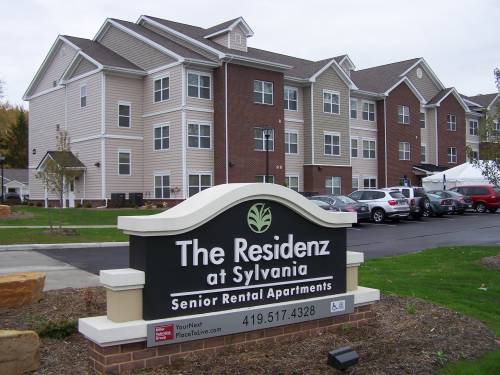
The Residenz of Sylvania is located on Percentum Road off Central Avenue. Toledo Free Press photo by Duane Ramsey.

Area seniors now have another option for affordable housing with the grand opening of The Residenz at Sylvania, celebrated Oct. 19 by residents and local officials with the developers, Miller-Valentine Group of Cincinnati and Preferred Properties Inc. of Toledo.

The Residenz at Sylvania, located off Central Avenue in Sylvania Township, is a new community of apartment homes designed for residents age 55 and older. The development provides high-quality housing for older adults who have limited or no affordable housing options, said David Liette, president of MV Residential Development.

The Residenz at Sylvania is located on Percentum Road off West Central Avenue in Sylvania Township. Toledo Free Press Photo by Duane Ramsey

“Quality affordable housing for seniors is more important today than ever before,” said Liette, who reported that 10,000 baby boomers reach the age of 55 daily in the United States.

The 51-unit residential development is the first property built in Sylvania Township specifically for residents age 55 and over to utilize Low Income Housing Tax Credits. The project was completed using the federally-funded, state-managed housing tax credit program.

Without the federal tax credit program, the rent would run from $1,500 to $2,000 per month but the units at The Residenz rent from $550 to $700 for residents who qualify, Liette said.

Sylvania and Sylvania Township didn’t have any affordable housing that would qualify for this program, said MV Developer Peter Schwiegeraht.

“We definitely need affordable housing in Sylvania Township. It’s a great project for people in this area,” said Sylvania Township Trustee Kevin Haddad.

The demand is high for affordable senior housing and the location is within walking distance of a drug store, supermarket and home improvement center, Liette said. All but three of the 51 units in the three-story complex are rented, he said.

Two residents of The Residenz spoke at the ceremony about how they came to live there.

Lyn Drake said she had to move out of her condominium due to having multiple sclerosis. Someone called her after seeing a sign about the project at the Giant Eagle store on West Central Avenue in front of the development.

James Fenwick, president of MV Property Management, said the company had a sign advertising the project at the site, but were not receiving many calls about it. Then they realized the sign was located on the road that was closed due to construction of the project.

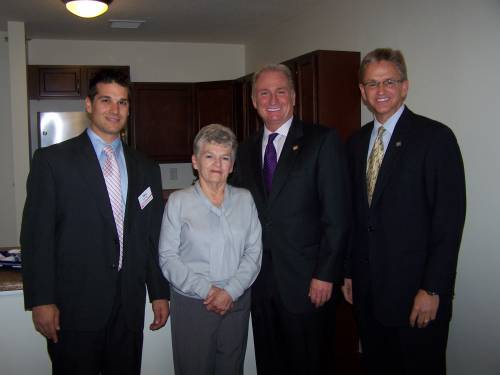
From left to right, Tony Feudi, store leader at Giant Eagle, resident Carole Ganzel, and James Fenwick and David Liette of Miller-Valentine Group. Toledo Free Press Photo by Duane Ramsey

When two local retailers, Giant Eagle and Lowe’s Home Improvement Center, heard about the dilemma, they offered to help market the project by putting signs for it on their property near Central Avenue. Fenwick said those “good neighbors” were responsible for informing many people who became residents.

“I’m so happy I found a new home here. It’s a great community where you have good relationships with your neighbors,” Drake said.

Carole Ganzel said her daughter, who lives in the area, called one day and said, “I think I’ve found a place for you to live.” Ganzel said that it’s a beautiful place to live and she has even seen deer on the property.

“We care about every resident and raising their quality of life,” Liette said at the grand opening.

“If you build it, they don’t necessarily have to come, but they have come here to this project that took a lot of collaboration and teamwork,” Fenwick said.

Miller-Valentine Group partnered with Preferred Properties, Ohio Capital Corporation for Housing, Ohio Housing Finance Agency, KeyBank and Sylvania Township to plan, finance, construct and now operate this $4.5 million project.

“It takes a lot of good partners to make a project like this happen. These are partnerships we need today,” said State Representative Barbara Sears, who supported the project.

Ohio Capital Corporation for Housing worked with Miller-Valentine and its partners to raise corporate equity to finance the project, reported Doug Klingensmith, vice president of development for the agency. KeyBank was the local lender for construction of the development.

“It’s always inspiring to see the final product of the projects which are tangible results of a tax program that works,” said Sean Thomas, director of planning and development for the Ohio Housing Finance Agency.

The agency allocated federal tax credits with federal and state funding for the partnership of federal, state and local governments and private partners on the project.

“The Residenz at Sylvania is the best community I’ve ever been involved in developing,” said Lew Ellis, executive director of Preferred Properties, who is retiring at the end of this year after 20 years of developing housing opportunities for adults with disabilities.

Ellis said Preferred Properties had an “excellent relationship with Miller-Valentine” developing more than 220 units of affordable housing in Northwest Ohio.

Miller-Valentine has been involved in developing, building, owning and operating multi-family real estate for more than 20 years.

The company built Oakwood Homes, a development of 80 4-bedroom single family homes for rent on Monroe Street in Toledo near the Toledo Art Museum.

The company also developed and built the Wauseon Senior Villas on the extension of Glenwood Avenue, one block south of Airport Highway in Wauseon. It has completed residential developments in the Northwest Ohio communities of Brian, Bucyrus, Delphos, Findlay, Lima, Mansfield, Marion, Napoleon, Van Wert, Walbridge, Whitehouse and Wapakoneta.

For more information about The Residenz, call 1-800-329-RENT or visit www.YourNextPLacetoLive.com.

Szyperski: Distracted living

0

My children are getting to an age where I can actually conceive of them growing up and going to school dances, graduating from high school, etc. Perhaps the grown-up activity of greatest concern for me in my children’s future, however, is driving. I’m holding out quite a bit of hope that driverless, accident-free cars will be the norm by 2019, but I’m also guessing that I’m hoping against hope.

My backup plan is to remember that my children are always watching me and to set a good example for driving with limited distractions. I’ve never texted while driving, but I’ve certainly wrangled a phone call or two … or 2,000. The day I realized that driving age isn’t so far away for my not-quite little ones, I stopped the on-the-road phone calls and instead started an on-the-road conversation about the importance of being a safe driver.

Whenever my text alert beeps while we’re on the road, I tell my kids how important it is for me to let it wait until I get where I’m going or pull over if need be. It wasn’t long before they started interjecting the same commentary each time we hear that oh-so-familiar beep-beep-beep-beep. I’m still working on limiting the distraction of my children arguing with one another or our 65-pound dog trying to crawl into my lap while driving to and fro, however.

I have all but given up on limiting the distractions encompassing the rest of my life. They include, but are not limited to:

Distracted showering. After years of little legs suddenly breeching the only 3-foot-by 3-foot space in our house that I can attempt to claim as my own, I finally started to lock the door when the kids were old enough to be out of sight for more than five minutes without complete and utter chaos ensuing. The barrier to my fortress has done little, unfortunately, to prevent screaming, knocking and constant demands to know “What are you doing in there?!” If you’re wondering, the answer is “hiding.”

Distracted sleeping. It’s no secret that we are not a house of good sleepers. My children and pets have conspired to produce a distraction-filled third shift schedule so elaborate that mammoth, round-the-clock employers like WalMart and Disney would surely envy its mastery. Bad dreams, bed wetting, thirsty spells, sleepwalking, bed switching, croupy coughs, insistent meowing, incessant kicking, wet noses (usually canine or feline) and random yelping, to name a few, have all added up to no sleeping through the night approximately 365 days per year for the past 10 years. On the rare, hiccup-free night I still wake up, usually about 3 a.m., to check on them all out of habit anyway.

Distracted while phoning. Being distracted on the phone is twofold. As the story goes, children will ignore you in all sorts of ways until the moment they see you with a phone up to your ear. All of a sudden your status within the household moves from insignificant fixture to person of dire consequence. You are needed. By everyone. Right now. If you’re somehow able to fend off your sudden admirers and continue with your call, children will resort to Plan B: Forget trying to be distracting and use mom being distracted to get away with something. Plan B works wonders if the phone conversation is engrossing enough, as I once unwittingly opened eight containers of Play-Doh without completely realizing it until I hung up and saw the aftermath.

Distracted pop culture consumption. In addition to listening to more boy bands than I’d like, when asked about my favorite TV show I might answer “iCarly” for lack of a better option. I thought finally having a DVR might change my child-focused pop culture reality. After trying to watch the same “Project Runway” episode five or six times, however, I finally gave up and accepted my fate. I really do want to consume entertainment for grown ups, but the lack of privacy, sleep and uninterrupted contact with other adults seem to have worn me down, which hinders me from fighting for such things.

I admit that it was a struggle to change my car routine in order to show my children there is a time and place to remain distraction-free. It helps to realize, though, that one on-the-road text or call, either by me today or by one of my children a few years down the road, could suddenly put an end to all of the other little distractions I encounter on a daily basis.

The thought of such an end also does wonders for making distracted living much more tolerable.


Shannon and her husband, Michael, are raising three children in Sylvania. 

Forecaster: Economic recovery hampered by bad policies

0
Ken Mayland of ClearView Economics

Imagine a baseball team on which all batters must wear a patch over one eye, all pitchers must throw with their opposite hand, all baserunners must hop rather than run and all fielders must wear their gloves backward.

Economist Ken Mayland, president of ClearView Economics, used that analogy during an Oct. 23 presentation in Toledo to illustrate how the recovery of the U.S. economy has been hampered by bad policies.

“How would you expect that economy to perform? You’d probably say it’s going to underperform what its true potential is,” Mayland said. “Bad policymaking is hobbling business and tampering growth. If the policies don’t change, why would you expect the results to change?”

Mayland, who spoke at KeyBank’s annual economic forecast breakfast at The Toledo Club, has spent more than 35 years studying the business cycle and is one of the nation’s leading experts in economic forecasting.

During his presentation, “What Emerging Data Reveals About America’s Future,” Mayland reviewed economic events of the past 70 years and explained what they can teach us about our present economic situation.

“If you line up the current tracking of this economic recession and recovery to date with the tracking of the four previous recession episodes — two of which were mild recessions and two of which were very deep — it’s quite apparent we are severely underperforming any kind of recovery we’ve seen in the past,” Mayland said.

Economic recovery has been slow because of poor government leadership under multiple administrations, especially on regulatory policies for housing, energy, taxing and spending, health care, labor relations, the environment and more, Mayland said.

“It’s the whole panoply of government policies that’s creating all kinds of stumbling blocks and drags to growth,” Mayland said. “We are still living with the legacies of bad policies of the past; that’s constraining growth today.”

Traditional fiscal policy levers have been “maxed out” and are no longer effective, Mayland said. The key now is sensible regulation, not oppressive regulation.

“These regulations have created a great deal of uncertainty about the future and they are clearly increasing costs, and those are [job] killers,”  Mayland said. “I would roll back Sarbanes-Oxley, Dodd-Frank, regulations that create a lot of spinning of the wheels, a lot of compliance cost, but produce very little good for the country.”

Mayland said he also disagrees with the Federal Reserve keeping the interest rate at zero and adding monthly mortgage securities.

“We’re punishing savers, people trying to do the right thing,” Mayland said. “We are rewarding them with zero, or near-zero returns. When we count in inflation, we are giving them losses of purchasing power. It’s counterproductive.”

Mayland also advocated energy independence and implementing a flat tax system.

Election

This year’s presidential race is one of the most divisive and critical in recent memory, Mayland said.

“I don’t know of any election where the differences were so starkly different as this,” he said. “We’re going to go one path or another.”

Historically, if economic growth exceeds 3 percent in the year preceding a presidential election, the incumbent or incumbent party has won, Mayland said.

“This economy ahead of this election will not come close to 3 percent growth,” Mayland said. “If the economy has a vote — and this has been a very strong pattern in past presidential elections — Obama is going to have a very tough road of it for his re-election bid.”

History

To lay the framework for his conclusions, Mayland reviewed the U.S. economic situation of each decade, starting at the end of World War II, from which the U.S. emerged with “an enormous amount” of debt, nearly 25 percent of the gross domestic product (GDP). Deficit accumulations raised the debt-to-GDP ratio to about 120 percent, higher than it is today, but by 1960, the ratio was down to 60 percent, Mayland said.

“Which raises the question, ퟀ�?How’d you do that? How’d you fix that situation?’ Obviously that question has relevance to the deficit and debt situation today,” Mayland said.

The ratio was not reduced by creating surpluses, although there were a few surplus years in the 1950s, Mayland said. The more important factors were maintaining “not spectacular, but good, solid growth” of 3.3 percent per year on average during the 1950s and keeping the growth of federal spending to under 4 percent per year, Mayland said.

“The lesson to be drawn from this period — and, by the way, we did exactly the same thing over the course of the ’90s — is the way to remedy big deficits is with good economic growth, austerity, discipline and patience,” Mayland said. “Put that policy into place, let it run and, over time, you will fix the problem.”

The 1960s were largely prosperous, with nearly full employment by the end of the decade, but then Vietnam War buildup and defense spending put pressure on the economy, Mayland said.

The inflation rate rose from 1 percent to 5 percent, prompting President Richard Nixon to implement wage and price controls — which never work, Mayland said. In 1973, the U.S. was blindsided by the tripling of oil prices. That pressure, along with the stress of coming off wage and price controls, drove the inflation rate to 12 percent.

“There was a kind of smugness in the economics community that, boy, we did such a good job managing the economy in the ’60s, we can tweak the economy, pull the levers,” Mayland said. “There was a sense that we can  squeeze a little more growth out of this economy by being willing to accept a little bit higher inflation. … What we ultimately found was there is no long-term trade-off between growth and inflation. When you try to put these measures in place, all you ultimately get is higher inflation.”

As inflation rates continued to rise, confidence in the economy dropped, measured by a steep decline in the value of the dollar and the rise of interest rates.

“When that prime rate was 21.5 percent, you had no sense that the rate was going to stop there,” Mayland said. “Is it going to be 30 percent next quarter, next year? There was really a loss of confidence and some real fear about the economy.”

Paul Volcker, chairman of the Federal Reserve from 1979-87, resolved the inflation problem by “clamping down on the money supply,” which contributed to high interest rates in the short term, but dropped inflation to below 4 percent by the early 1980s, Mayland said.

“He accomplished what he achieved, but with great pain,” Mayland said. “We went through two recessions over that period and we saw the unemployment rate rise ultimately in 1982 to 10.8 percent, which is higher than the unemployment rate rose in this most recent episode of recession. On top of that we suffered from sky-high inflation rates and sky-high interest rates, so there’s a case that this period was just as bad as what we recently experienced.”

Today

Today, the U.S. is experiencing a poor economy along with “eye-popping deficits,” Mayland said.

“We’ve now seen nine of 10 quarters come in under 3 percent growth, which is the average growth rate we’ve seen over the last 50 or 60 years,” Mayland said.

Consumer spending comprises 70 percent of the economy, but growth in disposable income, the main driver for consumer spending, has been slow and people don’t have money to spend, Mayland said. Jobs are being recovered, but at a slower rate than Mayland feels is acceptable. Wage growth has been under 2 percent while the inflation rate is 2 percent or more.

“Wage growth is not even covering the loss of purchasing power due to inflation,” Mayland said. “How can you expect consumer spending to grow? When you understand that arithmetic, you can see why the growth of the economy is constrained.”

Good companies will always find a way to survive, if not thrive, Mayland said. Segments of the economy that are recovering well include the auto industry, the aerospace industry and the fuel drilling industry, all of which impact Ohio, he said.

Mayland also briefly addressed the economic situation in Greece and Spain, which is calm for the moment, but he doesn’t expect that to last.

“We’re going to see more problems come out of Europe and when we do they are going to rock the financial markets,” Mayland said. “We can’t control what’s going on in Europe. The only question is, can we do something with creating good policies here in this country to help us decouple from them? In other words, create such a strong dynamic here that it doesn’t matter so much what’s going on in Europe.”

Mayland said he is ultimately optimistic about the U.S. economic recovery.

“Is this sluggish growth, this 2 percent growth, the new normal for our economy?” Mayland said. “I refuse to accept that.”

Jim Hoffman, president of KeyBank’s Michigan/Northwest Ohio district, said Mayland’s presentation was insightful.

“It just helps everyone focus on how important this election is going to be and probably the different paths our economy can follow based on the election,” Hoffman said. “The other thing I thought it did is it focused on the steady but very slow growth that we’re having in our economy, and that’s why people are not feeling like things are very robust. It’s not bad; it’s just not good enough for people to really thrive.”