Home Blog Page 240

‘Star Wars’ writer says Disney will respect franchise

0

In the wake of The Walt Disney Co.’s announcement of its purchase of Lucasfilm for a smidge over $4 billion, it’s not just “Star Wars” fans who are putting their trust in the Force — it’s also those creators who make their living shaping that galaxy far, far away.

Freelance writer Jeremy Barlow, author of several “Star Wars” projects at Dark Horse Comics as well as “Mass Effect” tie-ins, exhibited “complete shock” when he first heard the news, but swiftly realized the deal’s potential and profitability.

“I did not see it coming, but it makes sense, really,” he insists. “Overall, it’s a good thing for the franchise — Disney will respect the brand and inject some new life into it. As a fan, I’m excited to see what they do with it.”

Barlow’s a pragmatic fellow, able to look at the Disney purchase in a cold light as well as by the flickering embers that burn in the heart of all devotees to George Lucas’ little 35-year-old rebellion.

“This is Disney’s game to lose,” he said. “There’s a segment of ‘Star Wars’ fans that put ‘Star Wars’ expanded universe timelines and continuity ahead of story, and those guys might have a rough road ahead, but I’d hope that some good films will ease that pain. Because, really, what are we talking about here? The —OK, very slight — possibility of Brad Bird or Andrew Stanton or Matthew Vaughn writing and directing a ‘Star Wars’ movie? I’ll be first in line.”

Is Barlow concerned that a portion of his bread and butter — ‘Star Wars’ comics — may make the jump to light speed and leave Dark Horse?

“That’s the other shoe still to drop, isn’t it?” he said. “Dark Horse has put so much care and thought into the ‘Star Wars’ comics that I can’t see anyone else doing that job at the same level. So I hope they keep the license. What’s right and what’s profitable seldom cross in the corporate world, though, and Disney does already own their own comics publisher. We can only wait and see.”

Lights to shine at Frankie’s Inner City on Nov. 12, 2012.

0
Electro-rocker Light performs Nov. 13 at Frankie's Inner City, Photo courtesy Perpetual Media Relations.

Electro-rocker Lights was flying high when she found inspiration for the title track of her 2011 disc, “Siberia.”

“That was one of the first songs written with [electronic band] Holy F*** after we jammed,” she recalled. “This really cool kind of pulsating, distorted sound came out, and I took it home and started writing to it. I tried to come up with lyrics and nothing would work, and I knew the track was something special.

“And I was actually flying into Denver, when I was landing I was trying to work on lyrics, and it was all just snow. And it reminded me of the way Siberia looked, and I remembered the man who’s my husband now said we could be happy no matter where we are; we could be in Siberia.

“And I thought, man, that means so much because that is truly what the best part of life is: How you can be anywhere but as long as you’re with the right people, you’re in the right place.”

The Canadian singer-songwriter found herself ready to change things up on this disc.

“I was ready to evolve,” she said during a call before a show in Calgary, Alberta. “When you have one record out and you’ve had your entire life to make that, it’s a very challenging thing to find your way to the next record.”

So Lights collaborated with HolyF*** and rapper Shad.

“The first record (2009’s ‘The Listening’) was kind of like me getting stuff off my chest and talking about things I was going through, and the second record is a bit more of a visual escape and a bit more carefree in terms of the content,” she said.

Consider the catchy single, “Toes.”

“I always like to make sure the lyrics have meaning because music is such a powerful thing, and why not move people if you can? So I thought: What’s the most exciting situation you can be in with your job or with a person? It’s anticipation, it’s looking forward to something. And that’s when you know there’s something special in your life, when it keeps you excited.”

She captured attention north of the border with a 2008 self-titled EP that featured “Drive My Soul.” In 2009, she won the JUNO Award for New Artist of the Year.

“I had this little EP out, we were touring around in this old, junky van, playing to 30 people, and I got a text saying that you were nominated for a JUNO, and I thought, ‘Wow, that’s super unexpected.’ And then to win on top of that was amazing,” she said. “It’s nice to know your country’s got your back.”

Lights will play at Frankie’s Inner City Nov. 13, 2912. Arkells will open. Tickets are $13 in advance and $15 the night of the concert. Doors open at 7 p.m.

“I like to write something that cantake people away for a little bit and they don’t leave heavier than when they came in,” Lights said. “I want it to be a bit freeing, a cheap vacation.

“The reason we like so much art is because it takes us out of real life for a minute, and that’s exactly what I try to do.”

Corporate giving, employee volunteerism growing

0
Don Rettig indicates some of the recognition Owens Corning employees have received for volunteering. Toledo Free Press photo by Duane Ramsey.

Corporate giving and employee volunteerism is on the rise in the Toledo area as more firms develop strategies to involve their employees in activities that benefit their communities.

That was the message of a presentation, “How corporations determine where to give and how it can parlay to individual giving,” given at the EPIC Toledo Summit on Nov. 1 by two major corporate givers in the Toledo area.

Julie Payeff, community commitment manager at The Andersons, and Don Rettig, director of community relations at Owens Corning, emphasized that both companies have strategies to get more employees involved in volunteering their time and talent in their communities.

Payeff and Rettig said their companies have many employees who are active members of EPIC. Payeff said The Andersons encourages its employees to get involved because EPIC helps to build leadership skills.

Many companies are putting more focus on community involvement, said Kim Sidwell, senior vice president of resource development for United Way of Greater Toledo.

“A trend we’re seeing is that more corporations are becoming much more intentional in how they employ their resources and more innovative about how they support community organizations,” Sidwell said.

Owens Corning employs about 15,000 people in 28 countries on five continents with about 900 employees at its world headquarters in Toledo.

“It’s important for a company to have a strategy for corporate giving. We want to have a presence in Toledo, but we’re a world company so we’re expanding what we do globally,” Rettig said.

The company focuses on building relationships with organizations that fit the company’s business, such as those providing safe, efficient housing and critical-need shelters that include disaster relief and community centers, Rettig said.

The company supports Habitat for Humanity and HomeAid, a national nonprofit provider of housing for the homeless. Owens Corning has helped HomeAid rehab six shelters for women and children in the U.S. and has helped Habitat for Humanity build nine homes in the Toledo area, as well as homes in Denver, Kansas City, Kan., and Jacksonville, Fla.

The company donates roofing materials and insulation for those homes and has 30-40 employees involved in each of the projects.“Employee volunteerism, that’s our sweet spot,” Rettig said.

The company has also adopted neighborhood centers, such as the Friendly Center in North Toledo. More than 700 people attended a fall festival at the local center sponsored by Owens Corning with the involvement of 45 employees and family members.

Owens Corning also recently hosted a vendor supplier golf outing with participants invited from its global customer base. The event raised $312,000 to benefit the United Way, up from $200,000 raised two years ago, Sidwell said.

The Andersons, which has more than 3,000 employees in more than 70 locations across the U.S., has local charities it encourages its employees to support through volunteerism each year, including the United Way, Junior Achievement, American Red Cross and Queen of Apostles, a Catholic charity and mission organization.

“Our spirit of giving is to give a little bit to many organizations in the community with a variety of charities for our employees to get involved in,” Payeff said.

Both Owens Corning and The Andersons encourage employees to serve on local boards.

Board membership is a great way for employees to contribute their time and talent to nonprofit organizations, enhancing quality of life in the community as well as their own personal and professional development, Payeff said.

In September, 42 companies provided 1,500 employee volunteers who contributed 5,600 hours to 65 community projects with various nonprofit organizations during the Week of Caring conducted by the Volunteer Center at the United Way of Greater Toledo.

“Companies want to see collaboration with organizations working together with measurable outcomes,” Sidwell said.

Revenue for the United Way comesfrom corporate and employee giving,comprising 21.7 percent and 56 per-cent respectively. Another 16 percent comes from grants and individual gifts outside the workplace with the balance from bequests, special events and sponsorships, Sidwell said.

Last year, the United Way raised$13.6 million with its annual fundraising campaign, and has a goal of $13.8 million this year as announced at its kickoff in September.

The campaign is starting to wrap up but no total figures are available yet.

In the past, Owens-Illinois has led with its combination of corporate and employee contributions to the United Way, but it has not yet completed its drive. The company matches any do-nations up to $500 dollar for dollar and any above $500 by 125 percent.

Owens Corning recently wrapped up its United Way campaign, with employees contributing $337,544.

Employees at The Andersons donated $333,500 for the local campaign. The Andersons also lends corporate support of $175,000 for the United Way’s overall campaign to “help graduate kids,” Sidwell said.

The United Way also partners with companies and organizations to hold Day of Caring events year-round to get more companies and individuals involved with community groups.

Owens Community College participated in its first Day of Caring event Sept. 14. The project benefited the Family House in Toledo and Otterbein Skilled Nursing & Rehab Neighborhood in Perrysburg. Owens allowed time for faculty and staff to serve alongside students with a total of 60 people involved in that event.

Bacik says Gandhi’s teachings still relevant

0
The Rev. James Bacik

To put Mahatma Gandhi’s teachings on nonviolence into practice, it is best to study the root causes of violence, the Rev. James J. Bacik said in a Nov. 4 lecture at the University of Toledo.

In the sixth annual Gandhi Lecture for Peace and Nonviolence, Bacik told the crowd of 250 in McQuade Law School Auditorium on Sunday (Nov.4) that human nature, selfish desire and sociopolitical oppression are key factors that lead to violence.

The retired Toledo Catholic priest, a theologian, author and scholar who now teaches at Catholic Theological Union in Chicago, also said Gandhi stressed the need for interreligious dialogue and participation in nonviolent resistance as means of countering the causes of violence and enacting change.

In opening his hour-long lecture, Bacik, as usual forsaking a clerical collar for sport coat and tie and speaking fluidly without notes, said French philosopher René Girard recognized that “mimetic desire,” in which a person wants something that another possesses, is a leading cause of violence.

“It’s like the story of little kids in a room playing with toys. There’s a bunch of toys, but if another little kid walks in he’s going to want the toy that that kid’s playing with,” Bacik said.

Of interest to Gandhian philosophy, he said, is that people who desire someone else’s possessions often create scapegoats on whom to blame their problems. Understanding this tendency helps in the quest for peacemaking, Bacik said.

He said Gandhi, who was born in Gujarat, India, on Oct. 2, 1869, and assassinated by a Hindu extremist in Delhi on Jan. 30, 1948, sought self-realization, which is integral to Eastern culture, rather than the quest for self-fulfillment that drives much of Western society.

“He was introspective. He tried to understand what made him tick,” Bacik said.

Gandhi fasted and prayed diligently, and in his 30s took a vow of chastity (without first consulting his wife) in hopes that mortifying the flesh would give him more strength for peace and justice.

Another important lesson from Gandhi is “to see the commonness of the human situation,” Bacik said. Everyone is at fault in some way or another, and it is dangerous when one group considers itself superior to others. Such an attitude can lead to dehumanization, discrimination and even genocide, he said.

He said Catholic teaching holds that “salvation is open to all people, not just a few,” as long as people “follow their conscience.”Such a belief erases any sense of superiority.

Recognizing that socioeconomic oppression is another major cause of violence, Gandhi sought to end India’s social caste system, Bacik said.

He said that if he were to be reincarnated he wanted to come back as an untouchable — India’s lowest social class. He sought to bring Muslims and Hindus together for dialogue, but because those efforts failed and the rift between the groups was not healed, Gandhi refused to join in celebration of India’s independence in 1947.

During a question-and-answer session, Bacik was asked if he thought the Catholic church would ever make Gandhi a saint.

“Not under the present pontiff,” Bacik replied. But he said that in the early church, before formal canonization, holy people were made saints “by acclamation,” and by that standard Gandhi “already is a saint for many people.”

When someone asked about Gandhi’s teachings on marriage, Bacik said the Indian leader “was not a good guide on marriage.” He was patriarchal to his wife, whom he married through an arranged marriage, and took a vow of chastity without even talking to her about it, he said.

David Yonke is the editor and community manager of Toledo Faith & Values (ToledoFAVS.com), a website that provides in-depth, nonsectarian news coverage of religion, faith and spirituality in the Toledo area.

From Obama to Kaptur, from Sears to Gerken, voters retain incumbents

0
President Barack Obama visited Bowling Green Sept. 26, 2012, one of several visits to Northwest Ohio. Toledo Free Press photo by Joseph Herr.

President Obama emerged victorious over Mitt Romney in an election that saw Ohio and its 18 electoral votes heavily courted with political ads and candidate visits.

In Lucas County, Obama won 64 percent of the votes to Romney’s 34 percent. Gary Johnson, the Libertarian candidate, earned 1 percent in Lucas County. All numbers are according to unofficial results from Lucas County Board of Elections and Secretary of State’s Office.

U.S. Senate

In another race driven by ads, Sen. Sherrod Brown triumphed over Treasurer Josh Mandel in the contest for U.S.Senate. Democrat Brown retained his seat with 50 percent of the votes statewide compared to Republican Mandel’s 45 percent. Independent Scott Rupert won about 5 percent of the votes.

Rupert said of his $6,000 campaign, “I would say our campaign got the most bang for the buck … we spent about a nickel a vote. Now people will know who I am so we’ll have more success in the future. What I’m trying to accomplish needs to be done.”

U.S. House

In the race to represent the redrawn District 9, U.S. Rep. Marcy Kaptur won about 73 percent of the votes. Republican Samuel Wurzelbacher earned about 23 percent. Libertarian Sean Stipe received about 4 percent.

Kaptur has served 30 years in the House and was recently appointed to the House Appropriations Committee. After winning the primary in March, Kaptur said of her district,which now includes Toledo and parts of Cleveland, “This is a powerhouse of a district — they’ve given us the crown jewels of Ohio.”

Wurzelbacher, who received his famous nickname in the 2008 election, said he decided to run because he was“disgusted” with the state of Congress. He said that poor voter turnout among conservatives may have been why he and Romney lost. In Ohio, officials reported that overall turnout was about 68 percent, compared to 70 percent in 2008.

“It’s gonna be a rough next couple years and we have ourselves to blame because we settled for the status quo,” Wurzelbacher said of the 2012 results. He plans to continue his work with Alaska’s Healing Hearts, which provides outdoor activities to help veterans with social reintegration.

Wurzelbacher also said he will continue to speak out on replacing the country’s tax system and did not rule out a future run for office.

“You’re supposed to say ‘Never say never.’ Right now, it’s the furthest thing from my mind, but we’ll see what happens in the future,” he said.

In the contest for District 5, U.S.Rep. Bob Latta had about 57 percent of votes while Democrat Angela Zimmann had 39 percent. Libertarian Eric Eberly received about 3 percent.

Latta, now in his third term, said,“I’m very, very humbled to once again be able to serve the people of the 5th Congressional District. It’s the greatest honor and privilege that I can have.”

Zimmann, pastor of Trinity Evangelical Lutheran Church in America in Riga, Mich., said, “It was an amazing race and we had fantastic support from so many people. I actually had a lovely conversation with Bob Latta tonight [Nov. 6] and told him I will be wishing him the best.”

Zimmann added that she is looking forward to seeing the results of the provisional ballots in Lucas County where votes were close.

State representatives

In the race to represent the redrawn 47th District, state Rep. Barbara Sears, currently serving her second term, received 60 percent of the votes over Democrat Jeff Bunck, a retired teacher, who took 40 percent.

“I’m thrilled. I’m absolutely ec-static with the support and feel an overwhelming amount of responsibility to appreciate the support everyone has given me in my race,” Sears said.

“Extending into new territory with Fulton County brings with it a lot of responsibility to learn, appreciate and understand a lot of new area.”

State Rep. Matt Szollosi received 65 percent of the votes against Republican Dave Kissinger, regional vice president at maxIT Healthcare, who earned 35 percent in the contest for District 46.

“I’m very pleased with the results and very humbled by the strong showing of support from the voters in the 46th District,” Szollosi said. “You can’t take on this kind of effort and campaigning without strong support from family and friends and we had a lot of people out there helping with the campaign. It was a hard-fought election and I’m just very humbled with the result.”

Kissinger said, “We’re obviously saddened by the loss, but we will live to fight again. It was a long campaign. We fought hard and we had a lot of support from great volunteers. We certainly appreciate all their hard work and contributions and assistanc ein helping us get to this point.”

County Commissioners

Lucas County Commissioner Pete Gerken won 67 percent of the votes versus Republican John Marshall’s 33 percent.

“I’m grateful to the people of Lucas County for giving me the opportunity to serve them for four more years,” Gerken said. “We came out of the worst four years and I think we showed our common sense and resilience. I thank our voters, our employees and our people that we give services to for their trust. It’s been a tough road, but we’re around the corner.”

In the other commissioner’s race, Commissioner Tina Skeldon Wozniak earned 62 percent of the votes to Brent McCormack’s 25 percent and Kevin Haddad’s 13 percent.

“It’s just a complete honor to serve the citizens of Lucas County and I can’t wait to continue to work hard with everyone to solve our community’s challenges,” Wozniak said.

McCormack said, “I made it a real focus to be out there and touch base with citizens on a personal level, not just put up a sign every five feet, and I think that really hit it off. I know I have support now and this absolutely will not be the last you see of me. Maybe not for county commissioner, but I plan on running again very soon.”

Lucas County Recorder

City Councilman Phil Copeland garnered 56 percent of the votes in the race for county recorder over fellow Councilman George Sarantou, who had about 44 percent.

“The voters have spoken. I respect that and we did the best we could,” said Sarantou, who has a year left on Council but is term-limited after that. He said he has not thought about what his next step will be after his term is up.

Levies

This year, seven tax levies were presented to Toledo voters, who chose not to support three of them.

The Toledo Public Schools’ (TPS) 4.9-mill levy failed to pass with about 52 percent against it.

“I’m disappointed … on the other side, I saw how close the numbers were. I can see we are making up some ground,” said Lisa Sobecki, president of the TPS Board of Education. In November 2010, voters rejected a 7.8-mill levy for TPS.

Imagination Station’s 0.17-mill tax levy failed with 50.28 percent of votes against the levy.

The City of Toledo Parks and Recreation 1-mill levy also failed, with about 54 percent of votes against it.

“We respect the will of the voters and we’re going to continue to work to come up with creative funding solutions for parks and recreations,” said Councilwoman Lindsay Webb, who supported the levy.

As of now, Webb does not know what will be cut. She is waiting for the mayor’s budget, which is due Nov. 15.

The Toledo-Lucas County Public Library 2.9-mill levy passed with about 66 percent of voters in its favor.

“It kind of demonstrates to us and to the community at large that people really see public value to public libraries,” Media Relations Coordinator Rhonda Sewell said.

The Metroparks’ 0.9-mill levy had 55 percent of votes in favor of the levy.

“We’re obviously thrilled with the outcome,” Director of Public Relations Scott Carpenter said. “It’s exciting and at the same time humbling.”

The money will be used mainly for major maintenance and capital improvement in the Metroparks system.

The Lucas County Mental Health& Recovery Services 1-mill levy passed narrowly, with 51 percent of votes for the levy.

“First of all, we need to thank the voters for their support,” Executive Director Scott Sylak said. “Our campaign was always about the best interest of our clients.”

The levy funds will go toward re-storing access to treatment, medication and housing, he said.

The Lucas County Children Services’ 1.85-mill levy passed with about 55 percent of the votes in favor of the levy.

“We are very happy that Lucas County voters have once again shown their commitment to our county’s most vulnerable citizens,” Public In-formation Officer Julie Malkin said.

Other candidate races

✯State Rep. Randy Gardner earned 59 percent of votes in his bid to returnto the Ohio Senate against Democrat Jeff Bretz, who earned 41 percent.

✯J. Bernie Quilter, Clerk of the Court of Common Pleas, earned 69 percent of the vote over Constantine Stamos with about 31 percent.

✯Common Pleas Judge Myron Duhart earned 51 percent of votes in the race to keep his seat versus Kenneth Phillips, who earned 49 percent.

✯Lucas County Treasurer Wade Kapszukiewicz garnered 71 percent of the votes over Norm Witzler, who had 29 percent.


BBB Torch Awards honor ethics in area businesses

0

The Better Business Bureau (BBB) announced the winners of its annual Torch Awards during a Nov. 1 luncheon in Perrysburg.

The Torch Awards honor area businesses that demonstrate the highest standards of business ethics and conduct. A panel of judges, consisting of volunteer community leaders, chose winners in five categories: small business (1-9 employees), medium business (10-49 employees), large business(50-149 employees), extra-large business (150-plus employees) and non-profit.

More than 100 nominations were received.

Also awarded during the ceremony were two $500 Jim Smythe Memorial Student of Integrity Scholarships, presented to area high school seniors to further their education.

Small business: Gillette Roofing

Residential roofing contractor Gillette Roofing, 1774 Sudbury Drive, in Holland, has been in business for 32 years and operates under the mantra “Make and keep customers happy.”

Whether it’s owner David Gillette personally inspecting the repair of a damaged driveway, advising potential customers during a consultation that their roof doesn’t yet need to be replaced or returning an over payment for services, the company strives to maintain honesty, integrity and moral business practices in all interactions, whether with customers, employees or business associates.

Gillette Roofing regularly donates many hours of labor to local families in need, as well as to nonprofits such as Habitat for Humanity and Sunshine, formerly Sunshine Children’s Home.

For more information, visit www.gilletteroofingllc.com.

Medium business: Earl Bros. Transmission & Auto Repair

Family-owned and operated for four generations, Earl Bros. Transmission & Auto Repair has served Northwest Ohio customers since 1933. With seven locations in Toledo, Maumee, Fremont and Bowling Green, Earl Bros. handles everything from oil changes to emergency repairs and strives to go above and beyond to meet each customer’s needs.

“We are very modest and view our ethics as common practice, an everyday occurrence, something that has been part of our upbringing,” wrote Robert D.Earl as part of the BBB Torch Award entry form. The company is committed to supporting other local businesses, buying most of its parts locally and outsourcing services to local companies when needed. The company also regularly supports local events ando rganizations, such as the Lagrange Street Polish Festival, Make-A-Wish Foundation, the YMCA and more.

For more information, visit www.earlbros.com.

Large business: Edgewood Manor Nursing Center

Edgewood Manor Nursing Center, 1330 S. Fulton St., in Port Clinton, is an award-winning skilled nursing and rehabilitation center offering residential, respite and outpatient care.

Services include physical, occupational and speech therapies, respiratory and restorative programs and wound care. For 30 years, the company has been committed to excellence and to providing prompt, ethical, compassionate interactions with its residents, patients, family members and employees.

“From the time I enter the front door, I am greeted with warm smiles and several friendly acknowledgments of my presence,” wrote a regular visitor in the Torch Award entry form. “It is nice to watch the residents stop and talk to the receptionist and the business office staff as if they have been friends for years.”

The company regularly supports local community groups, including Port Clinton High School, United Way in Ottawa County, American Cancer Society and more.

For more information, visit the web site www.edgewoodmanornursingcenter.com.

Extra-large business:Huntington National Bank

Founded in 1866, Huntington National Bank provides full-service commercial, small business and consumer banking services; mortgage banking services; treasury management and foreign exchange services; equipment leasing; wealth management services and more.

Headquartered in Columbus, the bank has more than 690 branches in Ohio, Michigan, Pennsylvania, Indiana, West Virginia and Kentucky.

Huntington prides itself on its core value of continuous improvement, including regularly evaluating customer needs and introducing new programs and services that meet those needs. Huntington provides financial education to local school districts and nonprofit organizations and regularly partners with a variety of local charitable organizations.

For more information, visit www.huntington.com.

Nonprofit: American Red Cross of Northwest Ohio/Kidney Foundation of Northwest Ohio (Tie)

The American Red Cross of Northwest Ohio, 3100 W. Central Ave., in Toledo, is dedicated to providing services to those in need.

Known around the world as a respected humanitarian organization, the Red Cross provides relief to victims of disaster and helps people prevent, prepare for and respond to emergencies.

Additionally, the American Red Cross provides support to individuals serving in the armed forces and their families, including emergency communication services, counseling programs and family support groups.

The organization is committed to maintaining the highest standards of performance, ethics, integrity and workplace conduct.

For more information, visit the web site www.redcrosstoledo.org.

The Kidney Foundation of Northwest Ohio, 3100 W. Central Ave., Suite 250, in Toledo, is the area’s leading advocacy and support system for individuals living with chronic kidney disease.

Founded in 1966, the nonprofit strives to empower those living with kidney disease to fight the disease as well as enhance their quality of life by easing emotional and financial burdens.

The organization also aims to increase public awareness of the risks and consequences of kidney disease, with the hope of preventing disease development.

The nonprofit serves 12,000 people per year in 20 area counties through patient services and educational outreach. For more information, visit the web site kfnwo.org.

Election 2012: Witzler challenges Treasurer Kapszukiewicz

0

Lucas County voters will decide Nov. 6 whether Democrat Wade Kapszukiewicz will return to the treasurer’s office for a third term or if Norm Witzler, a Republican who previously served on Waterville City Council,will replace him.

Kapszukiewicz said he’s proud of his record as a treasurer who looks beyond balancing the books and tries to use the resources of the office to move Lucas County forward.

Witzler said he’d like to change a few things about the way the office operates and also described himself as a responsive leader who, while on City Council, made a point of answering every letter and phone call he received.

Wade Kapszukiewicz

Kapszukiewicz won his first election at 23, when he was elected to the board of the Lucas County Educational Service Center, now called The Educational Service Center of Lake Erie West.

He was elected to Toledo City Council in 1999, then re-elected in 2001 and 2003.He attributes his desire to seek public office to the Rev. Tim O’Brien, a professor he met while pursuing his bachelor’s degree from Marquette University in Milwaukee.

“He came from the social justice wing of the Catholic church,” Kapszukiewicz said of O’Brien, whom he called the most important influence on his professional life.

Kapszukiewicz has a bachelor’s degree in journalism and political science from Marquette and a master’s degree in public policy from the University of Michigan.

When he decided to run for treasurer in 2004, Kapszukiewicz said, “I was attracted to the ability to use the treasurer’s office to help move the county forward.”

Kapszukiewicz said he tries to be more than just a “bean counter.”

“Don’t worry, rest assured, all the beans are counted,” he said, “But at the end of the day, if that’s all I did I’d be doing the community a disservice.”

He cited his office’s decision to purchase $18 million in bonds to help finance the Huntington Center and the creation of a $5 million loan program for small businesses that he said has allowed 38 employers to create or retain 375 jobs. Any income that may have been lost by lending that money to businesses at low interest, instead of keeping it in the county’s stock portfolio, is more than made up by the positive economic benefit from those businesses’ operations, he said.

Kapszukiewicz said he sees those decisions as sound financial investments, but, “more than that, I see them as investments in the quality of life for Lucas County citizens.”

The incumbent said he’s most proud of his work with a coalition of other county treasurers to pass legislation establishing a funding stream for the Lucas County Land Bank and speeding up the process by which the Land Bank acquires vacant tax-foreclosed properties. Close to 700 properties have been acquired by the Land Bank with the goal of either rehabilitating or demolishing them to stop the erosion of property values in Toledo, he said.

Norm Witzler

A lifetime resident of Lucas County, Witzler said that although he’s not the incumbent, he still brings plenty of financial acumen to the race, gathered through formal education and through his experience over the years.

Witzler went to Bowling Green State University for two years to study accounting, then spent another semester at the University of Toledo before deciding to begin a building trades apprenticeship instead.

He was employed as a plumber from 1968-84 and later worked for Chrysler. For the past five years, he has worked at a Home Depot store in Toledo.

Witzler served three four-year terms on the Waterville City Council, being elected in 1992, 1996 and 2000. He said he wanted to be a voice for people in Waterville, and made a point of responding when people contacted him with concerns.

“I returned every phone call and every letter that I ever received,” he said. “I can’t say that for the rest of the Council when I was involved, or the mayor.”

His financial experience includes serving as the treasurer for Family House, a families-only homeless shelter in Toledo. Witzler said he would like to be more aggressive about delinquent tax collections.

Kapszukiewicz contested the idea that he’s not aggressive enough, saying he’s been “extraordinarily tough on people who are trying to game the system and avoid paying taxes.” He cited his introduction of tax lien sales in 2006.

Witzler also said he would like to revisit some of the structures the Land Bank plans to tear down with an eye toward rehabilitating them instead. Although rehabilitation would cost more, he said, it could also get properties back on the tax rolls sooner and with higher values.

He said his decision to run also came from not wanting the treasurer’s office to be “another unchallenged seat in Lucas County.”

Barhite: Don’t squander Ohio’s role in the presidential election

0
President Barack Obama and challenger Mitt Romney both made multiple campaign appearances in northwest Ohio leading up to the 2012 Presidential Election. Toledo Free Press photos by Joseph Herr.

Here’s a prediction: Ohio might not always be a presidential swing state.

We might not always be the state to win. One day the Buckeye State might not be worth the gazillions spent on television ads, mailings, phone calls and every-other-day visits from the candidates.

Our population is declining; we are down to 18 electoral votes and the next census could take away more. As populations shift to the Southwest and the Latino population becomes a more sought-after demographic, Ohio could lose some of its electoral prominence, according to Sam Nelson, a political science professor at the University of Toledo.

But for at least one more presidential election, maybe two, Ohio matters. We matter a lot. And we should enjoy it.

“Every vote does count. That is for sure,” said U.S. Sen. Rob Portman of Ohio. “I know people are tired of seeing TV ads. I am, too, but we do have a great opportunity.”

It is a proud fact that Ohio has accurately picked the president for the past 12 elections; the last candidate to lose Ohio and still become president was John F. Kennedy in 1960. Also,no Republican has ever won without carrying the state. Current polls show President Barack Obama, a Democrat, with a slight edge on Republican Mitt Romney.

Before I spoke to Portman on Oct. 31, he had been campaigning in Ohio with Romney. After I spoke to him, he had plans to keep campaigning for the former Massachusetts governor.

Portman said Ohio is a classic swing state with no clear majority. Adding to Ohio’s complexity is that voters are willing to change their minds, making the state’s 18 electoral votes anyone’s to win — or lose.

“We are not blue or red, which makes us a prime target in every presidential election year,” the Republican said. “It puts us in the spotlight. If you lived in Texas or New York, you would be looking at Ohio and saying, ‘I wish I could impact the election like that.’”

But many Ohioans are tired of the onslaught. They want the ads to stop. They want the visits to end. They want the calls to cease.

So what’s the alternative?

Nelson said some states haven’t seen the candidates this entire campaign season. He has friends in other states who plan to vote, but know their votes won’t truly matter.

The professor used to be in that club. Then he moved to Ohio before the 2000 election.

“I had been living in Illinois where things weren’t close, and I got here and I was like, ‘Oh,my vote matters.’”

In 2000 and 2004, Republican George W.Bush won Ohio — and the election. Before that, Democrat Bill Clinton won two terms in the White House, taking Ohio both times.

Ohio’s importance probably doesn’t go back to its founding in 1803, but certainly in modern politics Ohio has played a pivotal role, according to Nelson. He attributes it in part to the state’s location. Ohio borders Michigan to the northwest, Pennsylvania to the east, Indiana to the west, Kentucky to the south and West Virginia to the southeast.

Each border comes with a variety of educational levels and occupations.

“The state is really diverse and is somehow a microcosm of the U.S., which means it will bein the middle of the divide,” Nelson said. “Even though the state is Republican leaning, it is close enough that it is a swing state.”

In 2008, Ohio went blue for Obama. Nelson said in this election there are plausible ways for Obama to win a second term without Ohio, but it would be much harder — almost impossible —for Romney to do the same.

Portman said Ohioans are concerned about jobs and their future. He thinks Romney’s plan for economic growth would benefit the state’s large automobile industry. Romney did not want the automobile industry to go bankrupt, Portman said. He had a plan, just not the same plan as Obama.

Ron Rothenbuhler, chairman of the Lucas County Democratic Party, said the election hinges on Ohio. Billboards, radio and television ads and volunteers at every polling location are part of the plan to secure Ohio for Obama — a president who designed the auto bailout that many Northwest ohio workers lauded.

Rothenbuhler has been interviewed by journalists from across the globe. Everyone wants to know how Ohio will swing.

“If that doesn’t make us feel important, then I guess you don’t care,” Rothenbuhler said. But even if you don’t care, it’s hard to ignore.

Ohio was mentioned during the first presidential debate in Denver on Oct. 3. Portman said he tried to be as authentic as possible when he played Obama during prep for that debate. He didn’t take it easy on Romney. He wanted to prepare him for anything.

“If you are doing a good job, the candidate doesn’t like you,” he said.

Portman is proud to be a part of a moment that many pundits say turned the campaign into a “horse race,” but he gives the credit to Romney.

“He did that on his own, not because of his advisers,” Portman said. “He was being himself. He is passionate about needing to get America on track.”

Democrat Angela Zimmann, who is running for Ohio’s 5th Congressional District, said if she beats Republican Bob Latta she will work with Obama or Romney.

“I have a group of supporters who are called ‘Republicans for Zimmann’ — they are voting for Mittromney and me,” she said. “People herein this district are really independent and cross party lines all the time.”

That independence is what both Romney and Obama camps are hoping for come election day.

And it’s why everyone will be watching Ohio.

“I would encourage everyone to go online or otherwise get the information that you need and exercise your right to vote. This could be a close election in Ohio,” Portman said.

Allegrini: Time for change

0

We often hear about the“mess” that President Barack Obama inherited when he was elected four years ago.

Many blame George W. Bush, saying that his policies and those of Republicans caused the worst of everything, inflicting this awful state on the backs of the American citizen.

Obama cannot be expected to fix the problems in four years, because of course the mess was much worse than could have been predicted. In addition, awful Republicans in Congress have done nothing to help, and have halted any conversation with the administration, especially a president who is so willing to “listen to ideas.”

Obama is the victim of someone else’s mess, and his efforts should not be judged on their own merit, but rather the mess he inherited.

The victim mentality is the feather in the cap of most Democrats. They capitalize on the distress of the American who fears that his or her only grasp of the American dream, that which the government affords, will be lost if the wrong people are elected.

And, ironically, the threat on which those fears are based is that Republicans will take away those things to which they are entitled. It works in every instance, not just with economic issues, but social issues as well.

According to Vice President Joe Biden, Republicans will put black people “back in chains.” Republicans are only happy if women are denied access to mammograms, birth control, abortion and equal pay for equal work. Certainly,republicans don’t want kids to go to college and make themselves marketable. Besides, there aren’t any jobs anyway and the Republicans did that, too.

There is a war on seniors, gay Americans, veterans, green energy, labor unions … these are only a few examples, but the list of the victimized goes on and on.

Back in the 1920s, my grandfather and his family came to America from Italy and my wife’s family came from Lebanon. Their parents left those countries for a better life, not a better government. Our great-grandparents begged our grandparents to learn English, to be American. They lived through the Great Depression, after having been here only a few years, and found that even an America in depression was stil lAmerica; it was about working hard to overcome.

They looked to their families,their neighbors, their communities and their churches to help them through the worst. They were the best of what the Goldenrule is all about. They never, even in the worst of economic circumstances, gave up on the American dream, knowing that with freedom they would not only overcome, but be better because of the struggle.

Our families,like so many other melting-pot Americans, came to this country knowing itwas exceptional! They were not victims,they were patriots invigorated by thespirit of freedom and liberty!

Our fear is that as we depend more on the government to solve our problems, we lose that American spirit.

When we delegate responsibility to take care of those in need to government bureaucrats, we lose what made us great.

Once we lose that spirit, we lose our freedom.

It is our duty to fight for freedom and liberty, to fight against a government that wants to provide everything from cradle to grave. Dependencyleads to slavery, and once we depend on others for our daily needs, it leads to control. This is what this election is about: starting the process of rolling back this out-of-control government, which preys on the victim mentality for its reason to intrude.

Mitt Romney said, “What makes America the greatest nation in the world is the heart of the American people: hardworking, innovative, risk-taking, God-loving, family-oriented American people.”

That is why we will be voting for Romney. I believe that he understands we need a course shift, and I believe his leadership can bring real hope to the people, to grasp an American dream that comes from within and not from the government.

The fact is, the “mess” that Obama inherited was not Bush’s mess. The mess was created by all of us who sat back and let the government step in without question. I, for one, will not make that mistake again, and promise, if Romney is elected, to hold him to account. This is our country, and we must fight to preserve it no matter who sits in the Oval Office. We have a choice on Nov. 6 between an America based on the dependency of the victimized and government entitlement or an America of potential and, to quote Romney, “individual initiative, personal responsibility, opportunity, freedom, small government, the Constitution.”

Now, after four years, it’s not time for moving “forward” on the current path. It is time for “change” in the direction of freedom. That same freedom sought by our Founders and our grand-parents, and the very same freedom that should be guaranteed for the future of our children.

The Halo Effect

0

Walking may be one of the more underrated and least glamorized forms of exercise, but there are many songs devoted to it.

Johnny Cash gave us “Walk the Line.” Dionne Warwick advised us to “Walk On By.” Nancy Sinatra said, “These Boots Are Made for Walkin’.”

There are dozens more*, including songs about walking that do not use the word in the title. The one-hit wonders The Proclaimers, in “I’m Gonna Be (500 Miles),” testified they would walk 500 miles for their girl; the Bee Gees bragged about their walking prowess in “Stayin’ Alive”; and Green Day, in “Boulevard of Broken Dreams,” wails, “I walk alone, I walk alone.”

That’s one song I don’t sing much these days, as while I am walking more than at any time in my adult life, I am rarely by myself.

Since Sept. 1, as part of a major lifestyle change that included bariatric sleeve surgery on Sept. 18, I have walked every day, at least one mile but up to as many as four. I started at 380 pounds; as of this writing, I am just under 298 pounds, so I have left a lot of excess weight on the sidewalks and walking paths of my journey.

From the beginning, when I started talking about the decision with my primary care physician, or doctor, as I call him, I have been told and retold that exercise is the key to weight loss, in conjunction of course with watching what you eat. Since I have been living for two months on liquid medical protein with the slow reintroduction of food through such mushy treats as sugar-free applesauce, low-fat cottage cheese and baby food, the eating side is under control. Post-surgery, I have about 15 percent of my original stomach left, so there is no real choice.

The baby food weeks were particularly challenging. I would stand in front of the shelves at Meijer, considering jars of brightly colored Gerber products like a sommelier studying a collection of fine wine. I would choose a jar, hold it up to the light and read the label, considering the color, consistency and ingredients. I do not recommend the herb chicken, but the lasagna was palatable, as were most of the vegetable flavors.

When I first started walking, even a few blocks would have me hobbling like an old dray horse trying to navigate a road filled with nails, broken glass and land mines. But with the proper shoes and an attitude blending equal parts determination and resignation, each day got better.

I bought an inexpensive pedometer and marked off paths of one, two and three miles around my neighborhood at home and around the Downtown offices of Toledo Free Press. I have met more neighbors and seen more of my town in eight weeks than I had in ten years. At home, my wife, two young sons and our little dog, too, all march along, enjoying the weather when it allows. Downtown, there is an endless stream of people to watch and traffic to dodge. I see people entering and leaving The Swamp Shop at Fifth Third Field, scurrying up and down sidewalks and keeping Downtown’s heartbeat steady.

On bad weather days, I hike a path at a local mall, weaving around shoppers and trying to keep pace with the walking seniors.

One phenomenon accompanying bariatric surgery is “The Halo Effect.” This is a ring of influence that sees people around the patient becoming more aware of their own health and taking positive action. This has been gratifyingly true in my heightened case; as I have made this journey a public story, I have heard from hundreds of people who have had the surgery, are contemplating the surgery or have someone in their lives who might need to explore the possibility. Reader support has been comforting and terrific, but I owe even more gratitude to the friends and family who have supported me in ways great and small, from checking in through texts and Facebook to actively walking with me. I will make the effort with or without a walking partner, but it does make it easier and seem to go faster while talking to someone, and my pace is usually more intense.

I knew when I started on this path that the journey would last forever. Knowing there are people walking beside me makes it more enjoyable and fun. At 82 pounds down, I am halfway to my goal. With my family, friends and “The Halo Effect,” I have faith that goal is not only attainable, it is sustainable.

As I hum to my diminishing belly as I circle the blocks, “Because you’re mine, I walk the line.”

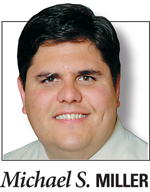
Michael S. Miller is editor in chief of Toledo Free Press and Toledo Free Press Star. Contact him at [email protected].


*The Walking Top 40 includes “Walking on Sunshine” by Katrina and the Waves, “Walk on Water” by Eddie Money, “Walk on the Wild Side” by Lou Reed, “Jesus Walks” by Kanye West, “Walking on the Sun” by Smash Mouth, “Walk This Way” by Aerosmith (with Run-DMC if you went to high school in the ’80s), “Walking on a Thin Line” by Huey Lewis and The News, “Walking in Memphis” by Marc Cohn, “Walking on Broken Glass” by Annie Lennox, “Walk the Dinosaur” by Was (Not Was), “Walk of Life” by Dire Straits and “Walk Like a Man” as suggested by The Four Seasons and Bruce Springsteen. You can be “Walking to New Orleans” with Fats Domino (who also offered “I’m Walkin’” and “I Want to Walk you Home”), “Walking on the Moon” or “Walking in Your Footsteps” with The Police, “Walk Like an Egyptian” with The Bangles, “Walk Hard” with Dewey Cox  and go “Walkin’ After Midnight” with Patsy Cline. Roy Orbison, U2 and Neil Young all urged us to “Walk On.” Matt Monro, Kelly Clarkson and Five Finger Death Punch all suggested we “Walk Away.” A number of sentimental fellows, from Elvis Presley to Jerry Lewis, offer solace that “You’ll Never Walk Alone.”