Home Blog Page 24

Toledo Works: Tech in Toledo

0

Episode 4 of Toledo Works

Stephen Zenner speaks to Mike Vanderpool of Anthony Wayne Innovations and Justin Beaudry of Toledo Codes, two guests who are instrumental in the evolution of the 419 tech scene. The guests talk about the downtown “Innovation Corridor,” promoting a more universal understanding of technology through education, and more.

Everywhere in Toledo, you’ll find people who play a role in making our city tick – from hospitals and factories to restaurants and art galleries – and behind every person is a story. Our program, Toledo Works, highlights those stories from workers’ firsthand accounts. Each week, Toledo Free Press hosts Jaden Jefferson and Stephen Zenner focus on a different topic within the Toledo workforce, exploring their day-to-day challenges and triumphs.

Swanton Township trustees approve fund transfers

0
(AWFP photo by Karen Gerhardinger)

SWANTON TOWNSHIP – It’s not unusual for a fiscal officer to reallocate money from one fund to another. But since her election to office in November 2025, new Swanton Township Fiscal Officer Mindy Curry has found a need to relocate funds multiple times.

“This is to document expenses properly and put them in the correct fund account,” Curry told township trustees during their March 10 meeting, as they acknowledged and approved a slew of transfer requests. 

As an example, Curry said the previous administration was paying for garbage pickup out of the Roads and Bridge Fund instead of the General Fund. Legal expenses were being paid out of the Legal Salary Fund instead of the Accounting and Legal Fees Fund. And water service was coming out of the Operating Supplies Fund instead of the Water and Sewage Fund.

“We’re having to reallocate funds to be where they’re supposed to be,” Curry said, explaining that she has worked with the state auditor in order to make the township fund account numbers compliant. 

Trustee Matt Beil said that, in the process, it was discovered that the township has spent $700,000 in the past five years for legal services. 

“That was the prior administration. It will be a stretch if we spend $30,000 a year,” said Beil, explaining that all entities have some type of legal expenses. 

Curry shared that the appropriation budget for legal fees included $150,832 for 2025; $100,000 for 2024; $200,000 each for 2023 and 2022; and $275,000 for 2021.

Resident Mike Tye expressed concern that the township might be headed into a shortfall, but Curry said that funds were in place to pay the bills, and that trustees were simply reallocating from one fund to another.

“We’re not in a bad position. We’re just moving stuff around to be compliant. The auditor said we need to do this,” Curry said, adding that many of these reallocations were verified by the state auditor.

Now that the funds are allocated in the correct area, Curry can work on submitting the permanent budget, which is due to the county auditor on March 31. Trustees approved her request to hire traveling Fiscal Officer Anthony B. Pranger at the rate of $45 per hour to assist with the finalization of the 2026 permanent budget. A contract was also approved with Charles E. Harris and Associates for $700 maximum to assist with the year-end financial statements and tax returns. 

“Once the budget is ready for review by the trustees, a special meeting will be held for the trustees to approve it. The public is welcome to attend,” she said, adding that a special notice will be posted at swantontwp.org.

During the meeting, the trustees also:

-Listened to Beil say that a contract with Whitehouse Fire Department is set to expire. WFD covers the southern portion of the township while Springfield Township Fire covers the north. A new contract is expected to increase the cost dramatically, but specifics are not yet in writing. Fire and EMS coverage is paid for out of a 1.4 mill fire levy and 1 mill EMS levy that were approved in 2001. Beil plans to meet with Whitehouse and other surrounding fire departments to look at options to present in the coming weeks, but he cautioned that it will likely mean a levy.

-Thanked roads maintenance supervisor Anthony Peet and Mike Stinson for their work in fixing headstones in the cemetery. Peet explained that a tombstone jack is able to pick up a maximum of 15,000 pounds and allow time for the ground to be leveled. He estimates that 96 – some dating back to the early 1800s – need to be reset.

-Listened to a presentation by Laurie Manning of Hylant Group on options for insurance to cover property and vehicle liability through Ohio Plan Risk Management. 

-Heard Trustee Bill Anderson say that the township now has a map of 911 calls from the county dispatch. A four-year rolling average of the number of calls coming into the call center from Swanton Township is used to figure how much should be paid for its 911 bill. Previously, calls were erroneously added to the call list, but that has been whittled to just five, added Beil.

– Listened to an update on the annual meeting with the Lucas County Engineer. Some upcoming projects include roundabouts at the intersections of Monclova and Wilkins roads and Providence-Neapolis-Swanton and Archbold Whitehouse roads. Both begin in June and will have 45-day closures posted on the township website. The trustees also learned that the township can request, at no charge, to have a traffic study to determine the correct speed limit on Reed Road, where 25 mph signs were improperly placed. Unless otherwise marked all township roads are 50 mph or 55 mph. Yellow horse crossing signs were also determined to not meet standards. 

-Learned that the zoning board approved the use of temporary signs for the Greens at Oak Openings.

-Heard from Trustee Mike Nowicki that Zoning Commission members interviewed four qualified candidates for the zoning inspector position. After offering the position to one candidate, the board learned that he had a conflict of interest, and are now working with another candidate. 

-Heard that T-Mobile is looking at adding additional cells onto the tower at SR 295 and Monclova Road.

-Listened to an update on the Arrowhead Lake Mobile Home Park violation letter sent in December to the owners – who have not responded or taken any action to correct violations. Nowicki said John Borell, the county’s assistant prosecuting attorney, is looking at options, and will attend the April meeting to share more, Nowicki said.

-Heard that Anderson is looking at a cemetery information management system to streamline the burial records that are currently kept in eight log books dating back to the 1800s. 

-Learned that the Metroparks will have volunteers out in Oak Openings through October, monitoring birds, frogs and turtles. Beil said he will meet with the Metroparks quarterly to share ideas, including the best locations for gravel lots along Girdham Road, which is a major destination for birders in the spring.

-Appointed Bruce Wholf to the Zoning Commission.

-Approved a contract with Falcon Forge AI to assist in compliance with state requirements on cybersecurity. The township must be compliant, or at least show significant progress, by July 1 in order to avoid state penalties.

-Agreed to get quotes for updating the website, and to create a Facebook page for the township to make announcements. The township hall will now have internet service and a landline with the number (419) 826-9730.

-Heard that a previous trustee has not returned a key to the township hall as requested. The board agreed to have the locks redone on all the township buildings.

-Listened to James Stewart, of 12613 Airport Hwy., say that semi trucks are entering the business at 12545 Airport Hwy. at all hours of the night and idling for hours just 33 feet from his property, causing diesel smoke to come into his home. Trustees agreed that the new zoning inspector would look into it.

Monclova recommends four zoning text amendments

0
Waterside resident Jeanette Gannon addressed the Monclova Township Board of Trustees during its March 17 meeting, asking Trustee Debbie Stevens-Laux (left) to keep her promise to represent the people when it comes to data centers. Also listening is township administrator Harold Grim. (AWFP photo by Karen Gerhardinger)

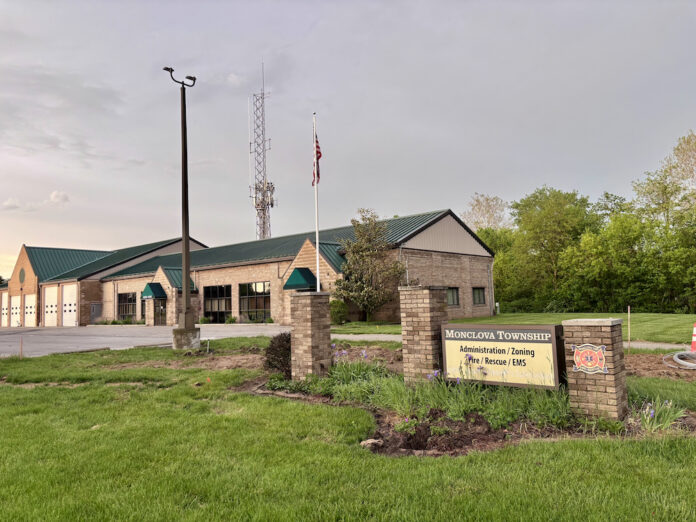
MONCLOVA – Monclova Township Trustees agreed to send four proposed zoning text amendments to the Lucas County Planning Commission for review – just the start of a process that will include public comment before enacting any change.

“This is based on the many conversations we’ve discussed at these meetings,” said Trustee Barbara Lang during the March 16 meeting. “This is the formalization of that process.”

Monclova Township Zoning Administrator Eric Wagner prepared four proposed zoning text amendments for consideration. (AWFP photo by Karen Gerhardinger)

Zoning Administrator Eric Wagner provided a copy of these proposed amendments, which include:

• The Board of Zoning Appeals may set conditions governing lighting, screening, parking, landscaping and hours of operation when issuing a conditional use permit, with the effort to “protect the general health, safety and welfare of the community.”

•A definition and rules governing the use of auxiliary electric generators, including noise, screening, distance from adjacent properties (300 feet for commercial/industrial/multi-family and 20 feet for residential), and type of fuel used (only natural gas or propane).

•Limiting the types of businesses that locate in the Toledo, Maumee, Monclova Township Joint Economic Development Zone to those with permanent structures and a minimum number of employees. The goal is to avoid passive commercial uses with few or no employees, Lang said.

• Methods for notifying the public of upcoming hearings may now include on the township’s website and social media accounts, on ohiopublicnotices.com or in one or more newspapers of general circulation at least 10 days before the hearing.

The county will review and made recommendations on these text amendments and then forward them to the township’s Zoning Commission. The Board of Trustees will make a final decision. Public hearings will be held in each of the meetings to gather input.

During the meeting, the trustees also:

-Heard that a Little Free Library, donated and stocked by Anthony Wayne High School student Lila Hippert, was installed at Keener Park.

-Noted that additional seating and enhanced the speakers in the meeting room will accommodate what has been a higher than normal attendance rate the past several months.

-Approved a contract with Bowers Asphalt to repave 3.75 miles of roadway this summer, including streets in Wrenwood, Ridge at Wrenwood and Keystone Drive.

-Set a public hearing for a street lighting district in Stoney Creek Plat 5, lots 133-181, for Monday, April 20 at 5:30 p.m.

-Approved several purchases for the Maintenance Department, including: $163,163 for a Toro Groundmaster 5910 mower; $105,490 for a Case TV370B Track Loader; $15,978 for a Conrkhite 3621 HD split tilt deck trailer; $63,903 for a Ford F-250 4×4 crew cab pickup truck; $4,074 for Department of Transportation approved warning light package for the truck; and $17,889 for a Grassopper729T6 rear discharge mower. All of the purchases were appropriated in the budget for this year, said Fiscal Officer Gavin Pike.

-Set the Safety Township program for June 8-11 at Monclova Primary School, with the graduation set for Friday, June 12. Two-hour morning and afternoon sessions are available with a maximum of 30 spots per session. The fee is $30.00 per person.

-Heard Lang say that the Ohio House is considering establishing a Data Center Study Commission, and a substitute House Bill 646 includes the Ohio Township Association’s request to include a township representative on the commission.

-Thanked Dennis Luginbuhl for his 48 years of service with Monclova Township Fire and Rescue. He joined the department in 1977 and retired on Feb. 23.

-Authorized Fire Chief Matt Homik to advertise for bids on self contained breathing apparatus (SCBA) equipment.

-Approved a memo of understanding with the Northwest Ohio Fire Prevention Association to handle the annual fire safety inspections for mobile food vendors. The township will still conduct inspections when vendors set up in the area, but the annual inspections are much more detailed and time consuming, Homik said.

-Heard that Grim is working with the Lucas County Engineer and the city of Maumee to do a joint project on resurfacing of Black Road in 2028. 

-Thanked township crews for extensive cleanup after the winds that knocked down power lines and blocked roads. 

-Heard that the township had 137 runs in February.

-Learned that the fire inspector and firefighters who are going through advanced incident command training all attended a class at the Cleveland Auto Show to learn how to safely work around electric and hybrid vehicles. This information will be utilized to provide training for the entire department.

-Listened to Waterside resident Risa Sindel ask that the trustees govern with integrity and a “straight moral compass.” She added that many residents are keeping notes on trustees’ decisions regarding data centers and development.

-Listened to resident Jeannette Gammon urge Trustee Debbie Stevens-Laux to keep her campaign promise of doing what is best for the people. 

-Learned that the post office building at 7959 Monclova Rd., a small portion of vacant land and the property lot for the post office were sold to Young Investment Properties. Both were previously owned by Lempak Properties Ltd.

-Learned that 2.6 acres at the northwest corner of Albon and Maumee Western were sold by Sky Group to Ridi’s. The property is zoned C-2.

Maritime Academy students’ weekend art exhibition

0
Jacqueline Hatcher (center) with Maritime Academy art students. (Courtesy photo)

Courtesy of The Sojourner’s Truth

TOLEDO – The Maritime Academy of Toledo showcased its art students’ creativity during its first art exhibition held at Truth Colours Art Gallery on the weekend of March 20-22.

Maritime Superintendent Misha Stredrick, EdD, wanted to recognize the creativity coming out of art teacher Jaqueline Hatcher‘s Maritime classroom. 

“She is just phenomenal,” said Stredrick of the art teacher. “Each day, I go into her classroom and the atmosphere is just amazing. It’s almost like a therapeutic mood – calm, dim lights, music playing … and the students are creating all types of things. I said what we need is a showroom.”

Stredrick approached The Truth Colours Gallery. “I wanted to reach out and see if we could make a connection, especially seeing that it is a Black-owned gallery.”

That’s when Stredrick met Nikola Welcome-Bovell, an accomplished artist herself and the manager/curator of The Truth Colours Gallery.

“It was like talking to an old friend,” Stredrick said of that connection. “The ideas that we threw out … and the idea [for this art show] was birthed out of those conversations.

The exhibition featured student artwork including stained glass, yarn panting, acrylic paint markers, watercolor, oil pastels and ebony pencils, noted Stredrick. The collection also included images of TV characters, flowers, fruits, animals angels and family situations, she added.

Maritime board members, administration, faculty and staff. (Courtesy photo)

“My reason for this exhibition is to give the youth an opportunity to showcase their work – to showcase their work in our gallery so our children can see their potential,” said Welcome-Bovell.

The exhibition was more than just art, however. Guests enjoyed great finger food prepared by Maritime Culinary Art‘s program headed by its teacher, Christopher Lowe. This is another program Maritime offers that will lead to employment. Students can also major in business at Maritime. 

In 2026-2027 Maritime hopes to expand its study majors to health care, welding and dental assistant. 

Jim Rush from Thread PR firm, who attended the art show, was duly impressed and said that corporate Toledo should start using this Art Gallery for a variety of events. This will bring corporate executives closer to the community they sell to and serve.

In addition to the art students and their families, other Maritime notables included Joy Goodner, a Maritime board member; Tamar Campbell, Community School Coordinator from Maritime’s sponsor in Columbus; Kathy Sampson, business manager; and Principal Jacob Lofton. They all remarked on the amazing art event. 

St. Clair Art Gallery in Hensville has offered their gallery for the next Maritime Art Show. Maritime’s board wants to thank Stredrick for her planning and input. Also, a shoutout to Maritime’s art teacher Jaqueline Hatcher. Many thanks to Fletcher Word, owner of The  Sojourner’s Truth and The Truth Colours Gallery.

Anthony Wayne Schools adds new courses

0
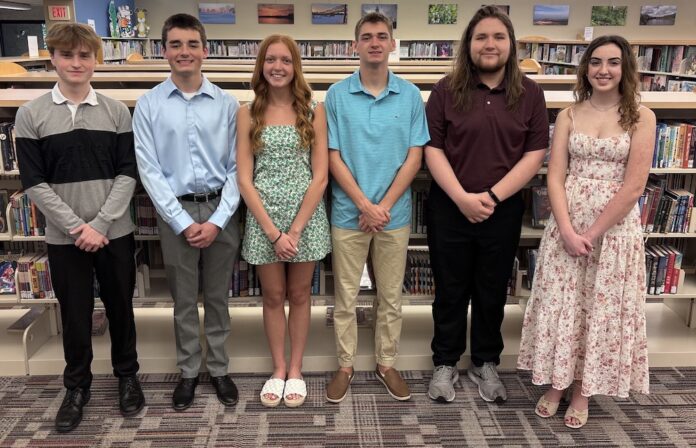
The Anthony Wayne Board of Education includes (from left) Kyle Miller, Mike Stamm, Amy Barrett, Lindsay Hoipkemier and Jeff Baden. (AWFP photo by Karen Gerhardinger)

Anthony Wayne High School is adding two new courses for the 2026-27 school year.

On March 10, the Anthony Wayne Board of Education approved the addition of AP Computer Science A and Generals Athletic Performance (GAP) to the high school course lineup.

“Both look like home run courses,” said Board Member Mike Stamm.

The AP Computer Science A class is an introductory college-level course where students will cultivate their understanding of coding through analyzing, writing, and testing code as they explore concepts like modularity, variables and control structures.

Fundamental topics include the design of solutions to problems, the use of data structures to organize large sets of data, the development and implementation of algorithms to process data and discover new information, the analysis of potential solutions, and the ethical and social implications of computing systems. The course emphasizes object-oriented programming and design using the Java programming language, according to the course description.

The Generals Athletic Performance class is geared toward multi-sport athletes participating in an amended school day, said high school Principal Jon Burke

“It’s designed to keep upperclassmen on campus a little longer instead of going home or to work. It keeps leadership at the school to continue leading the younger students,” he said.

According to the description, the advanced course is designed for student-athletes focusing on developing strength, power and mobility, along with overall athletic performance, through structured, sport-specific training. Grading is on a pass/fail basis and is determined by attendance, active participation and demonstrated effort.

Members of the Anthony Wayne High School dance team were honored during the March 10 board of education meeting for their first state title win since 2007. (AWFP photo by Karen Gerhardinger)

During the meeting, the board also:

-Congratulated the dance team, which won the Ohio High School Athletic Association state championship for its gameday routine. This is the first state win since 2007, said Coach Caitlyn Oser, who calls the team “tiny but mighty” with just nine members who worked hard this season.

-Discussed concerns shared online about bullying, and heard Superintendent Kevin Herman talk about plans for a March 11 coffee and conversations to help community members understand processes in place to address behavioral concerns. Herman encourage anyone with questions to contact him or assistant superintendent Dr. Kevin Pfefferle directly at (419) 877-5377 or via email.

-Made policy changes to adhere with Ohio House bills, including: admitting children to begin kindergarten if they are age 5 by the first day of school; allowing athletes to be paid for their name, image and likeness; and policies related to the use of artificial intelligence.  Several other policies governing transportation, purchasing and bidding, procurement, and financial matters addressed by the state auditor, were also added. A complete list is available on the website, anthonywaynelocalschools.org.

-Approved several donations, including $20,000 from the AW Vocal Arts Boosters for the purchase of mics and sound equipment, thanks in part to a substantial contribution from the Josh Doyle Foundation. The Fallen Timbers Parents Club donated playground equipment valued at $15,189 to the school. And the Anthony Wayne Education Association contributed $6,330 for the AWEA Scholarship. 

-Watched a video recap of the True Blue Reunion – a Valentine’s Day gathering of couples who first met in high school.

-Awarded a contract to Cardinal Bus Sales for the purchase of three buses at $442,407 out of permanent improvement funds.

-Approved supplemental contracts for staff members serving as head coaches, including: Anderson Brungard, football; Chandler Adams, girls basketball; Pat Phillips, boys golf; Jill Feltner, girls tennis; Brian Billings, boys soccer; and Lori Williams, girls soccer.

-Issued limited supplemental contracts for non-employees who are serving as head coaches for the 2026-27 school year, including: Nikolas Encalado, volleyball; Alex Geisel, boys basketball; Dalton Nicely, wrestling; Rick Briars, girls golf; Caitlyn Oser, dance; and Julia Foster, gymnastics. Dave Taylor, who will serve as assistant boys tennis coach, was approved for a limited supplemental contract.

-Approved the employment of: Bradley Keener, bus driver; Debbie Perry, high school cafeteria aide; Tamara Woodruff, Whitehouse food service worker; Drake Furey, junior high social studies teacher; Clare Black, middle school intervention specialist; and Amy Brinthaupt, junior high intervention specialist.

-Set the next meeting for Monday, April 13 at 6 p.m.

Quandary of Lucas County Israel bonds

0
Walaa Kanan, a northwest Ohio organizer for the Pro-Palestinian movement, speaks during a public comment designation at a Lucas County Investment Advisory Committee meetings at 1 Government Center in downtown Toledo, Ohio on Friday, February 20, 2026. Pro-Palestinian supporters sought to pressure the advisory council to divest bonds from Israel. (TFP photo by Stephen Zenner)

Public Comment: Invest/Divest Q4

Space was limited during the Feb. 20 Lucas County Investment Advisory Committee (IAC) meeting, as supporters of Israel and supporters of Palestine sat to be heard.

Only five individuals total, from a combination of both sides, had an opportunity to address the IAC for three minutes each. 

According to Lucas County Treasurer Lindsay M. Webb, those who would be able to give public comment at the investment meeting were chosen at random, and the first individual chosen was Pro-Palestine organizer Walaa Kanan.

TFP video by Jaden Jefferson.

Dispute over Israeli bonds

“This committee cannot reinvest in Israel bonds due to political reasons,” Kanan said, beginning her three minute criticism of Lucas County’s investment. “Supporters of these bonds have continued to share their support for Israel’s military operations, which, mind you, are being tried in international court as acts of genocide.

“If this was an ordinary bond that was evaluated simply based on funds, we wouldn’t see repeated legislation and attempts and attention to accommodate surrounding the continued purchase of Israel bonds,” Kanan said, potentially referring to HB 188 establishing The Ohio Israel Trade and Innovation Partnership, yet to pass in the Ohio Senate. 

“So to me, clearly not a neutral financial decision.”

One percent of Lucas County’s investments, or as Webb said previously, one $5 million bond, is invested in Israel from Lucas County, and will not reach maturation until December 2026.

In August of 2025, Lucas County Commissioner Pete Gerken pressured the treasurer and the IAC to divest from Israeli bonds by packing conference room A on the eighth floor of 1 Government Center with Pro-Palestine protesters, in a move that visibly made members of the IAC uncomfortable. 

The meeting in August ended with a representative from the Jewish Federation asking to be notified about such meetings in the future, and with a formal recommendation from the advisory committee to divest from Israeli bonds.

No actions, beyond the recommendation to divest, were made at the time concerning the Israeli bonds. 

Walaa Kanan, a northwest Ohio organizer for the Pro-Palestinian movement, addresses Pro-Palestine advocates who were unable to fit in the room during the Lucas County Investment Advisory Committee meeting inside City Council Chambers. (TFP photo by Stephen Zenner)

Continued opposition

Six months later, protesters showed up in greater numbers for both sides with similar sentiments stated in the last meeting. 

Pro-Palestine supporters outnumbered Israel supporters, with somewhere around 60 to 20 people respectively on each side of the issue.

Even with the larger room reserved on the first floor of 1 Government Center, many who came had no other option than to stand outside of the investment meeting. Two police officers guarded the entrance to the meeting without incident. 

Kanan and others in opposition to the Israeli bonds referenced Ohio Revised Code (ORC) 9.76 §, a provision stating that the state of Ohio will not engage in contracts with companies boycotting the state of Israel. 

In the previous meeting, Webb made reference to this part of the ORC: “Directing me not to invest in instruments of a foreign nation by which the category is only Israel runs the risk of running afoul of state law, and I personally don’t think that that’s a wise move.”

This statement received public rebuttals from Kanan, and subsequent public speakers. 

Jim McCourt, the director of advisory services for Meeder Investment Management, gives financial updates concerning Lucas County’s investments. (TFP photo by Stephen Zenner)

Rashad Daoudi, an independent attorney, spoke after Kanan on ORC 9.76, saying, “I can tell you that that law has absolutely no application whatsoever to your decision to choose not to reinvest [in Israeli bonds].

“Furthermore, even if it does apply to your decision, there are exceptions that allow you to still choose not to reinvest. And those exceptions are, one, if the decision is commercial, two, if it’s non-discriminatory, and three, if it’s based on the specific conduct of the entity that’s being targeted.”

Concisely, Daoudi said there were other investments that would return higher yields than continued investment in Israel, the decision to divest was not based on discrimination against Israeli or Jewish people, and the conduct of Israel against the Palestinian people merited reevaluation of the reinvestment in the country.

Approximate figures on Gaza

Daoudi himself said the death toll in Gaza was “as many as 200,000,” a figure used to refer to the dead and injured in Gaza collectively. 

The Associated Press (AP) following the two year marker of the Hamas led attacks on Oct. 7, 2023, killing roughly 1,200 people inside Israel, released its estimates of casualties inside of Gaza, 67,000 killed Palestinians and 170,000 wounded. 

Israeli Defense Forces’ (IDF’s) former chief, Herzi Halevi, who initiated the assault on Gaza in 2023, confirmed the over 200,000 casualty marker between the injured and dead in Gaza just ahead of the two-year marker. And then, after over two years of denying the Gaza Ministry of Health’s (GMoH) death toll as propaganda, Israel officially accepted the estimate of around 70,000 dead at the end of January 2026, this toll includes 20,000 minors who have died. 

Walaa Kanan, a northwest Ohio organizer for the Pro-Palestinian movement. (TFP photo by Stephen Zenner)

A less controversial statistic is that about 90 percent of Gaza’s total population of 2.2 million people have been displaced due to Israel’s attacks on the area. 

An independent study from Lancet Global Health found the GMoH’s death count to be “conservative” and said, “We estimated 75 200 violent deaths (95 percent CI 63 600–86 800) between Oct. 7, 2023, and Jan 5, 2025…” in Gaza. This study leaves out any casualties that have happened since Jan. 5, 2025, at this point, over a year’s worth of data on the dead and wounded in Gaza. 

Lorna Hulsebus from the Greater Toledo House of Prayer prays for a Toledo Patrolman, William White, after a Lucas County Investment Advisory Committee meeting. (TFP photo by Stephen Zenner)

Pro-Israel POV

The subsequent speaker Joel Beren moved to defend the state of Israel, and highlighted the Hamas attacks on Israel killing 1,200 and the taking of 251 hostages, leading to the deadly escalations in Gaza. 

“My goal is to communicate with several elected officials who are sowing seeds of hate, specifically antisemitism in our community,” Beren said, and detailed the different cultures and nationalities of the people who were killed on Oct. 7. 

“Israel then went to war against Hamas, a U.S.-designated terror organization, not with the Palestinian people,” he said.

“Since then, a complex international dispute has entered our community, where a county official is making strong accusations of genocide, a claim also repeated by senior members of the Lucas County Democratic Party.”

Lucas County Treasurer Lindsay Webb listens to public comment on divesting from Israeli bonds during a Lucas County Investment Advisory Committee meeting. (TFP photo by Stephen Zenner)

Beren argued genocide requires “an intent to destroy people,” and he said the evidence did not support that Israel was intending to destroy the people of Gaza, only Hamas. Hamas, Beren said, was ideologically opposed to western values, and he advocated for keeping Lucas County funds invested in Israel as the state treasurer of Ohio has been doing at greater levels than Lucas County. 

Stephen Rothschild, the CEO of the Jewish Federation, said separately, in an interview with the Toledo Free Press that the use of the term “genocide” has been used as a provocation, to inflame people against the Jewish people. 

There is no doubt some people use the word “genocide” to stir up hate against the Jewish people, as antisemitism and Islamophobia rise in the United States. 

However, there is a real reason to question what is going on in Gaza. 

Joel Beren, a supporter of Israel, speaks before the Lucas County Investment Advisory Committee on investing in Israeli bonds. (TFP photo by Stephen Zenner)

Humanitarian groups, including Amnesty International, the United Nations (UN) and the International Association of Genocide Scholars (IAGS), have resolved that Israel is committing a genocide in Gaza.

An excerpt from the conclusion of the 60th session of the Human Rights Council for the UN reads:

“On the basis of fully conclusive evidence, the Commission finds that

statements made by Israeli authorities are direct evidence of genocidal intent.

Additionally, on the basis of circumstantial evidence, the Commission finds that genocidal intent was the only reasonable inference that could be drawn based on the pattern of conduct of the Israeli authorities. Thus, the Commission concludes that the Israeli authorities and Israeli security forces have the genocidal intent to destroy, in whole or in part, the Palestinians in the Gaza Strip.”

Written in the latter part of 2025, the conclusion comes on the 64th page of the council’s proceedings, and is preceded by evidence supporting the legal definition of genocide as defined by the Convention on the Prevention and Punishment of the Crime of Genocide, in 1948.

Towards the end of his three minutes, Beren said the United States (US) has given money to Hamas through direct humanitarian aid, and that it has only made things worse, and asked the IAC again to continue their investment in Israel. 

The Israeli government has banned The United Nations Relief and Works Agency for Palestine Refugees (UNRWA) from its operations in Israel along similar sentiments, alleging members of UNRWA were terrorists. 

The British Broadcasting Corporation (BBC) reported, “In December [2025], Israel told organisations – including Médecins Sans Frontières (MSF, Doctors Without Borders), Oxfam, Save the Children, ActionAid and the Norwegian Refugee Council (NRC) – that their registrations had expired. They were given 60 days to renew them – by complying with new rules – or cease operations by 1 March.”

New rules put forth by the Israeli government for nongovernmental organizations (NGOs) require them to share complete staffing details, operational organizational information and funding sources.

The AP reported, “Aid groups that refuse to comply say they fear what Israel might do with the personal data of their employees, noting that hundreds of aid workers have been killed in Israeli strikes during the war.”

Supporters of Israel and supporters of Palestine sit and listen to public comment on Lucas County’s investments during the Lucas County Investment Advisory Committee meeting on Feb. 20. (TFP photo by Stephen Zenner)

Israel claims in some cases NGOs have been infiltrated by Hamas, and Israel has acted accordingly. 

In one instance 15 Palestinian medics with the Red Cross/Red Crescent were killed by Israel, but then later Israel backtracked and blamed “professional failures” for the deaths. 

To make things more complicated, Israel killed five armed individuals in a World Central Kitchen (WCK) vehicle. WCK condemned the armed individuals’ use of WCK as a disguise, and said they were not familiar with the five people brandishing weapons under their logo. 

But in another instance seven WCK workers were killed in a strike by Israel, which the Israelis later apologized for. 

“The Israeli Diaspora Ministry says that since its guidelines came into effect, it has been contacted by 117 NGOs. Of these, 27 have been approved and 11 were rejected with the remainder still undergoing review or told to conclude operations should they fail to meet the compliance requirements,” according to the BBC.  

Time is kept on a phone during the Lucas County Investment Advisory Committee meeting. (TFP photo by Stephen Zenner)

NGOs have pushed back against the standards, claiming they seek to silence criticism of Israel’s tactics. Jan Egeland, Secretary General of the Norwegian Refugee Council told the BBC, “This is a political matter…They don’t want independent witnesses that are not pro-Netenyahu to operate in the Palestinian areas. That’s why they’ve come after us and so many others.”

The new standard for NGO’s is in step with Israel preventing foreign journalists from entering Gaza since their offensive began, except in cases where journalists are embedded with the IDF.

Prominently, Save the Children lost its license to operate in Gaza after being accused of delegitimizing the State of Israel. Another well-known humanitarian operation, Doctors Without Borders, is disputing the terms with Israel, after many claims the NGO denies about their staff being affiliated with armed groups in the area.   

“County investment policy cannot be influenced by politicized narrative,” Beren said before his time ran out. “This committee is advisory. Israel bonds are both credit-worthy and a permitted investment within the authority of the county treasurer.”  

Public comment continued

After Beren spoke, Hoda Al-Hayim was called from the hallway to give her public comment. She mentioned some of the same sentiments as previous Pro-Palestine supporters, but during her speaking time the Pro-Palestine supporters in the hallway, began chanting, “No Israel Bonds.” 

Al-Hayim continued speaking, and ended by urging the committee to “stand with humanity.” 

The last speaker was a co-chair of the Northwest Ohio Democratic Socialists of America, Lamar Willis, who spoke against investing the money in a “genocidal state.”

“I want to remind everyone that we don’t know exactly where that money is going,” he said, and advocated for “Lucas County money to stay in Lucas County.”

Willis ended his time asking Treasurer Webb “to be on the right side of history.”

Members of the Lucas County Investment Advisory Committee listen to comments. (TFP photo by Stephen Zenner)

Lucas County Commissioner Anita Lopez, interrupted Webb as she tried to move on with the meeting amidst chanting. “I know you discussed this policy beforehand, but I do feel like both sides should be provided equal time,” Lopez said, after the random selection yielded 4 to 1 speakers, respectively. 

Webb seemed less interested in continuing public comment, making the argument that both sides of the issue were heard to some extent. 

And while the two women were discussing the proper solution for public comment going forward Lopez became frustrated, and said, “Can we get that under control?” referring to the chants from the hallway.


Ziad Hummos, an organizer for the Pro-Palestine movement, asks the crowd outside of the Lucas County Investment Advisory Committee meeting to stop chanting “No Israeli Bonds” outside of the meeting at 1 Government Center in downtown Toledo, Ohio on Friday, Feb. 20, 2026. (TFP photo by Stephen Zenner)

Local Palestinian organizer, Ziad Hummos, accommodated, opening the door, and the crowd immediately responded by quieting down, at his direction.

Lopez recommended the next IAC meeting to take place in a larger space, potentially the Commissioners Hearing Room. 

As soon as the  meeting room quieted, Webb said, “I want to acknowledge the 180 some emails that we’ve received, that all members of the committee have received,” and said they had been “noted,” along with a number of phone calls. 

She then encouraged people to email and call “so people can continue to participate in this process and have their voices heard.”

“This is America,” she stated. 

That being said, Webb, seemingly exhausted by the controversy, took note of Commissioner Lopez’s recommendations for further comment, and moved on with the meeting. 

“It is well-noted the feelings of the people in this room and quite frankly, this bond does not mature until December,” Webb said. “So regardless of what is said today, no action will be taken today, tomorrow, next month or the month after.”

“It will only be when the bond matures in December, and we will make that decision according to our responsibility under the [Ohio Revised] Code, which is the safety liquidity, the safety of the investment, the liquidity needs of the county, and the yield, that is the permissible determination that I am allowed to invest in.”

Webb told those in attendance that she had reached out to the Ohio Attorney General, Dave Yost, through the Lucas County Prosecutor’s Office for an opinion on ORC 9.76 § related to the local issue of investing or divesting from Israeli Bonds in Lucas County. 

“If the point is to be heard, people are being heard, and I would like to move on with the rest of the agenda,” Webb said. 

Supporting Webb, Lucas County Clerk of Courts, Bernie Quilter, also on the IAC, affirmed everything stated by the treasurer. 

“I too, have received all your emails,” he said. “I have a separate folder that I have kept every one of your emails in, and I have read every email also.”

Lamar Willis, a co-chair of Northwest Ohio Democratic Socialists of America, gives public comment during a Lucas County Investment Advisory Committee meeting on the topic of Israeli bonds. (TFP photo by Stephen Zenner)

The issue of investing in Israel bonds does not come up until December, he said, and mentioned U.S. banks are investing, “a lot of money in Israel bonds.” Quilter also mentioned other areas in Ohio had put a pause on Israel bonds, and confirmed the request for opinion went out to the Ohio AG.

Lopez spoke afterwards, and said, “I just want to make sure that you understand we are dividing our county on this issue.” 

She then announced that it was a sad state of affairs when the two parties in the room could not break bread because of an international dispute the county had no control over. 

From local business to national delight: Marsha’s Buckeyes

0
Marsha's Buckeyes facility is in Perrysburg, and the operation has recently expanded to Walmarts nationwide. (TFP photo by Lucas Sells)

PERRYSBURG – Starting from the basement of the Smith house, Marsha’s Buckeyes has evolved from a simple home-based operation into a production line serving most of the country. Based in Perrysburg, Marsha’s got its start in 1984, when Marsha Smith wanted a way to make a bit of extra cash to support her family. To achieve this, she decided to monetize her hobby of making buckeyes. Fast forward to today when Marsha’s is now sold in over 2500 Walmart locations across the country.

An empty basket of Buckeyes decorates Brad Smith’s desk. Smith is president of Marsha’s Buckeyes. (TFP photo by Lucas Sells)

When Marsha’s business began, it served only a few local markets, but eventually, her business began to explode in popularity, with her buckeyes eventually reaching the corporate offices of Cracker Barrel. Seeing their potential, Cracker Barrel offered to sell her buckeyes in all of its stores nationwide. Today, Marsha’s Buckeyes are sold in every Cracker Barrel location across the country.

TFP video by Lucas Sells.

Spearheading the recent expansion into a nationwide market at Walmart is Brad Smith, one of Marsha’s sons. Brad is the president and owner of Marsha’s Buckeyes, and – along with his brother Mitch – oversees the production and distribution for the company. Growing up around his mother’s business, Brad and Mitch both had a desire to continue on what their mother had begun, and after attending OSU and graduating in 2009, the two began the process of taking over for their parents. In 2018, they officially purchased the business from them.

During this time, the brothers found ways to expand to match the newfound demand. In 2006, they began to use cookie dough machines to make the peanut butter balls. In 2018, they began working on a personalized dipping machine, something that they couldn’t find on the market. Being surrounded by the business since they were young, the brothers found that originally, the way that they made buckeyes was not much different than what many Ohioan families did as well.

“The original manufacturing process was no different than what everybody else does at home.” Brad reminisced. “Mixing the ingredients, putting them into a ball by rolling with your hands, and then dipping with a toothpick into a bowl of chocolate.” 

Brad also found that demand would peak during certain periods of the year, with the college football season being an exceptionally busy time, and winter holidays also seeing another spike in demand. With buckeyes being a staple of statehood in Ohio, it’s no wonder that families across the state share an affinity for the treat.

Jacob Juhasz packs a tin with freshly cooled buckeyes. (TFP photo by Lucas Sells)

“It’s very much a tradition where you get together as a family and make buckeyes as part of your platters… that’s certainly the foundation of what we’ve been as a company.”

Reflecting on how his company gives back, Brad mentioned how the company serves the Perrysburg community, primarily through gifting their buckeyes for events. A notable example was the Buckeye Cruise for Cancer, an annual fundraising event that takes place every February. Marsha’s Buckeyes has been sponsoring the event for 15 years. 

On the other side of Marsha’s headquarters lies the production facility, and leading the floor is Zakary Kern, E-Commerce and Logistics Coordinator for the company. Zakary, like many of the office workers, wears many hats, but his primary goal is to lead the company’s production line. A cousin of Brad and Mitch, Kern came into the company to help the brothers expand. To him, family has meant a lot in getting where he is today, and he sees that reflected in how the business is run.

“I wouldn’t be where I’m at without family, and [I’ve had] opportunities because of family. So, you know, it means a great deal to me,” he expressed. “The family aspect of this shows where, unlike larger corporations… It’s a lot more relaxed here… If you need to take time off, for whatever reason, it’s not so difficult and structured.” 

Part of Kern’s job is to look forward, and like Brad, he believes that Marsha’s has the capability and needs to justify an expansion to meet the new demand that the Walmart deal has given them. From hiring new employees and increasing production lines, the expansion of their operation is something he’ll be spearheading.

The humble beginnings of a small business like Marsha’s is proof that entrepreneurship at the local level is pivotal to powering communities all over the country. With further expansions driving this company forward, they stand as a reminder that local business is the lifeblood of our economy, and that anyone seeking to make money from a hobby only needs the courage to take the first step.

Erin Lowe talking to fellow coworkers on the side of the product. (TFP photo by Lucas Sells)

Ohio’s 2026 primary election: 3 things to know

0
(TFP image by Jaden Jefferson)

TOLEDO — This year, Ohio voters will decide on their congressional representatives, who will hold one of the state’s two U.S. Senate seats, as well as who will replace Republican Mike DeWine as governor.

But before these big decisions are made in November, voters must decide on who the main candidates will be — as in some races — there’s more than one Democrat or Republican running for the same position. And that’s where a primary comes in: to reduce the field of candidates in any given race down to just two. So if you plan on voting in Ohio’s May primary, here are three things to know.

1. Registering to vote

While registering to vote can be done in person at your county board of elections office, or by mail, a quick way of doing it is through the secretary of state’s website. To complete this process efficiently, have both your driver’s license/state ID and Social Security number on hand. Keep in mind that, under Ohio law, those who’ve registered less than 30 days from an election are ineligible to vote in it. So simply put, April 6 is the final day to register to vote in the upcoming primary.

2. When, and how, to vote

Ohio offers both early and absentee voting. 

Early in-person voting begins on April 7, a Tuesday — and from there — will only take place on certain days and during certain hours. Here are those dates and hours, per the secretary of state’s voting schedule:

Tuesday, April 7 – Friday, April 10 | 8 a.m. – 5 p.m.

Monday, April 13 – Friday, April 17 | 8 a.m. – 5 p.m.

Monday, April 20 – Friday, April 24 | 8 a.m. – 5 p.m.

Monday, April 27 – Friday, May 1 | 7:30 a.m. – 7:30 p.m.

Saturday, May 2 | 8 a.m. – 4 p.m.

Sunday, May 3 | 1 p.m. – 5 p.m.

Remember that if you choose to vote this way, you’d be casting your ballot at the county board of elections office — not your precinct location.

Absentee voting, or vote-by-mail, also begins on April 7. To vote this way, one must first request a ballot. That can be done by filling out the application online, printing it, and mailing it to the county board of elections office. Another way of requesting a ballot is to call the county BOE directly.

3. Figuring out what & who will be on the ballot

The Toledo Free Press will continue to interview the candidates you’ll see on your ballot, as part of the Toledo Free Press Voter’s Guide, which can be found on YouTube and Spotify. Consuming these interviews is a great way to gain an understanding of who candidates are and the policies they support. But if you’d like something of a replica of what your ballot will look like, many county boards of election provide a ‘sample ballot’ on their website.


Toledo City Council: Federal immigration enforcement

0
Nick Komives, Toledo City Council Member At-Large, during his closing remarks at a Toledo City Council meeting inside City Council Chambers at 1 Government Center on Tuesday December 16, 2025. (TFP photo by Stephen Zenner)

Toledo City Council met Tuesday, St. Patrick’s Day, with a few highly anticipated resolutions and ordinances concerning the role of the City of Toledo in federal immigration enforcement.

“We just really focused on making sure that we set some parameters and policies around the ways that the City of Toledo works with ICE, otherwise known as Immigration and Customs Enforcement,” said Nick Komives, Toledo City Council member At-Large.

“There is an agency, ICE, that has more money than God,” he said. “They do not need more resources from the City of Toledo. We believe that the limited resources that we have are already dedicated to important work, so we just made sure to outline exactly how we will spend our resources and what any type of alignment with ICE looks like.”

Theresa Gadus, council member for district 3. (TFP photo by Stephen Zenner)

Resolutions 093-26,094-26 and Ordinance 095-26 passed unanimously without issue, while Theresa Gadus, Council Member for District 3, said Ordinance 096-26 was held for more community feedback. Ordinance 096 dealt with protections for schools and childcare centers from immigration enforcement actions.

Council Members Mac Driscoll (At-Large), Gadus, Brittany Jones (At-Large), Komives, Erin Kramer (At-Large) and Adam Martinez (District 2) sponsored the five legislative measures surrounding federal immigration enforcement referenced during the Committee of the Whole a week prior to this council meeting. 

There was one proposed ordinance, dealing with biometric data security, which did not have a drafted appearance during the city council meeting. 

Komives was available to give a brief summary of the two resolutions and one ordinance that passed. 

“I’m just really proud of this community for stepping up. We did something that I think is quite brave,” he said about the three passed measures that day. 

“We just don’t want to see them [ICE] coming here and violating people’s constitutional rights,” he said. “It is our job at the local level to do what we can to protect our residents, so we will continue to take a look at policies and procedures to make sure that we’re doing just that.”

A brief summary from Komives listed the some of the steps in place with the new resolutions and ordinance. 

“We also requested that they properly identify themselves, no more of the hidden badges or wearing face coverings, things of that nature. We also made it very clear that our city employees are not going to be sharing the immigration status of individuals and residents who live here in Toledo,” he said. 

“In no way is this us telling anything to ICE about what they can and cannot do. They have their legal parameters. We’d like them to especially stick to what those are. But more importantly, this legislation really touched on how city employees interact with ICE, and so we won’t be sharing immigration status, we won’t be providing them any data. We won’t be accompanying them on any raids or anything like that, unless they have the appropriate judicial warrant.”

Immigration legislation for Toledo

093 clarified the procedure and standard of detention facilities within the city. 

Since detention facilities “require a unique set of public services,” the resolution recommended to the Plan Commission that a special use permit should be required for detention facilities. Special use permits are obtained by a vote by City Council, so a detention facility would not be authorized without a vote by city council. 

The resolution requested a public hearing when this resolution is proposed to become an ordinance. 

Resolution 094 formally asked the federal government to adhere to a certain set of standards when conducting immigration enforcement in Toledo. 

Part of this standard was providing identification and transparency for themselves and their vehicles, including not wearing face coverings, except for medical reasons, while agents are conducting official immigration enforcement. 

The resolution asked that Department of Homeland Security (DHS) agents deployed in Toledo and nationwide to have completed 22 weeks of training, the former standard before the onset of ICE surges across United States cities. 

And finally, the resolution asked that DHS agents adhere to local, state, federal and constitutional law, maintain a civility when interacting with residents, refrain from lethal force and urged federal law enforcement to comply with the city’s ordinances for the safety and security of residents. 

At the end of February 2026 DHS put out a statement clarifying the changes in their training practices. 

“New ICE recruits receive 56 days of training and an average of 28 days of on-the-job training. No training requirements have been removed. Training increased from five days a week, eight hours a day to six days a week, twelve hours per day. It is the same hours of training officers have always received,” the statement said. 

Regardless, the behavior of federal agents under the second Trump administration has been widely criticized for their unprofessionalism, including aggressive escalations against immigrants and United States citizens alike. Most prominent of the criticisms has been agents’ use of lethal force against Minneapolis, Minn. residents Renee Good and Alex Pretti

Ordinance 095 lays out rules surrounding immigration enforcement and the City of Toledo’s personnel and resources. 

It prohibits city employees and officials from restricting city services based on immigration status, except where required by law or court order. 

It stops the city from using its resources to investigate individuals for suspected immigration status, except if required to by court order, a warrant, a criminal violation or during an arrest. 

It stops city employees from holding secondary employment with Immigration and Customs Enforcement.

It requires Toledo City Council approval before local law enforcement assists in the enforcement of federal immigration law as defined by 287(g) Agreement, and prohibits city funds to be used in coordination with the 287(g) Agreement, federal immigration enforcement. 

Unless given authority by the 287 (g) Agreement, and transitively city council, local law enforcement cannot “stop, arrest, or detain a person” based solely on an immigration detainer request, an administrative warrant for civil immigration enforcement or suspicion of unlawful presence/immigration violation.

The ordinance prohibits the use of city-controlled/city-owned areas like parking lots and garages for use as staging areas or processing locations for immigration enforcement. 

If city employees are aware of city property used for immigration enforcement they are required to report the unauthorized use. 

The mayor will put up signage to inform federal law enforcement of the area’s prohibited use. 

Lastly, the ordinance restricts non-public and semi-restricted areas of city property from immigration enforcement, except in cases with a judicial warrant. 

And the ordinance says that the mayor, or someone designated by the mayor, is the only one with the authority to consent to an immigration search or enforcement without a judicial warrant. 

Brittany Jones, Toledo City Council Member At-Large, speaks as Trevor Diane Thomas Black is recognized in Celebration of Women’s History Month during a Toledo City Council meeting at 1 Government Center in downtown Toledo, Ohio on Tuesday March 17, 2026. (TFP photo by Stephen Zenner)
Stephanie D. Kynard, owner of Rita’s Italian Ice and Custard, is recognized during Women’s History Month. (TFP photo by Stephen Zenner)

Whitehouse holds first reading on rezoning

0
Whitehouse Village Hall. (AWFP photo by Karen Gerhardinger)

WHITEHOUSE – With little discussion, Whitehouse Village Council on March 17 held a first reading on an ordinance to rezone 37.99 acres for Country Meadows South – a proposed single family home subdivision at 11320 Archbold Whitehouse Rd.

Developer Charlie Grass of Artisan Craftbuilt Homes sat quietly, listening as two residents spoke against rezoning the farmland from S1 Suburban to R-2 Residential. 

“The density of homes is too much for the traffic in the area, for Oakbrook and any of the other feeder streets,” said Centerville Street resident Jeff Heaney. “I’m mainly opposed to the curb cut on 64. I’m opposed to the variance on the lot sizes. The schools can’t handle the traffic. The village is not prepared for that kind of development.”

While a preliminary plat was presented to the village’s Planning Commission on March 2 to get feedback – showing 37 homes in Plat 1 – the exact layout and number of homes isn’t finalized, as Grass is waiting to find out whether he’ll get the R-2 zoning.

For 18 months, Grass has sought to rezone the property from S-1 Suburban, which has bigger lots.  Grass initially asked for the more dense R-3, then R-2 with a Planned Unit Development (PUD) – both of which were denied. On March 3, the village held a public hearing on rezoning to R-2, which matches the zoning of Oak Brook.

“I know Oak Brook is R-2. We can’t change the past, but we can change the future,” Heaney said, encouraging the village to look at overall development and the impact on traffic.

“We’ll have at least 80 more cars. We’ll have problems with traffic. Waterville, Oakbrook, Temperance and West will be a mess,” Waterville Street resident Craig Whitman predicted. 

Council Member Carrie Tuohy asked if Temperance Street, a stub street that will be extended into Country Meadows South, would get speed bumps and sidewalks.

“My road is taking the brunt,” she said of the development’s plans to utilize Temperance. Tuohy said children play and ride bikes in the streets because of the lack of sidewalks. 

“What are we doing to keep children from getting hurt? I want to make this workable for everybody. I want to make sure we’re not punishing one group,” she said.

Council will hold a second reading on the ordinance during the Tuesday, April 7 meeting, then hold a third and final reading on Tuesday, April 21.

During the meeting, council also:

• Heard that the village is one of 10 communities out of 48 to receive both the Tree City USA designation and the Growth Award this year.

•Heard that the Tree Commission will host an Arbor Day event with Whitehouse Primary School third graders on Wednesday, April 29. A shellbark hickory, catalpa, American elm and swamp white oak will be planted at Whitehouse Park.

•Heard that a spring seminar featuring Paul Bauman speaking about mosquito control will be held on Wednesday, April 22 at 7 p.m. in council chambers.

•Awarded a $47,035 contract with Vodika to repair the maintenance building roof.

•Awarded a $207,303 contract for Bowers Asphalt to repave Cemetery Road between the Wabash Cannonball Trail and Weckerly Road.

•Learned that the Public Works Department staff is researching options and ideas for inclusive playground equipment to be added to Whitehouse Park.

•Agreed to update the conditions for no-bid contracts. If the purchase or project is not a line-item in the budget, it should be reviewed by the Committee of the Whole and then council. If the purchase is in the budget, and the bid is equal, less or within 15 percent of the budget, it can be brought directly to council.

•Discussed ways to meet residents’ requests to provide a village newsletter without printing and distribution, such as a short video posted online.

•Heard that the Saturday, March 21 Easter Egg Hunt will start at 10 a.m. at the Whitehouse American Legion, with staggered 15-minute start times for different age groups. 

•Discussed a complaint about the electric outage on Field Avenue in an area where many elderly or disabled residents live. Toledo Edison was urged to give the area priority, said Mayor Rich Bingham.

•Heard that a resident asked whether trash pickup could be delayed on days with high winds, as trash and cans were blowing into the streets and yards. Tuohy thanked ARS drivers for picking up as much as the could. Delaying pickup could prove a hardship for those who fill up their bins each week, added Council Member Joe Bublick. Administration will reach out to ARS to see if a delay would be just one day or a week, and whether other options are available when inclement weather impacts pickup.

•Asked Law Director Kevin Heban to draft an ordinance mandating sidewalks in new neighborhoods, in order to encourage connectivity. Heban said such an ordinance already exists, but Council Member Dave Riggenbach said some neighborhoods do not have them. 

•Heard that retiring firefighters Tom Vincent and Rich Snyder will be honored during the Whitehouse Fire Association meeting on Wednesday, April 1.

•Heard Fire Chief Jason Francis say the department is working through new DEA requirements for fire and EMS to lock up narcotics in special vaults.

In other Whitehouse news:

The Crust, a pizzeria at 6792 Providence St., is expanding into an adjacent storefront through a newly-created doorway. (Courtesy photo)

The Crust Pizzeria is expanding its operation into the adjacent vacant storefront, opening up a doorway from the existing space at 6792 Providence St. This will allow the addition of 26 seats and more room to operate, according to owner Tony Fronk

• Plans for a collaboration between the Toledo Lucas County Public Library and the Metroparks for a new library and conservation center at Blue Creek Metropark have changed. Library leadership is now in conversation with Whitehouse administration to find an alternative location to the park, but plans to open a new library in the village within the next two years, according to library spokesperson Stephanie Elton. In the meantime, the nonprofit, independent Whitehouse Library remains open.