Home Blog Page 237

Restaurant Week Toledo to feature healthy options

0

Eating healthy doesn’t have to be an unpleasant experience, say organizers of Restaurant Week Toledo.

Among the healthy dishes planned by local chefs for this year’s event are a sesame-seared Chilean sea bass at Rosie’s Italian Grille, a slow-roasted pork chop stuffed with spiced apples at Bar 145 and a chicken shish tawook sandwich at Poco Piatti.

One of the healthy options at Bar 145

The third annual Restaurant Week Toledo, set for Feb. 21 to March 2, will feature at least one healthy option at each of the 28 participating, locally owned restaurants, said Becca Gorman, co-chair of Restaurant Week Toledo.

Participating restaurants are Bar 145, Barr’s Public House, The Blarney Irish Pub, Bobby V’s American Grill, Burger Bar 419, Caper’s Restaurant, Gradkowski’s, ICE Restaurant and Bar, La Scola Italian Grill, Loma Linda, Mancy’s Bluewater Grille, Mancy’s Italian Grill, Mancy’s Steaks, Manhattan’s, Maumee Wines and Bistro, The Oliver House (Mutz, Maumee Bay Brew Pub, Rockwell’s and The Café), Plate 21, Poco Piatti, Registry Bistro, Rosie’s Italian Grille, Shorty’s True American Roadhouse, Tea Tree Asian Bistro, TREO, Ventura’s and Zinful.

Each venue will feature a special Restaurant Week menu priced at $10, $20 or $30. (Drinks, taxes and gratuities are not included unless specified.) A portion of the proceeds will benefit local nonprofit Leadership Toledo’s youth programs.

The catalyst for making Restaurant Week Toledo healthier was feedback from diners at last year’s event and the commitment was solidified when Medical Mutual signed on as a presenting sponsor, Gorman said.

“We hope people will feel they can participate fully in Restaurant Week Toledo with no regrets,” Gorman said. “We want them to try multiple restaurants and experience new dishes and new flavors all around town and still feel like they are taking care of themselves.”

A healthy diet helps to prevent or lessen the negative effects of chronic diseases such as diabetes, heart disease, hypertension and obesity, said Connie Beutel, manager of health promotion and wellness at Medical Mutual.

“Almost all restaurants have healthy options and a lot of that is about requests. There’s a movement and a trend, recognizing that it is possible to eat out and eat healthy, so I think you’re seeing that a lot more and this is a perfect fit,” Beutel said.

Many people are surprised healthy food can taste as good as less healthy dishes, said Mark Tooman, communications manager for Medical Mutual.

“I hope when people see these healthy options are available, they make the connection that they can eat healthy and still get delicious, tasty options at these restaurants,” Tooman said.

Beutel said she also hopes the healthy options will help people learn to navigate menus and recognize keywords signifying healthier dishes.

“There’s a lot of awareness that will come out just seeing things labeled  as healthy options,” Beutel said. “How it is prepared and what it is will stick in people’s minds that this is healthier.”

Rosie’s Italian Grille

Rosie’s Italian Grille in Toledo plans to offer not just one but three Healthy Option meals on its Restaurant Week Toledo menu.

For lunch ($10 including a small side salad), Rosie’s plans to offer grilled herb chicken with fresh sautéed vegetables marinated with homemade Sicilian herb dressing. For dinner ($20 including a small dinner salad), Rosie’s will offer the grilled herb chicken as well as a Cajun herb grilled Mahi Mahi with fresh vegetables or a sesame-seared Chilean sea bass with fresh vegetables finished with ginger sesame drizzle.
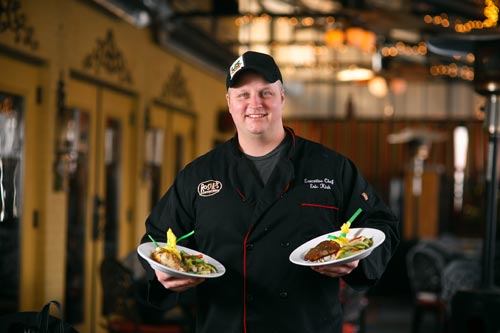
Eric Kish, chef at Rosie’s, said the sea bass is his favorite fish.

Rosie’s owner Phil Barone and chef Eric Kish both called fresh sea bass their favorite fish.

“It’s very moist. You don’t really need to do a lot to it because it’s really flavorful anyway,” Kish said. “It’s very simple and healthy and really tasty.”

The herb marinade is a tweak on an old family recipe.

“It’s very light, not overpowering,” Barone said. “I’ve never found anything better to marinate chicken or fish with. It just gives a little twist, keeps it nice and moist and it’s good for you.”

The Mahi Mahi has a little spice to it, Kish said.

“It’s got that same herb dressing on it, but then we spice it up with some Cajun seasoning as well,” Kish said. “Grilled — that’s the way you want to do it. It’s a steakier fish.”

The herb chicken dish features two 6-ounce pieces of tender chicken.

“It’s simple and healthy,” Kish said. “There’s a lot of flavor, but it’s not bad for you.”

Barone and two of his brothers started Rosie’s more than 30 years ago. The eatery is named after their mother and uses recipes she brought with her from her hometown in Sicily. This year will be the third time Rosie’s has participated in Restaurant Week Toledo.

“It’s grown,” Barone said. “The first year was kind of quiet. Last year, we were very busy and it was fun. I love it when things are hectic. The people I met were very friendly and very complimentary. They really enjoyed Rosie’s, some of them for the first time, which is good for us. It’s why we like to do specials like that, to bring in new people who may not have tried Rosie’s.”

Kish said he was happy to comply with the focus on healthy options.

“It’s what people want, especially now more than ever,” Kish said. “I just think that’s what it’s evolving to more and more. It’s just going to make it that much more popular.”

Bar 145

Chef Robby Lucas of Bar 145 said he enjoyed the challenge of coming up with healthy options.

“No chef likes to be handcuffed and be told, ‘This is what we’re doing,’” Lucas said, laughing. “But every chef likes a challenge so I think if we can get the Bar 145 identity across while staying within those guidelines then we’re better off for it. I definitely got excited for it.”

Lucas came up with an herb-roasted chicken breast with an apple and strawberry winter salad for lunch ($10) and, for dinner ($20), a slow-roasted bone-in pork chop stuffed with spiced apples and served with an arugula salad and a gelato dessert.

“We use an all-natural chicken — hormone-free, antibiotic-free. You can really taste that when you’re eating the meat itself.

“It doesn’t taste processed. It tastes like chicken,” Lucas said, laughing. “As often as people say that, I don’t think people realize what chicken is supposed to taste like.

“With the pork, we actually stuff the pork with the apples and as that cooks together it really infuses the flavor throughout the meat itself.”

Lucas said he’s used to being creative with healthy food because his girlfriend is a vegetarian.

“I assume it gets a little boring being a vegetarian, so I’m always thinking [of new ways to prepare food],” Lucas said and laughed again. “I absolutely love cooking proteins, but vegetables are kind of the unsung heroes in a chef’s world. There’s nothing a chef gets more excited about, especially our vegetables we buy from The Chef’s Garden in Huron. When I open up this crate of Ohio-grown carrots, Brussels sprouts, broccoli and stuff like that, it really gets chefs excited.”

This will be Bar 145’s second year participating in Restaurant Week Toledo. The eatery opened in 2011.

“We had a great response last year,” said Lucas, who worked in Cleveland before moving to Toledo. “Restaurant Week in Cleveland is huge, so when they approached us and said they were doing one in Toledo we absolutely wanted to be part of it and we definitely wanted to do it again this year.”

Bar 145 is known for its burgers, especially its stack-your-own option, but Lucas would love if Restaurant Week Toledo helps spread the word about the rest of Bar 145’s menu, which changes seasonally and offers unexpected twists, such as duck wings in place of chicken wings.

“A lot of times people see bar in our name and they associate us with just bar food. Then they hear the burger in our tagline and think we just do burgers and we are so much more than that,” Lucas said. “Our burgers are great — I stand behind them 100 percent and they are amazing — but our menu encompasses so much more.”

How food is prepared goes a long way toward making it healthy, said Lucas, who started cooking when he was 9 at the Put-in-Bay restaurant his father managed.

“I’m not going to say we’re health-food oriented here, but we serve homemade food from scratch. We don’t have a freezer here. Everything you eat that day is prepared that day,” Lucas said. “Rather than shortening or fat alternatives, we try to use a lot of healthy oils and canola oils that lend themselves well to the flavors we’re trying to accomplish.”

Jake Guthrie, director of operations for Bar 145, recently moved to Toledo from Columbus and said Restaurant Week Toledo brings some of his former city’s “foodie” culture to the Glass City.

“I’m excited. Hopefully it gives people an opportunity to step outside their comfort zone and do something or try something they may not necessarily be prone to do,” Guthrie said. “It’s also one of those things that promote the culinary world in general, where people are excited to go out and dine. And what’s good for one is good for all.”

Poco Piatti

Poco Piatti, featuring Lebanese, Italian and Greek food, is already known for healthy dishes, said Elias Hajjar, owner of the Levis Commons eatery.

The name means “small plates” in Italian and refers to the communal tradition of sharing dishes around the table with everyone trying a little bit of each one.

“Mediterranean food in general is very healthy. We tend to use a lot more olive oil than butter, lots of vegetables, lots of lean meat,” Hajjar said. “We’ve always focused on being healthy and prided ourselves on offering our guests healthy options.”

For lunch ($10), Poco Piatti will offer a choice of chicken shish tawook sandwich, falafel sandwich or poco burger served with a choice of hummus, feta dip or lebanee.

For dinner ($20), diners can choose from two skewers of beef or chicken kabobs or salmon with a side dish. Dinner also includes a choice of chicken wrap, ara-yes or sauteed mushrooms and a dessert.

This is Poco Piatti’s third year participating in Restaurant Week Toledo, and each year has gotten better, Hajjar said.

“We have always believed very strongly in community and eating locally,” he said. “When the opportunity came up to join together with other locally owned restaurants and help charity and promote our businesses at the same time, it was the perfect combination of win-win for us.

“The first year was good, but we were just getting the word out. The second year was much better for all the restaurants.”

Hajjar expects this year to the best yet.

“We’re excited to be a part of it. I really think it’s going to be great.”

Toledo Free Press is a media sponsor of Restaurant Week Toledo.

For more information, visit www.restaurantweektoledo.com.

Newsmakers: Casino answers critics with months of success

0

Hollywood Casino Toledo General Manager Richard St. Jean has plenty to be cheerful about as the casino, which opened May 29, marks seven months in business.

Hollywood Casino Toledo General Manager Richard St. Jean reports success during the casino’s first seven months. Toledo Free Press File Photo by Joseph Herr.

Business is brisk while concerns about increased crime, traffic jams and gambling addictions have subsided.

“Early on, we did our best to assure local residents, businesses and government that a lot of what you hear [about casinos] isn’t necessarily true and won’t materialize,” St. Jean said. “[Rossford has had] virtually no incidences associated with those fears, aside from increased traffic on the Toledo side obviously coming up and down 75. And we’ve heard the same thing from [Toledo Police] Chief [Derrick] Diggs and [Toledo]Mayor [Mike] Bell, so all of our efforts to educate and inform everyone early on have now been validated by what they are actually seeing on a day-to-day basis. We’re very pleased they feel more comfortable with this neighbor in their backyard.”

Penn National Gaming, which operates the casino, is happy with the property’s performance, particularly the volumes, St. Jean said.

“Table games, poker and food and beverage in particular have far exceeded our expectations and slots is actually right around where we expected it would be,” St. Jean said.

Gamblers wagered a total of $126.7 million at Toledo’s casino in November, including $113.2 million on slot machines and $13.9 million on table games. Total wagers were down about 9 percent from the $138.8 million wagered in October, which was also down about 9 percent from the $153.1 million wagered in September, according to monthly reports from the Ohio Casino Control Commission. Taxable revenue in November was $13.6 million, down from $14.8 million in October, $15.9 million in September, $17.4 million in August, $19.1 million in July and $20.4 million in June, the casino’s first full month of operation.

“This dip in business month over month as we settle into the fourth quarter of 2012 was absolutely expected and we expect to ramp up as we head into 2013,” St. Jean said. “We looked at what we’ve seen at other grand openings, particularly in the Detroit market, and we’re really following those trends very, very closely.”

St. Jean said he is proud Toledo’s casino fulfilled its pledge to hire 90 percent of its workforce locally and to promote from within. So far, 55 team members have been promoted once, six have been promoted twice and two have been promoted three times.

The casino is exploring adding more entertainment options beyond gaming, such as a riverfront concert series, car show or food and wine festival.

“There’s still somewhat of a perception I hear that you must be a gamer to come to the casino, which is far from the truth,” St. Jean said.

Director of Food and Beverage Marc Guastella said expectations were high for the casino’s four eateries, but he feels all have delivered.

Guastella hopes Final Cut Steak & Seafood will earn a Forbes four-star rating when the next report is released in spring 2013.

“Four stars is very achievable for us and I’m confident we can achieve that,” Guastella said.

Brenda Schwind, vice president of the Rossford Business Association (RBA), said the casino is a “great partner.”

“Everybody I’ve talked to, even people who were really leery of the casino coming in, are impressed with the facility and I’ve heard nothing but good comments,” said Schwind, of Directions Credit Union. “I think people have been very surprised. They’ve proven to be a very good neighbor.”

Rossford Mayor Neil A. MacKinnon III agreed.

“I’ve been in business quite a while now and I know these guys are sincere and they are for real,” MacKinnon said during a recent Rossford City Council meeting. “I consider them friends and I consider them part of the fabric of the community. Their participation in the RBA has been phenomenal.”

Mayor Bell also feels the casino is a positive asset, said Public Information Officer Jen Sorgenfrei.

“The revenues are definitely aiding the city budget and they’ve been a good corporate citizen, contributing to local philanthropy and supporting community organizations,” Sorgenfrei said. “They are still finding their equilibrium, but remain a positive asset to the region.”

There hasn’t been a major influx of crime like many feared, agreed Rossford Police Chief Glenn Goss Sr. and Sgt. Joe Heffernan, who is public information officer for the Toledo Police Department.

“Whenever you have more people, you’re going to have more issues, but we haven’t had any major incidents that you can point your finger at and say, ퟀ�?That’s the casino’s fault,’” Goss said. “It’s still new. We’re still monitoring. We’ll have to wait and see. There could be good and bad down the road, but as far as law enforcement, it hasn’t really affected Rossford directly, which we’re thankful for.”

Penn National recently presented a $200,000 grant to Rossford’s police and fire departments. The company also donated more than $12,000 to help Rossford Police create a K-9 unit.

“I keep hearing people call them good neighbors, like a cliché, but truly they are,” Goss said. “I think we’re really fortunate to have the casino here.”

Bill McFarland, interim superintendent of Rossford Schools, said the district has had no issues with crime or traffic, as some parents feared.

“We really have seen no effect. We hardly know it’s there to be honest with you,” McFarland said.

“The hysteria and paranoia I think has long been forgotten. I think it’s functioning really well and I don’t think it’s having any negative effect on our community at all.”

Larry Eilert, owner of Larry’s Auto Center in Rossford, said he’s pleased with an uptick in business the casino has created.

“I’ve gotten more customers from there, especially the employee side of it,” Eilert said. “There is more traffic — but it’s a good traffic, not a bad traffic.”

Holley Bockelman, who owns Bock’s Place in Rossford with her father Bill Bockelman, said the casino hasn’t helped business as much as they were hoping, but it hasn’t hurt either.

“Really nothing has changed,” Bockelman said. “We thought it would be better. But the people who do come here are faithful. We get some of the casino workers later at night. Very, very seldom the out-of-towners. The locals will sometimes meet here and then go down there for a little gambling, some cocktails, watch a concert and then come back here. So that’s fun.”

Rossford City Councilman Larry Oberdorf Sr. said the casino has proved detractors wrong.

“A lot of people had apprehensions about Penn coming into this community and I think Penn has answered with good qualification all of those apprehensions,” Oberdorf said during a recent Rossford City Council meeting. “We haven’t had the traffic problems we had assumed or any of the other illicit things some people thought would happen. It’s really a professional organization. I’m extremely happy to have them in our locale.”

For more information, visit www.hollywoodcasinotoledo.com.

Donations Sought for Children’s Shopping Event

0

Local nonprofit Feet on the Street is organizing its fourth annual 12 Kids of Christmas shopping event.

Children are recommended for participation in the program by police department members, school employees, social agencies and family shelters, according to a news release.

The event is set for 8 a.m. to noon Dec. 21. The children will be served breakfast at the Toledo Police Patrolman’s Association Hall, featuring appearances by Santa Claus and Ronald McDonald. Afterward, Toledo police officers will help the children shop for Christmas gifts at Meijer.

After shopping, the group will eat lunch and be entertained by a visit from Spike the Toledo Walleye mascot, Christmas music from Kyle White, Jeff Stewart and Johnny Rodriguez, and animals from the Toledo Zoo.

For more information, visit feetonthestreet.org.
— Staff Reports

Local sponsors make Make-A-Wish benefit CD possible

0
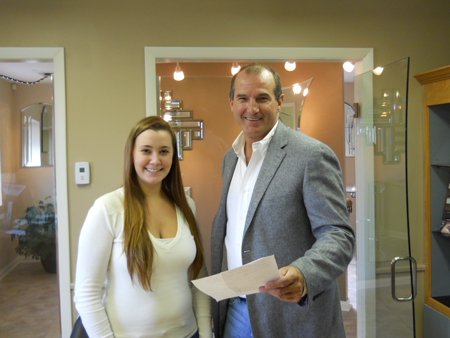
Art McCormick, of A&D Glass & Mirror, and his daughter Ally McCormick. Toledo Free Press photo.

Joe Choate, plant manager of GM Powertrain Toledo, knows the pain of losing a child, while Art McCormick, president of A&D Glass & Mirror in Perrysburg, is thankful for his family’s continued health.

Both men’s companies provided financial support to “Holiday Wishes 2,” a Make-A-Wish benefit CD organized for the second year by Toledo Free Press Editor in Chief Michael S. Miller.

Also supporting the CD were UAW Local 14, WNWO, 101.5 The River, Levis Commons and Panera Bread.

GM Powertrain Toledo, UAW Local 14 and Panera Bread also sponsored last year’s inaugural benefit CD, a 25-track compilation that raised more than $25,000 for Make-A-Wish.

This year’s two-disc package features 44 tracks contributed by local artists. CDs are available for $15 at area Panera Bread stores and select Levis Commons locations. Digital downloads are also available.

Art McCormick, of A&D Glass & Mirror, with his daughter, Ally McCormick.

Because of the local sponsorship, all proceeds will go directly to Make-A-Wish Ohio, Kentucky and Indiana to help grant wishes for Northwest Ohio children with life-threatening medical conditions.

Make-A-Wish does not receive federal, state or local government funding. Wishes are paid for by donations and donations-in-kind. The average cost of a wish is $8,000.

The mission of Make-A-Wish is especially meaningful to Choate, whose 12-year-old son, Matthew, died of a congenital heart defect in 1989.

Although his son was not involved with Make-A-Wish, Choate later served on the organization’s regional board for several years.

“I know what it’s like to have a very sick child,” Choate said. “I found out about Make-A-Wish way back when. [Matthew] never received a wish, but I was always really curious about what they did and how they did it. When I was transferred to Toledo, I was asked to serve on the board.”

Choate heard about the 2011 “Holiday Wishes” CD project from Eric Slough, former executive director of Make-A-Wish Ohio, Kentucky and Indiana, Northwest Ohio Regional Office.

“Eric was telling me about this idea [for the CD] and expressed the need to find someone to fund some of the costs and we jumped on it from year one,” Choate said. “We wanted to help give people an awareness of what Make-A-Wish is all about and what they do for families and to promote the mission itself. That’s why we’re involved in it. We’re looking for Make-A-Wish to be successful at granting wishes. We’re not looking for it to sell an extra car. We did it to help out Make-A-Wish.”

GM Powertrain Toledo has a community relations board that regularly allocates funds to help support local charities and community organizations, including Big Brothers Big Sisters, the American Red Cross of Northwest Ohio, the NAACP and more.

“We’ve been active in the community in a lot of different ways. We stick pretty well to the needs of the community,” Choate said.

“A lot of people in the Toledo area affiliate Toledo with being a Chrysler-Jeep town. We like to get the General Motors name out there too, and make sure people understand we’re a big part of the community as well. The CDs are great. They make nice Christmas gifts. It’s just a unique idea and it’s nice to be able to be associated with that.”

McCormick, whose daughter Ally McCormick is vice president of A&D Glass & Mirror, recently attended a Make-A-Wish fundraiser, where he learned more about the organization and wanted to support it.

“My daughter is partner with me in this company and I just feel very fortunate to have a successful business and a healthy daughter,” McCormick said. “I feel very lucky from the standpoint of having succeeded during the tough times of this economy and am still able to give back. We’re very fortunate.”

McCormick, a Toledo native who has been a Toledo area business owner since 1990, founded A&D Glass & Mirror in 2006. He said he tries to support local nonprofits and organizations, including the YMCA and the Sisters of Notre Dame, whenever possible.

“The opportunity to help arose and Make-A-Wish just seemed to fit into the realm of what we were doing and fit well with me,” McCormick said. “Michael [Miller] was telling me how they do so well with the CDs and being part of that was just a great opportunity for us. Our supporting role is really small compared to others involved, but we’re fortunate to be able to help out where we can. Make-A-Wish is a great organization, it really is. I think it’s very important as a business owner in Northwest Ohio to give back. I try to do everything locally and to give back to my local community.

“It’s a great CD,” McCormick said. “It’s very diverse. It pulls in local talent, which is really great, and again it goes back to the community. That’s what it’s all about, our community. I think as you get older you realize that. Helping each other is the only way you make it through life. We’re very fortunate and lucky to be able to give back.”

Rathbun: Much ado about nothing

0

I am getting very tired of hearing about the severity of the tax increases and spending cuts that are supposed to take effect, but ultimately won’t, on Jan. 1.

Let’s take a quick look at the term fiscal cliff. Once a person or an object goes over a cliff, it is pretty much an irreversible action. No matter how God-like Congress thinks it is, it cannot reverse time or repeal the law of gravity. So going off a cliff is not a proper analogy. Maybe pothole would be more appropriate, especially in Toledo.

Let’s go with fiscal pothole, since it is less fatal but still something one wants to avoid if possible. Now that we have the proper analogy, let’s look at the numbers that are being thrown around and see if they add up. The fiscal pothole consists of $100 billion in mandatory spending cuts and $400 billion in increased taxes.

The $100 billion in spending cuts is not a cut but merely a decrease in the rate of increase of government spending. Four years ago when President Barack Obama took office the highest annual deficit to date was $500 million under President Bush. Since then we have run annual deficits of more than $1 trillion for four years in a row. Will reducing that by $100 billion or 8 percent of the deficit or less than 4 percent of the annual budget, send us over an irreversible cliff? Doubtful.

Next, the $400 billion in tax increases. While I agree that this is bad for the economy and for growth overall, the negative effect will not be felt on Jan. 1 but it will probably take more than 18 months to fully collect the amount of taxes indicated. That is assuming, of course, that those with high incomes don’t figure out how to avoid being assessed those taxes to begin with.

Every time that a government raises taxes on people they ultimately figure out how to avoid those taxes and consequently the government actually collects less in taxes than it did before the increase. Just ask England.

Furthermore, to illustrate the futility of this discussion of raising taxes on the rich, if President Obama gets his tax increases on the “rich” it will only take 500 years of that increase to pay off the 2011 budget deficit! Five-hundred years to pay off one year of deficit. “It’s about math!”

The bottom line is that this is not about revenue, spending cuts or math; this is about power and ego. All of these politicians are only concerned about their own legacies and re-election prospects. They could not care less about the financial condition of the American people, jobs, the value of our money or America’s place in the world.

The new taxes will affect the stock market in the sense that people will sell holdings before the end of the year and next year, if the law stays in place, dividends and capital gains will be penalized. Every dollar that is taken out of the system in taxes is one more dollar that is not available for capital reinvestment and therefore hurts the overall economy.

Jan. 1 may be an additional fiscal pothole for the taxpayers but we are not going off a cliff because of current tax laws and scheduled spending cuts. One could, however, make the case that we are already over the cliff with a $16.3 trillion anvil tied around our neck. But that’s another topic for another day.

Gary L. Rathbun is the president and CEO of Private Wealth Consultants, LTD. He can be heard weekdays on 1370 WSPD at 4:06 p.m. on “After the Bell” and every Wednesday and Thursday at 6 p.m. throughout Northern Ohio on “Eye on Your Money.” He can be reached at (419) 842-0334 or email him at [email protected].

Retirement Guys: Mapping out a financial inventory

0

Sometimes one of the hardest parts of financial planning is getting started. The average investor has saved and accumulated a variety of financial and insurance accounts over the years. Putting it all together can seem like a daunting task. But it is important to take time to create a financial inventory to eliminate inefficiencies and keep everything up to date. The way to get started is to map out the financial plan in a few easy steps by creating an inventory and action plan.

Organize all of the financial accounts and documents and take an inventory of everything. The inventory should include all of the personal information for the individual and his or her spouse, such as name, date of birth and Social Security number. It is also helpful to gather all of the personal information on the children as well as their addresses, as this will often be used for updating the beneficiary forms if needed. Then organize the documents into file folders in the following categories, investment statements: company benefits, taxes, estate plans, insurances, and miscellaneous.

Make a note in each folder as to the last time a comprehensive review was done on each category. If there is a specific purpose or a concern about any financial account, make note of that as well.

The next step is to take all of the information gathered in the inventory and put together a one-page summary. The goal of the summary is to have a quick, handy reference guide that gives the average investor a good overview.

The sections to include on the summary are current investments; current and future income sources and needs; tax distribution of the accounts between taxable, tax deferred and tax free; and current insurances. Next to each investment and insurance account, put the account numbers and where the account is held.

Also include whether the account is safe or risky.

Now start to put together an action plan on items that need to be addressed. Look for opportunities and/or threats. When I create action plans, I separate observations into categories for investment planning, tax planning, estate planning, insurance planning, liabilities and any miscellaneous items. The investor can use the one-page summary to take a look at how much risk they are taking, how much money they have in each tax category and what type of income needs there will be in retirement, as well as making sure the surviving spouse is protected in the event of a premature death.

The person creating the financial inventory and map should now go back and look at each folder that was created when they were organizing their documents. Review any notes in each folder and put those notes on the main action plan.

As the person reviews each folder for more action items, a thorough review should be done on the current investment fees and expenses as well as the current yield on the accounts. Review the beneficiary designations on all financial and insurance accounts. Be sure to include the beneficiary’s full name, date of birth, Social Security number, physical address and the exact percentage you are leaving that person. As these items are discovered, include them on the one-page summary.

At this point, the average person should have a pretty good overview of their entire financial picture, a detailed inventory along with a one page summary and a list of action items to address.

If several items are listed on the action plan, prioritize the list and set deadlines to get each category accomplished. We recommend that the individual or family work on one section at a time. For example, complete all investment planning action items before moving on to estate planning.

Now all you need to do is take action!


For more information about The Retirement Guys, tune in every Saturday at 1 p.m. on 1370 WSPD or visit www.retirementguysnetwork.com. Securities and Investment Advisory Services are offered through NEXT Financial Group Inc., Member FINRA / SIPC. NEXT Financial Group, Inc. does not provide tax or legal advice. The Retirement Guys are not an affiliate of NEXT Financial Group. The office is at 1700 Woodlands Drive, Suite 100, Maumee, OH 43537. (419) 842-0550.

Shawn Colvin talks about new book, disc

0

Relationship drama, alcoholism, depression — Shawn Colvin has dealt with it all and survived, thanks to one friend.

“To say [music is] something I’ve turned to in times of trouble is almost an understatement; it’s just been my constant companion,” Colvin said.

“I grew up surrounded by [music], listening to it. I think a lot of people do and that doesn’t necessarily mean that they fell in love with it the way I did. I find so much solace; it was both comforting and inspiring. And then to top it all off, I could sing.”

Colvin tells her story in “Diamond in the Rough,” a memoir that shares the title of a song from her Grammy Award-winning disc, “Steady On.” Released in June, the 240-page book mirrors her music, which is honest and witty.


Shawn Colvin

“I’ve had to have humor; that was necessary,” she said with a laugh during a call from her home in Austin, Texas.

She talked about being upfront about her struggles.

“Part of my salvation has been people who have been willing to be open and honest with me, people who have suffered from alcoholism and depression.

“When you hear honesty from people who have actually gone through something that you’re going through, it’s about the most helpful thing there is, I would say. So I like to give that back.

“And I’m just so used to this feeling that comes with being honest about things that people don’t necessarily still like to acknowledge or talk about it,” Colvin said.

The singer also wrote about the stories behind her songs, including “Get Out of This House,” “Fill Me Up,” “Shotgun Down the Avalanche” and “Sunny Came Home,” which won Grammys for Record of the Year and Song of the Year in 1998.

“All Fall Down,” Colvin’s eighth studio CD, also came out in June. Recorded in Nashville, the disc features several guests: Alison Krauss, Mary Chapin Carpenter, Jakob Dylan and Emmylou Harris.

“My producer, Buddy Miller, is well-loved, deeply respected, and records in his home, and there’s this kind of open-door policy,” she said of the added star power.

Colvin will play a solo show at 8 p.m. Dec. 12 at the Ark in Ann Arbor. Tickets are $42.50. Doors open at 7:30 p.m.

“When I go out and sing, it’s generally by myself, and it’s just a very pure experience that I appreciate more and more as time goes on because as natural as it feels to me to go and entertain by myself, as the years go by, I’m just more and more appreciative that people still come and the fact that it’s my responsibility to take care of them for that hour and a half by myself.

“It’s almost more daunting than it used to be; in your youth, you take things for granted and you’re cockier,” she said and laughed.

“So it’s an extremely rewarding experience all around for me because that expression for me is vital, and my communication with the audience and their trust in me to move them is also invaluable to me; I need it.”

Allegrini: Freedom vs. license

0

Recently, I survived my 11th Black Friday, the busiest shopping day of the year. Working in retail this time of year is amazing because I never know what I will witness. There were hundreds of people waiting to get “the deals.” The biggest Black Friday 2012 sensation was $25 video games, normally $59, so it was a great deal for avid gamers.

With the sale beginning at 8 p.m., people lined up as early as 5 p.m., and as sale time approached, the lines grew and the demeanor of those standing in line became tense. People tried to cut in line while countless others tried to sneak around the back, hoping to just grab a game and run.

The potential to lose control of the anxious crowd grew, and two police officers began to intervene. With their best authoritative voices, they told the customers how things were going to proceed as 8 p.m. approached. The amazing thing was that once the sale started, the crowd followed the police officers’ directions, and the sale went off without any rushing, fights or punches thrown. That was good news — this would not be the Black Friday that would land our retail location in the headlines.

As I reflected on the “good news” of the day, I realized that this news was in reality, not so good at all. The demeanor of the crowd that I experienced, along with the necessary intervention of the law, was quite indicative of the state of the culture.

The experience proved that if citizens are unable to regulate themselves and act in a civilized way, it is necessary to have an outside agency control their actions. Americans are fond of talking about wanting freedom and how “rights” are deserved, but those same people forget that with those freedoms and rights comes the acceptance of responsibilities.

In today’s society, Americans mistake “license” for freedom.

When people “take license,” they believe they can do whatever they want with no limits. License is the throwing off of all responsibility. It is carte blanche to do as one feels, because one wants to. It is a very selfish and childish way to live life. In this manner, right and wrong is derived from self-interest, with no regard for the effects of actions on others or on society.

Freedom is having the choice to do what ought to be done. Freedom means doing what one is meant to do, but freedom has to have boundaries and responsibilities. The challenge of freedom is accepting the responsibility of to act in a way that can support and nurture a society that allows freedom to flourish.

If people want freedom, they have to accept the responsibility that comes along with it. There is a reason that freedom has been such a rarity throughout human history, because it is hard. License is much easier because one just does whatever one feels like doing, without worrying about anyone else.

So there is a choice. Do people accept responsibility for the effects that their actions have on others and society in general, or do they just do what they feel like doing?

Choosing freedom is the only way that the nation can continue to grow. My grandfather’s family did not come here so that they could do whatever they felt like, they came here because they recognized that in the United States, if they worked hard and followed the rules, they could achieve the American Dream and become the best version of themselves. That is the attraction to freedom — the opportunity to work hard and reap the rewards that come from becoming the best version of oneself.

If society continues to digress into a culture of license, history shows this will lead to an authority dictating people’s actions, because they can’t. License leads to hundreds of people willing to do anything in order to get a cheap video game. What happens to others is not of concern, as long as they get the video game. This approach always leads to the same ending, an authority controlling actions. When people cannot control their own actions, authority steps in, whether it’s parents, teachers, neighbors or, eventually, the state. If society continues down this path, it ends with the police controlling the actions of the people.

So I ask you to think about how much you value freedom. Because if citizens want to keep freedom, they need to act in a way worthy of it, and accept that there are times when people must act selflessly and in ways that will create a better society, even if that means we don’t get our way or the cheap video game.

Email columnist Scott Allegrini at [email protected].

Barhite: Zepf Center needs donations for its holiday store

0

Josie Allen cannot afford to buy much for her family at Christmas. Everyone is limited to one gift each.

But last year her family was selected to participate in the Zepf Center’s Adopt-a-Family program, so her children received multiple gifts.

They opened sweat suits, games and even received a PlayStation 2.

“I would not have been able to provide that,” Allen said.

These gifts were possible because two of her teenage daughters (one is a relative whom she considers a daughter) receive services at the Zepf Center, which provides behavioral health and vocational help to youth and adults with mental illness.

The nonprofit also hosts a holiday store as part of its December outreach. Donations are still needed for the store, as well as a volunteer to play Santa on Dec. 19.

I learned more about the Zepf when my sister began to work there. Last year, I helped adopt one of the 40 families. This year, I am having my BGSU students collect hygiene products like toilet paper, toothbrushes and shampoo for the holiday store.

Families who are selected to participate can shop for new and used clothes and toys, as well as the hygiene products I am gathering. Video games, DVDs, crafts and Hello Kitty merchandise are some of the most-requested items. Everything is free.

Zepf employee Kim Middleton said for some clients and their families this is the only resource for celebrating the holidays.

“Last year, with the help of Toys for Tots, we were able to provide over 200 children with two new toys for each client and their siblings in the household,” Middleton said in an email.

Zepf was able to provide families with new and gently used household items, as well as cleaning supplies.

Things that most people consider everyday necessities are luxuries to some Zepf families, Middleton said.

“One mother was overjoyed because we were able to give each family a new laundry basket filled with laundry detergent, food and paper products. She was so excited over a four-pack of toilet tissue, I thought she was going to cry,” Middleton said.

To donate, drop off items at the Zepf Center, 6605 W. Central Ave., or at its 905 Nebraska Ave. location. Hours are 8:30 a.m. to 4:30 p.m. Monday through Friday.

Former pastor discusses new book on atheism

0
Jerry DeWitt spoke to Great Lakes Atheists Dec. 3, 2012. Photo by David Yonke.
After 25 years of preaching about God, hell and salvation, Jerry deWitt just couldn’t take it anymore.
For too long, he said, he’d been preaching messages he didn’t believe.
Last year, he reached a point where he had had enough of living a lie. He quit his job as a Pentecostal pastor, dropped out of church completely and declared to the world that he was a nonbeliever.
“I committed identity suicide,” deWitt said in a talk Dec. 3 in Toledo.
The 43-year-old Louisiana native is traveling the country to promote his book, “Hope After Faith,” scheduled to be published next spring by daCapo Press.
Walking away from his job as a pastor was a gut-wrenching decision, one that deWitt wrestled with for years.
He knew he wasn’t just leaving the ministry, he was leaving the only world he had ever known. Virtually all of his friends and his church community abandoned him, he said. He claims he was fired from his city job by his best friend because of the controversy caused by publicly doubting God’s existence.
DeWitt, well-spoken with a strong southern accent, spoke informally to 10 people from the Great Lakes Atheists and the local branch of Recovering From Religion, seated around conference tables in a room at the Washington Branch library.
“When word got out, I wasn’t surprised about how many people suddenly thought I was going to hell. But I was surprised at how well they were taking it,” deWitt joked.
He was “humiliated” to go to bankruptcy court to save his house. His wife left him — not for dropping out of church but because of the pressures of being married to “the most hated man in town.”
“I can tell you the rejection of the community, because I was such a people-pleaser, has been grueling. It has had me more than once on the verge of suicide. If it wasn’t for my son, my 20-year-old son, then there’s no doubt I wouldn’t be here,” deWitt said.
One of the reasons he stayed in the church and the pastorate so long was that he didn’t want to destroy his family’s lives.
“Life’s not just good for me, life is also good for my wife, my soulmate. Life is also good for my son, the young life I want to shape and mold into a real man and send off to college,” deWitt said. “And I’m going to screw all of that up because it bothers my conscience [to preach]?”
DeWitt grew up in church. His paternal grandfather was an Assembly of God preacher and his maternal grandparents were leaders in the United Pentecostal Church. Some of his earliest memories were of being prayed for by church members in the sanctuary, and resting his head in his grandmother’s lap as she prayed in tongues.
“I really grew up thinking I would be a preacher,” he said.
At 17, he attended a church camp meeting in Baton Rouge, La.
“And lo and behold, it does its thing and I get saved at Jimmy Swaggart’s church,” deWitt said, triggering moans and groans from the Toledo atheists.
“I mean a really true blue,100 percent experience. It was truly life changing,” he said.
He started preaching at age 17, became an evangelist at 19, and later served as a pastor of two Pentecostal churches.
His first doubts came early, he said, finding it hard to believe that a loving God would condemn most of humanity to hell. And it was a struggle trying to understand why God didn’t heal some of the most devout Christians, he said.
“I will never know that there isn’t a God,” deWitt said. “Based on the evidence, I gladly say atheism is my opinion, and that may change. Humanism has always been my motivation.”
He has found a new calling, so to speak, telling people about his personal journey from Pentecostal pastor to nonbeliever. He is motivated to help the “thousands and thousands of people across the United States” going through the same struggles.
“I pastor. I know atheists don’t like that word, but I pastor every day. I pastor via e-mail, Facebook, phone calls, in person. … I pastor through Recovering From Religion. I pastor, and that’s the joy of my life. That’s what I live for.”
David Yonke is the editor and community manager of Toledo Faith & Values (ToledoFAVS.com), a website that provides in-depth, nonsectarian news coverage of religion, faith and spirituality in the Toledo area.