Home Blog Page 228

Second neighborhood improvement initiative kicks off in Toledo

0

Several city officials and businesspeople, including Mayor Mike Bell’s office and the Inspection, Neighborhoods, Public Service and Public Utilities departments, kicked off Toledo’s second year of Spring Sweeps, an initiative striving to better the city’s housing
and building stock, on March 27.

“These Spring Sweeps are very crucial to the quality of life for people in different areas of our city,” Bell said during a news conference at East Toledo Family Center on March 27.

“It is a very aggressive process to make people feel assured that their city cares about them,” he said.

The initiative’s soft launch started March 20 and the program ends June 1.

The first part of the sweep will focus on East Toledo before going into the United North, Broadway Corridor and Overland Park areas. As part of the initiative, the city’s Division of
Code Enforcement is conducting inspections and handing out door tags that include information on assistance programs. Discount codes to local hardware stores are also available.

Spring Sweeps also includes police participation. In a 10-day targeted enforcement operation in March, police arrested more than 200 people in East Toledo areas where higher than average crime rates were reported.

At the news conference, Police Chief Derrick Diggs said that maintaining neighborhoods is important because vacant or rundown buildings can attract crime.

The sweeps also feature a neighborhood cleanup day where school and community groups will help out.

East Toledo’s is set for 9 a.m. to noon April 27, starting at East Toledo Family Center. Last year’s program focused on West Toledo.

“The feedback from last year was very positive. If anything, the residents in the areas we targeted wanted more information about their neighborhoods,” said Chris Zervos, director of inspection. “[Residents] not only took care of their own properties but they helped their neighbors take care of theirs.”

This year’s Spring Sweeps tackles 8,000 properties, down from 17,000 last year, said Dennis Kennedy, manager of code enforcement.

“We focused our areas down. We’re a little bit smaller this year so the neighborhoods get more attention from the inspectors instead of doing a larger blanket sweep,” he said.

Rathbun: Be careful where you get your hair cut

0

We have had a lot of interesting news the past several days out of Cyprus. It all started March 14, when Cyprus became the fifth country to receive a bailout from the European Union (EU). The interesting aspect of this is that it became a “bail in” instead of a bailout.

A bail-in takes place before a bankruptcy, and generally involves the losses being imposed on bondholders. This has rarely taken place throughout the euro crisis. (Remember a while back, Greek bondholders took a haircut on the bond value at one point in the Greece
meltdown.) In fact, the government (taxpayers) consistently makes the private sector whole.

This bank rescue in Cyprus is no exception, except this time there is a bail-in, not of bondholders but of depositors. This is a direct contradiction to the usual legal claims on the capital structure. Think about this: Instead of the bondholders and/or stockholders shouldering the risk of failure, the depositors are paying for the rescue!

Obviously, the powers that be knew that this would be a problem and called for a bank
holiday for March 17. This quickly became such a major issue with people trying to get
their money out of the banks via ATMs, that the bank holiday was extended to March 28 as
of this writing.

Taking money out of a depositor’s account without any consideration other than that the money is there is a direct assault on individual property rights and every one of us that
lives in the developed world should pay attention. If this should actually go through, not only would this become a serious contagion of panic across the rest of the EU but it would spread to other countries as well.

Why would anyone put money into a bank account if at any given time the government could reach in and confiscate whatever amount it wanted without due process, simply because the money is there?

Equally disturbing are three other stories or situations related to this. The first is that
the American Bankers Association this week came out with a statement simply stating
that the situation in Cyprus has “no implication for depositors in U.S. institutions. Depositors in U.S. banks are insured up to $250,000 and no insured depositor has ever lost
money in a bank failure.”

The second was an article from The Wall Street Journal that states that 57 percent of Americans have less than $25,000 in savings and investments, thereby freeing those
unwealthy individuals from being subjected to the same confiscation threshold as Cypriots.

And finally, the fact that New Zealand has legislation in process, namely the Open Bank Resolution, that says that all depositors of a failing bank will have their savings reduced to fund big bank bailouts.

Could it happen here? Doubtful.

But then again, I thought it was very doubtful that we would have national health care and go to a onepayer system, and yet here we are.

We do have the Federal Deposit Insurance Corporation (FDIC). However, the FDIC has $25 billion in reserves against $3 trillion in deposits, so we should feel very comfortable
about that.

I am at the stage of my life where I rarely need a haircut and when I do, it’s a five minute ordeal. But when it comes to my deposits getting a haircut, I am at a stage in my life where it is a much larger deal than when I was 25. I am not going to withdraw all of my money out of the bank (yet), but I am going to stay diligent. If I think a late-night haircut is coming our way, I will act and act quickly.

Gary L. Rathbun is the president and CEO of Private Wealth Consultants, LTD. He can be heard every day on 1370 WSPD at 4:06 p.m. on “After the Bell,” every day on the Afternoon Drive, and every Tuesday, Wednesday and Thursday evening at 6 throughout
Northern Ohio on “Eye on Your Money.” He can be reached at (419) 842-0334 or email him at [email protected].

Retail or custom fit?

0

Have you ever had the opportunity to get a custom fit suit of clothes tailored to fit you? If you have, you really appreciate what a nice feeling this is and what a difference in how your clothes feel and look. I (Mark) can remember as a young boy my dad taking me to
a tailor who took my measurements to make me a nice suit. Now mind you, we were not rich. My dad was a missionary in Korea, and it was very inexpensive to buy a custom tailored suit. My dad taught me how to dress and that if you look good it really has an effect on how you feel. You feel great. You look great. I definitely notice the difference when I see someone wearing something that is ill-fitting. My dad also taught me that when
you go shopping for clothes, get dressed up so you look sharp. The sales person will treat you much better and will be more inclined to want to help you. I have followed dad’s advice and believe me it works. Try it out for yourself.

It seems that anything that is customized to your specifications is much better all around. It works better, feels better and has a positive impact on whatever you are doing. I always wondered how cowboys keep their hats on their heads when riding a horse. You would thing that because of the wide brim on the hat that it would blow off every time. I recently went to a business conference in Dallas and the hosts of the conference offered a custom
fit cowboy hat for everyone there. I thought that was really cool. There were people there that helped you pick out your hat and then custom fit it to your head. They had stretchers and steamers and kept putting the hat on your head and taking it off until they had fit it just right. I now understand how the hat stays on the head. My hat is fitted perfectly and will not come off if the wind blows. Living in Ohio will probably not give me the occasion to wear it too often, but I actually got to wear it again when my little sister Michelle took me to the rodeo in Houston. Good times!

Why is custom fit such an important idea to The Retirement Guys? People come into our office everyday and share with us where they have their retirement money invested. When
we look at it, we typically see a lot of the same kind of stuff. We call it retail. The kind of
stuff anyone can go to the store and pull off the shelf. The same whether you have a
little money or a lot. What we are then able to do is enlighten those that meet with us that
there may be things available to you that you have not been made aware of. Things that are more customized to each individual situation. Some of these things are because of new technology. There may be things like “circuit breakers” that provide some potential
protection against large downward movements in values of certain types of investment accounts.

Other things may be available to folks that have a higher net worth. Many don’t realize what they are worth until they start adding it up. They don’t realize that they may qualify for some more favorable things that can be customized to their situation. They also may qualify for discounts they did not know they could get.

What to do? Check into it. As the saying goes, “you don’t know what you don’t know.” Find out what a custom fit feels like. Find out if you can be doing things more efficiently that can lead to a better result. You may be very glad you did.

One way to do this is to get a copy of “The Essentials to Investing.” You can go to www.retirementguysnetwork.com to request a free copy.

Remember, the next time you go shopping for clothes, dress up. See what happens.

For more information about The Retirement Guys, tune in every Saturday at 1 p.m. on 1370 WSPD or visit www.retirementguysnetwork.com. Securities and Investment Advisory Services are offered through NEXT Financial Group Inc., Member FINRA / SIPC. NEXT Financial Group, Inc. does not provide tax or legal advice. The Retirement Guys are not an affiliate of NEXT Financial Group. The office is at 1700 Woodlands Drive, Suite 100, Maumee, OH 43537. (419) 842-0550.

Fisher presents improvement program in Toledo

0

Former Ohio Lt. Gov. Lee Fisher, now president and CEO of CEOs for Cities, a membership network of innovators and leaders in urban areas, made two presentations in Toledo on March 28.

“We’re not just CEOs even though our name implies that. We’re change makers. Anybody who considers themselves a change maker, in other words committed to making positive changes in their city, is qualified to be a member of our team. And what we do is we share smart ideas and practices for making a city successful,” Fisher said, adding that members are all ages and ome from many sectors.

Cities like Cincinnati, Cleveland, Milwaukee and Memphis, Tenn., have had success with the program, Fisher said.

Fisher, who has led the organization since May 2011, said that with 65 million people moving to cities every year, urban areas are crucial. He travels to a different city every week with his job.

HisToledo presentations were at Toledo City Council’s chambers and the University of Toledo’s Libbey Hall and attended by several city officials.

“Here’s what we do — we curate ideas. We take the ideas that we see around the country every day and we identify the ones we think are the most interesting and best ones and we connect people — we do regional meetings; we do national meetings,” Fisher said.

These ideas include Cincinnati’s revamping of its Over-the-Rhine area and Grand Rapids’ GRid70, which enables creative employees from top corporations in the area to work in the
same building and share ideas.

There is a $25,000 fee for a two-year membership. CEOs for Cities has about 350 individual and organizational members and 11 “cluster” members who can share the membership and work together, Fisher said.

“Clusters” are a “team of cross-sector, cross-generational leaders committed to the economic success of their city,” according to the website. Membership includes discounted or free attendance of meetings where ideas are shared.

Sue Wuest of UT Urban Affairs was one of a few UT employees who attended a CEOs for Cities meeting recently. She said she enjoyed the variety of people comfortably conversing at the March 2012 meeting in Cincinnati.

“It was like the nexus of high-level and mid-level business folks, high-level and mid-level university folks, students, young entrepreneurs and community organizers,” Wuest said.

While Fisher was in Toledo, he also met with representatives from UT, Toledo Community Foundation, Regional Growth Partnership and the Mayor’s Office.

Mayor Mike Bell said the group will discuss the decision to potentially join as a cluster and split costs April 2. Bell said the program appealed to him because it would connect Toledo with other cities going through similar situations like a water-rate hike.

CEOs for Cities has several criteria for evaluating cities. The group uses what it calls CITY Vitals, which measures how connected, innovative, talented and distinctive a city is.

Wuest said the CITY Vitals could be helpful in serving as benchmarks, which are useful for applying for grants and setting goals.

The program also promotes setting several 1 percent goals like improving college attainment by just a percentage point. This could potentially raise Toledo’s per capita income by $600 million per year, Fisher said.

The national meeting is set for Sept. 29 in Grand Rapids. Bell said the Toledo representatives would potentially like to attend that meeting. For more information, visit www.ceosforcities.org.

Toledo Council member urges support for Wear Blue Day

0

Toledo City Council will vote at its April 2 meeting on a resolution encouraging residents to participate in Wear Blue Day on April 10.

The second annual event, organized by Lucas County Children Services (LCCS), is meant to
“unify our community in a commitment to keep children safe from being abused and neglected,” according to the resolution.

April is National Child Abuse Prevention Month.

“People need to know they are not alone in caring for kids,” said LCCS Public Information Officer Julie Malkin. “It’s simply getting the word out that it’s important to be passionate about this.”

LCCS Assessment Manager Cary Brown said she hopes seeing widespread community support might encourage someone to report suspected abuse or neglect.

The agency’s hotline, (419) 213-CARE (2273), is staffed 24 hours a day, seven days a week. Reports can be left anonymously.

“Child abuse and neglect continues to be a concern in the Toledo area and members of Toledo City Council urge our community to stand up to protect our most precious resource,
our children,” the resolution reads.

“It’s very important because we need to eradicate child abuse in our community,” said Councilman George Sarantou, the resolution’s sponsor. “Every day we’re reminded of child abuse in Toledo and throughout Northwest Ohio. It’s very important to urge people to be aware of it, report it and do something about it. It just can’t be tolerated. Children are very innocent and they certainly deserve to live in a positive environment and not go through child abuse, which as we know can have lifelong negative effects on a human being.”

Speaker: Religious liberty ‘vital and vulnerable’

0

From the writings of the Founding Fathers to headlines in the news today, religious liberty has long been a “vital and vulnerable” concept in the American experiment, according
to Richard W. Garnett.

A professor of political science at the University of Notre Dame known for his expertise on the First Amendment, Garnett spoke on “Challenges to Religious Freedom in America Today” at the University of Toledo on March 26.

Garnett, whose latest book, “Two There Are: Understanding the Separation of Church and State,” will be published by Cambridge University Press, said he believes that religious
freedom, including the freedom to reject religion, “is a human right grounded in dignity and essential for human flourishing.”

He said the nation’s Founding Fathers considered religious freedom to be “a crucial prerequisite for the success of this new political experiment.”

One of the most visible flashpoints on religious liberty today is the federal mandate by the Department of Health and Human Services (HHS), which requires employers to provide
birth control and some abortifacient drugs to employees even if such provisions violate the religious tenets of employers such as Catholic hospitals and colleges.

The resolution of the HHS mandate is still being determined in courts and administrative actions, Garnett said, but similar church-state tensions date back to the American Revolution and span a broad range of issues today.

Religious freedom controversies in the news include whether schoolchildren should be required to say the words “under God” when reciting the Pledge of Allegiance; whether the Ten Commandments can be displayed in a courtroom, and if government meetings can open with prayer.

“Engaging questions like these require us to dig down a bit and to identify the foundations and the context of the freedom of religion,” Garnett said.

He cited an observation by President Bill Clinton that religious freedom is “literally our first freedom.”

“His point, to be clear, was not simply that religious liberty happens to come first in what we now have as the Bill of Rights; his point instead was that the freedom of religion was central to the founders’ vision for our new political community,” Garnett said. “To say this is not to say or claim that America is or was or should be a ‘Christian nation,’” he added.

“It’s just to observe that our Constitution was not designed to displace or defeat religion, or to displace faith with state worship. Its aim instead was to build a stable, enduring political community that would be stronger precisely because it recognized that religious freedom is foundational.”

The First Amendment’s legal structure allows the flourishing of what Pope Benedict XVI referred to with admiration as America’s “healthy secularity,” Garnett said, adding that it is
human nature to be both political and religious and “nothing in the text, history or structure of the Constitutions requires us to deny this.”

The religious freedom protections included in the Constitution were not “accidents” or “aberrations,” Garnett said, but designed to safeguard and support religion “so it can flourish” and “to protect everyone, believers and nonbelievers alike, against coercion on religious matters.”

He suggested there are three approaches toward religious liberty:
-“Freedom from religion,” which considers religion “as a social reality but regards it as somewhat of a danger to the common good.”
-“Freedom of religion,” emphasizing toleration and neutrality, and treating religion as “something that matters to many people and so the law should not single it out for special discrimination or hostility.”
-“Freedom for religion,” an approach Garnett said is most consistent with the vision of the Founding Fathers and American ideals.

“According to this approach, the search for religious truth is acknowledged as an important human activity. It’s willing to say that religion is special — so special that the government ought not to interfere with it or direct it.”

Describing religious liberty as “robust but incomplete,” Garnett urged Americans to be “proud but also vigilant.”

David Yonke is the editor and community manager of Toledo Faith & Values (ToledoFAVS.com), a website that provides nonsectarian news coverage of religion,
faith and spirituality in the Toledo area.

Troy Neff back on radio — sober, more open than ever

0
Troy Neff said he has not had a drink of alcohol sInce a January 2009 OVI. He has returned to local radio with ‘Rebel Financial Radio with Troy Neff. Toledo Free Press photo by Joseph Herr.

Four years after his life publicly imploded, Troy Neff has returned to radio as a financial talk show host.

Neff’s unraveling began Dec. 10, 2008, with a road rage incident that resulted in his stabbing.

The next day, Clear Channel yanked his WCWA show.

After the stabbing, Neff vowed to be back on the air in 2009; however, his life — professionally and personally — continued to tank.

On Dec. 17, 2008, Toledo Free Press dropped his financial planning column for plagiarism.

Shortly after, he was charged with assault for the road rage incident.

Then in the early morning of Jan. 19, 2009, after an angry night of drinking, Neff got arrested for OVI (operating a vehicle while intoxicated) en route to his home in Curtice after almost running a police cruiser off the road.

Every incident resulted in media scrutiny that put Neff and his business, Advance Retirement Solutions, in peril. Not in the headlines was the news that his marriage was falling apart, his relationship with his daughter suffering.

“The marriage problems were already happening, but certainly nothing helped, especially at the end with all the drinking,” he said.

Four years later, Neff’s return to radio isn’t marked by resolution in all areas of his life. His divorce isn’t final; his relationship with his college-aged daughter is still on the mend.

Troy Neff said he has not had a drink of alcohol sInce a January 2009 OVI. He has returned to local radio with ‘Rebel Financial Radio with Troy Neff. Toledo Free Press photo by Joseph Herr.

“I will always be working on that. The amends we make to certain people in our lives we make for the rest of our lives. I never abandoned her during that time, but between her mom and I, it was very difficult.”

Neff was engaged for a while, but it didn’t work out; he dates, but nothing overly serious. His biggest accomplishment since last being on air is his sobriety. He said he has not had a drink since his OVI.

“I have been four years sober now. I needed to get things in my past and have them far enough in my past,” the 44-year-old said.

This time Neff’s show is devoted to financial news, his specialty, and is not trying to be a combination of Howard Stern and Rush Limbaugh, he said.

While this difference is notable, Neff is as open as ever and just as willing to say exactly what he thinks. He is tanner, fitter and more inked, too.

Fittingly, his new Clear Channel show is called “Rebel Financial Radio with Troy Neff.” The 30-minute show on WSPD airs Saturday at 6 a.m. and re-airs at 9:30 a.m. Sunday. Like last time, Neff owns his show and pays for the air time. He hopes to attract new clients.

“Part of me being successful, both good and bad, was having a little bit of a chip on my shoulder,” said the Genoa High School graduate. “You weren’t supposed to be successful in the financial business getting there the way that I got there. Most of them went to college, and I don’t know if they like that I get to play in their stadium.”

‘This is a disease’

No one can accuse Neff of slacking. When he does something, he goes after it with every ounce of energy and passion he can muster. Even his fitness regimen (and three gym memberships) demonstrates this commitment. That’s why admitting he can’t drink responsibly is so hard.

“Being somebody like me who has had other success in business and such, you beat yourself up because people think that I don’t have the willpower. My willpower is as strong as anybody’s willpower. This is a disease.”

Neff started drinking as a teen, even to the point of blacking out. There were periods where he tried to get sober in his 20s and was fairly successful for a few years. When Neff lived in Michigan, he went to Alcoholics Anonymous for a bit. When he returned to Ohio, he made the mistake of not getting a new sponsor. He thought he could control his drinking. He can now say, “Not in any time in my life was I ever able to control it.”

Neff’s drink of choice was vodka. He would try many tricks to keep his drinking under control. If he only had a certain number of  drinks, he would be fine, he thought. If he had a certain type of alcohol, he could manage it.

“I started whenever my day was done. If my day was done at 4, 8 or 9, it didn’t matter. I would be out most weekdays to midnight or 2 a.m. and then I would be up at 4:30 a.m. on the radio. That was my day, every day. I don’t know how I did it. I was burning at both ends and in the middle.”

As a businessman and a biker, he is still around alcohol all the time. He can manage the temptation these days and said with certainty he will never have another drink.

“I believe that everyone is allowed a certain amount of alcohol in their life and I reached my allotment early,” he said. “It is about the environment you put yourself into. Some people are not comfortable being around it.”

Neff said the OVI was his “Come to Jesus moment.” He had driven back from Pittsburgh that day angry because Clear Channel had pulled his press pass for the Steelers playoff game. He went to Moe’s Place in Rossford and drank alone.

“It happens when you are ready. Sometimes things have to get bad enough for you to want change. Most people in their lives put up with a certain amount of things they rather not put up with; they don’t make a change until it gets bad enough.”

‘Just don’t do it again’

While drinking was not directly related to his road rage, Neff said it affected his mindset.

“He was spiraling pretty bad,” said his former producer Jeremy Baumhower. “I knew he had issues. I would hear his road rage on the phone at 5 a.m.”

On Dec. 10, Neff’s rage peaked. He was returning to his financial office in Perrysburg Township after helping the girls’ soccer team at Lake High School with weight training. Neff slammed on his brakes and honked at a man who had pulled out in front of him.

The out-of-towner, Jeffrey Hardeman, allegedly flipped him off. Arguing ensued, and Neff got out of his vehicle. Hardeman shoved him, he said, and Neff picked him up, slammed him to the ground and punched him.

“As I was getting up, I realized I had been stabbed,” Neff said. “I thought I was in a fist fight. I wasn’t beating the guy to an inch of his life.”

The next day, Michael S. Miller, editor in chief of Toledo Free Press, filled in as the guest host on Neff’s show. On pain meds from the stabbing, Neff called in to talk about his wounds and then said, “Apparently people got a memo at WSPD from Brian Wilson not to mention the story, not to mention my name at all today. I’d just like to say that Brian Wilson can go screw himself.”

Neff also sent an email to Wilson telling him “to go f*** himself.” Clear Channel owns WSPD in addition to WCWA and subsequently, his show was canceled.

“My clients really stuck by me and that meant everything. I reached out to so many when this happened,” Neff said. “I am good at what I do; I mean good. It had nothing to do with their accounts. Many of them have privately had DUIs. My clients gave me sympathy because of how big the story got blown up.

“They are yelling in their cars, minus the getting out, and thinking, ‘That could be me.’

“The clients were like, ‘Just don’t do it again.’”

Joe Clement, a financial adviser with Neff’s firm, said the staff worried about him but never thought about leaving him.

“There was no way any of us were going to turn our backs on him,” Clement said. “We have all had our problems; you don’t want to bail on someone. It wouldn’t be fair to our clients.”

Rebel with a cause

Neff always knew he wanted to return to radio; it was just a matter of when. After getting sober and completing his probation for his assault charge, which was reduced to disorderly conduct, Neff started to feel ready. When Neff heard Wilson had parted ways with Clear Channel, he thought it might be time to return.

“We are excited to have Troy Neff back,” said Kellie Holeman-Szenderski, regional market manager of Clear Channel Media & Entertainment, in an email statement. “He approached us with his show idea and we thought it would be a good fit for our weekend programming. Since Troy’s return we have received positive feedback from our listeners.”

Baumhower, who contributes a media column to Toledo Free Press, said he thinks Neff deserves this second chance. His previous show, “The Troy Neff Show,” was four hours a day Monday through Friday, which Neff said was too much. Baumhower said 30 minutes a week might not be enough.

“He is really smart and entertaining,” Baumhower said. “He had a bad spell, that was it. … The drive to win has always separated Troy.”

Neff said his market is made up of the people who firms like Merrill Lynch don’t want because they have less than a million dollars to invest. Listeners won’t hear him use the term “wealth” either.

“Show me one guy from Jeep who calls his money ‘wealth,”’ Neff said. “We don’t call our money wealth in Genoa. If you are talking about wealth, it means you probably aren’t talking about me. You are talking about rich people and I ain’t rich people.”

This is one reason Neff feels comfortable dressing more like himself these days. He used to ride his bike into work and then change into a suit with French cuffs. A few times he didn’t have time to change and no one objected, not even the 65-year-old widows.

“This is who I am. I feel like my clients respond. They feel comfortable when they come in with work boots and jeans because they are pipe fitters and work at Marathon; they are just regular people.”

Despite his rebellious streak, Neff said he was one of the few financial planners who pulled clients out of the market before the 2008 crash. When it comes to money, Neff plays it safe.

“We aren’t in the market now, we are in the minority,” Neff said. “I think another severe crash is coming. We are investing money, but not into stocks. Even though the market has went up, we are still not going to chase it. I believe there is going to be another big decline.”

Neff is optimistic the economy will eventually recover.

“I was lucky enough to manage money in the ’90s, which was the best decade ever after the best decade ever, which was the ’80s,” he said. “The past 12 years have been nowhere close to the best decade ever.

“I know this: When things were really good, they weren’t always going to stay that way, and when things are really bad, I know they won’t stay that way,” he said.

But are listeners ready to hear from Neff again?

“People love a comeback,” Neff said, confidently. “It was me doing what I had to do. Initially, I wanted it to turn around immediately. You want your life back. It just doesn’t happen like that. I didn’t know how long it would be.”

Victims advocate Simpson remembered as compassionate

0

One word that comes up frequently when friends and family discuss Russ Simpson, a longtime advocate for crime victims who died March 12, is compassion.

“[Russ] had more compassion and sympathy for people than anybody you know,” said Russ’ wife Pat. “He was a strong, caring, giving man.”

Former Lucas County Sheriff and Russ’ longtime friend James Telb said, “He had some issues with the way victims were being treated, by law enforcement, by the court, by the prosecutor and by the social agencies, and he wanted to get some help and he wanted his voice heard. He wanted to bring compassion.

“The concern and the compassion is not going to go away that he instilled in the folks of the criminal justice system.”

Russ, 78, died after having a heart attack at his home. He was expected to undergo open-heart surgery March 14. He had recently received word that his son David Simpson, who was battling terminal cancer, was not doing well. David died March 18, the day of Russ’ funeral.

Two of Russ’ other children had been murdered in separate incidents. Stacy, 4, was strangled to death by a neighbor in 1969 and Scott, a 19-year-old security guard, was shot trying to stop a shoplifter in 1981.

“I think it just broke [Russ’] heart to lose another child and I don’t think he could take that,” Pat said.

The couple, who has four grandchildren, would have been married 55 years on March 29. They met at Libbey High School.

Starting POMC

Russ Simpson and his wife Pat founded a chapter of Parents of murdered children after losing two children to murder. Toledo Free Press file photo.

Russ and Pat started the local chapter of Parents of Murdered Children (POMC) in 1983.

“Just helping other people get through their grief was really a big part of my father. I really believe that was his therapy,” said his daughter Linda Simpson.

Russ was instrumental in starting the Lucas County Victim/Witness Assistance program and was a facilitator for the Office of Victims Services with the Ohio Department of Rehabilitation and Corrections. He also served as chair and state coordinator of the National Board of POMC, helping to start the founding of chapters in Indiana, Florida and Utah.

In addition to his work for victims’ rights, Russ drove for Greyhound Lines for more 20 years, before retiring in 1990. He also helped out at the Eleanor Kahle Senior Center.

Lynn Carder, executive director of Lucas County Victim/Witness Assistance, said Russ often went to schools to speak for the Victims’ Forum Program: Reaching Youth to Prevent Violence.

“Kids just absolutely hung on every word when he would speak,” she said.

Russ also worked with the Victim Offender Dialogue program, which gives victims a chance to speak to perpetrators.

Carder said that Russ was helping a victim’s family get information they needed when he died.

“In recent years, he was becoming more of an activist. He was looking at things from a legislative standpoint,” Carder said. “He had seen families be put out of the court systems, and the justice system doesn’t always work the way you want.”

‘Very intense’

After becoming sheriff in 1985, Telb said, he and Russ became reacquainted. The two had grown up near each other and both attended Libbey although Russ was a little older than Telb.

“He was very intense. I knew him for 50 years, and he wasn’t always that intense. He was kind of a happy-go-lucky guy as a young guy, growing up,” Telb recalled.

“When I became sheriff we kind of merged a little back into our old friendships,” he said. “We talked about what programs he was involved in and if there was anything the Sheriff’s Office could do to help out and we bonded real quickly and the rest is kind of history.

“He convinced us we weren’t doing what we were supposed to do in regards to our approach to victims,” Telb said. “The way we approached victims was changed forever.”

Telb said Russ was a frequent presence in the courthouse, making sure he was there for victims.

One of those victims was Gabe Burgete, who now leads the local POMC chapter. Burgete’s son General Hurst was shot and killed in 2006.

“[Russ] knew how to talk to me. He knew how to let me get my anger out and he talked to me as he knew what he was doing and he comforted me and my son’s mother,” Burgete said, adding that David would also sit with him in court.

Russ encouraged Burgete to become chapter leader and coached him along the way.

“He explained everything to me and he was always there for me, whether it was good or bad. He knew how to listen to people; he knew how to comfort people.”

Leslie Robinson, whose son Dionious Robinson died after being shot in 2005, said he also plans to continue Russ’ work. Robinson joined POMC about a year after his son’s death.

“I was very angry, very angry. I didn’t feel that I had justice. I didn’t have justice. And there was this race issue that I had and I felt black-on-black crime was treated differently and Russ was one of the first ones to say, ‘You’re absolutely right,’” Robinson said.

The two men became so close they called each other “Brother” and Robinson was a pallbearer at Russ’ funeral. Robinson now runs his own advocacy group called Equal Justice for All.

‘A long road’

“[Victims’ rights] still has a long road but it’s a road that’s now moving forward because of [Russ]. I know I’m still moving forward because of him,” Robinson said.

Linda remembers a different side of Russ — she remembers a father.

Russ loved to travel, bowl and fish, she said. He was also an avid cardplayer.

“Till the day he died, he sat there at the kitchen table and played solitaire,” she said.

“Even though he was a Greyhound bus driver on the road, he was still involved. With my brother when he played basketball, he still went to all his games and when I played CYO (Catholic Youth Organization) softball as a kid, he would come to my games.”

She added, “The best times that I would remember is when he would come home at midnight and we would sit there at the kitchen table and play gin rummy.”

The local POMC chapter is having a motorcycle run on April 21 at Toledo Speedway to kick off National Crime Victims’ Rights Week. Registration is 9-11:45 a.m. and the bikes leave on their 65-mile journey at noon. There will also be food and raffle prizes. Tickets are $20 per rider, $10 per passenger, $5 for ages 6-14 and those younger than 6 get in for free. For more information, call (419) 309-7759.

Miller: The fighter

0

“This one’s a fighter”

— “The Fighter,” Gym Class Heroes

We know what we are supposed to do when life hands us lemons. But how do you respond when life treats you like the lemon, squeezing the blood from your heart and the joy from your soul?

Russell “Skip”  Simpson died March 12 at age 78, two days before a scheduled open-heart surgery. At his viewing March 17 at Newcomer Funeral Home, a long line of mourners passively watched video screens that ran still images of Russ’ life. The video repeated with the silent efficiency of a soldier guarding a tomb, each new loop opening with the sentiment, “It is said most people leave this world with their stories still inside them.”

But Russ’ story, one of loss and grief turned to action and hope, was shared with the world, and the world is a stronger place for it.

On May 1, 1969, Russ and his wife Pat lost their 4-year-old daughter, Stacy, to a strangulation murder. On Aug. 31, 1981, they lost their son Scott, 19, who was shot three times while working as a security guard at the Swayne Field Kroger. Russ grieved, and despaired. Then he took action, forming a local support group that has helped hundreds of bereaved parents deal with unspeakable loss and heartbreak.

Russ was a fighter.

To me, he was the fighter.

Stacy

Russ was an imposing, strong presence, but the burden of years of sharing grief and pain showed in his tired eyes. He spent decades driving a bus, and that experience must have given him a sense of control that he tried to impose on other areas of his life. Life, of course, resisted his efforts.

I first met him in September 2006, when he was re-establishing the group he helped form locally, Parents of Murdered Children (POMC). That a need exists for such a group is horrific. That Russ carried that burden for so many people is heroic.

Here are my original interview notes with Russ; he told his story slowly and evenly, with the emotionless intensity of a sun fighting through an eclipse:

Russ Simpson: “Stacy and Linda were twins, born in 1964. Stacy was just 4, so it’s hard to talk about what she did, but Stacy ran our household. To her, there was no such thing as a stranger. We’d stop at a traffic light, she’d start talking to people in the car next to us. Same at the grocery store; she talked to everyone. She had an outgoing personality.

“We lived on a dead end in the South End. On May 1, 1969, I was out of town on a charter (Simpson drove a bus for Greyhound for 27 years). My wife’s mom called and said she was coming over to take the kids for ice cream, so my wife went out on the front porch to tell the kids to stay close, their grandma was coming. This was around 7 at night. There were 17 kids on our block, so they were outside playing all the time; everyone knew everybody.

“Within 15 minutes, when my wife’s mom showed up, Stacy was gone. The neighbors started looking, the police came right away. They found her two doors down in a neighbor’s garage. She was on her tricycle, slumped over the handlebars. She had been strangled with a small piece of a dress.

“When they found Stacy, she was still warm, but back then we did not have EMS, so they took her in a paddy wagon. My wife was a registered nurse. If she had been allowed to see Stacy, maybe she could have saved her life. That’s one of the questions we’ll never have answered.

“They tracked me down and had me call my dispatcher in Detroit. He said, ‘Russ, you have to call home right away,’ and I knew it was bad because I could tell he was crying, he was all choked up.

“I called home and my mother-in-law answered the phone. She said, ‘Russ, get home as soon as you can. Stacy’s been killed.’

“She was killed by an 18-year-old neighbor boy, Terry Lee Place. He had never been in trouble. He used to baby-sit some of the kids in the neighborhood. He spent three months in a psychiatric prison where they determined he knew right from wrong, that he knew what he was doing.

“They sentenced him to 25-40 years in prison. He was released and now lives in Texas. He has kids of his own.

“My oldest boy David is still having trouble; he blames himself for her death because at 10 years old he was the big brother and he did not keep an eye on her.

“We found out Place was released in the newspaper article about our son Scott’s murder.”

Scott

Russ Simpson: “Scott was the All-American boy. He loved life. He loved basketball and did just enough in school to get the grades to play basketball. He did not like school, but he had friends all over the school, all over the neighborhood. He was an amateur sleight of hand artist, pulling handkerchiefs out of nowhere, making coins appear from kids’ ears.

“He was killed on Aug. 31, 1981, just before his birthday. He was a security guard for the Kroger Co. at Swayne Field. He stopped a shoplifter, and they tussled, rolled outside.

“Scott pinned the shoplifter to the ground and was waiting for help from inside the store when an acquaintance of the shoplifter, who was not involved in the robbery, came around the corner, behind Scott, grabbed ahold of him and shot him point blank three times in the back of the head.

“The shoplifter had taken $5.85 from the store. It was a senseless, needless killing. The murderer, Eddie Lee Robinson, had been on parole less than six months for aggravated assault when he killed Scott.
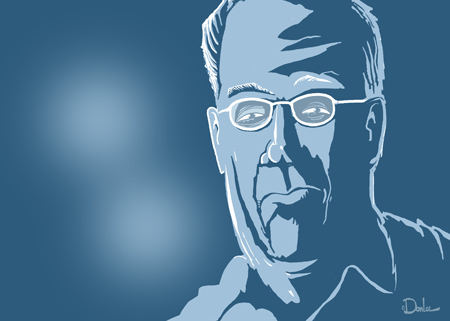
Russ Simpson (illustration by Don Lee)

“Again, I was on the road, and when I got to Cleveland, a supervisor told me to call my dispatcher in Detroit. That rang a bell. It was the same dispatcher I talked to when Stacy was killed. He was crying when he told me to call my wife at the emergency room.

“I called her, and she said, ‘Scott’s been shot, three times. He’s alive, but he won’t be by the time you get home.’

“Two hours later, when I got home, he had already passed away.

“I just had a hearing in July when Robinson was up for parole. It was denied. The next time he comes up for parole, 2016, I’ll be too old to deal with it. Or 6 feet under.

“Back in 1969, when Stacy was killed, there were no support groups. When Scott was murdered, I located the national POMC group and started a chapter here. Having a child murdered carries a stigma. People think it’s contagious; we lost a lot of friends.

“When Stacy was murdered, I drank very heavily; I did not go back to work for five weeks. But no amount of drink filled the hole in my heart. My wife has become a workaholic. She can’t sit still. That’s how she deals with it.

“I went to Scott’s grave one day and made a promise that every day, I would make at least one person laugh or smile or feel good, because that person I make smile this afternoon may not be alive tomorrow. Making that promise is how I survived.”

Legacy

After years of “heavy drinking,” Russ said he sought out other parents of murdered children and founded the Toledo chapter of POMC in 1983. His continuing efforts to educate people on the aftereffects of murder include participation in the Ohio Victim Offender Dialogue program, in which crime victims speak with the criminals who changed their lives, and visits to prisons, where he tells his story to roomfuls of murderers. Russ was always busy: planning vigils, community days, senior activities, lobbying for legislation. I stayed in contact with Russ, helping him publicize his efforts, sponsoring events, serving as a rather poor pancake cook at one of his fundraisers.

In April 2008, I sat at his family’s table when he and his Libbey classmate, then-Lucas County Sheriff James Telb, received honors at the Pizza-Coleman “Stand Up for Victims” luncheon.

“I really don’t want to be here,” Russ said at the podium. “For me, to start on the road that ended here today with all the wonderful words, the proclamations … it wasn’t worth it.”

Simpson found the grace to remind the audience that along with the victims and their families, the families of the criminal also suffer from the fallout.

“Sanity prevails,” Russ said that day. He said it twice. But in my head, a small scrap of dress used as a noose on a 4-year-old and three lead slugs taunted my belief in a rational and loving order.

Goodbye, Part I

At Newcomer, I spoke briefly with Russ’ daughter Linda, who was greeting people with the numb shock you often see on the faces of people dealing with death. Her brother, David, Russ and Pat’s surviving son, was recently placed in hospice, and a number of people at the funeral home speculated that Russ died before he had to face the loss of another child.

I do not believe that. Russ would have known his wife and daughter would need him, and Russ was a fighter. I believe he would have tried to dredge the Maumee River with his bare hands if that would have kept him alive to support his family. David died March 18, the day of Russ’ funeral.

I waited in the long line for my turn to see Pat and to say goodbye to Russ, watching the video of still images from Russ’ life. I had never seen him young, fit and trim in his military uniform. I had never seen him play with his young children, as he did in the photos on the screen. In those photos, he laughed and held his children, just as I do. Just, perhaps, as you do. Knowing what happened to those children drained the joy from the photos, and I again marveled at Russ’ strength and fighting spirit.

It saddened me to realize I was seeing something else that I had rarely seen.

Russ smiling.

The rock

At the casket, I hugged Pat and listened solemnly as she recounted the last hour of her nearly 55 years with Russ. A meal, a hug, an “I love you.” A call for help. An ambulance.

We stood at Russ’ side, and as she spoke, Pat touched his hand. To the world, he was a grief-stricken father who turned darkness into light for hundreds of people. To Pat, he was, in her words, “the rock.”

In his silk-lined coffin, dressed for the next plane of existence, Russ, silent, looked almost at peace, at long last.

Almost.

I assume he is with Stacy and Scott. I hope he is holding them for the first time in decades and I hope they are seeing the smile captured in their photos with him. I pray he is at peace.

I pray his fight is over.

But somehow I doubt that. If there is an injustice wherever Russ is, he will fight it.

Goodbye, Part II

“If you lose a child in an auto accident or to a disease, there’s a funeral and then a chance to try and move on,” Russ once told me. “There’s no two-year wait for a trial, no trip through the legal system, no 15-year appeals, no parole board session, no worrying about the son of a bitch getting out of prison and doing this again.

“The difference is, our story never ends.”

The names of the murdered children will change. The names of the mourning parents will change. But Russ was correct — the story never ends. And while there is no happy ending for such stories, and little comfort, there is light, in the spirit, works and legacy of Russell “Skip” Simpson, who was struck, and struck again, but who stood and fought. And fought. And fought.

“Give ’em hell, turn their heads


Gonna live life till we’re dead.

Give me scars, give me pain

Then they’ll say to me, say to me, say to me

There goes the fighter, there goes the fighter

Here comes the fighter

That’s what they’ll say to me, say to me, say to me,


This one’s a fighter”

Michael S. Miller is editor in chief of Toledo Free Press and Toledo Free Press Star. Email him at [email protected].

Rocker to sing solo, Live songs at casino on March 30

0
Ed Kowalczyk will play a concert at Hollywood Casino Toledo on March 30. Photo courtesy of Hardin Entertainment.

Ed Kowalczyk, former frontman of the alternative band Live, was a South by Southwest virgin.

“Very excited to be at my first SXSW! It’s been such a blast so far,” he wrote from Austin, Texas, in an email interview with Toledo Free Press. “Couldn’t imagine a more perfect way to introduce I Alone Acoustic. Such an eclectic and international gathering here in Austin; it’s going to be great.”

The singer-songwriter played songs from Live and his solo career at the annual event.

“I love my acoustic shows mostly for the intimacy and the rawness of the environment and production,” he wrote. “It takes a lot more to pull off a 90-minute set with just a mic and an acoustic guitar than with a band, so it’s very gratifying when it happens!

“Toledo will be my full band though; we’re gonna rock!”

Kowalczyk will play a free show at 9 p.m. March 30 in the Hollywood Casino Toledo H Lounge.

“I play lots of songs from my work in Live, including all the ‘hits’ — ‘Lightning Crashes,’ ‘I Alone,’ ‘The Dolphin’s Cry,’ etc.”

That set list may include cuts from his 2012 EP “The Garden.”

Ed Kowalczyk will play a concert at Hollywood Casino Toledo on March 30. Photo courtesy Hardin Entertainment.

The title track packs a powerful chorus: “Take my hand like you did on the night you disappeared/ I found you sleeping in the garden I had sown/ For your love, for your love, I would die 10,000 times/ Just to take that pain and turn it into light/ Just to take that pain and turn it into love.”

“The basic lyrical idea behind ‘The Garden’ is that it’s always easier to find and follow the road traveled, and harder to find and follow the one that is less traveled but leads to greater reward,” Kowalczyk wrote.

“I didn’t intend it consciously, but a lot of fans have said it recalls Jesus in the Garden of Gethsemane. I like that interpretation.”

The spirited musician gained a reputation by penning dynamic, mystical songs for Live. The group’s 1994 disc, “Throwing Copper,” launched the quartet thanks to “I Alone,” “All Over You,” “Selling the Drama” and “Lightning Crashes.”

In 2009, the band went on hiatus, Kowalczyk recorded a solo disc titled “Alive” and the three other Live members formed The Gracious Few with a couple of friends from Candlebox. The break became permanent — until 2011 when the three Live members reformed with a new lead singer.

Kowalczyk is working on a new disc and wrote that he hopes it will be out this fall.

“I may include at least one track [from ‘The Garden’] on the LP, but in any event, there will be 10 brand new tracks,” he wrote.

“A good song is one that touches the soul. Period. Most people don’t even know they have a soul, or they do and just forget like we all do sometimes,” Kowalczyk wrote. “Then a great song comes along and blows open their heart and mind and points to a deeper reality.”