


Home Blog Page 228

Herzing, Owens to sign reciprocity agreement

0
Herzing University is located at 5212 Hill Ave. in Toledo. Photo courtesy Herzing University.

Herzing University Toledo will sign an agreement with Owens Community College within days establishing a “3+1” program between the two schools.

“It is an effort to make higher education more affordable and attainable,” said Kevin Milliken, community relations coordinator for Herzing. “This ‘3+1’ program is unique to the Toledo campus. It’s the first time we’ve ever done something like this. We have to continue to find unique and creative ways to help students afford and access higher education, as well as retain them and help them complete.”

The 2010 census reports that one in three adults living in Lucas County currently has at least an associate degree. One in 11 has at least a bachelor’s degree.

“And that’s worse than even the Appalachian regions of southern Ohio,” Milliken said. “The census broke down adult education county by county. Lucas County is pretty much in the middle of the pack with that one in three [statistic]. But because Ohio is an industrial state, there’s the manufacturing mentality that says if you get a high school diploma, you can get a job on the assembly line and make good money. Of course, those days are long gone.”

By 2020, the Ohio Board of Regents projects that three of every five jobs in Ohio will require some form of higher education.

“That’s not necessarily a four-year college degree, but an associate degree or a diploma or certificate program — something — because of technological advancements,” Milliken said. “And that’s seven short years from where we currently are in Lucas County.

“My message (when speaking to high school students) in the classrooms is a high school diploma is now a one-way ticket to working poor. That’s a message from the organization Complete College America.”

Milliken will follow up the March 28 Transfer Fair hosted by Owens for its students graduating with associate degrees when he meets with interested students April 2 at Owens at 10:30 a.m.

Significant cost savings

Milliken said the “3+1” program allows students to take three years of classes at Owens and the final three semesters at Herzing. “3+1” will save students almost $20,000 on the cost of a traditional four-year liberal arts university bachelor degree program.

“What this does is accomplish a couple of things,” Milliken said. “No. 1, it allows students to attend a community college at a lower per credit hour cost. It also allows them to finish in a reasonable amount of time, saving that kind of money so they’re not up to their necks in student loan debt.”

Options for students

Doug Bullimore, assistant director of transfer partnerships at the Toledo campus at Owens, said he is glad Owens signed the agreement.

“I’m always looking for different options for our students after they earn their associate degree,” Bullimore said. “The whole educational system is changing. We are going through a renaissance. This ‘3+1’ program can give our students another avenue to follow.”

Herzing’s “3+1” program will allow students to take three years of classes at Owens, where tuition is $146.03 per credit hour, as opposed to Bowling Green State University ($359), The University of Toledo ($327.66) or Herzing University ($460).

However, Milliken said the cost of classes at both UT and BGSU are closer to the $450 Herzing charges.

“When you look at Herzing’s per-semester cost, we are right there in the ballpark with UT and BGSU because they stack all those fees on top of everything,” he said.

Additional BGSU costs

BGSU’s website reports that students pay a $59 fee for each credit hour, which makes one academic credit hour actually cost $418. BGSU’s website also estimates book and academic supplies will cost $1,194 annually.

Students also pay a mandatory $61 per credit hour fee with a maximum charge of $732 a semester “to attend most campus activities and athletic events free or at a reduced admission fee.” This fee also supports the student union, intramural sports, and “other student services, activities and related capital projects” and allows full-time students access to the Rec Center and Perry Field House.

A parking permit costs $60 a semester or $100 a year.

The website also lists 49 other fees  ranging from $7 to $720 per semester that students could potentially be required to pay.

The website also informs students that “fees are subject to change at any time with Board of Trustees’ approval.”

Additional UT costs

UT’s website reports that students pay an additional $49.60 fee for each credit hour, which makes one academic credit hour actually cost $377.26. UT’s website also estimates the “typical annual cost of books” at $750.

A parking permit costs $120 a semester or $240 a year.

The website provides a link to a 17-page PDF from The Office of the Treasurer that identifies technology fees calculated by the college in which a student is enrolled, ranging in price from $1.25 to $17.50 per credit hour.
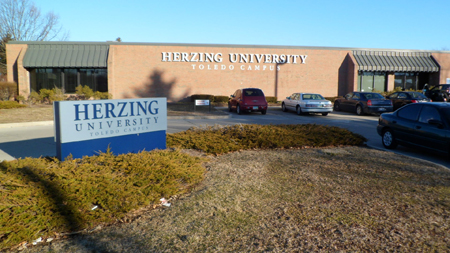
Herzing University is located at 5212 Hill Ave. in Toledo. Photo courtesy Herzing University.

The document also lists 21 “miscellaneous fees” ranging from $3 per credit hour to $4,825 a year that students could potentially be required to pay. The document also lists four of the miscellaneous fee categories as “vary by course.”

The website informs students that “fees are for a typical fall/spring semester, 15-week course. Application and new student registration fees may also apply. Tuition and fees are subject to change.”

Additional Owens costs

Owens’ website reports that unlike BGSU and UT, Owens does not attach a fee to the cost of a credit hour. The advertised $146.03 cost is final.

The website lists five required fees. Two are one-time fees — an application fee ($20) and a new student orientation fee ($65).

Recurring required fees are registration fees ($10), laboratory fees, which vary by course, and academic support service fees ($110).

Owens lists 12 optional fees, ranging in cost from $5 per academic program to $50 per semester. Owens does not charge a parking fee.

‘No fee’ policy

“We don’t stack fees,” Milliken said. “We include the cost of books (in the price of a credit hour), and we don’t add any fees. We even pay for any certification test that a student would need. For example, our new information technology program will include some Cisco (Computer Information System Company) certifications. If someone has to sit for a Cisco certification test, we pay that fee as a part of their tuition.

“We don’t have technology fees, special services fees, program fees and parking fees. If you were to take a look at the typical bill for a public university, you could see as many as six to 10 different kinds of fees. When the state legislature puts a tuition freeze on what public colleges and universities can charge, those institutions generate additional revenue by establishing fees.”

Global marketplace

“This is career-oriented stuff where graduates can walk right in the door and do the job because, built into our curriculum, we’re using actual case studies that companies faced in logistics, product ordering, HR, benefits, financial accounting — every aspect of the global marketplace,” Milliken said.

Milliken said Herzing’s Software Applications Platform (SAP) component to the curriculum makes its graduates more marketable.

“SAP is the software system that 60 percent of the world’s companies use, including local employers such as the City of Toledo, Owens-Illinois, Owens Corning, The Andersons and Chrysler,” Milliken said. “It’s in demand, especially in Northwest Ohio.”

Milliken said SAP allows various software programs that companies use to talk to each other and expand out into all types of devices, including personal computers, smartphones, tablets and the Web. Milliken said SAP allows companies to present information in user-friendly ways.

Liberal arts four-year colleges and universities teach the theory behind SAP and other computing platforms, but they don’t offer students the hands-on training in operating platforms that Herzing provides, Milliken said.

“When graduates walk out with a bachelor’s degree in business with this SAP component, they’re ready to walk into any one of our major local employers,” Milliken said. “They don’t have to leave the area to find opportunity. And we’re being told anecdotally out in the field that if you don’t have that SAP piece, many of the local employers aren’t going to look at you. Since the unemployment situation is so high right now, employers can pick and choose whom they want.”

Milliken acknowledged that critics will be skeptical of the “3+1” program, saying it is simply a marketing ploy that a for-profit university is using to entice more students to enroll.

“There will be naysayers out there, but until we start creating the university of the future, we’re going to miss a lot of opportunity,” Milliken said. “For the traditional bricks-and-mortar university, time is passing it by. There are almost 1,000 online programs out there. Our online bachelor’s program is now ranked 80th in the country by U.S. News & World Report. That puts us at No. 1 on Northwest Ohio and No. 2 in Ohio.”

Further implications

“We have to leverage the resources that are available to meet the students where they’re at because the adult learner, formerly known as the nontraditional student, is the norm rather than the exception these days,” Milliken said. “In order for them to complete an education, we have to work around the work-family-children-life balance. And education is just one more thing piled on all the pressures of life. And unless and until we evolve and adapt to meet those situations, we’re not going to succeed as a region.”

Milliken said Herzing is looking to expand the “3+1” program “in any way we can so that students can save money on college. It’s something that may be a good fit for Northwest State [Community College, with its main campus in Archbold and satellite campuses in Bryan, Van Wert and Whitehouse] or Terra [Community College in Fremont], but those discussions have not been completed. The idea has been introduced to their leadership, but further discussions are obviously needed.”

Milliken said reciprocity programs like “3+1” could be expanded to programs both schools have in common, including:

  • Technology programs in computer networking, network management, security technology and technology management.
  • A public safety program in criminal justice.
  • Health care programs in health information management, health care management, insurance billing and coding, medical assistance services and surgical technology.
  • Business programs in accounting, business management and paralegal services.

“Anything that we offer could be pursued at a higher level toward a bachelor’s degree,” he said. “Anything we offer is a logical candidate for such a ‘3+1’ program.”

Milliken said Greg Guzman, Herzing campus president, gets all the credit for establishing the program.

“Greg used to work at Owens so he has some ongoing relationships there,” Milliken said. “What gives us such a foothold here is that Greg has worked in higher education in many of Northwest Ohio’s public universities, including Owens, Lourdes [University] and Bowling Green [State University].

“As institutions of higher education, we have to do a better job of meeting all students where they’re at and structure programs accordingly to do two things — help them achieve success and give them the tools and the tool belt necessary for what the workforce demands.

“And if we’ve done neither or either, then we’ve failed the students who are investing in their future success.”

Local agency plans several events to mark Child Abuse Prevention Month

0

A baby boy later named Alex Michael Cervantes was a few days old when he was submerged in water and strangled, his body left in a freezer when his parents moved out of their East Toledo rental.

Two-month-old Kalib Henderson and 6-month-old Noland Letellier died after being shaken while 6-month-old Avery Glynn Bacon was allegedly thrown against a hard surface, causing the skull fractures that killed him.

One-year-old Ke’Ondra Hooks was struck in the head by a stray bullet, killed by street violence while sleeping on the floor of her family’s Moody Manor apartment.

Siblings Paige Hayes, 10, Logan Hayes, 7, and Madalyn Hayes, 5, were killed by their grandmother and uncle in a murder-suicide using carbon monoxide inside a vehicle in a West Toledo garage.

Five-month-old Ella Thomas drowned in a bathtub and 4-year-old Taevion Maulsby died of smoke inhalation from a fire started by playing with matches in the Old South End.

These 10 Lucas County children will be remembered at a memorial set for 11:30 a.m. April 19 at Lucas County Children Services (LCCS), 705 Adams St. The annual ceremony remembers those younger than 18 who died of abuse, neglect or street violence during the past year.

LCCS Executive Director Dean Sparks said 10 children is the most to be memorialized in one year since the agency started doing memorials about a dozen years ago. In 2011, three Lucas County teens were killed as the result of street violence and none died of abuse or neglect.

�?Profoundly somber’

“It’s sad,” Sparks said. “It is profoundly somber for all of us. We do what we do because we want to protect kids. That’s our mission in life. We think it’s important to take the time to stop and remember and to commit ourselves anew to doing everything we can to prevent child abuse. Those 10 deaths were absolutely preventable.”

April is national Child Abuse Prevention Month and April 10 is Ohio’s second annual Wear Blue Day.

“People need to know they are not alone in caring for kids,” said LCCS Public Information Officer Julie Malkin. “It’s simply getting the word out that it’s important to be passionate about this.”

LCCS Assessment Manager Cary Brown said she hopes seeing widespread community support might encourage someone to report suspected abuse or neglect. The agency’s hotline, (419) 213-CARE (2273), is staffed 24 hours a day, seven days a week. Reports can be left anonymously.

“If I see my cubicle mate doing it and a neighbor doing it, I might be the one to make that report and intervene before a child is seriously hurt because I know there are other people in the community who care,” Brown said.

Sparks said many people don’t report suspicions because they convince themselves the adult won’t really hurt the child or they feel it’s none of their business.

“People have a hard time imagining anyone harming their children, especially if it’s someone in their family or their neighborhood, but if you have a suspicion, call us or call local law enforcement,” Sparks said. “It’s better to call and it not be right than for a child to be harmed.”

Brown agreed, noting that LCCS had little or no prior involvement with the families of the 10 children killed.

“That fact reminds me that we depend on families, neighbors, community members and professionals to tell us these things are happening. Someone has to call and tell us,” Brown said. “I would err on the side of caution, err on the side of safety for that child.”

In 2012, LCCS received 4,959 referrals involving 7,347 children. Investigations determined 822 were abused or neglected, a 40 percent increase over 2011, according to the agency’s annual report. Forty-nine percent of investigations were for alleged physical abuse, 36 percent for neglect, 13 percent for sexual abuse and 2 percent for emotional abuse.

The highest rate of referral (referrals per 1,000 child residents) was in the 43604 ZIP code, followed by 43605 and 43608. The highest number of referrals came from the 43605 ZIP code followed by 43609.

“Some parts of our community have more resources than others, both financially and service-wise, where you would have a better ability to get help without coming to the attention of our system,” Brown said. “There’s probably areas of the community that think it doesn’t happen here, that it only happens in the central city. But drugs, alcohol and physical violence is not just in the central city; it happens everywhere.”

Of new cases opened in 2012, 40 percent of families were white, 32 percent were African-American and 25 percent were multiracial, according to the report.

Almost a third of the children (29 percent) remained in the home while issues were worked through, a third (34 percent) stayed with relatives and nearly a third (27 percent) went to foster homes, Malkin said.

Twenty-four percent of referrals came from social services, 24 percent from relatives, friends or neighbors, 16 percent from law enforcement, 15 percent anonymously, 13 percent from schools and 5 percent from medical personnel.

One area Brown said LCCS has been seeing an increase is with children affected by heroin addiction, whether through parental drug use or children born addicted to the drug or the prescription treatment drug methadone. From September 2012 to March 2013, 48 children were removed from Lucas County homes because of heroin use, including 15 infants who were born addicted and must stay in the hospital for up to a month to be weaned off the drug.

Mental health issues is another area seeing an increase, Brown said.

Families involved with LCCS aren’t necessarily “bad people,” Brown said.

“Most of the families we see really love their kids and want to be able to take care of them; most of our parents want to be good parents, but life circumstances are such that they can’t do it without resources that we can give them at this point in time,” Brown said.

Brown said the rewards of her job outweigh the stress and heartbreak.

“People say, �?Oh I couldn’t do what you do,’ but the ability to make a difference has really gotten me through all these years,” Brown said. “We have the ability on a daily basis to make a difference in children’s lives. I’ve been doing this 25 years and I still feel that as I come to work every day.”

LCCS’ website, lucaskids.net, offers tips for recognizing child abuse or neglect and information about becoming a foster parent.

LCCS is encouraging people wearing blue April 10 to post photos on the agency’s Facebook page, tweet photos to @LucasCoOHKids or email photos to [email protected].

Sarantou

“Every year 1,700 kids die in the U.S. from child abuse or neglect. That’s epidemic stuff,” Sparks said. “All of us who are going to be putting on blue are saying we are going to be doing everything we can to prevent child abuse in our community. We want all of Lucas County and Ohio to be blue that day. We’re all going to stand united on behalf of kids.”

Toledo Council member urges support for Wear Blue Day

Toledo City Council will vote at its April 2 meeting on a resolution encouraging residents to participate in Wear Blue Day on April 10.

The second annual event, organized by Lucas County Children Services (LCCS), is meant to “unify our community in a commitment to keep children safe from being abused and neglected,” according to the resolution. April is National Child Abuse Prevention Month.

“Child abuse and neglect continues to be a concern in the Toledo area and members of Toledo City Council urge our community to stand up to protect our most precious resource, our children,” the resolution reads.

“It’s very important because we need to eradicate child abuse in our community,” said Councilman George Sarantou, the resolution’s sponsor. “Every day we’re reminded of child abuse in Toledo and throughout Northwest Ohio. It’s very important to urge people to be aware of it, report it and do something about it. It just can’t be tolerated. Children are very innocent and they certainly deserve to live in a positive environment and not go through child abuse, which as we know can have lifelong negative effects on a human being.”

Toledo FAVS hosts April film series on religion, spirituality

0

Toledo Faith & Values (ToledoFAVS.com), a website covering religion and spirituality in Northwest Ohio, is set to debut its film series “Faith Under Fire: Documentary Films on Religion’s Hot Topics” on April 6.

David Yonke, editor of ToledoFAVS and Toledo Free Press contributor, will moderate a discussion of the films after each screening and has invited community experts to answer questions at each screening.

Yonke said he got the idea for a film series after the church he attends, Calvary Church, moved to the former Rave Motion Pictures Maumee 18. He said he decided to have discussions after each film because he “wanted to do more than just show a movie.”

The April 6 film “Hitchens v. Blair: Is Religion a Voice for Good?” features a debate between the late Christopher Hitchens, an intellectual and an atheist, and former Prime Minister of the United Kingdom Tony Blair, a Christian.

“It was brilliant because you’ve got two really intelligent people with two contrasting views,” Yonke said.

The Rev. Julian Davies, a former atheist and professor and now a pastor of the University Church, and Peg Clancy of the Toledo chapter of Recovering From Religion, will talk after the film.

“Father of Lights: Who is God?” will screen April 13. Darren Wilson, a Monroe, Mich., native, directed the documentary, which explores God’s character.

“Twist of Faith” will follow April 20. This documentary features Toledo firefighter Tony Comes coming to terms with past sexual abuse by a Catholic priest. Comes and Jon Schoonmaker and Claudia Vercellotti of the Toledo chapter of the Survivors Network of those Abused by Priests are expected to attend the discussion after the film.

The final film in the series is “Expelled: No Intelligence Allowed,” in which Ben Stein explores freedom of speech in academics in regard to intelligent design, on April 27.

Yonke, the former Blade religion editor, said he hopes the film series makes people more aware of ToledoFAVS.

“I still run into people who are wondering what I’m doing,” Yonke said with a chuckle. He added that he’s enjoying running his own website, which launched last summer.

“[ToledoFAVS] really meets a need in the Toledo area. It’s a lot of work but it’s very rewarding,” Yonke said.

Each film screens at 6 p.m. at Calvary Church, 1360 Conant St., Maumee. There is a suggested donation of $10 that goes to ToledoFAVs, a nonprofit. For more information, visit
toledofavs.com.

Walleye make playoffs despite losing 5 players to AHL

0
Toledo Walleye forward Randy Rowe. Photo courtesy Toledo Walleye.

Despite losing 2-0 to the conference champion Reading Royals, the Toledo Walleye clinched a spot in the ECHL playoffs with a little help from the Wheeling Nailers on March 24.

The Nailers held on and defeated the Kalamazoo Wings, who were ninth in the standings and trailed the Walleye by seven points.

Despite gaining a point from a shootout loss, the Wings could at best tie Toledo in total points, but the Walleye would have the advantage in the tiebreaker.

According to the ECHL website, the first tiebreaker is total wins excluding shootout victories. If the Wings were to win their final three games, they would have 31 wins. Toledo already has 35 and no shootout wins.

Walleye head coach Nick Vitucci said the March 24 loss was “bittersweet.”

“I was excited, our effort was night and day compared to last night and that’s a top team in the conference and we ran right with them, thrilled about out last 70 minutes of hockey against this hockey club here.”

Vitucci said he knew after the second period about Kalamazoo’s shootout loss but waited to spread the news until trainer Brad Fredrick could confirm it — from his cellphone on the team bench during the final stanza.

Vitucci then told his captain Kyle Rogers and alternate captain Randy Rowe.

Later in the period, the final was announced and the 7,071 attendees gave the team a standing ovation for clinching the playoffs for the second time in Walleye history.

Despite the pressure of making the postseason being lifted, Rogers said there is still some work to be done before the playoffs start, which could be as soon as April 3.

“It’s a great feeling; maybe loosen up the hands a little bit and maybe the guys will play a little better,” he said. “We can’t sit back, we have to go hard and practice and go harder actually to get better and to improve so we don’t get four-and-out in the first round.”

Defenseman Wes O’Neill noted one adjustment will need to be the team’s power play, which is 18th in the ECHL at 15.2 percent (70-of-256). Only two other playoff-bound teams have worse execution with a man advantage.

The Walleye have been in playoff contention for most of the year and during the NHL lockout the team had the depth and talent to potentially take the North Division crown. Once the lockout ended in January, however, the Walleye — who had a share of first place in the division — lost five players in a 24-hour span. The five called up to the American Hockey League, including playmakers Byron Froese, Ben Youds and Terry Broadhurst, combined for 84 points. Froese and Youds would intermittently find themselves on the Walleye roster and Youds finished the season in Toledo.

Vitucci said he is unsure whether the AHL affiliates will send any players down to help the Walleye’s playoff run.

While the Walleye were looking to fill their roster, they signed Nino Musitelli on Jan. 15 and he remained with the team, scoring 20 points (10 goals, 10 assists) in 31 games.

The Walleye took advantage of having Trevor Parkes in the lineup when he was sent down from the Grand Rapids Griffins. Parkes’ presence is especially felt on special teams, accounting for six power play goals in 17 games with the Walleye.

For some players, such as 32-year-old Rowe, this could be one of the last postseason appearances.

“Might be my last year, might not; I don’t have too many more years left at all,” Rowe said. “[Making the playoffs is] really important, especially with the group of guys we have here because I respect all these guys and it’s a good group of guys and if there’s a
team to do it, I think we’ve got a good bunch of guys to do it.”

Rogers said he would “want to try to do everything I can for him to get into the playoffs this year.”

O’Neill said while the team is happy to clinch a playoff spot, the players’ goals are high.

“We want to win it. We’re not just happy to get there, we’re going to hopefully play hockey for a couple more months,” O’Neill said. “Once we get there, we have to step up our game
another notch.”

Second neighborhood improvement initiative kicks off in Toledo

0

Several city officials and businesspeople, including Mayor Mike Bell’s office and the Inspection, Neighborhoods, Public Service and Public Utilities departments, kicked off Toledo’s second year of Spring Sweeps, an initiative striving to better the city’s housing
and building stock, on March 27.

“These Spring Sweeps are very crucial to the quality of life for people in different areas of our city,” Bell said during a news conference at East Toledo Family Center on March 27.

“It is a very aggressive process to make people feel assured that their city cares about them,” he said.

The initiative’s soft launch started March 20 and the program ends June 1.

The first part of the sweep will focus on East Toledo before going into the United North, Broadway Corridor and Overland Park areas. As part of the initiative, the city’s Division of
Code Enforcement is conducting inspections and handing out door tags that include information on assistance programs. Discount codes to local hardware stores are also available.

Spring Sweeps also includes police participation. In a 10-day targeted enforcement operation in March, police arrested more than 200 people in East Toledo areas where higher than average crime rates were reported.

At the news conference, Police Chief Derrick Diggs said that maintaining neighborhoods is important because vacant or rundown buildings can attract crime.

The sweeps also feature a neighborhood cleanup day where school and community groups will help out.

East Toledo’s is set for 9 a.m. to noon April 27, starting at East Toledo Family Center. Last year’s program focused on West Toledo.

“The feedback from last year was very positive. If anything, the residents in the areas we targeted wanted more information about their neighborhoods,” said Chris Zervos, director of inspection. “[Residents] not only took care of their own properties but they helped their neighbors take care of theirs.”

This year’s Spring Sweeps tackles 8,000 properties, down from 17,000 last year, said Dennis Kennedy, manager of code enforcement.

“We focused our areas down. We’re a little bit smaller this year so the neighborhoods get more attention from the inspectors instead of doing a larger blanket sweep,” he said.

Rathbun: Be careful where you get your hair cut

0

We have had a lot of interesting news the past several days out of Cyprus. It all started March 14, when Cyprus became the fifth country to receive a bailout from the European Union (EU). The interesting aspect of this is that it became a “bail in” instead of a bailout.

A bail-in takes place before a bankruptcy, and generally involves the losses being imposed on bondholders. This has rarely taken place throughout the euro crisis. (Remember a while back, Greek bondholders took a haircut on the bond value at one point in the Greece
meltdown.) In fact, the government (taxpayers) consistently makes the private sector whole.

This bank rescue in Cyprus is no exception, except this time there is a bail-in, not of bondholders but of depositors. This is a direct contradiction to the usual legal claims on the capital structure. Think about this: Instead of the bondholders and/or stockholders shouldering the risk of failure, the depositors are paying for the rescue!

Obviously, the powers that be knew that this would be a problem and called for a bank
holiday for March 17. This quickly became such a major issue with people trying to get
their money out of the banks via ATMs, that the bank holiday was extended to March 28 as
of this writing.

Taking money out of a depositor’s account without any consideration other than that the money is there is a direct assault on individual property rights and every one of us that
lives in the developed world should pay attention. If this should actually go through, not only would this become a serious contagion of panic across the rest of the EU but it would spread to other countries as well.

Why would anyone put money into a bank account if at any given time the government could reach in and confiscate whatever amount it wanted without due process, simply because the money is there?

Equally disturbing are three other stories or situations related to this. The first is that
the American Bankers Association this week came out with a statement simply stating
that the situation in Cyprus has “no implication for depositors in U.S. institutions. Depositors in U.S. banks are insured up to $250,000 and no insured depositor has ever lost
money in a bank failure.”

The second was an article from The Wall Street Journal that states that 57 percent of Americans have less than $25,000 in savings and investments, thereby freeing those
unwealthy individuals from being subjected to the same confiscation threshold as Cypriots.

And finally, the fact that New Zealand has legislation in process, namely the Open Bank Resolution, that says that all depositors of a failing bank will have their savings reduced to fund big bank bailouts.

Could it happen here? Doubtful.

But then again, I thought it was very doubtful that we would have national health care and go to a onepayer system, and yet here we are.

We do have the Federal Deposit Insurance Corporation (FDIC). However, the FDIC has $25 billion in reserves against $3 trillion in deposits, so we should feel very comfortable
about that.

I am at the stage of my life where I rarely need a haircut and when I do, it’s a five minute ordeal. But when it comes to my deposits getting a haircut, I am at a stage in my life where it is a much larger deal than when I was 25. I am not going to withdraw all of my money out of the bank (yet), but I am going to stay diligent. If I think a late-night haircut is coming our way, I will act and act quickly.

Gary L. Rathbun is the president and CEO of Private Wealth Consultants, LTD. He can be heard every day on 1370 WSPD at 4:06 p.m. on “After the Bell,” every day on the Afternoon Drive, and every Tuesday, Wednesday and Thursday evening at 6 throughout
Northern Ohio on “Eye on Your Money.” He can be reached at (419) 842-0334 or email him at [email protected].

Retail or custom fit?

0

Have you ever had the opportunity to get a custom fit suit of clothes tailored to fit you? If you have, you really appreciate what a nice feeling this is and what a difference in how your clothes feel and look. I (Mark) can remember as a young boy my dad taking me to
a tailor who took my measurements to make me a nice suit. Now mind you, we were not rich. My dad was a missionary in Korea, and it was very inexpensive to buy a custom tailored suit. My dad taught me how to dress and that if you look good it really has an effect on how you feel. You feel great. You look great. I definitely notice the difference when I see someone wearing something that is ill-fitting. My dad also taught me that when
you go shopping for clothes, get dressed up so you look sharp. The sales person will treat you much better and will be more inclined to want to help you. I have followed dad’s advice and believe me it works. Try it out for yourself.

It seems that anything that is customized to your specifications is much better all around. It works better, feels better and has a positive impact on whatever you are doing. I always wondered how cowboys keep their hats on their heads when riding a horse. You would thing that because of the wide brim on the hat that it would blow off every time. I recently went to a business conference in Dallas and the hosts of the conference offered a custom
fit cowboy hat for everyone there. I thought that was really cool. There were people there that helped you pick out your hat and then custom fit it to your head. They had stretchers and steamers and kept putting the hat on your head and taking it off until they had fit it just right. I now understand how the hat stays on the head. My hat is fitted perfectly and will not come off if the wind blows. Living in Ohio will probably not give me the occasion to wear it too often, but I actually got to wear it again when my little sister Michelle took me to the rodeo in Houston. Good times!

Why is custom fit such an important idea to The Retirement Guys? People come into our office everyday and share with us where they have their retirement money invested. When
we look at it, we typically see a lot of the same kind of stuff. We call it retail. The kind of
stuff anyone can go to the store and pull off the shelf. The same whether you have a
little money or a lot. What we are then able to do is enlighten those that meet with us that
there may be things available to you that you have not been made aware of. Things that are more customized to each individual situation. Some of these things are because of new technology. There may be things like “circuit breakers” that provide some potential
protection against large downward movements in values of certain types of investment accounts.

Other things may be available to folks that have a higher net worth. Many don’t realize what they are worth until they start adding it up. They don’t realize that they may qualify for some more favorable things that can be customized to their situation. They also may qualify for discounts they did not know they could get.

What to do? Check into it. As the saying goes, “you don’t know what you don’t know.” Find out what a custom fit feels like. Find out if you can be doing things more efficiently that can lead to a better result. You may be very glad you did.

One way to do this is to get a copy of “The Essentials to Investing.” You can go to www.retirementguysnetwork.com to request a free copy.

Remember, the next time you go shopping for clothes, dress up. See what happens.

For more information about The Retirement Guys, tune in every Saturday at 1 p.m. on 1370 WSPD or visit www.retirementguysnetwork.com. Securities and Investment Advisory Services are offered through NEXT Financial Group Inc., Member FINRA / SIPC. NEXT Financial Group, Inc. does not provide tax or legal advice. The Retirement Guys are not an affiliate of NEXT Financial Group. The office is at 1700 Woodlands Drive, Suite 100, Maumee, OH 43537. (419) 842-0550.

Fisher presents improvement program in Toledo

0

Former Ohio Lt. Gov. Lee Fisher, now president and CEO of CEOs for Cities, a membership network of innovators and leaders in urban areas, made two presentations in Toledo on March 28.

“We’re not just CEOs even though our name implies that. We’re change makers. Anybody who considers themselves a change maker, in other words committed to making positive changes in their city, is qualified to be a member of our team. And what we do is we share smart ideas and practices for making a city successful,” Fisher said, adding that members are all ages and ome from many sectors.

Cities like Cincinnati, Cleveland, Milwaukee and Memphis, Tenn., have had success with the program, Fisher said.

Fisher, who has led the organization since May 2011, said that with 65 million people moving to cities every year, urban areas are crucial. He travels to a different city every week with his job.

HisToledo presentations were at Toledo City Council’s chambers and the University of Toledo’s Libbey Hall and attended by several city officials.

“Here’s what we do — we curate ideas. We take the ideas that we see around the country every day and we identify the ones we think are the most interesting and best ones and we connect people — we do regional meetings; we do national meetings,” Fisher said.

These ideas include Cincinnati’s revamping of its Over-the-Rhine area and Grand Rapids’ GRid70, which enables creative employees from top corporations in the area to work in the
same building and share ideas.

There is a $25,000 fee for a two-year membership. CEOs for Cities has about 350 individual and organizational members and 11 “cluster” members who can share the membership and work together, Fisher said.

“Clusters” are a “team of cross-sector, cross-generational leaders committed to the economic success of their city,” according to the website. Membership includes discounted or free attendance of meetings where ideas are shared.

Sue Wuest of UT Urban Affairs was one of a few UT employees who attended a CEOs for Cities meeting recently. She said she enjoyed the variety of people comfortably conversing at the March 2012 meeting in Cincinnati.

“It was like the nexus of high-level and mid-level business folks, high-level and mid-level university folks, students, young entrepreneurs and community organizers,” Wuest said.

While Fisher was in Toledo, he also met with representatives from UT, Toledo Community Foundation, Regional Growth Partnership and the Mayor’s Office.

Mayor Mike Bell said the group will discuss the decision to potentially join as a cluster and split costs April 2. Bell said the program appealed to him because it would connect Toledo with other cities going through similar situations like a water-rate hike.

CEOs for Cities has several criteria for evaluating cities. The group uses what it calls CITY Vitals, which measures how connected, innovative, talented and distinctive a city is.

Wuest said the CITY Vitals could be helpful in serving as benchmarks, which are useful for applying for grants and setting goals.

The program also promotes setting several 1 percent goals like improving college attainment by just a percentage point. This could potentially raise Toledo’s per capita income by $600 million per year, Fisher said.

The national meeting is set for Sept. 29 in Grand Rapids. Bell said the Toledo representatives would potentially like to attend that meeting. For more information, visit www.ceosforcities.org.

Toledo Council member urges support for Wear Blue Day

0

Toledo City Council will vote at its April 2 meeting on a resolution encouraging residents to participate in Wear Blue Day on April 10.

The second annual event, organized by Lucas County Children Services (LCCS), is meant to
“unify our community in a commitment to keep children safe from being abused and neglected,” according to the resolution.

April is National Child Abuse Prevention Month.

“People need to know they are not alone in caring for kids,” said LCCS Public Information Officer Julie Malkin. “It’s simply getting the word out that it’s important to be passionate about this.”

LCCS Assessment Manager Cary Brown said she hopes seeing widespread community support might encourage someone to report suspected abuse or neglect.

The agency’s hotline, (419) 213-CARE (2273), is staffed 24 hours a day, seven days a week. Reports can be left anonymously.

“Child abuse and neglect continues to be a concern in the Toledo area and members of Toledo City Council urge our community to stand up to protect our most precious resource,
our children,” the resolution reads.

“It’s very important because we need to eradicate child abuse in our community,” said Councilman George Sarantou, the resolution’s sponsor. “Every day we’re reminded of child abuse in Toledo and throughout Northwest Ohio. It’s very important to urge people to be aware of it, report it and do something about it. It just can’t be tolerated. Children are very innocent and they certainly deserve to live in a positive environment and not go through child abuse, which as we know can have lifelong negative effects on a human being.”

Speaker: Religious liberty ‘vital and vulnerable’

0

From the writings of the Founding Fathers to headlines in the news today, religious liberty has long been a “vital and vulnerable” concept in the American experiment, according
to Richard W. Garnett.

A professor of political science at the University of Notre Dame known for his expertise on the First Amendment, Garnett spoke on “Challenges to Religious Freedom in America Today” at the University of Toledo on March 26.

Garnett, whose latest book, “Two There Are: Understanding the Separation of Church and State,” will be published by Cambridge University Press, said he believes that religious
freedom, including the freedom to reject religion, “is a human right grounded in dignity and essential for human flourishing.”

He said the nation’s Founding Fathers considered religious freedom to be “a crucial prerequisite for the success of this new political experiment.”

One of the most visible flashpoints on religious liberty today is the federal mandate by the Department of Health and Human Services (HHS), which requires employers to provide
birth control and some abortifacient drugs to employees even if such provisions violate the religious tenets of employers such as Catholic hospitals and colleges.

The resolution of the HHS mandate is still being determined in courts and administrative actions, Garnett said, but similar church-state tensions date back to the American Revolution and span a broad range of issues today.

Religious freedom controversies in the news include whether schoolchildren should be required to say the words “under God” when reciting the Pledge of Allegiance; whether the Ten Commandments can be displayed in a courtroom, and if government meetings can open with prayer.

“Engaging questions like these require us to dig down a bit and to identify the foundations and the context of the freedom of religion,” Garnett said.

He cited an observation by President Bill Clinton that religious freedom is “literally our first freedom.”

“His point, to be clear, was not simply that religious liberty happens to come first in what we now have as the Bill of Rights; his point instead was that the freedom of religion was central to the founders’ vision for our new political community,” Garnett said. “To say this is not to say or claim that America is or was or should be a ‘Christian nation,’” he added.

“It’s just to observe that our Constitution was not designed to displace or defeat religion, or to displace faith with state worship. Its aim instead was to build a stable, enduring political community that would be stronger precisely because it recognized that religious freedom is foundational.”

The First Amendment’s legal structure allows the flourishing of what Pope Benedict XVI referred to with admiration as America’s “healthy secularity,” Garnett said, adding that it is
human nature to be both political and religious and “nothing in the text, history or structure of the Constitutions requires us to deny this.”

The religious freedom protections included in the Constitution were not “accidents” or “aberrations,” Garnett said, but designed to safeguard and support religion “so it can flourish” and “to protect everyone, believers and nonbelievers alike, against coercion on religious matters.”

He suggested there are three approaches toward religious liberty:
-“Freedom from religion,” which considers religion “as a social reality but regards it as somewhat of a danger to the common good.”
-“Freedom of religion,” emphasizing toleration and neutrality, and treating religion as “something that matters to many people and so the law should not single it out for special discrimination or hostility.”
-“Freedom for religion,” an approach Garnett said is most consistent with the vision of the Founding Fathers and American ideals.

“According to this approach, the search for religious truth is acknowledged as an important human activity. It’s willing to say that religion is special — so special that the government ought not to interfere with it or direct it.”

Describing religious liberty as “robust but incomplete,” Garnett urged Americans to be “proud but also vigilant.”

David Yonke is the editor and community manager of Toledo Faith & Values (ToledoFAVS.com), a website that provides nonsectarian news coverage of religion,
faith and spirituality in the Toledo area.