Home Blog Page 227

Artists, yarnbombers support local fight against child abuse

0
Yarnbombers from the United States, Germany and Sweden have contributed to the local effort. Toledo Free Press Photo by Joseph Herr.

A knitting group from Sandy Hook in Newtown, Conn., has contributed to the sea of blue planned for Toledo.

In support of Lucas County Children Services’ (LCCS) Wear Blue Day, a day bringing awareness to child abuse, a Toledo “yarnbomber” with a secret identity will decorate the streets with blue.

Known by the moniker “Streetspun Yarnbomber,” the local artist enlisted the help of fellow yarnbombers all over the world. At press time, she was expecting yarn bombs from five European countries, including Germany and Sweden, and several other U.S. states.

Yarnbombs are knitted sleeves that can often be found around lampposts, parking meters and bike racks. During the week of Wear Blue Day, which is April 10, Streetspun will install the blue yarnbombs outside the LCCS building on Adams Street. They will remain up at least until the agency’s annual memorial on April 19.

The Cosmic Knittas from Sandy Hook in Newtown Conn., site of the December school shooting in which 26 students and adults were killed, was one of the groups to send a yarnbomb. A handwritten card that came with the piece read: “We know all too well that we need to protect our children and applaud your efforts for Wear Blue Day. We are graffiti knitters from Sandy Hook who are working on our own event but want to support yours too.”

LCCS Public Information Officer Julie Malkin communicated with Streetspun via email.

“It’s a great artistic way to show that people really care about kids,” Malkin said. “It’s particularly touching to have something coming from Sandy Hook where there was so much sadness.”

Streetspun said she love the gesture from the Cosmic Knittas.

“For me, it really goes to show that we all can come together, be peaceful and love one another,” Streetspun said via email. “I know that we cannot solve the world’s problems with [yarnbombs] but it is one way to make you smile and give you that warm fuzzy feeling.”

This form of graffiti is an act of good intentions, Streetspun said.

“They are all made with love and are meant to be a happy gesture to make things brighter and to simply make you smile,” she said.

Streetspun picked up the hobby on the first International Yarnbombing Day, June 11, 2011. Immediately, she knew she was hooked. When she was contacted by LCCS to make yarn bombs, she couldn’t refuse.

“When your city asks for [yarnbombs] how can you say no?” Streetspun said. “When you are making a statement like standing up against child abuse and domestic violence it is without a doubt very near and dear to my heart.”

After Wear Blue Day, Streetspun wants to donate the yarnbombs to an organization.

“Wherever they end up it will surely be a reminder of hope that there is so much love out in the world especially when it comes to our children,” she said.

Artomatic 419!

Artomatic 419! also plans to support the day of awareness. LCCS joined forces with Artomatic 419!, which issued an open call for artists to submit art for a “Blue Room” piece.

Two local artists, Louis Wilson and Kelly O’Brien, will create blue artwork for the local arts showcase set for 11 a.m. to 11 p.m. April 13, 20 and 27. The pieces will be set up at 911 Summit St., with Wilson’s on the first floor and O’Brien’s on the second.

“We appreciate the value of freedom of expression,” Malkin said. “Child abuse is a very sad and unfortunate thing and for people to express themselves artistically to show their feelings about this very serious subject is terrific.”

Wilson wants to help people understand the effects of child abuse with his wall-hanging, mixed media piece.

“I’ve seen the adverse effects on families and children from child abuse,” Wilson said. “[My piece is] meant for people to draw their own direction toward child abuse and the anguish that it brings.”

O’Brien wanted to portray more with the color blue in her piece. She hopes people get awareness from it.

“Blue also represents peaceful, tranquility, calmness,” O’Brien said. “I wanted to somehow portray that.”

April has been designated Child Abuse Prevention Month since 1983. This is the second year Wear Blue Day has been observed in Toledo.

Lucas: College is the vehicle — or chauffeur

0

“The future is already here — it’s just not very evenly distributed.”


— William Gibson

A friend of mine recently had some vacation time to spend. Knowing it was coming up, it didn’t cross my mind to ask how he was getting to his chosen destination. I only cared where he was going. Was he going somewhere with a beach? Maybe he was going to tour Washington, D.C.’s museums, or maybe go someplace where they speak the Romance languages. The means of transportation were mildly above insignificant.

Until about six or seven years ago, a college degree was your near-guaranteed ticket to the life you always wanted. By collecting abbreviations after your name, the value you could provide and the reward you got in return, only increased. If you had a bachelors degree and didn’t have a job, you probably didn’t want one. If you had a master’s degree and weren’t working, you were probably weighing several lucrative offers. If you had a Ph.D. and didn’t make $150,000 or weren’t the president of a college, you just couldn’t be trusted. College, at least for the past 100 years or so, was your ticket. It held a promise: Going to school resulted in getting a good job by default. Until it didn’t.

In this world, high school students get asked by each passing adult if they’re going to college and which school they’ve chosen. I find these inquiries quite odd. Like my friend who was set for a vacation, his mode of transportation really didn’t matter to me. I wanted to live vicariously through his enjoyment of the resort he’d attend. I wanted him to have a fantastic time and do what he’d greatly looked forward to for quite a while. He’d worked hard, and I wanted him to enjoy the fruits of his labor. This is why I look sideways when I hear this question asked, because it positions the transportation as the destination. College has, at least historically, been the car — or maybe the chauffeur. Going to university was what delivered you to the doorstep of your utopia. It isn’t in and of itself your destiny. However, when we ask this question we imply that college is the end zone when it’s only supposed to advance our ability to get there. We cause students to believe that a post-secondary degree is the only way. When traveling, I can take a car, a plane or a train. Might even walk. Getting to my dream has options also. College, while a major option, is still just that. One option.

There is a major democratization under way in our world that has already shaken our educational system to its core. While we’re bracing for a huge shift in education, we’ve yet to realize that it’s already happened. The effects of this shift are just coming to the surface.

College enrollment peaked in  2008 just after the financial crisis landed a swift roundhouse kick to the jaw of the world’s economy. Community colleges and technical schools spilled over with anxiety-laden 19- and 22-year-olds wandering in delirium from whatever the heck happened to their hopes and dreams, now lying shattered in a sea of debt crises, broken housing markets and plummeting job potential. That trend of fresh meat in the lecture hall has only reversed, however, and by current estimates, may never again be matched. Between 2000-10, the cost of college increased between 4 to 9 percent annually. During this same period, Internet penetration in North America increased 153 percent. There’s no doubt that the Internet loves to revolutionize industries and turn traditions on their heads mercilessly. It’s revolutionize alongside or get steamrolled. Information inherently wants to be free. Data wants to be known. Historically, sharing knowledge meant putting a message in a bottle. Today, it means broadcasting to the entire planet with just a few keystrokes, and for free. How do universities respond? There are plenty of theories, and I even have my own. How has the Internet responded? It’s responded with Coursera, Khan Academy, iTunesU, OpenCourseWare, Udemy, SkillShare and Udacity. These are all domains where anyone resting inside the troposphere can learn any skill from the world’s best teachers, as well as professors from MIT, Harvard, Stanford or my local college’s teaching roster, for free or maybe a crisp $20.

Newsweek stopped printing paper copies last year and found an amazing cover story worthy to grace one of its final hard copies. The title, “Is College A Lousy Investment?” They’re not the only one publishing stories with these provocative headlines. Forbes, TIME and USA Today have all done major stories on this same topic in the past year. So, is college still worth it? Yes. But the way we’re doing it won’t work, and obviously hasn’t worked in quite some time. Nobody with a lick of common sense is debating the value of knowledge, only the return on investment in college sheepskin. For the degree to maintain any value moving forward, major changes in how we structure these programs are necessary. Forty percent of students picking schools purely based on the football team or the super-scientific “girls’ hotness factor” ain’t gonna cut it. Neither of which is worth racking up $10,000-$25,000 a year in debt.

The best thing we can do for our young people is inspire a joy of learning. Not institutional learning or segmented learning. But learning and curiosity as a permanent state. I’ll write more on this particular thought later, but we have to stop pursuing educational experiences based on future job prospects. The future belongs to people who can make a way where there traditionally hasn’t been one.

College will always be with us, just as it should be. But we’re being forced to rethink what it means and how we do it. It’s important that we’re clear that college is an enabler. A key. An automobile. To position it as the destination is to stunt true development and creativity. Instead of asking, with odd suspense, if little Billy is going to college, ask him what he plans to do with his life, then ask him how he’s going to get there. To respond, he’ll at least be forced to think — and that’s more than asking what school he’s going to could ever hope to do.


Will Lucas is founder and CEO of Creadio, president at AWLCo, a music producer and former radio DJ.

TPS board to interview 3 interim superintendent candidates

0

Following a 76-minute executive session March 27, the Toledo Public Schools (TPS) Board of Education (BOE) quickly informed the public that it intended to interview three of the five candidates for TPS’ interim superintendent position.

Brenda Hill, BOE president, said the board intends to interview Dr. Romules Durant, TPS’ assistant superintendent of the Bowsher, Scott and Waite Learning Communities; Douglas Heuer, superintendent of the Cleveland Heights-University Heights City School District; and Dr. Michael Zalar, superintendent of the Oregon City School District.

The BOE left executive session at 6:17 p.m., and within 92 seconds, it had voted on two motions and closed  the meeting. Hill made a motion to interview three candidates, but before she had named Durant, Heuer and Zalar as those three candidates, a different BOE member seconded and a third member called for a vote on Hill’s unfinished motion. After the 5-0 was recorded by Treasurer Matt Cleland, Hill began a motion to close the meeting. Before Hill finished her second motion, two other board members seconded and called for a vote on the unfinished motion.

Hill would not say whether board members took a vote in executive session.

“My legal counsel has told me that I am not required to talk about anything that happens in executive session,” she said.

Keith Wilkowski, TPS’ legal counsel, dismissed the suggestion that the speed with which the board conducted public business was either illegal or inappropriate.

Wilkowski, who did not attend the meeting, said “From what you say happened, they did everything in line with the public meetings law.”

Wilkowski said board members “may or may not discuss” the opinions they express in executive session, and BOE members are not “legally required to express their opinions about any of the candidates. They have to take actions in public, and they did that. They acted completely appropriately in terms of the Open Meetings Law (Ohio Revised Code 121.22(H)).”

Top priorities

Prior to the board meeting, Hill did say she considered test scores and a candidate’s communication skills as her top priorities.

“No. 1, we need to have our scores  go up,” Hill said.     “And I would personally like to have someone who has confidence, and people have confidence in them and their abilities. I want someone who is definitely child-centered and achievement-centered, someone who is very easily communicated with and is approachable so that our citizens aren’t afraid of them or standoffish.”

Hill said she wants an interim superintendent who can “really talk” to Toledo’s citizens, children, teachers, staff, businesses and government officials. “Now, governments are interconnected, especially the way the economy is. We have  to have good communication with all of them.”

Hill said she would like the board to interview the three candidates in the first week of April “so that we can make the decision as quickly as possible.” She said the board would also need to discuss when the interim superintendent’s contract would begin.

Outgoing Superintendent Jerome Pecko’s contract ends July 31.

“Possibly, they could start earlier and maybe get mentored,” Hill said. “We have to discuss it. It would be hard just to come and just step in, like he leaves today and you step in tomorrow. You don’t even know where the paper clips are. It would be good to have a transition time so that the transition would be smooth.”

Renovation projects

At its March 26 monthly business meeting, the TPS BOE:

  • voted 5-0 to increase the amount spent on the Arlington Elementary renovation project from “not to exceed $1.5 million to not to exceed $1.8 million” to allow for the addition of six instead of four classrooms and related storage space. Discussion leading to the unanimous vote focused on how Arlington Elementary, which was not designed to accommodate the seventh and eighth-grade students who now attend the school, lacks adequate art, computer lab, science laboratory and related storage space.  Cecelia Adams, BOE vice president, was adamant that “there needs to be space so teachers can do real science, real laboratory experiments.”  Hill suggested the BOE may need to put a levy on the ballot to add science labs and the related space to K-8 schools originally designed for K-6 grade students.
  • The board also voted 5-0 to adopt BOE member Lisa Sobecki’s walk-in resolution to increase the number of classrooms in the Whittier Elementary renovation project from eight to 10 for the same $3.5 million price tag. When BOE member Larry Sykes questioned Sobecki as to how the district could add two rooms at no additional costs, James Gant, chief business manager, told the board that the Design/Build process, which replaces the long-standing Bid/Build process, “gives the district more flexibility. There will be no change in orders unless we decide to make the changes.”

Baumhower: The comfort of silence

0

There are very few people whose Facebook profile picture truly shows how beautiful they are both inside and out. Kaitlin Gerber was one of those few. Her picture captured her perfect smile and shared the warmth and love she maintained and kept in her heart, even though she was living a nightmare. I never met Kailtin or her family, but as a father of three girls, I feel her loss. I was horrified when the details of her final moments were shared.

Kaitlin was on the phone with a 911 operator as she unsuccessfully tried to escape her killer. My gut was wrenched even further after learning about who she was and the life she lived. Then an awful thought creeped into my head — there is a 911 recording that captured her last moments on this planet. Working in the media, I knew there was a possibility that a local news organization could request, play and even post the last sounds Kaitlin ever made. This was something I could not stomach.  I went to the very place that captured Kaitlin’s beauty and posted the following:

“To all of my NW Ohio Media Friends: I fully understand the ratings war and the constant competition to one up each other in our collective news departments. I think too often we lose focus on humanity when chasing the most sensational tidbits/audio and video of the hottest news items. As you all know, yesterday, a young woman named Kaitlin Gerber was brutally gunned down by her deranged ex BF. I also know, as do you, that her final moments on this planet was captured during her frantic 911 calls looking for help. We all know the outcome, so why bring the family any additional pain by playing and posting those calls? As soon as those calls go online, they are out there forever. I know it is public record and that if they (the family) wanted to hear them, they can simply go to the Safety Building downtown and request a copy. The citizens of Toledo and NW Ohio do not want to hear a 20 YO’s final moments as she unsuccessfully ran for her life, unless they have mental issues. Please give this family some peace and do not play the 911 tapes. I challenge you to not stoop so low. Instead of playing the audio, inform your viewers on what they should do if they are being stalked. Once again, please do not play the 911 Calls.”

I just wanted to give Kaitlin’s family some peace. It’s hard to even breathe, let alone mourn at this kind of sudden devastating loss, and it would be impossible if TV stations and newspapers’ websites played her final frantic moments. My Facebook posting went viral, was shared a bunch of times and the response has been overwhelming. Although at least two media outlets formally requested a copy of the audio, as of presstime the 911 tapes had not been played on-air or shared online.

I am still haunted by the 2008 death of a former classmate who was murdered while working at a gas station.  Matt Dugan rode the bus with me on our way to and from Whitmer High School. The image that cannot escape my mind is the video captured by a security camera inside the BP. This grainy black-and-white video showed how the cowardly way in which Matthew’s life was taken. A person so innocent and meek, who would never hurt another soul, was executed. I saw Matthew’s death by clicking on a link on The Blade’s website. I have been looking for a mental erase button ever since.

Most 911 tapes and surveillance videos, like the one that captured Matthew’s death, have no real purpose except for shock value. When local news shows play these videos and 911 tapes they are effective at garnering viewer’s attention. When these are posted to a website, they generate hits. But once the 911 calls are shared online, they never go away. Too often producers, editors and reporters are so competitive over a 30-second sound bite, they never realize what they are actually playing. It’s a fast-paced business where we are always worrying about the next segment or story, never grasping the lifetime of damage a previous one created.

To Jeni and Jeff Gerber: I know you are being overwhelmed with words from family, friends and even strangers expressing their deepest condolences. Words are heartfelt and well-intentioned but not effective at stopping your pain. There are no words that have ever been written that can ease your suffering today, tomorrow or in the near future. Just know that Kaitlin’s passing, and the way she left us, may give women the strength to find help when in a similar situation. Her tragedy may also connect with men, who may be losing control, and give them the courage to seek help. Even in her death, Kaitlin is helping others.

I am so very sorry for your loss.

Gerber murder sheds light on handling of stalking cases

0
Kaitlin Gerber. Photo from Facebook.

More than 6 million people are stalked per year in the United States, according to the Stalking Resource Center. One of those people was Kaitlin Gerber, who was shot and killed by her ex-boyfriend Jashua Perz on March 24.

While driving, Gerber, 20, called police to report that Perz was shooting at her from his car. He murdered her in the parking lot of Southland Shopping Center and later committed suicide in his home after a standoff with police. Perz had previous trouble with the law, including  an incident where he kidnapped and assaulted Gerber for more than four hours in September.

Lucas County Prosecutor Julia Bates said, “What everyone is doing is looking at everything that happened because this was such a terrible thing. It happened right under our noses on a Sunday morning.”

She later added, “I don’t know how we help people who are stalked other than tell them we’ll do everything we can, but sometimes everything we can do isn’t enough.”

Rebecca Facey, a local advocate for domestic violence victims, said Gerber is an example of someone who did everything “right” when it came to protecting herself.

“This is an example of a woman who uprooted her entire life, moved, changed her number, relocated, did everything that even the most extreme cases weren’t doing and it wasn’t enough,” Facey said.

“The typical response is usually to criticize the woman. You know, ‘Why didn’t she protect herself? Why didn’t she get away? Why didn’t she protect the children?’ This is an example of a woman who did everything she could. She went to multiple courts. She got her protection order. She called the police as this was happening. She left her family’s home to protect them because she knew he was after her.”

‘Did all she could’

Laura Gerhardinger, a friend of Gerber’s, agreed.

“It is clear that Kaitlin did all she could legally to protect herself, but in the end it wasn’t enough,” she wrote in an email.

Facey stressed that the one to blame is the perpetrator.

“The issue is Perz … He was the one acting out in incredibly illegal and unbelievable ways and he’s the one we can control as a society. He’s the one breaking laws we put in place.”

In Ohio, menacing by stalking is a misdemeanor of the first degree. That can be bumped up to a felony of the fourth degree if certain criteria, like previous offenses or stalking a minor, are met.

Michelle Garcia, director of the Stalking Resource Center, said her organization published a model code for states on dealing with stalking in 2007.

“Our recommendation is that it should minimally be a felony,” she said, adding that stalking has only been considered a crime for about 20 years in most areas.

“When we look at how our system responds to it, we are still playing catch-up,” she said, stressing that the law is just the first step in dealing with stopping stalking in our society.

Teaching schoolchildren about dating violence is another way to curb future incidents, Garcia and Bates said.

“If we start doing healthy relationship education in an age-appropriate way starting very early in schools, we could see a decrease of things like stalking,” Garcia said, adding that there also needs to be a change in the way stalking is portrayed in popular culture.

“Most often stalking is portrayed as being romantic or a joke or minimized in a number of ways.”

Need for training

Facey also said there needs to be a move toward educating people, noting, “It is about not focusing entirely on girls not being victims, but focusing on boys not being abusers.”

“It’s those awful texts, ‘Where are you? What are you doing? Who are you with? Why didn’t you call me?’ And that’s the stuff we need to be teaching young people — that it’s none of your f****** business and she’ll call you when she’s ready.”

Facey and Garcia both said stalking can take several different forms, but it is often between ex-partners. According to the Stalking Resource Center, one in six women and one in 19 men have experienced stalking victimization. Sixty-six percent of female victims and 41 percent of male victims were stalked by a current or former intimate partner.

Garcia emphasized a need for training for those who respond to stalking.

“There has to be this ongoing training [for responders to stalking] and that tends to be one area that’s lacking,” she said.

Sgt. Joe Heffernan, public information officer for the Toledo Police Department, said training updates on dealing with domestic violence are often included in the continuing education required for all Toledo officers.

When asked when is it time to call in law enforcement, he said, “Anytime you feel threatened, you can make a police report and you can request to have a protection order.”

An officer can attach a request for a protection order to an affidavit when responding to an incident if he or she feels it’s necessary. “So if the person has been arrested then the judge on the spot will determine if the protection order is warranted or not,” he said.

Otherwise, a victim can speak to a police officer to file a report, which can then be taken  to the prosecutor’s office, Heffernan said. The prosecutor’s office can then decide whether to file criminal charges and also potentially issue a protective order. If a person violates a protective order, it’s an automatic arrest, Heffernan said.

However, the first violation of a protection order is a misdemeanor. The second is a felony, Bates said.

Garcia said, “[Protection orders] are absolutely one tool that are available to victims and in most cases, they’re not a complete answer.”

Most dangerous time

The most dangerous time for a domestic violence or stalking victim is once he or she has broken off the relationship and filed for protection, Heffernan said. However, he added, “It’s still often times a very necessary step.”

He advocated planning ahead with someone who is trained to deal with domestic violence victims like police, the Victims/Witness Assistance program or the YWCA. He also recommended watching for warning signs like anger issues in the beginning of a relationship.

Documenting stalking incidents is also crucial to building a case, Garcia said. There is a PDF for logging incidents available at www.victimsofcrime.org/our-programs/stalking-resource-center. Safe intervention by bystanders is also crucial, she and Bates said.

Garcia also said it’s become rare to hear about a stalking case that doesn’t involve technology.

Facey said that society shouldn’t restrict what young women can or can’t do online, but rather needs to educate perpetrators about proper use of technology.

“Why is it ‘Girls, don’t do that,’ instead of, ‘Boys, don’t spend all Saturday creeping your ex-girlfriend’s Facebook page and then getting ideas of where to ambush her?’”

Facey recommended that the Toledo Municipal Court start a dedicated docket for domestic violence cases.

“[Perz] is a guy who’s literally seen every single judge in Toledo Municipal Court. What a benefit if we had one concentrated system looking at this particular person and saying, ‘You’re a really high risk.’”

Facey added, “On your first offense, for whatever the crime, you’re generally treated more leniently by the court, but I think in terms of domestic violence, we need the exact opposite response.”

Bates said more specialization by the justice system and law enforcement would be a positive thing, but that funds are limited.

Need for evidence

There were nearly 1,600 domestic violence cases seen by Toledo Municipal Court in 2011, according to a report released in May 2012 by Independent Advocates, a group on hiatus that Facey ran. Of those cases, 79 percent were dismissed or reduced to lesser charges.

“Homicide is a very real possibility when dealing with all domestic violence cases regardless of whether they’re misdemeanor cases or not. … [The cases] come into our lowest courts and get shuffled around and dismissed like crazy and amended beyond belief,” Facey said.

Heffernan said that last year, domestic violence was the No. 1 driver of homicides.

Bates said victims are often reluctant to go forward with prosecution and if there isn’t additional evidence, this can make prosecution difficult.

“If we don’t have [evidence] and we have a victim who is unwilling or reluctant to testify, it really does tie our hands,” she said, adding that a lack of evidence is another reason charges can be reduced.

Even if stalking doesn’t end in violence, it can have other effects, Facey and Garcia said.

“We can recognize a text saying, ‘I’m going to kill you if you don’t A, B, C or D’ is a terrible, horrifying thing, but a text saying, ‘Where are you? Who are you with? What are you doing?’ may not seem as threatening, but I think they’re ultimately going for the same goal, which is control,” Facey said.

Gerhardinger, who sang in a praise band with Gerber, remembered her as an “altogether a wonderful friend.”

“I’ve noticed in college, that almost everyone is or knows someone affected by these crimes. It sticks to you and becomes close to the heart.”

Herzing, Owens to sign reciprocity agreement

0
Herzing University is located at 5212 Hill Ave. in Toledo. Photo courtesy Herzing University.

Herzing University Toledo will sign an agreement with Owens Community College within days establishing a “3+1” program between the two schools.

“It is an effort to make higher education more affordable and attainable,” said Kevin Milliken, community relations coordinator for Herzing. “This ‘3+1’ program is unique to the Toledo campus. It’s the first time we’ve ever done something like this. We have to continue to find unique and creative ways to help students afford and access higher education, as well as retain them and help them complete.”

The 2010 census reports that one in three adults living in Lucas County currently has at least an associate degree. One in 11 has at least a bachelor’s degree.

“And that’s worse than even the Appalachian regions of southern Ohio,” Milliken said. “The census broke down adult education county by county. Lucas County is pretty much in the middle of the pack with that one in three [statistic]. But because Ohio is an industrial state, there’s the manufacturing mentality that says if you get a high school diploma, you can get a job on the assembly line and make good money. Of course, those days are long gone.”

By 2020, the Ohio Board of Regents projects that three of every five jobs in Ohio will require some form of higher education.

“That’s not necessarily a four-year college degree, but an associate degree or a diploma or certificate program — something — because of technological advancements,” Milliken said. “And that’s seven short years from where we currently are in Lucas County.

“My message (when speaking to high school students) in the classrooms is a high school diploma is now a one-way ticket to working poor. That’s a message from the organization Complete College America.”

Milliken will follow up the March 28 Transfer Fair hosted by Owens for its students graduating with associate degrees when he meets with interested students April 2 at Owens at 10:30 a.m.

Significant cost savings

Milliken said the “3+1” program allows students to take three years of classes at Owens and the final three semesters at Herzing. “3+1” will save students almost $20,000 on the cost of a traditional four-year liberal arts university bachelor degree program.

“What this does is accomplish a couple of things,” Milliken said. “No. 1, it allows students to attend a community college at a lower per credit hour cost. It also allows them to finish in a reasonable amount of time, saving that kind of money so they’re not up to their necks in student loan debt.”

Options for students

Doug Bullimore, assistant director of transfer partnerships at the Toledo campus at Owens, said he is glad Owens signed the agreement.

“I’m always looking for different options for our students after they earn their associate degree,” Bullimore said. “The whole educational system is changing. We are going through a renaissance. This ‘3+1’ program can give our students another avenue to follow.”

Herzing’s “3+1” program will allow students to take three years of classes at Owens, where tuition is $146.03 per credit hour, as opposed to Bowling Green State University ($359), The University of Toledo ($327.66) or Herzing University ($460).

However, Milliken said the cost of classes at both UT and BGSU are closer to the $450 Herzing charges.

“When you look at Herzing’s per-semester cost, we are right there in the ballpark with UT and BGSU because they stack all those fees on top of everything,” he said.

Additional BGSU costs

BGSU’s website reports that students pay a $59 fee for each credit hour, which makes one academic credit hour actually cost $418. BGSU’s website also estimates book and academic supplies will cost $1,194 annually.

Students also pay a mandatory $61 per credit hour fee with a maximum charge of $732 a semester “to attend most campus activities and athletic events free or at a reduced admission fee.” This fee also supports the student union, intramural sports, and “other student services, activities and related capital projects” and allows full-time students access to the Rec Center and Perry Field House.

A parking permit costs $60 a semester or $100 a year.

The website also lists 49 other fees  ranging from $7 to $720 per semester that students could potentially be required to pay.

The website also informs students that “fees are subject to change at any time with Board of Trustees’ approval.”

Additional UT costs

UT’s website reports that students pay an additional $49.60 fee for each credit hour, which makes one academic credit hour actually cost $377.26. UT’s website also estimates the “typical annual cost of books” at $750.

A parking permit costs $120 a semester or $240 a year.

The website provides a link to a 17-page PDF from The Office of the Treasurer that identifies technology fees calculated by the college in which a student is enrolled, ranging in price from $1.25 to $17.50 per credit hour.
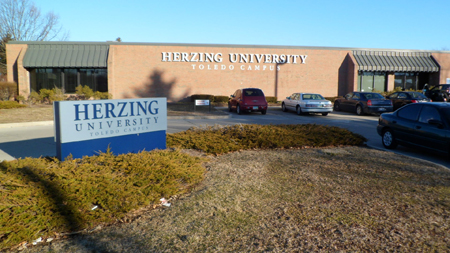
Herzing University is located at 5212 Hill Ave. in Toledo. Photo courtesy Herzing University.

The document also lists 21 “miscellaneous fees” ranging from $3 per credit hour to $4,825 a year that students could potentially be required to pay. The document also lists four of the miscellaneous fee categories as “vary by course.”

The website informs students that “fees are for a typical fall/spring semester, 15-week course. Application and new student registration fees may also apply. Tuition and fees are subject to change.”

Additional Owens costs

Owens’ website reports that unlike BGSU and UT, Owens does not attach a fee to the cost of a credit hour. The advertised $146.03 cost is final.

The website lists five required fees. Two are one-time fees — an application fee ($20) and a new student orientation fee ($65).

Recurring required fees are registration fees ($10), laboratory fees, which vary by course, and academic support service fees ($110).

Owens lists 12 optional fees, ranging in cost from $5 per academic program to $50 per semester. Owens does not charge a parking fee.

‘No fee’ policy

“We don’t stack fees,” Milliken said. “We include the cost of books (in the price of a credit hour), and we don’t add any fees. We even pay for any certification test that a student would need. For example, our new information technology program will include some Cisco (Computer Information System Company) certifications. If someone has to sit for a Cisco certification test, we pay that fee as a part of their tuition.

“We don’t have technology fees, special services fees, program fees and parking fees. If you were to take a look at the typical bill for a public university, you could see as many as six to 10 different kinds of fees. When the state legislature puts a tuition freeze on what public colleges and universities can charge, those institutions generate additional revenue by establishing fees.”

Global marketplace

“This is career-oriented stuff where graduates can walk right in the door and do the job because, built into our curriculum, we’re using actual case studies that companies faced in logistics, product ordering, HR, benefits, financial accounting — every aspect of the global marketplace,” Milliken said.

Milliken said Herzing’s Software Applications Platform (SAP) component to the curriculum makes its graduates more marketable.

“SAP is the software system that 60 percent of the world’s companies use, including local employers such as the City of Toledo, Owens-Illinois, Owens Corning, The Andersons and Chrysler,” Milliken said. “It’s in demand, especially in Northwest Ohio.”

Milliken said SAP allows various software programs that companies use to talk to each other and expand out into all types of devices, including personal computers, smartphones, tablets and the Web. Milliken said SAP allows companies to present information in user-friendly ways.

Liberal arts four-year colleges and universities teach the theory behind SAP and other computing platforms, but they don’t offer students the hands-on training in operating platforms that Herzing provides, Milliken said.

“When graduates walk out with a bachelor’s degree in business with this SAP component, they’re ready to walk into any one of our major local employers,” Milliken said. “They don’t have to leave the area to find opportunity. And we’re being told anecdotally out in the field that if you don’t have that SAP piece, many of the local employers aren’t going to look at you. Since the unemployment situation is so high right now, employers can pick and choose whom they want.”

Milliken acknowledged that critics will be skeptical of the “3+1” program, saying it is simply a marketing ploy that a for-profit university is using to entice more students to enroll.

“There will be naysayers out there, but until we start creating the university of the future, we’re going to miss a lot of opportunity,” Milliken said. “For the traditional bricks-and-mortar university, time is passing it by. There are almost 1,000 online programs out there. Our online bachelor’s program is now ranked 80th in the country by U.S. News & World Report. That puts us at No. 1 on Northwest Ohio and No. 2 in Ohio.”

Further implications

“We have to leverage the resources that are available to meet the students where they’re at because the adult learner, formerly known as the nontraditional student, is the norm rather than the exception these days,” Milliken said. “In order for them to complete an education, we have to work around the work-family-children-life balance. And education is just one more thing piled on all the pressures of life. And unless and until we evolve and adapt to meet those situations, we’re not going to succeed as a region.”

Milliken said Herzing is looking to expand the “3+1” program “in any way we can so that students can save money on college. It’s something that may be a good fit for Northwest State [Community College, with its main campus in Archbold and satellite campuses in Bryan, Van Wert and Whitehouse] or Terra [Community College in Fremont], but those discussions have not been completed. The idea has been introduced to their leadership, but further discussions are obviously needed.”

Milliken said reciprocity programs like “3+1” could be expanded to programs both schools have in common, including:

  • Technology programs in computer networking, network management, security technology and technology management.
  • A public safety program in criminal justice.
  • Health care programs in health information management, health care management, insurance billing and coding, medical assistance services and surgical technology.
  • Business programs in accounting, business management and paralegal services.

“Anything that we offer could be pursued at a higher level toward a bachelor’s degree,” he said. “Anything we offer is a logical candidate for such a ‘3+1’ program.”

Milliken said Greg Guzman, Herzing campus president, gets all the credit for establishing the program.

“Greg used to work at Owens so he has some ongoing relationships there,” Milliken said. “What gives us such a foothold here is that Greg has worked in higher education in many of Northwest Ohio’s public universities, including Owens, Lourdes [University] and Bowling Green [State University].

“As institutions of higher education, we have to do a better job of meeting all students where they’re at and structure programs accordingly to do two things — help them achieve success and give them the tools and the tool belt necessary for what the workforce demands.

“And if we’ve done neither or either, then we’ve failed the students who are investing in their future success.”


Local agency plans several events to mark Child Abuse Prevention Month

0

A baby boy later named Alex Michael Cervantes was a few days old when he was submerged in water and strangled, his body left in a freezer when his parents moved out of their East Toledo rental.

Two-month-old Kalib Henderson and 6-month-old Noland Letellier died after being shaken while 6-month-old Avery Glynn Bacon was allegedly thrown against a hard surface, causing the skull fractures that killed him.

One-year-old Ke’Ondra Hooks was struck in the head by a stray bullet, killed by street violence while sleeping on the floor of her family’s Moody Manor apartment.

Siblings Paige Hayes, 10, Logan Hayes, 7, and Madalyn Hayes, 5, were killed by their grandmother and uncle in a murder-suicide using carbon monoxide inside a vehicle in a West Toledo garage.

Five-month-old Ella Thomas drowned in a bathtub and 4-year-old Taevion Maulsby died of smoke inhalation from a fire started by playing with matches in the Old South End.

These 10 Lucas County children will be remembered at a memorial set for 11:30 a.m. April 19 at Lucas County Children Services (LCCS), 705 Adams St. The annual ceremony remembers those younger than 18 who died of abuse, neglect or street violence during the past year.

LCCS Executive Director Dean Sparks said 10 children is the most to be memorialized in one year since the agency started doing memorials about a dozen years ago. In 2011, three Lucas County teens were killed as the result of street violence and none died of abuse or neglect.

�?Profoundly somber’

“It’s sad,” Sparks said. “It is profoundly somber for all of us. We do what we do because we want to protect kids. That’s our mission in life. We think it’s important to take the time to stop and remember and to commit ourselves anew to doing everything we can to prevent child abuse. Those 10 deaths were absolutely preventable.”

April is national Child Abuse Prevention Month and April 10 is Ohio’s second annual Wear Blue Day.

“People need to know they are not alone in caring for kids,” said LCCS Public Information Officer Julie Malkin. “It’s simply getting the word out that it’s important to be passionate about this.”

LCCS Assessment Manager Cary Brown said she hopes seeing widespread community support might encourage someone to report suspected abuse or neglect. The agency’s hotline, (419) 213-CARE (2273), is staffed 24 hours a day, seven days a week. Reports can be left anonymously.

“If I see my cubicle mate doing it and a neighbor doing it, I might be the one to make that report and intervene before a child is seriously hurt because I know there are other people in the community who care,” Brown said.

Sparks said many people don’t report suspicions because they convince themselves the adult won’t really hurt the child or they feel it’s none of their business.

“People have a hard time imagining anyone harming their children, especially if it’s someone in their family or their neighborhood, but if you have a suspicion, call us or call local law enforcement,” Sparks said. “It’s better to call and it not be right than for a child to be harmed.”

Brown agreed, noting that LCCS had little or no prior involvement with the families of the 10 children killed.

“That fact reminds me that we depend on families, neighbors, community members and professionals to tell us these things are happening. Someone has to call and tell us,” Brown said. “I would err on the side of caution, err on the side of safety for that child.”

In 2012, LCCS received 4,959 referrals involving 7,347 children. Investigations determined 822 were abused or neglected, a 40 percent increase over 2011, according to the agency’s annual report. Forty-nine percent of investigations were for alleged physical abuse, 36 percent for neglect, 13 percent for sexual abuse and 2 percent for emotional abuse.

The highest rate of referral (referrals per 1,000 child residents) was in the 43604 ZIP code, followed by 43605 and 43608. The highest number of referrals came from the 43605 ZIP code followed by 43609.

“Some parts of our community have more resources than others, both financially and service-wise, where you would have a better ability to get help without coming to the attention of our system,” Brown said. “There’s probably areas of the community that think it doesn’t happen here, that it only happens in the central city. But drugs, alcohol and physical violence is not just in the central city; it happens everywhere.”

Of new cases opened in 2012, 40 percent of families were white, 32 percent were African-American and 25 percent were multiracial, according to the report.

Almost a third of the children (29 percent) remained in the home while issues were worked through, a third (34 percent) stayed with relatives and nearly a third (27 percent) went to foster homes, Malkin said.

Twenty-four percent of referrals came from social services, 24 percent from relatives, friends or neighbors, 16 percent from law enforcement, 15 percent anonymously, 13 percent from schools and 5 percent from medical personnel.

One area Brown said LCCS has been seeing an increase is with children affected by heroin addiction, whether through parental drug use or children born addicted to the drug or the prescription treatment drug methadone. From September 2012 to March 2013, 48 children were removed from Lucas County homes because of heroin use, including 15 infants who were born addicted and must stay in the hospital for up to a month to be weaned off the drug.

Mental health issues is another area seeing an increase, Brown said.

Families involved with LCCS aren’t necessarily “bad people,” Brown said.

“Most of the families we see really love their kids and want to be able to take care of them; most of our parents want to be good parents, but life circumstances are such that they can’t do it without resources that we can give them at this point in time,” Brown said.

Brown said the rewards of her job outweigh the stress and heartbreak.

“People say, �?Oh I couldn’t do what you do,’ but the ability to make a difference has really gotten me through all these years,” Brown said. “We have the ability on a daily basis to make a difference in children’s lives. I’ve been doing this 25 years and I still feel that as I come to work every day.”

LCCS’ website, lucaskids.net, offers tips for recognizing child abuse or neglect and information about becoming a foster parent.

LCCS is encouraging people wearing blue April 10 to post photos on the agency’s Facebook page, tweet photos to @LucasCoOHKids or email photos to [email protected].

Sarantou

“Every year 1,700 kids die in the U.S. from child abuse or neglect. That’s epidemic stuff,” Sparks said. “All of us who are going to be putting on blue are saying we are going to be doing everything we can to prevent child abuse in our community. We want all of Lucas County and Ohio to be blue that day. We’re all going to stand united on behalf of kids.”

Toledo Council member urges support for Wear Blue Day

Toledo City Council will vote at its April 2 meeting on a resolution encouraging residents to participate in Wear Blue Day on April 10.

The second annual event, organized by Lucas County Children Services (LCCS), is meant to “unify our community in a commitment to keep children safe from being abused and neglected,” according to the resolution. April is National Child Abuse Prevention Month.

“Child abuse and neglect continues to be a concern in the Toledo area and members of Toledo City Council urge our community to stand up to protect our most precious resource, our children,” the resolution reads.

“It’s very important because we need to eradicate child abuse in our community,” said Councilman George Sarantou, the resolution’s sponsor. “Every day we’re reminded of child abuse in Toledo and throughout Northwest Ohio. It’s very important to urge people to be aware of it, report it and do something about it. It just can’t be tolerated. Children are very innocent and they certainly deserve to live in a positive environment and not go through child abuse, which as we know can have lifelong negative effects on a human being.”

Toledo FAVS hosts April film series on religion, spirituality

0

Toledo Faith & Values (ToledoFAVS.com), a website covering religion and spirituality in Northwest Ohio, is set to debut its film series “Faith Under Fire: Documentary Films on Religion’s Hot Topics” on April 6.

David Yonke, editor of ToledoFAVS and Toledo Free Press contributor, will moderate a discussion of the films after each screening and has invited community experts to answer questions at each screening.

Yonke said he got the idea for a film series after the church he attends, Calvary Church, moved to the former Rave Motion Pictures Maumee 18. He said he decided to have discussions after each film because he “wanted to do more than just show a movie.”

The April 6 film “Hitchens v. Blair: Is Religion a Voice for Good?” features a debate between the late Christopher Hitchens, an intellectual and an atheist, and former Prime Minister of the United Kingdom Tony Blair, a Christian.

“It was brilliant because you’ve got two really intelligent people with two contrasting views,” Yonke said.

The Rev. Julian Davies, a former atheist and professor and now a pastor of the University Church, and Peg Clancy of the Toledo chapter of Recovering From Religion, will talk after the film.

“Father of Lights: Who is God?” will screen April 13. Darren Wilson, a Monroe, Mich., native, directed the documentary, which explores God’s character.

“Twist of Faith” will follow April 20. This documentary features Toledo firefighter Tony Comes coming to terms with past sexual abuse by a Catholic priest. Comes and Jon Schoonmaker and Claudia Vercellotti of the Toledo chapter of the Survivors Network of those Abused by Priests are expected to attend the discussion after the film.

The final film in the series is “Expelled: No Intelligence Allowed,” in which Ben Stein explores freedom of speech in academics in regard to intelligent design, on April 27.

Yonke, the former Blade religion editor, said he hopes the film series makes people more aware of ToledoFAVS.

“I still run into people who are wondering what I’m doing,” Yonke said with a chuckle. He added that he’s enjoying running his own website, which launched last summer.

“[ToledoFAVS] really meets a need in the Toledo area. It’s a lot of work but it’s very rewarding,” Yonke said.

Each film screens at 6 p.m. at Calvary Church, 1360 Conant St., Maumee. There is a suggested donation of $10 that goes to ToledoFAVs, a nonprofit. For more information, visit
toledofavs.com.

Walleye make playoffs despite losing 5 players to AHL

0
Toledo Walleye forward Randy Rowe. Photo courtesy Toledo Walleye.

Despite losing 2-0 to the conference champion Reading Royals, the Toledo Walleye clinched a spot in the ECHL playoffs with a little help from the Wheeling Nailers on March 24.

The Nailers held on and defeated the Kalamazoo Wings, who were ninth in the standings and trailed the Walleye by seven points.

Despite gaining a point from a shootout loss, the Wings could at best tie Toledo in total points, but the Walleye would have the advantage in the tiebreaker.

According to the ECHL website, the first tiebreaker is total wins excluding shootout victories. If the Wings were to win their final three games, they would have 31 wins. Toledo already has 35 and no shootout wins.

Walleye head coach Nick Vitucci said the March 24 loss was “bittersweet.”

“I was excited, our effort was night and day compared to last night and that’s a top team in the conference and we ran right with them, thrilled about out last 70 minutes of hockey against this hockey club here.”

Vitucci said he knew after the second period about Kalamazoo’s shootout loss but waited to spread the news until trainer Brad Fredrick could confirm it — from his cellphone on the team bench during the final stanza.

Vitucci then told his captain Kyle Rogers and alternate captain Randy Rowe.

Later in the period, the final was announced and the 7,071 attendees gave the team a standing ovation for clinching the playoffs for the second time in Walleye history.

Despite the pressure of making the postseason being lifted, Rogers said there is still some work to be done before the playoffs start, which could be as soon as April 3.

“It’s a great feeling; maybe loosen up the hands a little bit and maybe the guys will play a little better,” he said. “We can’t sit back, we have to go hard and practice and go harder actually to get better and to improve so we don’t get four-and-out in the first round.”

Defenseman Wes O’Neill noted one adjustment will need to be the team’s power play, which is 18th in the ECHL at 15.2 percent (70-of-256). Only two other playoff-bound teams have worse execution with a man advantage.

The Walleye have been in playoff contention for most of the year and during the NHL lockout the team had the depth and talent to potentially take the North Division crown. Once the lockout ended in January, however, the Walleye — who had a share of first place in the division — lost five players in a 24-hour span. The five called up to the American Hockey League, including playmakers Byron Froese, Ben Youds and Terry Broadhurst, combined for 84 points. Froese and Youds would intermittently find themselves on the Walleye roster and Youds finished the season in Toledo.

Vitucci said he is unsure whether the AHL affiliates will send any players down to help the Walleye’s playoff run.

While the Walleye were looking to fill their roster, they signed Nino Musitelli on Jan. 15 and he remained with the team, scoring 20 points (10 goals, 10 assists) in 31 games.

The Walleye took advantage of having Trevor Parkes in the lineup when he was sent down from the Grand Rapids Griffins. Parkes’ presence is especially felt on special teams, accounting for six power play goals in 17 games with the Walleye.

For some players, such as 32-year-old Rowe, this could be one of the last postseason appearances.

“Might be my last year, might not; I don’t have too many more years left at all,” Rowe said. “[Making the playoffs is] really important, especially with the group of guys we have here because I respect all these guys and it’s a good group of guys and if there’s a
team to do it, I think we’ve got a good bunch of guys to do it.”

Rogers said he would “want to try to do everything I can for him to get into the playoffs this year.”

O’Neill said while the team is happy to clinch a playoff spot, the players’ goals are high.

“We want to win it. We’re not just happy to get there, we’re going to hopefully play hockey for a couple more months,” O’Neill said. “Once we get there, we have to step up our game
another notch.”

Second neighborhood improvement initiative kicks off in Toledo

0

Several city officials and businesspeople, including Mayor Mike Bell’s office and the Inspection, Neighborhoods, Public Service and Public Utilities departments, kicked off Toledo’s second year of Spring Sweeps, an initiative striving to better the city’s housing
and building stock, on March 27.

“These Spring Sweeps are very crucial to the quality of life for people in different areas of our city,” Bell said during a news conference at East Toledo Family Center on March 27.

“It is a very aggressive process to make people feel assured that their city cares about them,” he said.

The initiative’s soft launch started March 20 and the program ends June 1.

The first part of the sweep will focus on East Toledo before going into the United North, Broadway Corridor and Overland Park areas. As part of the initiative, the city’s Division of
Code Enforcement is conducting inspections and handing out door tags that include information on assistance programs. Discount codes to local hardware stores are also available.

Spring Sweeps also includes police participation. In a 10-day targeted enforcement operation in March, police arrested more than 200 people in East Toledo areas where higher than average crime rates were reported.

At the news conference, Police Chief Derrick Diggs said that maintaining neighborhoods is important because vacant or rundown buildings can attract crime.

The sweeps also feature a neighborhood cleanup day where school and community groups will help out.

East Toledo’s is set for 9 a.m. to noon April 27, starting at East Toledo Family Center. Last year’s program focused on West Toledo.

“The feedback from last year was very positive. If anything, the residents in the areas we targeted wanted more information about their neighborhoods,” said Chris Zervos, director of inspection. “[Residents] not only took care of their own properties but they helped their neighbors take care of theirs.”

This year’s Spring Sweeps tackles 8,000 properties, down from 17,000 last year, said Dennis Kennedy, manager of code enforcement.

“We focused our areas down. We’re a little bit smaller this year so the neighborhoods get more attention from the inspectors instead of doing a larger blanket sweep,” he said.