Home Blog Page 226

Ottney: Thank you — July 4 and beyond

0

Toledo Free Press received a huge response to last year’s inaugural Military Yearbook and this year’s response was even more enthusiastic. The issue, published June 30, featured the names and faces of more than 100 area men and women who proudly wear the uniform of the United States military, hailing from every era and branch of service. Many have siblings, parents, children and other family members who also served.

There’s a special blend of pride, patriotism and camaraderie shared by military members and it spans the generations. I witnessed it June 26 watching veterans interact at Honor Flight of Northwest Ohio’s latest welcome home celebration. I witnessed it June 5-9 at the traveling Vietnam Veterans Memorial Wall in Toledo. And I’ve seen it in my own family.

My grandfather, Alfred Ottney, and brother-inlaw, Alex Wolff (both pictured in last week’s yearbook) joined the Navy more than 60 years apart, yet find more common ground than I’d expect about their experiences, comparing stories every chance they get.

Military families — parents, spouses, children and significant others who go months at a time without being able to embrace, lean on or know their loved one is safe — also sacrifice.

Growing up, my grandma taught all her grandchildren the proper way to fold a flag, warning us to never let it touch the ground. My parents illuminate their flag at night or take it down each evening. They remove their hats and place their hands over their hearts during the national anthem. They attend a Memorial Day service every year and linger afterward at gravesites, willing to sacrifice a few hours to pay their respects. I’m thankful now I was raised with that kind of reverence and attitude of gratitude toward those who serve.

Shortly after Memorial Day, a letter to the editor came across my desk. Vietnam veteran Daniel Cannode of Waterville was concerned that fewer and fewer members of local veterans groups seem to be honoring the annual ritual of placing flags at veteran headstones in area cemeteries.

“The current generation it appears does not deem it necessary to remember the sacrifices veterans made to keep this great republic free,” Cannode wrote. “How much longer will it be before it is ‘just another Monday holiday’?”

I can’t speak for veterans groups, but it does seem too few civilians take time out of their three-day weekend to attend a Memorial Day ceremony. Too few bother on the Fourth of July to think about the true cost of our independence. Too few ever pause to thank a veteran for his or her service. The service members highlighted in last week’s yearbook represent only a small fraction of those with ties to this area; the issue is our modest effort to thank them all, one we plan to continue for years to come.

Sarah Ottney is managing editor of Toledo Free Press and Toledo Free Press Star. Contact her via email at sottney@ toledofreepress.com.

UPDATE: Relatives of Angela’s cellmate contact FBI with tip

0

Relatives of Angela Steinfurth’s cellmate alerted the FBI late Tuesday evening to the potential location of Steinfurth’s missing 18-month-old daughter, Elaina.

Jobeth Adams of North Toledo said her sister, Connie Elam, called her June 18 from Lucas County Correctional Facility. Elam told Adams that Steinfurth had confessed to helping her boyfriend hide Elaina’s body.

Jobeth Adams of North Toledo holds her cellphone showing the call she and her husband made to Toledo Police Department's Crime Stoppers tip line on June 18 regarding missing 18-month-old Elaina Steinfurth. Toledo Free Press Photo by Sarah Ottney

“[Elam] called Tuesday night, and she was really upset,” Adams said. “She said, ‘I don’t know why this woman has decided to confide in me.’”

According to Elam, Steinfurth’s boyfriend Steven W. King threw Elaina up against the wall between the night of June 1 and the morning of June 2, injuring her. King then put the toddler down for a nap and when Steinfurth checked on her later, Elaina was dead.

“They wrapped [Elaina] up in a blanket, and took her down by the High-Level Bridge and [King] stood behind [Steinfurth] and she threw this baby in the river,” Adams said.

‘“[I said] ‘So what you’re trying to tell me, Connie, is there is no hope for this baby coming home?,’” Adams said. “And she said, ‘No Jobeth.’ She said, ‘They’re looking in the right place for this baby. This baby is dead. She’s in the river.’”

Elam called Adams at 9:24 p.m. June 18. Adams’ husband called Toledo Police Department’s Crime Stoppers tip line at 10:50 p.m.

“Carl called and gave all the information, and they transferred us over to the FBI,” Adams said.

Adams said her sister is only interested in helping the search for Elaina.

“The other women [in Steinfurth’s cell] want something. My sister don’t want something,” Adams said. “That’s the reason she said something.”

Adams said Elam and Steinfurth became cellmates on June 17.

“[At first], she felt bad because all the girls in there was wanting to beat the girl up,” Adams said. “Then all of a sudden, the girl comes to her and confided in her and she’s like, ‘You didn’t take your baby to the hospital?’

Elam is currently incarcerated on child endangerment charges, but has not been convicted. The charges stem from an incident on March 20, in which Elam left her 2-year-old daughter with the child’s paternal grandfather, Aubrey Dale Marshall, a convicted sex offender. Adams said Elam did not know of Marshall’s prior conviction. Marshall is charged with raping Elam’s daughter, but has not been convicted.

“My sister’s in there for something that happened to her child that she couldn’t help and is looking at this girl like, ‘I took my baby to the hospital.’ My sister took her child to the hospital. … and this lady didn’t do nothing for her baby. So it hurt my sister. It hurt her bad. It is a real messed up situation.”

Steinfurth is being held on child endangerment charges while the investigation into Elaina’s disappearance continues. King has not been charged in connection with Elaina’s disappearance.

Elaina was reported missing on June 2 when her father Terry Steinfurth Jr. came to pick up his daughter between noon and 1 p.m. at a home on Federal Street. An argument ensued when Angela refused to give him Elaina, according to several witnesses.

Almost an hour after the start of the argument, Angela went in to get Elaina but came out “crying and screaming” that Elaina was gone, according to Terry Steinfurth Sr., Elaina’s grandfather.

The family began searching the area for Elaina. They called the police when she could not be found.

GM: Casino drew 3.4 million visitors in first year

0

Remarking that “success in any business is measured one guest at a time,” Hollywood Casino Toledo General Manager Richard St. Jean has 3.4 million reasons to feel the casino’s first year of operation has been a success.

The casino drew more than 20,000 guests on its opening day, May 29, 2012, and went on to log more than 3.4 million visitors during its first year — 600,000 more than projected, he said. Seventy-four percent of visitors came from outside Lucas County and 44 percent came from outside Ohio, including 31 percent from Michigan. The casino paid out $41.5 million in jackpots.

Hollywood Casino Toledo General Manager Richard St. Jean speaks during the casino’s one-year anniversary celebration on May 29. Toledo Free Press Photo by Sarah Ottney

On May 29, as hundreds of slot machines dinged and chimed in the background, St. Jean joined local officials and business partners on the H Lounge stage to mark the casino’s anniversary.

“I stood here a year ago very, very proud of the property we were ready to launch and here it is one year later and I can tell you that pride hasn’t changed or diminished one bit; in fact, it’s actually grown,” St. Jean said.

During its first year, the casino served 36,000 gallons of draft beer, Final Cut Steak & Seafood served 23,000 pounds of prime beef and visitors used 1,662 miles of toilet paper, said Hollywood Casino Toledo Vice President of Marketing Jason Birney.

In February, Final Cut earned a four-star rating from Forbes — the only restaurant in Ohio, Michigan or Indiana to receive the distinction.

“We’ve been a great neighbor to Rossford and a great business neighbor to Toledo,” St. Jean said. “We feel we have been accepted as a fun hotspot that complements the other entertainment facilities in town.”

St. Jean said he and parent company Penn National Gaming are pleased with Hollywood Casino Toledo’s first-year results.

“Our patterns, inception to date, have been very, very close to what we’ve predicted month by month,” St. Jean told Toledo Free Press. “We can’t control how we perform relative to someone else’s numbers. Too many people compare a state number pulled out of a budget that said, ‘This is what we really need to hit,’ whether its current or whether it was back in 2009 when the referendum passed. Well, there are a lot of mitigating factors with the economy and everything else, so we do our own forecasts and we measure our success against that forecast and we were pleased with our performance against our forecast.”

Horseshoe Casino Cleveland opened May 14, 2012, followed two weeks later by Hollywood Casino Toledo. Hollywood Casino Columbus opened in October followed by Horseshoe Casino Cincinnati in March.

From their openings through April, Ohio’s four casinos brought in $615.7 million in adjusted gross revenue, with $181.2 million coming from Hollywood Casino Toledo.

St. Jean said he was particularly pleased to see Toledo notch the highest net slot win among the state’s four casinos in April, a result he attributed to Cleveland’s casino being “cannibalized to a degree” by nearby Thistledown Racino.

Toledo’s biggest revenue month to date was June 2012, the casino’s first full month of operation, when it brought in $20.4 million.

Revenue then dropped to $19.1 million in July, $17.4 million in August, $15.9 million in September, $14.8 million in October and $13.6 million in November before bumping up to $14.2 million in December, $14.3 million in January, $14.8 million in February and $17.8 million in March and then dipping to $16.4 million in April.

Economic growth

Toledo Mayor Mike Bell said May 29 that, while the casino was a controversial subject, to him the issue was simple: The casino would create jobs and help turn the city’s economy around.

Workers install the Hollywood Casino Toledo sign facing Interstate 75 in December. Toledo Free Press Photo by Joseph Herr.

“When we started our administration the unemployment here in Toledo was about 13.8 percent; that’s down to somewhere about 8 percent now,” Bell said. “The casino has played a role in that. It’s employed people who were not employed before and they now have a job. They are able to do the things they want to do for their families and that increases the quality of life for all Toledoans.

“If all 1-year-olds could do what [the casino has] been able to do in one year, we’d really be moving forward as a city and as a world,” Bell said.

New opportunities

About 90 percent of the casino’s 1,300 team members were local hires and 80 percent of the original hires are still with the casino, St. Jean said. So far, 128 people have been promoted, including 13 twice and six three times or more.

One local hire was 41-year-old Stacy Alani of Toledo. Two years ago, Alani didn’t know a thing about cards. Now it’s her livelihood.

After the transportation company she’d worked at for four years consolidated most of its Toledo area operation to an out-of-state office, Alani found herself out of a job.

After several frustrating months of applying for jobs but getting no response, Alani landed a job as a table games dealer — earning more money than before and enjoying the work more.

“Everything happens for a reason. I firmly believe that,” Alani said. “I love the people I work for. Compared to the job I had, which just wasn’t a friendly environment, at Hollywood [General Manager] Richard St. Jean and [Assistant General Manager] Mike Galle will sit down in our lunchroom, just plop their tray down beside us. They are not above anyone. They know everyone by name. They want you to succeed and be happy and you want to do well for them. Everybody is just like a big family there.”

Alani deals mainly craps, but also works at the roulette and blackjack tables. She and the other dealers know regular customers by name. She went through weeks of dealer training, but said her education continues daily.

“This is my new career. This is what I’m doing and I want to know everything about it,” Alani said. “I just try to take it all in and learn everything I can. I learn so many new things every day.”

Business impact

Construction workers provided an initial increase in revenue for Rossford businesses and casino employees continue to bring in a minimal level of business, employees at several Rossford businesses said.

“We get business from the employees of the casino, but not their customers,” said Amanda Schoenhofer, an employee of Marco’s Pizza in Rossford. “I don’t think a lot of the people leaving the casino come into Rossford. They just go straight to the highway.”

Rossford City Councilman Chuck Duricek, who owns Duricek’s Automotive Services about a mile from the casino, said businesses in Rossford have experienced little to no increase in customers. The best part, though, is that the predicted increases in crime have not been an issue at all, Duricek said.

Toledo Mayor Mike Bell helps Hollywood Casino Toledo General Manager Richard St. Jean cut a cake during the casino’s one-year anniversary celebration May 29. Toledo Free Press Photo by Sarah Ottney

Nearby hotels, however, are an exception. According to Front Desk Manager Cal Disouky, the Days Inn in Toledo, located across the street from the casino, has experienced a 15 to 20 percent increase in occupancy because of the casino.

“We’re the only hotel within walking distance,”  Disouky said. “We expected more, but it didn’t turn out how we expected in part because we’re not on the casino’s list of approved hotels.”

Other hotels have experienced a bump in business.

“We’ve picked up quite a bit of business,” said Connie Adams, front office supervisor at Country Inn & Suites in Rossford, which is on the casino’s recommended  list. “We probably have six to 10 people per day from the casino.”

Local focus

The casino often touts a commitment to supporting local businesses, especially woman- and minority-owned businesses.

Kurt Amstutz, co-owner of Elmore-based Tank’s Meats, which supplies 50 percent of the meat sold at the casino, said May 29 he was thankful for the opportunity to partner with the casino.

“For a company this size to give a small player like us the opportunity, the chance of doing business with them, is phenomenal,” Amstutz said.

Shelly Okun, owner of Toledo-based Sam Okun Produce, called the partnership a once-in-a-lifetime opportunity.

“It’s been really empowering to us as a company and for our customers,” Okun said.
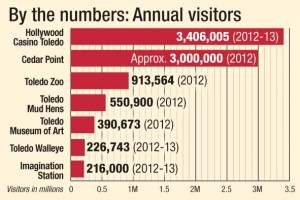
Graphic by James A. Molnar; information compiled by Sarah Ottney.

Tourism

Richard Nachazel, president of Destination Toledo Convention and Visitors Bureau, said the casino has helped attract conventions and events to Toledo.

“There’s probably been 15-20 groups that have booked the Toledo area not specifically because the casino was there, but the casino being there was a help,” Nachazel said.

One example is the Heartland Travel Showcase, which hosted its annual convention in Toledo in February for the first time in 25 years and will return in March 2014.

“One of the things that helped them decide on us versus other cities was the fact we do have a casino,” Nachazel said. “It’s been incredible for the area, in a word. They’ve been a great stakeholder in the economic tourism impact of Northwest Ohio and certainly work well with our office. We couldn’t be happier they are there.”

Crime

By the six-month mark of the casino’s opening, concerns about increased crime, traffic jams and gambling addictions had largely subsided, area law enforcement said.

Capt. Brad Weis, commander of the Toledo Police Department’s strategic response bureau, said the casino has not been the problem area that many people expected — especially after it started hiring off-duty police officers to work inside.

“It’s definitely less than we expected,” Weis said. “Crime is actually minimal at best. From my perspective, it’s a benefit to the community and it hasn’t been a police issue at all other than traffic backups now and then.”

Rossford Mayor Neil A. MacKinnon III said the casino has actually made Rossford safer than before, thanks to a $200,000 public safety grant from Penn National used to purchase new radios and automated CPR machines, and a $12,000 grant to help establish a K-9 unit.

“We’ve seen no increase in crime whatsoever,” MacKinnon said. “We are actually safer today as a community than before they got here.”

Rossford Police Chief Glenn Goss Sr. agreed.

“It’s been real quiet,” Goss said. “We haven’t had any major changes in criminal activity since the casino’s been there.”

Goss reported more operating a vehicle while impaired (OVI) stops during the past year, but attributed the increase to his increased focus on all traffic law enforcement since taking over as chief in December 2011 rather than a direct result of casino traffic.

Last summer, Rossford police noticed an increase in burglaries, but that also was seemingly unrelated to the casino, Goss said.

Community involvement

Penn National prides itself on community involvement and has given more than $270,000 to local organizations in the past year, plus thousands more prior to opening, St. Jean said. Management team members sit on a dozen local boards and are active participants in the Toledo Regional Chamber of Commerce and Rossford Business Association.

The casino recently partnered with ProMedica on a food reclamation program, in which ProMedica collects unused food and donates it to local social service agencies. Since late February, more than 13,000 pounds of food have been collected, said Stephanie Cihon, corporate director of community relations for ProMedica, who is now working to expand the program into other area businesses.

Tax revenue distribution

Each casino pays a fixed tax of 33 percent of gross casino revenue. Fifty-one percent of the revenue is distributed among Ohio’s 88 counties in proportion to population; half of each county’s distribution will go to its largest city if that city’s population is above 80,000. Thirty-four percent of the revenue is distributed among all public school districts, 5 percent among  host cities, 3 percent to Ohio Casino Control Commission, 3 percent to the Ohio State Racing Commission fund, 2 percent to a state law enforcement training fund and 2 percent to a state problem gambling and addictions fund.

The City of Toledo received $2.9 million in 2012 and about $1.4 million so far this year in tax revenue distributions. Lucas County received more than $575,300 in 2012 and $1.1 million so far this year. Lucas County school districts have received $1.3 million, including $462,575 for Toledo Public Schools.

2012 distributions fell short of the city’s projected $3.4 million, but Lucas County got more than its projected $545,000, said Lucas County Commissioner Carol Contrada.

“We projected conservatively but realistically and the casino outdid itself,” Contrada said. “For 2013, we are on pace to exceed again. In fact, if the casino revenue keeps up the pace that it has been, we’re doubling down in Lucas County.”

The city’s 2013 budget projects $4.95 million in casino revenue, according to public information officer Jen Sorgenfrei.

Rossford City Council member Robert Ruse said he wished the legislation would have allowed for Rossford and Rossford Schools to benefit more from the casino. Rossford Schools has received $38,390 from casino tax revenue distributions.

Detroit impact

Ohio’s casinos have impacted Detroit’s casino business by about 4 percent, said Jake Miklojcik, president of Michigan Consultants, a Lansing-based firm providing economic and policy analysis for the casino and gaming market.

“Stories with the ‘lower than expectations’ headlines for Ohio casinos are intriguing because the totals are just about exactly what I thought they might be and told clients,” Miklojcik said in an email. “I was quoted several places in putting the likely impacts on Detroit at between 2.5 percent and 5 percent, with 4 percent my best estimate. If you look at Detroit figures, and factor in that there was a clear trend upward of 2 percent before the opening, and now down about 2 percent to 2.5 percent with the openings and, in addition, a racino, the net of about 4 percent from the Ohio casinos is pretty much right on.”

Yvette Monet, a spokesman for MGM Resorts International, the parent company of MGM Grand Detroit, said the company “enjoys hearty competition in all of the jurisdictions in which we operate.”

“Though we have seen some recent impact on revenues, there are a variety of factors, including the poor economy, that have impacted revenues in regional gaming markets throughout the county,” Monet said in an email.

MotorCity Casino and Greektown representatives did not return requests for comment.

Looking ahead

Casino employees recently decided to unionize, with negotiations expected to begin in June, St. Jean said.

The biggest challenge for Hollywood Casino Toledo going forward will be continuing to attract new visitors, St. Jean said. Food specials and entertainment such as the outdoor summer concert series that recently kicked off are among ways the casino is trying to draw more people in.

“It was a little lighter attendance than I was expecting, probably compounded by the holiday weekend and cold weather and it being the first concert people didn’t really know what to expect,” St. Jean said of The Temptations and The Spinners concert on May 24. “We expect Air Supply and LeAnn Rimes to be at capacity.”

Year one has been exciting, but St. Jean said he won’t spend too long celebrating the milestone before turning back to the work ahead.

“We’re excited about our performance in year one, but it’s like anything else, we’re now in a new year and it starts all over again. We’re interested in seeing where the business volumes level out. I don’t think we’ve necessarily seen that yet,” St. Jean said.

“We’re always raising the bar, so whether its financial performance, team member engagement or guest satisfaction, we’ve set all new benchmarks based on 2012 which became our baseline. So although we fared well compared to Penn National metrics, we challenge ourselves to do even better [next year].”

By Sarah Ottney TOLEDO FREE PRESS MANAGING EDITOR [email protected]

Toledo Free Press Staff Writer Casey Harper contributed to this report.

Cleveland Film Festival kicks off 37th year April 3

0
The 2012 CIFF Closing Ceremony at Tower City Center in Cleveland. Photo by Janet Macoska.

It’s a long way to Sundance and even farther to Cannes. But film enthusiasts don’t have to travel quite so far for a peek at up-and-coming films and filmmakers.

On April 3, the lights will go dark and the projector will illuminate the big screen as the 37th Cleveland International Film Festival (CIFF) kicks off.

The 12-day festival will showcase 180 feature films and 165 short films from 65 different countries.

More than 200 filmmakers are traveling to Cleveland for the festival, according to Patrick Shepherd, associate director of CIFF.

The 2012 CIFF closing ceremony at Tower City Center in Cleveland. Photo by Janet Macoska.

“Their countries of origin include Belgium, Belize, Brazil, Canada, France, India, Mexico, the Netherlands, Poland, Romania, Slovenia, United Kingdom and of course the USA,” he said. “We’ll also have a filmmaker from Puerto Rico.”

CIFF kicks off its opening night gala April 3 with screenings of “The Kings of Summer,” a coming-of-age film that was shot last summer in Greater Cleveland.

The festival begins at full steam on April 4. On a typical day there will be more than 30 films screened between 9 a.m. and midnight. On Fridays and Saturdays, there are late-night screenings that start around 11:30 p.m.

For those traveling from Toledo, Shepherd said they could make a day trip out of it or spend the whole weekend in Cleveland.

“The program is spread very evenly throughout the festival so you can get a sampling of the different types of films from around the world and all of the various documentaries that we bring in,” he said in an interview with Toledo Free Press.

For those who have never been to a film festival before, most operate out of theaters of varying shape and size. CIFF benefits from having one main location for almost all of its screenings: Tower City Cinemas in downtown Cleveland.

“We’re lucky to be in the heart of downtown,” Shepherd said.

“We’re very fortunate to have a very attentive film-going community in Northern Ohio,” he said, “and we’re most lucky about having everything under one roof.”

Organizers spend all year looking for films around the world, he said. There is also a call for entries launched every summer. Shepherd said there were nearly 2,000 films submitted for consideration.

Local connection

Once films are selected, CIFF works closely to connect specific films with nonprofit organizations in Northern Ohio. This was the first year CIFF reached out to Toledo organizations, said Shepherd, a 1993 Bowling Green State University graduate.

“I noticed that there was a trend of more people coming to the festival from the [Toledo] area,” he said.

The Toledo-Lucas County Public Library is partnering with CIFF for screenings of ‘Google and the World Brain’ on April 6 and 7.

The Toledo-Lucas County Public Library is partnering with CIFF for screenings of “Google and the World Brain” on April 6 and 7.

Shepherd said he reached out to the library because of the film’s story about Google’s mission to digitally scan and preserve every book ever written.

Tracy Montri, manager of the Main Library’s audiovisual department, said the partnership is a great opportunity to remind the community of the library’s commitment to film.

She noted that individuals who enjoy movies can borrow from the library’s film collection for free.

Montri has gone to CIFF several times and recommends attending.

“If you’re really into film, it’s a great investment to surround yourself with it. The folks who attend film festivals are like-minded individuals,” she said. “Film festival crowds are just there for the right reasons. It’s a really great community experience.”

Montri also organizes the library’s Film Focus series, which is a twice-annual, six-week independent film program at the Main Library, 325 N. Michigan St.

LGBT films

Equality Toledo is also partnering with the festival for God Loves Uganda,’ which screens April 11 and 12.

Equality Toledo is also partnering with the festival. The nonprofit organization that works to end discrimination in the region is connected with “God Loves Uganda,” which screens April 11 and 12.

“The festival has always made a commitment to LGBT films and the LGBT community, especially with its 10 percent cinema series,” said David Mann, spokesman for Equality Toledo. “We thought it was a great opportunity to help tell our collective stories.”

The film tells the story of LGBT Ugandans, who are risking their lives to fight for basic equality, Mann said. It also features certain forces in America that are exporting antigay hate and fueling violence in Africa.

“It’s a story that fits well with what we do here locally,” Mann said. “Whether here in Toledo or in Uganda, all of us are fighting for basic equality for LGBT people.”

What to expect

Audiences can expect to see filmmakers from films screened at CIFF.

“What makes a film festival special is the ability to engage filmmakers,” Shepherd said. “Anybody can watch a film on an iPad or even on your smartphone these days.”

Audiences at festivals have an opportunity to connect directly with directors, producers, writers or actors of a film, he said.

“Last year we had a little over 200 filmmakers come in for the 11 days,” Shepherd said. “I think we have at least 130 feature filmmakers coming in” this year.

One program at the festival is Focus on Filmmakers, which is sponsored by a grant from the Academy of Motion Picture Arts and Sciences.

Official poster for 2013.

CIFF received a three-year $150,000 grant in 2011 — the only festival in the country to receive the grant from the Academy, which is known for its Oscars.

“Getting support from the Academy is like getting a Good Housekeeping seal of approval from the industry,” Shepherd said.

In 2011, the focus was on African Diaspora films and filmmakers. This year, the focus is on the Latino community. Next year, the focus will be on the LGBT community.

Another tie-in with the Academy, two of CIFF’s short film award winners — Best Animated and Best Live Action Shorts — are automatically eligible for nomination consideration for the Oscars. Last year’s Live Action Short winner, “Curfew,” went on to win the Oscar in the same category in February.

CIFF is the largest film festival between New York and Chicago, according to Shepherd.

“There’s no other festival in the region that matches us in attendance,” he said.

CIFF has been at Tower City Cinemas since 1991, according to Shepherd. Back then, the attendance for the festival was around 15,000. In 2012, attendance for CIFF was more than 85,000, a record.

More are expected to attend this year after organizers added another day to the festival.

“There wasn’t any more room to grow, space-wise,” Shepherd said. “This is the first time in over 20 years that we’ve extended the length of the festival.”

Toledo Free Press is a media sponsor for the 37th Cleveland International Film Festival. More information and a schedule for the festival can be found online at clevelandfilm.org. (For a $2 ticket discount, use code: TOLEDO). For a chance to win tickets, visit Facebook.com/ToledoFreePress.

Pounds: Predatory pricing

0

One of the sad bastardizations of capitalism is predatory pricing. Yes, competitive pricing is a clear benefit to consumers, but when taken to an abusive extreme, the practice is a cudgel used to thwart the open market and harm smaller businesses.

I was heartened to see that Sens. Sherrod Brown (D-OH) and Rob Portman (R-OH) have asked President Barack Obama to protect employment at Appleton Papers, Inc. in West Carrollton, Ohio. According to a news release, “Brown and Portman led a bipartisan group of eight senators and representatives in calling on the U.S. Department of Commerce to impose duties on a foreign paper producer. A preliminary investigation shows that the company manipulated data to avoid paying antidumping duties, hurting domestic manufacturing at companies like Appleton, Inc.”

According to the Commerce Department, German exporter Papierfabrik August Koehler AG and Koehler America Inc. — known as Koehler — “sold its merchandise at a less than normal value and had deliberately manipulated data to avoid paying antidumping duties for imports on lightweight thermal paper.”

“We cannot allow foreign companies to get away with predatory pricing that undermines our economic growth and shutters our factories,” Brown said. “Dumping allows foreign paper companies to undersell U.S. companies, including Appleton Papers. As a result, manufacturing workers have lost jobs and communities have been forced to deal with plant closures. I commend the Commerce Department on the work they’ve done so far to curb unfair trading practices and urge them to continue protecting American jobs by imposing duties on Koehler paper sold in the United States.”

“American workers, like those in West Carrollton, can compete and win on a level playing field. However, when foreign competitors don’t play by the rules, we must stand up to ensure fair competition and enforcement of the laws on the books,” Portman said. “In 2011, I worked with my colleagues to protect Appleton’s workers from unfair imports and was successful in getting the administration to reverse their position. Ohio manufacturers like Appleton need our continued support and I urge the Commerce Department to strongly support their case.”

Those businesses that engage in predatory pricing should be held fully accountable and punished to the fullest extent of applicable laws. There are many examples in our media industry of those who have rigged their pricing to unfairly hurt competitors, and who have paid dearly for it when their actions were exposed.

Thanks to our Ohio senators for making this an issue and for fighting for businesses that are being battered by an unAmerican practice.


Thomas F. Pounds is president and publisher of
Toledo Free Press and Toledo Free Press Star. Contact him at [email protected].

Miller: Seuss’ muses

0

One of the great joys of being parents is watching our sons discover interests and explore new activities. Our 4-year-old, Sean, loves music, dancing and soccer. His 6-year-old brother, Evan, is a reader, Lego builder and modest budding athlete, with an affinity for T-ball and bantam bowling.

It was a mild surprise when Evan brought home a flier announcing auditions for a play. The Tecumseh Youth Theatre (TYT) was producing “Seussical the Musical” and was looking to integrate elementary students into the cast. TYT is an independent nonprofit not officially affiliated with Tecumseh Public Schools, but it draws the majority of its youth actors from that system. We try to encourage the boys to try new things, so we took him to the audition.

We arrived to find there were more than 140 elementary students trying out for about 16 ensemble roles.

Evan was undeterred and, in the closed audition, apparently sang a spirited version of “Happy Birthday.”

A week or so passed, and as you have likely surmised from the direction of this discussion, Evan was chosen for a part. He was excited and we were excited for him, even after we realized the amount of rehearsal time the production required. Evan was told as long as his school studies and homework were not affected, he could participate. So, from early February through the play’s debut at the Tecumseh Center for the Arts on March 22, Evan and his elementary castmates rehearsed and were assigned roles. Evan was a Who, a fish in McElligot’s pool and a boy in military school. The late nights were a challenge, but Evan learned his songs and came home each night excited about being part of the production.

“Seussical The Musical” mashes together dozens of Dr. Seuss characters, including The Cat In The Hat, Yertle The Turtle and The Grinch, with passing mentions of The Lorax, The Sneeches and many others. Its story and songs focus on two characters, Horton the Elephant and JoJo, melding two Horton stories, “Horton Hatches The Egg” and “Horton Hears A Who.” The main message is the importance of individuality and the danger in conforming to societal pressure. Horton braves ridicule and bullying to maintain his loyalty to his friends. JoJo’s independent thinking gets him in trouble at school and causes strife at home, and his refusal to blindly march in line at military school results in his parents believing he is lost in The Butter Battle.

So, to recap, the play celebrates and encourages those who refuse to blend in with the crowd and who instead choose to assert their individuality.

You know where this is going, don’t you?

The March 22 performance was played to a full house. It was a remarkable production (directed by Jamie Buechele and produced by Molly Rice), with a $15,000 budget, a 40-member cast and professional sets, costumes and choreography. It was an ambitious, complex and full production with 40 songs and a live orchestra. Standouts in the cast included Jake Ringer as Horton, Bryan Gilbey as The Cat In The Hat, Becca Nowak as the Sour Kangaroo (who performed her entire role carrying little Brenna Davis as the Young Kangaroo on her back) and the amazing Evan Pollet, a second-grader who carried the show with countless lines, songs and choreography. The production featured elements of ballet, circus acrobatics, black-light jazz hands and myriad musical styles.

Of course, none of the spectacle was as anticipated by me as my son’s several stage appearances. During his first time onstage, standing with about a dozen Whos, Evan spotted his family in the audience and timidly waved, drawing laughter from the audience and looks of consternation form some of the teenage Whos in his row. During an interlude in which several small Whos played very Seussian musical instruments, the Whos on the balcony above stood still and watched the band. All the Whos except our Evan, who danced up a storm as the spirited music played.

Now, during this brief minute or two, no actors were singing or speaking. It was just several Whos pretending to play Jing Tinglers, Flu Floopers, Tar Tinkers and Who Hoovers. As Evan danced, drawing laughter from some audience members, the teen Who behind him placed her hand on his shoulder and tried to still him. Evan wiggled away and continued channeling James Brown. It wasn’t obnoxious or wild, but as he was the only one not standing still, it drew attention to him. He continued tripping the light fantastic until the matriarchal teen Who physically pulled him back into line and forced him to stand still. That drew murmurs of disappointment from several people around me, but the scene soon ended.

From my seat in the audience, I marveled at the irony that in a play celebrating individuality and the refusal to conform, our son was being reined in and forced to abandon his individuality in the name of conformity.

Evan later cavorted in a full fish costume, without incident, then later marched in line with several boys in military garb. Except, rather than marching, he skipped, and when called upon to perform calisthenics, dropped into a push-up stance but proceeded to wildly kick his feet as if carrying out a crazed series of hyperkinetic bear crawls.

During the play’s climax, as the Whos jump and shout “We are here! We are here!” to prove their existence and save their world, Evan yelled and jumped as high as he could. For the finale, as the entire cast rocked out to “Green Eggs and Ham,” Evan’s little legs and feet were a blur of musical celebration.

In other words, every time Evan appeared on stage, he had fun.

Which is what it’s all about, right?

After the play, he excitedly asked if we had seen his “bonus moves,” a phrase he picked up from the Wii game “Just Dance.”

I was never backstage during the production, but I know the director told Evan he was fine and that the parental teen Whos would leave him alone. But the message to chill out got through, and when Evan took the stage on the next night, there was no waving, no dancing, no bonus moves.

He was just another little boy standing in line, behaving. It saddened me to see him not enjoying himself (to be fair, a runny nose and six consecutive nights of ignored bedtimes did not help his attitude). He was going through the motions, clearly unhappy to be caged. I wanted to yell up at him to dance and have fun, but of course, as a well behaving and conforming member of society, I did not.

But during the finale, as the cast cut loose, Evan’s attitude returned. He shuffled away from the Who who had acted like a teacher from Pink Floyd’s “The Wall” and danced his little shoes off, twisting and singing and rocking out.

The Whos around him, finally catching on, danced as well, joining him in a chaotic, bouncing, nonconforming line. I was the first to rise from my seat and start the standing ovation.

I don’t want Evan to draw undue attention to himself when it’s not appropriate and I certainly do not want him to be a troublemaker. But I do want him to understand that standing still and falling in line are not always the same thing as behaving. I want his spirit to burn bright and lead the way, not get lost in a long line of followers.

I can tell him from experience that there is a price to pay for following your hunches and standing up for yourself, but I can also tell him from experience that when you do … oh, the places you’ll go.


Michael S. Miller is editor in chief of
Toledo Free Press and Toledo Free Press Star. Email him at [email protected].

Toledo Main Library offers Film Focus series

0

The Toledo-Lucas County Public Library offers a Film Focus series every spring and fall. The six-week spring series started March 25 and runs through April 29.

“We’re really proud to have our own film festival with Film Focus,” said series organizer Tracy Montri, who is also manager of the Main Library’s audiovisual department. “We’re really proud of our programming at the library and of our collection.”

Film Focus started as a way for Toledoans to experience great films.

“Over the years, the public has taught the library that they’re very much interested in a diverse group of topics and presentations,” she said. “I try to choose very high-quality content and things that I don’t believe people otherwise have had an opportunity to see in the Toledo area.”

Now in its ninth year, the series is held in the McMaster Center at the Main Library, 325 N. Michigan St., on Mondays at 6:15 p.m. Each event is free, including underground parking.

The schedule:

  • April 1: “You’ve Been Trumped” documentary, U.K., 95 minutes. A group of Scottish homeowners takes on Donald Trump over Britain’s very last stretches of wilderness.
  • April 8: “Planet of Snail” documentary, Finland/Japan/South Korea, 88 minutes. At the heart of this film is Young-Chan, a deaf and blind man, who learns how to communicate with the world after meeting Soon-Ho. The two rely on one another completely. The film combines imagery with Young-Chan’s personal writings.
  • April 15: “Resurrect Dead: The Mystery of the Toynbee Tiles” documentary, U.S., 86 minutes.
  • April 22: “Found Memories” drama, Brazil/Argentina/France, 98 minutes. Madalena makes bread and lives a routine life. With the arrival of a visiting photographer, the two forge a deep relationship that changes both of their lives, as well as the lives of the villagers.
  • April 29: “Award-Winning Family Friendly Shorts” (Encore screening May 4, 2 p.m.). An entertaining collection of short films recognized by the American Library Association:
    • “Big Drive,” 9 min., ages 8 and up.
    • “Show Way,” 12 min., ages 5 and up.
    • “55 Socks,” 8 min., ages 8-14.
    • “Kali the Little Vampire,” 9 min., ages 12 and up.
    • “Anna, Emma and the Condors,” 20 min., ages 7 and up.
    • “Bink & Gollie,” 14 min., ages 4-8.
    • “Knuffle Bunny Free: An Unexpected Diversion,” 13 min., ages 4-8.

For more information about the series, visit ToledoLibrary.org.

Artists, yarnbombers support local fight against child abuse

0
Yarnbombers from the United States, Germany and Sweden have contributed to the local effort. Toledo Free Press Photo by Joseph Herr.

A knitting group from Sandy Hook in Newtown, Conn., has contributed to the sea of blue planned for Toledo.

In support of Lucas County Children Services’ (LCCS) Wear Blue Day, a day bringing awareness to child abuse, a Toledo “yarnbomber” with a secret identity will decorate the streets with blue.

Known by the moniker “Streetspun Yarnbomber,” the local artist enlisted the help of fellow yarnbombers all over the world. At press time, she was expecting yarn bombs from five European countries, including Germany and Sweden, and several other U.S. states.

Yarnbombs are knitted sleeves that can often be found around lampposts, parking meters and bike racks. During the week of Wear Blue Day, which is April 10, Streetspun will install the blue yarnbombs outside the LCCS building on Adams Street. They will remain up at least until the agency’s annual memorial on April 19.

The Cosmic Knittas from Sandy Hook in Newtown Conn., site of the December school shooting in which 26 students and adults were killed, was one of the groups to send a yarnbomb. A handwritten card that came with the piece read: “We know all too well that we need to protect our children and applaud your efforts for Wear Blue Day. We are graffiti knitters from Sandy Hook who are working on our own event but want to support yours too.”

LCCS Public Information Officer Julie Malkin communicated with Streetspun via email.

“It’s a great artistic way to show that people really care about kids,” Malkin said. “It’s particularly touching to have something coming from Sandy Hook where there was so much sadness.”

Streetspun said she love the gesture from the Cosmic Knittas.

“For me, it really goes to show that we all can come together, be peaceful and love one another,” Streetspun said via email. “I know that we cannot solve the world’s problems with [yarnbombs] but it is one way to make you smile and give you that warm fuzzy feeling.”

This form of graffiti is an act of good intentions, Streetspun said.

“They are all made with love and are meant to be a happy gesture to make things brighter and to simply make you smile,” she said.

Streetspun picked up the hobby on the first International Yarnbombing Day, June 11, 2011. Immediately, she knew she was hooked. When she was contacted by LCCS to make yarn bombs, she couldn’t refuse.

“When your city asks for [yarnbombs] how can you say no?” Streetspun said. “When you are making a statement like standing up against child abuse and domestic violence it is without a doubt very near and dear to my heart.”

After Wear Blue Day, Streetspun wants to donate the yarnbombs to an organization.

“Wherever they end up it will surely be a reminder of hope that there is so much love out in the world especially when it comes to our children,” she said.

Artomatic 419!

Artomatic 419! also plans to support the day of awareness. LCCS joined forces with Artomatic 419!, which issued an open call for artists to submit art for a “Blue Room” piece.

Two local artists, Louis Wilson and Kelly O’Brien, will create blue artwork for the local arts showcase set for 11 a.m. to 11 p.m. April 13, 20 and 27. The pieces will be set up at 911 Summit St., with Wilson’s on the first floor and O’Brien’s on the second.

“We appreciate the value of freedom of expression,” Malkin said. “Child abuse is a very sad and unfortunate thing and for people to express themselves artistically to show their feelings about this very serious subject is terrific.”

Wilson wants to help people understand the effects of child abuse with his wall-hanging, mixed media piece.

“I’ve seen the adverse effects on families and children from child abuse,” Wilson said. “[My piece is] meant for people to draw their own direction toward child abuse and the anguish that it brings.”

O’Brien wanted to portray more with the color blue in her piece. She hopes people get awareness from it.

“Blue also represents peaceful, tranquility, calmness,” O’Brien said. “I wanted to somehow portray that.”

April has been designated Child Abuse Prevention Month since 1983. This is the second year Wear Blue Day has been observed in Toledo.

Lucas: College is the vehicle — or chauffeur

0

“The future is already here — it’s just not very evenly distributed.”


— William Gibson

A friend of mine recently had some vacation time to spend. Knowing it was coming up, it didn’t cross my mind to ask how he was getting to his chosen destination. I only cared where he was going. Was he going somewhere with a beach? Maybe he was going to tour Washington, D.C.’s museums, or maybe go someplace where they speak the Romance languages. The means of transportation were mildly above insignificant.

Until about six or seven years ago, a college degree was your near-guaranteed ticket to the life you always wanted. By collecting abbreviations after your name, the value you could provide and the reward you got in return, only increased. If you had a bachelors degree and didn’t have a job, you probably didn’t want one. If you had a master’s degree and weren’t working, you were probably weighing several lucrative offers. If you had a Ph.D. and didn’t make $150,000 or weren’t the president of a college, you just couldn’t be trusted. College, at least for the past 100 years or so, was your ticket. It held a promise: Going to school resulted in getting a good job by default. Until it didn’t.

In this world, high school students get asked by each passing adult if they’re going to college and which school they’ve chosen. I find these inquiries quite odd. Like my friend who was set for a vacation, his mode of transportation really didn’t matter to me. I wanted to live vicariously through his enjoyment of the resort he’d attend. I wanted him to have a fantastic time and do what he’d greatly looked forward to for quite a while. He’d worked hard, and I wanted him to enjoy the fruits of his labor. This is why I look sideways when I hear this question asked, because it positions the transportation as the destination. College has, at least historically, been the car — or maybe the chauffeur. Going to university was what delivered you to the doorstep of your utopia. It isn’t in and of itself your destiny. However, when we ask this question we imply that college is the end zone when it’s only supposed to advance our ability to get there. We cause students to believe that a post-secondary degree is the only way. When traveling, I can take a car, a plane or a train. Might even walk. Getting to my dream has options also. College, while a major option, is still just that. One option.

There is a major democratization under way in our world that has already shaken our educational system to its core. While we’re bracing for a huge shift in education, we’ve yet to realize that it’s already happened. The effects of this shift are just coming to the surface.

College enrollment peaked in  2008 just after the financial crisis landed a swift roundhouse kick to the jaw of the world’s economy. Community colleges and technical schools spilled over with anxiety-laden 19- and 22-year-olds wandering in delirium from whatever the heck happened to their hopes and dreams, now lying shattered in a sea of debt crises, broken housing markets and plummeting job potential. That trend of fresh meat in the lecture hall has only reversed, however, and by current estimates, may never again be matched. Between 2000-10, the cost of college increased between 4 to 9 percent annually. During this same period, Internet penetration in North America increased 153 percent. There’s no doubt that the Internet loves to revolutionize industries and turn traditions on their heads mercilessly. It’s revolutionize alongside or get steamrolled. Information inherently wants to be free. Data wants to be known. Historically, sharing knowledge meant putting a message in a bottle. Today, it means broadcasting to the entire planet with just a few keystrokes, and for free. How do universities respond? There are plenty of theories, and I even have my own. How has the Internet responded? It’s responded with Coursera, Khan Academy, iTunesU, OpenCourseWare, Udemy, SkillShare and Udacity. These are all domains where anyone resting inside the troposphere can learn any skill from the world’s best teachers, as well as professors from MIT, Harvard, Stanford or my local college’s teaching roster, for free or maybe a crisp $20.

Newsweek stopped printing paper copies last year and found an amazing cover story worthy to grace one of its final hard copies. The title, “Is College A Lousy Investment?” They’re not the only one publishing stories with these provocative headlines. Forbes, TIME and USA Today have all done major stories on this same topic in the past year. So, is college still worth it? Yes. But the way we’re doing it won’t work, and obviously hasn’t worked in quite some time. Nobody with a lick of common sense is debating the value of knowledge, only the return on investment in college sheepskin. For the degree to maintain any value moving forward, major changes in how we structure these programs are necessary. Forty percent of students picking schools purely based on the football team or the super-scientific “girls’ hotness factor” ain’t gonna cut it. Neither of which is worth racking up $10,000-$25,000 a year in debt.

The best thing we can do for our young people is inspire a joy of learning. Not institutional learning or segmented learning. But learning and curiosity as a permanent state. I’ll write more on this particular thought later, but we have to stop pursuing educational experiences based on future job prospects. The future belongs to people who can make a way where there traditionally hasn’t been one.

College will always be with us, just as it should be. But we’re being forced to rethink what it means and how we do it. It’s important that we’re clear that college is an enabler. A key. An automobile. To position it as the destination is to stunt true development and creativity. Instead of asking, with odd suspense, if little Billy is going to college, ask him what he plans to do with his life, then ask him how he’s going to get there. To respond, he’ll at least be forced to think — and that’s more than asking what school he’s going to could ever hope to do.


Will Lucas is founder and CEO of Creadio, president at AWLCo, a music producer and former radio DJ.

TPS board to interview 3 interim superintendent candidates

0

Following a 76-minute executive session March 27, the Toledo Public Schools (TPS) Board of Education (BOE) quickly informed the public that it intended to interview three of the five candidates for TPS’ interim superintendent position.

Brenda Hill, BOE president, said the board intends to interview Dr. Romules Durant, TPS’ assistant superintendent of the Bowsher, Scott and Waite Learning Communities; Douglas Heuer, superintendent of the Cleveland Heights-University Heights City School District; and Dr. Michael Zalar, superintendent of the Oregon City School District.

The BOE left executive session at 6:17 p.m., and within 92 seconds, it had voted on two motions and closed  the meeting. Hill made a motion to interview three candidates, but before she had named Durant, Heuer and Zalar as those three candidates, a different BOE member seconded and a third member called for a vote on Hill’s unfinished motion. After the 5-0 was recorded by Treasurer Matt Cleland, Hill began a motion to close the meeting. Before Hill finished her second motion, two other board members seconded and called for a vote on the unfinished motion.

Hill would not say whether board members took a vote in executive session.

“My legal counsel has told me that I am not required to talk about anything that happens in executive session,” she said.

Keith Wilkowski, TPS’ legal counsel, dismissed the suggestion that the speed with which the board conducted public business was either illegal or inappropriate.

Wilkowski, who did not attend the meeting, said “From what you say happened, they did everything in line with the public meetings law.”

Wilkowski said board members “may or may not discuss” the opinions they express in executive session, and BOE members are not “legally required to express their opinions about any of the candidates. They have to take actions in public, and they did that. They acted completely appropriately in terms of the Open Meetings Law (Ohio Revised Code 121.22(H)).”

Top priorities

Prior to the board meeting, Hill did say she considered test scores and a candidate’s communication skills as her top priorities.

“No. 1, we need to have our scores  go up,” Hill said.     “And I would personally like to have someone who has confidence, and people have confidence in them and their abilities. I want someone who is definitely child-centered and achievement-centered, someone who is very easily communicated with and is approachable so that our citizens aren’t afraid of them or standoffish.”

Hill said she wants an interim superintendent who can “really talk” to Toledo’s citizens, children, teachers, staff, businesses and government officials. “Now, governments are interconnected, especially the way the economy is. We have  to have good communication with all of them.”

Hill said she would like the board to interview the three candidates in the first week of April “so that we can make the decision as quickly as possible.” She said the board would also need to discuss when the interim superintendent’s contract would begin.

Outgoing Superintendent Jerome Pecko’s contract ends July 31.

“Possibly, they could start earlier and maybe get mentored,” Hill said. “We have to discuss it. It would be hard just to come and just step in, like he leaves today and you step in tomorrow. You don’t even know where the paper clips are. It would be good to have a transition time so that the transition would be smooth.”

Renovation projects

At its March 26 monthly business meeting, the TPS BOE:

  • voted 5-0 to increase the amount spent on the Arlington Elementary renovation project from “not to exceed $1.5 million to not to exceed $1.8 million” to allow for the addition of six instead of four classrooms and related storage space. Discussion leading to the unanimous vote focused on how Arlington Elementary, which was not designed to accommodate the seventh and eighth-grade students who now attend the school, lacks adequate art, computer lab, science laboratory and related storage space.  Cecelia Adams, BOE vice president, was adamant that “there needs to be space so teachers can do real science, real laboratory experiments.”  Hill suggested the BOE may need to put a levy on the ballot to add science labs and the related space to K-8 schools originally designed for K-6 grade students.
  • The board also voted 5-0 to adopt BOE member Lisa Sobecki’s walk-in resolution to increase the number of classrooms in the Whittier Elementary renovation project from eight to 10 for the same $3.5 million price tag. When BOE member Larry Sykes questioned Sobecki as to how the district could add two rooms at no additional costs, James Gant, chief business manager, told the board that the Design/Build process, which replaces the long-standing Bid/Build process, “gives the district more flexibility. There will be no change in orders unless we decide to make the changes.”