Home Blog Page 209

GOP races could reshape state committee

0
Bill Delaney, a retired Toledo business owner, is challenging incumbent Jon Stainbrook for a District 11 Republican state central committee seat. Toledo Free Press Photo by Joseph Herr

Eight local Republicans will vie for four spots on the party’s state central committee to be decided in the May 6 primary election, the most contentious being the races for the District 11 seats held by Jon Stainbrook and Meghan Gallagher.
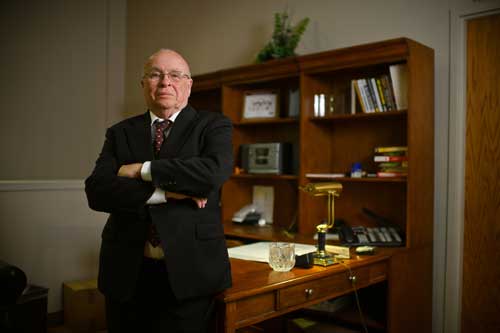
Bill Delaney, a retired Toledo business owner, is challenging incumbent Jon Stainbrook for the District 11 Republican state central committee seat. Toledo Free Press Photo by Joseph Herr
Bill Delaney, a retired Toledo business owner, is challenging incumbent Jon Stainbrook for a District 11 Republican state central committee seat. Toledo Free Press Photo by Joseph Herr

Stainbrook and Gallagher are both finishing their first term and seeking a second. Stainbrook is chairman of the Lucas County Republican Party and member of the Lucas County Board of Elections (BOE). Gallagher was recently ousted as director of the BOE. Running against them are Bill Delaney of Toledo, a retired bar owner who recently ran for City Council, and Diana Skaff, a financial adviser and precinct representative from Curtice.

Mark Wagoner and Dee Talmage are the current District 2 state central committee members. Running against them are Perrysburg business owner Ron LeRoux and Maureen Alexander of Ottawa Hills, both political newcomers.

The 66-member state central committee is comprised of two representatives, a male and a female, elected from each of Ohio’s 33 Senate districts for two-year terms. Members represent their districts as the group formulates the statewide bylaws that direct how the party handles elections, and endorsements and assists in funding and getting candidates elected.

District 11 comprises most of Toledo while District 2 comprises western Lucas County, including Ottawa Hills, as well as Wood, Ottawa and Erie counties and most of Fulton county.

District 11

Delaney, 73, was born in Scranton, Pennsylvania. He came to Toledo in 1973 while working as a district food manager for Kmart. He said he is getting more involved in politics now that he no longer has a business to run.

Election_JonStainbrook_WEB
Jon Stainbrook

“I’m getting more and more disgusted as I go through it,” Delaney said. “I just want the truth. I want to dig into things on the bookkeeping side because that’s what gets me. What does this cost? How much did we spend on it? How much are we getting back in return? I want to know where the money is going.”

He said the local GOP needs a change and he is not a fan of current party leadership, particularly Stainbrook.

“I’ve seen this man operate. He disgusts me. I’m sorry,” Delaney said. “I just want to see people being treated fairly and they have not been. I want to see a better Toledo and a better Republican Party.”

He said the organization is currently “very closed.”

“It’s their way, their club, their people and there’s a lot of people in town that know this but don’t want to come out of the shadows,” Delaney said. “There’s a lot of fear.”

He said he would like to see more communication between local conservative organizations, including Republicans, Libertarians and the tea party.

“We’ve got to draw all these ideologies into one big R because we’re not going to get anyplace being divided,” Delaney said. “There’s too much division. I want to get all these people together in one group. You’ve got to have somewhere where you can talk about it. Right now, there’s no talking going on. We have got to form a better organization.”

Stainbrook, 50, of Toledo, said Delaney’s claims are “not substantiated” and that he, Skaff, LeRoux and Alexander are all “protest candidates” put forth by tea party groups.

John McAvoy of the Northwest Ohio Conservative Coalition, which recruited Delaney and Skaff to run against Stainbrook and Gallagher, said his group endorses candidates from all parties. He said Republican groups outside Toledo are ignored by Stainbrook.
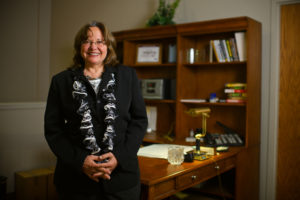
Diana Skaff is a financial adviser and Republican precinct representative from Curtice. She is running against incumbent Meghan Gallagher for District 11 state central committee. Toledo Free Press Photo by Joseph Herr

“If I was chairman of the party, I’d be like a business manager surrounding himself with good people,” McAvoy said. “The managers are already there — out in Fallen Timbers, Maumee. You don’t have to reinvent the wheel. Just bring them in, bring them together, utilize the resources that are already available.”

Stainbrook said he has done just that. He said the Lucas County Republican Party has grown and diversified under his leadership as chairman since 2008.

Six years ago, the party often had difficulty even drawing a quorum of 25 members for central committee meetings, Stainbrook said. Today the meetings regularly draw 75-100 members.

“The numbers speak for themselves,” he said. “We brought people in. We recruited and filled the central committee with people all over Lucas County, people who had never been involved before. There’s great Republicans who just weren’t being recruited so we went out and did it.

“We’ve rebuilt this party since 2008 and it’s a force to be reckoned with, fighting the Democrats, not each other,” he said.

Stainbrook questioned why Delaney wants to be involved with the party at the state level but hasn’t gotten involved at the local level.

“He just wants to criticize without being a member of the team,” Stainbrook said. “Talk minus action equals zero.”

Delaney said he isn’t running for county central committee because there’s already a representative he respects in his precinct. The same question has been posed to McAvoy, who said he doesn’t run for office because of his membership in the Northwest Ohio Conservative Coalition, which has a policy that its members will not run for office because of its endorsements of all political parties.

Stainbrook also questioned Delaney’s choice of party affilitation.

“He ran as an independent for City Council and all of a sudden now he wants to represent the Republican Party in Columbus?” he said.

Stainbrook said he is confident in the re-election of himself and the three other District 11 incumbents, all of whom were endorsed by the Lucas County Republican Party.

“I have a great working relationship with the governor’s office and with the Ohio Republican Party,” Stainbrook said. “You want to make sure Senate District 11 has the proper conservative Republican core values represented at the state level and we absolutely do.”

Stainbrook and Delaney both said conservatives need to work together.

“The tea party and Republican Party agree on 85 percent. Can’t we just work together and work on that last 15 percent? I think we can,” Stainbrook said.

However, Delaney said he doesn’t believe Stainbrook is sincere.

“Absolutely not. It’s a private club to him,” Delaney said.

Skaff said she and others haven’t been invited or welcome at meetings, even after requesting to be. Stainbrook said that’s not true.

“We have to have open meetings and we’ve followed Ohio’s sunshine laws to the T,” Stainbrook said. “Everything is done by the book because I’m under the microscope with these guys. That’s ludicrous they would even say that.

“I have people who support me. Let the voters decide. I’ve done a good job and I want to continue,” he said. “It’s an honor and a privilege to serve the party, to make sure Columbus knows Lucas County is up here. I’ve got that bridge. I’ve built that.”

Stainbrook, who is known for being divisive and argumentative, said he gets his fighting spirit from his father.

“He would always say, ‘If you know you’re right, don’t back down.’ He’s stubborn,” Stainbrook said.

On May 1, the BOE voted to launch an investigation against Stainbrook over an accusation that he encouraged an employee via text to slow down elections work.

Stainbrook said his phone records will prove the accusation is untrue and that those who try to bring BOE issues into the state central committee race are trying to compare apples to oranges.

“They are always trying to make this about the Board of Elections. The state committee has nothing to do with that,” Stainbrook said. “If you’re going to talk, you’ve got to know what you’re talking about.”

Skaff, 59, of Curtice, is a financial adviser with her husband, Tom, at Wells Fargo Advisors. She has been her precinct representative for several years. Lucas County has 352 precincts, although not all the precinct representative seats are filled.

Skaff grew up in South Toledo and graduated from St. Ursula Academy and the University of Toledo. She has taught business classes at UT and has her pilot’s license. She is also active at CedarCreek Church and with Heartbeat of Toledo.

Skaff said she started to become more politically active because of her growing concern about Obamacare. Her experience with the health care system after her 16-year-old daughter sustained a brain injury in a 1996 car accident convinced her a government-run system was not in the best interest of the people.

“I’m kind of an accidental activist,” Skaff said. “I’m a self-starter. I’m pretty independent. I’ve worked for myself most of my life. I raised a good family.

“The bylaws and the way the Republican Party is organized is very important and who we endorse as candidates is critical,” Skaff said. “I want to make a difference. I have five grandchildren and I got tired of just reading about problems and saying, ‘Why isn’t anyone standing up for this?’ I finally looked in the mirror and said to myself, ‘It’s time.’”

Skaff said she would attend local Republican club meetings to listen to what people want and take that back to the statehouse.

“The clubs we visit, those people have ideas and they are not being heard,” Skaff said. “No one is listening. That’s something I would do differently. Not just listening, but being accountable too.”

McAvoy said state central committee members need to have good networking skills.

“It helps to bring a network in with you rather than establishing a new network. So if you have some of those networks already available and you’re currently utilizing them, that’s a really big part of this job,” McAvoy said.

Being able to work and interact with people you may dislike is also a necessity.

“That’s a challenge, but if you can’t do that then you’re in the wrong job,” McAvoy said.

Both Skaff and Delaney said they would “come to the table” and listen to the viewpoints of others. Although change has been slow, they are confident it will come.

“There’s great people in government and there’s a lot of them that are standing up. They just need to be supported and then what will happen is you get more people to stand up,” Skaff said. “It’s really lonely to be the first two or three to stand up, but as people respect that and see that, they’ll follow. It doesn’t take 50 percent; it takes an active 15-20 percent of people to change things.

“Being a mom and raising a family, I know how to handle children and their little temper tantrums,” Skaff said. “I’d like to see a more responsive Republican Party and see the rule of law apply for everyone, the meetings being held according to the bylaws and rules being followed.

“The American people and the citizens of Toledo have a lot of wisdom. Everyone who is running their own business and raising a family, we have a lot of common sense. We could solve the problems the elites won’t. We have the answers. They are not listening to our answers. That’s the problem. We have common sense on our side. We know how to sit down at the kitchen table and balance a budget. We stop spending so much! But they don’t want to hear our answers,” Skaff said. “We have the answers. They aren’t listening. We would listen, and we will take that message to Columbus.”

Delaney said he and Skaff just want a chance to prove themselves.

“What I want to do and what she wants to do is we want to try to make a difference, someway, somehow,” he said. “Give us just the opportunity. Let us show you what we can do.”

Gallagher did not respond to a request for comment.

District 2

Wagoner, 42, of Ottawa Hills, is a lawyer at Shumaker, Loop & Kendrick in Toledo. He spent eight years in the state legislature as a senator and representative. He was appointed to the Republican state central committee to replace his father, also named Mark Wagoner, who resigned.

Mark Wagoner
Mark Wagoner

“I came back home to spend more time with my kids and focus on my law practice, but I still want to be engaged and help Republicans be elected at all levels,” Wagoner said. “I just want to make sure our voice in Northwest Ohio is heard down in Columbus.

“I’ve been in politics a long time now and been able to hold leadership positions in the Senate. I have personal relationships with people throughout the district and I think I can be helpful.

“We have to continue with the success we’ve had in statewide elections. All five statewide officials are Republicans. I was in Columbus when four of the five were Democrats and I can tell you, who is in those offices matter. We want to continue to make sure we have a winning slate for this fall.”

LeRoux, 47, of Perrysburg, is a journeyman tool and die maker who owns Odyssey Machine Company in Perrysburg with his two sons. He said he’s always been “politically aware,” but it wasn’t until he started attending tea party events that he decided to run for office.

“The old-fashioned me thinks that’s something people who like to be in the public eye get involved in, but the newborn constitutionalist in me realizes it’s the duty of every citizen to get involved,” LeRoux said.

“I’m a problem-solver. That’s what I do in my business,” he said. “I’m a good organizer and I’m a very good structural thinker. I think I’ll bring back something to the party that will pay back the citizens of the party, not just the special interests.”

Ron LeRoux
Ron LeRoux

LeRoux said he sees a divide between the beliefs of his conservative friends and neighbors and the state Republican Party.

“The results that are coming out of the Republican Party do not resemble the things we believe in. I don’t consider myself a lawmaker, but to get involved at the party level makes sense to me. I can help build a party platform that makes sense to my neighbors and friends,” LeRoux said.

“Individually, I couldn’t point a finger at any member of the state central committee and say they are doing a bad job. All I can do is look at the whole and the result is not what I would expect. … Career politicians don’t belong on committees; people do.”

Talmage, 73, of Ottawa Hills, has been a state central committee member since 2002. The former chairwoman of the Lucas County Republican Party is a retired teacher and former Ottawa Hills Board of Education member. She is also a member of many local boards and is active in numerous local Republican clubs. She was Wagoner’s campaign manager during several of his state races.

Dee Talmage
Dee Talmage

“I love working with people and with the political process,” Talmage said. “I do a lot of networking with the boards I’m on. I really know the area and am passionate about the community and having people work together.

“Our job is to recruit and get Republican leaders elected. That’s our main job. I really know a lot of people and I try to get people involved that way. It’s a lot about networking. It’s not really about taking a stand on any issue.”

Alexander, of Ottawa Hills, is a sales representative for Maxima Supply based near Lansing, Michigan. After years away, she returned to her native Northwest Ohio to raise her two children, now both in college.

Alexander said many of her views lean Libertarian, but she believes in a two-party system.

“A lot of what I’m driven by is fiscal policy,” Alexander said. “I really have dire concerns about this country from a financial standpoint. I don’t know how we can continue on this path. Socially I’m more of a moderate, but as far as the fiscal part I’m definitely conservative.”

Frustration with the state legislative panel that voted in 2013 to allow the expansion of Medicaid sparked Alexander’s entry into politics.

“I’m very frustrated that our party basically went along with this, even though the voters in Ohio didn’t agree,” Alexander said. “I just feel we have to have some change. If I keep sitting and accepting the way things are, it’s going to be the status quo.”

Maureen Alexander
Maureen Alexander

Alexander said she admires her opponent Talmage, but wants to offer voters a choice.

“She has a phenomenal record, she’s a huge volunteer. She’s done an amazing job. Most people can’t believe I’m running against her, but I don’t see any changes to the policies and platforms of the Republican Party. I see the same people running again and again,” Alexander said.

“I realize I’m an underdog. I don’t have any campaign signs. That’s not really in a single mom’s budget. It’s a real grassroots, word-of-mouth campaign. I’m just hoping for the opportunity.

My cousin told me, ‘Maureen, you sit there and talk about this stuff, but you don’t do anything about it.’ I’d like to at least offer up a different option and let the voters decide.”

Democrats

The candidates for Lucas County’s four Democratic state central committee seats — Mike Friedman and Alexandra Huguelet in District 11 and Thomas Galloway and Margaret Mary Murray in District 2 — are running unopposed.


Peter Wolf to sing, share stories in Ann Arbor

0

It was Peter Blankfield’s grandmother who gave the rowdy youngster growing up in the Bronx his nickname: “Little Wolf.”

“She was the lady who gave me my first cigarette, my first taste of whiskey, and she brought me to the theater,” he said of Anna, who was an actress in New York City’s Yiddish Theater. “She had a great influence on me. She was somebody who sort of steered me in the direction that I’m in now.”

Peter Wolf

Peter Wolf

And that term of endearment became his stage name — eventually.

“I started as a painter and painted all my life, and I always was a music fan. And then when I came to Boston to study painting, I had a roommate — his name was David Lynch — he decided to go into filmmaking, and I decided to go into music,” he said.

Wolf became a star as the passionate lead singer with a penchant for fast-talking storytelling in The J. Geils Band. With that energetic frontman, the group’s live shows became legendary.

Think of “Must of Got Lost” with Wolf’s epic intro, complete with “Woofa Goofa with the green teeth.”

“We used to go through Cleveland and Detroit with The J. Geils Band; just being able to connect with the audiences and having audiences remain loyal throughout the years is a meaningful thing for someone that does what I do,” the singer-songwriter said.

His love of music was influenced by a concert organized by DJ Alan Freed he saw when he was 10.

“At that show was Jerry Lee Lewis; Little Richard; Chuck Berry; Frankie Lymon and the Teenagers; Buddy Holly; The Everly Brothers; Screamin’ Jay Hawkins; Jo Ann Campbell, the Blonde Bombshell; Dion and the Belmonts; and Dicky Doo and The Don’ts. So I was baptized into rock ’n’ roll at a very early age,” he recalled during a call from Boston.

“Seeing that show, it was pretty hard to beat. When I look back at it, the remarkable thing is I remember every performer and I don’t necessarily remember the exact songs they did, but I remember all the different performers; it just stayed with me all my life.”

Wolf will play two sold-out shows May 4-5 at The Ark in Ann Arbor.

Celebration of nurses starts May 6

0

Although Benjamin Irvine was raised by two nurses, he initially wasn’t interested in going into the profession himself.

Instead, the Maumee resident pursued a degree in interpersonal communication and got a job in Colorado with a staffing company that placed nurses.

Ben Irvine
Ben Irvine

Despite his proximity to the great outdoors, where he could hike and fly-fish to his heart’s content, Irvine found himself increasingly dissatisfied in the business world.

“Everything going on in my life pointed me to change careers,” he said. “I wasn’t happy with what I was doing and I didn’t want to go through the rest of my life being unhappy like that.”

That’s when he decided to go back to school for nursing, enrolling at Owens Community College.

“As soon as I started it just felt so right,” he said. “It just felt so natural.”

Irvine, 28, a graduate of St. John’s Jesuit High School, said he gets his work ethic from his father and his compassion from his mother.

“That combination serves me really well,” said Irvine, now a registered nurse at ProMedica Toledo Hospital. “At St. John’s, the motto was to be a man for others. … People [in hospitals] are going through the toughest time in their lives and need someone there to take care of them, even just small things. I want to care for them like they were my own family member and go the extra mile.”

His mother, Becky, also an RN, said she was thrilled about her son’s decision to go into nursing.

“He is a real people person and very compassionate. We knew he’d do well. I always tell him, ‘Go out and make a difference today.’ Even if it’s just one person, it makes a difference.”

The American Nurses Association reports 3.1 million RNs in the United States. About 2.6 million are working as nurses with more than 60 percent employed by hospitals.

Irvine said he’s noticed more men choosing nursing as a second career.

“A lot of males don’t look at nursing initially as a career choice. It’s nontraditional. But I guess the numbers are on the rise,” Irvine said.

Five C’s

Kim Holman, clinical teaching faculty at Owens’ school of nursing, said good nurses fulfill the five C’s: commitment, competence, compassion, conscience and confidence. She also added one more: communication.

“You have to have the ability to talk to people. If you don’t have good communication skills or be willing to grow them, it’s hard to be a good nurse,” Holman said.

Owens Community College Nursing students work on a lesson. National Nurse Week is May 6-12. Photo courtesy Owens Community College

Owens Community College Nursing students work on a lesson. National Nurse Week is May 6-12. Photo courtesy Owens Community College

Nurses also need to be able to think on their feet and be flexible, she said

“If you can’t deal with change, you’re not going to be a good nurse,” Holman said.

Adaptability is key, agreed Stautzenberger College Practical Nursing Department Program Administrator Carolyn Nagy.

“We need to learn if we don’t have a certain piece of high-tech equipment, how do we care for the patient without that piece of equipment?” she said. “Part of what we do here is help students develop critical thinking and clinical reasoning skills.”

Nursing is a field that requires lifelong learning, Nagy said.

“You can’t rest on your laurels from your training 20 years ago,” she said. “Every day there’s something new in the field of medicine.”

The same attributes that draw people to nursing tend to make them community volunteers, Holman said.

“Nurses are usually leaders. They take on projects out of the goodness of their hearts. They put in volunteer hours at schools, churches. They’re not punching a time clock and leaving,” Holman said.

National Nurses Week is observed annually May 6-12.

“Nursing week should be 52 weeks a year,” Holman said. “If it weren’t for nurses, hospitals wouldn’t be able to operate.”

Treece Blog: Profile of a dying market

0

I  want to preface this week’s article with a brief observation. It is common, in any market, to attack those people who point out problems or shortcomings. The perception is that people who discuss weaknesses are overly pessimistic, or that they want something to fail.

.

.

Here, this is not the case. This column seeks to point out that there are substantial, longstanding problems facing the Toledo region which need to be addressed. However, there can be no solutions until we have recognition that problems do exist. My family hopes to be part of the solution to Toledo’s problems, but first we must seek to spread understanding of this region’s difficulties.

Toledo, it is no secret, is a dying town. It has been a dying town for decades and, unless drastic change is implemented in a hurry, it will likely continue or even accelerate its decline.

Recently, to gain a better understanding of the metrics that have caused or characterized Toledo’s decline, we analyzed several statistics of the Toledo metro area and then compared them to national aggregates. These statistics included personal incomes and labor force numbers, which will serve as the focal point of discussion here.

Between 1969 and 2012, personal incomes in the Toledo metro area grew faster (or declined less) than the U.S. aggregate in only seven of those years. That means that in 37 of the past 44 years, personal incomes in the Toledo market have failed to keep pace with the broader U.S. market.

This failure has naturally led to an oft-cited “brain drain.” For direct evidence of this, consider that the labor force in Toledo has expanded faster (or declined more slowly) than national aggregates in only four of the years since 1990.

So, what do these numbers mean? First, they demonstrate a marked inability for Toledo to attract or retain talented individuals. The brain drain is alive and well in Toledo. After all, why would anyone want to stay in a market where personal incomes fail to rise as fast as they, by all accounts, should? Why wouldn’t people make a mass exodus to other areas of the country where personal incomes are keeping pace with — or even growing faster than — the U.S. on the whole?

Well, that’s just what has happened. Our high school graduates who leave for top post-secondary educations, by and large, do not return. Local small businesses that grow into large businesses and seek to expand beyond the regional market often leave at their first opportunity. Startups seek and are awarded funding from sources outside Toledo and pack up and move before Toledo ever benefits from their innovative ideas.

Second — and even more importantly — these numbers depict a metro market that is unable to grow as fast as the broader domestic economy. If personal incomes here fail to keep pace, and if our labor market struggles to expand, that means there are fewer and fewer dollars available in Northwest Ohio to support new or existing businesses. It means that, just as workers are forced to look elsewhere for good paying jobs, companies must look outside Toledo in order to find the demand they need to support their supply. For most large companies in Toledo this is already the case.

While many successful companies may have headquarters here, they have been doing more and more of their work — or selling more and more of their products — outside the Toledo region.

This failure to keep pace means that we as a metropolitan area are in decline. We have fallen behind other markets and are likely to fall further behind some markets. In fact, we are seeing some previously smaller markets surpass us. After all, areas where personal incomes rise faster than the U.S. aggregate will naturally attract talent to fill high-paying jobs.

Toledo, meanwhile, will continue to suffer. Our local economy will continue to shrink. Why? Because there are not — and will not be — as many dollars to go around here as there are in other markets. People elsewhere have comparatively more to spend. Businesses here have a greater need to export to other regions — or even other countries — to find the demand they need to thrive.

One natural inquiry is whether these numbers are changing, and sadly the answer is no. The reason these numbers aren’t changing — why trends aren’t reversing — is because we aren’t changing. Toledo today isn’t doing anything drastically different than it did in 1969. We, for the most part, continued pushing the trends that have led us to exactly where we are and yet somehow we expect that things will magically improve. It’s not rational to keep doing the same things over and over while expecting different results.

What can or should we do to stop these trends and reverse course and put Toledo back on track to becoming a thriving market again? We need to do something different, and that doesn’t mean more government. This has been the trend in Toledo for decades; first a strong mayor and then regionalization. More government is not, and has never been, the answer to this region’s problems, and yet for some reason we are always fooled into thinking the same scheme will work.

Rather, if previous decades offer any lessons for us at all, what we need to take away is that government does not and never will have the answers for making this region successful. Elected officials don’t hold the keys for success; in fact they have a tendency to impede progress more than they encourage it. If we want to do better in Toledo, leadership will have to come from the private sector.

Dock David Treece is a partner with Treece Investment Advisory Corp (www.TreeceInvestments.com) and is licensed with FINRA through Treece Financial Services Corp. He provides expert content to numerous media outlets. The above information is the express opinion of Dock David Treece and should not be construed as investment advice or used without

outside verification.

Barhite: A sad ending to a once-happy story

0

Five years ago, a colleague wrote about a local woman who risked death to deliver her baby.

The original story ran as part of the Mother Day’s coverage in Toledo Free Press.

.

Kristy Kress had been in her seventh month of pregnancy when she developed peripartum cardiomyopathy — pregnancy-induced heart failure — and gave birth to a premature son.

A few months later, she had a successful heart transplant.

She went back to work, she and her husband Chad raised little Hunter, and she became a huge advocate for organ donation.

In most cases, we would never have to revisit this story. But then everything changed — in a heartbeat.

On Feb. 7, Kristy, 36, died after suffering a rare form of rejection related to her heart transplant — years after the surgery had been deemed successful.

It was a shock.

“She wasn’t sick over the past five years,” said her sister-in-law Lexy Batey. “You would have seen her on the street and you would have thought she was just like you.”

I vividly remember the original story from 2009. At first, her last name didn’t sound familiar. However, her photo gave me pause. It was Kristy McVicker, a 1995 graduate of Springfield High School, my alma mater.

When I started to see on Facebook that she had passed, I thought it had to be because of something other than her heart. She had met all of her transplant milestones.

“We have had five extra years,” said her mom, Diana McVicker. “Her rejection started in August and progressed really quickly.”

As the family struggles to find a routine after Kristy, they try to focus on her memory. Unfortunately, none of her organs could be saved and donated.

“She would want to be remembered as a good mom. She had five years with her son that she wouldn’t have had,” Batey said. “We are holding up, but it is tough. We are trying our best.”

In the future, the family would like to do something in her memory or organize a benefit. They will be paying medical bills for a lifetime, so encouraging organ donation is a more immediate gift.

“Organ donation meant so much to Kristy. She wasn’t sick over the past five years,” Batey said. “She was back at work a week after being released from the hospital with a heart transplant.”

Kristy was the general manager of Extended Stay America in Holland. She and her husband met at work.

“Kristy was so down to earth. Monetary things meant nothing to her. She is my sweetie,” her mom said.

The Thursday before she died, it was suggested that Kristy go on disability. She refused. “That is not going to happen; don’t even go there,” she said.

In honor of Kristy, the family asked that donations go to Life Connection of Ohio, an organization dedicated to organ donation.

“It became her passion,” McVicker said. “Every time she posted she would mention it. If Kristy would have asked anything of us, she would ask us to be organ donors.”

Her other passion was her family, which was evident the first time we wrote about her. Doctors didn’t think she would survive a cesarean section to bring her son into the world. She did it anyway.

“Kristy was a fighter. She believed in hard work. She had a great deal of love, and she loved her family, especially Hunter,” her mom said.

Culbreath: Sterling reputation

0

Pity the Clip Show, because even when the Los Angeles Clippers win, they lose.

In their third consecutive year making the playoffs, and their first year without having to share the postseason spotlight with the Lakers, instead of making headlines with their play on the court, the Clippers were instead in the news for an entirely, brutally different reason. Team owner Donald Sterling was recently banned from the NBA for life for some incredibly racist comments he made in a recorded conversation with his girlfriend.

.

.

After a few days of hearing this discussed on my radio station, I feel like I need to address some of the more common issues that keep coming up.

First and foremost: “Doesn’t he have the freedom of speech?” Sure he does. The First Amendment guarantees that the government may not pass laws to infringe on your right to say, print or draw whatever you want. Now, there is some question as to how this is applied lately, from everything from indecency laws to “free speech zones.” But Sterling hasn’t been criminally charged or arrested. The government has, in fact, done nothing. The court of public opinion is what weighed in here, and boy, did they bring down the lumber.

See, the freedom of speech includes the freedom to respond. We are not compelled to sit on our hands and listen to what somebody says. We are free to argue, walk away and refuse to talk to that person again.

The NBA is walking away, refusing to do business with the man, and using the rules he agreed to abide by in an effort to force him to sell the team. You can argue if they should, but you can’t argue that they can’t. I’d certainly hope you’d do the same if someone you did business with suddenly dropped a Marge Schott-like “Hitler was good at the beginning” kind of line.

Second: “Why is this blowing up now?” Yes, there are mounds of evidence of Sterling’s bad attitude for people with different levels of melanin in their skin, most of it tied to his property holdings, and his refusal to rent to African-Americans and Asian-Americans. So why is one recording suddenly the catalyst for his ouster?

There are two answers. The first is that the old guard at the NBA, former commissioner David Stern, never took Sterling on directly. Don’t know why. He was probably hoping Sterling would pass away before he did something else. Adam Silver, as new commissioner, had to come out strong in his first real test as the man in charge. Also, and it hurts to admit it, but you have to look at who broke the story on the recording: TMZ. Just the sheer volume of that audience, not to mention its direct feed into social media, meant that it was going to catch fire, and quickly.

And here’s the question that hasn’t been asked, but is in the back of the mind of everyone who’s freaked out by the whole situation: “Am I next?” Not to say that they have the same kind of hate in their heart as Sterling, but I think people are literally afraid that they’ll lose their jobs if they say the wrong thing. They look at what happened at the Mozilla Corporation, when CEO Brendan Eich stepped down after a public outcry over his donations to campaigns that were trying ban same-sex marriage in California.

Look, Sterling and Eich were very high-ranking management. Donald Sterling was simultaneously a bigot toward minorities and an owner of a basketball team that employs minorities. You can see the conflict of interest. The same thing happened with Mozilla: The company employs many homosexuals, and had often been cited as a very gay-friendly organization. Hiring someone who does not hold those same values to lead the company caused many to be disillusioned with the direction of the organization. You can’t have a guy in charge who openly discriminates against his employees.

The fact of the matter is that there’s nothing illegal with what happened between the NBA and Sterling. Sterling has his views, and the NBA has theirs. They’re no longer compatible, and the NBA has the bigger stick.

“Shaggy” Matt Culbreath is sports director at 1370 WSPD. Email him at [email protected].

Amazing Johnathan prepares to take final bows in Toledo

0

The Amazing Johnathan was performing in front of a crowd full of fans in San Diego about two months ago when he knew it was time to call it quits.

.

He’d planned for this moment for a while now. The famous comedy magician was diagnosed back in 2007 with a serious heart condition, cardiomyopathy. It means the heart muscle, for whatever reason, is beginning to deteriorate, leading to heart failure. At the time, the situation looked grim. Johnathan, who’d been a regular act in Las Vegas for years, made plans for retirement. But then, after losing weight and getting on blood thinners, everything seemed OK. He decided to cancel the end of his career.

Now, more than six years later, he was once more preparing to bow out of the spotlight, but on his terms — this year-long nationwide tour would be his farewell before he would quit performing for good. But he’d already learned the hard way that with this condition, even the best laid plans of mice, men and magicians are built on a foundation of quicksand. And in San Diego, it all came crashing back.

“Everything starting shutting down,” Johnathan said in an interview with Toledo Free Press. “My heart’s not allowing enough oxygen to be pumped into my legs and my arms. So halfway through the show, my hands started cramping up, and my legs started freezing up on me. And I pretty much made the decision then to cut this one-year tour short to only about three months.”

Johnathan — last name Szeles — will perform in Toledo at Laffs, Inc. from May 1-3. Then he’ll head to Los Angeles for a gig in Hollywood at the Magic Castle. And then … that’s it. He’ll retire to Las Vegas and work on maintaining his health as long as possible.

“It’s supposedly supposed to deteriorate more and more. In fact, I’m getting ready to go right now to the doctor’s to see if the medication that they gave me [is working]. And that’s my last resort. Because if that’s not working, they told me I probably have about a year. So, that’s not what you want to hear.”

Johnathan’s voice spoke of his mortality — which he gleefully pretended to imperil on a nightly basis for much of his adult life — in matter-of-fact terms. This is happening, and that’s that. “They were wrong last time about it. They said that it was going to deteriorate, and it didn’t. For six years, I was fine. And now, it’s just starting up again. So we’ll see what happens.”

In some ways, one gets the impression that the saddest part of everything for Johnathan is not that his health may be failing, or that he must give up his livelihood. No, the real tragedy is that he has to give up his act right when it’s getting so good.

For 30 years he has performed his wild brand of comedy magic — part purposefully bad tricks, part old-fashioned geek show, part prop comedy, part genuinely great illusions — and just now he’s reaching a point where he feels like he’s perfecting it.

“The show is actually better than it’s ever been. Before we announced that I was retiring, we started getting standing ovations, which was always sporadic throughout my career. Everybody loves the show, but to get a standing ovation is not an easy thing,” Johnathan said. “And I’m like, ‘Oh, great. Now that I’m finally getting standing ovations, I’m sick and I can’t go out and enjoy that.’”

He’s also found a connection to a whole new generation of fans, thanks to appearances on fellow magician Criss Angel’s series “Mindfreak.” The shows opened the door to younger fans who weren’t around when he first made a name on the national stage 25 years ago through appearances on “Late Night with David Letterman” and FOX’s “Comic Strip Live.”

“Comedy Central is a good gauge for that. Because they called me after 10 years — after I thought I’d never hear from them again — they called me out of the blue after 10 years of not calling me and said, ‘Hey, you want to do an hour special?’ I’m like, wow. I can’t believe it. I thought it was a joke.”

Despite his condition, Johnathan is doing everything he can to make this truncated final tour as epic as it can be. He has plans to record the entire run of his final week at the Magic Castle for possible release — he even hinted that the Toledo stops may be recorded, as well. And don’t even think about asking if he has any regrets.

“The good news is that even if I did go tomorrow, I’ve had such a great career. I’ve been so blessed for 30 years. A lot of the people I started doing comedy with are either working regular jobs, or out of the business or dead,” Johnathan said. “I’ve been on the top for at least 25 of those 30 years, I’ve headlined.”

It’s remarkable — Amazing, one might say — how many lives a performer can touch during their career. Even if said performer swallowed razor blades or took swigs from a bottle of Windex while he was onstage.

“It’s been tough to announce the farewell tour and tell people it’s a health issue — I’ve had a huge outpouring of love from these people. You don’t really think about the effect you’ve had on their lives until they come up to you and tell you, ‘I had cancer and going through my treatment, you made me laugh during that time.’”

DC launches new weekly series on Free Comic Book Day

0

Comic book fans have paused in collective wonder over DC Comics’ recent launch of a new weekly series and announcements of two more on the way. The venerable comic book house has taken a clear backseat to rival Marvel Comics over the past several years, but the infusion of the weekly publishing projects brings some excitement to readers who may have fallen away from the company after the 2011 revamping of its entire line.

Batman Eternal purports to celebrate the Dark Knight’s seventy-fifth anniversary, a published weekly title that kicked off this April and whose story encompass the entire universe of Batman characters. In its first few installments, stalwart Commissioner Jim Gordon’s been accused of the deaths of several Gothamites when he derailed a subway train during a perp takedown. Batman’s on the case, though, and heroes like Batwoman, Red Robin, Batgirl, and others will join in the investigation soon.

On May 3rd, which happens to be Free Comic Book Day, the weekly called The New 52: Future’s End begins. Its narrative jumps readers five years into a possible future of the DC Universe and the aftermath of a war with an alternate Earth. The central character is Batman Beyond, the hero of the animated TV series of the same name. The crux of the title rests upon skewed versions of classic DC characters, and the company claims the story will “forever alter the direction of the New 52.”

Then, this October, DC launches Earth 2: World’s End, which also concerns an alternate Earth, this one a nod to the publisher’s properties from the 1940s. Few details have been released on the series, but teaser artwork for it indicates more apocalyptic goings-on.

Weekly comic book series are not easy to produce. In an age when monthly titles – the industry standard for decades – are late to the shelves on a regular basis, a weekly series seems a foolhardy gamble. Comic companies must maintain a strict schedule on them and by utilizing numerous writers and artists they create backup protocols should any part of the machine fail. DC had a major hit with its 2006 weekly opus, 52, but has never truly matched it since. Maybe 2014 will put it back on the hit parade – and on schedule.

Local religion news website to lose funding

0

ToledoFAVS.com – a locally based website covering area religion news – learned that its funding ends May 31, forcing a change in its business model and approach. 

The Lilly Endowment, based in Indianapolis, had guaranteed three years of funding to ToledoFAVS in 2011, one of five community-based regional hub sites for Religion News Service (Columbia, MO).  However, ToledoFAVS wasn’t launched until summer 2012, at which point the three-year grant clock had already been ticking.

“I was guaranteed three years of funding, and we’d likely get another three years, but then I’d have to be self-sustaining,” said David Yonke, ToledoFAVS editor & community manager.  “After May 31, I don’t have any income unless it’s by donation.  I’m going to continue it, but I’m not going to be able to devote as much time to it.”

“We were not guaranteed another three years, but there were a lot of indications that we would get another three years.  So, I would say it was a surprise,” Yonke said.

Religion News Service Publisher Debra L. Mason indicated in a statement that the original business model was flawed from the start.

“The business model previous relied heavily on grant funds to launch FAVS as a start-up,” Mason said.  “Unfortunately, the business model we relied upon (which was adapted from Knight Foundation-funded research) overestimated the amount of revenue we could raise via donors and advertising. As a result, our overall budget going forward needed to be cut.”

Under the new business model, Yonke will become a contractor for ToledoFAVS as of June 1.

The site was conceived as a gathering place for non-sectarian coverage of faith and values news (hence FAVS) for Northwest Ohio.  Readers embraced the site, having generated 20,000 hits per month, second highest among the five hub sites nationwide.

“It will look the same, but right now I’m updating it five times a day,” Yonke said.  “That may go to twice a day, depending on how much I get from volunteers.  Right now I write 4-5 stories a week, but that may go down to one a week.  We’ve published 2800 stories since inception of the site, and with blogs as well, maybe 3000 stories in 21 months.”

Religion News Service offered nothing but praise for Yonke and ToledoFAVS.

“It was a real pleasure to have had the opportunity to work with David Yonke and the Toledo community,” said Tiffany McCallen, national community manager for Religion News Service.  “It has been obvious to me from the beginning that David is a true treasure in his community, a notion that was reflected in the area’s willingness to heartily engage with ToledoFAVS as readers, writers, event-goers and supporters. I have no doubt the community will continue to embrace ToledoFAVS in its new form.”

At least two of the five regional hub sites will cease operation.  Yonke hopes to find new funding somewhere, but is not counting on it.

“I don’t think religions leaders know, they might not be aware of it,” Yonke said.  “I haven’t tried to really rally the troops, so I don’t think people are aware of it.  There’s been some outpouring of support, mostly from regular visitors.  I don’t expect to bring in enough money to make it self-sustaining in a month, but maybe in the long term we can build it up and bring in some revenue.  It all depends.  If some funding does come in, I have big plans for it.”

Could an outpouring of community support in the form of fundraising keep ToledoFAVS in its current state?

“We would love nothing more than for the community to support this site; that’s in fact what is needed,” Mason said.

Those interested in assisting ToledoFAVS.com through financial or in-kind gifts, can contact Yonke at [email protected], or 419-346-1007.

Cinco de Mayo ‘biggest day of year’ for Mexican eateries

0

It’s Cinco de Mayo all year long for the local Mexican eateries that bear that name — but the day itself is always one of the busiest days of the year, local restaurant managers said.

Cinco de Mayo, which is Spanish for “fifth of May,” is “the biggest weekend of the year,” said Arturo Castro, assistant manager at Cinco De Mayo Mexican Bar & Grill at 304 E. Alexis Road.

The eatery’s annual celebration will be bigger than last year, featuring the return of a jalapeño-eating contest at 5 p.m. May 4 and 5, Castro said.

Also on the calendar is a Tony Orlando revue and Elvis tribute contest 2-5 p.m. May 4 and folkloric dancers at 5 p.m. May 4 and 5. Starting at 4 p.m. May 5, there will be a live band downstairs and DJ and karaoke upstairs. Happy hour, featuring 12-ounce margaritas for $3.75, is 11 a.m. to 5 p.m. daily.

Carlos Fuentes, owner of La Fiesta Restaurante in Maumee, agreed Cinco de Mayo is “the biggest day of the year.”

The 1406 S. Reynolds Road eatery will feature a tent in the parking lot on May 5. Pints of draft beer and Mexican bottled beer will be $2.75. Margaritas will also be on special. DJ Excel will perform all night starting at 3 p.m. The Bradberries will perform at 6 p.m. There will also be giveaways all day.

“Any day we can give something back to our customers and pay them back what they give to us all year round is a good day,” Fuentes said. “This is the way I see it — a day you can celebrate with your customers.”

La Fiesta will also host a “warm-up party” May 3 and 4, featuring jumbo margaritas for $6.25 and 23-ounce domestic drafts for $2.99.

“A lot of people think Cinco de Mayo is Independence Day for Mexico, but it’s not,” said El Camino Real owner Jesus Angel. That’s Sept.The May 5 holiday honors a great military victory over the French at the Battle of Puebla in 1862.

The festivities at El Camino Real, 2500 W. Sylvania Ave., will kick off May 2 with “the biggest guacamole ever made,” featuring free guacamole and chips to the first 100 people starting at 3 p.m., Angel said. Guacamole mash will be free to the first 100 people May 4.

The eatery will also feature a jalapeño toreado-eating contests on May 2, 3 and 5, burrito-eating contests on May 3 and 5 and a taco-eating contest on May 4. Folkloric dancers and a mariachi band will perform May 3. May 4 will feature $1 off drinks. May 5 will also feature a variety of DJs from local radio stations and plenty of giveaways all weekend, Angel said.

El Vaquero — with locations at The Docks, on Secor Road and in Perrysburg — will feature “five days of fun” starting May 1, said general manager Arne Lopez. There will be live DJs broadcasting on 101.5 The River from all three locations on May 5.

Specials include all Mexican beers, buckets of beer and pitchers of margaritas.

“It’s a party,” Lopez said. “It’s going to be a great day for a deal.”

Jeanie Kunzer, owner of Loma Linda, is excited because Cinco de Mayo falls on the Swanton eatery’s Margarita Monday this year.

“You know what happens when Cinco de Mayo finally falls on Margarita Monday — margaritas on special, beer specials, food specials, entertainment and fun on the patio!” Kunzer said.

Kunzer’s birthday is May 7, so she usually makes Cinco de Mayo a week-long celebration.

May 2 and 3 will feature a live mariachi band at Loma Linda. There will also be a live band May 5.

The family-owned eatery, at 10400 Airport Hwy., has been in business since 1955 and was the first Mexican restaurant in Toledo. The eatery will celebrate its 59th year in business June 9.

“Cinco de Mayo is a big one, but our anniversary will be even bigger yet,” Kunzer said.

Ventura’s, 7742 W. Bancroft St., will feature $2 Mexican beers, $3 margaritas, half-off appetizer specials and live entertainment on May 3 and 5, said general manager Valerie Mundt-Scott.

Mi Hacienda, 3302 Glanzman Road, will offer food and drink specials all weekend, including half-off beer, 12-ounce margaritas and jumbo house margaritas during happy hour from 2-6 p.m. May 5-6. Food specials include a $5.99 taco dinner on May 5 and $2 off fajitas on May 6. There will be a DJ on the patio on May 5.

Other events

The Toledo Zoo will host its 14th annual Cinco de Mayo event from 11 a.m. to 3 p.m. May 4, including performances from DJ Tony Rios at 11 a.m. and 1 p.m. and the El Corazon de Mexico Ballet Folklorico at noon and 2 p.m. There will also be a piñata at 1 p.m. and cultural crafts throughout the day, said zoo events coordinator Jen Brassil. The events are free with a paid zoo admission.

“Compared to other Cinco de Mayo celebrations, we’re very family-oriented,” Brassil said. “I think people just love to see the performances and all the costumes.”

Bowling Green State University’s Latino Student Union and Latino Networking Alliance will celebrate Cinco de Mayo a week early. Its Latinopalooza event, featuring “food, games and fun” will take place 1-5 p.m. April 26 on the University Hall lawn.