Comic book fans have paused in collective wonder over DC
Comics’ recent launch of a new weekly series and announcements of two more on
the way. The venerable comic book house has taken a clear backseat to rival
Marvel Comics over the past several years, but the infusion of the weekly
publishing projects brings some excitement to readers who may have fallen away
from the company after the 2011 revamping of its entire line.
Batman Eternal
purports to celebrate the Dark Knight’s seventy-fifth anniversary, a published
weekly title that kicked off this April and whose story encompass the entire
universe of Batman characters. In its first few installments, stalwart Commissioner
Jim Gordon’s been accused of the deaths of several Gothamites when he derailed
a subway train during a perp takedown. Batman’s on the case, though, and heroes
like Batwoman, Red Robin, Batgirl, and others will join in the investigation
soon.
On May 3rd, which happens to be Free Comic Book
Day, the weekly called The New 52:
Future’s End begins. Its narrative jumps readers five years into a possible
future of the DC Universe and the aftermath of a war with an alternate Earth.
The central character is Batman Beyond, the hero of the animated TV series of
the same name. The crux of the title rests upon skewed versions of classic DC
characters, and the company claims the story will “forever alter the direction
of the New 52.”
Then, this October, DC launches Earth 2: World’s End, which also concerns an alternate Earth, this
one a nod to the publisher’s properties from the 1940s. Few details have been
released on the series, but teaser artwork for it indicates more apocalyptic
goings-on.
Weekly comic book series are not easy to produce. In an age
when monthly titles – the industry standard for decades – are late to the
shelves on a regular basis, a weekly series seems a foolhardy gamble. Comic
companies must maintain a strict schedule on them and by utilizing numerous
writers and artists they create backup protocols should any part of the machine
fail. DC had a major hit with its 2006 weekly opus, 52, but has never truly matched it since. Maybe 2014 will put it
back on the hit parade – and on schedule.
ToledoFAVS.com
– a locally based website covering area religion news – learned that its
funding ends May 31, forcing a change in its business model and approach.
The
Lilly Endowment, based in Indianapolis, had guaranteed three years of funding
to ToledoFAVS in 2011, one of five community-based regional hub sites for
Religion News Service (Columbia, MO).
However, ToledoFAVS wasn’t launched until summer 2012, at which point
the three-year grant clock had already been ticking.
“I
was guaranteed three years of funding, and we’d likely get another three years,
but then I’d have to be self-sustaining,” said David Yonke, ToledoFAVS editor
& community manager. “After May 31,
I don’t have any income unless it’s by donation. I’m going to continue it, but I’m not going
to be able to devote as much time to it.”
“We
were not guaranteed another three years, but there were a lot of indications
that we would get another three years.
So, I would say it was a surprise,” Yonke said.
Religion
News Service Publisher Debra L. Mason indicated in a statement that the
original business model was flawed from the start.
“The
business model previous relied heavily on grant funds to launch FAVS as a
start-up,” Mason said. “Unfortunately,
the business model we relied upon (which was adapted from Knight
Foundation-funded research) overestimated the amount of revenue we could raise
via donors and advertising. As a result, our overall budget going forward
needed to be cut.”
Under
the new business model, Yonke will become a contractor for ToledoFAVS as of
June 1.
The
site was conceived as a gathering place for non-sectarian coverage of faith and
values news (hence FAVS) for
Northwest Ohio. Readers embraced the
site, having generated 20,000 hits per month, second highest among the five hub
sites nationwide.
“It
will look the same, but right now I’m updating it five times a day,” Yonke
said. “That may go to twice a day,
depending on how much I get from volunteers.
Right now I write 4-5 stories a week, but that may go down to one a
week. We’ve published 2800 stories since
inception of the site, and with blogs as well, maybe 3000 stories in 21
months.”
Religion
News Service offered nothing but praise for Yonke and ToledoFAVS.
“It
was a real pleasure to have had the opportunity to work with David Yonke and
the Toledo community,” said Tiffany McCallen, national community manager for
Religion News Service. “It has been
obvious to me from the beginning that David is a true treasure in his
community, a notion that was reflected in the area’s willingness to heartily
engage with ToledoFAVS as readers, writers, event-goers and supporters. I have
no doubt the community will continue to embrace ToledoFAVS in its new
form.”
At
least two of the five regional hub sites will cease operation. Yonke hopes to find new funding somewhere,
but is not counting on it.
“I
don’t think religions leaders know, they might not be aware of it,” Yonke
said. “I haven’t tried to really rally
the troops, so I don’t think people are aware of it. There’s been some outpouring of support,
mostly from regular visitors. I don’t
expect to bring in enough money to make it self-sustaining in a month, but
maybe in the long term we can build it up and bring in some revenue. It all depends. If some funding does come in, I have big
plans for it.”
Could
an outpouring of community support in the form of fundraising keep ToledoFAVS
in its current state?
“We
would love nothing more than for the community to support this site; that’s in
fact what is needed,” Mason said.
Those
interested in assisting ToledoFAVS.com through financial or in-kind gifts, can
contact Yonke at [email protected], or 419-346-1007.
It’s Cinco de Mayo all year long for the local Mexican eateries that bear that name — but the day itself is always one of the busiest days of the year, local restaurant managers said.
Cinco de Mayo, which is Spanish for “fifth of May,” is “the biggest weekend of the year,” said Arturo Castro, assistant manager at Cinco De Mayo Mexican Bar & Grill at 304 E. Alexis Road.
The eatery’s annual celebration will be bigger than last year, featuring the return of a jalapeño-eating contest at 5 p.m. May 4 and 5, Castro said.
Also on the calendar is a Tony Orlando revue and Elvis tribute contest 2-5 p.m. May 4 and folkloric dancers at 5 p.m. May 4 and 5. Starting at 4 p.m. May 5, there will be a live band downstairs and DJ and karaoke upstairs. Happy hour, featuring 12-ounce margaritas for $3.75, is 11 a.m. to 5 p.m. daily.
Carlos Fuentes, owner of La Fiesta Restaurante in Maumee, agreed Cinco de Mayo is “the biggest day of the year.”
The 1406 S. Reynolds Road eatery will feature a tent in the parking lot on May 5. Pints of draft beer and Mexican bottled beer will be $2.75. Margaritas will also be on special. DJ Excel will perform all night starting at 3 p.m. The Bradberries will perform at 6 p.m. There will also be giveaways all day.
“Any day we can give something back to our customers and pay them back what they give to us all year round is a good day,” Fuentes said. “This is the way I see it — a day you can celebrate with your customers.”
La Fiesta will also host a “warm-up party” May 3 and 4, featuring jumbo margaritas for $6.25 and 23-ounce domestic drafts for $2.99.
“A lot of people think Cinco de Mayo is Independence Day for Mexico, but it’s not,” said El Camino Real owner Jesus Angel. That’s Sept.The May 5 holiday honors a great military victory over the French at the Battle of Puebla in 1862.
The festivities at El Camino Real, 2500 W. Sylvania Ave., will kick off May 2 with “the biggest guacamole ever made,” featuring free guacamole and chips to the first 100 people starting at 3 p.m., Angel said. Guacamole mash will be free to the first 100 people May 4.
The eatery will also feature a jalapeño toreado-eating contests on May 2, 3 and 5, burrito-eating contests on May 3 and 5 and a taco-eating contest on May 4. Folkloric dancers and a mariachi band will perform May 3. May 4 will feature $1 off drinks. May 5 will also feature a variety of DJs from local radio stations and plenty of giveaways all weekend, Angel said.
El Vaquero — with locations at The Docks, on Secor Road and in Perrysburg — will feature “five days of fun” starting May 1, said general manager Arne Lopez. There will be live DJs broadcasting on 101.5 The River from all three locations on May 5.
Specials include all Mexican beers, buckets of beer and pitchers of margaritas.
“It’s a party,” Lopez said. “It’s going to be a great day for a deal.”
Jeanie Kunzer, owner of Loma Linda, is excited because Cinco de Mayo falls on the Swanton eatery’s Margarita Monday this year.
“You know what happens when Cinco de Mayo finally falls on Margarita Monday — margaritas on special, beer specials, food specials, entertainment and fun on the patio!” Kunzer said.
Kunzer’s birthday is May 7, so she usually makes Cinco de Mayo a week-long celebration.
May 2 and 3 will feature a live mariachi band at Loma Linda. There will also be a live band May 5.
The family-owned eatery, at 10400 Airport Hwy., has been in business since 1955 and was the first Mexican restaurant in Toledo. The eatery will celebrate its 59th year in business June 9.
“Cinco de Mayo is a big one, but our anniversary will be even bigger yet,” Kunzer said.
Ventura’s, 7742 W. Bancroft St., will feature $2 Mexican beers, $3 margaritas, half-off appetizer specials and live entertainment on May 3 and 5, said general manager Valerie Mundt-Scott.
Mi Hacienda, 3302 Glanzman Road, will offer food and drink specials all weekend, including half-off beer, 12-ounce margaritas and jumbo house margaritas during happy hour from 2-6 p.m. May 5-6. Food specials include a $5.99 taco dinner on May 5 and $2 off fajitas on May 6. There will be a DJ on the patio on May 5.
Other events
The Toledo Zoo will host its 14th annual Cinco de Mayo event from 11 a.m. to 3 p.m. May 4, including performances from DJ Tony Rios at 11 a.m. and 1 p.m. and the El Corazon de Mexico Ballet Folklorico at noon and 2 p.m. There will also be a piñata at 1 p.m. and cultural crafts throughout the day, said zoo events coordinator Jen Brassil. The events are free with a paid zoo admission.
“Compared to other Cinco de Mayo celebrations, we’re very family-oriented,” Brassil said. “I think people just love to see the performances and all the costumes.”
Bowling Green State University’s Latino Student Union and Latino Networking Alliance will celebrate Cinco de Mayo a week early. Its Latinopalooza event, featuring “food, games and fun” will take place 1-5 p.m. April 26 on the University Hall lawn.
A new app developed by a company with Northwest Ohio connections will make its Ohio debut at the Medical Mutual Glass City Marathon on April 27.
The app, called RaceJoy, was released about a year ago by Altamonte Springs, Fla.-based developer Tri-Perta, based on the personal experiences of owners James and Shelly Harris as both athletes and spectators.
“James used to do triathlons and Ironmans and I’d be out there with the kids all day trying to cheer him on,” Shelly said. “It can be very tiring for the spectator and stressful. We wanted something that could let us know where the other was and ways to connect in with each other.”
Shelly’s mother moved to the Toledo area for a job and now her parents and several siblings call Maumee and Holland home.
The app also offers course and parking maps, Expo information and race progress updates, which can be automatically posted to social media.
“Ninety-eight percent of the app is free, provided by the Glass City Marathon for participants and spectators. Everything you want to know about the race is in there,” Shelly said.
“You get results within moments of crossing the finish line,” she said. “It’s very instantaneous.”
A 99-cent upgrade called Phone Fun can use the GPS technology in a smartphone to track a runner’s progress. If the runner is carrying his or her phone, a spectator can watch the runner’s progression along the route in real time.
“Some tools are estimators. With this, you’ll see them actually move on the course,” Shelly said.
The tracking feature is also expected to be helpful to relay runners since the app gives a “proximity alert” when a specific runner is nearby, Shelly said.
Another popular feature of the Phone Fun upgrade is the ability to send runners an “audio cheer.”
“There will be thousands of those going out on race day,” she said.
Audio alerts is a new Phone Fun feature debuting during the Glass City Marathon, Shelly said. As runners cross a timing mat, their phones will announce the mile mark, pace and estimated finish time so they don’t have to look down at their phones, she said.
The Harrises have both run the Glass City Marathon’s half-marathon. They will be at this year’s pre-race Expo, 10 a.m. to 6 p.m. April 26 at University of Toledo’s Savage Arena, to answer questions. The Expo is open to the public and will feature more than 40 vendors.
Record registrants
More than 7,000 people are registered for Glass City Marathon events — a record number of participants, said sixth-year Race Director Clint Mc- Cormick. The half-marathon and five-person marathon relay events have been sold out for weeks, the relay for the first time. A course change to the final three miles of the half-marathon allowed organizers to increase the number of runners from 2,500 to 3,000. Even with the increase, the half-marathon sold out faster than last year, he said.
McCormick said he’s excited about the new app. Recipients of the text alerts the race has used the past few years often reported delayed delivery, he said.
“Reliability was a big factor and the text messaging was really a one-way communication. The app provides more information at the fingertips of the user,” McCormick said.
Economic impact
The Glass City Marathon supports several charities, including the Toledo Roadrunners. Last year’s marathon raised between $100,000 and $140,000, McCormick said.
“It’s our signature event of the year,” he said. “It helps us fund all the other races of the year. So the success of this event is really critical to the events for the rest of the year.”
An economic impact study done by a UT professor last year found almost half the marathon and half-marathon registrants came from outside Northwest Ohio, mainly southeast Michigan and Ontario, Canada, and that the event accounted for more than $600,000 of increased regional economic activity.
Organizers are encouraging participants and spectators to use the hashtag #RunToledo. For more information and to check road closures, visit www.glasscitymarathon.org.
Sarah Ottney will run this year’s Medical Mutual Glass City Marathon as a member of a five-person relay team.
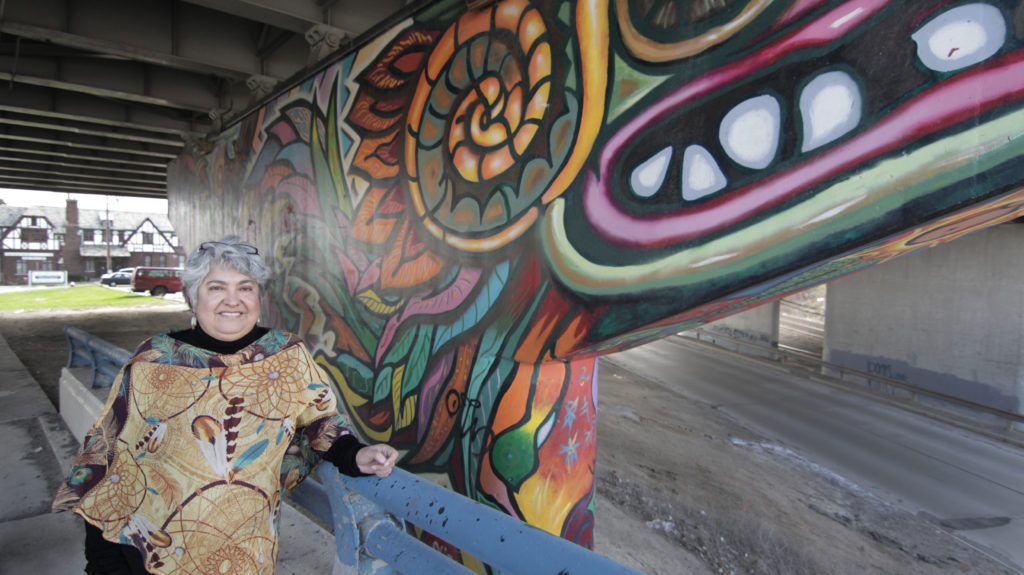
Maria Rodriguez-Winter of the Sofia Quintero Art and Cultural Center with a mural in South Toledo. Toledo Free Press photo by Kim Sanchez.
Vacant lots strewn with trash, abandoned buildings littering the city, boarded-up windows — it’s no secret that neighborhood blight is a problem in Toledo. “Revitalizing neighborhoods” even became a campaign issue in the November election.
One such abandoned building sits at the corner of 18th Street and Madison Avenue in the UpTown neighborhood. The Arts Commission, Art Corner Toledo (ACT), Home Depot, the UpTown Green planning committee and volunteers from United Way of Greater Toledo are all working together to place murals over its boarded-up windows.
The artwork is expected to do for UpTown what murals have done for other parts of the city. Murals have revived dilapidated landscapes, increased a sense of ownership and transformed a neighborhood plagued by vandalism and prostitution to one that kindles respect and pride. Murals have revitalized Toledo’s neighborhoods, supporters say, and more are planned.
“[Murals] have a huge, huge impact on the way people interact with the city and engage with the city,” said Ryan Bunch of the Arts Commission. “They’re more aesthetically appealing … they create meaning. … Some of Downtown is a little rough-looking at times and it creates this feeling that ‘I’m not alone here — there’s some life and activity here.’”
“Murals and public art have been proven to create destinations for people to visit, take photos and simply be in a positive, creative space and place,” said Rachel Richardson of ACT. “They also attract developers and activate parts of blighted neighborhoods that need some extra help due to decades of decay.”
“Neighborhood revitalization and economic development follow in the wake of public art.”
The murals at 18th Street and Madison Avenue will be painted on panels that can be moved to preserve the art for the future. The Arts Commission is accepting artist submissions with a design concept of “activism and community.” When finished, the murals will be 8.5 feet high and 14 feet wide with contributions from more than 10 artists.
“We are excited about it,” said Julie Champa, executive director of the UpTown Association. “And it will certainly add to the overall feel of the neighborhood in general.”
The mural will be adjacent to a park, called UpTown Green, that is currently under construction. Both the mural and the park are expected to enhance the neighborhood and entice potential developers.
Toledo City Council plans to vote on a measure to spend $15,000 on murals for the city. The money will match $15,000 offered by Lucas County and will go to ACT, said City Council member Lindsay Webb. The measure was on the agenda April 22 but was held for a vote, Webb said.
“Murals are a great way to capture the heart of a neighborhood and express it visually, Webb said. “It’s a part of developing and identifying and dealing with blight. My hope is that we can roll it out citywide and look at Summit Street or maybe on Secor Road and in East Toledo.”
Point Place is also another neighborhood that has expressed interest in getting a mural.
“Point Place would love to put up murals about boats and that aspect. I can’t do that if I don’t have the resources,” Webb said.
One percent of the city’s capital budget is designated to the Arts Commission, Webb said, but that money must be used on city-owned property. Council would like to get murals into neighborhoods to improve blight and increase economic development, she said.
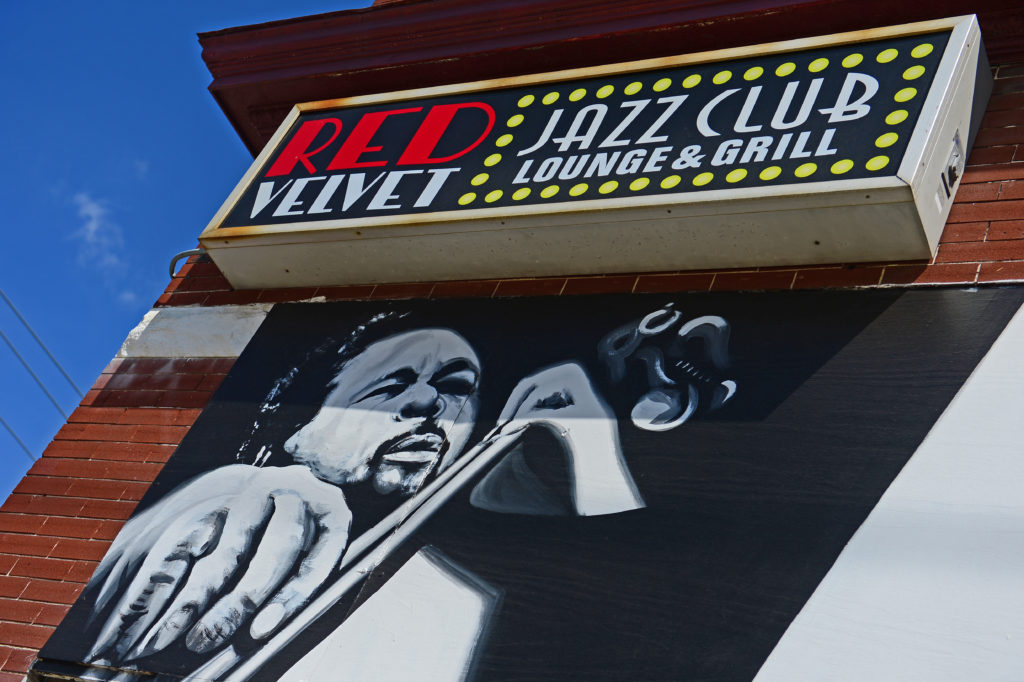
Ahmad Jacobs painted the murals at the Red Velvet Jazz Club at Junction and Belmont avenues. Toledo Free Press photo by Andrew Weber.
Red Velvet Jazz Club
Artist Ahmad Jacobs said people in the Junction neighborhood had a sense there was a “movement” about to happen.
The business owners in the area and the residents were “all happy and full of excitement” to have him paint a mural on the side of the Red Velvet Jazz Club at Junction and Belmont avenues.
“It was really good feedback for me. I felt special,” Jacobs, 45, said. “It brought a lot of people out who didn’t want to come out.”
The building is under new ownership and in the process of opening, according to Jacobs.
Jacobs has painted a number of murals around the city, many of them as a volunteer. He attended the Art Institute of Pittsburgh and taught kindergarten through sixth grade before life got in the way and he said he lost his creative direction.
“I wanted to give up,” he said. “I ended up finding myself again and experiencing art. … I had to get humble. Once I started volunteering, it worked wonders. … My whole thing was to make the city my sketchbook. No one knew I was an artist. I started going around giving businesses a ‘hug.’”
Richardson enlisted Jacobs to paint the mural that he says altered the Junction neighborhood.
“The spirit of the neighborhood completely changed,” he said. “A lot of the businesses had hope when they saw it. And even the people, the winos, they had something positive to talk about. They saw people come into their neighborhood who didn’t live there (who) had passion and drive for their neighborhood. … They needed to step their game up and join in. … So many people I would never talk to came to talk to me and offer suggestion on what they wanted to see.”
The Love Wall
The “Toledo Loves Love” mural at Adams and 13th streets has not only helped revitalize the UpTown area, it has also become a destination spot. Wedding parties, residents and people taking selfies use it as a backdrop.
“It’s a great promoter of Toledo,” said Manos Paschalis, owner of Manos Greek Restaurant, 1701 Adams St., and the owner of the building sporting the “Toledo Loves Love” wall. “Yes, it brings people together and it brings energy to the area and it’s always positive.”
That positive energy can only enhance a neighborhood, Champa said.
“The ‘Toledo Loves Love’ has gotten a lot of attention. … So many people come to that and take pictures. It’s become synonymous with the district and we think that’s really cool.”
Paschalis said the mural is bringing in business; every year, more and more people who come out to see the mural are flocking to area businesses.
A new business is going in at the building the mural adorns. Toledoan Aggie Alt is opening Moxie Live, an art house and pub that will have art on display and offer theater, dance and “anything to do with art,” Alt said.
“I think the mural is such a perfect fit,” she said. “I think it’s going to help us identify with that area. Even people outside the city know it.
“The mural shows artists, ‘Yeah, you can have your work shown here and (the art world) isn’t dead,’ and I think the mural really promotes that.”
‘The Voyage’
In 2013, the United Way of Greater Toledo held its Days of Caring event. The organization set out to “transform a neighborhood, strengthen relationships.” And to do that, they went straight to the Junction neighborhood residents to find out what changes they wanted.
The neighborhood responded. During the event, more than 30 properties were landscaped and mulched, 13 houses painted, five schools beautified, three wheelchair ramps built, two home foundations repaired, two playgrounds improved, one church basement floor installed and two murals painted, plus much more.
Titled “The Voyage,” one of the murals looks like a big blue wave rolling across the side of a building and wrapping around its edges.
It’s painted on the old Munchies building at North Detroit Avenue and Dorr Street, whose sign reads “Munchies. Again. Shrimp. Fish. Chicken.” Behind it sits a Family Food Center and, next door, a dollar store.
“The concept that we wanted to capture is that there is a voyage that needs to take place, for the past, present and future — so (the generations) know who they are and how they are connected to American history with a positive perspective,” said Alicia Smith, a resident and community organizer.
Smith sees the mural as not only a lesson in the voyage of life, but also a testament to relationships: Hundreds of volunteers, sponsors and residents worked together to make the mural and Days of Caring a reality.
“The most important thing is connection. There’s strength in connection; there’s power behind connection. … When you allow the community to have a voice you stop prescribing what you think they need and they start prescribing what they need,” Smith said.
United Way shifted to a grassroots way of interacting with the community about five years ago, said Emily Avery, director of community engagement at United Way of Greater Toledo. The organization listened to the residents at Days of Caring, acted and got great feedback, she said.
“We heard a lot from the neighborhood — it gave people hope again — just to see how much community support that they had,” Avery said. “It’s amazing what a little paint can do. We heard from people that it just kind of spread joy through the neighborhood.”
The Junction neighborhood is not done with its revitalization plan. They recently cleared sidewalks, organized a voter registration drive and will continue to landscape and paint. The journey is not over, Smith said.
“We’re going to continue to do murals. The voyage doesn’t stop,” she said. “The minute you dock the boat, you have to continue.”
Broadway Street
Gordon Ricketts was influenced by the Latino art of his San Diego childhood. As art professor and director of the Arts Village at Bowling Green State University, he wanted to bring the Latino art style to Toledo. To do so, he enlisted his friend Mario Torero.
Torero, an artist born in Peru, helped paint 60 colorful murals on the concrete support piers for the San Diego-Coronado Bridge and I-5, called Chicano Park in San Diego’s Barrio Logan neighborhood.
Ricketts brought Torero to Toledo about five years ago for the first of several murals, two on the underpass of I-75 on Broadway Street. Passersby can see the murals are large and Hispanic in style, much like the murals at Chicano Park.
“Broadway made sense because of the bridge,” Ricketts said. “We got permission from ODOT (Ohio Department of Transportation) and the mayor’s office and business leaders in the neighborhood. It was a pretty involved project.”
Students from BGSU and residents helped Torero paint the murals that stretch from the I-75 underpass to the Green Lantern at 509 Broadway St., Ricketts said.
Since the murals have graced the neighborhood, leaders said they no longer see the graffiti or prostitution they once did along Broadway Street. So far, none of the murals have been vandalized and a survey of the neighborhood showed that residents like the artwork and the gardens.
Maria Rodriguez-Winter, interim director of the Sofia Quintero Art and Cultural Center at 1225 Broadway St., said the murals have had a transformative effect on the neighborhood, which in the past was very depressing with boarded-up buildings and absentee landlords. The decline started about 20 years ago, said Rodriguez- Winter, who has been involved in the neighborhood for the past 40 years.
About 10 years ago, things started to change and now every day she sees a synergy at work in the neighborhood, she said. Residents now have a sense of pride and respect for the neighborhood. The murals are a big part of that.
“We love [the murals],” she said. “We feel that they really add a lot of beauty to the neighborhood and it engages people. When Mario comes and when Gordon comes into the area with the students, they are engaging the community.
“It’s just a process of having the people of the neighborhood be involved in the creative aspect of it. We’ve gotten so much positive feedback that some of the businesses want to have their walls painted.”
This year will be the fifth year Torero has come to Toledo to paint. The artist will be in the Old South End neighborhood June 17-18, Ricketts said.
Sid Kelly diminishes humanity of low-income people
TO THE EDITOR,
I am writing in response to Sid Kelly’s April 20 editorial, “Accepted Assistance.” Kelly’s thesis appears to be that low-income Ohioans are using their SNAP benefits to purchase things they don’t need. The word “need” comes up a lot. One person doesn’t “need” crab legs. Another doesn’t “need” an iPhone.
All this talk of need got me thinking. What do people need? We need hydration. We need vitamin C to ward off scurvy. We need calories, fats and proteins. Do we need crab legs? Do we need phones? Do we need a Downtown ballpark? Do high-income Ohioans need the money they get from the home mortgage interest deduction?
More importantly, do people need choice, agency or free will? Do people need to make their own decisions about their own life? Maybe they splurge once in a while on their favorite foods. Maybe they have a phone that doubles as their computer. Or maybe, as Kelly argues, these people are prioritizing things we wouldn’t prioritize. Just like Toledo using their tax dollars to build a stadium and wealthier individuals using their tax credits on vacations or second homes, low-income Ohioans deserve the respect of being able to make choices with their benefits. That agency is a need. And Kelly’s judgment of that need only serves to diminish the humanity of our lowincome brothers and sisters.
There is another need. I need your readers to understand that no one “approach[es] assistance as a vacation” as Sid Kelly claims. To qualify for SNAP (food stamps), a household must be under 130 percent of the federal poverty guidelines. That’s less than $1,270 per month for a single person. About $2,580 per month for a family of four. Some vacation.
These people — our neighbors — are hungry and desperate. These benefits help them put food on the table. There is no value in shaming them for occasionally buying crab legs or saving up to buy a phone.
— L. Russell Allen, Columbus
Disappointed in Collins
DEAR MAYOR COLLINS,
I am writing this letter on behalf of my family who are property owners in Toledo, who have attended the public schools and have invested their time and money into businesses in and around Toledo. We are committed to the success of Toledo.
I am very disappointed to hear that you will not entertain any plans to privatize the Toledo Express Airport. I hope that you will reconsider your position. The business at Toledo Express Airport has been shrinking for a number of years. Paul Toth, president of the Toledo-Lucas County Port Authority, has stated that “we continue to see great growth, good numbers,” in referring to the airports. Where are these numbers? Where is the evidence to support this statement?
The Toledo-Lucas County Port Authority may have been the right group to manage the Toledo airports in 1973. However, it is 2014 and our economic situation is different. Under the current management, we have lost tax revenue, traffic volume has decreased, putting us at risk for reduced federal funding, and we have seen a decrease in economic development.
If we want the situation to change, then we need to change. We need a thorough review of the current management of the Toledo airports. We need to consider credible alternative solutions like the Treece plan. The taxpayers deserve the opportunity to hear the details of the proposal in a public forum. Improved management equals more tax revenue to improve schools and more jobs to help put Toledoans back to work. Now is the time to get out in front of this issue before it is too late. Let’s be proactive!
I have started a Facebook page www.facebook.com/SavetheToledoAirports and I have sent this letter to Toledo Mayor D. Michael Collins and the Toledo City Council.
— Jim Wuwert, Toledo
Murphy’s law
TO THE EDITOR,
I just finished reading Tom Pounds’ Publisher’s Statement on the State of the Region in the April 20 issue of Toledo Free Press. I read the advice of Tom Murphy and I thought it to be very timely. Pounds’ column states, “Murphy said Pittsburgh invested in its cultural community and reclaimed the waterfront. Those are both lessons we should well heed.” Having just spent this past Saturday at 419 Day, I am very proud of how Toledoans support their cultural community. There are so many cultural opportunities available and people around the area show their support in so many ways.
However, what about the waterfront advice? We are about ready to sell out some reclaimed waterfront to ProMedica. People fought hard to open that area up to the public by getting rid of a hideous government issue building. Are we really going to give up this land for a parking garage? Are there alternatives? Some say that placing the garage underground is too costly. I think it would be worth the cost — in the long term.
I would suggest that people look no further than the University of Cincinnati. They have created acre upon acre of green space by placing parking structures underground. The aesthetics of the campus have changed drastically, making it a much more inviting campus. There is no doubt that enrollment has been positively affected by these decisions.
Like Pounds, I hope we can heed Murphy’s lessons. Let’s look at alternatives to another ugly parking garage blocking the view of our waterfront and taking up valuable space that could be enjoyed by generations of Toledoans. As Murphy stated, “You need to think of Toledo, not as it is today, but as it can be in the future.”
Will we heed this advice or settle for most expedient?
On two different evenings recently, area high schools had events in Downtown Toledo. One was a series of performances by students while the other was an effort to raise funds. The events took place in separate venues, but across the street from the same parking lot.
On both nights, the owner of the parking lot, seeing the opportunity for increased income, raised the parking charge to a flat fee of $10. Since regular parking would be no more than half that, he clearly was taking advantage of what he considered to be a captive audience.
What the owner did not focus on was the fact that future event planners might well determine that other venues would be more appropriate, where the people they were inviting did not have to pay $10 just to park. There are a number of venues around the city that could have accommodated these groups and each would have had free parking.
The parking lot owner is not there to serve the public. His is a private business, operated for his own benefit and at his own risk. He has substantial costs, not the least of which is real estate taxes. I am sure the daytime parking is down as well. He has to plow it, pave it and maintain it on his own nickel.
That said, the point is that parking is a problem and if the city is going to rebound, we need to get people Downtown. In a perfect world, parking would be free. But that would leave the question of who maintains the lots. Moreover, without charging for parking, people would avail themselves of the closest spaces, leaving those arriving later a two-mile hike.
For years, urban planners have cited airport parking as the appropriate model. You charge a high price for those who want the most convenience, and offer bargains for those willing to park further away. That is the way it is in Toledo, except when there are special events. But it seems to me there is a key difference between Mud Hen’s games or those of the Walleye and local high school events. The sports teams are both profit-making ventures, so I think parking lot owners are entitled to make a profit as well.
I’m not suggesting that the owner of the parking lot did anything wrong. But I am saying that this circumstance highlights the parking problem and it seems to me the mayor and his staff ought to address it.
Perhaps offering a tax break to parking lot owners to reduce their prices would help. Or, it might be suggested that they offer special prices for certain events, again with the idea that some form of compensation or tax break could be afforded to lot owners for doing so.
I am sure the University of Toledo has at least one if not more classes that study this topic. By reaching out to the university, the city could obtain some quality free consulting on the issue.
By the way, I know parking is important. Our firm is located on the south edge of the city and our building has its own parking lot, which is free. Our clients appreciate it and so do I.
Rick Kerger is a trial lawyer at Kerger & Hartman LLC in Toledo.
We go through life, essentially, learning the entire way. It seems that when it comes time to tackle our retirement planning, we often fall short in educating ourselves or reaching out to fellow mentors about the right choices to make. This can be a costly mistake for retirees.
.
We see it more often than we’d like here at the Retirement Guys Resource Center — smart, well-educated individuals who have made vital retirement decisions without taking the time to learn about their different planning options. At retirement, an employee is often handed the biggest check of their lifetime in the form of a pension and a 401(k). Smart decisions have to be made with those accounts so the income lasts as long as needed.
For all these years, the employee relied on the company for a steady paycheck. At retirement, most companies say, “Here are the choices on the pensions and the 401(k) plan. Let us know what you want to do.” Those decisions on how to best manage the money to have a lifetime of income can become overwhelming and at times are made without a lot of prior planning. Don’t make that mistake; here are three tips to follow.
Know what is important. A lot should be considered before any retiree makes a decision. Remember, most decisions — like pension payouts — are irrevocable. So once the decision is made, it cannot be changed. Get it right the first time. Start by writing down what is important. Think about what you want to do, where you want to be and how much income you are going to need. Write down all of your dreams, goals, and desires. Just start on a yellow pad of paper and write down anything that comes to mind.
Run the numbers. Once you know what is important to you and your dreams, goals and desires are written down, it is time to run the numbers. Is paying off the mortgage a possibility? Do you have enough money to buy a new car or second home? How long will your money last? What do the numbers look like when other options are considered? Running the numbers will not only help a retiree understand what is realistic and possible, but it will also help the retiree begin to prioritize the list.
Map out a game plan. Anyone who has met me knows I am big into checklists. I like checklists because they can give an investor a road map to follow and also allow an individual to write in dates and deadlines. Moving into retirement is a new phase for a lot of people, so creating a retirement checklist is a great idea. Financial items on the list should include things like an inventory of all assets, a listing of income sources and an overview of the amount of risk in each account. This list should also include any dreams, goals and desires that, after the numbers were run, are still part of the plan.
Retirement planning might seem a bit overwhelming at first. Remember, the best decisions for a co-worker or a friend may not be the best decisions for your family. No one decision is best for everyone.
For more information about The Retirement Guys, tune in every Saturday at 1 p.m. on 1370 WSPD or visit www.retirementguysnetwork.com. Securities and Investment Advisory Services are offered through NEXT Financial Group Inc., Member FINRA / SIPC. NEXT Financial Group, Inc. does not provide tax or legal advice. The Retirement Guys are not an affiliate of NEXT Financial Group. The office is at 1700 Woodlands Drive, Suite 100, Maumee, OH 43537. (419) 842-0550.
Riverbend Leadership Solutions was founded on the belief that individuals can achieve a greater sense of self-awareness by interacting with horses.
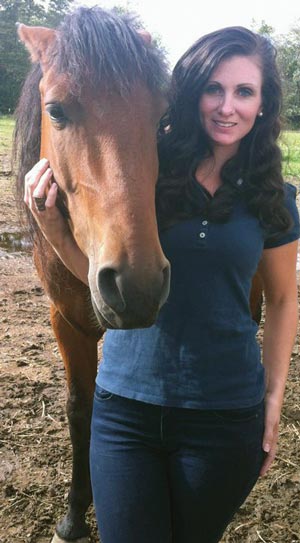
Amanda Thompson and an equine friend
The Grand Rapids, Ohio-based organization was established in 2013 with the goal of enhancing personal and professional growth in development, leadership and communication skills through equine therapy.
The principal idea behind equine therapy is that horses possess an instinctive ability to mirror those with whom they interact, allowing individuals to develop a better understanding of their leadership and communication styles, said founder and Equine Assisted Psychotherapy and Equine Assisted Learning (EAGALA)-certified equine specialist Amanda Thompson.
This heightened understanding leads to the enhancement of effective communication and the development of more unified interpersonal and professional relationships, she said.
Thompson said her goal in creating Riverbend Leadership was to help people achieve health, healing and growth.
“I do not heal people; they heal themselves,” Thompson said. “I just provide the environment and the tools they need to heal.”
Thompson grew up riding and showing horses, and developed a love for the animals at a young age. She spent four years in the military on active duty during which time she began to learn to communicate with and tame wild horses.
She realized that she was on to something when she noticed her interactions with the horses strengthened her leadership, communication and interpersonal skills in other areas of her life.
Upon returning to Ohio after her military career, she attended college for business and wrote a business plan for owning and running a horse farm. She said her grandfather and father helped her to make her dream a reality in 2006 when she bought a farm.
She began by working with horse owners who were having difficulty managing their animals. She was able to assist people in establishing a relationship and communicating with their horses.
Shortly thereafter, she established a nonprofit organization using equine therapy to help abused women and veterans suffering from post-traumatic stress disorder.
She said the positive results for participants were almost immediately recognizable, with improvement in life impairments in as few as six sessions with the horses.
“Horses will pull out of you not what you think you need to know, but what you really need to know,” said Sarah Hafner, operations manager of Equine Leadership Solutions.
Currently, the organization’s primary target audience is corporate America. Thompson believes that business executives can learn about their leadership and communication styles by interacting with the horses, and from there they can develop a plan of action.
By identifying how to incorporate what is learned from equine therapy into the work environment, communication and leadership skills are improved and cohesive professional relationships are formed, she said.
Riverbend Leadership also offers equine therapy to people struggling with depression, anxiety and grief issues. Hafner is currently working with several clients on coping with the grief of losing a pet, which she said she finds extremely rewarding.
“The results are outstanding,” Hafner said. “They come in vulnerable and unsure of themselves and leave with a newfound confidence and empowerment.”
The farm currently houses 13 horses, all of which were rescued by Thompson. Besides herself, consistent with the EAGALA model for equine therapy, she also employs Paul Standinger, a therapist.
Together, they form a team with the horses to provide therapeutic programs and workshops to people and businesses within the community.
EAGALA, Thompson’s certifying body, is a nonprofit organization founded in 1999 comprised of more than 4,000 members from 49 different countries.
This association sets the standards of practice for certified equine specialists, with a vision that “every person worldwide will have access to Equine Assisted Psychotherapy and Learning Services, provided at the highest standard of excellence,” according to the group’s website.
Thompson hopes to continue to grow her organization and expand her services through community awareness and education. Riverbend Leadership is presently in search of sponsors for their horses in order to continue to provide these therapies.
For more information, visit www.riverbendequine.org.
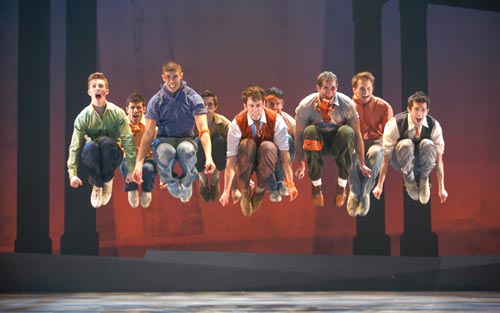
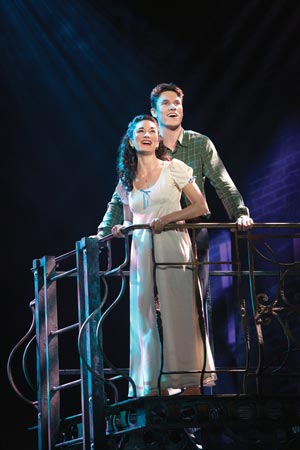
‘West Side Story’ will be in Toledo for one weekend. Photo by Carol Rosegg
MaryJoanna Grisso’s mother, a music teacher, often played music from “West Side Story” when Grisso was a child, which exposed her to the songs she is performing today as Maria.
‘West Side Story’ will be in Toledo for one weekend. Photo by Carol Rosegg
“I grew up loving this musical,” Grisso said. “It was something that I always wanted to be in. It’s such a classical piece of theater and it’s such an incredible story, an incredible message and a lot of people can relate to it.”
Locals can catch her performance when “West Side Story” dances into the Stranahan Theater on May 1. The show will be in town for one weekend only, showing at 8 p.m. May 1; 8 p.m. May 2; 2 and 8 p.m. May 3; and 2 and 7 p.m. May 4. The show runs for two hours and 30 minutes with a 20-minute intermission. Tickets can be purchased online at theaterleague.com.
Grisso, who thinks the show is one of the best of Broadway, said the production is timeless.
“It’s such a relatable story; it’s the Romeo and Juliet story,” Grisso said. “So many people deal with that in their lives, and racism and bigotry all still exist. … I think that’s why it’s still relevant.”
A number of things attracted Grisso to the role of Maria, but she mostly admires the growth of her character throughout the show.
MaryJoanna Grisso in West Side Story. Photo by Amy Boyle
“She is a very inspiring character to me,” Grisso said. “She grows so much in the show. You see her in the beginning of the show and she’s a young girl and by the end of the show, which is only a matter of two days, she’s forced to grow up very quickly with the things that she’s dealing with. … For me to do it every day, it’s like I’m learning from this character, which is really spectacular.”
This is Grisso’s second season playing Maria and she said she never gets sick of the character. The most challenging part was the role’s Spanish lines, which Grisso began being coached for as soon as she got the part.
“There’s a little addition of Spanish in this edition, which is great. It adds so much authenticity to these characters,” Grisso said. “So that was one of the things I worked on.”
For more information, visit the website theaterleague.com.