Home Blog Page 193

Casino plans events for Responsible Gaming Week

0

Dining specials, a fundraiser for a local behavioral health nonprofit and special appearances from “Beti,” a character emphasizing safe betting, are among the activities planned for Aug. 4-8 at Hollywood Casino Toledo to mark Responsible Gaming Education Week.

The 17th annual initiative, held the first full week of August, is a program of the American Gaming Association.

Hollywood Casino Toledo will mark  National Responsible Gaming Education Week  Aug. 4-8. Toledo Free Press File photo by James A. Molnar

Hollywood Casino Toledo will mark National Responsible Gaming Education Week Aug. 4-8. Toledo Free Press File photo by James A. Molnar

Each day will feature a special meal at Scene sports bar, including Winner Winner Ranch Chicken Dinner on Aug. 5 and Know Your Limit Beef Lasagna on Aug. 8, said Brian Hopkins, slot manager at the casino who is leading Toledo’s effort.

The casino will also donate $1 from each Epic Buffet meal purchased on Aug. 4, 7 and 8 to Unison Behavioral Health Group in Toledo.

Beti, a character based off of Progressive Insurance mascot Flo, will emphasize making safe bets. She will appear at the casino, including at the Smokey Robinson concert Aug. 8, as well as at the Wood County Fair on Aug. 4 and the Northwest Ohio Rib-off and Mud Hens game on Aug. 7.

Each year, properties owned by Hollywood Casino Toledo’s parent company Penn National Gaming compete to see who can come up with the most fun promotions while not diminishing the seriousness of the subject, Hopkins said.

Also as part of the week, all casino employees will be retrained to spot warning signs of problem gambling.

“Hollywood Casino Toledo takes responsible gaming very seriously,” Hopkins said. “It’s not just one week of the year; it’s an everyday commitment.”

As stipulated by state law, 2 percent of the tax on Ohio’s gross casino revenue goes to problem gambling resources.

“It was very important to lawmakers that money be set aside to help people who might have a problem,” said Tama Davis, director of communications with Ohio Casino Control Commission (OCCC).

Scott Anderson, gambling disorder treatment specialist with the Ohio Department of Mental Health & Addiction Services (Ohio MHAS) Bureau of Problem Gambling, has been working with problem gamblers for years.

“Gambling isn’t new to Ohio. It’s only the casinos that are new,” he said.

Horseshoe Casino Cleveland and Hollywood Casino Toledo opened in May 2012. Hollywood Casino Columbus opened in October 2012, followed by Horseshoe Casino Cincinnati in March 2013.

Gambling addiction was recently reclassified by the American Psychiatric Association as a substance-control addiction rather than an impulse-control disorder, Anderson said.

“Gambling addiction is 90 percent the same as any other addiction, but 10 percent very, very different,” Anderson said. “It doesn’t have the component of toxicity. You can’t overdose. If you gamble, gamble, gamble, you won’t pass out or get sick. If I were high or drunk, you would probably be able to tell, but there’s no way to tell that someone lost $10,000 over lunch.

“It’s a pathological relationship with mood-altering experience.”

Resources

One resource is the Ohio Problem Gambling Hotline (1-800-589-9966). A total of 16,431 people have called since January 2012, including 10,176 in the past year. From January to June 2014, the hotline received an average of 650 calls per month.

Another resource is the state’s Voluntary Exclusion Program (VEP). More than 1,000 people from 12 states and one Canadian province, including 155 in Lucas County, have voluntarily banned themselves from entering Ohio’s casinos.

More than 85 percent of the 1,032 people currently on the list are from Ohio. As of July 14, there are 879 participants from Ohio, 116 from Michigan, 21 from Kentucky, four from Indiana, three from Ontario, Canada, two from Pennsylvania and one each from Arizona, Florida, Georgia, Illinois, Missouri, New York and Wisconsin. Twenty-four are from Wood County, four from Fulton County and three from Ottawa County.

The list includes 758 men and 274 women. More than half are 40 or younger, with about a quarter of the applicants 30 or younger.

Thirty-one percent of applicants placed themselves on a lifetime ban list, 22 percent excluded themselves for five years and 47 percent for one year.

To be added to the list, an application must be filled out in person at an OCCC office, located at each of Ohio’s four casinos as well as the agency’s headquarters in Columbus. The list is confidential and only accessible to certain OCCC employees via a secure database, Davis said.

Those on the list are removed from all direct marketing and his or her player card is deactivated. They are also excluded from entering any property operated by Penn National Gaming or Caesars Entertainment Corporation. Penn operates the casinos in Toledo and Columbus while Caesars operates the casinos in Cleveland and Cincinnati.

“From a psychological standpoint, the Voluntary Exclusion Program would be a step in taking some self-responsibility during recovery,” Anderson said. “It’s a move in the direction of abstinence, a move to minimize life-damaging consequences.”

Nothing electronic flags a person on the VEP list from entering a casino. They must be recognized by a staff member. However, if they try to cash in a jackpot or use their player card, they will be flagged.

“The downside of it is it’s completely up to the individual to police themselves,” Anderson said. “Unless they run into someone at the casino who knows them or they win a jackpot or use their player card, they would go undetected, so it’s not really foolproof. It’s a voluntary exclusion program with the key word being voluntary.”

Those on the VEP list found at a casino are asked to leave and could be arrested and charged with trespassing.

For the fiscal year ending June 2014, 91 people were charged with criminal trespassing in Ohio’s casinos, 73 of them from the VEP list, Davis said. Thirty-three were at Hollywood Casino Toledo, with 25 of them from the VEP list.

Four state agencies — Ohio MHAS, OCCC, the Ohio Lottery Commission and the Ohio State Racing Commission — make up Ohio for Responsible Gambling, an initiative aimed at promoting responsible gambling in Ohio.

“We were the first state in the country to bring state agencies under one umbrella [to focus on problem gambling prevention],” Davis said. “There is a big concentrated organized push in Ohio under this collaboration to really understand who’s at risk, to target prevention messaging and help make resources available to help any Ohioan who may face a gambling problem.”

“This is something we take very seriously,” Anderson added. “We’ve taken a very proactive approach to it.”

Toledoans join state rally to support marriage equality

0

The Cincinnati-based 6th Circuit Court of Appeals will determine the future of marriage equality in four states on Aug. 6, but supporters will rally outside the courtroom the day before.

Gays, lesbians, bisexuals, transgendered people, straight allies, faith leaders, business owners, elected officials and more will be present at the rally, said Michael Aremo, campaign manager of Why Marriage Matters Ohio. Speakers at the rally will include State Rep. Nickie Antonio, Cincinnati City Councilman Chris Seelbach and former Ohio Gov. Ted Strickland.

The rally is a time to show that “Ohio is ready for marriage equality,” Premo said.

“This is the most important day in the legal fight in marriage equality in Ohio’s history,” Premo said. “When you have this many people who are willing to get in their cars and drive down to Cincinnati to participate in this rally … it’s incredible.”

The rally will be 5:30 p.m. Aug. 5 at Lytle Park, in Cincinnati and Toledo locals will be traveling to the location. Brent Rabie, volunteer and Equality Toledo board member, will lead a caravan and carpool to the rally. The group will leave from the Collingwood Arts Center, 2413 Collingwood Blvd., at 1 p.m. Aug. 5.

Supporters are encouraged to wear red the day of the rally to show support because red is the color of love, Premo said.

“The fight for marriage equality is about love and commitment,” he added.

On Aug. 6, oral arguments of five landmark cases will be presented in front of a three-judge panel, representing four states: Ohio, Michigan, Kentucky and Tennessee.

Premo said the five cases focus on different issues. The plaintiff couples from Ohio and their attorneys will make the case that the refusal to recognize legal marriages performed in other states is unconstitutional.

After the arguments, the three-judge panel will issue their decision, upholding or overturning the lower court’s ruling that Ohio’s ban is unconstitutional, Premo said. He added that whoever does not get the decision they want has the option to appeal to the Court of Appeals or directly to the Supreme Court.

“The oral arguments, I believe, will reinforce how harmful and widespread marriage bans really are,” Rabie said. He added that this event can change the lives of many in the area.

Premo, who is a straight ally, has worked with Why Marriage Matters Ohio since December, and he said support for marriage equality has grown. Since Why Marriage Matters Ohio was founded in September, Premo said there has been a nine-point increase in public opinion in favor of marriage equality.

“Momentum is clearly on our side and we want to make that clear at this rally,” Premo said. “What we’ve been encouraging people to do since the beginning was to have conversations with their family and friends about marriage equality and why they support it and why it’s important to them. Those conversations have been bearing fruit in that people are starting to think about marriage equality in a way that they haven’t thought about it before.”

He also added that two polls from this year show 50 percent of Ohioans support marriage equality, which is a five-point increase from last year. Opposition has dropped four points as well.

Before working in Ohio, Premo worked with the marriage equality campaign in New Jersey, which he said was “tremendously gratifying.”

“I wanted to bring that experience here to Ohio,” he said. “Marriage equality is coming to Ohio. It is no longer a question of if; it’s a question of when.”

For more information on the rally, visit action.wmmoh.org/page/s/rally-for-marriage-equality. To RSVP for the carpool, visit marriageoh.org/rally.

Officials battle heroin and opioid abuse

0

By Tom Konecny

Toledo Free Press Associate Editor

[email protected]

By Danielle Stanton

Toledo Free Press News Editor

[email protected]

The alarming escalation of heroin and opioid abuse, and subsequent death, is just as evident in Northwest Ohio as it is across America. The outbreak is real. The outbreak is serious.
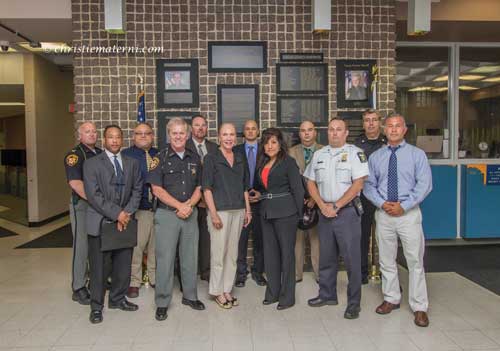
n FIGHTING AN EPIDEMIC:  Back Row: William Talbott, Matthew Rizzo, Scott A. Sylak. Damian Worthy, SHERIFF’s Sgt. Joe Gorney and Paul Magdich Front Row: DEPUTY SHERIFF Charles Johnson, LUCAS COUNTY Sheriff John Tharp, Prosecutor Julia Bates, Lt. Andrea LunA, Capt. Michael Troendle and Detective John Szmania. Toledo Free Press photo by Christie Materni/cover illustration by James A. Molnar

n FIGHTING AN EPIDEMIC:

Back Row: William Talbott, Matthew Rizzo, Scott A. Sylak. Damian Worthy, SHERIFF’s Sgt. Joe Gorney and Paul Magdich

Front Row: DEPUTY SHERIFF Charles Johnson, LUCAS COUNTY Sheriff John Tharp, Prosecutor Julia Bates, Lt. Andrea LunA, Capt. Michael Troendle and Detective John Szmania. Toledo Free Press photo by Christie Materni/cover illustration by James A. Molnar

One Northwest Ohio woman is fighting back with her most powerful weapon — a parent’s love.

Mary Juarez of Archbold lost her 31-year-old son Marjoe Gineman to drug and alcohol addiction in 2010, and has become — as her website indicates — “a mother on a mission.”

She quit her job to help others with the same problem.

“Drugs,” Mary said, “offer the hardest battle we have to fight.”

Marjoe lived far from any major urban setting or gang culture. He had a love of God, enjoyed sports, was artistic and liked to joke around.

Mary raised her son in this rural Fulton County town (pop. 4,300) in a faith-filled home surrounded by loving, extended family.

“My mother passed away in Marjoe’s freshman year,” she said.  “I do believe for a 14-year-old young man, going through adolescence and a whole new realm of life — learning to deal with grief — he ended up in the wrong place at the wrong time. Instead of walking away, he gave into the temptation of a few beers.”

It led to more drinking, which was a gateway to marijuana. He turned to heroin, which then evolved into prescription pills.

“I didn’t know him,” Mary said, “and he didn’t even know himself.”

Marjoe’s 15-year addiction landed him in two rehabilitation centers, but by 2009 he seemed to be conquering his problem and finding peace, courage and new hope.

“He was so strong then and said, ‘If I can make it through rehab, anyone can make it through rehab,’” Mary said. It only took a small relapse where Mary believes “for one second he let go of God’s hand and the courage to say no,” and Marjoe was gone.

Not long after, her sorrow grew into a passion for helping others with Never Let Go Ministries, a nonprofit aimed at creating drug-free communities through education and awareness.

Mary and her husband, Victor Juarez, have spoken to more than 60 schools, youth groups and rehab centers throughout Northwest Ohio and appear at various events, such as the recent EXCLAIM! Christian music festival in Toledo.  Their website — neverletgo ministries.com — explores their motto, “Never let go of God’s hand, and never let go of the courage to say no.”

“The main thing is she (Mary) doesn’t want Marjoe’s life to be a waste of a life,” Victor said.  “She wanted his death to have a purpose.  If it wasn’t for him losing his life, we wouldn’t be doing this. She does this because Marjoe lives on through this. She wants something to become good through his death.”

Having recently obtained 501(c)(3) status, the Juarezes have big plans for Never Let Go Ministries as they hope to obtain an office, earn grants and create a center where others can get counseling. Fighting the battle in Northwest Ohio must be a group effort, said Victor, because the location poses problems.

“You have the turnpike which crosses the top of Northwest Ohio,” Victor said.  “You have Michigan, Detroit, Canada, Fort Wayne — it’s just surrounded by different areas and highways where dealers can come in and sell their product.  It’s just so hard for law enforcement to keep it down, and they’re trying very hard.”

While the couple will do what they can to help, they realize addiction is often the result of bad choices.

“I can’t say I ever met an addict who wanted to be an addict,” Mary said. “They tell me it is the most hopeless, sickest journey anyone has ever walked, but once they cross that line there is no going back. These are absolutely beautiful people, but they made some wrong choices.”

Epidemic proportions

When former first lady Nancy Reagan introduced the famous “Just Say No” anti-drug campaign in the 1980s, it wasn’t as though the war on drugs had just begun. That battle was originated, at least formally, 100 years ago in 1914 by the U.S. government.

The campaign was, however, a very public and concentrated group effort among national and world leaders, educators, law enforcement and drug abuse programs to stop what was becoming a growing problem.

Right here in Toledo that same concept is being applied to a drug problem that’s not just grown, but has reached epidemic status throughout Northwest Ohio and all of America:  heroin and opioid abuse.

“This is now the No. 1 cause of accidental death in America,” said Dr. Robert Forney, Lucas County chief toxicologist.  “And it’s growing at an exponential [rate].  There is no plateau yet.”

If that statement doesn’t cause alarm, a quick look at local statistics should. The Lucas County Coroner’s Office confirmed the following heroin deaths in recent years: 2010, 8; 2011, 15; 2012, 31; 2013, 80; 2014, 60 in the first five months, with 100-150 possible by the end of the year.

“I think the thing that needs to be remembered is that some of these people were put on medications, and for one reason or another became addicted,” said Dr. James Patrick, Lucas County coroner. “The public and others have come to the understanding that one should not have to endure chronic pain. The problem with that is — and I don’t disagree — many of the drugs that are used to alleviate pain are significantly addictive. Then the problem is, if the source of pain is no longer there or is fixed, the question becomes then how to wean somebody off these drugs if they’re addictive.

“They are using heroin as a substitute for prescription drugs that they’re no longer able to obtain in the quantities that they need them.”

Another surprise to many is that this epidemic affects various social groups, and is not necessarily confined to an urban setting, as many often expect. Forney indicated that of the 60 heroin deaths so far this year, 76.3 percent were men and 82.8 percent were white/Caucasian. The age range is 19-66, with the average at 39.9.

“This is really in the suburbs,” Forney said. “I don’t mean it’s not in the inner city, but these aren’t people meeting street people in the inner city, and part of that whole gang/drug sort of culture.”

He said addiction can affect anyone, using Rush Limbaugh’s battle with prescription painkillers in 2003 as an example.

“If you look at the statistics of people that are dying of overdoses, they are typically individuals ranging from mid-30s to mid-50s, typically Caucasian,” said Scott Sylak of the Mental Health and Recovery Services Board of Lucas County (MHRSB). “ZIP codes are primarily not in the central city district.”

The current epidemic can be traced back several years, Forney said. In 2001, the Joint Commission — an independent organization that accredits and certifies over 20,000 health care organizations and programs — named pain a fifth vital sign (the others being the more scientifically measurable temperature, blood pressure, pulse and respiratory rate).

With pain as vital sign, the physician must now pay attention to it and treat it, according to Forney, and that’s where opioids come in. Opioids’ narcotic effect causes a dullness and soothing emotion, and synthetic opiates are often used to treat bodily pain.

In the wake of the Joint Commission’s revised standard, the sale of opioids began to increase as more and more prescriptions were written for outpatients. But while there is a real attempt to treat pain with narcotics on a chronic, long-term basis, as the body adjusts to these drugs it needs higher doses to be effective.

“These are all combination deaths,” Forney said.  “It’s very [different from] what we typically see in a suicide, where people take a handful of pills. That’s not the way these look. With narcotics, the more you take the more your body accommodates itself to it.  It’s a little bit like the tolerance to alcohol, although the actual methods of tolerance are different.”

“One of the problems with opioid drugs is not only are they addicting,  it takes more of them to do their thing,” Patrick said. “The idea is that there is clearly a factor of tolerance with the opioid drugs. You are apt to require more to alleviate pain.”

There was a time when patients with expired prescriptions could drive to an urgent care facility in another city to get more medicine, but now a statewide monitoring system prevents that overuse.  But the fact remains that when someone is hurting, they want drugs to alleviate the pain.

When a prescription supply is cut off, many seek alternate sources for the medication they’ve become dependent on. Instead of obtaining the drugs they really need, they may turn in desperation to heroin, which can be inexpensive compared to drugs like Vicodin.

The conundrum begs more questions, for which it’s difficult to find solid answers.

“I’m not a social scientist, but I’ve heard others, especially in the media, comment on the ‘greatest generation,’” Forney said.  “They were tough people and were willing to suffer a lot without calling in sick or needing much in the way of pain relief.  If you go to the next generation — baby boomers or generation X — are we crybabies?  These [cases] are mostly men.  Why aren’t there more women? Why aren’t there more minorities?”

Doctors are somewhat caught in the middle. If they don’t alleviate patients’ pain, they can be criticized. If they believe what patients tell them and prescribe opioids, they’re in a sense part of the larger problem.  Pain, it could be argued, is a subjective symptom, not an objective sign.

At MHRSB, officials work to help those with addictions.

“Our role is mainly to look at those folks in need of treatment, and how to get them the best possible treatment in our community,” Sylak said. “We’ve been working on a process to refer people to us. I think in general, [to curb] the heroin and opioid epidemic, it will take multiple efforts of different groups working together.”

By law, MHRSB doesn’t provide direct services, but rather contracts with five different centers in the area to offer that help:  Harbor, Zepf Center/COMPASS, Unison, New Concepts and Rescue Mental Health Services.

Sylak notes that MHRSB is working with each to ensure there’s adequate capacity to serve future clients as projected by the trends. Their most recently passed levy in November 2012 is certainly helping them in their quest, Sylak said.

Fighting the war

Until recently, law enforcement dealt with heroin overdose cases in a “callous” manner, Lucas County Sheriff John Tharp said during a July 25 interview.

Tharp recalled a case he handled with Toledo Mayor D. Michael Collins when both men were police officers. They were called to a home, he said, and found three people who had overdosed on heroin.

The protocol: Find out their names, create a file and be done with it.

Tharp may have revolutionized the procedure for handling heroin cases by recently creating the Addiction Resource Unit (ARU), comprised of law enforcement officers and agencies from across the county. They will visit hospitals, talk to family members and investigate the scene all with the intent of getting the victim treatment and arresting the drug supplier.

The ARU involves a staggering level of cooperation among agencies: police and fire departments around the county, dozens of rehabilitation services, the metro drug unit, the county prosecutor’s office and the county coroner.

“This is not a program, not a philosophy,” Tharp said. “This is a new way of doing business.”

It’s a collaborative effort with the goal of keeping people alive, he said.

Dispatchers are often unaware that emergency calls are actually heroin overdoses because family members cover up for their loved ones. They don’t want police to know that their son or daughter or aunt or father is using.

Law enforcement knows what to do when there’s a shooting or stabbing, but they didn’t know what to do when dispatched to a hospital for an overdose. They did know that the person being treated might not be able to speak, not only because of medical treatment, but because they might not want to talk to law enforcement, Tharp said.

That’s where Matt Rizzo, interim executive director of A Renewed Mind, steps in. Rizzo developed a training module for deputies to use on the streets.

The SOS method involves “supporting” families and listening to their struggles that have led to a loved one using heroin or opioids, including information on what may lead to an arrest; “offer” resources that are available to help the victim into treatment; and “secure” the environment for recovery, such as removing any prescription drugs from the home.

With 20 years in the mental health and addiction field, Rizzo used his experiences in social work and therapy to develop the SOS training model. A DVD is currently being created so law enforcement can train themselves. Counselors are also riding along with deputies to provide additional support.

The training aids the deputies in their dealings with family members at the home or hospital. They now can help families find treatment and discuss insurance options for their loved one. Deputies also hand out educational prevention kits that contain information and resources on addiction.

“We’ll continue working with the family,” Tharp said. “If there’s a relapse, we’ll still be there for them.

“We’re not going to walk away. When that person hits bottom, that deputy could be the spark to get them into counseling and start a new life for themselves.”

Lucas County Prosecutor Julia Bates is on board with Tharp’s new way of doing business. Bates plans to hand down manslaughter or homicide charges to suppliers if the evidence supports it.

Now, deputies will investigate overdoses that result in death as homicide cases. They will gather evidence, including syringes and fingerprints, to track down suppliers.

Bates said she will take each case on an individual basis.

“We don’t want to make criminals out of the overdose subjects,” Bates said. “So we’re going to have to feel our way with this, but maybe we can help these people get off of drugs. If the victim does die, we’ll look at it as a homicide; we’ll look at the scene and see what we can find out — who did they get the drugs from, who gave it to them?

“We’ll look at what kind of evidence is found. If we find the dealer, we can prosecute the dealer.”

National trend

According to a July report by USA Today, there’s a national trend to prosecute overdoses that result in death as homicides.

Ohio legislators are considering a drug-induced homicide law. Illinois, Pennsylvania and Kansas have already passed one. Wisconsin prosecutors charged 71 people with first-degree reckless homicide by drug delivery in 2013, compared to 47 in 2012.

In Michigan, it has been reported that the homicide charge has been used against 75 people from 2010 to 2013.

The deputies in ARU currently have more than 60 cases they’re working on, including two deaths. Tharp said two to three people overdose per week, just in Toledo.

Tharp did not receive any startup money for the unit, nor did he want to wait for grants. With the county commissioners’ OK, he pulled in deputies from other departments and paid overtime.

“The county commissioners have been very aggressive to encourage a change in the way of doing business,” Tharp said. “This could not wait for grants. This service needed to be done immediately.”

The Addiction Resource Unit is housed Downtown at the Lucas County Sheriff’s Office. Tharp said they are currently in the process of knocking down two walls in an office area to create one large squad room where deputies can work together. “United we’re strong,” he said.

The Lucas County Sheriff’s Deputies in the unit include Deputy Sheriff Charles Johnson, Deputy Sheriff Damian Worthy, Sheriff’s Sgt. Joe Gorney and Lt. Andrea Luna.

Johnson said he has been inundated with emails from the public seeking assistance and information since the unit was formed a few weeks ago. Johnson, who has worked for the Lucas County Sheriff’s Department since 2002 and has 19 years in law enforcement, called his new position the most demanding yet fulfilling job he’s ever had.

“I will work 20 hours a day doing this job and get paid for eight because I’m helping someone out,” Johnson said.

The unit’s work is “very, very important,” Tharp said, because young people are destroying their lives and their families every day.

“All resources have to pull together to curb this heroin epidemic — all law enforcement agencies in the county, all fire departments in the county, all rehabilitation agencies in the county and in the community,” Tharp said. “We all have to pull together.

“And we have to stay united.”

Miller: Date night in New Orleans

0

As my wife Shannon and I made recent arrangements for a night out, our 8-year-old son Evan and 6-year-old son Sean picked up Lego blocks and prepared for their babysitter to arrive.

.

.

“How come you have dates?” Evan asked. “You’re already married!”

I caught my wife’s eyes and said, “And we stay married because we still have dates.”

Evan nodded and went back to his blocks. I doubt the boys truly understood but they will one day. Shannon and I have maintained a strong friendship as our marriage has evolved. That strikes me as an obvious thing to state but we see too many couples who seem to be together more out of habit and obligation than from friendship, much less love.

A recent invitation to a baptism in the New Orleans area offered an opportunity for what we viewed as an extended date night. I had never been to New Orleans and Shannon’s sole experience was based around a conference, so a weekend away on a long date held great appeal.

We haven’t planned it that way, but we have taken weekend getaways without our sons just about every two years. A weekend in Las Vegas for Shannon’s birthday four years ago and a revelatory weekend in Grand Rapids, Michigan, two years ago have been woven around family trips and work trips to Chicago, Miami and many points in between.

We arranged for the boys to stay with my wife’s youngest sister and her husband; they have three kids in our sons’ age range and I suspect Evan and Sean were as excited for their weekend as we were for ours.

We landed at Louis Armstrong New Orleans International Airport on a cloudy Friday afternoon, diving into a humidity that caresses skin and envelops clothing in a steamy embrace.

We knew we were in Las Vegas when we saw slot machines at the airport. Our first confirmation we were in the Big Easy was when our airport rental car agent’s first recommendation for the weekend was to make sure we tried two local drinks, the Hurricane and the Hand Grenade. I bemusedly commented on the irony of a rental car agent encouraging us to drink alcohol. She offered the warm sugary smile I would see on many faces that weekend and said, “Hon, we have drive-thru daiquiris here; you just be smart as you party this weekend.”

Lee Circle

The New Orleans Convention and Visitors Bureau (NOCVB) found accommodations for us at The Hotel Modern in the central business district (the NOCVB made the hotel contact but we paid all costs).

The Hotel Modern faces the monument honoring Gen. Robert E. Lee (as he once said he would never turn his back on the North, his statue resolutely faces straight into Yankee territory). It is a 12-foot statue on top of a 60-foot tall column surrounded by wide stairways, decorative urns and a traffic circle.

The Hotel Modern is easy walking distance to the French Quarter, and is just steps from the St. Charles Avenue streetcar that ventures to Canal and Bourbon streets. Its staff was uniformly friendly and patient with tourist questions. The hotel is acutely attuned to tourist needs. How attuned? The sleeve that holds the electronic door key folds out into a walking map of the French District and central business district. The room we stayed in was designed more like the apartment bedroom of a friend than a cookie-cutter hotel room. It was clean and homey, with a modest library of books and a blessedly effective air conditioner. We could have stayed at the Hotel Modern and been perfectly happy; its restaurant, Tivoli & Lee, offered a wide range of specialty drinks and such regional food as Dirty Spaetzle (over easy eggs with crispy greens), a Two Run Farm Burger (pimento cheese, pork belly marmalade and spicy house-made pickles on a pretzel roll) and cinnamon doughnut bread pudding with coffee ice cream.

The hotel’s Bellocq Lounge, named after a photographer who captured the madams in the red light district of Storyville, offers creative cocktails, wines and small plates crafted by Chef Marcus Woodham.

But as tempting and exquisite as The Hotel Modern’s offerings were, the night beckoned.

Beignet there, done that

We knew Bourbon Street was going to be a part of the weekend, so we decided to ease into the party with a walk along St. Charles Avenue. It’s mostly residential, dotted with a few hotels and restaurants near Lee Circle. The houses are close together like those in many Washington, D.C., neighborhoods. The architecture, accented with remarkable lush landscaping, columns and fountains, is worth a mile or two walk. We found The Irish House, with live music and warm scents of food drifting onto St. Charles Avenue. The fish and chips were fresh and well seasoned, and it was there we tried our first drink, a Frozen Leprechaun (Absolut Citron, Midori, blue curaçao, sour and lime juice).

The next morning, we set out in a light rain to walk the two miles to the French Market, nestled against the Mississippi River. We enjoyed a fine breakfast at Stanley’s (Shannon ordered an Eggs Benedict Poor Boy and I had a mimosa and about one-third of a delicious Stanley Classic (scrambled eggs, smoked bacon, Creole breakfast potatoes, and whole wheat toast). I do not usually associate breakfast with dessert, but we were just a block away from Café Du Monde, which had a three-block wait for its chickory coffee and beignets. Beignets, which parents may remember as Tiana’s culinary specialty in “The Princess and the Frog,” are basically doughnuts on steroids, deep-fried twists of dough seemingly smothered in equal parts powdered sugar and crack cocaine.

I have never killed a man, but if one stood between me and a Café Du Monde beignet, that man better hope I am not within arm’s reach of a knife, revolver, wrench, lead pipe, rope or candlestick.

We shopped along the many windows on Decatur Street, from the fairy tale backdrop of Jackson Square to the Old U.S. Mint. We were exhilarated, overstimulated, exhausted and wired.

And it wasn’t even noon yet.

Next week: Qualia, Marie Laveau’s tomb and the premature death of Fats Domino.

Michael S. Miller is editor in chief of Toledo Free Press and news director for Newsradio 1370 WSPD. Email him at [email protected].

Pounds: No rest

0

It’s not surprising that someone is trying to exploit the ugly mess surrounding Father Gerald Robinson’s death, but it’s still sick and shocking.

I normally encourage entrepreneurial spirit, but when Toledo Free Press first reported July 28 that Florida-based Serial Killers Ink is brokering Robinson-related funeral items, I was unable to muster any enthusiasm.

.

.

The site is offering the items on behalf of Toledoan Dan Clay, founder of Grave Fixations, which offers local crime scene and graveyard tours.

How do these ghouls defend this?

It’s fair to offer them a chance to explain their choices. Eric Holler, who runs the Serial Killers Ink website, told Toledo Free Press the Robinson items don’t have much academic value, but said there is a market for such items and meeting that demand is his business. Priests convicted of murder are exceedingly rare and Robinson is believed to be the first to be convicted of murdering a nun.

“I do understand these men and women have done some heinous, brutal crimes,” he said. “The Gerald Robinson case is horrible. He killed a nun. But people seem to have an interest in dark and morbid history. It’s history. We can’t push history under the rug. It happened. These things happened, and there are people who collect these items and people who use these items in the academic field, who study these items to get a better grasp of these individuals.

“I can’t really say a photograph of him lying in a coffin has social value. It’s not going to help anyone understand his crime. But there are collectors out there that would love to have a photograph of an infamous murderer in his final resting place. People are interested in some really dark things. That’s part of our psyche.”

I am neither a defender of Robinson nor an apologist for how the Catholic Diocese of Toledo handled his funeral. But it’s stomach-turning to think of someone sneaking into his visitation to snap a photo of him in his casket, collecting items from the funeral and scooping gravesite dirt into a vial for sale.

It is offensive to the memory of Sister Margaret Ann Pahl, whom Robinson was convicted of murdering, and to her family, who have been through enough with the controversy over Robinson being buried with full priesthood rites.

There is no question the case is sensational. But even those who do not believe Robinson deserves to rest in peace must be taken aback by this crass, tasteless and offensive exploitation.

Thomas F. Pounds is president and publisher of Toledo Free Press. Contact him at [email protected].

Gerald Robinson items for sale on ‘murderabilia’ website

0

A well-known “true crime collectables” website is offering a set of items related to Toledo priest Gerald Robinson’s funeral.

The one-time lot, priced at $350, includes a photograph of Robinson in his casket, soil from Robinson’s burial plot, a memorial card from Robinson’s funeral and a copy of the July 12 Blade featuring an article about the funeral.

A vial of dirt from Father Gerald Robinson's grave site is among the items for sale by

A vial of dirt from Father Gerald Robinson’s grave site is among the items for sale by “true crime collectables” website Serial Killers Ink. Photo via Series Killers Ink

The listing, titled “Gerald Robinson ‘When Satan Wore a Cross’ Funeral Lot,” can be found online at serialkillersink.net.

Serial Killers Ink, a nationally known website based in Florida, is brokering the items on behalf of Toledoan Dan Clay, founder of Grave Fixations, which offers local crime scene and graveyard tours.

Robinson died July 4 in a prison hospice facility. He was serving a sentence of 15 years to life for the 1980 murder of Sister Margaret Ann Pahl, for which he was arrested in 2004 and convicted in 2006.

Robinson’s funeral prompted controversy as local Catholic officials announced he would be given a priest’s funeral. Although he was no longer permitted to take part in public ministry activities, he remained a priest while appeals of his conviction were ongoing. Appeals were still pending at the time of his death.

Clay brought a camera to Robinson’s July 11 visitation at St. Hyacinth Church and took a photo while standing near the casket. No one appeared to notice or stop him, he said.

“I just took my camera and thought, ‘If I can do it, I’ll do it,’” Clay said. “I did it very discreetly.”

He visited Robinson’s grave site about a week later and scooped a vial of dirt.

He then reached out to Eric Holler of Serial Killers Ink about brokering the sale.

“People collect anything and everything,” Clay said. “There’s a market for anything out there.”

Clay said he’s never purchased any “true crime collectables” himself, but he does collect vials of dirt from the grave sites of celebrities and infamous criminals for a personal collection. This is the first time he’s has tried to sell anything.

Holler started Serial Killers Ink about 17 years ago. At first he only sold items related to serial killers, but he has since expanded into other types of crime.

“Everything on the site is legit,” said Holler, who is based in Jacksonville, Florida. “I’ve been writing and corresponding with infamous inmates for years now, since the ’90s. They would send me artwork, letters. They’d go to the prison barber shop and send me locks of their hair.”

At first he sold the items on eBay, but after the site banned such items in 2001, many sellers, including Holler, launched their own websites.

Holler said he doesn’t typically broker items, but will consider it when someone asks.

“99.9 percent of the items [on the site] are mine,” Holler said. “Once in a while I will be contacted by someone who has something they wish to broker.

“In Dan’s case, I knew him. We’re kind of operating in the same genre. He does his crime scene tours. I sell items related to crime,” Holler said. “We met through Facebook years ago; he’s been an associate of mine since then.

“As far as I know, he is the only person able to get photographs from inside the service,” Holler said. “Somehow he was able to take a photo.”

Although many call the items “murderabilia” — and Holler doesn’t reject the name — he prefers the term “true crime collectables.”

“The old stereotype is that only psychos buy this stuff. People say, ‘Who would buy these types of items? Who would want this stuff?’” Holler said. “But my customer base is vast and the last five to 10 years, it’s really picked up. I sell all over the world.”

Buyers include collectors as well as psychologists, professors, police officers, attorneys and more, Holler said.

“People throw the moral question at me, ask ‘How could I do this? Do I feel bad about this?’ No, this is my business,” Holler said.

However, the business is not without controversy. In 2011, Holler’s site came under fire by the family members of victims of Ohio serial killer Anthony Sowell for selling soil from his backyard. Several of Sowell’s victims were buried on his property.

Claudia Vercellotti, a Toledo representative of the organization Survivors Network of those Abused by Priests, said she was horrified to hear about the Robinson items and reached out to Holler by email.

“I asked him, ‘If this was your family, would you want someone doing this?’” Vercellotti said. “It’s a shock to sensibility and common sense.”

She said Holler responded by asking her to stop sending him “harassing” emails, a description Vercellotti denies.

But Vercellotti mainly blamed the Catholic Diocese of Toledo.

“The blame for this falls squarely on the shoulders of the Toledo Catholic Diocese, who had no regard for Sister Pahl when they chose to bury him as a priest in good standing,” Vercellotti said. “If his funeral had been small and simple, if the Diocese of Toledo had exercised any common sense or decency to Sister Pahl’s family and the community at large, perhaps it wouldn’t have gotten the same attention and maybe we wouldn’t be watching a man capitalize off this murder.

“If [Diocesan Administrator] Father [Charles] Ritter had not buried him in a sensationalized, spectacle of a funeral, ask yourself, ‘Would this have happened?’ The answer is probably no. Murders happen every day, people die in prison every day and people aren’t selling their stuff on the Internet. They keyed it up. Clearly that is what kicked up the interest. Their hands are all over this.

“My heart goes out to the Pahl family. This is just one more insult to injury. The idea that anyone would profit off this is devaluing as a women, devaluing as a nun and devaluing as a human being. This is gross. Shame on him. Shame on anyone who bids on or buys this material.”

Sally Oberski, the Toledo Catholic Diocese’s director of communications, declined to comment.

“Such activity doesn’t justify a comment from us,” she wrote in an email to Toledo Free Press.

Holler acknowledged the Robinson items don’t have much academic value, but he said there is a market for such items and filling it is his business. Priests convicted of murder are exceedingly rare and Robinson is believed to be the first to be convicted of murdering a nun.

“I do understand these men and women have done some heinous, brutal crimes. The Gerald Robinson case is horrible. He killed a nun. But people seem to have an interest in dark and morbid history. It’s history. We can’t push history under the rug. It happened. These things happened and there are people who collect these items and people who use these items in the academic field, who study these items to get a better grasp of these individuals.

“I can’t really say a photograph of him lying in a coffin has social value. It’s not going to help anyone understand his crime,” Holler said. “But there are collectors out there that would love to have a photograph of an infamous murderer in his final resting place. People are interested in some really dark things. That’s part of our psyche.

“I do expect it to be sold in the next week or so,” Holler said. “I do foresee it selling.”

Items from notorious killer Charles Manson are among Holler’s fastest-selling items.

“I’ve got Manson items on there but they go quick,” he said. “Everyone wants a piece of Charles Manson.”

Holler said he doesn’t sell items from pedophiles or child killers.

“That’s something I stay away from,” Holler said. He also rarely sells items from victims.

Holler said he’s always been interested in law enforcement and crime. At one time, he wanted to be a police officer.

“This is my career. This is what I do for a living,” Holler said. “It’s my passion. It’s always been my passion.”

Clay, a Toledo native, started Grave Fixations about two and a half years ago and gives up to four tours a week. The tours, which are by appointment only, last about two hours and have 15 to 20 stops, Clay said. Cost is $18 per person or $30 for two people. The tour is “not recommended for the squeamish,” but is respectful, Clay said.

“The whole purpose is to educate people and show people the evil man is capable of,” Clay said. “It doesn’t glorify or glamorize anything. When we’re at the graves, it’s all respect. There’s no circus atmosphere. Some people even bring flowers.”

Of Robinson, Clay said he thinks only God can judge.

“This is a very high-profile crime,” he said. “People have their own ways of judging. I’m not saying he was guilty and I’m not saying he was innocent. I guess we just have to let God judge.”

Updated with comments from Claudia Vercellotti.

Updated with comments from Catholic Diocese of Toledo.

Festival to turn Centennial Terrace into a ‘Big Fat Indian Wedding’

0

When Chairman of the Festival of India Arun Agarwal got married, 1,300 guests attended.

In India, it’s not uncommon to have that many people in attendance; weddings in India are grand occasions, usually days-long and elaborate with colors and high-energy entertainment, Sangeeta Mahta, co-chair of the festival, said.

“At the end of it, people are just done; it’s like they need a vacation to overcome the time,” she said.

A lot of planning and thought goes into an Indian wedding as well.

“It’s really about bringing the extended family and community together,” President of the Hindu Temple of Toledo Atul Agnihorti said. “It’s not considered as just a relationship between a man and a woman, it’s considered to be an integral part of how society grows.”

The Festival of India, like an Indian wedding, will be on a grander scale this year. To celebrate its 25th anniversary, the Festival of India has the theme “My Big Fat Indian Wedding.” Guests will be greeted to plenty of color, music, food and dancing.

 Agnihorti said the festival will include close to 100 performers, all volunteers.

One of the main events during the festival is the stage show, which will show a couple reminiscing from the early days to the later years of their lives. The stories will be told through songs and dances in Bollywood style. This show is choreographed by Mahta.

“It’s absolutely impossible to capture every single event [of an Indian wedding], so we kind of capture the major events that are apart of most of the weddings,” Mahta said. “We are going to depict that with the dance and the significance of what’s going on and why it is done … it’s not learning or teaching; it’s more of an exposure and entertainment.”

Mahta used to teach dance classes and is excited for people to learn moves at the festival.

Other entertainment will include an Indian drummer, a face painting booth for kids and plenty Indian street food that are delicacies from different parts of India.

The food is Agarwal’s favorite part of the festival. It’s something he looks forward to when he returns to India for business as well.

“I am a foodie so I go to eat,” he said.

Some foods that will be featured include: an Indian vegetarian burger which includes a potato patty in between two Indian-style breads with Indian chutneys and Indian-style chex mix, Bombay Style Mega Sandwiches, Pav Bhaji (an Indian-style Sloppy Joe) and more.

“We are going to give everybody and experience of India but with a touch of American,” Agarwal said. “We try to keep it less spicy so that people who don’t like spice will still enjoy.”

Usually the favorite dish is Paani Poori, a Tamarind juice with puffed round chips.

The Temple of Toledo is an Ohio landmark, Agnihorti said.

“Temple today is not just a place of worship. It is a place where Toledo connects with a part of the world,” Agnihorti said.

The 25th anniversary of the festival coincides with the expansion of the Temple of Toledo, which is currently under those renovations. The temple is usually the venue for the festivals but, because they are expecting a bigger celebration, this year’s festivities will be from 11 a.m. to 8 p.m. on Aug. 10 at the Centennial Terrace & Quarry, 5773 Centennial Road. This is a free event and it’s open to the public.

“You have to spend nothing to come and experience an Indian wedding,” Agnihorti said.

Agnihorti, who is from North India, said his heritage means a lot to him and sharing it with Toledo is important.

“It’s a five to seven thousand-year-old culture so it rubs on you pretty well and it gives you a lot of pride,” he said. “Amongst all the conflicts that happen in the world, a pleasant way to interact is always a good way to interact.”

BGSU aviation program adding partnership, flight simulator

0
From left, Bowling Green State University aviation student Kara Clifford, BGSU President Mary Ellen Mazey, BGSU Board of Trustees Chairman Fran Voll and North Star Aviation President Mark Smith at the June groundbreaking for a new aviation facility that will include a full-motion flight simulator.

Bowling Green State University’s aviation program will be featuring new partnerships and facilities in the coming year.

Dr. Venu Dasigi, Dean of the college of Technology, Architecture, and Applied Engineering at BGSU, said that changes being made include a partnership with North Star Aviation (NSA), a private company based in Mankato, Minn.

NSA will operate the aviation training department under the title Bowling Green Flight Center.

“They are actually creating two new complexes—an instructional building and a hangar,” Dr. Dasigi said.  “We’re very excited about it.”

NSA will provide services like maintaining planes and equipment upgrades at no extra cost to students.

“Now, with the partnership with North Star, we are in a position to expand the program as needed,” Dr. Dasigi said.

Christine Doering, marketing manager for BGSU Aviation, said that the project will also be adding another classroom and a “Redbird,” a full-motion flight simulator.

“You’ll actually move as you would in a plane,” Doering said.  “If you bank to the right, you will actually bank to the right.”

The aviation school broke ground for the new facilities in June.  According to Dr. Dasigi, construction should be completed by end of this year.

Last spring, the aviation school also announced a partnership with the University of Toledo to offer flight instruction for students in Asia, including China’s Northwestern Polytechnical University, Shenzen Campus.

“Students from there will be receiving flight instruction from this combined program we have with UT,” Dr. Dasigi said.

Students from China will begin the program at the UT campus, where they will earn an Associate Degree, then work toward a Bachelor of Science degree while receiving flight instruction at BGSU.

Doering said that BGSU has offered an aviation program since 1978, and about 120 students are currently in the program.

BGSU offers Bachelor of Science degrees in Flight Technology and Operations, as well as Aviation Management and Operations. 

“With Flight Operations, students can go into corporate or commercial flying, owning their own planes, and there are quite a few aviation options like working for UPS or FedEx,” Doering said. 

“For management, they can be an airport manager, or go into corporate management.  There are different avenues they can take.”

Doering added that the new buildings being constructed will be associated with the Flight Operations program, primarily.

Dr. Dasigi said that while BGSU is not the only aviation program in the region, its facilities make it stand out above others.

“We’re one of two programs in the entire nation, I believe, that has an airport right on campus, so that’s a very distinguishing feature for us.”

BGSU’s airport currently boasts a total of six planes—four Cessna 172s, a Piper Arrow, and a Piper Seminole—all with recent paint jobs and interior equipment updates.

Doering added that hands-on instruction begins immediately for would-be pilots.

“If they’re in the flight program, they start flying the first week they are here.”

For more information, visit www.bgsu.edu/aviation.

Kerger: What happened to telephone calls?

0

The apocryphal tale of the first telephone call was that Alexander Graham Bell knocked over a vial and hollered for his assistant to come to him, “Watson, come here.  I need you.”  Whether true or not, the ensuing century saw improvement after improvement in the way calls could be made.

I remember the party line in my neighborhood in Ashtabula.  You had to wait until someone else was done talking before you could make a call.  Of course you also had the opportunity to listen in on what was being discussed! 

Then the phone company found a way to change the color of the phone from black to a variety of colors.  Calling cards were created to make long distance calling easier and then, miracle of miracles, they developed the “cell phone”, a device that would allow you to talk to anyone, anytime, anywhere. 

And yet as things have developed, these devices would be better called “cell tablets” because fewer and fewer people are using them to make phone calls.    Let us  skip over for now the fact that spellcheck often changes a text into a far more humorous comment than was intended, or that texting has doomed our nation to be one of mis-spellers. 

We just don’t talk anymore.  I am told there are many who consider it rude to call unless you have sent a text alerting the person to the fact that the call is coming.  And there are advantages to texting.  Giving directions and phone numbers is more precise.  It is often quicker to review a text than to listen to a voice mail. 

But it is less personal than a call.  It is hard to tell the emotion behind a text, while that is generally pretty easily determined during a phone call.  The dialogue that occurs during a telephone conversation is quicker than the one in which texts are exchanged.  And you connect as to human beings, rather than two computers. 

And to end on a cautionary note, however distracting it may be to talk on a cell phone while driving, texting is universally a bad idea while going 65 miles an hour!  But testing is here to stay, and apparently grow and grow.

Rick Kerger is a trial lawyer at Kerger & Hartman LLC in Toledo. Contact him at (419) 255-5990.

Maumee native raises school test scores, wins national award

0
Maumee native Kelly Zunkiewicz is a math teacher in Florida. She recently won the prestigious Fishman Prize. Photo courtesy Tampa Bay Arts & Education Network and Hillsborough School District.

Kelly Zunkiewicz knew from early childhood that she was destined to teach. She said her mother, an elementary school teacher for 35 years, provided her with her initial inspiration.

“I witnessed firsthand the impact that incredible teaching can have and realized that there was no reason for students to hate math,” Kelly said. “As a teacher, I would have the ability to change how students thought and felt about math which is an integral part of our lives.”

This experience gave Kelly the drive needed to teach at Dr. Earl J. Lennard High School, a school with previously low passage rates. She worked tirelessly to help improve the students’ standings, and those efforts have finally paid off.

Kelly recently found out she is the one of four winners of the Fishman Prize for Superlative Classroom Practice and $25,000.

Eddie Zunkiewicz, Kelly’s father, said he and Kelly’s mother, Lauri, have been elated since they found out about her award.

“I’ve been skipping around with a mental lollipop,” Eddie said. “We knew that she went to New York to be in the top 10, and we found out ahead of time that she did win it. She was number one out of the 10 finalists.”

Kelly said the moment she received the award was full of emotion due to her parents’ appearance at the surprise presentation.

“I will never forget the moment the door opened and everyone poured in,” Kelly said. “Teaching is full of emotion and I was overwhelmed with it in that moment. My parents even flew down from Maumee for the surprise. I have not stopped smiling since.”

Ana Menezes, vice president for New Teacher Effectiveness who observed Kelly for the prize, said the environment of Kelly’s classroom was completely unlike the environment in the halls of Lennard High School.

“It was so stark between what was happening outside of her classroom with kids, teenagers, talking to each other… and in her classroom where it was productive, respectful and really focused,” Menezes said.

Menezes said her impression of Kelly’s teaching was twofold.

“The first impression that I had was that kids were immediately working as soon they walked into the door. There was something to do,” Menezes said. “The second was that she clearly has really great relationships with her students. She greeted them when they walked through the door and it was clear she cared about them personally.”

Menezes said part of Kelly’s dedication to her job came through in the application phase.

“She’s incredibly thoughtful about her practice,” Menezes said. “She is constantly seeking improvement. She is never satisfied with the work she is doing; she is hungry for feedback and hungry to improve. She is a model in terms of looking to improve and better what she does.”

The Fishman Prize selection committee reviewed over 820 teachers from around the nation. Of those, 21 were selected as semi-finalists and only 10 reached the final interview stage.

Kelly’s improvements at Lennard speak for themselves. Her AP Calculus passage rates rose 11 percent to 80 percent since she started at Lennard High School. Her students recently earned a 93 percent average on their first semester exam.

“I knew how amazing the students were and, over time, have been able to change their expectations and perceptions of themselves and the county’s perception of them too,” Kelly said. “We have 27 high schools in Hillsborough County and Lennard traditionally is not known for outstanding test scores, but we have been able to change this.”

Kelly attended St. Ursula Academy for the first two years of high school and graduated from Anthony Wayne High School in 2003. Kelly found inspiration in many of her teachers, but two who stood out were Sister Mary Crumb of St. Ursula, now deceased, and Dr. James Berta, a former Anthony Wayne teacher.

“Sister Mary Crumb or, as we affectionately called her,

‘Sister Chem’ from St. Ursula Academy opened my eyes to the possibilities that the fields of mathematics and science could hold,” Kelly said. “Every day was interesting and something new.”

Eddie said he found Kelly’s decision to move down to Florida funny, because she had previously turned down the opportunity to attend university in the state.  

“When she was in high school, she got a basketball scholarship from the University of Florida and she refused,” Eddie said. “She went to Ohio Dominican University, majored in Math. All of a sudden, she got interviewed [in Florida] and the school district said come on down. She fell in love with these kids.”

Kelly said she shares this award with all the children she has worked with and that they are her true motivators for the future.


“The reward in teaching is not the paycheck or the summers off, it is working with such wonderful young men and women and seeing their progress over the years,” Kelly said. “My students are phenomenal and are making connections in the material and pushing one another to new heights every day. Their eyes have been opened to the infinite possibilities that the future can hold if they work hard and work together.”