Home Blog Page 184

Reviving the Addams Family: Memories of the greatest pinball machine ever made — and how it can make a comeback.

0

To be a fan of gaming in the late ’80s and early ’90s didn’t only mean sitting at home with a controller or mouse in your hand. It meant venturing out into the world, changing a dollar bill into some quarters or tokens and plunking them into a tall machine that fed on your desire to score just a little higher than the last time you played.

Ah, yes, the arcade. The names of the establishments were different from mall to mall, but there were always a few constant offerings: “After Burner,” Sega’s fighter jet classic; some variation of Whack-a-Mole; winning tickets for useless prizes; “Mortal Kombat” and its sequels, ubiquitous from the moment they debuted until the arcade market crashed; “Pac-Man,” or the “Ms.” for the purists.

.

Most importantly, there was always a wall of pinball machines — my personal obsession. Sure, the sound-and-fury cacophony of the video cabinets had its own appeal, but there was something special about pinball. Each video game was regimented, controlled, designed right down to the pixel. But there was something unique — human — about pinball tables. There was an unpredictable element to how they worked. No matter how good you were, that shiny silver ball was the ultimate unknown. Your game could last 30 seconds or 30 minutes. It was a joyful gamble.

And for a few years, every wall of pinball machines seemed to have one particular model in its possession. There was something about this table that seemed to strike a chord with players everywhere. Maybe it was the license it was based on, maybe it was the nearly flawless design, maybe it was the prominent use of an LED screen (still new to the genre), maybe it was the incredibly entertaining voice-over work by its actors. But “The Addams Family” table from 1992 grabbed the imagination of a whole new generation of pinball fans and helped make sure the genre would persevere and evolve.

Based on the 1991 movie, the “Addams” table became the most popular pinball machine of all time (it sold over 20,000 copies, a record), and with good reason. From the electric chair dominating the middle of the space to the “Thing” box in the corner, there is no wasted space or motion on the “Addams” table. Everything has a purpose, nothing feels cluttered. There are plenty of little secrets for players to discover, but it’s welcoming out of the gate for newbies, as well.

Then you add in the designer’s perfect use of the license, particularly the work of the late Raul Julia as Gomez. While many stars’ voice-overs on pinball tables are perfunctory at best (Arnold’s sleepy encouragement on the T2 table could put players into a coma), every line Julia delivered for “Addams” was boisterous and infectiously enthusiastic. When a player started the table’s elusive multiball, it was impossible not to become giddy at the slowly building tension created by the lights and sounds, capped by Gomez’s exclamation: “SHOW TIME!”

Addams Family pinball Farsight Studios Kickstarter

All these details remain burned into my memory even today, years after the era of the arcade has long since faded into the distance. Most video games from that era have been lovingly preserved and ported to modern consoles for a new generation of gamers to appreciate. But pinball seemed like it might be a casualty of the death of the arcade — a loved relic that wouldn’t make the transition.

Farsight Studios out of California has been working to change that. Through its multiplatform release “Pinball Arcade,” the developer has worked to port classic pinball machines to modern audiences. The problem is, many old machines come laden with licenses that make them prohibitively expensive. Farsight has worked to make these games a reality through Kickstarter fundraisers, successfully bringing “Twilight Zone,” “Star Trek: The Next Generation” and “T2” to new consoles.

Now, finally, the chance has come to make an “Addams Family” port a reality. Farsight has listed a new fundraiser, asking for $97,000 to earn enough to secure the rights to the actors’ licenses and finally, finally make the greatest table ever made available in digital form. (Copies of the finished table come with just a $7 donation.)

As “The Art of Video Games” exhibit comes to a close at Toledo Museum of Art, I hope fans inspired by its memories of eras gone by consider chipping in a couple bucks toward preserving one of the most important pieces of arcade history. “Pac-Man” is available everywhere. You can play “Mortal Kombat” in any format imaginable. But “The Addams Family” remains just a memory.

That can, and should, change.

Show time!

Farsight’s “Addams Family” Kickstarter runs through Oct. 12. Visit http://bit.ly/addamskickstarter for details.

Beard: Not all of ‘Gotham’ populated by comic characters

0

The Sept. 22 debut of TV’s “Gotham” introduced both comic fans and interested non-fans to an army of DC Comics’ newest film incarnations of Batman-related characters, with the notable exception of one prominent troop.

.

.

Beyond the more recognizable characters like Bruce Wayne, James Gordon, Alfred, the Penguin, Catwoman and the Riddler, the show’s wallpapered with those denizens of the comic pages that wouldn’t necessarily show up on the casual viewer’s radar.

Harvey Bullock, rough-around-the-edges partner to Gordon, first appeared in a 1974 issue of Detective Comics, but perhaps didn’t fully come into his own until the 1989 Michael Keaton Batman film. Also on the list of Gotham’s comic-born police officers is Renee Montoya, a 1992 character, and her partner Crispus Allen, who was introduced in 2000 and then later killed – after death he became the host for the all-powerful Spectre entity.

It may surprise some to learn that Gordon’s fiancée Barbara Kean is actually a 1981 comics-derived character, and not the same character as Barbara Gordon, Jim’s daughter and the heroine Batgirl. Gordon and Bullock’s boss, Captain Sarah Essen, is also a comic character, having been introduced in 1987’s Batman: Year One as a fellow officer with whom Gordon has an extramarital affair.

On the other side of the law, Gotham’s big crime boss, Carmine Falcone, while not a known-name outside of comics has been a heavy hitter in Batman’s backyard since 1987 and nicknamed “The Roman.” Falcone’s currently bedeviling the Caped Crusader in the weekly Batman Eternal comic series. Eagle-eyed viewers looking for true comic characters in the show may also have spotted young Ivy Pepper, whose name and penchant for plants singles her out as the future-villainess Poison Ivy.

So, who’s the one major role in “Gotham” without a comic book foundation? Jada Pinkett Smith’s wily Fish Mooney has no counterpart in Batman’s comic universe; in fact, while our hero has faced many a femme fatale, there have been few lady kingpins of Mooney’s stripe. As with Harley Quinn, the Joker’s moll who made the backwards leap from television to comics, it will be interesting to see if the same will occur with Fish.

Speaking of the Joker: Where is he in the show? Is he the Wayne’s killer? Is he Fish Mooney’s comedian? Well, that’s the joke isn’t it?


Hens turn outfield into golf course

0
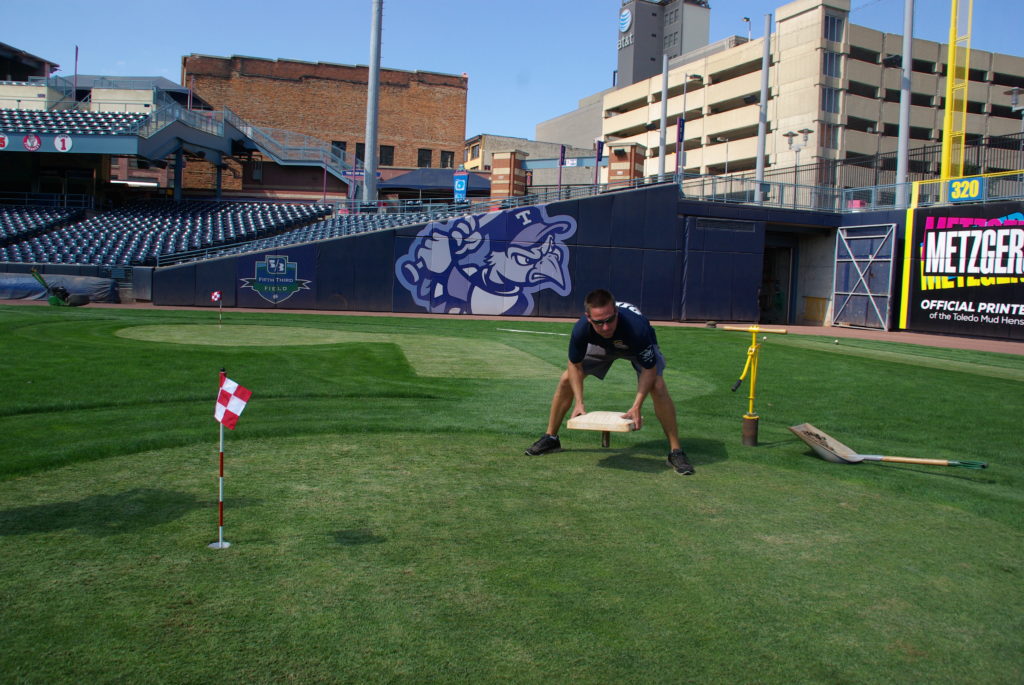
Sports Turf Manager Jake Tyler works on the minigolf course at Fifth Third Field. TOLEDO FREE PRESS PHOTO BY DON LEE

There’s been enough interest in golfing at Fifth Third Field that the Mud Hens have doubled down on a once-in-a-lifetime opportunity.

The Links at Fifth Third Field, the mini-golf course that will take over the outfield for three days this month, has gone from one 18-hole minicourse to two, said Sports Turf Manager Jake Tyler.

“We were running out of tee times,” Tyler said, laughing, as he and assistant Cory Myers put some finishing touches on the jigsaw puzzle of miniature golf greens in what is normally the Hens’ outfield.

The only downside? There’ll be no 17th hole ending on the pitcher’s mound, as originally planned. Tyler said he and his crew decided to have both courses play the same, and, of course, there’s only one pitcher’s mound.

It’s the first time a minor-league outfield has been turned into a miniature golf course, said Hens’ spokeswoman Andi Roman, and as far as she knows, the first time in any ballpark.

“The idea was all Jake’s,” she said.

“I always thought it would be fun to play golf out here,” Tyler said while lining up starter blocks — made out of baseballs — on one of the holes in left field.

The opportunity itself came out of left field when plans to turn the ball field into a hockey rink for this year’s Toledo Walleye Winterfest — together with plans already in place to renovate the field anyway — meant “there was about a month that we didn’t have to worry about the condition of the field,” Tyler said.

Work began the day after the last home game: Marking and mowing out the greens, letting the rest of the grass grow out a little, coming up with hazards and baseball-themed in-play features such as an arch made of bats, a base off which to bounce a shot into the cup (or try to, anyway) and a batting helmet through which the ball must go to reach the cup.

Normally, a ball field requires care through the winter to help make it ready for each spring. But a long weekend of minigolf fits in nicely with Tyler’s philosophy of keeping the fans connected with the field.

“Plus, it looks really neat,” he said.

Tee times are $15 per person and include a souvenir golf ball. Part of the proceeds support area charities, including Helping Hens Charitable Fund, the Epilepsy Center of Northwest Ohio, the Boys & Girls Club and Susan G. Komen for the Cure.

Tee times are available 6-10 p.m. Sept. 26; 10 a.m. to 3:30 p.m. and 6:30-10 p.m. Sept. 27; and 2-8 p.m. Sept. 28. Walk-ins will be accommodated when possible all weekend, including starting at 9 a.m. Sept. 28.

Sign up at mudhens.com or by calling (419) 725-4367.

Midwest Pre-Health Conference set for Oct. 25

0

The 2014 Midwest Pre-Health Conference is aimed at helping students prepare for professional and graduate level programs in medical, dental and pharmacy schools, said event assistant Jamila Hatcher.

“The goal of this event is to provide high school, community college and university students, parents and counselors with the information and skills necessary to succeed in the professional and graduate school admission process,” Hatcher told Toledo Free Press via email. “It provides a unique opportunity for direct contact with medical school deans of admission, admission officers, faculty and staff.”

The conference is 8 a.m. to 5 p.m. place Oct. 25 at Bowling Green State University’s Bowen-Thompson Student Union. Registration is free to all students and programs. To register or for more information, go to www.mwprehealth.com. Keynote speakers at the event include Dr. Louito C. Edje, program director at ProMedica Toledo Hospital’s Family Medicine, and Monik Jimenez, instructor in medicine at Harvard Medical School.

Common interests inspire Sylvania Avenue Neighbors

0
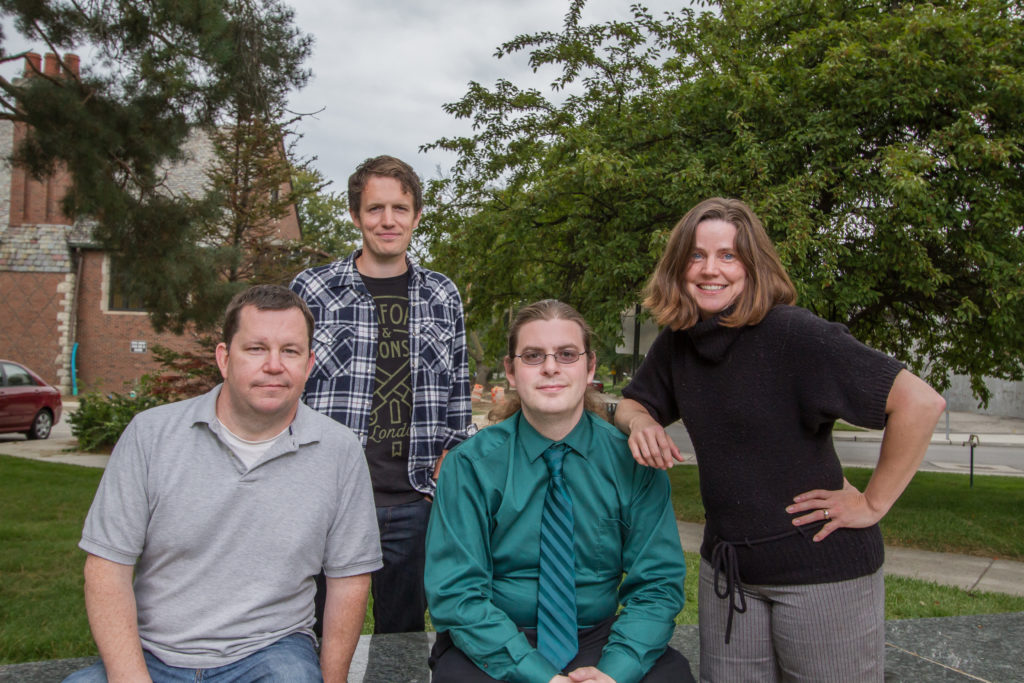
From left, Greg Lyons, Sam Melden, Sean Nestor and Jonie McIntire of Sylvania Avenue Neighbors.

It doesn’t take millionaires, big companies or even an act of government to create positive change in Toledo. Sometimes all it takes is an idea, a few neighbors and 100,000 poets.

Steeped in decades of ample tradition stretching from the old Jeep plant to Monroe Street and beyond, the Sylvania Avenue Neighbors were formed this past spring after a few friends talked about a simple idea: making a good neighborhood even better.

“It was exciting to meet more and more people who think the same thing,” said Greg Lyons, Sylvania Avenue Neighbors president. “We’re really doing it on our own. The only way we can move and rally people is to stop being negative, and do something positive and creative.”

This new organization is committed to engaging businesses, churches, schools and its residents all along Sylvania Avenue to work for the betterment of this expansive neighborhood.

One of many events the group plans to stage, “100 Thousand Poets for Change,” is part of an international grassroots educational effort focusing on the arts, especially poetry, music, and the literary arts. Slated for 2-7 p.m. Sept. 27, it will be held near the West Toledo Branch Library, a place many consider as the cornerstone of this proud neighborhood.

“Poets” events are being held worldwide that day, each one being encouraged to focus on issues that have local importance, combining social activism with poetry.

“That sounds very explosive, but if you have a local concern or issue, artists need to have a way about dealing with that local issue,” said event organizer Jonie McIntire. “This is sort of a way to get artists into a situation where they can be more active in their communities and that artists contribute in more ways than painting or poetry.”

This year will mark Toledo’s fourth “Poets” event, but its first in a neighborhood setting with a theme focused on the environment.

“This really fits in with the larger goal of Toledo, which is part of our theme this year,” McIntire said. “There is plenty to talk about there. We wanted to bring attention to the potential in Toledo. We want to go after those things and start fixing them.”

The Sylvania Avenue Neighbors recognize they have plenty of positive assets up and down their notable corridor: a beautiful library, venerable churches, classic restaurants, manufacturing and local homegrown businesses. They also tout its accessibility, and believe everything a resident needs is within walking distance.

“If you look at the arrangement of businesses along there, there’s so much potential,” said Sean Nestor, president of the Phoenix Earth Food Co-op and vice president of the Sylvania Avenue Neighbors. “We have a great street.”

Thankfully the group benefits from active business leaders mixed in with community members all focused on the same goal.

“We’re slowly building an identity based on what we already find prevalent in our neighborhood,” Nestor said. “The goal is to merge culture and local independent businesses and talk together collectively. I think there’s just so much to look forward to.”

Knowing that the arts is one of Toledo’s strengths, the association is also looking at other local entities – like LeSo Gallery on the East Side – and what they’re doing with art and culture. They’re admittedly influenced by other similar groups around Toledo.

They’re also finding support from Toledo City Council, and hope for increased dialogue regarding the future of Sylvania Avenue. The stretch is distinct in that it spans the domain of three City Council members.

The neighborhood remains every bit ethnic and blue collar through its innate ties to the old Jeep plant. Residents include numerous retired Jeep workers, and they’re proud of their identity. Many are also encouraged to see the former site being developed and reborn.

“I think it’s great that is happening,” Lyons said. “It’s good for the neighborhood and would be good to have something in close proximity that will supply jobs. There’s always so much stress on blight and jobs, and those things are important, but there’s more to life than that.”

The group also owes every bit of its beginnings to Sam Melden, a neighborhood resident who has taken the somewhat rare approach of simply getting to know his neighbors. In a busy world where people keep to themselves more and more, Melden said he realizes his method takes time, but it’s all in an effort to “create a sense of place.”

“You just have to start doing it,” he said. “My personal belief is that the neighborhood is one of the most underutilized assets in our world. Our culture has gone further and further away from it. Any momentum you want to create, you start in a neighborhood. You have to start with what’s already here and build around it.

“We talk all the time how we want to be on offense, not defense. We feel like often like there’s not enough conversation. There’s violence all over the place and blight, but then there are opportunities to create something rather than responding to the negative things. We believe in the concept of a neighbor.”

Melden previously served as Food for Thought’s chief thought officer, but recently was named executive director of the Center for Servant Leadership, located right on Sylvania Avenue. Thus, he now lives and works in the same neighborhood.

The Sylvania Avenue Neighbors trust in their work and insist it’s critical, as it can strengthen the city’s economy. Another factor it can strengthen – something more difficult to measure – is attitude.

“The way people talk about the city they live in reflects their outlook in life,” McIntire said. “There was all this negativity and I thought, we’re going to drown or we have to reach out and get out of this. I have to love where I live to remind myself that there’s hope everywhere.”

“It’s that sense of place that drives them. They don’t want to go somewhere else for it. They don’t want to buy it. They don’t want to say their neighborhood doesn’t have it.”

They simply want to create it.

“I want to be a part of creating a neighborhood that is inclusive, welcoming, honest and real,” Melden said. “There are struggles. I’m not interested in figuring out a way to gentrify a part of Toledo to make it more comfortable for any one group of people. I want it to be an honest expression of everyone and the neighborhood.”

For more information, visit saneighbors.org or “100 Thousand Poets for Change” on Facebook.

Frogtown Regatta showcases regional rowing

0

Each fall, Toledo’s Frogtown Regatta draws hundreds of rowers from across the region to the Maumee River.

Hosted by Toledo Rowing Club (TRC), the 29th annual event will feature high school, adult and corporate rowers from at least 12 clubs in Michigan, Ohio, Indiana and Illinois.

Toledo Rowing Club Executive Director Kristina Latta-Landefeld works with a group of middle school recreational rowers as part of a new program that started this fall. Toledo Free Press photo by Christie Materni

“One reason people like to come here from around the region is they really enjoy the cityscape,” said TRC Executive Director Kristina Latta-Landefeld. “It’s also pretty straight so you can get a really fast time.”

The regatta, which is set for 8 a.m. to 4 p.m. Sept. 27, will feature food trucks, rowing T-shirts from Jupmode and coffee and snacks from Black Kite Coffee. Some of The Docks restaurants will be open as well.

Most of the teams will be set up on the International Park side of the river, but races can be viewed from the Downtown side as well, said event organizer and TRC board member Mike Dibling.

“Toledo is really centrally located for a lot of rowing,” Dibling said. “It’s a once-a-year event that brings a lot of people from out of town, so it’s a good way to showcase the waterfront.”

New this year will be a corporate race, including a team from Owens Corning.

“We’re going to give teams close to 20 hours of coaching and they’ll be able to use our equipment and go out and race,” Latta-Landefeld said. “I look forward to expanding it next year.”

Corporate Development Associate Charles Smith will be part of Owens Corning’s team at Frogtown. Three weeks ago, he knew “not much — bordering on nothing” about rowing, but said it’s been fun to learn and he’s excited to experience Frogtown.

“Rowing is a lot more difficult than I imagined, mostly due to the coordination involved,” Smith said. “You really have to work with everyone else to be in sync. I’m excited to be out there. It’s cool being out on the water.”

The corporate race was inspired by Partners in Education’s popular annual  Dragon Boat Festival, Latta-Landefeld said.

“When you ask Toledoans what they know about rowing, they’re like, ‘Dragon Boats!’” she said.

But the Dragon Boat race is a paddling competition, which is different than rowing.

“Part of [Dragon Boats’] appeal is you can be pretty darn new and get right into it and start doing it right away,” Latta-Landefeld said. “The rowing shells, because they are so narrow and long, it’s much harder to do that. You have to build yourself up.

“But we’ve seen how people come together and get really excited about doing the Dragon Boats,” Latta-Landefeld said. “We want to get those folks who are involved once a year to continue to be involved on the water because they clearly love it.”

The regatta is a great way to showcase Toledo’s “treasure,” TRC board member Ed Conn said.

“There are a lot of folks who don’t make use of the river, who just cross it on their way to work,” Conn said. “We want to get people on the river and rowing, but in a broader sense, it’s an opportunity for us to get people to appreciate it and understand what an incredible asset we have.”

Expanding the reach of TRC has been one of Latta-Landefeld’s main goals since taking her role last year.

“Since I’ve come on, I’m seeing there’s a major gap in terms of who has access to the boathouse,” she said.

Rowing is often seen as an elite sport affiliated with private institutions.

“What I’ve been trying to do is change that image and get more people involved,” she said.

A middle school recreational rowing program started this fall. Maritime Academy, a charter school, is working on starting a team. Her dream is to get Toledo Public Schools involved as well.

Inspired by mentor Jim Reisig, Latta-Landefeld is also working on restarting an adaptive rowing program.

“He was in a wheelchair and one of the first international competitive rowers in the U.S., so there’s a strong history here [in Toledo]. But it’s just been stagnant,” Latta-Landefeld said. “We have all these adaptive boats but we haven’t had an adaptive program for a long time.”

Current high school teams include St. John’s Jesuit, St. Francis de Sales, St. Ursula Academy, Notre Dame Academy, Central Catholic and Anthony Wayne. Toledo Metropolitan Rowing Club (TMRC) is a high school team comprised of rowers from various schools. There is also a masters club for adults.

TRC individual memberships cost $55 for the fall season. Members have access to TRC boats and rowing machines.

Latta-Landefeld grew up in East Toledo and was introduced to rowing at St. Ursula. She rowed for Smith College in Massachusetts and coached at Steel City Rowing Club in Pittsburgh before returning to Toledo to work for TRC.

“I just fell in love with it,” she said. “It’s competitive. It tends to draw people who are Type A because you’re always chasing after that perfect stroke, or what’s called swing. It’s like getting in a runner’s high. All you can think about is that next stroke. It’s really cathartic.”

She won’t be at Frogtown because she’s being inducted into Smith’s athletic hall of fame with her  rowing teammates for an undefeated season.

“It’s not my accomplishment; it’s our accomplishment,”  Latta-Landefeld said. “That is a big piece of rowing and I don’t think you can say that about too many other sports. Even with other team sports, one person can say, ‘I got the winning goal.’ You can’t do that in rowing.”

Someday Latta-Landefeld hopes to add another boathouse to TRC.

“We’re maxed out here and we’re expanding. And that’s a really good problem to have,” she said. “I’d love to have canoes and kayaks for people to rent and bikes to use along the river. There is so much potential.”

TRC is also hosting the Maumee Bay River Festival noon to 6 p.m. Sept. 28 at International Park with a suggested donation of $5 to benefit Lake Erie Waterkeeper. The third annual event will feature chances to try rowing, canoeing, kayaking, racing boat expo, Sandpiper cruises, live music, tours of a U.S. Coast Guard boat, fishing derby, kids’ activities, regional beer, food vendors and more.

For more information, visit the website www.toledorowing.org.

Wines for Wishes to benefit Make-A-Wish

0

by Abigail Woods

On Sept. 26, Make-A-Wish Foundation of Ohio, Kentucky and Indiana will have its annual Wines for Wishes fundraiser event.

“This will be our 15th year holding this event,” said Callie Cannon of the Make-A-Wish Foundation. “It’s a great event that has helped us raise much needed funds to grant wishes to local children with life-threatening medical conditions.

“The last year we held this event was in 2012. We took a hiatus in 2013.”

The fundraiser will take place at a new location this year, Table Forty4 in Downtown Toledo.

“Table Forty4 has graciously donated their upstairs space to host the tasting event. The event is also being hosted by Treece Investment Advisory Corp., as well as the Make-A-Wish Young Professionals Advisory Council of Northwest Ohio. We are hoping to raise $8,000, which is the average cost of a wish,” Cannon said.

Wines from four regions will be available for tasting, provided by Heidelberg Distributing. Table Forty4 will provide hors d’oeuvres and Whitty Music will entertain guests all evening, she said.

Wines for Wishes is set for 7-10 p.m. Sept. 26. Tickets are $55 in advance and can be ordered by contacting Cannon at

[email protected] or (877) 206-9474.

UT annual event to celebrate banned books

0

By Russ Axon, Toledo Free Press Staff Writer

What do “The Diary of Anne Frank,” Dr. Seuss’ “The Lorax” and the Quran all have in common? All of them can be found on lists of frequently banned books.

Each of them will be celebrated, along with hundreds of other books, at the 17th Annual UT Banned Books Week Vigil from 9 a.m. to 5 p.m. Sept. 25.

The vigil will feature 12 censorship-themed presentations from community members. Paulette Kilmer, University of Toledo communications professor who heads the event committee, said she likes to give the presenters free rein.

“I’m only strict that they keep [their presentation] under 20 minutes because I don’t want it to feel like another lecture,” she said. “Otherwise, I encourage them to discuss what they’re passionate about.”

The free event is open to both students and the public. Attendees can also expect games, door prizes, food and music. Additionally, copies of commonly banned or challenged books will be given away throughout the day.

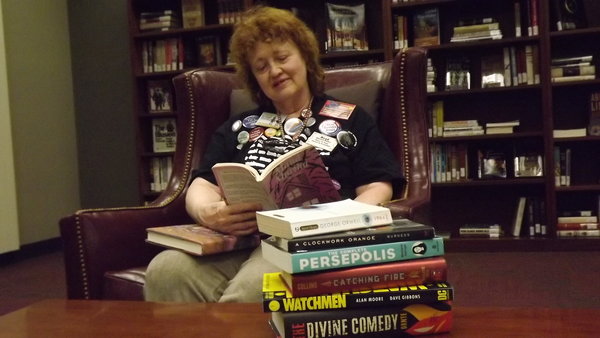
Paulette Kilmer of University of Toledo's Banned Books Week Virgil. Toledo Free Press Photo by Russ Axon

Paulette Kilmer of University of Toledo’s Banned Books Week Virgil. Toledo Free Press Photo by Russ Axon

The vigil will be held in the Carl Joseph Reading Room of the library, which is normally a quiet study area. Kilmer said it’s one of the few times the library is allowed to get noisy.

“One of our goals is to get in as many people as we can so that anyone walking outside can hear us,” she said.

Kilmer said the event is a collaborative effort, and the committee tries to make every year unique. The vigil has opened itself up to other mediums, like comic books, video games and films. Past events have included sit-ins, a Mark Twain impersonator, and viewings of select “South Park” and “The Simpsons” episodes.

“It’s very special because it’s a unique formula,” Kilmer said. “It combines the fellowship of meeting with the intellectual benefits of listening.”

Almost every department and school at UT, as well as multiple local businesses and community members, have donated either funds or door prizes this year. With all the funds, Kilmer said, she was able to purchase about $1,500 worth of banned books.

“We have more support this year than we have ever gotten,” she said. “We can make it a better event, and we can make it so that when people come over here they really have fun.”

The vigil is part of the American Library Association’s Banned Books Week, an annual campaign meant to bring awareness to censorship throughout the world and celebrate reading.

“I consider this, as much as anything, a holiday for reading,” Kilmer said. “It’s one time in our busy schedules where we can stop to reflect on what a wonderful gift reading is for all of us.”

Kilmer remembers attending the first vigil when it was held at Thackeray’s Books, a now-closed local bookstore. Originally, it was a 24-hour event where volunteers would read selections from banned or challenged books.

“It was really fun. My students and I, we took the graveyard shift, and then we’d go to breakfast afterwards,” she said.

Kilmer helped move the vigil to UT in 2000 and fought to keep it alive.

“It was four or five years that we really struggled,” she said. “Now we’re here with the library, which is where we belong.”

The vigil is very important to Kilmer, who was instilled with a love for reading as a child.

“My mother read books with me and my brother, and then we’d sit on the front porch and talk about the book while we drank lemonade,” Kilmer recalled. “That was one of the best gifts my mom gave me.”

Kilmer hopes everyone who attends the vigil has a great time and takes away a little knowledge.

“I hope they leave thinking about how incredibly fortunate we are to live in a country where we have the right to read and nobody has the right to tell us what we’re going to read,” she said. “The right to read is the right to think freely.”

The Banned Books Week Vigil is on the fifth floor of Carlson Library at UT’s Main Campus, 2801 W. Bancroft St. For more information, visit www.facebook.com/UTBannedBooks.

Toledo Free Press is a sponsor of the vigil and Managing Editor Sarah Ottney is one of the event speakers.

Miller: Life after Peggy

0

EDITOR’S NOTE: Peggy Zachel died last week.

I was beginning to think no one would ever type those words; she lived so long and so fiercely that I was beginning to believe she would outlive us all.

This unworthy portrait of her was published in October 2008; nothing about her changed to the very end. I offer these words again because I am unable to process any better ones.

Peggy Zachel grabbed the steering wheel from my hands the first time I met her and she’s never really given it back.

In July 2003, I was assigned an Adrian story that took me to Zachel’s property in Seneca Township, near Morenci, Michigan. Peggy, who was about to turn 85, had dedicated several years to restoring a one-room schoolhouse that stood on the farm she and her husband John cultivated.

.

.

I met Peggy at her house, and she slowly climbed into my car for the short drive to the schoolhouse. As we came upon a place where the path split, she tried to guide me the correct way, but I wasn’t catching on.

Suddenly, the octogenarian reached across the seat, smacked my hands off the steering wheel and began directing the car. Surprised by her speed and strength, I did not question her authority.

“Turn right! Right! I need you to be on that path,” she said, exasperated.

I worked the brakes and gas while she steered the rest of the way.

“I’ve been in the country all my life,” she admonished. “You city people just don’t do things like we do.”

Looking back at my Daily Telegram description of Peggy, I can see that my admiration and slight intimidation of her mingled from the very beginning: “Zachel’s hair and face bear the strain of squeezing each drop of life out of every day for more than eight decades. But her eyes are focused and clear, reflecting her state of mind. In blue canvas sneakers and a red cotton dress embroidered with flowers, she looks like a Norman Rockwell grandma. But she does not suffer fools lightly — or, more accurately, at all.

“Zachel climbs the concrete stairs with the concentration of a wizened Sherpa navigating Everest. A knobby, polished-wood walking stick supports her. As she opens the door of the one-room schoolhouse, the brick seems to soften and embrace her presence.”

I spent a few hours with Peggy that day, watching her soften as she walked me through the schoolhouse, which had been painstakingly restored with the help of neighbor Jack Sampson. Walking into the schoolhouse was a time-machine experience. From the late-1800s textbooks to the framed portraits of George Washington and Abraham Lincoln, the schoolhouse stood as a transporting pocket of rural America.

But as fascinating as the restoration was, it faded as I learned more about Peggy. Everything about her emanates a stability and grace rarely seen in modern people. Peggy pioneered speech therapy in the 1940s, establishing a program in Lenawee County. She and John are approaching 60 years of marriage, and their children include Alaskan adventurers Robert and Cortland and published author Gretchen.

As our tour of the schoolhouse ended, Peggy sat down for a rest on the bench of a player piano. With a little prompting, she placed a scroll in the ancient music maker and started pumping the pedals, raising a fine ruckus.

After the lengthy article was published, Peggy and I stayed in touch, and I wrote small articles as the schoolhouse neared completion. The restoration of the bell was the last major touch, and by the time Peggy rang it for the first time, more than a year had passed and I considered her to be a great resource of wisdom and guidance.

There are people in life who see things more clearly than the average person, people who have insight and sense on superhuman levels. I do not mean to turn Peggy into a caricature by invoking fictional wizards like Gandalf and Kenobi, but Peggy stands in my mind as hyper-real, someone of supernatural talent and presence.

My wife and I made several trips to the Zachel farm, to watch John herd turkeys and to share meals that consisted only of things he and Peggy grew on the farm. On one visit, as the adults talked, we opened a package of dried apple pieces to feed Evan. The snack is 100 percent apple, nothing artificial, and the package makes for easy transportation.

Without saying a word, Peggy went to her kitchen and cut up a farm-grown apple, giving Evan small slices, which he devoured.

“Nothing like the real thing,” she said, and we haven’t bought dried apples since.

Neither of my sons will know their paternal grandmother, who died more than 10 years ago. I know it is unlikely they will have decades to spend around Peggy. But if they can soak in just a few atoms of her spirit, that wise, determined, steady and no-nonsense soul, they will be better men, as I am a better man for knowing her.

A decade into our relationship, I see no need to ask Peggy Zachel to relinquish the wheel; I trust that wherever she drives us will be a good place, a safe place, and all I have to do watch, listen and learn.

Michael S. Miller is editor in chief of Toledo Free Press. Contact him at [email protected].

Residents, city give Junction neighborhood some elbow grease

0

Residents in Toledo’s Junction neighborhood decided they were going to do something. They weren’t going to stand by while people dumped trash in their vacant lots, renters grew their grass knee-high and kids walked over cracked pavement and broken glass to school.

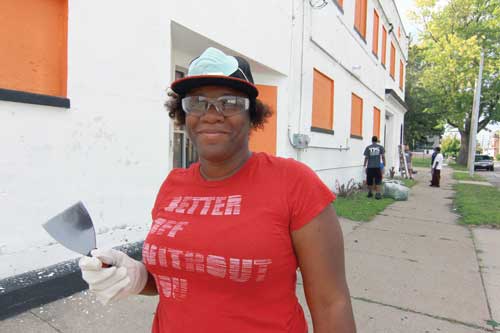
Alicia Smith is a community organizer who leads the Junction Avenue Project. Toledo Free Press photo by Kim Sanchez

Alicia Smith is a community organizer who leads the Junction Avenue Project. Toledo Free Press photo by Kim Sanchez

So they started meeting on porches. They put their heads together and tried to come up with a plan of attack. A community organizer out of Cleveland got wind of their efforts and came over to help.

Then they turned to the City of Toledo’s Department of Neighborhoods and the movement took off. The city brought in lawn mowers, and about 15 young people mowed down the tall grass. That was in 2010, and organizer Alicia Smith hasn’t looked back.

“It’s about the community; it’s about the youth,” Smith said in regard to her continual push for progress.

She calls their efforts simply the Junction Avenue Project, and it involves many different people from city departments to nonprofit programs to the average citizen. Everybody gives a little bit of elbow grease to revitalize the neighborhood and turn it into a place people want to live.

At a recent neighborhood meeting, which happen every third Monday at the Frederick Douglass Community Association, the Lucas County Land Bank, the Toledo Metropolitan Area Council of Governments (TMACOG), Toledo City Council and the Toledo Police Department (TPD) all showed up, not just to give face time, but to actively participate in the improvement of the neighborhood.

The Lucas County Land Bank is working with Smith to funnel money toward removing abandoned homes.

So far, 100 houses have been razed since about 2012.

Kari Gerwin of TMACOG is working with the neighborhood to increase green space while making more efficient use of storm sewers to combat sewage overflows and flooding.

Smith and others are conducting an early voter registration drive supported by the city in which dozens of people have signed up to vote, and they have a new newsletter to get the word out called “Function in the Junction.”

The neighbors

Oscar Hill has lived in the Junction neighborhood for 22 years and has been coming to the neighborhood meetings for the past eight.

The biggest problem living in the Junction neighborhood, he said, are transient renters who come in for months and leave before Hill and others have any clue as to who they are. By that time, they’ve let their grass grow wild or they’ve dumped trash.

The goal, he says, is to instill in the people who are “on the move” more pride in their properties and one way to do that is to lead by example.

“Getting people to buy into the pride issue of where they live and being able to sustain it,” that’s the problem, he said. “We need to stay unified to really get results.”

Harvey Savage, executive director of the MLK Kitchen for the Poor at 650 Vance St., worked with Soul City Boxing Club over the summer to keep neighborhood kids out of trouble.

Savage said the second Saturday of every month is “Dump Day” in the neighborhood to help residents clean up their homes and streets. He agreed with Hill that the biggest problem in the neighborhood is the lack of ownership. He said residents need to step up and take responsibility.

“The city can’t take care of all the gray spots,” he said. “Citizens need to be a part of that.”

Several residents were upset over ongoing illegal dumping. One man said culprits bring a different couch practically every night to one location at Belmont and Detroit avenues.

“We’ve got rats big enough to wear a field pack. You’d think they’re in the Army,” said one irate resident.

City presence

Paula Hicks-Hudson, president of Toledo City Council, said what the neighborhood needs is enforcement.

“We need more of us to call the mayor’s office,” she told the group assembled Aug. 18. “I share your frustrations.”

As for abandoned houses, Hicks-Hudson said there’s no money in the city’s demolition fund. The money is all in the Lucas County Land Bank fund.

“I’m hoping when we do the budget we’ll put money into demolition,” she said.

The Junction neighborhood is in Hicks-Hudson’s City Council district. She said during a telephone interview days after the meeting that she fully supports what the residents are trying to do.

“I’m there as a district Council-person to support them, as a citizen and a representative of them because that’s my district,” she said. “They elected me, therefore I represent them and I want to help in the success of their endeavors.

“That’s what residents should be doing, is taking leadership and self-determination as to how the neighborhood should be and what it should look like. I see my role as someone to help them achieve those decisions.”

Hicks-Hudson coordinates information about city resources and brings in city departments to the meetings to discuss solutions. Their issues have evolved from focusing on violence and police response times to illegal dumping, tall grass and rodents.

Hicks-Hudson is concerned about the lack of public transportation and jobs, the dumping that continues to plague the neighborhood and the dearth of public resources to combat vacant homes.

“Sociologists talk about the broken window,” Hicks-Hudson said. “If you allow it to stay broken and don’t fix it, it will [encourage] more disrepair and many of the residents are feeling it’s regressed to the point that their issues are not being addressed or heard. We’ve got these problems, but what is our response to them? They are banding together and becoming a powerful voice that speaks, and making these determinations of what is the No. 1 issue.”

Toledo Police

The TPD has a strong presence in the neighborhood via community policing officer Kimberly Darrington.

Darrington has been literally sifting through trash to look for objects that will help identify those who dump garbage. She called the city three times about a single location, hoping to land some prosecutions.

“I go out and see the dumping and call the city and get frustrated when I see more dumped. I hate it so much I go out there into the trash,” Darrington said. “We (the police) get frustrated. We want to be there. We want to catch people.”

In one case, she was able to catch the culprits when a neighbor who witnessed the dumping agreed to testify in court.

Smith said residents are told to take note of license plate numbers but not pursue when they see illegal dumping.

Darrington will soon move to a different district. She will be replaced by a new community officer for the Junction neighborhood, Officer Jim Below.

Days of Caring

“Dump Day” is by far the largest self-directed event in the Junction neighborhood but the largest sponsored event is the “Days of Caring” by United Way of Greater Toledo, which focuses on youth development and enrichment, Smith said.

On Sept. 12, nearly 2,000 volunteers participated in several painting, cleaning and landscaping projects meant to spruce up areas, including painting a mural at the Soul City Boxing Club, erecting a welcome sign and weeding, mulching and painting a barrier walkway at the Frederick Douglass Community Association.

United Way also partnered with Live Well through the YMCA and other partners to create safe walkways to school, including creating street islands and installing crosswalks.

To become involved in the Junction Avenue Project, call Smith at 419-215-9243, email [email protected] or send a letter to the Frederick Douglass Community Association, 1001 Indiana Ave., Toledo, OH, 43607.