Home Blog Page 183

Changes ‘re-energizing’ Collingwood Arts Center

0

It’s been a year of growing pains for the Collingwood Arts Center (CAC) — with a long way yet to go — but the nonprofit’s leadership believes it’s headed in the right direction.

Collingwood Arts Center interim Executive Director Sarah Kurfis, left, and Special Events Coordinator Lexi Staples who will take over take over as Executive Director Oct. 1. Toledo Free Press photo and cover photo by by Christie Materni.

Since taking the helm last August, Interim Executive Director Sarah Kurfis has shepherded CAC through a period of transition, most notably from an artist residency program to a more community-focused arts center.

“We’re in the process right now of figuring out what we’re going to be when we grow up,” Kurfis said. “There’s still a lot of work to do, but we’ve come pretty far. People are getting re-energized. We have a lot of new energy and artists and people helping out at the building.”

Now, she says, it’s time to pass the job to someone new. Lexi Staples will take over as executive director Oct. 1.

Staples, who has served as CAC’s special events coordinator and office manager since March, has worked closely with Kurfis to organize dozens of events at the site, including a series of ghost hunts, two food truck festivals, monthly community art days and more. She is founder and executive director of Pride of Toledo Foundation and event director for Toledo Pride. She previously owned OUTSKiRTS, a bar that closed earlier this year.

“I’m excited to continue what Sarah started,” Staples said. “It’s been cool to see just how much the community does want to be involved with the space and with the idea there could be a different use for the building. It’s been really fun to watch people start to change their minds about the building and be more supportive of futuristic plans.”

Kurfis, an attorney, will transition to a job in Washington, D.C., with the Federal Labor Relations Authority, but will remain available to Staples to answer questions and help ease the transition.

“We’re stabilizing and Lexi is the perfect person to carry out this new vision,” Kurfis said. “We found an avenue and a niche the Collingwood can be successful at and developed a strategic plan that can help it get somewhere great and have an impact on our community. I turned the ship slightly and now I’m stepping out of the way to let the most capable people do it.”

CAC also recently hired former board treasurer Colleen Eldridge as office manager.

Kurfis said she is proud of the work she did at CAC, even her controversial decision to end the building’s longtime artist residency program in January. Faced with building conditions that included no heat or hot water, residents were given 30 days to move out.

“My original recommendation was a six-month transition, but then everything basically went to hell in a week,” Kurfis said. “It was the weather that made the decision to move quicker, but it was still the right decision to make. It just wasn’t safe.”

Kurfis worked with Children’s Theater Workshop and Community Shares of Northwest Ohio, both based at CAC, before taking the interim executive director position.

“When I graduated law school, two (CAC) board members asked if I would be willing to step in and get it on a better path,” Kurfis said. “I said yes because I’ve always loved it. It has such great potential and it’s such a great building. It just needed to be pointed in the right direction. So that’s been my goal for the past year.”

Kurfis spent her first few months getting acclimated and studying the nonprofit’s structure, and concluded the resident program wasn’t working.

“It was a great idea; it just didn’t work,” Kurfis said. “I spent lots of time managing resident issues. It was basically a dorm, with everyone so close and sharing things. It was a dysfunctional mess.

“I had said I’d come in, basically with a consultant mindset, and help make decisions and figure out how we can do this,” Kurfis said. “I came to the conclusion that this isn’t working at all and I think we could make it better, but it might go under.”

The center’s financial standing is still shaky.

“We’re in a lot better position than we were even a year ago or a few months ago, but we’re still digging ourselves out of a hole caused by mismanagement,” she said.

Kurfis said some past board members bristle at the term “mismanagement,” but that’s the best way she can describe it. Staples will be CAC’s seventh executive director in five years. Several previous directors have died since stepping down. One died in the position.

“Whoever was keeping the books didn’t know what they were doing. I’m still discovering bills we owe and I’ve been here for a year. We are still digging out. It’s a mess,” Kurfis said.

“I figured out the financials I need to move forward, but I haven’t gone back and done forensics as far as finding exactly where and how it derailed, but there’s clearly signs of gross negligence.

“There’s nothing you can point to and say, ‘That was the specific problem,’” Kurfis said. “It was just a bunch of bad decisions. My guess is a combination of negligent management, unreliable contractors, probably some theft somewhere.”

CAC lost its 501(c)3 nonprofit designation for about a year and a half, although Kurfis is quick to note donations remained tax deductible since reinstatement was pending. It’s designation was restored this summer.

“We do have a complicated history,” Staples said. “It’s really frustrating to not be able to fix all the past mistakes. But we need to go forward on a clean slate.”

The beginning

Finished in 1905, the CAC is a registered historical site designed by prominent Toledo architect E.O. Fallis as a convent for the Ursuline Order of the Sacred Heart. It later housed Mary Manse College and St. Ursula Academy.

It was Pat Tansey’s idea to turn it into a community art center.

“The nuns told me in 1983 that they were going to move out of the building and they didn’t know what would happen to it. That’s when I came into the picture,” Tansey said. “In October 1984, they walked away from the building and gave me the keys and I walked in. In the early years I was pretty much alone trying to make things work here.”

With the end of the artist residency program, CAC lost its main source of funding, which now comes from studio rentals, event space rentals and proceeds from events, Kurfis said. All current funds are tied into basic operating costs, but the hope is to eventually shift to capital improvements.

Future needs will include a new roof, electrical upgrades, plumbing upgrades and more, Kurfis said.

“We’ve been chasing crises and plugging little holes and can’t get ahead of the big stuff yet,” she said. “Cleaning up after the residents has taken us a lot longer than we originally anticipated. It was one of those things where the culture had probably eroded over time and the building was not being treated respectfully. We’re still throwing out garbage every week that’s accumulated over years.”

A boiler donated by the local chapter of the National Electrical Contractors should help prevent heating situations like the one that led to the end of the residency program, Tansey said.

“We have a working bicycle, but we have training wheels and we’d like to take them off at some point,” Staples said.

New mission

CAC’s new mission statement is “to provide an outlet for creative community involvement while preserving a historic space.” Its new tagline is Creating Community Through Art.

Over the past few months, Kurfis, Staples and a host of volunteers have added fresh coats of paint and started landscaping projects. About 20 artists and organizations rent studio space in the building. Meeting rooms and event rentals are also available.

“The community didn’t know this building was worth saving because they hadn’t seen it and we weren’t doing anything to give back. There was no reason for outside people to support us,” Kurfis said. “I’m really excited about the progress.”

Restoration

Pam Pullella of Sylvania Township and her husband John volunteer regularly at CAC.

“It’s a beautiful building, but it hasn’t gotten the love and attention it needed over the years,” Pullella  said. “I would love to see it brought back to its original grandeur, to let it shine how it did, to become a magnet for the arts. It’s really great how [Kurfis and Staples] are trying to make it a community space and get people more involved.”

Many groups that rent studio space at CAC are also happy with the new direction.

Barry Aslinger started the T-Town Tassels burlesque troupe at CAC earlier this year. He and his partner are the only former residents still living at CAC. Aslinger stayed on doing maintenance work at the building, which he calls a “jewel” of Toledo.

“More has been done now since Lexi and Sarah have been in place than I’ve seen since I moved in,” Aslinger said. “It’s brighter, it’s cleaner, the energy that flows through the building is more welcoming. The whole vibe has changed and a lot of people are supporting the fact that it’s moving forward so progressively.”

The changes have been good for business, said Erin Garber-Pearson, who founded Bird’s Eye View Circus Space at CAC in 2011.

“The building is on the mend,” Garber-Pearson said. “The visual upkeep of the space has definitely changed and that’s really huge for me running a professional business there.

“It was a hard situation (with the former residents). It’s someone’s home but it’s also my business and my business has needs different from the needs of a living space. For me, I like having it as more of a professional organization now.

“If folks want to see the building prosper, grow and continue to evolve and be the center the community needs, it’s a good time to take some of the personal needs out of that and look at the larger picture, which I think Lexi and Sarah have both done.

“They are both really invested in the community and have the drive needed to make connections with other parts of the community, not just artists. We are really broadening the scope into a community center that’s related to the arts, but also services the community in ways not currently offered.”

Performing arts, in particular, have “really blossomed” at CAC, she said

“There have been more shows here in the last six months than in the past three years I’ve been here combined,” Garber-Pearson said. “It’s just been incredibly busy here, which is really exciting.”

Upcoming events

Upcoming events at CAC include:

  • Hardcore Crafters, 7:30-10 p.m. Oct. 2, featuring craft beer and two crafts: a pendant out of poker chips and a concrete coaster. Cost is $19 per person or $30 for two people.
  • Ghost hunting lecture, 8 p.m. Oct. 3, presented by local paranormal investigator Chris Bores, featuring tips for novice ghost hunters and a 15-minute audio recording of a conversation with a ghost. Cost is $5 and attendees will get a coupon for $5 off one of  CAC’s October ghost hunts. An optional ghost hunt will take place after the lecture from 10 p.m. to 2 a.m. Cost is $35.
  • Ghost hunts led by Bores, 8 p.m. to 2 a.m. Oct. 4, 11, 12, 17, 18, 24 and 25. Following an hour-long tour of CAC, attendees are released to explore. Cost is $35. If available, tickets at the door are $45. Event is open to ages 18 and older.
  • 6-9 p.m. Oct 22: Spooky Family Fun Night, featuring art projects and trick or treating inside CAC.
  • Oct. 31: T-Town Tassels burlesque show.
  • 6-10 p.m. Nov. 6: The Art of Craft, featuring craft beers from four breweries and two musical acts. Cost is $30 per person or $50 for two people.
  • November: Bird’s Eye View Circus Space performance.
  • February: Bird’s Eye View retelling of the Russian fairy tale “Baba Yaga” using circus acts.

“I’m just really excited about the Collingwood’s future,” Kurfis said. “It’s still going to be hard for a while, but I think it’s going to be awesome.”

For more information, visit the website collingwoodartscenter.org.

Retirement Guys: Retirement health care can be costly

0

If you are retired, you probably already know that health care costs can put a big dent in your budget. If you are not retired, you may still be in the dark about what the costs will actually end up being.

Wait a minute. At age 65 everyone is required to enroll in Medicare, which is a free benefit in retirement, right? Wrong! At 65, most people do enroll in Medicare (unless they are still working and covered by an employer plan), but unfortunately it is not free. We will get to how much Medicare costs in a bit, but let’s first get an idea of how much health care might cost in retirement.

.

.

According to a Kaiser Family Foundation analysis of the CMS Medicare Current Beneficiary Survey Cost and Use File in 2006, people age 65-74 will spend, on average, about $3,500 per year on a combination of insurance premiums and services. As you get older it may be more likely you will need health care and therefore likely that you will spend more money to get it. In the same analysis, people age 75-84 may spend $4,664 per year  and those 85 and older approximately $7,487.

Beware if you’re married because this is per person. Depending on how much money you have saved and how well you have planned your budget in retirement, this chunk of change can cause financial stress. That is the last thing we want in retirement. We all would like a happy and relaxing retirement. The point here is to spend some time and get familiar with what to expect in retirement health care costs and how you will pay for them.

Some people may not be aware that Medicare is not free. Part of the insurance premiums included above, Medicare Part B (doctors’ services, tests, etc.), is currently $104.90 per month. This amount is typically deducted from your Social Security check. In addition to this premium Medicare Part A (hospital services) currently has a deductible of $1,216 per spell of illness.

Part B also has an annual deductible of $147. Then there is the cost of prescription drugs. There is a $310 per year deductible that many drug plans may cover, but you do have to pay for the Part D drug plan itself. This can vary in cost depending on how may drugs you take and what they are.

Then there is this thing called the doughnut hole. Doughnut hole? I am getting hungry now thinking about the old commercial with the guy waking up and saying over and over “Time to make the doughnuts.” Sorry, I have a tendency to digress with random thoughts.

Once your drug costs have reached $2,850, there is a coverage gap (“doughnut hole”) that requires the beneficiary to pay the entire costs of medications. Catastrophic coverage then starts when total drug costs have reached $4,550. Confusing, huh? Wow. We have not even gotten to the fact that Medicare will only pay for up to 60 days of hospitalization before you must pay more money and 80 percent of Part B. This means you are exposed to the other 20 percent, whatever that may be. What to do?

Here are some important tips:

1. If you do not enroll in Medicare on time, you will pay a monthly penalty.

2. If you do not get the right private insurance to go with Medicare, you may pay too much in premiums or out-of-pocket costs.

3. If you do not plan for higher health care costs in retirement, you could run out of money or not be able to get the care you need.

All this stuff can be very confusing and overwhelming. The main point is to start educating yourself as to what your costs may be so you are better prepared to pay them. Find an adviser who can be helpful with information on what to look for.

The Retirement Guys would be glad to send you a copy of The Baby Boomer’s Guide to Medicare Planning. Just go to www.retirementguysnetwork.com and request a copy, or call us at (419) 885-0550 and we will send it to you. As always we wish you a happy and relaxing retirement.


For more information about The Retirement Guys, tune in every Saturday at 1 p.m. on Newsradio 1370 WSPD or visit www.retirementguysradio.com. Securities and Investment Advisory Services are offered through NEXT Financial Group Inc., Member FINRA / SIPC. NEXT Financial Group, Inc. does not provide tax or legal advice. The Retirement Guys are not an affiliate of NEXT Financial Group. The office is at 1700 Woodlands Drive, Suite 100, Maumee, OH 43537. (419) 842-0550.

Industry, retailers commit to cleaner water standards

0

Those responsible for much of the fertilizer sprayed on crop fields in Ohio, Michigan and Indiana are not farmers, but rather the farmers’ crop advisers and agricultural retailers.

“There might be 100 farmers with one crop adviser. If we work with that one crop adviser so they are making the best recommendations, we have reached 100 farmers. It gets more nutrition management on the ground (and)  we implement the 4R’s  a lot faster.” — Carrie Vollmer-Sanders

“There might be 100 farmers with one crop adviser. If we work with that one crop adviser so they are making the best recommendations, we have reached 100 farmers. It gets more nutrition management on the ground (and) we implement the 4R’s a lot faster.”

— Carrie Vollmer-Sanders

The Nature Conservancy and the Ohio Agribusiness Association have developed a program in which crop advisers and retailers — those companies that sell fertilizer to farmers and also apply it — can undergo voluntary certification in an effort to prevent chemical runoff from fields.

After a rainfall, the runoff from fertilized fields is laden with nutrients. The nutrients flow into tributaries, rivers and into Ohio’s biggest natural resource, Lake Erie. Among the nutrients is phosphorous, which is the main culprit in forming the toxic algae blooms responsible for a shutdown of Toledo’s water supply in August.

The 4R Nutrient Stewardship Certification Program is a voluntary certification process in which companies undergo an audit and must demonstrate they are applying fertilizer in a responsible manner.

The program shows the agricultural industry’s commitment to clean water, said Chris Henney, president and CEO of Ohio Agribusiness Association, a trade group that manages the program.

“We’re very proud of our work on this and we think it’s very important we all do our part. I think our program is one way to show we’re committed to being part of the solution,” Henney said. “These companies want to show they’re committed and that they are very supportive of this program.”

In March, crop advisers and retailers began the process of certification. Currently, 50 companies are being audited, although Henney declined to name any of them. He did say their response to the program has been overwhelmingly positive. The companies are primarily from Northwest Ohio in the Western Lake Erie watershed. A few are outside the watershed or from Michigan and Indiana.

Program managers are expected to announce the first company to earn its certification in October, Henney said.

The 4R Nutrient Stewardship Certification Program ensures companies are proficient in the best practices and the best science behind applying fertilizer, or what’s called the four R’s, or 4R’s: “Using the right source of fertilizer, at the right rate, at the right time, in the right place.”

Agricultural businesses, farmers, researchers, university faculty and environmental groups like The Nature Conservancy helped to develop the concept of 4R nutrient stewardship years ago, Henney said, adding that farmers have known for a long time that good management practices are required to sustain their fields.

“Many companies have been doing [the 4Rs] for many years but now we’re requiring them to prove it,” Henney said.

The 4R practice helps to keep fertilizer on the crops where it belongs, and out of the water supply. As part of the program criteria, companies are not allowed to apply fertilizer on frozen ground or apply before a heavy rainfall.

The watershed is 7 million acres; fewer than 5 million is farmland.

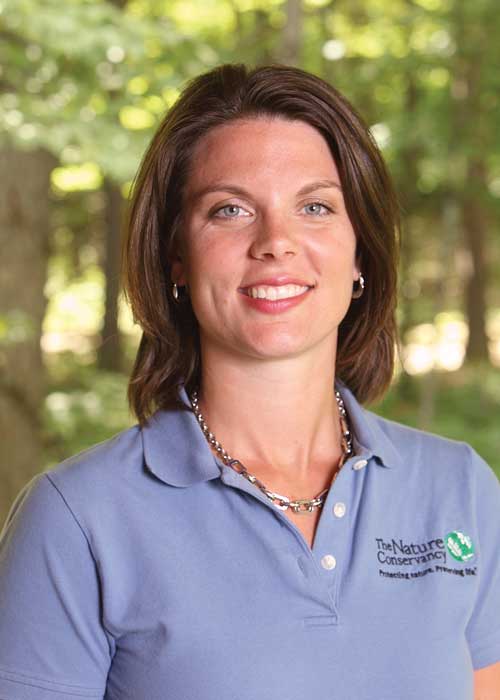
Because of the criteria, the program will have a “positive impact” on Lake Erie as well as in streams and tributaries, said Carrie Vollmer-Sanders of The Nature Conservancy, who  was honored by President Barack Obama as part of the “Champions of Change” initiative for her work with the 4R Stewardship Certification Program.

“There might be 100 farmers with one crop adviser. If we work with that one crop adviser so they are making the best recommendations, we have reached 100 farmers,” she said. “It gets more nutrition management on the ground (and) we implement the 4R’s a lot faster.”

Each adviser or retailer within the program represents about 40,000 acres on the watershed, she said.

“Twenty percent of the watershed could be under the 4R entity in a year, which is huge,” she said.

Joe Cornely, spokesman for the Ohio Farm Bureau Federation, an organization that represents 60,000 farmers, 85 percent of them in Ohio, said the feedback he’s been getting is positive. Farmers are glad to have their advisers and retailers commit to clean water, he said.

The campaign for clean water goes back years, Cornely said. As an example, his organization hired a water quality expert 15 years ago and today they have plans to hire another. The farming industry is not alone, he said. The marina owners, the charter boat captains, the beverage industry — all those who have a quality-of-life dependency on the lake are following the water issues. The water crisis in Toledo raised overall awareness of the issues, he said.

Farmers are now required by Senate Bill 150 to become state certified in the application of fertilizer by 2017. Cornely said the bill is a “good thing” but it’s only “one thing.”

“We don’t make the claim that that’s the only thing that needs to be done,” he said. “This is a very broad, complex problem. There are no individual steps that work — it’s going to take a lot.”

Maumee River busy with new project, freighter action

0
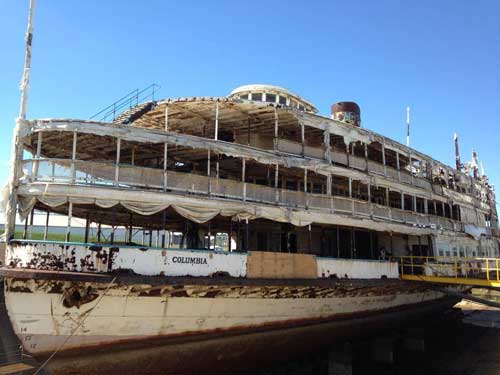
Columbia in the small drydock at Ironhead Shipyard, Toledo, with the smokestack of the freighter Manistee visible behind her where Manistee is moored along the river wall. Photo by Don Lee

A busy week along the Maumee River saw one long-term project begin, one freighter become legally idled and another return to service after two years of idleness.

Sept. 17 saw the arrival of the former Bob-Lo ferry Columbia at the small drydock at Ironhead Shipyard, and the sailing of the lake freighter Adam E. Cornelius for the first time in more than two years.


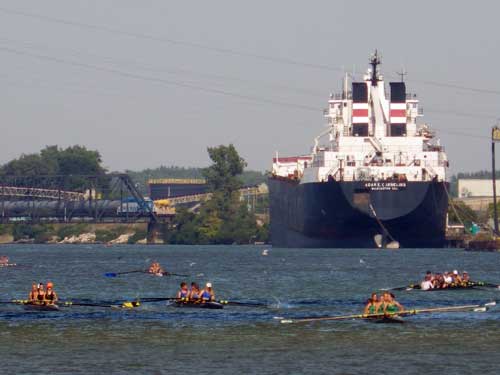
Cornelius with the rowers, photographed Sept. 28, 2013. Toledo Free Press photo by Don Lee

Cornelius with the rowers, photographed Sept. 28, 2013. Toledo Free Press photo by Don Lee

Historic ferry

Columbia, towed by the tugs Manitou and Captain Keith, is the oldest surviving passenger steamer on the Great Lakes, and was used to ferry people from Detroit to the former amusement park on Boblo Island for many years. The five-deck steamer is at the center of a nonprofit project to refurbish her and return her to service, this time as a cruise boat on the Hudson River in New York.

Ironhead’s part of the project is to inspect the boat and make sure she is in good enough shape to tow to New York, which is expected to take place by next August, according to The Detroit Free Press.

Columbia, built in 1902 in Wyandotte, Michigan, was designed to carry more than 3,000 passengers on five decks, and included mahogany staircases and an open-air ballroom, a unique feature allowed for by a new framing system designed by marine architect Frank Kirby.

Columbia last sailed for Boblo Island in 1991; by then, competition from Cedar Point had become too much for the amusement park.

Columbia’s sister ship, Ste. Claire, briefly spent time in Toledo several years ago, with an eye toward restoration. Ste. Claire, also designed by Kirby, was built in Toledo but returned to her berth alongside Columbia in Ecorse, Michigan.

Both boats were given a cosmetic restoration for the filming of “Transformers: Age of Extinction.”

Return to service

Another Toledo-built boat of more modern heritage sailed last week for the first time in more than two years.

American Steamship Co.’s lake freighter Adam E. Cornelius, idled just downriver from Ironhead, sailed Sept. 17. A reviving economy has created enough demand for iron ore and associated cargoes that Cornelius was needed.

Cornelius had been tied up since January 2012 at a piece of riverfront property along Front Street, owned by the shipping line.

Cornelius, a 680-foot, self-unloading bulk freighter, was built in Toledo and launched in 1973 as the Roger M. Kyes, the name she had until 1989. She is the largest ship to have been built in Toledo, and at the time of her launch was the first new vessel to have been built at the Toledo shipyard since 1959, according to the Great Lakes site boatnerd.com

The ship’s return to service has kept her busy operating between Lake Superior ports and, as of Sept. 24, a week since she sailed, she was in Lake Huron.

Under arrest

Unpaid bills totaling $900,000 are still keeping an oceangoing freighter tied up at the Midwest Overseas Terminal on the Maumee.

The freighter Fritz, registered in Liberia and with a Romanian crew, hasn’t been able to leave Toledo since arriving in August to drop off a load of steel coil.

This is the second time on the same trip the Fritz has encountered trouble, being detained for more than two weeks in Oshawa, Ontario, near Toronto after being towed there by tugs because of engine problems, according to the Oshawa Express newspaper.

She was repaired before being allowed to proceed to Toledo.

A port official who spoke to the Express in July said the Fritz, which was built in 2010, looked as though it had been “manufactured in 1910” because of its condition.

In photos taken of the Fritz by freighter fans in Toledo, the ship is showing considerable rust and wear on her hull.

There were also problems in July with the crew being paid, but the Oshawa paper cited a man claiming to be the Fritz’s captain who said that had been resolved after a new management company took over the ship.

The crew received assistance from churches in the Toronto area’s Romanian community, the Express reported.


Boblo steamer Columbia in drydock at Ironhead. Toledo-Lucas County Port Authority Facebook Page.

Boblo steamer Columbia in drydock at Ironhead. Toledo-Lucas County Port Authority Facebook Page.

Scrap future

The future is dimmer for two American Steamship Co. fleetmates in long-term layup at the mouth of the Maumee.

The freighters American Fortitude and American Valor are likely candidates for the scrapyard. Both ships, of the older, classic Great Lakes design, have been idle since 2008 and the tight-knit community of freighter fans who call themselves “boatnerds” have been speculating among themselves whether or when the freighters will meet their end.

Bottom-line-conscious shippers have considered the older ships too expensive to operate, even the ones in good condition. Some lake boats built in the 1940s are still in service.

Parts have been taken off the Valor for use aboard similar ships, according to boatnerd.com, and there was a brief flurry of speculation this week when one boatwatcher reported the heavy tug Ohio, which has in the past been used to tow ships to the scrapyard, had left Cleveland and was headed west on Lake Erie. However, that tug bypassed Toledo and as of Wednesday afternoon was in the Detroit River industrial area.

Reviving the Addams Family: Memories of the greatest pinball machine ever made — and how it can make a comeback.

0

To be a fan of gaming in the late ’80s and early ’90s didn’t only mean sitting at home with a controller or mouse in your hand. It meant venturing out into the world, changing a dollar bill into some quarters or tokens and plunking them into a tall machine that fed on your desire to score just a little higher than the last time you played.

Ah, yes, the arcade. The names of the establishments were different from mall to mall, but there were always a few constant offerings: “After Burner,” Sega’s fighter jet classic; some variation of Whack-a-Mole; winning tickets for useless prizes; “Mortal Kombat” and its sequels, ubiquitous from the moment they debuted until the arcade market crashed; “Pac-Man,” or the “Ms.” for the purists.

.

Most importantly, there was always a wall of pinball machines — my personal obsession. Sure, the sound-and-fury cacophony of the video cabinets had its own appeal, but there was something special about pinball. Each video game was regimented, controlled, designed right down to the pixel. But there was something unique — human — about pinball tables. There was an unpredictable element to how they worked. No matter how good you were, that shiny silver ball was the ultimate unknown. Your game could last 30 seconds or 30 minutes. It was a joyful gamble.

And for a few years, every wall of pinball machines seemed to have one particular model in its possession. There was something about this table that seemed to strike a chord with players everywhere. Maybe it was the license it was based on, maybe it was the nearly flawless design, maybe it was the prominent use of an LED screen (still new to the genre), maybe it was the incredibly entertaining voice-over work by its actors. But “The Addams Family” table from 1992 grabbed the imagination of a whole new generation of pinball fans and helped make sure the genre would persevere and evolve.

Based on the 1991 movie, the “Addams” table became the most popular pinball machine of all time (it sold over 20,000 copies, a record), and with good reason. From the electric chair dominating the middle of the space to the “Thing” box in the corner, there is no wasted space or motion on the “Addams” table. Everything has a purpose, nothing feels cluttered. There are plenty of little secrets for players to discover, but it’s welcoming out of the gate for newbies, as well.

Then you add in the designer’s perfect use of the license, particularly the work of the late Raul Julia as Gomez. While many stars’ voice-overs on pinball tables are perfunctory at best (Arnold’s sleepy encouragement on the T2 table could put players into a coma), every line Julia delivered for “Addams” was boisterous and infectiously enthusiastic. When a player started the table’s elusive multiball, it was impossible not to become giddy at the slowly building tension created by the lights and sounds, capped by Gomez’s exclamation: “SHOW TIME!”

Addams Family pinball Farsight Studios Kickstarter

All these details remain burned into my memory even today, years after the era of the arcade has long since faded into the distance. Most video games from that era have been lovingly preserved and ported to modern consoles for a new generation of gamers to appreciate. But pinball seemed like it might be a casualty of the death of the arcade — a loved relic that wouldn’t make the transition.

Farsight Studios out of California has been working to change that. Through its multiplatform release “Pinball Arcade,” the developer has worked to port classic pinball machines to modern audiences. The problem is, many old machines come laden with licenses that make them prohibitively expensive. Farsight has worked to make these games a reality through Kickstarter fundraisers, successfully bringing “Twilight Zone,” “Star Trek: The Next Generation” and “T2” to new consoles.

Now, finally, the chance has come to make an “Addams Family” port a reality. Farsight has listed a new fundraiser, asking for $97,000 to earn enough to secure the rights to the actors’ licenses and finally, finally make the greatest table ever made available in digital form. (Copies of the finished table come with just a $7 donation.)

As “The Art of Video Games” exhibit comes to a close at Toledo Museum of Art, I hope fans inspired by its memories of eras gone by consider chipping in a couple bucks toward preserving one of the most important pieces of arcade history. “Pac-Man” is available everywhere. You can play “Mortal Kombat” in any format imaginable. But “The Addams Family” remains just a memory.

That can, and should, change.

Show time!

Farsight’s “Addams Family” Kickstarter runs through Oct. 12. Visit http://bit.ly/addamskickstarter for details.

Beard: Not all of ‘Gotham’ populated by comic characters

0

The Sept. 22 debut of TV’s “Gotham” introduced both comic fans and interested non-fans to an army of DC Comics’ newest film incarnations of Batman-related characters, with the notable exception of one prominent troop.

.

.

Beyond the more recognizable characters like Bruce Wayne, James Gordon, Alfred, the Penguin, Catwoman and the Riddler, the show’s wallpapered with those denizens of the comic pages that wouldn’t necessarily show up on the casual viewer’s radar.

Harvey Bullock, rough-around-the-edges partner to Gordon, first appeared in a 1974 issue of Detective Comics, but perhaps didn’t fully come into his own until the 1989 Michael Keaton Batman film. Also on the list of Gotham’s comic-born police officers is Renee Montoya, a 1992 character, and her partner Crispus Allen, who was introduced in 2000 and then later killed – after death he became the host for the all-powerful Spectre entity.

It may surprise some to learn that Gordon’s fiancée Barbara Kean is actually a 1981 comics-derived character, and not the same character as Barbara Gordon, Jim’s daughter and the heroine Batgirl. Gordon and Bullock’s boss, Captain Sarah Essen, is also a comic character, having been introduced in 1987’s Batman: Year One as a fellow officer with whom Gordon has an extramarital affair.

On the other side of the law, Gotham’s big crime boss, Carmine Falcone, while not a known-name outside of comics has been a heavy hitter in Batman’s backyard since 1987 and nicknamed “The Roman.” Falcone’s currently bedeviling the Caped Crusader in the weekly Batman Eternal comic series. Eagle-eyed viewers looking for true comic characters in the show may also have spotted young Ivy Pepper, whose name and penchant for plants singles her out as the future-villainess Poison Ivy.

So, who’s the one major role in “Gotham” without a comic book foundation? Jada Pinkett Smith’s wily Fish Mooney has no counterpart in Batman’s comic universe; in fact, while our hero has faced many a femme fatale, there have been few lady kingpins of Mooney’s stripe. As with Harley Quinn, the Joker’s moll who made the backwards leap from television to comics, it will be interesting to see if the same will occur with Fish.

Speaking of the Joker: Where is he in the show? Is he the Wayne’s killer? Is he Fish Mooney’s comedian? Well, that’s the joke isn’t it?


Hens turn outfield into golf course

0
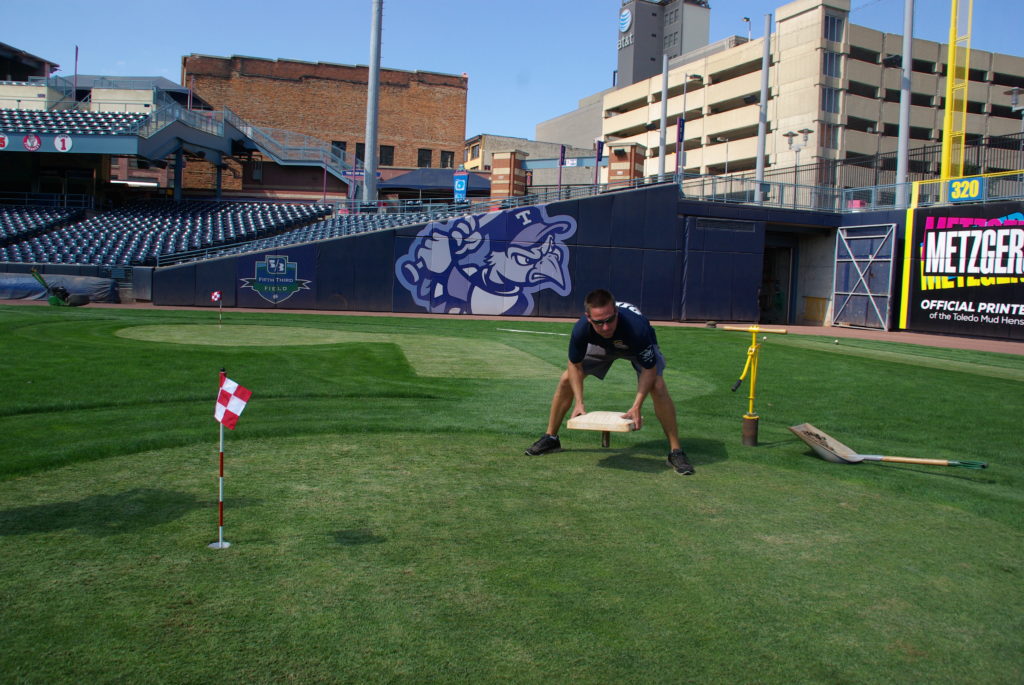
Sports Turf Manager Jake Tyler works on the minigolf course at Fifth Third Field. TOLEDO FREE PRESS PHOTO BY DON LEE

There’s been enough interest in golfing at Fifth Third Field that the Mud Hens have doubled down on a once-in-a-lifetime opportunity.

The Links at Fifth Third Field, the mini-golf course that will take over the outfield for three days this month, has gone from one 18-hole minicourse to two, said Sports Turf Manager Jake Tyler.

“We were running out of tee times,” Tyler said, laughing, as he and assistant Cory Myers put some finishing touches on the jigsaw puzzle of miniature golf greens in what is normally the Hens’ outfield.

The only downside? There’ll be no 17th hole ending on the pitcher’s mound, as originally planned. Tyler said he and his crew decided to have both courses play the same, and, of course, there’s only one pitcher’s mound.

It’s the first time a minor-league outfield has been turned into a miniature golf course, said Hens’ spokeswoman Andi Roman, and as far as she knows, the first time in any ballpark.

“The idea was all Jake’s,” she said.

“I always thought it would be fun to play golf out here,” Tyler said while lining up starter blocks — made out of baseballs — on one of the holes in left field.

The opportunity itself came out of left field when plans to turn the ball field into a hockey rink for this year’s Toledo Walleye Winterfest — together with plans already in place to renovate the field anyway — meant “there was about a month that we didn’t have to worry about the condition of the field,” Tyler said.

Work began the day after the last home game: Marking and mowing out the greens, letting the rest of the grass grow out a little, coming up with hazards and baseball-themed in-play features such as an arch made of bats, a base off which to bounce a shot into the cup (or try to, anyway) and a batting helmet through which the ball must go to reach the cup.

Normally, a ball field requires care through the winter to help make it ready for each spring. But a long weekend of minigolf fits in nicely with Tyler’s philosophy of keeping the fans connected with the field.

“Plus, it looks really neat,” he said.

Tee times are $15 per person and include a souvenir golf ball. Part of the proceeds support area charities, including Helping Hens Charitable Fund, the Epilepsy Center of Northwest Ohio, the Boys & Girls Club and Susan G. Komen for the Cure.

Tee times are available 6-10 p.m. Sept. 26; 10 a.m. to 3:30 p.m. and 6:30-10 p.m. Sept. 27; and 2-8 p.m. Sept. 28. Walk-ins will be accommodated when possible all weekend, including starting at 9 a.m. Sept. 28.

Sign up at mudhens.com or by calling (419) 725-4367.

Midwest Pre-Health Conference set for Oct. 25

0

The 2014 Midwest Pre-Health Conference is aimed at helping students prepare for professional and graduate level programs in medical, dental and pharmacy schools, said event assistant Jamila Hatcher.

“The goal of this event is to provide high school, community college and university students, parents and counselors with the information and skills necessary to succeed in the professional and graduate school admission process,” Hatcher told Toledo Free Press via email. “It provides a unique opportunity for direct contact with medical school deans of admission, admission officers, faculty and staff.”

The conference is 8 a.m. to 5 p.m. place Oct. 25 at Bowling Green State University’s Bowen-Thompson Student Union. Registration is free to all students and programs. To register or for more information, go to www.mwprehealth.com. Keynote speakers at the event include Dr. Louito C. Edje, program director at ProMedica Toledo Hospital’s Family Medicine, and Monik Jimenez, instructor in medicine at Harvard Medical School.

Common interests inspire Sylvania Avenue Neighbors

0
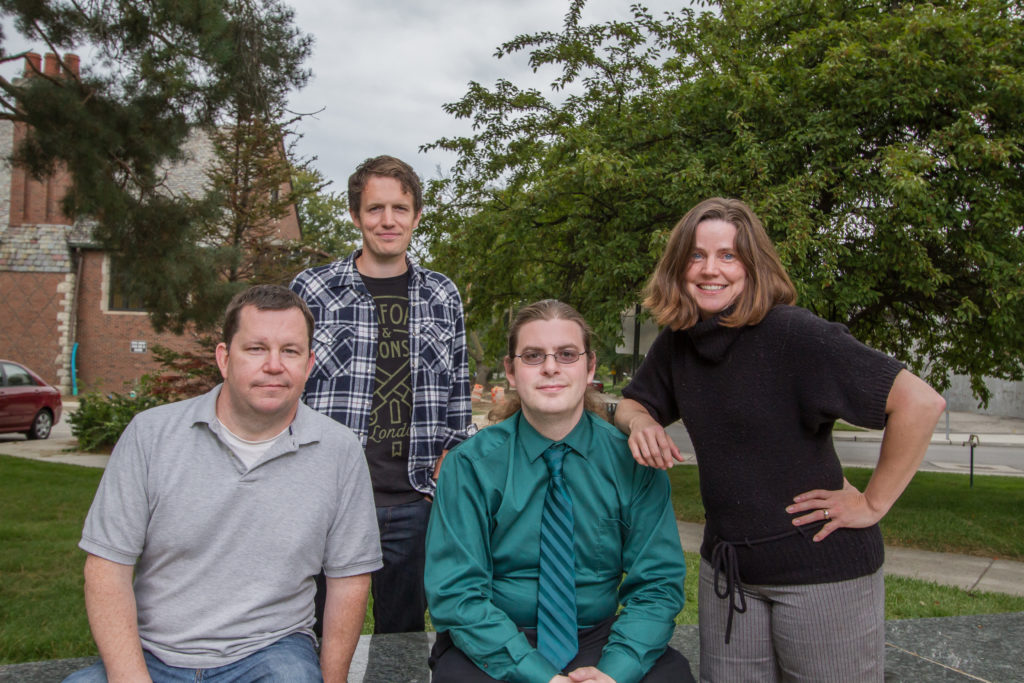
From left, Greg Lyons, Sam Melden, Sean Nestor and Jonie McIntire of Sylvania Avenue Neighbors.

It doesn’t take millionaires, big companies or even an act of government to create positive change in Toledo. Sometimes all it takes is an idea, a few neighbors and 100,000 poets.

Steeped in decades of ample tradition stretching from the old Jeep plant to Monroe Street and beyond, the Sylvania Avenue Neighbors were formed this past spring after a few friends talked about a simple idea: making a good neighborhood even better.

“It was exciting to meet more and more people who think the same thing,” said Greg Lyons, Sylvania Avenue Neighbors president. “We’re really doing it on our own. The only way we can move and rally people is to stop being negative, and do something positive and creative.”

This new organization is committed to engaging businesses, churches, schools and its residents all along Sylvania Avenue to work for the betterment of this expansive neighborhood.

One of many events the group plans to stage, “100 Thousand Poets for Change,” is part of an international grassroots educational effort focusing on the arts, especially poetry, music, and the literary arts. Slated for 2-7 p.m. Sept. 27, it will be held near the West Toledo Branch Library, a place many consider as the cornerstone of this proud neighborhood.

“Poets” events are being held worldwide that day, each one being encouraged to focus on issues that have local importance, combining social activism with poetry.

“That sounds very explosive, but if you have a local concern or issue, artists need to have a way about dealing with that local issue,” said event organizer Jonie McIntire. “This is sort of a way to get artists into a situation where they can be more active in their communities and that artists contribute in more ways than painting or poetry.”

This year will mark Toledo’s fourth “Poets” event, but its first in a neighborhood setting with a theme focused on the environment.

“This really fits in with the larger goal of Toledo, which is part of our theme this year,” McIntire said. “There is plenty to talk about there. We wanted to bring attention to the potential in Toledo. We want to go after those things and start fixing them.”

The Sylvania Avenue Neighbors recognize they have plenty of positive assets up and down their notable corridor: a beautiful library, venerable churches, classic restaurants, manufacturing and local homegrown businesses. They also tout its accessibility, and believe everything a resident needs is within walking distance.

“If you look at the arrangement of businesses along there, there’s so much potential,” said Sean Nestor, president of the Phoenix Earth Food Co-op and vice president of the Sylvania Avenue Neighbors. “We have a great street.”

Thankfully the group benefits from active business leaders mixed in with community members all focused on the same goal.

“We’re slowly building an identity based on what we already find prevalent in our neighborhood,” Nestor said. “The goal is to merge culture and local independent businesses and talk together collectively. I think there’s just so much to look forward to.”

Knowing that the arts is one of Toledo’s strengths, the association is also looking at other local entities – like LeSo Gallery on the East Side – and what they’re doing with art and culture. They’re admittedly influenced by other similar groups around Toledo.

They’re also finding support from Toledo City Council, and hope for increased dialogue regarding the future of Sylvania Avenue. The stretch is distinct in that it spans the domain of three City Council members.

The neighborhood remains every bit ethnic and blue collar through its innate ties to the old Jeep plant. Residents include numerous retired Jeep workers, and they’re proud of their identity. Many are also encouraged to see the former site being developed and reborn.

“I think it’s great that is happening,” Lyons said. “It’s good for the neighborhood and would be good to have something in close proximity that will supply jobs. There’s always so much stress on blight and jobs, and those things are important, but there’s more to life than that.”

The group also owes every bit of its beginnings to Sam Melden, a neighborhood resident who has taken the somewhat rare approach of simply getting to know his neighbors. In a busy world where people keep to themselves more and more, Melden said he realizes his method takes time, but it’s all in an effort to “create a sense of place.”

“You just have to start doing it,” he said. “My personal belief is that the neighborhood is one of the most underutilized assets in our world. Our culture has gone further and further away from it. Any momentum you want to create, you start in a neighborhood. You have to start with what’s already here and build around it.

“We talk all the time how we want to be on offense, not defense. We feel like often like there’s not enough conversation. There’s violence all over the place and blight, but then there are opportunities to create something rather than responding to the negative things. We believe in the concept of a neighbor.”

Melden previously served as Food for Thought’s chief thought officer, but recently was named executive director of the Center for Servant Leadership, located right on Sylvania Avenue. Thus, he now lives and works in the same neighborhood.

The Sylvania Avenue Neighbors trust in their work and insist it’s critical, as it can strengthen the city’s economy. Another factor it can strengthen – something more difficult to measure – is attitude.

“The way people talk about the city they live in reflects their outlook in life,” McIntire said. “There was all this negativity and I thought, we’re going to drown or we have to reach out and get out of this. I have to love where I live to remind myself that there’s hope everywhere.”

“It’s that sense of place that drives them. They don’t want to go somewhere else for it. They don’t want to buy it. They don’t want to say their neighborhood doesn’t have it.”

They simply want to create it.

“I want to be a part of creating a neighborhood that is inclusive, welcoming, honest and real,” Melden said. “There are struggles. I’m not interested in figuring out a way to gentrify a part of Toledo to make it more comfortable for any one group of people. I want it to be an honest expression of everyone and the neighborhood.”

For more information, visit saneighbors.org or “100 Thousand Poets for Change” on Facebook.

Frogtown Regatta showcases regional rowing

0

Each fall, Toledo’s Frogtown Regatta draws hundreds of rowers from across the region to the Maumee River.

Hosted by Toledo Rowing Club (TRC), the 29th annual event will feature high school, adult and corporate rowers from at least 12 clubs in Michigan, Ohio, Indiana and Illinois.

Toledo Rowing Club Executive Director Kristina Latta-Landefeld works with a group of middle school recreational rowers as part of a new program that started this fall. Toledo Free Press photo by Christie Materni

“One reason people like to come here from around the region is they really enjoy the cityscape,” said TRC Executive Director Kristina Latta-Landefeld. “It’s also pretty straight so you can get a really fast time.”

The regatta, which is set for 8 a.m. to 4 p.m. Sept. 27, will feature food trucks, rowing T-shirts from Jupmode and coffee and snacks from Black Kite Coffee. Some of The Docks restaurants will be open as well.

Most of the teams will be set up on the International Park side of the river, but races can be viewed from the Downtown side as well, said event organizer and TRC board member Mike Dibling.

“Toledo is really centrally located for a lot of rowing,” Dibling said. “It’s a once-a-year event that brings a lot of people from out of town, so it’s a good way to showcase the waterfront.”

New this year will be a corporate race, including a team from Owens Corning.

“We’re going to give teams close to 20 hours of coaching and they’ll be able to use our equipment and go out and race,” Latta-Landefeld said. “I look forward to expanding it next year.”

Corporate Development Associate Charles Smith will be part of Owens Corning’s team at Frogtown. Three weeks ago, he knew “not much — bordering on nothing” about rowing, but said it’s been fun to learn and he’s excited to experience Frogtown.

“Rowing is a lot more difficult than I imagined, mostly due to the coordination involved,” Smith said. “You really have to work with everyone else to be in sync. I’m excited to be out there. It’s cool being out on the water.”

The corporate race was inspired by Partners in Education’s popular annual  Dragon Boat Festival, Latta-Landefeld said.

“When you ask Toledoans what they know about rowing, they’re like, ‘Dragon Boats!’” she said.

But the Dragon Boat race is a paddling competition, which is different than rowing.

“Part of [Dragon Boats’] appeal is you can be pretty darn new and get right into it and start doing it right away,” Latta-Landefeld said. “The rowing shells, because they are so narrow and long, it’s much harder to do that. You have to build yourself up.

“But we’ve seen how people come together and get really excited about doing the Dragon Boats,” Latta-Landefeld said. “We want to get those folks who are involved once a year to continue to be involved on the water because they clearly love it.”

The regatta is a great way to showcase Toledo’s “treasure,” TRC board member Ed Conn said.

“There are a lot of folks who don’t make use of the river, who just cross it on their way to work,” Conn said. “We want to get people on the river and rowing, but in a broader sense, it’s an opportunity for us to get people to appreciate it and understand what an incredible asset we have.”

Expanding the reach of TRC has been one of Latta-Landefeld’s main goals since taking her role last year.

“Since I’ve come on, I’m seeing there’s a major gap in terms of who has access to the boathouse,” she said.

Rowing is often seen as an elite sport affiliated with private institutions.

“What I’ve been trying to do is change that image and get more people involved,” she said.

A middle school recreational rowing program started this fall. Maritime Academy, a charter school, is working on starting a team. Her dream is to get Toledo Public Schools involved as well.

Inspired by mentor Jim Reisig, Latta-Landefeld is also working on restarting an adaptive rowing program.

“He was in a wheelchair and one of the first international competitive rowers in the U.S., so there’s a strong history here [in Toledo]. But it’s just been stagnant,” Latta-Landefeld said. “We have all these adaptive boats but we haven’t had an adaptive program for a long time.”

Current high school teams include St. John’s Jesuit, St. Francis de Sales, St. Ursula Academy, Notre Dame Academy, Central Catholic and Anthony Wayne. Toledo Metropolitan Rowing Club (TMRC) is a high school team comprised of rowers from various schools. There is also a masters club for adults.

TRC individual memberships cost $55 for the fall season. Members have access to TRC boats and rowing machines.

Latta-Landefeld grew up in East Toledo and was introduced to rowing at St. Ursula. She rowed for Smith College in Massachusetts and coached at Steel City Rowing Club in Pittsburgh before returning to Toledo to work for TRC.

“I just fell in love with it,” she said. “It’s competitive. It tends to draw people who are Type A because you’re always chasing after that perfect stroke, or what’s called swing. It’s like getting in a runner’s high. All you can think about is that next stroke. It’s really cathartic.”

She won’t be at Frogtown because she’s being inducted into Smith’s athletic hall of fame with her  rowing teammates for an undefeated season.

“It’s not my accomplishment; it’s our accomplishment,”  Latta-Landefeld said. “That is a big piece of rowing and I don’t think you can say that about too many other sports. Even with other team sports, one person can say, ‘I got the winning goal.’ You can’t do that in rowing.”

Someday Latta-Landefeld hopes to add another boathouse to TRC.

“We’re maxed out here and we’re expanding. And that’s a really good problem to have,” she said. “I’d love to have canoes and kayaks for people to rent and bikes to use along the river. There is so much potential.”

TRC is also hosting the Maumee Bay River Festival noon to 6 p.m. Sept. 28 at International Park with a suggested donation of $5 to benefit Lake Erie Waterkeeper. The third annual event will feature chances to try rowing, canoeing, kayaking, racing boat expo, Sandpiper cruises, live music, tours of a U.S. Coast Guard boat, fishing derby, kids’ activities, regional beer, food vendors and more.

For more information, visit the website www.toledorowing.org.