Home Blog Page 182

Pianists to play Ann Arbor Aug. 27

0
Liz Story and Lisa Downing. Photo courtesy of Vision Quest Entertainment.

Pianists Liz Story and Lisa Downing had a lot to say about the pressing nature of their instrument.

“If you’re studying harmony at a conservatory, you always study it at a piano or a keyboard because there it is: It’s visually set out, the relationship of this information,” Story said.

“The geometry is there, it’s black and white, nothing in between,” Downing chimed in.

“It really is the piano, not the electric keyboard. A friend of mine put it this way and it always makes me laugh because there’s a real physical sensation that really isn’t there with the keyboard, and as my friend put it, ‘The difference between when you’re playing a keyboard instead of a piano is like trying to have Tantric sex with a plastic doll,’ ” Story said and laughed.

“There’s a real sensation and that’s what I really love about the piano is that very sensual quality of playing it.”

Downing recalled her first encounter with the keys when her family visited friends and she was about 18 months old.

“I reached up over my head and moved my fingers down and there was sound coming out, and oh my god,” she said during a call from her Colorado home. “I remember my parents taking me out of there, turning out the lights. And I’m thinking: There’s a magic thing in there that when you push it down sound comes out! Why is everyone not in there all the time?”

Classically trained, Story’s career blossomed when she decided to play at a restaurant to improve her sight-reading.

“I got all this music together, and I get to this restaurant, it was a very dark restaurant, and the piano they had was this old upright, and the entire front casing of the piano was missing, which basically means there is absolutely nowhere to put music,” Story said during a call from her Los Angeles home.

“And I totally went into a state of panic. Can I put the music on the floor? No, it’s too dark; I can’t see it. I was flipping out. And the manager walked up and said, ‘OK, I want you to start playing and I don’t want any applause,’ meaning don’t play really loud. So I sat down and started making things up.”

Will Ackerman, founder of Windham Hill Records, heard her playing and signed her. Story’s dazzling debut, “Solid Colors,” followed in 1983.

Downing drew inspiration from Keith Jarrett and George Winston, then heard Story.

“When I heard Liz’s music, it’s like that’s the music I hear in my head. She’s a woman and if she can do it, I can, too,” Downing said. “I found her on mySpace and called her.”

The two struck up a friendship about seven years ago and started touring together.

Story and Downing will play at 8 p.m. Aug. 27 at the Ark in Ann Arbor. Tickets are $25. Doors open at 7:30 p.m.

“Night Sky Essays” from 2011 is Story’s most recent release. She is re-recording some of her material.

“After so long performing the pieces, you play them differently,” she said.

Downing’s latest, “A Delicate Balance,” came out in 2009. Her next disc, “The Wisdom of My Shadow,” is expected next year.

“[The new disc] has sort of a dark fantasy kind of flavor in the mood of maybe the ‘Twilight’ trilogy. So there are some vampires and dragons and that kind of stuff going on with my music lately.”

German-American Festival marks 49th year

0

For all the events that take place at the German-American Festival — the annual celebration of all things Deutschland taking place this year at Oak Shade Grove in Oregon, Aug. 22 -24 — what brings the most joy out of the average attendee is the food. Sigh. Yes, the food.

Just ask Tim Pecsenye, the festival chairman. He’s been involved with the event since 1976 in one capacity or another. Even when he moved to New Jersey for a while, he stayed involved. Inquired as to what foods will be available at the event for this, the festival’s 49th year, he rattled almost ten items without even thinking, with a longing tone in his voice. Potato pancakes. Sausage. Barbeque chicken. Swiss sandwiches. Baked goods. All made fresh, thank you very much.

“One thing is that our committee, for our festival, does not have food vendors,” Pecsenye said. “Every food operation that we have — and I mean funnel cakes, schnitzel sandwiches, all of those kinds of things — every one of those is prepared by our folks. We don’t have food vendors come in, we don’t have the trucks come in or anything like that, like most of the festivals do.

“And our people conceive of it, run it, do the ordering of products. Basically, we run everything.”

It takes a great deal of dedication to keep a celebration like the GAF running for nearly half a century. Over 3,000 volunteers help make the festival a reality each year. It’s a process that continues virtually year round, Pecsenye said.

“We start looking at it even while the Festival is going on, of what changes we can make for next year, what needs to be made better, what needs to service the people better. And so that’s an important part of the Festival. We have Committee meetings just about every month.

“We have a very hard-working committee,” he added. “A quarter or a third of the population in this area refers to themselves as either German or Swiss heritage, when it comes time for census. … People like our entertainment, they like our music. They love our food. And we work very hard to make sure it’s a quality event. And then, you add in a certain liquid adult beverage …”

Well yes, the presence of such a beautiful hops-and-barley concoction certainly helps enliven the festivities. But the music which will fill the air throughout the weekend will be doing its part as well, with performances from favorites like the Brother’s Grimm, the Jay Fox Band, the Austrian Express, the Polish American Concert Band and more providing the merriment its soundtrack. This year’s featured performers are the Alex Meixner Band out of Palm City, Florida.

Working to keep everything running smoothly for the thousands of attendees who will pack Oak Shade Grove, Pecsenye won’t have much time to enjoy the music himself, however, or much of anything else — which he claimed is fine by him. “I’m sort of an event planner type of a person. I sort of enjoy seeing what happens with events like this, and how it works. Even if I go to someone else’s event, I’m looking at the back room stuff rather than just enjoying it.”

Hays: Battling the stigma of mental health issues

0

I didn’t plan on writing about suicide and mental health this month, but I saw the death of Robin Williams and how I see his death as a teaching moment about our military and veterans, I decided to change subjects. Robin was a brilliant comedian, though personal tastes may differ on some of his content and the way his life was lived, it is a strong consensus that he was a genius of comedic improv!

Though I was well aware that he had mental health and substance abuse issues, from what I read now in comments on social media, many people were not aware of the darkness in Robin’s life. The passing of Robin is getting International attention, and understandably so, but many in the veteran community are upset or confused that the 22 veterans a day who commit suicide in our country are not ever given much attention by the media, and most individual’s stories are never told.

I understand their frustration as my passion is to drive down stigma connected with invisible wounds and that includes mental health issues as well as traumatic brain injury.

But I believe almost any opportunity to create more awareness through conversation in the public about what are referred to as “invisible wounds” is welcomed.

It is difficult to grab the attention of the masses in our society about any subject matter with the overwhelming amount of information thrown out from every direction. And, when the attention does go to a subject, there is another catastrophe or topic that is deemed newsworthy and attention is quickly diverted. I wish that every military member who died from suicide received a headline.

I wish that every military veteran who struggled beyond measure and lost any semblance of hope in their life would be honored for their place in life, but not glorified in death by suicide as maybe some are doing with Robin Williams.

There is no glory in taking your own life. Suicide is dark. Suicide is empty. Suicide is never the answer. But, what is the answer? I wrote about the “mask” of invisible wounds and hiding our true selves a few months back. As much as many thought they knew this iconic comedian, he wore a mask that allowed him to portray himself as someone who was not struggling. He showed glimpses of his true self when he would speak of his drug and alcohol abuse, or the demons, as he put it, that he had inside. But the mask was almost always present in Robin’s life.

The inner world of his pain was hidden from the public that adored the funny guy and maybe the mask prevented him from taking advantage of all the help available to him.

Living in denial is never healthy. We all put on our masks in some way on most days, but until you have lived with mental health illness yourself, or loved someone who has, you might not fully comprehend the battles of denying your true self every day.

You might not understand what it is like to watch television and listen to your “unprotected class” of people being ridiculed by the language and situations that our world still finds acceptable. Words like lunatic, looney bin, the crazies, insane asylum, and others that cut into the spirits of those who are trying to live with a disease; one that does not emote the feelings of caring and empathy like breast cancer, heart disease etc.

People struggling with mental health disease don’t have the benefit in our country of “being accepted for who they are”. Sure some do, but I am talking about a broad overview of how we treat, mistreat, interact with, talk about or portray those with mental health issues. Stigma breeds in society like an out of control virus and is the “connected” disease that stops many from fully removing the mask.

Not all that are homeless have mental health disease. Not all that have mental health disease are homeless. Not all have alcohol or substance abuse problems. But all are our fellow human beings. All of us have the possibility to walk in their shoes; we are not above having mental health issues ourselves.

In a given year, one in four Americans will be challenged with a mental health problem and 1 in 17 will have what is called a serious mental health disorder.

Each of us can do something to combat the stigma that makes the mask a necessity for so many.

Pam Hays is president and founder of The Arms Forces, www.thearmsforces. org; (419) 891-2111.

Helping Hands offers food, hope to East Side and beyond

0
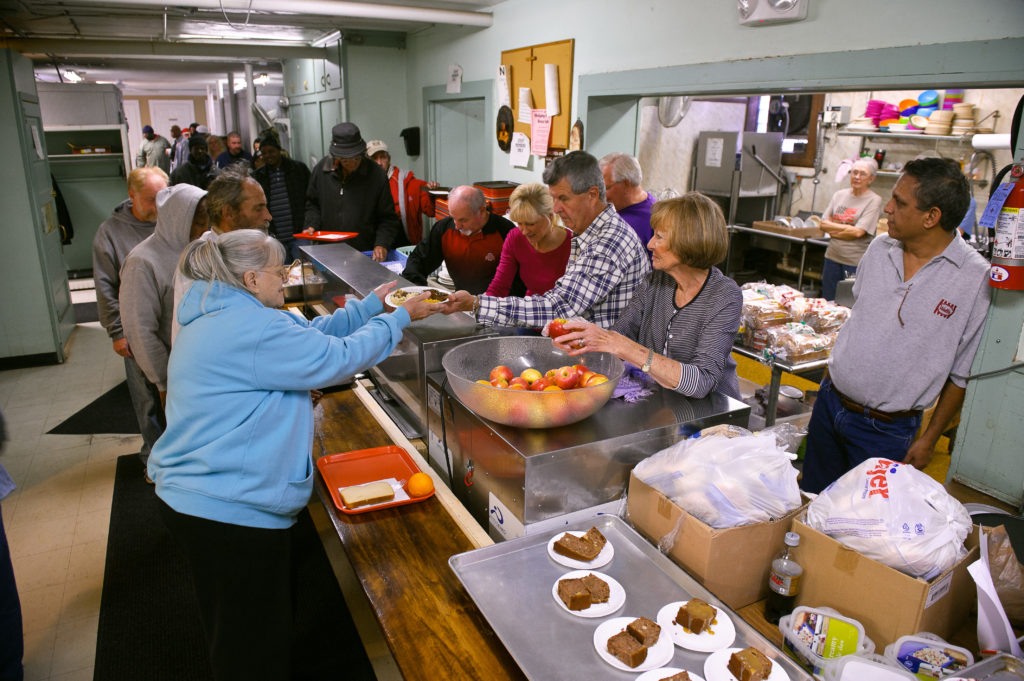
Helping Hands of St. Louis in East Toledo serves more than 100 Breakfasts and 375 lunches every weekday.

Poverty and hunger can seem like insurmountable issues. It’s easy to dismiss them entirely on the notion that there is little one person can do. Thankfully, we have people throughout world history that have taught us to start small.

Locally, we have people like the late Rev. Robert Armstrong, a priest from the former St. Louis Parish in East Toledo who in 1981 started the Helping Hands of St. Louis Outreach Center.

“We’re trying to put a dent in poverty,” said Paul Cook, director. “We try to do the best with what we have.”

Helping Hands is perhaps best known for serving hundreds of meals every day in East Toledo, though it also has a popular food pantry, clothing center and hygiene kit distribution program.

The parish of St. Louis was closed by the diocese in 2005, but its outreach ministry remains alive and well. Helping Hands has always served the needs of the East Side and beyond, formally becoming part of Catholic Charities in 2011.

“Before Catholic Charities, we did everything ourselves,” Cook said. “Now, they take care of a lot for us, because we only have three and a half staff members, so they handle the budgeting, paperwork and things like that.”

That allows Cook and a whole lot of volunteers — roughly 28 core groups from churches and nonprofits from around Northwest Ohio — to pitch together and serve the needs of citizens. Neither services nor volunteering opportunities are limited to Catholics, as there are several other religions involved.

Even the grocery distribution can be a collaboration of sorts, working with other pantries in the area when certain supplies are in overabundance. Helping Hands serves around 100 breakfasts and 375 lunches, sometimes many more, every single weekday.

“It just makes us feel like a part of something,” said Debbie Gaster, who with husband Larry, comes from St. Joseph Parish in Sylvania about once a month. “We’ve been very blessed and fortunate, so it’s something small we can do.”

Volunteers seem to spike at the holidays, when Cook noted that “it’s a feel good time,” but the center has a dedicated group of people who assist year round. The help is needed, because Cook says demand is strong and he doesn’t see things getting better.

“Right now no, not until the jobs pick up,” Cook said. “We have some people with felonies, and not until people take a chance on them. Some people simply can’t work because they have some kind of physical or mental illness. About 3-4 percent of our people can’t read or write.”

Cook noted that he has patrons from not only East Toledo, but many from the north, south and west, too. Often he finds they ride a bus, get a ride, or even walk very long distances to take advantage of what Helping Hands offers.

The clothing store is open two days a week, and anyone may to shop for their needs just as they would in a department store.

The food pantry operates in similar fashion. Anyone can take advantage of the services, but the hygiene kit distribution is partially grant-funded, so recipients must be from the East Side.

Helping Hands serves about 70,000 on-site meals, distributes 2,400 bags of groceries and 650 hygiene kits every year. While the group relies heavily on donations, it also receives federal grants, though those dollar amounts decrease every year.

There are several other outreach centers that offer meals and assistance, but if Helping Hands weren’t around, it makes Cook wonder where everyone would go for help.

“I really don’t know,” Cook said. “I hate to think what would happen.”

La Posada shelter aims to help families stabilize

0

People arrive on the doorstep of La Posada Family Shelter for a variety of reasons. Those can include a mental health issue, unemployment or simply a stroke of bad luck. Danielle Tedrow of Toledo lost the home she rented when the owner took out a second mortgage and failed to make a payment. The sheriff’s office threatened to evict her so she moved in with her grandmother.

When that plan fell through, she had no other choice. She took her two young daughters into Catholic Charities’ La Posada house on Feb. 15, 2010. She stayed for two life-changing months.

The name La Posada originated from the Spanish holiday “Las Posadas.” The event is a nine-day celebration that represents the difficulties Joseph and Mary, the parents of Jesus, faced in search of a room when traveling to Bethlehem. Since opening more than two decades ago, La Posada has sheltered more than 2,000 families.

Last year, 62 families found shelter within its walls on Eastern Avenue in South Toledo. The majority of “house guests” are young mothers with three or four children, said Program Coordinator Jeanelle Addie. Fathers with children are also welcome. The families are referred by United Way of Greater Toledo.

“We understand that the families are in need,” Addie said. “There’s other issues going on … we do a needs assessment. We figure out what needs they have in the family.”

The shelter offers résumé preparation and GED classes from Lourdes University students, tutoring for children from Toledo Public Schools, financial education, nutrition education, parenting group, Bible study, self-esteem workshops and more.

The goal is not to do it for them but help them help themselves, said Catholic Charities Executive Director Rodney Schuster.

“They are in crisis mode when they come to us [at La Posada],” Schuster said. “The first thing is to provide stability. Let them know they are loved and will be cared for. Kind of let the dust settle. Then a case manager meets with them and finds out in essence how did they end up here, what were the circumstances. And then once we find that out, we help them determine what’s your plan once you’re here, what are some things we can do.

“There a mindset out there sometimes that ‘I don’t need to do anything to help myself.’ Well, yes you do because otherwise you will be going from shelter to shelter to shelter, soup kitchen to soup kitchen. If you’re of sound mind and body, God has greater intentions for you. And we would hope you would to. We have no idea what you’ve gone through in your life; we’re not in your shoes. But you either can dwell on that and let it keep you underneath water for the rest of your life or you can emerge and say, ‘Today’s a brand-new day and I’m going to do something’ and we’re going to help them.”

Many families keep their identity secret out of a desire for privacy and/or a sense of shame. Tedrow said she felt as if she were a failure — that she had let her children down by moving into La Posada house. She felt ashamed. But as bad as she felt coming in, she was transformed by the experience.

Tedrow said she would have been sleeping under a bridge that night. Instead, she arrived at La Posada house with her two daughters, ages 4 and 6. She was separated from her husband and was “on her own.”

At the time, she said she worked from job to job, her self-esteem “not worth a few hours at a Walmart.” She described herself as a “doormat,” someone who didn’t stand up for herself, who didn’t have her own voice.

La Posada house changed all that. She locked herself in her room for the first 37 days, wanting to isolate, not realizing that the staff was there to help. But she eventually came out of “hiding” and participated in workshops and talks with Addie and others.

“You almost feel like you failed as a parent, that you don’t have that stability to give. It is rewarding in the end,” Tedrow said. “I’ll never forget the people I met at La Posada.”

On April 17, 2010, Tedrow and her two daughters moved out of La Posada and today live in a four-bedroom home in Ottawa Hills. Tedrow is now a state tested nursing assistant (STNA) working in hospice.

Four years after her experience, she still communicates with Addie and has been serving on the advisory board for La Posada.

“I feel strongly in what they do and how they support the community,” Tedrow said. “Six months after I left, Jeanelle offered me the position, so it’s been a couple of years now … You can make it when you get out of here.”

For more information, visit catholiccharitiesnwo.org.

Konecny: Fighting blight

0

The “Toledo Loves Love” mural, located Downtown at the corner of Adams and 13th streets, was painted in 2012 and achieved immediate star status. It is often featured in articles and on TV, and people seeking a romantic backdrop regularly frequent the site for photos. Wedding parties have even been known to stop by for an eternal scrapbook keepsake.

Like any work of art, it’s open to individual interpretation and it is easy to catch symbol-itis there, finding different meanings in just about every brushstroke. But in one simple estimation, the wall depicts something broad: a message that Toledo does indeed love love.

We like good things, and doing good for one another.

Who doesn’t?

Like any family, we citizens have our imperfections. A holiday gathering, for example, doesn’t make those go away, but it helps us celebrate our family and the good times together. It gives us a moment to stop and think, “Hey, life isn’t perfect, but I love this family despite our flaws.”

Maybe over time we can work together and our flaws might lessen or even disappear.

Toledo Free Press is a newspaper. It’s our job to report the news, not create it. But positive things like the “Toledo Loves Love” mural are happening all over Toledo; we just rarely hear about them. The police officer involved in a standoff is more exciting to watch than the one who speaks to first-graders about safety. We get that. But there are plenty of times when a train merely rolling down the track is more majestic, thrilling and idealistic than a train wreck. Those noble trains modestly doing their thing are all over — we just have to find them.

That’s going to be our job in a new monthly series during the next year, as we highlight local citizens and groups doing selfless deeds for our city. Expect to see a series of inspiring stories that celebrate all things good in Toledo. We start on page 21 this week in East Toledo with the efforts of LeSo Gallery.

Toledo Free Press columnist Jeremy Baumhower recently coined the term “Toledo Tough.”

Perhaps that says it best, because we all know that love involves some measure of firmness, compassion and action.

We’re already a good family, but so many unsung citizens make it great. Let’s talk about them for a change.

Tom Konecny is associate editor of Toledo Free Press. Contact him at [email protected].

Wuwert: Wake up and smell the water, Toledo!

0

Dear Citizens of Northwest Ohio,

During the past few weeks, we have heard about algal blooms, phosphorus in the lake, licensing fertilizers and my personal favorite, “summits” conducted by politicians about what to do with Lake Erie.

It seems the only thing we have not discussed in detail is the performance of city leadership. Toledo Mayor D. Michael Collins stated at a recent news conference that he knew about the condition of the Collins Park Water Treatment Plant as a city councilman, but he did not have the power to do anything because he was not the mayor. After he became mayor, we learned that the Ohio EPA sent several letters asking the city to speed up plant repairs because it was “vulnerable to potential failures.”

The response from the city was so slow that the Ohio EPA was considering taking over the water treatment plant. When the water became undrinkable, Collins chose to not make a neighborly call to community leaders forewarning them of the situation. Let me recap that in case you did not catch what I said: Mayor Collins knew about the problem prior to taking office, did not take aggressive action to address it when he had the power to fix it, almost had the responsibility taken away from him by the state government and then neglected to tell other leaders when the problem was a danger to the public. How is he still the mayor?

If this had happened in the private sector, his contract would have been terminated immediately. But the citizens seem to have accepted the line from city leaders that the algal bloom in the lake is the cause for the bad water. The lake sneaks out at night like a drunken sailor drinking “phosphorus martinis” and then it produces toxins. Bad lake!

However, before you consider sending the lake to rehab, the city of Oregon pulls its water out of the western area of the lake and did not have a problem. These cities must be doing something right. The City of Toledo water intake pipe is near the shoreline at the mouth of the Maumee River right where algae tend to collect. The lake must have put it there, right? Well, it must be those evil farmers and their fertilizer that have caused this problem. Before you ban all fertilizer, keep in mind that the phosphorus content (which is produced from fertilizer runoff) in the lake was higher in 2007 than in 2011, yet the algal bloom was higher in 2011. How about we take shifts for a 24/7 police patrol of the shores of Lake Erie and all rivers that flow into it to make sure that it does not take in any toxic chemicals?

Many still insist that we need more regulation. It would be much more cost-effective to build a state-of-the-art water treatment facility and move the intake pipe farther out in the lake. It is the one thing that the city can control.

But, for those of you who still strongly believe in the need to regulate more, let me offer a starting point — One Government Center, Suite 2200, Toledo, Ohio, 43604. How about we do a better job of regulating the politicians? Voters can hold elected leaders accountable and demand that they exit stage left when they have made repeated errors in judgment that have jeopardized the public health of the community.

I know, you still think it is the lake’s fault. Go clean it up — meanwhile the water treatment plant is at risk of another failure. Is the lake causing that too?

Wake up and smell the water, Toledo — you are being hoodwinked.

Your friend, Jim Wuwert

Catholic Charities marks 100 years of service

0

In the Book of Matthew, Jesus tells his disciples that whatever is done to “the least of these” — the widow, the orphan, the sick, the hungry, the imprisoned — is done to Him, and Catholic Charities has taken that mission to heart for 100 years.

Catholic Charities Executive Director Rodney Schuster. Founded in 1914, the organization serves more than 40,000 people in Northwest Ohio each year. Toledo Free Press photo by Joseph Herr / Cover photo by  Christie Materni

Catholic Charities Executive Director Rodney Schuster. Founded in 1914, the organization serves more than 40,000 people in Northwest Ohio each year. Toledo Free Press photo by Joseph Herr / Cover photo by Christie Materni

The nonprofit was founded in 1914, four years after Catholic Diocese of Toledo was formed.

“You cannot separate dealing with God from dealing with God’s people,” Diocesan Administrator Father Charles Ritter said. “From the Old Testament on, the measure of the uprightness of society was how you dealt with the widow, the orphan and the alien. The church has to be involved with those if it’s going to be authentically faithful to the message of Scripture.”

Today, Catholic Charities has expanded its focus to include jail and prison ministry, senior citizen care, disaster relief, crisis navigation, post-abortion support and more.

“To try to help change lives is — I don’t know if there can be anything more rewarding,” Catholic Charities Executive Director Rodney Schuster said. “It’s a real blessing for me.”

Catholic Charities has a budget of about $3.7 million, a staff of about 50 and more than 1,000 volunteers per year. It serves about 40,000 people per year, double the number served four years ago.

However, Schuster emphasized it’s the love behind each encounter not the number served that’s important.

“Our mission is we make real the love of God to anyone who comes to us,” Schuster said. “There’s still a perception out there we only serve people who are Catholic. In our ministries, we help anyone in need because we follow the example of Jesus and that’s what he did.”

Helping Hands of St. Louis in East Toledo serves about 300 meals per day and about 8,200 people receive hot meals and groceries each month in Toledo, Norwalk and Mansfield. About 40 people per night receive emergency and long-term shelter in Toledo and 10 per night in Norwalk. About 145 impoverished elderly are provided companionship and legal guardians in Erie, Huron, Ottawa and Richland counties.

Crisis navigator Linda Kraft spends two days a week at Helping Hands of St. Louis  and the rest in Catholic Charities’ Downtown Toledo office taking calls.

“She’s just dynamite,” Schuster said. “She just listens to what’s going on in their life and helps identify barriers, helps provide a pathway to support services they might not know they could get. And most importantly follows up with them a couple weeks later.

“We just keep walking with them along the way until they get to a point where they are in a good spot,” Schuster said. “That’s really what ministry is.”

The focus is on helping people help themselves, Schuster said. For example, the 125 families on the verge of eviction who utilize the organization’s emergency rent program each has attend a 16-hour financial literacy program in exchange for the help.

“Ninety percent of the families we help stay in their homes because we give them the financial skills to manage their budget,” Schuster said.

Last year, the program was also offered pre-emptively to 50 families who had not yet reached the point of eviction, Schuster said.

Another program is Project Rachel, which offers a 24-hour hotline, counseling services and support to women who have had an abortion. Toledo was only the second diocese in the country to train its priests and counselors through Project Rachel.

“A lot of times people will say the Catholic Church is about rules and they don’t care about women. All you have to do is look at our devotion to Mary,” Schuster said. “We do care about women because abortion harms women and we’re there to say, ‘We wish you hadn’t, but you did.’ We’re never here saying we’re better than anyone else. We’re all sinners and we all make mistakes.”

Mercy and justice

While “works of mercy” was the focus of Catholic Charities for the first 50 years, the organization has been focusing more and more on “works of justice” as well, Ritter said.

“You feed the hungry and you deal with housing issues and you deal with orphans, but you also look at what are the social issues that end up creating the people in need,” Ritter said.

For the past year and a half, Catholic Charities has been working with Family House, Aurora Project and Bethany House through a strategic alliance partnership grant, exploring ways to reduce overhead cost, avoid duplication and possibly restructure some programs, Schuster said.

“A great example is the water crisis,” Schuster said. “We didn’t need a governmental agency. We were all on the phone that morning making sure everyone had food, water, paper products and whatever was needed so no one was going to be left in a situation where the people we are serving would be suffering. I think that’s beautiful.”

The future

As Catholic Charities moves into the next 100 years, Schuster said his two main hopes are that the organization can be more present across the 19 counties it serves and to attract more volunteers.

“There are many people that sit in churches every weekend wondering how they can help. One of our future roles and goals is to better engage people in volunteering,” Schuster said.

Many former recipients of aid now serve as volunteers or staff members, he said.

“We know that not everybody who comes to us is going to have a successful outcome, the ones that do we celebrate,” Schuster said. “That’s why we do this, one life at a time.”

Ritter said his hope for Catholic Charities is that it continues evolving in order to identify and meet the changing needs of the community.

“I hope they continue to not simply do good works — they do that and they do that well — but to help the broader church be more and more aware of the needs that are out there and get past some of the stereotypes we have about people who are in need,” Ritter said. “I think we have a great tradition of responding to genuine need when we know it’s there. We don’t always realize that it’s there.”

Anniversary Gala

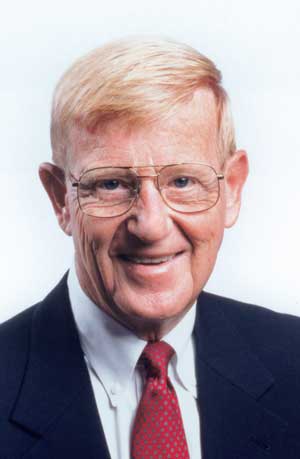
A 100th Anniversary Gala on Sept. 18 will feature legendary University of Notre Dame football coach Lou Holtz.


Lou Holtz

Lou Holtz

“His talk is called ‘Game Plan for Success.’ He shares his story and background and things he’s learned,” said Catholic Charities Marketing and Communications Manager Andrea Slivka.

News anchor Jerry Anderson will serve as master of ceremonies for the event, which is set for 6:30 p.m. Sept. 18 at the Hilton Garden Inn in Perrysburg. Tickets are $150.

There will be dinner, complimentary wine, cash bar and a silent auction featuring Notre Dame tickets and sports memorabilia, autographed jerseys from the Detroit Red Wings and Pistons and more.

Catholic Charities has raised $400,000 so far toward its $1 million anniversary year fundraising goal.

“This will be a fun, festive event reflecting on 100 years,” Schuster said. “I hope attendees are inspired by his words to continue helping Catholic Charities as we move into the next 100 years.”

For more information, visit catholicchartiesnwo.org.

Toledo Chamber named national Chamber of Year

0

The Toledo Regional Chamber of Commerce was named Chamber of the Year at the 100th annual American Chamber of Commerce Executives (ACCE) in Cincinnati on Aug. 13.

.

Toledo won against fellow finalists Association of Washington Business, Boise Metro Chamber of Commerce and Commerce Lexington Inc to take home the top honor.

Chambers honored with the Chamber of the Year designation have not only demonstrated organizational strength, but also have made an impact on key community priorities, such as education, transportation, business development and quality of life, according to the ACCE’s website.

“We share this honor with our members and the community. All of our staff members are proud to work to support the businesses in this great region,” chamber president Wendy Gramza said in a news release.

Chamber of the Year is the most distinguished award that a Chamber of Commerce can receive and is is the nation’s only award recognizing the dual role chambers have in leading businesses and communities, according to the release.

“This is an extra special award for us as it highlights the end of Mark V’Soske’s incredible career leading our chamber,” Gramza told Toledo Free Press.

Gramza took over as president from V’Soske earlier this month.

The Toledo Regional Chamber of Commerce serves a membership of more than 2,300 businesses. This is the third win for the Toledo Regional Chamber of Commerce this decade.

Huntington Bank leads nation in SBA lending

0

Huntington Bank was recently named the No. 1 Small Business Adminstration (SBA) lender in the country by helping thousands of small businesses expand and create jobs.

Huntington led the nation in terms of number of 7(a) loans and volume based on third quarter rankings for fiscal year 2014. The Columbus-based bank moved up from its previous position as the third largest SBA lender in the nation in 2013.
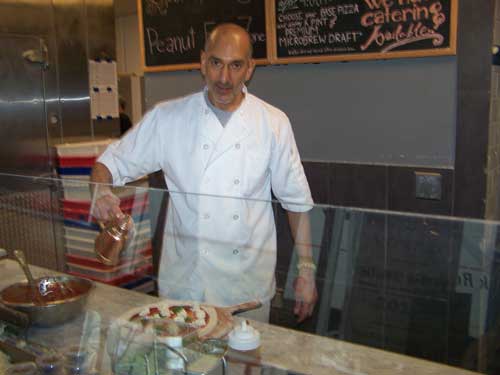
 

Joe Sheena is a hands-on owner making pizza at Neopapalis. Toledo Free Press photo by Duane Ramsey

Joe Sheena is a hands-on owner making pizza at Neopapalis. Toledo Free Press photo by Duane Ramsey

During the first three quarters of SBA’s fiscal year 2014, which ended June 30, Huntington Bank wrote 1,705 SBA loans in Ohio alone, totaling $199,345,900. The top national ranking is noteworthy because the bank is ranked 33rd in the country in terms of assets and only makes SBA loans within its six-state footprint.

Huntington Bank made more than half of all SBA 7(a) loans in its footprint for the first six months of the fiscal year. It made 1,804 loans while the remainder of the industry made 1,758 loans in Huntington’s service area during the period from Oct. 1 to March 31.

“Huntington is committed to supporting small business growth as a key way to strengthen our communities as they continue through the economic recovery,” said Steve Steinour, chairman, president and CEO of Huntington Bank in the announcement of its SBA rankings.

“Small businesses are the foundation of our Main Street economies throughout the United States. These businesses generate two thirds of all new jobs and help keep our neighborhoods healthy,” Steinour said.

“Huntington is very big in the small business market. We focus on small business and have a great reputation in that arena,” said Ken Connell, executive vice president and business banking sales director.

“We listen to what companies need for expanding their business. If SBA is the best solution for them, we have the expertise in SBA lending. We help companies expand their business and create more jobs,” Connell said.

Based in Toledo, Connell is responsible for 16 managers and markets in six states, including Northwest Ohio and part of southeast Michigan.

The original owner of PizzaPapalis in Toledo, JJSV Enterprises, obtained SBA financing through Huntington Bank to open that chain’s first restaurant in Ohio in 2009. The store located adjacent to Fifth Third Field in Downtown Toledo remains the only one in Ohio to date.

“With SBA, you get longer terms and lower interest rates for reduced principal which allows small business owners to have more capital that is critical in the restaurant business,” said Joe Sheena, of Sheena Management, which now owns and operates the PizzaPapalis chain based in the Detroit suburb of Troy.

Sheena said they opened the first Pizza Papalis store in Greektown in 1986. The success of the chain allowed them to open a new concept called NeoPapalis in downtown Ann Arbor in 2012 without SBA financing, he said.

Patrons can create their own pizza with fresh ingredients and watch it made and slid into the oven at Neopapalis which also serves a selection of sandwiches and salads made fresh to order.

Sheena explained that they plan to offer franchise opportunities with the NeoPapalis concept that is very popular on the West Coast. He said they would encourage franchisees to consider using SBA financing to get their business started.

he husband and wife team of Jake and Emily Dunfee, who owned the Rescue Marine and Repair, wanted to purchase another established business. However, their bank at the time told them that they couldn’t help them with it, she said.

Emily said they knew Lee Vivod, a business banking rep from Huntington’s office in Port Clinton, from living in the community.

Securing financing

A year later, the couple decided they wanted to open a restaurant in the community. By that time, they were doing all their business banking with Huntington. Once again, the bank helped them secure SBA financing to establish the Hidden Beach Bar (and restaurant) in Marblehead.

Most recently, the Dunfees got an additional SBA loan to refinance and expand their original marine rescue and repair business. They have a total of about 20 employees at the three businesses.

Emily said they told the local bankers at Huntington that “you really do make dreams come true.”

Ohio actually led Huntington’s combined mid-year ranking for number of 7(a) loans and dollar volumes with 1,050 loans totaling $118,900,300, followed by Michigan with 472 loans totaling $66,091,700, Indiana with 116 loans totaling $23,695,500, western Pennsylvania with 90 loans totaling $10,632,400, and West Virginia with 37 loans totaling $7,635,400.

Locally, more than $70.94 million in SBA loans were written for small businesses in the 5th and 9th U.S. Congressional districts in Northwest Ohio, based on total loans approved as of Aug. 1. These figures were provided by the SBA’s Great Lakes Regional Office in Detroit.

In Congressman Robert Latta’s 5th district, a total of 167 SBA loans were written for a total of $36,839,200. It included nine 504 loans for $4,224,000 and 158 7(a) loans for $32,615,200.

In Congresswoman Marcy Kaptur’s 9th district, a total of 180 SBA loans were written for a total of $34,104,700. It included five 504 loans for $1,549,000 and 175 7(a) loans for $32,555,700.

Other lenders

However, Huntington is not the only local bank active in the SBA lending market.

Two other Ohio-based banks that operate in the NW Ohio region were active in Ohio’s SBA lending market during the first three quarters of fiscal 2014. KeyBank made 64 loans totaling $21,571,500, while Fifth Third Bank made 34 loans totaling $20,987,700, according to the SBA.

Waterford Bank NA based in Sylvania provided SBA solutions for American Manufacturing Inc. of Toledo. It allowed that firm to increase its business and employment. The company once had 125 employees but was reduced to a skeleton crew due to the recent recession.

American began receiving orders from Chrysler, Ford, General Motors and other manufacturers. The firm specializes in high volume production of steel shipping containers for those automakers and their suppliers.

Chuck Gotberg, owner of American Manufacturing, went to Waterford Bank looking for a new source for commercial banking. He said they needed working capital to keep the business going to meet the new demand from the auto industry.

“Waterford was able to offer us more money and lower rates with the SBA options. We have a beautiful relationship with Waterford for all our business banking,” Gotberg said.

With the help of SBA financing through Waterford Bank, American once again has 125 employees at its 300,000-square foot manufacturing facility in Toledo, formerly operated by Surface Combustion. Gotberg said they are still looking for more qualified workers to meet their increasing business.

Waterford Bank opened in August of 2007 and now has offices on McCord Road in Sylvania, in Bryan and Perrysburg. The bank reported total assets of $449.9 million, deposits of $400 million of loans of $332 million in December of 2013.