Home Blog Page 180

Toledo Streets newspaper celebrates five years

0
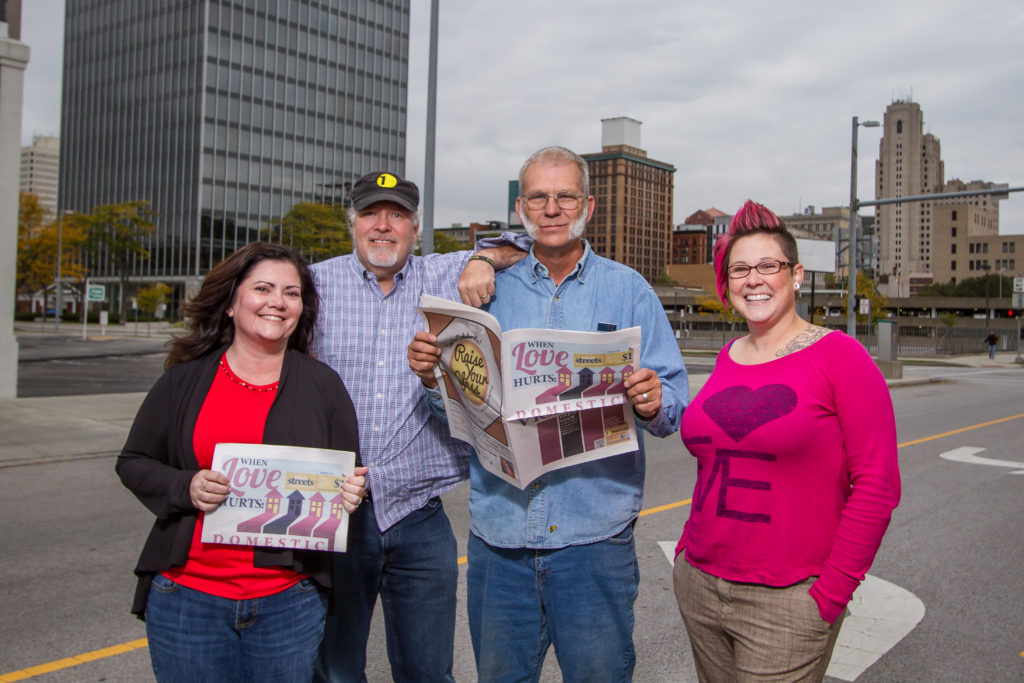
From left, Karin Coble, Ken Leslie, Lawrence Staler and Christy Grob of Toledo Streets.

After serving 21 years in a Texas prison, Lawrence Staler owed $59,800 in back child support payments in Ohio. He was sent to Bowling Green through a prisoner transport system to meet his obligations.

Without a job or a home and with a weight of debt, his future looked uncertain.

The now-56-year-old found his way to Cherry Street Mission, a homeless shelter in Toledo, where he met Amanda Zuehlke, who would transform his life through her newspaper, Toledo Streets.

The urban, sold-on-the-street newspaper that serves homeless people turns 5 this year.

To honor the anniversary, Toledo Streets will hold a fundraiser, “Raise Your Glass,” Oct. 17 that will coincide with Glass Month in October.

The fundraiser, presented by Columbia Gas of Ohio, runs from 7-10 p.m. Oct. 17 at the Gathered Art Gallery, 23 N. Huron St., and will feature live glass blowing, an auction of the glass creations and refreshments. Two drinks tickets will be handed out at the door. Tickets should be purchased in advance for $35 at toledostreets.org/tickets. Space is limited.

For Zuehlke, the wheels started turning on an idea for a street paper in 2008 after she attended Tent City in Toledo. She began educating herself on homelessness. In the spring of 2009, a friend sent her a New York Times article on street papers and she thought again how much she’d like to be a part of that movement in Toledo.

She talked to people. She attended a North American Street Newspaper Association conference in Denver and then teamed up with Ken Leslie of 1Matters who pitched in with financial support. The first issue came off the press Oct. 15, 2009, with a feature story celebrating 20 years of Tent City.

For its first three years, Toledo Streets was operated by volunteers. Zuehlke was doing a great deal of the work — all the layout, the editing, some of the writing and running the vendor management program. Today, it has a paid staff of two and a brand new 501 (c) 3 status with eight board members.

“I’m working on issue 39,” said Zuehlke, who got married and moved to Cleveland but continues as interim director and serves on the board. “We recently made a commitment to being a monthly publication now. The people we serve deserve to have a fresh product.”

ZUEHLKE

Leslie, whose nonprofit 1Matters has been the parent company of Toledo Streets from the get-go, likened the newspaper’s new nonprofit status to a child leaving the nest.

“It’s awesome,” he said. “It’s like a 30-year-old child still in the basement and you’re glad when it gets out on its own. The bird is kicked out of the nest. It will fly and it did fly. It will continue to be successful.”

The eight board members are Zuehlke, Leslie, Karin Coble, Liz Simon, Jason Copsey, Steve Atkinson, Ann Malak and Greg Loeb.

Zuehlke gives Toledo Streets credit for making her into a better person.

“When I started the paper, I was a broken and a quite often depressed person. There was a huge poverty of self and in doing this and working hard and through all the ups and downs and doing something that was bigger than me really just prepared me for the next stages of life,” Zuehlke said.

Last May, Zuehlke tied the knot and now has two “amazing” step-daughters, she said.

“I don’t think I would have been the person to step into that and been able to succeed with it [if not for my experience],” Zuehlke said. “Toledo Streets has made me richer.”

She sees her role as a cheerleader, supporting the vendors in the often thankless job of selling the paper.

The vendors who hawk the paper at select locations around the city are direct benefactors of the paper. The first 10 papers they sell for a suggested donation of $1 are free. After that, the papers cost them 25 cents to sell to cover operating costs. They keep every cent they earn.

The program is called a microenterprise venture and vendors are responsible for paying their own taxes.

Currently, there are 12 vendors but none of them are what Christy Grob calls “unhoused.” Grob is the manager of the vendor program, providing guidance, support and encouragement. They are a diverse group, she said.

Some have been homeless in the past or are currently in danger of becoming homeless. Others came from a shelter and worked their way up to an apartment. Still others have their own place and car but are living in poverty.

“We have young ones and older ones, quiet ones and go-getters,” Grob said.

In her year and a half at Toledo Streets, Grob said she’s seen half a dozen people go from living in a shelter or couch surfing at a friend’s house to renting their own apartment or finding that traditional job they’ve been searching for.

Unfortunately, most vendors don’t stick with the program, Grob said.

“The vendors get out of it what they put into it,” she said. “We provide the opportunity for them to work their way and get what they need out of life.”

The average vendor makes $14 an hour. Some might make $25 an hour, others $5. It depends on the vendor, Grob said.

After Staler met Zuehlke, she had him fill out a form and gave him the 10 free issues. He didn’t know where to sell, so Zuehlke set him up at the Municipal Court at 555 Erie St. Downtown.

“I thought to myself, ‘If I can’t sell these things, I’m going to throw them in the trash,’” Staler recalled during a recent phone interview. “I sold them within the hour.”

With about $15, he bought his second stack of papers at 25 cents each. Soon, he was selling 250 to 300 papers a week at the courthouse. At the Old West End Festival one year, he made $650 over two days.

Staler started paying down the child support he owed. He has been able to reduce his debt by several thousand dollars, he said.

In 2012, Staler was appointed by Leslie to advertising sales representative for the paper. That year, he made $18,000 in six months. In 2013, he became senior sales representative and was able to put a down payment on an acre and a half lot in Oregon.

Today, Staler doesn’t have much time to sell ads, or the paper. He has moved into a full-time job at Aqua Blok operating a forklift. He works 12-hour days, five days a week. Next year, he has plans to build a home on his property. He’ll live there with his new wife, Patricia, whom he married May 1.

What’s the secret behind his success?

“I took the hustle I developed in prison and found a way to use that on the streets selling the street paper,” Staler said. “I’m aggressive when I sell. I’m bold when I sell. When people say ‘Get away,’ I say ‘What? Do you have a problem with the street paper?’ Some actually stopped and listened to me and some actually wanted the paper.”

Vendors must obey the laws of the city, stay off private property and, for their protection, wear an orange safety jacket if they step into the street to collect money from a car. They must respect customers and other vendors. Other than that, they have freedom in how to sell the paper.

“It’s all up to them in how they run their business,” Grob said.

Staler related a story about a man who came out of the courthouse in 2012 “stomping and cursing.” Staler said he tried to give the man a paper but the man just cursed him.

“I said, ‘God Bless you,’” said Staler, who turned to Christianity in 2004 while in prison.

The man paid for a paper with a $50 bill that day and he returned to Staler for a paper every year thereafter, always paying with a $50 bill.

After Staler started making good money this year, he told the man to keep his $50, that he didn’t need it anymore.

“It wasn’t a job for me,” Staler said. “Yeah, I made good money and made a lot of people smile but it was fun for me.”

Staler gives most of the credit for his success to Zuehlke.

“People come to us with different work ethics,” Zuehlke said. “We’re dealing with people who have been beaten down by life and constantly rejected and looked down upon.”

Some vendors have been with the paper for a couple of years, which is fine, said Karin Coble, the new president of the board of directors. Others go on to different jobs and careers.

“We want to serve as many people as want to work,” Coble said. “We try to make ourselves available to anyone who is ready and willing to start this process of getting back to work.”

Toledo Streets has also seen some other changes recently.

Rachel Richardson was hired July 1 as development director. Her job is to raise money and so far, has secured a corporate sponsorship for $10,000 with TARTA. In the deal, TARTA will get editorial space in the paper every month and will have a column, “The Bus Stop,” on schedules and changes to its bus routes.

Toledo Streets is looking into moving into its own space. Several locations are being considered, from Uptown, to Lagrange Street to the Old West End. They are searching for store-front property where they can hold their vendor support meetings, do programming and distribute the paper.

“It’s all about giving them an opportunity to give them autonomy and be more financially stable,” Coble said. “We look to transition people. Our hope is they’ll learn the skills through working with us.”


Natural gas line under Maumee River nears completion

0

A $7.5 million natural gas line replacement and upgrade by Columbia Gas of Ohio, which is being directionally bored 30-40 feet beneath the Maumee River between Maumee and Perrysburg, is nearly complete.

On Sept. 29, a GPS-guided drill broke through the Perrysburg side of the river after the process began on Sept. 13. Workers will spend up to three more weeks widening the initial 10-inch pilot hole to 30 inches, before pulling eight 330-foot sections of 20-inch coated steel pipe through in a rigorous, nonstop 24-hour continual pull, according to Tammy Wheeler, project coordinator.

Jason Copsey, Chris Kozak and Tammy Wheeler of Columbia Gas of Ohio at the site of the pipeline upgrade in Maumee. Toledo Free Press photo by Tom Konecny

Jason Copsey, Chris Kozak and Tammy Wheeler of Columbia Gas of Ohio at the site of the pipeline upgrade in Maumee. Toledo Free Press photo by Tom Konecny

Each 330-foot section takes about three hours to pull, and the sections were tested four individual times to ensure sound construction and gas supply integrity. Crews were pleased to find rock beneath the river bed, which presents a sturdier passageway than sand, which can collapse while boring.

The project will update about 5,300 feet of 12-inch uncoated pipe that was originally installed in 1940, almost half of which is located under the Maumee River. Columbia Gas expects the new pipe to have a lifespan of more than 100 years, according to Chris Kozak, communications and community relations manager.

The entire project began in mid-July and was described by Columbia Gas officials as “once in a generation” due to its length and scope. Development has taken more than five years and has involved state and federal EPA, the U.S. Fish and Wildlife Service, Ohio Corps of Engineers, Toledo Metroparks and the cities of Maumee and Perrysburg.

When complete, the new line will be used to transport natural gas below the river to homes and businesses in Maumee, Perrysburg and South Toledo. The upgrade also ensures adequate gas supply for all of Northwest Ohio in case of extreme weather.

The project’s location near Fallen Timbers in Maumee and Fort Meigs in Perrysburg presented some historical considerations, meaning an archaeologist was on site during the work.

No items have been found, though Columbia Gas worked closely with area historians to re-route the line around a little known cemetery and assured any artifact discoveries would go directly to the municipalities.

Gas line entry work on the Maumee side was completed near walking trails in Side Cut Metropark; that land will be restored to its original state. On the Perrysburg side, several trees were cleared to make room for construction near the gas line’s entry point, and Columbia Gas will convert that area into a new park for the city.

The new gas line is expected to be operational in early November, and following site cleanup, Columbia Gas expects to be off site no later than Thanksgiving. The new Perrysburg park entryway and parking lot will most likely be completed by or in spring 2015.

Fuel, belts among snowmobile winter checks needed

0

While the average person may cringe at the approach of another intense Midwest winter, for avid snowmobilers the change in seasons means it’s time dust off their machines and get ready to hit the trails.

Dan Cunningham, the shop foreman at Honda East in Maumee, has been snowmobiling since he was 12 years old. He says this past winter was a banner year for snowmobiling.

Snowmobiles can sustain more damage while stored over the summer than in use during the winter, said Dan Cunningham, shop foreman at Honda East in Maumee. Toledo Free Press photo by Christie Materni

Snowmobiles can sustain more damage while stored over the summer than in use during the winter, said Dan Cunningham, shop foreman at Honda East in Maumee. Toledo Free Press photo by Christie Materni

“You could go back 30 years and not find a better winter for snowmobiling than we had last year,” Cunningham said.

Consistent snow cover on the lower Michigan peninsula meant it was a popular year to start snowmobiling, and while more snow means less wear on the machine, it also means more activity, making proper maintenance vital as the region gears up for what could be another heavy winter.

“The biggest thing is fuel,” he said. “Drain any excess fuel, put in fresh fuel, check the fuel gauge and replace it if necessary.”

It is also important to check high-maintenance parts like clutches and drive belts.

Sam Black, co-owner of DZ Motorsports in Genoa, recommended stocking up on an extra drive belt at the beginning of the season to avoid being stranded if your first part breaks.

Cunningham also suggested making sure riders replace ski wear rods and the plastic hyfax that cover them.

If proper preventative maintenance was performed at the end of last season, these routine checks should be all you need to get your snowmobile back out on the trails, both men said.

“The key is to maintain a snowmobile properly before it’s put away,” Cunningham said, “More damage happens when they’re sitting in storage than when they’re actually operating.”

This means that before putting the machines in storage, conscientious snowmobile owners would have drained the engine of fuel to prevent buildup of gooey “varnish,” “fogged” or coated the engine with oil, removed the battery and the drive belt and cleaned the machine thoroughly to prevent salt buildup from causing corrosion.

“Once the snow melts, sometimes people just park it in the garage and don’t worry until fall,” Black said. “Then it sits all summer and can become a big pile of corrosion and rust.”

Vehicle maintenance

Of course, while snowmobilers are waiting eagerly for winter to arrive, most automobile owners are dreading the slippery, snowy roads and the unpredictable weather of the Great Lakes region.

However, a few simple steps can save drivers a lot of worry in the winter months, area experts said.

Bob Kazmierczak, enterprise development manager and vice president of automotive services at AAA Northwest Ohio, said aside from cars getting stuck in heavy snow, batteries dying suddenly tops the list of the light maintenance calls AAA gets during the winter.

“It’s the same as getting gas. People don’t wait until they run out of gas to get more, but for some reason people tend to wait until their battery dies before they worry about it,” Kazmierczak said.

The average car battery lasts around four years, and changing it before it dies can help drivers avoid dangerous situations.

Even the most meticulous driver can be caught off guard by winter conditions, so if drivers do find themselves stranded on the roads this winter, Kazmierczak recommended keeping a blanket or extra coat, a small shovel, a first aid kit, a bag of rock salt, a flashlight, water and a granola bar in the car. He also recommended keeping a candle and matches, which can provide both heat and light until help arrives.

Checking the tires’ tread and all fluids, including oil, transmission fluid and coolant, is also recommended.

“Coolant fluids actually will keep the engine from icing up and will provide heat inside the car, so make sure you have enough of that,” Kaz-mierczak said.

A general inspection of the vehicle by a mechanic, especially to check steering, brakes and suspension, is always a good idea, Kazmierczak said.

“We get a lot of potholes as a result of the weather and the salt on the roads really tears up the suspension, so you’ll have less problems at the end of the winter if you start out with everything in good condition,” he said. O

‘Can’t Sit Still’: Jeff Stewart celebrates new CD

0

“I can’t wait for these people who are helping out and pre-ordering — they’re gonna get some cool stuff. And get the record. And that’s what I care about, that’s all I care about. I just want my friends to get the songs, and hear ‘em the way I hear ‘em.”

— “Jeff Stewart can’t sit still,”

Toledo Free Press, Sept. 26, 2013

It’s a year later, and the time has come. After a successful fundraiser on the website Kickstarter backed the production of Toledo musician Jeff Stewart’s long-gestating album “Can’t Sit Still,” the last obstacle facing its release was work. Long, long hours of work polishing the songs that had been waiting to be perfected for over eight years.

A CD release party for Jeff Stewart’s new album “Can’t Sit Still” is set for 3-5 p.m. Oct. 12 at The Village Idiot in Maumee. Photo by Heather Ballmer Meyer

The donors who made the Kickstarter a success were the first to get a finished copy of the CD over the summer, naturally. Now, it’s time for the rest of Stewart’s expansive fan base to get their chance.

“When we did it, I was so apprehensive, and not really for it, necessarily,” Stewart said in a new interview with Toledo Free Press. “And then, to see the support that I got from it — I was kind of blown away. And then we got more than we figured, the amount, and I was thrilled. And then, we got it done. It’s that simple.”

To celebrate the album’s completion, Stewart is holding a CD release party on Oct. 12 at the Village Idiot in Maumee. The shindig is set to take place between 3-5 p.m. — at first glance, an early start time for a party honoring one of the most beloved figures in the Toledo music scene.

But Stewart said the timing was deliberate.

“I want it to be low-key. I wanted it to be during the day on a Sunday afternoon, low-key.

“I like the energy of The Village Idiot so much — it seems to be a universal place where people can come together and drop all pretensions, and just go have a good time.

“I wanted it also to be where musicians could attend. A lot of [us], obviously, were doing our thing on weekend nights or all throughout the week. So it made sense to me to do a low-key event on a Sunday where you can stop by, if you’re driving down the river, you can just pop in.”

The seeds of what would become “Can’t Sit Still” were first planted nearly a decade ago now.

In the aftermath of a painful divorce, Stewart plowed himself into his music, channeling the emotions into the creation of tunes that he has spent years trying to refine. He said that thanks to his Kickstarter backers, the spirit of the songs has never diminished throughout the process of bringing them to the new album.

“We didn’t have to short-change ourselves or anything. I didn’t have to cut any corners. I was able to do exactly what I wanted,” Stewart said. “Sometimes, you get done with a project and you’re like, ‘I wish I would have done that,’ or something. But you just have a feeling of completion with [the CD]. I can rest on that now.

“The vision was there, and we were going to finish no matter what. If it took another ten years, we were going to make the songs the way they needed to be.”

So, looking at the finished product, does Stewart see a piece that accurate captures who he is as an artist at this stage of his career? The result is mixture of both the past and the present, it seems.

“You’re not going to stay the same age, so you do evolve. Your emotions change, and then you move on from certain opinions you might have been about. But they’re still a part of your story. So you see now — you’re not exactly in that same frame of mind, but you go there, so you might tell that story. So you can kind of go there if you need to.”

The struggle to bring “Can’t Sit Still” to listeners has brought Stewart’s career full circle in many ways. Years of emotion, expressed through art, which only saw completion through the support of his friends and fans. And now those same individuals will finally get the chance to experience the piece as Stewart had always intended.

“The support is so amazing among all [my] other friends. We were all in the trenches together,” Stewart said. “I’m not the young pup anymore. The young pups are out there doing it. I’m kind of the — I’m grandfathered in.

“I had to make sure that I was standard-bearer,” he added. “I couldn’t put out something that was junk. I had to put out something that was top-notch, so I could give it to those musicians, and you know, they could listen to it and hopefully say, ‘You know, man, I want it to sound like this.’” O

Upcoming Walleye season to feature ‘Frozen,’ Winterfest

0

Themes for the upcoming Toledo Walleye hockey season include “Frozen,” “Gilligan’s Island” and “Batman.”

The season kicks off Oct. 18 and features events that families can enjoy, even if hockey isn’t among their favorite pastimes.

“We always try to keep it fresh … so even the season ticket holders are getting a little something different every game,” said Special Events Coordinator Emily Croll.

One of the most anticipated is the “Frozen” theme, which will be Nov. 8. Two characters from the movie will appear and there will be a “Princess Tea Party.” Croll said families have already taken interest in this theme.

Winterfest. Illustration Courtesy Toledo Walleye

Winterfest. Illustration Courtesy Toledo Walleye

“This has been, by far, one of our most popular events of the season,” Croll said. “This is something we just came up with, with the popularity of the movie and it just fits in with the hockey theme. It’s just a totally different fan base that we don’t usually host events for.”

Another theme is perfect for superhero fans and will celebrate the 75th anniversary of “Batman.” A themed jersey will be auctioned during the game with proceeds going to charity. Batman Night will be Nov. 22 and will also include a “Teddy Bear Toss” where fans will throw stuffed bears onto the ice after the Walleye score their first goal. All bears will be donated to charities.

Other themes include the popular “Star Wars” night Nov. 15 and a “Gilligan’s Island” theme March 28.

“Our ‘Star Wars’ night is always popular,” Croll said. “As old as the movies are, people still enjoy them. It’s kind of interesting that we find adults that love ‘Star Wars’ [and] kids that love ‘Star Wars.’”

Winterfest

Winterfest, a 10-day event planned for Dec. 26 to Jan. 4, has been two years in the making.

The program will include various events at the Huntington Center and an outdoor ice rink on Fifth Third Field. A series of hockey games and other recreational events will take place from 7:30 p.m. to midnight every night of the 10 days. On Dec. 27 and Jan. 3, Walleye games will take place as well.

Winterfest will include youth, college and adult games, community open skates and more. A New Year’s Eve party and a “Winter Brewfest” will also be offered.

“It’s not just for the Walleye games,” Croll said. “We have been working to get the community involved and we really wanted it to be a whole 10-day event.”

Croll said outdoor hockey games have become popular.

“The fact that we already have the baseball field here and that the Mud Hens and Walleye are so closely related, it was just a great fit for us to put on this event,” Croll said. “Just to be able to utilize two venues has given us the opportunity to host as many youth teams in 10 days as we do in a whole season.”

This is the first time the Walleye organization has done anything like this. Croll said the event is perfect for families.

The season will kick off at the annual FinFest Pregame Party in the Aquarium at the Huntington Center. The event is free for anyone attending the game and will include drink specials, face painters and free giveaways. Live music from The Bradberries will be featured and head coach Derek Lalonde will address the crowd.

The party will be from 4:30-6:30 p.m. Oct. 18. The Walleye will play the Cincinnati Cyclones directly after the party.

Chess transforming students at Jones Leadership Academy

0

In the halls of Jones Leadership Academy — the former Jones Elementary School, now reborn as part of the district’s plan to transform itself — one of the most striking transformations taking place may be centered around one of the world’s oldest forms of competition: chess.

In 2013, students under the guidance of coach Warren Woodberry won the 10th Annual TPS Chess Tournament, covering 35 schools from all over the Toledo area. For any group of kids to rise to the top in such a competition is impressive. But for a program only a few semesters into its existence — from a district struggling to reinvent its academic reputation in a time of restructuring — it’s extraordinary.

Leadership Academy chess students honored by Toledo City Council. Photo Courtesy Warren Woodberry

Jones Leadership Academy chess students honored by Toledo City Council. Photo Courtesy Warren Woodberry

Yet the coverage for this achievement was almost nonexistent.

“If we were a football team or a basketball team in 2013, and we won the championship, we would be covered in the sports page, we might be mentioned in your academic books or your newspaper,” coach Woodberry said in an interview with Toledo Free Press. “How a little inner-city school, with a mix of African American, Spanish and white — diversity — we beat every school in the city. Out of the 35 schools, we won first place as a team, and first, third and fourth as an individuals.

“That’s Ottawa Hills, that’s Maumee Valley, that’s Start, that’s Central Catholic. That’s all of them. Not a peep,” he added. “For one of the inner-city schools that has decided to do this, and win in chess — which is one of the most difficult sports — why wouldn’t there be some coverage, or some encouragement or something?”

The story of Jones students embracing one of the most demanding of all games may have largely gone unnoticed at first, but the seeds of the students’ newfound passion have begun to sprout in arenas far removed from simple competition.

“We actually started the program as ‘Kids, Cartooning and Chess,’” Woodberry said, recalling the program’s early days. “But once we got here and we introduced the chess segment of it, we found the kids really gravitated to that.”

The impact of introducing a game with such rigorous structure to his students has not been lost on Woodberry. He cited numerous studies that demonstrate how students who did well in chess had improved scores on standardized tests, with gains even greater among children with low social and academic skills.

“Also, the emotional intelligence of children in chess — it’s a game where they have to be polite. Where they have to learn to lose — they can’t stand up on the table and punch someone. So it’s a game where they have to show control and respect. It’s a very good game for people who have anger management [issues], because we have kids that have that.”

The fruits of the program’s labor have begun to be born in Jones classrooms, Woodberry said.

“A lot of the teachers marvel at the fact — we have letters from the teachers — that we can get a child to sit down in our class for two hours, play chess, not make a sound, and they would have sent them to the principal’s office three times for acting out and clowning.

“So there’s a lot to the game that makes an individual take responsibility for his actions. He acknowledges the fact that, when he loses, the person is better learned than him. You can’t be a bully in chess. You can’t be a clown. It doesn’t matter whether you’re rich, poor, black or white. You’re using your mind.”

And as results begin to show, so too is acknowledgment beginning to trickle in. On June 17, Toledo City Council officially recognized the Woodberry Park Chess Program, as well as its efforts to promote National Chess Day, Oct. 11. In March, Jones returned to the Toledo Public Schools Chess Tournament and finished second.

Woodberry stressed how an extraordinary amount of credit must be given to superintendent Romules Durant, officer James Gault and Jones principal Ward Barnett for helping introduce chess into the school system.

“The kids that we brought in were excellent at what they did, to defeat all the other kids — the kids that have chess coaches,” Woodberry said. “These kids don’t have that background, but they are willing to learn.”

Downtown’s Okun Produce celebrates 100 fruitful years

0

The Sam Okun Produce Company celebrates 100 years of operation Oct. 11, a distinction that could also make it the Dean of Downtown Businesses, having achieved all of its success in the heart of Toledo.

Supplying fresh produce to Northwest Ohio businesses since 1914, Okun Produce has changed with the times but continues to thrive by sticking to its original ideals.

“We’ve never lost sight of the values, the priorities and the actual mission of Sam Okun,” said Shelly Okun, president. “It’s based on integrity, honesty, quality of product, quality of service and maintaining strong relationships with our vendors, suppliers and customers, no matter how big or small. That’s never changed from the very beginning.”

CEO Fred Okun of Sam Okun Produce, celebrating 100 years in business this month. Fred’s grandfather started the business in Toledo in 1914. Toledo Free Press photo by Aaron Geller.

The bulk of Okun’s business originally came from independent, family-owned grocers located on seemingly every Toledo neighborhood corner. As those small retail stores began to close and shoppers migrated to big box stores, Okun continued to service the smaller retail chains that remained, but also began to focus  on health care, schools, senior living communities and several local institutions.

Okun’s business started thanks to immigration and a simple letter. It was in the early 1900s when Sam Okun’s oldest sister, Fanny, came to New York from Lithuania and happened to visit Toledo. She wrote back to the entire family with the message, “Toledo seems to be a nice place to make a living and raise a family.”

That was all it took for almost the entire Okun family — Sam, his four sisters and parents (two brothers stayed behind in New York) — to move to Northwest Ohio. Sam first used a horse and cart, then eventually a truck, and to deliver produce all over in addition to operating a small market at the intersection of Spielbusch Avenue and Cherry Street. That store moved to Huron Street where the present Fifth Third Field is located.

In 1946, Okun purchased the company’s current Huron Street facility and focused solely on supplying produce; it has maintained the same location since.

The business remains well-rooted in the family, with Sam’s grandson Fred Okun as CEO, and Fred’s daughter Shelly as president. Several other siblings and relatives have played key roles in its success over the years. Okun also has nonfamily employees who have worked with them for several generations, creating an extended group with family-like ties.

“Statistics show that family-owned businesses make it to the third generation, but we’ve made it to five,” Shelly  said. “I’ve walked the same floor that all of them walked. Every day I’m in here I feel them. It’s really neat.”

Okun Produce has also achieved official WBE (Woman Business Enterprise) certification by the National Women Business Owners Corporation, which means that a woman has majority ownership and control of a business entity. In truth, though, the business has been led by the women since the beginning, as Sam’s wife Rose was a central figure in Okun’s early beginnings.

“I listen to my dad tell stories, and [Rose] didn’t have washers or dryers, or cars, or the luxuries that our generations have, yet it was a really good life for them,” Shelly said. “And they raised really happy children, who in turn raised happy children, who also raised happy children. That work ethic is in our genes. She was amazing.”

Fred Okun was also heavily influenced by various family members, and learned similar life lessons.

“I just learned different work ethics (from family),” he said. “Their ethics were above reproach. They just worked hard and taught me very good lessons. I admired them a lot.”

Okun’s allegiance to Downtown started out of necessity, but in time it became a mutual loyalty. In its infancy, Okun was reliant on trains with iced rail cars that came Downtown, as truck refrigeration wasn’t yet an option. However, by the time trucks became refrigerated, rail cars had more than doubled in size and their large capacity meant they were still the desired choice.

All this found Huron Street home to 15 wholesale produce companies in its heyday in the 1940s, a fact largely responsible for giving the Warehouse District its name.

As Okun continues to not only operate but thrive, its leadership knows the day could come where they may have to investigate a more modern facility, all in the name of space and safety.

“It’s not on one floor, so using a freight elevator is a grind, and as we get more business it’s getting more apparent that it could change someday,” Shelly said. “At this point, it’s important to maintain integrity and safety of product.  We have a third party to judge us on how we keep everything safe for the community we serve. This facility might be too expensive for us.”

Fred added, “Time will tell.”

Okun plans to celebrate with an extended family reunion dinner Oct. 10, and then a company open house Oct. 11. It’s a chance to celebrate all things good at Okun and in Toledo.

“My dad is a very loyal and consistent person in his professional life and personal life,” Shelly said. “He could never give up on Toledo. He still believes in it, and now there’s new, young people investing their time in Downtown much like my dad did. It’s a very cool story.”

Retirement Guys: Life insurance strategies start with saving

0

More than 20 years ago, a month after I turned 18, I, Nolan, got licensed to sell life insurance. I knew I wanted to get into the financial services business after my parents taught me to start investing at the early age of 12. My parents also had some friends that were in the financial services business, so I had the opportunity to job shadow them.

.

.

Mike Johnson and Mick Poncsak were my first two mentors when I joined Franklin Life Insurance. I can still remember the 100 men story. As the story goes, the average person will start to earn their first paycheck in their early 20s and their income will usually go up till retirement time. Over the course of their working career they will earn almost $1 million, even more if they have special training. What is interesting about the average person at age 65 is, only four will be well off financially. Forty-nine will struggle financially in retirement time, 22 will live in poverty, and 25 will die before retirement.

Ninety-six out of the original 100 will either be dead or dead broke. Maybe these people didn’t understand they need to have a written plan, a plan to automatically save every month.

Twenty years later, what is interesting is most of those facts, in my opinion, still apply today. The one thing that has changed over the last 20 years is the cost and strategies that are available today when incorporating life insurance into a well thought out written plan.

Term insurance can still be a great option to cover the needs for a set number of years. Costs have generally decreased and new options are available. In 1994 when I started selling life insurance it was mainly done face to face with an agent who represented one or a limited number of companies and a family. Today, independent agents, the Internet and longer life expectancy all have made insurance cheaper.  Plus, some policies now even offer terminal, critical and chronic care riders to protect policy owners while they are alive and not just benefits for others at death. I recommend in term insurance to purchase a policy that has an option to convert to a permanent policy without a new medical review in case the insured’s health changes.

Asset-based policies are another change that I have seen over the years. Do you have an emergency or rainy day fund? In a lot of cases, people we talk with say yes. When we ask what the purpose of that money is, often times we hear it is in case of an unexpected health care crisis. An asset-based longterm care policy may be a better option. Instead of just having the money in the rainy day fund, if a person who qualifies for coverage and repositions the money, it can be leveraged into tax free life insurance benefits as well as longterm care coverage.

Let me give you an example. Sara, aged 64, in good health, had $100,000 in an emergency account. If she took and repositioned $50,000 she could get three benefits. One, if she ever needed the money back, guaranteed in writing she could have all of the money back. Two, if she never needed the money and never had a health care crisis, her beneficiary will receive up to 200 percent of her deposit paid in the form of life insurance. Three, if she had a health crisis, her deposit could be leveraged up to 400 percent for long term care benefits. The amount of coverage depends upon several factors, including Sara’s health, age and type of benefits and company she selects. Yet, bottom line is her $50,000 deposit could provide substantially more benefits than her current fixed account.

Other people don’t have a lump sum money available for asset based longterm care. Thus, another option is what we call a Life Leverage Plan. This policy can provide many of the same benefits as asset-based longterm care, except instead of making a single deposit the owner usually makes payments over time, say, 10 years or over their entire lifetime. Yet, since it is insurance, their money is immediately leveraged in the event of a premature death as well as for long-term care coverage.

Our recommendation is to review insurance policies every few years. This gives the account owner the ability to review costs, like with term insurance, as well as other benefits like we mentioned with policies that include long term care coverage. Before making any changes, be sure to get educated the on the pros and cons of any recommended changes.

For more information about The Retirement Guys, tune in every Saturday at 1 p.m. on 1370 WSPD or visit www.retirementguyradio.com. Securities and Investment Advisory Services are offered through NEXT Financial Group Inc., Member FINRA / SIPC.  NEXT Financial Group, Inc. does not provide tax or legal advice.  The Retirement Guys are not an affiliate of NEXT Financial Group. The office is at 1700 Woodlands Drive, Suite 100, Maumee, OH 43537. (419) 842-0550. Insurance guarantees are based upon the claims paying ability of is insurance company.

The fall of the American dream: Jennifer Rockwood brings ‘Detroit’ to Toledo

0

Much of the human experience in the modern age is an ever-shifting landscape of our own expectations. What the average American wanted out of life decades ago — or even a few years ago — is nowhere close to what they want now.

Turning an eye on that kind of change is the sort of thing that Toledo stage director Jennifer Rockwood has been drawn to throughout her illustrious career. Her latest expression will come on Oct. 10 and 11, with a reading of Lisa D’Amour’s quirky satire “Detroit” at Studio A of the Valentine Theater.

“’Detroit’ is a play about couples’ expectations,” Rockwood said. “Couples’ expectations of the American dream. It’s about two couples who end up in the suburbs, and it’s about how today is very different from, I guess, where it used to be. And maybe we are, in our own ways, mourning the past.

From left, Jeff Albright, John DuVall, Cindy Bilby and Lane Hakel in

From left, Jeff Albright, John DuVall, Cindy Bilby and Lane Hakel in “Detroit.” Photo by Todd Grinonneau

“People used to have block parties, and hang out in the neighborhood, and Big Wheels, and now, of course, people don’t even know their neighbors. Or they may live next to their neighbors for ten or fifteen years and they may not even learn their names. So it’s about the changing world of what we see as the American dream.”

Though the show may be named after the Motor City, nothing in the play itself gives any indication of where the story of its bored and disgruntled suburbanites may be taking place. Which, of course, is part of the point, Rockwood said.

“It’s anywhere. Anywhere on the outside of a downtown, where people — the dream used to be to have a home, to own a home and live in the suburbs, and a nice car, and raise your family and go to the right schools. And people can’t do that anymore —the economy is wrecked, and people are under water, and the ability for us to communicate with our neighbors, and the idea that we are not friends and have block parties and those kind of things is kind of gone.”

This reading of D’Amour’s play — a Pulitzer Prize finalist for Drama in 2011 — fits right in with the canon of material Rockwood has made her own in the city for years. The area’s avid theatergoers have long become accustomed to the director’s affinity for works that are both seeing and humorous — finding the funny side of issues, but with a sting in the tail.

“Those are the kind of plays I like. I like to take serious issues — I mean, laugh, get the audience to laugh, and think about serious issues. While you’re laughing, on the inside you’re going, ‘Oh, God. You know, this is true.’ Or laughing at something that’s really sad. I’m watching the death of something that used to be an important part of America.”

Putting “Detroit” onstage is another passion project in a career littered with them for Rockwood. She jokes about how it often seems her muse has a pattern — discovering a work, becoming obsessed with a work, sharing it with others and, finally, a pressing need to bring a production of it to life.

“I was passing this play around a year ago, telling people that I want to do it. Maybe even longer than that. And that’s what I do — I glom onto a few different plays.

“I find these plays, and I just start passing them around to actors and passing them around to friends and saying, ‘Don’t you think these are great? Tell me what you think about this.’ So some of these people, even though they weren’t cast yet, were on board and liked the play, when I was passing it around a year ago.”

It helps that Rockwood has a core of actors that she has worked with regularly and is comfortable sharing the creative process with. “I like to work with small casts. There’s a joke that big casts are like herding cats,” she said.

“I have a sort of small ensemble that I’ve worked with for quite a while. I have the actors that I like to work with, and they’ve worked with each other before. And we sort of speak the same language. They know how I direct, and I don’t have to use too many words to get them to do something.”

Rockwood has more projects in the months to come — in addition to more directorial work, she’s been focused a lot more on writing in recent days, working on a few plays of her own. Theater may be ephemeral — much like life — but the emotions it can generate live on well after the curtain falls.

“I don’t want to lecture to people. I mean, a lot of plays do lecture to the audience. But I don’t want that — I prefer to make people laugh a lot, and then afterwards, maybe see something a little differently, or maybe understand the human condition a little different.”

Baumhower: Dear Sergio

0

Dear Sergio,

Chrysler’s Jeep Wrangler and I have a lot in common.

The Wrangler and I are both the product of hardworking parents who sacrificed for our future.

  .

.

We were both born and made in Toledo, Ohio. We’re from the same streets and neighborhood. We know the same people, some of whom were made in a Jeep.

We are both driven by family. While I’d do anything to protect the well-being of my loved ones, the Wrangler makes sure their safety is its first priority. As parents, we love to brag about how awesome our kids are — the back window of the Jeep have become a favorite place for us to boast about our children’s activities.

The Jeep Wrangler and myself are built for all seasons — we’re not scared by the cold in the Winter and we’re not afraid to take our top off in the Summer.

We know how to work and we know how to have a good time.

We are both hardworking, never afraid to get dirty or to help a friend in need. We both tend to be pretty low maintenance– just occasionally needing some refreshing fluids, maybe a little romp here or there to keep our engines running and our spirits up. We both like to park and we both enjoy getting some action.

We are loyal. We take care of those who take care of us.

Jeeps have been made and owned by numerous generations of families. Our grandparents made them during World War II. Our parents made them while they were being showcased on “M*A*S*H.” We’ve been manufacturing them ever since … through 9/11 and the bailout — good times and bad. We have put Jeeps on the road and Jeeps have been putting food on our table and children through college.

Our parents bought us our first Jeep — as we find a way to buy one for our children. It’s not a business relationship; we’re family. We share the same blood.

I know you are thinking about changing the body of future Wranglers to the lighter aluminum — we can relate, our wives have been wanting us to get in better, lighter shape for a long time. However, if you choose to move the production of the Jeep Wrangler, our brother, to anyplace other than its home– you are ripping out not only its very heart and soul, but the hearts and souls of its family.

We have been through a lot together, but we have always been there for each other.

Please keep our family together.

With Love, a Toledoan

Email columnist Jeremy Baumhower at [email protected].