Home Blog Page 178

TPS seeking levy funding for salaries, transportation, technology

0

If voters pass the Toledo Public Schools (TPS) levy on the Nov. 4 ballot, the estimated $66.5 million raised over five years would be the first new money for the district since 2001.

The five-year, 5.8-mill levy — 4.3 mills for operations and 1.5 mills for improvements — breaks down to $121.80 a year, or about $10 per month, for the owner of a $60,000 home.

Superintendent Romules Durant, a Waite High School graduate, listed a number of areas the funds will assist, but said he prioritized the safety of students.

Funds raised by the levy would restore bus transportation for students from kindergarten to 12th grade, which was eliminated in 2010. High school students currently have no transportation and some elementary students walk up to two miles to get to school. The need for change was made apparent after the harsh weather conditions last year, Durant said.

“Last winter was an eye-opening experience,” he said. “We want to make sure safety is our priority. … We heard it from the community and from parents who made decisions to go elsewhere because of that.”

Maintenance and repairs to the existing TPS facilities and purchasing school computers will also be funded by the levy.

“Our buildings look new; the reality is that iPhones weren’t even invented when we started,” he said. “[Technology] has drastically changed. We need to make sure that these kids, who we consider the digital natives, are having the practice and experience with the most updated technology.”

Durant said that because some testing is now online, the schools need the proper bandwidth to accommodate it.

The levy will also help increase the salaries of TPS teachers, currently among the lowest-paid in the region. Durant said without quality teachers, programs are not being driven the way they should be. He said that he wants to use levy funds to improve conditions in regards to “recruitment and retention” of staff members.

Durant said he will continue implementation of the district’s Transformation Plan, which aims to “increase community partnerships, broaden educational opportunities for students and establish neighborhood schools” in order to increase state performance ratings. The plan has already seen success, Durant said.

“If you want collective impact, you have to have collective work,” he said. “When people say Toledo is a compassionate city, I find that to be in true reality.”

If the levy passes, TPS will not be on the ballot again until 2018 when the current tax levies are due to be renewed. Durant said he will consider cost-cutting even if the levy is passed.

“We’re being judicious with our taxpayers’ dollars so we’re going to make sure that we’re doing our best in regards to spending it appropriately and efficiently,” he said.

Other school levies

Voters in four other local districts will also find levies on their ballots.

– Washington Local Schools will ask for a new, continuous 4.9-mill levy for current operating expenses.

-Oregon City Schools is asking for an emergency five-year, 5.9-mill levy.

-Springfield Local Schools is seeking two levies: one a five-year, 1.35- mill renewal levy for permanent improvements and the other a new, continuous 7.9-mill levy for current expenses.

-Maumee City Schools will ask voters to approve a new, continuous 3.9-mill levy.

Service agencies seek levies

0

Lucas County Children Services said they will be forced to cut a program that helps kids stay out of foster care and trim valuable staff if a levy they’re seeking on the November ballot fails.

Dean Sparks, executive director of LCCS, said the agency has already frozen enrollment and will eliminate the $180,000-a-year program that provides financial support to relatives who care for kids if the levy does not pass. The program’s end will force more children into the foster care system, Sparks said.

The agency is asking for voters to renew and extend its current 1.4 mill levy set to expire in 2016, and support an additional 0.35 mills, through 2018. The levy is a property tax that will cost the owner of a $100,000 house $54.25. Residents now pay $42 at the current millage.

Sparks said the agency has cut its spending this year from $46.5 million to $40 million in order to maintain its services and has had little help from the state and federal government. He has seen a “significant reduction” in state and federal dollars, placing the burden for financial support on local institutions.

“The State of Ohio is the 50th in the nation in support of child protection; and that’s something that we in Ohio are going to have to struggle with,” Sparks said. “We used to have 405, now we have 349 staff people. We can’t cut anymore. The next cut is staff and services.”

The renewal and additional levy will raise $11.8 million to meet its $42.5 million budget. The agency will see about 12,000 children this year and will handle 5,000 new reports of abuse and neglect in Lucas County.

Most of the children the agency serves are five years old and younger; however they are seeing more older kids due to the fact that they deal more with juvenile court by helping kids gain independent living outside of foster care.

The “faces” of the kids are changing: they come with more needs; they have more siblings; more require institutional care; LCCS keeps more kids until they are 21 years old to guide them through high school, college and into the workforce.

Many of the LCCS children have special needs such as autism, developmental issues or behavorial issues. Some children have parents who are victims of domestic abuse, have a mental illness or lack stable housing. Some 100-plus children were trafficked in Lucas County.

“We’re seeing 9-year-olds that are homicical and suicidal and kids getting suspended from kindergarten,” Sparks said.

The levy is also about kids who have been affected by heroin, either addicted at birth or with parents who are addicted.

Sparks said the agency is seeing success in its foster care program in which more kids are graduating high school than ever before and more kids are entering college from foster care than in the past. The figures are dim: a third end up homeless and another third in the criminal justice system.

LCCS has a “very dedicated” staff of 200 case workers, Sparks said. If the case workers are unable to help the children now then they will return in the criminal justice system later.

“The citizens of Lucas County have always been supportive,” he said. “They have always cared about kids.”

Senior Levy

Billie Johnson, president and CEO of the Area Office on Aging Northwestern Ohio, has requested a 5-year renewal of the agency’s 0.45 mill levy that expires at the end of the year, as well as an increase of 0.15 mills.

“It’s a modest increase of 0.15 mills. I say modest because last year we never got the money we were certified (by the auditor) to receive,” Johnson said. “That’s the reason we went out for more money.”

The auditor tells applicants what dollar amount they can expect to receive at a certain millage. Johnson said her agency received $3.5 million this year from its levy, a million less than expected.

The agency needs the money, Johnson said, to meet growing demand from an 11 percent increase in the Lucas County senior citizen population since 2010 and for its four main areas of service: nutrition, Alzheimer’s care, home care and senior center services.

“We use the levy to match federal and state dollars,” Johnson said. “When we don’t get the money, you can’t deliver the services.”

Ninety-two cents of every dollar goes toward program costs and eight cents toward operating costs, Johnson said.

“(The levy) is really very important,” Johnson said. “We have pretty close to 50 agencies that get this money and if they don’t get these dollars, they will really have to cut services and maybe eliminiate some. It’s not all of their funding, but a good portion. Most of the agencies’ funding were reduced since 2009, close to 15 percent, when at the same time, our population increased.”

Mental Health Levy

Mental Health Recovery and Services Board is seeking to renew a 10-year, 0.50-mill levy.

The agency said it anticipates about 26,000 Lucas County residents will receive treatment for mental illness or addiction in fiscal year 2014, a 4 percent increase over the previous year.

Executive Director Scott Sylak said he expects the levy, if it passes, will generate $3.4 million dollars.

Sylak said the agency lost $2.6 million in state and federal funds this year. Last fiscal year, the legislature put an additional $50 million in the budget of which the agency received a portion. That money was later retracted, Sylak said.

“We still have a tremendous need for services,” Sylak said. “Not only treatment but support that helps stabilize individuals on their meds and help them recover from their addiction.”

One in four families are affected by mental illness. A “significant” number are in jails and have contact with law enforcement, Sylak said.

“Voters have been generous in the past,” he said. “We want to keep that momentum moving foward and prove that the services are needed.”

The levy funds will help the agency address the heroin epidemic, allow them to continue to help people — 3,700 last year — negotiate a “significant crisis;” provide emergency shelter; help house 600 individuals who would be in a shelter, and fund training for law enforcement, among other services.

“We fund a network of 21 agencies that employ 1,600 individuals,” Sylak said. “We will loose services. If this levy is not renewed, we will cut $3.4 milion dollars out of our budget. That will absolutely affect people. We are trying to get the word out.”

The agency, in order to be a good steward of tax dollars, took an internal look at itself and lowered administrative costs in 2007.

Ninety-four cents of every dollar collected by the levy goes toward its network.

Sylak said they are seeing benefits from the levy money. More people are being released from hospitals and they are seeing a “good return” on treatment.

“We recognize we have a lot of work to do,” Sylak said. “Every service we fund has an outcome and we monitor that twice a year.”

Sylvania may lay off firefighters, close station if levy fails

0

If a 1.5-mill levy fails to pass at the ballot box, the Sylvania Fire Department said it may have to layoff firefighters and eventually close a fire station, said the department’s fire Chief, Jeffrey Kowalski.

“The next year’s going to be a challenge,” Kowalski said. “I have a deficit next year. I may have to lay off a few firefighters…. I won’t be able to maintain a fire station…. It’s not a threat; I’m not trying to pull one over on the public; it’s not a threat just the reality of it. We have done so much with so little for so long we’ve become good at it.”

The department currently has 56 fulltime firefighters/paramedics who staff four fire stations 24 hours a day.

The continual 1.5-mill levy would collect about $1.82 million annually and would cost the homeowner of a $100,000 house $53 a year.

In 2008, the fire department asked for a 2.5-mill levy and promised they would not come back for five years, Kowalski said. “It’s been seven years,” he said.

Kowalski cited a decrease in expected revenue from depreciating property values coupled with rising demands on his department as reasons why he needs the extra money.

The levy in 2008 was expected to bring in $1.8 million a year, but only generated $1.5 million due to re-evaluation of property tax values, he said. With that levy money, they replaced three fire stations that were falling apart — one 85 years old — and bought three engines and a truck. Kowalski said they spent money only on areas of need and tightened their belts when less money came to the door.

“We tightened our belts and did away with purchasing things we needed before going back to the voters,” he said. “Unfortunately, we don’t have another way of funding our department. We have no payroll tax and we don’t transport people so we don’t get any money for that.”

The fire chief said his department has been doing more with less for years now yet it remains No. 1 and No. 2 on its level of runs in a comparison with six other departments in the Toledo area. Few other departments protect a city and a Township, he said.

The demands have increased. Over the past 10 years, runs have gone up 47 percent and the population has increased 9.6 percent, yet Kowalski staff has decreased, he said.

“We’re doing more with less and trying to make it work,” he said.

The response to the levy has been mostly positive with some folks saying the Sylvania Department should go back to being a volunteer department. To that, Kowalski says they wouldn’t have the same level of response time.

“Response time is key to saving lives,” he said. “You have a better chance than anyplace else of being saved in Sylvania and the township. Each engine and truck that leaves the station has all the equipment.”

With the new levy money, Kowalski said he plans to put some firefigthers on full-time status because runs are going up. Since 2007, runs have gone up 2.7 percent every year. Last year, the department had 4,500 incidents with 7000 responses. Responses are the number of vehicles put into service for an incident. Most of the runs — 77 percent — are EMS and the rest are fire.

He wants to replace aging equipment, including radios, a 20-year-old fire truck and an aerial truck in 2020. He said he is setting money aside each year for new vehicles.

“We want to improve our basic life support system,” he said.

Kowalski said the department “did its homework” on the financials of building three new fire stations rather than renovating the old. He said it would have cost twice as much to renovate.

Four businesses to be inducted into EBE HOF Nov. 6

0

Four area businesses were recently named this year’s Entrepreneurial & Business Excellence Hall of Fame (EBE HOF) honorees and the group also announced plans to form a group just for women.

Honored for business excellence are American Broadband + Telecommunications, Hanson Inc. and The Oasis Restaurant & Delivery. Honored for excellence in family business is Rima Manufacturing Company.

The EBE HOF recognizes outstanding entrepreneurs and business leaders who have built and sustained growing businesses and created jobs in the region, said Adam Davenport, EBE HOF chairman and president of Gorillas & Gazelles, founding sponsor of the event.

The companies will be inducted during a public ceremony Nov. 6 at The Pinnacle, 1772 Indian Wood Circle, Maumee. Networking will start at 5:30 p.m. with the first set of awards announced at 6:30 p.m. Cocktails and hors d’oeuvres will be served and a cash bar will be available. Tickets are $85 with various sponsorship packages also available.

The winner of the Davenport-Longenecker Lifetime Achievement Award will be announced at the event.

The EBE HOF began as the Ernst & Young Entrepreneur of the Year program in 1989, brought to the area by Adam’s father, Larry Davenport. In 2006, Gorillas & Gazelles founded the EBE HOF, which took over the inductions.

More than 700 people attended last year’s induction ceremony and the event grows each year, Adam said.

“That proves and validates that we are doing something really great for the community and people need to know about the positive aspects going on in this area,” he said. “Every year, I get so many calls and emails after the event saying, ‘Oh my gosh, I did not know those companies even existed.’ The motivation all of the honorees give year after year is just truly astounding.”

Nominees come from businesses within about 60 miles of Toledo and winners are chosen by an independent panel of judges.

“Particularly as our Fortune 500 base has diminished, the entrepreneurial base has done a marvelous job of filling in for it in Northwest Ohio,” Larry said.

Partnering with Bowling Green State University has been great for EBE HOF, he said.

The university brings about 100 students to the event as ambassadors and for networking and learning opportunities, said Kirk Kern, director of BGSU’s Dallas-Hamilton Center for Entrepreneurial Leadership.

“What we’re trying to do is get students started on the right track,” Kern said. “This gives them the opportunity to look to the future and say, ‘Listen, if I start my company today, five years from now, 10 years from now, 20 years from now, look where I could be and be recognized.’”

EBE HOF also partners with BGSU on its E-Week, or Entrepreneurship Week, in April, which features a startup business competition called The Hatch. As many as 12 student finalists chosen to go through a 10-week training course with BGSU professors and alumni entrepreneurs compete.

Starting last year for the 25th anniversary of the business awards, the EBE HOF started hosting speakers and other events throughout the year.

“A lot of people love that we did that,” Adam said. “One of the things we want to focus on this year is what we going to do for the next 25 years.

“Each year we get bigger and better and bring different ideas. There are a few things we have in the works this year that we hope are going to blow away the audience. They are going to say, ‘Oh my gosh, it’s not just the ceremony anymore.’”

New this year is the formation of Women of EBE, a branch of the EBE HOF for female inductees as well as member spouses.

For more information, visit www.ebehof.com.

Glass City Athletics complex hosts grand opening

0

Tenants at the “mancaves” of the Stone Oak Business Condominiums at the corner of Airport Highway and Albon Road have new neighbors after last weekend’s grand opening of a new facility for the veteran youth volleyball organization, Glass City Athletics.

The 22,500-square-foot facility will house Glass City Athletics’ travel youth volleyball program, as well as Toledo Elite Basketball Club and Toledo Sport and Social Club adult recreational sports.

Developer Stephanie Kuhlman of Industrial Developers Ltd. estimates the facility will bring in 300-400 people a weekend during travel volleyball tournaments. This could mean more development along Airport Highway.

“At the moment, once you hit that Super Kroger by Holloway, everything sort of stops right there. We’re hoping to tie that development space into our development farther down,” Kuhlman said. “There have already been more sales of land as people know that things are coming. It just stretches everything west a little bit.”

Glass City Athletics owner Dana Hooper connected with property owners Greg Repass and Rich Iott through Kuhlman, whose daughters play volleyball at the club.

“I’ve been looking for the last eight years for a place, but nothing fit with location, price, all those kinds of things,” Hooper said. Until now, the volleyball club has rented spaces around the city, including Tam-OShanter and the University of Toledo.

Repass, co-owner of the 15-acre property, said he hadn’t planned on opening an indoor athletic facility. In fact, the original plan was to augment the existing Stone Oak Business Condominiums with more mancaves, individual, multipurpose condominium units geared toward men. However, after connecting with Glass City, the project took a different path.

“God had a different plan and we were trying to be obedient to him,” Repass said. “We wanted to do something that would benefit the youth in this community, and [Glass City] needed somebody who would believe in them.”

In addition to the sports facilities, additional retail and restaurant facilities will be going in on the property in early 2015. The biggest of these additional facilities is a nationally franchised indoor trampoline park called SkyZone. That project broke ground earlier this month and should be open early next year.

SkyZone approached the property’s owners and developers after spending a long time scouting locations in the Toledo area. They were eager to build near an athletic complex because of the extra business the captive audience of tournamentgoers can provide.

“When a family comes to town for a tournament, the players usually have siblings, the other kids have nowhere to go, nothing to do,” Repass said, “So one parent can go take the younger kids to jump on the trampolines next door. We truly think it was a match that was made in heaven.”

Kuhlman said the Las Vegas-based company has opened 50 new locations this year; the next closest location to Toledo is in Fort Wayne, Indiana. The project is estimated to create 70 new jobs. As for the ‘mancaves,’ Repass said the tenants were a little nervous to have such a large-scale project go in right next to them. However, so far, so good.

“Quite honestly, it’s not the direction they thought that the project was going to go — but they’ve welcomed the tenants,” Repass said. “They understand that the new development is good for everybody, good for them and good for our community.”

Hero Hustle to raise organ, tissue donation awareness

0

“Organ donation is something you never want to think about,” said Kelly and Monny Yakumithis, whose 6-year-old daughter, Elena, was killed in a car accident in June 2010. “But the hope you can give another family is immeasurable.”

The couple will participate in the inaugural Hero Hustle 5K on Nov. 1 at the Shops at Fallen Timbers in Maumee. The event, presented by Community Tissue Services of Northwest Ohio and Life Connection of Ohio, is designed to strengthen support, education, and recognition of organ, eye, and tissue donation in Northwest Ohio.

The event’s theme is “Be a Hero at Life’s Finish Line” because everyone has the potential to be a hero through organ, eye and tissue donation, said Kara Steele, director of community services at Life Connection of Ohio.

“We are inviting organ, eye and tissue donor families, recipients, living donors, supporters, friends, family, and anyone else in support of donation to participate in the Hero Hustle,” Steele said. “Recipients can walk or run because of the gift of donation they received, and donor family members can participate to honor their loved ones’ generosity. And we invite the community to participate to support the cause.”

The Hero Hustle will begin at 9 a.m., with a Kids’ Fun Run at 8:30 a.m. Kids of all ages are encouraged to wear superhero costumes for the event. Registration starts at 7:30 a.m. Check-in tents will be in the grass across from Rave Cinemas. The route starts near Barnes and Noble and follows the internal roads of Fallen Timbers, and then crosses out onto the bike trail before returning back to Barnes and Noble.Registration is online only until the day of the event (www.davesraces.com). Pre-race online registration is $20, and race-day registration is $25. This fee includes a T-shirt and goodie bag.

Organizers are not looking at the Hero Hustle as a fundraiser, but as a community event to raise awareness.

“We are always striving to increase the number of registered organ, eye, and tissue donors in northwest Ohio,” Steele said. “If there are any proceeds, that money will be put to good use educating the community about the importance of donation.”

According to Steele, more than 123,000 people are currently awaiting life-saving organ transplants in the U.S., including over 3,300 Ohioans.Thirty people die every day waiting for organ transplants because the need far outweighs the supply.One person has the power to save eight lives through organ donation and 50 more through tissue donation.More than 28,000 lives are saved through organ donation every year, and more than one million people benefit from tissue transplants every year.

None of these statistics were on the mind of Kelly and Monny Yakumithis on June 9, 2010, when Kelly was in a car accident with their son, Alex, and their daughter, Elena. Kelly and Alex weren’t hurt, but Elena sustained a traumatic brain injury. After learning their daughter would not recover, it was Monny who brought up organ donation to the doctors.

Kelly’s grandmother had been an organ donor recipient, as was Monny’s uncle; both received kidneys from family members. The Yakumithis family was familiar with organ donation, and both Kelly and Monny are registered donors. Although heartbroken about their daughter, they knew there was a chance Elena could help others.

Elena’s heart could not be donated because she had gone into cardiac arrest twice, but her kidneys and liver were viable. Elena’s kidneys have allowed a 40-year-old father of four to spend more time with his family, and her liver saved the life of a 13-year-old girl.

Kelly and Monny began volunteering at Life Connection of Ohio, which promotes and facilitates organ donation, to honor their daughter. Kelly has participated in Cleveland’s organ donation awareness walk, and she and Monny were happy to hear that Toledo would hold an event. They will walk as a part of Team Elena, which already has over 50 members, including about 15 from the Yakumithis family. They will all wear matching Team Elena T-shirts.

Other Team Elena participants include Elena’s kindergarten teacher and several of her classmates from Wayne Trail Elementary School, which the family finds heartwarming.

“Her classmates were so young when this happened, so we didn’t know how much they would remember about Elena,” Kelly Yakumithis said.

The Maumee High School girls’ cross country team will run the race in Team Elena shirts as well. Kelly said two of her brothers-in-law had signed up for the New York City Marathon that will take place the same day as the Hero Hustle, but if they had known about the local race sooner, they would have participated. Instead, they will wear their Team Elena shirts for the New York race.

Hero Hustle organizers decided to hold the event on Nov. 1 to kick off the month of Thanksgiving because there are countless grateful recipients in northwest Ohio who are here because of selfless gifts of donation.

“When you are faced with the darkest time of your life, the last thing you are thinking about is organ donation,” Yakumithis said. “But to see the lives that Elena has touched is an amazing thing.”

For more information about the Hero Hustle 5K Run/Walk, visit its Facebook page, https://www.facebook.com/NWOhioHeroHustle5K.

Pounds: Yes on Issue 7

0

Lucas County Children Services (LCCS) works 24/7 to care for some of the most vulnerable among us, children at risk of abuse or neglect. Fifty percent of children served are age 5 and younger, according to Julie Malkin, public information officer for LCCS.

On the Nov. 4 ballot, the agency will ask voters to renew and extend its 1.4-mill levy, currently set to expire in 2016, and increase that by an additional 0.35 mills through 2018. For the owner of a $100,000 home, that’s a total of about 15 cents per day.

With declining property values and dropping federal and state funding, LCCS is feeling the squeeze. Ohio ranks 50th in the nation in child welfare funding and is the only state that relies on levies to fund services, Malkin recently told Toledo Free Press. The agency has an annual budget of $40 million, with more than half that coming from levies.

LCCS has already cut $6 million from its budget by not filling vacant positions, reducing support to families who take in relatives’ children and spending down its budget stabilization fund.

If the levy fails, LCCS will be forced to trim $1.8 million more, which will likely mean eliminating the extra money it provides to “kinship caregivers”; eliminating recreation, mentoring and tutoring programs; and ending some of the service provider contracts that help parents access services faster, Malkin said.

The agency is particularly worried that eliminating the supplemental kinship caregiver funds will result in more families unable or unwilling to take in relatives’ children, Malkin said. That would mean more kids in foster care, when LCCS is already struggling to attract and retain families, who haven’t seen a pay increase since 2005.

LCCS caseworkers often do difficult, sometimes dangerous and always vital and sensitive work. The links between children who experience trauma and those who end up in trouble later are well-established, Malkin said, so failing to help LCCS now will likely simply transfer the tax burden to the criminal justice system or treatment centers later.

LCCS is doing something right. It leads the state in finding adoptive homes for children. It also stays involved with children past age 18, which Executive Director Dean Sparks credits with increasing high school graduation rates among teens in its care from 20 percent to about 60 percent.

Sparks has recently come under scrutiny for “double-dipping” — retiring to collect a pension only to be rehired at LCCS at a (slightly) reduced salary. Lucas County Commissioners have raised concern there isn’t a succession plan in place, as Sparks is scheduled to retire mid-2015 and the two positions directly beneath him are empty. But Sparks told Toledo Free Press that passing the levy will address both issues as it will allow the agency to stabilize financially, improving the odds of attracting quality new leadership.

Either way, it’s the kids who are most important. For less than 15 cents
per day, we can ensure LCCS can do its best to help all children feel safe at
home and get off to the right start in life. LCCS is in the business of protecting
our children and there’s nothing more important than that.

Tom Pounds is president and publisher of Toledo Free Press. He can be reached at [email protected].

Media couple cope with loss of son through Gabriel’s Gowns

0

As a cast member on 92.5 KISS FM’s “The Morning Rush,” and husband to 13abc newscaster Shaun Hegarty, Sara Hegarty is used to sharing intimate details of her life with the listening public. But one day last year, she was terrified about the prospect of doing so.

Just a few weeks prior, Sara and Shaun’s son Gabriel had been delivered stillborn.

“I remember directly after having him, wanting to hide in the house for as long as possible and never have to talk about what had happened publicly,” Sara said in an interview with Toledo Free Press. “I hid away for quite a while. And when I felt like I was strong enough to go back to work, I never dreaded going on air as much as I dreaded it that day.”

Now, more than a year later, Sara is sharing her story as part of a drive to help other families who went through what hers did. Throughout October, the Hegartys, along with the March of Dimes Northwest Ohio Division, are holding a drive for Gabriel’s Gowns, a project that provides burial clothes for stillborn children or babies who die shortly after birth.

The idea for the gowns, which are crafted from donated wedding dresses, was inspired by a Texas group whose YouTube account caught Sara’s eye.

“It was one of those viral videos where you just couldn’t open up Facebook or YouTube without seeing it,” she said. “And so I watched it, and I watched it a few times. And then, I went back a week later and I watched it a few more times, and I sent it to people I thought would appreciate it. And one of those people was my husband.

“At night, after the kids would go to bed, I would tell him, ‘I just wish we had something like that here. … I wish we could have it everywhere — every family deserves something that special.’ I kept talking about it and talking about it and he would just listen and look at me. And all of a sudden, it dawned on me that if I wanted it here, I was going to have to do it here.”

Sara began to discuss the idea with Dawn Lyman, the executive director of the Toledo branch of March of Dimes. (Hegarty is on the group’s board of directors.)

“She jumped on it,” Hegarty said. “She had two little boys who died at 21 weeks — twins. And so this project means just as much to her as it does to me. And she said, ‘Of course, let’s do this.’ And so over the summer, she was the one who went out and spoke to the hospitals. And it didn’t take much convincing — the hospitals were ready to go.”

Every donated dress can be crafted into 10-12 burial gowns. ProMedica and Mercy hospital systems will distribute the garments upon their completion, which Hegarty estimates will happen sometime around the new year.

Hegarty said she has been amazed at the outpouring of support, from those who have donated dresses to those who have given their time and expertise to make the gowns.

“I’ve gotten emails upon messages, and emails through Facebook and people have called me to tell me their story. Because they thought, ‘She shared with me her story. I want to tell her my story, of my child.’ Whether they lived for a few hours, or whether they died and were born sleeping, like Gabriel was, they share these very personal stories with me, and I am so honored and touched. This has been more than I ever could have expected.”

The sharing of those stories — and her own — is a big part of what makes this project so important, Hegarty said.

“I can’t remember another time in my life where it felt like Shaun and I were the only two people in the world going through this pain. And in actuality, we’re not. One out of every 160 births is stillborn. That’s one baby every 20 minutes who is born sleeping. I mean, you don’t know that — that emotional time, you think that nobody else will ever feel this pain. So I just want them to know that they’re not alone.”

Dresses can be donated at March of Dimes, 3450 W. Central Ave., Suite 352. Drop-off times are 1-6 p.m. Tuesdays, 8 a.m. to noon Thursdays, or by appointment. For more information, visit gabrielsgowns.org.

Scare Masters: Fremont’s Haunted Hydro marks 25th season with ‘Os-Scares’ theme

0

In a world saturated with electronics, it’s easy to think that more is better. In the case of haunted attractions, electronically triggered lights, bursts of air and elaborate animatronics do add to the scares. However, evolving and adapting age-old scare tactics in conjunction with today’s technology is a cumbersome task.

Haunted Hydro features a Hollywood-inspired theme, “Night at the Os-Scares.”

Photo by Katie Feher

Fremont’s Haunted Hydro is celebrating its 25th anniversary this Halloween season and it’s hardly showing any age. An attraction some people might call “classic,” Haunted Hydro relies on old-fashioned scare tactics while making sure to add something fresh each season.

While it may be difficult to imagine how the same space can be re-imagined season after season, owners Bob and Beth Turner draw annually on what seems to be endless creative imagination.

This year, Hydro guests are treated to a Hollywood theme. “A Night at The Os-Scares” begins with a short film just before guests are immersed in the dark space that is the Haunted Hydro.

There is little time to let your eyes adjust before being pushed along what seems like endless nooks, crannies and corridors, all inspired by film and television.

In addition to revamped rooms, Hydro guests also navigate the haunt in reverse this year, making old and familiar corners and rooms feel unusual and spooky once more.

So as not to spoil the final event that precedes your successful departure from the haunted concrete cage, let’s just say that if you choose to get out “alive,” you’re going to need to spend some time in a small, small box.

Featured too this year is “Crazy Bob’s Sanitarium and Psycho-Path.” The outdoor combination haunt and maze is quite good. While a well-constructed haunt can raise the hairs on your arms, the addition of natural wooded areas on the edge of a river create a very true-to-life, daunting knot in the stomach.

The horrifyingly mutilated dead that inhabit this part of the Haunted Hydro property know very well how to use the natural foliage and white noise to cover their approach and inevitable attack. There are some parts of the Sanitarium and Psycho-Path that are better than others, but overall it’s more than worth a walk, or run.

The Haunted Hydro is open weekends through Nov. 2 and visitors can experience both Haunted Hydro and Crazy Bob’s Sanitarium and Psycho-Path for $19.

For hours, directions and full ticket information visit thehauntedhydro.com.

Flagg: Student outcomes first

0

This is the third in a series about the Toledo Public Schools (TPS) levy. The first, “Tough choices,” was published July 26. The second, “TPS’ pig in a poke,” was published Oct. 19.

An obvious professional goal for any teacher is to assist students in meeting their academic potential. The primary objective for a teachers union is to represent and protect its dues-paying members. While these two objectives can be compatible, students rarely come first in this equation.

TPS K-8 Elementary Schools

TPS K-8 Elementary Schools

Albert Shanker, a past president of the American Federation of Teachers, is reputed to have said, “When schoolchildren start paying union dues, that’s when I’ll start representing the interests of children.” Toledo Public Schools’ unions appear to have taken this quote as gospel.

Over the past 40 years, TPS’ collective bargaining agreements have become longer and more complex, control of vital resources has been taken from the community’s elected representatives and the inflexibility of many work rules have raised costs.

While there are provisions in bargaining unit contracts besides the Toledo Federation of Teachers’ (TFT) that require change, it is the TFT contract that has provisions that most egregiously hamper improving student academic outcomes beyond the considerable improvement manifested with the change to K-8 elementary schools.

Seniority provisions in the TFT contract provide for five different types of seniority that control teacher classroom and school assignments, system-wide assignments for specialty teachers, transfers due to layoffs and department chair assignments. The process is complex and strips TPS administration of a key component in improving student outcomes: deployment of quality teachers.

Steven Flagg

Steven Flagg

I used information obtained from the Ohio Department of Education and TPS via open records requests to test my speculation that this process has put at-risk students in central city and underperforming schools at a disadvantage. Sure enough, something is going on and it’s impacting minority and poor students the most.

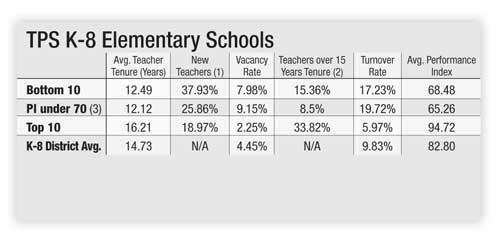
TPS has 40 K-8 elementary schools. The chart below compares the 10 best performing schools versus the 10 worst performing schools based on the performance index (PI) score from 2013 state report cards. The seven schools with a PI below 70 (D or worse letter grade) are further examined as well.

We can see a disturbing pattern. TPS’ underperforming schools have the most new teachers, the greatest vacancy and teacher turnover rates, and the lowest percentage of teachers with more than 15 years’ tenure compared to TPS’ highest performing schools.

This can only be due to seniority — the only criteria for teacher assignment — and the single salary schedule in the TFT contract. It seems that the contract has created a system where the highest paid, most senior teachers get the easiest positions without the challenges associated with lower performing schools. What effective organization survives and thrives under these conditions?

Besides the seniority and salary schedule, there are numerous other onerous provisions that impact student outcomes and increase operational costs, including the preference for long-term substitutes, hourly teachers, tutors and home instructors for full-time positions before an outside hire; placeholder substitutes for the 77 teachers on special assignment (some of the highest tenured TPS teachers); and professional development practices.

It’s not possible to comment on all of them in this column. But one point is clear: Changes are drastically needed now. The past 40 years of negotiations and most recently the lack of progress on performance audit recommendations demonstrate how difficult it will be to get the TFT and other union leadership to negotiate any changes without the appropriate leverage.

A yes vote on Issue 1 ensures the problems will never be negotiated. Voting no sends a message to the board and union leadership that this community wants student outcomes to be the first priority before a levy funding salary increase is passed.

Steven Flagg is a community activist with more than 20 years of experience in education advocacy. For more of his writings, visit tpsinfo.com.