Home Blog Page 168

McGlade: Learning to trust the wonder

0

Most religions begin with a story.  That story infects the imagination of the practitioner with a sense of wonder and hope. Encounters with the holy, albeit fleeting, break through into the soul and the celebrant senses a belonging to something greater than the self.

That something has different names. For some it is God. For others it might be Allah or Yahweh or Jesus Christ or Vishnu or Buddha or the Great Spirit or Mother Mary or Sophia, or the Ground of Being  or whatever. Regardless, the story becomes important because it is the Rosetta stone of a particular religious community’s faith.

Without the story, there is no wonder.  Without the wonder, there is no encounter. Without the encounter, there is no sense of belonging to something greater than the self … and so it goes.

For the most part, these stories from varied faith communities are healing, life-enriching and liberating. At their core is a simple affirmation: There is something transcendent out there beyond the self (or deep within the self) that is generous, gracious and desires for us a holistic, peaceable and just life. So candles are lit, songs are sung, rites and rituals are rehearsed annually at the appointed time. These things are done so that we practitioners of our various faith disciplines might remember and allow the holy to rekindle that sense of wonder that is often worn away by the brutalities and vulgarities of life.

Two things never cease to amaze me. The first is that these ancient rites and celebrations still have a lot of punch to them. This is one of the grand mysteries of the practice of the religious life. Every year my parishion -ers and I work to get that pregnant mother to Bethlehem so that this child of hers (and ours) can get born and then gently laid in a manger. And every year, no matter how crazy the marketplace is behaving and how overscheduled our calendars are, the silence of that night breaks through and the tired and beleaguered spirit rediscovers the bread of heaven.

I like that very much.

The second is more troubling. How quickly those of us who wear the mantle of “religious” allow the healing and reconciling power of these stories to drift away. We replace that power with the harder edge of doctrine, law and belief.  We are quick to make judgments, draw our lines, define who is in and who is out, who is saved and who isn’t, who is going to heaven and who will roast forever. This temptation to moral certainty has led to diverse acts of character assassination, prejudice, violence and wars throughout human history. It is no wonder that so many today will confess to being “spiritual” but not “religious.”

Religion is not rational. The problem is, many of us in the religious community want religion to be rational. This leads us to define, objectify and literalize the stories of faith. Once this has happened, the story loses its natural power to inspire wonder, instill hope and bring healing. It becomes a hammer or, as the late Leonard Bernstein suggested in the sermon portion of his “MASS”: “God gave us the cross. We turned it into a sword.” All that is left is the brute force of decree. It is no wonder that one afternoon I found myself pinned to a storefront window by an overbearing street preacher shouting at me that I was headed to a rather hot and uncomfortable destiny if I did not accept his particular blend of the faith tradition I practice.

Religion at its healthiest is mythical. It is driven by a story and if we are willing to trust the story and get lost in it, a sense of wonder emerges. The interesting thing about wonder is that it never requires of us the need to be “right” about something. It never requires of us the need to control or define or even divide. It only requires of us our imagination and a willingness to simply “be” in the moment, a moment when we encounter the holiest of all mysteries: that we are loved — all of us — and because of that, we all belong to each other.

The Reverend Eric McGlade is pastor of Trinity United Methodist Church in Bowling Green.
Collins pledges continued development, job growth

0

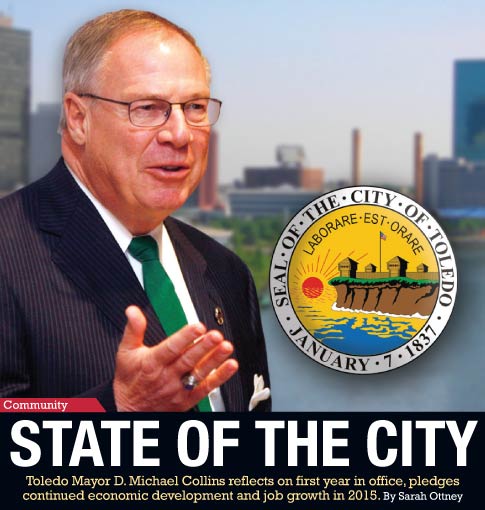
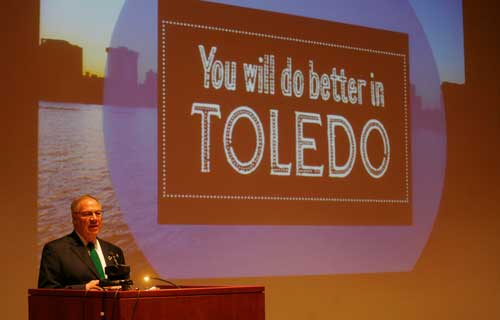
From the polar vortex to the water crisis to a number of percolating economic development opportunities, Toledo Mayor D. Michael Collins spent most of his hourlong Dec. 9 State of the City address reflecting on his roller coaster ride of a first year in office.

Toledo Mayor D. Michael Collins plans to install 55

Toledo Mayor D. Michael Collins plans to install 55 “You Will Do Better In Toledo” signs at city limits this month. He talked about the slogan during his State of the City address at the Main Library on Dec. 9. Toledo Free Press Photo by Kristen Norman

121414_cover_WEB

.

Looking ahead to 2015, he vowed to create more jobs and secure a developer for the former Southwyck Mall site. He also announced plans to add cultural sensitivity to Toledo Police training and install 55 “You Will Do Better in Toledo” signs at city limits.

“We’ve been a government that’s been reactive instead of where I really wanted to be and that was to be more proactive in terms of giving us a different direction,” he told Toledo Free Press. “I’m hoping in 2015 we can take those dynamic steps to redefine Toledo.”

Punctuated by short video testimonials from community members and business leaders, Collins’ presentation highlighted successes such as redevelopment progress Downtown and along the Reynolds Road corridor; the introduction of innovative  technology like the SeeClickFix app and an interactive crime map; and improvement of neighborhood safety and cleanliness through partnerships between police officers, city code enforcement officials and block watch groups.

Saying his administration likely faced more obstacles in a single year than any of its predecessors, Collins also addressed the year’s major challenges, including August’s do-not-drink water advisory caused by a toxic algal bloom on Lake Erie; record-breaking cold and snow; budget shortfalls that hampered infrastructure repairs; and the deaths of two Toledo firefighters.

“Jan. 26 was a day that produced holes in all of our hearts,” Collins said, referring to the North Toledo blaze that killed Stephen Machcinski and James Dickman. “May they rest in peace knowing that their heroism will never be forgotten.”

Calling public safety a subject “near and dear to my heart,” Collins, a former police officer, announced plans to add cultural sensitivity to police training.

Developed with the help of Latino community leader Baldemar Velasquez, the program will promote understanding of Latino culture as well as black, lesbian, gay, bisexual and transgender cultures.

“While we may think we know and understand each other, there are cultural differences and we need to have that as a part of the training experience,” Collins said. “Differences don’t make polarity; differences make strength.”

In one of many digressions from prepared remarks, Collins addressed the national unrest following citizen deaths at the hands of police officers in Ferguson, Missouri, and elsewhere.

“[Toledo Police] should not be stereotyped. They should not be looked upon as oppressors in a community,” Collins said. “I have full confidence … they are committed to having your back.”

Collins said the city and its partners created 444 jobs and retained 548 jobs in 2014 and vowed to increase those numbers by at least 20 percent in 2015. He pledged to work hard to keep Jeep Wrangler production in Toledo.

“In 2015 we shall continue our efforts to demonstrate it matters where you make it,” Collins said. “Wrangler is critical to both Toledo and Fiat Chrysler. We will advance our discussions with [CEO] Mr. [Sergio] Marchionne and fortify Toledo’s commitment to achieve this goal and advance his company’s position in the world market.”

Development was a major topic, particularly ProMedica’s move Downtown, which Collins called a domino effect that will “change the face of Toledo” over the next three to five years.

He also praised the Mud Hens’ vision for the Hensville development, the Reynolds Road Clarion Hotel demolition and the East Toledo smokestack implosions as steps moving the city forward.

Collins said he was proud of the work accomplished by 10 neighborhood-focused “T-Town” cleanup events, which filled 733 potholes, swept 97 streets and mowed 301 lots.

City workers will install “You Will Do Better in Toledo” signs this month, replacing the “Rocket Country” signs at city limits. The cost is less than $10,000, said City Public Information Officer Stacy Weber. The slogan marked its 100th anniversary last December.

“[At that time] people came to Toledo because they knew opportunities existed here that were not opportunities they would find in other areas,” Collins said. “I want to return that same image to Toledo.”

Councilwoman Sandy Spang and Councilman Rob Ludeman were there.

“It’s really important to take a moment and review the year, but I also think it’s important to cast vision for the future,” Spang said.

Ludeman said he thought Collins should have stayed more on point.

“There was a lot of filler and side stories that just didn’t need to be part of the speech,” Ludeman said. “It was more of a history lesson than a state of the city speech.”

Lucas County Commissioner Tina Skeldon Wozniak said she came to show her willingness to work with the city.

“[Collins] did a really good job trying to highlight interested leaders who want to improve neighborhoods as well as business leaders who want to help,” Skeldon Wozniak said afterward.

Although fellow commissioners Carol Contrada and Pete Gerken were not able to be there, all three said they were disappointed Collins didn’t mention the county as a partner.

“I find that unfortunate,” Gerken said. “From the county’s perspective, the state of the city is critical to the state of the county and vice versa.”

Baumhower: Fighting dancer

0

Valory Newton is a beautiful 9-year-old girl from Walbridge, a fourth-grader at Lake Elementary School and a dancer from The Dance Factory in Perrysburg.

  .

.

Val’s been dancing for five years, over half of her life. But now cancer is trying its best to make sure she doesn’t step-ball-change ever again.

Last month, Valory was dancing with a lower left leg that had been bothering her all summer. Her parents thought it was a combination of growing and dancing. “One minute her leg would be hurting, the next she was on the trampoline,”  her mom, Dyana, recalled.

It wasn’t until early November that Valory’s pain became unbearable. Her leg was unusually swollen, so her mom, an emergency room nurse, make a doctor’s appointment to get it checked.

On Nov. 26, the family traveled to Nationwide Children’s Hospital in Columbus, where their worst fears were confirmed: Valory has osteosarcoma, a form of bone cancer, in her left fibula.

Doctors told Valory’s family the best action would be to remove the tumor wrapped around a nerve and her left fibula. Removing the nerve will cause Val to have “foot drop,” which means she will lose the ability to point or flex her foot. She will learn to walk again after six months of rehab. There is also a chance that Valory may lose her lower leg completely.

Valory began chemotherapy Dec. 5. This type of chemo will cause her to lose her hair. While this news would be devastating for any 9-year-old girl, Valory dreamed of a way to outsmart her chemo. She decided to cut off her hair and make it into a wig. Her family found out doing that would take about $2,000 and around 18 ponytails, each 10 inches long.

On Dec. 2, Valory struck the first blow in her battle. She and three of her friends cut their hair to begin the process of making a wig. Her “dance sisters” and their families organized a cut-a-thon at Modern Chic Salon & Spa in Holland, where on Dec. 6 they collected an astounding 186 ponytails — enough for 11 wigs, which the family plans to donate locally. Between the cut-a-thon, a GoFundMe campaign and a hot chocolate sale set up by two classmates, $9,000 has been raised, which will pay for Val’s wig and some medical bills.

Kelly Clark, a family friend and photographer from Josi Rae Photography, recently offered her services to capture Valory before her battle began. Valory chose a couple of dance outfits for the photo session, but first, she wanted to write something on her forearms. In black marker, you can read her words and see her spirit: “Fighting Dancer.”

Valory doesn’t want to be identified by the disease in her body. She wants to be identified by who she is. In July, Valory was in Sandusky competing with her Dance Factory team; this month she’s in Columbus battling cancer. No child should ever have to deal with cancer or watch their friend battle it. Let’s show all of these dancers and dreamers what a community means, and how we are there for each other. For updates, visit her Facebook page, “Valory Newton — Support Our Dancer in Her Battle With Cancer.”

Jeremy Baumhower can be reached at [email protected].

Vetter: Chicks for Mom’s House

0

After nearly a decade and almost $1 million in cash and donations raised, a casual observer might think Chicks for Charity was a carefully planned organization. Actually, it started with an emotional reaction to serving a meal.

.

Many years ago, I was with a group serving dinner at Beach House Family Shelter. A woman came through the food line. She was young, pretty, vibrant — and visibly upset. Eyes red, with a tear-stained face, it was impossible not to notice. Someone asked her what was wrong, and she pointed to those of us on the serving side of the counter and said, “I used to be there. I used to be the one standing there.” I didn’t understand what she meant, and stupidly commented, “Oh, don’t worry; we’re happy to serve you this evening.”

As soon as those words came out of my mouth, it hit me. Before, she had been the one to help others, to give back, to serve a meal; now she was on the receiving end.

And there but for the grace of God we all go. In a moment, our lives can change and any one of us may be the one needing help. Standing behind the counter that evening is a moment I’ll never forget.

Chicks for Charity — a group of women and girls who believe in giving back — is the result of that evening. We know not everyone has the means to make big donations, but working together we can raise enough money to help a small, under-the-radar organization have the much-needed resources to continue helping others.

Over the past nine years, we’ve raised more than $400,000 in cash and more than $500,000 in in-kind donations and services for six organizations: the Toledo-Lucas County Furniture Bank, Beach House, Assistance Dogs of America, The Victory Center, International Boxing Club and Shared Lives Studio. Our charity for 2015-16 is Mom’s House.

Our goal is for each chick to do something — anything — fun to raise money for our charity. We then give 100 percent of funds directly to the organization. It’s not always big money. In fact, the gift of $10.75 we received as nickels, dimes and quarters in a sandwich bag from one of our junior chicks this summer was as important as any donation we received all year. It came from the heart, from a little girl who understands others are not as fortunate as she is. She wanted to help. She is what we call an awesome chick.

Chicks for Charity can’t cure all the ills of our community, but we are working together to make sure women of all ages know they have the ability to make a difference. Philanthropy at any age is a beautiful thing, and small amounts can make a big difference in someone’s life.

This year, we started with applications from 31 organizations. We narrowed it down to three finalists: Mom’s House, Family House and Food for Thought. They shared their missions, their successes and their needs during presentations in early December. It was an incredible evening.

After giving all 1,900 chicks the opportunity to cast a vote, Mom’s House was designated our charity for 2015-16. They are a phenomenal organization, going to great lengths to help young, single moms deal with the realities of motherhood while continuing their education. Many become the first in their family to get a high school diploma, college degree or jobs that any one of us would be proud to have. Mom’s House helps young women in crisis become contributing members of our community.

At our voting meeting, a former client of Mom’s House shared her story. Once a high school girl in desperate need, she is now a college graduate and the regional palliative care coordinator at Mercy. She was the first in her family to graduate from high school; her son is now 10 and in classes for gifted students. She’s married with two other sons and a husband also counseled by Mom’s House. He hated his job as a janitor and, with their guidance, has since graduated from college and is working as a pretrial booking officer for Lucas County.

They are a successful family, contributing to our community in every way possible. They are now on the “serving” side of the counter.

Any woman or girl is welcome to join Chicks for Charity. There are no membership dues or meetings. To register, go to chicksforcharity.net.

Martha Vetter is founder of Chicks for Charity and CEO of R/P Marketing Public Relations. She can be reached at [email protected].

Former Ohio judge pens legal thrillers

0

Linda Rocker was practically born into the legal system. Her father was a judge before she followed in his footsteps, and she proudly proclaims herself a “troublemaker,” just like him.

Blame by former Ohio judge Linda Rocker

As such, she has some ideas why readers find the courtroom such a fascinating setting for drama — both in fiction and in real life.

“They understand the stakes,” Rocker said in an interview with Toledo Free Press. “For so many people, it is life or death. It is loss of career or opportunity. And too much of it, in my view, remains a sort of profound mystery that is highlighted only when we see incidents such as that that has occurred in Ferguson, and most recently on Staten Island.

“I think the fascination is, it is always drama. Every court case, particularly criminal cases, is like a small opera, playing out on a stage where the parts are kind of preordained, and emotions run deep and high at the same time. And the characters are usually true to form. But as we all — at least at my age — have learned from ‘Perry Mason,’ there are often surprises.”

Rocker experienced many such surprises firsthand during her years as a lawyer and trial judge for Ohio’s Common Pleas bench. But in a way, her passion for writing has brought her career full circle: Her undergraduate degree was in English, so her latest project, a series of legal thrillers focused on a bailiff named Casey Portman, serves as a union of two important parts of Rocker’s life. Three, if you count their setting: West Palm Beach, Florida, where Rocker currently resides.

“It would have been easier for me to set my books in Ohio, because of course I know Ohio law so well and I know our court system so well. But even setting my books here in West Palm, where I’ve had to do a great deal more research about law and the court system, has not dissuaded some of my former colleagues from accusing me of using them as the prototype for some of my characters,” she said with a laugh.

Rocker is also cheerfully upfront about what inspired her to begin pursuing her new career.

“Boredom,” she said. “After I discontinued running for election … I began to sit as what we call in Ohio a ‘visiting judge.’ But that allowed me to hear only a single civil case at a time. And they were usually cases that were sent over by the sitting judges at the court across the street, meaning cases they really had no interest in trying in their courtroom.

“It was just downright boring. There was just too much time sitting in chambers with just not much to do. So I started to use the very nice computer in my chambers as a new weapon in the pursuit of justice.”

That sense of right is woven into the fabric of each story in her trilogy, which began with “Punishment” in 2012. The second book, “Blame,” was published in November.

Each story is based on a case Rocker was involved with.

“I always take a real case as the centerpiece that all the other action kind of revolves and evolves around. So, in ‘Punishment,’ it was a pit bull case that actually transpired in my courtroom. And in ‘Blame,’ it is a case that is actually occurring here in West Palm Beach as we speak.

“The doctor who is the inspiration for the case [in ‘Blame’], lives near me and has become a good friend. I never imagined three and a half years later, his case would not have come to trial. But that is, in fact, true. So in some ways, I’ve cheated myself, because there are more twists and turns to come. But I’ve promised him he’ll at least get part of a chapter in [the forthcoming final book] ‘Innocence.’”

Winterfest is coming: Outdoor ice rink begins taking shape at Fifth Third Field

0

It’s been three years in the making, but the ice resurfacers have finally made their way to the home of the

Toledo Mud Hens.

North Carolina-based Rink Specialists has begun changing Fifth Third Field into an outdoor ice hockey rink in preparation for Toledo Walleye Winterfest, which will include two outdoor Walleye games. Winterfest, which will feature many other games and events, runs Dec. 26 through Jan. 4.Toledo Free Press Photo by Christie Materni

The biggest events and challenges of the Toledo Walleye Winterfest running Dec. 26 through Jan. 4 will be the outdoor hockey games hosted at Fifth Third Field on Dec. 27 and Jan. 3. Winterfest officials hosted a Dec. 9 news conference at Fifth Third Field to provide an update on preparations for the events.

To see it finally come to fruition is pretty exciting,” said Mike Keedy, manager of special events for the Walleye. “Everything is right on schedule. We’re very excited about the progress that we’ve made.”

Jake Tyler, sports turf manager at Fifth Third Field, was responsible for preparing the field to host games measured in periods rather than innings.

“There’s been a lot of work that has gone into all the logistical issues that we’ll have  to deal with [in putting] an ice rink here in a baseball field,” Tyler said, explaining his crew started doing a field renovation this fall.

A field renovation, performed every five to eight years, is designed to diagnose and treat issues of the playing field.

The field, which is now completely devoid of turf, will not be re-sodded until the spring.

“That allowed us to build a big sandbox on the field to level it out where the rink will go,” Tyler said.

Rink Specialists is a North Carolina-based company that has set up NHL-sized rinks at venues such as Fenway Park in Boston and Comerica Park in Detroit. The company’s six trucks full of hockey rink equipment began arriving at Fifth Third Field on Dec. 8.

The biggest challenge in installing outdoor hockey rinks is weather, according to Dave Fies, vice president of operations for Rink Specialists.

“In a perfect world, we’d love to see it anywhere from 25 degrees to 35 degrees,” Fies said. Ideal conditions also include overcast skies with no wind.

“Direct sunlight on ice is not good,” he said. “Air movement melts ice just as much as direct sunlight so we don’t want it to be a windy day. If it gets below 20 [degrees, the] ice surface becomes very frigid and the ice becomes brittle. It does not make for great skating conditions.”

Fies said his crew of six to eight people will be busy until the beginning of Winterfest on Dec. 26. After testing the 13 miles of plastic tubing that goes underneath the rink, crews will lay a paper barrier down over the sand on Fifth Third Field. They will then put down a plywood foundation and bring in a crane to lower a generator into the outfield. The company hopes to make ice at the temporary rink around Dec. 17.

Structurally, the rink will be identical to those found in indoor arenas, Fies said.

“The only difference is it will probably be a little thicker ice,” he said. “We have to have enough ice built up on top of the lines and logos that if a warm rain did come, it’s not going to wash away all the lines, which obviously they don’t have to worry about in indoor ice arenas.”

A half-inch to an inch of extra ice is added to ensure there are no such problems, he said.

For the main events of Winterfest, presented by ProMedica, the Walleye host the Kalamazoo Wings in the first outdoor hockey game in ECHL history at 5:30 p.m. Dec. 27. The Walleye host the Fort Wayne Komets in the second game at the stadium 6:30 p.m. Jan. 3. Prior to this game, there will be a 4:30 p.m. showdown featuring alumni teams from Toledo and Fort Wayne. Ticketholders for the Jan. 3 game may enter the stadium early to watch the alumni game.

The outdoor rink at Fifth Third Field will also host more than 150 youth, high school and adult recreational teams during Winterfest. The public may attend these events at no charge.

The community is welcome to get the outdoor skating experience for themselves with open skate sessions Dec. 28-29 and 31. These sessions are open to the public but tickets are required for admission.

There is also a game at 4 p.m. Dec. 31 featuring Adrian College vs. the U.S. National Under-18 team. At noon Jan. 3, the Bowling Green State University Falcons will play their first outdoor game vs. Robert Morris Colonials.

For more information and a live-camera feed of the field-to-rink process, visit www.toledowalleye.com/winterfest.

Inmates assemble bikes to be donated to abused, neglected kids

0

Eighty-eight kids in Northwest Ohio will get bikes this Christmas thanks to a partnership between Lucas County Children Services (LCCS) and a Columbus-based nonprofit.

The bicycles, donated by Bike Lady Inc., were assembled Dec. 5 by seven inmates at Toledo Correctional Institution (TCI). LCCS will distribute 50 of the bikes as part of its annual holiday gift drive for caregivers and families to give as gifts.

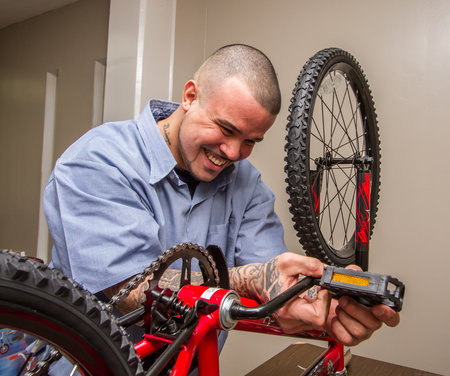
Joshua Faulkner, an inmate at Toledo Correctional Institution, helps assemble bicycles Dec. 5 for Lucas County Children Services and other Northwest Ohio counties. Toledo Free Press Photos by Christie Materni

Joshua Faulkner, an inmate at Toledo Correctional Institution, helps assemble bicycles Dec. 5 for Lucas County Children Services and other Northwest Ohio counties. Toledo Free Press Photos by Christie Materni

Twenty bikes will go to Wood County, eight to Hancock County, six to Sandusky County and four to Fulton County. This is the third year for the partnership in Lucas County and the first year for the other Northwest Ohio counties.

Most of the bikes will go to kids living with relatives or in their own homes while their parents work with LCCS, said Julie Malkin, public information officer for LCCS. Some will go to children in foster care. LCCS is working with donors to make sure each child also gets a helmet with the bike, Malkin said.

“This is huge,” she said. “Bikes are a ‘big ticket’ item, especially the teen bikes. Many of our families couldn’t otherwise afford to purchase a new bike for the child or children in their lives. It means a lot to us as an agency to be able to allow these families to give such an amazing gift to the kids we serve.”

Joshua Faulkner, 30, of East Toledo got a little teary during assembly thinking about his own children and his own first bike, a neon green Huffy he got for Christmas when he was 7 or 8.

“My mom tricked me on Christmas,” he said. “She said I’d been bad so there were no presents under the tree. She asked me to feed and water the dog — and all my presents were there on the back porch, including the bike.”

The bike is still in his garage, even though no one rides it anymore.

“I just can’t part with it,” he said.

Faulkner, who is serving a five-year sentence for burglary, is scheduled for release in February. He said he volunteered because he can’t be with his own four kids this Christmas.

“I have kids, I love kids, I’m just a big kid myself,” he said. “I can’t be there for my kids right now but I love the fact I can be there for someone else’s kids. It makes me feel better about myself as a dad.

“I’m learning to do things to humble myself and be more productive. I want to put myself in a new environment. Doing projects like this helps prepare you. It’s very humbling to do something with nothing expected to be given back.

“The best part is some little kid will be smiling riding this bike – maybe a few crashes and burns – but it will be alright,” he added, smiling.

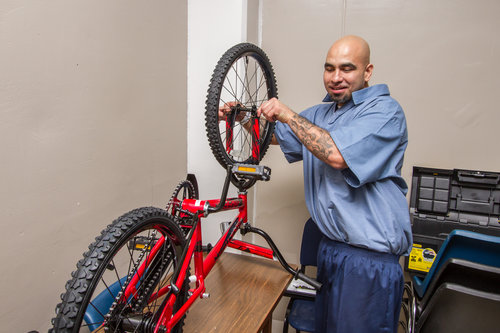
Joe Luna, an inmate at Toledo Correctional Institution, helps assemble bicycles Dec. 5 for Lucas County Children Services and other Northwest Ohio counties. Toledo Free Press Photos by Christie Materni

Joe Luna, an inmate at Toledo Correctional Institution, helps assemble bicycles Dec. 5 for Lucas County Children Services and other Northwest Ohio counties. Toledo Free Press Photos by Christie Materni

Armondo Ballard, 22, of Cincinnati is serving four years for drug trafficking and a weapons charge. He is scheduled for release in 2018.

“I’d do whatever for the kids, just to see the smile on the kids’ faces,” Ballard said. “It means a lot. Everyone doesn’t get to have bikes. Just to think about someone getting on this bike I put together, asking ‘Can I ride my bike?’ That feels good to be part of them smiling.”

Ballard said he couldn’t remember the last time he’d ridden a bike himself, but his first bike was a gold Rhino with no front brakes he fixed up with his grandpa.

“My grandpa had in the garage for a long time. Thought I’d fix it up and just ride it,” he said.

Ballard said it’s good for kids to stay active.

“You want to give kids a lot of activities – something busy and positive — so they don’t end up in places like this,” he said.

Anthony Wheatley has helped assemble the bikes for two years now.

“Gotta make sure kids have something to have fun,” said Wheatley, 33, of Toledo. “If I was out there with one of these babies, I’d be riding in the snow.”

He’s serving nine years for two counts of felonious assault and one count of escape. He shot two people in a car outside a North Toledo carryout during a botched robbery in 2010.

“It makes me feel good. It makes my heart warm,” Wheatley said. “It helps me out, shows I can do something positive and not just negative things. It’s a good opportunity to redeem myself and show people we’re not all who they think we are. We’re not monsters; we’re people who made mistakes.”

Corey Foster, deputy warden of special services, said the situation is win-win.

“This allows our offenders to be engaged in something positive and meaningful,” Foster said. “It goes into the concept of restorative justice and giving back to society.”

Everyone who’s part of the process is touched by it, said Bike Lady founder Kate Koch.

“The inmate who assembles it. The caseworker who passes it to the caregiver and the caregiver who passes it to the child. And the donors — they tell me they get up on Christmas morning and go through their normal family routine, but in the back of their minds, they’re thinking about the 1,000 kids in Ohio who just saw a bike and are flipping out and it makes them feel really good,” Koch said. “For every population who is touching this bike, it’s a little bit of a gift from them and a little bit of a gift for them. And I think that’s really cool.”

Bike Lady was founded in 2008 in Franklin County and expanded to eight counties, including Lucas, in 2012. Last year, Bike Lady distributed 1,141 bikes in 16 counties. Bikes will be distributed in 16 counties again this year with four more on a waiting list if extra funding comes through, Koch said.

“For the little kids, it’s very important just for the freedom, the joy, the ability to be like any other kid on the block,” said Koch, a foster-turned-adoptive parent in Gahanna, a Columbus suburb. “For bigger kids, it’s an extremely practical form of transportation.

“We heard from the family of an 11-year-old boy who got one of our bikes and he said getting a new bike made him feel like a billionaire. Everybody remembers their first bike. When you’re talking about kids who don’t have a lot of really positive memories from their childhood, this is one they’ll have that they’ll carry lifelong and I think that’s a positive thing.”

A Trailer Awakens: Two fans discuss whether ‘Star Wars’ teaser is worth getting excited about.

0

By Jeff McGinnis and Jim Beard

JEFF: Never before has so much been written, with so much in-depth analysis, of so little actual content. When it was revealed that the upcoming “Star Wars” sequel — “The Force Awakens” — would see its first teaser trailer released in a handful of theaters over Thanksgiving weekend, fans the world over salivated at the news. When the trailer was released online on Nov. 28, the reaction was swift and rapturous. It seemed that every “Star Wars” enthusiast the world over was thrilled with what they saw, and couldn’t wait to tell everyone else all about it.

Strange, given how the trailer itself really offered no information at all about the plot, characters or much of anything about the new film, beyond the fact that the new lightsaber has a crossguard. Otherwise, it’s just a bunch of quick cuts of images that are vaguely “Star Wars,” accompanied by the iconic theme. Frankly, it felt like a pretty lazy teaser to me. Yet the reaction was over the moon. What are fans going so crazy for?

JIM: Because “Star Wars” is “back,” I’d say. Another friend said it was like JJ Abrams & Co. saying, “Don’t worry. We’ve got this,” and I have to say I pretty much agree with that. Maybe some people forget that we’re a little more than a year out from the film’s release, and that this is only a teaser to whet the appetite.

A little historical perspective: When I saw the very first “Star Wars” teaser trailer in January of ’77, I gleaned little to no story or plot from it. It was a jumble of images that I let wash over me, and began to speculate over. I guessed the Tusken Raiders awaited Luke and Leia at the other end of their swing across the chasm — who knew? Flash forward to now. Same thing: a bright burst of “Star Wars” and I’m a kid again.

I’ll be honest with you. I just went with it and allowed my gut to tell me what to think. And I thought it was pretty cool. The real trailer will come eventually and we’ll get some idea of the story. I’m not worried about it. For now, I’m assured that Abrams & Co. are delivering a “Star Wars” film that echoes the past and delivers the future, and that feels pretty good.

A menacing figure seen in the new Star Wars: The Force Awakens teaser trailer.

A menacing figure seen in the new Star Wars: The Force Awakens teaser trailer. Photo: Lucasfilm Ltd.

JEFF: But are fans setting themselves up for a great fall? I remember the overwhelming excitement that accompanied the early trailers for “Episode I,” and the general response to the film itself was significantly more muted. As you said, you filled in most of the excitement and ideas yourself when you were a kid, and that same excitement fills you now. But considering how little you were given, it feels like you — and many fans — are doing the heavy lifting yourselves.

Yes, this is a teaser trailer, and the film is still over a year away. But that hasn’t stopped fans the world over from praising this snippet of footage as proof that Abrams has a firm grasp on the universe he has inherited. But there’s really no concrete evidence either way, based upon what we have seen. Trailers convinced me Abrams would deliver a great “Star Trek” experience, too, and in my opinion, he went 0-for-2 there. I’m not saying “The Force Awakens” WON’T be a great “Star Wars” movie. I’m just approaching this with caution — as a fan who has been burned before by trailers that offered considerably more meat to chew on than this one.

JIM: I totally get what you’re saying, but my gut — my sensitivity to the Force, if you will — tells me that they’re at least heading in the right direction. And yes, “Star Wars” fans, like most all other genre fans, can be their own worst enemy. With this teaser, I can really only speak for myself when I say that I don’t think I’m kidding myself by being optimistic for the film.

From what we know and what we’ve seen, it appears as if they’re trying to be all-inclusive: diversity in casting, mystery in action, humor, dark fantasy, sly wrinkles on existing “Star Wars” iconography — it’s all there in the teaser, which I see as being carefully thought out. In some ways, it’s fairly masterful, because it sends a message without giving much away. It provides excitement, and despite some grumblings and the typical naysaying, as well as a few nuggets of mind-boggling racism over the casting John Boyega, the excitement seems heartfelt to this “Star Wars” fan. Maybe the supposed wounds over the prequels are healing.

Ottney: Aiding awareness

0

Earlier this week on World AIDS Day (Dec. 1), a Mother Jones article made the rounds online. It featured portions of transcripts from 1982, 1983 and 1984 White House press conferences in which journalist Lester Kinsolving questioned President Ronald Reagan’s press secretary Larry Speakes about the administration’s knowledge of and reaction to the growing AIDS epidemic.

.

While numbers cited by Kinsolving increased from 600 cases in 1982 to an estimated 300,000 cases just two years later, the response — jocularity and laughter — remained the same. (It’s unclear from written transcripts who, exactly, is laughing, but as such press conferences are typically a room full of journalists hosted by a few administration members, it likely included other press corps members.)

An interaction from Oct. 15, 1982, begins:

Kinsolving: Larry, does the president have any reaction to the announcement [from] the Centers for Disease Control in Atlanta, that AIDS is now an epidemic and have over 600 cases?

Speakes: What’s AIDS?

Kinsolving: Over a third of them have died. It’s known as “gay plague.” (Laughter.) No, it is. I mean it’s a pretty serious thing that one in every three people that get this have died. And I wondered if the president is aware of it?

Speakes: I don’t have it. Do you? (Laughter.)

Kinsolving: No, I don’t.

Speakes: You didn’t answer my question.

Kinsolving: Well, I just wondered, does the president —

Speakes: How do you know? (Laughter.)

Kinsolving: In other words, the White House looks on this as a great joke?

Speakes: No, I don’t know anything about it, Lester.

Kinsolving: Does the president, does anybody in the White House know about this epidemic, Larry?

Speakes: I don’t think so. I don’t think there’s been any —

Kinsolving: Nobody knows?

Speakes: There has been no personal experience here, Lester.

That right there is the telling line for me. In other words, if it isn’t happening to me, it isn’t happening at all.

I don’t quote this particular conversation to throw Speakes under the bus or cast aspersions on Reagan, but only to point out how easy it is to ignore or make light of something that doesn’t affect you or anyone you know. And how hard it is to stomach someone doing so when it does.

Ohio Sen. Rob Portman reversed his stance on same-sex marriage last year when his then-21-year-old son came out as gay. Suddenly the issue was personal. Brian and Cindy Hoeflinger  of Ottawa Hills became national advocates against teen drinking after their 18-year-old son was killed by a drunk driver — himself. It wasn’t that they didn’t care before. But suddenly the issue was personal.

On Dec. 2, Toledo City Council voted 12-0 to amend language referring to sexual orientation in the city’s ordinance against hate crime to include “a person’s actual or perceived heterosexuality, bisexuality, homosexuality or gender identity, by orientation or practice.”

Candice Milligan, a transgender woman who was attacked and robbed Downtown last month, was there.

“It’s important to help people who live here, who are a member of this community, feel safe and also to send a message that hate crimes are not going to be tolerated here, that that kind of behavior isn’t going to be tolerated here and this is a place where that’s not welcome,” she told me after the vote.

Toledo’s move is a step in the right direction, advocates said, but Ohio still doesn’t include sexual orientation in its hate crimes statute, which means it’s difficult to charge crimes allegedly motivated by sexual orientation as hate crimes.

Asked by another reporter how she was doing, Milligan said that’s a difficult question. Speaking through her teeth, her broken jaw still wired shut, she said she’s “getting by.” It’s “back and forth,” she said. Mostly forth, I hope. She was also in court when one of her alleged attackers came before a judge. Her build is slight. But she’s clearly strong.

“Keith” expressed a common sentiment when he posted a comment on that story online: “‘Hate Crime’ destroys equality in our judicial system. Yes, one more special group was added to the club, but it sends the message that certain people have more value than others. If a person attacks a transgender person as opposed to an elderly woman in a robbery, ITS THE SAME CRIME, but now the homosexuals are demanding more punishment than the elderly woman who also could have been the victim in this example, which just makes the judgement less fair for the defendant. Or what if a homosexual attacks a heterosexual and the heterosexual in self defense injures the homosexual… was it a “hate crime”? The words ‘Hate Crime’ need to be removed from the equality that is intended in justice for all.”

Keith and those who subscribe to this view misunderstand the very notion of hate crime. A crime against a person who happens to be transgender or black or Muslim doesn’t make it a hate crime. It’s a hate crime if the action is motivated primarily because of the person’s real or perceived sexual orientation, race, religion, etc. It is different.

Two years ago, I talked to Ed Hoffman about the 35th anniversary of the Holiday With Heart Charity Gayla. Hoffman is one of the founders of the event, which has grown from a small gathering of friends to nonprofit status and an annual dinner-dance that raises thousands of dollars for local LGBT causes. This year’s event, which Toledo Free Press sponsors, is Dec. 7.

Hoffman’s voice broke as he told me the Gayla is special because it’s a place where members of the LGBT community can relax among those who accept and support them.

“Unless you are in our community, you really don’t have a clue,” Hoffman said “Things you take for granted. You and your boyfriend or husband or whomever, you can dance slow all you want, nice and close and warm. We can’t. Unless we’re among our own.

“You can feel comfortable there. You can hold hands together. You can kiss each other. You can dance. It’s wonderful to be able to dance with your partner, slowly, and not feel like who’s watching or feeling ill at ease.”

No matter what your personal view on someone’s sexual orientation, race, religion or anything else, everyone has a right to feel safe and be treated equally.

I wasn’t at the White House on Oct. 15, 1982. I wasn’t in Ferguson, Missouri, on Aug. 9. I wasn’t at 13th and Madison, Missouri, on Nov. 3.

I will probably never truly understand what it’s like to live as an AIDS patient, a black man or transgender woman. But it’s our job as fellow citizens, as human beings, to try.

Sarah Ottney is editor in chief of Toledo Free Press. Contact her at [email protected].

City purchases land near Jeep plant in hopes of keeping Wrangler

0

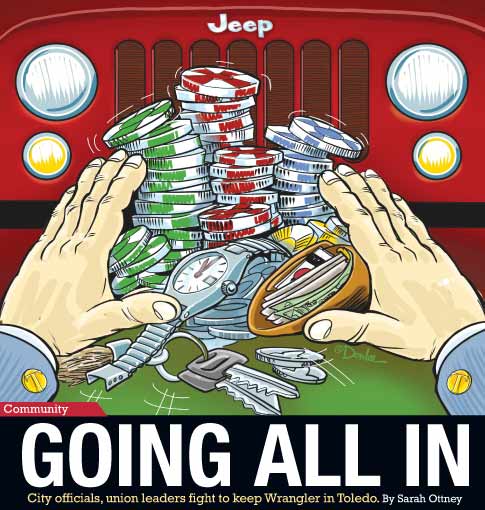
With a unanimous vote approving the purchase of 28.8 acres of land near Jeep’s Toledo Assembly Complex, Toledo City Council hopes it dealt city leaders another round at the table with Chrysler and a fighting chance to keep Wrangler production in Toledo.

Jeep workers and supporters rally outside Toledo City Council on Nov. 25 to show support for a proposed land purchase near Jeep's Toledo assembly complex. Council members voted 12-0 Dec. 2 to approve the purchase. Toledo Free Press photo by Sarah Ottney

Jeep workers and supporters rally outside Toledo City Council on Nov. 25 to show support for a proposed land purchase near Jeep’s Toledo assembly complex. Council members voted 12-0 Dec. 2 to approve the purchase. Toledo Free Press photo by Sarah Ottney

Council voted 12-0 during its Dec. 2 meeting to buy the former Textile leather property for $738,000.

Local officials have been in talks with the auto company about Wrangler’s future in Toledo since Chrysler CEO Sergio Marchionne’s surprise comments during an interview at the Paris Auto Show in October that Wranglers may move from Toledo if the model switched to an aluminum unibody design.

RELATED: Speculation over Jeep future spurs debate, city action

Toledo’s plant is set up for steel body-on-frame production. Shutting the plant down for six months to retool for aluminum would be too costly, as the plant already can’t keep up with demand for Wranglers even working nearly around the clock, UAW Local 12 President Bruce Baumhower told Council during an agenda review session Nov. 25. That session was attended by more than 100 Jeep workers wearing red “Solidarity on Stickney” shirts.

“This whole problem we’re facing has been caused by their phenomenal success,” he said. “They can’t shut that plant down for one minute.

“Yes, there’s some risk in saying, ‘Hey, we’re going to buy this land and we don’t have a commitment from Chrysler.’ But you’ve got to weigh that against if we don’t do this, it’s game over. It’s gone,” Baumhower said. “Now what we’re saying is, ‘Let’s give him something to think about.’”

Discussions so far have been about replacing Wrangler with another Chrysler model, Baumhower said.

120714_cover_WEB

.

“There’s been no conversation about keeping Wrangler in Toledo because there was no scenario where it would work — until today,” he said after the vote. “This puts us back in the game and allows us to have some future dialogue with the corporation about keeping Wrangler here in Toledo.”

Toledo Mayor D. Michael Collins praised the decision.

“It matters where you make it and we make it better here than anywhere on this planet,” Collins said.

The next step is closing on the property, which the city anticipates by mid-December, said Matt Sapara, the city’s director of business and economic development.

The cost of environmental remediation at the site, expected to start early next year, has been estimated at $1.2 million. A carcinogen, PCB, had been found in the soil and the Ohio and U.S. Environmental Protection Agencies are both involved in cleanup plans, he said. The site’s current owner, Textileather, will provide $1.75 million to cover the job.

“It’s a little bit of a challenge for us, but I think we put ourselves in the best position we could possibly be in by acquiring the land and giving Chrysler more options and more flexibility,” Sapara said. “It shows Chrysler we have a really united front from Council to the mayor to our elected officials. It’s really a team effort to put together something that will get their attention and I think we’re there.”

Chrysler spokeswoman Jodi Tinson declined to comment.

The Textileather site along with the 4.1-acre former MedCorp property the city acquired in October plus a few other smaller parcels would bring the city’s total acreage in the area to 70, Sapara said.

The city has talked with Chrysler as well as several other potential end-users, he said.

“Obviously Chrysler is our No. 1 and the end-user we’re hoping for, but my goal is to get the biggest economic impact for the community out of the disposition of that property, whoever that end-user happens to be,” he said.

A new meeting date with Chrysler has not been set, Sapara said, but the city is hoping to meet before the end of the year.

Councilman Tom Waniewski, who was critical of Council’s 7-5 vote last month to purchase the former Southwyck Mall site, said he was in support of the Textileather purchase.

“With Jeep, we have a viable tenant already there that has been looking for more room, so it’s not like we have no players there,” Waniewski said. “The Southwyck property — once The Andersons dropped out of that, I thought, ‘We’re gonna end up holding the bag again.’

“We have to be at the table to play with Chrysler. By not passing this land deal, we would have in essence taken our cards and said we’re done for the night. But with this land purchase at least we’re still at the table, we’re still playing with them … and hopefully convince them that’s still the best place to continue to build Wrangler.”

It wouldn’t only be Jeep workers if Wrangler left. Parts suppliers and Toledo’s economy in general could suffer or would be impacted, Baumhower said.

Frank Rao of Toledo, who works in the stock department on Toledo’s Jeep Cherokee line, came out to the rally last week to support his co-workers on the Wrangler line.

“I think it’s important we all stick together as one voice,” Rao said. “Cherokee and Wrangler, we’re all one big family. It would be a hit to everyone if we lost the Wrangler.”