Home Blog Page 165

Visions: Hebert: Park could be solution to Marina District’s riverfront riddle

0

Editor’s Note: This column ran as part of an annual special section called Visions, in which Toledo Free Press asks local economic development and business leaders to share what they see ahead for Toledo and Northwest Ohio in the coming year.

The next time you’re on the East Side of Toledo, take a turn off Main Street down Riverside Drive. It’s the street that runs the length of the so-called Marina District along the Maumee River.
.

.

If you’re there in the daytime, you’ll likely find at least a dozen cars with people inside, eating lunch, talking on a cellphone or contemplating life. Oftentimes, people get out of their cars to take a stroll down to the river.

As talk grows louder about a possible repossession of this taxpayer-improved riverfront site — owned but ignored by Chinese investors — we will likely need to get serious very soon about what the city wants to do with this property. Opinions and ideas are sure to run the gamut.  So here’s mine. Let it be what it is now and what it wants to be: a park.

RELATED: Ottney: Visions

With minimal investment, this could become a premier park venue for Toledo. It may be a far better investment in the long term than just pouring more money and concrete into a “mixed development” project of retail and housing that may or may not be successful.

The last thing Toledo needs is another “failure.” We need positive momentum. A new riverfront city park would give us that. And it would be a much greater investment in the city’s future. Parks in general have been, with few exceptions, success stories.

Toledo’s major city parks are still just as popular as they were when they were developed 100 years ago. Even back then, park promoters and visionaries had to convince the naysayers this was money well spent and was a necessity, not a luxury.

In 1895, one of the top parks in the city was Walbridge Park along the riverfront, drawing hundreds of thousands of visitors a year. It still does. In West Toledo, in 1896, when Bancroft Street was still a dirt road, Ottawa Park was in its undeveloped infancy. It was a 280-acre acquisition that was highly controversial at the time, with critics claiming spending public money on such a large rural tract of land, far beyond the heart of the city, was a foolhardy waste of money and that no one would ever use the land for recreation.

After parks and public golf crusader Sylvanus P. Jermain was able to get a golf course built in the park, followed by ball fields and an ice rink as well as a shelter house, the park became the most popular in the city, drawing close to a million visitors a year. The voices of the naysayers were silenced and the rest, as they say, is history.

So let’s make more history. Think about giving Toledoans another park. And not just “another” park, but a “special” park. One that could become the centerpiece of a new commitment to recognize and develop our love for the greatest natural resource in the city: the Maumee River.

It could be that one signature venue that defines our city, helping to create a quality of life that makes the city more attractive in the eyes of prospective companies looking for a new home, or people looking for a great place to live. Or those Toledoans looking for reasons to stay.

Toledo has the best riverfront on the Great Lakes. We need to embrace that. We need to say it loudly every day. And we need to use our riverfront to our best advantage and not give in to those who would give this public treasure away to yet another private developer to soil with yet another a flavor-of-the-month mall concept.

So let’s start with the seeds already planted at the north end of the Marina District property: the new and popular National Museum of the Great Lakes. From those seeds it’s not an impossible stretch to think Toledo could grow and nurture a park-like setting that could easily include other museums, activities and facilities that are centered on celebrating the city’s heritage.

Whatever it is, it should be grand. We should have no quarter for little plans. We need to do something to stir our souls. Toledo needs to make a statement — a bold one to the rest of the world and to ourselves. This is our chance. This is our challenge. This waiting and vacant piece of our riverfront is our opportunity.

Email Toledo Free Press columnist Lou Hebert at [email protected].
Mercy program aims to help teens achieve better health

0
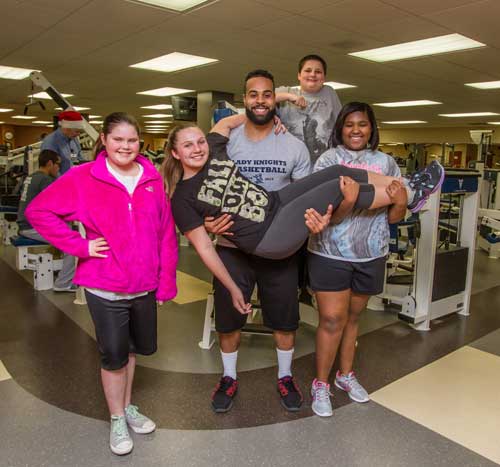
From left, Alana, Allie, exercise specialist Jammal Lee, Corey and Lexi work out at the Mercy Weight Management Center. Toledo Free Press photo by Christie Materni

Being a kid can be hard.

Being a kid struggling with weight issues can be even harder.

From left, Alana, Allie, exercise specialist Jammal Lee, Corey and Lexi work out at the Mercy Weight Management Center. Toledo Free Press photo by Christie Materni

Over the past year and a half, staff at the Mercy Weight Management Center, 3930 Sunforest Court, have been trying to ease the pain for overweight adolescents and their families.

The center’s adolescent weight program is a six-month, research-based program that focuses on helping teens and their families make better choices on nutrition, behavior and exercise. Each week, families meet with Mercy staff for two hours, in addition to an hour of exercise.

“This program really gives the teenagers confidence to go out in the community or in their school and participate,” said Jenny Nelson, program coordinator and health educator.

Jammal Lee is on the front lines of teen obesity. As an exercise specialist at the center, Lee knows that many teens are intimidated by exercise.

“When they come in, they understand that exercise is strenuous, that exercise is no fun, that exercise takes work and I try to eliminate that thought process,” Lee said.

Not that he takes it easy on them. The program starts with five-minute, high-intensity workouts.

“I’m not a fan of working out a really, really long period of time,” Lee said. “These kids automatically have this fear, automatically are very uncomfortable when it comes to working out, so if I can keep that down to a minimum with the high-intensity level, they’ll understand that ‘Wow, first of all, that was really, really hard, but second of all, I conquered it,’” Lee gradually works the teens’ workouts up to 25 minutes in five-minute increments. Eventually, they find something in the program they enjoy.

“They’ll say, ‘Hey Mr. J, can we do that again?’” he said. “That’s what it’s all about. Finding what you love, and going after it hard.”

A team of health experts helps identify the issues each child and family may be facing.

“I find out that some of these kids are spending 12-15 hours of screen time a day, which is virtually their whole waking day on some sort of electronic device,” said Sheri Desmond, a certified nurse practitioner who conducts a medical review of each teen.

Kim Snyder decided to enroll her daughter Allie, 14, in the program after attempts at home failed.

“It just seemed like we weren’t seeing the results we wanted,” Snyder said. Allie will soon enter Phase 2 of the program, a more strenuous continuation of Phase 1. Allie has lost 22 pounds in six months.

Allie encourages other teens to look inward when making a commitment to becoming healthier.

“It’s really never OK to change who you are for someone else, but it’s OK to change yourself because you want to,” she said.

Lexi, 16, another teen in the program, has been involved since it began in 2013.

“The first day I came I thought, ‘This isn’t going to help me at all.’ But after the course of maybe a month I did see some type of results. … I got more into vegetables and fruits. I had my water bottle by my side. I was always on the treadmill. My mom and I cut out going to restaurants.”

Snyder said the program was exactly what her family was looking for.

“I didn’t want her to go on a diet. I didn’t want her to go into Weight Watchers. … I wanted her to understand this is a way of life.”

The program costs $100 per month, with scholarship funds available. Mercy Weight Management Center is hosting free informational sessions to learn more about the program at 6:45 p.m. Jan. 14 and Feb. 11. For more information, contact the center at (419) 324-9112.

More murals planned for city in 2015

0
Toledo City Councilwoman Lindsay Webb, artist Ahmad Jacobs and Rachel Richardson of ACT by a mural in Toledo. Toledo Free Press file photo by Andrew Weber.

As Toledo continues to fight its blight problem, Art Corner Toledo (ACT) continues to help in the battle by investing, planning and executing murals throughout the city.

For 2015, murals are planned at four different blank walls meant to help revitalize the neighborhoods in which they appear.

ACT will hold four public meetings, one at each location, to gather public input on what type of mural the community would like to see.

“We find that when we do put a mural in otherwise neglected neighborhoods, it beautifies and revitalizes and gets the neighborhood to realize they can invest in their own space,” said ACT founder Rachel Richardson.

Richardson said ACT has not hired any artists yet or decided on any designs for the murals, but will gather community input and go from there.

Community members are invited to attend the following meetings add their voices to the discussion: 5:30 p.m. Jan. 8 at Lighthouse Landing, 4441 N. Summit St., in Point Place; 5:30 p.m. Jan. 15 at Seed Coworking, 25 S. St. Clair St.; 5:30 p.m. Jan. 21 at the West Toledo Branch Library, 1320 Sylvania Ave.; and 5:30 p.m. Jan. 22 at Mad Ave Collective, 1600 Madison Ave.

The murals are made possible by funds provided by the city and county.

Toledo City Council passed a measure this year to spend $15,000 on murals for the city. That money matched $15,000 offered by Lucas County, with all funding going to ACT.

“Murals are a great way to capture the heart of a neighborhood and express it visually,” Councilwoman Lindsay Webb has said. “It’s a part of developing and identifying and dealing with blight.”

In another project, two railroad bridges on Bancroft Street will be covered, with a mural on each side of the two bridges. Richardson plans a public call to artists in February through a contest from which the top four designs will be selected. The winning designs will be chosen by Councilman Tyrone Riley.

The idea is to have the phrase “Toledo Alive!” incorporated into the murals.

The Collingwood Arts Center has been supporting ACT by providing space for muralists to paint on panels that are later installed at locations around the city. The help is allowing artists to work outside the normal season.

“We can paint them all throughout the year,” Richardson said.

ACT was founded in 2010 with a mission to promote Toledo as a socially conscious city and began creating murals to illustrate that, Richardson said. So far, the organization has completed 20 murals.

“An abandoned lot or a building gets developed in the wake of one of our murals,” Richardson said.

Melden: My grandfather’s watch

0

I wear my grandfather’s watch.

It’s an Accutron from Bulova with a simple gold face. The underside has his name, Don Roepke, engraved along with dates that mark 25 years of service at the factory where he worked. My mother gave it to me just after he passed away in September 2013.

At first I couldn’t figure out how to make the days of the week line up with the date. The clear, quartz cover was very scratched and even had a small crack in it. I got that fixed. I also replaced the golden, stretchy metal band with one made of brown leather. It’s not worth hundreds of dollars, but it’s a nice watch and it means a lot to me.

But you know, even with all the tweaks and changes I’ve made, there is still this sense that I am wearing Grandpa’s watch. I didn’t get a new watch. It was someone else’s and now I simply look after it. And, if I can take care of it, keep it clean and working, I might be able to pass it on one day, too. I have been thinking recently; my grandpa’s watch reminds me of the mindset of really great leaders.

“Leader” is unfortunately a confusing word in our culture. Most of us are well aware of self-centered, incompetent and even corrupt people who have grafted the title of leader to their persona without first earning the required respect, trust and credibility. We are tempted to associate “leader” with other words like success, prestige, money, fame, etc., losing the true meaning of the word. There are other words though. Other words that describe other leaders. One of my favorite authors and leaders, Parker J. Palmer, defines leadership this way: “A leader is someone with the power to project either shadow or light upon some part of the world, and upon the lives of the people who dwell there. A leader shapes the ethos in which others must live, an ethos as light-filled as heaven or as shadowy as hell.”

The reason my grandfather’s watch on my wrist reminds me of great leadership is because I believe the best leaders are stewards, not owners. Trust has been given, influence granted, and the leader is faced with the question of how to handle this gift. Does she consider this status as something to be used for her own benefit, or does she understand the “here today, gone tomorrow” component of leadership? Is the goal to get his name in lights, or create a light-filled reality for whoever will take his seat next? As leaders, do we hold our influence with tight fists focused on scarcity? Or do we accept the open-handed invitation of abundance?

As I said earlier, we are all too familiar with negative leadership examples. However, there are great examples of leadership as well, and we can especially spot them when we look for those who are living as stewards, those who build something that stretches much further than themselves.

It’s like the CEO who relocates his company headquarters Downtown to help accomplish much more than simply running a profitable business.

Or the pope, in his first address, saying to the world: “Pray for me.”

Or the school superintendent who walks the halls engaging each seventh-grader he sees as if they were a board member or a voter in levy season.

Or the neighbors who care for the house they are renting because they respect the neighborhood and the landlord.

Owners use, spend and consume their way forward. Stewards preserve, share and collaborate their way into the future. Our entire conversation regarding conservation and environmental responsibility comes down to understanding stewardship. When we understand the idea of stewardship we support our schools long after our own kids have graduated.

Stewardship is tantamount to good leadership. And at The Center for Servant Leadership, we believe understanding yourself as a steward, not an owner, of the influence, power and status you currently hold is a key step in becoming a servant leader. This is an aspect of our work: teaching leaders how to uncover stewardship in their lives.

Stewardship is inspiring. When I do finally hand off grandpa’s watch to the next person, they will understand that it was given to me and now I give it to them. It is not theirs to own. They are simply looking after it for a time.

Sam Melden is executive director of The Center for Servant Leadership. He can be reached at [email protected].

CrossFit takes fitness back to our roots

0
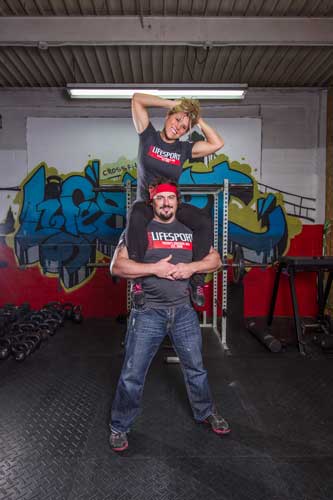
Todd and Tamera Ovall, Owners of CrossFit Lifesport in Toledo. The B usiness as the 986th Crossfit box in the world when it opened in 2008. Today there are more than 10,000 worldwide. Toledo Free Press photo and cover by Christie Materni

Modern exercise routines, equipment, apps and trends abound. CrossFit only dates to the beginning of the 21st century, but its philosophy of fitness and diet goes back to our roots. Like, back to our hunter and gatherer roots.

Todd Ovall got into CrossFit before most people had heard of it.

n  TODD AND TAMERA OVALL, OWNERS OF CROSSFIT LIFESPORT IN TOLEDO. THE BUSINESS WAS THE 986th CROSSFIT BOX in the world WHEN IT OPENED IN 2008. TODAY there are more than 10,000 WORLDWIDE.  TOLEDO FREE PRESS PHOTO AND COVER  PHOTO BY CHRISTIE MATERNI
Todd and Tamera Ovall, Owners of CrossFit Lifesport in Toledo. The B usiness as the 986th Crossfit box in the world when it opened in 2008. Today there are more than 10,000 worldwide. Toledo Free Press photo and cover by Christie Materni

The former YMCA trainer opened CrossFit LifeSport, now at 3128 Douglas Road, in 2008. His “box” (CrossFit gym) was the 986th in the world. Today, there are more than 10,000 across the globe, including at least four in the Toledo area.

“CrossFit is part of the ancestral fitness movement,” said Ovall, 42. “It’s the convergence of a bunch of different sciences — exercise science, biochemistry, anthropology and all kinds of other things — shooting toward the same conclusion, which is if we emulate our hunter/gatherer forebears the best that we can realistically and the closer we get to most of what they did, the healthier things seem to get for us.”

At its core, the CrossFit lifestyle combines a Paleo (think natural, non-processed, sugar-free foods) diet and an exercise regimen of three to four one-hour WODs (“workout of the day”) a week. WODs may consist of deadlifts, squats, pushups, pullups, flipping tractor tires, rowing machines or more.

Another Toledo-area box, Black Swamp CrossFit, 7335 W. Sylvania Ave., Sylvania, got its start in 2012 when husband-wife duo Abbey Mortemore and Michael Sachs, who had been into CrossFit for a couple of years, decided it was time for a career change.

Mortemore had been working for the Ohio Attorney General when she decided they should open up a box — their “happy place,” as she called it.

“It’s a subculture more than just a fitness regimen,” Mortemore said. “It creates some sort of odd community. I think it’s because of the difficulty of it, and people go through it together.”

She does not regret the career shift.

“Every day I go to work, I work with people who want to be where I’m at,” Mortemore said. “People are there for such positive reasons.”

The CrossFit box aesthetic is a rather stark one. Exposed plywood and cement blocks are common.

“It’s not going to be posh because the business model demands we get a garage or warehouse space essentially and keep the overhead relatively low so that we don’t price ourselves out of existence,” Ovall said.

Ovall eats about 80 percent Paleo, a high but manageable level for many people, he figures.

“I ask people to try it for a month,” he said. “It’s always a game-changer. … They find out they have reactions to food they never realized they had. They have toxic reactions to some things that we’ve all grown up as thinking of food and it’s really not food. It’s nothing that a human is genetically predisposed to. It was never in our environment until 50 years ago.

“We’re fighting against the scourge of the modern food culture in the West,” he said. “Paleo is totally doable if you have a grill and you make good choices at the store. If you grab the cheese puffs at the store, you’re probably going to eat them. If you don’t, you’re probably not.”

The diversity of members was evident in one trip to the box. Jarvis Gamble and Doug Doherty were the sole members of a recent 7:30 a.m. class at CrossFit Lifesport. They did six rounds of rowing 250 meters, followed by 20 pushups.

Gamble is 69. Doherty is 76.

“I liked the concept of CrossFit,” Gamble said. “It challenges you, works on a lot of different things. It’s not just aerobic. … I have better balance, more endurance and more strength.”

Doherty is into Paleo — about 85 percent, he said. He’s lost 38 pounds in the four years he’s been doing CrossFit. Many are surprised to learn someone born in the 1930s goes to a box.

“They say, ‘CrossFit? I understand that’s a real butt-kicker.’”

CrossFit isn’t the cheapest fitness plan. Ovall says more traditional gyms keep costs low because they know many memberships will go completely unused. CrossFit boxes want people to show up, he said.

In Toledo, memberships generally run between $100-200 a month, depending on the length of membership.

“But with that, you get workout buddies,” Ovall said. “If you don’t have a workout buddy, your likelihood of achieving your goals is significantly reduced from what I’ve seen in my 25 years of training.”

“CrossFit cannot be devalued,” Mortemore said. “It’s group personal training. We program for people, we coach them, we train them.”

Tracy Plumb-Ruiz, 36, of Toledo got started in CrossFit two years ago.

“I was looking for something different and more challenging than the standard gym. I had plateaued with diet and exercise and was having trouble finding the motivation to go.”

Six years ago, she lost 150 pounds. She’s kept it all off, using CrossFit to improve her physique.

“It requires so much more of my body and I had to work so much harder than the standard machines,” she said. “I had been doing cardio for an hour, working certain muscles at each workout. In CrossFit we work everything, every workout. A lot of times, in a much shorter time period.”

At the end of the day, CrossFit’s mantra is essentially “Just show up.”

“All you’ve got to do is get to the door,” Ovall said. “Get that far and we’ll make it happen. You’re not going to get in amongst a group of your peers and say, ‘Eh, I just don’t feel like it today.’”

Mortemore said of CrossFit, “It may not be for everyone, but anyone who wants to do it, we can make it for them.”

Ottney: Visions

0

Each year at this time, Toledo Free Press asks local economic development leaders to share their thoughts, plans and visions for Toledo and the region in the coming year. We want to know what they think are the biggest successes to build on, the biggest challenges ahead and what they are most excited about. It never disappoints.

“Toledo’s best days are still to come,” Toledo Mayor D. Michael Collins declared, pledging to continue his focus on job creation and his support to local companies considering expansion.

Toledo Chamber of Commerce President Wendy Gramza focused on the chamber’s talent attraction and retention efforts, encapsulated by the slogan, “It Matters Where You Make It.”

“People are the No. 1 asset of any company,” Gramza wrote. “We must be able to grow local talent, recruit talent from other regions and hold on to talent when recruiters want to lure it elsewhere.”

The Lucas County Commissioners touted their efforts to streamline economic and workforce development efforts with the creation of the Department of Planning and Development and a partnership with the Regional Growth Partnership (RGP) alongside Wood, Ottawa and Monroe counties called Comprehensive Economic Development Strategy. They also plugged Work Ready Lucas County, an initiative that helps measure, identify and close skill gaps in the workforce.

Northwest Ohio Regional Economic Development (NORED) President Hans Rosebrock of FirstEnergy used his company’s $600-million steam generator replacement and refueling project at Davis-Besse as an example of how large-scale private sector investments can make a big impact on our regional economy.

RGP President and CEO Dean Monske talked about his agency’s role in pitching and selling Northwest Ohio’s assets to domestic and international site consultants looking for places to expand, while Toledo African American Chamber of Commerce President Jay Black focused on ways to help promote growth and development of African-American-owned businesses, which stabilizes neighborhoods while helping the region as a whole.

The University of Toledo’s Molly Reams Thompson, Rhonda Wingfield and Jessica Sattler jointly recapped successes in innovation at UT. Roost, Nextronex and Blue Water Satellite were among startups that made a splash in 2014.

This year is shaping up to be one of the most exciting for Northwest Ohio in decades, concluded Toledo-Lucas County Port Authority President and CEO Paul Toth, citing low interest rates, oil prices, unemployment rates and more — “all signs that our economy is moving in the right direction and that further investment in the region is imminent.”

Finally, TFP’s Lou Hebert offers his solution for the “riverfront riddle” of the Marina District — a park. “Let it be what it is now and what it wants to be: a park,” Hebert wrote. “Whatever it is, it should be grand. We should have no quarter for little plans. We need to do something to stir our souls. Toledo needs to make a statement — a bold one to the rest of the world and to ourselves. This is our chance. This is our challenge. This waiting and vacant piece of our riverfront is our opportunity.”

Here’s to 2015. Cheers.

Sarah Ottney is editor in chief of Toledo Free Press. Contact her at sottney@
toledofreepress.com or find her on Twitter at @sarahottney.

McGinnis: Social media anxiety

0

I stare blankly at my smartphone. At moments like this, I’m certain it actually is smarter than I am. I haven’t said anything on Facebook or Twitter for a few hours now. I need to add a comment, joke, clever observation or link for my followers to visit. I want to say something that will add a smile to their day, something they can acknowledge with a like, comment or — Lord willing — that cherished repost or retweet.

I want to post something good. Funny. No, more than funny — brilliantly funny. I want to post something that will go down in the annals of social media. A note that, after the inevitable Internet Hall of Fame is built, will be enshrined on a plaque somewhere. Fans of wit or wisdom will gather around to speak of it in hushed tones, wondering of its origin. “He went by the handle ‘jeffmac813.’ No one knows what inspired this seminal work. We only know it has enriched the lives of generations.”

Yet a blank screen stares at me, and I am powerless before it. I can’t think of anything to write — at least anything that people would actually want to read. I am paralyzed between the desire to share a thought and the lack of any thought to share. You often hear about writer’s block, that bane of the creative. If this particular lack of movement has a term, it would be akin to SMA — Social Media Anxiety. And I have suffered from it for a long, long time.

It wasn’t always like this. Back when I first began to dip my toe into the waters of Friendster, MySpace and their now-obsolete brethren, social media was a bit of a mystery. In those early days, the platforms just seemed like a fun and harmless way of keeping in touch with my pals and occasionally making new ones.

As someone who clings to people I care about like a barnacle, it was a great way of maintaining connections to people who had long since departed Northwest Ohio.

I didn’t put much thought into what I was posting at that point — my comments were the usual “feeling glum” or “just ate at so-and-so” that everyone writes. But somewhere along the way, I began noticing the kind of users and status updates that I loved reading, and longed to be more like them. These were the individuals using these platforms not just to exchange simple observations, but as a creative outlet.

People like my friend Jessica Joy (@J2thaJOY), whose off-center thoughts on the universe never cease to make me smile. (“If Jesus doesn’t sing on your album, why are you thanking him for your Grammy?”) Comedians whose work I’ve always admired, like Albert Brooks (@AlbertBrooks) and Steve Martin (@SteveMartinToGo), who find a way to be brilliant and funny even when confined to 140 characters. New friends like the remarkable Babsbat (@BabsBat), a cosplayer from Britain whose remarkable costume work is surpassed only by her blindingly wonderful wit.

These kinds of writers inspired me to up my game. To use Facebook, Twitter and their ilk as a forum not only for miscellaneous thoughts on the events of the day, but to contribute a smile or two to the people who cared enough to follow me. And as time has gone on and my number of friends has grown, it’s an obligation I take increasingly — some would say worryingly — seriously.

No, for real. I work almost as hard on my Twitter and Facebook updates as I do on most any other form of writing I do, and I take just as much joy in a job well done. When I get a beep from my phone notifying me that someone commented or replied to something I posted, my heart glows a bit. If someone who I admire has “liked” one of my lines, I feel a surge of pride. Seriously, it’s insane.

I’ve even started signing up for new websites, just so I don’t get left behind. I signed up for Vine even though I have never had any interest in filming videos. I signed up for Instagram, though I loathe having my picture taken in general. Seriously, look at me. I know a shot of my mug accompanies this column. Look at it — tell me I don’t have a face for radio.

And yet, I keep going. I try to learn the new obsessions, I make new jokes, I suffer through those paralyzing bouts of SMA. I am an addict, I admit it. But in my mind, it’s all worth it. Because unlike most addictions, which are purely selfish in nature, the end result of this one brings a sliver or two of joy into the lives of people I care about. And if I can do that, it’s worth every agonizing second spent staring at a blank smartphone screen. @jeffmac813. Let me know how I’m doing, would you?

Jeff McGinnis is pop culture editor of Toledo Free Press. He can be reached at [email protected] or on Twitter at @jeffmac813.

Chrys Peterson steps down as anchor

0

After spending 20 years coming into our homes via newscasts on WTOL, Chrys Peterson has relished spending more time in 2014 in her own home.  

The former news anchor’s last day on the air was Feb. 28. The main reason she decided to not sign another contract with WTOL at that time was to be able to spend more time with her teenage daughter, Riley.

“I’ve really enjoyed my family time since I left WTOL,” Peterson said. “I’ve been able to spend a lot of quality time with Riley, attending all her basketball games, tennis matches and musical performances. But it’s also been nice just being able to be home when Riley has her friends over or be available to help with homework at night.” 

When she was preparing to leave the news business, Peterson told Toledo Free Press she was ready to take on the more challenging parent roles she would be undertaking as the mother of a teenage daughter.

“When children are older they need you more than when they’re younger,” she said. “When they’re younger you meet their basic needs, and a babysitter can do that for you. They can feed them and make sure they get to bed on time, check their homework, that kind of thing,” she said. “But when they’re older they’re making choices and decisions about things that are really helping them to become the people that they’re going to be. I just don’t think I can do that over the phone effectively, and basically that’s what it comes down to.” 

The decision to stop working in the news business also offered Peterson more time to see husband Tom Runnells, bench coach for the Colorado Rockies Major League Baseball team.

“I also had the freedom to travel more over the summer to see Tom,” she said. “We made two trips to Denver, a trip to Florida, two trips to California and were also able to drive and spend time when they played in Detroit, Cincinnati, Pittsburgh and Cleveland. The flexibility has been wonderful!”

Peterson isn’t exactly taking it easy in retirement, however.

She opened her own consulting business, working primarily with ProMedica Health System on leadership training and video projects.

Doing the training is exciting because it’s something new for me, and employee development is something I’m passionate about,” said Peterson, who has her master’s degree in organizational leadership from Lourdes University.

“I’m also excited that I still get to tell interesting stories about people in our community doing amazing things. … I absolutely love the work and love the people I work with there.”

The stories the ex-anchor tells now can be found on the ProMedica Health Connect Website, ProMedicahealthconnect.org.    

While she does miss her friends from the station, she says she is able to stay in relatively close touch with them.

“I knew I would miss the interaction with the viewers, she said. “But I’ve continued to stay connected to many of them through my Chrys Peterson WTOL Facebook page and people still come up to me and say ‘hi’ when I’m out which I enjoy very much.” 

But for Peterson, it’s all about the flexibility these days.

“I can plan my work and activities around my important family events instead of having to be sitting on the set at a certain time each day,” she said. “I’ve been surprised that my schedule has changed so dramatically. For years, I worked until midnight, so I didn’t really go to sleep until 3 a.m. most nights.  Now, I get up with Riley around 6 a.m. so I’m not always able to stay awake to watch the 11 p.m. news!  “Thank goodness I can still see Jerry on Fox at 10!” she said with a smile.

CAC ends residency program

0

It’s been a year of growing pains for the Collingwood Arts Center (CAC) — with a long way yet to go — but the nonprofit’s leadership believes it’s headed in the right direction. Since taking the helm in August 2013, Interim Executive Director Sarah Kurfis shepherded CAC through a period of transition, most notably from an artist residency program to a more community-focused arts center.

“We’re in the process right now of figuring out what we’re going to be when we grow up,” Kurfis told Toledo Free Press in September. “There’s still a lot of work to do, but we’ve come pretty far. People are getting re-energized. We have a lot of new energy and artists and people helping out at the building.”

On Oct. 1, CAC’s special events coordinator Lexi Staples took over as executive director.

 “I’m excited to continue what Sarah started,” Staples said in September. “It’s been cool to see just how much the community does want to be involved with the space and with the idea there could be a different use for the building. It’s been really fun to watch people start to change their minds about the building and be more supportive of futuristic plans.”

“We’re stabilizing and Lexi is the perfect person to carry out this new vision,” Kurfis said. “We found an avenue and a niche the Collingwood can be successful at and developed a strategic plan that can help it get somewhere great and have an impact on our community. I turned the ship slightly and now I’m stepping out of the way to let the most capable people do it.”

Kurfis said she is proud of the work she did at CAC, even her controversial decision to end the building’s longtime artist residency program in January. Faced with building conditions that included no heat or hot water, residents were given 30 days to move out.

“My original recommendation was a six-month transition, but then everything basically went to hell in a week,” Kurfis said. “It was the weather that made the decision to move quicker, but it was still the right decision to make. It just wasn’t safe.”

Michael Grover was among the residents who were displaced and he’s still bitter.

“All I can say about it was that arts center was a unique facility. Not only for this area but for the whole country,” Grover said. “Its loss is a loss to the community as a whole and is a sad statement on the state of the arts in America.”

Kurfis spent her first few months getting acclimated and studying the nonprofit’s structure, and concluded the resident program wasn’t working.

“It was a great idea; it just didn’t work,” Kurfis said. “I spent lots of time managing resident issues. It was basically a dorm, with everyone so close and sharing things. It was a dysfunctional mess.”

The center’s financial standing is still shaky.

“We’re in a lot better position than we were even a year ago or a few months ago, but we’re still digging ourselves out of a hole caused by mismanagement,” she said.

“There’s nothing you can point to and say, ‘That was the specific problem,’” Kurfis said. “It was just a bunch of bad decisions. My guess is a combination of negligent management, unreliable contractors, probably some theft somewhere.”

“We do have a complicated history,” Staples said. “It’s really frustrating to not be able to fix all the past mistakes. But we need to go forward on a clean slate.”

Finished in 1905, the CAC is a registered historical site designed as a convent for the Ursuline Order of the Sacred Heart. It later housed Mary Manse College and St. Ursula Academy. It became a community art center in the mid-1980s.

With the end of the artist residency program, CAC lost its main source of funding, which now comes from studio rentals, event space rentals and proceeds from events, Kurfis said. All current funds are tied into basic operating costs, but the hope is to eventually shift to capital improvements.

A donated boiler was recently installed and Staples said the temperature in the building is rising, making it useable this winter.

CAC’s new mission statement is “to provide an outlet for creative community involvement while preserving a historic space.” Its new tagline is Creating Community Through Art.

Many groups that rent studio space at CAC are also happy with the new direction.

Barry Aslinger started the T-Town Tassels burlesque troupe at CAC earlier this year. He and his partner are the only former residents still living at CAC. Aslinger stayed on doing maintenance work at the building, which he calls a “jewel” of Toledo.

McGinnis: 2014’s Best Thing: How the World Cup brought people together

0

Forget about soccer being “the world’s game.” That phrase is usually bandied about by the well-intentioned as if the sheer fact that the sport is popular worldwide should be enough reason for American fans to like it. This makes it feel more like an obligation than a joy. No, the fact that it’s “the world’s game” doesn’t matter to me a whit.

.

What does matter is that for a month this summer, it was MY game. And the game of an ever-increasing number of people I know, connecting us in a real, emotional way. For that reason, I think the FIFA World Cup was 2014’s Best Thing, period, in pop culture.

Every four years, I start to get an itch. Right around the beginning of May, I start to get an itch. By the time the opening kickoff finally occurs, my excitement is at a fever pitch. The World Cup once more has me under its spell.

More than 2,000 people watched the United States take on Belgium on the ballpark's big screen at Fifth Third Field this summer, including University of Toledo students Morgan St. Julian, Carly Gains and Austin Burgess. Toledo Free Press Photo by Sarah Ottney

More than 2,000 people watched the United States take on Belgium on the ballpark’s big screen at Fifth Third Field this summer, including University of Toledo students Morgan St. Julian, Carly Gains and Austin Burgess. Toledo Free Press File Photo by Sarah Ottney

I place most of my grateful blame at the feet of my former roommate Ian. One night I came home to find on the screen the 2002 World Cup out of South Korea and Japan. I hadn’t even known Ian was interested in sports, much less soccer. Yet it seemed every four years, World Cup fever took hold of my friend.

At first I was resistant to the point of hostility. “This is dull! The offside rule makes no sense!” But as each game passed and I found myself becoming more and more acquainted with the strategies involved, I began to enjoy the matches.

By 2010, though time and distance separated us, my friends and I could still geek out over the World Cup through the burgeoning advances of social media. I began to notice we were becoming less alone. World Cup fever seemed to be catching on.

This was even more apparent during this year’s tournament out of Brazil, which was probably the most purely entertaining World Cup I have seen yet. United States fans were treated to a roller coaster of emotions, as the men’s national team once more was able to survive the group stage, only to falter in the knockout round.

Even though the World Cup is competition between nations, the overriding spirit — how the love of a game brings everyone together — is what I truly take away once the final whistle has sounded. And every four years I can feel and see that spirit take root among more and more people.

For being a wonderfully entertaining event, for bringing people together, for providing the most expansive common ground in this most divisive of times — the 2014 FIFA World Cup was this year’s Best Thing. Period.