Home Blog Page 164

Visions: Gramza: Attracting, retaining talent key for regional development

0

Editor’s Note: This guest column is part of an annual special section called Visions, in which Toledo Free Press asks local economic development and business leaders to share what they see ahead for Toledo and Northwest Ohio in the coming year.

In my new role with the Toledo Regional Chamber of Commerce, I had the opportunity to spend time with even more chamber members than usual in 2014.

.

.

Without fail, every company cited talent attraction and retention as one of its key challenges.

This came as no surprise, as people are the No. 1 asset of any organization. We must be able to grow local talent, recruit talent from other regions and hold on to talent when recruiters want to lure it elsewhere.

RELATED: Ottney: Visions

As a first step toward connecting with emerging talent, the Chamber created EPIC Toledo in 2007. EPIC, which stands for Engaging People, Inspiring Change, is based on the belief that a region that is influenced by diverse young professionals is a region that can attract and retain them.

In 2009, the  Toledo Region branding initiative was developed to promote the region’s quality of place and economic assets. Last year, the initiative enhanced its message with a new campaign: It Matters Where You Make It.

In 2015, the chamber’s main goal is to help companies in the region with their efforts to recruit top talent by promoting the diverse opportunities and benefits of working and living in the Toledo region.

We will accomplish this in two key ways. The first is to promote the diversity of jobs within the region, while the second is to showcase the quality of life that can be attained for those who relocate or choose to remain here. For those who wonder if there is a regional economic development strategy and if “all of those organizations talk to each other,” rest assured there is and we do.

While many groups throughout the region have economic development as a part of their mission, this does not necessarily mean that there is confusion or duplication. The business of growing our economy is complex and requires focus in key areas. When each organization focuses on what it does best and communicates regularly with the others, success is not only possible but likely.

The chamber is proud to play a key role in this regional effort through our advocacy efforts and member services. Our team is eager to move into this next phase of talent attraction and recruitment in 2015 as we illustrate for the world exactly why “It Matters Where You Make It.”

Wendy Gramza is president of Toledo Regional Chamber of Commerce.
Visions: Monske: RGP trumpets NW Ohio assets to domestic, international companies

0

Editor’s Note: This guest column is part of an annual special section called Visions, in which Toledo Free Press asks local economic development and business leaders to share what they see ahead for Toledo and Northwest Ohio in the coming year.

The Regional Growth Partnership  (RGP) is the lead economic development group serving the Toledo region and 17 counties of Northwest Ohio.

As a privately led organization, the RGP focuses on meeting the site selection needs of corporate clients in a confidential, innovative and time-sensitive manner.

.

.

The RGP offers a full range of traditional business development services, working in conjunction with our partners at the regional and state levels, to most effectively manage the site selection process.

RELATED: Ottney: Visions

These services include: comprehensive site and facility searches; incentive packaging; project development, planning and expediting; facilitating projects in collaboration with regional and state partners; and providing access to Northwest Ohio’s premier venture capital firm.

To support these business development efforts, the RGP serves as the network partner in Northwest Ohio for JobsOhio, a private, state-created corporation leading Ohio’s job-creation efforts. The RGP partners with JobsOhio to provide project management and administration resources throughout the 17 counties it serves.

The RGP’s business development efforts are focused on six cluster industries: advanced and alternative energy; advanced materials and manufacturing technologies; automotive; food processing/agricultural business; transportation and integrated logistics; and bioscience.

Site consultants are the primary audience for the RGP because of the central role they play in the site location process. Our business development team focuses on direct outreach efforts to this target group. This includes direct market visits and hosting consultants for special events.

The RGP’s business development efforts also include an international component focused on cultivating the region’s infrastructure to serve both foreign-owned businesses and companies looking to expand in the global marketplace. Much like domestic business attraction, the international investment strategy is geared toward site consultants and targeted industry executives.

As chief marketing arm for the region, the RGP takes a lead role in pitching and selling Northwest Ohio’s assets to a national and international audience. Our editorial marketing campaign has generated coverage for the region in such prominent outlets as The New York Times, The Wall Street Journal, ABC World News, CNN and Newsweek.

To help foster technology development, the RGP created Rocket Ventures, which serves as Northwest Ohio’s top resource for entrepreneurs and startups seeking capital and commercialization assistance. Client companies are eligible for funding consideration and access to a professional team which offers unparalleled knowledge and assistance and a track record of success in launching early-stage tech companies.

Dean Monske is president and CEO of the Regional Growth Partnership.

Visions: UT: UT innovation helps fuel economy

0

In recent years, The University of Toledo has stepped up to the plate to help drive economic development throughout Northwest Ohio and 2014 was no exception. This past year marked some exciting changes that impacted the entire innovation ecosystem in our region. In 2015, UT is poised to take its passionate commitment to innovation and entrepreneurship to another level.

.

.

At the core of this change is the newly branded UT’s Rocket Innovations enterprise (formerly UT Innovation Enterprises). Rocket Innovations consists of an investment fund, a technology transfer office and the LaunchPad Incubation program, which all work together to stimulate economic development.

Rocket Innovations’ focus is to invest in technology-based pre-seed companies in three sectors: IT, biomed and renewable energy. The new structure will enable UT to more effectively leverage assets and resources and collaborate with partners, including Regional Growth Partnership and Rocket Ventures to drive job growth, capital investment and wealth creation to Northwest Ohio.

LaunchPad Incubation, a program that provides intensive assistance to tech-based startups, underwent a complete makeover in 2014. The result was a 400 percent growth in clients that helped launch 20 new companies and generated over 30 new jobs.

LaunchPad also experienced two graduations. Roost, an IT-based push notification company that recently attended the prestigious Y-Combinator accelerator program in Silicon Valley, graduated in August. Nextronex, an alternative energy-based company that manufactures inverters for solar arrays, graduated in September. Both were also finalists in the Seed Financing category at the inaugural VentureOhio Awards event in September, which acknowledges significant milestones in early-stage startup firms in Ohio. Nextronex came out on top as the winner.

Another notable company in UT’s portfolio is Blue Water Satellite (BWS), an IT company that has developed a proprietary algorithm using satellite imaging to detect specific mineral contents in water and on land. This startup, now part of the LaunchPad Incubation program, was created at Bowling Green State University. Growing exponentially, BWS has been selected as a Trusted Tester by Google and has garnered some terrific press lately, partially in response to the Lake Erie water issues.

In addition to modest funding through investment (Rocket Innovations) and grant awards (LaunchPad Incubation), the focus in 2015 for both programs will be to provide business assistance, management services and mentorships to startups, and experiential learning through Student Entrepreneur In Residence opportunities. Through these activities, students and faculty are given the opportunity to receive hands-on experiential learning through active engagement in research, technology commercialization and economic development in our region.

UT was also chosen as one of the first four National Science Foundation-backed Innovation Corps (I-Corps) sites in the nation. The program allows interdisciplinary students from engineering, business and law to work collaboratively with industry to research the market and create new products through the use of a new maker space, which is a joint partnership with UT’s College of Engineering, the I-Corps program at UT and LaunchPad Incubation.

Our end goal for 2015 is to continue to leverage the assets available within UT and Northwest Ohio; develop essential resources such as time, talent and treasure (access to capital); foster engagement among students and the community partners who can help make the biggest impact to the companies we serve; and further build the programs and partnerships to provide the biggest impact to the region. O

Molly Reams Thompson is director of LaunchPad Incubation at University of Toledo, Rhonda Wingfield is interim CEO of UTs Rocket Innovations (formerly Innovation Enterprises) and Jessica Sattler is director of economic engagement and business development programs at UT.

Visions: Black: Supporting black-owned businesses helps stabilize communities

0

The Toledo African American Chamber of Commerce (TAACC) advocates and promotes the economic growth and development of African American-owned businesses by focusing on the development of business opportunities, business alliances and legislative advocacy.

.

.

There are several tactics that will help create an environment of economic stability and help create jobs for one of Toledo’s most underserved communities. If we can help our businesses grow and expand, they in turn will hire those within our community who want to turn their lives around and those whom mainstream businesses do not employ. These tactics have worked successfully in other communities around the country and can work here.

It is a well-known fact that our community has traditionally been among the most marginalized and underrepresented. It has the highest rates of unemployment, lowest per capita individual income, highest crime rates, highest teen pregnancy rates, lowest life expectancy rates, one of the highest rates of homelessness, the most uneducated and unhealthy group and the highest rate of underfunded businesses. As you can see from this list, the needs are great.

These conditions exist for a variety of reasons (including conditions we have caused within our community). The entire community will be strengthened as some of the issues that have plagued our community for decades are addressed and eliminated.  The tactics are as follows:

  • Recycle our dollars as many times as possible within our community by patronizing our businesses. We can help create jobs in our own community by helping our businesses grow. This growth cannot occur without consistent and sustained support of our local businesses.
  • Ensure that our businesses have the same level of access to public contracts as other groups.
  • Work with governments, public institutions and others to develop job creation strategies that include our community. For instance, the University of Toledo, City of Toledo, Lucas County Commissioners, Mercy, Toledo-Lucas County Port Authority, Neighborhood Health Association and the State of Ohio have all made commitments in writing to include minority-owned businesses in their procurement processes. These organizations understand the importance of granting underserved communities the opportunity to grow their businesses by doing business with them. Other organizations, like the Toledo-Lucas County Public Library and Metroparks of Toledo Area apparently do not. The library has refused to adopt similar written inclusion polices and has refused to release evidence of its procurement performance to underserved communities even though it is public information. The Metroparks have indicated for more than two years now that they intend to adopt a policy but have not.
  • Unite and work together to develop plans that address blight, safety, infrastructure improvement and the delivery of services in and to our community.
  • Refrain from aligning with people who do not have a proven track record of supporting economic initiatives that have benefited our community. This includes elected officials, political candidates and levy sponsors.
  • Require that politicians and organizations we support with our votes and dollars reciprocate by supporting initiatives that focus on investing their resources in our community.
  • Set the leadership tone by requesting that corporate welfare (such as tax abatements, development assistance, public grants and block grant allocations) be given only to those entities that have a proven track record of including underserved communities in their hiring and procurement processes.

    TAACC believes that if we do more to help ourselves, along with the support of those outside our community, the entire Northwest Ohio community will benefit, grow and prosper.

Jay Black is president of the Toledo African American Chamber of Commerce. He can be reached at (419) 407-6697 or [email protected].

Black is back: Comedian Lewis Black returns to Northwest Ohio for gig at Stranahan

0
Lewis Black will be in Toledo on Jan. 11 for a performance at Stranahan Theater. Photo by Clay McBride.

The stereotype is that the best comedians don’t really have a “character” — they essentially play themselves onstage, but with the volume turned up.

This may never be more true than it is for the great comic Lewis Black. For over 30 years the Maryland native has toured the country, becoming a sensation with his trademark angry delivery, finding outrage in almost every corner of American life. But offstage? Black is calm, soft-spoken, patient, introspective. This is a man who takes his art seriously.

“When I was just starting out it felt like my feet were on a frying pan and that I had to keep moving them so as not to suffer third-degree burns to my frail confidence,” Black said in an interview with Toledo Free Press. “Sometimes it felt like I was bleeding in a pool of sharks. Now, after years of performing and learning somewhat the craft of comedy, it’s like what I imagine surfing is like, if I could surf. And when it’s really going well, you feel as if you and the audience are one. That you are merely the voice of the room. It’s exhilarating and it’s insane.”

The level of vitriol he expresses in front of audiences the world over may be amplified for comic effect, but there is no doubt it strikes a chord with audiences everywhere. Black, who will perform at the Stranahan Theater on Jan. 11, said that the development of his unique comic voice came over time.

“I think the hardest thing in comedy is finding out what makes you funny. You can write the jokes, but if you don’t know how to deliver them you are screwed. For the longest time, I wrote angry material but I wasn’t presenting it as angry. I was sitting on my anger, which can be very strange.

“After years of trying every which way to find my stage persona, a fellow comic, Dan Ballard, told me that I was angry, so when I got on stage next time I should yell my act. I should be angry up there. So I tried it. It worked. And I spent years refining it. Quite simply, I am funny when I am angry and sarcastic. It took years for me to realize something that was always a part of me.”

He came to comedy relatively late in life, compared to many contemporaries who seem to have had designs on stardom when they were barely out of high school.

Black’s first career was as a playwright, after earning a Master of Fine Art in theater from Yale in 1977. His first stage experience as a comedian came as a lead-in to plays he had written. Like most overnight sensations, it took years of fine-tuning and perseverance before he broke through to a mass audience after committing to his act full time. When did it really become apparent to Black that something big was happening?

“Sometime between receiving a very complimentary phone message from George Carlin and winning the American Comedy Award for Best [Male] Stand-up,” he said. “George told me he liked my work and thought I was funny. I wasn’t well known at all at that point, but the fact that George Carlin, a comic hero of mine, thought I was funny, I felt more successful than I ever imagined. When I won the award, I knew that the public had started to notice me. To this day, George’s compliment has meant more to me than any awards I have received.”

Black found his audience through appearances on Comedy Central, both in his own stand-up specials and his regular “Back in Black” segments on “The Daily Show,” where, introed by the driving beats of AC/DC, he railed against whatever injustices had caught his eye. Given their shared roots on Jon Stewart’s late-night news satire, Black expressed his support for Stephen Colbert as he prepares to take over for David Letterman on CBS’s “Late Show.”

“I think he will be brilliant as the host. Stephen Colbert is at heart one of the most extraordinary entertainers I have ever met. He will raise the level of the mass-market formula and make the mass market more intelligent. ‘The Colbert Report’ was great, but you ain’t seen nothing yet.”

Not that Black has a slow year ahead, himself. He will star as one of the emotions in the head of a young girl in the Pixar film “Inside Out” this summer. (His character, naturally, is Anger.) In addition, whenever possible, Black streams the last 15 minutes of his stage appearances at the website www.therantisdue.com, giving audiences their fix of that trademark Black outrage whenever needed. Does he think his audience’s need for the kind of catharsis he provides will ever wane?

“I hope not. Especially if the idiots who run the world keep the insanity going in high gear. But I wish that they would all get a grip and I can go back to just bitching about the weather.

“People deserve a lot better than what they are getting.”

Visions: Collins: Toledo’s best days are still to come

0

Editor’s Note: This guest column is part of an annual special section called Visions, in which Toledo Free Press asks local economic development and business leaders to share what they see ahead for Toledo and Northwest Ohio in the coming year.

In 2014, the effects of the Great Recession could still be felt, with perhaps the single greatest indicator of this economic downturn seen in the per capita income of the average Toledo citizen.

.

.

The most recent data demonstrates that the average Toledoan earned less than $20,000 per year. Of all of the political subdivisions in the State of Ohio, Toledo ranked in the bottom half in terms of per capita income. This is simply unacceptable.

To combat this stark reality, the city’s economic development department has focused its efforts on fundamentals. Studies have shown that 80 to 90 percent of all economic growth comes from the existing business core. Accordingly, the city is focusing its energy and resources on an outreach program to Toledo businesses to provide support for those companies considering expansion. In partnership with the Regional Growth Partnership, more than 300 businesses were contacted in 2014.

RELATED: Ottney: Visions

This outreach program has already produced results. As of Dec. 20, 712 jobs have been retained and 648 jobs have been created in the community. From an income tax standpoint, these jobs will generate more than $1.6 million that will flow directly into the general fund.

Job creation will continue to be a focus of my administration.  Job creation is the result of private businesses feeling comfortable investing capital in an environment where there is an appropriate labor force and land and facilities to accommodate their business models.

Toledo has a rich history of an exceptionally skilled workforce. This is why the slogan “It Matters Where You Make It” is so powerful. Any business engaged in manufacturing must consider Toledo as a location for its production facility.

In 2015, the city, in conjunction with its economic development partners, including the Toledo Regional Chamber of Commerce, is going to work to ensure that these skills remain sharp. A specific example of this can be seen in the relationship between the Northwest Ohio Building and Construction Trades Council, the contractor community and the residents of the city. A number of programs are being developed that will provide training and employment opportunities for the youth of Toledo. The emphasis here is providing a career that will increase the per capita income for our residents.

Toledo’s industrial legacy has been a double-edged sword for our community. On the one hand, a skilled workforce has been assembled to advance this manufacturing cluster. However, this industrial legacy has left strategically located properties in need of environmental remediation before they can be put back into the stream of commerce.

Between the Toledo-Lucas County Port Authority and the City of Toledo, more than 350 acres of property have been acquired and remediated so that jobs can be created. Most recently, the city closed on 30 acres of property near Fiat Chrysler’s Toledo North Assembly Plant. In 2015, this land will be remediated and redeveloped.

In 2015, an increased emphasis will be placed on quality of life issues. Efforts continue to make our Downtown a vibrant, safe and socially friendly environment. The city is working with the Mud Hens, the Toledo Museum of Art and the Toledo Zoo on bike trails that will allow Downtown residents to have better access to some of the community’s most significant treasures.

Outside events forced many previous mayors to manage decline. I am confident, however, that through the hard work and passion of our residents and team members, I will have the honor of being in a position to lead and inspire economic growth in our community. Toledo’s best days are still to come.

D. Michael Collins is mayor of Toledo.

Visions: Hebert: Park could be solution to Marina District’s riverfront riddle

0

Editor’s Note: This column ran as part of an annual special section called Visions, in which Toledo Free Press asks local economic development and business leaders to share what they see ahead for Toledo and Northwest Ohio in the coming year.

The next time you’re on the East Side of Toledo, take a turn off Main Street down Riverside Drive. It’s the street that runs the length of the so-called Marina District along the Maumee River.

.

.

If you’re there in the daytime, you’ll likely find at least a dozen cars with people inside, eating lunch, talking on a cellphone or contemplating life. Oftentimes, people get out of their cars to take a stroll down to the river.

As talk grows louder about a possible repossession of this taxpayer-improved riverfront site — owned but ignored by Chinese investors — we will likely need to get serious very soon about what the city wants to do with this property. Opinions and ideas are sure to run the gamut.  So here’s mine. Let it be what it is now and what it wants to be: a park.

RELATED: Ottney: Visions

With minimal investment, this could become a premier park venue for Toledo. It may be a far better investment in the long term than just pouring more money and concrete into a “mixed development” project of retail and housing that may or may not be successful.

The last thing Toledo needs is another “failure.” We need positive momentum. A new riverfront city park would give us that. And it would be a much greater investment in the city’s future. Parks in general have been, with few exceptions, success stories.

Toledo’s major city parks are still just as popular as they were when they were developed 100 years ago. Even back then, park promoters and visionaries had to convince the naysayers this was money well spent and was a necessity, not a luxury.

In 1895, one of the top parks in the city was Walbridge Park along the riverfront, drawing hundreds of thousands of visitors a year. It still does. In West Toledo, in 1896, when Bancroft Street was still a dirt road, Ottawa Park was in its undeveloped infancy. It was a 280-acre acquisition that was highly controversial at the time, with critics claiming spending public money on such a large rural tract of land, far beyond the heart of the city, was a foolhardy waste of money and that no one would ever use the land for recreation.

After parks and public golf crusader Sylvanus P. Jermain was able to get a golf course built in the park, followed by ball fields and an ice rink as well as a shelter house, the park became the most popular in the city, drawing close to a million visitors a year. The voices of the naysayers were silenced and the rest, as they say, is history.

So let’s make more history. Think about giving Toledoans another park. And not just “another” park, but a “special” park. One that could become the centerpiece of a new commitment to recognize and develop our love for the greatest natural resource in the city: the Maumee River.

It could be that one signature venue that defines our city, helping to create a quality of life that makes the city more attractive in the eyes of prospective companies looking for a new home, or people looking for a great place to live. Or those Toledoans looking for reasons to stay.

Toledo has the best riverfront on the Great Lakes. We need to embrace that. We need to say it loudly every day. And we need to use our riverfront to our best advantage and not give in to those who would give this public treasure away to yet another private developer to soil with yet another a flavor-of-the-month mall concept.

So let’s start with the seeds already planted at the north end of the Marina District property: the new and popular National Museum of the Great Lakes. From those seeds it’s not an impossible stretch to think Toledo could grow and nurture a park-like setting that could easily include other museums, activities and facilities that are centered on celebrating the city’s heritage.

Whatever it is, it should be grand. We should have no quarter for little plans. We need to do something to stir our souls. Toledo needs to make a statement — a bold one to the rest of the world and to ourselves. This is our chance. This is our challenge. This waiting and vacant piece of our riverfront is our opportunity.

Email Toledo Free Press columnist Lou Hebert at [email protected].

Mercy program aims to help teens achieve better health

0
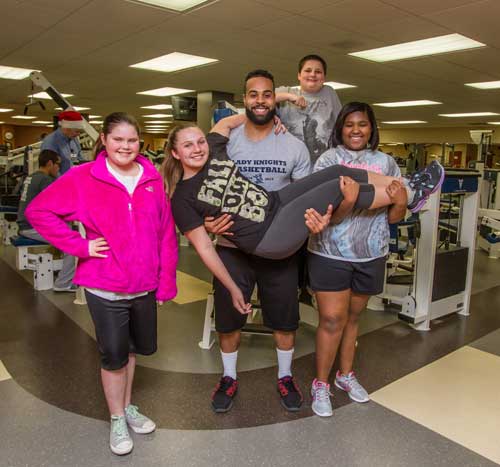
From left, Alana, Allie, exercise specialist Jammal Lee, Corey and Lexi work out at the Mercy Weight Management Center. Toledo Free Press photo by Christie Materni

Being a kid can be hard.

Being a kid struggling with weight issues can be even harder.

From left, Alana, Allie, exercise specialist Jammal Lee, Corey and Lexi work out at the Mercy Weight Management Center. Toledo Free Press photo by Christie Materni

Over the past year and a half, staff at the Mercy Weight Management Center, 3930 Sunforest Court, have been trying to ease the pain for overweight adolescents and their families.

The center’s adolescent weight program is a six-month, research-based program that focuses on helping teens and their families make better choices on nutrition, behavior and exercise. Each week, families meet with Mercy staff for two hours, in addition to an hour of exercise.

“This program really gives the teenagers confidence to go out in the community or in their school and participate,” said Jenny Nelson, program coordinator and health educator.

Jammal Lee is on the front lines of teen obesity. As an exercise specialist at the center, Lee knows that many teens are intimidated by exercise.

“When they come in, they understand that exercise is strenuous, that exercise is no fun, that exercise takes work and I try to eliminate that thought process,” Lee said.

Not that he takes it easy on them. The program starts with five-minute, high-intensity workouts.

“I’m not a fan of working out a really, really long period of time,” Lee said. “These kids automatically have this fear, automatically are very uncomfortable when it comes to working out, so if I can keep that down to a minimum with the high-intensity level, they’ll understand that ‘Wow, first of all, that was really, really hard, but second of all, I conquered it,’” Lee gradually works the teens’ workouts up to 25 minutes in five-minute increments. Eventually, they find something in the program they enjoy.

“They’ll say, ‘Hey Mr. J, can we do that again?’” he said. “That’s what it’s all about. Finding what you love, and going after it hard.”

A team of health experts helps identify the issues each child and family may be facing.

“I find out that some of these kids are spending 12-15 hours of screen time a day, which is virtually their whole waking day on some sort of electronic device,” said Sheri Desmond, a certified nurse practitioner who conducts a medical review of each teen.

Kim Snyder decided to enroll her daughter Allie, 14, in the program after attempts at home failed.

“It just seemed like we weren’t seeing the results we wanted,” Snyder said. Allie will soon enter Phase 2 of the program, a more strenuous continuation of Phase 1. Allie has lost 22 pounds in six months.

Allie encourages other teens to look inward when making a commitment to becoming healthier.

“It’s really never OK to change who you are for someone else, but it’s OK to change yourself because you want to,” she said.

Lexi, 16, another teen in the program, has been involved since it began in 2013.

“The first day I came I thought, ‘This isn’t going to help me at all.’ But after the course of maybe a month I did see some type of results. … I got more into vegetables and fruits. I had my water bottle by my side. I was always on the treadmill. My mom and I cut out going to restaurants.”

Snyder said the program was exactly what her family was looking for.

“I didn’t want her to go on a diet. I didn’t want her to go into Weight Watchers. … I wanted her to understand this is a way of life.”

The program costs $100 per month, with scholarship funds available. Mercy Weight Management Center is hosting free informational sessions to learn more about the program at 6:45 p.m. Jan. 14 and Feb. 11. For more information, contact the center at (419) 324-9112.

More murals planned for city in 2015

0
Toledo City Councilwoman Lindsay Webb, artist Ahmad Jacobs and Rachel Richardson of ACT by a mural in Toledo. Toledo Free Press file photo by Andrew Weber.

As Toledo continues to fight its blight problem, Art Corner Toledo (ACT) continues to help in the battle by investing, planning and executing murals throughout the city.

For 2015, murals are planned at four different blank walls meant to help revitalize the neighborhoods in which they appear.

ACT will hold four public meetings, one at each location, to gather public input on what type of mural the community would like to see.

“We find that when we do put a mural in otherwise neglected neighborhoods, it beautifies and revitalizes and gets the neighborhood to realize they can invest in their own space,” said ACT founder Rachel Richardson.

Richardson said ACT has not hired any artists yet or decided on any designs for the murals, but will gather community input and go from there.

Community members are invited to attend the following meetings add their voices to the discussion: 5:30 p.m. Jan. 8 at Lighthouse Landing, 4441 N. Summit St., in Point Place; 5:30 p.m. Jan. 15 at Seed Coworking, 25 S. St. Clair St.; 5:30 p.m. Jan. 21 at the West Toledo Branch Library, 1320 Sylvania Ave.; and 5:30 p.m. Jan. 22 at Mad Ave Collective, 1600 Madison Ave.

The murals are made possible by funds provided by the city and county.

Toledo City Council passed a measure this year to spend $15,000 on murals for the city. That money matched $15,000 offered by Lucas County, with all funding going to ACT.

“Murals are a great way to capture the heart of a neighborhood and express it visually,” Councilwoman Lindsay Webb has said. “It’s a part of developing and identifying and dealing with blight.”

In another project, two railroad bridges on Bancroft Street will be covered, with a mural on each side of the two bridges. Richardson plans a public call to artists in February through a contest from which the top four designs will be selected. The winning designs will be chosen by Councilman Tyrone Riley.

The idea is to have the phrase “Toledo Alive!” incorporated into the murals.

The Collingwood Arts Center has been supporting ACT by providing space for muralists to paint on panels that are later installed at locations around the city. The help is allowing artists to work outside the normal season.

“We can paint them all throughout the year,” Richardson said.

ACT was founded in 2010 with a mission to promote Toledo as a socially conscious city and began creating murals to illustrate that, Richardson said. So far, the organization has completed 20 murals.

“An abandoned lot or a building gets developed in the wake of one of our murals,” Richardson said.

Melden: My grandfather’s watch

0

I wear my grandfather’s watch.

It’s an Accutron from Bulova with a simple gold face. The underside has his name, Don Roepke, engraved along with dates that mark 25 years of service at the factory where he worked. My mother gave it to me just after he passed away in September 2013.

At first I couldn’t figure out how to make the days of the week line up with the date. The clear, quartz cover was very scratched and even had a small crack in it. I got that fixed. I also replaced the golden, stretchy metal band with one made of brown leather. It’s not worth hundreds of dollars, but it’s a nice watch and it means a lot to me.

But you know, even with all the tweaks and changes I’ve made, there is still this sense that I am wearing Grandpa’s watch. I didn’t get a new watch. It was someone else’s and now I simply look after it. And, if I can take care of it, keep it clean and working, I might be able to pass it on one day, too. I have been thinking recently; my grandpa’s watch reminds me of the mindset of really great leaders.

“Leader” is unfortunately a confusing word in our culture. Most of us are well aware of self-centered, incompetent and even corrupt people who have grafted the title of leader to their persona without first earning the required respect, trust and credibility. We are tempted to associate “leader” with other words like success, prestige, money, fame, etc., losing the true meaning of the word. There are other words though. Other words that describe other leaders. One of my favorite authors and leaders, Parker J. Palmer, defines leadership this way: “A leader is someone with the power to project either shadow or light upon some part of the world, and upon the lives of the people who dwell there. A leader shapes the ethos in which others must live, an ethos as light-filled as heaven or as shadowy as hell.”

The reason my grandfather’s watch on my wrist reminds me of great leadership is because I believe the best leaders are stewards, not owners. Trust has been given, influence granted, and the leader is faced with the question of how to handle this gift. Does she consider this status as something to be used for her own benefit, or does she understand the “here today, gone tomorrow” component of leadership? Is the goal to get his name in lights, or create a light-filled reality for whoever will take his seat next? As leaders, do we hold our influence with tight fists focused on scarcity? Or do we accept the open-handed invitation of abundance?

As I said earlier, we are all too familiar with negative leadership examples. However, there are great examples of leadership as well, and we can especially spot them when we look for those who are living as stewards, those who build something that stretches much further than themselves.

It’s like the CEO who relocates his company headquarters Downtown to help accomplish much more than simply running a profitable business.

Or the pope, in his first address, saying to the world: “Pray for me.”

Or the school superintendent who walks the halls engaging each seventh-grader he sees as if they were a board member or a voter in levy season.

Or the neighbors who care for the house they are renting because they respect the neighborhood and the landlord.

Owners use, spend and consume their way forward. Stewards preserve, share and collaborate their way into the future. Our entire conversation regarding conservation and environmental responsibility comes down to understanding stewardship. When we understand the idea of stewardship we support our schools long after our own kids have graduated.

Stewardship is tantamount to good leadership. And at The Center for Servant Leadership, we believe understanding yourself as a steward, not an owner, of the influence, power and status you currently hold is a key step in becoming a servant leader. This is an aspect of our work: teaching leaders how to uncover stewardship in their lives.

Stewardship is inspiring. When I do finally hand off grandpa’s watch to the next person, they will understand that it was given to me and now I give it to them. It is not theirs to own. They are simply looking after it for a time.

Sam Melden is executive director of The Center for Servant Leadership. He can be reached at [email protected].