David Lymanstall of Toledo can cross iditarod volunteer off his bucket list in March after he serves as a dog handler at the race in Alaska. Toledo Free Press photo by Christie Materni.
David Lymanstall of Toledo can cross iditarod volunteer off his bucket list in March after he serves as a dog handler at the race in Alaska. Toledo Free Press photo by Christie Materni.
Toledoan David Lymanstall has been fascinated by the Iditarod Trail Sled Dog Race for as long as he can remember, going so far as raising his own husky dogs, teaching the Iditarod to his students and visiting Alaska twice in the late ’80s and early ’90s.
Now, Lymanstall, director of the nursing program at the University of Toledo and a published poet, has secured the opportunity of a lifetime and will be able to scratch “Iditarod volunteer” off his bucket list.
Lymanstall, 57, will help “line up” as many as 1,280 dogs at the ceremonial start in Anchorage, Alaska, on March 7, and again at the official start in Willow, Alaska, on March 8.
“I’m really excited about it,” Lymanstall said. “This is one of my bucket lists. I absolutely loved it up there. I went to a few husky farms around Nome. When I came home, that’s when I got my first husky.”
He owned Sitka for 14 years until she died in 1997. Five weeks later he found Gracie, a cinnamon and white husky, from a breeder in Lambertville. He owned Gracie until last January when she died of organ failure. Lymanstall said he plans to rescue an adult husky after this year’s Iditarod.
The Iditarod originated in 1925 when a diphtheria epidemic threatened isolated and icebound Nome, Alaska, prompting a relay of dog teams to deliver a serum that saved hundreds of lives. The final two legs of the journey were completed by Gunnar Kaasen with his lead dog, Balto. They traveled through a blizzard with winds over 80 mph. The relay of 20 mushers made the 700- mile trip in 127 hours, according to the official Iditarod website.
The effort received international attention and the mushers received special gold medals and a commendation by President Calvin Coolidge. Statues of Balto were erected around the country and the age of the sled dog went out in a blaze of glory, according to the website. In 1973, the first official Iditarod Trail Sled Dog Race was run between Anchorage and Nome.
When Lymanstall taught seventh and eighth grades at West Side Montessori, he sent for teaching material on the race. He tacked up a map of Alaska in his room and used it for lessons on geography and cultural history. Students would push in pins to mark the location of mushers on their trek from Anchorage to Nome. The student who tracked the winning musher would win a prize.
Lymanstall contacted a tour guide out of Alaska to plan his trip from March 2-10. Volunteering for the Iditarod race was an optional part of the trip. He contacted the Iditarod Trail Committee, the nonprofit that heads the race and was accepted as a volunteer in December.
Volunteers come from all walks of life and from around the world, said Julie Busch, Iditarod media coordinator.
“There are more than 1,500 volunteers that come from all over the world — Norway, France, Germany, Spain — you name it,” Busch said during a phone call from Anchorage. “We’ve had people come from Korea. It’s the premier sled dog race in the world.”
Lymanstall will be one of about 200 dog handler volunteers, who should be physically fit and must earn a certificate and undergo special training, said Diane Johnson, Iditarod volunteer coordinator.
“The dogs are priority one, so handlers must know how to safely move the dogs from the mushers’ staging area to the starting line,” Johnson said in an email from her base in South Dakota. She is also the education director of the Iditarod.
Eighty mushers have signed up for the race and each one will start the race with up to 16 dogs, Johnson said.
“One day I woke up in October and I needed to do this (volunteer). This is really my focus: I’m just fascinated by it, I can’t explain it,” Lymanstall said.
Bill Dickinson of Grand Rapids, Ohio,will also participate in the 2015 Iditarod as a guard for Trail No. 6, which is near Wasilla, Alaska. He’ll be stay in Alaska from March 1-21.
“I like to sightsee and take pictures and network,” he said.
Dickinson said he had plans to move to Alaska in 1976 but got hurt at work and had to cancel those plans. He instead bought a farm.
A parking garage at Promenade Park, seen at left in the above illustration, remains a controversial part of ProMedica's proposed plan for its move downtown. Toledo City Council could vote as soon as Jan. 20 on the plan. Illustration courtesy ProMedica.
A parking garage at Promenade Park, seen at left in the above illustration, remains a controversial part of ProMedica’s proposed plan for its move downtown. Toledo City Council could vote as soon as Jan. 20 on the plan. Illustration courtesy ProMedica.
Influential community leaders stepped up to the plate at Toledo City Council chambers Jan. 14 to weigh in on ProMedica’s plan to move its headquarters Downtown.
The move is projected to bring $9.2 million in net revenue to Toledo over 10 years, city officials announced.
Joe Napoli, Carty Finkbeiner, Judge James G. Carr and Bob LaClair were a few of those who addressed Council as members of the public to weigh in on the health care company’s plan to move Downtown in 2017.
The most controversial part of Pro- Medica’s plan is the proposed construction of a six-story parking structure in the southwest corner of Promenade Park. The structure — which would occupy 14 percent of the park’s surface area and 120 feet of the park’s 500 feet of frontage along Summit Street — is a key part of ProMedica’s $60-million plan to move up to 1,000 employees into the former Toledo Edison Steam Plant and KeyBank building Downtown.
ProMedica officials have said future phases could bring as many as 2,500 employees Downtown. There is no timeline on when subsequent phases would be implemented.
“We shouldn’t kid ourselves — many business leaders and investors are watching this decision with great interest,” said Napoli, president and general manager of the Toledo Mud Hens and Toledo Walleye. “ProMedica wasn’t recruited to come Downtown, they called us. Small business leaders that are on the fence about moving Downtown are asking themselves, ‘If the City of Toledo doesn’t welcome ProMedica to Downtown, why would they welcome us?’”
Napoli, who also serves as chair of the ProMedica Toledo Children’s Hospital board, said ProMedica should be commended for being committed to moving Downtown.
“The lack of ample, convenient parking will seriously hinder the future growth of Downtown Toledo,” he said. “To their credit, ProMedica didn’t overreact to the Downtown parking challenge. Most others would have given up, and they did for years. Instead, ProMedica embraced the challenge, studied the issue, and came up with a solution — exactly what a responsible corporate citizen would do.”
The first part of the meeting consisted of a Q-and-A session between Council and Matt Sapara, city development director, and Eileen Granata, the city’s senior attorney, on the Memorandum of Understanding (MOU) between the city and ProMedica. The MOU sets forth key components of the project, highlighting commitments necessary from both the city and ProMedica to keep the project moving forward.
Sapara said the project would amount to net revenue of $9.2 million to the city over 10 years, while the expense to the city for the first year would be $693,000. The city would convey the land for the parking garage to ProMedica at no cost. The company, in turn, would restore and put $2 million worth of renovations into Promenade Park, which would remain open for use by the public.
The city would be responsible for maintaining the park. If, however, the park were not maintained to ProMedica’s liking, it could step in and maintain the park at its own cost.
Councilman Mike Craig voiced concern over the city’s ability to maintain the park.
“Park maintenance is not something the city of Toledo is known for,” he said. “I would feel better taking that money and writing a check every year for the maintenance of that property. I just don’t think we’re going to maintain that property to their standards.”
Councilman Jack Ford, who worked for ProMedica for six years, pressed Sapara and Granata for answers on several topics he felt had not been properly addressed. He asked how significantly the MOU has changed since the company first presented it to the city.
“It has not changed in the sense of the scope of the project,” Granata said. “There have been certainly changes in terms of some of the property, in terms of some of the ownership and how that property is handled. … There were substantive changes.”
The MOU states that the city will also convey most of the green space between the steam plant and Imagination Station to ProMedica, which would allow use of the land by the public until or unless ProMedica decides to modify the site to accommodate its needs.
Ford questioned if this control of the site could be turned over to Pro- Medica at any time, as no specific timeline is given.
Granata said under this arrangements ProMedica could in fact take over the site as it sees fit for future expansion.
“I don’t really know what exactly that means in terms of future plans, but you’re correct in your statement,” she said.
“Should that be important to us, or is that a toss-away issue?” Ford responded.
Sapara said there aren’t any tossaway issues, but any future plans remain open-ended at this time.
More than 20 members of the public signed up to speak at the hearing.
After Napoli, a number of prominent business individuals addressed Council, including Steve Cavanaugh of HCR ManorCare, which employs 800 people Downtown, and Sara Swisher, director of EPIC Toledo, which was created by the Toledo Regional Chamber of Commerce to attract and retain young professionals in the region. Both are proponents of ProMedica’s plan.
LaClair, president and CEO of Fifth Third Bank in Northwest Ohio, agreed with much of Napoli’s statement.
LaClair, a ProMedica board member, said, “It’s very difficult to recruit people to Toledo. The first thing a candidate says when they come to meet with us is ‘Where are all the people Downtown? Why do you have all these empty buildings?’
“We need people walking around Downtown during the day, showing up in offices, eating in restaurants during the lunch hour. That’s what’s going to revitalize Downtown Toledo. We’ve got an opportunity that we have not seen in 30 years to do that right now.”
Former Toledo Mayor Carty Finkbeiner also addressed Council.
“New jobs and great hospitals are very important to Toledo’s future,” he said. “But so is fresh air, clean water — as we learned last summer — and public waterfront parks.”
Finkbeiner said he hopes Pro- Medica’s campus Downtown would not mirror that of Owens Corning, which sits a short distance south of Promenade Park.
“We did isolate and insulate Owens Corning on that piece of land,” he said. “They have their own restaurants, their own dry-cleaning businesses, their own day care centers, their own workout facilities. They drive in, park their car in the morning and go home at night and not have to support, patronize or integrate themselves into all of those small businesses that are yearning, begging for their business. We need to make sure that the guidelines for this integrate, not isolate, the ProMedica campus from all of the existing businesses that have in some cases been hanging on by the skin of their teeth in Downtown Toledo.”
Carr, a former federal district judge for the U.S. District Court for the Northern District of Ohio, said he remains unconvinced there are no options other than building a six-story garage at Promenade Park. At the same time, he admitted this project must move forward for the sake of Toledo’s future success.
Carr urged Council to put a provision in the agreement that if Pro- Medica or a successor were to vacate the premises, the company would then be responsible for tearing down the parking garage.
Toledo resident Jane Randall gave an impassioned speech about why she thought the proposal was wrong for Toledo.
“Why are we even talking about giving away one inch of the little postage stamp piece of greenery we have Downtown?” she asked. “It’s a shame. Do your best, but for heaven’s sake, please do your homework.”
At the end of the four-hour meeting, Sapara addressed some of the comments and questions raised in the public statement portion of the meeting, during which many said the city and ProMedica should explore more parking options.
“There are no alternatives, I’m sorry,” he said. “We can talk about ‘It should go here, it should be there.’ The reality of it is, [an alternative] doesn’t exist.”
Several business leaders told Council that current parking structures could not be used because that would only serve to prevent other companies from coming Downtown because their employees would then have no parking.
Toledo Mayor D. Michael Collins noted the parking garage concern is not a new one, and that a parking garage for the redevelopment of the steam plant was noted as a critical piece of its success as far back as 2000.
“The window of opportunity for us is here today,” he said. “What are we going to tell the future generations of Toledo when they say, ‘I’d really like to be in Toledo but there is no opportunity?’… Will we reject that over a very narrow sliver of property that in the grand scheme of things is never going to save this city?”
Collins noted that having a debate on the matter is a positive thing, but “I also think the answer is crystal clear.” Council is expected to vote Jan. 20.
Park idea ‘right on target’ I read Lou Hebert’s column and found it to be thought-provoking and right on target. I agree that the Marina District would be an excellent choice for developing a beautiful riverside park. I even thought that ProMedica might be persuaded to donate money toward the project as a goodwill act for having to use some of the green space for their parking garage. With this project the East side would be included in the development of ProMedica and downtown Toledo and not just a place of land across the river. — Toby Herman, Perrysburg
Develop Marina District I very much enjoyed Lou Hebert’s column about the so-called Marina District property now languishing on the east side of our riverfront. You are spot-on in calling for this area to be developed more fully as a park. Why not? We as taxpayers have already footed the bill to acquire, clear and clean up the parcels that now comprise the Marina District, as well as to build the small marina, museum and mooring for the Willis B. Boyer (now Schoonmaker) at the northeast end. Perhaps some consideration could be given to returning a large portion of the site to its original elevation, which was under water as part of the Maumee River, enabling construction of a very large public marina. — Rick VanLandingham, Toledo
Cocktail-length, all-over lace dresses are popular for bridesmaids and many brides are choosing nonwhite dresses. Photo Courtesy Atlas Bridal Shop
By Michele Jurek, Toledo Free Press Staff Writer
With so many websites dedicated to planning weddings and creating unforgettable events, and so many bridal shows featuring all the latest styles, it would be easy for a bride to become overwhelmed when planning the big day.
Cocktail-length, all-over lace dresses are popular for bridesmaids and many brides are choosing nonwhite dresses. Photo Courtesy Atlas Bridal Shop
Local experts in the wedding business provided some insight as to what trends brides may most want to keep in mind as they plan their 2015 event.
According to Lia Colapietro, a custom floral designer in the Toledo area, flower crowns have become a big trend recently.
“Big, over-the-top flower crowns started showing up last season. They are a romantic or fun touch for the right bride,” Colapietro said. “I recently outfitted a future bride with a floral crown for her engagement photos.”
The top accessory she creates is the bouquet, and another trend she loves is the statement ribbon. Bouquets accented with long, flowing trails of specialty ribbons in silks, velvets and more are gaining popularity, Colapietro said.
Asymmetrical and flowing bouquets are also becoming popular, and lately she has been designing floral cuffs for the mothers of the bride and groom.
“They are a nice twist on a traditional corsage,” she said.
Another trend, which Colapietro hopes will stick around for a long time, is sustainability. She grows some of her own flowers and loves adding an accent of locally grown foliage to make an arrangement really stand out.
“Brides are very savvy about checking out trends on various websites,” Colapietro said. “There are many sites out there devoted to inspiration. Because we live in a smaller city, you see a lot of the same trends rolling out for a season or two. I would love to see more focus on color trends and then see how a couple can pull together flowers and decor to reflect their own personality.”
Brides are also starting to bring color into their wedding gowns, said Jeanne Fairchild, owner of Atlas Bridal Shop in Toledo. Ivory and champagne are popular colors and some brides are now asking for blush pink.
Fairchild said lace is popular and it is the shop’s most requested fabric. Backs are getting lower and lower on the gowns, she said. All silhouettes are popular, from slim fit and flares to large tulle ball gowns. Many of the ball gowns Atlas is selling have interesting skirts, such as sparkle tulle and ruffles. Beaded belts are very popular and can be worn with every silhouette. Designers are showing long fitted lace sleeves for spring 2015.
Manufacturers are starting to show headbands, but Fairchild is not sure that Atlas will regularly sell the look quite yet. The shop has purchased a few that can be worn either across the forehead or on the top of the head.
“Brides looking for a formal gown with a train can expect gowns to start at $900 and go up from there,” Fairchild said. “Informal gowns without trains can be found in the $200 to $500 range.”
As for bridesmaids’ dresses, Atlas is selling a lot of floor-length chiffon and cocktail length with all-over lace. More and more brides are choosing a color, but letting each maid choose her own gown, which is beneficial to the bridesmaid because each girl can choose a style that flatters her figure and suits her personal style.
Bridesmaids can expect to pay between $150 and $220 at Atlas for their gowns, Fairchild said.
“Participating in a wedding can be very expensive,” she said. “There’s the gown, shoes, personal prep the day of the wedding (hair, makeup, nails), shower gift, wedding gift, and possible travel expenses. When asked to be in a wedding, you aren’t just saying ‘Yes to the dress.’”
Jenny Dever of Toledo, who is planning her wedding for June 6, said trends didn’t even enter her mind when she was picking out her dress and accessories. Some of her friends that were getting married were going with vintage styles, but she felt they did not look right on her. She had her mind set on a white, mermaid-style dress, but inadvertently ended up choosing something that is trending — she fell in love with an ivory lace ball gown with a tulle skirt.
“I didn’t even realize the dress wasn’t white until someone told me, and I had to compare it to the white one before I could even believe it,” she said. “The color and style aren’t what I had planned at all, but you never know what you like for sure until you try it on.”
Jason Kelley and Laura Spiess, who are engaged to be married, own JL Entertainment and bookthatdj.com. Photo Courtesy Jason Kelley
Jason Kelley and Laura Spiess met while working at a pizza parlor in 2010. Nearly five years later, they are the brains behind JL Entertainment and bookthatdj.com.
Jason Kelley and Laura Spiess, who are engaged to be married, own JL Entertainment and bookthatdj.com. Photo Courtesy Jason Kelley
They are also in the middle of planning their own wedding.
“I’ve found that we’re more picky because we see the same things over and over,” Kelley said. “The biggest thing was finding a venue. We don’t want to have our wedding at a place where we’ve worked at.
“It’s stressful any way you look at it,” he said. “Planning a wedding is stressful.”
After the pizza place where they worked closed, the couple began planning open-mic sessions, karaoke and comedy contests with their business, JL Entertainment. During this time, Spiess got certified as a wedding planner.
Eventually, the couple began managing and handling the booking for Graystone Banquet Hall in Perrysburg.
“That became our place of business, I guess,” Kelley said. “The great thing is we live across the street.”
The two collaborate using their individual skills: Kelley likes to work with people and Spiess dives into the small details of their business.
The couple has a panel made of dry erase boards they hang in their living room and call their “Brain Board.”
JL Entertainment, which bookthatdj.com was launched through in 2011, offers professional sound and event planning. Other options include a photo booth, chair covers and, coming soon, a catering service.
Bookthatdj.com, owned by Jason Kelley, above, and his fiancée Laura Spiess, DJ’ed almost 400 weddings in 2014. They hope to double that number in 2015. Photo courtesy Jason Kelley.
In 2013, Kelley was voted best disc jockey in Toledo in a local poll.
“I don’t necessarily consider myself the best DJ in Toledo. There [are] a lot of great DJs,” he said. “But I do love that all the people that know me and appreciate me went out and voiced their opinion.”
Kelley said there’s never a dull moment when he DJs weddings. His energy is directly correlated to the energy from the crowd.
“You have multiple age groups, multiple types of people, multiple vibes throughout the entire evening,” he said. “It’s the DJ’s job to provide a backdrop for that and create energy. … I feed off of people’s energy, whether they’re having a good time or a bad time.”
Kelley said he tends to tune out songs he doesn’t like when seeking that energy.
“I like when people are happy and, at the end of the day, that’s what makes me happy,” he said. “I’m not listening to the music; I’m feeling the vibe and watching the people.”
Kelley said he has a lot of fun with his profession, but admits it is hard work. In 2014, the company, which has about 20 employees, DJed almost 400 weddings, a number Kelley said he wants to double in 2015.
“I get up early in the morning and go to bed late at night,” he said. “It’s constant, constant, constant work.”
For more information, visit
bookthatdj.com. Kelley can also be seen at Bar Louie, 4105 Levis Commons Blvd., every Saturday night.
Ivory linens. Twinkling chandeliers. Tapered candles. Lush flower arrangements. A madly in love couple.
When it comes to wedding staples, sometimes the classics are the best — even in 2015.
At La Boutique Nostalgie, we specialize in classic and vintage event design, flowers and wedding planning.
While we indulge in many fun trends, this year we find ourselves and our clients drawn to many traditional event design elements.
By choosing timeless décor, couples ensure that their wedding photos won’t look dated in 10 years. However, classic doesn’t have to equal boring. There are several ways to make your event look both elegant and fun.
Bringing some bling and sparkle into your wedding décor is a great way to liven things up.
Metallics remain prevalent in 2015 but gold is king. Gold softens up bolder colors like plum or emerald and also pairs perfectly with popular muted palettes like blush and dusty blue.
Couples can use gold in numerous ways, too; they can incorporate some shine into their china, Chiavari chairs or use antique gold-rimmed mirrors under their centerpieces.
Like always, flowers and candlelight complete any wedding look. Traditional blooms like peonies, hydrangeas and garden roses will continue to be popular in 2015 but they will be woven between greenery like eucalyptus and leatherleaf for a more bohemian vibe.
Fun, loose centerpieces with plenty of greenery will keep other more classic design elements feeling fresh.
Couples can weave greenery into their wedding design in other ways, too. A full green garland can serve as a unique table runner or be used with an arbor for ceremony décor. Or your bridal bouquet could feature a cascade of ivy.
Flower girls (or even brides) can wear delicate flower crowns made mostly of greenery and accented with ranunculus and hypericum berries.
Flower lovers may prefer a full floral backdrop, which was popularized by Kim Kardashian and Kanye West, for their ceremony décor.
A wall of flowers is certainly a gorgeous and dramatic option, but brides without the Kardashian-sized budget may prefer a strand of flowers strung together and evenly spaced hanging behind them or from the ceiling.
Try not to neglect the ceiling in your design plan either. Chandeliers, swaths of white drapery or hanging lanterns spruce up a drab ceiling and add some charm.
Our team always encourages couples to pick a range of colors to use in their wedding décor for a varied, more natural look.
But this year, we find ourselves drawn to a spin on that rule — using several shades of just one color for an interesting monochromatic design. Using varying shades of one color like pink (blush, magenta, candy pink, coral, etc.) mixed with greenery creates a striking look.
Alternatively, we have a few brides who have requested all-ivory and white weddings. Couples can use white flowers like orchids, freesia, calla lilies and gladiolus mixed with metallic candelabras to produce a glamorous, 1920s-inspired look.
Like in 2014, event designers will continue to use antique lounge furniture to construct fun, separate areas for guests.
By incorporating just a few pieces of furniture into your wedding’s décor, you can create a space that allows for both unique photo opportunities and intimate conversations between guests.
We recommend a chaise, small coffee table and a couple of comfy chairs to make the perfect mini living room for your wedding.
A classically designed wedding allows the couple to shine and gives guests a warm, inviting atmosphere.
An event designer and florist can help couples achieve the right ambiance and balance between elegance and creativity.
Hiring professionals to ensure your wedding is beautiful and efficiently run also frees up couples to focus on what really matters: marrying the person you love.
Brigitta Burks is the creative director at La Boutique Nostalgie, the premier classic and vintage wedding design, floral and coordination firm in Northwest Ohio. Heather Sass is the event and design manager. Contact them at [email protected] or (419) 308-4559. To learn more, visit laboutiquenostalgie.com.
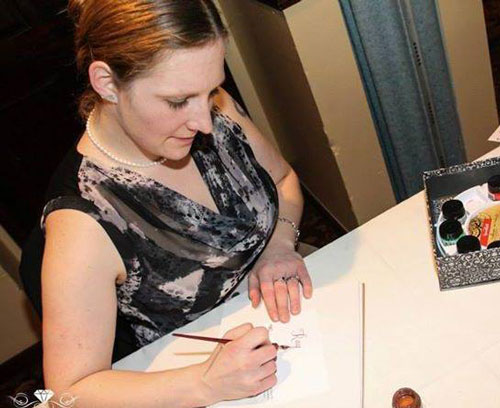
Laura Brown of Signature Scribe & Silhouettes said the bulk of her business is from harried brides with no time to address invitations. Photo Courtesy Laura Brown
Laura Brown, the scribe behind Signature Scribe & Silhouettes, picked up the calligraphy pen several years ago but has had no formal training in handwriting.
Laura Brown of Signature Scribe & Silhouettes said the bulk of her business is from harried brides with no time to address invitations. Photo Courtesy Laura Brown
What began as a way to make a little cash as a stay-at-home mom evolved into a business creating hand-lettered wedding invitations, menus and books as well as everything from a die-cast firetruck for her friends’ children to a family tree.
She officially opened Signature Scribe & Silhouettes last spring, but has been writing calligraphy — or as Brown likes to call it, “vintage handwriting” — for the past four or five years.
She said the wedding invitation is one of the most important aspects of the wedding — one that brides often put off until the last minute. The bulk of her business is being there for brides who have a million other things to do besides those pesky envelopes and invitations.
“People forget sometimes that the invitation is a peek at showing what the event is going to be like,” Brown said. “Brides worry about first impressions. This gives people a little hint of what’s to come, and I think brides would want that little extra touch of class.”
Brown’s lettering is not the gothic style that “you can barely read,” she said. She calls her style “old-fashioned.”
Not a lot of people are in the business. When she started out, she had to research companies in Ann Arbor, Detroit and Cleveland. “There’s not a whole lot out there,” she said.
She doesn’t advertise and relies mostly on word of mouth, Facebook and wedding shows. She attended a budget bridal expo a couple of years ago, and said the experience blew her mind.
“People just love it,” Brown said. “People want to stand and watch me. They are oohing and ahhing. Everybody likes pretty things. [I realized] if I write everyone’s names, then they would probably keep that. So I took my pen and ink and notecards and when a bride would come by, I’d write their names for them. It goes up on the fridge and everybody says ‘Who did that for you?’ So when it comes time for invitations, they’ll think of me.”
Mardelle Shaffer hired Brown for her invitations, signs, menus and more for her September wedding. She had nothing but complimentary things to say about the finished product.
“We were really pleased with everything,” Shaffer said. “It really helped step up the look of everything for my wedding. It made it more classy and elegant, especially for the invitations that set the tone for your wedding.”
Some brides like to put a special twist on the invitation and add a wax seal. One of Brown’s clients used a seal and it worked perfectly, she said.
Brown said she is trying to grow her small business but still needs the flexibility to care for her husband and children, ages 1 and 4.
As she builds her wedding clients, she has been doing other side jobs, including a family tree, the lyrics to a song and a baby book.
“I definitely have room for a lot of growth,” Brown said. “The funny thing is you watch someone do calligraphy, it’s very slow. It’s almost like drawing. I want it to come out like I’m handwriting. It doesn’t take me nearly as long as you would think.”
Brown enjoys Renaissance weddings and believes that’s her market. She’s also there for the bride who “doesn’t want to mess around with the envelopes.”
“You know you have a bunch of other stuff to do and I can have it for you in a couple weeks,” Brown said.
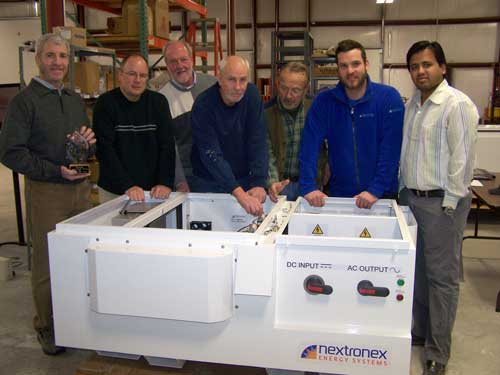
From left, Jay Troger holds the award from Solar Power World Magazine, with the team from Nextronex that includes Mike Dennis, Peter Gerhardinger, Dennis Benning, Richard Ashton, Dan Cassavar and Purnaansh Gunaicha.Toledo Free Press photo by Duane Ramsey.
Nextronex, producer of the patented Distributed Architecture solar inverter system, has moved into a new facility constructed for the company in Holland. The firm’s new home will serve as its corporate headquarters while housing all manufacturing, testing and development functions.
From left, Jay Troger holds the award from Solar Power World Magazine, with the team from Nextronex that includes Mike Dennis, Peter Gerhardinger, Dennis Benning, Richard Ashton, Dan Cassavar and Purnaansh Gunaicha.Toledo Free Press photo by Duane Ramsey.
Nextronex moved into its new home in December and is now fully operational. The 10,000 square-foot facility located on Geiser Road off Eber Road just north of Airport Highway is a much better setup for the company, said to CEO Jay Troger.
“Our operations were spread across two facilities, and we had outgrown both of them,” Troger said. “The new facility consolidates our operations and has features that will improve our manufacturing efficiency. The new location also provides convenient highway access.”
Nextronex was previously located in incubation space at the Nitschke Technology Commercialization Complex on the College of Engineering campus of the University of Toledo.
Nextronex manufactures commercial and utility-scale solar inverter systems for applications of 150 kilowatts and larger. Those inverter systems aim to optimize output from 1,000-volt, DC solar installations up to 35,000-volt AC grid connections.
Founded in Toledo in 2008, Nextronex has supplied inverters for large-scale solar installations in numerous U.S. states and several foreign countries. Its largest order to date was for 24 inverters, which were used at the 4.2 megawatt installation in Napoleon, Ohio.
Troger said that 2014 was a transitional year for the company due to legislation passed in Ohio that severely hurt solar business in the state. Prior to those changes in the law, the majority of the company’s previous sales had been for projects in Ohio.
Yet Nextronex currently has its largest backlog of orders for inverters ever, Troger reported. The entire backlog is for out-of-state business and will be delivered by the end of April to meet deadlines, he said.
“We’re the final assembly point for the inverters and have a much better production flow in our new facility,” Troger said.
Nextronex receives most of the components for the solar inverters from five key suppliers, most of which are located in Ohio.
Other Nextronix products include the Generation II RAY-MAX Power Podium inverter system introduced in 2014, is 60 percent more powerful in the same product enclosure, Troger said. The power podium allows all equipment to be pre-assembled and tested while still in the factory, cutting down on the time and costs associated with installation.
The RAY-MAX Power Podium was recognized as a Top 100 product of 2014 by Solar Power World magazine.
“Our heritage is to produce innovative products that offer unique benefits to solar power developers. It’s rewarding for our team when we are recognized for doing so,” Troger said.
Two members of the Nextronex team, James Olzak, vice president of manufacturing, and Peter Gerhardinger, vice president of technical sales, are original founding members of the company. Olzak is also a company board member and investor.
Nextronex has included two new provisional patented technologies that provide the unique approach of integrating solar power with battery storage. Such a setup would involve significant savings for power users, according to Troger. The company is testing its inverters with both aqueous and lead acid batteries at its new facilities.
The company’s power podiums were included in the Anthony Wayne Solar Array for the Toledo Zoo which won Solar Builder magazine’s Project of the Year in 2014 in the ground-mount category.
“Nextronex has always had good technology, done well and looks to be entering an exciting phase of its life,” said Bob Savage, CEO of Rocket Ventures, one of several investors in Nextronex.
“Nextronex was founded on leading-edge distributed architecture technology and is staying on the forefront of technology and cost-saving solutions. This combination has had the company in a great position for installations in Ohio where they have enjoyed an over 50 percent market share,” Savage stated.
“Over the past 18 months, Nextronex has landed some good national installation partners and some nice new projects. We believe the company has a very good future ahead of it,” he said.
Nextronex has continued to develop cutting-edge technology to provide solutions to solar developers and installers. The company’s engineering team has developed advanced integrated energy storage for solar projects, as well as energy management systems, according to Savage.
Jeanne Fairchild, owner of Atlas Bridal Shop, tries to maintain the values and vision of the original shop owners by closely interacting with and getting to know the future brides who walk through the doors of her business. Toledo Free Press photo by Matt Liasse
When she became owner of Atlas Bridal Shop, Jeanne Fairchild knew she would have the position for a long time. Years later, she still has no retirement plan in place.
Jeanne Fairchild, owner of Atlas Bridal Shop, tries to maintain the values and vision of the original shop owners by closely interacting with and getting to know the future brides who walk through the doors of her business. Toledo Free Press photo by Matt Liasse
“I truly enjoy coming to work every day,” she said. “There’s not a morning that I get up and … don’t feel like going to work. I genuinely love it.”
Atlas Bridal Shop, 4895 Monroe St., was opened in 1927 by Anna and John Szaroleta. It specializes in bridal gowns and dresses for bridesmaids and flower girls, as well as mothers’ gowns.
In the beginning, the store featured original gowns made by the owner who dreamed of turning it into a family business. Anna even sent her son, Chet, to school to be a pattern maker before he was drafted into the U.S. Army, Fairchild said.
“When he came back from the Army, he actually wanted to be a doctor but she said no,” Fairchild said.
The shop was originally on Lagrange Street and had a cutting room in a lower level. Customers would choose a design and Chet would make it.
Chet and his wife Dorothy eventually took over the shop from his parents before Fairchild, who is not related, took over in the 1980s. At the time, Fairchild was going into nursing, which she balanced with managing the shop for a short time with the help of two of Chet’s daughters, Lorrie Lewandowski and Lynn Szaroleta.
“I gave up nursing and haven’t looked back,” she said.
Fairchild became the sole owner more than a decade ago, a move she was confident she could handle after learning from the previous owners.
“I was surrounded by the family so I was never afraid,” she said. “Dorothy and Chet have both passed away now [but] I just feel like I try to run the business like I want to make those two proud. I have so much respect for them.”
Fairchild said the values and vision of the shop are the same today as they were almost 90 years ago.
A big part of the business is the interaction between Fairchild and the future brides.
“I love getting to know each girl. I love to hear her story. I love to hear how she met her fiancé, where she’s getting married, what makes her wedding unique,” she said. “I’m genuinely interested in these girls.”
Today, the shop includes dresses by designers including Allure Bridals, Sottero & Midgely, Maggie Sottero, Alfred Angelo, Bill Levkoff and, Fairchild’s favorite, Mori Lee.
“We’ve carried them forever; we have one of their earliest account numbers,” she said. “They’re reasonably priced, they’re well-made and their style is very versatile.”
In addition to wedding attire, Atlas Bridal Shop also sells dresses for proms. Blue by Atlas Bridal Shop will open within the next couple of weeks in order for teenagers to prepare for one of their junior and senior years’ biggest events.
This is the fourth year the seasonal shop has been catering to the needs of local high school students.
Blue by Atlas Bridal will be open until May and will open again for homecoming in the fall. For more information, visit bluebyatlasbridal.com.
Fairchild said her employees feel like family. There are 16 long-term employees working at the shop. The operations supervisor, Tiffany Strock, has been with the company for half her life; she began working there part-time when she was 16.
“Working here is like working with your family; we’re like a big, happy family,” Strock said.
There are also two seamstresses who have been with the company for more than three decades.
“We know a lot of everyone’s personal business, whether we want to or not,” head seamstress Jo Hafner said. “But it’s nice because if you have any type of family problems or something dramatic, everyone sticks together.”
Fairchild agreed.
“I have the greatest bunch of people working for me and it’s very much like a family; we’re very much involved in each other’s lives and, because of that, we work as a team,” she said.
In October 2012, the Mud Hens announced that Fifth Third Field would host an outdoor Walleye game as part of a 10-day celebration called Winterfest. Hens and Walleye President and General Manager Joe Napoli said at the time the idea had been in the works for over three years, ProMedica would be the sponsor and that it would take place in late 2014.
.
Five years of thinking, planning, dreaming — for just 10 days.
Winterfest was designed to showcase our Downtown jewel while celebrating and marketing our winters. Last year, Toledo was recognized by The Weather Channel as having the worst winter in the nation. I don’t need to remind you of the inches of snow or the bitter cold; if you were here it’s tattooed on your soul. I think it’s the snow and cold that give Toledoans a thicker skin than most.
Many of you might be asking, “Why would anyone celebrate the awful cold and horrible snow?” It’s hard to see the beauty in something that we have to shovel off our driveways.
Some people who walk this Earth never get to see, feel or taste a snowflake. They see it on TV, read about it, maybe see it in the backdrop of a movie, but never get to experience it.
As you are well aware, Northwest Ohio has four true seasons. We love our springs, summers and falls, but most of us carry on a love/hate relationship with our winters.
As Toledo tries to rebrand itself on a global scale, why wouldn’t we celebrate and embrace the one thing that makes us very different from other places in the world? Winterfest was and will continue to be a game changer for this community.
Photo by Eric Shanteau / instagram.com/hobbes2485
Of course, only in Toledo could we host a “Winterfest,” promote it for two years and then have Mother Nature miss the memo. How ironic. We have 80-plus inches of snow in January, and no water to drink in August. We throw a 10-day festival named after our cold weather and have eight days described as “unseasonably warm.”
It only snowed a few times during Winterfest; snow fell Jan. 4 during the Walleye game postponed from Jan. 3, as well as during the Battle of the Badges — a game played between the Toledo Police and Toledo Fire & Rescue departments. I am positive that Steve Machcinski and Jamie Dickman nudged somebody upstairs for that one.
The Walleye games were the big draws, but I decided to experience Winterfest differently. I wanted to see what it was like the other 95 percent of the time, when the Walleye weren’t on the ice.
I chose 2 p.m. on a Tuesday, and it was the perfect choice. Temperatures were in the 40s, with a strong, cold wind, no snow falling and none in the forecast. I brought local photographer and Instagram superstar Eric Shanteau with me. I wanted his eye to capture the true beauty of Winterfest.
The stadium was empty, the main gates wide open and the admission was free. As a father of four, I knew what was going on the moment I heard the first cowbell: travel hockey.
The ice rink that covered the Mud Hen’s infield featured a game between two teams of 9-year-olds. One squad was coached by former Toledo Storm player Gordy Hunt, the other came from Canada. There was music, a live video feed on the scoreboard, nervous fathers yelling instructions, hockey moms ringing bells and plenty of smiles. There were no mascots, no remote-controlled balloon dropping prizes — just an ice rink full of kids playing a game of hockey and having a moment they will never forget.
Winterfest not only showcased Toledo hockey and Fifth Third Field and brought tens of thousands of people to Downtown Toledo — in the winter — it also supplied something.
Winterfest created lifetime memories for every person who walked through the gates.
For 10 days straight, Joe Napoli and his incredible team gave thousands of people a once-in-a-lifetime experience right here in Toledo.
Decades from now, one of the boys I watched play hockey on that Tuesday afternoon will tell his grandkids about that game. His story will detail how blue the sky was, how cold the wind felt, how proud his parents were and, depending on what team he was on, the score. You don’t forget an experience like that, even if you weren’t victorious.
Five years of planning for a lifetime of memories seems like the perfect formula for Toledo’s future. O
Jeremy Baumhower can be reached at [email protected] or on Twitter @jeremytheproduc.