Josh Wagy, left, and Kengo Kato of Kengo Sushi & Yakitori, opening soon in Downtown Toledo. Toledo Free Press File Photo
Josh Wagy and Kengo Kato hope to make a large splash in the Toledo dining scene with their small sushi restaurant set to open soon.
Josh Wagy, left, and Kengo Kato of Kengo Sushi & Yakitori, opening soon in Downtown Toledo. Toledo Free Press File Photo
The respective food blogger and classically trained sushi chef are almost ready to debut Kengo Sushi & Yakitori, a traditional sushi and yakitori restaurant at 38 S. St. Clair St. The two have been working on the Warehouse District space since last summer, and are anxious to make their debut.
“[Kato] and I are so passionate, and we get along so well,” said Wagy, who many in the Toledo culinary world know best as the man behind Smashing Toledo, a foodie website and social media page. “He’s never really been in a position to really showcase his skills. He’s classically trained — his techniques are really phenomenal. He needs his own space to really show off.”
Kengo, a 1,000-square-foot spot with seating for about 20 customers, will provide him with the means to display his skills behind the sushi bar.
The business began to take shape last year after Wagy persuaded Kato — who had been offered a job in Denver — to stay in Toledo with a proposal to run a restaurant with him. The two found affordable rent and the small space they were looking for on South St. Clair Street, in the building that most recently housed Fine Things Bistro.
Although the entrepreneurs originally planned to open in the fall, things didn’t fall together as quickly as they had hoped. The kitchen needed a complete hood system, which took time and money to install.
“To build a full restaurant in three months is unbelievably optimistic,” Wagy said. “We’re probably about two and a half months behind schedule.”
Still, the two are getting the establishment ready for inspections and plan to open very shortly after getting the go-ahead from the Toledo-Lucas County Health Department and the City’s Division of Building Inspection.
Once open, Wagy hopes to wow diners with Kengo’s traditional Japanese fare, which will be heavy on yakitori, which means grilled chicken, as well as skewered food in general. He said the food will immediately set the restaurant apart from others in the Toledo area.
“You will see yakitori on some menus as an appetizer,” Wagy said. “But no one’s traditionally doing yakitori, not on a yakitori grill, not using traditional yakitori sauces.”
Josh Wagy of Kengo Sushi & Yakitori. The Warehouse District eatery at 38 S. St. Clair St. will feature dishes by chef Kengo Kato. Toledo Free Press Photo by Christie Materni
Food will be served on wooden platters, created by local craftsman Craig Mossing.
The food itself must be fresh, as Kengo does not have a walk-in cooler or freezer.
“I really want to work with local farmers and stay local,” Kato previously told Toledo Free Press. “I will work with Honolulu and Japan and all over the U.S. I have guys that will deliver [meat] daily and in Livonia there’s a warehouse where I will personally go pick it up. I just want to do everything fresh.”
Kato was born and raised in New York City. His parents owned two Japanese restaurants in the city, where he worked from a young age. As an adult, he worked in a traditional Japanese restaurant for seven years and helped other people open restaurants, but this endeavor will be the first time he has opened up his own restaurant.
“We’re going back to Kengo’s roots,” Wagy said. “Classic, not Americanized. We’re not deep-frying anything. We don’t have a deep fryer. No cream cheese. If we do a California roll, we won’t call it a California roll — it will actually have real lump crab in it, not imitation things.”
Most items on the constantly changing menu will be á la carte, with skewers of yakitori priced at about $3 and pieces of fish in the $3-$5 range.
“We’re just really excited,” Wagy said. “We kind of want to push the food scene a little bit. It’s a small enough place where hopefully we can be passionate enough to take Toledo on a new sushi adventure.”
Kengo plans on having sake on tap, along with several American craft beers in the pilsner and Kölsch styles to fit the delicate flavors of the Japanese food.
Here we go with all the “new beginnings” talk — the resolutions and awesome goals that year after year go along with a change in a number on the calendar.
.
When I am in my car with the heater on and still freezing and see a svelte runner out in below-zero temps, it does not encourage me to exercise more. I use social media a lot to get our message out about our military and veterans and to educate on invisible wounds. But all the posts and comments and tweets about how one person is shaking it up with healthy concoctions in their blender don’t make me want to rush out and buy kale. I don’t care that one celebrity ate a rare fruit that looks like it should be thrown away and pounds just dropped off!
Why? Because I cannot relate to any of these people. It doesn’t hit home with me that I might have icicles hanging from my hair and enjoy the experience. I can’t imagine putting kale together with fruit and saying, “Yum!” I don’t have celebrity status and the money that goes along with it for the injections and surgeries that probably help more than some magical fruit to get in such great shape. So, what does all of this have to do with our veterans? After all, I am not a health adviser or a nutritionist. Quite the opposite, as I believe pizza is a “food group.”
The point is, if we can’t personally relate to something it is much more difficult for us to become involved or offer support. Many civilians know very little about military life for the enlisted or the family that serves beside them or what it is like after service to be a veteran in the United States. False presumptions by the 99.5 percent who never served in the military can lead to misunderstandings between civilians and veterans. Bridging that gap is how I have spent a great deal of my time in the past five years. It is why I have this column, which is read by both groups, in hopes that education will reduce the myths because myths lead to stigma and stigma leads to our military, veterans and their families missing the opportunity to have their needs met and to live quality lives.
So, why would YOU — someone who doesn’t want to join the military or someone who has not had direct contact with anyone in the military except maybe an uncle twice removed from a different generation — want to become more acquainted with our veterans and learn a bit more, maybe even volunteer, join a committee or bring education to your school or workplace?
Look around. Every single day, you say and do things that are based on a freedom that our military has had to defend. Our country would be vastly different without those freedoms. Don’t just consider those freedoms talked about the most, for example, religion. Break it down so the freedoms you call upon every day become real to you. You must become inspired and relate it to your life to truly begin to understand the sacrifices our military has made over generations so you can live life as you choose today.
You like to download music on your device, right? That is a freedom many in this world do not have nor do they have the freedom to connect on social media or own a phone. When you go to the grocery store, you have the freedom to choose from items that others around the world will never know even exist. If you hate your job, you can do almost anything in this country with the will and the hard work it takes to succeed. That is a freedom! Want one child, 10 children or no children at all? You are free to make that choice and no one is dictating what sex of child you can keep and what sex gets tossed away like garbage. Don’t like the way our country is going? You have a freedom to vote for your choice; a freedom lacking for many of our fellow humans. This is how you can begin to personally relate to what it means to defend your freedoms. Make a goal in 2015 to be more conscious of the freedoms you use every day. Think more about how freedoms are defended and what your life would look like if you did not have the ability to make the choices you do every day.
I hope this will open your heart to learning more about the cost of freedom and to reaching out and becoming more involved. Please let me know how I can help you and people you know learn more and become more involved. 2015 — the Year of Freedom Awareness.
Pam Hays is president and founder of The Arms Forces, thearmsforces.org; (419) 891-2111.
The cornerstone of the former Champion Spark Plug factory in Toledo. Photo Courtesy Jeff Schneider Collection
When West Toledoan Jeff Schneider began working for Champion Spark Plug in 1970, he was doing what so many other young men and women of the area had done before him: securing a job and paycheck at a successful Toledo factory that promised good wages, a pension and a future.
.
And like so many others, Schneider followed other family members into the Champion family of workers. In Schneider’s case, his father had worked for Champion for decades before him and his mother had also worked there for a time.
Schneider’s story is not unusual. For Toledo was a city that flourished with industry and opportunity for over a century. Those in need of a paycheck could usually find one among the long list of the big smokestack companies that called Toledo home: Willys-Overland, Doehler-Jarvis, Sheller-Globe, DeVilbiss, Libbey-Owens-Ford, Libbey Glass, Auto-Lite, Buckeye Brewing, Toledo Scales, Chevrolet, Mather Spring, Questor, Interlake Steel, American Ship and Champion, just to name a few.
But as many of these industrial giants fell to the winds of economic change over the years, the list shortened considerably. Some of the names remain. Most do not. What were once proud temples of American industry and productivity have closed their gates forever, their workers and legacies furloughed to fate. As factories closed down or moved out of town, they were erased from the local landscape, their bricks and steel and dreams reduced to piles of rubble.
And so it was for Champion Spark Plug in the 900 block of Upton, between Dorr Street and Nebraska Avenue. Felled by wrecking machines more than a decade ago, the buildings’ remains still lie in broken pieces.
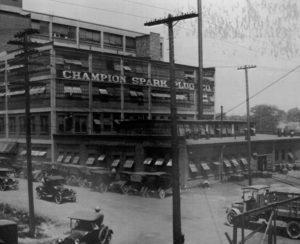
Toledo’s Champion Spark Plug factory in the 1920s. Photo Courtesy Jeff Schneider Collection
For Schneider and others who spent much of their lives in that factory, the rubble is a bittersweet reminder of what Toledo used to be. In some ways, it’s an insult to thousands of men and women who devoted their lives to a company and product once synonymous with the city’s proud industrial heritage.
Champion moved to Toledo in 1910 from Boston, when owners Robert and Frank Stranahan cut a deal to provide all of the spark plugs for Willys-Overland in Toledo, and later for Ford in Detroit. Over nine decades, Champion employed thousands of Toledo workers and produced millions of spark plugs used in vehicles around the world. The Champion badge and brand were as famous as Jeep.
By the 1990s though, the Stranahan family had sold the company to Cooper Industries, where it was then spun off to Federal-Mogul, which moved its operations completely out of Toledo. Soon after, the buildings were reduced to heaps of brick and steel.
On a recent urban expedition back to the ignoble brick pile at Upton and Nebraska, Schneider and a fellow former Champion worker Tim Lohman went looking for the coveted symbol of that one-time industrial icon, namely the 1916 cornerstone. They had been told it was still there, but weren’t sure where it might be amid the jumble of junk. Eventually, they spotted it.
“It was just lying in the debris,�? Schneider said. “It was exciting. I started jumping up and down and couldn’t believe we had actually found it.�?
The cornerstone of the former Champion Spark Plug factory in Toledo. Photo Courtesy Jeff Schneider Collection
The granite stone was intact. The only thing missing was the time capsule of green glass. Only a few shards were left in the hollowed-out compartment where it must have been placed. It’s not certain what might have been inside or who took it.
What Schneider and Lohman were certain of was that they had to get the stone out of the debris field. Within a few months, including a call to Rep. Marcy Kaptur’s office, the former co-workers hatched a plan to rescue the 500-pound block of stone from the grip of the ruins. Kaptur was eager to help in the effort, as her mother Anastasia was an early and longtime worker at Champion and Kaptur herself had worked there during her summer breaks from college.
Last fall, the plan turned to action. With a front-end loader from A.A. Boos construction, the big stone was lifted from the dirt and debris and set onto a rental trailer. Within minutes, the iconic block was whisked away from an uncertain fate. It now sits in an undisclosed location ready for a new future.
The cornerstone (bottom right) of the former Champion Spark Plug factory, found in the debris field of the demolished building by two former employees.
What that future may be is still undecided. Schneider hopes it will be one that helps tell the story of Champion Spark Plug and the thousands of workers who made it a “champion�? among Toledo companies. He’s hoping the stone can be displayed in a public park or venue somewhere in the city, perhaps set on a pedestal of original brick from the factory, as a monument to the workers and company.
“That’s what it’s all about,�? said Schneider, who said he has contacted numerous agencies and groups and has found considerable interest. “A lot more people are interested than I had expected.�?
He thinks Wildwood Preserve Metropark would be an ideal place to showcase the stone and the story of Champion, given its background as the Stranahan Estate and the hundreds of thousands of visitors every year who would see it there.
In the meantime, Schneider and a group of other like-minded former Champion workers are working on assembling hundreds of photographs and other historic documents for a commemorative book about Champion and its workers. It’s a work in progress and a labor of love for Schneider, who said he enjoys all of this research because not only is he a history buff, but he “grew up with Champion.�?
It was a big part of his family’s life and he feels a sense of duty to memorialize the history, adding, “If I don’t do it, I don’t know who else will.�?
Among the long investors who have proposed building a $7 million sports complex at the former Raceway Park site are, from left, Lloyd Grant, Sean Parker, Toledo Area Soccer Association President Richard Parish, Paul Magdich and Ali Merhi. Property owner Penn National Gaming said discussions are still early. Toledo Free Press photo by Christie Materni.
Plans for what organizers say would be one of the largest and finest outdoor athletic field complexes in the nation project 350,000 visitors each year starting as early as spring 2016.
A group of 20-30 investors — all members of the Toledo Area Soccer Association (TASA) — is pursuing efforts to bring a $7 million, all-artificial turf, 12-field outdoor athletic complex to the site of the former Raceway Park in North Toledo.
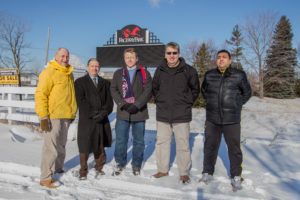
Among the long investors who have proposed building a $7 million sports complex at the former Raceway Park site are, from left, Lloyd Grant, Sean Parker, Toledo Area Soccer Association President Richard Parish, Paul Magdich and Ali Merhi. Property owner Penn National Gaming said discussions are still early. Toledo Free Press photo by Christie Materni.
The plans for Toledo Fields Sports Complex are designed to lure national and regional sports tournaments, and allow weekday use for local sports clubs and high schools. Initially, soccer, lacrosse and football teams would be their primary targets.
“Anything that can be played on a field, we are looking to bring in,” said Richard Parish, managing partner, who also serves as president of TASA, an adult men’s and women’s soccer association formed in 2006.
Investors have made a land purchase offer to Penn National Gaming, owners of both the Raceway Park property and Hollywood Casino Toledo. Raceway Park closed in 2013, and Penn moved its track license to Dayton so as to not compete with Toledo’s casino.
According to Parish, the property is valued at $5 million, while Parish and his group expect to pay around $1.5 million.
Eric Schippers, senior vice president of public affairs for Penn National Gaming, said there is no agreement and that the two sides are “not even close.” He dismissed the notion that a sale is imminent.
“They have made contact, they had made their pitch, but we’re not close to any kind of an agreement,” Schippers said. “There are many different options on the table, but that is one we’re not pursuing.
“We’re just continuing to look at different opportunities for the site. We certainly want to have the site lined up in a situation that the community is happy with it. It’s certainly not in our interests to have it sit for too long, but we want to make sure it’s done appropriately. There’s not even a timeline that’s clear enough to provide you at this point.”
Despite the uncertainty of the purchase, Parish insists his timeline includes having fields in place by this fall, with tournaments starting next spring. The investors are still actively looking for more investors and project partners.
TASA would be one of the complex’s primary weekday tenants, and would initially manage the project and have on-site offices, Parish said. TASA also intends to have office space available for area youth clubs, including lacrosse and others. They also anticipate reaching out to area schools without their own facilities and offering a partnership that would give them a home field.
Parish said there is no sports complex of this size in Cleveland, Columbus, Detroit or Chicago with all artificial turf fields, which make rainouts and unplayable fields a thing of the past, and are thus more desirable than grass for travel teams. Turf requires less maintenance than real grass, and Parish expects most fields to last about 10 years, with the main fields being replaced every five years.
The next closest facility comparable in size and surface is located in Overland Park, Kansas, he said.
The group’s plans also call for repurposing the 5,000-seat grandstand used at Raceway Park, opening up the possibility for more minor league sports in Toledo, Parish said. He hopes to start conversations soon regarding facility naming rights, and to reach out to Mud Hens/Walleye management about minor league soccer, lacrosse and perhaps football.
Organizers said they would expect to host tournaments about 35 weekends each year, drawing 10,000-12,000 out-of-town visitors to each.
While other Toledo attractions draw hundreds of thousands of visitors each year, Toledo Fields Sports Complex would be set apart in that nearly all of its weekend users would be from out of town, Parish said, a possibility that has several area hotels watching intently.
Downtown’s Grand Plaza Hotel & Convention Center already gets business from sports teams, including youth soccer and university groups, but they’d happily welcome more.
“There are other tournaments going on around the area parks here, so it’s already a spot where people are coming to participate in soccer tournaments,” said Steffen Sheerin, Grand Plaza director of sales and marketing. “So it sounds to me like something that could really enhance what [the parks are] already doing, and it could attract a whole other segment.”
Sheerin said the Grand Plaza has 240 rooms, and according to Star Data — which produces a monthly hotel occupancy and rate report — there are 7,620 rooms among 80 Toledo area properties, indicating there is plenty of space for 10,000 visitors on any given weekend.
Park Inn, one of Downtown’s other large hotels, sits between Fifth Third Field and the Huntington Center and is equally familiar with sports.
“We do everything from youth to the pros, so we’d certainly welcome this type of facility,” said Haley Gronemeier, director of sales. “Of course, we’d love to see it grow. It would bring a lot of out-of-town people.”
Rich Nachazel, president of the Greater Toledo Convention and Visitors Bureau, also known as Destination Toledo, said he believes the proposed Toledo Fields Sports Complex would be a boon for the area.
“If they’re able to reach those numbers, there’s no question it would be the largest number of out-of-towners visiting the region,” Nachazel said.
“That would be a tremendous economic boost to have a facility almost year round pulling out-of-town people in,” Nachazel said. “We’d be happy to participate in any way with a group like that, and let people know that this facility is coming.”
Parish estimated that a small tournament with 50 teams would bring about 80 people per team, for a total of 4,000 visitors. If each person in that group spends an average of $50 while in Toledo, that would translate to $200,000 toward the local economy.
“We’ve already sat down and had an unofficial nod from all the economic development people in Toledo, and they’re pretty excited about having tournaments every single weekend,” Parish said. “Every single weekend there would be a tournament from outside the area.”
Raceway Park, which closed in 2013. Image courtesy Google Earth/Toledo Fields Sports Complex.A rendering of the Toledo Fields Sports Complex as proposed to site owner Penn National Gaming by a group of investors from Toledo Area Soccer Association. Images courtesy Google Earth/Toledo Fields Sports Complex.
Parish said the new facility would truly be an “if you build it, they will come” scenario. The complex would be built to host soccer, field hockey, lacrosse, ultimate frisbee, football, gaelic football and rugby, and management would also consider hosting outdoor concerts.
“We don’t know we can land these tournaments, but we do know people want a quality place that’s easy to get to,” Parish said. “They’re always looking for a place to have tournaments. The No. 1 thing groups want is a great place to play. No. 2 is where it’s located, and No. 3 is a tournament that is well put-together. Toledo is right in the middle of everything.”
A similar sports complex was proposed in 2012 at the former Southwyck Mall site, where a different group of mostly Columbus-based investors had hoped to open outdoor fields, volleyball courts, skating, retails shops and a hotel.
At that time, TASA partnered with the Columbus delegation to serve as a partner and facility manager, and would also have been the primary tenant.
The lead developer held a press conference with the city, but plans for the complex quickly folded after the developer was found to have a precarious development history, which included financial and legal troubles.
TASA has seen considerable growth in its eight years. It started as one team with five players and today has 40 teams and 1,200 participants.
Parish said he believes the proposed complex would benefit Northwest Ohio, as well as make a huge impression on out-of-towners.
“It would be a difference-maker in Toledo,” Parish said.
Black Cloister Brewing Company CEO Tom Schaeffer hopes to open the Downtown brewery by February. Toledo Free Press photo by Christie Materni
By Dave Kubacki, Toledo Free Press Staff Wrtier
After two years of planning, renovating and brewing, Black Cloister Brewing Company is nearly ready to open its doors to the Glass City — and CEO Tom Schaeffer hopes those glasses will be filled with Toledo’s newest brews, which will focus on Belgian-inspired styles.
Black Cloister’s name was derived from a 16th-century monastery where Martin Luther, who is credited as the architect of the Protestant Reformation, was trained as a monk.
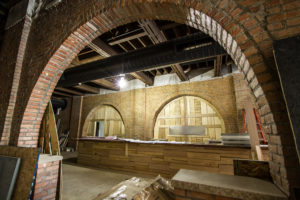
Upon walking into Black Cloister’s new Downtown home near Fifth Third Field, patrons will sense the monastic influence. According to Schaeffer, the building’s architecture immediately made it a frontrunner.
“This was always the building I loved” Schaeffer said. “I walked in and saw these arches and thought, ‘Wow, this ought to be our home.’”
Black Cloister Brewing Company CEO Tom Schaeffer hopes to open the Downtown brewery by February. Toledo Free Press photo by Christie Materni
Without recent changes in licensing, Black Cloister would have been markedly different than the brewery slated to open in February. According to Schaeffer, the initial vision was a bit more primitive, with thoughts of simply having a production warehouse. However, in July 2013 taproom licenses became available and that drastically changed his vision for Black Cloister.
“When we realized that license was going to be available, that sort of changed everything,” Schaeffer said. “After speaking with brewery owners and reading, I discovered that a taproom for a newly opening brewery is the most important aspect of a brewery. It’s kind of the identity of the brewery.”
The major difference between Black Cloister’s taproom and other brewpubs, according to Schaeffer, is that it will not have a kitchen or serve beers from other breweries. Instead, Black Cloister will focus on its own beers and rely on other Toledo businesses to feed hungry patrons.
The future home of Black Cloister Brewing Co. in Downtown Toledo. Toledo Free Press photo by Christie Materni
“It’s going to be all take-in food,” Schaeffer said. “We’ll have food trucks parked on the side. We’ve also talked to Downtown restaurants close to us like Table Forty4 who will let us carry their menu.”
According to Schaeffer, every corner of the Black Cloister’s taproom has been meticulously planned, with a monastic/church theme throughout. The 27-foot hammered black steel bar top encapsulates the brewery’s 12 main taps, which protrude out of a 16th century-style church door. The Black Cloister will hold around 100 people, with a room available for private parties, Schaeffer said.
“There is a table going into the room for small parties designed by Lacey Campbell,” he said. “Lacey’s from Toledo and is actually currently being featured on a competitive furniture-building show called ‘Framework’ that is airing on Spike TV.”
According to Schaeffer, there was debate among the co-founders as to when Black Cloister would open due to the time needed to produce the brewery’s various beers. At the end of the day, the co-founders decided to open the brewery as soon as they had beer to put on tap.
“We have three different beers we can get brewed in two to three weeks,” Schaeffer said.
“We’ll have a Belgian witbier, a palesner, which is a pilsner recipe brewed with ale yeast at about 44 degrees and it is our own invention,” he said. “At this point, because of timing, we’ll probably brew an Irish red.
“There will be flagship beers, but not at first. We decided to produce our beers, get them out there and let the public tell us what the flagship beers are going to be.”
Toledo Free Press photo by Christie Materni
The Black Cloister’s Irish red, according to Schaeffer, is the brainchild of assistant brewer Shannon Speight, a highly decorated brewer who won more than 40 awards for her beers in 2014 alone.
When Black Cloister opens, co-founder Bob Hall will be the brewery’s brewmaster, but will likely turn those responsibilities to Speight. Brewmaster responsibilities will be shifted to Speight after she completes the American Brewers Guild program she’s been accepted into after being on a wait list for two years. According to Schaeffer, Speight is part of another selective society.
“[Speight] actually joined the Pink Boots Society, which is a society for women brewers,” Schaeffer said. “She literally has pink steel-tip work boots.”
The Black Cloister joins a Downtown that has seen substantial growth and revitalization over the past few years. According to Schaeffer, being part of that revitalization is one of the most exciting things about opening the brewery.
“You want to turn Downtown into a destination,” Schaeffer said. “I would be better off if people weren’t getting into their car and saying, let’s go to the Black Cloister, but instead were saying, let’s head Downtown by the ballpark, there’s tons of stuff to do down there.”
Schaeffer and co-founders Hall, Scott Biddle and Mike Kennedy, along with 20 or so investors have put roughly half a million dollars into the Black Cloister renovations and equipment.
According to Schaeffer, who began this process as a simple home brewer, the process of starting a brewery has only enhanced his respect for beer.
“It’s always dangerous when you take a hobby and make it into a career,” Schaeffer said. “I actually think I’ve learned to appreciate it a lot more. I have a different perspective as I now understand everything that goes into it.”
Black Cloister Brewing Company will be located at 619 Monroe St., in close proximity to other popular Downtown destinations including Fifth Third Field, Table Forty4, The Blarney Irish Pub and PizzaPapalis.
Ken Leslie is the type of person who sees a problem and sets to work doing something about it.
.
Three years ago, he found out a $750 rental deposit was all that was preventing four chronically homeless local veterans from moving into voucher-assisted housing provided by the U.S. government.
He realized the simple problem had a simple solution: find money to pay the deposit to the landlord, pushing those veterans —and others like them — over the threshold into housing.
The next morning, Leslie called ProMedica to ask for $26,250 in pilot funding from the Toledo Community Foundation’s ProMedica Advocacy Fund. Knowing veterans were waiting, he also asked to have the usual three-month due diligence process waived.
Seven days later, ProMedica came through with full funding. Three days after that, the first veteran family moved out of a shelter into housing.
Eleven days from idea to implementation.
“Black ops speed,” Leslie calls it.
Just like that, Veterans Matter was born.
“Our goal is simply to house as many veterans as we can, as fast as we can,” Leslie said. “Even one more night in a shelter is way too many for us.”
He makes it seem so simple. But that’s what he does.
He’s part realist, part idealist, the type of guy who dreams of ending veteran homelessness — and doesn’t let a little statistic like 57,000 homeless veterans still to go get him down.
Leslie is a comedian, but behind the jokes and jabs is a heart of pure gold and an unwavering passion for those he calls the unhoused. He knows what it’s like. He was one of them once.
Leslie soon discovered Toledo’s problem was a national problem, and Veterans Matter chapters have since started in seven states with 517 veterans housed so far.
John Mellencamp, Dusty Hill of ZZ Top, Susan Sarandon, Katy Perry, Kid Rock, Ice-T, Stevie Nicks, Kix Brooks of Brooks and Dunn, Willie Nelson and others have all opened their wallets and lent their names and voices in support.
Next month, dozens of local restaurants will join the fight.
Dine 419, a new week-long restaurant fundraising event, will raise money for Veterans Matter. You can help simply by going out to eat.
Participating restaurants so far include Bar 145°, Burger Bar 419, The Beirut, Black Pearl, The Blarney Irish Pub, Byblos, Hollywood Casino Toledo (Final Cut Steak & Seafood and Scene), La Scola Italian Grill, McDonald’s, Poco Piatti, Table Forty4 and Ye Olde Durty Bird. Hollywood Casino Toledo is the presenting sponsor. Toledo Free Press is the media sponsor.
“I just realized that I have a key to my own place, I know where I am going to be sleeping tonight,” reads a framed letter from a veteran in Leslie’s office. “It is like the stress of the last several years has been lifted off my shoulders at once.”
Let’s help Leslie show more veterans what their service means to us. Mark your calendars for Feb. 23-March 1 and join me at the table.
For more information, read more here or visit www.dine419.org.
Sarah Ottney is editor in chief of Toledo Free Press. She can be reached at [email protected] or on Twitter at @sarahottney.
Mom’s House Executive Director Christina Rodriguez with, clockwise from top left, Royal, Gabriel, Lorelei and Raelynn. Chicks for Charity recently chose Mom’s House as its 2015-16 charity recipient. Toledo Free Press photo by Christie Materni
Each year, more than 700 teen girls give birth in Lucas County, according to the Ohio Department of Health.
Having a child drastically changes these young women’s lives and many do not have the support they needed to keep their goals on track. In addition, negative stereotypes often add a stigma to teen pregnancy that can make it difficult for women to overcome obstacles.
Mom’s House Executive Director Christina Rodriguez with, clockwise from top left, Royal, Gabriel, Lorelei and Raelynn. Chicks for Charity recently chose Mom’s House as its 2015-16 charity recipient. Toledo Free Press photo by Christie Materni
Given these challenges, one local charity aims to change that narrative and improve the lives of teen moms in Northwest Ohio.
Mom’s House is a Toledo nonprofit that assists mothers aged13-24 while they raise their children. It was recently named the 2015-16 next charity recipient by Chicks for Charity.
Founded 21 years ago, Mom’s House offers 30 women and children highly rated childhood education and adult classes, which leaders hope will break the cycle of poverty.
“We play the mom role, but also teach our girls how to be a mom to their child,” Mom’s House Executive Director Christina Rodriguez said.
Rodriguez’s enthusiastic spirit is contagious and it’s obvious how much she cares about the family members she’s gained while running the organization.
“We really treat the children like they’re our own and it’s a big family,” she said. “It’s so rewarding.”
While enrolled in the program, children receive a four-star-rated preschool education; 90 percent of the children are ready to test into kindergarten afterward, Rodriquez said. In addition, the mothers take classes to learn about home safety, healthy relationships, family wellness and parenting techniques. The Mom’s House team also assists with child care while the mothers attend classes at local high schools and colleges.
Brittney Goldi, 28, is a graduate of Mom’s House and credits her success to the organization’s staff. Aside from assisting with her child, they were there when Goldi’s mother died.
“They were my counselors and the first people I would call when I had an issue,” Goldi said. “They took on the bereavement role for me.”
Goldi gave birth to her son Jeremy when she was 17 years old. She was still in high school and had a difficult time finding babysitters and overall emotional support while raising her newborn son.
After connecting with Mom’s House, she enrolled in the program and quickly found the assistance she needed. Thanks to her new “family,” Goldi began classes at Owens Community College and finished her nursing degree at Mercy College of Ohio, graduating in 2010.
“They really were my family. I didn’t have the support I needed to take care of my son before, and they helped me outside of regular hours and were more than willing to go above and beyond,” Goldi said.
Goldi is now a palliative care coordinator for Mercy. She’s also married, having met her husband during her time at Mom’s House. The organization also helped him earn his degree and start a career as a booking officer for Lucas County. She and her husband are now proud parents to three boys.
After all of Goldi’s success, she makes sure to give back to Mom’s House and recently spoke during the group’s presentation to Chicks for Charity as a finalist for the Chicks’ next charity recipient. After four years of applying, Goldi’s Cinderella story won the Chicks over and led them to choose Mom’s House for its new charity.
“This was a big win for us,” Rodriguez said.
Every two years, Chicks for Charity selects a new nonprofit initiative to support.
“All 501(c)(3) official groups in Northwest Ohio that are small, under the radar and willing to work with us to get word out are eligible,” said Martha Vetter, founder of Chicks for Charity.
The Chicks recently wrapped up their work with Shared Lives Studio, raising $115,000 over the past two years.
Vetter said Goldi and the Mom’s House presenters made a lasting impact on the more than 80 members of Chicks, which led to their decision.
“They told raw and personal stories,” Vetter said. “It was really moving and wonderful.”
The Chicks will meet with members of the Mom’s House board in January and begin the initiative, but Vetter said it’s up to the nonprofit to decide where to use the funding.
As for joining the Chicks, Vetter said anyone can become a member as long as you plan something “fun.”
“Any chick at any age can join. Just plan a fun and unique event with your family or coworkers and raise at least $75 to give to the charity,” Vetter said. “Anyone can give a little, and it will add up to a lot.”
Rodriguez is planning on using the extra funds from Chicks to develop the group’s family wellness and mentoring programs. One of the new projects includes Mom’s House work with attorney Gretchen DeBacker. They are working with 14 female attorneys for the new Sisters in Law initiative, which assists young mothers with legal issues.
“Many women are involved with legal battles that are hard to navigate and these women can build relationships and assist them,” Rodriguez said.
In addition, the attorneys can help the Mom’s House students prepare for job interviews by building strong resumes and providing tips for proper work attire.
The extra funding and exposure from Chicks for Charity will allow Rodriguez and her team at Mom’s House to continue allowing young moms like Goldi to keep following their goals to success.
“They’ve always been my support system and they’re always there,” Goldi said. “The women at Mom’s House are amazing. They took me from being a pregnant teen mom to being a palliative care coordinator.”
“We can’t do it all, but we definitely see the cycle of poverty being broken,” Rodriguez said.
Real Time Gaming Network (RTGN), a local startup, is hosting its first “Super Smash Bros.” for Wii U tournament in Toledo on Jan. 16. The event is expected to draw some of the top gamers in the country.
“Our goal is to host this tournament and broadcast it live through our website rtgn.tv for thousands of fans to view. Our technology allows us to broadcast in HD,” said founder and CEO Tim Fields, a graduate of Sylvania Southview High School.
The tournament will be broadcast live on rtgn.tv through funding by Rocket Ventures and support from the University of Toledo. The competition will take place at the Nitschke Technology Commercialization Complex on UT’s campus.
“RTGN is one of our newest LaunchPad Incubation tenants. We are providing the host facility for RGTN to test its beta product with the tournament and validate their business model,” said Molly Reams Thompson, director of LaunchPad Incubation at UT.
Rtgn.tv will stream the tournament live for fans who cannot attend the event in person, Fields said.
The tournament is designed for professional and semiprofessional gamers. Fields said 80-100 gamers are expected to attend. Competition begins at noon with the semifinals, and finals expected to air at 8 p.m. Participants will have the opportunity to meet and compete with professional gamers like Mew2King, Vidjo, BigDamien, Chompy, Bo X7, Joeisfatal and Perfect Legend.
Fans are invited to bring a Wii GameCube Adapter and receive free registration for the event. Registration is $15 the day of the event, starting at 10 a.m. Free food will be provided by Chick-fil-A and Fricker’s.
RTGN considers itself “the next phase in online broadcasting,” according to its website. Its consumers are users engaged with online and streaming content of Cyber Athletics from tournaments and those who enjoy 24-hour tech, geek and gaming lifestyles broadcast with an ESPN-style experience. The site will have most aspects of current social media standards and will deliver an interactive twist, Fields said.
RGTN’s marketing director, Scott Guttenberger, is a graduate of Bowling Green State University and Sylvania Northview High School.
For more information, visit rtgn.tv or call (419) 309-5850.
David Lymanstall of Toledo can cross iditarod volunteer off his bucket list in March after he serves as a dog handler at the race in Alaska. Toledo Free Press photo by Christie Materni.
David Lymanstall of Toledo can cross iditarod volunteer off his bucket list in March after he serves as a dog handler at the race in Alaska. Toledo Free Press photo by Christie Materni.
Toledoan David Lymanstall has been fascinated by the Iditarod Trail Sled Dog Race for as long as he can remember, going so far as raising his own husky dogs, teaching the Iditarod to his students and visiting Alaska twice in the late ’80s and early ’90s.
Now, Lymanstall, director of the nursing program at the University of Toledo and a published poet, has secured the opportunity of a lifetime and will be able to scratch “Iditarod volunteer” off his bucket list.
Lymanstall, 57, will help “line up” as many as 1,280 dogs at the ceremonial start in Anchorage, Alaska, on March 7, and again at the official start in Willow, Alaska, on March 8.
“I’m really excited about it,” Lymanstall said. “This is one of my bucket lists. I absolutely loved it up there. I went to a few husky farms around Nome. When I came home, that’s when I got my first husky.”
He owned Sitka for 14 years until she died in 1997. Five weeks later he found Gracie, a cinnamon and white husky, from a breeder in Lambertville. He owned Gracie until last January when she died of organ failure. Lymanstall said he plans to rescue an adult husky after this year’s Iditarod.
The Iditarod originated in 1925 when a diphtheria epidemic threatened isolated and icebound Nome, Alaska, prompting a relay of dog teams to deliver a serum that saved hundreds of lives. The final two legs of the journey were completed by Gunnar Kaasen with his lead dog, Balto. They traveled through a blizzard with winds over 80 mph. The relay of 20 mushers made the 700- mile trip in 127 hours, according to the official Iditarod website.
The effort received international attention and the mushers received special gold medals and a commendation by President Calvin Coolidge. Statues of Balto were erected around the country and the age of the sled dog went out in a blaze of glory, according to the website. In 1973, the first official Iditarod Trail Sled Dog Race was run between Anchorage and Nome.
When Lymanstall taught seventh and eighth grades at West Side Montessori, he sent for teaching material on the race. He tacked up a map of Alaska in his room and used it for lessons on geography and cultural history. Students would push in pins to mark the location of mushers on their trek from Anchorage to Nome. The student who tracked the winning musher would win a prize.
Lymanstall contacted a tour guide out of Alaska to plan his trip from March 2-10. Volunteering for the Iditarod race was an optional part of the trip. He contacted the Iditarod Trail Committee, the nonprofit that heads the race and was accepted as a volunteer in December.
Volunteers come from all walks of life and from around the world, said Julie Busch, Iditarod media coordinator.
“There are more than 1,500 volunteers that come from all over the world — Norway, France, Germany, Spain — you name it,” Busch said during a phone call from Anchorage. “We’ve had people come from Korea. It’s the premier sled dog race in the world.”
Lymanstall will be one of about 200 dog handler volunteers, who should be physically fit and must earn a certificate and undergo special training, said Diane Johnson, Iditarod volunteer coordinator.
“The dogs are priority one, so handlers must know how to safely move the dogs from the mushers’ staging area to the starting line,” Johnson said in an email from her base in South Dakota. She is also the education director of the Iditarod.
Eighty mushers have signed up for the race and each one will start the race with up to 16 dogs, Johnson said.
“One day I woke up in October and I needed to do this (volunteer). This is really my focus: I’m just fascinated by it, I can’t explain it,” Lymanstall said.
Bill Dickinson of Grand Rapids, Ohio,will also participate in the 2015 Iditarod as a guard for Trail No. 6, which is near Wasilla, Alaska. He’ll be stay in Alaska from March 1-21.
“I like to sightsee and take pictures and network,” he said.
Dickinson said he had plans to move to Alaska in 1976 but got hurt at work and had to cancel those plans. He instead bought a farm.
A parking garage at Promenade Park, seen at left in the above illustration, remains a controversial part of ProMedica's proposed plan for its move downtown. Toledo City Council could vote as soon as Jan. 20 on the plan. Illustration courtesy ProMedica.
A parking garage at Promenade Park, seen at left in the above illustration, remains a controversial part of ProMedica’s proposed plan for its move downtown. Toledo City Council could vote as soon as Jan. 20 on the plan. Illustration courtesy ProMedica.
Influential community leaders stepped up to the plate at Toledo City Council chambers Jan. 14 to weigh in on ProMedica’s plan to move its headquarters Downtown.
The move is projected to bring $9.2 million in net revenue to Toledo over 10 years, city officials announced.
Joe Napoli, Carty Finkbeiner, Judge James G. Carr and Bob LaClair were a few of those who addressed Council as members of the public to weigh in on the health care company’s plan to move Downtown in 2017.
The most controversial part of Pro- Medica’s plan is the proposed construction of a six-story parking structure in the southwest corner of Promenade Park. The structure — which would occupy 14 percent of the park’s surface area and 120 feet of the park’s 500 feet of frontage along Summit Street — is a key part of ProMedica’s $60-million plan to move up to 1,000 employees into the former Toledo Edison Steam Plant and KeyBank building Downtown.
ProMedica officials have said future phases could bring as many as 2,500 employees Downtown. There is no timeline on when subsequent phases would be implemented.
“We shouldn’t kid ourselves — many business leaders and investors are watching this decision with great interest,” said Napoli, president and general manager of the Toledo Mud Hens and Toledo Walleye. “ProMedica wasn’t recruited to come Downtown, they called us. Small business leaders that are on the fence about moving Downtown are asking themselves, ‘If the City of Toledo doesn’t welcome ProMedica to Downtown, why would they welcome us?’”
Napoli, who also serves as chair of the ProMedica Toledo Children’s Hospital board, said ProMedica should be commended for being committed to moving Downtown.
“The lack of ample, convenient parking will seriously hinder the future growth of Downtown Toledo,” he said. “To their credit, ProMedica didn’t overreact to the Downtown parking challenge. Most others would have given up, and they did for years. Instead, ProMedica embraced the challenge, studied the issue, and came up with a solution — exactly what a responsible corporate citizen would do.”
The first part of the meeting consisted of a Q-and-A session between Council and Matt Sapara, city development director, and Eileen Granata, the city’s senior attorney, on the Memorandum of Understanding (MOU) between the city and ProMedica. The MOU sets forth key components of the project, highlighting commitments necessary from both the city and ProMedica to keep the project moving forward.
Sapara said the project would amount to net revenue of $9.2 million to the city over 10 years, while the expense to the city for the first year would be $693,000. The city would convey the land for the parking garage to ProMedica at no cost. The company, in turn, would restore and put $2 million worth of renovations into Promenade Park, which would remain open for use by the public.
The city would be responsible for maintaining the park. If, however, the park were not maintained to ProMedica’s liking, it could step in and maintain the park at its own cost.
Councilman Mike Craig voiced concern over the city’s ability to maintain the park.
“Park maintenance is not something the city of Toledo is known for,” he said. “I would feel better taking that money and writing a check every year for the maintenance of that property. I just don’t think we’re going to maintain that property to their standards.”
Councilman Jack Ford, who worked for ProMedica for six years, pressed Sapara and Granata for answers on several topics he felt had not been properly addressed. He asked how significantly the MOU has changed since the company first presented it to the city.
“It has not changed in the sense of the scope of the project,” Granata said. “There have been certainly changes in terms of some of the property, in terms of some of the ownership and how that property is handled. … There were substantive changes.”
The MOU states that the city will also convey most of the green space between the steam plant and Imagination Station to ProMedica, which would allow use of the land by the public until or unless ProMedica decides to modify the site to accommodate its needs.
Ford questioned if this control of the site could be turned over to Pro- Medica at any time, as no specific timeline is given.
Granata said under this arrangements ProMedica could in fact take over the site as it sees fit for future expansion.
“I don’t really know what exactly that means in terms of future plans, but you’re correct in your statement,” she said.
“Should that be important to us, or is that a toss-away issue?” Ford responded.
Sapara said there aren’t any tossaway issues, but any future plans remain open-ended at this time.
More than 20 members of the public signed up to speak at the hearing.
After Napoli, a number of prominent business individuals addressed Council, including Steve Cavanaugh of HCR ManorCare, which employs 800 people Downtown, and Sara Swisher, director of EPIC Toledo, which was created by the Toledo Regional Chamber of Commerce to attract and retain young professionals in the region. Both are proponents of ProMedica’s plan.
LaClair, president and CEO of Fifth Third Bank in Northwest Ohio, agreed with much of Napoli’s statement.
LaClair, a ProMedica board member, said, “It’s very difficult to recruit people to Toledo. The first thing a candidate says when they come to meet with us is ‘Where are all the people Downtown? Why do you have all these empty buildings?’
“We need people walking around Downtown during the day, showing up in offices, eating in restaurants during the lunch hour. That’s what’s going to revitalize Downtown Toledo. We’ve got an opportunity that we have not seen in 30 years to do that right now.”
Former Toledo Mayor Carty Finkbeiner also addressed Council.
“New jobs and great hospitals are very important to Toledo’s future,” he said. “But so is fresh air, clean water — as we learned last summer — and public waterfront parks.”
Finkbeiner said he hopes Pro- Medica’s campus Downtown would not mirror that of Owens Corning, which sits a short distance south of Promenade Park.
“We did isolate and insulate Owens Corning on that piece of land,” he said. “They have their own restaurants, their own dry-cleaning businesses, their own day care centers, their own workout facilities. They drive in, park their car in the morning and go home at night and not have to support, patronize or integrate themselves into all of those small businesses that are yearning, begging for their business. We need to make sure that the guidelines for this integrate, not isolate, the ProMedica campus from all of the existing businesses that have in some cases been hanging on by the skin of their teeth in Downtown Toledo.”
Carr, a former federal district judge for the U.S. District Court for the Northern District of Ohio, said he remains unconvinced there are no options other than building a six-story garage at Promenade Park. At the same time, he admitted this project must move forward for the sake of Toledo’s future success.
Carr urged Council to put a provision in the agreement that if Pro- Medica or a successor were to vacate the premises, the company would then be responsible for tearing down the parking garage.
Toledo resident Jane Randall gave an impassioned speech about why she thought the proposal was wrong for Toledo.
“Why are we even talking about giving away one inch of the little postage stamp piece of greenery we have Downtown?” she asked. “It’s a shame. Do your best, but for heaven’s sake, please do your homework.”
At the end of the four-hour meeting, Sapara addressed some of the comments and questions raised in the public statement portion of the meeting, during which many said the city and ProMedica should explore more parking options.
“There are no alternatives, I’m sorry,” he said. “We can talk about ‘It should go here, it should be there.’ The reality of it is, [an alternative] doesn’t exist.”
Several business leaders told Council that current parking structures could not be used because that would only serve to prevent other companies from coming Downtown because their employees would then have no parking.
Toledo Mayor D. Michael Collins noted the parking garage concern is not a new one, and that a parking garage for the redevelopment of the steam plant was noted as a critical piece of its success as far back as 2000.
“The window of opportunity for us is here today,” he said. “What are we going to tell the future generations of Toledo when they say, ‘I’d really like to be in Toledo but there is no opportunity?’… Will we reject that over a very narrow sliver of property that in the grand scheme of things is never going to save this city?”
Collins noted that having a debate on the matter is a positive thing, but “I also think the answer is crystal clear.” Council is expected to vote Jan. 20.