Home Blog Page 158

ProMedica program rehabs ‘broken’ hearts

0
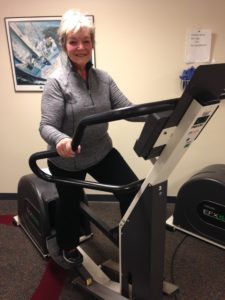
Linda Shaw of Perrysburg has been exercising through ProMedica St. Luke’s Hospital’s Cardiac Rehab program since 2011 when she suffered a heart attack at the age of 59. Since 1983, the center has helped patients lead healthier lives after heart events through exercise, education and support. About 300 patients currently receive care through the program. Toledo Free Press photo by Joel Sensenig

Linda Shaw thought she had the flu.

Four years ago, while visiting her sister in Valparaiso, Indiana, the Perrysburg woman awoke at 4 a.m. with the feeling of not being able to lie down any longer. Shaw, who had not been feeling well for some time prior to that, just wasn’t feeling “right,” by her own admission.

Her sister told her she was taking her to the hospital.

There, Shaw learned she didn’t have the flu.

She had had a heart attack.
Linda Shaw of Perrysburg has been exercising through ProMedica St. Luke’s Hospital’s Cardiac Rehab program since 2011 when she suffered a heart attack at the age of 59. Since 1983, the center has helped patients lead healthier lives after heart events through exercise, education and support. About 300 patients currently receive care through the program. Toledo Free Press photo by Joel Sensenig

“I had that kind of [flu] ache. Muscle aches in my arms, across my back,” Shaw said. “No chest pain, no jaw pain. None of the earmarks of a heart attack.”

But inside Shaw’s body were the indicators of a heart attack. That Friday, the doctor told her she had three blocked arteries: one at 98 percent blocked, another at 100 percent and the third at 97 percent. She had triple-bypass surgery the following Monday.

Now 62, Shaw can be found first thing in the morning three days a week in the lower level of ProMedica St. Luke’s Hospital in Maumee. She’s a regular at the hospital’s Cardiac Rehab program, which aims to help those who have suffered a heart event regain their health.

“Recent studies show those who get in rehab after a heart event live on average five years longer,” said Karen Sherman, a nurse and cardiac rehab coordinator at St. Luke’s. “Time is muscle. The heart is a muscle.”

The hospital’s cardiac rehab program began in 1983. Through exercise, education and support, the program aims to provide healthier lives for patients who have had a heart attack, bypass surgery, valvular surgery, heart transplant, angina, stents or heart failure.

The program consists of three phases. Phase 1 begins with light education and exercises while the patient is still admitted in the hospital. Phase 2 is a three-month program of monitored exercise and education, with patients coming in three to five times per week. Phase 3 is a maintenance phase for those who want to continue the exercise portion of the program in the hospital setting. Up to 300 people are regularly in the Phase 2 or 3 portion of the program, with more in ProMedica’s other hospitals throughout Northwest Ohio.

Sherman said the hospital encourages patients to start the rehab program within one to three weeks of being discharged.

“The quicker we can get to them and start educating them and exercise them, the better they do,” she said.

After recovering in Indiana for a month following her surgery, Shaw was eager to begin exercising at St. Luke’s. She’s been in Phase 3 for more than three years.

“I’m here because this is my lifestyle, this is where I belong and it’s a comfort to me,” Shaw said after one of her two-hour workouts, which begin as soon as the center’s doors open at 6:15 a.m. “While I don’t worry about it on a daily basis, if something would happen, they’re here for me. In a second, they’re here. … [The center] deals with the whole compass of heart disease. Not just the nutrition and exercise, but the emotional support. We have a great camaraderie here because we’re all here for a reason.”

The communal spirit of the program is beneficial to many patients, who may be experiencing the “cardiac blues” following their heart event, according to Sherman.

“Some people are socially isolated, and they’re depressed after an event,” she said. “Getting them out and interacting with others improves their quality of life.”

Each patient’s exercise program is catered to his or her ability, said Kristin Easter, an exercise therapist in the program.

The patient’s background, risk factors and any health problems they may be experiencing are reviewed during their first day in the program. Because participants may be as young as their 20s to as old as their 90s, there is a wide range in exercise routines.

“That’s a big part of the program — making sure we can provide them with an exercise routine that they feel comfortable with, so it’s all individualized for a patient,” Easter said. “We kind of act as a liaison between the doctor and patient. They may see the doctor once every three to six months but we’re here to keep the doctor updated and let them know how their patients are doing.”

Shaw said the program has helped improve the quality of life for not only herself, but also the lives of her daughters and grandchildren, who say grandma had a “broken” heart. Because Shaw had a heart attack prior to the age of 60, her family is considered at-risk for a heart event.

“It’s hard, I won’t deny. Nothing’s ever laid me out like that,” Shaw said of her heart attack. “But I think what you do is just keep pushing forward. It’s been a blessing for my family. … Since then, my girls, who never had a weight problem, are very conscious now of what they’re putting in their bodies.” Her 10-year-old grandson recently told her, “I’m not going to have a second helping of this, Grandma, because it’s a better choice if I don’t.”

Although Shaw knows she doesn’t “have” to keep showing up three times a week, she has no plans on stopping.

“I’m not done. This is the lifestyle now, and this is something that you have to do for yourself,” she said. “I want to be an example for my grandchildren, so they continue this better lifestyle of being healthier for themselves — so they know it’s their responsibility to be the best that they can be.”

For more information about the program, call (419) 897-8440.
Groups unite to stage Opera Ain’t No Drag

0

Opera singers and drag queens are alike in more ways than one: the extravagance, the big wigs, the shiny dresses.

“It’s all performance,” said Toledo Pride Marketing Director Kelly Heuss. “It blends more than you think it does.”

Both types of performers will be part of the Opera Ain’t No Drag event at 7:30 p.m. Feb. 7 at the Collingwood Arts Center, 2413 Collingwood Blvd. The event is a collaborative effort between Toledo Pride and the Toledo Opera Association.

“It’s just kind of a ridiculous, fun evening,” Heuss said.

Toledo Pride Executive Director Lexi Staples has done wigs and makeup for the opera for a few years, which is how the connection between the two groups was first made.

The idea, brainstormed by Staples, was put into effect two years ago to much success. More than 500 people attended the event and Heuss said the crowd was diverse.

“You get the opera guild members and then you get the younger generation that hangs out at the bars and watches the drag queens,” she said.

Heuss said the two types tend to mesh well.

“I just love that it’s a fun event that really brings together different parts of the community,” she said.

The event will include live performances by opera singers and lip-synced performances by drag queens and a drag king. The songs included during the event will include some well-known numbers.

The local performers include Jenny Cresswell, Micah Graber and Madeline Harts from the Toledo Opera Association; drag queens London Asia, Empress Fontaine, Amber Stone and Sugar Vermonte; and drag king Santana Romero.

Tickets for the event cost $15 or two for $25, available in advance or the day of the show. To purchase tickets, or for more information, visit toledopride.com.

SilverSneakers: Helping seniors get physically active

0

What do you think of when you hear the word SilverSneakers?

.

Many people think of the 16-year-old program that gives seniors a free membership at many area gyms. This program came about after a study showed seniors who exercise spend $1,000 less per year in medical costs than ones who don’t exercise.

In January 2013, the program saw some major changes. Surveys showed  that seniors often could not get to the gym; that they didn’t feel comfortable in the gym setting; and they didn’t want to work out with the younger crowd. For these reasons the FLEX program was developed. This program gives seniors a more convenient way to work out and stay fit.

In July 2013, American Mobile Fitness collaborated with the FLEX program to provide seniors group fitness class at parks, churches, 55+ communities, senior centers, assisted living facilities and nursing homes.

Currently, there are 33 locations hosting 150 classes per week in Toledo and surrounding areas.

Seniors can take advantage of a wide variety of classes that are led by a certified group of fitness instructors or certified personal trainers. Some of the classes include aqua aerobics, senior stretch, chair aerobics, circuit training, strength and balance, yoga and Zumba.

As we age, our metabolism decreases, which often causes weight gain in the senior population. Many seniors also have a number of ailments to deal with from arthritis, diabetes, COPD, osteoporosis, stroke and high blood pressure to Parkinson’s and heart disease.

Many times after a surgery or an injury, physical therapy is limited to working and rehabbing the specific injury. We find that people still need rehab not only for that specific injury but also the entire body.

After someone has been released from therapy, they still need to continue exercising to avoid losing the gains they have made. Group fitness classes offer a great opportunity to avoid regression.  The next step in your continuum of care is a certified professional to lead you in classes specifically designed to make seniors stronger.

Many times, seniors are caught in a cycle of regression followed by physical therapy where they progress to a certain point before being released to regress again. We have found that this program has helped seniors to continually progress and lead a much stronger, healthier and happier lifestyle.

To find out more about the program and how to bring it to your facility or to see if you qualify, please go to www.AmericanMobileFitness.com or call us at (419) 351-1381.

Gregg Schwartz is owner of American Mobile Fitness.

Mud Massacre II: Radio host unites 34 local rappers in music video with anti-violence message

0
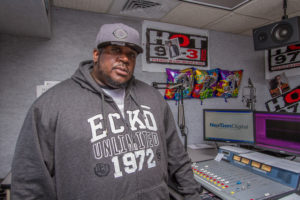
Eddie Bauer of Hot 97.3 WJZE organized “Mud Massacre II,” an anti-violence music video featuring 34 local rap artists. Toledo Free Press photo by Christie Materni

To promote the message that violence is wrong, local radio host Bigg Eddie Bauer created a YouTube video of 34 local rap artists who rap about ending gang violence, dispelling negative images and uplifting the poor.

Eddie Bauer of Hot 97.3 WJZE organized “Mud Massacre II,” an anti-violence music video featuring 34 local rap artists. Toledo Free Press photo by Christie Materni

The video, “Mud Massacre II,” was a monumental effort, said Bauer, of “Toledo’s Blazin’ Hip-Hop and R&B” station Hot 97.3 WJZE. Many of the artists have gang affiliations, Bauer said, and part of making the video was to put those rivalries to rest.

“As you know, the city is filled with violence, gang-banging and negative images of the poor and impoverished, but I was able to put together a project where artists, who may have problems with each other due to rivalries, worked together to shine a positive image and collaborative spirit on the music scene in Toledo,” he said.

The video was modeled after a similar video, called “Cincinnati Riots,” made in Cincinnati, where Bauer is originally from.

That led to “Mud Massacre,” which featured 20 artists and was released in October 2013. “Mud Massacre II” was released in December and features two parts, “Chuckie” and “Zion.” Bauer decided on the beats for the video and enlisted two producers from Toledo, Yung Chuck and duo Derrick Holcomb Jr. and Chuck “da Deuce” Browne aka The Beetz.

The project took two to three months to complete. The song “Chuckie” features 16 artists and “Zion” features 18.

“It was totally my creation from the ground up,” Bauer said. “After [the artists] sent the verses back, I spent many hours and days listening until the song was completed. Then we shot each person’s individual scenes.”

Bauer said at one time he wanted to be a rapper, but had no luck in the music industry so he went into broadcasting. His show “#GIMMEMYSHINE” airs 2-6 p.m. Monday through Saturday. He hopes his video gives rap artists in the city their moment to shine.

“If I’m not going to be an artist, the least I can do is give artists a platform,” he said.

Some of the artists in the video include Stink Bomb, whom Bauer called the “hottest artist in the city,” Cuntry, Thee Untouchable, Mike Wit da Goldz, Yung Chuck, G5Juan, 7 Diamond, Prophet Mocmoud, Geech, Jimmy Paid and Kane.

“Mud Massacre” has 56,000 views on YouTube. So far, “Mud Massacre II” has gotten 10,000 hits in its first month.

“It’s called ‘Mud Massacre’ because Toledo is known as the mud and they’re killing the rap,” Bauer said. “That’s where it came from. … They’re killing it. They’re doing their best to get their shine on.”

Yung Chuck, the architect of “Chuckie” who boasts a national fan base, said he got involved with the video to showcase Toledo’s talent and to emphasize his core message. Yung Chuck said he had a difficult beginning in life; his mother did drugs and he moved in with his grandparents.

“I had a crazy life,” he said. “My whole movement is about uplifting, doing for yourself. When people say you can’t do anything, you can do it.”

Yung Chuck has been in the industry for two years and rapping for 10. In 2012, he went national with the group Educate Portege and can be seen in many of their videos.

Artist Mike Flamez has been a part of the rap scene in Toledo for 12 years. He contributed the first verse in “Zion.”

“It’s just an amazing thing Eddie put together,” Flamez said. “There’s not a lot of DJs in the area that take the time to do something like this. From my perspective, it is very well-appreciated. You just have to do everything for yourself in Toledo. Eddie is putting in his own money and time. It’s just a beautiful thing really because around here there is a lot of negativity, so it’s good we have something more positive to be about.”

Area restaurants, residents deliver meals to firefighters

0

Last year, in the wake of the deaths of Toledo firefighters Pvt. Stephen Machcinski and Pvt. James Dickman, a group called Feed Our Toledo Firefighters arranged for meals to be delivered to local fire stations for six months, at first every day, then on the 26th of each month.

Machcinski, 42, and Dickman, 31, died from injuries sustained while fighting a North Toledo apartment fire on Jan. 26, 2014.

During the anniversary week, the group again stepped up to organize meal deliveries to fire stations, an initiative called A Week of Feast.

Area restaurants, schools, organizations and individuals volunteered to donate and deliver food to each station Jan. 26-31.

“It was really just a continued effort,”  said Week of Feast organizer Larry Cready. “As we got near to the one-year anniversary … I suggested we see if we can get them fed on Monday and it just blossomed from there.”

On Jan. 26, 18 fire stations and the 911 dispatch building received delivered meals as part of the group effort.

“It’s just a collaboration of people who have gotten together,” Cready said. “I may be organizing it and trying to coordinate the effort here, but I certainly couldn’t do this by myself.”

Tony Packo Jr. of Tony Packo’s Cafe was among the restaurant owners who donated meals to local stations. Packo’s At The Park delivered to Station No. 5 on Jan. 27 and the Original Tony Packo’s delivered to Station No. 13 on Jan. 28.

Packo Jr. said it was an easy decision to get involved, not only because of the close proximity of his restaurants to fire stations, but also to show support for Toledo’s firefighters, many of whom are regular customers.

“We’re obviously very close to the fire stations in a lot of regards. A lot of firefighters, including the chief, patronize our restaurants,” he said. “We appreciate their dedication and their sacrifice to say the least. We just wanted to show our support.”

Cready said local firefighters have been humbled by the meals and the outpouring of support is something they appreciate.

“They don’t ask for anything from us,” Cready said. “They get up every morning and they put their lives on the line for us because that’s their job. …  For us to come together to show them that we’re Toledo Strong [gives] them a pat on the back and [is] showing them some love.”

Toledo Fire Chief Luis Santiago referenced the meals as part of his thank you to the community during a public memorial service Jan. 26.

“It’s just another gesture of kindness,” Santiago said afterward. “I am ever so grateful to them that they take time out of their day to do that because they don’t have to do that.”

Pvt. Mike Eck of Fire Station 14, a member of Dickman’s graduating class, agreed.

“It’s very welcome just for the fact that people are bringing us hot meals,” Eck said. “They care. They want to take care of us. The support is very humbling.”

The group’s reach extended even down South — 1,000 miles from Toledo in Gainesville, Florida.

University of Florida student and Toledo native Stevie VanAusdale participated in the feeding last year and was so moved by the city’s response, she jumped at the idea to participate for the anniversary.

VanAusdale, who is working on her master’s degree, delivered food to a fire station in Gainesville in honor of the fallen heroes in Toledo.

“I have a friend who is a Detroit firefighter who was injured while fighting an arson fire and it felt like the city really turned their back on him and the others who were injured,” VanAusdale said in a Facebook message. “It was really important for me to help out after Jamie and Steve passed away. I think we so often forget about firefighters and the life-threatening work they do.”

Since the initiative began last year, VanAusdale, her family and some neighbors they rallied have donated meals each month.

“It really isn’t that difficult to make a little extra food once a month, so we figured it was the least we can do,” she said. “I am still Toledo Proud 1,000 miles away.”

Toledo Free Press Editor in Chief Sarah Ottney contributed to this report.

Bennett Management marks 50th anniversary

0

Bennett Management Corp. celebrated 50 years in business Jan. 24.

The family-owned, Maumee-based business was founded by Bob Bennett, who recognized the potential of Burger King when it was 11 years old and opened a franchise in Kalamazoo, Michigan. At the time of his death in May 2013, Bennett had grown the business into 26 Burger King locations across Michigan, Ohio and Indiana.

His widow, Emily Bennett, who now owns the business, credited great management, an excellent team and a great brand for the company reaching the milestone.

“He was an attorney and a CPA and he had a brilliant business mind,” Emily said of her late husband. “I’m sure a lot of planning and experience went into creating such a great business model.”

During his life, Bennett spoke highly of the Toledo area and sought ways to improve the quality of the city through its business economy, she said.

Bennett Management remains involved in Toledo as well as the other communities it serves, supporting organizations such as The Boy Scouts of America, Easter Seals, Lucas County Children Services, and Historic Church of St. Patrick’s Food Pantry, she said.

While its founder may not get to witness the business’s continued growth, Emily said she is looking ahead to Bennett’s next 50 years.

“I think it’s absolutely incredible we’ve made it this far, and it’s all thanks to the wonderful people we’ve had involved,” she said. “We’re looking forward to many more years serving the communities in which these store are located.”

McGinnis: I’m free Sunday

0

I will not be watching the Super Bowl this Sunday night.

.

.

For anyone who knows me, this is hardly shocking news. I rarely express any interest in anything related to football, whether on the college or professional level. Most of my friends naturally assumed I would spend Sunday night playing video games or sleeping or marathoning Martin Scorsese movies or whatever else they imagine I do in my spare time. (Most of the time, these people would be correct.)

But even though I am hardly the most avid football fan, and not-so-secretly believe it is massively overrated as a sport, even I usually hear the siren song of Super Bowl Sunday.

It has long since become a national holiday anyway, a moment of community where we gather with friends and family to worship at the cultural altar that is the country’s most popular game, with hymns to shameless commercialism and pop music added in. There may be no more purely American event than the Super Bowl.

So every year I find myself joining the crowd for an evening of football. But not this time. This year, a series of events has coalesced to make me think twice about joining in the celebration.

First, I watched the excellent and disturbing Frontline documentary “League of Denial: The NFL’s Concussion Crisis” on Netflix. The piece is a two-hour-long exposé on the effects of concussions on football players; it examines mounting evidence that serious health risks are posed by the continuous hits sustained by players. Beyond that, the documentary makes serious claims about the NFL’s response to such evidence, depicting a league seemingly dragging its feet instead of seriously investigating the problem.

The NFL has apparently started to come around, treating head injuries with the care needed. It also reached a settlement in a lawsuit related to the claims in August 2013, contributing $765 million to the medical treatment of thousands of players. And only 20 years after the first hard evidence began to come to light. (The settlement was rejected by a judge in January 2014 but is expected to be approved soon.)

Then came the season’s scandals, a seemingly endless wave of embarrassments and outrage connected to the league, with the Ray Rice incident and the NFL’s handling of it at the top of the list. We could talk all day about what the NFL knew and what it didn’t know, when it got the infamous tape and the recent investigation which cleared the league of wrongdoing.

Beyond everything, I can’t help but find the NFL and Commissioner Roger Goodell’s response to the scandal to be indicative of a wider problem. Between the far-too-lenient two-game suspension handed down to Rice, the clearly botched handling of attempts to obtain the security footage, and having Rice’s suspension overturned because of the league’s screw-ups, the NFL’s response to the incident has frankly been an embarrassing comedy of errors.

But the last thing, the very last straw that caps the whole season, are the investigations and focus being placed on the condition of the footballs used in the New England Patriots’ last win — the so-called “Deflategate.” I honestly couldn’t give a crap about whether or not the Patriots cheated deliberately. What bothers me is how rapidly and deliberately the NFL, media and fans moved to garner as much evidence as possible to condemn or clear the team of wrongdoing. So decisive. So unlike how the league reacted to previous scandals.

Admittedly, there was a time factor — the Super Bowl was only two weeks away, and there was an obvious benefit to getting information as quickly as possible. But contrasting the rapid response to an issue where the outcome of something as meaningless as a game was in question, to the relatively lackadaisical response to situations where human lives were impacted — this has disturbed me.

So no, I won’t be watching the Super Bowl this Sunday. I don’t begrudge anyone who does, and I’m not campaigning for anyone to join me. I am merely expressing my frustration toward what I feel are misguided priorities. For no matter how monumental and important people may feel a game is, it is, after all, just that — a game. A diversion. No more, no less. But when the health and well-being of human beings seem to take a back seat to the integrity of a game, something should change.

Jeff McGinnis is pop culture editor of Toledo Free Press. He can be reached at [email protected].

Mercy St. Anne challenges community to better health

0
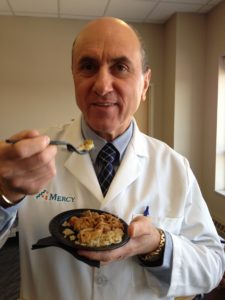
Dr. Ahed Nahhas, cardiologist and medical director for Cardiac Cahteterization Lab Service at Mercy St. Anne Hospital, eats a heart-healthy dish at the news conference to announce the ‘Heart of West Toledo Challenge.’ The challenge is designed to raise awareness of heart health while awarding cash grants to community organizations. Toledo Free Press photo by Joel Sensenig

Mercy St. Anne Hospital is inviting nonprofit organizations and the community to take an active part in preventing heart disease — and maybe win some money while they’re at it.

Dr. Ahed Nahhas, cardiologist and medical director for Cardiac Cahteterization Lab Service at Mercy St. Anne Hospital, eats a heart-healthy dish at the news conference to announce the ‘Heart of West Toledo Challenge.’ The challenge is designed to raise awareness of heart health while awarding cash grants to community organizations. Toledo Free Press photo by Joel Sensenig

Officials announced Jan. 26 the “Heart of West Toledo Challenge,” an interactive series of events designed to raise awareness of heart disease and help organizations win up to $5,000 in grant money.

“We are here to announce a challenge to the community to change lifestyles that lead to a healthier heart and a healthier you,” said Dr. Imran Andrabi, chief operating officer, president and chief network integration officer for Mercy. “As a leader in cardiac care throughout Northwest Ohio, Mercy has a commitment to our community to ensure that you’re not only receiving high-quality, compassionate health care, but also have the tools needed to improve your health while you live your everyday life.”

Mercy officials came up with the idea of the challenge, a three-day series of themed community health fairs provided to the public at no charge.

The events from 1-3 p.m. March 15 (Nutrition), April 12 (Lifestyle) and June 27 (Fitness) will feature a variety of health activities, informational sessions and cooking demonstrations at Mercy St. Anne Hospital, 3404 W. Sylvania Ave.

The “challenge” component of the series stems from nonprofit and community organizations competing to gather votes at each session, with the top three vote recipients earning cash grants (first place $5,000; second place $3,000; third place $2,000) to support a health-related program within their organization. Participating organizations will earn points for attending the events, and attendees at each of the three sessions will cast a paper ballot to indicate their support of one of the 25 eligible organizations.

Mercy St. Anne is using the challenge in part to help raise awareness about its cardiac and vascular care. Last fall, it debuted its full-service cardiovascular program, with services including heart catheterization, coronary angioplasty and stenting, as well as open-heart surgery.

Brad Bertke, president and CEO of Mercy St. Anne, said the larger point is to improve public awareness of heart disease prevention.

“We know that sometimes it takes a life-threatening or life-altering event for people to truly engage in their own health care, but that doesn’t have to be the case,” he said. “We can do that now, and that’s what this event is all about. Through the ‘Heart of West Toledo,’ the goal is to give people an avenue to understand and engage in their health care today.”

Dr. Ahed Nahhas, cardiologist and medical director for the cardiac catheterization lab at the hospital, said these community-engagement events are all about preventing future problems.

“When we do procedures on those patients, we see them near the end of the disease process,” he said. “It’s important to try to focus on prevention as much as we can.”

Springfield Local Schools has already signed up for the challenge.

Kristina White, community liaison for the school district, said it represents an important part of schools’ impact on students and the community.

“Springfield Local Schools, like any almost any other public school district in America, relies on partnerships with our community in order to really take what can be teachable moments that we see with our students and bring those teachable moments to reality,” she said.

“There are students, there are families, there are staff members that are going to take advantage of what Dr. Nahhas shares at these events. But even greater than that, it offers us the opportunity to encourage people to get off the sideline and take some responsibility, and have fun while they do it.”

The challenge is limited to 25 nonprofit and community organizations, which must register by Feb. 27 at

mercyweb.org/heart or by calling Kelly Schenavar at (419) 887-6823.

Ottney: Hearts behind badges

0

For more than 15 years, Stephen Machcinski fought fires, responded to medical calls and saved lives in Toledo. Until Jan. 26, 2014, only his friends and family knew his name.

One of his last calls was to the North Toledo home of Tina Petersen, who had a seizure in January 2014. A few days later, Petersen recognized the Toledo Fire & Rescue Department EMTs who had responded — Machcinski and fellow Toledo firefighter James Dickman — in a news story about a fatal fire. She attended the June rededication of Fire Station No. 3 to introduce herself to the Machcinski and Dickman families and thank them in person.

There are no doubt countless Tina Petersens in Toledo — not to mention in Perkins Township, where Dickman served for 10 years before joining Toledo’s department only months before he died — who were served or even saved by Machcinski or Dickman and will never realize it was them.

It’s only when tragedy strikes that most of us actually learn the names and stories of those who protect us day and night.

Years ago I noticed a friend’s mom would bow her head every time a police vehicle, ambulance or fire truck blared past, saying a little prayer for the first responders as well as whomever they were rushing to help. I got into the habit myself and still think about her every time I hear a siren.

Service calls, of course, don’t stop for heartache. A fire broke out in the city during last year’s Last Alarm ceremony and crews responded. Another crew left this year’s anniversary memorial service at the Historic Church of St. Patrick to respond to a medical call. While talking to a firefighter for a story earlier this year, I heard tones go off at the station on the other end of the phone. He calmly continued the conversation even as he slid down the pole, grabbed his gear and jumped on a truck. Even as I write this, I hear sirens outside, heading somewhere. All in a day’s work.

Earlier this summer, I had the privilege of talking to Toledo Police Deputy Chief Don Kenney Jr. for a story I was writing about multigenerational first responders. He’s been on the job more than 30 years and his father, Don Kenney Sr., was a Toledo firefighter. Kenney Jr.’s son and daughter are both Toledo police officers and his daughter-in-law is a Toledo Police detective.

“To this day, he is still out going to calls with patrolmen and coming in on Friday nights and holidays because his patrolmen have to,” daughter Pvt. Kellie Kenney told me. “This past Thanksgiving, he finished eating and got up to put on his uniform. I asked what he was doing and he said, ‘I’m going to spend Thanksgiving on the street.’ And he did.”

That’s the dedication of the first responders who serve this city.

It’s clear first responders, firefighters in particular, are a tight-knit family that takes care of its own. Hundreds filled St. Pat’s for a private memorial ceremony on the one-year anniversary of the fatal fire.

Last January, Toledo Fire Chief Luis Santiago remarked that TFD and the extended firefighting community would always be there for the friends and families of their fallen, including the proverbial “Monday morning” when media and others have moved on to the next big story.

This past Monday morning proved how true that was.

Sarah Ottney is Editor in Chief of Toledo Free Press.

Reddish Printing finds home on Adams Street

0
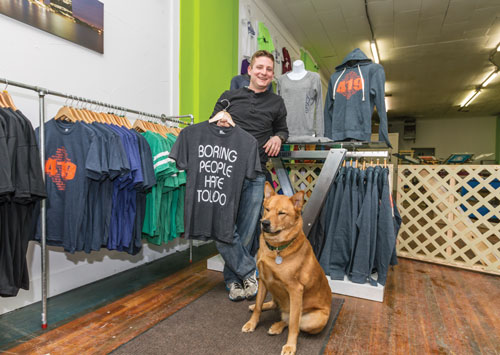
Max Reddish of Reddish Printing, with dog Red, opened his shop at 1503 Adams St. in October. Toledo Free Press Photo by Christie Materni

If Toledo is a growing body, Max Reddish certainly knows where the heart is.

As part of a family that has been doing business in the city since 1909, beginning with his great-grandfather’s hardware store, Reddish said he opened Reddish Printing with the intention of celebrating the city’s potential.

“This is my town,” Reddish said. “I think if you’re going to make a profit off the community you should give back to the community as well.”

n  Max Reddish of Reddish Printing, with dog Red, opened HIS SHOP at 1503 Adams St. in OCTOBER.  TOLEDO FREE PRESS PHOTO By CHRISTIE MATERNI
Max Reddish of Reddish Printing, with dog Red, opened his shop at 1503 Adams St. in October. Toledo Free Press Photo by Christie Materni

His journey began while working labor jobs at factories, fresh from his decision to eschew a college degree. His family ran Reddish Contact Sports Supply, already a popular brand with locals, but Reddish found his niche by discovering something the business didn’t produce.

“They always made screen printing available but never actually did it in house,” Reddish said. “So I said, ‘That’s an opportunity. I’ll buy some equipment and learn how to screen print.’”

With a business plan in mind, Reddish flew to Arizona to attend a school specializing in the craft. The new business had a humble beginning as he worked from a nook in the back of the family’s store. After five years, Reddish decided he wanted to expand into his own location.

He found the perfect spot at 1503 Adams St., right across from Manhattan’s, his favorite restaurant.

After investing in equipment and materials, Reddish set up shop in a “big bang” sort of way,  he said, getting everything in at once and displaying T-shirts promoting the city.

Using his imagination paired with the printing skills he’s developed, Reddish can take a customer’s idea and create designs for their club, sporting team, organization or personal use.

Dave Crafts, who noticed Reddish’s work at a street sale booth during The Arts Commission’s summer Art Walks, frequently enlists him to create jerseys for a sand volleyball league and for students who served in the military.

“I have always been able to give Max a rough idea of what I need and he is able to translate my sporadic vision into a great product.” Crafts said. “Max’s commitment to and passion for Toledo is apparent in his designs, and you can see he truly loves his work.”

Reddish currently offers T-shirts, sweatshirts, baby clothing and more. In the coming months, he plans to offer custom pint glasses and drinkware, as well as sunglasses and summer attire.

Other plans moving forward involve creating a relaxing space in the front of the store for people to hang out, complete with new couches and possibly offering drip coffee.

Being creatively driven, Reddish also said he plans to repurpose the display space at the front of the store into a stage for local performers to play acoustic sets or for open-mic nights.

“I’m thinking of maybe adding a projector screen too, something to show movies on for customers,” he said.

One screening that immediately came to Reddish’s mind was WGTE’s “Toledo Stories,” a series of short films about the city’s history.

Part of this creativity in utilizing his space comes from the awareness of other businesses with multifaceted approaches to customer interests.

“Everyone seems to want to be interactive on multiple planes,” Reddish said. “You’re not just a bar, you’re a banquet hall. You’re not just selling crafts, you also have people there crafting. I don’t want this place to just be a print shop.”

Lending his space to other artists seems like a no-brainer, Reddish said. His walls display several works by a local painter, providing exposure to someone else who may have a dream waiting to see fruition.

Reddish said people often overlook Toledo’s friendly attitude and regional developments on the rise. He said the city has the famous Midwestern spirit, and newcomers are always welcomed and shown around.

“This is my city,” Reddish said. “I’ve been stomping around this area for 17 years. I’ve always had a love for it and I hate people who are hating on it.”