Home Blog Page 154

Mayor laid to rest with moving tributes, funeral procession

0
Local first responders serve as pallbearers, carrying Toledo Mayor D. Michael Collins’ casket into Rosary Cathedral for his funeral mass on Feb. 12. Photo by Scott Grau

The city of Toledo’s two-day farewell to its late Mayor D. Michael Collins concluded Feb. 12 with a funeral mass at Our Lady, Queen of the Most Holy Rosary Cathedral.

Prior to the service, a funeral procession from Coyle Funeral Home to the cathedral on Collingwood Boulevard passed many spots important to Collins for personal and professional reasons, including the former Southwyck Mall site, Heather Downs Country Club, Wixey Bakery, Walbridge Park, Toledo Zoo, the former St. James School, the future Downtown site of ProMedica headquarters and the Toledo Police Patrolman’s Association building.

Along the route, the roadways were lined with city vehicles, police and fire personnel, schoolchildren and members of the community paying their respects as the procession made its way from South Toledo to Downtown and into the Old West End.

Bishop Daniel Thomas of the Diocese of Toledo celebrated the funeral Mass.

Local first responders serve as pallbearers, carrying Toledo Mayor D. Michael Collins’ casket into Rosary Cathedral for his funeral mass on Feb. 12. Photo by Scott Grau

During the homily, Thomas discussed Collins’ work ethic, which has been widely praised by those who knew him.

“I dare to say that those who worked with him in the Marines, in the police force, in city government, perhaps even in his family, knew how hard he worked and how hard he encouraged others to do the same,” Thomas said.

He referenced the slogan Collins used during his 2013 campaign for Toledo mayor, “Collins Cares,” saying that everyone could implement that in their own lives.

“Today, we make his campaign slogan a new slogan, because we can say, ‘Toledo cares.’”

Following the mass, private burial services were conducted at Toledo Memorial Park.

On Feb. 11, the University of Toledo’s John F. Savage Arena hosted the public visitation and memorial service for Collins, who died Feb. 6 at the University of Toledo Medical Center after experiencing cardiac arrest Feb. 1 while driving.

Collins’ widow, Sandy Drabik, and the rest of his family were joined by city and state officials, former colleagues of Collins with the Toledo Police Department, friends and members of the public in honoring his life of 70 years.

In the arena’s reserved seating section above the crowd, Collins’ Toledo Rockets season ticket seats were illuminated and adorned with Irish regalia in a tribute to the heritage he was so proud of.

“Look at the numbers of people who are present in this facility,” said Imam Shamsuddin Waheed, of Toledo Masjid Al-Islam, who gave the invocation at the service. “This gathering, as well as the funeral Mass to come tomorrow, is a testament to Michael Collins, not only as the mayor of Toledo, Ohio — but as a man, as a human being.”

WTOL-11 news anchor Jerry Anderson and 13abc news anchor Diane Larson served as masters of ceremony for the service.

Larson pointed out that service attendees included Evelyn Johnson and Andra Crisp, the two members of the public who helped administer CPR to Collins prior to the paramedics’ arrival to the vehicle accident. After being identified, the two received a standing ovation from the crowd.

“Ladies and gentlemen, ours is a community that D. Michael lived for, he breathed for, he loved,” Anderson said. “And I mean, a lot. This tremendous turnout tonight shows that the feeling is mutual, Mr. Mayor.”

Members of the St. Francis De Sales High School Choir bow their heads Feb. 11 during visitation for Toledo Mayor D. Michael Collins at the University of Toledo’s Savage Arena. Toledo Free Press photo by Kristen Norman.

Nagi Naganathan, interim president of UT, was the first to give remarks during the service. He mentioned Collins teaching criminal justice classes at UT for more than a decade just a few hundred feet from the arena.

“He was passionate about education,” Naganathan said. “He truly believed that education is the solution to poverty.”

Naganathan also addressed the commitment Collins had to the city in which he was born and raised.

“He truly loved the city of Toledo and its people, and his only goal was to make the lives of people in this community better,” he said. “He didn’t want the credit, was happy to take the blame and focused only on achieving the results that benefited the citizens of Toledo. And that is the profile of a leader, someone who truly places the issues and responsibilities to his community first, at all times.”

Ron Scanlon, a retired Toledo police detective, remembered happy moments he shared with Collins, his former partner with the Toledo Police Department.

“I knew from the moment we started working investigations that Michael was something special,” he said. “His demeanor, his tenacity, and his ability to work an investigation from start to finish was always thorough and aboveboard. He was truly one of the best.”

Toledoans lined the streets to say goodbye to Toledo Mayor D. Michael Collins during his funeral procession Feb. 12. Photo by Jeremy Baumhower

He told of going ice fishing on Lake Erie with Collins and his late son Michael. After Collins talked Scanlon into driving his vehicle out onto the ice, they heard the ice cracking while about a mile and a half off shore.

“It just scared the blank out of me,” he said. “But Mike laughed and he told me, ‘That sound is traveling miles away. Don’t worry about it.’” The next day, several fishermen in the area had to be rescued by the Coast Guard.

Scanlon told of another time fishing with Collins in the Toledo Police Walleye Tournament when the weather took a turn for the worse; they were miles away from shore.

“Mike said, ‘Don’t worry, I know the lake. I’ll get us back to shore.’” The two ended up in Canadian waters and had to be towed to shore.

Collins was the anti-politician, Anderson said.

“He always ran with that ‘I’ behind his name,” he said. “In 2013 when Mike Collins pulled off a win that some didn’t see coming, he did so impressively. … He was to be independent, but he did so surrounded by the legion of young Toledoans who believed that, ‘Oh yeah, you will do better in Toledo.’”

Next to speak was Robert Reinbolt, Collins’ chief of staff, who said Collins’ love and respect for his family was present in everything he did.

“He was always talking about them, expressing his pride in a latest accomplishment,” Reinbolt said. “He always encouraged staff to keep their family first. … I can still hear him saying, ‘Go home, it’s getting too late to still be in the office. Work will still be there in the morning.”

Although conversations with Collins were rarely short, Reinbolt said he enjoyed them.

“His desire to make Toledo a better place was contagious and made all of us better staff members,” he said.

Reinbolt said the challenges faced during Collins’ first year on the job — the death of two firefighters, the record-breaking snowfall and cold temperatures of the winter and the August water crisis caused by algae toxins in Lake Erie, among them — did not deter Collins.

Toledo Police officers and firefighters say goodbye to Toledo Mayor D. Michael Collins during his funeral procession Feb. 12. Photo by Jeremy Baumhower

“Most people would be very frustrated faced with all these challenges,” Reinbolt said. “But not Mayor Collins. It challenged him to make him stronger and more determined and work harder to accomplish the goals outlined in his campaign commitments and make Toledo a better place to live.”

Matt Sapara, director of development for the city, was the last to speak during the remarks section of the service.

Sapara said one of Collins’ management philosophies was to let managers run their respective divisions.

“He had enough respect in our collective abilities to let us manage our teams to ensure that if the unthinkable happened, an unplanned change in leadership for example, there would be a seamless transition and would not impact the services the citizens of Toledo expect and deserve,” he said.

Sapara said one of Collins’ legacies will be solidifying the future of Downtown Toledo by landing the ProMedica deal approved last month by City Council.

“Certainly ProMedica should get the lion’s share of credit for demonstrating its leadership to the community, but it was the mayor who shaped the deal,” he said. “The mayor firmly believed that the key to a successful region is a strong and vibrant Downtown. This will be one of his legacies.”

Sapara also said the ProMedica deal will help cement Collins’ place in the city’s history books.

“History will show that Mayor Collins was the catalyst for the city of Toledo’s renaissance,” he said.

Collins’ successor, Mayor Paula Hicks-Hudson, spoke before presenting the City of Toledo flag to Drabik.

“We come to this place collectively to pay our respects to a man who willingly and eagerly went anywhere and everywhere, to talk with anyone, about anything, always, always, striving for the betterment of this great city,” she said.

After Toledo Chief of Police George Kral read the record of Collins’ accomplishments, a video presentation of Collins’ life was shown, followed by a performance of “Amazing Grace” by Toledo Fire & Rescue Department’s Pipes and Drum Corps.

Benediction was then read by Monsignor Christopher Vasko, of The Historic Church of St. Patrick.

Collins was hospitalized in critical condition for five days after suffering cardiac arrest Feb. 1 while driving in South Toledo. He was taken off life support and died at 1:25 p.m. Feb. 6.

Students recall Collins as engaging, teamwork-focused educator

0
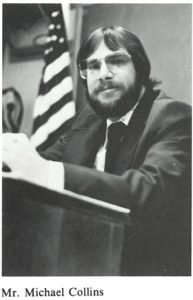
D. Michael Collins as a teacher at St. Francis de Sales High School in 1977. Photo Courtesy St. Francis de Sales

Toledo Mayor D. Michael Collins assigned a lot of group work when he taught at the University of Toledo, former student Amy Tracy recalls.

D. Michael Collins as a teacher at St. Francis de Sales High School in 1977. Photo Courtesy St. Francis de Sales

Although group work doesn’t tend to be particularly popular among college students, Tracy, now a director in corrections, said it helped prepare her for her future career in criminal justice.

“Everybody kind of hated it,” she said. “But I give him a lot of credit for preparing me for a job like this because I deal with several different courts, several different agencies. … When you think about it, it’s teamwork.”

Tracy said the things Collins taught have stayed with her long past the classroom. One thing he stressed was that those in the criminal justice system are people too, she said.

“How I treat people as a whole has a lot to do with him,” she said. “[The group projects] alone helped me to prepare to deal with people. He prepared me for crisis situations and how to keep my head clear.”

Robert Fitzgerald, another former UT student, agreed that Collins prepared students for their future careers, not just the final exam.

“He was very engaging and kept your interest,” said Fitzgerald, who works as a security guard at Davis-Besse Nuclear Power Station. “He wanted me to further my career in law enforcement and tried to guide me through certain aspects. … He wanted to make sure [students] stayed interested no matter what their major was.”

Collins would often share real-life stories, former student Heather Heiland recalled. “It made me relate more to what he was teaching,” she said.

Collins also used humor in the classroom. “He always had jokes; he always made me laugh,” she said.

Heiland had Collins for a juvenile justice class, which she went on to pursue as a career. She said he was easy to relate to and talk to and was one of her favorite teachers ever. “He took the time to talk to you,” she said.

Collins was a visiting assistant professor at UT from 1999 to 2011. He also worked as an adjunct instructor at Lourdes University from 2010-12.

“I really liked him,” said Dale Lanigan, chair of Lourdes’ Department of Sociology and Justice Studies. “He was always very straightforward, honest and loved to talk public policy. He didn’t just express his views. He always wanted to explain why he thought as he did, bringing up history and data to support his positions.”

Collins also taught at St. Francis de Sales High School from 1976-83 and 1984-86.

Tracy hopes people remember him for his passion for people.

“A big part of my success in the criminal justice system is because of him,” she said. “I will be forever thankful to him for that.”

Collins outworked campaign staff decades younger

0
D. Michael Collins campaigning during the 2013 mayoral race. Photo via Collins’ Twitter

During his time as media relations manager for D. Michael Collins’ 2009 and 2013 mayoral campaigns, Matt Zaleski once made the mistake of calling Collins a “former Marine.”

“One thing that Mike was very proud of was his service as a Marine,” Zaleski said. “He made the point to [tell me], ‘There is no such thing as a former Marine.’”

Last week, while visiting Collins in the hospital, Zaleski took his mentor by the hand and whispered in his ear: “Get well, Marine. You’ve got work to do.”

“It was a very emotional moment for me,” Zaleski said.

Zaleski met Collins in the 1970s, when Collins taught criminal justice at St. Francis de Sales High School, where Zaleski was a student.

Collins also previously taught at the University of Toledo and Lourdes University. As an educator, Collins would bring humor to the classroom.

“He actually did have a sense of humor and it came out in certain environments,” Zaleski said.

Zaleski said Collins taught his St. Francis students how to avoid being victims of crime, something Zaleski has carried with him for 40 years.

Zaleski looked to Collins as an inspiration throughout his adult life. The two met up to play racquetball and golf a few times and Collins even attended Zaleski’s wedding.

“He was a mentor and was looking out for me, I could tell,” Zaleski said. “Now I just hope he looks out for me from above.”

D. Michael Collins campaigning during the 2013 mayoral race. Photo via Collins’ Twitter

As a politician, Zaleski said Collins never stopped.

“He was always going,” Zaleski said. “He once told me, ‘I may not be the smartest guy in the room, but I’m going to be the hardest working in the room.’ That’s the way he was.”

Zaleski said Collins loved going door to door and talking to people.

“Mike was a guy who loved to get out and meet people,” Zaleski said. “He was 69 years old when he was running and he would outwork the 20-year-old volunteers.”

Zaleski said he last spoke to Collins on Jan. 29 and the two talked about whether or not he would run for mayor again. The two were making plans to work together in the future.

Zaleski said he hopes people remember Collins for his leadership.

“He had almost a watchdog mentality,” Zaleski said. “Don’t forget that this man spent 26 years as a police officer … kicking in doors and doing some of the most dangerous jobs.”

Wine and beer: Matt Snyder of Veritas Cork & Craft recommends his recent favorites.

0
Wines recommended by Matt Snyder of Veritas Cork & Craft are Angels & Cowboys 2012 Proprietary Red Blend, Venge Vineyards Silencieux Cabernet Sauvignon and Schweiger Vineyards 2008 Dedication. Photo courtesy Veritas Cork & Craft.

I am excited about being in an industry that every time the door swings open to the retail shop at Veritas, I have a customer that usually has a specific wine want or need.  I get to be one of the guys that help people find the most appropriate wine for whatever the occasion, which is a pretty awesome responsibility. 

We ask a few purposeful questions that will help guide our clients in the right direction to find the best bottle of “juice” that best pairs with the menu, celebration or just every day consumption.

Wine

This month I’m enjoying the Angels & Cowboys 2012 Proprietary Red Blend from Sonoma County.  This wine is an interseting blend of Zinfandel, Syrah, Petit Verdot, Sangiovese and Malbec.  Hints of cocoa dust combine with ripe berries and dark cherries to provide a rich mouthfeel wine with a warm, lingering finish.  On sale from $25 down to $20 a bottle.  This wine delivers big bang for the buck!

Also from California is the Venge Vineyards 2010 Silencieux Cabernet Sauvignon, Napa Valley.  Silencieux (see-lens-see-oh, Silent One) is anything but silent.  Some of the best Cabernet Sauvignon grapes from five different vineyards combine beautifully well to create a great bottle of wine that will continue to age well for the next decade, under proper cellaring conditions.  Upon initially opening, scents of blackberries, cassis, licorice and notes of coffee evolve into a full-bodied wine that possesses great length on the palate.  This is a great bottle of wine to enjoy with friends that share an appreciation for big, bold and rich California wines. Please do not worry, though — the 2012 vintage, also retailing for $50 a bottle, will not disappoint.

Last but certainly not least with only 690 cases produced, is the Schweiger Vineyards 2008 Dedication.  Composed of 58 percent Cabernet Sauvignon, 31 percent Merlot, 6 percent Malbec and 5 percent Cabernet Franc.  The winemaker notes suggest rich blackberry, currant, plum and loads of jammy cherry with faint seasonings of dark chocolate, truffle oil, coriandor, and minerals, I simply thought of liquid silkiness with great structure and finesse.  This is another example of a wine that can and will, age for 20+ years under proper cellar conditions.  Not my everyday, go-to style of wine but when you do want to splurge and invest $100 for a bottle of this magnificent juice, I am quite confidant you too will be inspired to greatness.

Beer

B. Nektar Meadery has a limited release of Apple Pi, an apple mead with spices added.  Enjoy a bottle of mead soon, made from fermented honey.  Nice baked apple flavors, spicy with honey, cinnamon and allspice.  Super delicious with a baked double cream brie.

I would like to invite each and everyone of you to come down to Veritas Cork & Craft and enjoy our Liquid Love Wine, Chocolate and Beer Tasting on Saturday, February 14 from 4-6 p.m. and taste, sample and purchase delicious artisan chocolates from Flying Rhino Coffee & Chocolates.  Come out and meet Gini Behrendt, owner/operator/chocolate maker extraordinaire and taste some of the best chocolates in the world! Cost is $15/person. Please call in advance for reservations at (419) 214-9463. 

Matt Snyder is the Beer and Wine Guy at Veritas Cork & Craft, 505 Jefferson Ave., Toledo.

Mahler: The confusing world of red blends

0

The hottest wine category right now, is the “Red Blend”. Unfortunately, “red blend” is not exactly a precise description of a wine. In fact, that could be said about more than 80% of all red wines out there. When pressed, many wine professionals even have a tough time drawing a line to say what is and what isn’t a “red blend”, so let’s dig a bit deeper into the issue.

Wines are often referred to by the varieties or varietals of the grapes in the bottle. Common names you’ll recognize-Cabernet Sauvignon, Merlot, Chardonnay, Pinot Noir, etc. In the new world, this is how we typically label our wines. In the old world, however, they label wines from their place of origin. The imported wines we are most accustomed to are from France and Italy, with some from Spain and Germany as well. Many, if not most of the red wines from these countries are blends. It’s easier to mention the exception rather than the rule. While Pinot Noir, Syrah and the wines from Piedmont are not blended (usually), almost everything else is or at least allowed to be.  Why the blending over there? Each additional grape brings something else to the wine.   This adds to complexity and the layering of flavors. Some of the most famous wines are built to be blends-Bordeaux, Chianti, Châteauneuf-du-Pâpe. Each of these blends is governed by tradition and years of refinement that define what can go into those blends.

In the U.S., there is no law about what needs to be blended with what. The laws that govern labelling refer to some parameters. For example, you can name a wine  by a variety name, like Cabernet Sauvignon as long as it has 75% of that grape in it-the 25% can whatever the winemakers wants it to be. Often, with Cabernet, they would blend it with Merlot and Cabernet Franc (among others). So, there you go, a red blend. Or is it? It’s labeled Cabernet, but it’s a blend of 3 grapes. For sheer categorization sake, let’s say that last wine listed is NOT a blend, but rather a Cabernet.  Not because of what’s in it technically, but because it’s style is built to be that of a Cabernet. Don’t forget,  blending often improves lesser grapes.  Now think about your average wine shop or wine list. They organize the wines on their shelves by categories. Cabernet, Chardonnay, French, etc, but there is a remainder, wines that don’t easily fit categories. So, a new category was created, “Red Blends”.

Confused? Yeah, you should be. I’ll break red blends down into 3 categories to make life a little easier. First, there are the old world referencing blends-these use the recipe of a blend of any place, but with grapes grown in the U.S. This would include Bordeaux Blends, Rhône Blends, Cal-Itals, etc. Next, you have a second category that might be referred to as “playful crimes against nature”. Taking these disparate varieties of disparate backgrounds and blend them together to see what you get. They’re great fun, unique and sometimes eye opening. Third, you have the Field Blend and it’s descendants. The field blend is a uniquely American thing. 150 years ago, when California was still brand new, many European, and specifically, Italian immigrants settled there. Many of these relocated Italians found themselves working for The Italian-Swiss Colony, a winery that employed immigrants for 10 years. After 10 years, they were given an opportunity to buy some land at a very reasonable price, and given root stock to start their own vineyards. Many of those grapes were Zinfandel and Petite Sirah.  Because this was so early in California wine history, there was no rule, so these immigrants planted everything in the same vineyard with no demarcating of the varieties. Think of a field of wildflowers. Now, 100+ years later, many of those vines are still around. And some of those vines have benefitted greatly from the age. Since the varieties haven’t been distinguished from each other, they would all be harvested and vinified to together, thus the “Field blend”. Stylistically, these wines are ripe and jammy, with blue and black fruit and relatively low alcohol.  They drink great upon release and are easy to enjoy without food.

That reference point, the old Italian field blends, is what is largely driving the “Red Blend” explosion of the last decade. Now, many producers are emulating the field blend with properly defined varieties and blending them in the cellar, rather than in the field, but the result is the same. So, if you find yourself loving the “Red Blend” category, it is most likely the “Field Blend” version. Look for Zinfandel or Petite Sirah based blends or even those grapes on their own.  And try something new. Always try something new.

Adam Mahler is the founder of Ampelography, a wine sales and marketing company based in Toledo (ampelographywines.com). He can be reached at adam@ampelography wines.com. You can tweet wine pairing or wine shopping questions to @ampelography

The Moxie mixes things up on Adams Street

0
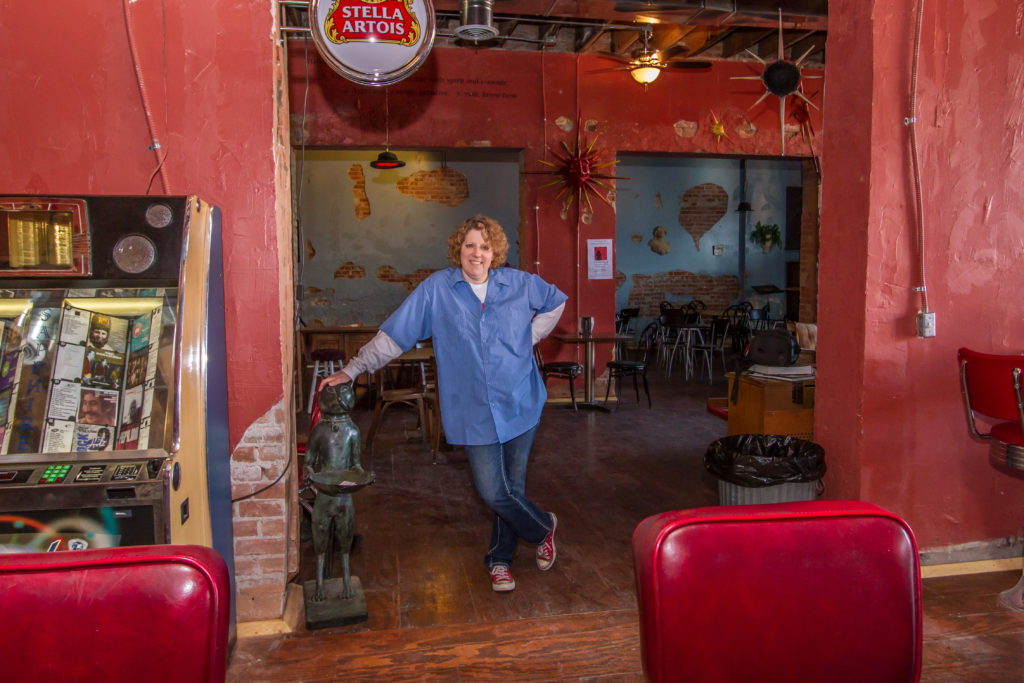
Aggie Alt is the owner of The Moxie, an art house pub at 1205 Adams St. The Moxie features a bar, dining space, art gallery and performance space for a variety of performing arts. Toledo Free Press photo by Christie Materni.
Aggie Alt is the owner of The Moxie, an art house pub at 1205 Adams St. The Moxie features a
bar, dining space, art gallery and performance space for a variety of performing arts.
TOLEDO FREE PRESS PHOTO BY CHRISTIE MATERNI

It’s not easy making art blend into its audience.

Just ask Aggie Alt.

She and her husband, Jamie DeKay, recently opened The Moxie Art House Pub at 1205 Adams St. The establishment is equal parts art gallery, performance space, restaurant and bar.

The Moxie, which opened in January, is 25 years in the making. Alt, a performance artist herself, wanted to open such a business back then, but fell ill, moved away and operated other businesses, including a pizzeria and dinner theater. Through the years, she never lost her vision for The Moxie, a venue for a wide range of artists to display their work, as well as a comfortable place to enjoy the arts with food and beverage.

“It’s definitely a niche,” she said during an interview in the middle room of the establishment, located in an 1852 building next to Wesley’s Bar and Grill. “We’re finding repeatedly what an odd duck we are. Because we’ve got really good food, but we’re not a restaurant. We have, obviously the bar, but I don’t necessarily want to be known as a bar. We are really an arts center that happens to have food and liquor.”

Art from local artists hang up on The Moxie’s walls, all for sale. In its first couple of weeks in business, the business has hosted live theater performances, poetry readings, a blues open mic session and a comedy night.

“I really want to use this as a place where artists can not only mingle and hone their art, but that they can get exposure, make some money and find a home,” Alt said. “And then I also want to kind of blur that line between audience and performer. I want people who love the arts to not be intimidated by it, to feel that they come in jeans and engage with the artist, whatever kind of art that is.”

Helping set the mood in The Moxie is its eclectic mix of furniture and décor: an old couch sits parallel to a vintage arcade-style bowling game Alt picked up at a garage sale. The game works perfectly and is available for patrons to use, free of charge. Her favorite piece is an old jukebox she purchased for $163 at an online auction. Among its album selections are Bob Seger’s “Live Bullet,” Bruce Springsteen’s “18 Tracks” and Tom Petty & the Heartbreakers’ “Greatest Hits.

“Other than some kitchen equipment, there’s nothing new in here,” she said proudly.

Alt, who has a background in nonprofit organizations, would eventually like to establish a program at The Moxie to teach art to inner-city children. Students from the nearby Toledo School for the Arts developed the establishment’s logo, and she hopes to be able to give back to the students by allowing them to show their work there.

“I think there’s a lot of talent out there who are 15-year-old kids,” she said. “How often do they get to perform somewhere? I think that’s important.”

Although The Moxie may not be your typical restaurant, that doesn’t mean its kitchen can’t hold its own in making the location a dining destination.

Chef Jeff Albright has concocted a small-but-diverse menu that leans heavily on creativity.

Starters ($4-$6) include “Bacon & Eggs” (deviled eggs topped with bacon jam); Caprese “kabobs” (fresh mozzarella, grape tomatoes and basil pesto); and buffalo chicken plate (dip with celery sticks, crackers and glacier penta crème blue cheese).

The Moxie “Picnic Board” ($10) is a choice of meats (smoked pancetta, duck salami, serrano ham and Borsellina Salami); cheeses (glacier penta crème blue, aged gouda, fresh mozzarella, prairie breeze cheddar, manchego and Parmigiano-Reggiano); and gherkins, olives, cucumbers, artisan bread or gluten-free crackers, along with mustard or fig jam.

Pizza ($11) varieties include a pesto, pacific rim, white and chef’s specialty.

“Jeff started out just giving me advice on food and then I made him stay,” said Alt. “He really took it to another level. The bacon jam made from scratch is to die for. He has a tomato soup that is vegan and gluten-free that is the best tomato soup you’ll ever have. … We’re actually getting people here where this is the destination for food, and that’s crazy.”

As for the kitchen hours?

“If we’re open, the kitchen’s open. I think that’s an important part,” Alt said, adding the midnight to 1 a.m. time slot is a popular time for patrons to order pies.

Although it’s been a long time coming, Alt is pleased with where The Moxie stands in its first month in operation.

“There are so many artists in this area that are so talented,” she said. “There are some outlets, but I think there are very few that mix medias, where an artist can work with a theater performance or a musician can warm up for a poetry [night]. I think that’s so important to have it be a hangout.”

When describing The Moxie’s appeal, Alt couldn’t come up with a better description than what an artist recently told her.

“She said, ‘This is the place that kids who used to put shows on in their backyard and grew up and still want to put shows on, can come here and still be that kid that puts shows on.’ That’s the concept,” Alt said.

Although the concept has been hers, Alt does not shy away from giving credit to her neighbors on Adams Street for helping her business get up and running.

“Adams Street has been so supportive,” she said. “Bar owners have given me advice, things and loaned me their staff. To me, that’s just mind-boggling. That’s what is going to make Adams Street work, because it’s just an amazing group of young, aggressive business owners.”

The Moxie is open from 11 a.m. to 1 a.m. Tuesday through Friday; 4 p.m. to 1 a.m. Saturday; and closed Sunday and Monday. For more information, call (419) 982-8810 or visit The Moxie’s Facebook page.

Beard: Comic book convention to land in Glass City this spring

0

Incredible as it may seem for such a geek haven, Toledo has never truly hosted a real comic book convention. That’s all about to change: the city that’s harbored comic shops for over twenty-five years and nurtured multiple writers and artists will welcome its very own comic show, Fantasticon, this April 11th and 12th at the Grand Plaza Hotel downtown.

“We’re very excited!” enthuses Joe Nieporte, owner and president of FunFest Productions, based in Sterling Heights, Michigan. “We have a lot of friends in the [Toledo] area, and the comic book shops in town are amazing. We believe that there is a huge fan base here that is dying for a show to call their own. So far we have had a tremendous response from the community. We believe that we have made the right decision bringing a show to Toledo.

“We have branded our show in the Detroit market for a few years now, [and] it’s considered a mid-size show that draws a few thousand people and is growing rapidly. We are proud of the fact that our show is very affordable to the fans, as well as artists and vendors. That being said, we want to bring this business model to other markets in the mid-west that do not have large established comic cons. Toledo was the first city we thought of. Toledo is the biggest city in the Midwest that does not have a comic con.”

Fantasticon Toledo promises celebrity guests on a national scale, dozens of local and regional creators, and collectible dealers from Chicago, Indiana, and Ohio who specialize in comics, action figures, and vintage toys and games. “Serious collectors will have a great opportunity to add something special to their collections,” notes Nieporte. “There will also be cosplay contests, and artist panels scheduled throughout each day.

“This show will be like going back in time twenty years before comic cons became corporate money grabs. It will be very affordable, fun, and fan friendly.”

Though Nieporte and his staff will be busy those two days insuring the show goes off without a hitch and all attendees have a good time, they’ll be looking forward to Fantasticon as fans themselves. “Watching all the people in costume is always enjoyable,” he says. “It will be even more gratifying to bring smiles to all the faces from the Toledo area while they are walking around having fun and enjoying the event we brought to town.”

Interested parties should check in regularly at www.fantasticon.net for updates on special guests and all other news before the show hits town in April.

Company grows bones at UT with grant funding

0
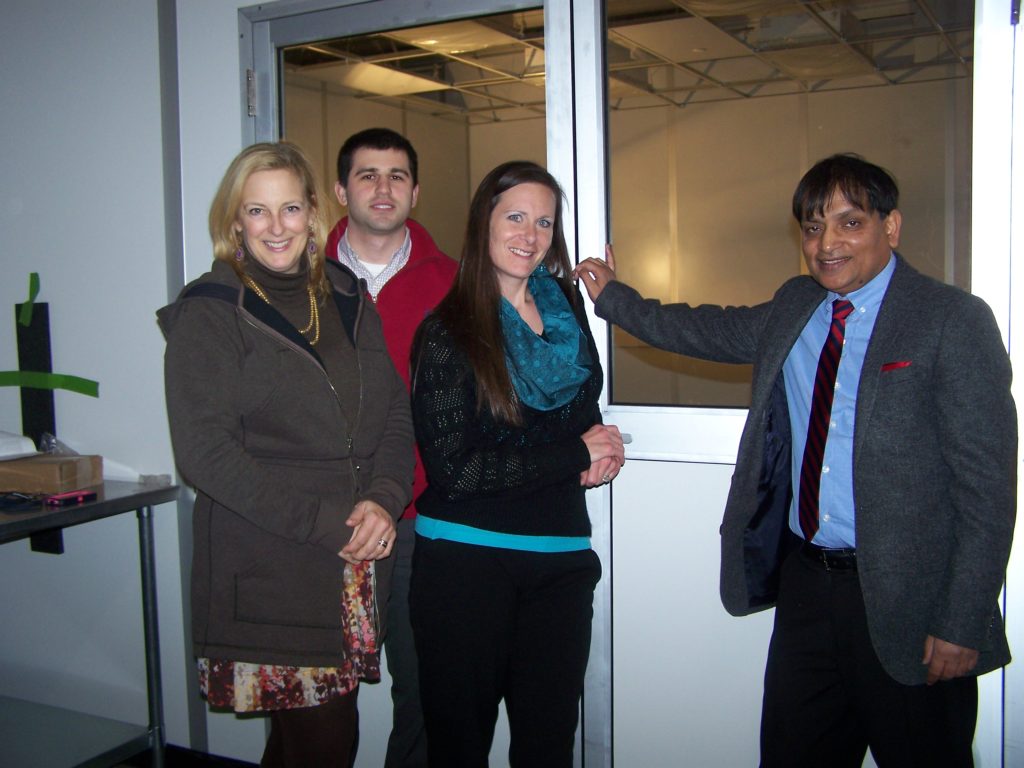
Anand Agarwal of OsteoNovus, Right shows the clean room under construction to Molly Reams Thompson, director of UT ’s LaunchPad Incubation, Christopher Mancino, manager, and Jessica Sattler, director of Economic Engagement and Business Development Programs at UT .

OsteoNovus, a startup company that is regenerating bones through a unique technology developed at the University of Toledo, is benefiting from two Technology Validation and Start-up Fund grants from the Ohio Third Frontier commission.

The commission awarded OsteoNovus $100,000 last October following an original grant of $250,000. The firm has raised a total of $1.5 million from Ohio Third Frontier partners such as UT’s Rocket Innovations and other investors, according to Anand Agarwal, co-founder, president and CEO.

OsteoNovus is an early-stage, orthopedic medical device company focused on the development of biologic materials to support and regenerate bone. The company employs innovative technology developed at UT by Agarwal and co-founders Sarit Bhaduri and Vijay Goel.

The company’s primary product, NovoGro, is a regeneration biomaterial that grows robust bones in just six weeks with excellent handling properties, Agarwal said.

The technology encompasses novel synthetic calcium phosphate-based cements suitable for several clinical applications, such as bone voids, and treatment of various fractures and spinal disorders. The firm has developed moldable bone putty for use as an injectable bone substitute, Agarwal said.

OsteoNovus is preparing to move into office and laboratory space as one of the newest tenants of the LaunchPad Incubation Program housed in the Nitschke Technology Commercialization Complex on UT’s campus.

Agarwal is also CEO and cofounder with Goel of Spinal Balance Inc., another LaunchPad tenant. Spinal Balance is an early-stage orthopedic medical device company focused on the development of complex spinal implants for the treatment of degenerative disease and deformity of the spine.

The State of Ohio has funded Spinal Balance with a one-to-one match for a total of $1.2 million in seed funding. The firm hopes to have Food and Drug Administration clearance by July, at which point they would enter the commercial market, Agarwal said.

UT’s LaunchPad now has 21 tenant clients in the incubation program and their facilities are 80 percent occupied. It has experienced 450 percent growth and marked two client graduations since fall 2014, according to Molly Reams Thompson, director of LaunchPad Incubation at UT.

LaunchPad works with early stage technology-based startups in the biomedical, alternative energy, advanced manufacturing and information technology fields. Thompson said they provide mentoring to clients along with access to funding and talent with additional help from other partners.

Another LaunchPad client, Grypshon Industries, has been operating out of co-working space for the past year but is about to sign a lease for incubator space at UT, according to its founder Tom Burden.

Burden launched Grypshon to manufacture and market safe, slipproof friction mats on which aircraft mechanics can stand or place tools. Burden saw the need for such a product while working as an F-16 weapons maintainer for the Ohio Air National Guard’s 180th Fighter Wing operating at Toledo Express Airport.

Burden used both his experience as an aircraft mechanic and his education as a mechanical engineering student at UT to develop the product. He said his current challenge is to find sources for manufacturing and distributing the mats. In addition, Company grows bones at UT with grant funding Toledo-themed T-shirts benefit Great Lakes protection agency Burden has developed a new type of scope for military weapons. With his scope, the green dot turns to red to alert the shooter of low ammunition. He is looking for sources to help him produce and market the scope.

Burden graduated from UT in December with a bachelor’s degree in mechanical engineering. He has also re-enlisted for another six years in the Ohio Air National Guard.

Burden won the student category in the Pitch & Pour business pitch competition at UT last year. He also was among the top 40 semifinalists in the International Business Model Competition at Brigham Young University in May.

Neighbors Against NEXUS now CORN

0

Opponents of a proposed pipeline’s route through eastern Fulton County are finding strength in numbers — and their local organizer is finding optimism in negotiating from that position of strength.

The company behind the proposed NEXUS natural gas transmission line took interest in the group’s proposal to route the line away from heavily populated areas in the county, said Liz Athaide-Victor, the Swancreek Township woman who first organized local opposition.

The group, which started in December as Neighbors Against NEXUS, is now calling itself the Northwest Ohio Chapter of the Coalition to Reroute NEXUS (CORN), she said. CORN is a grassroots group centered around Medina County, south of Cleveland, that has had some success getting NEXUS to change its proposed route.

Athaide-Victor said she learned of CORN when researching the NEXUS pipeline after she received a letter from Spectra Energy, the Texas company behind the NEXUS project. She said she attended a meeting of another group opposing the pipeline in Medina County, but later heard from Paul Gierosky, the organizer of CORN, and realized she and the Medina County property owner shared the goal of rerouting, not stopping, the pipeline.

“We started talking, and people started calling Paul, and we decided to work together all along the pipeline [route],” she said.

Athaide-Victor thinks the strategy might be working; at a recent meeting she noticed Spectra looking over a proposed re-route she presented in December at a Swancreek Township Board of Trustees meeting.

The renamed group still allies with other groups simply opposed to the pipeline, citing such concerns as safety of the pipeline itself, property rights, groundwater protection, preservation of natural areas and the fact that the pipeline won’t benefit residential and small business customers because it’s designed to carry gas in large volumes to an export hub. Permanent buildings can’t be built over a pipeline, nor can trees be planted. However, farming can take place.

Athaide-Victor said she’s more hopeful lately because of the apparent receptiveness of pipeline officials to her alternate route, as well as news that the pipeline “study corridor” will be routed away from Oak Openings Preserve.

NEXUS spokesman Arthur Diestel has said in previous public statements the route as proposed last year is merely a “study corridor,” which will be narrowed and “tweaked” as safety, land use and environmental factors are taken into account.

Though Athaide-Victor says she’s now “cautiously optimistic” that neighbors and NEXUS can work something out, not everyone in her group is willing to go that far.

Laura Cole, who hopes to start a residential farm for adults with autism on her Swancreek Township property that’s in the study corridor’s path, said she’s hesitant because of the way NEXUS representatives have behaved in the past.

Group members have said NEXUS representatives told them, incorrectly, their neighbors supported the pipeline, or threatened them with eminent domain seizure if right-of-way agreements couldn’t be negotiated. A letter from Terry Lodge, a Toledo lawyer representing five local advocacy groups, accused NEXUS of “bullying” and the Federal Energy Regulatory Commission, which makes the rules governing pipelines, of allowing it.

Leaders in Summit County in Northeast Ohio were the first to approve a countywide resolution against the pipeline going through their county. The Ohio Farmers Union recently approved the first statewide resolution against the pipeline.

In Medina County, several townships approved resolutions against the pipeline nearly identical to resolutions approved locally by Swancreek, Providence and Waterville townships.

The next public forum on the project is set for 5-7:30 p.m. Feb. 11 at Swanton High School, 601 N. Main St. Northwest Ohio CORN members plan informational pickets outside the forum. Another forum will take place 5-7:30 p.m. Feb. 12 at Central Park West, 3141 Central Park West Drive.

72 Degrees and Rising to kick off garden’s 50th anniversary events

0

For the past 50 years, the Toledo Botanical Gardens brought life and color into the community and now it’s getting ready to celebrate its golden anniversary with a slew of exciting exhibits.

The gardens that Toledoans know today got its start in 1964, when 20 acres of lush land was donated to the city by George Crosby. Now, that lot tripled into 60 acres of beautiful gardens located off Elmer Drive. The TBG is also housed in its downtown campus, which is home to The Robert Anderson Urban Agriculture Center and acts as the hub for the Toledo GROWs program.

The garden’s 50th Anniversary brings about plenty of events, new and old. Although each holds a different theme, all are geared towards community involvement.

“Engaging all generations headed our priorities. We want to give the community reasons to visit the Garden,” Gretchen DeBacker, 2015 Board President and Chairman of the 50th Anniversary Committee, said.

“[We want the community] to experience its natural beauty, to enjoy entertainment such as Jazz in the Garden, and to discover the joys of gardening through our annual spring and fall plant sales.”

TBG’s anniversary season kicks off on February 8 with its 72 Degrees and Rising event. Held inside the gardens’ greenhouse located off its Bancroft entrance, this family-friendly, tropical exhibit allows community members to escape the bitter cold temps and enjoy a cozy greenhouse experience. There will be plenty of information on the plants, along with children’s activities and refreshments for Botanical Garden members.

“Delightful hands-on activities and exotic refreshments will accompany this behind the scenes peak at where banana plants and other tropical species spend their winter months here at the Garden,” Karen Ranney Wolkins, Executive Director of TBG, said.

Celebrations continue with an event specifically geared towards millennials on May 30. The Garden After Dark ties together art, music and performance while focusing on light-related art exhibits.

“We are working with University of Toledo students to develop content for projection installations that will be placed throughout the Garden,” Nathan Mattimoe, TBG board member and Chairman of the After Dark committee, said.

“The Work Collective is going to set up ‘The Cube’ a large, interactive projection project that responds to movement.”

In addition, DJ Rob Sample is slated to provide musical entertainment, while Birds Eye Circus performs. Also, there will be delicious grub provided by local food trucks.

On the Saturday before Mother’s Day, May 9, ladies can enjoy Tea in the Garden. This multi-generational event is geared towards daughters, mothers and grandmothers.

Finally, the garden will display “dramatic, large-scale sunflower plantings” around the city of Toledo providing an “explosion of color” and beautiful scenery for community members throughout the 50th anniversary season.

“It wouldn’t be a garden celebration without flowers,” Matt Killam, TBG Marketing Director, said.

Traditional events will still take place at the gardens and feature an anniversary celebration twist. Those events include:
72 Degrees and Rising to kick off garden’s 50th anniversary events
*Seed Swap (Feb. 28)
*Spring Plant Sale (May 7-10)
*Crosby Festival of the Arts (June 26-28)
*Jazz in the Garden (Every Thursday beginning July 9 through Sept. 10)
*Arts in the Garden (Aug. 9)
*Harvest Market Dinner (Sept. 17)
*Heralding the Holidays (Dec. 4-6).