Imagine sitting in a humid courtroom in Guantanamo Bay, Cuba, 50 yards away from the alleged mastermind behind the Sept. 11 attacks. Evan Matheney experienced this firsthand and the “intense” encounter inspired him to create his own nonprofit, Dream Again Ohio, to help foster kids successfully transition to independence.
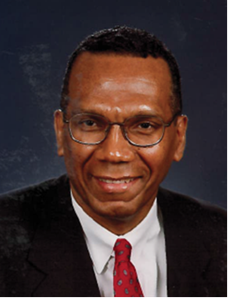
Evan Matheney. Toledo Free Press File Photo by Christie Materni
Before heading down to Cuba as an advocate for the University of Toledo during the 9/11 trials, Matheney was in law school with a focus in juvenile law. He was also a member of the Lucas County CASA (Court Appointed Special Advocate) program. As a CASA, Matheney advocated for abused and neglected children when they came into the court system.
Mom and dad have their attorneys, grandma and grandpa have their attorneys and the CASA is the only person in the room that’s a voice for just the child, Matheney explained.
“Looking Khalid Sheikh Mohammed in the face, I just had this realization that if they can do that much evil in the world with that type of passion, then assuredly the opposite has to be true,” Matheney said. “We can do that much good if we just have that type of passion for whatever we’re working toward.”
“That was my big catalyst,” he said. “I had to go home and do something about this problem. At the time I had a CASA case and I couldn’t imagine my CASA kid aging out of the foster care system and being homeless.”
Matheney’s experience with CASA instilled in him a passion for assisting children in need, especially those in the foster system. When he arrived home from Cuba, he left his studies and started Dream Again Ohio.
“I dropped out of law school to work on this nonprofit because it became so successful,” he said.
Dream Again Ohio helps foster youth find housing and subsidizes their rent. The youth who age out of the foster system receive assistance from the organization by agreeing to participate in its life skills programming. Essentially, this program teaches the young adults how to prepare for the responsibilities that come with living independently, Matheney said.
According to the Ohio Department of Job and Family Services, 20,000 young adults age out of the American foster system each year, with 1,000 of them living in Ohio. The statistics are daunting for those who age out of the system. Twenty-two percent become homeless within two years, 25 percent will become involved in crime and 50 percent of women experience early pregnancy.
“When kids age out of the foster care system, they’re either 18 or graduating high school, so it’s like, ‘Here’s your stuff, get out,’” Matheney said. “We’re their support system because they don’t have a family.”
However, Julie Malkin, public information officer for Lucas County Children Services (LCCS), the agency responsible for Lucas County youth in foster care, said the statistics are not representative of the situation in Lucas County. She said LCCS offers post-emancipation services to foster youth between the ages of 18 and 21 where caseworkers assist youth with obtaining housing, continuing their education and finding steady employment. Before emancipation, Lucas County teens are linked with independent living caseworkers who work with them on self-care, budgeting, cooking and other skills, she said. Youth are also encouraged to stay with their foster families past age 18 if they are enrolled in high school, college or a GED program.
Matheney urges the community to get involved. “If not you, then who? And if not now when?” he said.
For more information, visit facebook.com/dreamagainohio.
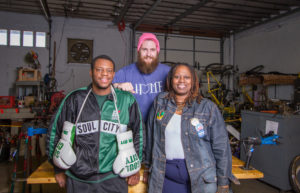
Audrey Johnson of Art Around Town, Maxwell Austin of Glass City Pedicabs and Roshawn Jones of Soul City Boxing and Wrestling. Toledo Free Press Photo by Christie Materni
Teneashia Cunningham keeps a bucket in her office.
It’s just an empty ice cream pail covered in paper marked “Toledo SOUP,” but it once held a donation of $734, enough to fund a basketball league at the Frederick Douglass Community Association that kept 120 young men off the streets on Friday and Saturday nights last summer.
Board member Brandy Fuller, far left, and interim director Teneashia Cunningham, far right, with some students at the Frederick Douglass Community Association. Toledo Soup helped the center fund a summer basketball league last year. Toledo Free Press Photo by Sarah Ottney
“It looks like a bucket to everyone else, but to us it’s a trophy,” said Cunningham, the community center’s interim director.
SOUP is an international movement of microgrant fundraising events held in more than 100 cities worldwide. Toledo SOUP started in 2012. Since then, six events have raised more than $7,000 for seven community initiatives ranging from art programs, urban farming, human trafficking rehabilitation and small business development.
At each event, several finalists present their projects while attendees eat and vote. The winning project receives all the funds raised during the night through admission, donations, raffles and bake sales.
When votes were tallied last June, Frederick Douglass, which is located on Indiana Avenue, had the most.
The Toledo SOUP bucket Interim Director Teneashia Cunningham keeps in her office at the Frederick Douglass Community Association. “It looks like a bucket to everyone else, but to us it’s a trophy,” she said. Toledo Free Press Photo by Sarah Ottney
“We were so over the moon,” said board member Brandy Fuller. “We have a number of gangs in this neighborhood, but basketball is a universal language. It brings people together.”
She recalled a time her son intervened when one boy pulled a gun on another. The boy with the gun knew her son from basketball and put his weapon down.
“That could have been a scary ending, but sports bridged it,” she said.
With the Toledo SOUP funds, Cunningham purchased team T-shirts, new nets, basketballs and a few team meals.
“It was awesome,” Cunningham said. “Our turnout was big and getting bigger. We had the structure, but we didn’t have the look of structure. We didn’t have jerseys or matching shirts.”
The players, mostly boys age 16-24, come from across the city, Cunningham said. Games start around 8 p.m. and can last until 2 a.m.
“We try to keep kids off the streets,” Cunningham said. “The whole purpose of it is to break those territorial lines. We have kids coming from the East Side, the North End. They see it as playing ball, we see it as breaking the lines.
“There’s a lot of gang violence during the summertime. I was trying to give them something to do. I knew I could get the draw with basketball.
“The older guys are helping the younger guys, building bridges and closing gaps a little bit. Some of them, once they start mentoring, they feel like they’ve done something and given back so there’s a lot of positivity.”
Besides youth sports, Frederick Douglass offers tutoring, GED classes, Alcoholics Anonymous meetings and more.
“We’re in trying times right now, but we are still here,” Cunningham said. “We are still viable to the community. We do still have a heartbeat. The doors are open and we are building.”
For more information, visit www.fdcatoledo.org.
Glass City Pedicabs
The first Toledo SOUP took place March 4, 2012. Maxwell Austin of Glass City Pedicabs won $1,047, of which he used $800 for insurance and the rest for spare parts.
Maxwell Austin of Glass City Pedicabs rides during the 2014 Old West End Festival parade. Toledo Free Press File Photo
“[That] doesn’t seem like a lot for some people, but for someone like me who has put every personal dime into this, it’s the difference between me operating or not,” Austin told Toledo Free Press at the time.
Three years later, Austin’s enthusiasm for Toledo SOUP has not flagged.
“I just can’t say enough nice things about it,” Austin said. “You can take every nice word in the dictionary and I’ll say them all.
“If it wasn’t for Toledo SOUP, I don’t know how long I would have continued to wait or struggle for that amount of money. Eventually it would have happened, but it jump-started my business quicker than it would have.”
In 2012, Austin had two pedicabs in his Ohio West End garage. Today, he has a fleet of six with plans to add two more. He has a rented space, advertisers, 20 contracted employees, a growing wedding business and gigs for out-of-state events like the Kentucky Derby and Indianapolis 500. Next up, he’s working to launch Atlantic Pedicab Fleet, a conglomerate of pedicab businesses from Detroit, Ann Arbor, Cleveland, Columbus, Boston and more, who travel to events together.
“We’ve grown and so has the city of Toledo,” Austin said. “Downtown has added way more restaurants and bars than were there in 2010 [when I started]. It’s really picked up. UpTown has grown too. That’s really nice to see.”
Austin said he’s excited about the future of Toledo and has no plans to leave his adopted hometown.
“I could go anywhere I want, but I love the people in Toledo,” Austin said. “You’ve got some naysayers that say, ‘Toledo sucks,’ but for the most part, man, there’s a huge group of diverse people trying to make a difference in Toledo, pushing for expansion and growth and new ideas. It’s a wonderful place.”
As a way to show his appreciation to Toledo SOUP, Austin now pays it forward by donating $100 to each new winner.
“When I put my idea out there to have pedicabs in Toledo, someone told me that was the dumbest idea they’d ever heard and it would never work,” Austin said. “I didn’t let that crush my dream. I went to Toledo SOUP and it exploded.”
For more information, visit www.glasscitypedicabs.com.
Art Around Town
The $858 Audrey Johnson took home from the second Toledo SOUP in September 2012, was used to take a group of eight Toledo youth to Chicago, most for the first time, to learn about Chinese culture.
Audrey Johnson of Art Around Town, Maxwell Austin of Glass City Pedicabs and Roshawn Jones of Soul City Boxing and Wrestling. Toledo Free Press Photo by Christie Materni
Johnson is the founder and director of the Jamil Lewis Multicultural Center for the Arts. Art Around Town is a program at the center offering creative and educational art activities for area youth.
The Chicago trip was part of a Hostelling International program called Cultural Kitchen. The kids stayed overnight at a hostel where they visited Chinatown, prepared a meal of Chinese dishes and gave a presentation to fellow travelers about Chinese culture.
Next up for Jamil Lewis is building a greenhouse and sculpture garden at a renovated mansion on Winthrop Street, slated for this fall, Johnson said.
Johnson is a vocal proponent of Toledo SOUP.
“I always tell as many people as I can about Toledo SOUP because I believe it’s one of the best organically developed, crowd-funded, locally driven processes,” Johnson said. “There’s no political connection and it’s always kept fresh with people who are guiding the process. It keeps it honest by allowing the community to decide where the funds should be used for that particular time.”
Even finalists who don’t win gain valuable feedback and awareness of their projects, Johnson said.
“That’s how beautiful the process is,” she said. “Beyond what you get from the main crowd-funding source, other people step up to the plate and say, ‘Hey, maybe I need to support that.’”
That happened during the September 2012 Toledo SOUP when local a doctor in the audience offered to help raise money for one of the finalists, a free clinic in need of new equipment.
That offer allowed Art Around Town to win Toledo SOUP instead.
“Because that happened, we ended up winning,” Johnson said. “It’s a beautiful thing.”
The Art of Hope
Only one Toledo SOUP event was held in 2013. The winner was The Art of Hope, a South Toledo-based program offering temporary housing, counseling and mentoring to women recovering from sex trafficking. The program has worked with about 40 women since 2013, said Genevieve Abalos, who started the program with Tina Robinson in a house owned by Vision Ministries, a South Toledo church.
The Art of Hope received $1,015 from Toledo SOUP, which it used to purchase exterior and interior paint for the house, which was then painted by volunteers.
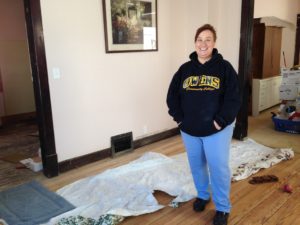
Tina Robinson of Butterflies 15, formerly of The Art of Hope. Toledo Free Press Photo by Sarah Ottney
“It meant everything to us. It was such a blessing,” Robinson said. “We had some donation money from the church but it wasn’t enough to take care of everything. When we got that, it was like a weight lifted off our shoulders.”
The Art of Hope will soon disband as Abalos is moving out of state. However, Robinson plans to continue work at the house. She’s starting a nonprofit called Butterflies 15, aiming to help women recover from drug and alcohol addiction.
“I’m a recovering addict myself,” Robinson said. “I want to give back to these women who are where I used to be.”
Butterflies 15 will use a five-stage, spiritually based recovery program developed by Robinson, who said she has been clean since 2004 and has gone back to school to become a social worker.
The five stages are Butterflies in the Sand, Butterflies in the Wind, Butterflies in the Sun and Butterflies in the Field followed by aftercare, Robinson said.
“Sand is you’re stuck. You want to get out of the rut you’re in, but you’re stuck,” Robinson said. “Wind is you have roots. You’re free from the sand and now you’re able to fly a little. Sun is a new dawning, a new beginning. You’re starting to change, you’re reaching out more, progressing more in your recovery. Field is you’re free, you’re finally free. You have all the tools you need to stay free. Then the next step is aftercare, where I will help them with housing, applications for jobs, resumes, all that.”
Right now, Robinson is searching for partnerships and working on house repairs, which lost heat after the furnace caught fire. The floors have been torn up; she plans to write Bible verses on the wood and shellac over them.
“I just started this at the beginning of this month,” she said. “It’s still a little baby. But this was set into me, God telling me what I need to do. So I’m doing it as he’s telling me to do it.”
Robinson said Abalos supports her change of focus.
“The Art of Hope was not really moving forward like we wanted it to. There were some major things we were not able to take care of,” Robinson said. “She has known my passion since the start.”
New Life Urban Agriculture
The first Toledo SOUP of 2014 came with another first — a tie.
Derek Bunch of New Life Urban Agriculture and the Glass City Goat Gals got an equal number of votes at the March 9 event and split the $2,168 pot.
Bunch’s plan was to use the funds to buy mushroom cultures, filtration units, lighting and other equipment needed to start local production of high-quality organic mushrooms in his Old West End home.
“For me it felt good that people believed in this plan I had,” Bunch said. “When you win, it’s a confirmation that something is a good idea.”
As it turned out, mushrooms didn’t work.
“In the first month, I had mold issues because the humidity has to be so high,” Bunch said. “I ended up reverting back to what I know, which is tomatoes, basil, peppers, carrots and strawberries. Mushrooms are still a part of it, but much smaller. But that Toledo SOUP grant gave me everything I needed to complete doing what I’m doing now.”
His goal is to sell his produce to local restaurants, food co-ops, food trucks and farmers markets.
Bunch first heard about Toledo SOUP the day after he had to shut down his former growing operation because he lost the space he was renting.
“I had to start over from zero,” Bunch said. “It was one of those things like, ‘What do I have to lose?’”
Glass City Goat Gals
Elizabeth Harris and Unique Jones of Glass City Goat Gals are an example of persistence paying off. Their project was a finalist at the inaugural Toledo SOUP, but didn’t win.
“It was disappointing, but made us see we needed to dig a little more, lay more groundwork, have a better business plan,” Harris said.
Two years later, they won.
“After losing, winning felt good. And it was also a confirmation that we’re on to something,” Harris said. “Once we won, it started a snowball effect of contacts and resources.”
The Gals haven’t yet spent their Toledo SOUP money — they’ve been waiting on city permits and approvals for construction — but still plan to use it for fencing for their 10 goats, hopefully by this spring, Harris said.
They are building their urban farm on Mentor Street in the central city. Both have degrees in urban agriculture and sustainability. They offer a 4-H Club and hands-on, STEM-based (science, technology, engineering, math) educational programs, which they bring to local community centers and soon to Moody Manor.
“We want the farm to be an educational resource for our community,” Harris said. “The children need to see the connection between nature and their lives.”
For more information, visit www.glasscitygoatgals.com.
Soul City Boxing and Wrestling
Soul City Boxing and Wrestling is the most recent Toledo SOUP winner.
Students study at Soul City Boxing and Wrestling on Junction Avenue. Photo Courtesy Roshawn Jones
After winning $1,278 in October, owner Roshawn Jones announced he would donate $100 each to the other two finalists.
“It was shocking and amazing,” Jones said. “People there were nice. It was so touching that I kind of wanted everybody to win.”
With the funds, Jones was able to purchase a laptop and three iPads for the Junction Avenue gym’s afterschool tutoring program. He also had two desktops and a laptop donated by people he met through Toledo SOUP.
Jones has about 55 kids who are regulars at Soul City, which just this week became a nonprofit.
“Their grades are monitored very closely,” Jones said. “Some of them have parents who don’t push them, so that’s what we do.”
For more information, visit soulcitygym.com.
The future
Paula Ross was among the original people who advocated bringing the SOUP model to Toledo. Her husband, Johnathon Ross, is the physician who offered to help fundraise for the free clinic.
“It’s just wonderful,” Ross said. “It’s unique for Toledo but it’s part of something that’s international. I think they are doing a terrific job.”
Ross would like to see SOUP expand regionally.
“There’s room for some regional projects,” Ross said. “Some communities have more than one group. Let’s face it, there’s a lot of need and I think people like to connect to worthy causes where they can make a difference with a small contribution. There’s just lots of room for creativity, I think.”
The next Toledo SOUP is set for 5 p.m. March 8 at Toledo School for the Arts, 333 14th St. For more information, visit toledosoup.com.
Not many places offer the chance to eat unlimited soup and salad while simultaneously supporting an organization that will benefit the community. Toledo SOUP offers just that opportunity.
The volunteer-led initiative raises money for community-minded organizations by providing a platform for them to “pitch” their ideas to a captive audience. Attendees — after paying $5 at the door — eat bread, soup and salad and vote for their favorite organization, with the winner taking home all the cash raised at the event. Additional funds are raised through donations, a raffle and bake sale.
“We have really come a long way in helping to grow support of these small community projects,” said Kelly Thompson, president of Toledo SOUP. “Some of them … they’re essential for their communities. Maybe not the entire city, but for the small community they’re in.”
Toledo SOUP, which began in 2012, hosts several sessions each year, with finalists selected by a panel of judges.
The next Toledo SOUP is 5 p.m. March 8 at Toledo School for the Arts, 333 14th St. This year’s presenters are: Silke Goudos of 419 Tales; Gretchen DeBacker of Sisters in Law; Dee Brown of Delightful Art With Dee’s Art With a Heart program; and Sandy Sieben of Toledo Youth Pages.
419 Tales is a bi-monthly podcast dedicated to collecting and archiving stories about life in Toledo.
Sisters in Law is a group of female attorneys who volunteer their time to provide legal advocacy and mentorship to young mothers at Mom’s House.
Delightful Art with Dee is a new nonprofit art gallery that provides local artists with a positive and encouraging venue in which to display and sell their work.
Toledo Youth Pages is a prevention tool for at-risk youth that provides information on health care, social services, criminal justice and rights and responsibilities.
On her gofundme.com site, Goudos wrote, “Our beloved metropolis is packed with flavor and history, which deserves a platform. I’d like to provide that platform by developing a podcast dedicated to revealing the characters, personalities, and gems of Toledo; an adventure in mining the depths of our fair city for the stories of its inhabitants. I hope to capture this through great interviewing techniques as well as competent, high-quality sound processing and editing. These recordings would be digitally archived. … Essentially, by using this podcast as a mirror of Toledo, I hope to further the burgeoning movement of pride in this place we call home.”
In her SOUP proposal, DeBacker, founder of Sisters in Law, said, “What all of the research tells us is that it is more likely than not that when a single woman has a baby, she will be in poverty for her and her child’s lifetime. Breaking the cycle of a lack of education, poor support systems, living conditions and minimum-wage employment is difficult. Mom’s House offers a model that works. It is a model that provides all of the necessary support for a young mom to stay in school and work, all while her child is being cared for and prepared to start school.”
When discussing the potential impact of SOUP funding, DeBacker said, “[It] is huge! We have already started this program without any funding. Mom’s House funding, as with any nonprofit, is always very tight. This money will allow us to get supplies, provide transportation and materials for our activities with the moms. All of the attorneys will still be 100 percent volunteer.”
In discussing her mission, Brown said, “The ability and opportunity to create your own art can bring a very deep fulfillment within one’s self. Art With A Heart will be providing the opportunity to create, to many who have none. We are raising funds to provide a great variety of free art classes such as drawing, painting, sculpture and found object art to those in life that have been left behind and often ignored.
“People such as veterans, the disadvantaged, disabled, and also the children and older adults living in homes they cannot call their own,” Brown said. “And our desire is also to help special learners such as the autistic, people with Parkinson’s just like my father, and even some that need help with translation such as the wonderful deaf community.”
Sieben, one of the coordinators for Toledo Youth Pages, said, “With SOUP’s support, the Toledo Youth Pages will be distributed to Toledo high schools, libraries, and community centers. … This is an incredible opportunity for us to collaborate with community members, share our skills and resources while learning from others in the community.”
Thompson said the simplicity of the SOUP model is an effective way to help improve the community.
“The impact of the kindness, the generosity, the donations of people really goes toward helping these projects get off the ground,” she said. “It’s just cash in their hand.”
Chefs from throughout the region are making soup for the event, while Country Grains Market in Sylvania is donating the bread. Chefs participating are Alex Sutphin of Ciao Bella Ristorante Italiano in Port Clinton, Pam Weirauch of Pam’s Corner in Toledo and Aaron Hensley, of Bier Stube’s House of Eats in Toledo.
About 150 people attended the last SOUP event in October, raising $1,278 for winner Soul City Boxing and Wrestling. Thompson expects about 200 people at the March 8 event.
“Each time we do this it gets a little bigger,” she said. “[SOUP] is something that’s an example for other people in the community. Come out, enjoy yourself, eat as much as you want, and watch people present these ideas. … You can’t get more grassroots than that.”
In case you haven’t seen the short films nominated for Oscars this year, the Sylvania Community Arts Commission (SCAC) has your back.
For the third year, the Tree City Film Fest will include a screening of every Oscar nominated short film from around the world on April 17. This includes live-action as well as animated short films, and it’s one of the few places in the area you can view these shorts on the big screen.
Jennifer Archer, executive director of SCAC, said it’s a big opportunity for film buffs to see films they may otherwise miss.
“For me, because I’ve got kids, most of the shorts I get to see throughout the year are animated shorts,” Archer said. “This is the one place I get to see them all.”
Tickets to the Oscar shorts are $8, which includes over three hours of entertainment.
This is just day one of the weekend-long festival, which will also include showings from the 50-hour film challenge on April 18 and original short films on April 19.
The 50-hour film challenge gives teams of local filmmakers the chance for local acclaim by creating original shorts. Each team is assigned a genre, prop, line of dialogue, character name, and shooting location to be used somewhere in the film. These shorts must be shot and submitted between March 20-22.
The deadline for entering the 50-hour film challenge is March 1, and cost is $45 per team.
On April 19, selections from Shorties Film Challenge will be screened and a winner will be announced.
The Shorties Film Challenge invites 3-5 minute short film entries from teams of children grades K-12. At the screening, children will be able to walk the red carpet with their families before seeing their masterpieces on the big screen.
Leading in to the Shorties Film Challenge is a four-week workshop called Shorties U, where 50 area kids are chosen to learn every aspect of filmmaking from local masters as well as industry professionals.
Hands-on projects during the workshop include screenwriting, filming and the editing process. Every kid will leave the program with a completed short film, and they’re encouraged to create a short in their own time to enter in the Shorties Film Challenge.
Although this year’s workshop is full, it’s never too early to think about applying for next year’s program, Archer said.
“We’ll have way more than 50 registrations, and part of our application process is asking, ‘Why does your kid want to be part of this?’” creator Jeremy Baumhower, a Toledo Free Press columnist, said.
Archer said the film festival helps locals experience the beauty of film, since Sylvania doesn’t have a movie theater.
To meet the challenge of not having a theater available, SCAC will convert the historical chamber in Sylvania into a screening house for the weekend.
“This engages everyone no matter what level they’re at, so if you want to try something new you can do it here,” Archer said.
Tickets to the Oscar shorts and release forms for contest participants are available at www.sylvaniaarts.org.
Feb. 14 was Save the Beat and I am still blown away by the love and support of this community. With unpredicted and perfectly timed terrible weather — over 200 people came out and are now versed in saving a life.
.
Save the Beat was a success, although it’s origin was created out selfishness.
After learning of Toledo Mayor D. Michael Collins’ health condition Feb. 1, I was sad. Really sad. I was sad for the city I was born in and for the family of a great man. By Feb. 3, I needed to change my attention and look for something positive to focus on. While some of you applauded the effort behind the planning, it was my way of dealing with a sudden loss.
The only bright thing coming from that Sunday’s darkness, was the story of the good Samaritans, Andra Crisp and Evelyn Johnson.
Toledo Fire & Rescue Department’s Nikki Zmijewski, a CPR trainer, and her co-workers always wanted to do a major event where hundreds of people would learn how to save a life at once. With her enthusiasm, and the full support of the City of Toledo, Save the Beat was born.
The name, Save the Beat, is an homage to Collins’ years with the Toledo Police Department and as president of the Toledo Police Patrolman’s Association.
Timing was important; picking the right day was crucial. With Feb. 14 — on a Saturday, 10 days away — made for a perfect but ambitious date. But ambitious also means focused. Trying to put an event together, in such a short time, would allow my brain to think about something other than my friend, fighting for his life.
I fell in love with the thought of people learning how to “save a heart” on Valentine’s Day.
There is something beautiful about this city after an unexpected event. We come together, with our chests leading the way.
Every phone call I made, every request for support, financial or otherwise, was answered with a “Yes.” ProMedica and the people at SMG, who manage the Huntington Center and SeaGate Convention Centre, provided a home for this vision. UAW Local 2213 made sure we had everything else. The William Swade All State Agency made sure we had the proper insurance and Jupmode made sure our 100-plus volunteers had T-shirts. My friend Paul Spoerl of the Entertainment Network donated his time and equipment and provided the soundtrack for the day.
In just 10 days, Save the Beat was created, planned and executed.
There was another major reason why I wanted to throw this large CPR event. Save the Beat would create a slight media diversion that would give local TV, radio and print some content, while allowing space for the Collins family to be together. It took some of the focus off DMC’s health and put it toward CPR education and preparedness. It was a way to rally the city behind the heroes of the day, while allowing those crushed a few extra inches to breathe.
It gave Toledoans a course of action, to accompany our prayers.
Save the Beat’s media support was beyond amazing. Toledo Free Press made it their cover story in less than a day’s notice. iHeartMedia’s general manager, Kellie Holeman, in a two-minute phone call, vowed the full support of her radio stations and delivered. Toledo News Now, 13abc and NBC 24 all assigned reporters and introduced the event’s concept to their viewing audiences. The Blade’s Marlene Harris-Taylor made it a feature story.
Some much-needed space for the Collins’ clan was in fact given.
Zmijewski rallied the CPR training community. She made it a regional collaboration, with trainers and dummies coming from as far as Ann Arbor. In total we had over 100 CPR trainers and 120 mannequins, but it was the volunteers’ excitement and passion that made for a celebratory day.
This event would have never happened if not for the support of Toledo City Councilwoman Lindsay Webb. She made sure all the proper city departments were aware of what was happening, including our new mayor.
Mayor Paula Hicks-Hudson surprised us by making an appearance. She wanted to see and feel the love that was filling the SeaGate Centre. Her energy was upbeat, and inspired; it matched those around her. Hicks-Hudson addressed the crowd: “Let’s make sure that we do everything that we can, be helpful toward one another, extend ourselves to one another… so that we can make this a compassionate community.”
Of all the scenarios we thought of and prepared for, bad weather wasn’t ever discussed. But a little after 10 a.m., Mother Nature reminded us where we live. A snowstorm popped up, creating white-out conditions around the time our morning session was ending. Our second session was scheduled to begin at 11. It was devastating. I knew it would prevent people from coming and it did.
But the weather didn’t stop two very special visitors.
On Feb. 12, the day of their dad’s funeral, Mike’s daughters un-expectantly messaged me on Facebook. They told me the Collins family was aware of Save the Beat and planned on coming. I knew if they came, the impact on every person in attendance would be permanent.
We had 54 brave people brave the elements to make our second session, and two of them were the daughters of D. Michael Collins. They were there to support the cause, express their gratefulness to everyone in the room, including Crisp and Johnson.
I presented Mike’s daughters with TOL DMC shirts, letters from the Navarre Elementary student body and staff and an opportunity to speak. They had not spoken publicly since their father’s passing, and when they did, there wasn’t a wasted word.
With Laurie Collins-Mulligan by her side, Kelly Collins-Sheridan spoke: “On behalf of my family, we’d like to say thank you to each and every one of you, for coming out today, on Valentine’s Day, in the snow, to learn how to save a life. … We are truly appreciative of all of you, for the compassion that you have shown our family, for your prayers and for the way you’ve reached out. We know by being here that Toledo truly cares and it’s comforting.”
When they walked offstage, Laurie asked us if one of the CPR trainers could give her husband and her, a refresher course. We did.
Kelly Collins-Sheridan was already certified.
I think Mike Collins was testing our resolve and had a hand in that unpredicted snow. He wanted to see which Toledoans would show up and learn CPR, even in white-out conditions. I’m sure he had the biggest grin in Heaven, as he watched his daughter Laurie, and 50 others, learn how to save a life.
Another test from above, and another pass.
It seems “The Professor’ wanted to give his city, a final exam.
Jeremy Baumhower can be reached at [email protected] or on Twitter at @jeremytheproduc.
Ohio State University professor Kenneth Goings can trace back to the origins of Toledo’s NAACP branch to explain how it has lasted here for 100 years.
February marks the 100th anniversary of the NAACP in Toledo and Dr. Goings will speak Feb. 21 Downtown at the Toledo-Lucas County Main Library to mark the occasion.
Most people thought the National Association for the Advancement of Colored People would fail, Goings said during a telephone interview Feb. 17. The national organization was founded in 1909 and the Toledo branch in 1915. In the beginning, the organization had few successes and many critics, said Goings, an expert on NAACP history in Ohio.
“[Black nationalist] Marcus Garvey heavily criticized the NAACP for working with white people,” Goings said. “Other African-Americans also criticized the NAACP. The labor organizers felt that the NAACP was focused more on race and not on class.”
Even the prominent African-American leader Booker T. Washington felt the NAACP was a group of radical “rabble-rousers” that would cause more harm than good in race relations.
The criticisms and lack of any real success continued until 1930, when Judge John J. Parker was nominated to the U.S. Supreme Court.
“Judge Parker had made some racist statements and the NAACP couldn’t tolerate someone like that on the Supreme Court,” Goings said. “They started a campaign to ensure Parker was not confirmed. They were ultimately successful. They reorganized their branches.
The Toledo branch took on this campaign. When Parker was defeated, it was one of the greatest achievements for African-Americans because they had been disenfranchised, Jim-Crowed, and here they were able to pull themselves together and defeat Parker.”
Defeating Parker brought prestige and honor to the African-American community and people started joining the NAACP. Their membership dues provided a financial infusion that ensured the Toledo branch of the NAACP would continue, Goings said.
Goings wrote a book, published in 1990, called “The NAACP Comes of Age’: The Defeat of Judge John J. Parker,” that details the beginnings of how the NAACP was born and became the powerful organization that it is today.
Blocking Parker’s nomination was not the end of the fight. The NAACP went on to target and block the election of Ohio senators who supported Parker. They were able to flip Toledo, Akron, Canton and Columbus from Republican-held cities to Democratic, Goings said.
“It gave [African-Americans] a real sense of accomplishment and motivation, and after 1930 the national and Toledo branch became much more active and started working on improving their lot,” he said.
The NAACP was founded to enforce the 14th and 15th Amendments to the Constitution. The 14th Amendment “granted equal protection of the laws” and deals with citizenship; the 15th Amendment prohibits the government from denying a citizen the right to vote based on the citizen’s “race, color or previous condition of servitude.”
The NAACP takes a legal approach to civil rights, Goings said, with the goal of influencing legislature. During the civil rights movement in the 1960s, the organization did not participate in sit-ins, marches or bus boycotts, and many African-Americans considered them “Uncle Toms.”
“Their whole approach is to do things through the courts, to change the laws,” Goings said.
Other black groups that were active during the civil rights movement are not active today, he said, such as Congress of Racial Equality, Student Nonviolent Coordinating Committee and the Black Panther Party.
“Where are they now?” Goings asked. “But the NAACP remains strong and it’s celebrating its 100th birthday.”
Goings believes today’s NAACP is not attracting enough young people, because they want action, like demonstrations and marches, such as those spawned from the shooting death of Michael Brown in Ferguson, Missouri. But that’s not the NAACP style, he said. Instead, the NAACP goes to court and enforces voting rights and fair procedures.
Goings will speak 2-3:30 p.m. Feb. 21 on the accomplishments and leadership of the Toledo NAACP chapter over the past 100 years at the Main Library’s McMaster Center, 325 N. Michigan St. A Q-and-A session will follow. Light refreshments will be served.
The event is sponsored by the Library Legacy Foundation.
Ben Bussell, Josh “The Reverend” Peyton and Breezy Peyton of The Rev. Peyton’s Big Damn Band. Photo courtesy Conqueroo.
Hop aboard! The Reverend Peyton’s Big Damn Band extends an invitation on the opening track of its new disc:
“Let’s go everywhere, let’s do everything/ Let’s raise a sail, let’s jump a train,” Peyton encourages over electrifying guitar playing that sounds like a runaway locomotive rocketing down the line.
Ben Bussell, Josh “The Reverend” Peyton and Breezy Peyton of The Rev. Peyton’s Big Damn Band. Photo courtesy Conqueroo.
“Because it’s just one guitar, it makes it seem that much more kind of insane and off the rails because the way the song is — it’s about adventure, it’s supposed to be exciting. I wanted it to feel like a train that was literally about to come off the tracks,” Peyton said of “Let’s Jump a Train.”
Expect an explosion of sound on the trio’s fifth disc, “So Delicious!” Peyton is the engineer, his fingerpicking six-string assault driving the raucous old-timey music.
“The beginning of American music is the country-blues,” the singer-songwriter said. “And the people that played that music at the very beginning, they played finger-style guitar, where they’re playing the bass with their thumb as they’re playing the melody with their fingers.
“When I first heard someone do that, it just absolutely blew my mind as a kid. I thought it was the most amazing thing I’d ever heard, and I became obsessed with it — and still am.”
Fueled by that fascination, Peyton and his band — wife and washboard player Breezy Peyton and drummer Ben Bussell — are spreading their punkified country-blues gospel.
“I think the best way to keep music genres that have a heritage alive is just make good music,” he said during a call from his home in Brown County, Indiana. “That’s the hope that we can take this stuff and bring it out of the museums and into people’s lives and do so by making music that matters now and that feels good to people.”
Fans are listening. “The Whole Fam Damnily” entered the Billboard Blues Album chart at No. 4 in 2008. “The Wages” with the hit “Clap Your Hands” came in at No. 2 in 2010 as did 2012’s “Between the Ditches.”
“Music is like a religious experience for me. I’m so relentless and obsessed with it, passionate about it, that it’s hard for me to even describe it,” Peyton said. “I’m like a little kid about it. And I kind of feel like that’s the way to approach music. I think it’s almost better to be like a little kid about it.
“Little kids, they don’t think about it too much; they sort of just feel music. Little kids aren’t afraid to dance, and they’re not afraid to sing along, and they’re not afraid to clap along. They don’t care about what other people think. There’s no guilty pleasures for little kids; they like what they like.”
The Reverend Peyton’s Big Damn Band will play at 7 p.m. March 1 at Frankie’s Inner City, 138 Main St. Andrew Ellis and the Ben Stalets Band will open. Tickets are $12 in advance and $15 at the door.
Of all the obstacles to economic growth, uncertainty is undoubtedly the most hindering. Uncertainty about policy, prices, armed conflict, even weather — the more uncertainty that exists in an economic system, the worse it is for growth.
.
When uncertainty is prevalent, business leaders can’t make decisions based on reliable forecasts. In some instances they can’t depend on consistent government policy (as is the case today); other times they can’t know whether they have dependable sources of natural resources. All of these things dictate the framework within which businesses and their leaders must operate, and a shaky framework prevents leaders from having the confidence they need to grow.
Consider Obamacare as one example. Like the concept or not, the Affordable Care Act has probably been the single worst-handled piece of American legislation in the past half-century. It has also been one of the most far-reaching, directly impacting more than 15 percent of the U.S. economy along with every major employer.
Democratic-led health care reform (post-Bill Clinton presidency) was first floated as a concept during the 2008 primaries, but business leaders were unsure whether it would be pursued. They were also unsure whether Barack Obama’s plan or Hillary Clinton’s would be the one on the table.
After the 2008 presidential election, business leaders had to wonder if Obama’s plan would be passed. After passage, there were doubts as to whether the Supreme Court would uphold the new law.
These steps have introduced another layer of uncertainty that has impacted business leaders’ thinking. Many have been frozen with indecision about whether to expand, to hire or fire, since no one knows what another employee might cost six months after hiring.
And now, after all the uncertainty is finally subsiding, Congress is generating a new debate on whether to repeal Obamacare entirely.
Business leaders aren’t the only ones impacted. Individuals also have greater trouble making decisions. For instance, people can’t necessarily depend on a job to remain available indefinitely, or even know if a company will survive a future downturn as the result of changing circumstances.
Traders and investors are similarly paralyzed because they’re left clueless as to what demand will look like in six months. It’s totally unknown what commodity prices will be, let alone what the geopolitical landscape will look like.
Along with uncertainty, leverage and illiquidity comprise the three biggest threats for any developed economy. Today in the U.S., there’s far too much leverage and far too little liquidity. Margin debt is at the highest levels on record while at the same time market liquidity is extremely low because (1) most investors, thinking the market is going to continue higher indefinitely, are fully invested and (2) most major banks have backed out of trading, making it less likely they’ll prop up the market in another downturn.
The end result is that, should market sentiment change quickly, financial markets are going to suffer major moves lower. When increased levels of uncertainty, leverage and illiquidity exist all at the same time, there’s no such thing as small moves down.
Dock David Treece is a partner with Treece Investment Advisory Corp (www.TreeceInvestments.com) and is licensed with FINRA through Treece Financial Services Corp. He provides expert content to numerous media outlets. The above information is the express opinion of Dock David Treece and should not be construed as investment advice or used without outside verification.
Volunteer Jacob Merkle, right, helps Pamela Redd prepare her taxes at the United Way of Greater Toledo. Toledo Free Press photo by Christie Materni
United Way of Greater Toledo is bringing free tax preparation to low- and moderate-income residents in Lucas, Wood and Ottawa counties.
At 15 sites throughout the counties, tax preparers help individuals and families prepare their state and federal returns for free through the Free Tax Preparation Program.
Volunteer Jacob Merkle, right, helps Pamela Redd prepare her taxes at the United Way of Greater Toledo. Toledo Free Press photo by Christie Materni
The average taxpayer spends $200 on tax preparation services each year, according to IRS estimates. In 2014, 84 volunteers assisted 3,487 residents, saving an estimated $670,000 in tax preparation fees. The program brought back more than $4.5 million in tax returns to Lucas, Wood and Ottawa county residents between January and April 2014, according to the United Way.
The United Way has been involved in the program for the past nine years, said program director Toni Shoola.
If you make less than $53,000 annually, you may qualify for the program. Tax preparers use what’s called a “scope guide,” which is provided by the IRS and sets eligibility requirements and limitations. A tax preparer will be able to determine your eligibility.
Jacob Merkle, a volunteer intern, said he and his fellow volunteers have been busy, even referring people who couldn’t get an appointment to a free website, www.myfreetaxes.com.
“I really like helping people,” Merkle said at the Downtown United Way offices on Jackson Street.
So far, tax preparers have handled more than 1,700 applications and more people are calling every day.
“We’re opening up appointments as soon as we can assist people,” Shoola said. “We have a huge demand. Every volunteer we get serves 40 more people. We’re always looking for more.”
The program has enlisted 70 volunteers for this year’s tax season and had 84 last year. United Way is still looking to enlist more, so for those interested should contact Toni Shoola at (419) 254-4689 or email
Brad Spelman and Emily Fischbach are site coordinators and tax preparers who set up sites in order to help residents on their returns. They are both students at the University of Toledo, majoring in accounting. Their volunteer time is an internship for them both.
“It helps me in my classes,”
Fischbach said. “It’s different than doing taxes behind a desk.”
To make an appointment or locate a site, dial 211 or 800-650-HELP (4357). For more information, go to www.unitedwaytoledo.org/taxprep.
As another alternative for the tax season, United Way of Greater Toledo is offering free classes to teach people how to prepare their taxes. An IRS-certified volunteer will teach the basics and answer questions to help residents complete returns.
The three-hour classes will run through April at the Locke, Mott and Sanger branch libraries.
For more information on times and dates, contact United Way.
Another option for free tax preparation is The Ohio Benefit Bank (OBB). The online system offers self-serve tax preparation as well as the option to sit down with a tax counselor.
The “expert system makes accurate calculations and asks the right questions to find the most income deductions and tax credits for you,” according to its website.
OBB is available to individuals with adjusted gross incomes of less than $65,000, or married couples with an adjusted gross income of $95,000 or less. Some tax forms and some situations, such as business owners, may not be able to be served by OBB.
To make an appointment or find out if you are eligible, call (800) 648-1176 or visit ohiobenefits.org.
Dirk Manning has published titles such as “Nightmare
World” and “The Tales of Mr. Rhee.” Photo courtesy Dirk Manning.
It’s a good thing that horror/comic book writer Dirk Manning is a master of the unexpected. He’s faced a good deal of it in the past few weeks — but all of it has been of the decidedly joyful variety.
Dirk Manning has published titles such as “Nightmare World” and “The Tales of Mr. Rhee.” Photo courtesy Dirk Manning.
It was just two weeks ago when Manning launched his latest effort on Kickstarter, a fundraiser to create a second graphic novel of his popular comic series “The Tales of Mr. Rhee,” published through Devil’s Due Entertainment.
“‘Tales of Mr. Rhee’ is a series about a paranormal troubleshooter,” Manning said in an interview with Toledo Free Press. “He lives in a world after the armageddon/rapture has happened, and society has rebuilt. Everything is seemingly back to normal. But Mr. Rhee is a character who knows there are still monsters left. Society chooses to kind of ignore that fact … or chooses not to believe that. Until something comes up, and then you need a guy like Mr. Rhee to come in and kind of clean up the mess.”
Manning has made a name for himself with these kinds of macabre tales for years now, whether it be his wildly popular anthology horror series “Nightmare World,” his stint writing the origin of the flying monkeys in the comic series “Legends of Oz: Wicked West,” his horror/romance compilation “Love Stories to Die For” and much more. He sees Rhee’s adventures, especially this second volume, subtitled “Karmageddon,” as something that draws from his experiences with all his work.
“With ‘Tales of Mr. Rhee,’ I guess we have a combination of everything I’ve done so far. We have the very strong world-building of ‘Nightmare World,’ combined with long-form character development, as it relates to Mr. Rhee.
“‘Karmageddon’ is actually a sequel and a prequel to the first volume. ‘Karmageddon’ does start with a look at where Mr. Rhee is now, after the cliffhanger ending of Vol. 1. We do touch on, OK, how do we get out of that mess? But then the rest of the story is largely about what Mr. Rhee did during the three days of the armageddon. So the main story is actually a prequel story.”
But creating a deluxe, special edition of a work can be expensive, even for an author with a loyal fan base. So about a year ago, Manning turned to Kickstarter in an effort to produce a hardcover collection of the first volume of “Rhee,” a campaign that succeeded with room to spare.
“One of the things I wanted to do is offer readers … a chance to have a deluxe edition of the book, and get some really cool extras on the side. And Kickstarter allows you to do that,” Manning said.
That philosophy has carried over into this most recent fundraiser, as Manning aimed to bring readers a special hardcover edition of “Karmageddon,” while still producing a paperback edition to be sold in comic shops. In addition, though, fans who invested a little more could get some unusual gifts.
“And that’s the thing that’s really cool to be able to do for people who are really into the series, to get this cool, exclusive edition of the book, with all these exclusive extras.
“We also did something with this edition of the campaign we didn’t do last time. People can actually buy their way into Vol. 3 as a main character for a full issue, they can be killed in one of the issues or have a cameo role. And that’s the highest honor, for a horror fan that’s the highest honor, to be killed in a book.”
The end result has been more successful than Manning could have ever dreamed, thanks to fans who have congregated on a Facebook group called “The F(r)iends of Dirk Manning Support Group” and elsewhere. “Between that and then just assembling a good, old-fashioned mailing list — I go to all these shows, I get myself a binder, a tablet or whatever, they can just write in their email — and I started my mailing list right before the campaign started, a couple thousand people, and this very dedicated group on Facebook.
“And what happened is, when we launched the campaign, it’s just nuts, man,” he said. “We had a goal of $6,666. We surpassed that goal in under eight hours, which is wild, man. I’m just blown away.”
Manning’s F(r)iends were not done, either. After another push to garner donations before Feb. 13 — Friday the 13th, naturally — the total donated stands at well over $13,000, with two weeks left.
Manning is not slowing down in the weeks to come, either. He has tons of appearances at conventions booked in the coming days, from Great Lakes Comic-Con in Warren, Michigan, on Feb. 28 to Animarathon XIII at Bowling Green State University on March 21. He also has signed a deal for a second volume of his guide to writers, “Write or Wrong.”
But for longtime fans of Manning’s work, the most exciting news may be the culmination and climax of one of his most popular works — one which he teases as only a master of suspense can.
“There’s this other franchise book I have, that has three volumes out there, and people have been begging for a fourth and final volume for a while,” Manning said. “And if this Kickstarter continues to do as well as it is, I see no reason why we can’t, at long last, bring it home.”
For more information on the “Tales of Mr. Rhee” fundraiser, visit the Kickstarter page at: http://kck.st/1BrrLq9.