thoroughly enjoyed “Birdman.” It is a rare treat to find a film that so deftly swoops between the disparate tones of comedy, tragedy, surrealism and slapstick. I found the ending a bit of a letdown, as I felt there were a few loose ends both thematically and on a character level that the film didn’t even try to tie up. But on the whole, I found “Birdman” an excellent moviegoing experience.
.
I say this to establish that what I’m about to write doesn’t come from a place of bias against the movie because it won the Academy Award for Best Picture, or that I would have preferred any of the other candidates. “Birdman” is a wonderful film, very worthy of the honor. But its victory seems to solidify a somewhat disturbing trend — an indication that, in its attempts to honor the best of its art form, Hollywood is in danger of disappearing (even further) up its own backside.
The fact is that of the last four films that have won Best Picture — a prize meant to signify a movie that represents the pinnacle of achievement in show business — three of them have centered around one particular subject: show business itself. And I would argue that the trend goes back even further than that, leading an interested observer to deduce that Hollywood’s voters are a little too keen on rewarding work that they, and perhaps few others outside of moviemaking, can relate to.
Start with “Birdman.” A sly meta-satire of both Hollywood and Broadway, with a few dollops of pathos and self-doubt mixed in. The characters are all show business archetypes: the down-on-his-luck veteran actor, the egotistical method performer, the paranoid agent, the neglected daughter. These are all individuals that Hollywood types can easily relate to and see themselves in. Other nominees depicting historical figures, individuals struggling with their humanity or both didn’t have that natural in-road with the voters.
In 2014, Best Picture was awarded to “12 Years a Slave” — a harrowing and important film that interrupted the Tinseltown reverie. But in 2013, the winner was “Argo,” a film about a fake film set up by the CIA to rescue diplomats from Iran. Sure, the movie wasn’t focused on Hollywood, but show business certainly played a key role, with plenty of inside winks to moviemaking and film buffs added in.
In 2012, Best Picture went to “The Artist,” a nearly-silent movie depicting a famous actor who has hit the skids and is looking for a way back to stardom. Hmm, that sounds familiar. Hey, whaddya know, that sounds almost identical to the basic plot of “Birdman”! Now, sure, the two films could not be more different in terms of filmmaking style, tone and more, but the fact remains that once again the story Hollywood deemed the best of the year was largely focused on Hollywood itself.
So that’s three films in four years that featured a behind-the-scenes entertainment story Best Picture. And then we get to 2011’s winner, “The King’s Speech,” about British monarch George VI overcoming his stammer in an effort to become an effective leader. If you get right down to it, the story can be read as working to overcome fear of expectation, of not performing well, which isn’t too far removed from stage fright — something many actors can certainly identify with. (Coincidentally, actors make up the largest branch of the Academy’s voters. Go figure.)
Look, I’m not saying any of these films are bad — in my opinion, they’re all excellent. But when a long string of victors for filmmaking’s top prize share a common theme, it begins to indicate a sort of tunnel vision, no matter what that subject is. Imagine if four out of five Pulitzer Prize winners were war novels, or (much less likely) sci-fi thrillers. It would hint that the voting block may be naturally biased toward that subject matter, potentially to the exclusion of other kinds of stories.
The Oscars are supposed to spotlight great examples of filmmaking artistry, and encourage the audience to seek out great work. The filmmaking industry churns out an endless stream of vacuous garbage on a yearly basis, so working to bolster great, smaller pieces is always worth the effort.
But when those same awards seem focused on honoring a series of films that play better to a very select market — the same market doing the voting — one can’t help but wonder if Academy voters would be well served to widen their scope in the years to come.
Jeff McGinnis is Pop Culture Editor at Toledo Free Press. He can be reached at [email protected].
A Memorial Plaque from the former Libbey High School honoring students killed in World War II was salvaged when the school was demolished. Libbey Alumna Sue Terrill is looking for a place to display it. Photos courtesy Sue Terrill
Despite a valiant fight from alumni and supporters, the former Edward Drummond Libbey High School fell victim to the wrecking ball in 2012.
Since then, a woman who led the fight to save the South Toledo school has been searching for a home for a memorial plaque honoring students who died in World War II. It is one of the last remaining pieces of the public high school that held classes from 1923-2010.
.
Libbey High School, which was part of Toledo Public Schools (TPS), was named after the founder of the Toledo Museum of Art and Libbey Glass. The building was placed on the National Register of Historic Places, the only school in TPS with such an honor.
However, after a failed levy, TPS decided to shutter the school.
Sue Terrill, formerly of South Toledo, worked with a group of neighborhood residents with support from the late Toledo Mayor D. Michael Collins (then a Councilman) to save the building but their efforts proved fruitless.
On Jan. 9, 2012, demolition began on the building, whose chief architect was Edwin Gee.
From the wreckage, Terrill, a Libbey alumna, was able to personally save a number of items, including two memorials. One memorializing Robert Craig, a Medal of Honor recipient from Toledo, recently found a home at the Veterans Affairs Outpatient Clinic; the other was the Libbey High School World War II Memorial Tablet, which honors 106 Libbey graduates who died in the war.
Terrill believes the World War II memorial deserves a place close to its roots in South Toledo, but as of yet, no one has been willing to make room for it. Terrill said she has become increasingly frustrated with the lack of support for what she sees as an important piece of Libbey’s past.
“I want to find a place to put it in the community; I’m not saying it should be on the walls of city hall,” Terrill said. “[But] it deserves a place in South Toledo. That is our highest hope, to place it in South Toledo.”
A Memorial Plaque from the former Libbey High School honoring students killed in World War II was salvaged when the school was demolished. Libbey Alumna Sue Terrill is looking for a place to display it. Photos courtesy Sue Terrill
The memorial plaque still sits in storage at TPS, she said.
Information about TPS’ plans, if any, for the memorial was not immediately available.
Aside from the Craig memorial, Terrill said only the Harold Williams Memorial, also saved from Libbey, has found a home. Terrill still has an inventory of items she would like to place, she said.
As for the World War II plaque, Terrill said she contacted several institutions around the city, including One Government Center and the Toledo-Lucas County Main Library, but both declined.
“There were many places we tried,” she said.
Collins vowed on Memorial Day 2013 that he would put the plaque on the walls of City Hall, Terrill said, but they never discussed the issue again before his death.
“I never even brought it up with him the last year or so,” Terrill said. “There was never an appropriate time to talk about it.”
Terrill said she believes Collins would fully support finding a home for the plaque. He was one of the few government officials who spoke out against the demolition of Libbey and went to bat for the organizers who wanted to save the school, she said.
“Count me among the many who valued Mayor Mike Collins’ courage and support on important issues,” Terrill said.
However, she said, One Government Center is “not necessarily the best placement for it.”
A meeting to discuss placement of the plaque is set for 6 p.m. March 2 at the South Branch Library, 1736 Broadway St. Terrill said community members should come prepared for serious discussion.
When I was first diagnosed with ovarian cancer, I didn’t cry because I had cancer, I cried because I was right.
Something was wrong with my body and I knew it. It took almost seven months of very invasive testing and being poked and prodded in places I didn’t know I had, but I was right! Nobody knows my body better than I do.
It all started with daily walks. I would get a quick, fleeting pain in my hips and groin area. At first I ignored it but as weeks went on, the pain became sharper and lingered longer. I made an appointment with a pain specialist with whom I had a history.
This specialist treated me for back pain in the past as I’ve been hit five times in various car accidents. (Earning a living as a driver in some capacity isn’t meant to be. Sooner or later, you will be hit.) I spent about five minutes with the specialist in the exam room. He dismissed the pain and attributed it to my back pain. He asked very few general questions and ordered no testing or follow-up. I left there thinking, “He is wrong, there IS something wrong with me.” I went to a second pain specialist and he had the same opinion as the first specialist in his five-minute appointment.
There were times I thought, “Am I crazy, am I making this up, am I looking for a quick fix, is this all in my head?” The answer was no. This is real. Someone, somewhere has to believe me.
So it was on to pain specialist No. 3. He ordered an MRI and it came back normal. He ordered an EMG, it came back normal. I had a spinal procedure that made me sick for a week and it, too, came back normal. For the next few months I had a number of tests; they all came back normal. We were both beyond frustrated, but he was determined. He ordered a second MRI to see if anything had been missed. When it came back, there it was: a 17.5 cm (6.5-inch) tumor.
It was then I cried out of relief. I was right and it was real — I wasn’t making anything up. He told me to go to my family doctor ASAP and then to an oncologist.
My first visit to the oncologist offered a wealth of information. All I remembered was I was going to lose my hair and be very tired. Ha! They didn’t know who they were dealing with, I thought at the time. I am as stubborn as they come, determined to live my life as I always have. I do a massive amount of volunteer work and have a job. Cancer was just another obstacle to overcome.
Treatment was inpatient for two days, one week outpatient, one week off: a schedule to be repeated for the next five months. When I would go inpatient, I’d take my knitting, sewing or some project to work on. After my first treatment, I wasn’t tired at all.
“Chemo isn’t so tough,” I thought. But I was so wrong. Tiredness set in after the third treatment and it hit hard. I made numerous trips to the ER over the next few months for IVs of magnesium and potassium. It took great effort to stand or walk. Taking a “quick shower” turned into a hourlong step-by-step process. I would sit and rest on each of the landings to my third-floor apartment. When I entered my apartment, I would collapse on the couch without taking off my coat or shoes — that’s how tired I was.
After my last chemo treatment, it took about six months before I began to feel normal again. Some cancer patients vomit during treatment. I vomited for almost a solid month after my last treatment. For me, cancer wasn’t the hard part — it’s the neuropathy that remains and still hinders me.
I was honored when ProMedica Toledo Hospital asked me if they could use me as a case study for their conference in continuing education on ovarian cancer. I immediately said yes. If I can do or say anything to help educate, I am all for it. Which is why I am writing this column. Ovarian cancer is one of the hardest to detect. Some symptoms include hip and groin pain (the only symptom I experienced), bloating, back pain, constipation, changes in bowel movements and menstrual cycles and upset stomach. If you feel something isn’t right with your body, follow up until you get the answers you feel you need. Nobody knows you better than you do.
A big thank you to ProMedica Toledo Hospital’s oncology staff, Dr. Garth Phibbs and his head nurse at the time Sandy, and Priscilla Turner and Liz Woolaver at Restorative Concepts. Also, Milan Mihalek at the Victory Center is the best!
Diane Miscannon is a volunteer for the Toledo Police Museum, Keith Dressel Memorial Ride, Remembering Detective Keith Dressel, Marine Corps Kids and My Pink Scarf.
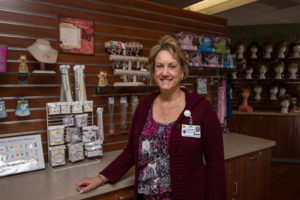
Cancer survivor Renee Schick is the manager of Renee’s survivor shop at UTMC’s Eleanor N. Dana Cancer Center. Toledo Free Press photo by Christie Materni
At 36, Renee Schick found a lump in her breast during a self-examination. A doctor performed an ultrasound and discovered she had cancer.
In the wake of that diagnosis, she had a difficult time finding products and services that comforted her during her surgeries, chemotherapy and radiation.
“When I was diagnosed, I had drain tubes and I didn’t know where to put them,” Schick said. “But there are camisoles that have pockets that are billable to insurance that can hold the tubes for you. They even come with puffs for people who have had a mastectomy.”
Cancer survivor Renee Schick is the manager of Renee’s survivor shop at UTMC’s Eleanor N. Dana Cancer Center. Toledo Free Press photo by Christie Materni
After Schick recovered, she opened Renee’s Survivor Shop at 5401 Secor Road in 2003. Last May, after 11 years in business, Schick decided to close the shop that catered to the area’s cancer patients and survivors.
She said the billing, paperwork and the uncertainty of a fluctuating business prompted the decision, one of the hardest she’s ever had to make.
However, Renee’s Survivor Shop did not close permanently. Schick contacted the University of Toledo Medical Center and now manages Renee’s Survivor Shop at the Eleanor N. Dana Cancer Center at UTMC.
Now cancer patients at the hospital have convenient access to the bright, airy shop tucked into a corner on the first floor. Cancer patients from other area hospitals have also found the new shop.
Schick loves what she does and is happy to be able to continue providing services.
“When you can help someone feel totally different about their situation than when they first walked through your door, what more rewarding job could you have? I have seen fear on the faces of many people who have come to my shop through the years. I’ve seen tears and anger.
“It is powerful to be able to help them find what they need and take away even just a little bit of that fear, and to let them know they’re not alone,” Schick said.
The shop provides items specially designed for cancer patients and survivors. Wigs line one wall and there’s a private fitting room for mastectomy patients. T-shirts, gloves, socks, koozies, fleece jackets, nonmetallic deodorant, hats, scarves, gloves and bracelets are available.
Some feature slogans such as “God Gives the Hardest Battle to the Strongest Soldiers” and “Life is Worth the Fight.”
The official grand opening was Jan. 15. The shop is owned by the hospital, which performs the billing and paperwork. Schick is an employee of the hospital.
Schick is a board-certified mastectomy fitter and has been fitting women for more than 10 years. The fittings and many of the products offered at the shop can be billed to insurance, she said.
Schick considers many of her patients friends and is empathetic toward their needs.
“When they come in and tell me they’ve just been diagnosed, I can relate to how they’re feeling,” Schick said, “especially the scary parts.”
The hours of operation are 9 a.m. to 4 p.m. Monday through Friday. Private evening appointments are available by request.
For more information, call the shop at (419) 383-5243.
An artist’s rendering of the $14.5 million, nearly 40,000-square-foot Mercy Perrysburg Cancer Center set to open in early 2016. The center is the result of a partnership between Mercy and Toledo Clinic. Illustration courtesy Mercy.
A $14.5 million comprehensive cancer center is coming to Northwest Ohio, the result of a partnership between Mercy and Toledo Clinic.
The nearly 40,000-square-foot Mercy Perrysburg Cancer Center will open in early 2016, according to a Feb. 26 news release.
The center will be developed on the site of the Mercy Medical Center campus that house the freestanding emergency center and imaging services, at the intersection of Dixie Highway (Route 25) and Eckel Junction Road in Perrysburg.
The center will offer access to the region’s largest team of medical oncologists who together will provide a comprehensive treatment plan designed for the unique needs of each patient that may include diagnostics, surgical consultation, chemotherapy, radiation therapy and access to clinical trials, all provided in an integrated approach in one location, according to the release.
An artist’s rendering of the $14.5 million, nearly 40,000-square-foot Mercy Perrysburg Cancer Center set to open in early 2016. The center is the result of a partnership between Mercy and Toledo Clinic. Illustration courtesy Mercy.
Illustration courtesy Mercy
“This is an exciting day for Northwest Ohio and Southeast Michigan,” said Dr. Imran Andrabi, Mercy’s chief operating officer in a news release. “Today is about bringing full service, coordinated cancer care to one, central location for patients and their families. Mercy is proud to partner with The Toledo Clinic, the leader in medical oncology care in this region. Our model will have more than 12 oncologists, the largest group in the region, that will work together to enhance care and develop areas of specialization in cancer care that will attract additional high-caliber physicians.”
The center will improve oncology services, which are currently “fragmented” and not well-coordinated between hospitals and private practice entities, according to the release. As such, there are currently no collaboratively developed and shared care protocols, standards, registration and billing processes and quality measures.
“The Toledo Clinic and Mercy have come together to develop a program that will uniquely meet the needs of patients here in Northwest Ohio,” said Dr. Rex Mowat, Toledo Clinic’s managing partner and medical director for Mercy Perrysburg Cancer Center, in the release. “Through our size and scope we will enhance our research and provide patients access to clinical trials that are currently not available in the market. Our partnership will enhance care to patients by combining the benefits of a private practice model with the depth and access to services offered by a large health care system.”
According to the release, Mercy Perrysburg Cancer Center will offer four key benefits for patients, reducing the need for patients to travel outside the community for care:
Improved care coordination and quality of care: By working in partnership, Mercy and Toledo Clinic can combine best practices and quality standards to provide a single, coordinated care pathway for all patients, improving efficiencies, accessibility and convenience for cancer care patients.
Enhanced integration with other physician specialists: The partnership will enhance alignment between medical oncologists with other radiation oncologists, surgeons, surgical oncologists, pathologists, radiologists and other specialists. Having all cancer specialists under one umbrella allows for better coordination of care for patients.
Increased access to clinical trials: A more robust clinical research program will allow cancer patients and physicians access to more clinical trials, which often provide advanced and therapeutic treatment options and improve recognition of high quality care standards.
Increased supportive care services: The center will be committed to providing additional supportive care for cancer patients, including patient navigators, generics counseling and testing, survivorship program, nutritional counselors, social workers and clinical research personnel. These programs are incredibly important to overall health and management of cancer patients throughout their course of treatment, survivorship stage and end of life care.
Mercy is part of Mercy Health, Ohio’s largest health provider, and Toledo Clinic is the region’s largest group of independent physicians.
“At Mercy, our 160-year mission guides us, leading us on a journey of transforming how we provide healthcare in this community, caring for mind, body and spirit,” Andrabi stated in the release. “The new facility supports Mercy’s strategy to expand our ambulatory footprint in the market and align with physician partners to build a system of care that makes healthcare easier and provides enhanced access for patients and families. The Toledo Clinic is a key partner in transforming care and we look forward to this new endeavor with them.”
How has awards season gotten so long, and so exhausting?
.
Feb. 22’s Oscars capped off a special season this year, filled with more dissent and vitriol than normal. (Or maybe I’m just watching social media more.)
This year seemed normal going into nominations on Jan. 15. There was a fantastic feeling around some of the nominated films, including “Boyhood” and “Birdman.”
Then #OscarsSoWhite happened.
People were up in arms over what they believed to be snubs for “Selma” in multiple categories, the result of a non-diverse motion picture academy. The hashtag on Twitter was created with this feeling in mind.
Oscars host Neil Patrick Harris awkwardly joked about this in his monologue.
“Tonight we honor Hollywood’s best and whitest — sorry, brightest,” he said.
While “12 Years a Slave” won for Best Picture just last year, it appeared that any progress made toward diverse inclusion had been reversed.
The Academy of Motion Picture Arts & Sciences voted for outstanding achievements of 2014. Members may not have meant to specifically exclude “Selma,” but surely not enough members voted to include it.
Was this specifically about the Oscars, or a larger question about the state of Hollywood and the studios that make the big films? What exactly is the problem and how can it be fixed?
Everyone brings his or her own perspective and opinion to the Oscars. After all, choosing “the best” is subjective. Look at previous winners of Academy Awards. Wouldn’t a film winning many awards for technical achievements or acting be a shoo-in for Best Picture?
Last year, “Gravity” took home seven Oscars in Best Director and the technical categories, yet lost Best Picture to “12 Years a Slave,” which ended the night with three Oscars.
These awards are chosen by a specific group of people. They happen to skew more white and more male.
But the public holds the Academy to a higher standard because its awards are supposed to represent all facets of the film industry and honor the best achievements of the previous year. It’s the gold standard, a seal of approval. But again, that can be really subjective.
The ceremony itself lost 16 percent of its record-breaking audience from last year, which was the best in a decade.
The biggest film nominated for Best Picture at the box office this year was “American Sniper.” The movie-going public, which votes with its wallet, chose “Sniper.”
Yet it didn’t win.
Maybe the exclusion of big ticket films from the top category kept audiences away. Or maybe the Olympics helped the Oscars last year, by giving awards season a monthlong break.
Demanding change from the Academy, along with Hollywood, is healthy and important.
Hopefully this awards season taught us something. It has certainly left us with many questions.
Toledo Free Press Film Editor James A. Molnar blogs about the Oscars at TheGoldKnight.com.
Acoustics for Autism founder Nicole Khoury, left, performs with Arctic Clam bandmates Scott Hayes and Steve Knurek at last year’s event. Photo Courtesy Project iAm
Nicole Khoury is not directly affected by autism, but the cause is important to her.
After watching parents of children with autism struggle to afford treatment and travel expenses, Khoury took matters into her own hands. She started Acoustics For Autism to raise money for Project iAm scholarships, which go directly to the families in need.
“It started off as me knowing people who were going through this and not having the money, going into so much debt to try to help their kids,” Khoury said. “The best thing I can say is that when something makes me mad enough, I do something and I do it with a statement. If it wasn’t for my anger, we probably wouldn’t be where we are right now so thanks for making me mad.”
The first Acoustics for Autism event, held in 2008, was a rousing success, Khoury said. This year’s event will take place March 8 in Downtown Maumee on four stages, the most the event has hosted to date. Live music will be heard at the Bier Garden tent, The Village Idiot stage, the Buster Brown’s stage and the silent auction tent. The outdoor Bier Garden tent will be heated, Khoury said.
More than 30 local musical acts are scheduled to perform including: Arctic Clam, Dave Carpenter & The Jaeglers, The Eight Fifteens, Jeff Stewart & The 25s, Flabongo Nation, Kyle White, Barile & May, Joe Woods Band, Brian Bocian, Judge Byers, Captain Sweet Shoes, Trey McLaughlin and more.
“This year, we’re really expanding so that we can get more people in,” Khoury said. “Sometimes we get so busy in some of the bars that people can’t even walk in the door.”
There will be donated merchandise up for grabs via a silent auction with a “Buy It Now” option. The merchandise will have Toledo flair, Khoury said. There will be raffles during the event as well.
Last year, the event brought in its highest profits yet with around $27,000 raised. This year, Khoury would love to break $30,000.
The need to help families affected by autism is now more important than ever as more children are diagnosed, Khoury said.
“When I started the charity in 2008, the statistic was one in every 150 kids was diagnosed with autism. Now the statistic is one in every 66 kids,” Khoury said. “More families now are more aware of it. I think that now they are starting to understand it.”
The original intent was to have the Acoustics For Autism event just once. But as it continued to grow, Khoury began to plan the event annually.
“What am I supposed to do, just throw in the towel at this point?” Khoury said.
Josh Whitney of The Eight Fifteens is returning to the event for the sixth year.
“I think it’s a great, great cause,” Whitney said. “It’s a way for me to give back to the community. … I’m very passionate for causes about kids. It just feels good that you can help in some small way.”
Project iAm is a 501(c)(3) organization recognized by the federal government.
For more information, visit acousticsforautism.com.
On March 6, area residents will find plenty of craft beers to fill their sample-sized glasses as the Glass City Beer Festival opens its doors for the ninth year.
The event, which will again be held at the Lucas County Recreation Center in Maumee, supports Camp Courageous & The Arc of NW Ohio and the Northwest Ohio Hemophilia Foundation.
The event will provide attendees an oasis from the reality of winter, said Carla Wells, executive director of the Northwest Ohio Hemophilia Foundation.
“People are ready to go out and do something fun,” Wells said. “It’s an indoor event so we don’t have to worry about the weather.”
The festival, which runs from 7-11 p.m., will offer pours of more than 200 beers from 40 breweries.
While the event will feature microbreweries from across the country, Lucas County will be represented well. Six area breweries will offer their beers: Maumee Bay Brewing Co., Great Black Swamp Brewing Company, Black Cloister Brewing Company, Black Frog Brewery, Sugar Ridge Brewery and Flatrock Brewing Company.
Black Cloister CEO Tom Schaeffer said the festival is one of the area’s premier events.
“The growth the Glass City Beer Festival has experienced since its inception has been amazing,” Schaeffer said. “It’s really a sizable festival at this point. It just shows that there is a growing craft beer culture in this area and that makes it very exciting for us to be a part of that and being a new brewery in the area. We have a starving public out there right now.”
Black Cloister, which is slated to open at 619 Monroe St. on March 20, is part of the growing craft beer scene in the Toledo area. According to Chris Harris of Black Frog Brewery, the festival provides an opportunity for the community to learn more about craft beers.
“It gives me a chance to reach a broader audience besides the core beer drinking community that follows craft beer,” Harris said. “A lot of people go to the Glass City Beer Festival so it’s a great chance to expand my audience and show everyone in Toledo what I have to offer.”
This year’s event will host new food vendors including PizzAroma and Granite City Food & Brewery, both in Maumee. Perrysburg’s Swig will again provide food for the VIP area, which opens an hour earlier and offers access to exclusive beers.
Wells said the festival offers an opportunity for people to try styles they might otherwise skip.
“Craft beers are not usually inexpensive so it is a great way to try a bunch of different beers that you may have seen at The Andersons or at Joseph’s Beverage Center and didn’t really want to pay $10 or $15 for a six-pack without knowing if you’d like it,” Wells said.
Tickets are $30 in advance and $35 at the door ($50/$55 VIP). Advance tickets can be purchased at The Andersons customer service desks. Admission includes 12 taste tickets (18 for VIP) with additional taste tickets available for $1 each or six for $5. Parking is $5.
For more information, visit the Glass City Beer Festival Facebook page or glasscitybeerfest.com.
Imagine sitting in a humid courtroom in Guantanamo Bay, Cuba, 50 yards away from the alleged mastermind behind the Sept. 11 attacks. Evan Matheney experienced this firsthand and the “intense” encounter inspired him to create his own nonprofit, Dream Again Ohio, to help foster kids successfully transition to independence.
Evan Matheney. Toledo Free Press File Photo by Christie Materni
Before heading down to Cuba as an advocate for the University of Toledo during the 9/11 trials, Matheney was in law school with a focus in juvenile law. He was also a member of the Lucas County CASA (Court Appointed Special Advocate) program. As a CASA, Matheney advocated for abused and neglected children when they came into the court system.
Mom and dad have their attorneys, grandma and grandpa have their attorneys and the CASA is the only person in the room that’s a voice for just the child, Matheney explained.
“Looking Khalid Sheikh Mohammed in the face, I just had this realization that if they can do that much evil in the world with that type of passion, then assuredly the opposite has to be true,” Matheney said. “We can do that much good if we just have that type of passion for whatever we’re working toward.”
“That was my big catalyst,” he said. “I had to go home and do something about this problem. At the time I had a CASA case and I couldn’t imagine my CASA kid aging out of the foster care system and being homeless.”
Matheney’s experience with CASA instilled in him a passion for assisting children in need, especially those in the foster system. When he arrived home from Cuba, he left his studies and started Dream Again Ohio.
“I dropped out of law school to work on this nonprofit because it became so successful,” he said.
Dream Again Ohio helps foster youth find housing and subsidizes their rent. The youth who age out of the foster system receive assistance from the organization by agreeing to participate in its life skills programming. Essentially, this program teaches the young adults how to prepare for the responsibilities that come with living independently, Matheney said.
According to the Ohio Department of Job and Family Services, 20,000 young adults age out of the American foster system each year, with 1,000 of them living in Ohio. The statistics are daunting for those who age out of the system. Twenty-two percent become homeless within two years, 25 percent will become involved in crime and 50 percent of women experience early pregnancy.
“When kids age out of the foster care system, they’re either 18 or graduating high school, so it’s like, ‘Here’s your stuff, get out,’” Matheney said. “We’re their support system because they don’t have a family.”
However, Julie Malkin, public information officer for Lucas County Children Services (LCCS), the agency responsible for Lucas County youth in foster care, said the statistics are not representative of the situation in Lucas County. She said LCCS offers post-emancipation services to foster youth between the ages of 18 and 21 where caseworkers assist youth with obtaining housing, continuing their education and finding steady employment. Before emancipation, Lucas County teens are linked with independent living caseworkers who work with them on self-care, budgeting, cooking and other skills, she said. Youth are also encouraged to stay with their foster families past age 18 if they are enrolled in high school, college or a GED program.
Matheney urges the community to get involved. “If not you, then who? And if not now when?” he said.
For more information, visit facebook.com/dreamagainohio.
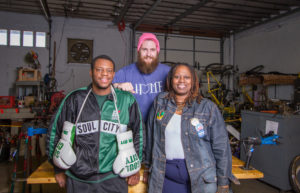
Audrey Johnson of Art Around Town, Maxwell Austin of Glass City Pedicabs and Roshawn Jones of Soul City Boxing and Wrestling. Toledo Free Press Photo by Christie Materni
Teneashia Cunningham keeps a bucket in her office.
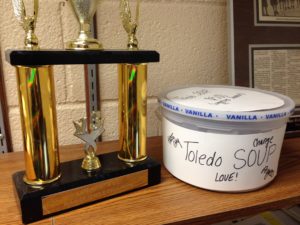
It’s just an empty ice cream pail covered in paper marked “Toledo SOUP,” but it once held a donation of $734, enough to fund a basketball league at the Frederick Douglass Community Association that kept 120 young men off the streets on Friday and Saturday nights last summer.
Board member Brandy Fuller, far left, and interim director Teneashia Cunningham, far right, with some students at the Frederick Douglass Community Association. Toledo Soup helped the center fund a summer basketball league last year. Toledo Free Press Photo by Sarah Ottney
“It looks like a bucket to everyone else, but to us it’s a trophy,” said Cunningham, the community center’s interim director.
SOUP is an international movement of microgrant fundraising events held in more than 100 cities worldwide. Toledo SOUP started in 2012. Since then, six events have raised more than $7,000 for seven community initiatives ranging from art programs, urban farming, human trafficking rehabilitation and small business development.
At each event, several finalists present their projects while attendees eat and vote. The winning project receives all the funds raised during the night through admission, donations, raffles and bake sales.
When votes were tallied last June, Frederick Douglass, which is located on Indiana Avenue, had the most.
The Toledo SOUP bucket Interim Director Teneashia Cunningham keeps in her office at the Frederick Douglass Community Association. “It looks like a bucket to everyone else, but to us it’s a trophy,” she said. Toledo Free Press Photo by Sarah Ottney
“We were so over the moon,” said board member Brandy Fuller. “We have a number of gangs in this neighborhood, but basketball is a universal language. It brings people together.”
She recalled a time her son intervened when one boy pulled a gun on another. The boy with the gun knew her son from basketball and put his weapon down.
“That could have been a scary ending, but sports bridged it,” she said.
With the Toledo SOUP funds, Cunningham purchased team T-shirts, new nets, basketballs and a few team meals.
“It was awesome,” Cunningham said. “Our turnout was big and getting bigger. We had the structure, but we didn’t have the look of structure. We didn’t have jerseys or matching shirts.”
The players, mostly boys age 16-24, come from across the city, Cunningham said. Games start around 8 p.m. and can last until 2 a.m.
“We try to keep kids off the streets,” Cunningham said. “The whole purpose of it is to break those territorial lines. We have kids coming from the East Side, the North End. They see it as playing ball, we see it as breaking the lines.
“There’s a lot of gang violence during the summertime. I was trying to give them something to do. I knew I could get the draw with basketball.
“The older guys are helping the younger guys, building bridges and closing gaps a little bit. Some of them, once they start mentoring, they feel like they’ve done something and given back so there’s a lot of positivity.”
Besides youth sports, Frederick Douglass offers tutoring, GED classes, Alcoholics Anonymous meetings and more.
“We’re in trying times right now, but we are still here,” Cunningham said. “We are still viable to the community. We do still have a heartbeat. The doors are open and we are building.”
For more information, visit www.fdcatoledo.org.
Glass City Pedicabs
The first Toledo SOUP took place March 4, 2012. Maxwell Austin of Glass City Pedicabs won $1,047, of which he used $800 for insurance and the rest for spare parts.
Maxwell Austin of Glass City Pedicabs rides during the 2014 Old West End Festival parade. Toledo Free Press File Photo
“[That] doesn’t seem like a lot for some people, but for someone like me who has put every personal dime into this, it’s the difference between me operating or not,” Austin told Toledo Free Press at the time.
Three years later, Austin’s enthusiasm for Toledo SOUP has not flagged.
“I just can’t say enough nice things about it,” Austin said. “You can take every nice word in the dictionary and I’ll say them all.
“If it wasn’t for Toledo SOUP, I don’t know how long I would have continued to wait or struggle for that amount of money. Eventually it would have happened, but it jump-started my business quicker than it would have.”
In 2012, Austin had two pedicabs in his Ohio West End garage. Today, he has a fleet of six with plans to add two more. He has a rented space, advertisers, 20 contracted employees, a growing wedding business and gigs for out-of-state events like the Kentucky Derby and Indianapolis 500. Next up, he’s working to launch Atlantic Pedicab Fleet, a conglomerate of pedicab businesses from Detroit, Ann Arbor, Cleveland, Columbus, Boston and more, who travel to events together.
“We’ve grown and so has the city of Toledo,” Austin said. “Downtown has added way more restaurants and bars than were there in 2010 [when I started]. It’s really picked up. UpTown has grown too. That’s really nice to see.”
Austin said he’s excited about the future of Toledo and has no plans to leave his adopted hometown.
“I could go anywhere I want, but I love the people in Toledo,” Austin said. “You’ve got some naysayers that say, ‘Toledo sucks,’ but for the most part, man, there’s a huge group of diverse people trying to make a difference in Toledo, pushing for expansion and growth and new ideas. It’s a wonderful place.”
As a way to show his appreciation to Toledo SOUP, Austin now pays it forward by donating $100 to each new winner.
“When I put my idea out there to have pedicabs in Toledo, someone told me that was the dumbest idea they’d ever heard and it would never work,” Austin said. “I didn’t let that crush my dream. I went to Toledo SOUP and it exploded.”
For more information, visit www.glasscitypedicabs.com.
Art Around Town
The $858 Audrey Johnson took home from the second Toledo SOUP in September 2012, was used to take a group of eight Toledo youth to Chicago, most for the first time, to learn about Chinese culture.
Audrey Johnson of Art Around Town, Maxwell Austin of Glass City Pedicabs and Roshawn Jones of Soul City Boxing and Wrestling. Toledo Free Press Photo by Christie Materni
Johnson is the founder and director of the Jamil Lewis Multicultural Center for the Arts. Art Around Town is a program at the center offering creative and educational art activities for area youth.
The Chicago trip was part of a Hostelling International program called Cultural Kitchen. The kids stayed overnight at a hostel where they visited Chinatown, prepared a meal of Chinese dishes and gave a presentation to fellow travelers about Chinese culture.
Next up for Jamil Lewis is building a greenhouse and sculpture garden at a renovated mansion on Winthrop Street, slated for this fall, Johnson said.
Johnson is a vocal proponent of Toledo SOUP.
“I always tell as many people as I can about Toledo SOUP because I believe it’s one of the best organically developed, crowd-funded, locally driven processes,” Johnson said. “There’s no political connection and it’s always kept fresh with people who are guiding the process. It keeps it honest by allowing the community to decide where the funds should be used for that particular time.”
Even finalists who don’t win gain valuable feedback and awareness of their projects, Johnson said.
“That’s how beautiful the process is,” she said. “Beyond what you get from the main crowd-funding source, other people step up to the plate and say, ‘Hey, maybe I need to support that.’”
That happened during the September 2012 Toledo SOUP when local a doctor in the audience offered to help raise money for one of the finalists, a free clinic in need of new equipment.
That offer allowed Art Around Town to win Toledo SOUP instead.
“Because that happened, we ended up winning,” Johnson said. “It’s a beautiful thing.”
The Art of Hope
Only one Toledo SOUP event was held in 2013. The winner was The Art of Hope, a South Toledo-based program offering temporary housing, counseling and mentoring to women recovering from sex trafficking. The program has worked with about 40 women since 2013, said Genevieve Abalos, who started the program with Tina Robinson in a house owned by Vision Ministries, a South Toledo church.
The Art of Hope received $1,015 from Toledo SOUP, which it used to purchase exterior and interior paint for the house, which was then painted by volunteers.
Tina Robinson of Butterflies 15, formerly of The Art of Hope. Toledo Free Press Photo by Sarah Ottney
“It meant everything to us. It was such a blessing,” Robinson said. “We had some donation money from the church but it wasn’t enough to take care of everything. When we got that, it was like a weight lifted off our shoulders.”
The Art of Hope will soon disband as Abalos is moving out of state. However, Robinson plans to continue work at the house. She’s starting a nonprofit called Butterflies 15, aiming to help women recover from drug and alcohol addiction.
“I’m a recovering addict myself,” Robinson said. “I want to give back to these women who are where I used to be.”
Butterflies 15 will use a five-stage, spiritually based recovery program developed by Robinson, who said she has been clean since 2004 and has gone back to school to become a social worker.
The five stages are Butterflies in the Sand, Butterflies in the Wind, Butterflies in the Sun and Butterflies in the Field followed by aftercare, Robinson said.
“Sand is you’re stuck. You want to get out of the rut you’re in, but you’re stuck,” Robinson said. “Wind is you have roots. You’re free from the sand and now you’re able to fly a little. Sun is a new dawning, a new beginning. You’re starting to change, you’re reaching out more, progressing more in your recovery. Field is you’re free, you’re finally free. You have all the tools you need to stay free. Then the next step is aftercare, where I will help them with housing, applications for jobs, resumes, all that.”
Right now, Robinson is searching for partnerships and working on house repairs, which lost heat after the furnace caught fire. The floors have been torn up; she plans to write Bible verses on the wood and shellac over them.
“I just started this at the beginning of this month,” she said. “It’s still a little baby. But this was set into me, God telling me what I need to do. So I’m doing it as he’s telling me to do it.”
Robinson said Abalos supports her change of focus.
“The Art of Hope was not really moving forward like we wanted it to. There were some major things we were not able to take care of,” Robinson said. “She has known my passion since the start.”
New Life Urban Agriculture
The first Toledo SOUP of 2014 came with another first — a tie.
Derek Bunch of New Life Urban Agriculture and the Glass City Goat Gals got an equal number of votes at the March 9 event and split the $2,168 pot.
Bunch’s plan was to use the funds to buy mushroom cultures, filtration units, lighting and other equipment needed to start local production of high-quality organic mushrooms in his Old West End home.
“For me it felt good that people believed in this plan I had,” Bunch said. “When you win, it’s a confirmation that something is a good idea.”
As it turned out, mushrooms didn’t work.
“In the first month, I had mold issues because the humidity has to be so high,” Bunch said. “I ended up reverting back to what I know, which is tomatoes, basil, peppers, carrots and strawberries. Mushrooms are still a part of it, but much smaller. But that Toledo SOUP grant gave me everything I needed to complete doing what I’m doing now.”
His goal is to sell his produce to local restaurants, food co-ops, food trucks and farmers markets.
Bunch first heard about Toledo SOUP the day after he had to shut down his former growing operation because he lost the space he was renting.
“I had to start over from zero,” Bunch said. “It was one of those things like, ‘What do I have to lose?’”
Glass City Goat Gals
Elizabeth Harris and Unique Jones of Glass City Goat Gals are an example of persistence paying off. Their project was a finalist at the inaugural Toledo SOUP, but didn’t win.
“It was disappointing, but made us see we needed to dig a little more, lay more groundwork, have a better business plan,” Harris said.
Two years later, they won.
“After losing, winning felt good. And it was also a confirmation that we’re on to something,” Harris said. “Once we won, it started a snowball effect of contacts and resources.”
The Gals haven’t yet spent their Toledo SOUP money — they’ve been waiting on city permits and approvals for construction — but still plan to use it for fencing for their 10 goats, hopefully by this spring, Harris said.
They are building their urban farm on Mentor Street in the central city. Both have degrees in urban agriculture and sustainability. They offer a 4-H Club and hands-on, STEM-based (science, technology, engineering, math) educational programs, which they bring to local community centers and soon to Moody Manor.
“We want the farm to be an educational resource for our community,” Harris said. “The children need to see the connection between nature and their lives.”
For more information, visit www.glasscitygoatgals.com.
Soul City Boxing and Wrestling
Soul City Boxing and Wrestling is the most recent Toledo SOUP winner.
Students study at Soul City Boxing and Wrestling on Junction Avenue. Photo Courtesy Roshawn Jones
After winning $1,278 in October, owner Roshawn Jones announced he would donate $100 each to the other two finalists.
“It was shocking and amazing,” Jones said. “People there were nice. It was so touching that I kind of wanted everybody to win.”
With the funds, Jones was able to purchase a laptop and three iPads for the Junction Avenue gym’s afterschool tutoring program. He also had two desktops and a laptop donated by people he met through Toledo SOUP.
Jones has about 55 kids who are regulars at Soul City, which just this week became a nonprofit.
“Their grades are monitored very closely,” Jones said. “Some of them have parents who don’t push them, so that’s what we do.”
For more information, visit soulcitygym.com.
The future
Paula Ross was among the original people who advocated bringing the SOUP model to Toledo. Her husband, Johnathon Ross, is the physician who offered to help fundraise for the free clinic.
“It’s just wonderful,” Ross said. “It’s unique for Toledo but it’s part of something that’s international. I think they are doing a terrific job.”
Ross would like to see SOUP expand regionally.
“There’s room for some regional projects,” Ross said. “Some communities have more than one group. Let’s face it, there’s a lot of need and I think people like to connect to worthy causes where they can make a difference with a small contribution. There’s just lots of room for creativity, I think.”
The next Toledo SOUP is set for 5 p.m. March 8 at Toledo School for the Arts, 333 14th St. For more information, visit toledosoup.com.