Toledo Crush will “suspend operations” in Toledo for 2015 with the team expected to return in another Ohio market by 2017, according to a post on the Legends Football League (LFL) website.
The women’s 7-on-7 tackle football league, which started in 2009, was formerly known as the Lingerie Football League. The league was rebranded as Legends Football League in 2013. Players wear helmets, shoulder pads and cleats — but little else.
Three other LFL teams also suspended operations this year, according to a post titled “State of the Franchise”:
Baltimore Charm – Will return to play in April 2016 with a move to Washington DC / Northern Virginia.
Jacksonville Breeze – Will shutdown operations and relaunch in another Florida market within the next three years.
Green Bay Chill – Will suspend operations, as the franchise expects a full overhaul prior to its return.
A representative from LFL was unable to be reached for comment. Al Purdie, marketing manager at the Huntington Center, said no one from the league has been in touch with him.
The Toledo franchise, formerly called Cleveland Crush, announced in December 2013 it was moving from Cleveland to Toledo. It played two home games at the Huntington Center during the 2014 season.
In 2013, league founder and chairman Mitchell Mortaza said he was enthusiastic about the move to Toledo. Open tryouts were held in early 2014 and a team put together.
“Cleveland is an incredible sports town and the Q Arena is one of the finest arenas in the country. While it was an incredible combination for us, it simply did not fit within our business model moving forward,” Mortaza said in a 2013 news release. “Toledo and specifically the Huntington Center is an incredible setting for LFL Football and it also provides proximity to draw athletes, coaches and fans not only from Toledo but Cleveland and Detroit as well.”
The LFL also has leagues in Canada and Australia with plans to launch a league in Europe this year.
What tools can you use to grow your money? If you think about your money and retirement, where can you put it to help you reach your retirement goal? We ask folks this question as they come to us to form a retirement plan, and we get a variety of answers: stocks, mutual funds, bonds, annuities, gold, real estate, CDs, savings accounts, money market accounts, oil and gas, currency, etc.
.
Let’s talk about some of these for a moment, and the possible results.
With stocks, you have the potential for the stock to increase in value. You have a piece of ownership in the company and if the company does well, your share values may increase. How much? Who knows? It depends on a lot of factors. If you are fortunate enough to invest at the right time, you may experience huge increases in values over a short period of time. If your timing is bad, you could experience huge losses.
If you don’t like risk, you may have much of your money in the bank. With the backing of the federal government on your deposits, you may feel safe from the possibility of losing your money. What are bank accounts currently paying? Five to 6 percent, right? Maybe back in the good old days, but you would be lucky to get anything like that in today’s interest rate environment. It seems like banks act like they are doing you a favor by holding your money for you and not really paying you much in return, all the while charging account fees. However, in many cases bank accounts are liquid. You can drive down to your local bank branch and draw it out.
Bonds are viewed by many as safer than stocks. But are they, really? When interest rates go up, the values of bonds go down. With interest rates very low, ask yourself, “Where will the rates go in the future?” and “What will it do to the value of bonds?” One result we can get from a bond is potential tax benefits. If we buy municipal bonds, we can get some tax advantages that other investments do not offer.
How about annuities? Our view is there are good ones and bad ones. Annuities offer tax deferrals and the opportunity for income for life if you exercise certain options. This means if you start taking a fixed income stream for life from an annuity, even if your money runs out, the insurance company still has to continue paying you that income for the rest of your life.
So far we have talked about tools to use with our money, and the results we may experience. What matters most to you in life? When we ask this question, we get answers like health, family, kids, grandkids, faith, pets, etc. If the tools you use make you a lot of money but you lose your health, will the amount in your bank account help you?
When The Retirement Guys help formulate a retirement plan (we call it The Retirement Game Plan), we think it is vitally important to come up with a comprehensive plan that ultimately helps you enjoy and focus on what is important. Think about what that is for you.
Do you have a written income plan? If not, why not? Without income, there is no future (retirement). It’s all about income. If the answer is no, you’d better get with someone that can sort it out quick. I (Mark) sure don’t want to be stressed out worrying about if I will outlive my money in retirement, and I bet you don’t, either.
For more information about The Retirement Guys, tune in every Saturday at 1 p.m. on 1370 WSPD or visit www.retirementguysradio.com. Securities and Investment Advisory Services are offered through NEXT Financial Group Inc., Member FINRA / SIPC. NEXT Financial Group, Inc. does not provide tax or legal advice. The Retirement Guys are not an affiliate of NEXT Financial Group. The office is at 1700 Woodlands Drive, Suite 100, Maumee, OH 43537. (419) 842-0550
Electronic Arts’ newest ‘Need for Speed’ game allows players the option to pay real money for gasoline. Photo courtesy Electronic Arts.
Since the creation of the form decades ago, the evolution of video games has been an ever-escalating attempt to capture a feeling of realism. From the first tentative steps with the addition of color, background graphics, adding new layers of dimension in movement, the rise of 3D acceleration and more natural-feeling controls, game developers have tried desperately to give players the feeling that “you are THERE.”
.
The next stage of gaming realism has officially been realized: You can now pay for gas. Not fake, in-game-world currency either. Real, honest to god money to power a fake car.
Electronic Arts has been one of the most celebrated gaming publishers for many, many years. When people think of sports in video games, chances are they are thinking of an EA title. But beyond the Maddens and NHL titles which have defined the company, EA has produced several other franchises outside the sporting realm. One of the most popular is its “Need for Speed” series, racing games which have connected with gamers for several console generations now.
Like most developers, EA has jumped into the mobile market with both feet, bringing ports of their flagship titles for players to experience in the palm of their hand. The latest game in the Need for Speed franchise, and the first game developed exclusively for handheld phones, will be hitting smartphones this spring. The game is entitled “No Limits” — a name that is supremely ironic, as we will see in just a moment.
As it turns out, Need for Speed: No Limits operates under the auspices of the “free-to-play” model that many publishers love to employ with their mobile offerings. But what that means is, you can download the game for free and play it however much you want … until you run out of gas. Yes, you can run out of gas in a video game.
And, if reports from regions where the game has already been released are to be believed, to fill the tank, you will have to pay real currency.
Now, you don’t *have* to pay, if like most gamers the idea of shelling out real cash for fake gasoline makes you retch. You can simply wait. Yes, “No Limits” is one of those games where you don’t HAVE to shell out for in-game dough to continue to have fun. But you will have to be patient. Your virtual gas tank will eventually refill on its own, and you can get back to having fun, or you can pay now and race right away.
EA is far from the only publisher to employ such a naked cash grab in one of their titles.
Beyond the “free-to-play” gaming model, which with each passing day is becoming more of a “pay-to-win” model, gamers have been subjected to a myriad of titles which seem content to hide additional content beyond a pay wall even after they’ve shelled out up to 60 bucks for the privilege of playing the title at home. More levels, cool new powers, awesome additional characters and more are released down the road in an effort to separate consumers from even more of their cash.
This latest step — charging players for fake fuel — makes me wonder if we’re a step away from the next evolution in gaming realism. Real-life fines for in-game infractions.
Picture it: An adventure game where you have hospital stays for an ill-timed jump. A flight simulator where you’re grounded if you crash. Jail time in “Grand Theft Auto” for the myriad crimes you commit! And if you don’t feel like waiting out those days/months/years as you heal or repay your debt to society, not to worry: Just enter in your credit card and you’ll be back on the road/streets/skies faster than you can say “shameless marketing.”
Tim Schmidt, left, and Kyle DeWitt of Tecumseh Brewing Company plan to open their business
in early April. The two previously worked together at Ann Arbor’s Blue Tractor BBQ & Brewery.
The brewery will also feature a full kitchen.
Toledo Free Press Star photo by Dave Kubacki
With over 130 breweries and counting, Michigan has become a
destination for beer enthusiasts. Having witnessed that passion firsthand
working together at Ann Arbor’s Blue Tractor Brewing Company, Kyle Dewitt and
Tim Schmidt decided to join Michigan’s ever-growing landscape of breweries in
the city of Tecumseh, Michigan.
“[Tim and I] really just sat down, had a couple of beers and
talked about what we wanted to do,” Dewitt said. “We had similar ideas of what
we wanted to do and both had unique skill sets that really balanced each others
out.”
It has been nearly four years since Dewitt and Schmidt first
conceptualized Tecumseh Brewing Company. While Schmidt is a native of Tecumseh,
Dewitt had actually originated from California. After visiting Tecumseh,
however, Dewitt said the southeastern Michigan seemed like a natural fit.
“I hadn’t necessarily envisioned being here, but I knew I
wanted to stop brewing for other people,” Dewitt said. “Like everyone else,
I’ve always wanted to do my own thing. When we came to Tecumseh, I thought it
was great. It’s been pretty easy to get comfortable here, especially after
getting to know everyone.”
With the nearest breweries nearly 45 minutes away in Ann
Arbor and Milan, Tecumseh Brewing Company has the unique opportunity to bring
its city some local suds. According to Dewitt, the excitement for the brewery
has grown substantially over the 4 years of planning.
“If we had a nickel for every time someone asked when we’d
be opening, we’d be opening a second brewery by now.” Dewitt said. “There have
been rumors of this brewery opening in the city for over three years now so
people definitely seem excited.”
Between Tecumseh Brewing Company’s interior and proposed
beer garden and patio, the establishment will hold approximately 150 people.
Guests will have the opportunity to choose from 16 taps dedicated to the
brewery’s signature brews. According to Dewitt, the goals is to have all 16
taps up-and-running by the brewery’s target opening date of March 17th,
just in time for St. Patrick’s Day.
“With 16 taps, they’ll always be a few hoppy options and a
few malty options,” Dewitt said. “We think the IPAs will be popular and other
standard beers, but we will probably let our sales, customers and mug club
members dictate what’s on tap. As it is now, we are just filling the taps with
as many different beers as possible. We don’t want to have too much structure
so that way it never gets dull.”
In addition to Tecumseh Brewing Company’s signature beers,
they will also have a full kitchen. With
the help of former Head Chef at Ann Arbor’s Melange, Chris Wanke and former
Sous Chef at Melange Mike Clayton Tecumseh Brewing Company believes the food
will be equally as unique as the beers.
“We’ll have a lot more items on the menus than we thought
we’d be able to do,” Dewitt said. “Just like the beer, the menu will change out
pretty often. We don’t want anything too set in stone. We are really not that
structured here.”
With an anticipated opening about a month away, Dewitt and
Schmidt are excited about the prospects for the future.
“We don’t want to shoot anything down for the future,”
Dewitt said. “We want to do everything right. We want to keep it simple and
focus on serving the town and we’ll see what happens. You have to grow with the
size of your tank. We are happy where we are and are excited to see how we’ll
grow.”
Michael Aughinbaugh will serve as Office Manager of the Toledo/Maumee office of Howard Hanna Real Estate Services.
Michael Aughinbaugh will serve as Office Manager of the Toledo/Maumee office of Howard Hanna Real Estate Services.
Howard Hanna Real Estate Services of Pittsburgh, one of the largest real estate companies in the nation, plans to open a Toledo office March 2 with a Perrysburg man at the helm.
Michael Aughinbaugh has been named office manager of the new location. He has worked in the real estate business in Northwest Ohio for nine years.
“The Toledo real estate market experienced fantastic growth in 2014 with the outlook being brighter for 2015,” Aughinbaugh said. “As an office, I believe we stand to gain on this momentum by offering programs and incentives that no one else does or can.”
Expanding west into the Toledo market has been a vital piece of the company’s development goals for the past few years, said Howard W. “Hoby” Hanna IV, president of Howard Hanna’s Midwest Region.
“We’re excited to be finally opening in the Toledo real estate marketplace,” Hanna said in a news release. “Our spirit of integrity has helped us to grow to the fourth largest real estate company in the United States and we are bringing this spirit to Toledo.”
Aughinbaugh said the company began recruiting agents in October and already has 14 agents for the Toledo market with more coming on board soon. The Toledo office will be one of the 12 Howard Hanna offices in its Ohio West Region.
The firm will open a 2,800-squarefoot temporary office at 3214 Briarfield Blvd. in Maumee. Aughinbaugh said they plan to open a 5,000-square-foot permanent office in that area later this year that will accommodate 50 agents.
Howard Hanna is the top real estate firm in Ohio, ranking No. 1 in homes sold for the past eight years with a 44 percent market share, according to the company, which is also No. 1 in Pennsylvania.
Aughinbaugh will serve as a non-competing manager who does not list or sell properties, which is part of Howard Hanna’s philosophy. He joined the company’s Fremont office in 2012, where he worked with his mother Kim Wood. He has had his Ohio Real Estate License since 2006.
“They talked to me about going into management and I’m very excited to be opening this office in the Toledo market,” Aughinbaugh said.
Aughinbaugh earned his business degree from the University of Toledo, but he grew up in the real estate business. His grandfather, Ed Zitzelberger, owned a Century 21 franchise in Pennsylvania and knew Howard Hanna II, who founded the real estate firm in Pittsburgh in 1957.
Howard “Hoddy” Hanna III now serves as CEO and his sister, Helen Hanna Casey, is president, supervising the firm’s residential real estate business.
“The Hannas are all down to earth and very hands-on. They know all their agents,” Aughinbaugh said of the family-owned business.
“When we open the permanent office in Toledo, they will be here to meet the local agents, customers and media,” he said.
The company specializes in residential and commercial brokerage services, mortgages, closing and title insurance, appraisal and insurance services, land development, corporate relocation and property management.
Aughinbaugh said they will eventually expand into commercial real estate in the Toledo market. The firm is big in the relocation business, working with more than 600 corporations. He said they are already working with some local companies for relocation services in the Toledo market.
The Glass City Wine Festival was so popular its first two years, organizers decided to double the size of the third event, set for noon to 9 p.m. March 7 at the SeaGate Convention Centre.
The festival will now occupy two halls rather than one, said Brook Hall, director of operations for the festival. Attendance the first two years was capped at 1,800, with tickets selling out several weeks in advance. This year, organizers are expanding ticket sales to nearly 3,000, Hall said.
The festival has also increased the number of featured wineries from 14 to 20. All of the wineries are from Ohio, including one from Northwest Ohio: Chateau Tebeau Winery in Helena.
There are two sessions: 1-4 p.m. and 6-9 p.m. VIP tickets — which are sold out — allow entry one hour early. Afternoon tickets are $25, while evening tickets are $30. Tickets are available at glasscitywinefestival.com. If tickets do not sell out, they will be $5 more at the door. Proceeds go to Toledo Northwestern Ohio Food Bank.
“I think a good part of [our success] is the time of year,” Hall said. “Everyone’s been cooped up all winter long, and it’s a chance to get out, relax and really have a good time, do some shopping and enjoy some wine.”
In addition to samples from regional wineries, the festival offers attendees a chance to sample gourmet cheese and fare from local restaurants and shop for gifts from a variety of craft businesses.
New this year will be Wine & Canvas, a national painting/cocktail business with a branch in Toledo. The business will host free painting classes at intervals throughout the event. Also new to the festival is the inclusion of Pairings, Ohio’s Wine & Culinary Experience, which will host free wine-tasting classes.
“They’ll basically be teaching people how to taste wine while they swirl a glass, what you’re smelling, what you’re looking for,” Hall said.
The food bank is the festival’s nonprofit sponsor, helping to staff the event while collecting donations and spreading awareness of its mission.
“We’re exceedingly proud to be affiliated with such a wonderful, growing event as the Glass City Wine Festival,” food bank president James Caldwell said in a press release. “It is especially gratifying to be part of an event that showcases local and Ohio-based businesses. The event not only helps us pay the bills but also increases visibility for our important agency.”
Hall said the agency received $6,000 last year from ticket sales, with an additional $1,500 in tips from operating the coat check area.
The Glass City Wine Festival was founded in 2011 by Lilly Productions as one of four similar events the company hosts in Ohio, Pennsylvania and New York.
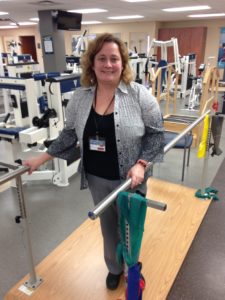
Anne Schroeder, a physical therapist and one of mercy’s 25 employees certified in the star program for cancer survivors, stands near equipment at the Mercy Center for health promotion and wellness at Sunforest Court. since 2013, a team of multidisciplinary specialists at mercy have helped cancer patients overcome treatment-related conditions such as pain and weakness. Toledo Free Press photo by Joel Sensenig
Cancer is a painful experience in a multitude of ways, but a Mercy Cancer Center program attempts to lessen the pain associated with treatment of the disease.
The STAR (Survivorship Training and Rehabilitation) Program is a nationally recognized cancer effort that focuses on improving the lives of survivors who suffer from the side effects of treatments.
Anne Schroeder, a physical therapist and one of mercy’s 25 employees certified in the star program for cancer survivors, stands near equipment at the Mercy Center for health promotion and wellness at Sunforest Court. since 2013, a team of multidisciplinary specialists at mercy have helped cancer patients overcome treatment-related conditions such as pain and weakness. Toledo Free Press photo by Joel Sensenig
“Fatigue is probably the primary complaint all of our cancer patients have,” said Anne Schroeder, a physical therapist and one of the 25 Mercy employees certified in the STAR Program. “It doesn’t matter where the diagnosis came from. A lot of it is the effect of the chemotherapy and radiation, and the medications they take are pretty toxic to their system. … A lot of patients experience muscle weakness and a lot of balance issues.”
Since 2013, a team of multidisciplinary specialists at Mercy — occupational and physical therapists, as well as nurses — have helped cancer patients overcome treatment-related conditions such as pain, weakness, fatigue, shoulder problems, balance issues, memory and concentration difficulties, swallowing and speech problems and lymphedema. About 10 patients go through the program each month.
“Regardless of their prognosis, the benefit that they’ll come back and tell you about is that they have more energy or ability to do what they need to do,” Schroeder said. “For some of them, that’s getting back to work. For others, it’s just being able to sit up at the kitchen table to eat with their family for a half-hour.
“There’s all levels of function there, but really we’re trying to get their pain down, increase their quality of life,” Schroeder said. “We set those goals with the patient in the first meeting or two.”
Catherine Hughes is an example of what the program can accomplish.
The 46-year-old Sylvania woman was diagnosed with breast cancer, resulting in two surgeries and chemotherapy every three weeks for one year, during which she also had 35 radiation treatments. To complicate matters, she was diagnosed with lymphedema — fluid retention and tissue swelling — in her left arm and left breast due to the removal of her lymph nodes.
“After all the treatment I had been through I felt like my body never got back to normal. I was fatigued and had a hard time exercising,” Hughes said in an email interview with Toledo Free Press. “When the opportunity was given to me to do the STAR Program I was excited to participate in it. The program made a world of difference in my life. After completing the STAR Program, I truly feel like my body is back to normal. I am able to exercise and I’m not tired anymore. Also, I have seen a difference in my lymphedema; my arm does not swell up anymore and I feel it is under control.
“This program has been a blessing to me and they have an amazing staff,” Hughes said. “From the time I was diagnosed with cancer I had all my doctor appointments, lab tests, surgeries and any other test I needed through the Mercy system. I always felt I was given the best treatment in every department I had contact with. The people who work for the Mercy system are wonderful and helpful. I thank God every day for the medical staff that gave me great care.”
Patients’ stays in the STAR Program tend to be one to two times per week for two to three months, Schroeder said. Inclusion into the program requires a physician referral.
So far, Schroeder has seen breast and brain cancer victims the most frequently.
While brain cancer is not a common cancer, Schroeder said these patients are more likely to experience problems with balance.
“Our goal is to see them the minute they start to experience a deficit, if not before,” she said. “We try to get people in quicker so they don’t have to live with those deficits. I think they just accept it sometimes as ‘Well, I’m happy to be alive and I’m stuck with this.’ But they can improve.”
A common problem faced by breast cancer patients treated by Schroeder is tightness in the shoulders, due to scarring, radiation and surgical issues.
“A lot of them can’t lift their arm up to get their shirt on,” she said. “Any task reaching overhead they can’t do. And they have weakness with that too, so they might not be able to lift their coffee cup.”
The STAR Program can help them regain that range of motion and muscle strength.
Regardless of the type of cancer, many cancer patients experience similar symptoms due to chemotherapy and radiation, Schroeder said.
“As a physical therapist, I don’t treat a kidney or a liver, but the chemotherapy effects [they experience] are almost the same,” she said.
The STAR Program was founded by Dr. Julie Silver an assistant professor in Harvard Medical School’s Department of Physical Medicine and Rehabilitation.
For more information or to refer a patient, call (888) 987-6372 or visit mercyweb.org
This month’s Eye on Health special section focuses on cancer, which hits close to home as my younger sister is a recent cancer survivor.
.
She was diagnosed with breast cancer when she was 26 and newly married. With no history of breast cancer in our family, the news threw everyone for a loop — most of all her. Instead off heading off on a honeymoon, she embarked on a year and a half of radiation, chemotherapy and battles with insurance companies.
Everyone copes in different ways. My sister is a private person. She didn’t like to talk about her treatments. She said she just wanted to be treated normally. But not knowing the details worried my parents half to death, as she was living across the country and they couldn’t personally check in on her.
Most of us have been touched by cancer, either personally or through someone we know. It’s scary. But luckily there are those out there who seek to help.
Bethany Gurzynski of apparel company Toledo Threads designed a charity T-shirt reading “I can. I will. End of story.” Renee’s Survivor Shop, offering wigs and other items, is operated by a cancer survivor at the University of Toledo Medical Center. Staff with Mercy Cancer Center’s STAR Program help survivors lessen ongoing pain associated with side effects from treatment.
Cancer takes a lot out of a person physically, mentally, emotionally and financially. It makes you sad, mad, frustrated, hopeful and terrified, sometimes all at once. I can only imagine. But I know it’s bad because my normally mild-mannered sister defiantly wears a necklace that reads, “F— Cancer.”
Cancer is tough, but she’s tougher. The day doctors gave her the “all clear,” she posted a photo of two fingers covering the R and S in the words “breast cancer.” She beat cancer. I’ve never been prouder. To all those still battling, fight on.
Sarah Ottney is editor in chief of Toledo Free Press. She can be reached at [email protected].
Bethany Gurzynski, owner of apparel company Toledo Threads is selling shirts stating “I Can. I will. End of story.” proceeds will go to Tiffany Townsend and Melinda Restivo, both diagnosed with breast cancer. Photo courtesy Toledo Threads
In a quaint Sylvania café, Bethany Gurzynski scrolls through an online catalogue of customized apparel she’s created with nothing more than her artistic talent and a little bit of free time.
Bethany Gurzynski, owner of apparel company Toledo Threads is selling shirts stating “I Can. I will. End of story.” proceeds will go to Tiffany Townsend and Melinda Restivo, both diagnosed with breast cancer. Photo courtesy Toledo Threads
Hoodies, T-shirts, V-necks — all bearing unique designs celebrating everything from Toledo’s historic Jeep plant to the University of Michigan’s hiring of Jim Harbaugh.
However, there is one design — albeit a rather simple one — that stands out among the rest.
A black T-shirt featuring a pink ribbon logo and bold lettering that reads: “I Can. I Will. End Of Story.”
“This is for Tiffany and Melinda,” she says, smiling.
Gurzynski, an art teacher at McCord Junior High School, recently began selling the shirts online to support two Sylvania women currently in the fight of their lives.
Tiffany Townsend and Melinda Restivo both had their lives drastically altered when they received a diagnosis of two very different forms of breast cancer.
To ease the financial burden on these two women, Gurzynski created the inspirational outerwear and jumpstarted a fundraising campaign Feb. 2 on Teespring.com.
Marketing the apparel under the umbrella of her new company, Toledo Threads, she has already sold 462 shirts with 100 percent of the proceeds to be split between Townsend and Restivo.
“There are a lot of things I couldn’t do to help them,” said Gurzynski, who currently teaches Townsend’s and Restivo’s children in her art class. “I couldn’t give them $5,000, but I could do a design — one that would cost me virtually nothing — that raises $5,000.”
Prices for the “I Can. I Will. End Of Story.” line range from $20 for a standard or women’s fit T-shirt to $35 for a hoodie. Gurzynski is also offering long-sleeve shirts, V-necks and a tie-dye version.
“I don’t know where I’ll be in five years,” Gurzynski said. “I don’t know if [cancer] is going to affect me, my mom or my sister. So why wouldn’t I pay it forward?”
Gurzynski said the design for the shirt, as well as the slogan, are well-known symbols of strength and inspiration for those battling tough times in life.
A big part of the campaign’s success is due to the local push it has received. Friends, relatives, strangers and even Gurzynski’s fellow teachers at McCord Junior High have all purchased shirts to support the two mothers.
“Their daughters will see the teachers wearing the shirts and they’ll feel that support at school,” Gurzynski said.
Townsend, an educator at Perrysburg Junior High School, said her students and even her own co-workers have also purchased the shirts.
“I’m overwhelmed,” Townsend said. “I think people just want to help in any way they can. This is an easy way they can show love and support, and it’s a cool shirt on top of it.”
Both Townsend and Restivo said the money they receive from the campaign will help their families survive this tough time by offsetting the cost of living expenses and medical bills.
“I wasn’t prepared for this in any way,” Restivo said. “The financial burden it puts on a family is hard. One day you think you’re just chugging along and then, ‘Wham!’”
Having only met Gurzynski a few times prior to her start of this fundraising effort, Restivo said she was surprised at the effort.
“She was this guardian angel that came to me,” Restivo added. “She’ll never know how grateful I am and how much this will help me and my family. Words will never be able to express how grateful I am.”
Melinda’s fight
Restivo lost her father to lung cancer in April and was still in the process of grieving when she discovered a lump on her right breast in October.
“At that time, I let a lot of things for my own health go by the wayside,” Restivo said. “I knew I needed a mammogram done. A week after I scheduled my mammogram, my husband hugged me and, when he hugged me, something popped in my right breast.”
Following a series of doctor and hospital visits, Restivo visited the ProMedica Toledo Hospital Breast Care Center on Nov. 3 and received the proper testing to diagnose the mass on her breast.
She was not prepared when she got the call two days later.
“It’s a day you never forget,” Restivo said. “I had lost my dad and six months later, here I am being diagnosed with cancer. You never know how it feels until it’s told to you. It affected me when my dad had it, but it changed me when I was told I have it.”
On Nov. 5, she was diagnosed with triple negative invasive ductal carcinoma — a rare subset of cancer that lacks the presence of estrogen and progesterone receptors, and generally responds well to chemotherapy.
Her tumor, relatively large by the time it was discovered, had evaded early detection by hiding behind dense breast tissue.
“It was already further along than I wanted it to be,” Restivo said. “I was shocked. I was shocked at the stage of it. I was shocked by the diagnosis of it.”
Now surrounded by what she calls a “wonderful group” of doctors, oncologists and radiologists, Restivo has been undergoing an aggressive chemotherapy regimen since November.
Restivo said she’ll finish with chemotherapy April 17 and prepare for surgery not long after.
“It’s been a journey. It still will be for another year or so,” Restivo said. “Every woman’s path is different. After surgery I’ll go through radiation; and, after that, there could be talks of reconstruction. My goal is to have a double mastectomy by the time it’s all said and done.”
Tiffany’s story
Townsend’s journey began more than a month ago when her ob-gyn discovered a lump on one of her breasts during an annual checkup.
Her doctor, whom she has gone to since she was 18 years old, tearfully delivered the news in late January.
The diagnosis: ER/PR positive breast cancer — a hormone-receptor form of the disease that grows in response to estrogen and progesterone.
“It’s been a total whirlwind,” Townsend said. “It’s been crazy. There really isn’t a better word to describe it.”
Townsend underwent surgery Feb. 19 and reported Feb. 25 that her lymph nodes are negative for cancer and the margins around her small tumor were all clear.
Within the next few weeks, Townsend said, she plans to begin one year of chemotherapy, followed by a daily regimen of hormone therapy pills for the next five to 10 years.
“It’s great to have some good news coming out of such a bad diagnosis,” she said.
Breast cancer is the most common form of cancer among women worldwide and the second most common cancer overall. In 2015, it is estimated there will be 231,840 new cases of invasive breast cancer among women in the United States — causing 40,290 deaths, according to Susan G. Komen.
To purchase the “I Can. I Will. End of Story.” shirt, visit teespring.com/stores/toledo-threads. For more information, visit the Toledo Threads Facebook page at Facebook.com/ToledoThreads or email Gurzynski at [email protected]. O
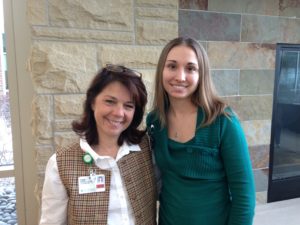
Promedica employees Robin Sulier-Charney (left) and Kelly Morse help educate the public on colorectal cancer and the need for discussion and screening to help fight the disease. Toledo Free Press photo by Joel Sensenig
Thanks to improved treatments and highly publicized fundraising events, cancer isn’t the taboo subject it once was.
However, there are still some types of the disease people don’t want to even think about.
Hello, colorectal cancer.
Promedica employees Robin Sulier-Charney (left) and Kelly Morse help educate the public on colorectal cancer and the need for discussion and screening to help fight the disease. Toledo Free Press photo by Joel Sensenig
It seems pretty much no one wants to talk about colonoscopies, although the screening method could prevent more than 90 percent of colorectal cancers if everyone had one at the age of 50, according to the American Cancer Society (ACS). Those with a family member who developed colorectal cancer before the age of 60 are advised to get their first colonoscopy at the age of 40.
Two women from the Hickman Cancer Center at ProMedica Flower Hospital hope to take away some of that stigma surrounding colorectal cancer. March is National Colorectal Cancer Awareness Month.
“We can prevent more cancer if people go in and have their colonoscopies,” said Kelly Morse, a licensed genetic counselor with ProMedica Cancer Institute. As part of her job, Morse talks with patients and their family members about preventing or catching cancer early, particularly with those who have a family history of the disease.
“Even with colonoscopies, there’s a stigma. People say, ‘Oh, I’m not doing that,’” Morse said. “It’s always ‘Oh, I’ve heard they’re terrible. Oh, I don’t ever want to have that done. Nobody’s doing that to me.’ Or the biggest one is, ‘I’m afraid of what they’ll find.’ Well, delaying it further is just going to make it worse. Trying to bring people to that realization is just really, really hard.”
Robin Sulier-Charney, an outreach coordinator with ProMedica Cancer Institute, goes out in the community to help raise awareness of cancer prevention and early detection. Any one of the 3,500 people who walked through a 20-foot, inflatable colon dubbed “Super Colon” at a Mud Hens game last year has Sulier-Charney to thank for that experience.
The blow-up colon will make another appearance March 20 at the Toledo Walleye game at the Huntington Center.
For Sulier-Charney, who wears a turquoise “I heart booty!” bracelet, it’s all about community awareness.
“It is almost a completely preventable cancer,” she said. “I would love to see people go in to their doctors and say, ‘Can you help me with my family history and what are my options for screening?’ Just to start that conversation, we could reduce the incidence of colorectal cancer by a pretty substantial rate.”
More than 50,000 Americans were expected to die from colorectal cancer in 2014, according to ACS.
The Lucas County Colorectal Cancer Coalition (LCCCC), a small group of community activists dedicated to colorectal prevention, states that Lucas County has one of the highest late-stage diagnosis rates in Ohio, with the cancer being the second-leading cause of cancer deaths in the county.
Although rarely discussed, people who have died from colorectal cancer include Audrey Hepburn, Charles Schulz, Jack Lemmon and Vince Lombardi.
As of five years ago, only 59 percent of Americans above the age of 50 had received any sort of colorectal cancer testing, according to the ACS.
“An early diagnosis is the closest thing we have to a cure,” Sulier-Charney said.
According to the ACS, colorectal cancers start as a polyp, an abnormal, fleshy growth in the colon. Polyps are not necessarily cancerous, although those identified during a colonoscopy can be removed before they become cancerous. Symptoms of colorectal cancer do not appear until the polyp is large enough to cause bleeding or colon blockage. Early-stage colon cancer shows no symptoms.
Hence, the need for screenings.
“The vast majority of colorectal cancers are sporadic and randomly occurring,” Morse said. “The way we’re going to identify those in people is through routine screenings.”
Although guidelines for the general population maintain getting a colonoscopy by the age of 50 (and every 10 years afterward), those with a family history may need to take a more aggressive approach.
One in 35 colon cancer cases is due to Lynch syndrome, a genetic disorder that predisposes a person to develop certain types of cancer. Someone with Lynch syndrome has a nearly 80 percent chance of developing colon cancer, Morse said.
According to the LCCCC, a colonoscopy involves the doctor using a flexible, hollow tube about the width of a finger to inspect the entire colon. The exam takes about 15-30 minutes, while the patient is sedated. About 12 hours of fasting is required, as well as the consumption of a liquid that will help clear out the colon.
Identifying cancer in one’s body can be a scary proposition, but it’s one that can save their life, said Sulier-Charney, who has overcome a personal battle with cancer. She has had two colonoscopies herself.
“When people think of cancer, they’re frightened and the first thing they think of is death,” she said. “They think of worst-case scenarios. But it is far from that. We have so many things that we can help people do before it even gets to that point.”
There are ways for most people to reduce their risk of developing colorectal cancer, such as eating a higher-fiber diet, increasing physical activity, limiting alcohol consumption and reducing the amount of red and/or processed meat consumed.
“The most important thing that I want to get through is save yourself a lot of heartbreak, time and money: know what your risks are, know what you need to do, talk to your doctor and be an advocate for yourself,” Sulier-Charney said.
For more information, visit toledocolonhealth.org and cancer.org