Home Blog Page 140

Drawbridge: Toledo man finds inspiration in local landmark.

0
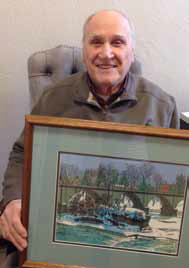
Rudolph Schroeder with his recent painting of the Interurban Bridge in Waterville. Toledo Free Press Star photo by Sarah Ottney.

Rudolph Schroeder is living proof that it’s never too late to pursue one’s passion.

The 84-year-old turned his lifelong passion for art into a second career. Schroeder has had artwork displayed in the White House and at Ellis Island. Now, he’s hoping his rendering of a well-known Northwest Ohio bridge will generate more attention for the region.

After the end of his career as a textile engineer, Schroeder entered retirement and began focusing on his art, which before retirement had simply been a hobby.

About 30 years ago, he started drawing with pen, often rendering the tall ships he recalled from the “swashbuckling” pirate films he loved watching as a child.

His most acclaimed moment as an artist occurred in 2000 when Schroeder created a piece using his favorite technique of starting with a base of acrylic paint and finishing with details using pen and ink. The patriotic piece, titled “History and Peace in the Millennium,” shows the Statue of Liberty alongside an American flag and a tall ship.

“It did very well because it was timely and people cared. They were really drawn to it,” Schroeder said.

It received attention from around the country and was displayed in the White House during President Bill Clinton’s time in office. The former president sent Schroeder a thank you letter after receiving a signed copy.

The piece was also displayed on Liberty Island, New York, for visitors of the Statue of Liberty to view. It later received Best in Show honors at the 2000 Marine City Art Fair in Michigan.

Schroeder found new inspiration recently in the Interurban Bridge, which spans the Maumee River beside the Roche de Bout landmark in Waterville. The spot was used as a meeting place by Native American tribes in the 1700s.

According to the Ohio Historical Society, the bridge was constructed in 1908 by the National Bridge Company of Indianapolis. It’s also referred to as the Ohio Electric Railroad Bridge and was designed with steel-reinforced concrete filled with dirt and mud.

He created a rendition of the bridge using his acrylic, pen and ink technique. Now he plans to sell prints of the painting, and hopes to bring more business to local frame companies and art studios.

“A lot of artists do a picture and they put it up with a price tag,” he said. “The difference with me is I make something that is historically significant and make prints. So I not only sell my work, but I also make more business for the picture framers and the matting companies. It makes me feel good.”

Schroeder is currently selling 11-by- 14-inch prints of the bridge for $30. To purchase a print, call (419) 367-1332.

Dementia — Knowing when to ‘make the move’

0

Among the battles faced by families with a loved one with Alzheimer’s disease or dementia is deciding if and when to take them out of their own home to a facility.

In March, Alzheimer’s expert Susan Scanland visited Senior Star at West Park Place Toledo to give a seminar titled, “Seniors: When to Make The Move.” Scanland has given more than 500 such seminars on Alzheimer’s and dementia in more than 40 states in her 30-plus year career. She currently consults at a long-term care center in Scranton, Pennsylvania, where she evaluates residents and can make dementia recommendations for the medical and nursing staff.  

There are a number of reasons it’s hard for both the patient and family to “make the move” from the home to a care center, Scanland said.

“Number one I think is the hesitancy to leave one’s homestead, where one’s been for many years,” she said.  “Number two is often the negative stereotype of community senior living. … Many families fear they are institution-like.”

Scanland, who has spoken at West Park Place several times, said that is often the furthest thing from the truth.

“It’s not the nursing home, but people often have that negative stereotype,” she said, explaining many places offer the ability for a couple to stay under the same roof but still provide the needed care for the partner with Alzheimer’s.

“Very often there are so many emotions when an older person has to put their loved one in a nursing home because they can’t take care of them,” she said. “But they can live together, and contract to bring private-duty nurses in. So a couple can be more independent longer and live together longer than if they were at home.”

The third reason it’s hard to move a loved one from their home into a care center could actually be higher on the list for many families, Scanland admitted.

“Guilt is a huge emotion when it comes to placement,” she said. “So many families have told me that this is the hardest decision they ever had to make in their lives. The problem is, often they’re making it without adequate information. … Often too, there are disagreements between adult children about what to do about mom and dad because there’s a lack of information.”

In her Toledo talk, Scanland said her purpose was simple — to educate about existing options.

“There are reasons why home sweet home may not be as safe or as wise a choice as they think it is,” she said.

Scanland identifies seven areas to consider when determining if it’s indeed time to “make the move” or “kiss the guilt good-bye.”

• Pedestrian and driving risks — Even persons with mild dementia are more likely to makae decisions that can result in them getting hit by a vehicle, Scanland said.

“Having fender benders, getting lost while driving are huge red flags,” she said. Oftentimes, dementia patients may depend on another passenger’s “copiloting” to get them from one place to another while driving, Scanland said.

• Nutrition and hydration — Scanland did house calls on dementia patients for years and would often find freezers full of ice cream and other junk food, with no vegetables. Older people often lose their sense of thirst and don’t get enough to drink, she said.

• Medication mixups — People over 65 are four times more likely to have reactions to medications than younger people, Scanland said. Dementia patients are more likely to confuse medications — blood pressure and diabetes drug mixups can be particularly dangerous, she said.

• Falls — “Often older people think it’s OK if they fall,” Scanland said. “It’s not OK that they fall.” Falls contribute to 16,000 deaths in the elderly each year, she said. One out of three people over the age of 65 are at risk for falling, while half are at risk if over 80 years old, she said. She has seen many cases where dementia patients were lying on the floor for one to two days after falling.

• Elopement (walking/driving away from home) — 75 percent of dementia patients wander from their home at least once, Scanland said.

• Isolation/loneliness — People who get depressed after the age of 65 are at a higher risk of developing Alzheimer’s, Scanland said.

“Just because you have dementia, sitting in front of the TV all day with no social interaction and no people, it’s not good for the brain,” she said.

• Financial exploitation — Scanland called it a silent epidemic, pointing out studies suggest four or five unreported cases of elderly scams to go along each one that is reported.

Kirsten Pickle, executive director of West Park Place, said the program on the seven areas to consider was well received by both seniors and their families.

“I think those things are important because nobody wants to leave their home, but it’s also hard to be objective on reasons why you should,” Pickle said. She said the average age of a West Park Place resident is 86. She pointed out statistics suggesting 80 percent of people over the age of 85 have some form of dementia, even if just mild cases.

“The most important thing that people need to understand is to move them earlier,” Pickle said. “The earlier the move, the easier it is on the senior and the more successful they will be in their new surroundings. … If they move here earlier, they’re usually able to stay here a lot later because they’re settled in so well. If you wait too long, your loved one usually ends up in a nursing home.”

Scanland said the purpose of her visit to Toledo was to replace confusion with information.

“When you look at the facts and gather information, it does take a lot of the guilt out of the equation because then the whole shift can be an incredibly positive experience,” she said.

For more information, visit dementiaconnection.com or call West Park Place at (419) 972-2280.

Music helps dementia patients connect with memories

0

It’s no secret that music has an undeniable connection to personal memories.

Just one song has the power to call back vivid recollections of everything from that first kiss under the stars to that one late-summer road trip spent racking up miles down Interstate 75.

In an effort to enable those suffering from cognitive diseases like Alzheimer’s and dementia to reconnect with the world through memories triggered by their favorite songs, several local nursing homes are implementing the “Music & Memory” program.

Founded in 2010 by Dan Cohen, “Music & Memory” is a non-profit organization that provides personalized music to the elderly through digital music platforms in order to improve the overall quality of life.

The organization teaches nursing home staff, as well as family caregivers, how to create personalized playlists for residents on digital music devices like Apple iPods.

“Music means so much to everyone’s lives,” said Katie Gulgin, administrator with Otterbein Senior Lifestyle Choices. “One song to me may not mean the same thing to another person. It’s about finding those songs that mean something special to someone.”

According to the “Music & Memory” website, songs associated with important personal events can trigger memory of the physical experience connected to the music. As a result, the music can often calm “chaotic brain activity” and enable the listener to “focus on the present moment and regain a connection to others.”

Each of Otterbein’s locations throughout Ohio – including its Perrysburg and Monclova communities – completed “Music & Memory” certification training as of March 5.

The Perrysburg site, located at 3529 Rivers Edge Drive, has already begun testing the effects of “Music & Memory” on one of its residents.

Gulgin said the resident – a woman who suffers from “severe dementia” – has communication limitations but has become more vocal and responsive since beginning the therapy.

“It’s something her son puts on for her,” she said. “When she’s feeling agitated, it calms her down; or, if she’s having trouble eating, it helps her eat better.”

Gulgin said Otterbein is still trying to work out how each of the individual facilities is going to implement “Music & Memory” into its activity regimen.

The smaller facilities may be able to provide enough iPods for each resident, while the larger, more traditional facilities might only allow access to the devices when an activity professional is on site.

“We should have a good portion of our facilities using the program by mid year,” Gulgin said.

Administrators with Foundation Park Alzheimer’s Care Center completed their “Music & Memory” training March 19 and are preparing to train the rest of the staff in the coming weeks.

Kathy Kuhlman, social service director with Foundation Park, said the facility currently only has 10 iPods, but is seeking donations to help obtain a music player for each of the 125 residents housed in the extended-care facility.

“We want to expand access to activities for residents who are normally unable to take part in (traditional) activities while, at the same time, decreasing negative behaviors and mood outbreaks,” Kuhlman said.

Kuhlman said Foundation Park has already decided which residents will receive the first 10 iPods and staff is in the process of contacting residents’ loved ones to obtain information about their favorite music.

“When residents hear the music they listened to at a younger age, it brightens their days,” she said.

On Dec. 15, 2014 the state Controlling Board approved a request by the Ohio Department of Aging (ODA) for the Office of the State Long-Term Care Ombudsman to use protection funds to contract with Music & Memory, Inc. to allow Ohio nursing homes to become “Music & Memory” certified.

According to a news release from the ODA, the funding will be used to underwrite costs associated with training and certification, equip the state’s regional long-term care ombudsman programs to support the expansion, and provide start-up kits and supplies for participating facilities.

No funds are paid directly to the nursing homes.

To learn more about “Music & Memory” in Ohio, visit www.aging.ohio.gov/services/music-memory/.

Mosiniak: Many ways to stay active at any age

0

As the mind and body age, we commonly think it is time to slow down and do less. However, the opposite is true.

It’s important to exercise both the mind and body to maintain mental function, reduce the risk of disease, stay physically active and maintain flexibility and balance.

There are options for individuals of all health and fitness levels to begin or maintain an exercise regimen.

If you don’t currently have a fitness plan, or begin to experience challenges with your current routine, it’s important to consult with your physician. Have a discussion about your goals and current challenges so you can work together to develop a plan that will work for your lifestyle.

There are four important focus areas for staying active as we age:

  • Aerobic exercises are fundamental for a healthy heart. Try walking or biking with a friend, swimming or low-impact group fitness classes that will elevate your heart rate but are relatively easy on your joints.
  • Strength training produces dramatic results but is also important to prevent muscle loss as we age. Lifting light weights can help to maintain strength in the arms, legs and core.
  • Stretching and balance exercises can help relieve some symptoms of arthritis and prevent falls. Try a yoga class or tai chi. The classes provide added benefits of peace and relaxation to help manage stress.
  • Stimulating the brain is important to help prevent the loss of mental function and some forms of dementia. Crossword puzzles, word games, Sudoku, conversations with friends and family, learning new skills and traveling are all ways to keep your mind active.

It’s important to set yourself up for success, both to maintain a high quality of life and to achieve measurable results with your personalized fitness program.

  • Make exercise a regular part of your day. You’ll be less likely to stop if it’s a part of your everyday routine, like brushing your teeth. If you are interrupted for travel, illness or injury, you’ll find it easier to start up again when you’re ready.
  • Stick with it. If you can maintain your exercise routine or physical activity for at least six months, it’s a good sign that you are on the way to making physical activity a regular habit and way of life.
  • Make it fun. Exercise doesn’t have to be an exhausting, sweaty chore to dread. Try a new sport, go dancing or visit walking trails in the Metroparks of the Toledo Area system. If you enjoy what you are doing, you’re more likely to look forward to your workout and stick with it.
  • Use the buddy system. Exercising with a friend helps you both be accountable and gives you someone with whom to try new things and laugh!

Roseanna Mosiniak is a certified personal trainer and certified group fitness instructor at ProMedica Wildwood Athletic Club, where she specializes in senior fitness. For more information, visit www.wildwoodathleticclub.org or call (419) 539-0235.

Kuron: Home for history

0

It was a bitterly cold January morning when I climbed the stairs of the Toledo Free Press offices for a first ever meeting with then-Editor in Chief Michael Miller.

Though normally I tend to let the cards fall as they will in my life, this day I was stepping out with a “nothing ventured, nothing gained” attitude. I approached Michael with the idea of writing a weekly history column about the events that occurred in the Northwest Ohio region during the War of 1812, because 2012 was the bicentennial of the event.

I didn’t have to wait long for Michael’s reaction to my nervously pitched idea. He smiled away the winter chill, and I knew it was going to work out, but never did I imagine how well. In fact, within moments he said we should make the first column the feature story in one of the next issues. It took a few minutes for me to understand that meant the cover story! Over the next two years, I was blessed to have over 25 columns accepted.

Having only written a book about this historical period, I was a little unsure of the correct stylistic approach to take for a weekly column. Michael promptly advised that I put myself into it, and let the reader get to know me personally, as well as the history I was sharing. I took that suggestion to heart and it worked, even though some unflattering moments of my life are now public knowledge.

Since then, new doors of opportunity have opened and my circle of history-nut friends has greatly expanded, triggered because they read the column offered me by the gracious Michael Miller. My instincts told me Toledo Free Press was the fitting venue for history-oriented stories. Thank you, readers, and happy 10th anniversary to one of America’s most relevant newspapers.

Frank Kuron is author of the War of 1812 book, “Thus Fell Tecumseh.” Email him at [email protected].

Hughes: Skate for hope

0

For 10 years, I have been traveling to Ohio to perform in Skate for Hope. Out of all the events I do each year, Skate for Hope has a special meaning to me. The reason for that is because Skate for Hope supports cancer research as well as friends and family of those impacted by cancer. My mother was diagnosed with breast cancer when I was 8 years old and in many ways, skating helped me and my family through my mother’s diagnosis and treatment.

Soon after my mother’s diagnosis and multiple rounds of treatment, she watched my sister Sarah win her first national medal as National Junior Champion.  Her diagnosis put everything in perspective, but Sarah’s win was a celebration for the whole family. Skating gave us all a chance to forget about cancer, hospitals and chemo for even a few moments.

By the time Sarah became the 2002 Olympic Champion and I represented the U.S. in the 2006 Olympics, my mother had scored a victory that dwarfed anything ever done on the ice.  She watched all our triumphs cancer-free.

I recognize that the story of my family is only one of millions of stories in the battle against cancer. Having the chance to perform again at Skate for Hope, I feel as though I get the chance to do something I love and give back to the community. Skate for Hope has already raised over $540,000 for research, but the show is more than a fundraiser. It’s the experience for the seven year old whose mother was just diagnosed with breast cancer and the teenager skating for their recently diagnosed uncle, and the thirty-something year old skating for herself after overcoming a diagnosis.

Skate for Hope began over 12 years ago.  The founder, Carolyn Bongirno, had overcome stage three breast cancer, and set out to create an event that would empower people of all ages to better cope with a friend or family member’s cancer diagnosis and to teach the importance of giving back to one’s community.

This year, I will be joined by World Professional Champion Dan Hollander, Elsa from Disney on Ice’s “Princess on Ice” Alexe Gilles, two-time National Champion and Bowling Green native Alissa Czisny, four-time National Champion Jeremy Abbott, and National Pairs Champions Alexa Scimeca and Chris Knierim.

Skate for Hope is a one of a kind skating show where the community comes together. On May 2nd, Skate for Hope will bring together world class figure skaters, brave cancer survivors and their loved ones in a show that dazzles and inspires. I hope to see you at the Bowling Green arena!

Tickets start at just $11 and are sale at the door, online and at all Ticketmaster locations. For more information, visit www.skateforhope.org.

Emily Hughes is the 2007 U.S. National silver medalist and was a member of
the 2006 U.S. Olympic team. She is the younger sister of Sarah Hughes, who
won gold at the 2002 Olympics.

Rosenthal: Stay on your feet

0

Every 13 seconds, an older adult is rushed to an emergency department because of a fall. In fact, so many older adults are falling that it’s now the leading cause of accidental death among the elderly. However, most of these accidents can be prevented.

From 2000-12, Ohioans aged 65 and older experienced a 167 percent increase in the number of fatal falls, according to the Ohio Department of Health (ODH). On average, about three older Ohioans suffered fatal falls each day in 2012. The ODH reports falls among older adults cost the state and its residents $646 million in 2012.

The costs can be psychological, too. As a physical medicine and rehabilitation physician at The Ohio State University Wexner Medical Center, I’ve seen that patients who have fallen before often develop a fear of falling, which puts them at an even higher risk of falling again.

There are many reasons why patients fall, including vision or medication problems, or even conditions like diabetes and low blood pressure.

That’s why it’s so important for doctors to assess patients from head-to-toe, examining their history of falls and medical history, along with testing their gait and balance.

The following tips may help reduce the risk of falling at home:

  • Remove clutter to create clear paths for walking in the home.
  • Remove throw rugs or use double-sided tape to keep rugs from slipping.
  • Install handrails and lights on staircases.
  • Install grab bars inside and outside the shower and by the toilet.
  • Use nonslip mats in the bathtub and on shower floors.
  • Extend the chain on ceiling fans to make them easily reachable.
  • Get up slowly and turn on a light before walking across the room.
  • Wear shoes both inside and outside the house. Avoid wearing slippers.

Falling is not an inevitability that comes with age.

There are steps doctors, patients and caretakers can take to help prevent falls.

Dr. Joe Rosenthal is a physical medicine and rehabilitation physician at The Ohio State University Wexner Medical Center.

Ottney: Doggone dogs

0

Last month, Blade ombudsman Jack Lessenberry addressed some of the negative feedback regarding Blade writer Keith Burris’ Feb. 15 column, “Woodville: Worst little town in Ohio?” in his March 1 column, “Additional info would have bolstered Woodville column.”

.

“You don’t have to be a dog lover to think there is something seriously wrong when a policeman shoots a Labrador retriever who is just walking up to him, something that eventually caused the dog to lose a leg,” Lessenberry wrote. “Blazing away with a gun at a dog ambling toward you is few people’s idea of farsighted police work.”

As has been stated numerous times in The Blade and elsewhere, Officer Steve Gilkerson’s statement about the Nov. 3 incident reads that the dog — an unleashed, unlicensed chocolate lab named Moses that approached him during a traffic stop — “did not stop when yelled at,” “continued toward me, with a look in its eyes that I would describe as focused on a target” and “did not seem interested in veering from its set path.” That doesn’t sound like ambling to me.

Granted, three witnesses to the incident — two from the stopped vehicle and one employee of Moses’ owners’ business ­— gave statements saying they saw the dog simply walking toward the scene. Two noted in their reports the dog was “just smelling the ground and wagging its tail.”

But when there are two versions of a story, either of which may or may not be factual and neither of which will ever be proven, why should either one be presented as fact? The he said-she said situation that was decided by four police chiefs, a firearms instructor and the Sandusky County prosecutor in favor of the officer was apparently decisively overturned by The Blade in favor of the witnesses.

A few weeks ago, I got some ribbing from co-workers after TFP ran several positive letters to the editor about my column (“Bully pulpit,” Feb. 22) responding to Burris’ column. It’s not that I didn’t also get criticism; I did. But those people declined permission to run their letters. One emailer stated: “You are not any better than The Blade if you don’t look into the dog and the dog’s history of attacks. Sugarcoat what you want. That is easy. True investigation, true reporting takes guts and persistence. Maybe the truth just isn’t what Toledo papers are interested in.”

Fair enough. For whatever reason, it’s never been reported that there is at least one prior incident on file with local law enforcement involving Moses. On Sept. 11, 2011, Ron and Kimberly Taylor, who live near Moses’ owners’ business on Route 20 called police after a dog without identification came onto their property. A sheriff’s office report states that the dog — later identified as Moses — “was acting aggressively” and “causing issues” with the Taylors’ animals. The report also states the dog had been seen on other occasions.

I recently spoke with Ron, who said he remembers the incident well as it happened during his daughter’s 7th birthday party. He said the dog attacked his female Great Dane, which caused his male Great Dane to jump in. “It had my female down and by the throat when my other dog came at it,” Ron told me.

He got all the kids inside before approaching the dog, which he said jumped at him and then chased him into his dogs’ kennel, where he managed to jump the fence and secure the dog inside before calling police.

When a sheriff’s deputy arrived, the dog was “barking and going nuts” inside the kennel, Ron said. The deputy advised Ron to keep it in the kennel overnight and notify animal control the next day. However, Ron said he became aggravated by the dog’s continuous barking so he decided to let it go. When it wouldn’t leave, he shot at — but didn’t hit — the dog with a paintball gun to drive it away. He said he watched the dog go to another neighbor’s property, where he saw owner Thomas Bischoff pick it up later that night.

Ron said the dog returned to his property weeks later and attacked his female dog again, but he didn’t call police. After that, he said he didn’t see the dog again for years until he recognized Moses on the news after the shooting.

Ron said he is friendly with Moses’ owners, Bischoff and Lauren Meyer, and has done business with them. But he’s frustrated Meyer blamed the incident on his dog being in heat rather than apologize for their dog being on his property. Bischoff is a “good guy,” he said, but needs to keep his dog on his own property. He also disputes “the narrative of poor innocent Moses.”

“The dog I saw that day, that was not a nice little puppy you were going to walk up and pet,” Ron said. “It was growling and barking like crazy. I don’t know [Gilkerson] but I see people trying to get a guy fired over a dog I’ve seen be very aggressive.”

Ron said someone from The Blade left a voicemail message last fall asking about the 2011 report.

“I called them back and left them a message, telling them the story I just told you,” he told me. “I never got a call back.”

The now-6-year-old dog is also once again unlicensed. According to the county dog warden, Moses was first licensed in 2011 and then again on Nov. 12, 2014. That license expired Dec. 31.

Moses’ owners did not return a phone call seeking comment. I guess I can’t say I blame them. This doggone story is getting mighty played out. But that’s a whole new (old) story.

Sarah Ottney is editor in chief of Toledo Free Press. She can be reached at [email protected].

Rogers Jr.: Slow down decreasing muscle mass by moving more

0

George Burns — who lived to be 100 years old — used to say, “If I knew I was going to live this long, I would have taken better care of myself!”

It’s true that some individuals are blessed with good genes. For the rest of us who might be concerned with quality of life as we age, exercise is one of the keys.

Burton Rogers Jr.

Muscle mass decreases as we age. Beginning in the fourth decade of life, adults lose 3-5 percent of muscle mass per decade, and the decline increases to 1-2 percent each year after age 50. Muscle keeps us strong; it burns calories and helps us maintain our weight, and it is also an essential contributor to our balance and bone strength.

The good news is that muscle mass can increase at any age in response to exercise. In an important study of strength training and older adults conducted with 100 male and female residents of a nursing home in Boston (average age 87), subjects lifted weights with their legs three times a week for 10 weeks. At the end of the study, there was an increase in thigh mass of 2.7 percent, walking speed increased 12 percent, and leg strength increased 113 percent. In a similar study of adults 65-79 years old, subjects who lifted weights three times a week for three months increased their walking endurance by 38 percent (from 25 minutes to 34 minutes) without appreciable increases in mass.

Additionally, the literature is voluminous with evidence defining geriatric improvements in cardiovascular, musculoskeletal and neurological health. The inclusion of carefully constructed exercise regimens may slow down the osteoporotic process. Additional studies show a reduction in hip fractures in women who undertake regular exercise regimens. The factors leading to this reduction are improved strength, proprioception and maintaining of greater bone density.

The rate of hip fractures increases dramatically within the geriatric population. Therapeutic exercise may reduce this risk. The evidence supports improved strength and endurance. Additionally, all therapeutic exercise regimens must include activities that sharpen proprioceptive skills, as most hip fractures are fall-related. Your fall risk can be estimated by your physical therapists.

While exercise cannot vaccinate against or eradicate dementia, evidence suggests therapeutic exercise can slow the rate of or reduce the onset of dementia while promoting mental health improvements.

Set an appointment with your physician to determine your capabilities to proceed with an exercise regimen. The physician may in turn refer you to physical therapy for balance assessment. The physical therapist will prescribe specific therapeutic exercise, which is capable of improving functional strength, endurance, balance and range of motion. The physician and physical therapist may also refer you to an exercise physiologist, who will consider your current physical status and issue a specific exercise prescription.

All of these services are available through Mercy. To find a physician, call (419) 251-4000.

Burton Rogers Jr. is regional administrative director for Mercy Sports Medicine.

New LCCS grant will help parents work through past trauma

0

Lucas County Children Services (LCCS) is preparing to implement what it calls a game-changing, systemwide training program this summer, thanks to a $72,800 grant from the State of Ohio.

The grant will allow the agency to pinpoint areas of trauma in the lives of parents and children and develop individualized treatment plans.

Behind antisocial behaviors, including crime, sexual abuse and the abuse of drugs and alcohol, is often a trauma the person suffered early in life, said Laura Neal, assistant manager of family services at LCCS.

RELATED: LCCS urges Lucas County to wear blue April 8

Parents who were traumatized often pass their pain to their children. LCCS wants to help nip issues in the bud by helping parents heal their trauma so they don’t repeat it, Neal said.

“Now we’re taking that next step and looking at what’s going on behind the problem,” said Julie Malkin, LCCS public information officer. “We’ve become so much more attuned to the needs of our families.”

LCCS, a countywide social service agency based in Toledo, works with families to place children in foster care, facilitate adoption, prevent child abuse and offer a host of other treatments through its partners in the children services sector.

LCCS wants all its supervisors, managers and caseworkers to be trained under the new grant. Multiple partner agencies, including the courts, mental health services, substance abuse prevention and counselors for emotional and physical abuse, will also undergo the training.

There are two types of trauma — acute and chronic, Neal said. Acute may be the loss of a loved one, whereas chronic might be ongoing physical or emotional abuse.

Neal said most parents who come to the agency have unresolved trauma issues and have learned to cope with them through maladaptive behaviors including criminal behavior, physical or sexual abuse or substance abuse.

“I’m really excited about this. We’re the only county in Ohio who is embracing this and trying to be a trauma-informed agency and the benefit is to the family,” Neal said. “The federal government is recommending that trauma is a huge part of child welfare. We’re ahead of the game here.”

The training is offered by the National Child Traumatic Stress Network, which has worked with the Chadwick Center for Children & Families out of San Diego. They were the first to implement the training program 10 years ago and it’s now being implemented across the country, Neal said.

“Traditional counseling doesn’t work,” Neal said. “We need counselors to understand. Traditionally, we see parents using drugs and it’s because they have some problem in their life. Now we’re going to be able to delve into what drove this parent to be using drugs.”

Training will occur in phases starting this summer and ending in December, Neal said. A kickoff two weeks from now will feature a trauma survivor based out of Washington, D.C., who wrote a book based on her experiences. A communitywide kickoff will happen June 23, and will include court employees and foster parents.

The training will change LCCS’s current practices, Neal said. The agency may have more pre-placement visits where children use art therapy in addition to a “whole continuum of things” they will do differently, she said.

“It’s more like a deepening empathy and a deeper level of understanding,” Neal said. “Once they become trained they will have a deep understanding for the parent and patience for them as well.”

Gone are the days of the stereotypical social welfare agency that only swoops in and takes away children, Malkin said.

“Our goal is that we have children going home and staying home in a safe environment,” Neal said.

As part of the grant, a trauma coalition is being formed and its committee will meet at 2 p.m. the second Tuesday of every month at United Way of Greater Toledo, except for April 14 when it will meet at the EMS Building. The meetings are open to the public. Coalition and committee members will include those from the schools, LCCS, courts and mental health providers.