Home Blog Page 137

Baumhower: Baseball much more than a way to pass the time

0
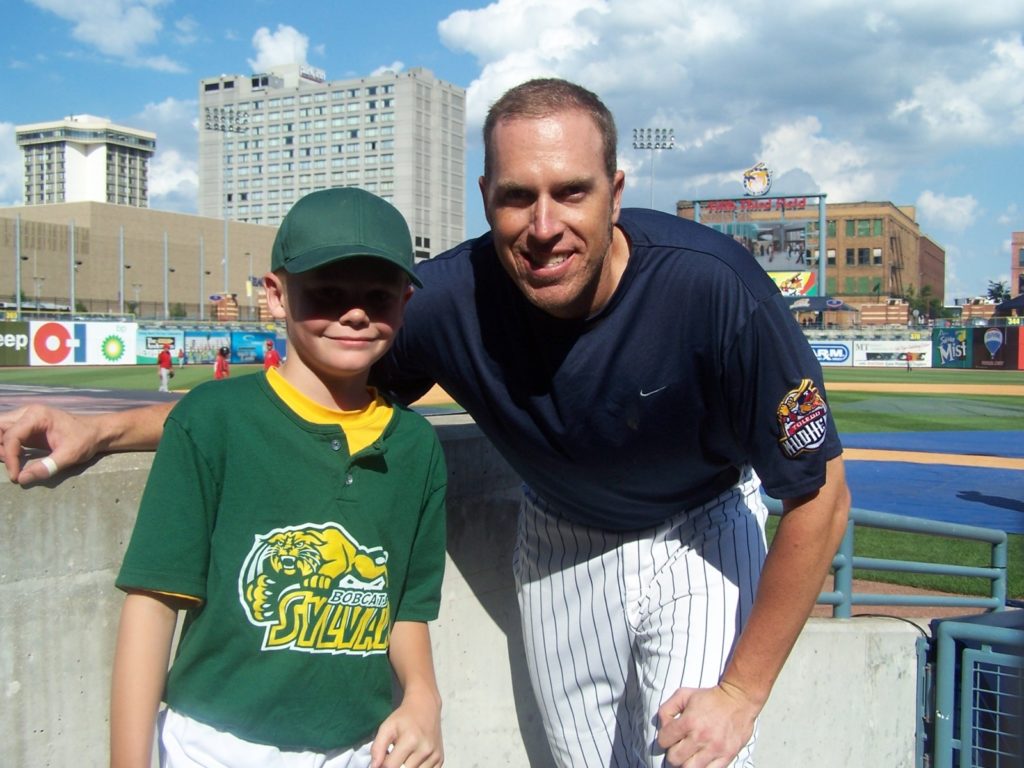
The writer’s son Brady with minor league home run king Mike Hessman at Fifth Third Field in 2008. Hessman, once again playing for the Mud Hens, has hit a career 417 homers in the minor leagues. Photo courtesy Jeremy Baumhower.

My son has always been a professional baseball player. I mean, he’s always played for money and compensation, since he was 4 years old.

Flashback to 11 years ago.

The rules for our front-yard game of catch, were pretty simple; Every time my son would succesfully throw the baseball to my mitt, he would win a $1, and every time he caught the ball, he would earn another.  

The first couple of outings, Brady, would make between $5 and $10. We would end the evening session with tense negoiations, with management succefully able to negoitate the sum down, for either ice cream or candy. Over the following weeks and months, our game would continue. The amount of funds my son’s arm would generate, steeply inclined upwards of $100-a-night; but since he was only 4 years-old (without an agent), I was always able to escape with buying baseball cards and M & M’s.

This bribery scheme was hatched with a simple goal and dream; I wanted my “1 in 68,” (1 in 68 children are on the autism spectrum) beautifully-gifted child, to fit in.  I believed at the time, that if I could give my son, the love of baseball, specifically the Detroit Tigers — we would have a venue for conversations and a chance to mask his unique traits amongst his peers.   Miraculously, it has worked.

The phone rang on a Sunday night, it was a parent of Brady’s Kindergarten classmate.  The unexpected solicitor wanted to see if I was interested in coaching T-ball, I have no idea why I was picked, or how many “nos” happened prior.  I proudly accepted.   The following evening was the night of our inaugural practice.  Brady was outfitted in jeans, a Tigers T-shirt, an English “D” cap, and a recently purchased bat. As we walked to the baseball diamond, my son tossed-and-dropped his mitt, with every stride. The first child that arrived moments later, Nick Olnhausen, was wearing a Mud Hens’ tee, white baseball pants, and double-wristbands on each arm. Nick was kind enough to bring his own personal catching equipment and batter’s helmet, in a equally-nice baseball bag.  
Many fears of fatherhood failure instantly flooded my soul.

 T-Ball evolved into “Coach Pitch,” which turned into “kid-pitch” and eventually travel baseball.  My dream for my son,  since that first time stepping on the grass at Sylvan Elementary — was for him to love the sport when his body’s coordination would match his size. My bigger fantasy was the hope that he could one-day make his High School team. It wasn’t about potential letters sewn on overpriced jackets, but social acceptance.

When I was nine years old, the Detroit Tigers won the 1984 World Series. The summer leading up to Fall Classic, might have been the greatest for children in Northwest Ohio. There wasn’t a single day we failed to play baseball. Armed with long yellow whiffle ball bats and tennis balls, kids would dream to be Lou Whitaker, Kirk Gibson, Larry Herndon or anyone else in Sparky’s lineup. 

My favorite player was the center fielder, Chet Lemon. It wasn’t for Chet’s tenacity on the basepath but for the way he chased down fly balls in the outfield. Number 34 didn’t use the traditional and coach-endorsed method of using two hands. Mr. Lemon used one. I quickly adapted his style, and remember my Dad yelling from the sideline: “Use two hands, Chet Lemon.” My dad was not a fan of his approach to the game.

I knew if my son would find a Tiger of his own, he’d be cursed for life. Brady found #30, Magglio Ordonez. in late 2006.  Magglio hit a walk-off home run, that sent Detroit back to the World Series. One of the symptoms of 1-in-68 children is delayed speech. 

Brady received a gadget that contained Dan Dickerson’s famous radio call of Magglio’s blast. “Monroe edges off of second .. the one-oh, a swing and a fly ball, left field … it’s deep … it’s WAAAAAY BACK … THE TIGERS ARE GOING TO THE WORLD SERIES!” My son would play this audio track repeatedly, while mimicking Ordonez’s triumph trot around the bases. He used this movement as a way to calm his brain, something he still does today. It did not take long, but Brady’s speech start catching up.

His love of the Tigers became an obsession. Like most boys, he wasn’t a fan of books, but we started catching him reading (unprompted) and memorizing the back of the Tigers’ baseball cards. The statitsics made sense. 

As he learned about the inner-workings of the Major Leagues — the Toledo Mud Hens became the focal point of his education. He got to witness up-and-coming players, rookies, and veterans on a rehab assignment, including non-Tigers like Curt Schilling and Daisuke Matsuzaka. He would witness and interact with the Hens during one of their summer baseball camps, and proceed to see the very same players later take the field in Detroit. Every season, we would take his current team to a Mud Hens game. One of team nights, we were at Fifth Third Field, and watched on the Jumbotron as Justin Verlander threw a no-hitter.      

For his ninth birthday, Brady was given the chance to throw a first pitch before a Mud Hens game.  He had recently started pitching, was fascinated by the mound and the alleged advantage given to the pros.   During his little league games, the distance was 40 feet, and his accuracy was suspect. Imagine a smaller version of Charlie Sheen’s character from Major League — before he got the eyeglasses. With his teammates watching from the stands and two nervous parents watching from the infield. Brady took the ball, climbed the mound and delivered a 60 foot, 6 inch strike. The crowd was appreciative with his effort. As he left the circle, he acknowledged the cheers with a simple tip of the cap, like he’d been there a 1,000 times before. 

Over the last decade, the Mud Hens have been a part of our extended family. Going to a ballgame at the corner of Washington and Huron, has felt the same as car-ride to Grandma’s house.

The game of baseball has provided a running topic of conversation between a man and his son. It’s been a shared experience and a way for us to talk about many other things. This pastime has provided normalcy for my “1 in 68” child. Fifth Third Field has been the home of so many breakthroughs — I wouldn’t even know where to start.

Brady celebrated his fifteenth birthday on April 9th. The Mud Hens’ season had yet to reach the Glass City.  Five days prior, he pitched from another raised mound — the season opener for his freshmen team. While wearing the #30, Brady threw a complete-game, allowing one run, while striking out nine. It took 85 pitches and his teammates’ bats, to give him his first high school win.

I don’t know where it goes from here, but I am excited to find out what he does next.

Happy Birthday, Jackie! 

Ex-Tiger Maroth to mentor Mud Hens arms

0
Mud Hens Pitching Coach Mike Maroth pitched for the Detroit Tigers from 2002-07. He pitched for the Mud Hens in 2001 and 2002. Toledo Free Press photo by Christie Materni.

There is a saying in baseball: “Pitching wins championships.” That seems like simple enough logic, but behind every great pitching staff is a pitching coach. This year, the Mud Hens welcome a familiar face to fill that role in former Tiger and Mud Hens pitcher Mike Maroth.

Maroth played in Toledo during 2001 and 2002, while the team was transitioning from its previous location at the Ned Skelton field in Maumee to its new digs at Fifth Third in downtown Toledo.

“The fans were great,” Maroth recalled.

Maroth went on to pitch for the big league club in Detroit from 2002 to 2007 as a staple to the starting rotation through a few rough years and into the new age of Tiger domination in the American League Central.

Once his time as a player had come to an end, a new opportunity presented itself—one that he had never considered during his time on the mound.

“I never saw myself as a coach while playing,” Maroth said. “I didn’t even entertain the thought, which is crazy, because now it’s what I’m doing and I love it.”

In 2011, Maroth became a coach for Detroit’s class A affiliate, the Lakeland Flying Tigers.

“Once my career was over, I wanted to know some options about staying in professional baseball,” Maroth said. “The opportunity to coach in Lakeland came up. I was living in Orlando, so it was a good fit and opportunity for me to try it out while still living at home. It didn’t have an impact on my family as it would if I were leaving for the summer and not seeing them for extended periods of time. That was very appealing and it allowed me to give it a try and see if I liked it.”

“After I started, it was something I fell in love with doing.”

Despite his relatively short service time as a pitching coach, Maroth has begun to develop his own philosophy to the craft, and he especially emphasizes adaptability to different personalities.

“There are many approaches to coaching,” Maroth explained. “Everyone’s a little bit different. I try to cater to each player separately and evaluate all aspects of pitching, whether it is things like mechanics or their approach is to games. I try to evaluate each pitcher separately, because everyone’s got different strengths and weaknesses, and then I give them feedback.

Maroth said that one of his primary roles as a coach is to provide his pitchers with information and encouragement.

“This game is very much about failure. There’s enough failure that happens in the game, and I want to be someone who is always encouraging to them.”

Maroth said that confidence can sometimes be an issue when working with so many young pitchers trying to work their way up to the majors, but not every case is the same.

“There are guys who are young and very mentally mature and can handle those situations, and there are players who are older and still struggle with handling the mental aspect, the adversity and the pressure. If a pitcher doesn’t have confidence in himself, then it is going to be very difficult for him to do his job. They’ve got to believe in themselves.”

Maroth is excited and optimistic with the roster of players he is working with now that he is back in a Toledo uniform.

“We’ve got a good mix of pitchers,” Maroth said. “We’ve got some junk pitchers, and we’ve got some guys that have been around, and some hard throwers. It’s a real good mix and balance of different styles. That’s always good, because it gives opposing teams some different looks.”

Maroth explained that the Hens pitching staff got an unexpected boost on the other side of the plate when Tigers catcher Bryan Holaday was recently assigned to Toledo to help with handling the Hens staff.

“It’s going to be very valuable having him around,” Maroth said. “He’s a great guy and great catcher. He is going to bring a lot to our staff, because he’s going to know how to work with these guys.”

“Obviously, you like to see him in the big leagues, but to have a guy like that is very valuable. It will really be helpful to these guys, especially those who are at AAA for the first time.”

Maroth also described some of the things he expects from his pitching staff come Opening Day, and he expressed confidence in their ability to perform what is asked of them.

“The most important thing to do as a pitcher is to throw strikes. We’ve got some guys here at spring training who are doing that and are not afraid to attack the plate. I expect them to come out of the pen ready to get hitters out. We’ll have some hard throwers coming into to the game throwing strikes.”

Maroth is also looking forward to seeing some Hens players move up to baseball’s highest level in Detroit.

“I want to help these guys,” Maroth said. “I’m looking forward to watching these guys succeed and move up, and watching them chase their dreams, as I once did, and to help them any way I can.”
“It’s exciting to see their reactions and watch them pursue something they love to do. It was the same thing [for me] when I was at Lakeland, only now when these guys move up, they are going to the big leagues. That’s pretty exciting, because that’s their dream.”

Altvater: Let’s play two!

0

Nothing says the beginning of spring like the crack of a bat or a baseball smacking the leather of a catcher’s mitt. Baseball season is upon us once more.  Although the Mud Hens will open 2015 on the road,  their first home game is Thursday, April 16, a day/night double header versus the Columbus Clippers.

Every year “Opening Day” becomes one of the most anticipated events in downtown Toledo. Area restaurants will be jammed beyond capacity, numerous impromptu tailgate parties will be held in parking lots around the stadium, as well as, several well-planned and catered affairs.

The Mud Hens have provided the next best thing to major league baseball in Toledo since 1883. Do you know how the Mud Hens got their original name?

In 1896 the local team was called the “Swamp Angels” and played their home games at Bay View Park. The field located outside the city limits was exempt from city Blue Laws, thus beer could be sold for Sunday afternoon contests.

Bay View Park sat near a swamp inhabited by the American Coot, also known as, the Mud Hen. The name stuck and the Toledo Mud Hens have been a professional team since the early days of baseball.

Toledo baseball fans have been able to witness some of the biggest names in the game. Casey Stengel, Jim Thorpe, Bobby Murcer, Kirby Puckett, Curtis Granderson, Doug Fister and Max Scherzer are just a few of the familiar names that have adorned Mud Hen’s rosters over the years.

Toledo native Jamie Farr, as corporal Max Klinger, even wore a Mud Hens baseball cap on the popular television series M*A*S*H.

To the untrained eye baseball seems like an athletic competition in slow motion. The leisurely pace is broken only occasionally by bursts of frantic action, when the batter happens to make contact with the speeding bullet being hurled by the pitcher.

Infielders and outfielders move as if in some time-worn dance to halt the batter’s attempt at taking each base and heading for the safety of home. As the action subsides fans can return to their hot dogs, peanuts and cold beverages to be amazed and discuss the events that just unfolded on the diamond.

True baseball fans understand the mental stress and force of wills being contested with every pitch. Managers are plotting strategy, catchers are taking the measure of each hitter and must be aware of any runner that happens to be on base. Each infielder constantly calculates the angles, spin rate and rotation of the ball should it be hit to them. Outfielders are always jockeying for the perfect position to be able to run down any fly ball hit in their direction.

Kids learn to play baseball at a young age and can relate to their heroes on the field. Every kid thinks that will be him on the diamond someday. Fathers take sons and daughters to the baseball park and cherished memories, of a day spent together, bond the parent and child for life.

I can still remember by father taking me to several Cleveland Indians and Cincinnati Reds games. The memories bring a smile to my face every time I think of them.

Mud Hens fans get the opportunity to watch young players trying to make it onto a major league roster, as well as, a few veterans, who have had a “cup of coffee” in the bigs and are trying to get back.

The Mud Hens have had a very successful relationship as the AAA affiliate of the Detroit Tigers since 1965. Tigers that suffer an injury are often sent down to Toledo for a few games of rehab assignment before  heading back to the big club. When the big club suffers an injury to one of its key players, the first place they call for a replacement is Toledo.

This will be the 13th season opener for Fifth Third Field in downtown Toledo. A successful Mud Hens franchise has done a great deal to help revitalize the area around the ball park and a plethora of dining and entertainment options dot the area. There is no better park in baseball to spend a summer evening than Toledo’s Fifth Third Field.

Whether you watch the game from your seat in the upper deck or stand along the outfield wall, there are no bad seats in Fifth Third Field. If ball park franks aren’t your thing, there are a multitude of food choices available from the vendors inside the ball park that can fill most appetites.

Don’t forget to visit the Mud Hens shop in the right field corner of the stadium. You can never have enough baseball caps and every kid, young or old, can find something to add to their baseball collection. 

Toledo baseball fans are indeed lucky to have the Mud Hens. Make some memories with your children. Leave the smart phones, tablets and Ipods at home. Bring them down to the ball park, have a hot dog and maybe even snag a foul ball.

As the late Hall of Fame star, Mr. Chicago Cub, Ernie Banks always said,

“Let’s play two.”

Mud Hens mix flavors with new food offerings

0
The s’more donut will debut at fifth third field this season at the tom+Chee Kiosk, located in section 113. the treat is among 14 new food offerings the mud hens are introducing For fans. Toledo Free Press photo by Joel Sensenig
The s’more donut will debut at fifth third field this season at the tom+Chee Kiosk, located in section 113. the treat is among 14 new food offerings the mud hens are introducing For fans.
Toledo Free Press photo by Joel Sensenig

Let’s face it: the hot dog will never be too far from the baseball fan’s heart — or stomach.

However, the Mud Hens believe fans can save a bit of stomach real estate for some more adventurous fare.

The team is introducing 14 new items this season, including a couple with significant head-turning appeal.

Inspiration for ballpark food is not hard to come by in today’s foodie culture, according to Dusten Brown, executive chef for A Cut Above Catering, the official catering group of Fifth Third Field.

“A lot of it comes from looking around the country, finding what are the popular things coming out,” he said. “We also have a lot of help from our purveyors, letting us know what items we could mix together.”

One thing Brown mixed together was pork — three different types of pork are present in one of his favorite new dishes: The Triple Play Nacho is available at the stadium’s El Burrito Misterio stand.

“It’s one of my little pet projects,” Brown said. “I am a big fan of pork, and being able to put as many pork products as I can on one item is great.”

The nachos feature “We Be Ribs” pulled pork, bacon, nacho cheese, tomatoes, jalapeño peppers and sour cream. Because two pork products are hardly enough for a plate of pig-centered nachos, pork skins replace the typical tortilla chips here.

Last year, the Mud Hens debuted their Mac & Cheese Dog. This year, the team is trotting out the Mac & Cheese Burger, served at Gilhooley’s.

The pretzel bun makes its debut at the stadium with the Cheddar Peppercorn Sausage, sold at Suds & Wieners. It’s a smoked sausage filled with cheddar cheese and peppercorn, topped with sauerkraut and housed in a pretzel sausage bun.

The Mud Hens didn’t forget dessert.

“I think guests are really going to love the Oreo churros,” said Corey Pleasant, casual dining manager for A Cut Above. “They’re an Oreo pastry, almost with a brownie-like texture to it, but it’s deep fried so it’s got a little crust on the outside and chewy on the inside. The creme [packaged in a separate dipping container] is the same creme that’s on the inside of an Oreo.”

Sure to raise some eyebrows, the Pineapple Habañero Sundae is available at Farr Out Funnels. Featuring fried pieces of pineapple on Toft’s ice cream covered with a habañero glaze and whipped cream, the dessert isn’t what one might assume from the name, Pleasant said.

“I think a lot of people will be shocked with the sundae,” he said. “You have the habañero name in there, so you probably think it’s spicy, but it’s not. It’s more of a sweet glaze.”

Ever wished your s’more around the campfire could be held together by something a bit softer, more delicious and … well, calorie-laden? Try the S’More Donut, which is precisely what it sounds like. The dish is made possible by the Tom+Chee kiosk located in section 113 on the main concourse. The chain restaurant will also feature the Grilled Cheese Donut.

Other new offerings at Fifth Third Field include: Fried Green Tomato Burger (Gilhooley’s); Nutella Poppers (Hen & Hound); Holy Toledo Chicken Sandwich (one-pound grilled chicken breast on a submarine roll with Italian dressing, lettuce, tomato and onion), Red Velvet Cake, House Sirloin, Chili Mac and Chicken Kabobs, all sold at the BirdCage Bar and Grill, a sit-down restaurant on the club level at the stadium.

The Hens are hosting the inaugural Taste of Fifth Third Field on May 8. During the tour, fans will sample eight featured dishes, as well as take home a complimentary souvenir from the Swamp Shop. Tickets are $42 and must be purchased in advance at mudhens. com or by calling the box office at (419) 725-HENS.

As the song says, “Buy me some peanuts and Cracker Jack.” Oh, and don’t forget the habañero glaze.

Win or lose, you can count on fans to fill ‘the Fraction’

0

I could write about how the Mud Hens finished below .500 last year, despite outscoring their opponents. How the team was middling in pitching and near the bottom in both batting and on-base percentage, but absolutely drilled the long ball. I could talk about how power hitting is what failed the Tigers last year, and it could very well be what failed the Hens as well.

But, let’s be truly honest … can you tell me what the Hens record was last year? Can you tell me how many games back they finished? How close they were to the playoffs? Who led the team in home runs? (OK, that one’s a gimme.)

My point isn’t a negative one by any stretch. In fact, it’s an amazing truth of minor league baseball: Win or lose, we always come out to the ballgame.

Last year was an odd year. The Hens were an even 36-36 within the friendly confines of Fifth Third Field last season. The pitching was OK, the batters maybe flied out a little more than they should have.

Still, we came out and watched: 545,000 Hens fans filled out the seats at “the Fraction” in 2014. Average it out across 71 games (one of them was a traditional doubleheader), and that’s nearly 7,700 fans per game in a stadium that seats almost 9,000 (85 percent capacity for the year).

Compare that to our major-league brethren — the Detroit Tigers brought in an average of 36,000 fans a game in a stadium that seats 41,000. That math comes out to 88 percent for the American League Central champs.

Across Lake Erie, it’s a different story: Despite a banner year and finishing five games back of the Tigers (and four games back of wild card and postseason Cinderella Kansas City), the Cleveland Indians were not bringing in the fans. Only 18,400 Tribe fans showed up to a game on average. Only Tampa Bay had worse raw attendance numbers, but with Progressive Field seating 42,000, the Tribe clocked in a major league low of 42 percent average capacity. It’s no wonder that the remodel at the corner of Carnegie Avenue and Ontario Street is claiming some 5,800 seats — who needs them?

Sometimes, the sports elitist in me starts to flare up when it comes to Toledoans’ relationship with the Hens and Walleye.

It’s no secret that when a fan walks up to the box office to get a ticket, he or she very likely doesn’t know where the Hens are sitting in the International League standings, or even that they play in the International League at all.

But that’s not why we go to Mud Hens games, is it?

We go down to Fifth Third Field because we support the name on the front of the jersey. We head Downtown because there’s no better way to spend a spring or summer evening than down at the ballpark. We park our butts in the seats because we want to pass the tradition of scoring a baseball game with paper and pencil on to the next generation. I might get a little salty at the between-inning shenanigans, but they’re not for me, they’re for the young ones. And the team? They’re the world famous Toledo Mud Hens, and we’re their world famous fans.

(Also, pork rind nachos are a thing at the Fraction this year. If that doesn’t bump attendance up to 90 percent, then I don’t know you, Toledo.)

“Shaggy” Matt Culbreath is sports director at 1370 WSPD.

Holaday looks to bring Detroit experience to Toledo tenure

0

Bryan Holaday knows he’s just one injury away from a trip up to Detroit.

After spending all of last season with the Detroit Tigers, the 27-year-old catcher is beginning the 2015 season with the Toledo Mud Hens, a team he’s quite familiar with.

Former Mud Hen James McCann has replaced Holaday to serve as starting catcher Alex Avila’s backup to begin the Major League Baseball season, but Holaday knows that call to play 50 miles north could happen at any time.

“I’m very optimistic,” Holaday said at the Mud Hens media day April 7. “I get a chance to play every day and get better. Not everybody gets a chance like that. I’m really excited — we have a good group of guys here and I’m going to learn and get better.”

Holaday, who spent time in Toledo in 2012 and 2013, will look to improve his numbers in Detroit last season, when he appeared in 62 games, turning in a .231 batting average in 156 at-bats. The reserve catcher, called upon to fill in when Avila missed time with concussion problems, actually bested Avila’s average of .218.

“Just getting at-bats is going to be very helpful,” Holaday said. “I’ve made a lot of adjustments with my swing in the off-season and my timing will benefit a lot from getting a lot of at-bats.

“It doesn’t matter what you’re doing, when you’re making adjustments, it’s not going to come overnight. In the spring, you have a lot of guys there, so you’re getting a limited amount of work, it’s tough to get that timing down and get that good feeling,” he said. “Toward the end of spring, I started feeling better and better, and I’m looking to carry it into the season.”

Holaday believes the Mud Hens have some strength on the mound to start out the season.

“Most of these guys are guys I’ve known for a while and caught before,” he said. “We’ve got some really good arms, some great arms out of the bullpen so it’s going to be a lot of fun catching these guys and working with them.”

Program seeks dialogue, action plans for improving race relations

0

When Karen Shepler was in college, the Black Power movement was in full thrust. It was then she first got a hint of her own white privilege — although no one told her what that was. That time period was a catalyst that began her life’s work of educating to end racism.

“My father was bigoted and was a klan member,” Shepler said during a recent telephone interview. “My brother and sister had done some things around (ending) racism. Now it stops with me. I am going to do anything I can do to eliminate racism in my time. Since my college days, I’ve been trying to do something about it.”

Shepler, a pastor who has recently come out of retirement, started the Dialogue to Change program in Toledo. The program, which brings together people of all races in a class format to discuss their personal experiences with racism, is meant to affect change.

“The purpose is to bring together people of various backgrounds to discuss the whole issue of racism and their personal stories of how racism has affected them, particularly people of color,” Shepler said. “And in some way, it’s to help white people understand white privilege.”

The classes are two hours a week for six weeks. They use exercises and a curriculum to stimulate discussion, but, Shepler said, most of the sharing is personal experiences. At the end, they have what’s called an Action Plan.

“We can talk about racism forever but if we don’t do anything to try to stop racism, it’s just talk. So we put together a plan of action,” Shepler said.

The most recent Action Plan was held in March. Some of the groups’ action plans included proposals for a third-grade classroom to participate in a pen pal project, a tool kit for faith-based organizations to put together class discussions and WTTE Channel 28 was invited to film the next Dialogue to Change from April 13 to May 20.

“We’ve had over 200 people participate in the group starting in the fall of 2013,” Shepler said. “We had two or three sessions in 2014. One in 2015. We’ll do another in the fall of 2015. … We’re lifting the consciousness of white people to understand institutional and structural racism. It’s all a part of the program.”

Shepler grew up in Waterville and Whitehouse, was ordained in 1982 and was pastor at Monroe Street United Methodist Church from August 2001 until she retired in June 2013.

The Dialogue to Change forum is a program by Everyday Democracy, a project of The Paul J. Aicher Foundation, a “private operating foundation dedicated to strengthening deliberative democracy and improving the quality of public life in the United States,” according to the website, www.everyday-democracy.org.

All classes are held at libraries or churches. To sign up for a class, go to www.dialoguetochangetoledo.org.

Pounds: Baseball’s back

0

People ask me what I do in winter when there’s no baseball. I’ll tell you what I do. I stare out the window and wait for spring. — Rogers Hornsby

One of my hobbies is visiting baseball stadiums. But even though I’ve been to almost all the major league fields, I have to say Fifth Third Field right here in Toledo is one of the best I’ve been to, major or minor. The sight lines, the food, the atmosphere — it’s all great. There’s something about a baseball game that has a way of changing your attitude.

Growing up in New Jersey, I was a Baltimore Orioles fan. But now that I’ve lived in Toledo for 15 years, I find myself rooting for the Tigers, thanks to years of watching the Mud Hens and getting to know some of the players who have made the jump to Detroit.

There is truly nothing to match a clear, sunny day at the ballpark. It’s a family event; it’s a guys’ day out; it’s a girls’ night out; it’s smells and sights and emotions that no other public gathering can evoke with such clarity and impact. Baseball offers a few hours’ escape from the travails of life like few other pastimes — movies, books, theater, music — can. That distinct crack of the ball on the bat and the undeniable thump of the ball in the glove are symphonies, car chases and page-turners all wrapped up in one fluid, unrestrained-by-the-clock afternoon.

Opening Day at Fifth Third Field has become one of the area’s biggest events; every seat will be filled, the suites and hallways will overflow with excited fans and the Huron-Monroe-Washington-St. Clair streets block will hum with foot traffic and activity.

For 11 years, Toledo Free Press has marked Mud Hens Opening Day with what’s become the biggest and most comprehensive guide published in the market. We understood from our first season Downtown how important the Hens are to Toledo’s identity and spirit, and we have taken great care to share their successes and challenges with our readers.

The Hens have developed a national reputation for creative, innovative and — most importantly — fun promotions. As illustrator Don Lee has captured on this week’s cover, Muddy is expanding his pop culture reach beyond the popular annual “Star Wars” Night to incorporate “Jurassic Park” and “Back to the Future” in his promotional plans for family fun. The fourth installment of the classic dino-centric series comes out this summer, which also marks the 30th anniversary of Dr. Emmett Brown and his DeLorean time machine.

This year’s Toledo Free Press Opening Day issue, compiled and edited by Managing Editor Joel Sensenig, positively thrums with the vibrations of a new season. We are grateful to our staff, advertisers, readers and the Mud Hens organization for helping to make this issue one of our biggest and best of the year.

We take pride in our home team, and we will continue to show that by offering the best Opening Day coverage we can, this season and every season. See you at the game!

Thomas F. Pounds is president and publisher of Toledo Free Press. Contact him at [email protected].

Hays: April showers bring May flowers

0

April showers bring May flowers: I always liked this saying when I was a little girl growing up. Most of my family and neighbors thought the rainy days of our fourth month intruded on the outdoor work that springtime brings for homeowners, but I loved walking and splashing in puddles.

My favorite childhood joke was, “It is really raining cats and dogs outside. I know that because I just stepped in a poodle!” Yes, I know: corny. But it sure made me giggle.

So, back to those flowers. If we had a dry April, then the flowers we are so anxious to see in May would have a much more difficult time sprouting without the nourishment of the rain. We wouldn’t have the beauty of May without the dismal darkness of storm clouds in April. We judge the clouds as yucky rainy days, when actually they are the days that prepare for the kaleidoscope of blooms just a few weeks later.

Life mimics this. We look at the “showers” in our lives and concentrate on the clouds, the canceled plans, the scary thunder of troubles and the lightning-sharp pain in our spirits. We are so blinded by the fog after the storm that we find it difficult to see the “flowers,” the things blooming in our lives that bring us a garden of possibilities. Even when the clouds are lifted, we stand dazed, allowing bitterness, regret, shame and unforgiveness to distort our view of all the beauty that lies ahead.

It would make life a lot easier if we had doppler radar and all the fancy weather-predicting equipment our local forecasters have at their disposal to alert us when the winds of change are coming. A machine to tell us when our hearts should take cover and when we should carry an umbrella to help repel negativity, so it might roll off without drenching us in worry. But, since we never know what life has waiting for us around the corner, the best defense against the storms is learning from them as they come.

As a child, it is difficult to understand why the showers in April have to happen. All you want to do is run and play and ride your bike. Instead you are told you have to stay inside and be bored. But as we get older, we learn we can survive these times, we can thrive during these times and we can learn great lessons. Those lessons become the nurturing ingredients we can use to create the May flowers, the times in our lives that make it all worth it.

Those who can’t or won’t open their eyes and their hearts to making a plan to move forward never realize the full spectrum of what life has to offer. They remain stuck in their ways, stuck in ruts and stuck in the muddy waters of regret. The clouds don’t always cover the sky completely, but you count on them coming out time and time again. The sun doesn’t always shine brightly, but you can always count on it to shine through, even if just a bit, on the cloudiest of days.

You can focus on April or you can prepare for May. When the tulips and daffodils and daisies bloom it is so easy to forget what helped bring them up from under the deep soil and into the light. But the keeper of the garden never forgets. They plan, they design, they prepare, they plant, they nurture.

Be the keeper of the garden in your life. Allow your life to bloom with beautiful colors. Happy spring!

Pam Hays is president and founder of The Arms Forces, www. thearmsforces.org; (419) 891-2111.

Ballpark treated to its new field of greens

0
Crews put in two 16-hour days to get the work done in mid-March. Toledo Free Press photo by Sarah Ottney

It’s a process that has only been done two other times since Fifth Third Field opened in 2002.

Last month, close to a dozen workers spent two days laying new sod onto the field in preparation for the Mud Hens’ April 16 Opening Day doubleheader. Sod started coming in March 15 and by the next day, crews had unloaded 26 flatbed trucks and laid 550 rolls of Kentucky bluegrass onto the field.

“Our main goal is to have [the field]consistent every day the guys play on it,” said Jake Tyler, sports turf manager at Fifth Third Field. “The main job of the minor leagues is player development, and you want the guys to have a nice surface to play on so they can hone in on their skills and get themselves to the next level in their career.”

Tyler said he subcontracted the work to Medina, Ohio based company Agricultural Design.

“Between their crew and my crew, we had 10-12 guys working about 16 hours a day,” he said. “We got the job done in two days.”

Crews put in two 16-hour days to get the work done in mid-March. Toledo Free Press photo by Sarah Ottney

According to Tyler, each roll of new sod — measuring 4 feet wide by 50 feet long — was unloaded and transported to the field one by one by a fleet of forklifts, and then fed into a machine that rolled it out into the correct spot. Workers then used pitch- forks to pull the seams together.

Once the sod was down, Tyler said he and the crew placed woven plastic sheets atop the grass to raise the field’s temperature and promote healthy growth in time for Opening Day.

“It kind of acts like a greenhouse on the field,” he said. “Even though it was 30 degrees and sunny outside, the soil temperatures were in the mid-60s. That’s what allowed it to really green up, root down and take hold out there.”

Tyler said the new grass is more tolerant to disease, stress and foot traffic.

“I think the field is kind of like the 10th man on the team,” he said. “The better the surface they play on, the better they’re going to play.”

Toledo Free Press photo by Sarah Ottney

The new green came from Graff’s Turf Farm in Fort Morgan, Colorado, a choice Tyler said was easy given our region’s climate and the supplier’s reputation of providing sod to the Mud Hens’ Major League Baseball affiliate, the Detroit Tigers.

“When we’re sodding a field this time of year, if we try to get sod from anywhere local the fields are really wet, muddy and soft, and it would be really difficult for anybody in this area to harvest the sod,” he said.

The players will not be the only ones benefiting from the new turf. Tyler said fans can expect more aesthetically pleasing grass and much shorter rain delays.

“We don’t rain out here very often,” he said. “But once the rain stops, the field needs to be in immaculate condition so the guys can get out and play, and so the fans can have that experience and enjoy their time.”

While the field normally undergoes renovations every five to six years, Tyler said he and his crew held off until the turf was roughly nine years old so they could replace it in conjunction with December’s Winterfest.

“Building a hockey rink on the field, we would have had to replace the turf anyways,” he said.

Work started back in October as the groundskeeping crew installed a new irrigation system, stripped out the old turf and covered the field with a blanket so there wouldn’t be any exposed grass during Fifth Third Field’s ice-cold festivities.

The crew spent two days in early March plowing snow off the field to prepare for the project. Tyler said he expects the new sod to last up to six seasons.

“I love the attention to detail that is required to maintain the field,” he said. “It’s 2½ acres that we have to look at every square foot of. You get instant gratification at the end of the day when the job is done, the field looks its best and you hear the people say, ‘Oh man, the grass looks good.’ That’s instant gratification every single day.”