Home Blog Page 134

Review: Kate Michaelson

0
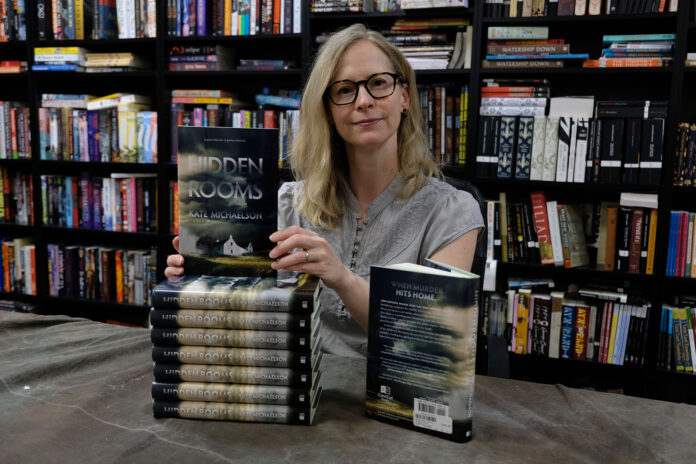
Author Kate Michaelson displays her inaugural novel, Hidden Rooms, at the Gathering Volumes bookstore in Perrysburg, where she’ll read excerpts for the Wine and Words Book Club on Oct. 1. (TFP Photo/Lori King)

Toledo academic and poet lends talents to mystery genre

PERRYSBURG – Riley Svendson enters the home of her friend and future sister-in-law, Beth, expecting to pick up her bridesmaid dress and be on her way. Though everything looks normal, even idyllic in a very Midwest Living kind of way, Riley’s sister-in-law is nowhere to be found. As she continues to look around the property, a sick feeling comes over her as she finds signs of foul play.

In this opening scene of Hidden Rooms, the main character’s internals unveil another important part of the book: that Riley doesn’t quite trust her instincts anymore due to a mysterious illness. Both that illness and the fate of her friend are central to this character-driven debut novel by Toledo’s own Kate Michaelson.

Michaelson’s Medical mysteries

Michaelson began having symptoms of Lyme disease in 2009, though it took a significant amount of time and testing to finally receive the diagnosis.

“I had a CT scan, an MRI and nerve conduction studies,” she says. “Everything came back basically normal. A neurologist told me that she was testing me for MS, she said, ‘There’s nothing wrong with you neurologically.’ I just started crying because it’s so hard not having an answer.”
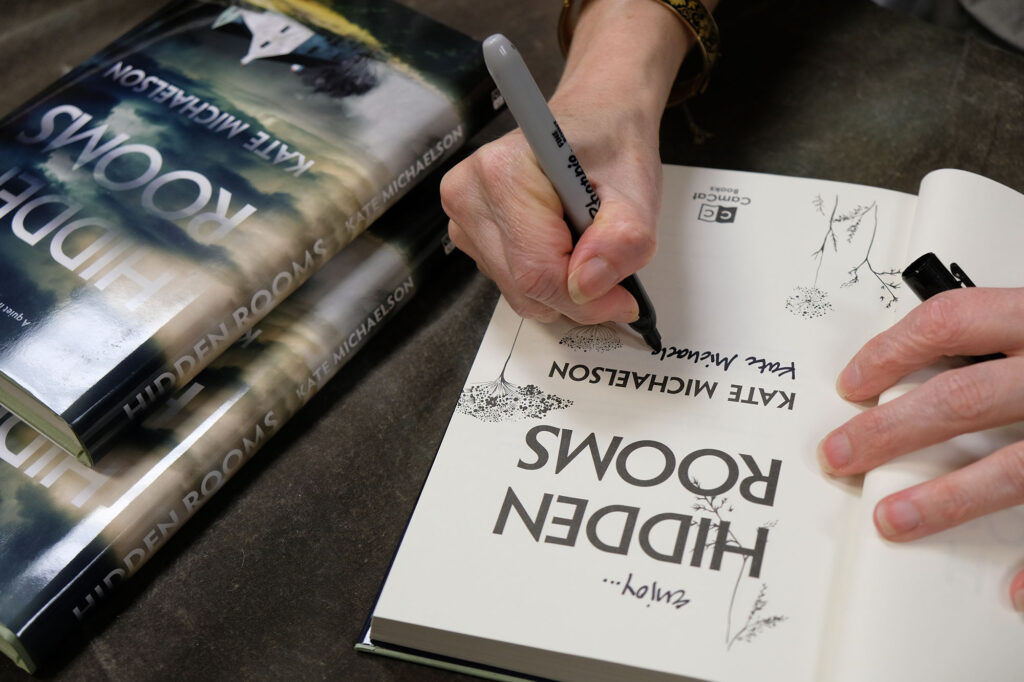
Author Kate Michaelson signs one of her inaugural novels, Hidden Rooms, at the Gathering Volumes bookstore in Perrysburg. (TFP Photo/Lori King)

Michaelson uses her personal search for a diagnosis to ground us in the main character’s world. The undertones within the loving-yet-dysfunctional family surrounding Riley are unsettling, even more so as we get the sense she’s not taken seriously in her health struggles. It’s subtle at times, but it’s there. Add that to the backdrop of a violent crime, and you’ve got yourself a page turner.

“It inspired me to write the book: the search for answers and how you start to not trust your judgment. You feel like something’s wrong, but you don’t get an answer,” she said.

The real North Haven

Though Kate has lived in Toledo for many years, she is originally from Greenwich, Ohio, a rural community that inspired the fictional town of North Haven, the setting for Hidden Rooms. She recently did a reading at the Greenwich Library, where she had a telling conversation with her first grade teacher about her literary aspirations.

“She reminded me that in first grade we did this young authors program, and I told her then that I was going to be an author. So I wouldn’t say I began the journey [as a writer] then, but it’s something I’ve always wanted,” Michaelson recalled.

Literary genre fiction

Michaelson grew up reading Agatha Christie mysteries and watching Murder, She Wrote and Columbo, but her writing pursuits as a young adult veered more literary and academic. She has an MFA in poetry and a Ph.D. in educational psychology. During the height of the COVID lockdown, she realized she wanted to pursue this idea for a novel that had taken root in her mind. 

I was writing academic articles that are so labor intensive, and hardly anyone’s reading them. And I thought, ‘Why am I doing all of this work on writing that nobody wants to read?’ That’s not to say there’s no point to academic writing.

Kate Michaelson

“I was writing academic articles that are so labor intensive, and hardly anyone’s reading them. And I thought, ‘Why am I doing all of this work on writing that nobody wants to read?’ That’s not to say there’s no point to academic writing.

Michaelson decided that if she can write a 300-page dissertation, she could at least try to write a 300-page novel.

That led Michaelson to seek out help from the Toledo Writer’s Group, where she brought in drafts of her first couple of chapters. She began to feel confident in the direction she was going with Hidden Rooms.

“They gave me great advice,” said Michaelson. “They said, ‘If it’s a mystery, it needs to have a hook. We need to turn the page at the end of the chapter. This isn’t your beginning.’ But they were very complimentary about the writing, and it was exactly what I needed to hear.”

It was actually during one of sessions with the Writer’s Group that Michaelson saw a missed call from Cam Cat Books. They offered to publish Hidden Rooms and Michaelson enthusiastically accepted. Since then, the author has been spending much of her time doing readings and speaking to the press about her book, which has been a huge hit among mystery lovers.

Part of what makes Michaelson’s work exceptional is the ease in which she employs figurative language. That’s not surprising for someone with a MFA in poetry, but it’s typically not what readers of literary fiction think of when they consider genre fiction. Michaelson embraces the tropes and format of the medium while asserting that mysteries can be as character-driven and richly written as any novel.

“The mysteries I love are just as compelling emotionally and have just as much of a character arc as any literary fiction to me,” she says. “That inspired me to write a mystery that isn’t solely about its plot-driven elements.”

What’s next?

Michaelson is working on the sequel to Hidden Rooms, also featuring Riley Svendson. This time, after human remains are discovered in North Haven, Riley investigates what may have been the murder of her long-lost childhood friend.

Along with this highly anticipated novel, Michaelson is working on a stand-alone novel about a professional mourner (yes, there is such a thing!) based in Sarasota, FL. 

Find Kate Michaelson’s work on katemichaelsonwriter.com. She’ll be reading at Gathering Volumes for the bookstore’s Wine and Words book club on October 1.  

About the Author:

Do you write everyday? No 

Where do you write? In my living room, on the couch. 

Do you have a word/page count you try to hit? My goal is 1,000 words when I’m drafting. 

Music or no music? No music. 

What are you reading right now? What Comes Around by Annette Dashofy. The other is Be Not Far From Me by Mindy McGinnis. 

When you are stuck during a scene, how do you move past that block? Getting up and going for a walk with my dog. 

Do you write only on the computer, or some longhand? I do longhand writing when I’m trying to brainstorm. 

Do you edit as you write, or save it for the very end? I do some editing as I write. I try to save it, but I can’t help myself. 

Best book you’ve ever read: That’s a tough one. I really like White Noise by Don DeLillo. 

Favorite writer: Right now, Tana French. 

Arlyn’s is made for music

0
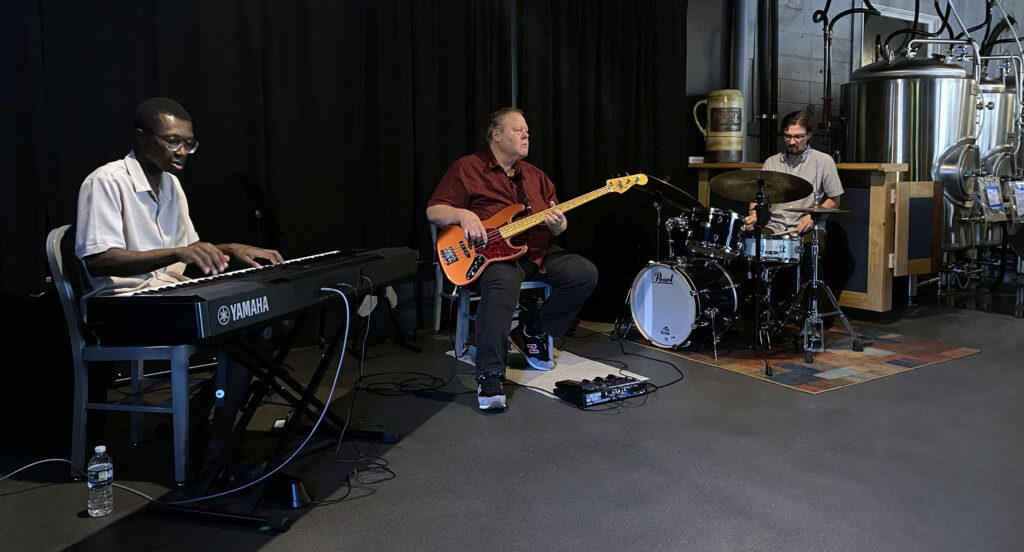
BGSU students and professors play during a Wednesday night jazz session at Arlyn's Good Beer. (TFP Photo/Lori King)

BG bar serves up good beer and live music

BOWLING GREEN – Eric Jones loves music, especially jazz.  

In fact, he loves it so much that he opened Arlyn’s Good Beer to give local musicians a steady place to play.

Before Arlyn’s opened on Feb. 5, 2020, students and faculty from Bowling Green State University were forced to jam in different local venues for decades. Jones said he attended their Wednesday night sessions for five years.

“They were kind of at the whim of bar owners who would let them play or pay them enough to play,” Jones recalled. “I had the chance to enjoy the jazz every Wednesday night. It looked like they were having trouble getting a place to play so I started talking about opening a bar.”

“And lo and behold, he did it,” said Jeff Halsey, a jazz bassist who plays regularly at Arlyn’s.

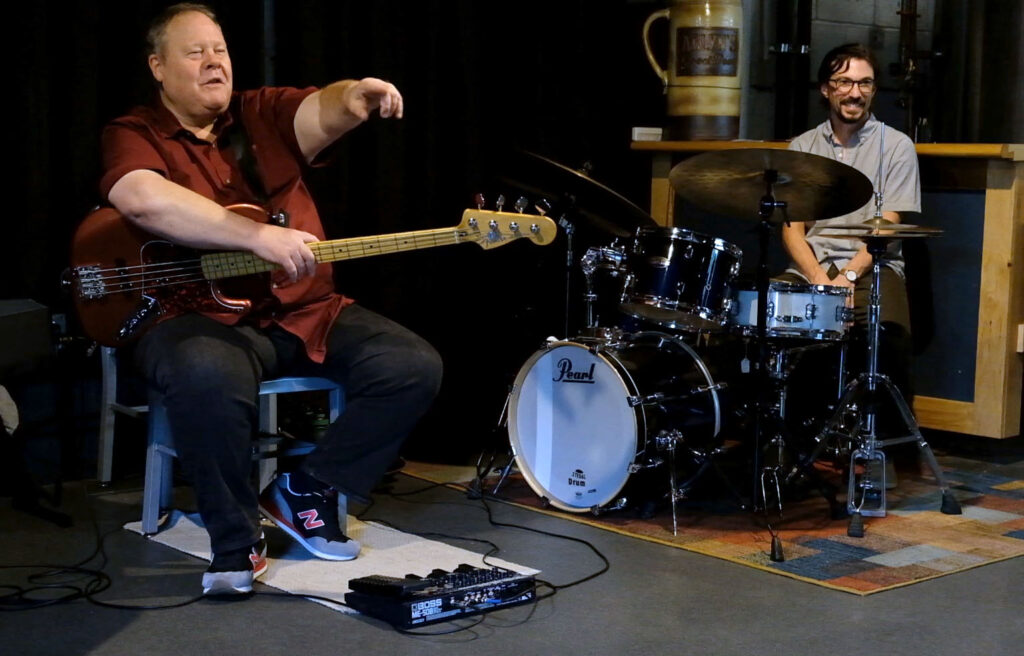
Jeff Halsey, center, performs with students and professors at Arlyn’s.

Jones retired as a professor of special education at BGSU and decided to take the plunge and open the bar, mainly to support live, local music.

Jones and his wife, Akiko Kawano Jones, teamed up with brewer Roger Shope and business partner Sean Brennan to buy a building and several acres of property on Hankey Ave., a side street just three blocks from downtown.

The new owners decided to name it after the building’s former owner, the late Arlyn Snyder, who ran a wood-milling shop.

The Joneses and partners opened Arlyn’s about a month before the world came to a screeching halt because of COVID. But Arlyn’s survived the pandemic and patrons know they can count on the venue for live music – and good beer.

Jazz is featured on Wednesdays, and blues and rock on Fridays and Saturdays, Jones said.

“It’s a fantastic place,” said Halsey, who just retired as a BGSU music professor and plays there on Wednesday nights. “It’s really cool, a beautiful space, and the beer really is good.”

“The community really likes it,” Jones added. “We hear frequently how much people really like the place.”

Somewhat surprisingly, Jones said the age of the patrons typically range from their mid-20s to 70+.

“People ask me if it’s popular with students. Well, not really. It’s kind of a mature adult hangout,” he said.

The beer brewed by Shope is mostly German and English ales and lagers.

“We decided early on to keep it simple, no fruity beers or sours. The only fruity beer we make is a raspberry ale. And we don’t have clever names; we just name them what they are,” Jones said.

The biggest night for students is Wednesdays. They come for the jazz. Many of the BGSU music students often join the band after the first set.

“The music students, they love it. They come there to play and to see each other,” Jones said.

He said about a third of them don’t drink because they’re under the legal age, but they can bring in their own soda pop.

Arlyn’s does not charge admission.

There is a half-acre beer garden outside with tables and chairs and picnic tables, and there is ample parking. The bar also doesn’t have a kitchen but food trucks open shop on the weekends and on many Wednesday and Thursday nights.

Arlyn’s Good Beer is at 520 Hankey Ave., Bowling Green, OH 43402. More information is available on its Facebook page.

Music Spotlight: Jeff Halsey

0

BOWLING GREEN – Jeff Halsey studied trumpet and piano as a child but found his instrument of choice by chance.

“I didn’t really pick it. I mean, it just happened,” he said.

His father, Tracy Halsey, worked full time in a day job and led his own band in the evenings. One night, which happened to be the biggest night of the year for musicians, his bass player called in sick for a New Year’s Eve gig.

“I was 13 years old and his bass player called in sick on that day,” Halsey recalled. “My dad said, ‘I want you to play bass tonight.’ I didn’t even know we had a bass in the house; it was upstairs
or something and it only had three strings on it, one string was off.

“I didn’t know anything about the bass. My dad said I want you to go ‘doom, doom, doom, doom’ all night long,” Halsey said, singing a progression of four notes. ‘Try to lock in or synch with the drummer, what he’s playing on the ride cymbal.’

“I didn’t know what I was doing but the guys in the band seemed to like it. And then some of the older guys spent a lot of time with me.”

It wasn’t long before Halsey found every note that could be plucked on that big standup double bass.

That was the start of his long and illustrious career as a bass player.

Halsey has performed with some of the most respected names in jazz, including Dizzy Gillespie, Budd Johnson, Yusef Lateef, Pete Siers and Stanley Cowell, to name just a few.

Meeting the late great pianist Claude Black was the turning point in his career, Halsey said.

Black, who was from Detroit, is a legend in Toledo for playing all over town, but especially at Murphy’s Place with bassist Clifford Murphy. Black passed away in 2013 at age 80.

“Claude was really the first training ground for me,” he said.

Black hired him to play at a club in Grand Rapids, Mich. six nights a week for two or three years.

“Through Claude I got to play with a lot of great people, including J.C. Heard.”

Heard, also from Detroit, was the drummer for the prestigious Jazz at the Philharmonic.

“Everybody knew him and when I played in his big band, we traveled around the world and were kind of like the ambassadors for the Detroit Montreux Jazz Festival.”

Jeff Halsey, center, performs with students and professors at Arlyn’s Good Beer in Bowling Green. (TFP Photos/Lori King)

Halsey also “climbed over the fence,” as some jazz artists call it, landing a teaching job at Bowling Green State University early in his career.

He found that performing and being a music professor were two sides of the same coin. The teaching job provides a steady income and gives him the opportunity to help young musicians. Performing allows him to collaborate with other artists and create something special.

“People ask me, ‘What do you do for a living, do you have another job?’ They don’t think you can make a living playing music. My vocation is my avocation,” Halsey said. “And basically, throughout my life, I’ve been able to play my bass with a whole lot of great musicians, and then I get to come home and talk about it with my students.”

Now, after 42 years teaching at BGSU, Halsey is fully retired. But he has a lot of work to do before he leaves the campus.

“I kept every piece of paper back when paper was, well, when we didn’t have the internet and there was no email. I kept every piece of paper in a folder,” he said, adding, “This is not fun!”

It’s actually the second time he retired from BGSU.

“I put my in papers in November 2019 to retire June 1, 2020. They started a search for my position and then COVID hit in February 2020 and [BGSU] froze all the positions,” he said.

BGSU students applaud Jeff Halsey and performers.

The university asked him to stick around, but instead of keeping his full-time tenured position he was offered a part-time job as an adjunct professor.

“A nice thing about being an adjunct is you don’t have a lot of the pressures of being a full-time tenured faculty,” Halsey said. “There was all the documentation and promotion and that kind of stuff, and I had none of that as an adjunct, so I enjoyed those four years.”

While he also enjoyed performing regularly with his jazz colleagues at BGSU, Halsey said it’s time to step aside and make way for the new jazz faculty members.

“We’re very cohesive,” he said of the music department faculty.

“We enjoy performing with each other. It’s kind of a diverse group of very talented players. So, I will miss that aspect of this, playing with them and working with them, because they were great.” 

Halsey will still keep performing, of course. Bass players are always in demand, and a stellar musician like Halsey is always getting calls for gigs.

He recently played four nights at Greenfield Village in Dearborn, Mich., and said he loves playing at Arlyn’s Good Beer, a brewery and jazz haven in Bowling Green just a mile from Halsey’s home.

“I’ll be busy on many weekends, and I’ll be quiet sometimes and I’m fine with that. If somebody calls me to do a wedding, I’m not going to jump on it. I only want to play creative music or play music with creative musicians.”

Jeff Halsey reacts with students in the crowd during a Wednesday night jam at Arlyn’s Good Beer in Bowling Green.

Memorial: Remembering Jeremy

0
Jeremy and Mackenzie Baumhower (Courtesy Photo)

Former TFP writer Jeremy Baumhower is memorialized by daughter MacKenzie

It has been five years since June 7, 2019. That’s when my world came crashing down around me. My dad, Jeremy Baumhower, lost his battle with influenza. It was a long four months from the beginning of his sickness to the end, and I can still feel the incredibly heavy weight of it today.

My dad described himself as a “father. Writer. Dreamer. Toledoan.” In the 25 years I knew him, I cannot think of a better or more true description. My dad loved being a dad. He lived a life full of baseball, basketball and soccer games, endless bouts of laughter at his own jokes, homemade spaghetti sauce and Toledo pride.

I have many great memories of him, but one of my favorites has got to be watching the 2018 Winter Olympics. We planted ourselves on the couch and decided we suddenly loved curling. We figured out the rules of the game and that we really liked the couples from the USA and South Korean women’s teams. We both laughed until we had tears in our eyes from our own ridiculous commentary.

Jeremy Baumhower

My dad was and always will be Toledo’s biggest fan. He believed in Toledo and, most
importantly, the people in it. His love of our community was contagious and there wasn’t a
singular trip to Kroger without someone stopping him to talk. He, of course, would talk to
everyone who came up to him, no matter if he remembered who they were or not. He was the biggest and loudest social butterfly. Since his passing, Toledo has been through a lot, and I have so missed his commentary about this beloved community.

I think I would be remiss if I didn’t mention my dad’s love for all things Toledo Mud Hens (and the Detroit Tigers), The Old West End Festival and Project IAm, specifically their event
Acoustics for Autism. He could always be found at the Old West End festival and at every
Acoustics for Autism, which he proclaimed is “the best day in NW Ohio.”

He could also be found in the Village Idiot in Maumee with a slice of pizza and a Yuengling. My dad wrote passionately about how Project IAm helped our family and how there aren’t many nonprofits like it. He also loved the musicians who play and support the now larger-than-life event, and he predicted early on that Conant St. would need to close down in order to support the always-crowded event.

In my opinion the greatest gift my dad was given, besides my siblings and I, were the gift of words. My dad claimed he was not a writer but his ability to perfectly capture the hearts of thousands would say differently. He wrote his first article for the Toledo Free Press in March 2012, when his passion for writing emerged.

Over the years he wrote many articles with many different topics that ranged from Toledo’s
worst winters, to specific community members showcasing their big hearts, to our own family, and to his dentist-finding endeavors.

The Toledo Free Press gave him a platform to share Toledo’s greatest hits and gave him a chance to be vulnerable. My dad was controversial to some but well-intentioned and good-hearted to most. From this paper he was able to open up more than I had ever seen him, and he was able to share his life with the readers. When he wasn’t writing about the pride he had for his favorite city, he shared his struggles with marriage, being a father and being human.

He would be so happy to see the Toledo Free Press making a well-deserved come back, and I’m willing to bet that if he were here today his article would be front and center with the highest praise and adoration. He loved the office above The Blarney Irish Pub in Downtown Toledo and would be more than elated it will be in use there once again.

One of my favorite articles he wrote was Toledo is Better with a Free Press. In the article, he describes how the Toledo Free Press helped him find his voice in the world and gave him a sense of belonging. He describes how he was able to make the transition from working for over a decade in radio to writing.

He discussed the ways in which this paper is extremely beneficial for the city by writing:

“TFP dedicates its ink to news without a hidden agenda while highlighting the heart of a city learning how to walk again. It provides a vehicle and voice for many previously unrepresented communities and people dreaming of change. It’s helped champion the ‘You Will Do Better in Toledo’ campaign, which now welcomes all those who visit the Glass City.”

“TFP dedicates its ink to news without a hidden agenda while highlighting the heart of a city learning how to walk again. It provides a vehicle and voice for many previously unrepresented communities and people dreaming of change. It’s helped champion the ‘You Will Do Better in Toledo’ campaign, which now welcomes all those who visit the Glass City.”

While my journey with grief has been far from easy, I am thankful every day that my dad’s
words are immortalized by the Toledo Free Press. I am forever grateful that I can read his words and that generations to come will be able to, as well. I will never be able to fully put into words how thankful I am that we live in a community as welcoming and supportive as Toledo. Grief is not easy, but it gets easier with every story shared of my dad and every laugh (or eyebrow raise) that inevitably follows.

I am excited to see what journey the Toledo Free Press will be on next, and I am honored to be a tiny part of this come back. I miss him every day and I hope to always keep his legacy alive.

Audio: Chatting website relaunch on 1370 WSPD

0

Former publisher of Toledo Free Press Tom Pounds joined 1370 WSPD’s Fred Lebebvre on April 24 to discuss the relaunch of ToledoFreePress.com.

Listen to the interview below:

Ottney: A labor of love

0

The years I worked at Toledo Free Press were some of the most challenging and rewarding of my life. Our small but mighty staff poured our hearts, souls and most waking hours into the publication for years. Every word, ad, cartoon, crossword puzzle and horoscope was created locally – by, for and about our local community.

When the paper closed five years ago, the website went down as well, which was devastating. It felt like the loss was compounded. Not only the loss of my job, the jobs of all my coworkers/friends and an independent local news outlet, but also the loss of the paper’s legacy – thousands of articles and columns full of countless local voices no longer able to be reached or referenced.

One of the things I loved most about TFP was its willingness to provide a platform to new, varied and underrepresented voices. “How long has it been since you felt any ownership in the Toledo print media?” founding Editor in Chief Michael S. Miller asked in his inaugural TFP column March 16, 2005. “If you answered, ‘I own it now,’ you’re not our intended audience.”

TFP offered weekly space to LGBTQ issues, comic books, local hip-hop, regional history and more. We regularly opened our editorial pages to guest columnists, including elected officials, business leaders and community activists. We asked local Instagrammers to submit photos we used to create a cover for 419 Day. We published an article in Spanish.

TFP prided itself on championing local nonprofits and causes, particularly smaller or upstart events that hadn’t yet found much of a voice or platform elsewhere. We were media sponsors for the first four years of Restaurant Week Toledo and the early years of Toledo Pride as well as Food for Thought’s Jam City, Lucas County Children Services’ Wear Blue Day and the Holiday with Heart Charity Gayla. Miller personally organized the production of six charity CDs that featured local artists and raised nearly $70,000 for Make-a-Wish Ohio, Kentucky & Indiana, American Red Cross of Northwest Ohio and Project iAm.

TFP’s weekly format allowed our writers the time and flexibility to dive deeper into local stories. One memorable example is Brandi Barhite’s year-long series chronicling one local family’s efforts to rebuild their home and lives after the Lake Township tornado — 52 stories showcasing not only what happens in the immediate aftermath of such a tragedy, but what continues to happen long after media attention typically fades away.

A sneak peek posted to Facebook in 2014 at a Local Heroes special issue honoring police officers, firefighters and other first responders.

Our annual Military Yearbook and Local Heroes issues offered the families of service members, veterans and first responders the opportunity to honor their loved ones and share their pride through words and photos free of charge.

While never a blind cheerleader, I think TFP as an institution did tend to see the Glass City as half full. When it was in vogue to focus on the city’s “brain drain”, TFP flipped that on its head and launched a multi-year series called “Brain Gain”, profiling more than 70 young people choosing to build their careers in Northwest Ohio.

In some ways, TFP balanced Toledo’s print media community in a way that no one else has, and no one may ever have the guts or opportunity to do again. We provided a check, an additional voice, an alternative voice and — most critically — a truly independent voice. This is the legacy of TFP and these are the stories that deserve to see the light of day once more.

I’m grateful to Sean Nestor and Toledo Integrated Media Education for spearheading this archive project and to everyone who has donated time or money to help bring it to fruition.

We decided to debut our progress on the fifth anniversary of TFP’s closure. It’s timely and significant to focus on preserving a body of journalistic work at a time when journalism as an industry is fragmenting and eroding nationwide in many ways. It’s no secret that print media, particularly newspapers, is struggling and has been for years, but while its future is unclear, the need for independent media is more pressing than ever.

TFP’s staff is now scattered – many still local, some still in journalism, others now pursuing different career paths – but I hope anyone who ever wrote a story, designed a page, edited a line, took a photo, sold an ad, delivered a paper or contributed in any small way can look back here with pride on the work we did.

Toledo Free Press was a labor of love. This restoration project has been another. But I’m so proud to have been a part of it.

Thank you, Toledo — still, again and always — for reading.

Sarah Ottney was a writer and editor for Toledo Free Press from 2010-2015, ending as Editor in Chief.

Pounds: Restoring a legacy

0
Editor-in-chief Michael S. Miller and Publisher Tom Pounds.

In March 2005, Toledo Free Press began its decade-long journey to bring a truly free press to the Toledo region. The very first column I wrote, published in the inaugural issue, was titled “A newspaper for the city, its people and its future”. Our goal was to look at Northwest Ohio in a positive and supportive way, to practice what we call “community journalism.” We wanted to showcase the quiet developments and hardworking people investing in Toledo and working for its citizens. To highlight positive stories but also ask tough questions and call for accountability.

Photo of award certificates.
Toledo Free Press was named “Best Weekly Newspaper in Ohio” for its work in 2014, along with other awards from Ohio’s Best Journalism Competition, presented by the Society of Professional Journalists (SPJ).

I’m proud to say I believe we succeeded on all accounts. Over that decade, TFP won six out of 10 years as Best Weekly Newspaper in Ohio, awarded by the Ohio Society of Professional Journalists. Unfortunately, most traces of those wonderful years were lost five years ago when the paper folded and the website followed soon after.

We are pleased now to announce the restoration of these issues in their entirety to this “active” online archive. This project began last year when community activist Sean Nestor, founder of local nonprofit Toledo Integrated Media Education, approached me about finding a way to preserve the paper’s archives and allow them to be easily accessible and searchable by the public. He said to me, “You guys were a huge part of the history during those years. We need to preserve it!” I could not agree more and I thank Sean for getting the ball rolling!

Also helping in this project was Sarah Ottney Grover (former Editor in Chief of the paper) and James A. Molnar (former Design Editor for TFP). These people still have a passion for the work we did and I thank them as well. I also want to thank the volunteers who have already helped put so much of our content back online, including Sean Nestor, Sarah Grover, Kim Gregor, Jacob White, Emily Desmond, Sarah Jo McDonagh, Delana Jamal and Heidi Buck.

We are off to a great start, but the job is not complete, so now we need your help. As you look at the site today, you will notice we have nearly three years of history completed (over 1,500 articles already restored). The rest of the content is currently in the form of PDFs of the published issues.

We are looking for digital archivists willing to commit at least four hours of time to restoring Toledo Free Press website content. You must have access to a computer or laptop and a reliable internet connection. You must be proficient in navigating web-based user interfaces (experience with WordPress is a plus). Strong attention to detail and proofreading skills are also a plus. Learn more about volunteering to complete the archive.

Completing the archive and getting it up and available is the main goal right now. That way you can search and enjoy articles and columns from Michael Miller, Brandi Barhite, Sarah Ottney, Jeremy Baumhower, Duane Ramsey, and many other familiar names, not to mention great local features from pop culture writers Jeff McGinnis, Jim Beard and Vicki Kroll and the news cartoons of Don Lee.

With the website restored, we will have the ability to post new stories and facilitate new conversations going forward. We don’t have immediate plans to bring back Toledo Free Press as it was, but now that we have the platform up and running, you never know …  Please keep an eye on toledofreepress.com and you may see some new and exciting things as we work on our plans!

Our goal at TFP was always to provide a place where area residents could learn what was going on in the region as well as offer a Toledo-positive outlet where we could spotlight the good that is happening here. This website and these archives are a reminder of that goal, a restoration of the paper’s local legacy and a reflection of hope for a future of quality journalism in Northwest Ohio!

Thomas F. Pounds was president and publisher of Toledo Free Press and Toledo Free Press Star. Contact him at [email protected].

Ottney: End of watch

0

“Night gathers, and now my watch begins,” starts the oath of the Night’s Watch in George R.R. Martin’s “A Song of Ice and Fire” series, chronicled on HBO as “Game of Thrones.”

“It shall not end until my death. I shall take no wife, hold no lands, father no children. I shall wear no crowns and win no glory. I shall live and die at my post. I am the sword in the darkness. I am the watcher on the walls. I am the fire that burns against the cold, the light that brings the dawn, the horn that wakes the sleepers, the shield that guards the realms of men. I pledge my life and honor to the Night’s Watch, for this night and all the nights to come.”

The first time I read the oath, I was struck by how closely it mirrored the watchdog tenet of journalism.

Like the “black brothers” of the Night’s Watch, the best journalists are bold, resolute and a little rough around the edges. There’s adventure and exploration to be had. But mostly there’s the thankless, messy toiling at the edge of the world, peering into places most people would rather not look, keeping the white walkers of corruption and the snarks and grumpkins of misconduct at bay.

The more eyes watching, ears listening and mouths asking questions, the more investigating, informing and explaining that can be done. The more stories that can be told. Any voice silenced, any critic squelched, any channel of information blocked is to the detriment of all.

Can you picture Toledo without Toledo Free Press?

For some, it won’t be hard. Even after a decade in print, we still occasionally come across those who’ve never heard of us. For our longtime readers and loyal advertisers, it might be disappointing, even distressing. For some of our employees and contributors, it will be devastating. A few in the community will celebrate.

But it should give all of us pause.

Empty racks. Bare driveways. One fewer reporter and photographer taking notes at City Council meetings, court hearings, gallery openings, ribbon-cuttings, community events and more. A locked building. A website and social media pages gone still. These will be the more obvious, outward signs. But the more insidious consequence is the silencing of a voice.

It’s no secret that print media, particularly newspapers, is struggling and has been for years. But while its future is unclear, the need for oversight is still there and it’s more pressing than ever.

In some ways, TFP has balanced Toledo’s print media community in a way that no one else has, and no one may ever have the guts or opportunity to do again. We provided a check, an additional voice, an alternative voice and — most critically — a truly independent voice.

TFP is local, community-driven newspaper: of, by and especially for Toledoans and the region. In my four years here, I witnessed firsthand this paper walk its talk and truly strive to embody that other oft-quoted tenet of giving a voice to the voiceless.

“How long has it been since you felt any ownership in the Toledo print media?” founding Editor in Chief Michael S. Miller asked in his inaugural TFP column March 16, 2005. “If you answered, ‘I own it now,’ you’re not our intended audience.”

TFP offered weekly space for columns discussing comic books, local hip-hop, regional history and more. We regularly covered LGBTQ issues, opened our editorial pages to guest columnists and championed nonprofit causes. Who will step up now and give these communities a voice?

What message does it send to the college students who planned to intern with us this summer that the paper folded before they ever arrived? Seeing the instability of the profession, many would-be journalists may change majors or career paths. Would one of them have won a Pulitzer Prize? Would one of them have requested public records, crunched some numbers and exposed an abuse of public trust? It’s not an easy career, but it’s gratifying and it’s important.

People might be shocked by TFP’s absence at first. Some will lament the loss. But they’ll move on. At the end of the day, most will shrug their shoulders and say, “Well, it’s a newspaper in the 21st century.” We’ll join the long line of Toledo businesses that have succumbed to industry upheavals, competitive pressures or simply changing times.

It’s true that in the long history and longer future of this city, 10 years is but a blip on the radar. But I like to think we’ll leave a bigger legacy than that.

This paper was a litmus test of sorts for Toledo. Does this city want to take risks and give new and different voices a chance? Or does it want to stick to the safe and scripted status quo? The fact that so many felt threatened by the existence of this publication and its voices speaks to the fear and the conditioned acceptance of the status quo. I hurt now. But going forward, I think the loss will hurt Toledo more, in ways big and small, ways many don’t yet recognize.

Competition drives innovation and makes any industry more robust. Every outlet has a role to play; print, television, radio, blogs and the voices of citizen journalists all add to the conversation. The fewer the players, the more complacent and less vigilant those that remain. The loss of Toledo Free Press means fewer checks and balances. One less “watcher on the wall.” And a less free press.

Sarah Ottney is Editor in Chief at Toledo Free Press. She can be reached at [email protected].

Downtown Latté closing

0

After 11 years of operation in the Warehouse District, Downtown Latté, 44 S. St. Clair St., is closing its doors.

The announcement was made April 19 on its Facebook page. The post reads:

“To Our Friends, Supporters & Others Too: Who would have thought a little unpretentious coffee shop would help revitalize a street, let alone a neighborhood? Who would have thought 11 years later, this shop would still flourish? Who would have thought others would try to duplicate this success in other parts of the city? We are proud of our accomplishments and contributions to the Warehouse District and greater Downtown area. We have met so many wonderful people over the years. We have shared stories, advice and smiles. We have felt your joys and sorrows. But after countless hours of hard work, sacrifice and two pairs of owners, it is time for Downtown Latté to say ‘goodbye.’ It is time for us to re-evaluate our lives and re-think our priorities. It is time for us to devote more time to our loved ones and community.

“So this will be the last week of the Latté. Our final day will be next Saturday, April 25. There is one more week to experience the Fair Trade coffee that started it all. Or a frappe, breakfast sandwich, panini. We will continue to live here and have carefully considered the implications for St. Clair Village. Exciting details for our space are forthcoming.

“We wish we could personally thank each of you for your love and support. It means so much to us. We hope to see you this week. Thank you for having an impact on our lives.
— Ron & Jason”

The owners declined to comment further about the closing. On its website, downtownlatte.com, it states the coffeehouse opened in April 2004.

Play Time: TMA to host interactive exhibit Memorial through Labor Day

0
“RedBall Project” by Kurt Perschke. Photo Courtesy Toledo Museum of Art

Toledo Museum of Art (TMA) wants the whole city to come out and play this summer.

“Harmonic Motion” by Toshiko Horiuchi MacAdam and Charles MacAdam. Photo Courtesy Toledo Museum of Art

From May 22 to Sept. 6, Memorial Day weekend to Labor Day weekend, TMA will host “Play Time,” a series of playful, interactive pieces that invite visitors to climb, swing, bounce and channel their inner child. Admission is free.

Featured works will change throughout the summer. Some will even switch locations, like “RedBall Project,” a massive inflated red ball that artist Kurt Perschke will place in unexpected spaces throughout the city. Perschke has visited Toledo and chosen several locations to place the ball during its 10-day display in August. The same ball has previously appeared in Abu Dhabi, UAE; Taipei, Taiwan; Toronto; Paris and other cities around the globe.

“The idea behind it is to activate spaces that are otherwise not activated and draw attention to architectural details,” said co-curator Halona Norton-Westbrook, associate curator of contemporary art. “It’s more about a performance piece and how it engages people.”

The exhibit’s most elaborate piece will be “Harmonic Motion,” a massive hand-crocheted hanging net that will fill Canaday Gallery, allowing visitors to clamber over it like a giant, multi-sensory playground.

“This is the showstopper,” Norton-Westbrook said. “It’s not just for kids, but for adults too.”

“Swing Space,” by artist Jillian Mayer, is designed to make visitors feel like they are floating.

“RedBall Project” by Kurt Perschk. Photo Courtesy Toledo Museum of Art

“It’s a projection of clouds against a wall with swings in front of it,” Norton-Westbrook said. “You swing on the swings and the clouds are animated so it feels like you’re swinging in the sky.”

Edith Dekyndt’s “Ground Control” features a black ball filled with helium that moves in reaction to viewers in the gallery.

“It rises and falls and actually responds to visitors and the number of visitors in the room,” Norton-Westbrook said. “It has a playful quality to it.”

Chicago’s Redmoon Theater, known for performing with and on larger-than-life contraptions, will visit TMA on June 13.

“They are going to do a major performance out on the terrace with a drum crane,” Norton-Westbrook said. “It’s going to be a real spectacle and really spectacular.”

Also part of the exhibit will be:

  • June 16-21: Marathon reading of James Joyce’s “Ulysses.”
  • Community bike rides (“Bicycle Music,” June 20; “Wheels of History,” July 25; “Neighborhoods,” Aug. 22).
  • Aug. 6-9: Films of Jacque Tati.
  • Aug. 15: Music Marathon: The Complete String Quartets of Dmitri Shostakovich, $15.

“Being ‘in the moment’ can be a challenge in adulthood, and these works really demand that of viewers,” said co-curator Amy Gilman, TMA associate director, on the exhibit’s website. “They physically and mentally engage you in a way that’s very lighthearted, and that’s the aim.”

TMA is located at 2445 Monroe St. For more information, visit playtime.toledomuseum.org.

“Swing Space” by Jillian Mayer. Photo Courtesy Toledo Museum of Art