Home Blog Page 134

Ottney: A labor of love

0

The years I worked at Toledo Free Press were some of the most challenging and rewarding of my life. Our small but mighty staff poured our hearts, souls and most waking hours into the publication for years. Every word, ad, cartoon, crossword puzzle and horoscope was created locally – by, for and about our local community.

When the paper closed five years ago, the website went down as well, which was devastating. It felt like the loss was compounded. Not only the loss of my job, the jobs of all my coworkers/friends and an independent local news outlet, but also the loss of the paper’s legacy – thousands of articles and columns full of countless local voices no longer able to be reached or referenced.

One of the things I loved most about TFP was its willingness to provide a platform to new, varied and underrepresented voices. “How long has it been since you felt any ownership in the Toledo print media?” founding Editor in Chief Michael S. Miller asked in his inaugural TFP column March 16, 2005. “If you answered, ‘I own it now,’ you’re not our intended audience.”

TFP offered weekly space to LGBTQ issues, comic books, local hip-hop, regional history and more. We regularly opened our editorial pages to guest columnists, including elected officials, business leaders and community activists. We asked local Instagrammers to submit photos we used to create a cover for 419 Day. We published an article in Spanish.

TFP prided itself on championing local nonprofits and causes, particularly smaller or upstart events that hadn’t yet found much of a voice or platform elsewhere. We were media sponsors for the first four years of Restaurant Week Toledo and the early years of Toledo Pride as well as Food for Thought’s Jam City, Lucas County Children Services’ Wear Blue Day and the Holiday with Heart Charity Gayla. Miller personally organized the production of six charity CDs that featured local artists and raised nearly $70,000 for Make-a-Wish Ohio, Kentucky & Indiana, American Red Cross of Northwest Ohio and Project iAm.

TFP’s weekly format allowed our writers the time and flexibility to dive deeper into local stories. One memorable example is Brandi Barhite’s year-long series chronicling one local family’s efforts to rebuild their home and lives after the Lake Township tornado — 52 stories showcasing not only what happens in the immediate aftermath of such a tragedy, but what continues to happen long after media attention typically fades away.

A sneak peek posted to Facebook in 2014 at a Local Heroes special issue honoring police officers, firefighters and other first responders.

Our annual Military Yearbook and Local Heroes issues offered the families of service members, veterans and first responders the opportunity to honor their loved ones and share their pride through words and photos free of charge.

While never a blind cheerleader, I think TFP as an institution did tend to see the Glass City as half full. When it was in vogue to focus on the city’s “brain drain”, TFP flipped that on its head and launched a multi-year series called “Brain Gain”, profiling more than 70 young people choosing to build their careers in Northwest Ohio.

In some ways, TFP balanced Toledo’s print media community in a way that no one else has, and no one may ever have the guts or opportunity to do again. We provided a check, an additional voice, an alternative voice and — most critically — a truly independent voice. This is the legacy of TFP and these are the stories that deserve to see the light of day once more.

I’m grateful to Sean Nestor and Toledo Integrated Media Education for spearheading this archive project and to everyone who has donated time or money to help bring it to fruition.

We decided to debut our progress on the fifth anniversary of TFP’s closure. It’s timely and significant to focus on preserving a body of journalistic work at a time when journalism as an industry is fragmenting and eroding nationwide in many ways. It’s no secret that print media, particularly newspapers, is struggling and has been for years, but while its future is unclear, the need for independent media is more pressing than ever.

TFP’s staff is now scattered – many still local, some still in journalism, others now pursuing different career paths – but I hope anyone who ever wrote a story, designed a page, edited a line, took a photo, sold an ad, delivered a paper or contributed in any small way can look back here with pride on the work we did.

Toledo Free Press was a labor of love. This restoration project has been another. But I’m so proud to have been a part of it.

Thank you, Toledo — still, again and always — for reading.

Sarah Ottney was a writer and editor for Toledo Free Press from 2010-2015, ending as Editor in Chief.


Pounds: Restoring a legacy

0
Editor-in-chief Michael S. Miller and Publisher Tom Pounds.

In March 2005, Toledo Free Press began its decade-long journey to bring a truly free press to the Toledo region. The very first column I wrote, published in the inaugural issue, was titled “A newspaper for the city, its people and its future”. Our goal was to look at Northwest Ohio in a positive and supportive way, to practice what we call “community journalism.” We wanted to showcase the quiet developments and hardworking people investing in Toledo and working for its citizens. To highlight positive stories but also ask tough questions and call for accountability.

Photo of award certificates.
Toledo Free Press was named “Best Weekly Newspaper in Ohio” for its work in 2014, along with other awards from Ohio’s Best Journalism Competition, presented by the Society of Professional Journalists (SPJ).

I’m proud to say I believe we succeeded on all accounts. Over that decade, TFP won six out of 10 years as Best Weekly Newspaper in Ohio, awarded by the Ohio Society of Professional Journalists. Unfortunately, most traces of those wonderful years were lost five years ago when the paper folded and the website followed soon after.

We are pleased now to announce the restoration of these issues in their entirety to this “active” online archive. This project began last year when community activist Sean Nestor, founder of local nonprofit Toledo Integrated Media Education, approached me about finding a way to preserve the paper’s archives and allow them to be easily accessible and searchable by the public. He said to me, “You guys were a huge part of the history during those years. We need to preserve it!” I could not agree more and I thank Sean for getting the ball rolling!

Also helping in this project was Sarah Ottney Grover (former Editor in Chief of the paper) and James A. Molnar (former Design Editor for TFP). These people still have a passion for the work we did and I thank them as well. I also want to thank the volunteers who have already helped put so much of our content back online, including Sean Nestor, Sarah Grover, Kim Gregor, Jacob White, Emily Desmond, Sarah Jo McDonagh, Delana Jamal and Heidi Buck.

We are off to a great start, but the job is not complete, so now we need your help. As you look at the site today, you will notice we have nearly three years of history completed (over 1,500 articles already restored). The rest of the content is currently in the form of PDFs of the published issues.

We are looking for digital archivists willing to commit at least four hours of time to restoring Toledo Free Press website content. You must have access to a computer or laptop and a reliable internet connection. You must be proficient in navigating web-based user interfaces (experience with WordPress is a plus). Strong attention to detail and proofreading skills are also a plus. Learn more about volunteering to complete the archive.

Completing the archive and getting it up and available is the main goal right now. That way you can search and enjoy articles and columns from Michael Miller, Brandi Barhite, Sarah Ottney, Jeremy Baumhower, Duane Ramsey, and many other familiar names, not to mention great local features from pop culture writers Jeff McGinnis, Jim Beard and Vicki Kroll and the news cartoons of Don Lee.

With the website restored, we will have the ability to post new stories and facilitate new conversations going forward. We don’t have immediate plans to bring back Toledo Free Press as it was, but now that we have the platform up and running, you never know …  Please keep an eye on toledofreepress.com and you may see some new and exciting things as we work on our plans!

Our goal at TFP was always to provide a place where area residents could learn what was going on in the region as well as offer a Toledo-positive outlet where we could spotlight the good that is happening here. This website and these archives are a reminder of that goal, a restoration of the paper’s local legacy and a reflection of hope for a future of quality journalism in Northwest Ohio!

Thomas F. Pounds was president and publisher of Toledo Free Press and Toledo Free Press Star. Contact him at [email protected].

Ottney: End of watch

0

“Night gathers, and now my watch begins,” starts the oath of the Night’s Watch in George R.R. Martin’s “A Song of Ice and Fire” series, chronicled on HBO as “Game of Thrones.”

“It shall not end until my death. I shall take no wife, hold no lands, father no children. I shall wear no crowns and win no glory. I shall live and die at my post. I am the sword in the darkness. I am the watcher on the walls. I am the fire that burns against the cold, the light that brings the dawn, the horn that wakes the sleepers, the shield that guards the realms of men. I pledge my life and honor to the Night’s Watch, for this night and all the nights to come.”

The first time I read the oath, I was struck by how closely it mirrored the watchdog tenet of journalism.

Like the “black brothers” of the Night’s Watch, the best journalists are bold, resolute and a little rough around the edges. There’s adventure and exploration to be had. But mostly there’s the thankless, messy toiling at the edge of the world, peering into places most people would rather not look, keeping the white walkers of corruption and the snarks and grumpkins of misconduct at bay.

The more eyes watching, ears listening and mouths asking questions, the more investigating, informing and explaining that can be done. The more stories that can be told. Any voice silenced, any critic squelched, any channel of information blocked is to the detriment of all.

Can you picture Toledo without Toledo Free Press?

For some, it won’t be hard. Even after a decade in print, we still occasionally come across those who’ve never heard of us. For our longtime readers and loyal advertisers, it might be disappointing, even distressing. For some of our employees and contributors, it will be devastating. A few in the community will celebrate.

But it should give all of us pause.

Empty racks. Bare driveways. One fewer reporter and photographer taking notes at City Council meetings, court hearings, gallery openings, ribbon-cuttings, community events and more. A locked building. A website and social media pages gone still. These will be the more obvious, outward signs. But the more insidious consequence is the silencing of a voice.

It’s no secret that print media, particularly newspapers, is struggling and has been for years. But while its future is unclear, the need for oversight is still there and it’s more pressing than ever.

In some ways, TFP has balanced Toledo’s print media community in a way that no one else has, and no one may ever have the guts or opportunity to do again. We provided a check, an additional voice, an alternative voice and — most critically — a truly independent voice.

TFP is local, community-driven newspaper: of, by and especially for Toledoans and the region. In my four years here, I witnessed firsthand this paper walk its talk and truly strive to embody that other oft-quoted tenet of giving a voice to the voiceless.

“How long has it been since you felt any ownership in the Toledo print media?” founding Editor in Chief Michael S. Miller asked in his inaugural TFP column March 16, 2005. “If you answered, ‘I own it now,’ you’re not our intended audience.”

TFP offered weekly space for columns discussing comic books, local hip-hop, regional history and more. We regularly covered LGBTQ issues, opened our editorial pages to guest columnists and championed nonprofit causes. Who will step up now and give these communities a voice?

What message does it send to the college students who planned to intern with us this summer that the paper folded before they ever arrived? Seeing the instability of the profession, many would-be journalists may change majors or career paths. Would one of them have won a Pulitzer Prize? Would one of them have requested public records, crunched some numbers and exposed an abuse of public trust? It’s not an easy career, but it’s gratifying and it’s important.

People might be shocked by TFP’s absence at first. Some will lament the loss. But they’ll move on. At the end of the day, most will shrug their shoulders and say, “Well, it’s a newspaper in the 21st century.” We’ll join the long line of Toledo businesses that have succumbed to industry upheavals, competitive pressures or simply changing times.

It’s true that in the long history and longer future of this city, 10 years is but a blip on the radar. But I like to think we’ll leave a bigger legacy than that.

This paper was a litmus test of sorts for Toledo. Does this city want to take risks and give new and different voices a chance? Or does it want to stick to the safe and scripted status quo? The fact that so many felt threatened by the existence of this publication and its voices speaks to the fear and the conditioned acceptance of the status quo. I hurt now. But going forward, I think the loss will hurt Toledo more, in ways big and small, ways many don’t yet recognize.

Competition drives innovation and makes any industry more robust. Every outlet has a role to play; print, television, radio, blogs and the voices of citizen journalists all add to the conversation. The fewer the players, the more complacent and less vigilant those that remain. The loss of Toledo Free Press means fewer checks and balances. One less “watcher on the wall.” And a less free press.

Sarah Ottney is Editor in Chief at Toledo Free Press. She can be reached at [email protected].

Downtown Latté closing

0

After 11 years of operation in the Warehouse District, Downtown Latté, 44 S. St. Clair St., is closing its doors.

The announcement was made April 19 on its Facebook page. The post reads:

“To Our Friends, Supporters & Others Too: Who would have thought a little unpretentious coffee shop would help revitalize a street, let alone a neighborhood? Who would have thought 11 years later, this shop would still flourish? Who would have thought others would try to duplicate this success in other parts of the city? We are proud of our accomplishments and contributions to the Warehouse District and greater Downtown area. We have met so many wonderful people over the years. We have shared stories, advice and smiles. We have felt your joys and sorrows. But after countless hours of hard work, sacrifice and two pairs of owners, it is time for Downtown Latté to say ‘goodbye.’ It is time for us to re-evaluate our lives and re-think our priorities. It is time for us to devote more time to our loved ones and community.

“So this will be the last week of the Latté. Our final day will be next Saturday, April 25. There is one more week to experience the Fair Trade coffee that started it all. Or a frappe, breakfast sandwich, panini. We will continue to live here and have carefully considered the implications for St. Clair Village. Exciting details for our space are forthcoming.

“We wish we could personally thank each of you for your love and support. It means so much to us. We hope to see you this week. Thank you for having an impact on our lives.
— Ron & Jason”

The owners declined to comment further about the closing. On its website, downtownlatte.com, it states the coffeehouse opened in April 2004.

Play Time: TMA to host interactive exhibit Memorial through Labor Day

0
“RedBall Project” by Kurt Perschke. Photo Courtesy Toledo Museum of Art

Toledo Museum of Art (TMA) wants the whole city to come out and play this summer.

“Harmonic Motion” by Toshiko Horiuchi MacAdam and Charles MacAdam. Photo Courtesy Toledo Museum of Art

From May 22 to Sept. 6, Memorial Day weekend to Labor Day weekend, TMA will host “Play Time,” a series of playful, interactive pieces that invite visitors to climb, swing, bounce and channel their inner child. Admission is free.

Featured works will change throughout the summer. Some will even switch locations, like “RedBall Project,” a massive inflated red ball that artist Kurt Perschke will place in unexpected spaces throughout the city. Perschke has visited Toledo and chosen several locations to place the ball during its 10-day display in August. The same ball has previously appeared in Abu Dhabi, UAE; Taipei, Taiwan; Toronto; Paris and other cities around the globe.

“The idea behind it is to activate spaces that are otherwise not activated and draw attention to architectural details,” said co-curator Halona Norton-Westbrook, associate curator of contemporary art. “It’s more about a performance piece and how it engages people.”

The exhibit’s most elaborate piece will be “Harmonic Motion,” a massive hand-crocheted hanging net that will fill Canaday Gallery, allowing visitors to clamber over it like a giant, multi-sensory playground.

“This is the showstopper,” Norton-Westbrook said. “It’s not just for kids, but for adults too.”

“Swing Space,” by artist Jillian Mayer, is designed to make visitors feel like they are floating.

“RedBall Project” by Kurt Perschk. Photo Courtesy Toledo Museum of Art

“It’s a projection of clouds against a wall with swings in front of it,” Norton-Westbrook said. “You swing on the swings and the clouds are animated so it feels like you’re swinging in the sky.”

Edith Dekyndt’s “Ground Control” features a black ball filled with helium that moves in reaction to viewers in the gallery.

“It rises and falls and actually responds to visitors and the number of visitors in the room,” Norton-Westbrook said. “It has a playful quality to it.”

Chicago’s Redmoon Theater, known for performing with and on larger-than-life contraptions, will visit TMA on June 13.

“They are going to do a major performance out on the terrace with a drum crane,” Norton-Westbrook said. “It’s going to be a real spectacle and really spectacular.”

Also part of the exhibit will be:

  • June 16-21: Marathon reading of James Joyce’s “Ulysses.”
  • Community bike rides (“Bicycle Music,” June 20; “Wheels of History,” July 25; “Neighborhoods,” Aug. 22).
  • Aug. 6-9: Films of Jacque Tati.
  • Aug. 15: Music Marathon: The Complete String Quartets of Dmitri Shostakovich, $15.

“Being ‘in the moment’ can be a challenge in adulthood, and these works really demand that of viewers,” said co-curator Amy Gilman, TMA associate director, on the exhibit’s website. “They physically and mentally engage you in a way that’s very lighthearted, and that’s the aim.”

TMA is located at 2445 Monroe St. For more information, visit playtime.toledomuseum.org.

“Swing Space” by Jillian Mayer. Photo Courtesy Toledo Museum of Art

Area groups offered positive alternatives to rally

0
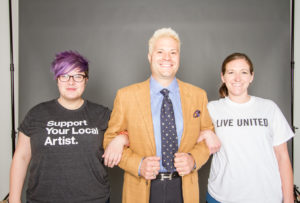
From left, Artomatic 419! coordinator Maureen Brogan, Toledo Fair Housing Center President and CEO Michael Marsh and United Way of Greater Toledo Director of Community Involvement Emily Avery each hosted events April 18 that many in the community used as alternatives to the National Socialist Movement Rally Downtown. Toledo Free Press Photo by Christie Materni

From cleanups to cookoffs, mural dedications to music, art to activism, groups across the city made sure Toledoans had  diversions April 18.

That’s the day a National Socialist Movement (NSM) group held a rally Downtown, drawing about 150 observers and counter-demonstrators. The event prompted heated verbal exchanges from both sides, but only one arrest and no other incidents, Toledo Police spokesman Lt. Joe Heffernan said.

From left, Artomatic 419! coordinator Maureen Brogan, Toledo Fair Housing Center President and CEO Michael Marsh and United Way of Greater Toledo Director of Community Involvement Emily Avery each hosted events April 18 that many in the community used as alternatives to the National Socialist Movement Rally Downtown. Toledo Free Press Photo by Christie Materni

That’s a marked difference from 10 years ago, when rioting in the wake of the last NSM rally led to 100 arrests, a burned business and national media coverage.

“It went as best as could be expected,” Heffernan said. “There were very minimal, minor incidents. There was a low turnout, both with NSM and the public, which is exactly what we wanted. We appreciate the citizens of Toledo for doing what we suggested and staying away.”

A heavy police presence — which a city spokeswoman said will cost taxpayers nearly $76,000 — was part of the reason. But another reason was the concerted effort of Toledoans like Willys Park block watch leader Tina Scott.

Community Peace Day

Scott was one of the first to suggest alternate programming after the NSM rally was announced last month.

“Community Peace Day was set up to be proactive, to reach out to all the organizations out there to host an event in their neighborhood to deter people from going Downtown [for the rally],” Scott said. “The whole idea was to show we have pride in our neighborhoods and in ourselves, to move forward doing our own thing while they were doing their thing.”

Held at Willys Park, the event drew about 400 people and featured a family movie, obstacle course, chili cookoff, DJ, scavenger hunt and more.

“It turned out great,” Scott said. “It’s really nice that everybody pulled together and showed that every time something negative comes, we can bring something positive.”

#BlackLivesMatterDay418

#BlackLivesMatterDay418 was another event organized as an alternative to the NSM rally. The Community Solidarity Response Network (CSRN) of Toledo has organized other events in the area, but the April 18 event was the group’s biggest yet, drawing more than 300 people, said member Julian Mack.

Mack said many people associate the Black Lives Matter movement with violence and black supremacy, but Toledo’s chapter wants to dispel those misconceptions. The event, held at the Frederick Douglass Community Association, featured a cookoff, dancing, songs, speakers and more.

“We wanted to show you can talk about serious issues, but do it in a positive way,” Mack said. “There’s nothing wrong with yelling on a street corner, but sometimes you have to change the narrative to get people to listen.

“Some people ask, ‘Why not say All Lives Matter?’ Of course all lives matter. But in order for all lives to matter, black lives must matter. You fix the worst part of the problem and the rest of the problem will improve.”

Although CSRN encouraged people to stay away from the rally, Mack said he understood why some people chose to go.

“There’s nothing wrong with someone having an issue with [NSM] coming to their city,” Mack said. “Just like those people have a right to speak their hateful message, people have a right to show their discontent with that message.”

Mack said he was happy with the turnout at #BlackLivesMatterDay418.

“At one point, I looked around at all the energy and the atmosphere and was like, ‘We did it! We beat them.’ I really think so. We beat them at their own game. Our group did, but also the city collectively. That’s something we should be proud of.”

Global Youth Service Day

After learning of the NSM rally, United Way of Greater Toledo decided to continue with plans to host its annual Global Youth Service Day (GYSD) on April 18.

More than 5,000 volunteers, including 4,171 youth age 5-25, participated, said Emily Avery, director of community engagement. More than 130 groups served at 84 different sites, providing more than 15,000 hours of service.

Because of the rally, organizers decided to cancel a planned celebration at Fifth Third Field. Instead, a team of volunteers brought the celebration to each group around the city, delivering T-shirts, certificates and more, Avery said.

Among those participating were about 60 students from Scott High School. On April 17, they volunteered at MLK Kitchen for the Poor and on April 18 they cleaned up the neighborhood around Scott, including planting flowers in a vacant lot nearby.

For some students, serving at MLK Kitchen hit close to home, said Shannon McIntyre, an AmeriCorps member with United Way of Greater Toledo who serves as a graduation coach at Scott, his alma mater.

“We had a couple of kids who actually ate there when they were kids,” he said. “Once they got older and their parents were a little more well off, they didn’t have to go there anymore. But some kids wanted to serve there just from prior experience.

“We ended up cleaning up the park across from the kitchen just on a whim. So you know you’re having fun if the kids say, ‘Let’s clean up the park as well!’” he said. “It felt good knowing there were others doing great projects all throughout the city of Toledo. We were really just about trying to work as much as we could but have fun as well.”

Fair Housing March

Toledo Fair Housing Center also decided to go ahead with its previously planned march April 18 to kick off its 40th anniversary celebration.

“It went incredibly well,” said President and CEO Michael Marsh. “We couldn’t have asked for a better day.”

“We know Toledo is not a hate-filled city,” Marsh said. “We know the majority of people who live here are compassionate individuals. We wanted to give them a place where they could come and express themselves and share their values. I think a lot of people were looking for a way to express themselves and an outlet that was positive and to keep away from [the rally].”

The march through the Old West End, led by the Scott High School band, culminated with the dedication of a new mural at the corner of Delaware Avenue and Collingwood Boulevard, painted by Toledo artist Yusef Lateef. The mural features the Martin Luther King Jr. quote, “We must learn to live together as brothers or perish together as fools.”

“The quote is so perfect when you are talking about creating inclusive communities of opportunity,” Marsh said. “There are some people who like to believe discrimination doesn’t happen anymore, but we see it all the time. It might not be as blatant — we don’t see signs that say ‘Whites only’; it might be more subtle, more sophisticated, but it still happens.

“Discrimination still happens every day and people’s pursuit of the American Dream and home ownership [is still denied], so we still have work to do.”

Artomatic 419!

Attendance at the April 18 Artomatic 419! was down from the previous Saturday, partially due to concerns about road closures and parking, said event coordinator Maureen Brogan of The Arts Commission. But she said she didn’t think fear was an issue.

“Everyone that joined us talked about celebrating art and love rather than hate,” Brogan said. “I love that there was positivity used to ‘combat’ the rally. We really were through with our planning stages when we heard about the rally but were happy to be a force of positivity in a day that could have turned dark.

“Assuring our patrons that the show would be safe was on our minds but that ended up being an easy thing to offer. Our city did so much to make sure that peace was kept and it made me feel truly comfortable Downtown.”

At the rally

Some people chose to bring positivity to the rally itself. Deonte Moss of Toledo brought a sign reading, “U hate me, I [heart] U.”

“We have a lot of people who work full time to hate, so people who love have to work even harder,” he said.

Lifeline Toledo pastor Steve North  attended several of the alternative events and applauded the efforts.

“All were important, because they helped us to highlight what we really care about in the city, and what many of us are committed to do,” North said. “I posted on Facebook there were some who thought the day would be difficult, but I believed it could be our finest hour. From reports I heard from other sites, and those at which I was present, I believe it was. And because of that, I believe there are even finer moments, days and years ahead.”

Baumhower: Here’s to the dreamers

0

Last weekend, the Sylvania Community Arts Commission held the 2015 Shorties, a film competition for children between kindergarten and eighth grade. This unique celebration was the third and final day of the Tree City Film Festival (TCFF), Northwest Ohio’s premier film festival.

  .

.

I am proud to be on the TCFF committee and the chairperson for The Shorties. 2015 was the third year for the Tree City Film Festival and was the biggest yet.  It was held in the Sylvania’s Historic Village, inside the Train Barn.

I was blown away by the submissions from our future filmmakers. From Elmore, Whiteford, Waterville, Toledo, Sylvania and more, the love of making movies crosses all ZIP codes in Northwest Ohio.

As a parent of four athletic children, we have baseball, soccer, basketball, travel teams and tournaments. There are even travel dance teams now, but nothing for the creative ones — no competitions nor celebrations for those who dare to dream.

It’s those creative people who are changing the world. The Shorties isn’t just about making movies, it’s about supporting those who dare to see the world differently — giving our children a moment of encouragement to dream.

You can watch all the video submissions online at iheartglasscity.com.

Enjoy and we’ll see you next year.

Jeremy Baumhower can be reached at [email protected].

Ottney: Trash talk

0
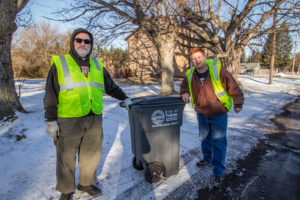
Jim Furney, left, and Eddie Garcia work through Triad Residential Services to help about 180 disabled Toledo residents Manuever their trash and recycling bins to and from the curb. TOLEDO FREE PRESS PHOTO BY CHRISTIE MATERNI

Eddie Garcia is a changed man, progress he and his employers attribute largely to his job.

He works for Maumee-based Triad Residential Services, a business that employs developmentally disabled adults in jobs like shredding, sorting or — in Garcia’s case — maneuvering trash and recycling bins to and from the curb for disabled city residents.

Ben Harteis, who oversees Triad’s trash aid program, said the job is a perfect fit for Garcia, who used to struggle with behavioral issues, but has thrived in the outside job with plenty of movement and “guy time.”

“I love it,” Garcia said. “I don’t care if it’s raining or snowing.”

Garcia and fellow worker Jim Furney are the two main employees in Triad’s trash aid program. Garcia has worked on the crew since the program started in 2010. Furney started two years ago.

“The Eddie we have today is not the Eddie we had four years ago,” Harteis said. “That Eddie was one handful of a guy. He’s totally different now. They are both different people when they are out doing that job, they really are.”

Jim Furney, left, and Eddie Garcia work through Triad Residential Services to help about 180 disabled Toledo residents Manuever their trash and recycling bins to and from the curb. TOLEDO FREE PRESS PHOTO BY CHRISTIE MATERNI

The program, which Triad has performed since 2010 at no cost to the city or county, has grown from 30 homes to 185 today, with more being screened and referred by Republic Services weekly, said Hillary Moore, Triad’s day services coordinator.

The number has jumped from 121 to 185 just since January, with the announcement of the Solid Waste Accommodation Program (SWAP), a collaboration between Republic, the Lucas County Commissioners and the Toledo-Lucas County Commission on Disabilities.

SWAP expanded and formalized the existing program for disabled Toledo residents, which Triad has handled since September 2010 when Toledo Area Ministries first approached them with the need. After Republic Services took over the city’s trash collection in 2011, Triad continued performing the service at no cost. Republic took over the job of screening requests in January.

In December, the Lucas County Commissioners amended the county’s contract with Republic to allow for up to $25,000 for SWAP services, which was expected to grow as word got out. Yet three months later, Republic seems content to continue letting Triad “donate” the service.

When SWAP was announced in January, Paul Rasmusson, senior area manager for municipal services with Republic Services, told me the issue of reimbursement would be addressed at a later date, once they saw how many more requests came in.

“We’ve left it very wide open because we don’t know if we’re going to get much growth,” Rasmusson said at the time.

Republic serves about 95,500 homes in Toledo. Triad is currently serving 185 households, but Republic has 280 on its list of people who have requested assistance. The remainder are in the process of being screened and referred, Rasmusson said, adding that there are no plans to charge residents who need the service or increase fees to cover it.

The January announcement led to a backlog of requests, Rasmusson said, leading to a delay in response time for both Republic and Triad, but the process has largely smoothed out now. However, the issue of reimbursement remains unresolved.

Triad pays worker wages, fuel, truck maintenance, insurance and other costs associated with the program with donations.

“We don’t make any money on the trash program. It’s not a cheap program to run, but we kept it going because there’s such a need for it,” Harteis said. “With the gas, we’re lucky to break even. We have the human service side, but at the same time we’re a business.”

Few of the companies that partner with Triad completely cover the cost of services rendered, but many offer partial reimbursement, Moore said. Republic does not, but does occasionally make donations to fundraisers, she said.

Garcia and Furney each work 12-14 hours per week, paid minimum wage. Harteis estimates he drives about 500 miles a week on their trash bin routes.

“It’s our profit we’re giving them since we’re not receiving any funds from the city, county or Republic — yet,” Moore said. “We’re hoping.

On April 22, Rasmusson told me Republic is “not pursuing payment” from the county as this time. He seems to be waiting to see what happens with the contract, set to expire in August 2016.  The county will decide by the end of August whether to renew the contract with Republic or open it to bidding. Payment to Triad, Rasmusson said, is “tied to a contract extension proposal.”

“As we’re finalizing or working toward that, we’ll also work toward reimbursing Triad for some of their growth and services beyond what their initial intent was,” he said. “I don’t know their real reasoning for why they did it as a contributed service to begin with.”

Jim Shaw, the county sanitary engineer who directs the Solid Waste Management District, verified Republic has not yet billed the county any funds for the service.

Republic’s options are reimbursing Triad now under the current contract, later under a new contract, having its own drivers take over the program —  or some combination of the above.

“Somewhere in the middle of there is the actual answer,” Rasmusson said. “That’s what we’re trying to figure out. We definitely need to sit down and continue our conversations.”

In an April 21 email to Rasmusson, Triad owner Todd Frick inquired about Republic’s intentions for the program.

“Triad has the capacity to expand this program,” Frick wrote. “We have done our part keeping up with demand, have kept the program running at our own cost for nearly five years. Yet, we cannot seem to get an answer as to whether this will ever be funded. … We are really trying to create jobs and opportunities for individuals with developmental disabilities, and dare I say that the individuals do a great job now.”

Frick said Rasmusson responded by implying he might opt to have Republic’s drivers take over taking bins in and out for disabled residents, as the company does in Maumee, Sylvania and Monclova Township.

If drivers take over that role in Toledo, Garcia and Furney may well be out of jobs. That would be unfortunate, said Jason Umstot, director of employment services with the Ohio Provider Resource Association, the state trade association that represents about 150 providers of services to those with developmental disabilities across Ohio.

It  might be easier or more inexpensive for Republic to assist residents themselves, but that doesn’t mean it’s the best solution.

“What we’ve found is there are little niche programs going on throughout the state that can be replicated and this is one that I think is phenomenal,” Umstot said. “By giving people an opportunity to work and at a competitive wage, there is a benefit not only to the individual but also to the community. In this case it’s even better because they are providing a service to people who need the service. It’s a win-win for everyone.”

The two form a special, friendly connection with many of the residents they serve, Harteis said.

“I don’t know what I’d do without them,” Toledoan Helen Holmes, 83, said. “I’ve tried to do the job myself and I just can’t. This Christmas I made them a little box of candy. I’m just blessed with their service.”

Toledoans in need of assistance can call Republic Services at (419) 936-2511. Applicants will be sent a request form after which a supervisor from Republic will visit their homes to determine customized solutions.

Anyone interested in helping Triad cover costs for the trash aid program can send a check to Triad Foundations, P.O. Box 1208, Maumee, OH 43537.

Sarah Ottney is Editor in Chief at Toledo Free Press. She can be reached at [email protected].

Toledo launches online billing for public utility customers

0
Abby Arnold, Toledo commissioner of utilities administration, discusses online billing for utility customers. Toledo Free Press Photo by Joel Sensenig

Making a pledge to move into the 21st century, Toledo officials announced details April 20 of online billing options for its department of public utilities.

At a launch for the service at the Kent Branch Library, 3101 Collingwood Blvd., Mayor Paula Hicks-Hudson said online billing, which had been sought by utility customers for years, allows the department to move into the 21st century.

“We’re so happy because it brings us into competition with other utility companies in which a customer is able to have modern, environmental and convenient means to communicate and conduct transactions with the city’s public utilities department,” she said. “We are creating a new way for customers and especially non-property owners — tenants, renters — to be able to get information and to be able to pay the bills.”

The online billing service, which is already in operation at http://toledo.oh.gov/services/public-utilities/online-billing, offers two payment options: QuickPay, which is accessible to anyone with an account number or street address; and online billing, which is for account holders to view and make payments on their utility account. Customers may also select an automatic bank plan to draw funds from a bank account.

The QuickPay option was designed primarily for renters and landlords to access accounts, letting them see amounts due and paid on the account, according to Abby Arnold, commissioner of utilities administration.

Edward Moore, director of public utilities, said the move to online billing is part of a larger movement to better serve customers.

“This is just one of many items that we’re working on to improve the department of public utilities,” Moore said. “For years, some of our customers, our stakeholders, indicated that we weren’t accessible enough and that we didn’t listen to the concerns of our customers. Well, I’m here to say that day and age has definitely passed us. We’re moving into the 21st century as the mayor said. We’re listening to our customers and we’re going to rebrand the department of public utilities to be a forward-thinking utility and respond to the needs of our customers.”

Moore said in a news release that online billing was among 34 recommendations made in an independent performance audit of the department in 2014.

To assist customers with online billing, the department of public utilities is hosting training sessions from 10 a.m. to 2 p.m. Tuesday through Friday this week at the walk-in center, 420 Madison Ave.

The following branches of the Toledo-Lucas County Public Library system will also conduct training sessions: Kent, 3101 Collingwood Blvd., 5-7 p.m. April 28; Reynolds Corners, 4833 Dorr St., 5:30-7:30 p.m. April 29; South, 1736 Broadway Ave., 5-7 p.m. May 5; Sanger, 3030 W. Central Ave., 5-7:30 p.m. May 11; Point Place, 2727 117th St., 5-7 p.m. May 12; and Heatherdowns, 3265 Glanzman Road, 5-8 p.m. May 13.

The trainings are conducted at public libraries because of their popularity as a destination for Internet services.

For more information, visit the department of public utilities at toledo.oh.gov/services/public-utilities/

Lucas County Sheriff’s Office implements body cameras

0
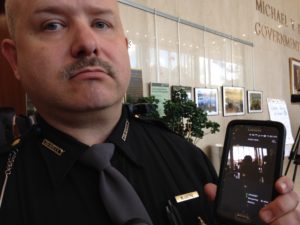
Lt. Matt Luettke of the Lucas County Sheriff’s Office wears a body camera on his collar, with footage viewable on his smartphone. Toledo Free Press Photo by Joel Sensenig

Lt. Matt Luettke of the Lucas County Sheriff’s Office displays a body camera, which all deputies will turn on when they leave their vehicles. The office will use 17 of the cameras to record interactions with the public. Toledo Free Press Photo by Joel Sensenig

All Lucas County Sheriff’s Office deputy interactions with the public will now be recorded via body cameras, according to Sheriff John Tharp.

Tharp, flanked by Lucas County Commissioners, deputies and community officials, announced the implementation of the cameras April 21 at One Government Center.  He first introduced the cameras in December and deputies have been using them since then as part of a trial period.

The commissioners have approved about $24,000 from their 2015 budget to be used for 17 cameras, which Tharp said will be turned on each time a deputy leaves his vehicle to interact with the public.

“All of the deputies are certainly excited about using the body cameras,” Tharp said. “It can be a win-win for the Lucas County Sheriff’s Office and for the community. … It does put everybody on their best behavior.”

The office’s body camera policy states cameras “shall be used to record all pedestrian and vehicle stops, pursuits, field interviews, calls for service and all other citizen contacts of an investigative nature.” At the end of the deputy’s shift, they will plug the camera into the evidence transfer manager, a docking station that simultaneously recharges the camera and downloads footage to evidence.com, a virtual warehouse storing digitally encrypted data. Fully charged cameras will be taken out on patrol by the next shift of deputies.

“As soon as they step out of the car, they will turn the camera on,” Tharp said. When asked what will happen if an officer forgets to do so, the sheriff said, “We will be turning them on. We’re not going to be covering up anything. We don’t need to be covering up anything.”

Tharp said nothing unusual turned up in video obtained by deputies during the office’s trial period of the cameras.

Commissioner Pete Gerken commended Tharp for taking a proactive step to protect the community and his deputies.

“Look, it’s a political and public policy concern,” Gerken said. “With the recent events in Baltimore (Freddie Gray, 25, died after suffering a severe spinal cord injury April 12 while in police custody), it’s just another chapter on how transparency has to be documented. This is a great tool. Transparency between the public and law enforcement is best documented by a body camera. We’ve seen citizens with cell phones participate in the process of recording officers, but I think the best view of any crime or incident between law enforcement and the public is best taken from the perspective of the law enforcement officer in the middle of the situation.”

Commissioner Tina Skeldon Wozniak compared the cameras to the police cruiser dashboard cameras that became prominent in the 1990s, saying body cameras will likely become an industry standard as well.

“The bottom line is this will create transparency and an objective record. At the end of the day, it will be very clear cut what occurred,” she said.

Rev. Donald L. Perryman, of United Pastors for Social Empowerment, stood by Tharp at the conference, as he did in December when the cameras were first announced.

“I approached Sheriff Tharp a few months ago, concerned about the increasing number of unarmed black men and women around the nation who were dying at the hands of law enforcement, and he said that he wanted to make a difference,” Perryman said.  “[The camera] brings public trust and a cultural accountability in law enforcement to the forefront. Although these body cameras are not a panacea, they do serve as a strong deterrent to officer misconduct and excessive force, and they are a major step towards police reform in our area.”

Lt. Matt Luettke of the sheriff’s office does not typically go on patrol duty, but tried the cameras recently to become familiar with the technology his officers will be utilizing.

“I don’t see a downside to it from anyone’s perspective,” he said. “It will be good for evidence collection. We can use this video to prove things in court. … At crime scenes, it will be a lot less likely that things will be missed.

“Human interaction is never perfect,” Luettke said. “Everybody’s human, so there’s a lot of imperfect interaction, but this way we’ll be able to say ‘This took place and this didn’t.’”