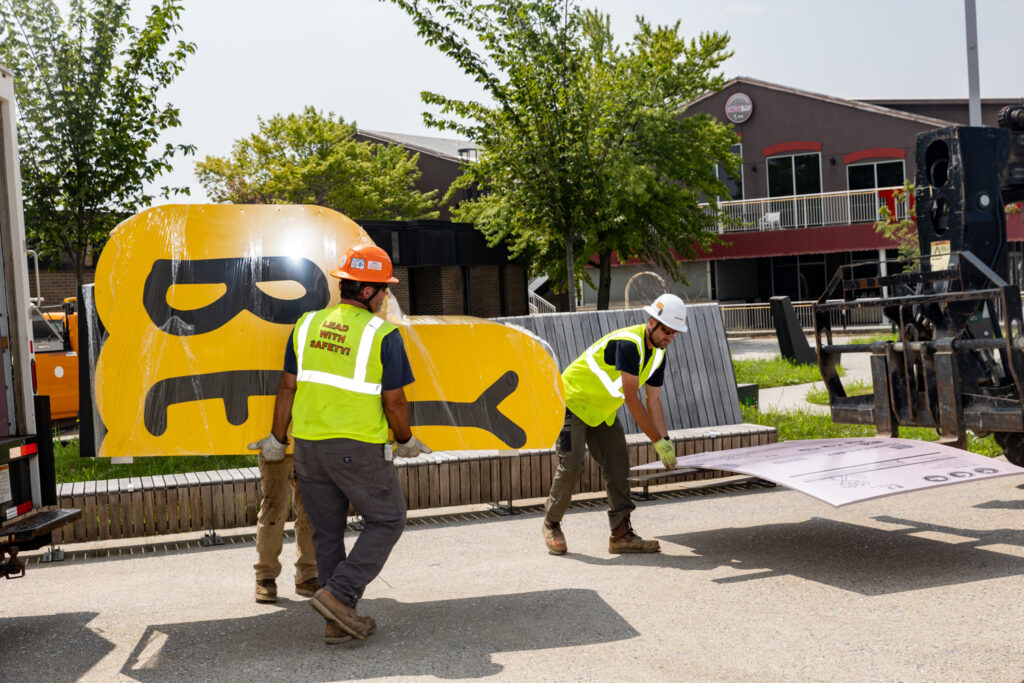
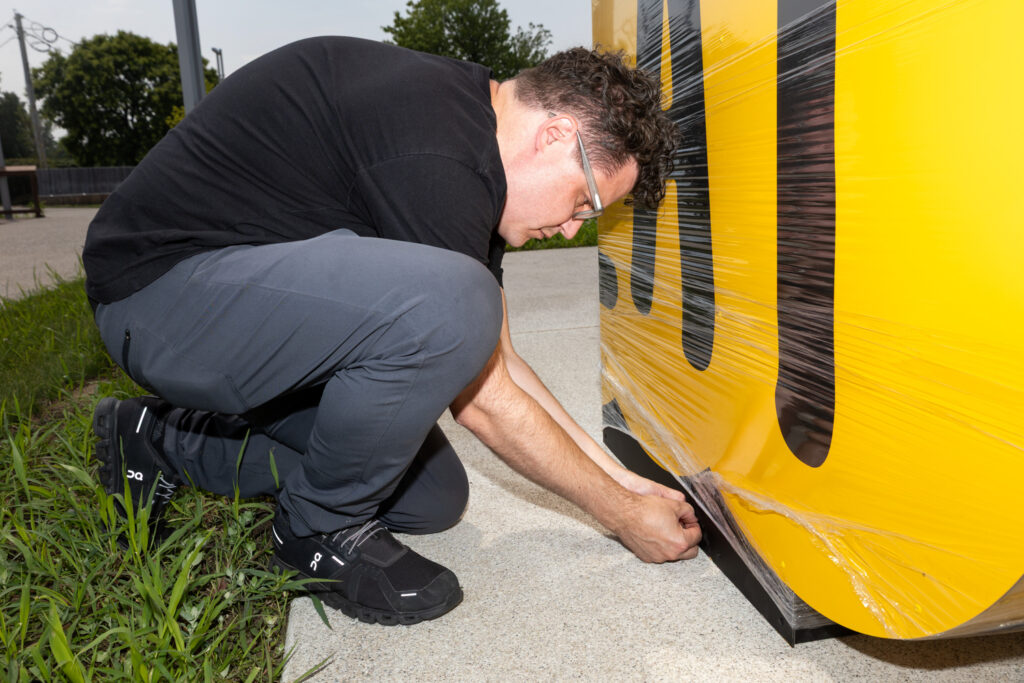
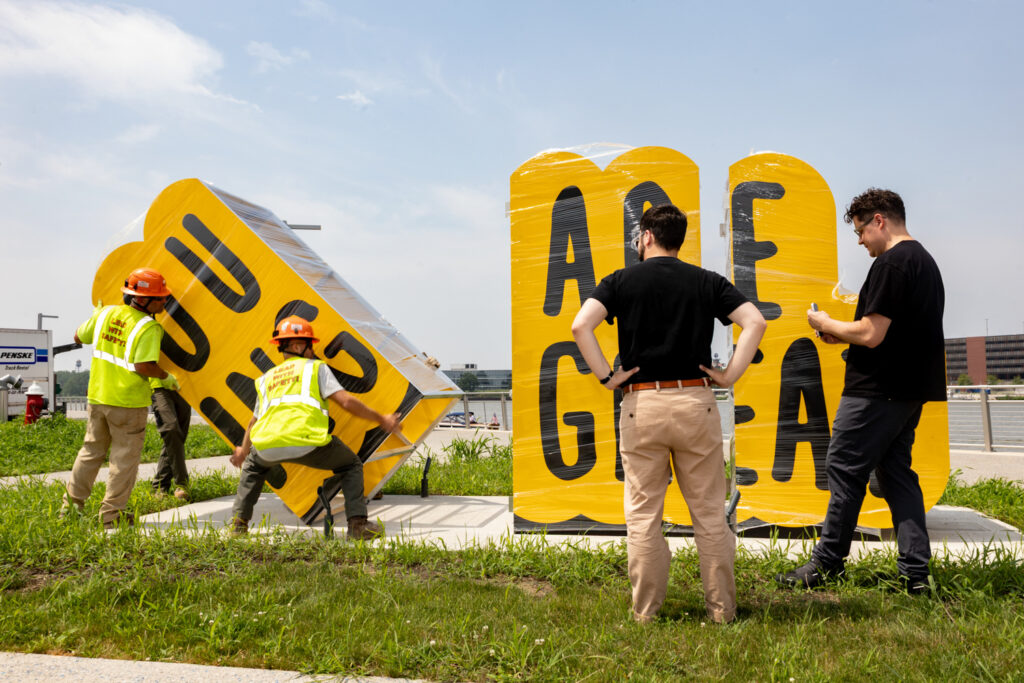
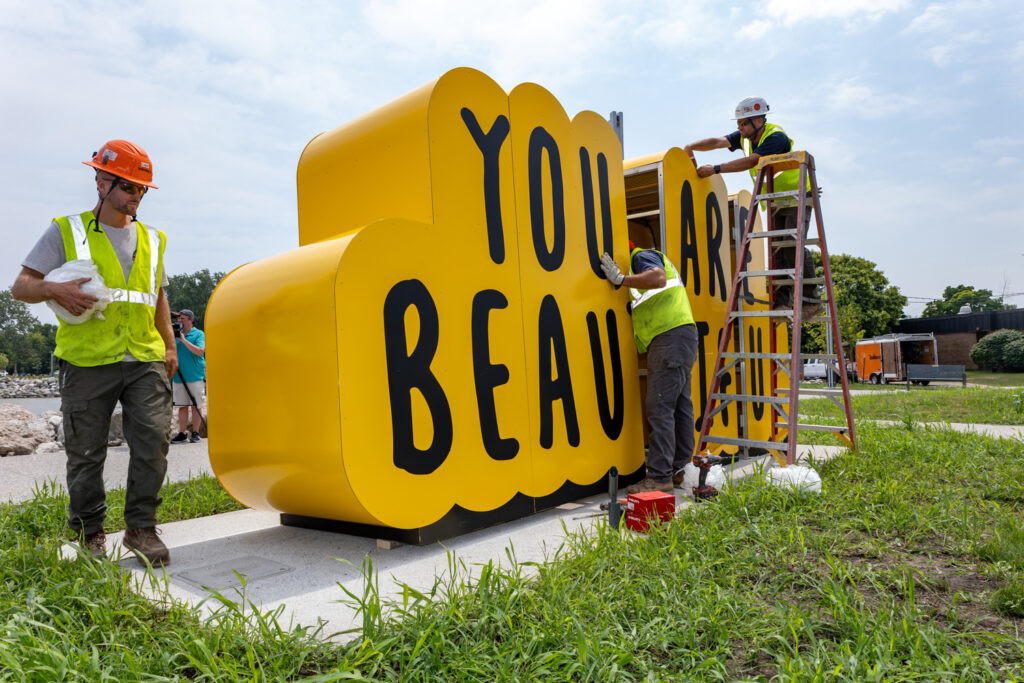
Workers carry the last part of the “You Are Doing Great/You Are Beautiful” installation at the International Cove part of the Riverwalk in Toledo, Ohio on Monday July 20, 2026. TFP Photo/STEPHEN ZENNER
Black letters with a bright yellow border reading “You Are Doing Great” on one side, and on the other side “You Are Beautiful” were reinstalled at International Cove Monday early afternoon. Matthew Hoffman, the artist who created the work, was on hand to ensure the integrity of his vision, along with members of the Arts Commission of Greater Toledo, while workers from Kokosing did the heavy lifting.
Initially the work was a temporary public art installation for The Arts Commission’s Momentum Festival in 2019, but then was moved to the east side in-between restaurants and International Cove. During Metroparks Toledo’s renovation of their multi-step Riverwalk project, the artwork was removed, and now is permanently reinstalled on July 20, 2026.
Hoffman said it was exciting to see the artwork re-installed, and that he is always trying to put positive messages out into the world.
Matthew Hoffman, the artist of the “You Are Beautiful/You Are Doing Great” installation, walks towards the truck with the art piece, while installation workers from Kokosing, Rob Ingersoll, a foreman, Caleb Gleckler, a laborer, Craig Mesenburg, a foreman and Joe Zika, a superintendent, begin to unload the sign in pieces at the International Cove part of the Riverwalk in Toledo, Ohio on Monday July 20, 2026. TFP Photo/STEPHEN ZENNERRob Ingersoll, a foreman with Kokosing, Craig Mesenburg (behind the work), a foreman with Kokosing, and Joe Zika, a superintendent with Kokosing, move a piece of the “You Are Beautiful” installation onto heavy machinery to move into place at the International Cove part of the Riverwalk in Toledo, Ohio on Monday July 20, 2026. TFP Photo/STEPHEN ZENNERHeavy machinery moves the first part of the “You Are Beautiful” installation at the International Cove part of the Riverwalk in Toledo, Ohio on Monday July 20, 2026. TFP Photo/STEPHEN ZENNERMatthew Hoffman, the artist of the “You Are Beautiful/You Are Doing Great” installation takes pictures of workers moving the piece into its location at the International Cove part of the Riverwalk in Toledo, Ohio on Monday July 20, 2026. Initially the work was a temporary public art installation for The Arts Commission’s Momentum Festival in 2019. TFP Photo/STEPHEN ZENNERMatthew Hoffman, the artist of the “You Are Beautiful/You Are Doing Great” artwork fills in details at the base of the piece after it is placed in its location at the International Cove part of the Riverwalk in Toledo, Ohio on Monday July 20, 2026. Initially the work was a temporary public art installation for The Arts Commission’s Momentum Festival in 2019. TFP Photo/STEPHEN ZENNERMatthew Hoffman, the artist of the “You Are Beautiful/You Are Doing Great” artwork fills in details at the base of the piece after it is placed in its location, while workers bring on additional pieces of the artwork at the International Cove part of the Riverwalk in Toledo, Ohio on Monday July 20, 2026. Initially the work was a temporary public art installation for The Arts Commission’s Momentum Festival in 2019. TFP Photo/STEPHEN ZENNERKokosing workers place pieces of the “You Are Doing Great/You Are Beautiful” artwork installation with Ben Cook of the Arts Commission and Matthew Hoffman, the artist, watching at the International Cove part of the Riverwalk in Toledo, Ohio on Monday July 20, 2026. TFP Photo/STEPHEN ZENNERWorkers carry the last part of the “You Are Doing Great/You Are Beautiful” installation at the International Cove part of the Riverwalk in Toledo, Ohio on Monday July 20, 2026. TFP Photo/STEPHEN ZENNERWorkers secure the individual parts of the “You Are Doing Great/You Are Beautiful” installation at the International Cove part of the Riverwalk in Toledo, Ohio on Monday July 20, 2026. Initially the artwork was a temporary public art installation for The Arts Commission’s Momentum Festival in 2019. TFP Photo/STEPHEN ZENNERWorkers secure the individual parts of the “You Are Doing Great/You Are Beautiful” installation at the International Cove part of the Riverwalk in Toledo, Ohio on Monday July 20, 2026. Initially the artwork was a temporary public art installation for The Arts Commission’s Momentum Festival in 2019. TFP Photo/STEPHEN ZENNERCraig Mesenburg, a foreman with Kokosing, drills into the concrete to secure the art installation of the “You Are Doing Great/You Are Beautiful” sign at the International Cove part of the Riverwalk in Toledo, Ohio on Monday July 20, 2026. Initially the artwork was a temporary public art installation for The Arts Commission’s Momentum Festival in 2019. TFP Photo/STEPHEN ZENNERWorkers carry the last part of the “You Are Doing Great/You Are Beautiful” installation at the International Cove part of the Riverwalk in Toledo, Ohio on Monday July 20, 2026. TFP Photo/STEPHEN ZENNER
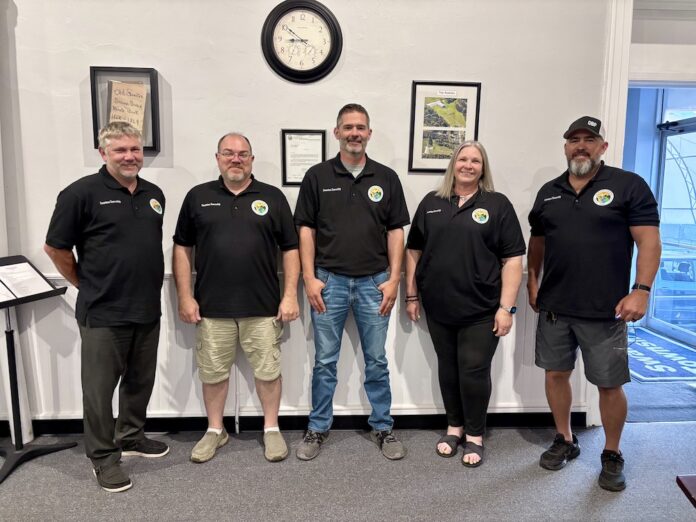
Swanton Township Trustees (from left) Mike Nowicki, Bill Anderson and Matt Beil, along with fiscal officer Mindy Curry and zoning inspector Ben Mooney, met on July 14. A new website was debuted with contact information at swantontownshipoh.gov – where residents can sign up for text alerts and find out contact information for township officials. (AWFP photo by Karen Gerhardinger)
SWANTON TOWNSHIP – Airport Highway properties and projects were among the topics shared by Zoning Inspector Ben Mooney during the Swanton Township Trustees’ July 14 meeting, held immediately after the start of the quarterly Zoning Commission meeting.
Mooney reported that the commission approved Shawn Albert‘s plans to build an office building on the southeast corner of Girdham and Airport Highway for his S & J General Contractors. The material will be corrugated metal, typically not allowed in the overlay district, but the design is attractive, the commission agreed, also approving an alternative landscaping plan.
The commission also approved Kevin Martin‘s plans to use the parking lot behind the building, located on the southwest corner of Airport Highway and U.S. 20A, for customers of the Greens at Oak Openings. He will close one entrance on Airport and one on U.S. 20A, leaving the main entrance on U.S. 20A. The Zoning Commission is allowing Martin to use gravel in the lot for up to two years, but then he must get it paved. The business includes a mini golf course, restaurant and gathering space, and is set to open in the coming months.
The Zoning Commission approved the re-zoning of 13 parcels totaling 112 acres in the Land-Air Commerce Park, 11520 Airport Highway. Interstate Capital acquired the land for development. Any construction plans will required a special meeting with the commission and the Ohio Department of Transportation will require a speed study.
An abandoned home at 11650 Airport Hwy. was also discussed. The owner is in more than $22,000 in arrears on taxes. The Lucas County Auditor can do a tax foreclosure on the property, which would be put up for sale through the sheriff’s office. Whoever buys the property will need to be aware that it’s less than the required five acres, so doing anything with the land would be a challenge. If it doesn’t sell, the township can work with the Lucas County Land Bank, which will clear the taxes and title and give it to the township – which would then be responsible for demolishing the building. Mooney and the county have both attempted to contact the owner and received no response. He described the condition of the home as being dangerous. Trustees agreed to begin the foreclosure process.
Mooney reported that the operators of a business at 12565 Airport Hwy. are working on changes to mitigate the impact of their business on neighboring residences, including planting arborvitae and reducing dust from the gravel lot where semis enter. And, elsewhere in the township, he continues to look for options to remove an a boat that was abandoned in front of a Reed Road residence many years ago. The boat can’t be donated because it doesn’t have a title, and he continues to seek answers from Michigan and Ohio.
Since taking the position in March, Mooney has begun working on updating the township’s zoning resolution. He presented new residential and commercial zoning violation fees, and plans to later submit ordinances for zoning – rules that he said will help protect residents and businesses. The fees for violations will allow the township to follow up on zoning violation letters and spur the recipient to contact the township, he said.
“It will allow us faster and defined rules to help accomplish township goals,” he said.
While the township’s Zoning Commission is complete, with members Mike Bayer, Johnnie Bryce, Liz Thurman, Mike Tye and Bruce Wholf, the trustees are working to recruit members to the Board of Zoning Appeals (BZA). That board hasn’t met in five years, although legally required to at least hold an organizational meeting every January. The trustees contacted those listed as BZA members and one one – Ron Oberhaus – agreed to continue. The BZA meets as needed to hear cases in which an applicant wants an exception to the rules in the zoning resolution. Interested members should send a resume or letter of interest to Fiscal Officer Mindy Curry at [email protected].
During the meeting, the trustees also:
-Held a moment of silence for former trustee and U.S. Navy veteran Joseph Zielinski, who passed on July 7.
-Agreed, with some conditions, to have Mooney contract with iWorQ Systems for a $250 activation fee and $2,000 a year for three years. The system will allow Mooney to track all of the zoning records with notes, photos and renderings, as well as permits and violation letters. Trustee Matt Beil plans to contact TrioTech to see how it fits in with cybersecurity measures and with the county prosecutor to look over the contract, while Mooney ensures that iWorQ does not sell the township’s data.
-Heard Curry say that she has asked assistant county prosecutor John Borell to come to the next meeting to address the topic of legal expenditures and outside council authorization policies. Her request was prompted by the receipt of a $65,000 settlement check from a defamation case between prior fiscal officer Peggy Michael and former Whitehouse council member Rebecca Conklin Kleiboemer in 2020. The township incurred $356,055.28 in legal fees for the case.
*Disclosure: Rebecca Conklin Kleiboemer is a board member for the Toledo Free Press, under which the Anthony Wayne Free Press operates.
-Learned from the Lucas County Engineer’s Office that the Ohio Public Works Commission has $500,000 set aside for projects in communities with populations less than 5,000. The engineer asked if Swanton Township has any projects that could be covered with such funding, and if the township could come up with the 10 percent match of $50,000. Trustees discussed possible projects, including a connecting bike trail on Fulton-Lucas Road between the Wabash Cannonball Trail’s north and south forks, where the 55 mph road is very narrow. Trustees also mentioned a need for repaving on Sager and Reed roads.
-Reminded residents that the township has a new website: swantontownshipoh.gov and emails. Residents can also sign up for text alerts on the site. A postcard with this information is going to every household.
-Heard that the township will host a free bulk trash drop-off on Saturday, Aug. 22 from 8 a.m. to 4 p.m. at the maintenance garage, 6576 Manore Rd.
-Learned the results of a speed study on the south side of the airport. The study was done at the request of airport police, who noticed an uptick in speeding by Amazon Air and Tronair employees. Based on the study, the section between Sager and the north terminus should be reduced to 50 mph; South Airfield Road from Whitehouse Spencer to Air Cargo Parkway should remain at 55 mph; and Whitehouse Spencer Road between Sager and the Airfield should be lowered to 45 mph.
-Agreed to accept the village of Swanton’s invitation to participate in the Saturday, Aug. 8 Swanton Corn Festival parade, which starts at 10:30 a.m., launching from Swanton Sports Center at 610 N. Main and traveling south past Swanton Memorial Park. Trustees approved up to $500 to purchase candy, giveaways and a banner.
This article by Marty Schladen was originally published in the Ohio Capital Journal. Find the original post here.
When local newspapers shut their doors and no reporters are there to watch school boards, city councils, and county commissioners, taxes go up, according to a new study.
The increase is $12 million a year in Ohio and $1.1 billion nationally — and that doesn’t even count the money that gets stolen or the cost to investigate and prosecute corruption, the report released earlier last month by Rebuild Local News says.
Those costs represent increased interest on municipal bonds as lenders worry that without a reporter on the beat, local officials will misappropriate funds.
“Local journalism performs a core fiscal function: continuous, external oversight of public institutions,” the report said. “When that oversight erodes, governments face less scrutiny over spending and procurement decisions, increasing the likelihood of wasteful spending and corruption.”
It added, “For these reasons, bond markets perceive greater risk of lending to unmonitored local governments and thus demand a higher interest rate as compensation for bearing the additional credit risk. The higher borrowing costs for local governments are ultimately borne by local taxpayers in the form of increased taxes and reduced spending on public services and infrastructure upkeep.”
Rebuild Local News is a nonprofit organization that advocates ways to make local journalism sustainable.
That sustainability has been under dramatic assault over the past decade.
The Medill School of Journalism at Northwestern University last year reported that 50 million Americans had limited or no access to local news — an all-time high. It said Ohio had lost 54.4 percent of its newspapers since 2005, the seventh-most of any state.
In Ohio, 1.04 million, or 8.7 percent of residents, live in 21 news desert counties, the Rebuild Local News report said. Those counties have $1.3 billion in bond debt, and the fact that they’re news deserts makes it $12 million more expensive each year to service it, the report said.
The Rebuild Local News report was written by the group’s research director Matthew Baker and Dermot Murphy, an associate professor of finance at the University of Illinois Chicago. It builds on a 2020 study by Murphy and two other academics that found that newspaper closures are associated with higher municipal borrowing costs.
“Following a newspaper closure, municipal borrowing costs increase by 5 to 11 basis points, costing the municipality an additional $650,000 per issue,” that study said. “This effect is causal and not driven by underlying economic conditions.”
Baker and Murphy defined a news desert as a county with no local newspaper, and used census data to determine how many people live in them. They also looked at total issuance and the mix of municipal bonds.
Using the 0.86 percent news-desert premium estimated in the 2020 study, they determined how much more people in news deserts are paying, assuming that those counties were borrowing in the same proportion as non-news deserts.
The researchers said the higher costs aren’t just a matter of coincidence.
“Critically, this estimate is causal rather than correlational: neighboring counties with similar economic conditions but still-robust news coverage do not experience an increase in borrowing costs,” it said.
In addition to higher interest rates come other costs, the report said.
“The stakes of this watchdog function are not abstract,” it said. “The Youngstown Vindicator, a 150-year-old daily that closed in 2019, had spent decades exposing organized crime and public corruption, contributing to dozens of convictions. Its absence removed a check that no internal control replaced.”
It just makes sense that without a reporter sitting in public meetings, making open-records requests and roaming government halls, an unscrupulous public official would be more likely to try something sketchy.
The report gave an example.
“In Bell, California, a low-income, predominantly Latino community of approximately 36,000 people in Los Angeles County, city officials spent years raising their own pay with almost no public scrutiny,” it said. “By the late 2000s, the city manager was earning $787,637 a year, the police chief $457,000, and city council members nearly $100,000 for what was officially part-time work. All of these raises were approved at public municipal meetings that lacked robust newspaper coverage.”
The Los Angeles Times later learned of the situation and reported it out.
Ruben Vives, one of the reporters who broke the story, said it was too late in the game.
“Someone would have got wind of this earlier had there been a reporter there,” the report quoted him as saying. “This is just a prime example of when you turn away, and you let something like this just kind of grow and grow, and it becomes sort of a cesspool of corruption.”
Online Casinos wirken auf viele neue Spieler zunächst unkompliziert: Konto anlegen, Zahlungsmethode wählen, ein Spiel starten. Doch bereits nach wenigen Minuten begegnen ihnen Fragen, die weniger mit Slots oder Bonusaktionen zu tun haben. Warum verlangt der Betreiber einen Ausweis? Weshalb wird eine Einzahlung manchmal geprüft? Und woran lässt sich erkennen, ob ein Casino den Schutz seiner Nutzer wirklich ernst nimmt? Gerade beim Glücksspiel hängt ein angenehmes Spielerlebnis oft davon ab, wie nachvollziehbar solche Schritte erklärt werden.
Wer sich Angebote wie felixspin deutschland ansieht, stößt daher nicht nur auf Spielauswahl, Aktionen und Zahlungswege. Ebenso sichtbar sollten Informationen zur Lizenz, zum Umgang mit persönlichen Daten und zu Schutzwerkzeugen sein. Erfahrene Nutzer berichten häufig, dass sie nicht die lautesten Versprechen überzeugen, sondern klare Regeln. Ein Casino, das Grenzen und Prüfungen offen erklärt, wirkt auf viele Menschen am Ende vertrauenswürdiger als eines, das alles möglichst schnell und reibungslos erscheinen lassen möchte.
Ein ruhiger Blick auf die Sicherheitsseite lohnt sich. Spieler merken oft erst bei einer Auszahlung, wie wichtig Lizenzangaben, Verifikation und eindeutige Geschäftsbedingungen tatsächlich sind.
Die Lizenz ist mehr als ein kleines Logo
Auf vielen Casino-Seiten steht die Lizenznummer im Footer, manchmal so klein, dass Neulinge sie übersehen. Dabei steckt hinter diesem Hinweis der rechtliche Rahmen des Angebots. Eine Lizenz verpflichtet den Betreiber unter anderem dazu, Spieler zu schützen, Identitäten zu prüfen, Geldflüsse zu dokumentieren und Beschwerden nachvollziehbar zu behandeln. In Deutschland achten viele Nutzer auf die Erlaubnis der Gemeinsamen Glücksspielbehörde der Länder. Andere Lizenzen können ebenfalls vorhanden sein, doch sie ersetzen nicht automatisch die für den jeweiligen Markt nötigen Anforderungen.
Manche Besucher empfinden diese Hinweise zunächst als Formalität. Das ändert sich oft, wenn es um Limits, Auszahlungen oder eine gesperrte Spielphase geht. Dann zeigt sich, ob ein Betreiber bloß mit Sicherheit wirbt oder ob die Abläufe tatsächlich geregelt sind. Lizenzierte Angebote sind nicht automatisch perfekt, aber sie unterliegen Kontrollen und klareren Zuständigkeiten.
Prüfpunkt
Was Spieler sehen sollten
Warum es zählt
Lizenzangabe
Name der Behörde, Nummer und Betreibername
Sie macht Zuständigkeiten überprüfbar.
Impressum
Adresse, Kontakt und Unternehmensdaten
Anonyme Seiten schaffen selten Vertrauen.
Spielregeln
Konditionen, Limits und Auszahlungsabläufe
Missverständnisse werden früher sichtbar.
Eine kurze Kontrolle braucht meist keine halbe Stunde. Spieler, die etwas vorsichtiger vorgehen möchten, orientieren sich häufig an einem einfachen Ablauf:
Den Betreiber im Impressum mit der Lizenzangabe vergleichen.
Die Regeln zu Einzahlungslimits, Spielpausen und Auszahlung lesen.
Bei unklaren Angaben zunächst den Support testen, bevor Geld eingezahlt wird.
Das klingt etwas nüchtern, bewahrt aber vor dem typischen Gefühl, erst nach der Registrierung wichtige Details zu entdecken. Besonders Einsteiger reagieren erleichtert, wenn Antworten des Supports konkret ausfallen und nicht nur auf allgemeine Werbetexte verweisen.
Verifikation, der manchmal unbequeme Sicherheitsmoment
Die Identitätsprüfung, meist KYC genannt, gehört in seriösen Online Casinos zum Alltag. Nutzer laden je nach Verfahren einen Ausweis, einen Adressnachweis oder gelegentlich ein Foto zur Bestätigung hoch. Einige finden diesen Schritt lästig, vor allem wenn sie direkt losspielen wollten. Andere sehen darin einen Schutz vor unbefugter Nutzung, Minderjährigen und Betrug. Beides kann nachvollziehbar sein. Entscheidend ist, dass das Casino den Ablauf vorab deutlich beschreibt und nicht erst kurz vor einer Auszahlung damit beginnt.
Wenn die Verifikation sauber organisiert ist, erhalten Spieler gewöhnlich eine Rückmeldung zum Status. Gute Anbieter erklären auch, welche Dokumente akzeptiert werden, wie lange die Prüfung ungefähr dauert und warum ein Bild abgelehnt wurde. Ein unscharfer Ausweis oder eine abweichende Adresse kann tatsächlich genügen. Das ist ärgerlich, doch eine verständliche Begründung macht einen großen Unterschied.
Vorsicht bei hektischen Aufforderungen: Werden Dokumente über unsichere Kanäle oder an unbekannte Mailadressen verlangt, brechen umsichtige Nutzer den Vorgang besser ab und prüfen den offiziellen Supportweg.
Situation
Übliche Reaktion des Casinos
Sinnvolle Reaktion der Nutzer
Kontoeröffnung
Abfrage persönlicher Grunddaten
Daten sorgfältig und wahrheitsgemäß eintragen
Hohe Auszahlung
Dokumenten- oder Zahlungsquellenprüfung
Fristen und angeforderte Unterlagen prüfen
Abweichende Daten
Vorübergehende Kontoeinschränkung
Nicht mehrere Konten eröffnen, Support kontaktieren
Spieler vermeiden unnötige Verzögerungen meist mit wenigen Gewohnheiten. Dabei geht es nicht darum, Dokumente leichtfertig zu verteilen. Es geht um einen kontrollierten, nachvollziehbaren Prozess.
Dokumente ausschließlich im verschlüsselten Nutzerkonto hochladen.
Vor dem Upload prüfen, ob Name, Geburtsdatum und Adresse lesbar sind.
Bestätigungen und Kommunikation für mögliche Rückfragen speichern.
Ein seriöser Betreiber sollte nie Passwörter, vollständige Kartendaten oder Fernzugriff auf ein Gerät verlangen. Sobald so etwas auftaucht, werden viele Nutzer misstrauisch, und das zu Recht.
Persönliche Daten, Vertrauen entsteht in kleinen Details
Ein Casino verarbeitet sensible Informationen: Kontaktdaten, Zahlungsdaten, Spielverhalten und bei der Verifikation auch Ausweisdokumente. Deshalb schauen erfahrenere Spieler gern in die Datenschutzerklärung, selbst wenn dieses Dokument nicht gerade als spannende Lektüre gilt. Dort sollte stehen, welche Daten erhoben werden, wofür sie genutzt werden, wie lange sie gespeichert bleiben und an welche Dienstleister sie gegebenenfalls weitergeleitet werden.
Viele Menschen achten besonders auf zwei Dinge. Erstens auf eine sichere Verbindung, erkennbar am Schloss-Symbol im Browser. Zweitens auf die Möglichkeit, Marketing-Einstellungen anzupassen. Nicht jeder möchte nach einer kurzen Registrierung mit Bonusmails überhäuft werden. Ein transparentes Casino lässt solche Einstellungen nicht im Kleingedruckten verschwinden.
Passwörter sollten lang sein und nur für das jeweilige Spielerkonto verwendet werden.
Zwei-Faktor-Authentifizierung erhöht den Schutz, falls sie angeboten wird.
Öffentliche WLAN-Netze sind für Einzahlungen und Dokumentenuploads keine gute Wahl.
Ungewohnte Login-Hinweise sollten sofort über den offiziellen Support geklärt werden.
Gerade weil Glücksspiel emotional sein kann, ist Datensicherheit nicht bloß ein technisches Thema. Spieler möchten nicht befürchten müssen, dass persönliche Informationen unklar verarbeitet oder Konten von Dritten genutzt werden. Ein ruhiges Gefühl beim Login ist vielleicht kein Bonus, aber für viele deutlich wertvoller.
Spielerschutz zeigt sich nicht nur im Kleingedruckten
Verantwortungsbewusstes Spielen bedeutet nicht, dass jede Runde problematisch wäre. Es bedeutet eher, dass Glücksspiel als Unterhaltung behandelt wird, mit einem vorher festgelegten Rahmen. Spieler, die sich daran halten, berichten oft, dass sie entspannter spielen. Gewinne bleiben angenehm, Verluste werden nicht automatisch zum Anlass, weiter einzuzahlen. Das ist leichter gesagt als getan, besonders nach einer knapp verpassten Bonusfunktion oder einer längeren Verlustserie.
Ein verantwortungsvoller Betreiber stellt deshalb Werkzeuge bereit, die nicht versteckt sein sollten. Einzahlungslimits, Verlustlimits, Zeitlimits, Reality Checks, Spielpausen und Selbstausschluss helfen Nutzern dabei, Abstand zu gewinnen. Manche finden Erinnerungen zunächst störend. Nach einer längeren Session bemerken sie aber manchmal, wie schnell Zeit vergeht, wenn ein Spiel dauernd neue kleine Anreize setzt.
Schutzwerkzeug
Wofür es gedacht ist
Typischer Nutzen
Einzahlungslimit
Maximalen Betrag pro Zeitraum festlegen
Das Budget bleibt berechenbarer.
Reality Check
Über Spielzeit und Einsätze informieren
Unterbricht den Automatismus.
Spielpause
Zugang zeitweise sperren
Schafft Abstand in angespannten Phasen.
Selbstausschluss
Längere oder dauerhafte Sperre aktivieren
Unterstützt bei Kontrollverlust.
Warnzeichen sind nicht immer dramatisch. Es kann schon auffallen, dass jemand Einsätze verheimlicht, dem verlorenen Geld hinterherjagt oder andere Ausgaben verschiebt. Angehörige bemerken gelegentlich zuerst, dass die Stimmung nach dem Spielen kippt. In solchen Momenten ist es sinnvoll, nicht auf den nächsten Gewinn zu hoffen, sondern eine Pause einzulegen und gegebenenfalls externe Beratungsangebote zu nutzen.
Glücksspiel ist keine Einnahmequelle. Wer mit Geld spielt, das für Miete, Rechnungen oder alltägliche Verpflichtungen vorgesehen ist, bewegt sich bereits außerhalb eines gesunden Rahmens.
Zahlungen und Boni ohne falsche Erwartungen betrachten
Bei Ein- und Auszahlungen wollen Spieler vor allem Klarheit. Welche Methode ist verfügbar? Fallen Gebühren an? Wie lange dauert eine Auszahlung? Und muss sie über denselben Weg erfolgen wie die Einzahlung? Ein Casino sollte diese Fragen vor dem ersten Transfer beantworten. Wenn Bedingungen erst später auftauchen, entsteht schnell Frust, selbst wenn der Vorgang am Ende korrekt abläuft.
Auch Boni verdienen einen nüchternen Blick. Freispiele und Einzahlungsangebote können Unterhaltung verlängern, sind aber kein Geschenk ohne Regeln. Umsatzbedingungen, maximale Einsätze und zeitliche Grenzen entscheiden darüber, wie realistisch eine Auszahlung von Bonusguthaben ist. Einige Spieler verzichten lieber ganz auf Aktionen, weil ihnen ein transparentes Echtgeldspiel einfacher erscheint. Andere nutzen Boni bewusst, nachdem sie die Bedingungen gelesen haben. Beide Entscheidungen sind vernünftig.
Vor einer ersten Einzahlung hilft vielen Nutzern diese kleine Reihenfolge:
Ein festes Unterhaltungsbudget bestimmen, dessen Verlust verkraftbar ist.
Zahlungsbedingungen und mögliche Verifizierungsanforderungen prüfen.
Bonusregeln lesen und ein Angebot ablehnen, wenn es unklar oder unpassend wirkt.
Diese Vorgehensweise nimmt etwas Tempo aus der Anmeldung. Aber genau dieses kurze Innehalten ist oft hilfreich. Im Online Casino sind schnelle Klicks überall vorgesehen, bewusste Entscheidungen müssen Spieler dagegen meist selbst einbauen.
Eine gesunde Routine beginnt vor dem ersten Spin
Verantwortungsbewusstes Spielen entsteht selten durch einen einzigen Schalter im Konto. Es wächst aus mehreren kleinen Entscheidungen: nicht müde oder frustriert zu spielen, kein geliehenes Geld einzusetzen, Pausen ernst zu nehmen und Verluste nicht persönlich zu nehmen. Das klingt beinahe banal. Trotzdem geraten gerade diese einfachen Regeln in Vergessenheit, wenn eine Spielrunde aufregend wird.
Nutzer, die ihr Spielverhalten gelegentlich überprüfen, erkennen Veränderungen eher. Manche setzen sich vorab ein Zeitfenster, andere aktivieren Limits direkt nach der Registrierung. Wieder andere sprechen offen mit einer vertrauten Person darüber, wie viel sie ausgeben möchten. Nicht jede Methode passt zu jedem Menschen, doch der Gedanke dahinter bleibt derselbe: Das Casino sollte ein begrenzter Zeitvertreib bleiben und nicht den Alltag bestimmen.
Ein sicherer Betreiber, eine überprüfbare Lizenz, sorgsamer Datenschutz und wirksame Schutzfunktionen bilden dafür die technische Grundlage. Den entscheidenden Teil übernehmen jedoch die Spieler selbst. Wer langsam startet, Bedingungen kritisch liest und bei einem unguten Gefühl rechtzeitig stoppt, begegnet dem Online Glücksspiel deutlich kontrollierter. Vielleicht wirkt das weniger spektakulär als ein großer Jackpot, langfristig ist es für viele aber die bessere Erfahrung.
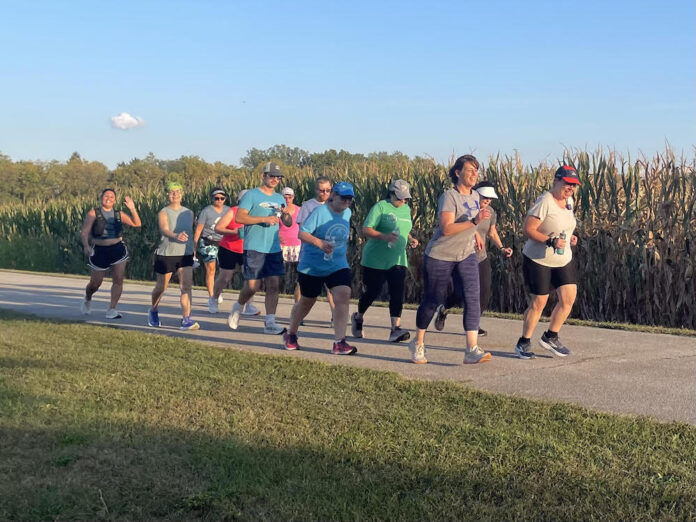
Members of the Toledo Area Galloway Group meet three times a week to run in area parks. (Courtesy photo)
When 62-year-old Maria Matney decided to start running again, after a six-year hiatus, she thought just completing a 5k would be a challenge. Now, two years later, Matney has not only completed multiple half marathons, but is training to run a full marathon.
She credits the Toledo Area Galloway Group (TAGG) for her success.
“This program and Jeff Galloway’s Run-Walk-Runmethod was a game changer,” Matney said. “I’ve been able to increase my running pace.”
Designed for people of all fitness levels, including Wellness Walkers, social runners and distance athletes, the program offers a structured, supportive environment to help each member reach their personal health, wellness and racing goals, said TAGG Program Director Nickie Sattler.
Nickie Sattler is program director for the Toledo Area Galloway Group (TAGG) – which uses the Jeff Galloway Run-Walk-Run method. (AWFP photo by Karen Gerhardinger)
Named for Jeff Galloway, an Olympic runner, the method involves intervals of walking with running, usually 30 seconds of walking and 30 seconds of running.
As Galloway was running a beginner’s running program, he noticed that many of his students were getting too winded to run consistently. So he suggested running a little, until they couldn’t hold a conversation, and then walking a little.
“He spent a lot of time gathering data, and that changed some of his ideas. He found that 30 seconds was the sweet spot – it allowed the heart rate to lower,” Sattler said. “This method has less impact on the body, it’s easier on the knees and the heart rate doesn’t get too high.”
The Galloway Method was introduced in 1973 and has helped thousands of runners meet their goals in the decades since, she added.
Sattler was a self-described couch potato when her son, Joseph, headed off to Marine Corps boot camp seven years ago. To keep her mind off his absence, and to show solidarity with the rigorous training he was undergoing, she started running around the neighborhood.
“I never thought I’d be doing half marathons and marathons. Going around the block was enough,” she said.
So she joined a Dayton Galloway Group and discovered the Run-Walk-Run method as a way to increase her stamina and her pace.
“I can run three miles without a break, at a slower pace. I run faster taking walk breaks,” she said, noting that she’s increased her personal record. “I’m not the fastest, but the back-of-the-pack runners get their money’s worth, and they enjoy the run. And nothing says that if you have to take a break and walk that you’re not a runner.”
Recently TAGG held a kickoff for its summer/fall session, with coffee, a meeting and a three-mile run. The season runs through November 21 and new Wellness Walkers and social runners are welcome.
Training sessions are all coach-led, three days a week, to ensure proper pacing, motivation and safety. Tuesdays and Thursdays are conditioning and maintenance sessions of 3 miles while Saturdays are dedicated to endurance-building group runs and walks in area Metroparks, ranging from 5 to 10 miles.
When Beth Tronolone joined TAGG, the former high school and college volleyball player didn’t have a lot of running experience. Now 68, she didn’t begin running until 57.
“I was able to go from being a slow runner to doing a 5k,” she said. “I signed up for the Garmin Half Marathon and had an impressive time for a first-timer.”
Just as she was hitting her pace, Tronolone was sidelined with arthritis in the knee, which kept her from even walking three miles. Using the Galloway Method, she slowly worked her way back into running and, last week, completed six miles.
“It’s great beginning runners, injured runners and older runners. I represent all three,” she laughed. “I’m at a point where I’m not going to go faster and see my name in the paper. Every once in a while I will place second or third, but that’s because I’m old. But I feel like I’m accomplishing something. And it’s about the camaraderie. I love my running group. The people are so great and we get to go to a lot of different places.”
Among her favorite runs over the years were the Shawshank Hustle and the Labor Day Mackinac Bridge Run. This year the group is preparing for three half marathons – the Air Force, Detroit Free Press International, and the Churchill’s – as well as the Honolulu Marathon.
While Tronolone is the oldest member at 68, the group has members in their 20s as well. The members usually follow up a run with a stop at an ice cream or coffee shop, brewery or restaurant. But the runners don’t keep their socializing until the end. Often they are talking to one another while running – because they’re not huffing and puffing.
“We’re trying to grow the community and share the love,” Sattler said. “The Galloway community is very supportive of each other.”
Smoke from Canadian wildfires reaches The Fifth Third Bank building, One Seagate, hazing the air and breaking records for poor air quality with Air Quality Index (AQI) ratings of over 700 in downtown Toledo, Ohio on Thursday July 16, 2026. Since the late 90s AQI has been monitored, and 300 and above is considered hazardous to be out in. TFP Photo/STEPHEN ZENNER
TOLEDO – Smoke passing over the Midwest from Canadian wildfires caused Toledo to have the worst air quality on record for the northwest Ohio city.
The Air Quality Index (AQI) measures pollution levels in the air, putting anything at 301 or higher at a hazardous level.
0-50 is the rating for good air quality.
51-100 is the rating for moderate concern, with potential to irritate some groups of people.
101-150 is an unhealthy amount of pollution for sensitive groups of people, according to AirNow.Gov.
151-200 is where some members of the general public will begin to have their health affected by the poor air quality.
201-300 is very unhealthy air quality.
301+ is hazardous.
The air quality on July 16, 2026 more than doubled the 300 marker. The photos below were all taken that day.
Monroe Street in downtown Toledo. (TFP photo by Stephen Zenner)
The Anthony Wayne Bridge as seen from the dock at Promenade Park in downtown Toledo during a cascade of polluted air from Canadian wildfires. (TFP photo by Stephen Zenner)
Veterans’ Glass City Skyway bridge is obscured by pollution caused by the fires. (TFP photo by Stephen Zenner)
The Toledo skyline with the Martin Luther King Jr. Bridge. (TFP photo by Stephen Zenner)
Two young raccoons grazing early in the morning. (Photo by Art Weber, nature photographer for Metroparks Toledo)
Wildlife populations have been high recently as young of all species set out on their own, venturing away from nests, hollows and dens. This pair of young raccoons has wandered from the safety of their den, probably in a nearby tree or hollow log where they were born two to three months ago. Their mother, who performs all the duties of raising young, is likely nearby. It’s not unusual for her to remain close to her young through their first year.
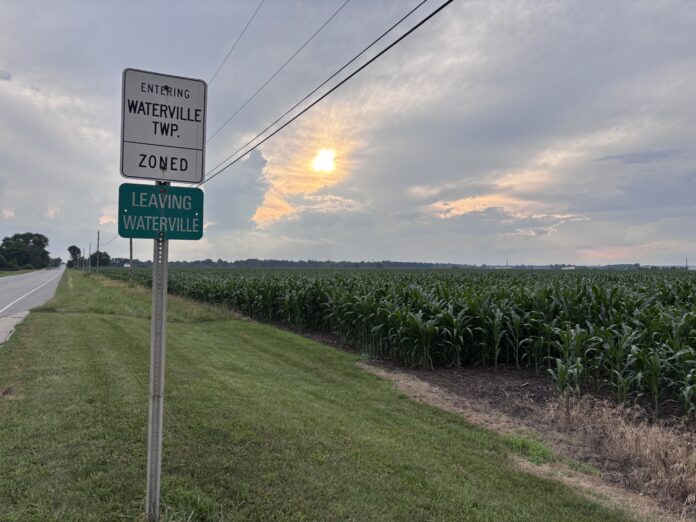
Waterville Township, which is being eyed for a possible data center, is moving forward with a 67-page zoning text amendment to put into place regulations for such projects. (AWFP photo by Karen Gerhardinger)
WATERVILLE TOWNSHIP – While a 67-page proposed revision to the zoning resolution is under legal review, Waterville Township leaders held a community forum on July 10 to ask for any last-minute suggestions and questions on the language that’s been developed over the past six months.
“Whatever we do has to be lawful and capable of surviving lawsuits without bankrupting the township,” said Trustee Toby Miller.
Miller, along with Trustee Julie Theroux and Board of Zoning Appeals Chair Roger Tucholski, read statements outlining their support for the zoning language, which would govern data centers and other large, campus-style projects by establishing an M-3 industrial classification with three tiers. The language does not approve a specific project or property for rezoning, but rather puts into place standards to protect the township, Tucholski said.
The document is the result of months of work by a Data Center Advisory Committee (DCAC) made up of citizens and township officials. Within the next few weeks, both the Zoning Commission and Board of Trustees will review it again and hold public hearings. Once approved, it will take effect in 30 days – prior to the Dec. 17 expiration of a one-year moratorium on data centers.
“We’re looking for questions and criticisms. If there is suggestion of something we can do better, we want to consider it,” Miller said, adding that legal counsel is currently considering increasing the property line setbacks for such developments from 500 feet to 1,000 feet for land adjacent to residences – including nursing homes and apartments – as well as schools and churches.
Lyn Cox thanked the township for its “Herculean” effort, which she said is much more than what other area communities have achieved during their moratoriums. She also asked about ensuring that a data center would discharge wastewater into a sanitary sewer rather than streams or lakes.
Many areas of the township don’t have sanitary sewer, Miller said, making it difficult for that requirement to be put into the document, but he said they would look into it.
Cox also asked about banning cryptocurrency mining, which emits noise well over the township limits. While such an enterprise would not likely be approved if the noise level is known at the time, Miller acknowledged that a data center might sell off space within the development – but that would be subject to the same noise regulations as all M-3 businesses. Putting a ban on any type of business would be difficult, but tightening up noise regulations is an option, he said.
Former Trustee Kim Anderson said she’s heard many residents ask why the trustees can’t just ban data centers or extend the moratorium for another year. Miller said Ohio Revised Code (ORC) won’t allow a complete ban because it would be considered a “take” – telling landowners what they can do with their property. And while other municipalities have tried extending a ban, that’s been challenged in court.
Whitehouse resident Leslie Harper brought several questions to the forum, including whether Waterville Township has unzoned areas, which Miller said are like the Wild West where landowners can do what they want, as zoning regulations don’t apply.
“Providence Township is the only township in Lucas County with unzoned areas,” said Jim Fischer, who serves as zoning inspector for both Providence and Waterville townships. “For them to change that, they would have to put it on the ballot for voters to approve. They tried 10 years ago and voters turned it down.”
Miller noted that anywhere in the AW area that a data center is built would impact the neighbors.
Harper asked whether the zoning resolution amendment includes pre-studies. That’s built into the zoning permit process, Miller said, with a requirement that funding be set aside for baseline measurements of water, noise, air quality and power usage, as well as approval from police and fire. Because Waterville Township has hard water, such a development would need to use municipal water, but Miller said he’s heard of cases where the water table is lowered after digging retention ponds. A bond will pay for monitoring those levels.
DCAC members Todd Heller, Brian Gowing and Russ Schifferly all recommend approving the 67-page zoning resolution, but shared their own concerns.
Schifferly, who served on the DCAC, said he recommends approval of the zoning resolution amendment, even if it’s not perfect – citing concerns about the need for regulation of ground water and air quality, which are regulated by the state.
“I feel like eventually someone needs to push the needle toward greater search for the proper balance between the rights of the citizens and the rights of the business that may want to come in and establish a data center,” he said, adding that there needs to be more regulatory change at the state level.
“The state has told us that we can’t submit a referendum for a township vote. That flies in the face of all our rights as citizens,” Schifferly added, referring to a process by which residents can collect signatures to put a zoning decision on the ballot within 30 days of its passage.
“That’s open for debate,” Miller said. “The state did pass something basically prohibiting mega projects from being put on the ballot as a referendum. However, it has a long list of requirements to be considered a mega project. I’m fairly certain we can overcome that state law based on those requirements – but I can’t change state law.”
He added that some proposals are at the state and federal level that would overturn whatever the township puts into place. One initiative seeks to classify data centers as a national security interest or utility. If it becomes a utility, eminent domain becomes a possibility.
“Call your senator. Call your representatives, both state and federal. Find laws that are pending and tell them what you think about them,” Miller said. “A lot of those laws are taking away the trustees’ power and taking away the residents’ voice.”
Risa Sindel, a Monclova Township resident, asked if there is a single action that deter data centers.
“Attending meetings, being a powerful voice and letting these large industrial complexes know how residents feel,” Theroux said. “Sign the petition circulating around for restrictions on data centers. Lucas County has done a wonderful job in getting signatures to get it on the ballot in 2027. Continue to be present at meetings and be a voice.”
The next public meeting for the zoning regulation changes is with the Zoning Commission on Monday, July 20 at 7 p.m., followed by a review by trustees on Wednesday, July 22 at 6:30 p.m.
This year's rally marks almost a decade of bringing awareness to cyberbullying and suicide prevention by sharing Luken's story. (Courtesy photo)
TOLEDO – Nine years on from a tragedy that took a teenager’s life, one family asks, “What does it really mean to be kind?”
Luken T. Boyle, was getting ready to start high school as a freshman at Central Catholic, when he was catfished and then bullied online by a classmate in 2017.
As a result of the online harassment, the 14-year-old took his own life, but his family didn’t give up on him or the kindness he showed others.
“He was just full of love and light, and he was just a really good kid,” said Samantha Boyle of her son.
Luken T. Boyle. (Courtesy photo)
Boyle said her son didn’t suffer from ongoing mental health struggles, but the online incident was overwhelming for the child to deal with at the time.
In the wake of her son’s death, Boyle pushed for suicide awareness, pushed back against cyberbullying, and ultimately wanted to put something positive out into the world.
“He was just the kindest young man you’d ever meet,” she said, and admitted that before her son passed away she didn’t think too much about the importance of kindness.
“When this was going on, we realized that some people, especially youth, have zero experiences of kindness,” Boyle said. “So we wanted to give them a space where they can experience kindness and really learn what it means to be intentionally kind and do something for someone that can change their day.”
The mother said in the days and weeks after Luken’s death, “I need to share his story.”
What came from that excruciating experience was the Luken T. Boyle Campaign for Kindness, a nonprofit dedicated to kids and adults empathizing, encouraging and helping one another.
“The rally was originally set up on the day of Luken’s death,” said family friend Rick Longenecker, who also serves on the board of the Luken 4 Kindness nonprofit board. “The summer after he died, they set it up on the exact day, and they were shocked at how many people showed up.”
Each year, the Boyle family plans a kindness rally in downtown to highlight the importance of being kind to one another.
While the first one was planned as a memorial, now the event raises awareness and urges the public to hold the value of kindness for one another by engaging the community. “We don’t ask for money at all,” Longenecker said, and went on to explain the Luken Campaign for kindness was highlighting two nonprofit organizations, Mom’s Houseand Catholic Charities.
Students in a Kindness Room, places created by the nonprofit to give students the opportunity to recenter. It also promotes creative projects and activities like writing kind letters to others. (Courtesy photo)
Longenecker said the rally was really about how, “even in the ugliest moments, you can make a positive choice.”
Max Boyle, contestant on season 17 of The Voice, and cousin to Samantha Boyle, will perform during the rally on Thursday, July 23 with speakers Mayor Wade Kapszukiewicz, Samantha Boyle and Brandon Hawkins, the team captain of the Walleye.
The event will take place in Hensville, 406 Washington Street, from 5 to 7 pm, ending before the first pitch of the Mud Hens game, and will feature Central Catholic High School’s Irish Dance Team.
The first 25 people to bring a donation of food items (canned or boxed), hygiene items, or diapers will receive a free voucher for the baseball game.