With urban birding front of mind, Erin Holden heads to Middlegrounds Metropark to explore just how rewarding birding in downtown Toledo can be. There’s sometimes no need to leave your own backyard to get the full experience, even when you are in a busy city center.
This is the third episode of A Walk in the Park with, a WGTE Public Media and Metroparks Toledo collaboration hosted and produced by Erin. Join her as she explores everyday life in Toledo’s Metroparks. In each episode, Erin interviews different park visitors – runners, teachers, artists, parents and more – revealing the many ways people connect with nature. You’ll hear personal stories about people’s relationships with our parks and the activities they cherish. Erin also documents her journey along the way, reflecting on the insights she gains from each experience.
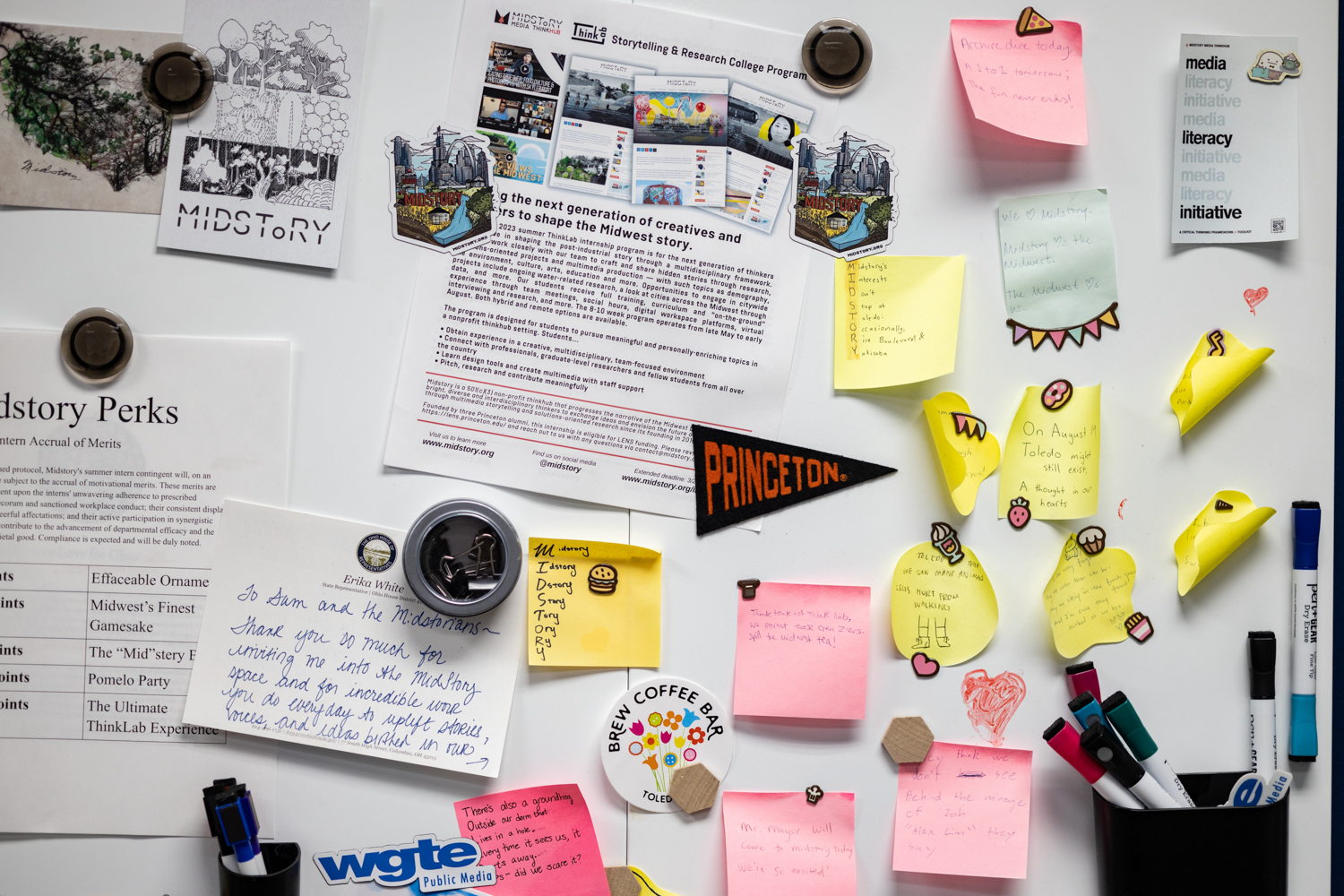
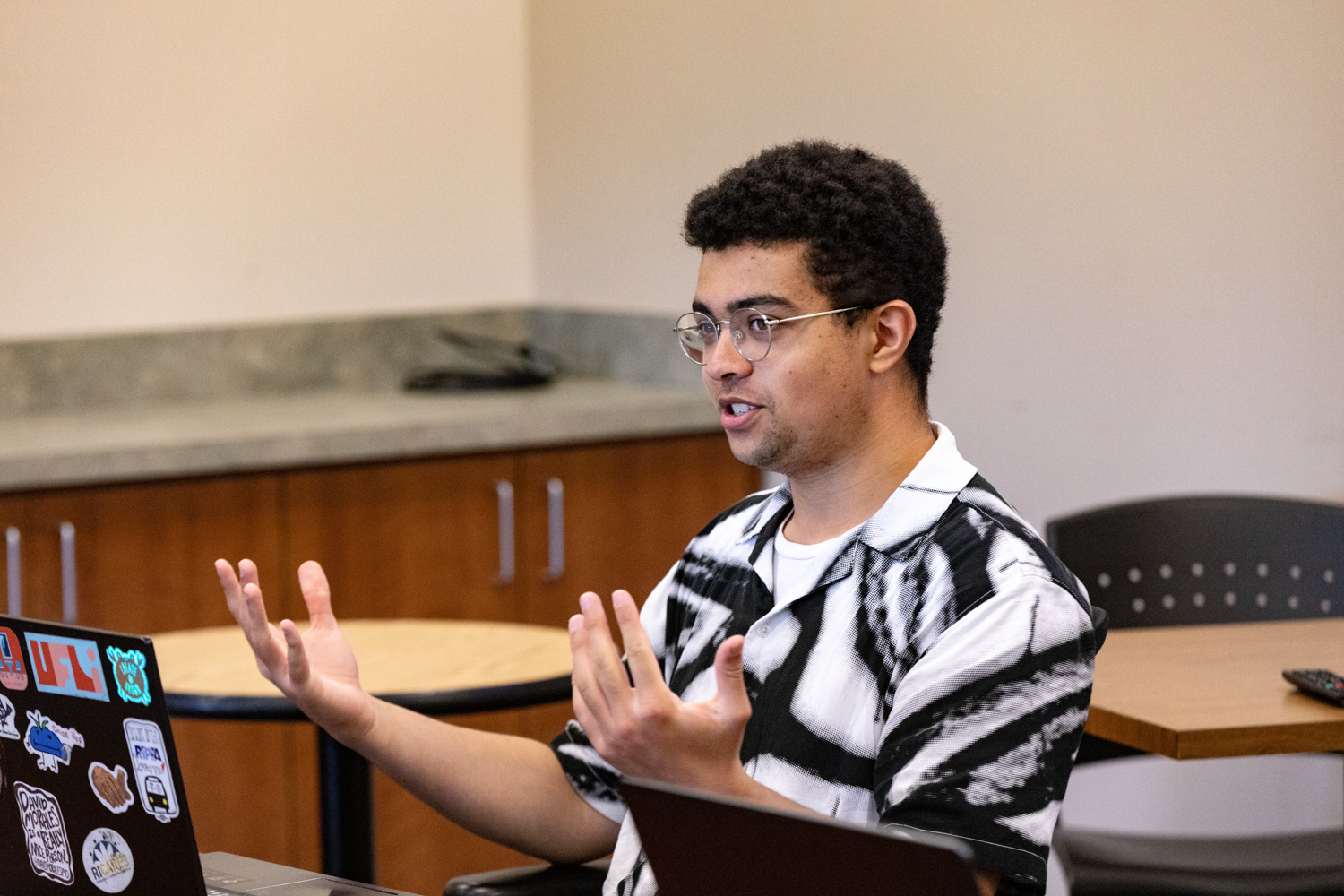
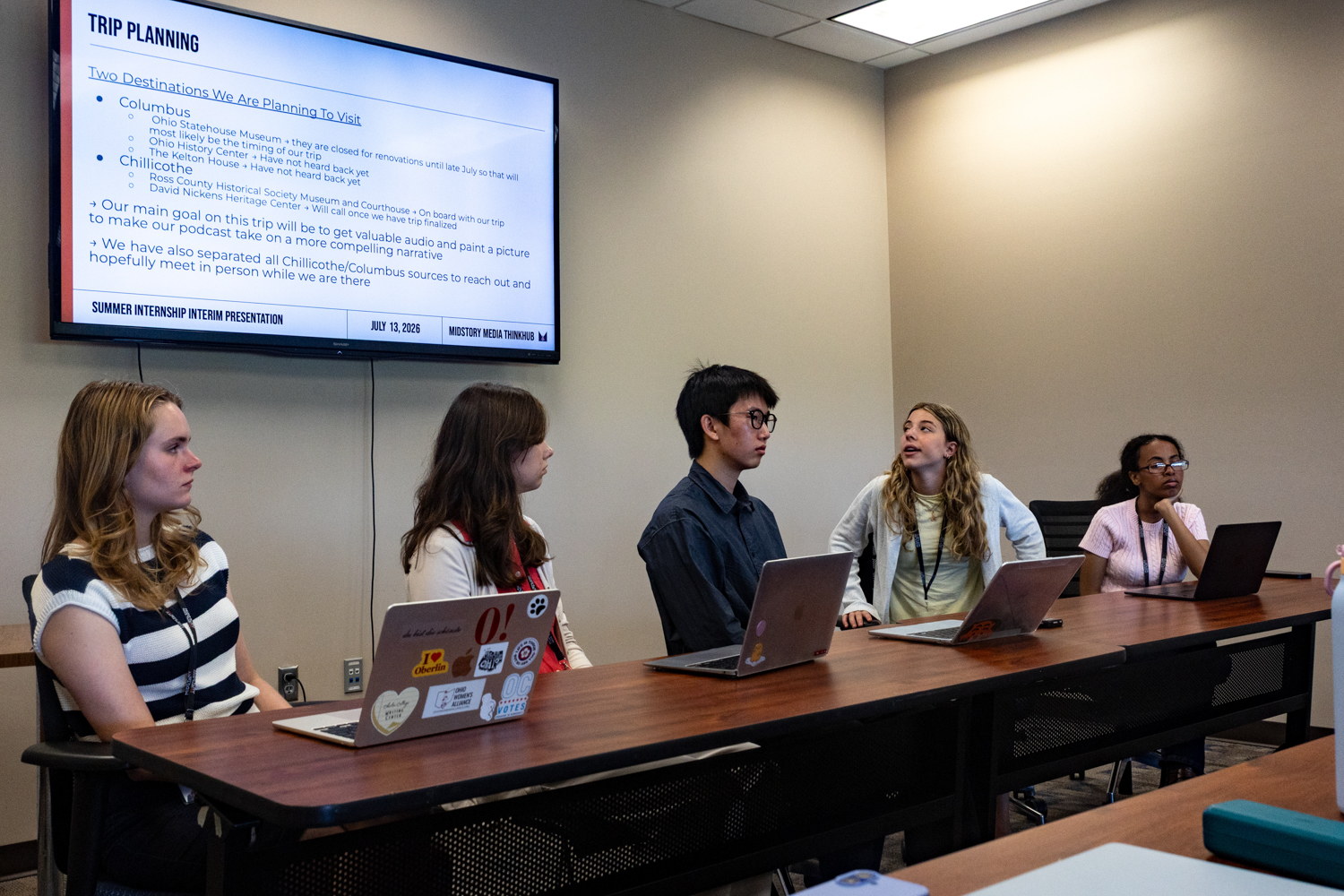
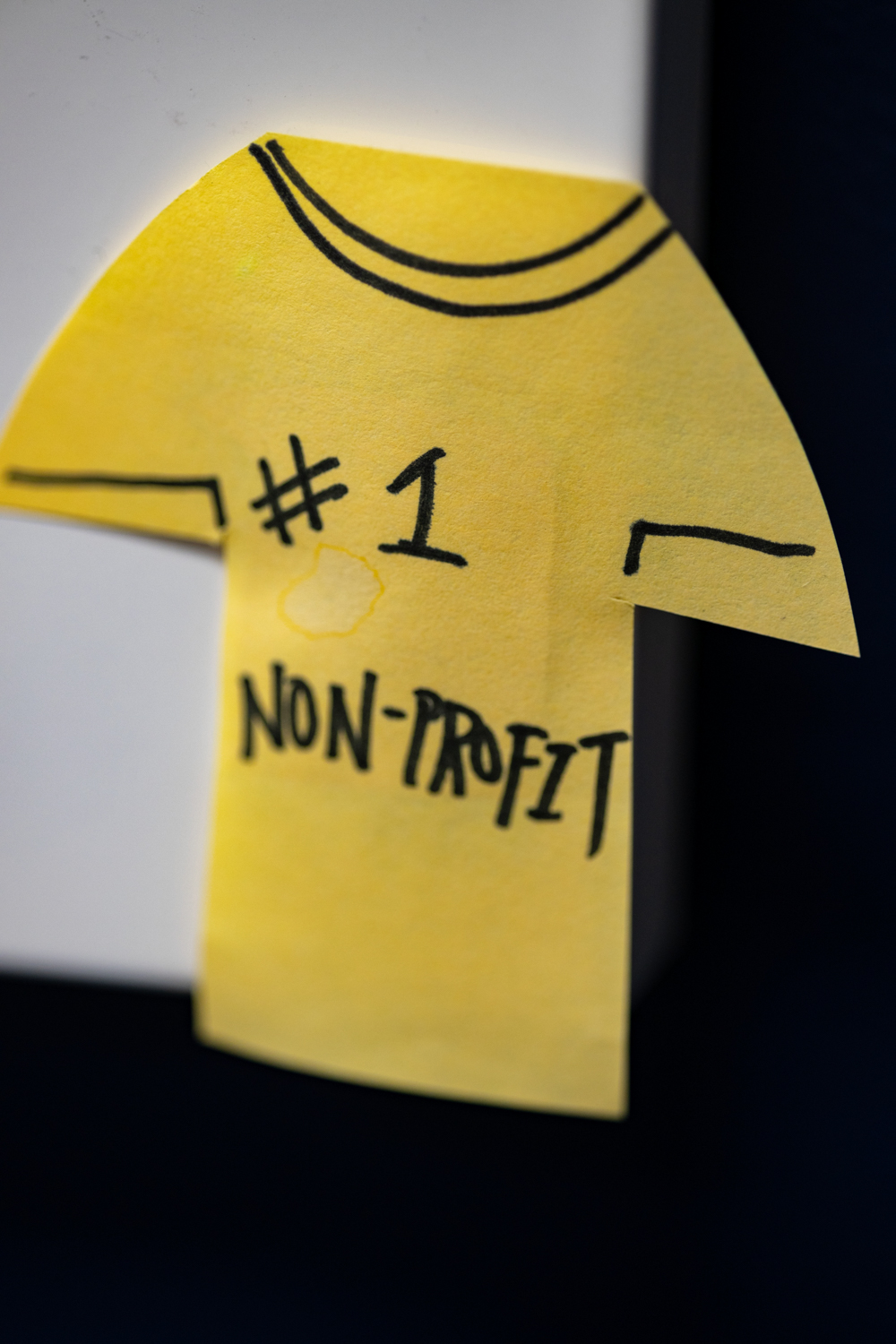
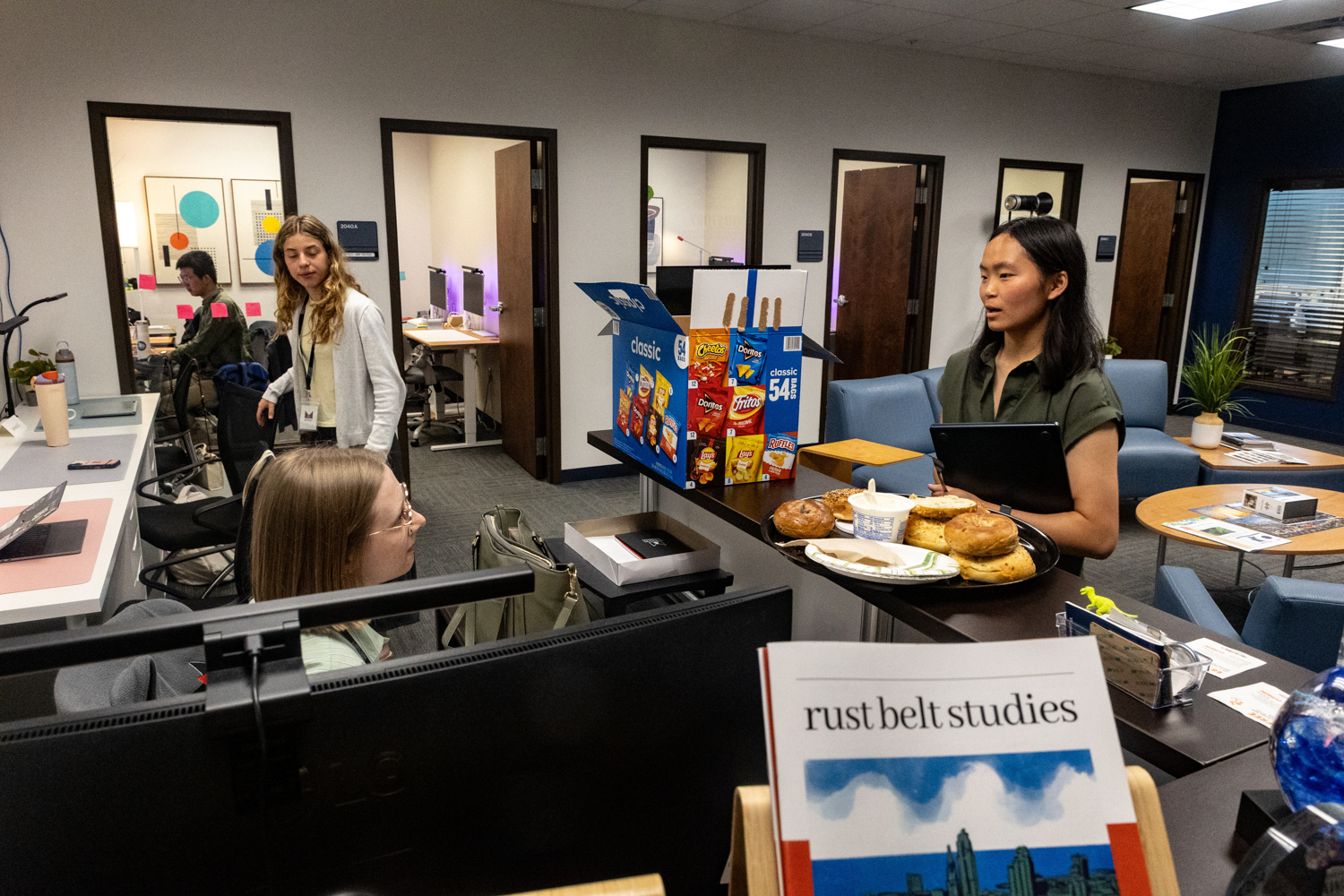
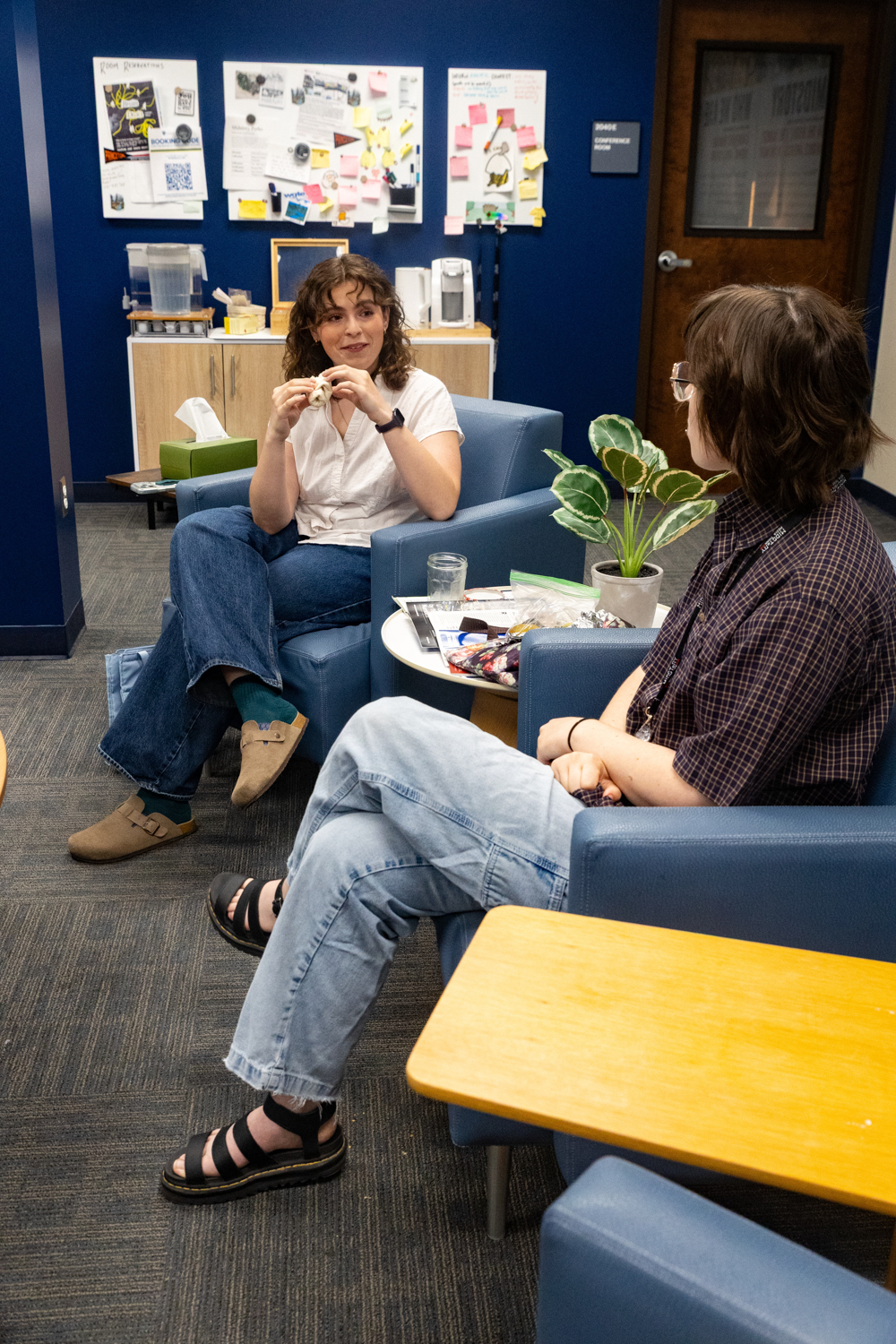
Public message board in a communal space at Midstory, a nonprofit media think tank, during a staff meeting where interns present their projects. (TFP photo by Stephen Zenner)
TOLEDO – Who says Toledo is not an attractive summer destination? Not the 250-300 undergraduates who applied to spend nine weeks in the Glass City this summer, and especially not the 17 of them who made the final cut.
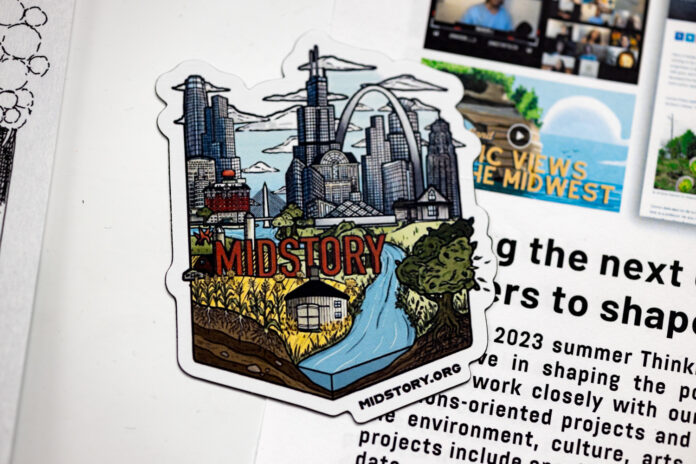
Those 17 – representing 14 universities, eight states, and three countries – are the latest intern cohort of the nonprofit multimedia thinkhub called Midstory – so named because its founders tell the stories of the Midwest, notably its base of Toledo.
What attracted those 17 is the opportunity to research, write, film, and produce stories of not only a local but national nature.
“One of our missions is to attract and retain young people and get them invested in a place like Toledo,” said Logan Sander, Midstory’s editorial director and one of its four founders – all with Toledo-area roots who left for schooling and careers elsewhere, then returned. “Most have never set foot in Toledo. Toledo is not usually a destination for humanities majors, people interested in storytelling or media work. We wanted to make Toledo a place where people can apply their critical thinking skills.”
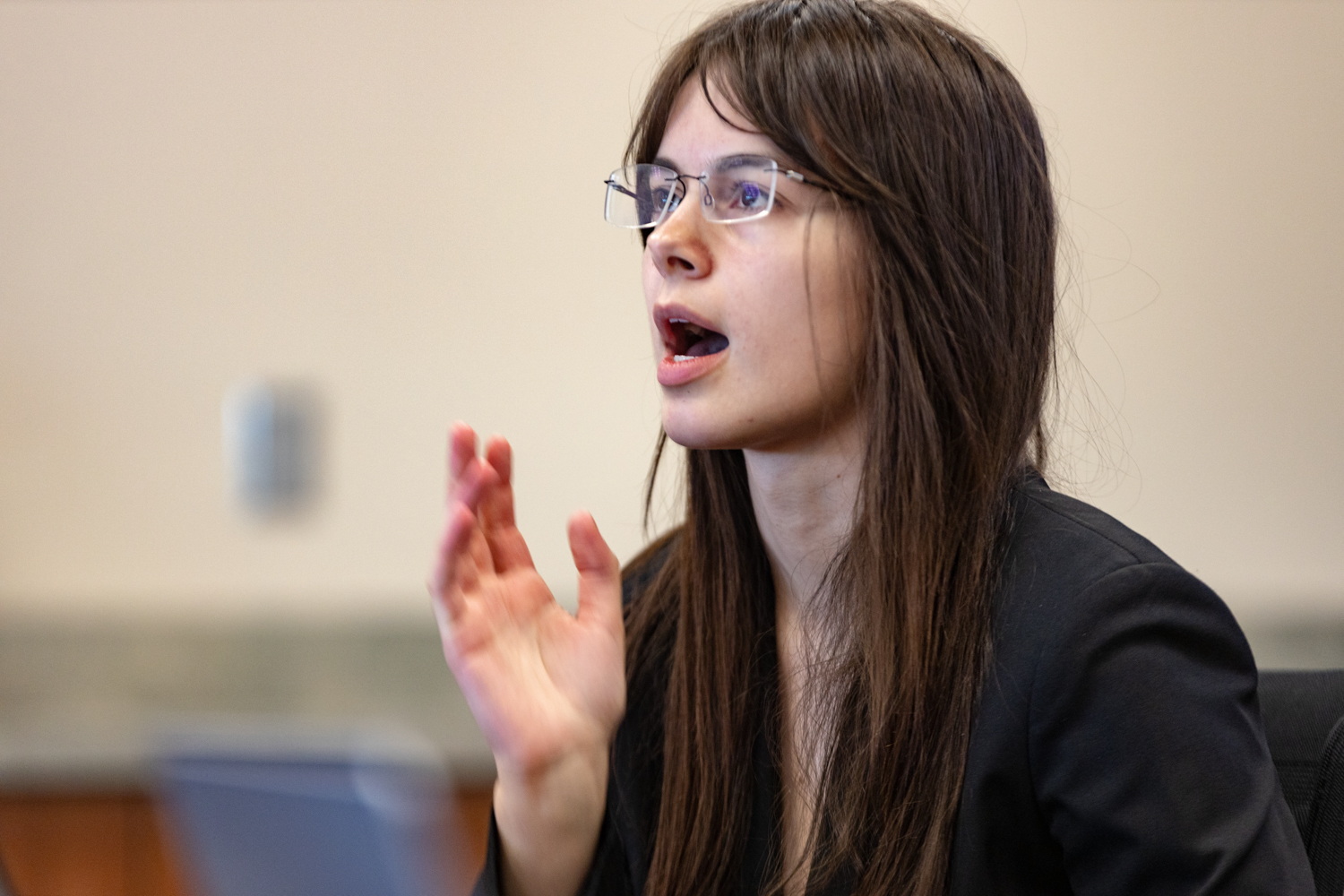
Olga Isailovic, an intern from Bowdoin College, speaks on a group project. (TFP photo by Stephen Zenner)
Of the cohort – the eighth since Midstory began in 2018 – “60 percent of the time they’re pitching and completing their own storytelling work. Forty percent they’re doing higher-level research work on multiple long projects – major podcasts, documentaries, and collaborating with universities. We give them the more immediate bread-and-butter storytelling and longer-term research work.
“We encourage them to not only look with a new set of eyes [on Toledo and the Midwest], but also be in love with the story they’re telling.”
Sander said, “While we are firmly rooted to Toledo, our work is Midwest-wide. We do work that hopefully is nationally relevant.”
An example of a nationally relevant story was done in 2024 by then-intern Casey He, a native of China who lived in Maryland and attended Northwestern University. He researched and produced a story about the shifting of Ohio from being a bellwether state during the presidential election, which “reflected the changing politics of the nation,” he said. “It was well-received.”
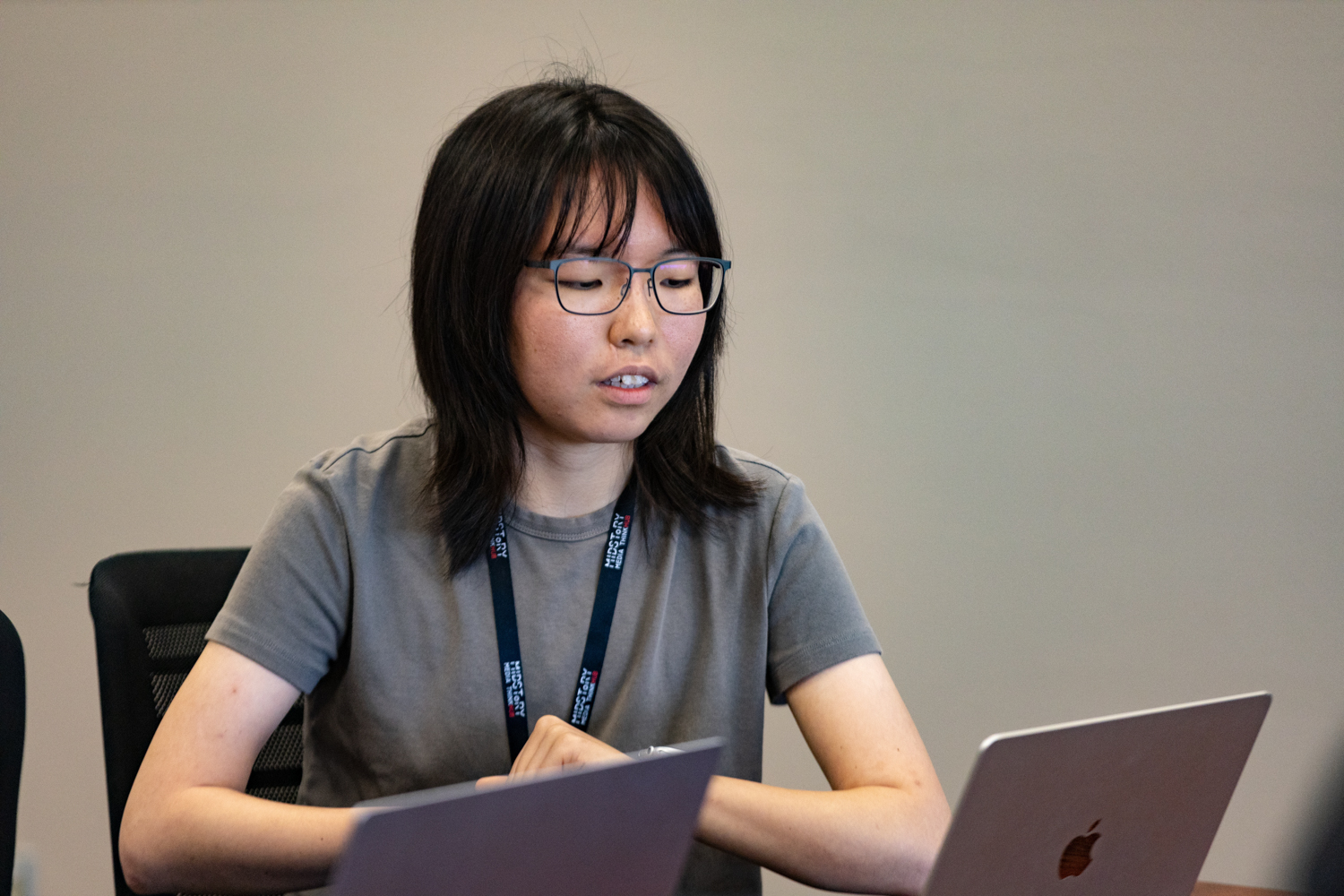
Duruo Li, from the University of Chicago. (TFP photo by Stephen Zenner)
He is back with Midstory this summer, this time as an editorial fellow, an advanced program for recent graduates – he earned a degree in journalism this spring from Northwestern. His role now is helping to edit the interns’ stories and write and research policy issues affecting the Midwest.
“It’s nice to come back to an area I am familiar with,” he said. “I truly appreciate this opportunity. It’s great to want to contribute to Midstory’s mission and explore Toledo and the Midwest and tell their stories. It was a great experience for me, I hope it’s a great experience for them,” he said of this intern cohort.
One of those interns is Natalie Gordon, a rising junior majoring in journalism and political science at Northwestern and from Washington, D.C. “I came here because I wanted to see what it’s like to cover a community,” she said. “I’m writing feature stories – helping spotlight people who are doing well for others and are hopefully inspirational. That allows for a more creative writing style. I’m excited for that. I want to leave here with a sense that what I did made people happy.”
(TFP photo by Stephen Zenner)
Fellow intern Anthony Nassar is a Toledo native who hadn’t heard of Midstory until the Honors College at the University of Toledo, where he’s a rising junior in digital communications with a minor in digital marketing, suggested he apply. That was last year; he didn’t make that cohort. Nassar became more involved at UToledo in preparation for re-applying. He did, and made the cut this summer. “I really wanted them to see how motivated I was,” he said of the application process.
The result so far, he said, “is I’m reinventing my relationship to Toledo. A place where I’ve grown up is a new place to someone else. Even though I was familiar with downtown, I’m creating new memories being with other people,” he said of his fellow interns.
Maison Teixeira, an intern from Brown University. (TFP photo by Stephen Zenner)
Sander said more than 250 collegians have been through the intern cohorts, the coordinator of which she considers “the ultimate success case.” That would be Caitlin Cooper, “a bright and valuable addition to Toledo,” Sander said.
Cooper, a native of Essex, England, came to Midstory for what was to be a three-month fellowship in 2023. “I was looking for a job in storytelling,” she said. She came upon Midstory, and, despite the fact that she had “never heard of Toledo,” applied and was hired.
Then, in a sense, the magic of what Midstory tries to do took hold. “In those three months I knew I wanted to stay,” Cooper said. “I found a community here outside of work that was not [like] anywhere else in big cities. The Toledo mindset is that people have ambitions, but are focused more on the people around them and how they can help. That was eye-opening.”
“Three years later, I’ve married and have roots firmly planted in Toledo.” She’s halfway through her Ph.D. pursuit in American cultural studies at Bowling Green State University.
In May, Cooper started fulltime with Midstory as intern coordinator and editorial assistant. “We’re trying to highlight the stories of this region,” she said. “I believe in this mission and fully support it.”
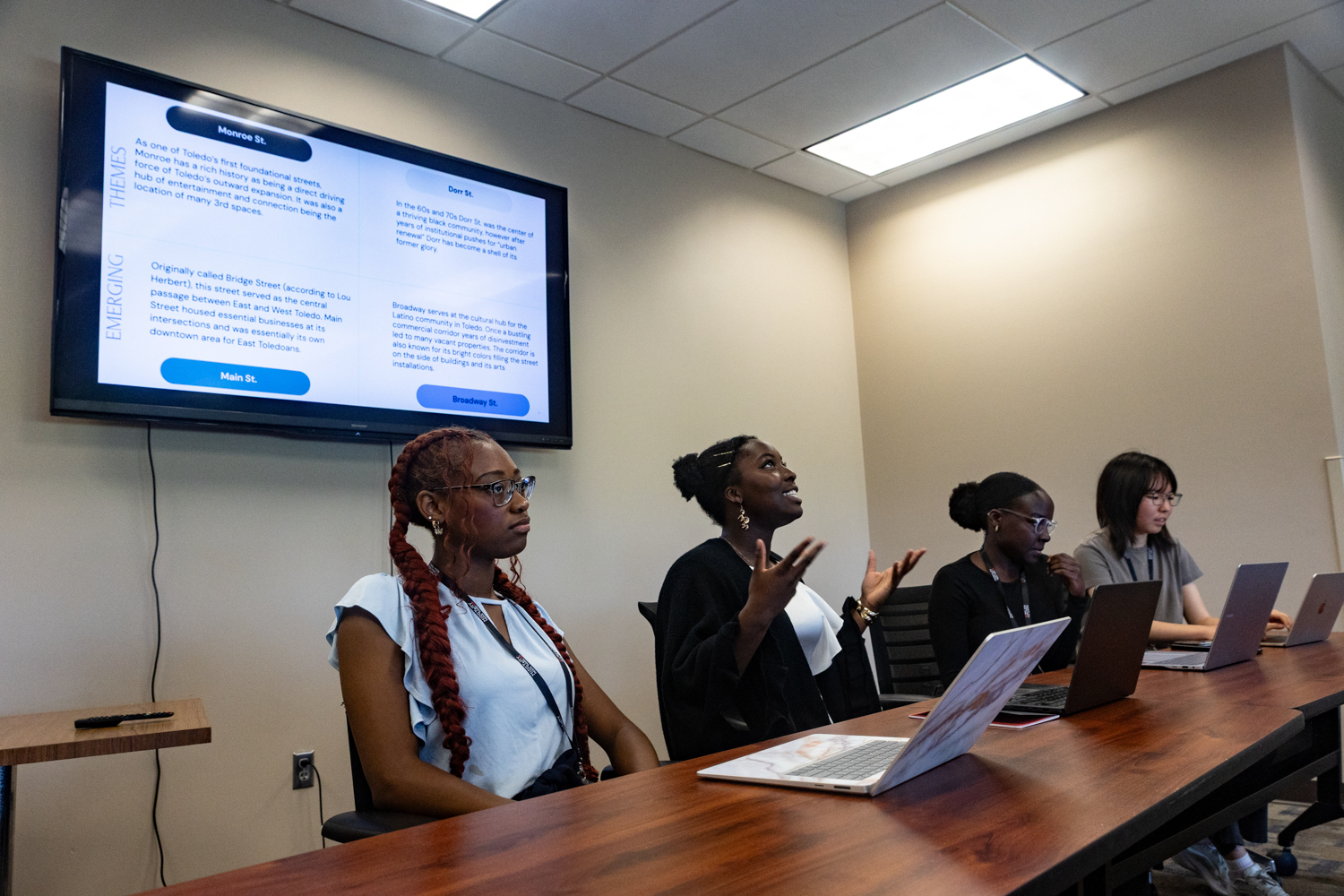
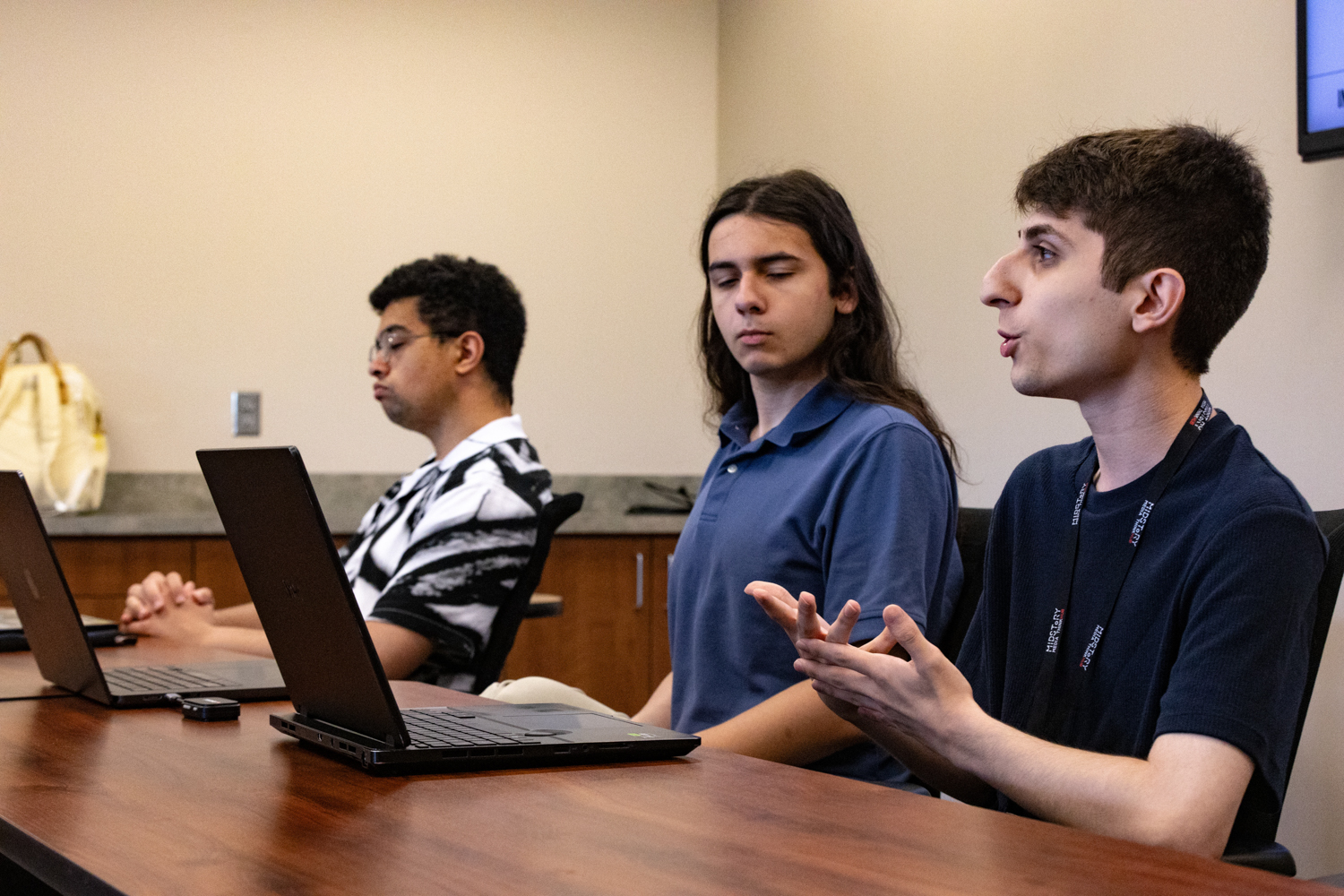
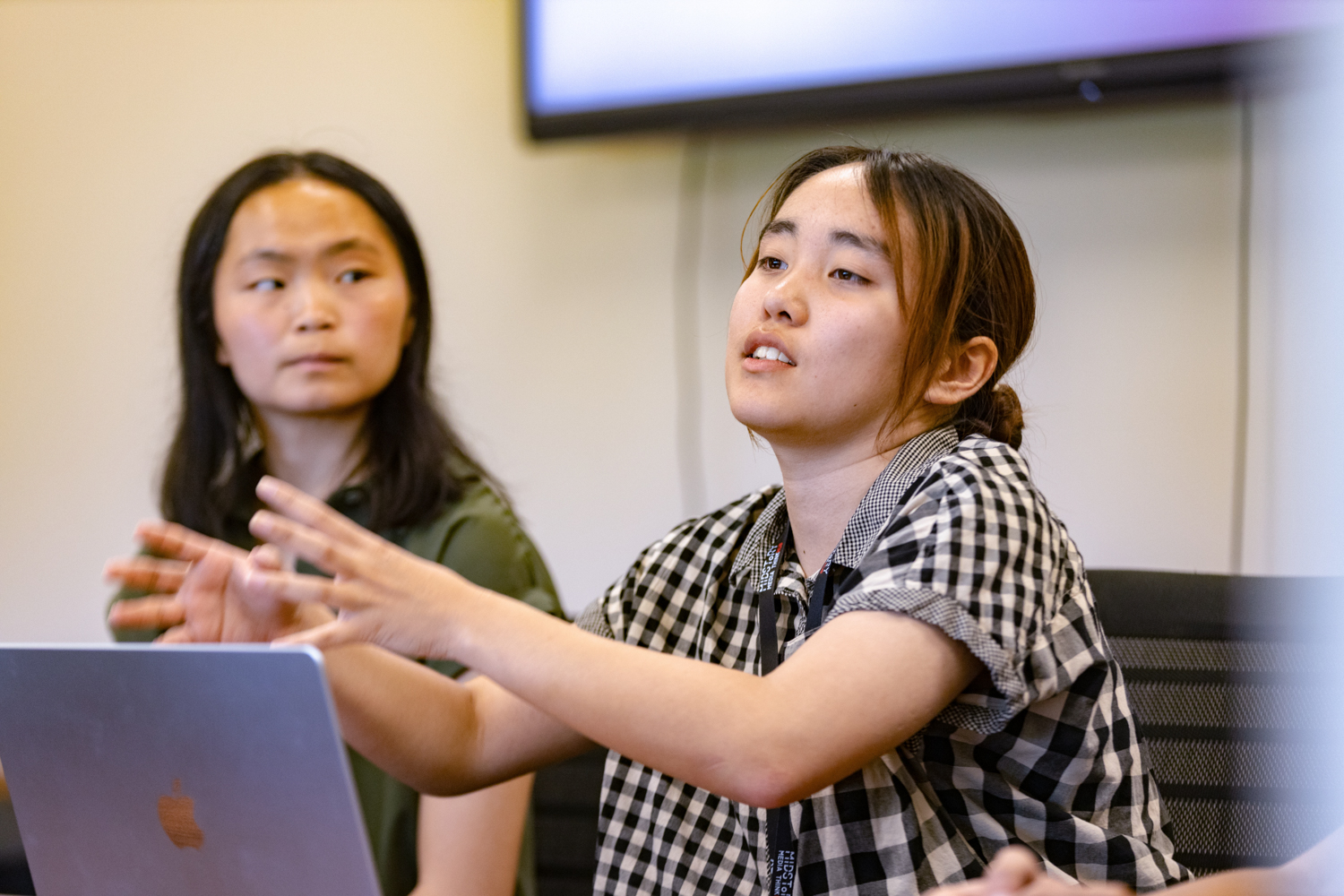
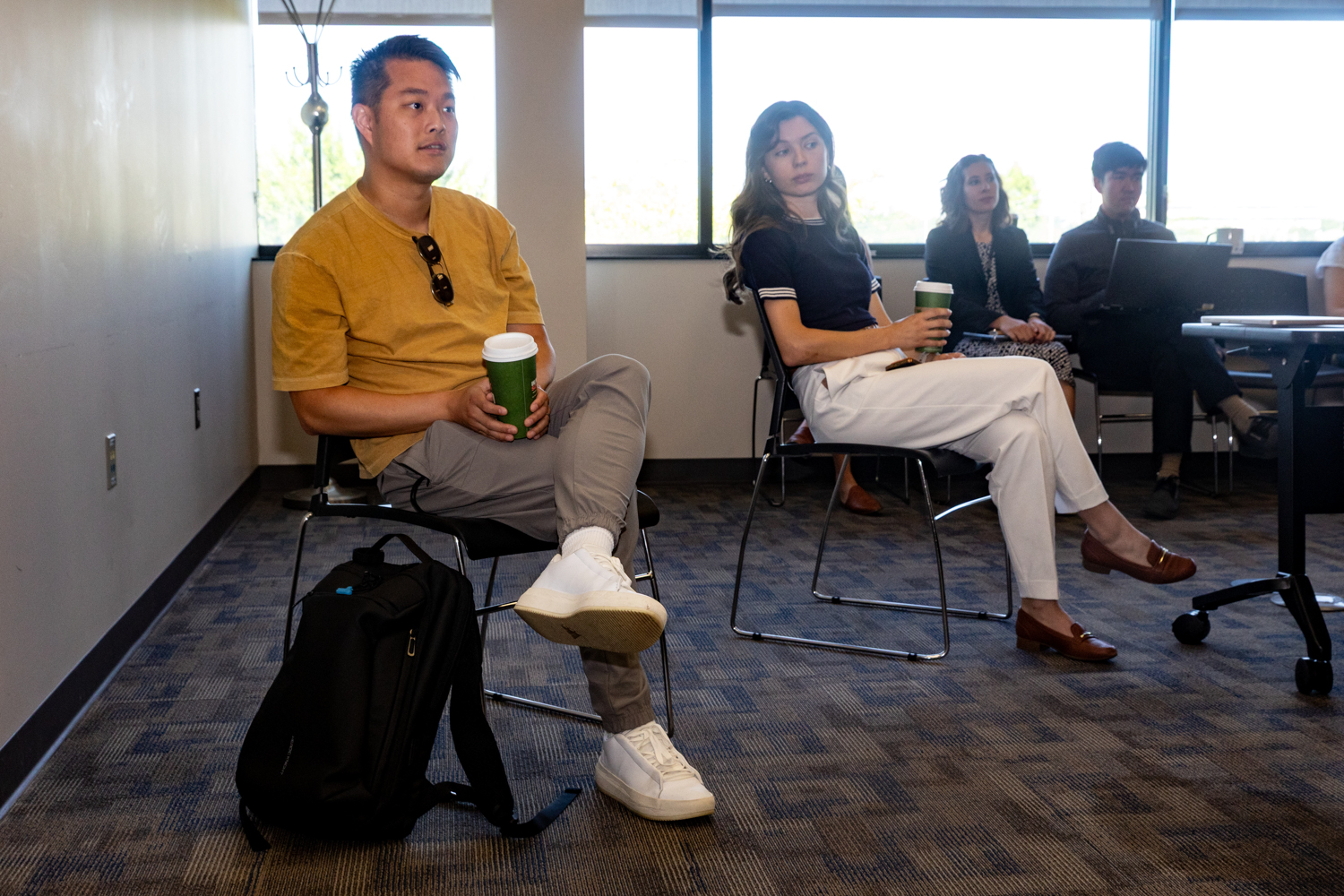
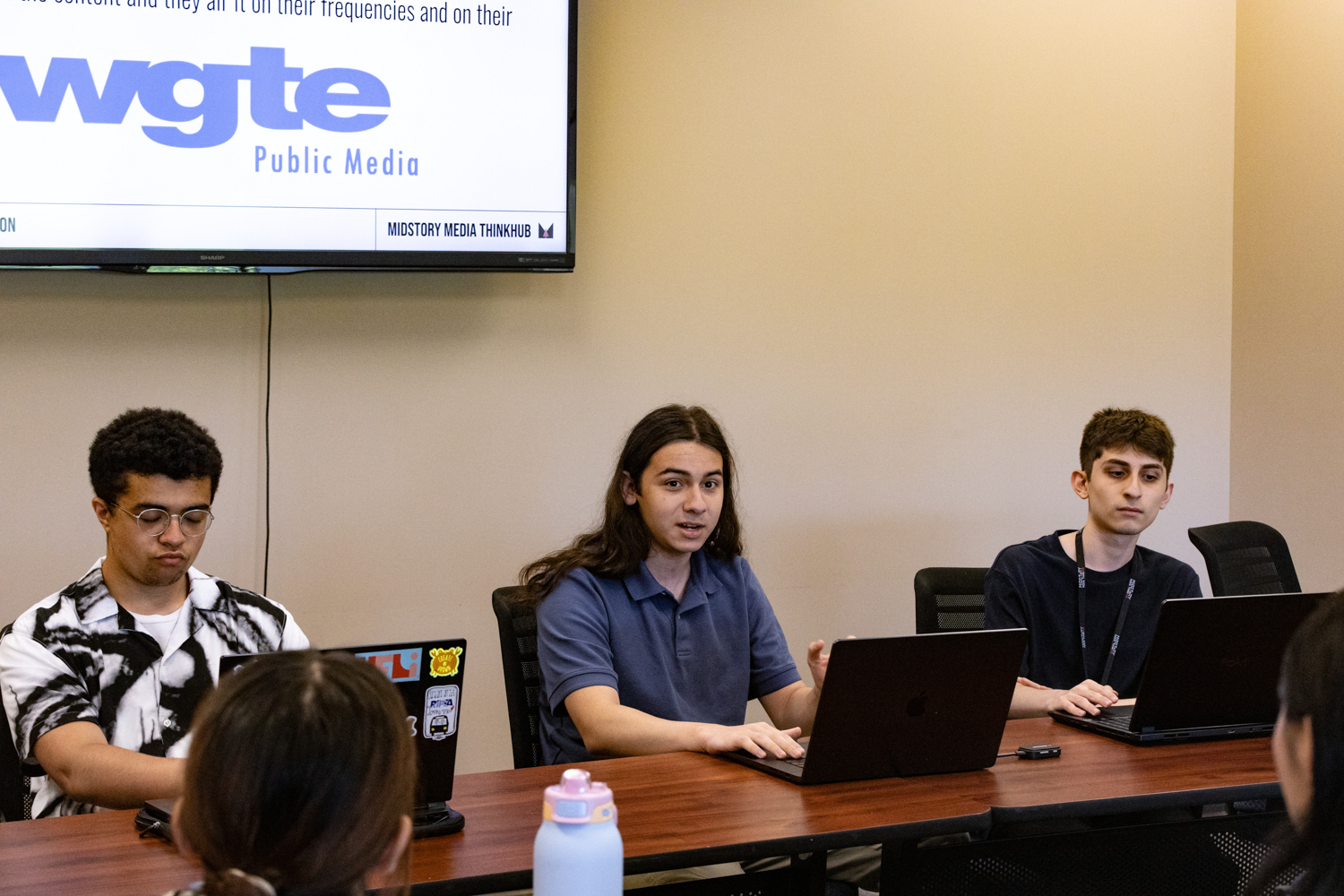
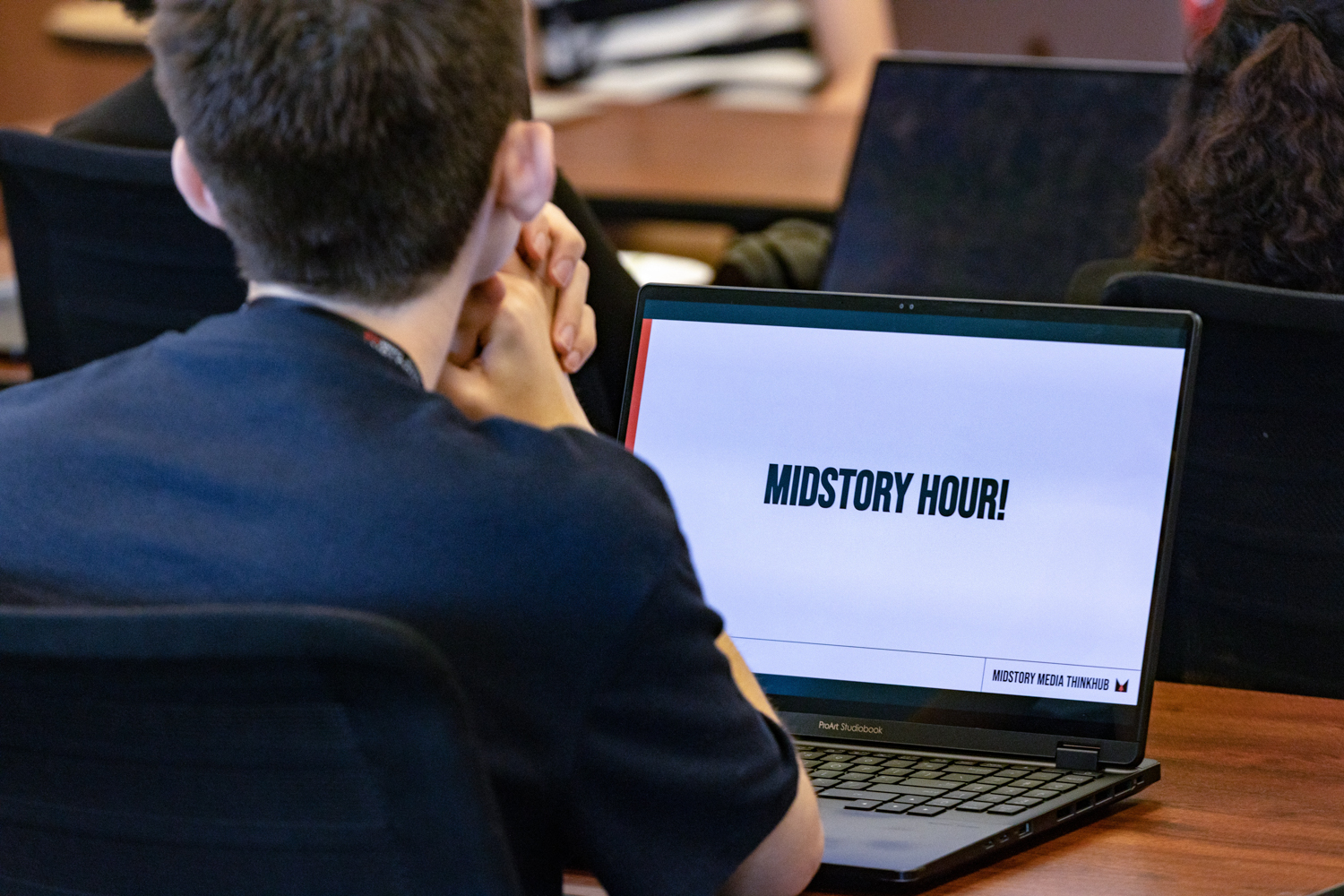
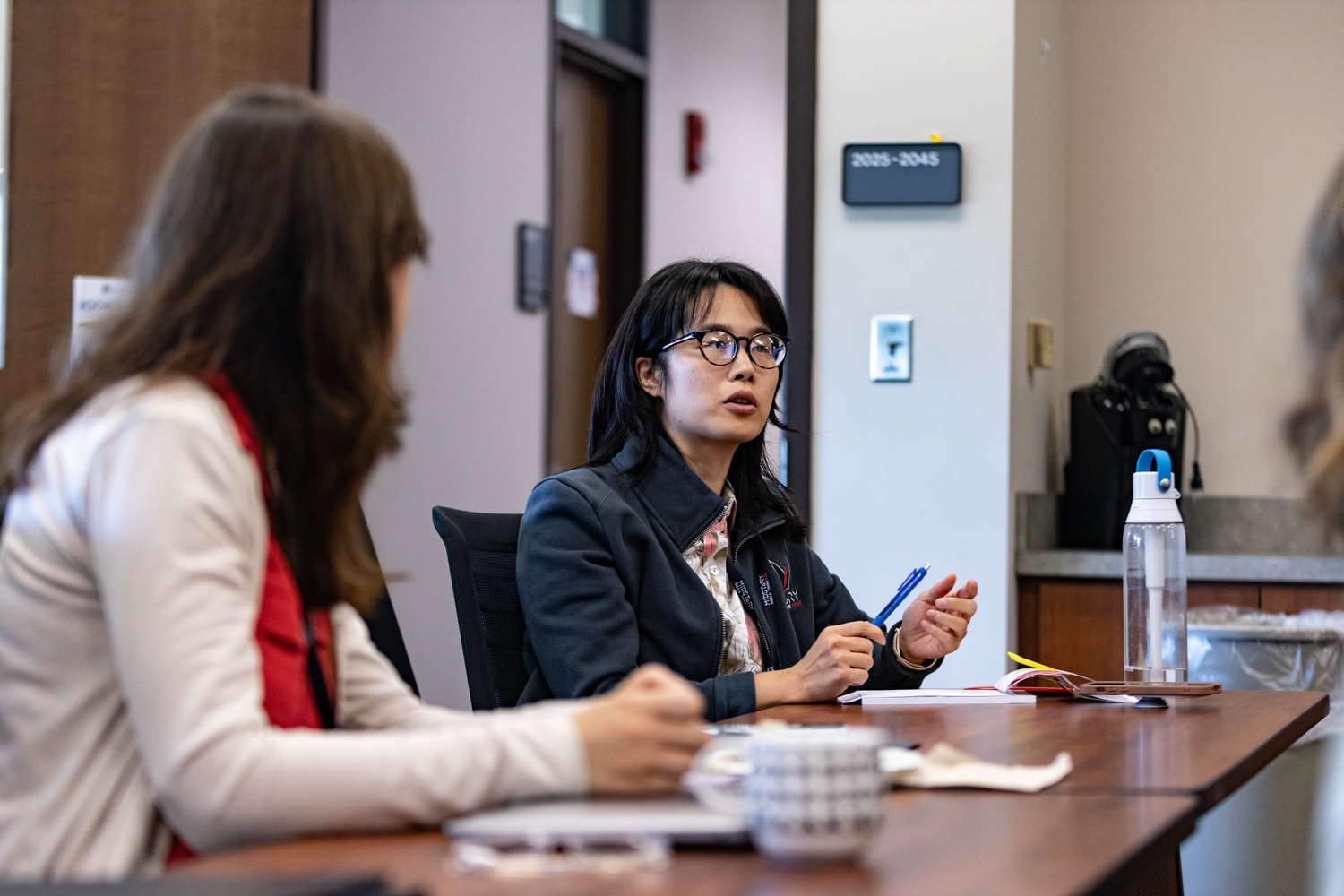
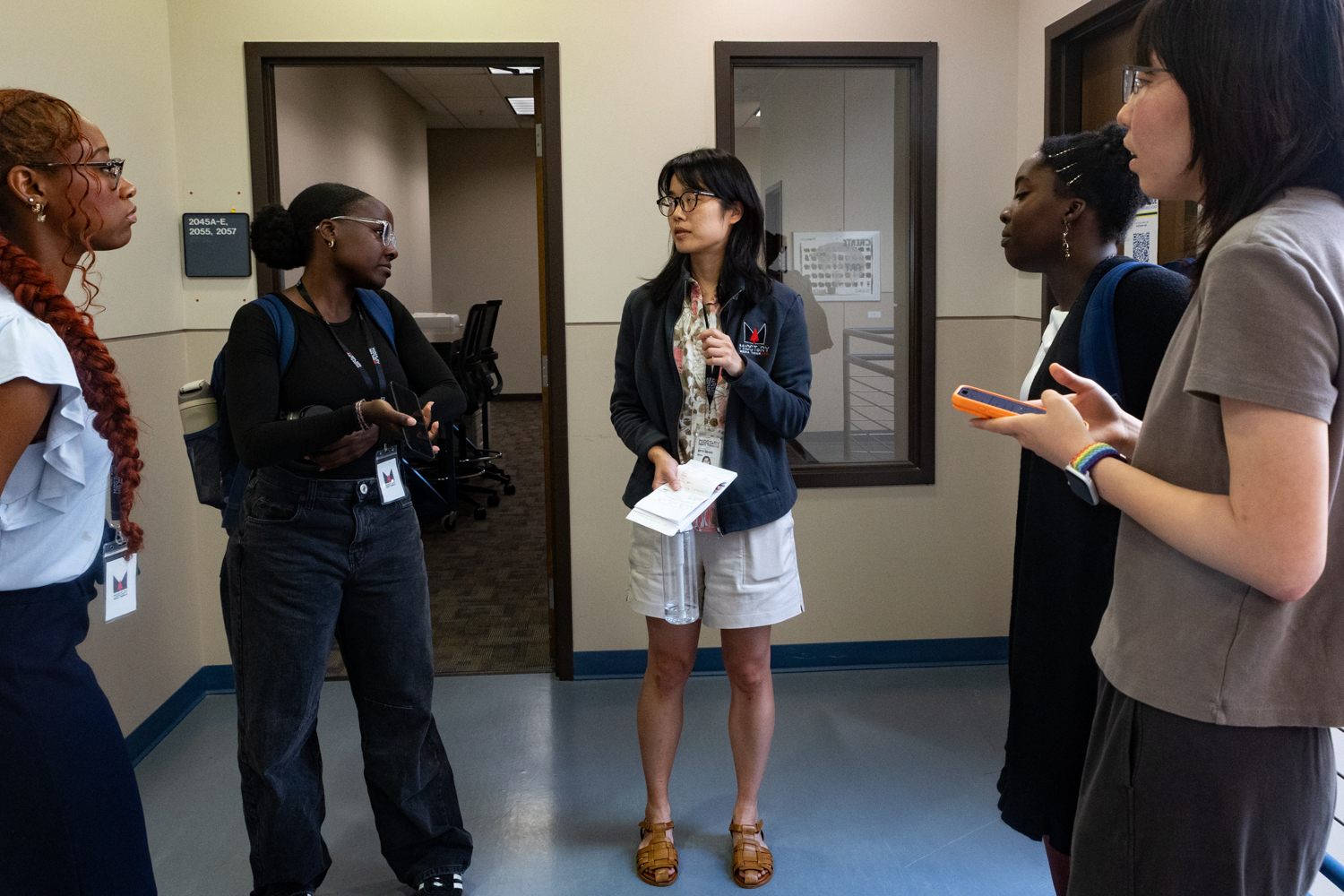
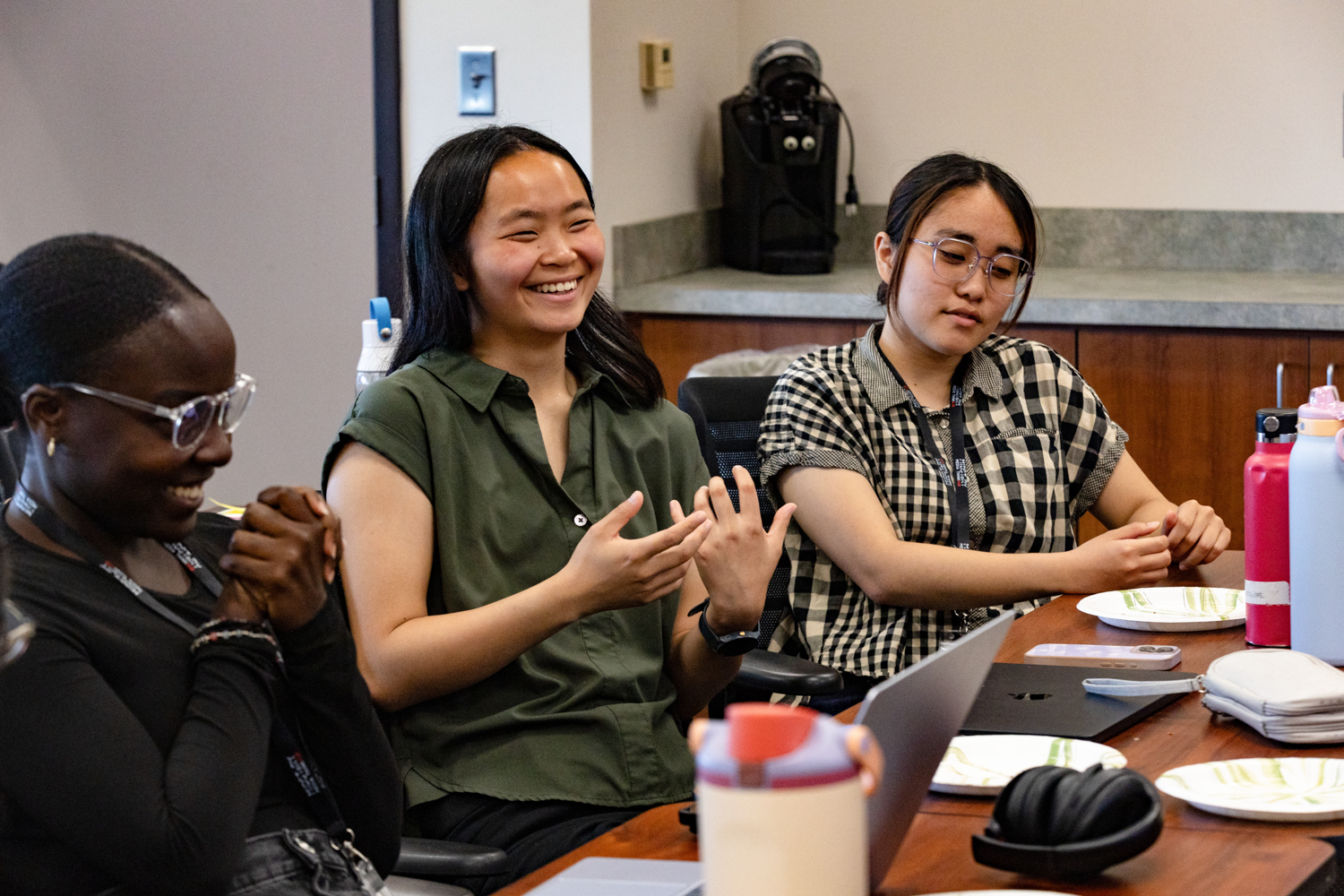
Jahzara Norris from the University of Illinois, Elizabeth Thomas from Carnegie Mellon University, Levia Ropheka from Syracuse University, and Duruo Li from the University of Chicago. (TFP photo by Stephen Zenner)Maison Teixeira, an intern from Brown University; Beckett Painchaud, an intern from Syracuse University; and Anthony Nassar, an intern from the University of Toledo present “Midstory Hour,” their project in collaboration with WGTE Public Media. (TFP photo by Stephen Zenner)“One Vote Away” team with interns Ava Illi of Oberlin College; Rebekah Repp of Case Western Reserve University; Ian Shin of Princeton University; Natalie Gordon of Northwestern University; and Luluya Tekle of Northwestern University. The project details the complicated politics of Ohio leading up to the Civil War, including the underground railroad, and that Ohio was one vote away from becoming a slave state. (TFP photo by Stephen Zenner)Kaitlyn Gastineau (left), an intern from the University of Michigan and Natsume Karude, an intern from DePauw University. (TFP photo by Stephen Zenner)Samuel Chang (left) and Logan Sander (founders of Midstory) facilitate a staff meeting where interns present their projects. (TFP photo by Stephen Zenner)Maison Teixeira, an intern from Brown University, Beckett Painchaud, an intern from Syracuse University, and Anthony Nassar, an intern from the University of Toledo. (TFP photo by Stephen Zenner)(TFP photo by Stephen Zenner)Kaitlyn Gastineau, an intern from the University of Michigan in a common room at Midstory. (TFP photo by Stephen Zenner)Anthony Nassar, an intern from the University of Toledo, prepares to present his group project, “Midstory Hour,” during a staff meeting. (TFP photo by Stephen Zenner)Ruth Chang, one of the founders of Midstory, asks questions of a group project focusing on the change in streets in Toledo. (TFP photo by Stephen Zenner)Midstory Co-Founder Ruth Chang (center) speaks with interns Jahzara Norris from the University of Illinois; Levia Ropheka from Syracuse University; Elizabeth Thomas from Carnegie Mellon University; and Duruo Li from the University of Chicago after a staff meeting. (TFP photo by Stephen Zenner)Yaffa Segal, an editorial fellow for Midstory, eats lunch with Brynn Drabek, a media fellow for Midstory. (TFP photo by Stephen Zenner)Levia Ropheka, an intern from Syracuse University; Kaitlyn Gastineau, an intern from the University of Michigan; and Natsume Karude, an intern from DePauw University. (TFP photo by Stephen Zenner)
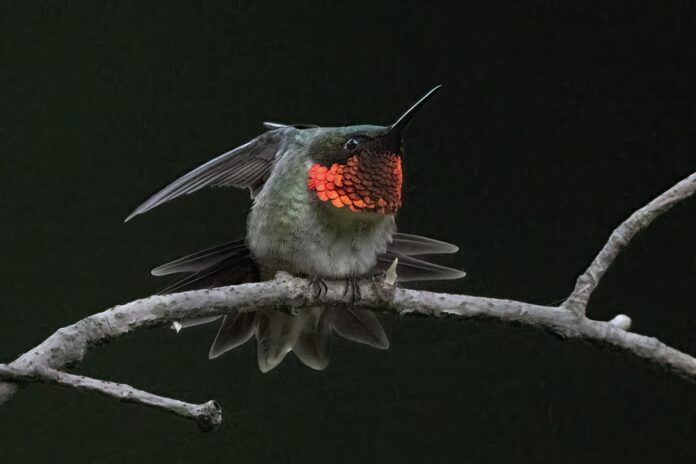
Male ruby-throated hummingbird. (Photo by Art Weber, nature photographer for Metroparks Toledo)
A male ruby-throated hummingbird performs some pre-flight stretches at dawn in the Oak Openings area. Like a baseball pitcher warming up in the bullpen before throwing 90 mph fastballs, this tiny bird loosens up a bit before pushing those wingbeats up to an incredible 50 flaps per second or more, maybe well over 100 per second if he kicks it into high speed. That pre-flight routine also includes fanning tail feathers and stretching its neck.
I will never forget the day that my best friend and I discovered Alanis Morissette’s hidden track on the genre-defining, internationally acclaimed album, Jagged Little Pill.
Caity and I would pop in our Jagged CD and drive around for hours listening to the album’s poignant lyricism and striking instrumentals, singing at the top of our lungs until we’d finish the final track, “You Oughta Know (Jimmy the Saint Blend),” and start it over again.
One day we were having a particularly hard day dealing with our adolescent angst, so we pulled into a parking lot and talked out our problems underscored by the album. When it finished, instead of starting the album over, we found the final track on the list kept playing only to reveal the most gut-wrenching, intensely vulnerable song we’d ever heard: “Your House.”
The album was already a core part of our lives, but in that moment, we felt like everything was going to be okay, and we discovered that Jagged Little Pill is the gift that keeps on giving.
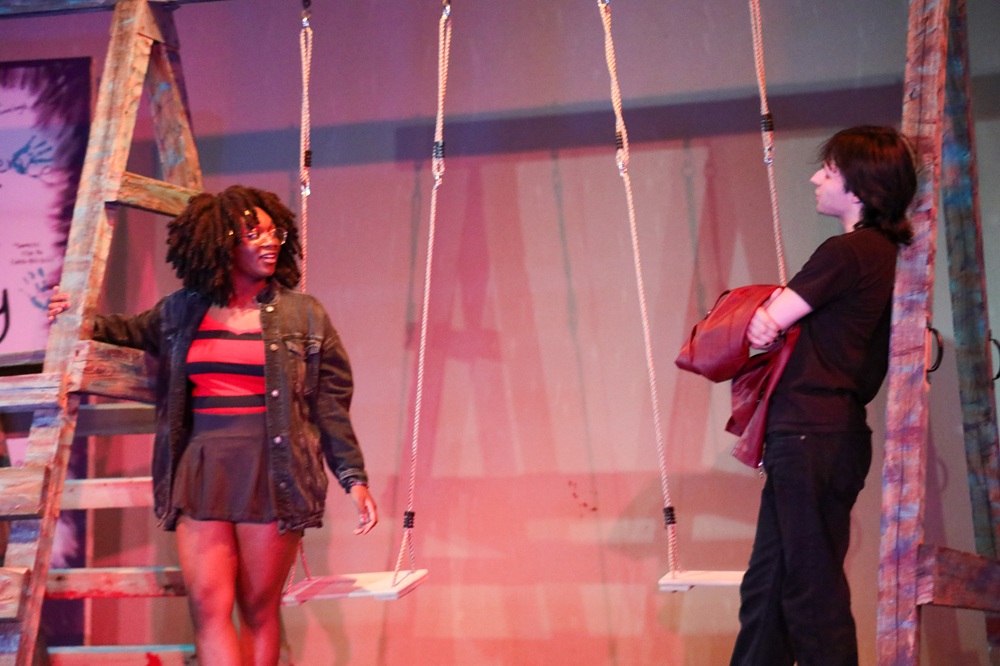
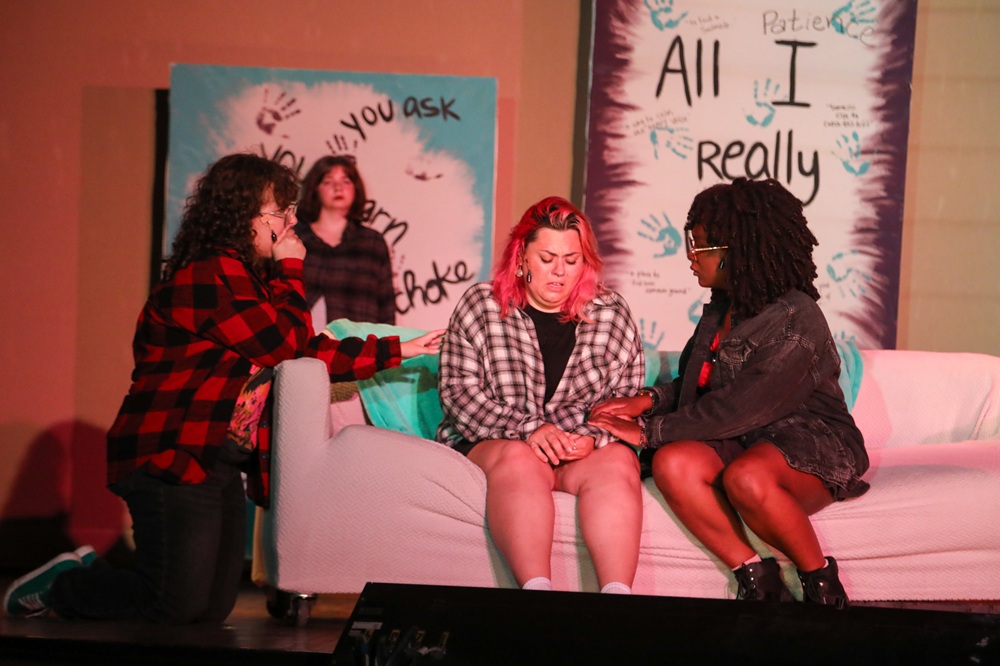
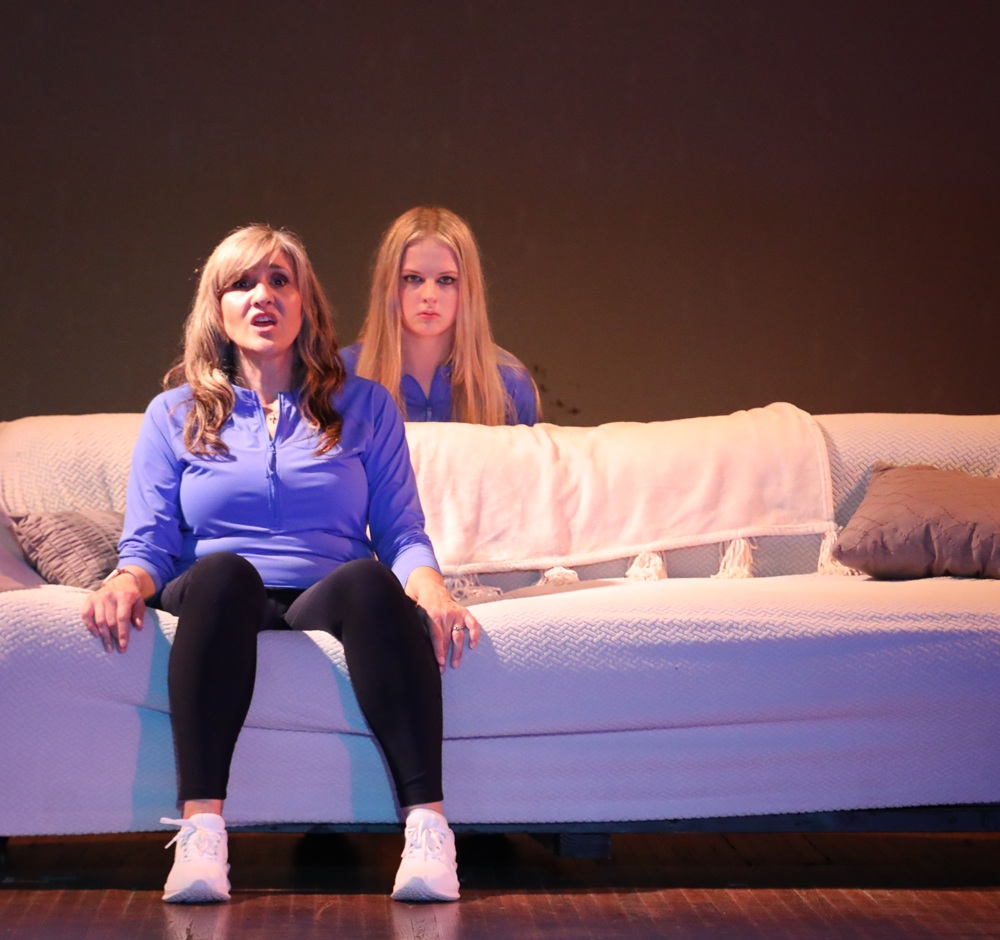
Enter: Jagged Little Pill (musical). The show follows the Healy family, all navigating their own strife with one central plotline that could change the family’s lives forever. The best part? The show is a jukebox style musical set to Alanis’ iconic album, padded with a few of her other hits, and featuring two songs written by Alanis for the musical.
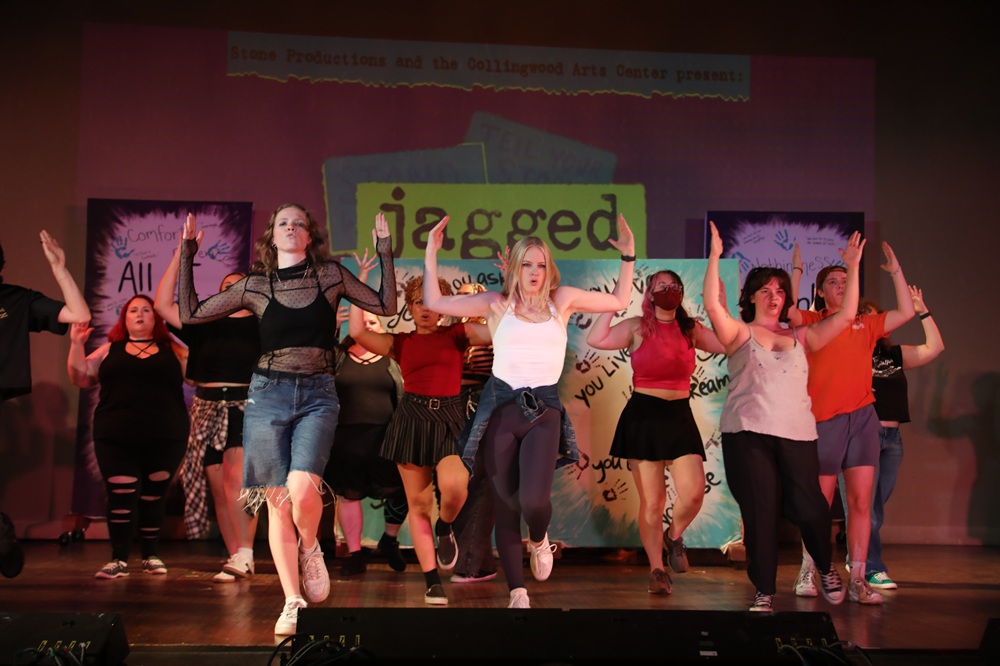
(Photo by Derek Roe)
This show is no easy feat to produce, but unsurprisingly, Stone Productions was up to the task. Let me set the scene of the roadblocks:
On the technical side, our production team had to create an airtight vision, as this is the northwest Ohio premiere of the show. Though minimal set pieces, Jagged has no time for scene changes, instead relying on stellar lighting (thank you Zann Campbell-Johannes!) and four panels to shift through the non-stop show. The show is ensemble-heavy, so our sound designer had his work cut out for him navigating cues and balance (shoutout Roger Flanagan!). On the performer side, there’s necessary trigger warnings for serious subject matter, which sets our team up for an emotional journey, combined with the physical and vocal demands that are nearly unheard of in live theatre.
Then there’s the choreography of the show, which is where I come in. Aside from the incomparable music of Alanis and the deeply important storylines, Jagged Little Pill does something extremely uncommon in musical theatre: It uses choreography to further the plot.
(Photo by Derek Roe)
I knew this would be unlike anything I’ve choreographed, and not just from the pressure of using dance as an actual plot device and combining 90s influence and lyrical expression. It wasn’t even the daunting task of choreographing 14 of the 23 songs on the album; rather, the biggest challenge was encouraging this group to develop a comfortableness with their bodies to be vulnerable on stage and engage with freestyle.
Our production team was so fortunate to work with some of the most talented humans. The principal actors are amazing, armed with complex, diverse characters. Our ensemble is just as crucial as these leading characters. They took my giant ask, and delivered to the umpteenth degree.
But I would be remiss if I didn’t wax poetic about my avatars.
This show features a few select dancers assigned to different characters in the show who have the hard job of showing how our leads are feeling emotionally. Ciara Lieberman (MJ’s avatar), Chanel Black (Frankie’s avatar), Callum Mather (Nick’s avatar), and myself (Bella’s avatar), have worked tirelessly to understand these characters and execute some demanding choreography, all while being in the ensemble as well.
(Photo by Derek Roe)
There’s no other combination of humans that could’ve produced what our production team put together. Our crew, including Ben Salati and Brad Arps, hustled beyond belief, under the direction of our bright and meticulous stage manager Marian Marlatt. Our music director and beloved friend Kevin McGill expertly taught songs that had most individuals tackling their own harmonies, compiled and leading musicians for the pit, and didn’t even break a sweat.
This is the fourth show I’ve choreographed alongside Co-Director Jaymes Gregory-Mull, whose reputation of putting on incredible productions precedes him. He was bold enough to choose this show, and knocked his vision out of the park, along with any roadblocks that stood in our way (even if it meant he had to wear multiple hats as director/stage crew/cast).
(Photo by Derek Roe)
I’m lucky that Co-Director Andronicus Roberts, or my “little brother” as he’s affectionately known, got to work together. Not only did Andy take on co-directing this show, but he also had the security and self-awareness to play Andrew, the show’s central villain, and my dance partner for one of the most pivotal moments of the show. Though I could go on and on about this team, I will simply say I am so grateful for the opportunity to work with them.
But what makes this experience one of the most memorable of my time as a choreographer is performing alongside my best friend, Caity. More than 10 years since we discovered “Your House” on a random weekday, I now get to hear Caity sing this song every night as Jo. I’ll find myself at rehearsals catching glimpses of our teen selves, unsure about what the world holds, but knowing that as long as we have each other, “Everything’s gonna be fine, fine, fine.” That’s the impact of Jagged Little Pill, and the magic of Alanis.
Jagged Little Pill runs at the Collingwood Arts Center July 24, 25 and Aug. 1 at 8 p.m., and Aug. 2 at 3 p.m. Viewer discretion is advised. Find your tickets here.
Reflecting on her history with mom meetups at Toledo’s Metroparks, Erin Holden meets up with members of the Mother’s Center of Greater Toledo for an impromptu playdate at Glass City Metropark.
This is the second episode of A Walk in the Park with, a WGTE Public Media and Metroparks Toledo collaboration hosted and produced by Erin. Join her as she explores everyday life in Toledo’s Metroparks. In each episode, Erin interviews different park visitors – runners, teachers, artists, parents and more – revealing the many ways people connect with nature. You’ll hear personal stories about people’s relationships with our parks and the activities they cherish. Erin also documents her journey along the way, reflecting on the insights she gains from each experience.
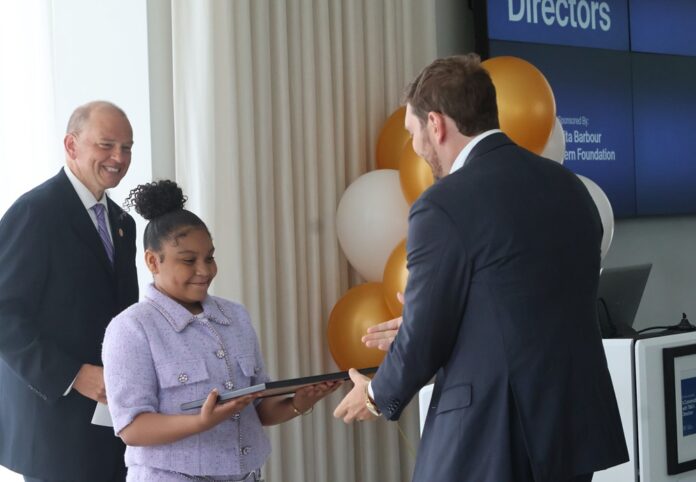
TMA director Adam Levine accepts a proclamation from Toledo Mayor Wade Kapszukiewicz and this year’s Kid Mayor, 10-year-old Jamie Howard of Ella P. Stewart Academy, in honor of the 125th anniversary of the museum. (TFP photo by Laurie Bertke)
TOLEDO — Two important milestones converged at Ohio’s Homecoming & Picnic on July 11, as the Toledo Museum of Art hosted free community festivities in coordination with the America 250-Ohio Commission to mark the nation’s anniversary and 125 years since the institution’s own founding in 1901.
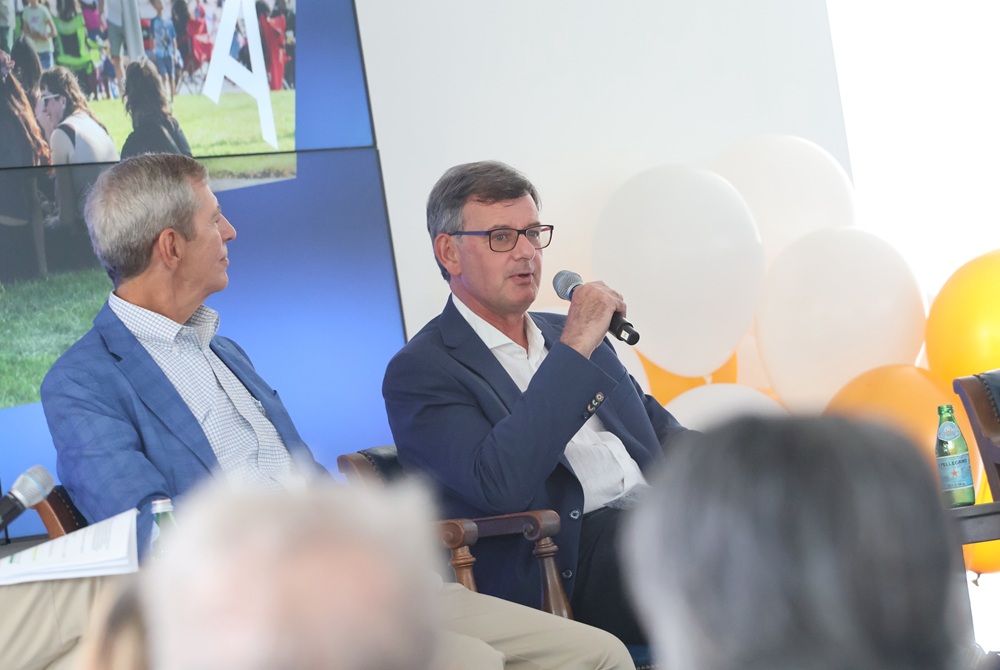
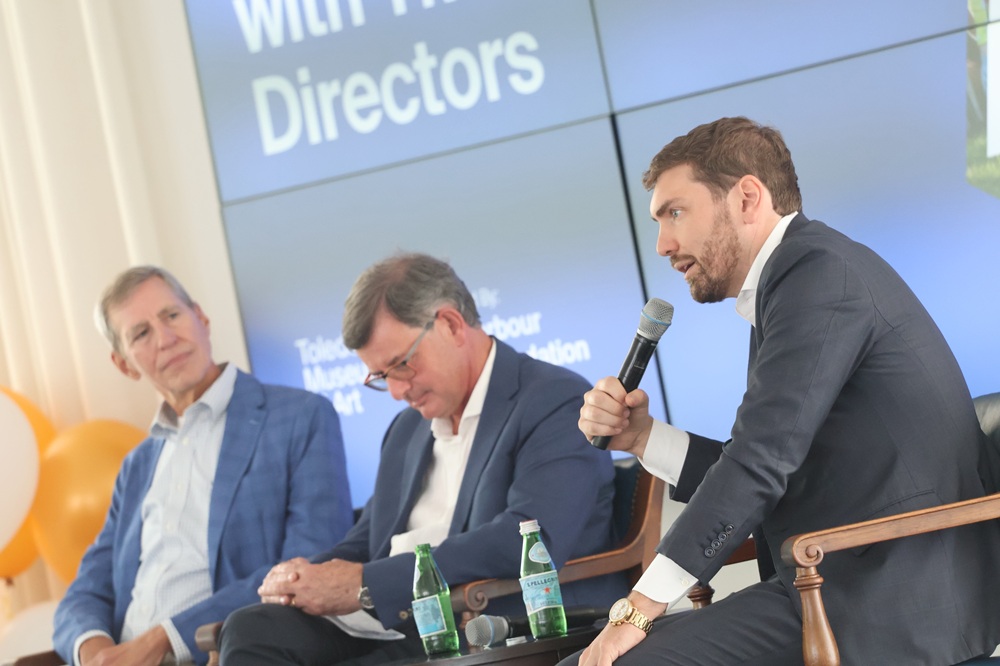
The day brought three museum directors past and present together for a candid conversation moderated by Libbey Inc. CEO and TMA Board President Mike Bauer. While the directors recounted memories from their tenures and discussed the museum’s evolution before a rapt crowd in the GlasSalon, families frolicked outside on the Glass Pavilion lawn playing games, making art, watching historical demonstrations and listening to live music.
Panelists included Adam Levine, the museum’s 11th director since he assumed the role in 2020, and his two predecessors, Brian Kennedy and Don Bacigalupi. Kennedy directed the museum from 2010 to 2019 and Bacigalupi served from 2004 to 2009.
Brian Kennedy, who directed TMA from 2010 to 2019, speaks during a panel discussion with other directors July 11 in the GlasSalon. (TFP photo by Laurie Bertke)
During his time as director, Kennedy recalled, he liked to say that the museum didn’t happen — it was called into being by its founders, Edward Drummond Libbey and Florence Scott Libbey.
Mrs. Libbey encouraged her husband to establish an art museum for the enrichment of the community, and the couple provided the land, funded much of the iconic construction on campus and donated their own personal art collection to the endeavor. An endowment fund from the Libbeys continues to fund museum operations and the purchase of works of art.
Kennedy said the Libbeys were people of the Gilded Age who brought the eye in design together with the hand in manufacturing to make something extraordinary.
He encouraged people to consider what the founders were trying to do when they started the museum, and not to lose that. “They were very, very remarkable people. And they set off this notion of art education, and Toledo is the beneficiary for generations now,” said Kennedy.
All three directors touched repeatedly on the importance of increasing community engagement during their tenures.
TMA director Adam Levine, left, speaks with past directors Don Bacigalupi and Brian Kennedy before a panel discussion July 11 in the GlasSalon. (TFP photo by Laurie Bertke)
When he first arrived at the museum and began talking with residents, Bacigalupi recalled his surprise and concern at observing a disconnect between the passion Toledoans expressed for the museum and how often they visited. He set about exploring ways to make the museum more accessible and open, and recalled the marketing campaign his staff developed. Banners and billboards utilized colloquial language with messages such as, “Come on in to your museum,” and “Come up and see me sometime.”
“It was kind of a different voice that the museum could speak in, that wasn’t up on a hill and up a marble staircase, but was, in fact, in the language parlance of the community which is, I think, the best language for this museum to speak,” said Bacigalupi. “It doesn’t mean that we, in any way, disrespect the scholarship and the quality of the museum and its history, but it does open its arms to a broader community.”
The museum’s annual Juneteenth celebration also began under Bacigalupi’s tenure, the idea growing out of his own experience at celebrations during his formative years in Texas and conversations with African-American staff members. It further evolved under Kennedy’s leadership into the block party the museum hosts annually in conjunction with the holiday.
“We are constantly evolving toward this greater sense of community engagement,” said Levine. “We’re sitting in a building that didn’t exist until 20 years ago, using a template that Don developed for the first Juneteenth celebration, that Brian perfected in the block party for getting the zoning, and getting the permit and getting the tents, right? … So we are always sort of standing on the shoulders of people who came before.”
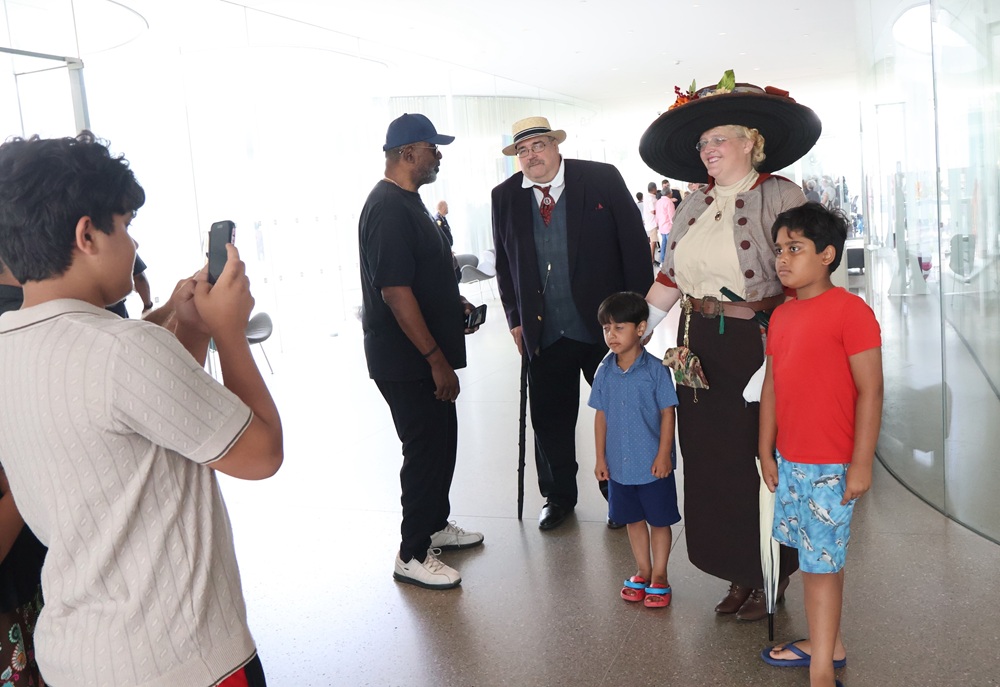
Jim WIlliams, dressed as Edward Drummond Libbey, and Jennifer Rounds, dressed as Florence Scott Libbey, pose for photos July 11 in the TMA Glass Pavilion. (TFP photo by Laurie Bertke)
Broadening the collection
Levine credited his two predecessors with the role they played in creating the contemporary art program at TMA.
“The debt of gratitude that we should have to both Don and Brian for getting the governance frameworks in place and changing the culture, to think about finding quality as a global phenomenon, both temporally and geographically, cannot be understated,” he said.
Levine said one of the first exercises Kennedy did was to put pins in a map representing the origins of the museum’s artwork, to see what regions were missing.
“Because there’s great work from those places, and a huge part of building a collection that causes people to feel reflected is just trying to find the best art, which is what we’ve always done, but from anywhere,” said Levine. “It’s really these two gentlemen that started to put some sense of systematicity around what had been a superlative collection, but really was very director-driven.”
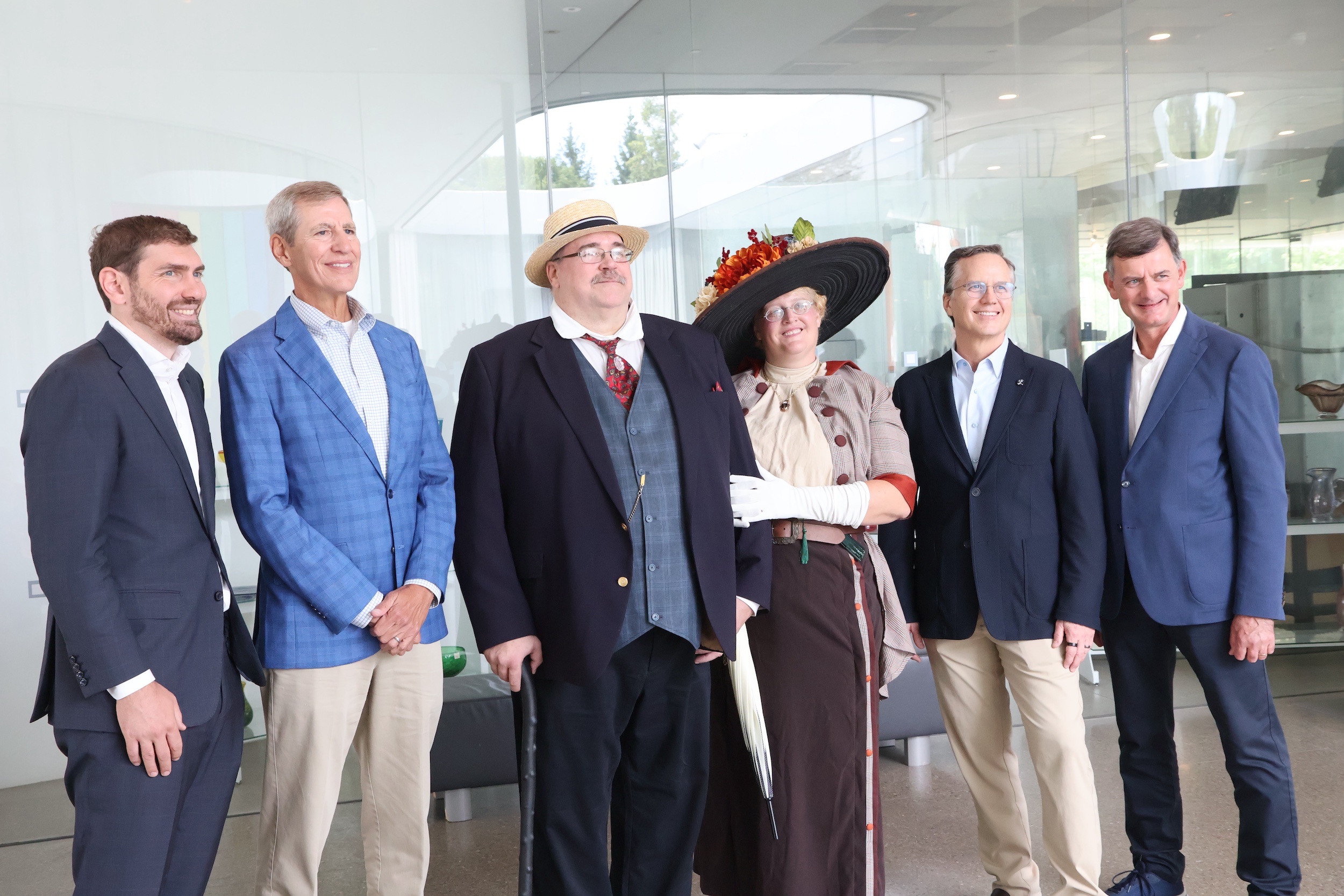
From left, TMA director Adam Levine, past director Don Bacigalupi, Jim WIlliams, dressed as Edward Drummond Libbey, and Jennifer Rounds, dressed as Florence Scott Libbey, Libbey Inc. CEO and TMA board president Mike Bauer and former TMA director Brian Kennedy pose for a photo July 11 in the Glass Pavilion. (TFP photo by Laurie Bertke)
After the museum hosted an exhibit of Aboriginal Australian art in 2013, Kennedy said people began asking why the museum did not have any Native American art in its collection. This led to the museum making a concerted effort to expand its collection of art made by indigenous peoples, with a particular focus on Native American art.
Kennedy also recalled a moment during the 2016 Jaume Plensa exhibition, Human Landscape, that brought home the significance of the decision to place “Paula,” a giant cast iron head, in front of the museum. He stopped to talk with a man who was walking up the steps with his young daughter, and the man told him, “Thank you for putting a black woman in front of a white museum.” The piece remains on display in the Sculpture Garden today.
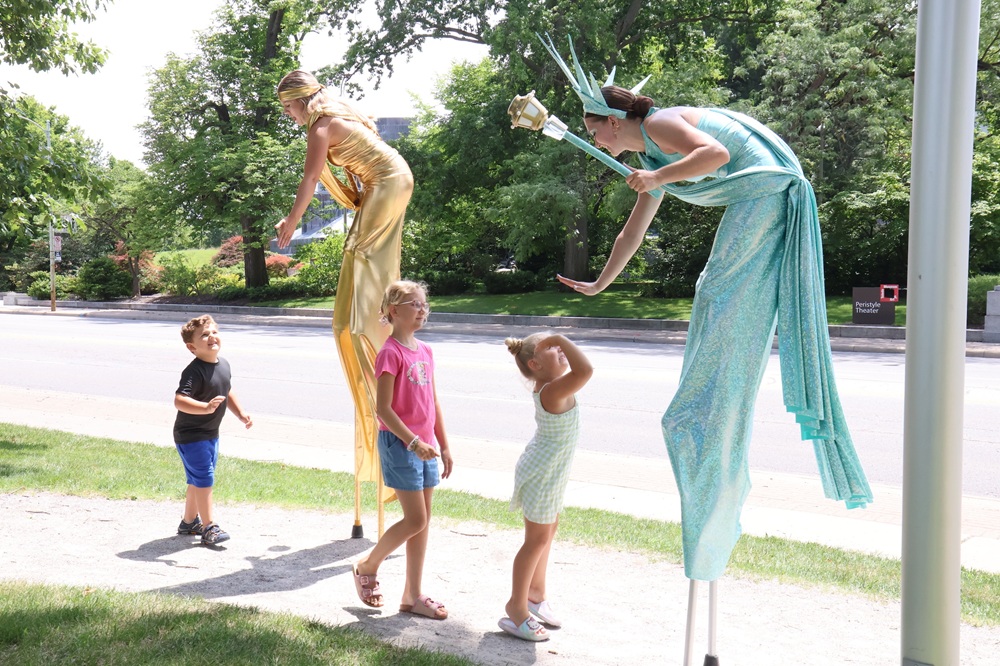
Megan Knight and Faith Yeary of Birds Eye View Circus, dressed as Lady Justice and Lady Liberty, high five young guests July 11 during Ohio’s Homecoming & Picnic at the Toledo Museum of Art.(TFP photo by Laurie Bertke)
Bringing art to everyone
Toledo Mayor Wade Kapszukiewicz was on hand at the panel with this year’s Kid Mayor, 10-year-old Jamie Howard of Ella P. Stewart Academy, to present a proclamation in honor of the museum’s 125th anniversary. He acknowledged that TMA has been named the best museum in the country for the past two years.
The mayor also noted that admission to the Toledo Museum of Art has been free since 1901, making it a place that “everyone can enjoy, regardless of their background or their means.”
“Anything that can bring art to the people, to everyone, is special,” said Kapszukiewicz. “Toledo Museum of Art, truly, is among the best museums in the entire country, and I might even say in the entire world.”
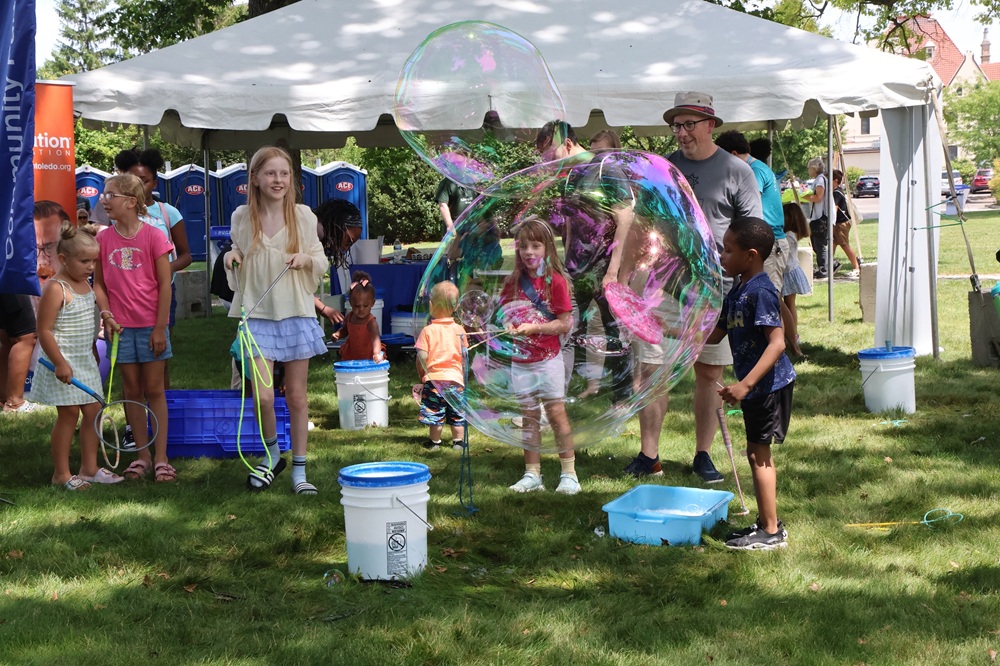
Families blow giant bubbles on the Toledo Museum of Art Glass Pavilion lawn during Ohio’s Homecoming & Picnic on July 11. (TFP photo by Laurie Bertke)
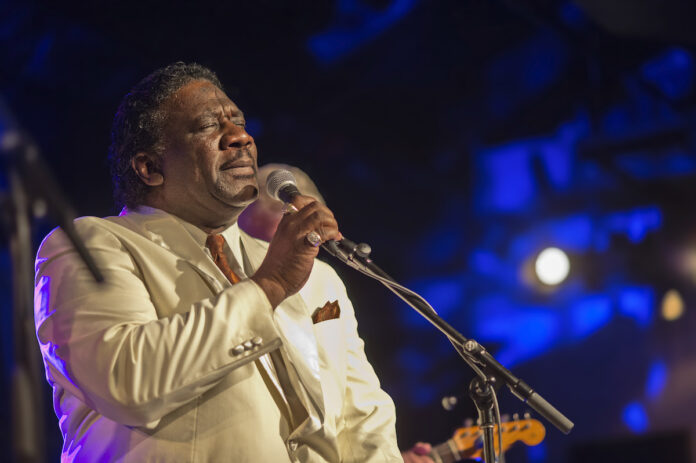
Mud Morganfield, the eldest son of Chicago blues legend Muddy Waters, will take the stage on Saturday, July 25 at the Anthony Wayne Area Rotary Club's Blue, Brews and Brats in downtown Waterville. (Courtesy photo by Roman Sobus)
WATERVILLE – When Mud Morganfield was a young child living in a South Side Chicago apartment building, the eldest son of Muddy Waters often ran into blues musicians, including Little Walter and Chuck Berry, in the hallway.
“I was a little tot,” said Morganfield, who at 74 is in his prime as a blues musician. “I would see those guys in the building, but I didn’t know who they were until I got a little older. I didn’t know the significance of the blues at the time.”
While he calls Chicago home, Morganfield has traveled all over the country, and internationally, since launching his professional career in 2008. On Saturday, July 25, he’ll headline the 11th annual Blues, Brews and Brats in downtown Waterville.
Last week, Morganfield chatted with John Henry, whose decades-long love of the blues has brought musicians to town for concerts and recordings with his Third Street Cigar Records. The Third Street Cigar lounge features dozens of photos of blues musicians throughout the decades, including one of Muddy Waters performing with Junior Wells and Buddy Guy at the Toledo Sports Arena in 1972 – a photo Morganfield plans to check out during his visit.
“It’s such a rich history; I’m sure you saw all of those Chicago Chess guys,” Henry told Morganfield, referring to Chess Records, which was founded in 1950 in the Windy City, and recorded Waters, Howlin’ Wolf, John Lee Hooker and Big Bill Broonzy, to name a few.
The influence of blues on music – including rock, R&B, funk, soul and jazz – is indisputable. The Rolling Stones named themselves after Muddy Waters’ song “Rollin’ Stone,” released by Chess Records in 1950.
For Morganfield, his father’s DNA and encouragement pulled him into the blues at an early age. At night, he would tap a rhythm on his head in order to fall asleep. As he got older, Muddy would give him any instrument he wanted. As he got older, Morganfield launched several bands with friends.
“The only thing is, these guys wanted me to buy all the wine,” he laughed. “I would buy it. I just wanted to play.”
As he sang in multiple bands and performed other musicians’ songs, Morganfield was trying to find his own unique voice, but he always ended up sounding like his father.
“I have to get in where I fit in. I have to do what God put me here to do,” he said, adding that he’s thankful for the gift he got from his famous father.
While he continued to play, Morganfield got a degree from Malcolm X College and studied at DeVry University, then spent years working as a semi driver.
“They called me the singing trucker,” he said.
But his professional career didn’t take off until 2008, when blues legend Mary Lane took him to a professional gig. He followed that with his first self-produced album, Fall Waters Fall. In 2012, Morganfield signed with Severn Records and released the acclaimed Son of the Seventh Son. For Pops – A Tribute to Muddy Waters, came out in 2014, and featured several musicians. Severn also released They Call Me Mud in 2018 – the same year that Delmark Records released Portrait. His most recent release is Deep Mud, in 2025.
While Morganfield has received many accolades over the years, he remains humble.
“I learned never to really brag. I’m a God-fearing man. If you’re arrogant, as fast as God can give it, he can take it. I’ve stayed grounded with that,” he said.
Morganfield credits his late mother, Mildred – who passed away at age 92 last year – for being his biggest supporter throughout his career. His father passed in 1983. While he looks and sounds like Muddy Waters, Morganfield is quite different than his father and some of the other Chicago blues musicians of his time.
“They come up from the cotton fields of Mississippi. I come up in Chicago,” he said.
When Morganfield takes the stage on Saturday night, expect a Chicago blues experience that will draw on his own background – plus a few songs to honor his dad. Joining him on stage will be Studebaker John, an internationally-known artist and bandleader who has produced and arranged albums over the years. Studebaker plays guitar and harp at the same time. Also in the band is guitarist Rick Kreher, who played in Muddy Waters’ final band. Chris Alexander will be on drums and Morganfield Mud will sing and play the bass guitar in a show that Henry knows will wow the crowds.
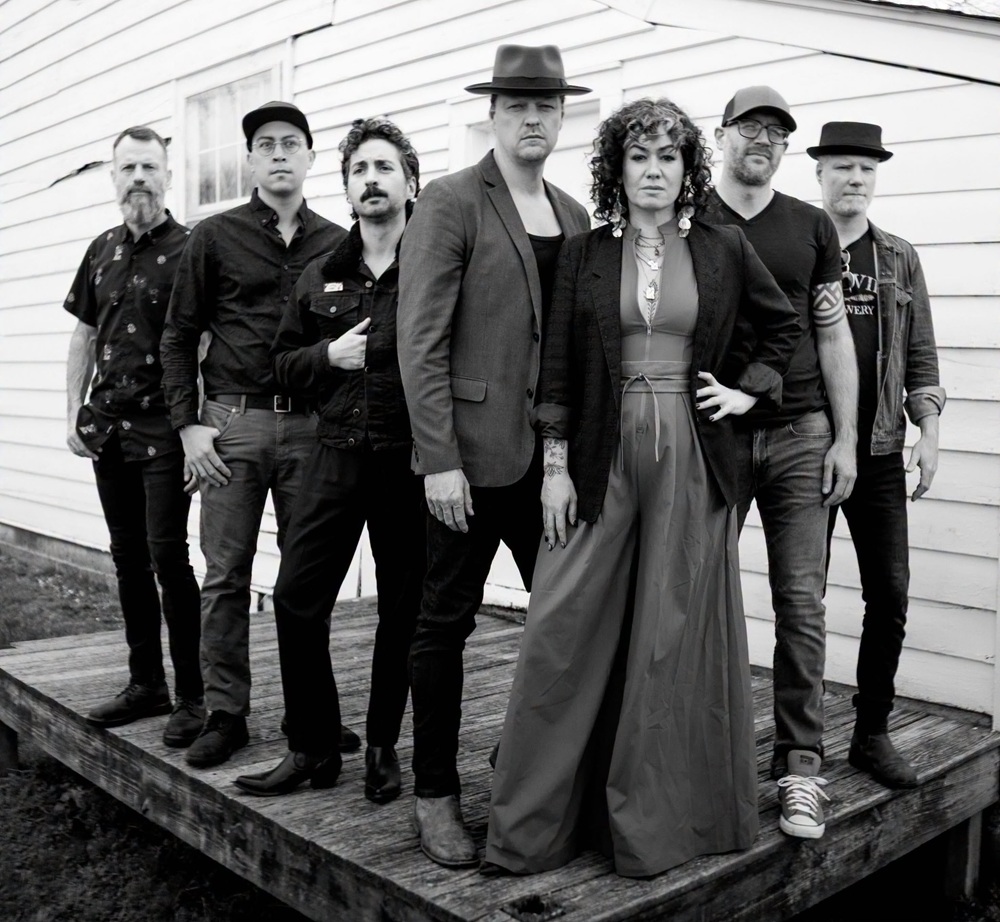
Toronto-based seven-piece band Bywater Call will take the stage during the 11th annual Blues, Brews and Brats in downtown Waterville. (Courtesy photo)
Also on the lineup is Toronto-based Bywater Call, a powerhouse seven-piece Southern soul, roots rock band comprised of Meghan Parnell, vocals; Dave Barnes, guitar; Bruce McCarthy, drums; Mike Meusel, bass; John Kervin, keys; Stephen Dyte, trumpet; and Julian Naili, tenor sax.
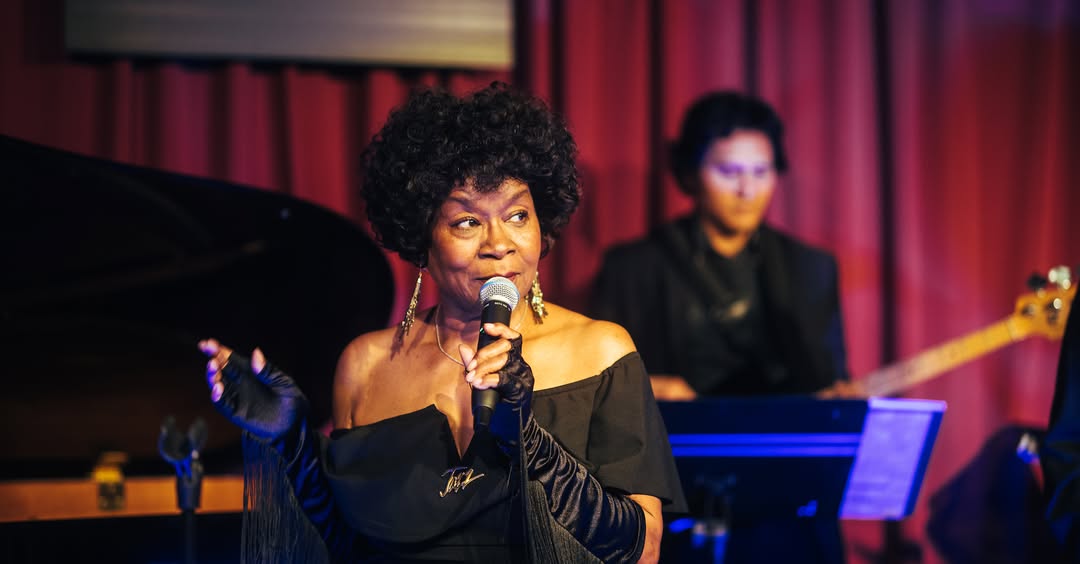
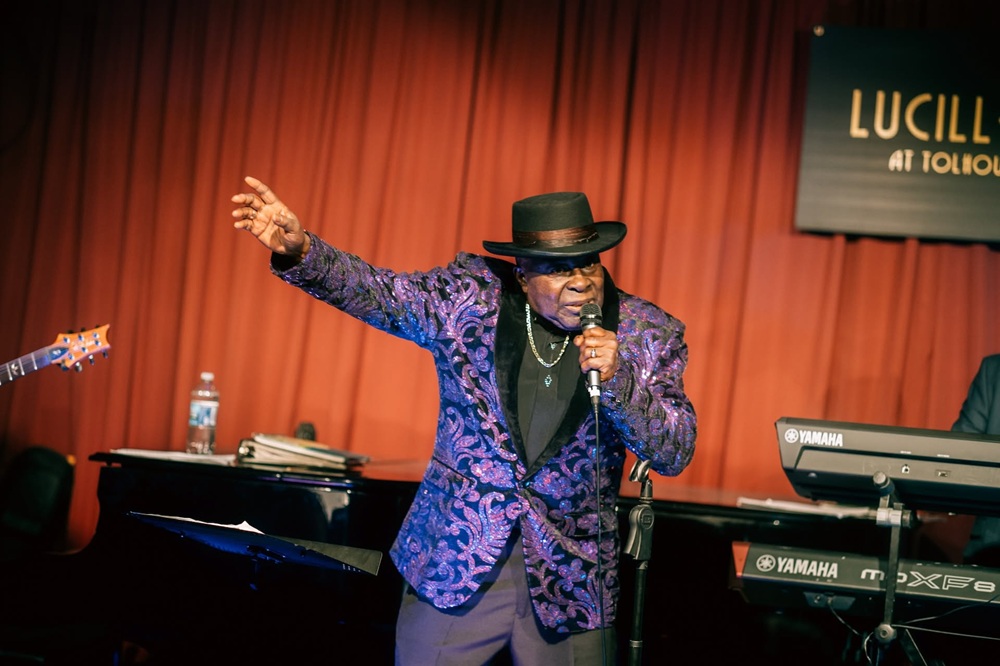
Fans will also enjoy a Toledo Rhythm and Blues All Star show featuring The Good, The Bad and The Blues, Bobby G, Stormy Monday and Ramona Collins.
Local blues singer Ramona Collins is part of a Toledo Rhythm and Blues All Star lineup slated for the Saturday, July 25 Blues, Brews and Brats in downtown Waterville. (Courtesy photo)
This is the 11th year for the BBB, which is the prime fundraiser for the Anthony Wayne Area Rotary Club (AWARC). But Henry has been bringing blues musicians to town since the 1980s, when he was a University of Toledo freshman hosting a blues show for the college radio station. In the years that followed, Henry and fellow Anthony Wayne High School Class of 1982 graduate Paul Croy hosted blues musicians for a backyard charity event before they decided to join forces with Rotary in 2015.
Bobby G is one of several Toledo-based blues musicians set to perform on Saturday, July 25 at the Blues, Brews and Brats. (Courtesy photo)
Finding blues artists to perform for the event is a passion for Henry, who has hosted legends including Big Jack Reynolds, Johnny Rawls, Bobby G, Chris Shutters and The Good, The Bad and the Blues in Third Street Cigar over the years. Rawls was recently in town for a week, and has recorded albums with Third Street Cigar Records and Waterville’s Bigfoot Studios.
While Waterville’s blues connection might go unnoticed by many in the community, it will be on full display Saturday night. Bringing the brews to the BBB are Buffalo Rock Brewing Company of Waterville. Also, Adventure Spirits Distilling of Whitehouse will be mixing up three drinks for the BBB: a Barrel Aged Old Fashioned, a Honey Lemon Drop and an Espresso Martini, all $8 each.
Glenn’s Brats will be serving up the brats, while guests can also enjoy Tano’s Pizza, Toledo Chuckwagon and Detroit Donuts – which is also bringing a snow-cone station.
This year will be a little cozier, with the festival taking up South Third Street just beyond Mad Anthony’s, so customers can still access the popular bar without paying admission to the BBB, said AWARC member Deb Cheney.
“Our footprint is a little smaller. We’ll all be closer, but it will have a better vibe,” she said.
Also expect enhanced security to ensure safety, with extra patrols in the area.
“We’re hoping for about 1,500 people,” Cheney said. “With a great lineup, great beer and cocktails, we think we’ll have a better draw.”
Cheney noted that additional sponsors this year have enabled the BBB to raise more for their biggest fundraiser of the year. That all goes back into the community, to support youth groups and local nonprofits, including scholarships for Anthony Wayne and Otsego high school graduates; Anthony Wayne High School’s Interact and STRIVE clubs, Anthony Wayne Youth Foundation, Anthony Wayne Neighborhood Bridges, Let’s Build Beds, Scouts, Nature’s Nursery and YMCA youth programs.
Gates open at 5:30 p.m. and music begins at 6 p.m. Bring a lawn chair, a thirst and some dancing shoes. For information, visit anthonywaynearearotary.org.
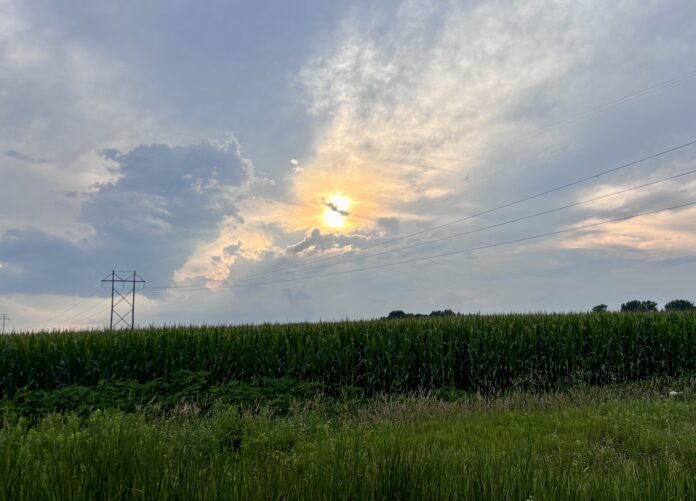
With abundant land and access to electric and gas lines, Waterville Township is being eyed for a potential data center. On July 20, the Zoning Commission reviewed proposed zoning text amendments to govern data centers and other large developments. (AWFP photo by Karen Gerhardinger)
WATERVILLE TOWNSHIP – The 34-person capacity Waterville Township hall was packed on July 20, with residents eager to listen and weigh in on a proposed zoning text amendment that would set the rules for data centers and other campus style developments.
While the Zoning Commission – including Chair Keith Moosman and members Bill Burkett, Bob Long, Jon Poponak and Cathy Vorst – didn’t make any decisions or even set a public hearing on the proposed changes, the meeting did provide an opportunity to discuss the process and questions about annexation and conflict of interest.
After five months of intense work, the Data Center Advisory Committee and Trustee Toby Miller announced the proposed changes in May. These include the addition of an M-3 zoning classification and changes to the current M-1 and M-2 language. Over the past two months, the document has been posted online, discussed in public forms and reviewed by the Lucas County Planning Commission (LCPC), which made “no recommendation” and punted the matter back to the township. The goal is to get the changes put into place before the one-year data center moratorium expires at the end of the year, Miller said.
The new language would replace the current zoning, which permits data centers in agriculturally-zoned areas with a conditional use permit (CUP) approved by a five-person, appointed Board of Zoning Appeals (BZA). The CUP process is administrative and not subject to referendum, while a zoning change is considered legislative and therefore open for citizens to file a referendum to let voters decide.
Assistant County Prosecutor John Borell has cautioned trustees that this new language is setting a new legal precedent that might not hold up in court. Miller shared the eight specific concerns from Borell, plus the answers from the township’s Columbus-based legal team of Brossius, Johnson and Griggs assuring that the language is legally sound and defensible.
Former trustee Karen Schneider said she trusts Borell’s judgment, and believes that the township wouldn’t have the financial means to support itself if a data center developer decided to sue on even one aspect of the regulations outlined in the new language.
“I appreciate the boldness of what you all are doing, but I think complexity here equals defeat, because we don’t have the legal finances or the wherewithal to fight that,” she said.
Instead, she suggested the township follow Borell’s advice to put all of the details in the 67-page document into the zoning book as conditions required to get a permit in an M-2 district. She also cautioned that adding an M-3 to the zoning resolution would open the township up to projects that, a few years ago, never would even be considered as compatible uses in the community.
“Heavy industrial and the way we live now – they don’t even fit into the same sentence,” Schneider said.
Burkett also agreed with the idea of adding many of the conditions into the zoning resolution, which has been updated many times as the township has changed. He disagreed with Miller’s assertion that nothing is on the books to provide guidelines for such a large project.
“We’re not all chicken farmers here looking at backwards regulations. I understand you did a lot of work on it, but for over the past 10 to 15 years we’ve been working on those regulations. The best thing we could do to respond at the time was to look at conditional uses – that gave us the power to address some of those issues,” he said.
The township’s legal team is considering all legally-viable ideas shared by residents and committee members. Lyn Cox asked for an update on her requests for a 1,000-foot setback from schools, churches and residences; to prevent cryptocurrency or data mining projects; and to ban discharging of wastewater into area streams and fields.
A crytocurrency or data mining operation wouldn’t be approved because the noise levels wouldn’t meet the standards included in the M-3 language, Miller said. The setbacks are being considered by the legal team, although Miller noted that they need to be cautious on adding requirements that might be deemed as punitive.
“If they are punitive, they will sue. And if they sue, the entire zoning resolution will be thrown out. It is threading a needle,” Miller said.
Requiring a data center to discharge into a sanitary sewer line would be problematic, as there are no sanitary sewers anywhere in the township, Miller said. And wastewater discharge is governed by the EPA – which Cox pointed out is “loosening their requirements.”
If a data center is required to hook up to sanitary sewer, their primary option would be to ask Waterville or Whitehouse for services, and this would prompt those municipalities to ask the developer to annex. Then all of the regulations the township has put into place wouldn’t be applicable.
The township is currently working on strengthening its annexation agreements with the city and the village, but Miller said some areas are already considered open to annexation, such as the area west of the Port Authority land on Neapolis Waterville Road.
The Zoning Commission members agreed to wait until the Columbus law firm provides updates on all the questions before setting a date for a public hearing in early August. During that hearing, commission members will take input from residents, and then vote on whether they recommend passage. The trustees will then hold their own public hearing and make a final decision on whether to adopt the zoning text amendments.
For now, only Miller and Trustee Julie Theroux are set to vote, as Trustee Kyle Hertzfeld has recused himself because a distant relative with the same last name could stand to benefit from a data center development.
“There is no reason for him to recuse himself. He doesn’t own land [that could be sold to a developer for a data center] or adjoining properties. He has no financial interest. His last name just happens to be Hertzfeld,” Miller said.
BZA member Jill Lipinski questioned whether Zoning Commission member Bill Burkett should be allowed to vote, as he is an employee of Regional Growth Partnership, which she said is working with the county to bring data centers to the community.
“There’s no conflict of interest for me to serve on this board just because of what job I have. If there is an application that is submitted and somebody believes there is a conflict because my employer has a reason to benefit from that, then there might be a conflict of interest. But strictly because of who I work for is not a conflict of interest,” Burkett said, asking Lipinski to contact the Ohio Ethics Commission for clarification.
Miller said he contacted the OEC and the county already, to determine if any member of the Zoning Commission, BZA or board of trustees has a conflict. They found none, he said, including Burkett or Hertzfeld.
Resident Bryan Imes suggested the people in the audience contact Hertzfeld too, and Miller agreed that a show of support might be helpful.
“We voted him in this position to represent us,” Imes said. “For him to recuse himself…doesn’t help the cause. He could go on the record and say he’s against it [data centers].”
Miller pointed out that Hertzfeld sent a written statement opposing data centers, and that was read aloud during the July 10 meeting. He agreed that it hurts the township to not have all three trustees weighing in.
The Zoning Commission did not set its public hearing, but will need to provide a 10-day notice to residents prior to that date. The trustees meet on July 22 at 6:30 p.m., and cannot set a public hearing on the matter until the Zoning Commission holds a public hearing and votes on a recommendation.
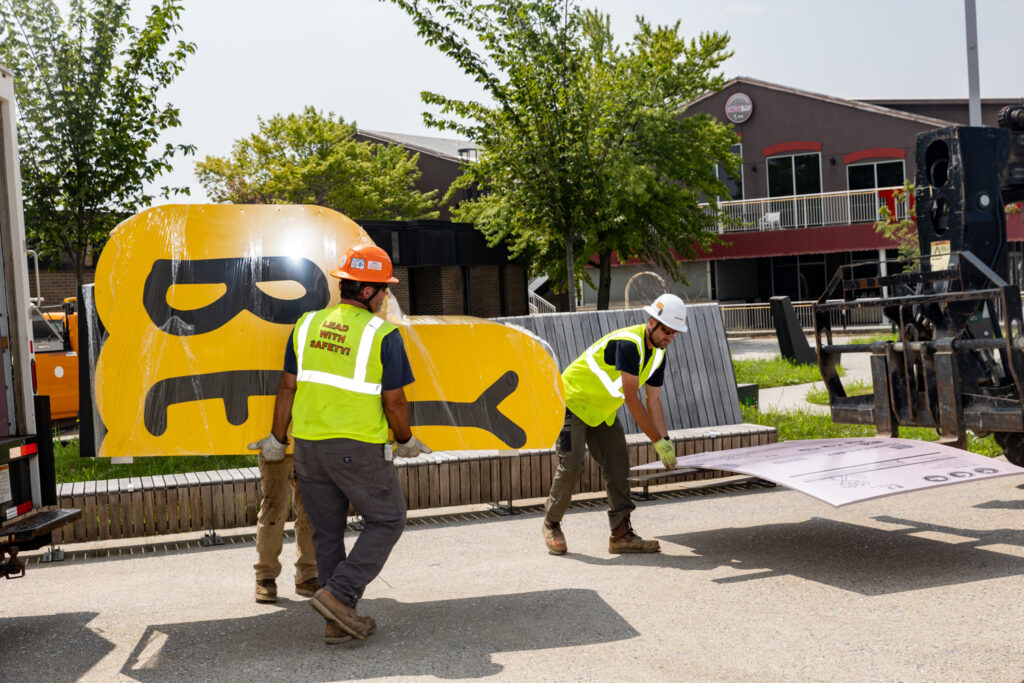
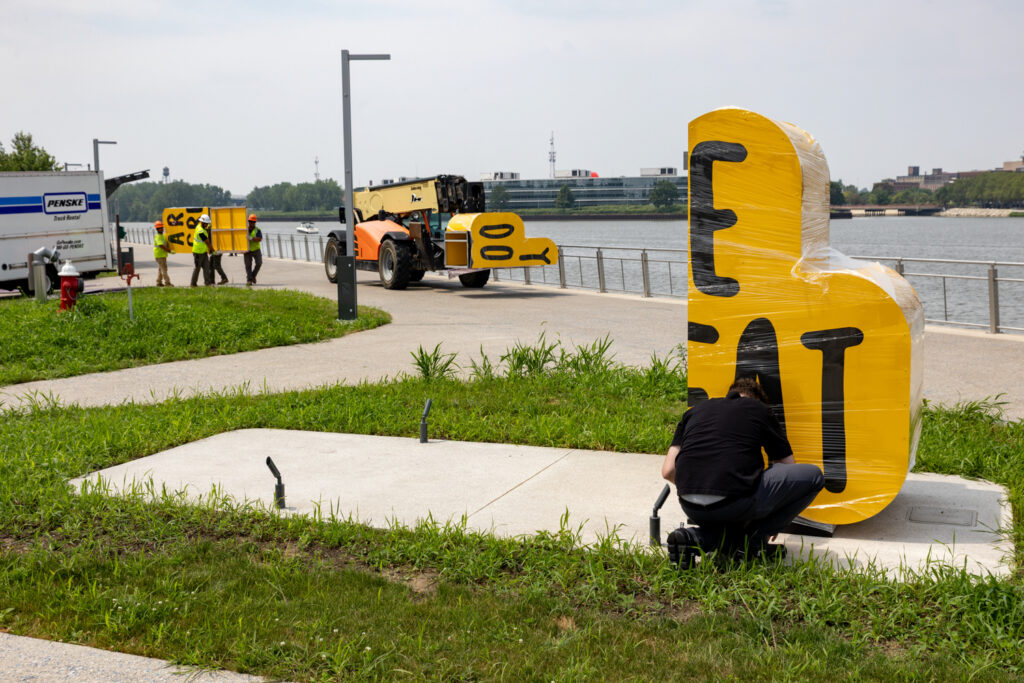
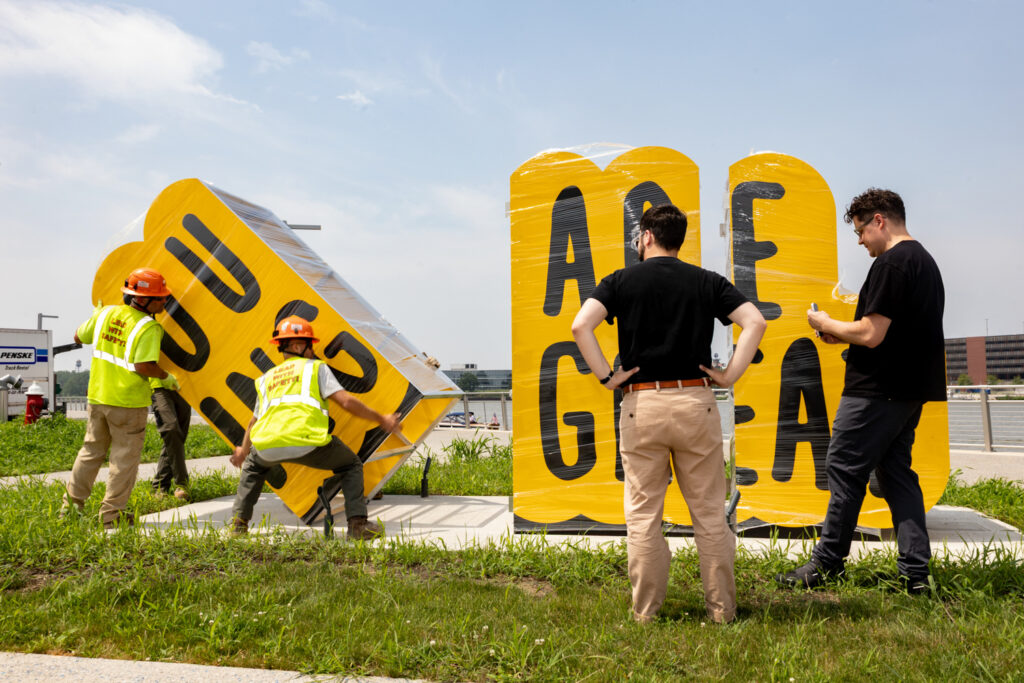
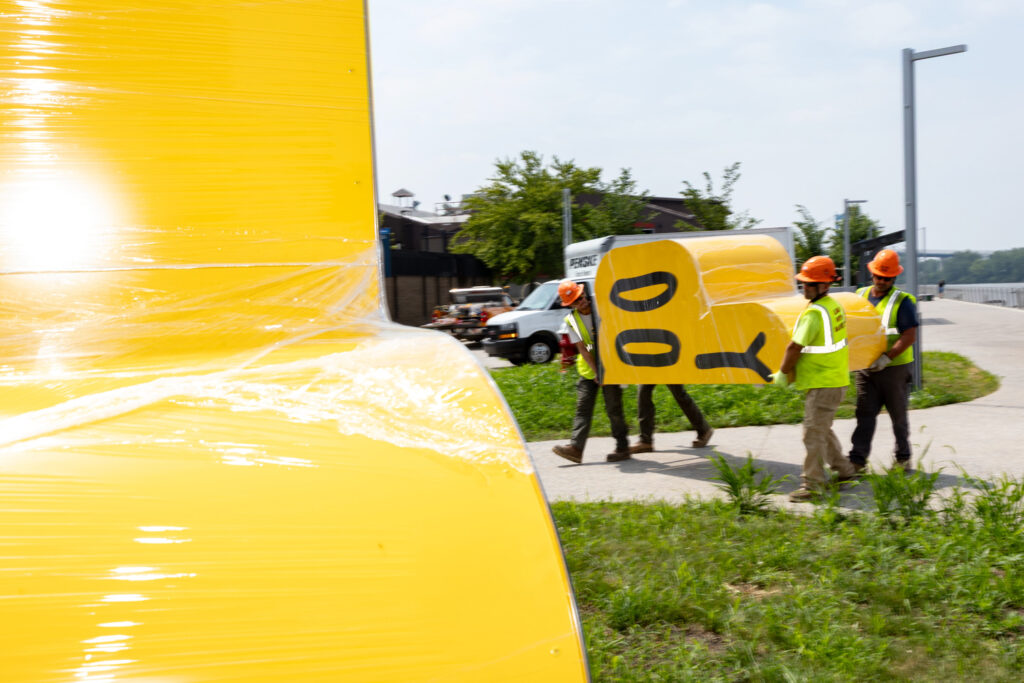
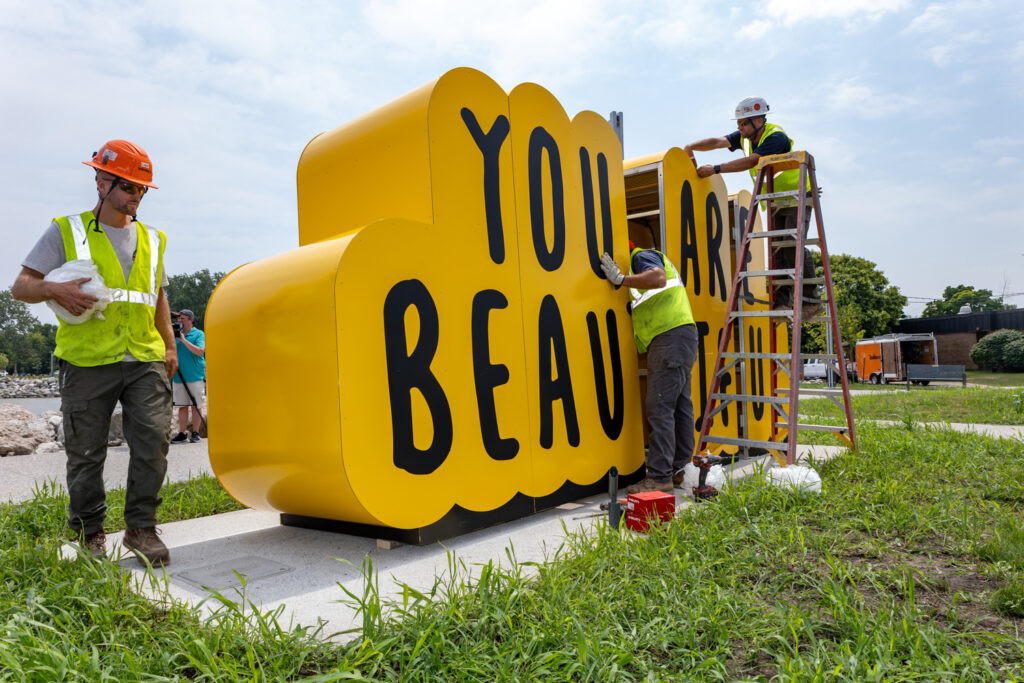
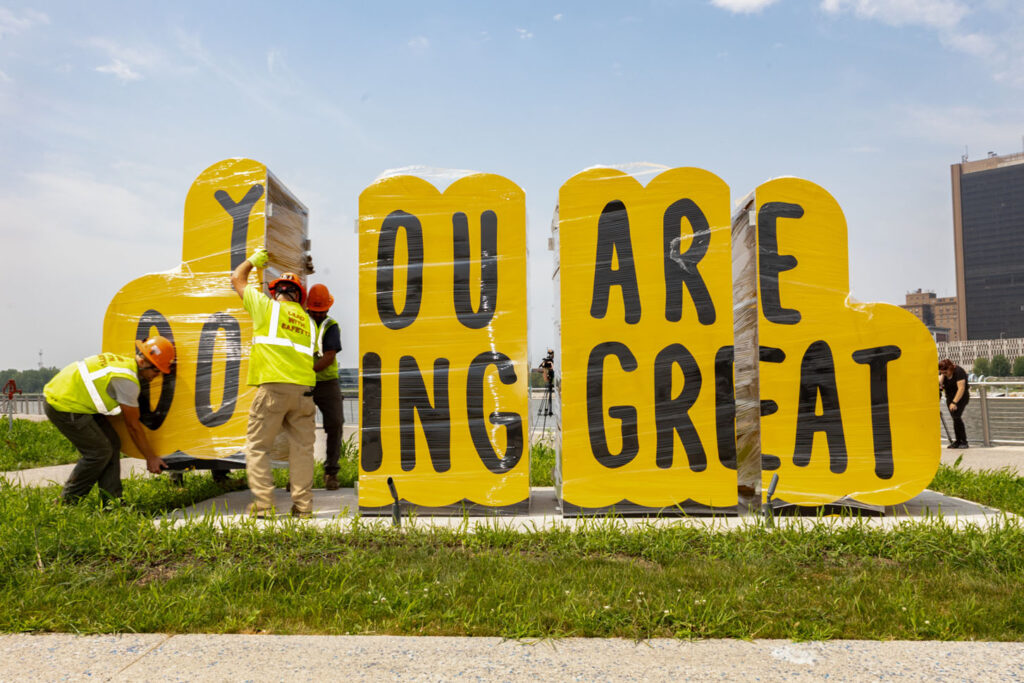
Workers carry the last part of the “You Are Doing Great/You Are Beautiful” installation at the International Cove part of the Riverwalk in Toledo, Ohio on Monday July 20, 2026. TFP Photo/STEPHEN ZENNER
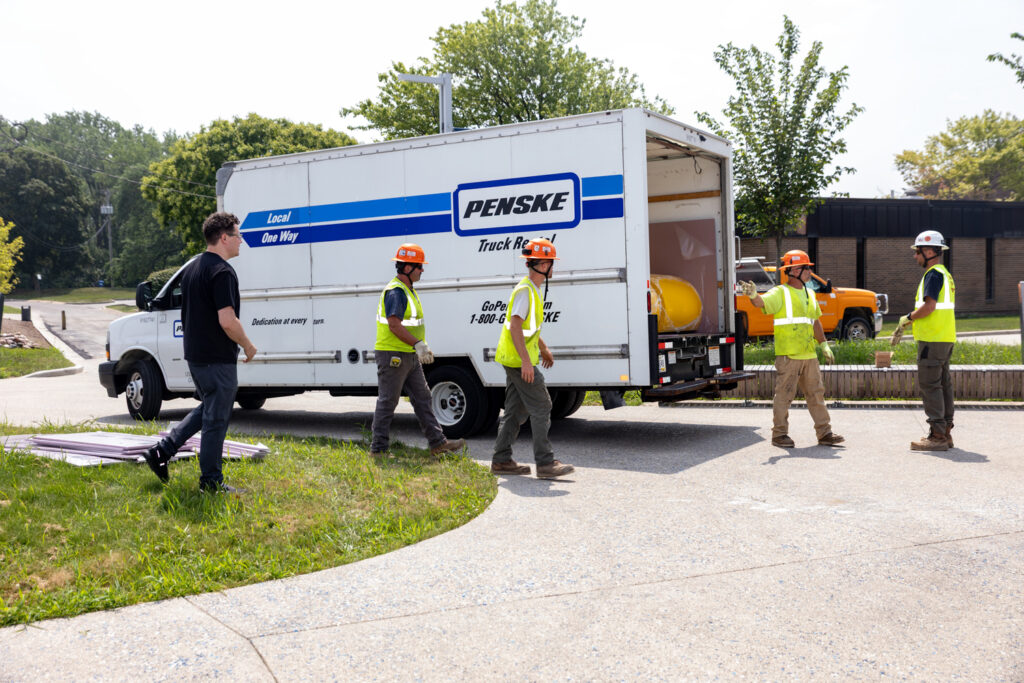
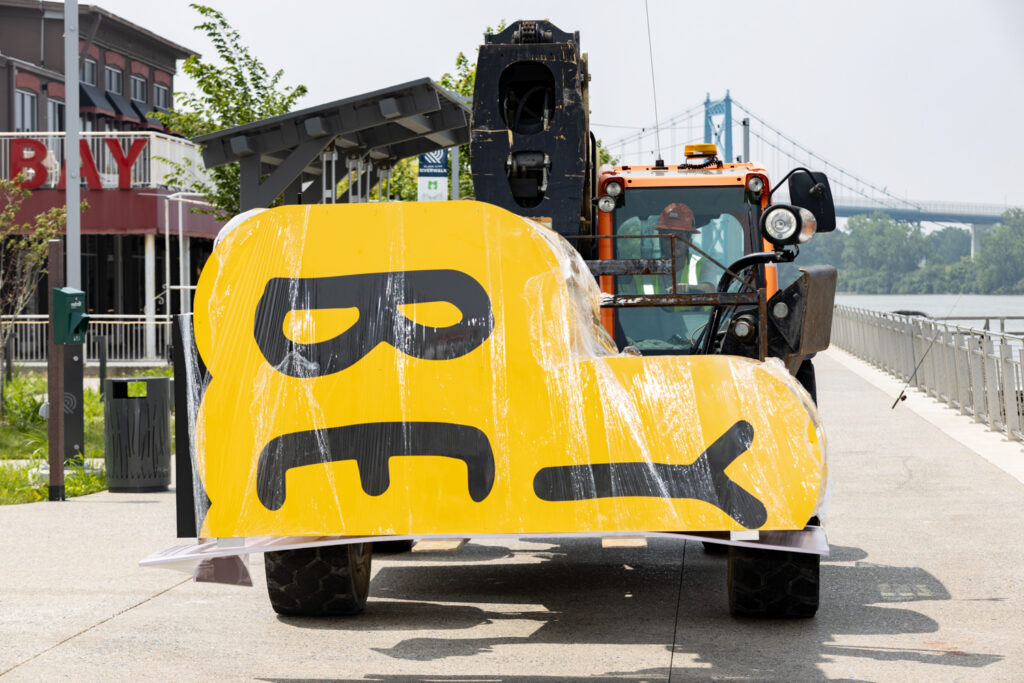
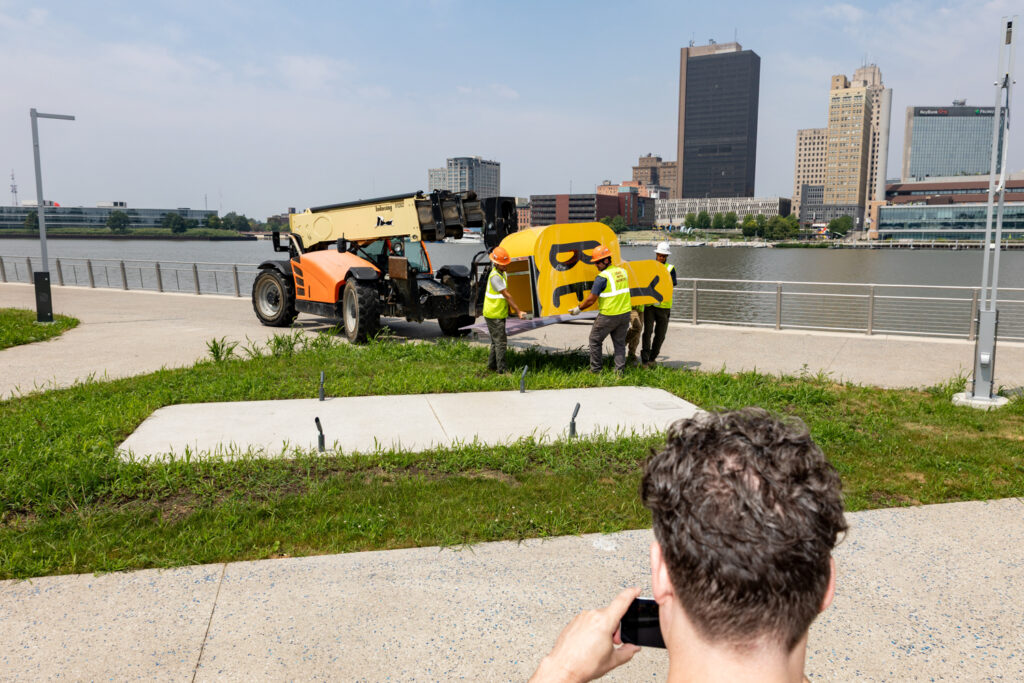
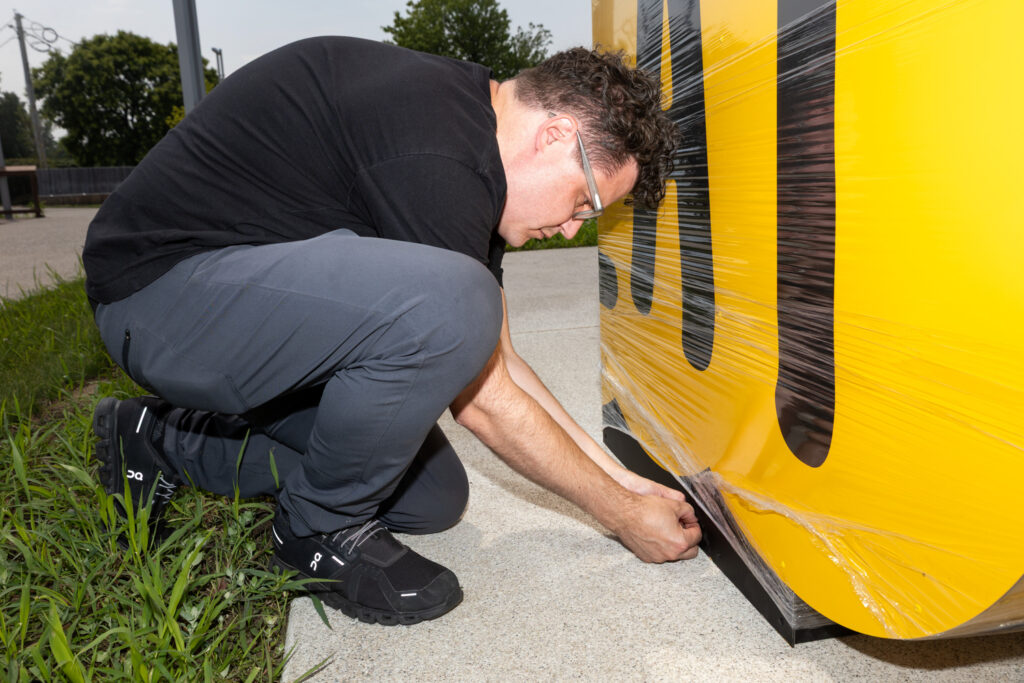
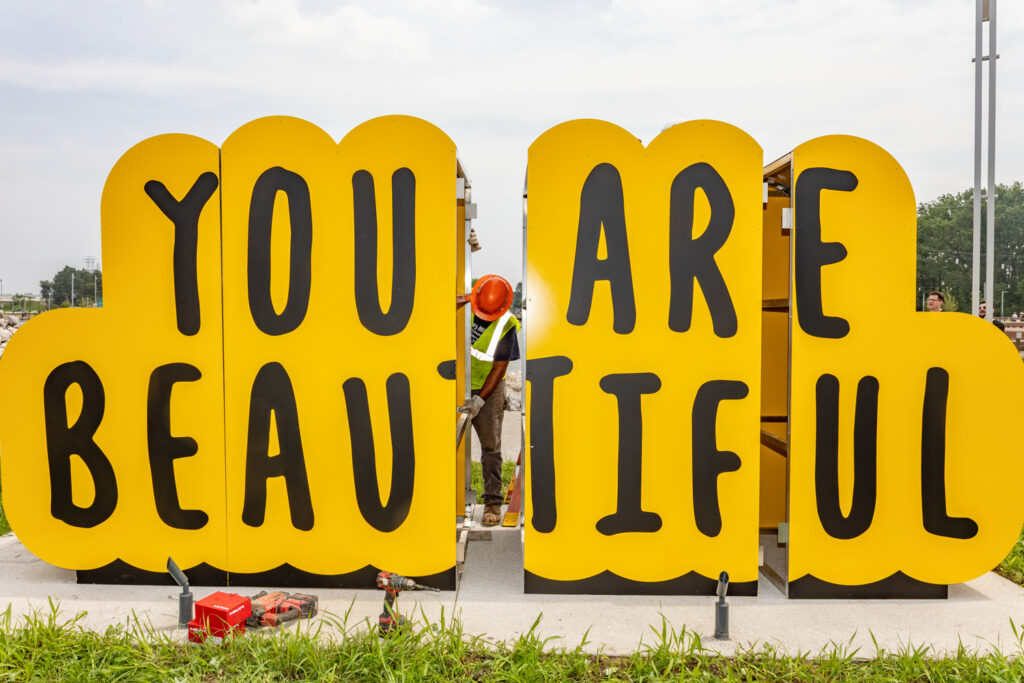
Black letters with a bright yellow border reading “You Are Doing Great” on one side, and on the other side “You Are Beautiful” were reinstalled at International Cove Monday early afternoon. Matthew Hoffman, the artist who created the work, was on hand to ensure the integrity of his vision, along with members of the Arts Commission of Greater Toledo, while workers from Kokosing did the heavy lifting.
Initially the work was a temporary public art installation for The Arts Commission’s Momentum Festival in 2019, but then was moved to the east side in-between restaurants and International Cove. During Metroparks Toledo’s renovation of their multi-step Riverwalk project, the artwork was removed, and now is permanently reinstalled on July 20, 2026.
Hoffman said it was exciting to see the artwork re-installed, and that he is always trying to put positive messages out into the world.
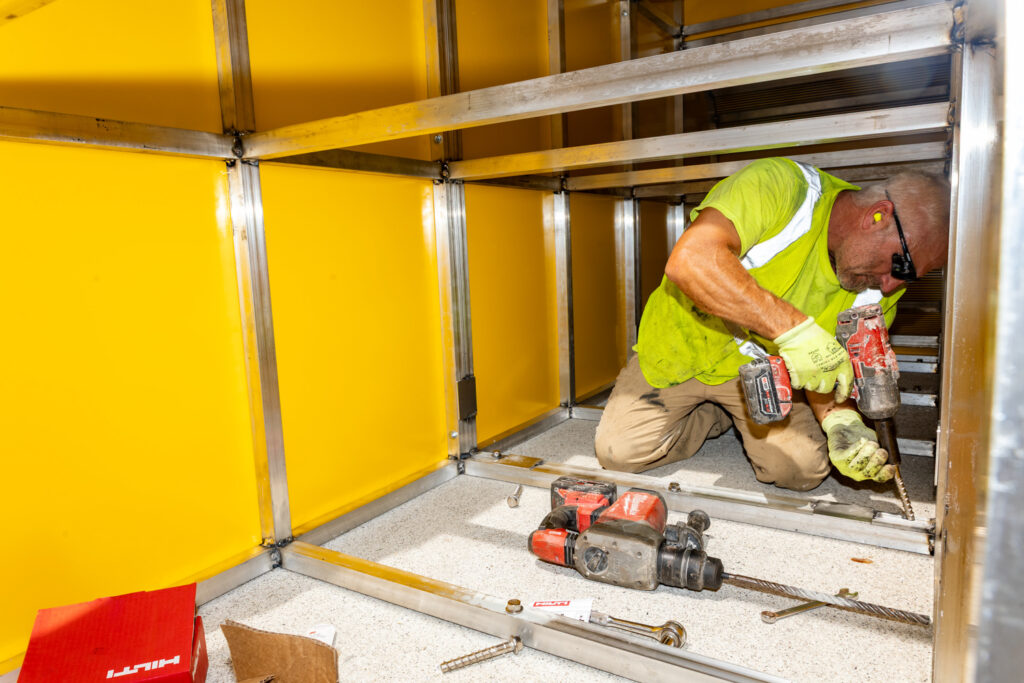
Matthew Hoffman, the artist of the “You Are Beautiful/You Are Doing Great” installation, walks towards the truck with the art piece, while installation workers from Kokosing, Rob Ingersoll, a foreman, Caleb Gleckler, a laborer, Craig Mesenburg, a foreman and Joe Zika, a superintendent, begin to unload the sign in pieces at the International Cove part of the Riverwalk in Toledo, Ohio on Monday July 20, 2026. TFP Photo/STEPHEN ZENNERRob Ingersoll, a foreman with Kokosing, Craig Mesenburg (behind the work), a foreman with Kokosing, and Joe Zika, a superintendent with Kokosing, move a piece of the “You Are Beautiful” installation onto heavy machinery to move into place at the International Cove part of the Riverwalk in Toledo, Ohio on Monday July 20, 2026. TFP Photo/STEPHEN ZENNERHeavy machinery moves the first part of the “You Are Beautiful” installation at the International Cove part of the Riverwalk in Toledo, Ohio on Monday July 20, 2026. TFP Photo/STEPHEN ZENNERMatthew Hoffman, the artist of the “You Are Beautiful/You Are Doing Great” installation takes pictures of workers moving the piece into its location at the International Cove part of the Riverwalk in Toledo, Ohio on Monday July 20, 2026. Initially the work was a temporary public art installation for The Arts Commission’s Momentum Festival in 2019. TFP Photo/STEPHEN ZENNERMatthew Hoffman, the artist of the “You Are Beautiful/You Are Doing Great” artwork fills in details at the base of the piece after it is placed in its location at the International Cove part of the Riverwalk in Toledo, Ohio on Monday July 20, 2026. Initially the work was a temporary public art installation for The Arts Commission’s Momentum Festival in 2019. TFP Photo/STEPHEN ZENNERMatthew Hoffman, the artist of the “You Are Beautiful/You Are Doing Great” artwork fills in details at the base of the piece after it is placed in its location, while workers bring on additional pieces of the artwork at the International Cove part of the Riverwalk in Toledo, Ohio on Monday July 20, 2026. Initially the work was a temporary public art installation for The Arts Commission’s Momentum Festival in 2019. TFP Photo/STEPHEN ZENNERKokosing workers place pieces of the “You Are Doing Great/You Are Beautiful” artwork installation with Ben Cook of the Arts Commission and Matthew Hoffman, the artist, watching at the International Cove part of the Riverwalk in Toledo, Ohio on Monday July 20, 2026. TFP Photo/STEPHEN ZENNERWorkers carry the last part of the “You Are Doing Great/You Are Beautiful” installation at the International Cove part of the Riverwalk in Toledo, Ohio on Monday July 20, 2026. TFP Photo/STEPHEN ZENNERWorkers secure the individual parts of the “You Are Doing Great/You Are Beautiful” installation at the International Cove part of the Riverwalk in Toledo, Ohio on Monday July 20, 2026. Initially the artwork was a temporary public art installation for The Arts Commission’s Momentum Festival in 2019. TFP Photo/STEPHEN ZENNERWorkers secure the individual parts of the “You Are Doing Great/You Are Beautiful” installation at the International Cove part of the Riverwalk in Toledo, Ohio on Monday July 20, 2026. Initially the artwork was a temporary public art installation for The Arts Commission’s Momentum Festival in 2019. TFP Photo/STEPHEN ZENNERCraig Mesenburg, a foreman with Kokosing, drills into the concrete to secure the art installation of the “You Are Doing Great/You Are Beautiful” sign at the International Cove part of the Riverwalk in Toledo, Ohio on Monday July 20, 2026. Initially the artwork was a temporary public art installation for The Arts Commission’s Momentum Festival in 2019. TFP Photo/STEPHEN ZENNERWorkers carry the last part of the “You Are Doing Great/You Are Beautiful” installation at the International Cove part of the Riverwalk in Toledo, Ohio on Monday July 20, 2026. TFP Photo/STEPHEN ZENNER