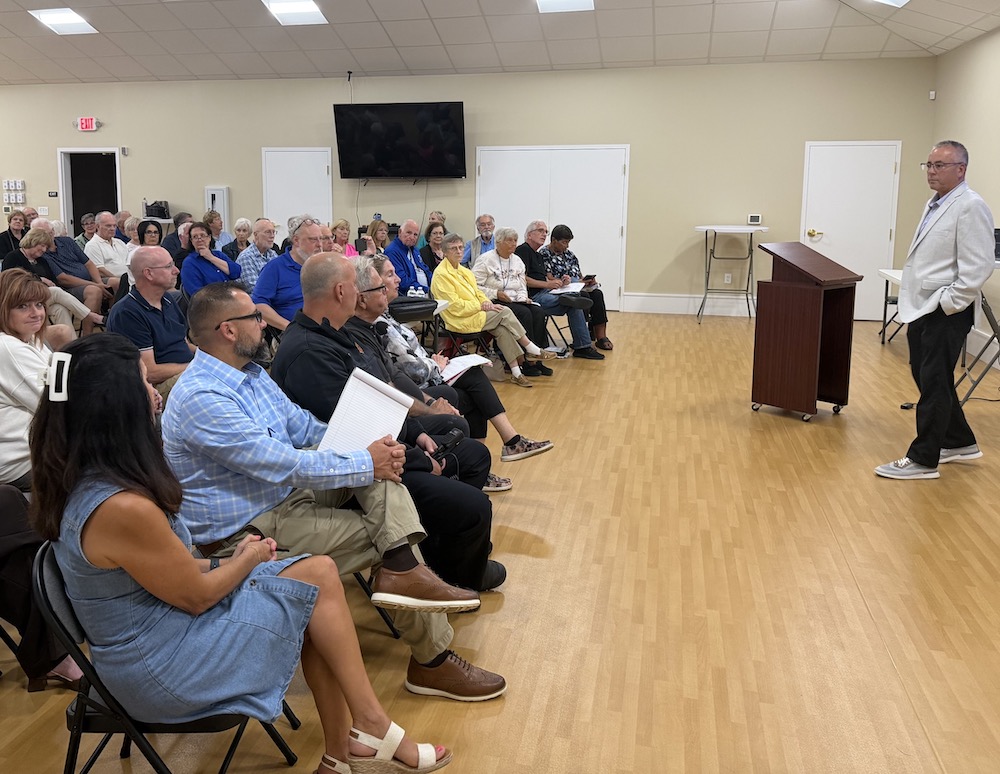
MONCLOVA TOWNSHIP – Loud music, overgrown yards, and junk vehicles on the street are among the issues that lead residents to seek help from Monclova Township staff. But enforcing resolutions and ordinances about noise, weeds, vehicles and other nuisances can be a challenge, Township Administrator Michael Hampton told Waterside community residents during a Sept. 16 presentation.
“Our resolution doesn’t have enough teeth,” Hampton said. “We’re on the front lines taking those complaints…and we want to be able to help them.”
Waterside residents Ann Frahn and Risa Sindel often attend the township’s board of trustees meetings, and heard that the Nov. 3 ballot will contain a question asking Monclova Township residents whether they want to adopt a Limited Home Rule (LHR) form of government. So they invited Hampton, who took over as administrator earlier this year, to visit the 1,000-resident community to explain more on how LHR works.
“It’s a big voting bloc. We thought it would be nice to have information presented so people could make a good decision,” Frahn said.
Townships with a population of 2,500 or more can become LHR governments with a majority vote of the population, and those with 15,000 or more can adopt LHR by a vote of the trustees, but Hampton said Monclova’s trustees want to have residents involved in the decision, even though he expects the township to have a population of nearly 20,000 by the next census in 2030.
LHR was created in 1991 in response to concerns by townships about larger municipalities like Cleveland, Cincinnati and Columbus trying to annex. Currently, 34 of Ohio’s 1,308 townships – including Perrysburg Township and Sylvania Township – have adopted the LHR form of government.
“Limited” is a key word, and Hampton explained that it would not allow Monclova Township to: enact a tax; circumvent Ohio Revised Code; prevent citizens from filing a referendum on legislation; change the zoning resolution or appeals process; change hunting, fishing or trapping rules; alter regulations on agriculture or natural resources; or set elected officials’ salaries above what is outlined in Ohio Revised Code.
“Limited Home Rule helps us battle everyday complaints and issues. It gives us the tools to help you and help us,” Hampton said.
One of the main tools is the ability to issue up to $1,000 in civil fines for violating the township’s resolutions, codes and ordinances. Right now, if a neighbor repeatedly calls the township or the Lucas County Sheriff’s Office about loud music, the most the sheriff can do is give a verbal warning or issue a citation for obstructing the peace. Hampton also pointed out some properties with overgrown grass, weeds and junk.
“Right now, we can send them ‘friendly-grams’ or ‘nasty-grams’ and say that they need to clean that stuff up. They just throw it away,” he said of the notices. With LHR, those notices would include information of a fine up to $1,000 and a 14-day timeframe to respond. He believes hitting violators with the threat of a fine will make a difference.
“We don’t want to harm folks. We just want folks, for health and safety reasons, to be good neighbors,” he said.
LHR can also aid in regulating potential impacts from business and industry, including noise, vibrations, soil erosion and water degradation, some of which are concerns shared about data centers – although Hampton was quick to note that he is not aware of any data center looking at the township.
With the opening of the US 20A interchange, one, if not two, gas stations are being eyed for the corners at Briarfield Boulevard. Having the ability to enforce codes prohibiting long-term parking or overnight stays will enable the township to prevent not only exhaust fumes from running semis but the possibility of prostitution, trafficking and drugs that often accompany truck stops, Hampton said.
One of the requirements of being an LHR government is that the township must have its own law director, which it has already. Currently, the law director has to work through the Lucas County Prosecutor’s office, which is very busy, to try to get codes enforced. With LHR, the law director can take issues and evidence straight to the courts. And if a property owner continually racks up civil offenses, that can equate to a criminal offense, he said.
“This allows more effective local response to everyday complaints,” he said.
Sindel, a Waterside resident, presented information about other townships with LHR, including the large Butler Township, which passed resolutions about impacts from commercial and industrial projects – such as light, noise, even overweight vehicles on the roadways.
Sindel, like resident Dave Burkart, admitted that their initial perceptions of LHR were that it was a move toward Big Brother government – referring to the totalitarian super state in George Orwell’s book, 1984.
“What I’m hearing now, the more I research, is that’s not what it is. We need teeth to preserve and protect our township,” Sindel said.
Burkart said the presentation put his mind at ease.
“It’s more about making the township a better place to be and to get it moving forward. I think it’s a good thing,” he said.
If Limited Home Rule passes in November, it would take effect on Jan. 1, 2027 and last for three years, at which point it would be evaluated, Hampton said. The township previously put LHR on the ballot in November 2024 and it failed, due in part to a lack of communication, Hampton believes.
Residents with questions on Limited Home Rule are encouraged to attend the Saturday, Oct. 3 Public Service Open House, 4335 Albon Rd., from 11 a.m. to 2 p.m. In addition to opportunities to visit with trustees, many local organizations and businesses will be on hand, along with food vendors, farm animals and fire truck visits.